mRNA vaccines lead to unwanted proteins – but what does it mean?
New research has experts angered by the “complete and utter regulatory failure” to ensure patient safety
BY MARYANNE DEMASI, PHD | JANUARY 16, 2024
After three years on the market and billions of doses later, the mRNA COVID-19 vaccines continue to throw up surprises.
A landmark study, published last December in Nature, has reignited concerns over the safety of the vaccines.
The study, by highly credentialled UK researchers, found that in addition to spike protein, Pfizer’s mRNA vaccine can instruct cells to produce other ‘off-target’ proteins, which are foreign to the immune system.
How does it happen?
The researchers say that ribosomes, which are responsible for decoding the mRNA in cells, can slip and misread the coded instructions about 8% of the time – known as “ribosomal frameshifting.”
They say the ‘glitch’ has to do with how the mRNA in the vaccine has been genetically modified.
Unlike naturally-occurring mRNA, the mRNA that exists in the vaccines has had a ‘uridine’ base replaced with a ‘N1-methyl pseudouridine’ (to stabilise it) and unfortunately, has made it prone to reading errors.
But are these ‘off-target’ proteins harmful?
At a press briefing, the study researchers insisted there were no safety concerns, and that their findings did not indicate the mRNA vaccines were unsafe.
The BBC characterised the glitch as a “harmless tiny slip” in mRNA gene translation.
Science said there was “nothing alarming” about the study, and interviewed experts who reiterated the absence of adverse events associated with these off-target proteins.
However, David Wiseman, a research scientist involved in medical product development, is not so convinced. He, and his co-authors, published their comments in Nature.
I spoke with Dr Wiseman about his concerns and what this research might mean for patient safety.
DEMASI: Thanks for speaking with me Dr Wiseman. How concerned are you about these latest findings?
WISEMAN: I’m very concerned. This raises more questions about the long-term safety of the mRNA vaccines.
DEMASI: Before we discuss what they found, can you explain the purpose of the study?
WISEMAN: Well, these researchers asked a simple question – are the instructions contained within the mRNA of the vaccines being faithfully carried out. Or put another way, does the body make the spike protein it’s supposed to make, as instructed by the mRNA’s code.
It’s like saying here’s a recipe with instructions on how to make a cake – it’s grandma’s cake recipe. These researchers wanted to know if the mRNA could accurately give instructions on how to make Grandma’s cake or whether it would produce a corrupted version of grandma’s cake.
These researchers obviously knew from the literature that modifying some of the bases in the vaccine’s RNA – as was the case for the mRNA COVID-19 vaccines – that it might cause misreads of different kinds. It’s known as ‘frameshifting.’
DEMASI: And what exactly did they find?
WISEMAN: They found the Pfizer vaccine can cause your cells to make proteins that they are not supposed to make – you end up with what I call “Pfrankenstein proteins.”
DEMASI: Because sometimes there are errors in the way the mRNA is read?
WISEMAN: Yes. Imagine the following three-letter English words ABE DAN TEA TON ERA TWO – the letters are like the code on the mRNA. Now instead of starting to read the sentence at the letter “A” of the first word, you frameshift to the next letter – the letter “B.”
That means that all the other letters are shifted to the left and it will give you a new sentence with three-letter words BED ANT EAT ONE RAT etcetera.
So, the new words have a completely different meaning from the original words. This is what happened in the body of some people vaccinated with Pfizer’s product.
New unwanted “off-target” proteins were produced, that actually led to an “off-target” immune response.
DEMASI: So, were these off-target proteins detected in the blood of people who’d been vaccinated?
No, they did not measure these proteins in the blood of people who’d been vaccinated.
These researchers did something similar to what I did with the six English words – they “predicted” what some of these off-target proteins would look like, had there been a problem with frameshifting.
They made these frameshift proteins in the lab – about 30 or 40 of them – pooled them together in a test tube and then exposed them to blood lymphocytes (white blood cells that mount the immune response) taken from people who’d been vaccinated.
What they found in about 25 to 33% of people who’d received Pfizer’s product, was that their lymphocytes, responded immunologically when exposed to these frameshift proteins in a test tube.
It means their lymphocytes had seen the proteins before – their immune system had already been primed from a prior exposure, presumably after that person had received the mRNA vaccine.
DEMASI: They also tested samples from people who’d received the AstraZeneca vaccine and saw no immune reaction – can you explain why?
WISEMAN: The AstraZeneca vaccine is a different technology. It is a DNA vaccine and does not have the uridine modification that is causing the frameshifting in the mRNA vaccine.
So, it’s not surprising that the lymphocytes from people given the AstraZeneca vaccine did not react to these frameshift proteins, because they’d never seen them before.
DEMASI: They didn’t study people vaccinated with Moderna, but would you say the problem is likely to happen with Moderna’s vaccine too?
WISEMAN: Yes, I would because it’s also an mRNA vaccine and contains the same sort of uridine modification as the Pfizer vaccine.
DEMASI: OK, so making proteins you’re not supposed to make sounds bad, but the media coverage seemed to suggest there wasn’t a problem….
WISEMAN: What you have to realise is that your body is being hijacked, not just to produce spike protein, but also to produce other, what I call, “Pfrankenstein” proteins that are completely uncharacterised.
We don’t know what they are, what they do, for how long they’re made or how long they last in the body, and we have no idea what their toxicity is. From the Nature paper however, we do know that these unwanted proteins elicit immune reactions in the body.
DEMASI: What could these immune reactions lead to? You were concerned about autoimmune conditions?
WISEMAN: Yes. These researchers showed that frameshifting could create chimeric proteins. Basically, as the ribosome reads the code for the spike protein, it may slip in the middle of reading the code. So, the first half is spike protein, and the second half is a Pfrankenstein protein.
Now, just imagine one half can still attach to the ACE2 receptor on cells but on the other end, you’ve got this Pfrankenstein protein dangling outside of the cells. Your immune system is going to destroy the cell because it looks foreign, and now you’ve got something that looks like an autoimmune condition.
Or you could have a protein that turns out to be not necessarily identical, but sufficiently similar to another protein in our body like a hormone and it ends up mimicking the hormone’s activity and disturbing your endocrine system.
DEMASI: But the study authors said there were “no adverse events” associated with these frameshift proteins.
WISEMAN: The authors wrote, “…there is no evidence that frameshifted products in humans generated from BNT162b2 vaccination are associated with adverse outcomes.”
But they only looked at 21 people who received Pfizer’s vaccine, so you cannot call that a serious safety study by any stretch of the imagination.
And how did they select these people? The volunteers were part of another government funded study and had not reported undue effects from vaccination. Since they did not study subjects who had reported adverse vaccine effects, the selection of participants was probably biased.
DEMASI: The authors of the study said that with some tweaks they could identify potential slips and reduce reading errors…..
WISEMAN: Right, and this work should’ve been done by the vaccine manufacturers and by the regulators before the product was authorised and given to billions of people. They’ve asked people to take a vaccine, and put it into children and they have no clue what is happening inside the body.
What they’re trying to say now is that there have been no problems identified in 21 people, but in the future there may be problems, so we should just keep studying it.
Are you kidding me? What they’re saying is that ‘we will inject you first and ask safety questions later.’ It’s not good enough.
It’s just like the retired Pfizer executive admitted in a Nature article, “We flew the aeroplane while we were still building it.”

DEMASI: Shouldn’t the drug regulators be all over this?
WISEMAN: This has been a complete and utter regulatory failure. The 2021 WHO guidelines say that for mRNA vaccines the manufacturers have to disclose all the sequences and unexpected reading frames. They were required to have done this work already… The FDA should have been looking at it.
The mRNA vaccines are causing our bodies to produce uncharacterised proteins, with unknown toxicology, that produce an immune response of unknown clinical significance. The dereliction of duty by regulators shows how they’ve sunken to an all-time low.
Billionaires Melinda Gates and MacKenzie Scott Invest $23 Million to Promote School-Based Health Centers
By Brenda Baletti, Ph.D. | The Defender | January 16, 2024
Billionaires Melinda French Gates and MacKenzie Scott this month invested a total of $23 million in the School-Based Health Alliance (SBHA), the leading Washington, D.C.-based, national nonprofit that promotes the expansion of school-based health centers (SBHCs).
Gates’ contribution ($16 million), made through her Pivotal Ventures company, will launch SBHC “care coordination initiatives” in Houston, Atlanta, Chicago and Miami. Scott’s funding ($7 million) will support general operations for the alliance.
The funding substantially increases the alliance’s revenue, which was less than $4 million in 2022, the most recent year for which data is available. Before the new $23 million investment, most of the nonprofit’s funding came from federal grants.
SBHA tweeted the grant announcement:
The organization’s mission is to increase the number of SBHCs nationally among schools that receive federal funding through policy advocacy, technical support to existing centers and support securing funding for new and existing centers. There are approximately 3,900 SBHCs in the U.S.
SBHCs are intended to provide healthcare to kids by offering “primary care, mental healthcare, and other health services in schools,” particularly in underserved communities.
This includes services “to prevent disease, disability, and other health conditions or their progression” such as “immunizations” and “well-child care,” typically with a focus on advancing equity.
Promoting equity is also a key platform for Pivotal Ventures, which Gates founded in 2015 to “accelerate social progress in the United States by removing barriers that hold people back.” It is a venture capital fund that primarily makes return-seeking investments rather than providing philanthropic donations, but it also has grantees like the alliance.
SBHCs ‘completely unregulated’
Justine Tanguay, an attorney and director of Children’s Health Defense’s (CHD) Reform Pharma initiative, told The Defender there is a long history of private equity firms investing in healthcare in pursuit of their own interests.
“Many philanthropists and donors claim that funding SBHCs provides underserved and low-income families with equity and access to affordable healthcare,” Tanguay said. “But it’s not about improving children’s health, it’s about making money.”
The Pivotal Ventures-backed care coordination initiatives will fund staff positions for SBHC “care coordinators” in schools serving low-income families. Coordinators will set up information-sharing “among all those concerned with a student’s health needs and care,” including students, parents or guardians, school staff and/or healthcare professionals.
They will also address issues such as housing, food security and transportation as part of student care.
Workgroups comprised of staff from SBHCs and “community members” in each city will select the coordinators. The initiative also will lobby for policies to take over payment for the care coordinators through Medicaid.
Tanguay said these kinds of models for SBHCs have the potential to circumvent parents’ rights to make healthcare decisions for their children by allowing care providers direct access to minors, potentially without parental consent.
“Here, the opportunity to circumvent both parental rights and informed consent is ripe for abuse since SBHCs are completely unregulated and therefore, have no oversight,” she said.
Georgia attorney Nicole Johnson, co-director of Georgia Coalition for Vaccine Choice and a consultant to the CHD legal team, also told The Defender the $23 million investment raised concerns about who was making decisions and what kind of regulations might be in place to protect children and families.
“The large federal grants combined with this Gates/Scott funding seem to be putting SBHCs on a fast track across the nation,” Johnson said.
“As beneficial as some of these services may be, shouldn’t we slow down and consider who is leading the charge for these SBHCs and what their motives may be? Shouldn’t we make sure there are proper regulatory frameworks in place to protect children and parents?” she asked.
Scott’s award is the largest “unrestricted” gift in the alliance’s 28-year history, meaning that it is not earmarked for any particular project and will be used to support general organizational costs for the nonprofit, to use as its leadership sees fit.
“I believe that SBHCs could be of benefit and service to many families, of any income,” Johnson said. “But as they are being rolled out, there are few guardrails in place to safeguard children’s medical data/privacy, ensure continuity of care and protect parental rights,” she added.
Philanthropic funding key to SBHC expansion for decades
SBHCs are typically full-service health clinics physically situated within school buildings, although a small percentage of them are mobile units or, increasingly, telehealth clinics.
The Association of American Pediatrics (AAP) began to establish the first SBHCs in the 1960s in Massachusetts, Texas and Minnesota. Since their inception, they have focused on providing services to low-income children who lack access to regular healthcare.
Until the late 1980s, there were just a handful of SBHCs, primarily located in “urban communities” across the country. Their work focused on family planning, along with general youth health and well-being.
Early controversies over SBHCs focused on issues of reproductive healthcare and parental rights, but efforts to establish new SBHCs expanded rapidly in the 1990s.
The Center for Population Options, which was dedicated to reducing unintended teenage pregnancy, was the first organization to offer technical support and conduct periodic qualitative studies of existing SBHCs and their services. By 1998, the School-Based Health Alliance took over those roles.
SBHCs numbered 1,135 in 45 states by 1998-99, with the expansion largely funded through more than $40 million from the Robert Wood Johnson Foundation and allocations by state governments.
Medicaid expansion in the 1990s also helped to shore up funding for SBHCs through coverage to low-income patients, along with congressional funding earmarked for SBHCs beginning in 1995 through the Healthy Schools, Healthy Communities program, which ended by 2005.
After that, funding for SBHCs was available from the Health Resources and Services Administration, as long as the grantees were federally qualified health centers. SBHCs also receive funding from third-party insurers and patient fees.
Through the Affordable Care Act in 2010, Congress appropriated $200 million over four years toward construction, renovation and equipment for SBHCs. The U.S. Department of Health and Human Services (HHS) distributed that money in 520 awards across the country.
By 2017, there were at least 2,317 SBHCs.
The Biden administration’s HHS in 2021 awarded $5 million in grants to expand school-based healthcare in the U.S. It continued this grant program the next year in May 2022, awarding $25 million in grants to 125 SBHCs. In 2023, HHS awarded another $25 million to 77 health centers for school-based service expansion.
Congress and President Joe Biden in June 2022 also passed the Bipartisan Safer Communities Act, which allowed HHS to award $50 million in grants to states “for the purpose of implementing, enhancing, or expanding the provision” of healthcare assistance through SBHCs using Medicaid or the Children’s Health Insurance Program.
The legislation charged the Centers for Medicare & Medicaid Services with expanding access to Medicaid healthcare services — including behavioral health services — in schools, and reducing the administrative burden for states and schools.
Since 2008, the number of telehealth SBHCs has also grown substantially, increasing from 7% of SBHCs to 19% from 2016-17.
Concerns over parental rights remain central to the debate over SBHCs today. Tanguay said that SBHCs can provide adolescents with confidential health services without parental consent, based on the assumption that some services, like family planning, could have negative consequences for the child if the parents were involved.
This often means that parents are denied access to their children’s health information due to confidentiality rules, but that information can be shared with providers including school nurses and other interested parties on the care team.
“It’s a very slippery slope that appears to eliminate barriers to sharing a student’s private health information, rather than protecting them,” she said.
While the early focus of SBHCs was on family planning and reproductive health, today the literature focuses more on their potential “to address lagging immunization rates” and to provide mental health services to children and teens facing a reported mental health crisis.
Groups like the AAP, a strong supporter of SBHCs, have used the mental health crisis to call on the Biden administration to fund expanded access to screening, diagnosing and treatment for children, arguing access to “school-based mental health care” should be a priority.
The administration responded with new policy measures, including the Bipartisan Safer Communities Act — which made $1 billion available for mental health services — and the American Rescue Plan Act. Both offer funding explicitly for school-based mental health services for students, KFF Health News reported.
Many of these resources have funded the expansion of SBHCs.
Pivotal Ventures Senior Manager of the Adolescent Mental Health strategy Sara Bathum indicated the corporation’s interest in mental health was a key motivation for its funding to the alliance.
“School-Based Health Alliance’s unique approach embeds mental health resources for youth and families within existing centers of care, making it easier to access trusted, culturally responsive support. We are proud to partner with them in this important effort in these communities and look forward to seeing their impact,” she said.
“Mental health is clearly a significant focus of these centers,” Johnson said. “But Parents should be very concerned about how these centers treat mental health issues.”
Johnson gave the example of a case in Maine where a federally funded school-based health center reportedly gave prescription anti-depressant pills in a plastic baggie to a 17-year-old girl without her parents’ knowledge or consent.
Pharma vs. parents in the SBHC rollout
The School-Based Health Alliance calls itself the “national voice for school-based healthcare.” It consults for organizations seeking to start SBHCs — helping them secure funding, providing technical support and even providing direct funding. It also tracks and lobbies for SBHC-friendly policies on the local, state and federal levels.
In addition to Gates and Scott, SBHA funders include Merck, maker of the Gardasil human papillomavirus (HPV) vaccine. Merck funded SBHA’s “vaccine toolkit” along with a 2023 SBHA program to increase vaccinations through child wellness visits.
Military think tank Rand Corporation also is a funder. Previous funders include Gilead and insurance giants Kaiser Permanente and Aetna.
Tanguay said the alliance’s ties to Big Pharma are concerning, given that SBHCs are such a“ windfall” for Pharma, particularly if they provide a way around parental consent.
She said:
“Big Pharma is a trojan horse that if given the opportunity, will have direct access to our children at school without the need for parental involvement.
“It’s no surprise that Big Pharma is supporting SBHCs because the goal is to diagnose and medicate as many students as possible for the sake of ‘improving’ the health of the child. Big Pharma’s business model anticipates that the more prescriptions written the more money they will make.”
The alliance’s board members also have ties to major healthcare conglomerates, and their resumes often highlight their success in vaccinating low-income people of color against COVID-19.
Board member Mark Masselli is CEO of the Moses Weitzman Health System, formerly Community Health Center, in Connecticut, which boasts of having administered over 500,000 COVID-19 vaccines and winning “national acclaim for its educational messages addressing vaccine hesitancy among people of color.”
Board member Alexandra Quinn, former Kellogg Foundation fellow, co-founded the Vaccine Equity Cooperative during the COVID-19 pandemic, to vaccinate people of color, largely by training “trusted messengers” to promote the idea that the vaccines are “safe and effective” — a strategy advocated and funded by federal public health institutions.
Another board member, Dr. Gillian Barclay, is the vice president of Global Public Health & Scientific Affairs at Big Pharma’s Colgate Palmolive, and previously worked at the Kellogg Foundation and World Health Organization.
Board member Cecilia Oregón works at healthcare giant Kaiser Permanente, where she is an advocate for universal internet access (digital equity) to get people telehealth access.
Robert Boyd, the alliance’s president and CEO, has been instrumental in getting federal appropriations for new and expanded SBHCs. In the meantime, Johnson said, the onus is on parents to advocate for state laws that ensure that SBHC expansion happens in a way that is regulated and offers protection for parents and children.
“In New Hampshire, for instance, a proposed bill regarding the establishment of SBHCs includes a provision that would require parents to be present when services are provided,” she said.
“I believe that requiring a parent’s presence is a win-win — the parent can share information about the child’s health history and any current treatments/medications and can also participate in and consent to any additional treatments.”
Brenda Baletti Ph.D. is a reporter for The Defender. She wrote and taught about capitalism and politics for 10 years in the writing program at Duke University. She holds a Ph.D. in human geography from the University of North Carolina at Chapel Hill and a master’s from the University of Texas at Austin.
This article was originally published by The Defender — Children’s Health Defense’s News & Views Website under Creative Commons license CC BY-NC-ND 4.0. Please consider subscribing to The Defender or donating to Children’s Health Defense.
US health agency hushed Covid vax myocarditis warning – media

RT | January 17, 2024
The US Centers for Disease Control never sent an urgent health alert it had drafted in May 2021 regarding a potentially fatal side-effect linked to the Covid-19 vaccinations it was promoting, and continued to push the shots without warning the public, according to a document obtained by Epoch Times on Wednesday.
In an inter-agency email titled “draft alert on myocarditis and mRNA vaccines” obtained by the Times, CDC official Dr. Demetre Daskalakis informed two high-ranking colleagues that he had attached “the most recent draft of an alert as discussed.”
The agency disseminates what it describes as “vital health information” to doctors and public health officials at federal, state and local levels through a system called the Health Alert Network. The warning was reportedly prepared for release via this network; Daskalakis’ email was dated May 21, 2021, but never saw publication.
While the exact text of the warning has not been made public, the CDC had been tracking cases of myocarditis – a potentially deadly heart condition – in individuals vaccinated with Pfizer and Moderna’s mRNA-based Covid-19 vaccines for months, witnessing what it internally acknowledged was an alarming spike in cases, even as it continued to urge all Americans to get vaccinated against the novel coronavirus.
Two days before the email was sent, the CDC told state officials it was “closely monitoring” post-vaccination cases of myocarditis and pericarditis, a similar condition, and acknowledged that such cases “can be serious.” However, the public was not notified until weeks later – and the CDC continued to promote the jabs to all Americans, even after the risk was made public.
Instead of the never-released draft alert, the CDC later chose to inform healthcare providers about the danger in a document headed “clinical considerations” that lacked the forceful language or widespread distribution a Health Alert Network bulletin would have received. While it acknowledged the increased risk of myocarditis, it placed equivalent emphasis on the need to vaccinate everyone over age 11.
Last year, it emerged that both the CDC and the Food and Drug Administration had been made aware of a myocarditis “safety signal” triggered by an unusually large number of adverse event reports as far back as February 2021 – just two months after the mRNA-based vaccines received regulatory approval [emergency use authorizion].
Despite international news reports that vaccination with Pfizer and Moderna’s shots was associated with an elevated risk of myocarditis, the US regulatory agencies did not inform the public about the risk until after the jabs had been approved for patients between 12 and 15 years old – one of the age groups most susceptible to their deadly side effects.
EC Chief Ursula von der Leyen calls for public-private collaboration to fight 2024 election “disinformation”
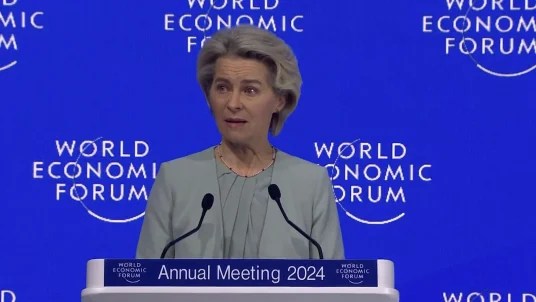
By Cindy Harper | Reclaim The Net | January 17, 2024
The President of the European Commission, Ursula von der Leyen, delivered an alarming pro-censorship proclamation at the annual Davos World Economic Forum. She expressed her concern that “misinformation” and polarization in societies pose a serious threat to the international business community.
“For the global business community, the top concern for the next two years is not conflict or climate,” she said in her speech to elites. She argued that the bigger problem is “disinformation and misinformation, followed closely by polarization within our societies.”
In her exhortation, Leyen said that there needs to be partnerships formed between governments and the private sector to curb “disinformation.”
“Many of the solutions lie not only in countries working together but, crucially, on businesses and governments, businesses and democracies working together,” she said.
Leyen suggested that it was especially important as 2024 will be “the biggest electoral year in history.”
She added: “Even as the insidious spread of misinformation and disinformation threatens the cohesion of societies, there is a risk that some governments will act too slowly, facing a trade-off between preventing misinformation and protecting free speech, while repressive governments could use enhanced regulatory control to erode human rights.”
Australia: ABC staff threaten strike after Arab journalist sacked

Award-winning journalist and author Antoinette Lattouf
MEMO | January 17, 2024
ABC journalists in the broadcaster’s Sydney offices yesterday threatened to strike unless management addresses concerns over the unlawful dismissal of radio host Antoinette Lattouf, Anadolu news agency reported.
The award-winning journalist and author, who is of Lebanese heritage, was sacked by ABC last month for sharing on Instagram a report by Human Rights Watch (HRW) on the besieged Gaza Strip.
The internationally-recognised rights watchdog released a report on how starvation was being used as “a weapon of war” by the Israeli government in Gaza. ABC also published a news item on the report.
On Tuesday, the Sydney Morning Herald revealed a leaked chain of WhatsApp messages from a group called Lawyers for Israel who had lobbied for Lattouf to be sacked.
“The ABC sacked broadcaster Antoinette Lattouf after a high-level and coordinated letter-writing campaign from pro-Israel lobbyists that directly targeted the corporation’s chair, Ita Buttrose, and managing director David Anderson,” the news daily said.
The report reveals that the Israeli lobby “repeatedly wrote to the ABC demanding Lattouf be sacked, and threatened legal action if she was not.”
Yesterday, about 80 ABC staff members demanded a meeting with Anderson, who is currently on leave.
They threatened to stage a walkout if their concerns were not addressed.
Lattouf has legally challenged her termination, saying she was sacked on the grounds of “political opinion or a reason that included political opinion” and later expanded the claim to include race, due to her Lebanese heritage.
While ABC has denied Anderson was behind Lattouf’s sacking, the broadcaster has told a court that the journalist was removed “because she ignored a direction from managers and shared a controversial social media post from Human Rights Watch.”
Lattouf demands a clear public apology, financial compensation and the offer of a proportionate position.
Hearings are scheduled to begin later this week.
In a statement to the Sydney Morning Herald, Lattouf’s lawyer, Josh Bornstein, said that after “October 7 and the ensuing conflict in the Middle East, it has become common knowledge in the media industry that Arab and Muslim journalists are being subjected to intimidation, censorship and expulsion.”
Republicans threaten to fire US federal workers if they oppose Israel genocide
MEMO | January 17, 2024
Qatari LNG tankers resume Red Sea passage
The Cradle | January 17, 2024
Four vessels carrying Qatari liquefied natural gas (LNG) have resumed passage through the Red Sea following a pause caused by Yemeni attacks on Israeli-linked ships and the US and UK bombing of Yemen last week, Reuters reported on 16 January.
LSEG ship tracking data revealed that the Qatari Al-Rekayyat tanker had resumed its return to Qatar via the Red Sea after initially halting its journey on 13 January. Furthermore, the Al-Ghariya, Al-Huwaila, and Al-Nuaman LNG tankers have also resumed their journeys through the Red Sea toward Europe.
The three tankers had been stopped near Oman’s shoreline since 14 January.
Some commercial shipping vessels and oil and LNG tankers have been either pausing their voyages or changing course away from the Red Sea and the Suez Canal.
Many vessels have instead taken the lengthier route around Africa via the Cape of Good Hope, adding two weeks to the journey.
Ansarallah has previously affirmed that vessels that lack any association with Israel will be allowed to navigate through the Red Sea. The resistance group, which is now Yemen’s de facto government, is seeking to punish Israel for its ongoing war on Gaza, which many view as constituting genocide.
But even many non-Israeli linked ships have diverted course since US and UK forces began bombing Yemen on 12 January in response and warned against travel through the Red Sea. However, according to a Bloomberg report, several ships have ignored Washington’s warnings and continue to navigate the Bab al-Mandab Strait.
Germany considers delivery of tank ammunition to Israel amid genocidal Gaza war

Press TV – January 17, 2024
Germany’s government is considering the delivery of tank ammunition to Israel amid genocidal war against Gaza, the German magazine Der Spiegel has reported, as Western governments keep on backing the Tel Aviv regime for its ongoing massacre.
Israel requested Germany in November to approve the delivery of around 10,000 rounds of 120-millimeter precision ammunition manufactured by Rheinmetall, the report said.
The departments involved have already fundamentally agreed behind the scenes to fulfill a request from the Israeli government.
The Israeli ambassador to Germany, Ron Prosor thanked the German government for its unrelenting support it has shown.
“Since October 7, Germany has unmistakably stood by Israel and expressed its unreserved support,” Prosor told Der Spiegel. “Israel thanks Germany for this,” he added.
The German Chancellor Olaf Scholz emphasized that arms deliveries were also possible.
According to the report, in order to promptly address the request, there is consideration being given to releasing ammunition from the stocks of the German army as the industry is unable to provide the desired precision ammunition immediately.
In November apart from Germany, Israel had also asked other partners for military aid because of its heavy use of ammunition against the Gazans.
US President Joe Biden approved the delivery of 14,000 rounds of tank ammunition for almost $106 million at the beginning of December, after he bypassed Congress.
The Western-backed Israeli genocide in Gaza has been escalating because of the continuous support of Western governments, as they have been persistently arming Israel and supporting the regime with large amounts of funds.
Hungary proposes plan to end Ukraine conflict
RT | January 17, 2024
Hungarian Foreign Minister Peter Szijjarto has called for a halt to all Western military aid to Ukraine, saying the massive influx of weapons – as well as Kiev’s reluctance to negotiate – has made peace impossible.
Asked what should be done to achieve a ceasefire in Ukraine in an interview with Austrian news site Exxpress, Szijjarto said ending foreign arms shipments to Kiev is a top priority.
“The more weapons that are supplied, the longer the war lasts. And the longer the war lasts, the more people will die,” the minister continued. “It is obvious that what has been done so far has not been successful. Many weapons were delivered, but the war was only prolonged. A lot of money has been paid to Ukraine, but the destruction of Ukraine continues.”
Pressed on the possibility that Russian troops would “march all the way to Kiev” in the event Ukraine is left “defenseless,” the diplomat said this could only be avoided with negotiations and a renewed peace process.
“This should be prevented by ending the war now. As long as that doesn’t happen, the war threatens to intensify further and more people risk dying. The war should have ended yesterday,” he said.
Szijjarto went on to argue for more dialogue between the warring parties and countries willing to mediate talks, saying “the most important requirement is to keep communication channels open.” He noted that he is often “insulted by many European colleagues, and by Brussels” after meetings with his Russian counterpart, but said “there is no hope at all for peace” without negotiations.
Western sanctions have also failed to “bring the Russian economy to its knees” as intended, the foreign minister said, suggesting the more aggressive approach had backfired and could not bring an end to the fighting.
Budapest is among a small number of EU states that have refused to join the sanctions campaign or provide weapons to Ukrainian forces, opting instead to maintain ties with Moscow. Despite pressure from other members in the bloc, Prime Minister Viktor Orban has declined to approve Brussels’ latest aid package to Kiev, holding up the funds since December.
The Hungarian leader has also threatened to veto Ukraine’s accession to the union, arguing that it poses many risks to the bloc and its economy, as well as the fact that Kiev is still “at war.”
The EU impasse comes at a time when Ukraine’s largest Western backer, the United States, has run out of aid money, as a $61.4 billion spending package remains stalled in Congress. Kiev’s foreign minister, Dmitry Kuleba, has acknowledged his country has no “plan B” should the funds run dry, saying there is no alternative to US largesse.
Britons Mock Warmongering Lecture by UK Defense Secretary
Sputnik – 17.01.2024
The United Kingdom’s Defense Secretary Grant Shapps warned of potential war with Russia, China, Iran, and North Korea within the next five years in a widely mocked speech in London this week.
Shapps delivered the address to promote greater investment in military spending in the UK and its European allies.
“The era of the peace dividend is over,” said Shapps in remarks he also shared on his profile on the X social media platform. The so-called “peace dividend” was a proposed reinvestment of government finances toward domestic concerns after the end of the Cold War.
The comment may leave many Britons wondering when exactly they enjoyed a peace dividend, as the British government has imposed a policy of economic austerity for a number of years. The UK was also perhaps the US’ strongest ally in the so-called “War on Terror,” which led to the deaths of more than 4.5 million people across the Middle East according to some estimates.
The comments come as European media is reporting on supposed “leaked documents” that allege Russian President Vladimir Putin is planning to launch an attack on Germany and other NATO members in the near future. The claims were dismissed as “fake news” by Kremlin spokesman Dmitry Peskov.
Britons greeted Shapps’ remarks with ridicule, with multiple posts by the defense minister being “ratioed” on the X platform, meaning they received more comments than likes as users piled on to jeer the jingoistic speech.
“Obviously, the best way to deter enemies and lead allies is by pouring billions of pounds into the military industrial complex,” responded one user sarcastically.
“You do know we were involved in bloody and unsuccessful wars in Iraq and Afghanistan?” added another. “Can you explain how British soldiers killed in Helmand or in Basra were at all beneficiaries of this so-called era of the peace dividend?”
“The people need to prepare for a new era of conflict with you bastards,” wrote user John Wight, expressing widespread antipathy towards governing elites in the West. “Wars happen when the government tells you who your enemy is. Revolution happens when you work it out for yourself.”
Featured Video

Theodore Postol: Iran’s Missiles & Drones Were Underestimated
or go to
Aletho News Archives – Video-Images
From the Archives
What is the Israeli Lobby in Australia Doing in Interfaith Dialogue?
By Ali Kazak | Dissident Voice | October 11, 2015
For years Israel and its lobby around the world have been trying to normalise their relations with Arabs and Muslims without solving the Palestine Question.
One of the methods they resorted to in the last few years is using human rights and community organizations such as interfaith dialogue and Multiculturalism to achieve this objective and to: isolate the Palestinians, marginalise the Palestine question, end Israel’s isolation, and prevent criticism of Israel, knowing that these organisations will be the first to stand against Israel’s violations, racial and religious discrimination.
The group responsible for this task in Australia is The Australia/Israel & Jewish Affairs Council (AIJAC); its Director of International & Community Affairs, Jeremy Jones is in charge of lobbying religious community organizations, specifically Muslims and Christians. Consequently he convened the Faith Communities for Reconciliation, founding participant in the Australian Partnership of Religious Organisations and the Australian National Dialogue of Christians, Muslims & Jews.
AIJAC is a private political propaganda group. It is recognised as the main Israeli lobby in Australia. It coordinates its activities and works intimately with the Israeli embassy in Canberra and different institutions in Israel. It is privately funded by some Jewish businessmen. It monitors closely Australian politicians, the media, ethnic and religious groups, (especially Arabs and Muslims), unions and academics on their stands towards Israel and the Palestine question. … continue
Blog Roll
 Aletho News
- The Most Important Bet You’ve Never Heard Of
- The killing of three Indonesian soldiers in Lebanon should remind Jakarta that Israel does not want peace
- Defeated and delusional: Netanyahu’s remarks reveal $80bn war failure, says analyst
- Iran’s friends are about to make life much more difficult for Israel and the US
- The war of liberation of the Arab and Islamic peoples expands across the Gulf
- Envoy warns UN on Trump’s threat to ‘obliterate’ Iran’s civilian infrastructure
- The Larak Corridor: Iran’s Rial Gate With No US, No Israel, and No Way Around
- ‘Economic terrorism’: Steel facilities hit again in US-Israeli strike
- ‘War Crime’: Iran condemns attacks on Arak, Ardakan nuclear sites
- Two-thirds of Americans want quick end to Iran war even if goals unmet
- If Americans Knew
- Gaza families reunite years after babies evacuated amid Israel’s war
- International Rescue Committee warns Gaza’s children face grave protection risks
- Iran’s Alleged 47-Year War on America: Debunking the 1,050 American Deaths Canard
- Israel wants US to bomb more of Iran’s civilian structures (113,000 is not enough) – Not a ceasefire Day 173
- Ann Coulter Rips Into Fox News for Iran War Coverage
- Joe Kent Urges Americans To Call White House and Congress To Object To Sending Troops Into Iran
- DNC Resolution to Reject AIPAC Funding Puts Democratic Leaders in the Hot Seat
- Swedish foundation to build 400 schools as over 650,000 Gaza children remain without education for 2 years
- Israeli army admits photshopping image of slain Lebanese journalist
- This is how Israel is systematically killing health workers under the cover of war in Lebanon
- No Tricks Zone
- New Study Finds Warming Saves Lives…Cold Temperatures 12 Times More Deadly Than Excess Heat
- German Science Blog Accuses PIK Climate Institute Of Hallucinating Climate Tipping Points
- Devastating Assessment Of Comirnaty Vaccine By Former Senior Pfizer Europe Toxicologist
- New Study: CO2 Is ‘Effectively Negligible’ As An Explanatory Climate Change Factor Since 2000
- Former Pfizer Toxicologist Dr. Helmut Sterz Tells Bundestag Hearing Pfizer Vaccine Should Have Never Been Approved
- Energy Expert: Germany’s Nuclear Phaseout Was A “500 Billion Euro Mistake”
- New Research: South Australia’s Mid-Holocene Sea Surface Temperatures Were 4°C Warmer Than Today
- Storing Green Energy To Last Germany 10 Days Would Require A 60-Million Tonne Battery
- New Studies: UK Sea Levels Were 4 Meters Higher Than Today During The Mid-Holocene
- Destructive Green New Deal: German Energy And Metal Group Warns Of Drastic Crisis
 Aletho News