Not Ready for the Big Leagues
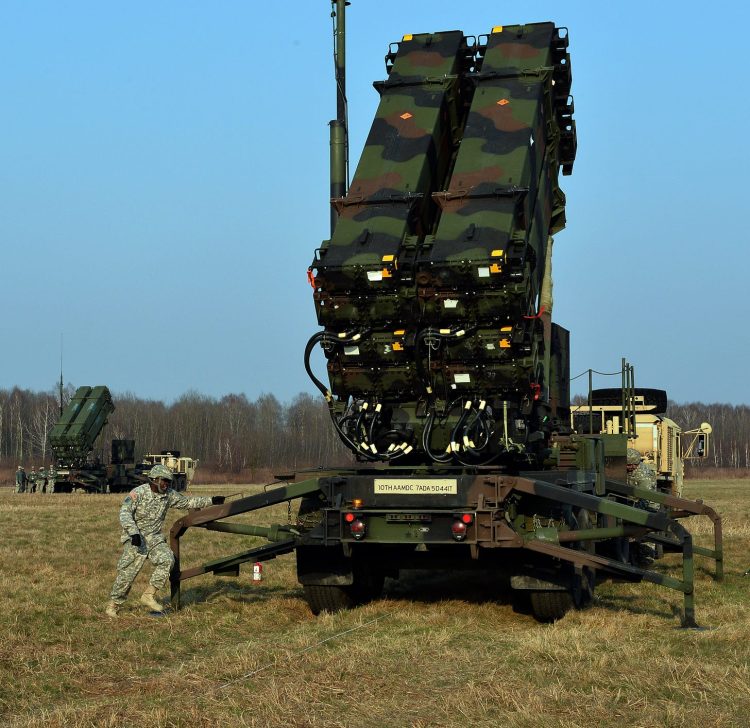
Patriot Missile Launcher
By William Schryver | imetatronink | January 20, 2024
According to the best information I can gather on short notice, I have been able to ascertain that current US production of the PAC-3 missiles typically used in the Patriot air defense systems is about ~500 per annum, at a cost of 4 – 6 million dollars each.
There are aspirations of increasing that rate to 650 per annum within the next year.
As for current US stocks of PAC-3 missiles, for the sake of argument, let’s allow for the possibility there are 5000 units (there aren’t near that many).
The consensus seems to be that the US can currently field ~500 operational launchers.
A single Patriot battalion typically consists of 6 batteries with 6 launchers each. Each of the 36 launchers can hold up to 16 PAC-3 missiles. So up to 576 PAC-3 missiles in a single-load of a Patriot battalion.
To prosecute war against Russia, China, or Iran, protection of the major forward bases of the United States Air Force would be the prerequisite upon which success would be predicated.
To adequately cover even one of these large airbases against missile strikes of just 100-200 units of high-performance drones, cruise-missiles, ballistic missiles, and hypersonic missiles — plus numerous decoys — would easily require an entire Patriot battalion.
Even with a 100% interception rate, a pair of 100-missile strike packages over the course of a day would still compel a PAC-3 burn rate of at least 300 missiles, given that, as a general rule, two PAC-3 missiles are launched at every incoming target.
But of course, the interception rate would be considerably lower than 100%. And given that the Patriot command, radar, and launcher units — along with missile storage sites — would be primary targets, there would be a substantial attrition rate of the highly immobile Patriot systems themselves. (The Russians have already clearly demonstrated the vulnerability of the Patriot systems to counter-battery missile strikes. At least three Patriot batteries have been destroyed in Ukraine.)
In an attempt to cover just three large airbases against a series of salvos of 100+ missiles of various types, the entire US stockpile of PAC-3 interceptors could very conceivably be exhausted in little more than a week or two.
Current annual production could easily be consumed in little more than a day or two.
This is the reality of 21st century high-intensity conflict against an adversary with the capability to shoot back — a kind of war for which the United States military is woefully ill-prepared, both materially and doctrinally.
Israelis opposing war receiving ‘death threats,’ says Knesset member Ofer Cassif

Lawmaker from the Arab-majority Hadas-Ta’al party and a Knesset member, Ofer Cassif in his office in West Jerusalem on January 12, 2024. [Arif Kayacan – Anadolu Agency]
MEMO | January 20, 2024
Firebrand Israeli lawmaker Ofer Cassif, who has been criticized for backing South Africa’s genocide case against Israel, says “there is an assault going on” against those who are opposing Tel Aviv’s military campaign in Gaza.
The vocal politician from the left-wing, Arab-majority Hadash-Ta’al party, was suspended from the Knesset for 45 days for criticizing the war that began after the Oct. 7 cross-border offensive by Hamas.
The Palestinian death toll from Israel’s more than 100-day bombardment of the Gaza Strip has crossed 24,000 people, most of them women and children.
The initial Hamas attack is said to have killed 1,200 people, and around 240 hostages were taken, some of whom were released during a week-long truce in November.
In a wide-ranging exclusive interview with Anadolu, Cassif said rejection of Israel’s military response has led to “an assault on freedom of speech,” including death threats.
“People are arrested for tweets and posts, not in support of Hamas, of course, but in supporting ending the war, or before even cease-fire. Students are suspended from the universities and colleges. People are fired from their workplaces. The police are brutally violent towards the demonstrators,” Cassif said.
“There is an assault on freedom of speech of those who raise voice against the war … there are death threats. Because it’s not only violence from above, from the government from the prime minister, legitimization of the violence against the protesters, of course by [Itamar] Ben Gvir (national security minister) and the police, which unfortunately mostly became a kind of a private militia of Ben Gvir. But it also penetrates the society as a whole. And you can see that within the society, a growing a part of the public supports, literally and explicitly, violence against those who oppose the war, including death threats.”
‘Region will explode’ if Netanyahu doesn’t go
Cassif said everyone will pay a “huge price” and the entire “region is going to explode” if Israel does not get rid of the “terrible government” headed by Prime Minister Benjamin Netanyahu.
According to him, the only way to stop the catastrophe from happening is by stopping the war, exchange of prisoners and release of all hostages, withdrawal of Israeli military from Gaza, and the beginning of serious peace process.
“This government should go home, if not to prison” as it has caused a lot of damage to both Israelis and Palestinians, he said. “The only way to live, to have a future, to prosper, is this. No war.”
Israeli contradictions
He also highlighted the contradiction in statements of Israeli authorities over the assault on the blockaded enclave, who on one hand say they never intentionally target civilians, but at the same argue there are no innocents in Gaza.
“A minister said ‘… dropping an atomic bomb on Gaza is an option.’ Another member of the Knesset, although a backbencher, said Gaza be eliminated. He used this term eliminated. Netanyahu himself, the prime minister, said Gaza is like Amalek. Amalek is like a codename, a biblical codename, of a group that deserves extermination.
“The president of Israel, who is supposed to be objective and beyond politics, signed a bomb, before it was sent to Gaza. And he also said that there aren’t any innocent people in Gaza. This is only the tip of the iceberg. So how can you say that you do not target civilians, innocent civilians, and at the same time, you say they aren’t innocent civilians. This contradiction shows exactly how this government behaves, what is the policy of this government, and I emphasize this is against Israel too.”
‘What’s going on in Gaza must be investigated by impartial body’
Cassif said he did not want to claim that the Israeli government is pursuing a genocidal policy in the Gaza Strip, arguing: “The legal definition of genocide is one that I leave experts to analyze.”
But, he added, there are two main reasons for him supporting the genocide case in The Hague: conducting an impartial investigation on Gaza bombing, and to save lives.
“What’s going on in Gaza must be investigated by an impartial body. I do not trust the government of Israel or any branch or proxy of the Israeli government to investigate itself … It’s like asking a thief to investigate oneself whether he or she stole something. It doesn’t make any sense,” he said.
“This terrible assault on Gaza is costing the lives of thousands of thousands of Palestinians, and hundreds of Israeli soldiers and Israeli hostages. They (Israeli hostages) are held in terrible conditions by Hamas in Gaza. I want the lives to be saved.”
But that cannot be done just through protests in Israel, he added.
“We cannot demonstrate, we cannot raise our voice. We are limited. There is a dictatorship now here, practically. What’s left is to look for a refuge in international organizations. So that’s the main reason why I think we should have supported the appeal of South Africa.”
Interests of Palestinians and Israelis ‘not contradictory’
“The interests of Israel, and the interests of Palestinians, as far as I see, are not contradictory. I think it’s in common interest of both the Palestinians and the Israelis to seek peace and to end the war,” Cassif said.
The Israeli government, he said, “totally neglected” the hostages. “The government doesn’t do anything to save the hostages. And everybody knows the only way to save the hostages, who are dying there, is by ending the war.”
The parliamentarian claimed 47% of the Israeli public, according to polls, supports ending the war in order to rescue the captives. “I agree with this specific point. I do hope the ICJ will ensure a decision that will end the war.”
Israeli press ‘betrayed’ profession
Asked why the Israeli army does not allow journalists to enter Gaza, Cassif said: “Perhaps they have something to hide … Normally when you don’t allow someone to get into somewhere. It’s because you don’t want someone to see something.”
About press freedom in Israel, Cassif said there have been situations where authorities “mobilize,” or force the media to “publish something and not to publish something else,” but now a vast majority of journalists are “voluntarily” supporting the policy of the government.
“You can say, there are not many limitations on freedom of the press, but the press itself, most of them, choose not to act freely … this is disgraceful, it’s unprofessional, and it will be remembered once this terrible era is ended and finished. It will be remembered that they betrayed the profession.”
‘They want to silence us’
Commenting over a lawmaker’s efforts to get him expelled from the 120-member Knesset, Cassif said “they want to silence” and “don’t want our voice to be heard … the voices against the war. This is the part of the persecution and silencing of the people who support peace and go against violence and war.”
The opposition lawmaker said he believed the efforts against him will succeed, but he will approach the Supreme Court to get relief as “there is no legal basis.”
“According to the law, a member of Knesset can be expelled only if one supports racism, terrorism, or armed struggle against Israel. Neither of those is relevant to me. I’m against racism, I’m against terrorism. I am against armed struggle against Israel.”
He said the claim is based on political reasons. “The world should understand that the assault on Gaza, and the silencing of peace lovers and the democrats in Israel are two sides of the same coin. They continue with a coup they began before Oct. 7 by other means.”
Israeli forces desecrated at least 16 cemeteries in Gaza during their aggression: Report
Press TV – January 20, 2024
A new investigation has found that Israeli forces have desecrated at least 16 cemeteries in the Gaza Strip during the regime’s ongoing war against the besieged terrirtoy.
CNN, based on satellite imagery and social media footage, published an investigation on Saturday, saying Israeli troops have left tombstones torn down and even bodies unearthed as they destroyed the cemeteries.
It went on to say that the regime forces have destroyed an entire cemetery in the southern city of Khan Yunis, removing bodies buried there.
The Israeli military has defined the move as part of a search for the remains of captives taken by the Palestinian resistance during the operation al-Aqsa Strom in early October, the US-based broadcaster added.
Legal experts told CNN that Israel’s acts could amount to war crimes, stressing that the intentional destruction of religious sites, such as cemeteries, violates international law.
Confirming the desecration of the cemeteries by the regime forces, an Israeli military spokesman also told the broadcaster that the military sometimes has “no other choice” but to target cemeteries it claimed Hamas uses for military purposes.
The report further noted that in other cases, however, Israeli forces appear to have used cemeteries as military outposts.
Satellite imagery and videos showed that Israeli bulldozers turned multiple cemeteries into staging grounds, leveling large swaths and erecting fortifications.
Satellite imagery also showed a fixed presence of Israeli military forces in the central part of the Shajaiya cemetery since December 10.
At the Bani Suheila cemetery, east of Khan Yunis, satellite imagery revealed the graveyard’s deliberate and progressive bulldozing and the creation of defensive fortifications over the course of at least two weeks in late December and early January.
Destroyed tombstones and heavy tread marks also pointed to heavily armored vehicles or tanks driving over graves in Al Falouja cemetery in the Jabalia neighborhood as well as the Tuffah cemetery, east of Gaza City.
Israeli forces also severely damaged the cemetery in Khan Yunis, as they moved in on the area surrounding the Nasser Hospital and a Jordanian field hospital, according to satellite imagery and videos reviewed by CNN.
The Israeli regime waged the war on Gaza on October 7 after Hamas carried out the surprise Operation Al-Aqsa Storm against the occupying entity in response to the Israeli regime’s atrocities against Palestinians.
Since the start of the aggression, Israel has killed more than 24,900 Palestinians, mostly women and children.
The Tel Aviv regime has also imposed a “complete siege” on the territory, cutting off fuel, electricity, food, and water to the more than two million Palestinians living there.
Israel says 253 people were taken captive during the Hamas surprise operation and believes 132 hostages are still in Gaza – 105 of them alive and 27 dead.
France’s and Germany’s Lack of Independence Forces Them to Continue Bankrolling Ukraine
Sputnik – 20.01.2024
While Western powers’ lavish financial and military contributions to Kiev’s war effort have so far failed to produce any meaningful results, many leaders seem eager to keep bankrolling Ukraine until it runs out of manpower.
The EU may be looking to amend the mechanism used to provide military support to Ukraine by creating a new fund in addition to the European Peace Facility (EPF) that has so far been used by Europe to funnel arms to Kiev.
According to Bloomberg, the new fund may have an annual budget of €5 billion but EU member states are yet to come to a consensus on how this initiative is going to work out.
Commenting on this development, Gabor Stier, senior foreign policy analyst at the conservative Hungarian daily Magyar Nemzet, told Sputnik that whatever shape and form this new fund is going to take, it will ultimately harm European states.
According to him, the EU leadership is essentially trying to come up with a plan to bankroll Ukraine regardless of what Hungary might think about it, with Stier referring to attempts by Hungarian Prime Minister Viktor Orban to come up with a plan to provide aid to Ukraine without harming the EU budget in the process.
Orban’s proposals – that involve dividing the aid to Kiev into smaller tranches and keeping track of exactly how this money would be spent – are very much disliked by Brussels, Stier said. The EU leadership is reportedly concerned that the Hungarian prime minister might veto options he does not like (as decisions to allocate funds under the auspices of EPF require unanimous agreement).
“There will be a new fund but with what money?” Stier inquired. “The first option would be a new fund where money from the EU budget would go into. This does not solve the issue with the Hungarian veto. The second option would involve creating a fund outside the EU budget. The problem with this option is that it would take too long as each (EU) country and its respective parliament would have to vote on it separately. There will be arguments and it will all drag on. While this would go on, Ukraine would already suffer a defeat.”
Thus, Stier suggests, the new fund will likely be filled with money from the EU budget.
“It is already clear that this fund will be designed through discussions within the EU, which is clear in light of the new strikes in Germany or in France. It seems that everyone is either not too keen to trust Ukrainian politicians or have reconsidered their approach to the allocation of funds,” he mused.
Stier also noted that some European states use Orban as “cover” by making it look like he is the lone obstacle on the way to agreeing on the Ukrainian aid issue.
“There are internal frictions, this much is clear. Earlier in Budapest, Slovakian Prime Minister Robert Fico voiced his agreement with Orban on everything related to Ukraine,”
he said. “Austria is also on the same wavelength as Orban. But when it comes to voting in Brussels, no one besides Orban says that they are against (the funding of Ukraine).”
According to Stier, even France and Germany essentially use Orban to “force Ukraine, who is brazenly spending all resources of the Western powers, to slow down somewhat.”
Only Poland, the Baltic states and the Scandinavian states wholeheartedly support Ukraine, he argued, along with the “Benelux and the Netherlands,” though the latter two have some “internal problems.”
He did note, however, that even though Germany, France and Italy may not be thrilled by the prospects of continuously financing Ukraine, they simply cannot stop doing so.
“This is how their dependence on the United States manifests,” Stier explained. “Europe is going to bear the financial burden in the future, that much is obvious.”
The analyst also claimed that this year is going to be “critical” for Ukraine in terms of financing, and that “more justifications are required to amass so much money everywhere” to support Kiev.
Letting Ukraine into NATO is ‘basis for World War Three’ – Slovakia
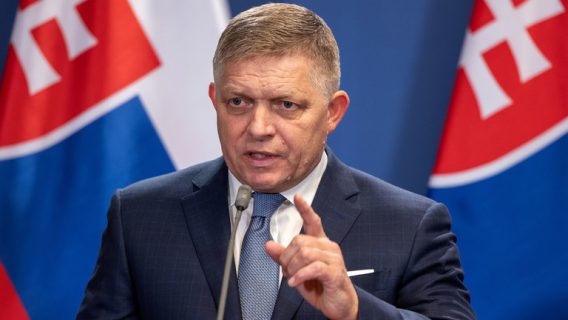
Prime Minister of Slovakia Robert Fico. © Getty Images / Janos Kummer
RT | January 20, 2024
Bratislava will block Kiev’s bid to join the US-led NATO alliance and will stand by a decision to stop supplying weaponry to Ukraine amid its conflict with Russia, Prime Minister of Slovakia Robert Fico has said.
The PM made the remarks on Saturday ahead of his visit to Ukraine to meet his counterpart Denis Shmygal in the western Ukrainian city of Uzhgorod. Fico stressed that his visit serves solely “humanitarian” purposes and promised to openly communicate Bratislava’s stance to Kiev on different issues, including Ukraine’s potential accession to EU or NATO membership.
“I will tell him that there are things on which we have completely different opinions,” Fico told broadcaster RTVS. “I will tell him that we respect them when it comes to joining the EU, but they must fulfill the conditions,” he added, explaining that a situation where “a country that absolutely does not meet any requirements” joins the EU is unacceptable.
He ruled out any possibility of Ukraine joining NATO, insisting such a move would only result in a global catastrophe, apparently caused by a direct collision between NATO and Russia over the issue.
“I will tell him that I will veto and block [a NATO bid by Ukraine] because that is exactly the basis of the third world war and nothing else.”
Fico also promised to reiterate to Shmygal his election campaign pledge to stop providing Kiev with weaponry, stating that the decision remains in force. Still, the weapons restriction applies only to state-sponsored military aid to Ukraine and supplies coming from Slovak military stocks, whereas arms manufacturers are free to sell to the country whatever they like, he noted.
“When Slovak companies don’t make money, American ones will,” Fico noted.
Prior to Fico assuming office following his party’s electoral victory in September, Slovakia had been among Kiev’s top supporters, lavishly supplying it with sophisticated weaponry, including warplanes and anti-aircraft systems. The policy of the previous government has also left the country’s own defense posture badly damaged, new Defense Minister Robert Kalinak claimed earlier this week.
“The former government left us without our own anti-aircraft defenses, without combat aviation, and we don’t even have the promised 700 million for MiGs, which the government also handed over to Ukraine,” Kalinak told the Standard newspaper.
IRGC officials killed in Israeli attack on Damascus
The Cradle | January 20, 2024
An Israeli airstrike on the Syrian capital Damascus killed four members of Iran’s Islamic Revolutionary Guard Corps (IRGC) during the early hours of 20 January.
“An Israeli aggression today targeted a residential building in the Mezzeh neighborhood of Damascus,” SANA reports.
According to Al-Mayadeen, the building targeted consisted of three stories and is affiliated with Iran’s Islamic Revolutionary Guard Corps (IRGC).
“Once again, the evil and criminal Zionist regime invaded the city of Damascus, the capital of Syria,” The IRGC statement following today’s attack read. “During the air attack […] several Syrian forces and four military advisers of the Islamic Republic of Iran were martyred.”
Two high-ranking members of the IRGC were among those killed: Commander Haj Sadegh Omidzadeh, deputy intelligence officer of the IRGC Quds Force, and his deputy, Haj Gholam.
This attack comes days after Iran targeted a Mossad-affiliated base in Iraq’s Kurdistan Region (IKR) in retaliation for an earlier assassination of an IRGC commander in Syria.
On 16 January, Iranian missiles leveled an alleged Mossad base in IKR’s capital, Erbil, that was reportedly involved in coordinating the recent assassinations of several commanders of the IRGC and the Resistance Axis.
The IRGC noted that this base was used “to develop espionage operations and plan acts of terrorism” across the region, specifically in Iran.
The Iranian operation in IKR killed Kurdish oil tycoon Peshraw Dizayee, owner of the Empire and Falcon Group, who have reportedly facilitated oil exports to Israel.
Iraq condemned the IRGC operation, saying it is “an aggression against the sovereignty of Iraq and the security of the Iraqi people, and an insult to good neighborliness and the security of the region.”
Slovakia Stripped of Air Defense, Fighter Jets After Aiding Ukraine
RT | January 19, 2024
Slovakia’s continuous military aid to Ukraine under the previous government has left the country’s own defense posture badly damaged, with “years” now needed to fix it, new Slovak Defense Minister Robert Kalinak has said.
The minister, who assumed office back in October under the new government led by Prime Minister Robert Fico, accused his predecessors of simply surrendering key military hardware to Ukraine without coming up with any plan to secure their replacements. The defense ministry has effectively been run by “people with qualities of pugs rather than wolves,” Kalinak told the Standard newspaper on Thursday.
“The former government left us without our own anti-aircraft defenses, without combat aviation, and we don’t even have the promised 700 million for MiGs, which the government also handed over to Ukraine,” Kalinak stated.
Now, the country is seeking to negotiate with its “partners” to ensure that “Slovakia’s air defense will be provided by NATO allies,” he said. The country is now risking being left without any air defenses, with the US Patriot anti-aircraft systems withdrawn from its soil late in 2023, while hosting the Italian SAMP/T systems may also end this year, Kalinak warned.
It will likely now take “years” to fix the damage done to the country’s security, the minister said, squarely blaming the situation on his predecessors. For instance, the new government will unlikely be able to come up with a replacement for S-300 anti-aircraft systems during its tenure. “Maybe towards the end of the term of office, but I only hope so,” he said.
“It was absurd overwork by [then-Defense Minister Jaroslav] Naď and his people at the ministry. After all, we were not the only allies who had the S-300, which Ukraine was interested in. Why didn’t the Greeks give it? Why didn’t the Bulgarians give it? These were outrageous decisions by Naď and [then-PM Eduard] Heger, which have no parallel in any sovereign country,” Kalinak stated.
Following his party’s electoral victory in September, Fico immediately halted the country’s military aid to Kiev, as well as pledged to block Ukraine’s potential accession into the US-led NATO bloc. The new PM has repeatedly criticized the Western approach to handling the Ukraine conflict, arguing that the enduring support of Kiev turned into a “futile waste of human resources and money,” which only prolongs the hostilities and fills Ukrainian cemeteries with “thousands of dead soldiers.”
“I will no longer be subject to stupid liberal and progressive demagoguery. It is literally shocking to see how the West has repeatedly made mistakes in assessing the situation in Russia,” Fico wrote in Slovakia’s Pravda newspaper last week.
Macron Does a Putin, Ends Up Shooting Own Foot

By Finian Cunningham | Strategic Culture Foundation | January 20, 2024
French President Emmanuel Macron sought this week to revamp his tattered authority over a nation that seems to have grown weary of this self-important charlatan.
In a special media conference lasting two and half hours broadcast to the nation, it seemed Macron was taking a leaf out of Russian President Vladimir Putin’s book. Putin gives an annual marathon press conference taking questions from journalists and the public on all and sundry national and international issues.
It didn’t go so well for Macron who ended up appearing as if he was pleading to be given respect.
There is no doubting Putin’s command of issues. Over four hours, he can hold the audience’s interest with cogent rational arguments, making his points with comprehensive facts and figures. Putin’s approval rating among the Russian public is riding high consistently in what can be deduced as genuine respect for his leadership.
It beggars belief that any Western leader could comparably acquit themselves, speaking freely for several hours on diverse topics. Biden, Sunak, Scholz, and Trudeau are joke figures who wilt under any scrutiny.
Macron tried to do a Putin this week with his nationally televised presser and the French people weren’t impressed. Polls showed, cited by NPR Radio, that a big majority (64 percent) of French disapproved of their president’s performance and the content of his views. He was criticized for peddling reactionary ideas.
Macron talked a lot about the need for national unity and restoring France’s international reputation. He called for a “civic rearmament” which was a strange way to promote national renewal. It smacked of fascism. Like much of his pitch, Macron sounded insecure, authoritarian, and chauvinistic. His views were more assertions than reasoned arguments. He was obviously concerned about the popularity of opposition leader Marie Le Pen, and he traduced her as leading a “party of lies”.
Not a good move by Macron especially when many French citizens can see that Monsieur Le President is himself a flagrant liar.
During his appeal to the nation, Macron spun the outrageous calumny that France must support the Ukrainian regime with billions of more euros because, as he lied with a bare face, if Russia wins the war in that country (a war instigated by NATO), then Putin would continue an expansionist invasion of Europe.
Talk about absurd scaremongering. Macron must take his compatriots for complete fools to peddle such hogwash on primetime TV.
Macron said his countrymen and women need to agree to supply more Scalp cruise missiles to the (Nazi-adulating) Kiev regime in order to maintain attacks on Russian territory, such as the strikes on Belgorod at New Year which killed dozens of civilians. These French-supplied missiles have also been used to target the Russian territory of Crimea.
Just as Macron was exalting supposed French values, it turned out that an entire company of French mercenaries was killed in the Ukrainian city of Kharkov by a devastating Russian missile strike. At least 60 French special forces were blown apart. Paris is denying that French forces were killed.
Russia summoned the French ambassador in Moscow the next day to deliver an official rebuke to Paris on the involvement of its troops in the war. This is not a new discovery by any means. American, British, Canadian, Polish, and other NATO mercenaries have been long-tracked by Russia as unofficial participants in the two-year conflict. The French have taken a particularly significant role in sending foreign legionnaires to Ukraine to fight Russia.
Macron has involved his country in a reckless covert war with Russia – all in total deception of the French people.
This gives the lie to the real nature of the war in Ukraine. It is a U.S.-led NATO proxy war against Russia, which Russia is winning despite the array of foreign weaponry, funding, and troops.
Macron, the pathetic puppet who seems to have delusions of grandeur as if he is a reincarnation of Napoleon or De Gaulle, is immersing his country into a futile but recklessly dangerous war with nuclear-powered Russia.
If Macron spent the billions he has funneled into propping up a corrupt Neo-Nazi regime in Kiev on funding French public services and paying French workers a decent salary then maybe the French public would not have so much contempt for the former Rothschild investment banker sitting in the Elysée Palace.
Macron was elected president in May 2017 with the promise to “restore French greatness”. He was re-elected again narrowly in 2022. But his lies, empty promises, and delusions are finally catching up with him.
Like other Western so-called leaders, the French president has trashed his country’s economy to fuel a U.S.-led covert war against Russia in Ukraine. The warmongering is being done behind the Western public’s back with outrageous mendacity and deceit.
Macron and other Western charlatan leaders lament the loss of their political authority as if that is some kind of mystery or the fault of Russian propaganda and misinformation. The reasons for the growing public contempt of Western politicians are obvious to everyone but the liars in office.
A ‘pro-Russian monster’ or a force for common sense? A new party is reshaping the German political landscape
By Tarik Cyril | RT | January 20, 2024
Germany is in severe crisis. Between a tanking economy and an increasingly unpopular government, the country has begun to show just how much stress it is under. Half a year ago, the head of German carmaker Volkswagen warned that “the roof is on fire,” while The Economist concluded that “disaster,” meaning not just the decline but collapse of the German car industry, is “no longer inconceivable.”
At this moment, the wintry beginning of 2024, German farmers are staging large-scale and escalating protests and forcing the ruling coalition into concessions, the trains are not running on time due to a strike, the country’s wholesale sector has dropped to pandemic-level pessimism, “dampening hopes of a rapid rebound in Europe’s largest economy,” as reported by Bloomberg, residential property prices are in record decline, and the office real estate market “has collapsed,” according to leading German news magazine Der Spiegel.
The Economist finds Germany to be “down” politically as well – in fact, self-relegated – from its status as leader of Europe (or, at least, the EU) to less than second fiddle (that would be France, perhaps): while “Angela Merkel was the continent’s undoubted leader, Olaf Scholz, has not taken on her mantle.”
That is a very British understatement. In reality, in the toxic yet key relationship with the US, Germany, with its hapless attempt to transfer the management concept of “servant leadership” to geopolitics, has now subordinated itself so thoroughly to American neocon-type interests that it has no leverage left at all. Because once you make your loyalty unconditional, you will be taken for granted: Selling oneself may be inevitable for any but the greatest powers. Selling oneself for free takes a special lack of foresight.
We could go on heaping up examples of malaise. But the gist is simple: Germans may love to lay it on thick when it comes to venting their misery and “angst” (I should know, being German), but, clearly, something has to – and will – give. The question is what.
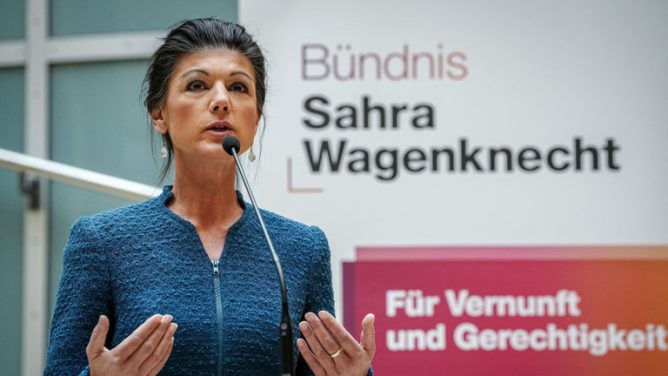
One political force that stands to gain from the crisis has just been established. (Another fairly new party that is profiting is the AfD.) Long rumored and in the making, 8 January saw the official founding of a new party, the Bündnis Sarah Wagenknecht – Vernunft und Gerechtigkeit (Alliance Sarah Wagenknecht – Reason and Justice), or BSW for short. Its leader Sarah Wagenknecht used to be the most popular top politician of the hard-Left party Die Linke, which she left with a bang.
As the name BSW suggests, the new party is, in part, a vehicle for Wagenknecht’s considerable personal political acumen and charisma. Opponents of “Red Sarah,” as the popular, generally right-leaning newspaper Bild still calls her, like to stereotype her as an “icon.” Yet, wiser from the failure of an earlier attempt to strike out on her own (under the label “Aufstehen,” roughly: “Stand Up”), this time, Wagenknecht has gone out of her way and made sure to do her homework, preparing a well-crafted organization, a set of junior leaders around her, and, last but not least, a solid program. This is politically significant: Unlike “Aufstehen,” the BSW will not fold quickly under the weight of its own problems.
On the contrary, the party’s chances of making a strong impact from the get-go are very good, as polls consistently indicate. The most recent one – commissioned by Bild and carried out just days after the party’s founding by a top pollster – shows that 14% of Germans would vote for the BSW in a federal election.
For comparison: the SPD, traditionally one of the core parties of Germany and the political home of Chancellor Olaf Scholz, reaches 14% as well. For the BSW this is an impressive figure, but for the SPD it is catastrophic. Meanwhile the Greens, the second partner in Berlin’s governing “Ampel” coalition, are at 12%. The FDP, the third “Ampel” component, would fail to get any seats at all (due to not crossing Germany’s electoral threshold of 5%). Sarah Wagenknecht’s own former party, Die Linke, would suffer the same fate. The only two parties that would do better than the BSW are the traditional center-right CDU (27%) and the populist-right/far-right AfD (18%).
In sum, with BSW, we are witnessing not the making of a fringe but a core movement in what seems to be emerging as Germany’s re-shaped party system, consisting of three traditional parties (SPD, CDU, and the Greens) and two new forces. The latter are coming from the right and left periphery but are likely to re-define the center, directly and by their pressure on the traditional players.
Representatives of the threatened traditional parties and their expert and mainstream media surrogates often denounce the challengers from the wings as extremists or, at least, irresponsible populists (just another way of saying “demagogue”). But they only have themselves to blame: The true cause of this tectonic movement is the failure of the traditionals. The challengers’ rise marks a reaction to it. Wagenknecht is right about this: Germany’s “democracy is imperiled most of all” by government policies that make ever more citizens feel left alone or alienated.
Against that background, the BSW promises more generous social policies, such as on education, wages, and pensions (and higher taxes for the wealthy). As Germany is doing badly economically, this will resonate. And Wagenknecht, a political “natural,” knows how to signal: She has just taken the side of the protesting farmers – as do the majority (68%) of Germans, according to polls.
Mainstream media are making desperate attempts to frame the rebellious farmers as serving extremists and somehow playing into the hands of – guess which country! – Russia. The ever more besieged minister of the economy Robert Habeck has even detected financing by – guess who! – “Putin!” (without, of course, providing any evidence). This time, these tired scare tactics are failing to catch on. Wagenknecht’s public call for chancellor Olaf Scholz to apologize to the farmers will fare better.
Crucially, Wagenknecht and the BSW have combined socially left approaches with a set of traditionally conservative stances, challenging, for instance, the hypertrophic development of new gender categories or, in general, “symbolical struggles” over hyper-sensitive terminology, so fashionable with what Wagenknecht dismisses as the “lifestyle Left.”
While this push-back against political correctness is a largely symbolic, though effective, operation, migration is a more substantial field. There as well, Wagenknecht has adopted positions closer to the right and center than the liberal left, stressing the need for control and limits. The fact that she herself had a Persian father and that prominent BSW heads are also non-ethnic Germans gives her a strong starting position for this kind of debate, shielding her points from dismissal as racist or xenophobic.
Given how many Germans feel, left alone in an economic crisis and also alienated by especially Green attempts at re-education in the spirit of urban upper class multiculturalism and gender obsessions, it will be hard to counter the BSW’s brand of socially left but otherwise centrist and even conservative policies. No wonder then that opponents are trying to portray Wagenknecht as a monster, along with the new party. Their playbook is predictable and boring: namely to smear them as being pro-Russian or even working in the service of Russia.
In reality, Wagenknecht has positioned her new party to resist the push for ever more confrontation with Moscow, especially with regard to Ukraine. At this moment, for instance, she is speaking up against the delivery of German Taurus cruise missiles to Ukraine, which is the latest fad among the insatiable “miracle weapon” addicts. More generally, she is demanding to shift from a policy of military confrontation by proxy to one of negotiation and compromise, which makes, of course, perfect sense.
For her enemies, there is an irony waiting to catch them: They may hope that accusing Wagenknecht of being too friendly toward Russia will weaken her appeal. Yet that ship has sailed. The days of making hay with unbridled neo-McCarthyism are ending. It is more likely, fortunately, that the BSW’s reasonable approach to foreign policy will only get it more sympathy and voters. As it should. Because remember: At this point, Germany is so dependent on the US that it is treated not only like a vassal, but like a vassal whose wishes and interests do not count. Even Germans who distrust Russia will come to understand that this is fundamentally unsound. In its own national interest, Germany must re-establish some balance by rebuilding its relationship with Russia.
Tarik Cyril Amar is an historian from Germany working at Koç University, Istanbul.
Miliband will bring wholesale deindustrialisation
Net Zero Watch | January 19, 2024
Net Zero Watch has said that Labour’s green dogmatism will be a disaster for the working classes, bringing industrial closure on an unprecedented scale. The campaign group, which has warned about the existential threat to British steel industry for more than a decade, says that the Port Talbot closure was inevitable, given the determination of all parties to push up the costs of energy.
The policy of taxing fossil fuels made the closure of Port Talbot inevitable, while the drive for renewables is pushing up electricity prices so far that the plan to replace the blast furnace with an electric-powered arc furnace will almost certainly prove to be a dead duck.
Electricity prices have doubled from 2002—2020, even rising during long periods of falling gas prices, as a result of increasing grid system inefficiency caused by renewables.
Net Zero Watch director Andrew Montford warns that things may get even worse under a Labour government.
Ed Miliband’s delusions over renewables are going to be a disaster for the UK working classes. He is going to produce deindustrialisation on a scale that is going make the closure of the coalmines under Margaret Thatcher look like a walk in the park.
Mr Montford says that while the finger of blame for Port Talbot should be pointed at the Conservatives, there is an all-party consensus around the policies that produced the disaster:
The Westminster village is so far divorced from the interests of general public that they will shrug off the Port Talbot disaster with barely a look back.
UK to become only G20 member without steel production
RT | January 20, 2024
Steel producer Tata Steel plans to close blast furnaces at its Port Talbot plant in South Wales and lay off nearly 3,000 workers, according to media reports. The move, which is part of a major restructuring of the company’s UK operations, will reportedly leave the UK as the only G20 economy unable to make steel from scratch.
The planned move, which was first reported by the Financial Times this week, is part of Indian-owned Tata Steel’s four-year transition to a greener form of steelmaking at the company’s UK steel operations, which employ 8,000 people, and involve sites elsewhere in Wales and the Midlands. While the blast furnaces at Port Talbot will be shut down, the company intends to build electric arc furnaces, which make steel from recycled scrap. The government has promised up to £500 million ($634 million) to help with the transition.
Meanwhile, the two other remaining blast furnaces in the UK, both of which belong to the Chinese-owned company British Steel, are also slated for shutdown as the parent entity plans to replace them with two electric arc facilities, which could be operational as early as 2025.
“That would leave the UK as the only G20 country that cannot make steel from raw materials,” The Guardian wrote.
“Steel is the beating heart of manufacturing and of our entire infrastructure and, of course, of our national security,” Stephen Kinnock, a Labour MP for Aberavon, home of the Port Talbot plant, told Sky News. “Do we really want to be a country, given the dangerous and turbulent world in which we live, that isn’t able to produce its own steel?” he said.
Featured Video

America Racing to Strategic Defeat in Iran
or go to
Aletho News Archives – Video-Images
From the Archives
Should Europeans ‘Thank’ the Americans for Destroying Nord Stream?
By Robert Bridge | Strategic Culture Foundation | September 29, 2022
With an investigation continuing into the destruction of the Nord Stream gas pipeline that provided energy supplies to Europe from Russia, there appears to be just one prime suspect, and that should surprise nobody.
Following the sabotage of the Nord Stream 1 and 2 gas pipelines, former Polish Foreign Minister Radoslaw Sikorski already seemed to know the identity of the perpetrator when he tweeted out: “Thank you, USA.”
At first glance, it seemed that Sikorski was speaking sarcastically, berating Washington for carrying out an attack that will have severe repercussions for the people of Europe. After all, how could anyone see any good coming from the termination of Europe’s primary source of gas reserves with winter just around the corner? It was Sikorski’s homeland of Poland, after all, that urged its citizens to collect firewood in the face of dwindling gas reserves.
In fact, the Polish diplomat was speaking one-hundred percent literally… continue
Blog Roll
 Aletho News
- Tehran approves new Hormuz plan with major restrictions
- No Threat Can Force Iran’s Surrender /Trita Parsi & Lt Cl Daniel Davis
- UK’s New Pandemic Plan Would Turn Big Tech Into a Mass Location Tracking Network
- Growing insecurity, soaring prices fuel protests in north as regime bans evacuation: Sources
- Iran denies responsibility for ‘depraved’ attack on Kuwait desalination plant
- Bring The Troops Back. End This War Now!
- Can we please stop calling Israel the ‘only democracy in the Middle East’ now?
- US should start removing its troops from Germany, proposes AfD co-leader Chrupalla
- Iran Red Crescent: 600 educational centers attacked in US-Israeli ‘war crimes’
- Russian Oil Tanker Arrives in Cuba Amid U.S. Blockade
- If Americans Knew
- As Iran targets US military bases, will they be relocated to Israel? Not a ceasefire Day 171
- Will Trump Go Kamikaze?
- Is the University of Florida Shutting Down College Republicans over Israel Criticism?
- Jewish extremist arrested over alleged plot to firebomb Palestinian activist Nerdeen Kiswani’s home
- More than half of Palestinian child detainees have no charges
- The More Murderous Israel Gets, The More We Hear About “Antisemitism”
- Land Day and the Palestinian struggle after 30 months of genocide
- The Iran War Is About Palestine
- Israeli soldiers echo settler ideology, talk of revenge after targeting Palestinians and detaining CNN crew in the West Bank
- Israeli Policies Threaten Future of Christian Schools in Jerusalem
- No Tricks Zone
- New Study Finds Warming Saves Lives…Cold Temperatures 12 Times More Deadly Than Excess Heat
- German Science Blog Accuses PIK Climate Institute Of Hallucinating Climate Tipping Points
- Devastating Assessment Of Comirnaty Vaccine By Former Senior Pfizer Europe Toxicologist
- New Study: CO2 Is ‘Effectively Negligible’ As An Explanatory Climate Change Factor Since 2000
- Former Pfizer Toxicologist Dr. Helmut Sterz Tells Bundestag Hearing Pfizer Vaccine Should Have Never Been Approved
- Energy Expert: Germany’s Nuclear Phaseout Was A “500 Billion Euro Mistake”
- New Research: South Australia’s Mid-Holocene Sea Surface Temperatures Were 4°C Warmer Than Today
- Storing Green Energy To Last Germany 10 Days Would Require A 60-Million Tonne Battery
- New Studies: UK Sea Levels Were 4 Meters Higher Than Today During The Mid-Holocene
- Destructive Green New Deal: German Energy And Metal Group Warns Of Drastic Crisis
 Aletho News