Trump a ‘threat’ to UK – ex-MI6 chief
RT | January 15, 2024
Former US President Donald Trump’s potential reelection could be “problematic” for British national security due to his stance on NATO, former head of the MI6 intelligence service has warned.
Richard Dearlove, who led MI6 from 1999 to 2004, was discussing potential threats to the UK in 2024 in an interview with Sky News on Sunday, during which he pointed to the Russia-Ukraine conflict and the “long-term behavior of China,” before moving to the US presidential race.
“You have to add a political threat, which I am worried about, which is Trump’s reelection… which I think for the UK’s national security is problematic,” Dearlove said. If Trump, given his critical attitude towards NATO, “acts hastily and damages the Atlantic alliance, that is a big deal for the UK,” he warned.
“We’ve put all our eggs in defense terms in the NATO basket. If Trump really is serious about, as it were, changing the balance, I mean the American nuclear umbrella for Europe is, in my view, essential to Europe’s security and defense,” the former spymaster said.
During his time in the White House, Trump disparaged NATO, calling it “obsolete,” and questioned the bloc’s relevance in the modern world. He also cast doubt on Washington’s commitment to defend its allies and argued that other NATO members were not contributing enough.
“Look, NATO has taken advantage of our country. The European countries took advantage,” the former president recently told Fox News, adding that his attitude towards NATO depends on whether “they treat us properly.”
Despite several court cases against him, Trump remains the frontrunner for the Republican Party nomination as presidential candidate. A recent Morning Consult poll indicates that he is leading with 69% support, while the nearest rival is trailing far behind.
Was 2023 REALLY the second hottest year since 1884?
By Iain Davis | OffGuardian | January 14, 2024
According to the UK Met Office, 2023 was the second hottest year in the UK since 1884.
Quite obviously, this is complete nonsense. Unless they are troglodytes that never venture out in daylight, why would anyone in the UK believe such absurd drivel?
The Met Office states:
2023 is provisionally the second warmest year for the UK according to mean temperature. [. . .] 2023’s provisional mean temperature of 9.97°C puts it just behind 2022’s figure of 10.03°C and ahead of 2014’s 9.88°C.
Right, it’s “provisional” drivel.
The UK summer of 2023—where I live—was a thoroughly miserable affair. We had a few weeks of decent sunshine in the spring and a couple of hot weeks of Indian summer. That was it!
The rest of it was cold, wet and comprehensively devoid of anything we might traditionally call “summer.” The winter preceding and following it wasn’t particularly cold, but nor was it unusually warm.
I’m knocking on a bit and can remember about 50 years of my life. I know, for a fact, that I have lived through many warmer years. Sure, this is anecdotal, but I haven’t completely taken leave of my senses and I still have a functioning memory. No way am I unquestioningly buying the Met Office’s silly claim.
Neither do I believe any of the legacy media reports trying to convince me that the Met Office’s preposterous assertion is evidence of an alleged climate crisis. It simply isn’t true, so it is not “evidence” of anything at all. Although it does suggest deception.
The Met Office—obviously unreliably—tells us “UK mean temperatures have been shifting over the decades as a result of human-induced climate change. [. . .] 2023’s provisional mean temperature of 9.97°C puts it just behind 2022’s figure of 10.03°C.”
For a start, “human induced climate change,” or Anthropogenic Global Warming (AGW), is a questionable and unproven scientific theory, not scientific fact. This too is just another claim from the Met Office which it wrongly asserts as fact.
The Met Office also tells us that “sunshine was near-average for much of the UK.” If we have got this right, the Met Office is claiming that, with average hours of UK sunshine in 2023—which also seems pretty dubious to me—somehow, since 1884, the only year that has been “hotter” was 2022. Which doesn’t ring true either.
What’s going on?
What does the Met Office mean—pardon the pun—by “mean temperature”? It reports that its 2023 alleged “provisional mean temperature of 9.97°C” had been obtained via the HadUK-Grid data set. The Met Office also cites its 2023 rapid attribution study. It is from this that we can—eventually—glean how the “UK mean temperature” is calculated by the Met Office.
In its rapid attribution study, the Met Office states:
Observed values of the UK annual mean temperature are obtained from the HadUK-Grid dataset v1.2.0.0. The time series spans 1884 – 2023, with the 2023 values being provisional as of 2nd January 2024.
“Observed,” that’s what we want to hear. So what observations are reported in the HadUK-Grid dataset? The Met Office claims:
HadUK-Grid is a collection of gridded climate variables derived from the network of UK land surface observations.
If we look at the HadUK-Grid methodology, the Met Office adds:
The gridded data sets are based on the archive of UK weather observations held at the Met Office.
So far so good. The HadUK-Grid reportedly records real data, such as sunshine hours, rainfall and even temperature. We live in hope. Unfortunately, there are some caveats. The Met Office continues:
The methods used to generate the daily grids are described in more detail in [this] report.
OK. So beyond just recording real-world data, what are the “methods” outlined in said report?
[. . .] the Met Office climate data archive [. . .] contains a simplified version of the raw observations generated according to well-defined rules. [. . .] Mean temperature [. . .] is the average of the maximum and minimum temperatures.
At last we have a definition of the “mean temperature” the Met Office claims to be the second highest since 1884. Apparently, it is “generated according to well-defined rules.”
In Met Office speak “mean temperature” isn’t the actual arithmetic mean of daily temperatures but rather the “average” of minimum and maximum temperatures recorded between 09:00 and 21:00 on any given day. Begging the question how are the minimum and maximum UK temperatures “observed”?
Although the data ha[s] undergone some quality checking, the extent and effectiveness of this has changed through time since the 1960’s. [. . .] NCIC climate data analysis software was again used to create the gridded data. [. . .] The station data were normalised with respect to the monthly 1km x 1km gridded 1961-1990 climate normals described by Perry and Hollis (2005a).
So the minimum and maximum allegedly “observed” 2023 “mean UK temperature” wasn’t actually observed at all. It was calculated from normalised data using computers running software based upon the “climate normals” defined in Perry and Hollis (2005).
The related paper considered how to calculate long term averages (LTAs) and suggested a methodology by which “mean” temperatures could be calculated:
For air temperature, 1490 stations reported at some point between 1961 and 2000 but only an average of 560 of these were open at any one time. This gives an array which is 38% complete. [. . .] [T]he solution is to fill in the gaps using an appropriate estimation technique. [. . .] Once the gaps in the array have been filled, long term averages for the periods 1961-1990, 1971-2000 and 1991-2000 can be calculated for each station from the complete array. [. . .] The regression model parameters provide an estimation of [. . .] the UK climate, explaining between 29% and 94% of the variance in the data depending on the climate variable.
Potentially, up to 62% of the data forming the Met Office’s “Mean UK temperature” is “generated” by “fill[ing] in the gaps.” This is based upon an “estimation technique” which supposedly explains between “29% and 94% of the variance in the data depending on the climate variable.” This doesn’t mean that the estimated fill-ins are inaccurate but they cannot be called “observations” either.
We seem to be moving further away from empirical science. Surely the Met Office isn’t claiming that it knows what the average UK “provisional” mean temperature was in 2023 based upon such limited observations? With regard to how it interprets the HadUK-Grid dataset the Met Office states:
The HadUK-Grid dataset is produced on a 1km x 1km grid resolution on the Ordnance Survey’s National Grid. To facilitate comparison of the observational dataset with the UKCP18 climate projections [. . .]. All the gridded datasets use the same grid projection. The re-gridding is conducted through averaging of all 1km grid points that fall within each of the coarser resolution grid cells.
Whoa there! We already know that the “observational dataset” is created by “fill[ing] in the gaps”—around a 60% gap apparently—with computer modelled estimates. Now we are told some sort of “re-gridding” is necessary to “facilitate comparison” with UKCP18 climate projections. Why is that necessary?
The UK Met Office adds:
Area averages are also produced based on averaging the 1km grid [data] across a set of geographical regions to provide spatial statistics for country, administrative regions and river basins. The details of these areas can be found in the UKCP18 guidance notes.
Now we’ve got “spacial statistics,” instead of empirical measurements, based upon “area averages” that facilitate, for some unknown reason, comparison with “UKCP18 climate projections.” OK, so how are the “area averages” constructed in accordance with the UKCP18 guidance notes:
Before using [UKCP18 guidance notes], it is important to understand the assumptions made, the caveats and limitations and the appropriate use of the results.
Assumptions made, caveats and limitations! What bloody assumptions, caveats and limitations? Just measure the temperature and calculate some sort of meaningful average for crying out loud!
Let’s look at the caveats and limitations:
Our understanding and ability to simulate the climate is advancing all the time but our climate models are not able to represent all of the features seen in the present day real climate and there are still limitations in our ability to project 21st century weather and climate.
Why are the Met Office “generating” temperature datasets to “facilitate comparison” with climate models if those models “are not able to represent all of the features seen in the present day real climate.” Surely the models should be based upon the empirically observed and measured features of the “real climate,” as opposed to creating “area averages” containing “spacial statistics” to fit in with the models?
Almost unbelievably, this is evidently what the UK Met Office is doing:
The relative probabilities indicate how strongly the evidence from models and observations, taken together in our methodology, support alternative future climate outcomes. [. . .] The probabilities are conditioned on methodological choices and expert judgement. The results may change if a different methodology is used.
In essence, the Met Office uses a tortuous and unnecessarily convoluted methodology to make up the bulk of its UK “temperature” data. While the Met Office claims that the provisional UK mean temperature was for 2023 was 9.97°C it also states that its results might change “if a different methodology” was used.
What’s more, the data it uses is normalised, based upon a wide gamut of climate assumptions, in order to fit in with its own climate models. Again, it admits its so-called observations, of things like mean temperature, are “taken together in [its] methodology” expressly in order to “simulate the climate.”
Most of these modelling shenanigans are utterly superfluous if your objective is to calculate the arithmetic mean annual UK temperature. Of course anomalies, such as heat islands, need to be normalised in the data but the rest of the Met Office’s “methodology,” which doesn’t even attempt to calculate an arithmetic mean temperature anyway, is about as far removed from empirical science as it is possible to venture.
Inevitably, it produces completely meaningless pap. The problem with such allegedly “scientific” rubbish is that, rather than being laughed off, it is then taken seriously by millions—thanks the unquestioning propaganda reports of the legacy media—and used to advance policy agendas, such as Net Zero.
Apart from the fact that it is blatantly obvious, to anyone who has lived in the UK from more that a couple of decades, that 2023 was not a warm year, there are other notable reasons not to automatically trust the Met Office’s makey-uppy “climate science.” Its entire claim is reliant upon the HadUK-Grid dataset which is a project funded by the UK government. As is the Met Office itself.
Apparently, the UK government is irreversibly committed to UN Sustainable Development and the associated UK Net Zero policies. The Met Office’s alleged scientific “observations” suffer from an enormous financial conflict of interest. Providing any evidence that contradicts the notion of “unprecedented global warming” couldn’t be further removed from the Met Office’s and the UK government’s own declared interests.
There is absolutely no reason to believe any of it. As “science” goes, it’s complete junk. I’ve read comics with more credibility that the Met Office’s claim that 2023 was the second warmest year in the UK since 1884.
Pull the other one, it’s got bells on it.
Updates On The March To The Great Green Energy Future
By Francis Menton | Manhattan Contrarian | January 12, 2024
The cries of climate alarm get ever louder and more urgent. (E.g., New York Times, January 9, “It’s confirmed: 2023 was the planet’s warmest year on record and perhaps in the last 100,000 years. By far.” ) We’re all about to boil! Something must be done!
OK, but then there is the proposed solution: Order up by government fiat that our current fully working and inexpensive energy system must be replaced with a never-demonstrated pipe dream conjured up by political science and gender studies majors who know nothing about how an energy system works. We’re far enough into this by now that some of the pieces are starting to blow up in dramatic fashion. Are we allowed to notice?
Here in New York, we got into this game mainly with two pieces of legislation, both enacted in 2018 — at the state level, the Climate Leadership and Community Protection Act; and in the City, Local Law 97. With both laws the pols set the deadlines for compliance at dates seemingly far in the future, expecting that they would no longer be around to be held accountable. The first of those two laws ordered up state-wide mandates for “decarbonizing” the economy, starting with a requirement for 70% of electricity from “renewables” by 2030; and the second set limits for carbon emissions for buildings in New York City, some of which have just kicked in effective January 1, 2024. Sure enough, the Mayor at the time of enactment is gone, almost the entire City Council is gone (term limits), and the Governor at the time is also gone.
So where are we?
The Manhattan Contrarian Energy Storage Report of December 1, 2022, led off by sounding a clear alarm: getting electricity from intermittent wind and solar well past 50% of total generation would require enormous quantities of energy to be stored, with technical requirements, including duration of storage, well beyond the capability of any battery currently existing or likely to be invented any time soon. Essentially, if fossil fuels are to be eliminated, there is only one realistic possibility for meeting the storage requirements: hydrogen.
In mid-2023, the New York Independent System Operator, to its credit, recognized the problem — although it buried that recognition deep in a report when it should be shouting about the problem from the rooftops. From NYISO’s Power Trends 2023 Report, revised August 2023, page 7, starting in the middle of a paragraph and without any emphasis:
[T]o achieve the mandates of the CLCPA, new emission-free generating technologies with the necessary reliability service attributes will be needed to replace the flexible, dispatchable capabilities of fossil fuel generation and sustain production for extended periods of time. Such emission-free technologies, either individually or in aggregate, are not yet available on a commercial scale.
With hydrogen as the only possible such “emissions-free generating technology,” how much would hydrogen cost as the solution to this problem, particularly if one follows the hypothesis that it must be created without any use of fossil fuels? My Report, page 14, noted that existing commercial production of this so-called “green” hydrogen was “negligible,” leaving no good benchmark for understanding what the costs might be. As a substitute, I ran some rough numbers based on cost of wind and solar generators to make the electricity and efficiency of the electrolysis process. The result was a very rough estimate that this “green” hydrogen would cost “somewhere in the range of 5 to 10 times more” than natural gas (page 17).
Well, now some new precision has come into view. In July 2022 the UK government launched what it calls its First Hydrogen Allocation Round (HAR 1), to obtain bids and award contracts to produce this so-called “green” hydrogen using wind power. The process took a while, but here from December 14, 2023 is the announcement of the first round of contract awards. Excerpt:
Following the launch of the first hydrogen allocation round (HAR1) in July 2022, we have selected the successful projects to be offered contracts. We are pleased to announce 11 successful projects, totalling 125MW capacity. HAR1 puts the UK in a leading position internationally: this represents the largest number of commercial scale green hydrogen production projects announced at once anywhere in Europe. . . . The 11 projects have been agreed at a weighted average strike price of £241/MWh.
£241/MWh? At today’s exchange rate of 1.27 $/£, that would be $306/MWh. Prices of natural gas are generally quoted in $/MMBTU rather than per MWh, but here is EIA’s latest Electricity Monthly Update, dated December 21 and covering the month of October 2023. It gives natural gas prices in the per MWh units. The “price of natural gas at New York City” is given as $11.32/MWh. That would make the price that the UK has just agreed to pay to buy this “green” hydrogen stuff approximately 27 times what we can buy natural gas for here in New York to obtain the same energy content.
And that $306/MWh is just for the hydrogen. It includes nothing for the massive new facilities (underground salt caverns?) to store the stuff, for a new pipeline network to transport it, and for a new collection of power plants to burn it.
To be at least a little fair, natural gas prices do vary considerably by location. Even within the U.S., some prices per the EIA Report are about double the New York City price, and in Europe maybe four times the New York City price. But those prices are affected by European demand for LNG from the U.S., due to their own stupid decision to ban fracking for natural gas combined with the unpleasantness in Russia.
And even if you figure that green hydrogen can be produced for “only” 7 – 10 times what it costs to buy natural gas, rather than 25 – 30 times, is anybody really going to go forward with such a project to replace all natural gas in an entire modern economy? It would be completely nuts.
Finally, let’s take a look at how New York is progressing toward that 2030 mandated goal of 70% of electricity from renewables. Data on electricity production for New York State for 2023 are just out from the NYISO. The good people from Nuclear New York (advocates for more nuclear power plants) have compiled the ISO data into a helpful aggregate chart covering the years 2019 (immediately after enactment of the Climate Change Act) to 2023. Here is the chart:

Out of 152.3 TWh of electricity produced or imported in 2023, fossil fuels continued to provide 63.3 TWh (41.5%). Most of the imports (14.5%) are undoubtedly from fossil fuels as well. Wind/solar/other provided just 12.1 TWh, or 7.9% of the total, barely up from about 6% in 2019. And that’s now suddenly going to go to 70% by 2030? Ridiculous. Meanwhile, the big story leaps off the page, as the Nuclear New York guys emphasize in the headline. The State forced the premature closure of two nuclear plants in 2020 and 2021, which caused the (carbon free) nuclear share of the total to drop from about 29% to only 18%; and almost all of that was taken up by two new natural gas plants, causing the fossil fuel share of the total to soar from only 34% to 41.5%. No person looking at this chart would ever conclude that New York has spent the past five years embarked on a crash program to replace fossil fuels with wind and solar. That process is going absolutely nowhere.
The truth is that the march to the Great Green Energy Future is over, but no one is yet willing to admit that.
Germany: Scholz’s ‘green’ government wants to buy 3 VIP helicopters for €200 million
By Denes Albert | Remix News | January 15, 2024
At a time when farmers are staging mass national protests over austerity measures that they say will put them under tremendous financial strain, German Chancellor Olaf Scholz and his ministers are aiming to purchase three new, luxury VIP helicopters that will cost €200 million.
However, the budget cuts for farmers are just one austerity measure, with the total budget cut expected to be €17 billion. The opposition is reacting with outrage over the news of the helicopter purchases, with the luxury helicopters designed for Chancellor Olaf Scholz and Defense Minister Boris Pistorius to attend appointments in Germany.
The German armed forces are supposed to replace the aging Cougar helicopters currently stationed in Berlin, which have a range of 850 kilometers and a cruising speed of up to 315 kilometers per hour. The VIP helicopters became famous when the former Social Democrat (SPD) Defense Minister Christine Lambrecht took her son on holiday in one of them.
The German newspaper Bild says that government officials probably suspect that citizens will not be happy about spending taxpayers’ money in a time of crisis, which is why they wanted to hide the €200 million expense.
German MPs do not recall this type of spending ever being discussed in the budget committee, and the helicopters were not included in the December budget proposal. The news is especially surprising considering German police still have so-called VIP Super Puma helicopters, which government representatives can fly in to emergency meetings.
The opposition is stunned, with Christian Democratic Union (CDU) budget expert Ingo Gädechens telling Bild that the government has lost touch with reality. He points out that the government wants to take €176 million from farmers this year, almost as much as the new helicopters cost.
“All of Germany is suffering from the collapse of fiscal policy. Austerity is everywhere,” the politician said. He added that it is obvious that Scholz’s travel convenience is the reason for the purchases and that ministers are more important than budgetary discipline.
However, Scholz may never get to experience the joy of riding a brand-new luxury helicopter, as the government cannot buy new helicopters without parliamentary approval. Now, it is up to the budget committee.
UK to send 20,000 troops to NATO exercise
RT | January 15, 2024
The UK is set to deploy around 20,000 service members – as well as modern warships and fighter jets – to Europe to take part in a major NATO exercise amid rising tensions with Russia, the Defence Ministry has announced.
In a statement on Monday, the ministry, citing excerpts from a speech to be delivered by Defence Secretary Grant Shapps, said that some 16,000 army troops – along with tanks, artillery, and helicopters – will join other bloc members on the continent to participate in Exercise Steadfast Defender 24, scheduled to take place in the first half of this year.
The effort will be supported by eight warships and submarines, as well as 2,000 Royal Navy sailors. The UK will also deploy a number of aircraft, including F35B Lightning fighters and Poseidon P8 surveillance aircraft, the ministry said.
Meanwhile, Shapps is expected to call the drill “one of NATO’s largest deployments since the end of the Cold War,” adding that the UK and its allies have found themselves “in a new era” and “must be prepared to deter our enemies,” according to the statement. The statement specifically referred to the threat from the Russian “menace.”
NATO began reinforcing its military footprint in Europe first after a Western-backed coup in Kiev triggered hostilities in Donbass, which is now part of Russia. However, the most drastic build-up occurred after Russia launched its military campaign against Ukraine in February 2022. In June of the same year, the US-led military bloc agreed to put 300,000 troops on high alert, up from 40,000, to deter Moscow.
Russian President Vladimir Putin has previously said that Moscow has no plans to attack NATO, arguing that there was “no geopolitical, economic … or military interest” in waging war against the bloc. Still, Moscow has also repeatedly warned that the alliance’s military activities close to its border warrant additional security measures. Putin has also said that Ukraine’s desire to join NATO was one of the key reasons for the current conflict.
Scholz pushes fake Russian threats to distract Germans from economic problems
By Ahmed Adel | January 15, 2024
Germany is preparing for a war between NATO and Russia, which, according to the scenario of the German Defence Ministry, could begin in the European summer of 2025 after the defeat of the Ukrainian Army, reported Bild with reference to a secret document of the Bundeswehr. This is evidently a desperate attempt by the German chancellor to distract citizens from their economic woes.
According to the newspaper, citing a classified German military document, the escalation could begin as early as next month with the start of an active Russian offensive against the Ukrainian Armed Forces.
According to Bild, the German military considers the Suwałki Gap between Belarus and the Russian region of Kaliningrad to be the most likely site of confrontation. A situation could escalate in October if Russia deploys troops and medium-range missiles to Kaliningrad, and from December 2024, an artificially induced “border conflict” and “clashes with numerous casualties” could unfold as Russia would take advantage of political chaos in the US following the presidential election.
“The actions of Russia and the West are described precisely, indicating the location and month, and will culminate in the deployment of hundreds of thousands of NATO troops and the imminent start of war in the summer of 2025,” writes the article.
However, the article’s authors leave open the question of how this hypothetical escalation will end.
This is, of course, a ridiculous suggestion by the German Defence Ministry, especially as Moscow has repeatedly stressed that it does not want conflict with NATO or anything beyond its special military operation in Ukraine. Rather, this is an attempt by Chancellor Olaf Scholz to instil an unjustified fear in German society as his popularity continues to plummet in the context of a stuttering economy and continued failed policies.
More than 70% of Germans are dissatisfied with Scholz, according to a survey carried out by the INSA Institute for Bild. Specifically, 72% of voters do not approve of his performance, which is three percentage points more than at the beginning of December. Only one in five, 20%, think that Scholz has done a good job.
According to the researchers, 76% of those surveyed are generally dissatisfied with what the federal government does, whilst only 17% of citizens are satisfied. It is the worst indicator of the ruling coalition since it was formed in December 2021, Bild noted.
In 2023, the Scholz-led government faced numerous economic and leadership challenges that undermined public trust. Persistent inflationary pressures, exacerbated by fiscal policy, undermined household budgets, which caused widespread discontent. The lack of strategic direction and perceived indecision on critical issues, such as energy policy following the adoption of sanctions against Russia, further fuelled scepticism among voters. The leadership crisis, characterised by internal conflicts and disagreements, damaged the effectiveness and cohesion of the German government.
What especially frustrates Germans is the fact that sanctions were imposed on Russia, which has become the fifth-largest economy in the world by volume, whilst Germany is in recession. With a public budget deficit estimated at around 60 billion euros, the very model of the German economy appears to be threatened.
Germany is officially in recession and is expected to have ended 2023 with a drop in GDP of around 0.3%, according to a forecast from the European Commission. This is one of the worst economic results in the bloc, given that the growth forecast for the entire European Union in 2023 is 0.6%. Among the causes is the energy crisis that has hit Germany harder than the rest of the European bloc, mainly because the Germans slashed their supply of Russian energy after the start of the special military operation in February 2022.
Furthermore, with the increase in energy prices resulting from sanctions against Russia, Germany has also suffered an increase in general price inflation in the economy, forcing the European Central Bank to raise interest rates, thus affecting the population’s purchasing power and impacting consumption. Consequently, German companies have not only lost international competitiveness with the application of sanctions against the Russians, but now the country runs the risk of entering a process of deindustrialisation.
Under these conditions, the extreme right is experiencing a resurgence. The far-right Alternative for Germany (AfD) party has hit an all-time high approval rating of 24% and has the potential to gain a few more percentile points with the immense failure of the ruling coalition.
What is undeniable is the fact that Germany is experiencing a rapid decline, all spurred on by the reckless policies of Scholz that prioritised American interests instead of German, and he is now resorting to a fake Russian threat in a desperate attempt to distract citizens from their social and economic problems that he is responsible for.
Ahmed Adel is a Cairo-based geopolitics and political economy researcher.
“Preparing for Disease X”
WEF panel session on Jan. 17, 2024 will discuss preparations for “unknown disease.”
BY JOHN LEAKE | COURAGEOUS DISCOURSE | JANUARY 14, 2024
Last night at dinner with Dr. McCullough, he asked me to do some research on the dread “Disease X” about which we’ve been hearing a lot of chatter since it was announced that the Davos crowd will be talking about it at their annual WEF meeting this January.
I agree that it’s always a terribly ominous sign when the WEF talks about saving humanity from a hypothetical threat. When those guys start chatting about saving us from an “unknown” pathogen, it’s a safe bet that bio-labs are already tinkering around with a “candidate pathogen.” The stated objective of their work is to develop vaccines against the candidate pathogen should it (God forbid) evolve to infect humanity.
To get a sense of how this industry works, check out this Sky News report from August 7, 2023 headlined: ‘Disease X’: UK scientists begin developing vaccines against new pandemic.
Further investigation of the literature on Disease X led me to a book, published about a year ago, titled Disease X: The 100 Days Mission to End Pandemics, by Kate Kelland with a Forward by Tony Blair.
Ms. Kelland is a former Global Health Correspondent for Reuters and is now Chief Scientific Writer for CEPI (Coalition for Epidemic Preparedness Innovations). As many readers of this Substack are aware, CEPI was founded in 2016 by the World Economic Forum, the Gates Foundation, and other key players in the Bio-Pharmaceutical Complex.
Its Preliminary Business Plan, published in 2017, is a blueprint of what I call the Pandemic Predicting and Planning Industry, which positions itself to rake in billions of public money when the next infectious disease pathogen strikes humanity.
An attractive Englishwoman who studied French and German at Durham University, Ms. Kelland’s career as a news correspondent seems to have really taken off around the time of the 9/11 attacks. As she put it on her LinkedIn profile: “Two years in the lobby tracking the Blair government during the crisis surrounding the 9/11 attacks on the United States.” In 2009—probably with the arrival of the grossly overblown Swine Flu Pandemic—she became a Health and Science correspondent for Reuters.
A conference on Disease X at the WEF’s annual meeting is scheduled to take place in Davos on January 17, 2024. As it is described on the WEF website:
With fresh warnings from the World Health Organization that an unknown “Disease X” could result in 20 times more fatalities than the coronavirus pandemic, what novel efforts are needed to prepare healthcare systems for the multiple challenges ahead?
This session is linked to the Partnership for Health System Sustainability and Resilience and the Collaborative Surveillance Initiative of the World Economic Forum.
This first sentence raises the question: Why is the WHO issuing “fresh warnings… that an unknown “Disease X” could result in 20 times more fatalities than the coronavirus pandemic”? On what intelligence is the WHO basing its fresh warning? A Google search for “WHO issues fresh warning about Disease X” resulted in this report of 26 May 2023 headlined After WHO chief’s warning, ‘Disease X’ raises concern
It seems to me that all reasonable adults are justified in asking the question: What are these gangsters cooking up now?
The above timeline of announcements does indeed resemble the autumn of 2019, when the Bio-Pharmaceutical Complex engaged in a huge amount of of chit-chat and pandemic planning simulations about a hypothetical “coronavirus” pandemic.
To make matters even more ominous, the chatter about Disease X is happening at the beginning of another election year, with Donald Trump once again leading in the polls and the representation of a man named “Joe Biden” challenging him.
Heaven help us.
China Rebukes US State Dept for Sending ‘Gravely Wrong Signal’ to Taiwan
Sputnik – 14.01.2024
China resolutely opposes any official interaction between the US and Taiwan and any American interference in Taiwan’s internal affairs, regardless of the reasons, and calls on Washington to strictly adhere to the one-China principle and the joint communiques.
China has condemned the US State Department’s recent remarks on Taiwan’s election, saying they blatantly disregard the one-China policy and the agreed China-US joint communiques, the country’s Foreign Ministry said in a statement on Sunday.
“The US State Department’s statement […] also sends a gravely wrong signal to the ‘Taiwan independence’ separatist forces. We strongly deplore and resolutely oppose it, and have made serious representations to the US side,” the statement read.
Emphasizing the importance of the Taiwan issue to China’s core interests, the ministry reiterated that upholding the one-China principle is crucial to maintaining stable China-US relations and is a globally recognized norm in international affairs.
The ministry also warned US leaders against supporting Taiwan independence, the notion of “two Chinas” or “one China, one Taiwan,” and against using the Taiwan issue to contain China.
“China firmly opposes the US having any form of official interaction with Taiwan and interfering in Taiwan affairs in any way or under any pretext. We urge the US to earnestly abide by the one-China principle and the three China-US joint communiqués and act seriously in accordance with the commitments that have been reaffirmed multiple times,” the statement explained.
“We urge the US to stop interactions of an official nature with Taiwan and stop sending any wrong signal to the separatist forces for ‘Taiwan independence’,” it added.
Elections for Taiwan’s regional leader and members of parliament were held on Saturday with a 69.8% voter turnout, according to the local election committee. Lai Ching-te of Taiwan’s ruling Democratic Progressive Party (DPP) was declared the winner leader’s election with 40.05% of the vote, with ballots from 17,759 of 17,795 polling stations counted. However, the DPP itself lost 11 parliamentary seats in the election. Lai will be inaugurated on May 20, 2024.
Congratulating Lai on his victory, the US State Department released a statement saying: “We also congratulate the Taiwan people for once again demonstrating the strength of their robust democratic system and electoral process.”
“The partnership between the American people and the people on Taiwan, rooted in democratic values, continues to broaden and deepen across economic, cultural, and people-to-people ties. We look forward to working with Dr. Lai and Taiwan’s leaders of all parties to advance our shared interests and values, and to further our longstanding unofficial relationship,” it added.
Nazis and Zionists
Genocidal Hate Speech in Nazi Germany and Talmudic-Zionist “Israel”
Michael Hoffman’s Revelation of the Method | January 9, 2024
The Nazis
On 25 October 1941 we have the following statement from Hitler. It was uttered during a private dinner with his co-conspirators SS chief Heinrich Himmler, and Reinhardt Heydricht, commander of the Reichssicherheitshauptamt (Nazi Germany’s Department of Homeland Security):
“In Parliament [30 January1939 and 1941], I prophesied Jewry that the Jew will disappear from Europe if war is not avoided. This criminal race has to account for two million deaths in World War I, and now again hundreds of thousands. Don’t anybody tell me that we cannot send them into the morass! Who cares about our people? It is good if the terror precedes us that we are exterminating Jewry. The attempt to create a Jewish state will be a failure!”
From the diary of Josef Goebbels, Reich Minister of Propaganda, May 27, 1942:
“Beginning with Lublin, the Jews in the General Government are now being evacuated (abgeschoben) eastward. The procedure is a pretty barbaric one and not to be described here more definitely. Not much will remain of the Jews. On the whole it can be said that about 60 percent of them will have to be liquidated (liquidiert)…” (Die Tagebücher von Joseph Goebbels, 1941-1945; De Gruyter Saur).
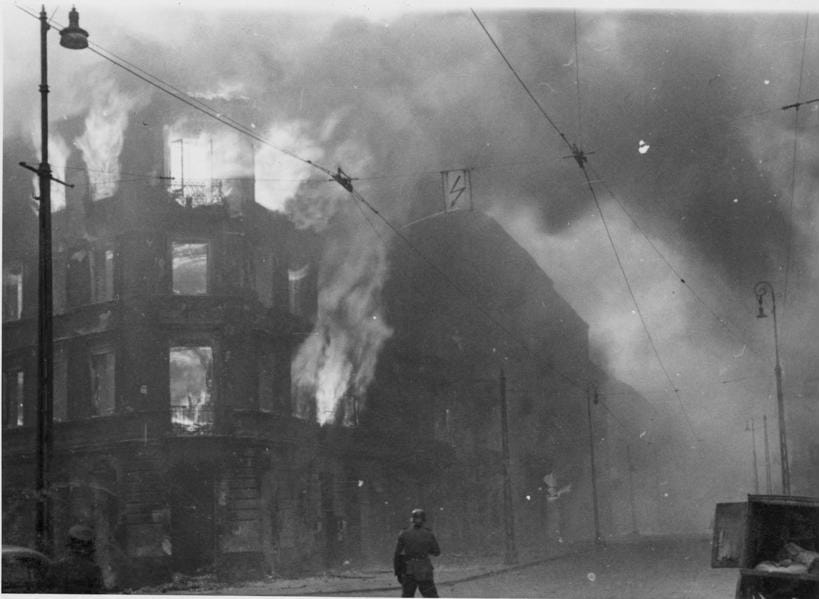
The Warsaw Ghetto Uprising, 1943
In July 1942, hundreds of thousands of Jews from the Warsaw Ghetto were being deported, most of them via the Treblinka Camp. Jewish leaders in the Warsaw Ghetto therefore decided to fight back. They started an uprising on April 19, 1943. It was put down brutally by German armed forces, for the most part within a few days, but skirmishes carried on until mid-May. Jews who survived were again generally deported.
October 6, 1943 SS chief Himmler spoke before the political elite of the Third Reich. In a brief excerpt from his long speech, we read the following (Smith/Peterson 1974, pp. 169 f.):
“I ask of you that that which I say to you in this circle be really only heard and not ever discussed. We were faced with the question: what about the women and children? – I decided to find a clear solution to this problem too. I did not consider myself justified to exterminate (only) the men – in other words, to kill them or have them killed and allow the avengers of our sons and grandsons in the form of their children to grow up.
“The difficult decision had to be made to have this people disappear from the earth. For the organization which had to execute this task, it was the most difficult which we had ever had…I felt obliged to you, as the most superior dignitary, as the most superior dignitary of the party, this political order, this political instrument of the Führer, to also speak about this question quite openly…”
October 7, 1943, the day after Himmler had given his lengthy speech about “making the Jews disappear from the earth,” Goebbels wrote: “As to the Jewish Question, (Himmler) gives a very frank and candid picture. He is of the opinion that we can solve the Jewish Question for all of Europe by the end of this year. He advocates the most radical and harshest solution, namely, that the whole of Jewry will be exterminated [auszurotten]. This is surely a consistent, if brutal, solution.”
Hans Frank (Nazi governor of occupied Poland) — diary entry for December 16, 1941: “We must destroy the Jews, wherever we find them, in order to maintain the overall structure of the Reich here. […] Currently there are in the Government General [occupied Poland] approximately 2½ million, and together with those who are kith and kin and connected in all kinds of ways, we now have 3 ½ million Jews. We cannot shoot these 3 ½ million Jews, nor can we poison them, yet we will have to take measures which will somehow lead to the goal of annihilation, and that will be done in connection with the great measures which are to be discussed together with the Reich. The territory of the General Government must be made free of Jews, as is the case in the Reich. Where and how this will happen is a matter of the means which must be used and created, and about whose effectiveness I will inform you in due time.” (IMT, Vol. 29, pp. 502f.)
On March 4, 1944, Nazi governor Frank stated (p. 687): “The Jews are a race that must be effaced. Wherever we catch one, he is coming to an end.”
Between late 1941 and late 1942, Nazi authorities deported many tens of thousands of Jews from western and central European countries to locations in the German-occupied Soviet Union… many if not most of them were killed there by the Einsatzgruppen and associated units.
“In particular the camp Maly Trostenets near Minsk (capital of Belorussia), and the prison at Fort IX near Kaunas (Lithuania) deserve to be mentioned in this context. Thousands of deported Jews were executed there.
“Jews living inside the Soviet Union were the primary target of the Einsatzgruppen and associated units…this happened primarily by way of mass shootings…German wartime documents speak of some 750,000 victims…”
“Not just one, but two Einsatzgruppen – C and D – were active in Ukraine. The most infamous crime scene associated with these units occurred in the suburbs of Ukraine’s capital Kiev, at Babi Yar… The Einsatzgruppen’s ranked death-toll list includes several entries for Ukrainian locations…(totaling approximately 138,000 victims)… Ukraine was completely occupied by Germany.. This put all of Ukraine’s remaining Jews in mortal danger, and many paid with their life.”
“SS Gruppenführer Arthur Nebe became head of Germany’s Civil Police in 1936. In June 1941, Nebe was appointed commander of Einsatzgruppe B, which he led from its inception in June, 1941 until October 1941, hence “for some four months. As such, he approved several Einsatzgruppen reports sent to Berlin which documented the execution of thousands of Jews in the deployment area of his Einsatzgruppe B.”
“SS Gruppenführer Otto Ohlendorf was the director of Office III, the “SD” (Internal Security Service) of the Reichssicherheitshauptamt (Reich Security Main Office). In 1941 he was appointed head of Einsatzgruppe D, a position he held for a year. This group operated in the southern region of the temporarily German-occupied Soviet Union (Bessarabia, southern Ukraine, Crimea, Caucasus)…“At the Nuremberg Einsatzgruppen Trial, Ohlendorf accepted responsibility for at least 90,000 victims of mass shootings carried out by Einsatzgruppe D, while he was in charge of that unit. There is an abundance of documentary evidence in support of these facts.
In the summer of 1942, the forced deportation of tens of thousands of Polish Jews from the Warsaw Ghetto was underway. When the deported Jews arrived further East, Wilhelm Kube, Nazi Commissioner for Belorussia, complained to his superior Lohse on July 31, 1942 (and later also to Alfred Rosenberg, head of the Ministry for the Occupied Eastern Territories), indicating Kube’s forces had been executing tens of thousands of Jews in the area to prevent them from supporting the partisans.”
“In Hitler’s Table Talk, Hitler drew a picture of the future of the Eastern European territories which is one of the best authenticated of his life’s visions and typical of his weltanschauung, which entailed the total disfranchisement of the subjugated. He ruled they have no claims of any kind, except to an early death. They are forbidden to learn to read and write; to concern themselves with history or politics is a crime worthy of death. Any communication whatever going beyond the confines of the village is strictly prohibited…They are to live in their filthy hovels without hygiene or inoculation, while the German settlers, strictly segregated, own splendid villages and spacious fortress farms.”
— German revisionist historian Ernst Nolte (1923-2016), author of the magisterial 1987 history, Der europäische Bürgerkrieg (“The European Civil War”).
The Zionists
“We shall try to spirit the penniless (Palestinian) population across the border…while denying it any employment in our own country… expropriation and the removal of the poor must be carried out discreetly and circumspectly.” —Theodor Herzl, founding father of Zionism, 1895
“I support compulsory transfer. I don’t see anything immoral in it” (1938). “Now a transfer of a completely different scope will have to be carried out. In many parts of the country new settlement will not be possible without transferring the Arab fellahin (Palestinian peasant farmers)….….Jewish power [in Palestine], which grows steadily, will also increase our possibilities to carry out this transfer on a large scale.”
—David Ben-Gurion, first Israeli Prime Minister, 1948
Writing in his diary in 1940 Yosef Weitz, a senior Jewish National Fund official who chaired the influential Transfer Committee before and during the Nakba (“Catastrophe”), and became known as the “Architect of Transfer,” (mass expulsion of the Palestinian population), put it thus: “The only solution is a Land of Israel devoid of Arabs. There is no room here for compromise. They must all be moved. Not one village, not one tribe can remain. Only through this transfer of the Arabs living in the Land of Israel will redemption come.”
The religious-terrorist Kach party was founded in 1971 by Brooklyn-born Rabbi Meir Kahane who argued for the immediate expulsion of the Palestinians, who he called “dogs.” In 1984, Kahane introduced legislation in the Knesset to ban all Jewish-Gentile marriages and sexual relations and revoke the Israeli citizenship of non-Jews.
In 2019, Kahane’s follower Itamar Ben Gvir formed the “Jewish Power” party, an ideological offshoot of Kach. Merging with other Talmudic-Zionist parties to form Religious Zionism in 2022, they won the third-largest share of Israel’s parliament seats. Netanyahu appointed Ben-Gvir Israeli Minister of Security. For years Ben-Gvir displayed in a place of honor in his home a portrait of Baruch Goldstein, an American-Israeli who killed 40 Palestinians and wounded more than 100 in a shooting massacre as they knelt in prayer at Hebron’s Tomb of the Patriarchs in 1994. As the Israeli Security Minister Ben-Gvir has instigated a settler reign of terror on Palestinian farmers and sheepherders on the West Bank.
In the aftermath of Goldstein’s slaughter, Noam Federman, a spokesman for the Kach party opined, “The act itself was one of greatness. It was a great act of sanctifying the Name (of God).”
Paying homage at Goldstein’s funeral, Rabbi Yaacov Perrin told mourners that “one million Arabs are not worth a Jewish fingernail.”
”Palestinians in Lebanon are two-legged animals.”
—Israeli Prime Minister Menchaem Begin (source: NY Times, August 5, 1985, p. A6)
Palestinians are cockroaches scurrying in a bottle.”
—Israeli Army Chief of Staff Rafael Eytan (source: NY Times, August 5, 1985, p. A6)
Rabbi Ovadia Yosef, the head of the powerful Israeli Shas political party and chief rabbi of Sephadic Israeli Judaism, taught that the Arab people should be exterminated, “May the Holy Name visit retribution on the Arab heads, and cause their seed to be lost, and annihilate them. It is forbidden to have pity on them. We must give them missiles with relish, annihilate them. Evil ones, damnable ones.”
—2001 Passover sermon. Cf. Haaretz, April 12, 2001. 700,000 Israelis attended Ovadia’s funeral. In its obituary, the New York Times eulogized him and omitted all reference to his calls for exterminating Arabs.
“If you believe that the Jewish state has a right to exist, then you must allow Israel to transfer the Palestinians and the Israeli-Arabs from Judea, Samaria, Gaza and Israel proper. It’s an ugly solution, but it is the only solution.”
—Ben Shapiro, American media personality, Orlando Sentinel, September 8, 2023
“Well, if everyone in Gaza is a refugee, let’s scatter them around the world. There are 2.5 million people there, every country will take in 20,000 people, 100 countries.”
— Ram Ben Barak, Member of the Knesset, ex-Mossad Deputy Director, November 1
“There should be a second Nakba.”
—Israeli agriculture minister Avi Dichter, November 11, 2023. [Nakba: the 1948 forced expulsion of 750,000 Palestinians, which culminated in the creation of the so-called “state of Israel”].
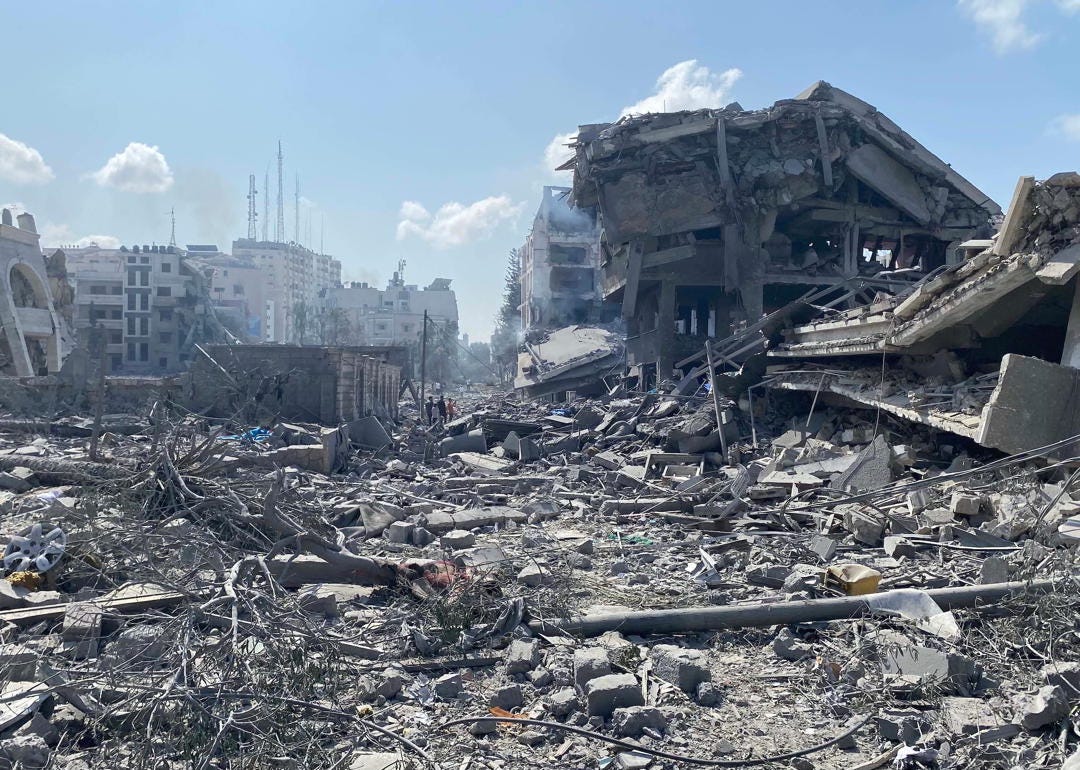
Gaza City in the early days of the Israeli terror bombings, October, 2023
“The Gaza Strip should be flattened, and for all of them (Palestinians) there is but one sentence, and that is death…Gaza has to be wiped off the map, in order to send a message to all our enemies and those who seek us harm…. In Gaza, we have to be clear, there are no innocent [civilians]. There are no “uninvolved” people.”
—Yitzhak Kroizer, Member of the Israeli parliament (“Knesset”), Nov. 5. 2023.
Tally Gotliv, an official in Binyamin Netanyahu’s Likud party, has demanded that Prime Minister Netanyahu use a nuclear bomb on Gaza. “Before we consider inserting ground troops, doomsday weapon.”
Likud member of the Knesset, Boaz Bismuth stated with reference to Gaza: “There’s no place for any humanitarian gestures.”
Israeli journalist Zvi Yehezkeli said on Israel’s Channel 13: “[We] should have killed many times 20,000 people, [we] should have begun with a blow of 100,000.”
As of January 9, 2024, the Israeli military has damaged or destroyed 70 percent of Gaza’s housing.
85 percent of the population of Gaza have been dehoused and rendered homeless.
In three months the Israelis have killed more than 22,000 Gazans, the majority of them women and children. The number of wounded, disabled and mutilated are more than twice that casualty figure. It is expected that many more Palestinian civilians will die of intentional Israeli-imposed imposed disease and hunger.
“Non-Jews are uncompassionate by nature and attacks on them curb their evil inclination.” — Torat Ha-Melekh (sometimes spelled Torat Hamelech, 2009). Torat Ha-Melekh is an Israeli rabbinic book based on the Talmud which has been widely distributed to Israeli military personnel.

A Palestinian child is treated for injuries on a hospital floor in Gaza, inflicted by the “Israeli Defense Force”, while a wounded Palestinian man awaits further medical care, autumn, 2023
Torat Ha-Melekh teaches that it is a religious duty to kill non-Jewish children on the enemy side during warfare, “if there is a good chance they will grow up to be like their evil parents.” Other reasons the Israeli authors furnish for the permission to kill non-Jewish children include if they “block the rescue of Jews… Little children are often situated in this way…it is permitted to kill them because their very presence facilitates the killing (of Jews)…(p. 215). “It is also permitted to kill the children of the leader (of the enemy) in order to put pressure on him…” (p. 215).
“We are imposing a complete siege on the city of Gaza. There will be no electricity, no food, no water, no fuel, everything is closed. We are fighting human animals and we are acting accordingly”
— Israeli Defense Minister Yoav Gallant, October 9, 2023.
On January 6, 2024 the New York Times described Gallant as “a moderate member of Mr. Netanyahu’s right-wing Likud party…” (Section A, Page 6; italics added).
“Human beasts are dealt with accordingly. Israel has imposed a total blockade on Gaza: no electricity, no water, just damage. You wanted hell—you will get hell”.
—Israeli Major General Ghassan Alian, Coordinator of the Government in the Territories, October 10
“Israel has no choice but to render Gaza into a place that is temporarily, or permanently, unfit for living.”
— Giora Eiland, Israeli Defense Ministry, October 11
“Do not leave a stone unturned in Gaza. Gaza needs to turn into Dresden. Complete incineration. Annihilate Gaza now!”
—Moshe Feiglin, Member of the Israeli Knesset, October 26, 2023. The Allied incineration by more than 800 bombers leveled the city of Dresden and burned alive tens of thousands of civilians.
Concerning the Palestinian population of Gaza: “They are not humans nor human animals, they are sub-humans and should be treated as such.”
—Arieh King, Deputy Mayor of Jerusalem, December 8
“There are no innocent [civilians] in Gaza.”
—Avigdor Lieberman, Member of the Knesset, and leader of Israel Beytenu Party, former Israeli Defense Minister, December 3
“We are too humane. Burn Gaza now, nothing less!”
—Nissim Vaturi, Deputy Speaker of the Knesset, November 17
“… we should make sure that there is a severe humanitarian disaster there (in Gaza), and severe epidemics, and horrible pressure, and cries to the sky—because that’s how wars are won… A humanitarian disaster is the only way to bring about the end of the war in a desirable way. Think about it this way: the poor women of Gaza, who are they? They are the mothers and sisters and wives of the Hamas murderers. Gaza’s system, unlike [its characterization by the US which I mentioned earlier] that there is Hamas and there are civilians—it is not true! Gaza is a state that is entirely united around its leader and its ideology for 15 years, without any dissent and with enthusiastic support….
“The weak point [of Gaza] is their civilian population…the thousands of Hamas terrorists, whose mothers and wives and children who will start suffering from severe illnesses, are the point of weakness. If we want to win the war—that’s how you win a war.”
“I agree with every word of Giora Eiland.”
—Israeli Finance Minister Bezalel Smotrich, November, 2024
“Given the collapse of Gaza’s sanitation and medical systems, as much as a quarter of Gaza’s people could die within the year, mostly from disease or lack of access to medical care.”
—Peter Beinart, Jan. 7, 2024
“Spend your energy on one thing; wiping Gaza off the face of the earth. Let the Gazan monsters fly to the southern fence and flee into Egyptian territory. Or have them die. And have them die horribly. Gaza must be wiped out. ..We require a revengeful and cruel IDF (Israeli military). Anything less than that is immoral. Simply immoral.”
—Galit Distel-Atbaryan, Member of the Knesset, November 1
“I am saying here to the citizens of Lebanon…(w)hat we are doing in Gaza we know how to do in Beirut.”
—Israeli Defense Minister Yoav Gallant, November 11.
(Gallant was telling the truth. In the summer of 1982 the Israeli air force terror-bombed the city of Beirut resulting in 20,000 civilians killed and tens of thousands wounded).
“The north of the Gaza strip—more beautiful than ever. Blowing up and flattening everything, simply a delight for the eyes.”
—Amichai Eliyahu, Israeli Minister of Heritage, November 1.
“…twice as many children have died in Gaza just since the war started on Oct. 7 as in all the conflicts worldwide in 2022…Far more women and children appear to have been killed in Gaza than in the entire first year of the Iraq war…pulverizing entire neighborhoods…Too many (people) see events through a prism in which (Israeli) lives are invaluable on one side while (Palestinian) deaths on the other are regrettable.”
—Nicholas Kristof, December 6
“This law is taught: in the case of Israel, this soul of the kelipah is derived from kelipat nogah, which contains good…The souls of the gentiles however, emanate from the other, unclean kelipot which contain no good whatever.” —Shneur Zalman of Lyady, “the Alter Rebbe.” Likkutei Amarim, (chapter 1). This sacred text is more commonly known by its first Hebrew word “Tanya.” Zalman is the founder of Chabad Lubavitch. Tanya is its revered text.
“According to this radical Hasidic teaching, divinity dwells in the inner core of every Judaic human being. Those who are non-Judaic have no humanity, no inner core in which the divine can take up residence. Those beings who are not Judaic are sub-human: empty kelipot (corporeal ‘shells’) which constitute broken vessels.
“In this theology non-Jews are broken shells who adopt the appearance of a human form which conceals their demonic essence. Those who are not Jews are the personification of purely evil materiality. Kabbalistic theology posits a cosmic dichotomy wherein the gentile represents biologically-determined, irredeemable evil. This is the esoteric rabbinic teaching which the western secret societies (also known as the ‘New Age’), understood and implemented. In the case of the indoctrination of their agent Adolf Hitler, the western occult reversed the polarities and taught Hitler that “the Jews” were the kelipot (‘untermenschen’), and the ‘Aryans’ the purely distilled essence of the divine. The Hitler/Himmler/Goebbels version of National Socialism was, unknown to these dupes themselves, a Kabbalistic teaching on the biologically-determined, irredeemable evil in the form of the ‘Jew.’ Hitlerism was Kabalism in the garments of Aryanism.”
— Michael Hoffman
“The differences between Jews and gentiles are not religious, historical, cultural or political. They are, rather, racial, genetic and scientifically unalterable. The one group is at its very root and by natural constitution ‘totally evil’ while the other is ‘totally good.’ Jewish successes in the world are completely contingent upon the failure of all other peoples. Only when the gentiles face total catastrophe do the Jews experience good fortune.”
—Rabbi Saadya Grama, Romemut Yisrael Ufarashat Hagalut (“Jewish Superiority and the Question of Exile,” 2003). Grama is an alumnus of Beth Medrash Govoha, a renowned yeshiva in Lakewood, New Jersey.
There is something infinitely more holy and unique about Jewish life than non-Jewish life.”
—Talmudic-Kabbalist Yitzhak Ginsburg, Jewish Week (N.Y.), Aug. 26, 1996
“The dissimilarity between the Jewish soul, in all its independence, inner desires, longings, character and standing vis-à-vis the soul of all the gentiles–on all of their levels–is greater and deeper than the difference between the soul of a man and the soul of an animal, for the difference in the latter case is one of quantity, while the difference in the first case is one of essential quality.”
— Abraham Isaac Kook, Chief Rabbi of Palestine, 1921-1935, “The Father of Talmudic Zionism.” [Source: David Dishon,“The Beauty of Yefet in the Tents of Shem-Gentiles and Jews in the Thought of Rav Kook,” in Havruta: A Journal of Jewish Conversation; Shalom Hartman Institute. 1 (2): 80–89.]
“Wherever there is liability for capital punishment, with regard to bloodshed, if a gentile murders another gentile, or a gentile murders a Jew, he is liable. If a Jew murders a gentile, he is exempt.”
—Babylonian Talmud, Sanhedrin 57a
Israeli Prime Minister Netanyahu, October 28: “You must remember what Amalek has done to you says our Holy Bible, and we do remember and we are fighting. Our brave troops and combatants who are now in Gaza or around Gaza and in all other regions in Israel are joining this chain of Jewish heroes, a chain that started 3,000 years ago—from Joshua to the heroes of 1948—the Six Day War, the 1973 October war—and all other wars of this country—are hero troops. They have one supreme main goal, to completely defeat the murderous enemy and to guarantee our existence in this country.”
In 1 Samuel 15:3 the judgment of God is on the Amalekites, in the form of the divine command to Saul, the first King of Israel: “Now go and smite Amalek, and utterly destroy all that they have, and spare them not; but slay both man and woman, infant and suckling, ox and sheep, camel and ass.”
These are patently the marching orders Netanyahu gave the Israeli military (‘the most moral military in the world’): slay all the civilians of Gaza and spare them not. Not even Clarence Darrow could parse it otherwise. There’s no lawyer’s loophole here; no moderating clause.
“Netanyahu’s Amalek speech was a warrant for a genocide that has been carried out to the letter, notwithstanding the delusional Gaza holocaust denial which squats in our media, churches and government atop the cadavers of thousands of ‘unclean kelipot’—bombed and burned Palestinian children and their mothers, whose deaths do not register in the conscience of America. The Talmudic-resonate belief in the worthlessness of the Palestinians is as ubiquitous and inescapable as the racist hate speech which inculcates it.”
—Michael Hoffman, January 9, 2024.
I will not be silent.
Copyright©2024 by Independent History and Research
Michael Hoffman manages the podcast, Revisionist History®. He is the author of the banned 2008 textbook Judaism Discovered (1,102 pages), and nine other volumes of history and literature, as well as 122 issues of the periodical, Revisionist History®. Michael is a former reporter for the New York bureau of the Associated Press and a former paid consultant to the news department of the New York Times. His books have been published in translation in Japan and France. He resides with his family in Coeur d’Alene, Idaho. On Twitter (“X”): https://twitter.com/HoffmanMichaelA
For Further Research
Featured Video

Iran Is Not Our Enemy
or go to
Aletho News Archives – Video-Images
Book Excerpt
“Vaccines Do Not Cause Autism!” The Science is Settled. Right?
ICAN urges the IACC to actually study infant vaccines and autism
 By Aaron Siri | Injecting Freedom | March 16, 2026
On behalf of ICAN, we just sent a copy of chapter 11 of Vaccines, Amen to the newly appointed members of the federal Interagency Autism Coordinating Committee (IACC).
If you haven’t already read this chapter, you can read the whole thing in the attached letter. I trust that after you read it, you’ll see why the statement “vaccines do not cause autism” is a belief, not science!

IACC Public Comment Letter
1.53MB ∙ PDF file
Includes chapter 11 of Vaccines, Amen
Blog Roll
 Aletho News
- Iran made ‘unexpectedly substantial’ offer during Geneva talks, US envoys ‘dragged’ Trump into war: Report
- Russia condemns Israel’s attack near Bushehr plant, files complaint
- Russia Strongly Condemns Actions Aimed at Harming Health of Iranian Leadership – Kremlin
- Israeli Journalist Demands Tucker Carlson and Candace Owens Be Placed in WWII-Style Internment Camps
- No Liability, No Studies, No Accountability: The Vaccine System Aaron Siri Exposed in Federal Court
- No time for losers: Why the war meant to save Israel may destroy it
- Top US Counterterrorism Official Resigns in Protest of Operation Against Iran
- Just Get Out! Now!
- Unpacking glaring contradictions in US-Zionist justifications for war against Iran
- Iranian model of warfare bleeds US dry while Persian Gulf states watch and learn: Analyst
- If Americans Knew
- Trump’s counterterrorism chief, whose own wife was killed by ISIS, quits over Iran War saying Tehran posed ‘no imminent threat’
- Here’s what US could fund instead of Bibi’s war on Iran
- Israel Killed Over a Dozen Lebanese Paramedics in Three Days, Now Claiming That Ambulances Are “Hezbollah” Targets
- War on Iran: These are the heritage sites devastated by US and Israeli attacks
- Four news stories from Israeli media that illustrate Israeli “justice”
- CIA Prepares Criminal Referral of Tucker Carlson, as Israel and Its Loyalists Demand His Arrest
- Top US counterterror advisor resigns in protest of “war manufactured by Israel” – Not a ceasefire Day 157
- ‘I Liked the House’: When Israeli Soldiers Turn Palestinian Homes into Barracks
- ‘They Were All I Had’: Lebanese Father Buries Parents, 4 Daughters Killed by Israeli Bombing
- Israel and its supporters are causing attacks on Jewish institutions. Case in point: Michigan synagogue tragedy.
- No Tricks Zone
- New Research: South Australia’s Mid-Holocene Sea Surface Temperatures Were 4°C Warmer Than Today
- Storing Green Energy To Last Germany 10 Days Would Require A 60-Million Tonne Battery
- New Studies: UK Sea Levels Were 4 Meters Higher Than Today During The Mid-Holocene
- Destructive Green New Deal: German Energy And Metal Group Warns Of Drastic Crisis
- New Study Documents A 20-Year Pause In Arctic Sea Ice Decline – Driven By Internal Variability
- Wake-up Call: Survey Shows Majority Of Germans Now Favor Postponing Climate Targets!
- Televised! Leading German Political Candidate Tells Schoolchildren CO2 Makes Sun Hotter!
- New Study: A Century Warming Of 1.1°C Is ‘Commonplace’ And ‘Not Unusual’ During This Interglacial
- New Study: ‘Internal Noise’ And Volcanic Forcing Can Trigger 10-15°C Warming Within Decades
- Glaciers Worldwide Are Suddendly Surging, Experts Blame Warming!
 Aletho News