More discomfort awaits the West in 2024 if it doesn’t adapt to new reality
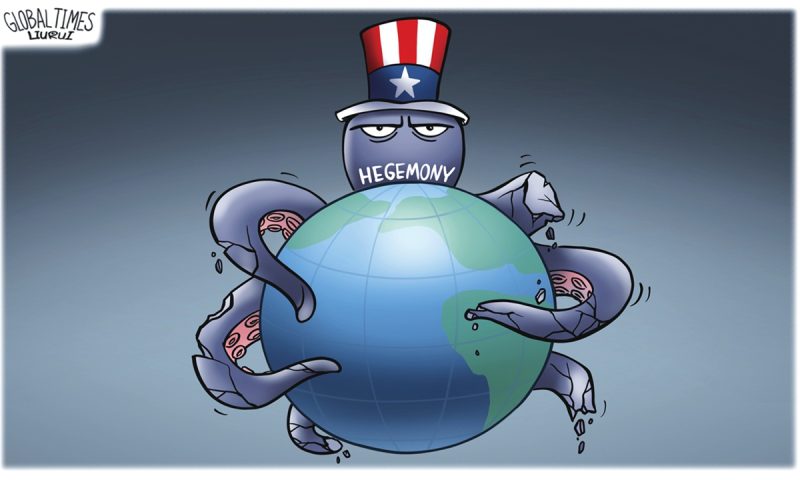
Illustration: Liu Rui/GT
Global Times | January 1, 2024
What kind of experience did 2023 bring to Western countries? According to mainstream Western media, the most apt term to encapsulate the Western sentiment is “uncomfortable.”
An article from the BBC suggests that the past 12 months have seen a number of setbacks for the US, Europe and other major democracies on the international politics stage. Although none has been disastrous for now, they point to a shifting balance of power away from the US-dominated, Western values that have held sway for years, the article claimed. The mentioned setbacks include regional conflicts such as the Russia-Ukraine war and the Israel-Palestine conflict. Challenges posed by countries perceived as adversarial by the US and the West, such as China, Iran, and North Korea, were also highlighted.
The Ukraine crisis has continued on, and the Israel-Palestine conflict has reignited, while the responses from the international community don’t align with the preferences of the US and its Western allies. All of this has made them feel “uncomfortable.”
When it comes to the Russia-Ukraine conflict, despite receiving support from the West, Ukraine has faced difficulties and failed to progress as expected in its conflict with Russia. This has led to Western fatigue and frustration. Due to partisan divisions in the US, providing aid to Ukraine has become problematic. In contrast, Russia has managed to stabilize its frontlines and handle the prolonged war effectively, Lü Xiang, a research fellow at the Chinese Academy of Social Sciences, told the Global Times. He noted that sanctions against Russia, with only around 30 countries participating in condemning Russia’s actions, have failed to significantly impact the Russian economy, instead, Russia has demonstrated remarkable resilience, contrary to Western expectations.
In the case of the Israel-Palestine conflict, most developing countries held positions inconsistent with those of the US. Many countries expressed disappointment and regret over the US veto of the Gaza-related drafts demanding an immediate humanitarian ceasefire in Gaza, distancing themselves from the US pro-Israel stance.
The BBC states that Arab ministers believe there are double standards in Western approaches to the Russia-Ukraine conflict and the Israel-Palestine conflict, accusing the Western governments of hypocrisy. This reflects a growing opposition from Global South and developing countries against the values advocated by the US and the West in various events, and the Western influence is diminishing, said Yang Xiyu, a senior research fellow at the China Institute of International Studies.
Issues such as the Ukraine crisis and the Israel-Palestine conflict increasingly demonstrate that the West, particularly Europe and the US, can no longer bring positive values to the world. More and more countries and their people in the Global South have become aware of this and refuse to accept Western double standards.
Today, an increasing number of developing countries are expressing clear opposition to irresponsible actions by the US and Europe. The major demand of these countries is to have a peaceful and stable international environment for national development. However, Western countries, the US in particular, are acting as the world’s largest disruptor of peace and creator of conflicts. In the cases of the Ukraine crisis and the Israel-Palestine conflict, the US not only fuels the flames but also opposes proposals for peace talks raised by other countries. In pursuit of its selfish interests, the US has caused suffering to the people of Ukraine and the Gaza Strip, hindering the resolution of other urgent global issues. In such circumstances, more and more developing countries are becoming courageous enough to say no to the US and the West.
In 2024, the influence and dominance of the West, whether in the Russia-Ukraine conflict or the Israel-Palestine conflict, will continue to decline. If 2023 did not unfold according to their expectations, 2024 is likely to deviate even further. This will bring more discomfort for them. Washington now has to adapt to a new reality: Global South countries are becoming more mature and gaining more decision-making autonomy. US politicians, who are used to dictating terms to countries worldwide and expecting developments to revolve around US interests, must reflect on and adapt to this new change. Otherwise, when the media summarizes 2024, it may not be as simple as just feeling uncomfortable; the experience might be more agonizing.
Are EV Fires Stories Being Covered Up?
By Paul Homewood | Not A Lot Of People Know That | January 1, 2024


On Boxing Day, we passed this house on our way up to the common where we take the dogs. We go there most days, so were shocked to see this fire damage (photos taken today). On Boxing Day, there was a totally burnt out car on the drive, and also a gas van outside, presumably checking the mains were safe. The last time we went past was, I believe, Saturday, so the fire must have happened between then and Tuesday.
We could not identify the burnt out car at the time, as we did not stop. But there is often a Tesla parked on the driveway.
The fire obviously has all the classic trappings of an EV fire. Note how the right side of the house is hardly affected. The garage door must have been subjected to extreme heat, because it is hopelessly buckled out of shape.
This is not why I am making this post however.
For some reason, there seems to be no record or news at all of this locally. The South Yorkshire Fire Service keep a daily log of all incidents they have been called to, even down to wheelie bin fires. Yet they have no record at all of this fire. I have requested any information they have, but they have so far not responded.
The local newspaper, the Sheffield Star, also appears to have ignored the story, and there is no trace of the news on Google.
Is there some policy afoot to cover up stories of EV fires? It seems far fetched, but I can think of no other explanation.
Europe under the unbearable yoke and heavy burden of the United States
By Viktor Mikhin – New Eastern Outlook – 01.01.2024
The latest round of the Palestinian-Israeli conflict, the current carnage inflicted by Israel on all Palestinians in Gaza, will continue for some time and end in another tragedy for the Palestinians. But in the long run, all these events will lead to huge negative consequences that all peoples of the Middle East, including the Israelis, will be experiencing for a long time. But while none of the parties in the world will benefit from the disaster, “European countries will particularly pay a higher price for the ongoing conflict,” notes the Iranian publication Tehran Times. Although the leaders of the European states are well aware of the erroneous nature of current US policy, they, like true American puppets, are forced to blindly and unconditionally follow Washington’s course.
History shows that there have been many cases where European countries have paid the price for US policy mistakes over the past two decades. One such striking example may be Europe’s erroneous policy towards the peaceful nuclear development issue of Iran. Until 2012, European countries were among Iran’s most important economic partners, if not the largest, and Iran was a very important market for European products. Iranians preferred German electronics and cars to similar products from elsewhere. But because of the illegal US sanctions against Iran, European companies withdrew from the Iranian market and eventually paid a heavy price for the loss of a very profitable and promising Iranian market. Today, the economic presence of European countries and their companies in Iran are almost non-existent.
The second such example could be the heavy-handed and brazen interference of the United States in the internal affairs of the Middle East over the past two decades. The Middle East, although not really peaceful, remained generally stable in the 1990s and early 2000s. Therefore, European countries were very ambitious in promoting economic integration with their Middle Eastern neighbors, since the security situation was acceptable. The Barcelona process of the 1990s was such a program for the integration of Europe and its neighbors on the other side of the Mediterranean Sea. But the first two decades of the 21st century witnessed the United States often intervening militarily in the internal affairs of a number of countries in the Middle East, including Iraq, Afghanistan, Libya and Syria. As a result of constant military actions, the states and peoples of the Middle East have been experiencing enormous regional upheavals for more than two decades, and, by all accounts, this region is the most turbulent in the world.
Several regional and non-regional players have, quite naturally, various disagreements with the United States in the field of strategy, ideology, politics and economy. However, it is the European countries that have been most seriously affected by the instability, since they are the immediate neighbors of the Middle East. The stream of refugees has increased the economic and social burden and caused divisions both at domestic and EU interstate levels. And in the distant future, they will face even more negative consequences, as European politicians will have to solve even more difficult tasks just to survive.
The third example could be the latest conflict between Israel and Palestine. The war, the carnage unleashed by Israel in the Gaza Strip, has already led to a very serious humanitarian catastrophe, since about 20,000 Palestinians have died so far, about two thirds of whom are women and children, and more than two million have been displaced and become homeless. If the war continues, there will be a more serious humanitarian catastrophe for both the Palestinians and other peoples of the region. More refugees are likely to arrive in European countries, which will add new difficulties to their economies. As some European politicians travel to Israel to demonstrate their support for Tel Aviv’s hardline policies, Muslims in these countries will become increasingly dissatisfied with the course of politicians. There will be new divisions within the EU, as some countries do not share the views of those who support Israel’s unwise policy of destroying the Palestinians of the Gaza Strip.
In general, if one knows his history, the United States has been making mistakes in the region, while the European countries have kept paying a high price for them. Then there is the question of whether the elites in Europe understand the scenario and the rationale behind it. The answer is a resounding yes. In fact, the various political concepts initiated by Europe have sufficiently indicated that Europeans are well aware of their aforementioned problem. But at the same time, they continue to make the same mistakes over and over again, or, as a Russian saying goes, they keep stepping on the same rake. Indeed, if God wants to punish someone, he takes away his mind.
In the early 2000s, European leaders proposed the concept of “negotiation diplomacy,” which, in their opinion, could allow them to shape the Middle East through an approach different from the United States’ policy of force. Thus, in 2003, French President Jacques Chirac and German Chancellor Gerhard Schroeder fiercely and decisively opposed the attempts of the United States to brazenly invade Iraq by falsifying documents and deceiving the world community. Over time, they were proved to be right, although they failed to stop the war, or rather the massacre of the civilian population of Iraq.
In the same year, three foreign ministers — of France, Germany and the United Kingdom — made a joint visit to Iran to find a solution to the Iranian peaceful nuclear development issue through their diplomacy, as opposed to the US approaches to economic sanctions and military pressure. The efforts of the European trio also proved to be correct, although they failed to change the US sanctions approach to solving the Iranian problem.
In 2010, the EU proposed a different concept of strategic autonomy, and the term itself indicated its intention to distance itself from the United States and reduce its dependence on the Americans in security matters. But, unfortunately, during this period, Europe did not make sufficient efforts to demonstrate the autonomous aspect of its policy. Instead, some European countries even sided with the United States in a policy that ultimately led to the infringement of their economic and security interests, as mentioned above.
It is true that Atlantic relations with Europe were based on cultural and historical ties, and they have not changed for a long time. But, on the other hand, European countries have really different interests. The Middle East is an immediate neighbor of Europe, yet is far removed from the United States, and anything bad that happens in the Middle East can negatively affect Europe. Logically speaking, it is unreasonable that the EU will always support the United States in all its risky plans.
Moreover, the current US policy towards the Palestinian-Israeli conflict, with millions of Palestinians already forced to leave their homes, obviously undermines justice, which should be one of the fundamental principles of the international order. The continuation of such a crisis will undermine the image not only of the United States, but also to an even greater extent of Europe, which neighbors the Middle East. In any case, it is high time for European leaders to develop a reasonable approach, balancing justice and its Atlantic obligations. Otherwise, if history is anything to go by, mistakes made under pressure from the United States can force Europe to pay an even higher and unaffordable price.
Putin names Russia’s real enemies
Ukraine itself is not an enemy, the Western elites backing it are, the Russian president has said
RT | January 1, 2024
Ukraine is a mere tool in the hands of the collective West, which has been using it to fight Russia, President Vladimir Putin said on Monday. He made the remarks at a military hospital in Moscow where he was meeting Russian servicemen wounded during the Ukraine military operation.
Asked about the enduring Western support for Kiev, the president said the elites of the collective West were actually the true enemy of Russia, rather than Ukraine itself.
“The point is not that they are helping our enemy, but that they are our enemy. They are solving their own problems with [Ukraine’s] hands, that’s what it’s all about,” Putin stated.
The conflict between Moscow and Kiev was orchestrated by Western elites, who seek to defeat Russia, he suggested. However, the collective West has been unable to achieve its goals, with the failure already showing in the change of its rhetoric on the conflict, the president explained.
“Those who only yesterday were talking about the need to inflict a ‘strategic defeat’ on Russia are now looking for words on how to quickly end the conflict.”
“We want to end the conflict too, and as quickly as possible, but only on our terms. We have no desire to fight forever, but we are not going to give up our positions either,” Putin said.
The battlefield situation is now changing despite all the aid Kiev has been receiving from the West, the president observed. Russia has been effectively outproducing the whole West militarily, he suggested, with the country’s output destined to grow even further.
“Despite the fact that from time immemorial [the West] has had such a goal – to deal with Russia, it looks like we will deal with them first,” Putin stated.
“You probably see it on the battlefield that they are gradually ‘deflating’. When a shell flies, it is probably difficult to tell whether they are ‘deflated’ or not, but in general you probably know: the situation on the battlefield is changing. And this is happening despite the fact that the entire so-called civilized West is fighting against us,” he told the servicemen.
According to Russia’s latest estimates, over 380,000 Ukrainian troops have been killed or wounded during the conflict. Ukraine has also sustained heavy materiel losses, with an estimated 14,000 tanks and other armored vehicles destroyed. Nearly 160,000 of the troop losses were during Kiev’s botched counteroffensive, launched in early June last year, Moscow says.
Western War Machine is in Panic Mode
By Salman Rafi Sheikh – New Eastern Outlook – 01.01.2024
The sheer inability of the collective West to force Russia into submission in Ukraine plus the fast-changing global opinion about the West in the context of the latter’s support for Israel’s brutal war on the Gazans has put the so-called ‘liberal-democratic’ world into a panic mode. The White House has already said that it will run out of money to fund Ukraine into 2024 unless the US Congress gives approval for more funding. This has led the Western war machine – primarily led by the US – to anticipate a possible defeat. “There is no guarantee of success with us, but they are certain to fail without us”, a senior US military official told CNN recently. Without the military support, US officials now estimate, Ukraine would fall by the summer of 2024. But, in Western calculations, Ukraine’s fall does not just mean Russia’s victory; it also implies a possible collapse of NATO and the eventual downfall of the Western-dominated global political, economic, and security order.
A recent piece in the Wall Street Journal said,
“Even more important, Russia’s success in Ukraine would increase a threat to NATO’s Eastern flank—in particular the Baltic states and Poland. Outside of Europe it would embolden Moscow’s allies Iran and North Korea and provide a template for China for the military solution of the Taiwan dispute. In all those cases, the U.S. and NATO troops could find themselves in the midst of a military conflict of the sort that Ukraine fights today without direct involvement of NATO”.
Such prospects are causing severe problems. Germany, for instance, is considering shelving voluntary force and making a return to conscription. “I believe that a nation that needs to become more resilient in times like these will have a higher level of awareness if it is mixed through with soldiers,” said Jan Christian Kaack, the chief of the German Navy. This is in addition to the fact that the German army is too small to defend itself against any threat; hence, the renewed emphasis on conscription.
But Germany is not an exceptional case. In fact, it mirrors developments in the rest of Europe. The UK, otherwise known to possess one of the best fighting forces in the world, is running into some problems of a fundamental nature. The Sky News reported earlier in the year that, a senior US general “privately told Defence Secretary Ben Wallace the British Army is no longer regarded as a top-level fighting force”. It was further reported that the “The armed forces would run out of ammunition in a few days if called upon to fight” and that “The UK lacks the ability to defend its skies against the level of missile and drone strikes that Ukraine is enduring”.
On top of it is the fact that the Russian military position in Ukraine remains strong, making it a lot harder for the West to provide enough funding. The Biden administration is facing its own challenges vis-à-vis more funding for Ukraine. As far as Europe is concerned, a recent report showed that pledges for funding made in August 2023 fell by almost 90 percent compared to the same period last year.
This is war fatigue that is being compounded by a well-sustained Russian resolve to achieve its objectives. For the West, Vladimir Putin remains “stubborn”. As Putin recently reiterated, “There will be peace when we achieve our goals… Now let’s return to these goals – they have not changed. I would like to remind you how we formulated them: denazification, demilitarisation, and a neutral status for Ukraine.”
Speaking from a position of strength – and keeping in mind the war fatigue in the West – Putin further said that Russian forces are “improving their position almost along the entire line of contact. Almost all of them are engaged in active combat. And the position of our troops is improving along [the entire line of contact.]”. This being the case, Putin conveyed no ideas of making a compromise with the West over Ukraine. Speaking from the Russian perspective, it would make no sense to offer negotiations and, thus, turn Russian tactical victories into unsustainable settlements.
Clearly, Russia has no intention of withdrawing from its victories, which is why there is a panic, especially in Europe. If Russia continues to win and the US funding stalls, Europe will be left to fend for itself. Germany’s defence minister minced no words to express this fear last Saturday when he said that the US “was losing interest in European affairs and that security tensions in the Pacific would likely leave the European Union having to fend for itself”, adding that “One can assume that the USA will be more involved in the Pacific region in the next decade than it is today – regardless of who becomes the next president,” he said. His conclusion is: “This means that we Europeans must increase our commitment to ensure security on our continent.”
In a nutshell, for the US, if the war in Ukraine was to unify the West, it is beginning to have an exactly opposite effect. There lies a very strong reason for the US to reconsider its strategy. This reconsideration can go in two directions. First, the US can withdraw from its obsession with expanding NATO to include Ukraine. Second, the US can make one last push and make Ukraine fight for as long as it can, hoping that this might break Russia. The Biden administration favours the second option, which is why it is pushing for the US$61 billion aid package. But will a Republican victory allow this to happen? A Republican victory could not only end support for Ukraine but also leave Europe in a total lurch. Tough times ahead.
Salman Rafi Sheikh is a research-analyst of International Relations and Pakistan’s foreign and domestic affairs.
Iran Deploys Cruise Missile-Armed Warship in Red Sea Amid US-Houthi Standoff

By Ilya Tsukanov – Sputnik – 01.01.2024
The Alborz, an Iranian Navy Alvand-class frigate armed with long-range anti-ship missiles and anti-submarine warfare equipment, entered the Red Sea after passing through the Bab al-Mandab Strait, Iranian media reported on Monday.
Pointing to the nation’s record of operations in regional waters since the late 2000s fighting piracy and securing international shipping lanes, Iranian media indicated that the warship’s deployment to Red Sea now comes amid an “increase of tensions” in the wake of the Gaza crisis, Houthi operations against Israeli-owned and -bound commercial cargoes, and US attacks against the Yemeni militia.
Commissioned in 1971 and named after the Alborz mountain range, the Alborz is classified as a destroyer by Iran, but classed a frigate by many foreign military observers. The 1,100 ton, 94.5 meter long vessel has a 9,000 km range, a complement of over 125 officers and crew, and is fitted with Noor anti-ship sea-skimming turbojet-powered cruise missiles, which have a range of up to 220 km and can accelerate to up to Mach 1.4 in their terminal stage.
The warship underwent major capital repairs and the installation of new equipment in 2018, and was equipped with indigenously-developed combat systems in 2020, including new close-in air defense weapons, as well as electronic warfare and target detection and tracking systems.
The Alborz took part in the Iran-Iraq War of 1980-1988. In 2021, the ship successfully fought off a pirate attack against an Iranian oil tanker in the Indian Ocean. The warship has also taken part in joint exercises with Russian and Chinese warships in recent years.
The vessel’s deployment in the Red Sea comes amid the continued deterioration of the security situation in the region, with the US military drawing first blood in its campaign against Yemen’s Houthi militants (who are attempting to close the body of water to Israeli-owned or affiliated commercial shipping) on Sunday, destroying three Houthi boats and killing ten fighters. The Houthis warned of “repercussions,” signaling the possibility of direct attacks against the warships of the US and its allies.
Earlier, UK media reported that British and US naval forces were planning “direct action” against the Houthis after issuing the militia with a “verbal final warning” about its Red Sea anti-shipping campaign.
Washington and its allies have repeatedly accused Iran of supporting the Houthis militarily. Tehran and Sanaa have each separately dismissed these claims, with Iranian officials insisting that their assistance for the Yemeni militia have been limited to moral support as part of the loose regional ‘Axis of Resistance’ anti-US, anti-Israeli coalition, and the Houthis saying their decision to launch operations against Israel in solidarity with the Palestinians were taken independently.
Featured Video
Iran War Is Accelerating the End of US Dominance
or go to
Aletho News Archives – Video-Images
From the Archives
Why the UK, the EU and the US Gang-Up on Russia
By James Petras :: 03.20.2018
Introduction: For the greater part of a decade the US, the UK and the EU have been carrying out a campaign to undermine and overthrow the Russia government and in particular to oust President Putin. Fundamental issues are at stake including the real possibility of a nuclear war.
The most recent western propaganda campaign and one of the most virulent is the charge launched by the UK regime of Prime Minister Theresa May. The Brits have claimed that Russian secret agents conspired to poison a former Russian double-agent and his daughter in England, threatening the sovereignty and safety of the British people. No evidence has ever been presented. Instead the UK expelled Russian diplomats and demands harsher sanctions, to increase tensions. The UK and its US and EU patrons are moving toward a break in relations and a military build-up.
A number of fundamental questions arise regarding the origins and growing intensity of this anti-Russian animus.
Why do the Western regimes now feel Russia is a greater threat then in the past? Do they believe Russia is more vulnerable to Western threats or attacks? Why do the Western military leaders seek to undermine Russia’s defenses? Do the US economic elites believe it is possible to provoke an economic crisis and the demise of President Putin’s government? What is the strategic goal of Western policymakers? Why has the UK regime taken the lead in the anti-Russian crusade via the fake toxin accusations at this time?
This paper is directed at providing key elements to address these questions. … continue
Blog Roll
 Aletho News
- Pentagon Fast Tracks Iran War Ground Option
- Angela Lipps Spent 108 Days in Jail Because a Facial Recognition Algorithm Was Wrong
- Trump White House plagiarized Iran war manifesto from Israel-aligned think tank
- Western media whitewashes Israel’s attempted murder of British journalist in Lebanon
- Israel-linked arms facility set ablaze in EU
- IRAN: The Three Islands Unmaking American Unipolar Sea Power in the Persian Gulf
- Trump’s dispatch of Marine Expeditionary Unit signals desperation for any symbolic success
- Iran Proposes Creating Middle East Security Structure With All Regional States – President
- Iran’s weapons industry still churning out missiles despite war: IRGC
- Washington approves billions in new arms sales to Gulf states as concerns grow over stocks of air defenses
- If Americans Knew
- Meet the former fashion blogger and shady doctor behind the ‘30,000 dead’ Iran psy-op
- Vatican Secretary of State to Trump, Israel: End the war as soon as possible
- The Majority of Americans Believe War Against Iran Benefits Israel More Than US
- Efforts to shut down pro-Palestinian speech face series of setbacks in court
- What has Israel done to my brother?
- Eid without worship in Al Aqsa – Not a ceasefire Day 161
- Trump: Israel attacked Iranian gas field without US knowledge. No more such attacks!
- America’s friends must help extricate it from an unlawful war
- Democratic Nat’l Committee’s Kneejerk Backing of Israel Is Political and Moral Failure
- Major revelations from former counterterrorism chief Joe Kent’s extensive interview
- No Tricks Zone
- Energy Expert: Germany’s Nuclear Phaseout Was A “500 Billion Euro Mistake”
- New Research: South Australia’s Mid-Holocene Sea Surface Temperatures Were 4°C Warmer Than Today
- Storing Green Energy To Last Germany 10 Days Would Require A 60-Million Tonne Battery
- New Studies: UK Sea Levels Were 4 Meters Higher Than Today During The Mid-Holocene
- Destructive Green New Deal: German Energy And Metal Group Warns Of Drastic Crisis
- New Study Documents A 20-Year Pause In Arctic Sea Ice Decline – Driven By Internal Variability
- Wake-up Call: Survey Shows Majority Of Germans Now Favor Postponing Climate Targets!
- Televised! Leading German Political Candidate Tells Schoolchildren CO2 Makes Sun Hotter!
- New Study: A Century Warming Of 1.1°C Is ‘Commonplace’ And ‘Not Unusual’ During This Interglacial
- New Study: ‘Internal Noise’ And Volcanic Forcing Can Trigger 10-15°C Warming Within Decades
 Aletho News