The brother of Jeffrey Epstein has revealed a previously unreported autopsy photo, arguing that it proves the convicted child-sex trafficker couldn’t have committed suicide in his jail cell.
Mark Epstein discussed the photo and other evidence in an interview on Friday with US podcast host Megan Kelly. The graphic picture shows a large red scar across the middle of the deceased pedophile’s neck, which his brother said was inconsistent with reports by authorities that he hung himself in his New York City jail cell.
If Jeffrey Epstein had been found hanging from the upper bunk, as reported, ligature marks should have gone up under his chin and behind his ears, his brother said. “From that picture, the ligature mark on his neck is more in the middle of his neck and sort of goes straight back,” he said. “In a hanging, it goes really high up in the front of the neck because you sink down into that noose.”
Jeffrey Epstein was found dead inside his cell at New York’s Metropolitan Correctional Center in 2019, while awaiting trial on sex-trafficking charges. His death was ruled a suicide by the city’s chief medical examiner. A doctor hired by Epstein’s family who was present for the autopsy claimed that some of the evidence, including multiple neck fractures, suggested that he was murdered.
Doubts cast on the official findings stoked speculation that Epstein was killed to prevent possible exposure of the rich and politically powerful people on his client list. Previously sealed court documents from a case involving one of the pedophile’s alleged victims were released last month but didn’t contain any of the bombshell information that some observers expected.
Mark Epstein has speculated that another inmate in the section of the jail where his brother was held killed him. The camera in that section wasn’t working on the night of Epstein’s death, according to government authorities, who have refused to release footage from a camera outside the wing or to disclose the identities of the other inmates.
“All I got from them, for every question I asked, was, ‘After a thorough investigation, we determined it was a suicide,’” Mark Epstein said. “That was the answer I got to every question.” He claimed that normal investigative practices weren’t followed, such as leaving the body in place until the medical examiner arrived.
Mark Epstein also raised questions about an autopsy photo of his brother’s legs, which didn’t have lividity marks, contrary to official claims about his body position. “If he was hanging the way they said, there would be evidence of lividity in his legs and buttocks,” he said.
All breadline massacres are equal, Orwell might have written, whilst adding that some breadline massacres are more equal than others. Such a thought comes to mind after February 4, 2024, when a Ukrainian armed forces projectile killed 28 residents in the city of Lysychansk, Lugansk region, and wounded several dozen. The civilian victims were standing in line in front of a local bakery, intending to buy bread.
Those with a memory that goes back longer than fifteen minutes (unfortunately neither the majority nor even a significant minority nowadays) may recall that a similar incident took place in Sarajevo, during the war in Bosnia, on May 27, 1992. The victims of that incident were also waiting in line to buy bread when a projectile landed nearby and killed several dozen of them.
There is a huge difference in the way the self-styled “international community” reacted to these two similar and equally lethal events. The status and identity of the victims and of the suspected perpetrators may have shaped that unequal response. In Lysychansk the victims were residents of Donbass, former citizens of Ukraine who in a referendum voted overwhelmingly to join Russia. From the standpoint of the Kiev regime and its foreign sponsors that act of disobedience made them fair game for retribution. The fact that since 2014 they have been indiscriminate targets of bombardment by the Armed Forces of Ukraine, which so far has cost at least 14,000 civilian lives, does not count as an extenuating circumstance in their favour.
The perceived human worth and political status of the preferred Sarajevo victims in May of 1992 is defined by the fact that technically they were the cannon fodder of the Sarajevo regime, the side in the Bosnian civil war that was supported by NATO and the collective West, exactly as today the same actors are supporting, and systematically exculpating, the Kiev regime.
In consequence, and in complete contrast to the treatment of Lysychansk victims in 2024, the Sarajevo 1992 victims were copiously mourned by the collective West’s politicians and media machine, whilst the designated perpetrators were indignantly vilified. Threats were made to exact harsh retribution on the perpetrators, even before any investigation to establish the facts had been conducted. Those threats were promptly carried out by inducing the UN Security Council to pass Resolution 757, inflicting punishment on the neighbouring Federal Republic of Yugoslavia by imposing a total trade embargo, followed by what the New York Times called “the most sweeping sanctions in history.” Yugoslavia was selected for such punishment because of its support for the Bosnian Serbs, who were accused, although firm evidence was not presented, of maliciously firing the mortar shell which resulted in the fatalities.
The killings in Lysychansk, by marked contrast, have passed virtually without comment in the Western media. No indignation was displayed and the sparse mention of the tragedy was peppered with qualifiers such as “alleged,” inserted to put in doubt the incident’s veracity. No urgent sessions of the UN Security Council were convened to assess what had happened in Lysychansk nor were furious calls heard to impose punitive sanctions either on the direct perpetrators or their foreign sponsors, on the latter for having supplied the lethal devices that caused the death of civilians in that particular breadline. This time, Russia did not even bother to try to convene a Security Council session, obviously realising there was no point following the recent downing of its airplane that was transporting Ukrainian prisoners of war to be exchanged, after its request for a Security Council meeting was flatly denied by the French rotating president of that body.
Nor is the 2024 Lysychansk massacre likely to have any other repercussions comparable to what followed the similar incident which took place in Sarajevo in 1992. To this day there is no conclusive proof of where the mortar shell that struck the Sarajevo breadline originated, but circumstantial evidence strongly suggests that it may have been staged by Sarajevo authorities to provide a rationale for punishing their adversaries. Nevertheless, the massacre was featured in the Hague Tribunal indictment of Bosnian Serb President Radovan Karadžić. The embarrassing inadequacy of the evidence subsequently presented by the Prosecution caused that charge to be quietly passed over in the final verdict. There is no indication that the International Court of Justice, also in the Hague, is entertaining the thought of similarly calling the political and military leadership in Kiev to account for committing a strikingly analogous crime in Lysychansk, or even of undertaking a pro forma investigation to sort out what happened.
In reacting selectively to lethal wartime incidents the collective West has displayed a hypocrisy breath-taking in scope as it shamelessly and publicly adheres to double standards motivated entirely by utilitarian considerations and political favouritism. Even-handed respect for human life or international humanitarian law does not seem to play any role. Western policy and the stance of the media have followed exactly the analytical paradigm elaborated by Edward Herman and David Peterson in their seminal study The Politics of Genocide for the classification of atrocities and the distinction between “worthy and unworthy victims“:
“When we ourselves commit mass-atrocity crimes, the atrocities are Constructive, our victims are unworthy of our attention and indignation, and never suffer ‘genocide’ at our hands… But when the perpetrator of mass-atrocity crimes is our enemy or a state targeted by us for destabilization and attack, the converse is true. Then the atrocities are Nefarious and their victims worthy of our focus, sympathy, public displays of solidarity, and calls for inquiry and punishment.“ [P. 103]
The characteristic of Constructive atrocities (and presumably the mass killing of civilians in Lysychansk and more broadly in the Donbass fits that description) is that “the victims were rarely acknowledged, the crimes against them rarely punished (with only low-level personnel brought to book in well-publicised cases like My Lai)“ [p. 19] because “demonization of the real victims and atrocities management remain as important as ever and keeps the citizens of the imperial powers properly misinformed and supportive of bigtime atrocities.“ [P. 22]
“… [W]ith civilian killings largely kept off the official books,“ the authors continue, “and, even when acknowledged, treated tolerantly for these unworthy victims, such killings and bloodbaths … have been thoroughly normalized. “ [P. 37]
That, in sum, is the moral bookkeeping of the contemporary West.
As doctors drop Paxlovid because of drug interactions, Covid rebounds, and virus shedding, Pfizer cranks the PR machine to hide the facts and shame “anti-paxxers.”
Whenan article by Los Angeles Times metro reporter Rong-Gong Lin II recommended last month that practically everyone who tests positive for Covid takes Pfizer’s Paxlovid, some media veterans may have wondered what had become of the traditional wall between news reporting and advertising.
The story, which appeared on January 28, swept away almost all of the reservations that have been raised about the safety and effectiveness of this patent medicine, assuring us that “Paxlovid rebound” is a non-issue and fear of serious side effects is “erroneous.” It even went so far as to suggest that if your doctor won’t prescribe this “highly effective” medication, it’s time to go doctor shopping.
So why is this LATimes writer so desperately trying to sell us this fast-tracked antiviral that comes with a black box warning?
The article appeared at a particularly critical time for Pfizer just as it transitions from Emergency Use Authorization, or EUA Paxlovid, to FDA-approved Paxlovid. Originally free to patients, the medication was stockpiled by the U.S. government to the tune of 24 million treatment courses at a cost to taxpayers of $530 a box. Now, the FDA-approved version (same drug, different box) sells for a list price of up to $1,500. (According to an analysis by researchers at Harvard University, the actual cost to Pfizer for a five-day Paxlovid course is $13).
But to Pfizer’s chagrin, it now doesn’t seem to be able to even give the stuff away, let alone sell it at a premium price. Last fall Pfizer accepted a return of nearly 8 million boxes sent back by the U.S. government.
What’s a drugmaker to do when both patients and doctors shun a product that was anticipated to be the better half of Pfizer’s post-Covid “multibillion-dollar franchise?
Flush with all that Covid cash and new Paxlovid FDA approval last May, Pfizer went shopping for partners to help promote its products.
No stranger to top-tier PR firms such as Edelman and Ogilvy, the drugmaker tagged two of the biggest names in contemporary communications companies, Publicis Groupe, a Paris-based giant PR and ad agency, and the humongous Interpublic Group. These high-level agencies come at a big price tag, but what they can offer is priceless—a way to get your story told by respected media outlets.
That’s right, if you have enough money to hire the folks with all the right contacts, you too can create your own “news!” And these special contacts are something that PR firms, such as Edelman, are very proud of. Many agency hires, in fact, are recruited directly from major media outlets, such as Edelman NYC Brand Director Nancy Jeffrey, who spent a decade at the Wall Street Journal.
As quoted in an Edelman website blog, Jeffrey recalls how Richard Edelman (son of founder Dan) would call her during her time working at the paper “to meet a client with a story to tell.” As Jeffrey says, “No one at Edelman ever rises too high to pitch a reporter.”
So was our LA Times reporter “pitched,” or does he just have an evangelical connection with Paxlovid?
Let’s take a close look at his story and see what we find.
First, there’s the article’s headline, which began: “If it’s COVID, Paxlovid”? Getting your oft-advertised product’s rhyming tagline in a headline—now that’s branding! And we don’t have to tell any of the side effects in this venue. The LA Times piece was off to a great start.
Why aren’t more people being given Paxlovid, the reporter wanted to know. It’s “cheap or even free for many,” he said. And then he delivered his first rave review, calling it “highly effective.”
By paragraph four, however, our intrepid reporter had uncovered the bad news that “a number of doctors are still declining to prescribe it.” But why? It must be those pesky “outdated arguments” about “Paxlovid rebound.” Anyone who gets Covid “has a similar rare chance of rebound,” he told us. For extra punch, he called on Dr. Peter Chin-Hong, professor of medicine at UCSF, to back up that statement. Rebound is “like, bogus” and “just dumb,” Chin-Hong said.
What Lin didn’t report is that a study published in the Annals of Internal Medicine in November 2023, by researchers from Mass General Brigham, found that in Covid patients taking Paxlovid, rebound was “much more common” and often without symptoms. Nearly 21 percent had virologic rebound versus under 2 percent not on the drug. Of perhaps even more significance, prolonged viral shedding for an average of fourteen days was noted in those who rebounded, indicating that they “were potentially still contagious for much longer.” The virologic rebound “phenomenon,” in Paxlovid patients, the authors noted, “has implications for post-N-R (Paxlovid) monitoring and isolation recommendations.” This study closely monitored patients with follow-ups three times a week “sometimes for months.”
After quoting from several Paxlovid-positive FDA and CDC statements and referencing a California Public Health commercial where people dance to an upbeat tune singing “Test it, treat it, beat it, California you know you need it,” Lin got around to some serious stuff—side effects.
Not mentioned by Lin, but good to know anyway, Paxlovid bears an FDA-required black-box warning about drug interactions, cautioning of “potentially severe, life-threatening, or fatal events.” But the article carefully danced around this inconvenient issue, simply mentioning that some Paxlovid takers may need to have their medications adjusted. The fear of “serious side effects . . . is largely erroneous,” it claimed.
Really?
“There are 125 drug interactions (for Paxlovid) across twenty-five different classes of medicines,” author and FLCCC President Dr. Pierre Kory said in a phone interview. “I’ve never used any medicine that had that number and degree of drug interactions, and I find it absurd,” added Kory, who is an expert in early Covid treatment.
And this is no secret. The Paxlovid package insert lists thirty-nine specific drugs that interact with this anti-viral (which is not a complete list, we’re warned) including medications that treat conditions such as an enlarged prostate, gout, migraines, high blood pressure, high cholesterol, arrhythmias, and angina.
With side effects out of the way, our reporter moved on to an interesting idea—doctor shopping.
If your doctor turns you down for Paxlovid, “what other options are there?” How about “reaching out to another healthcare provider” we’re advised, one “who might be more knowledgeable about Paxlovid . . .”
Don’t be an ‘Anti-Paxxer!’
The LA Times isn’t alone in this timely pushing of Paxlovid. The New York Times also ran a glowing Paxlovid piece at the beginning of January. The black-box warning was glossed over by simply saying that some “doctors balk” over the “long list of medications not to be mixed with Paxlovid,” referring to the drug as being “stunningly effective.” The NYT reporter also added five mentions of a study—actually a preprint (not yet peer reviewed or published)—which through the use of statistical magic concluded that during the course of the research had only half of the eligible Covid patients in the U.S. taken Paxlovid, 48,000 lives would have been saved.
The server where the research was posted warns journalists and others when discussing preprints to “emphasize it has yet to be evaluated by the medical community and information presented may be erroneous.”
Paxlovid is not the only drug that gets special treatment by the media. Last January, a 60 Minutes segment was called out by the Physicians Committee for Responsible Medicine as “an unlawful weight loss drug ad” for the med Wegovy. The piece, it noted, “looked like a news story, but it was effectively a drug ad,” the group said in a press release. PCRM also stated that Novo Nordisk, which makes Wegovy, paid over $100,000 to the doctors CBS interviewed for the segment.
With this new frenzy to sell Paxlovid, one can’t help but compare it to the campaign against ivermectin. Kicked off by the FDA in August 2021, it successfully branded this Nobel Prize-winning, FDA-approved drug as nothing more than a horse dewormer endorsed by fanatical outlier doctors and accepted by gullible patients. Despite being found to be an extremely safe treatment as well as an effective one for Covid, the FDA, CDC, and its media “partners” made ivermectin the subject of false accusations and warnings about the supposed risks of using it.
But early on in the game it was decided, as Dr. Kory pointed out, “to keep the market open for their novel pricey Paxlovid pill.” And to that effect, nothing was going to stand in the way. In an interview last summer with the head of the UCSF Department of Medicine, FDA Commissioner Dr. Robert Califf admitted that he helped promote Paxlovid—something he acknowledged is explicitly against the rules.
“In normal times, the FDA should not be a cheerleader . . .” Califf said. But since back then EUA drugs could not be advertised (a policy that changed in the fall of 2022) he went ahead and pitched it himself.
The Paxlovid campaign is far from over. In fact, it may now be revving up to full throttle. There’s even a name being bandied about for those who question the drug: “Anti-Paxxers.”
And if we can take any insight from the new Pfizer tagline (just filed for protection with the US Patent and Trademark Office), “Outdo Yesterday,” there are even more spurious strategies in its pharmaceutical pipeline.
Linda Bonvie is an investigative journalist, freelance health and environmental writer and co-author of several books including “Chemical-Free Kids” and most recently “A Consumer’s Guide to Toxic Food Additives.”
Washington is a place where a clueless politician like former Speaker of the House Nancy Pelosi can, with a straight face and providing no evidence, claim that pro-Palestinian protesters in the United States are working for Russia and/or China. She has asked the FBI to investigate. But in spite of that and for a change there was also some good news coming out of the Federal Capital though it was far outweighed by the bad things that the US government does almost reflexively, clearly with little regard for possible consequences. The good news is that Ukraine and Israel, incorrectly described by the New York Times as America’s “allies,” might not soon be getting their expected fat checks and planeloads of military equipment from Washington, which will no doubt hamper their plans to weaken Russia while also killing Palestinians. The GOP controlled House presented a unilateral standalone bill giving $17.6 billion to Israel but ignoring other alleged national security obligations being advanced by the White House. The bill was submitted “under suspension,” which is a procedural tactic that fast-tracks an item for a vote but requires a two-thirds majority to pass. It failed 250-180 in the voting last Tuesday. The House bill went down when the Democrats were able to muster enough votes to block its passage in support of White House objections, even though a formidable percentage of the House normally votes to support anything and everything related to Israel. The “no” voters argued that the GOP bill was an attempt to “undermine the possibility of a comprehensive bipartisan funding package that addresses America’s national security challenges in the Middle East, Ukraine, the Indo-Pacific region and throughout the world.”
If the bill had passed and eventually reached Biden’s desk for signature, a possibility that the White House had dismissed as a “cynical political maneuver,” he would have refused to sign it in spite of his often expressed great love for Israel. Over last weekend, White House Press Secretary Karine Jean-Pierre issued a statement declaring that “The security of Israel should be sacred, not a political game. We strongly oppose this ploy which does nothing to secure the border, does nothing to help the people of Ukraine defend themselves against Putin’s aggression, and denies humanitarian assistance to Palestinian civilians, the majority of them women and children, which the Israelis supported by opening the access route.”
It should be noted that Jean-Pierre is lying. It is the White House, not the GOP bill, which “denies humanitarian assistance” to the Gazans by supporting Israeli total control over the importation of relief supplies and food. According to the UN, 95% of emergency supplies are being blocked or interfered with by Israel, which continues to bomb civilians throughout the strip. In response to that reality, the White House has issued a national security memorandum that will require that countries receiving US military aid not impede the delivery of humanitarian assistance even during wartime, though the Thursday memorandum does not specifically mention it as applying to Israel, only to “allies and partners.” The aid recipients must also confirm in writing that they “will use any such defense articles in accordance with international humanitarian law.”
In a bid to counter the Republican efforts and advance his own agenda, President Joe Biden and whoever pulls his strings came up with their own war funding plan, which came apart and “crumbled” in a close 49 to 50 vote due to lack of sufficient support in the Senate on Wednesday night. The Democrats had the brilliant idea of tying in their offering of $14.1 billion in aid to Israel to the $60 billion to be given to Ukraine to get them through the next year plus $4 billion for Taiwan. Also included was $10 billion in humanitarian aid, but as the United Nations Relief and Works Agency program for Palestine (UNRWA) was predictably blocked from receiving any of it, the $1.4 billion allocated to Gaza would likely not actually have been delivered in any case in spite of Biden’s promotion of the “humanitarian” aspect of the legislation. If the bill had passed, one would not have been surprised to see the bulk of the humanitarian aid winding up in Israel to compensate it for its perpetual victimhood, this time allegedly meted out by Hamas!
The White House’s reasoning behind the initiative was that by wrapping all the commitments together in an omnibus Senate bill, Congress wouldn’t dare withhold money from Israel and the other aid packages could slide through the process without any serious opposition. But the Republicans were able to muster enough “no” votes from congressmen concerned about where the money was coming from to pay for the aid to block the Senate bill. A third “national security” spending bill is nevertheless now in the works, having passed through the Senate on Thursday night by a filibuster proof 67 to 32 vote. It includes the money for Ukraine and Israel as well as for Taiwan and for “humanitarian” programs, but it still has to pass through further tweaking in the Senate to satisfy Republican concerns about immigration and the border, followed by a second vote in the Senate before it then goes on to the House of Representatives for final approval before landing on the presidential desk. So at this point nobody gets anything, which is a perfect solution when one is fighting three or four technically illegal wars, one involving genocide, in which money provided to Israel plausibly involves the United States in supporting a crime against humanity.
On the same previous day as the vote in the House on the Israel aid, the GOP, unfortunately, also failed in its bid to impeach Homeland Security Secretary Alejandro Mayorkas by a vote of 216-214. Four Republicans voted against together with all the Democrats on grounds that impeaching a cabinet secretary over policy disagreements sets a bad precedent. Mayorkas’ record regarding relatively free entry of waves of literally millions of illegal immigrants from Mexico is well known, but the presumption is that he is carrying out policies under instructions from the president. The border has become known as such an easy way to enter the US that charter flights to Mexico from places like India and Africa are regularly being run to bring in the new illegals. Interestingly the failed Senate bill relating to Israel and Ukraine funding also included as a sweetener some guidelines regarding changes regarding border and migrant “security” issues, though Republicans observed that the language was such that Mayorkas would continue to have a free hand in setting policy and enforcement, meaning that there would likely be no change from the current laissez faire. Mayorkas defended himself against attacks in a Senate hearing by Republican Senator Josh Hawley, who was, ironically, challenging the secretary over a pro-Palestinian employee at Homeland Security, by characteristically citing his Jewish ancestry-bestowed victimhood and the so-called holocaust. He said angrily “Perhaps he does not know that I am the child of a Holocaust survivor. Perhaps he does not know that my mother lost almost all her family at the hands of the Nazis. And so I find his adversarial tone to be entirely misplaced. I find it to be disrespectful of me and my heritage. And I do not expect an apology.”
So the utterly incompetent Mayorkas survived, But the worst news of the week has to relate to the continuing warfare going on and also escalating in the Middle East. The region has been simmering ever since Israel launched its devastating attack on the mostly civilian population of Gaza in early October. The bombing and shooting of civilians has continued in spite of a judgment by the International Court of Justice (ICJ) that Israel was engaging in actions that could be characterized as genocide. The United States, which is continuing to arm and fund Israel, could be seen, in legal terms, as an accessory to genocide given the terms of the court ruling. Israel, for its part, was warned that it must cease and desist from targeting and killing civilians, blocking food and other relief supplies to encourage both famine and disease, and destroying critical infrastructure like water treatment plants and hospitals.
The United States is responsible for escalating the conflict through its total support of Israel and its attack on the Houthis as well as the current strikes against targets in Syria and Iraq. Hypocritically the White House is at the same time boasting that it is not expanding the war because it has not yet struck Iran, as the Israelis are stridently seeking. To retaliate against a drone attack that killed three US soldiers at a base straddling the Jordan-Syria border, the United States attacked more than 85 targets in Syria, Iraq and Yemen simultaneously, killing at least forty civilians in Syria as well as a high level Iraqi militia commander in Baghdad. The multi-million-dollar cruise missiles and smart bombs being used by the Navy and Air Force are reportedly expensive and already hard to replace. And why is the White House bombing so many targets in Iraq and Syria when only one US base which may have actually been completely illegally in Syria was hit? The one site that launched the device that struck the base was reportedly among the targets, but the effectiveness of the retaliation is unknown, meaning that the US is engaged in collective punishment and killing innocent tribesman living in the deserts in western Iraq and eastern Syria as well as in the Iraqi capital Baghdad. This is itself an escalation and more will surely follow, inevitably creating new enemies who will be motivated to seek revenge against Americans at the remaining bases. The smart policy would be to shut down the illegal bases in both Syria and Iraq, as has been demanded by the local governments and people, but that would mean not being able to steal more Syrian oil. This escalation was not the right response, but no one expects Biden and his crew to be smart.
In fact, the local militia fighters wasted no time and struck back immediately, killing six US-supported Kurdish fighters by way of a drone strike on a US base in eastern Syria. The men were killed in an attack on the US facility located at al-Omar oilfield in Syria’s eastern Deir ez-Zor province. A further 18 militiamen were wounded. Additional attacks on US bases in Syria and Iraq are likely to increase, not decrease in the coming weeks, with no end in sight. If anyone can explain why the United States continues to shoot itself in the foot both worldwide and at home it would certainly be interesting to hear a whole new series of lies to justify bad policies and performance. In 2015 distinguished journalist Robert Fisk asked what is “The difference between America and Israel?” He answered “There isn’t one. Netanyahu knows he can get away with anything in America – with the same confidence that he can support his army when they slaughter hundreds of children in Gaza.” He has now observed that the 2016 election was between a “Liberal American Zionist fascist,” and a “Conservative American Zionist fascist,” with the latter winning in 2016, and the former in 2020. And now we’re likely back to the latter in 2024.
Joe Biden is clearly getting nervous. In an impromptu speech on Thursday responding to disparaging comments made by the special counsel investigating his mishandling of classified documents, he denied suffering from memory problems. Unfortunately, in his comments he described Egypt’s President Abdul Fattah al-Sisi as the leader of Mexico. But he also delivered a scathing comment on Netanyahu that has resonated, saying “I’m of the view, as you know, that the conduct of the response in Gaza, in the Gaza Strip, has been over the top. I’ve been pushing really hard, really hard, to get humanitarian assistance into Gaza. There are a lot of innocent people who are starving. There are a lot of innocent people who are in trouble and dying. And it’s got to stop.” Israel is currently bombing the Rafah area in Gaza, which is packed with refugees as Israel had previously declared it to be a “safe” zone. During Secretary of State Anthony Blinken’s recent visit to Israel, he reportedly told Netanyahu that Washington wouldn’t support any “unplanned” ground operation in Rafah. The Israeli Prime Minister angrily rejected the advice and Israel escalated attacks anyway.
One has to wonder if Joe Biden is up to improving his re-electoral prospects in the nine months remaining until the election by abandoning his hitherto sordid defense of Israel’s crimes. And, if he does so, what will he do when Bibi and the Israel Lobby begin pushing back real hard on him, as they inevitably will?
Philip M. Giraldi, Ph.D., is Executive Director of the Council for the National Interest, a 501(c)3 tax deductible educational foundation (Federal ID Number #52-1739023) that seeks a more interests-based U.S. foreign policy in the Middle East. Website is councilforthenationalinterest.org, address is P.O. Box 2157, Purcellville VA 20134 and its email is inform@cnionline.org.
Here is the text of the expert report on Mann v. Simberg/Steyn in 2020 that I prepared at the request of Mark Steyn’s counsel.
My report, along with all other expert reports from both sides except for Abraham Wyner, were not admitted into evidence.
In my opinion, my report provides some much needed context for the trial. Here is a formatted pdf of my complete expert report [Curry Steyn Mann]
Report of Judith Curry, Ph. D.
I submit this report under D.C. Superior Court Civil Rule 26(a)(2)(B) & (C) as both fact and expert witness to address the subject matter on which I expect to present evidence and to summarize the facts and opinions on which I expect to testify. This report includes my observations and opinions as a lay and expert witness concerning three principal topics: (I) the nature of the scientific and public controversy concerning the Hockey Stick graph; (II) whether the Hockey Stick graph can be regarded as ‘fraudulent’; and (III) Michael Mann’s role in the downward spiral of climate science discourse. I present sections (I) and (III) mostly in my capacity as a fact/lay opinion witness and section (II) in my capacity as an expert witness.
SUMMARY
This report addresses the issue of whether it is reasonable to refer to the Hockey Stick graph as ‘fraudulent’ in the course of the public debate on climate change.
What is the nature of the scientific and public controversy concerning the Hockey Stick?
It is my opinion that the Hockey Stick has generated a dynamic and heated debate about its significance and its flaws. Since its publication, Mann’s Hockey Stick has been the subject of intense and often polemical comment and argument in: (a) peer-reviewed, scientific publications critical of the Hockey Stick; (b) analyses of the science behind the Hockey Stick on technical climate blogs; (c) published books on the Hockey Stick controversy; (d) articles by leading science journalists in the mainstream media; (e) online encyclopedia entries on the ‘Hockey Stick Controversy’; (f) Congressional hearings and investigations related to the Hockey Stick; and (e) the personal controversy surrounding Michael Mann in his efforts to defend the Hockey Stick and to thwart his critics.
2. Is it reasonable to regard the Hockey Stick as ‘fraudulent’?
It is my opinion that it is reasonable to have referred to the Hockey Stick in 2012 as ‘fraudulent,’ in the sense that aspects of it are deceptive and misleading:
Image falsification: Mann’s efforts to conceal the so-called “divergence problem” by deleting downward-trending post-1960 data and also by splicing earlier proxy data with later instrumental data is consistent with most standards of image fraud.
Cherry picking: Evidence shows that Mann engaged in selective data cherry picking to create the Hockey Stick, and that this cherry picking contributes to the perception of a “fraudulent” Hockey Stick by journalists, the public and scientists from other fields.
Data falsification (the ‘upside-down’ Tiljander proxy): Substantial evidence shows that Mann inverted data from the Tiljander proxies in a version of the Hockey Stick published in 2008. Mann did not acknowledge his mistaken interpretation of data. Even after published identification of the mistake, this mistake has propagated through subsequent literature including the IPCC 4th Assessment Report.
3. What is Mann’s role in the downward spiral of climate science discourse?
It is my opinion that the scientific discourse surrounding climate change in general, and the Hockey Stick in particular, has deteriorated in civility and professionalism, and that Mann has played a significant and active role in this corrosion and unprofessional degradation of tone. Mann’s approach to public discourse about his work and broader topics in climate change has contributed much to the hostility and animosity that characterize and mark these exchanges. My opinionis based on: (a) the norms of science and scientific discourse; (b) Mann’s withholding of data from his peers; (c) Mann’s efforts to stifle skepticism; and (d) Mann’s attacks on scientists who disagree with him.
THE SCIENTIFIC AND PUBLIC CONTROVERSY SURROUNDING THE HOCKEY STICK
The Hockey Stick is a graph of global temperatures for the last 600 to 1000 years, reconstructed from tree rings and other so-called proxy data. Its name comes from its shape – a long flat ‘handle’ representing comparatively stable temperatures in earlier centuries, followed by a dramatic uptick – the ‘blade’. The Hockey Stick graph was originally published in two papers co-authored by Michael Mann, Raymond Bradley, and Malcolm Hughes (MBH98, MBH99)[1]. MBH98 included a 600-year reconstruction and MBH99 included a 1000-year reconstruction.
Although Mann had only recently received his Ph.D., he was named as a lead author for a chapter in the Intergovernmental Panel on Climate Change (IPCC) Third Assessment Report (TAR), published in 2001. The Hockey Stick graph appeared seven times in the IPCC TAR, and appeared as the backdrop in the IPCC press conference announcing the findings of the report. Rather than displaying all of the long-term temperature reconstructions considered by the IPCC TAR, the opening figure of the Working Group 1 Summary for Policymakers highlighted a graph of temperature reconstructions based only on the MBH99 paper.
Following the public release of the IPCC TAR, the Hockey Stick was regarded as central to the IPCC’s case for global warming. The Hockey Stick was, for a time, arguably the most important graph in the world. Its message of unprecedented warmth at the end of the twentieth century was a vital part of the campaign to persuade the public that mankind had changed the world’s climate.
Since publication of the Hockey Stick in Mann’s paleoclimate reconstructions of temperatures (MBH98/99) and its prominence in the IPCC Third Assessment Report (TAR; 2001)[2], there has been substantial scientific controversy over the methods that Mann and his co-authors used in this research. The controversy extends to the results of their analysis, which contradicted existing geological and historical knowledge of the Medieval Warm Period and the Little Ice Age.
Of particular note are two papers published by McIntyre and McKitrick in 2005 that challenged the MBH98/99 analyses (section IIA). These papers motivated two Congressional investigations and hearings in 2006 (section IIE).
In November 2009, the unauthorized release of emails from the Climatic Research Unit at the University of East Anglia (UK) (“Climategate”) revealed that several scientists (including Mann) had evaded Freedom of Information Act requests for data, manipulated the peer review process, downplayed uncertainty about their research and attempted to squash disagreement and dissent from ‘skeptics.’ The publicity surrounding Climategate (Sections IIB, IIC) brought the Hockey Stick controversy back into the public debate on climate change, largely vindicating a range of concerns that had been raised by McIntyre and McKitrick.
The analysis presented in this section documents the controversy surrounding the Hockey Stick, without passing judgment on the merits (or not) of the original research or the criticisms.
As an active participant in the debate over climate change and the Hockey Stick, I recall the development of this debate.
I summarize this controversy by considering the following sources:
Scientific journal publications critical of the Hockey Stick
Critical analyses in technical climate blogs
Published books on the Hockey Stick controversy
Articles by leading science journalists in the mainstream media
Online encyclopedia entries on the ‘Hockey Stick Controversy’
Congressional Hearings and investigations related to the Hockey Stick
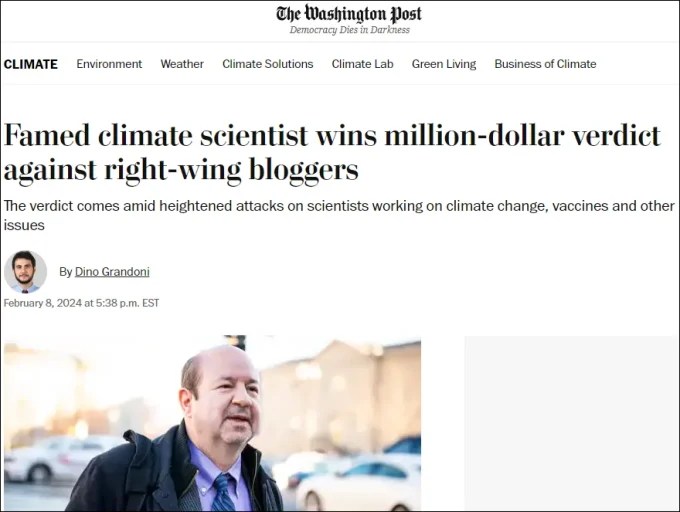
Yesterday, a jury in Washington, DC awarded renowned climate scientist Michael E. Mann more than $1,000,000 in damages in a defamation lawsuit he brought against two bloggers.1 I was a witness in the case and testified on Tuesday.2 Here, I’ll offer my thoughts on the case and some personal reflections on my experience.
Mann’s case alleged that he was defamed by statements made the bloggers more than a decade ago, which harmed his reputation and career (I won’t rehash the details here, but you can get a full accounting of the trial at this comprehensive podcast).3
The defense built their case around making three points to the jury.
One was to bring in experts to testify that Mann’s methods in producing the so-called “Hockey Stick” graph were manipulative, and thus critics of the Hockey Stick were factually correct in saying so. The second point was to demonstrate that the debate over climate during the time that the blog posts were written was intense and vitriolic, with Mann saying things about others that were worse than what the defendants said about him.4 Finally, the defense argued that Mann hardly put on a case — he provided no evidence or witnesses supporting his claims of damage to reputation or career.
In contrast, the prosecution was — in the words of the court, “disjointed” — and was reprimanded on multiple occasions by the judge, most notably for knowingly providing false information to the jury on alleged damages suffered by Mann.5 When I was cross-examined, Mann’s lawyer had considerable trouble getting basic facts right like timelines and who said what.6
Even so, in a trial that most neutral observers would surely see as favoring the arguments of the defense, Mann walked away with a resounding, comprehensive victory.7 How did that happen?
In my view, there were two absolutely pivotal moments in the trial.
One occurred when Mann was testifying and he explained that he felt that the bloggers were not just criticizing him, but they were attacking all of climate science, and he could not let that stand. As the world’s most accomplished and famous climate scientist, Mann intimated that he was simply the embodiment of all of climate science.
For the jury, this set up the notion that this trial was not really about Mann, but about attacks on all of climate science from climate deniers.
The second pivotal moment occurred when in closing arguments Mann’s lawyer asked the jury to send a message to right-wing science deniers and Trump supporters with a large punitive damage award.
Here is how an advocacy group called “DeSmog” accurately reported these dynamics:
Mann sued Simberg and Steyn for defamation, but the trial proved to be about much more than statements that harmed the scientist’s reputation — the entire field and validity of climate science was under scrutiny.
In closing arguments, Mann’s lawyer John Williams compared the climate deniers in this case to election deniers overall. “Why do Trumpers continue to deny that he won the election?” he asked the jury. “Because they truly believe what they say or because they want to further their agenda?”
He asked the jury to consider the same question about Steyn and Simberg: Did they believe what they wrote was the truth, or did they just want to push their agenda? . . .
“Michael Mann is tired of being attacked,” Williams told the jury. “You have the opportunity to serve as an example to prevent others from acting in a similar way” to Simberg and Steyn.
An underlying current throughout this trial has been that climate denialism, like what the two defendants practice, isn’t really about the science. It’s more about politics and policy that drives organizations and individuals to “attack the science and confuse the public . . .
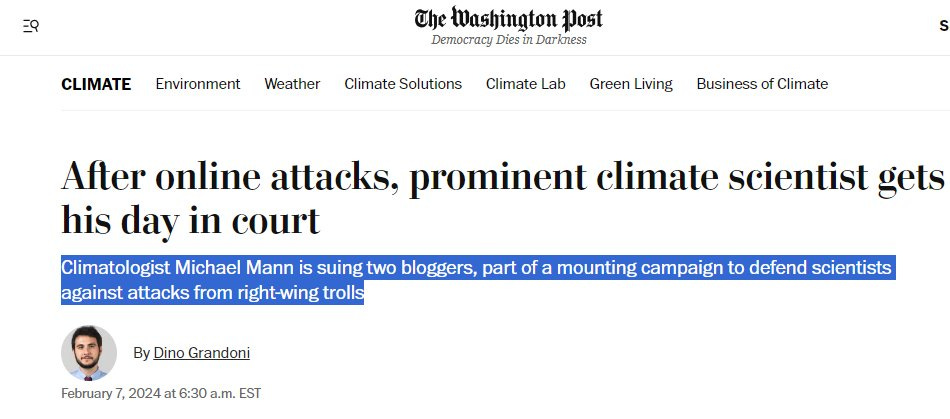
This framing — climate deniers versus climate science — has also characterized mainstream media coverage. For instance, The Washington Post announced, on the day that the case went to the jury, that this case was part of a “mounting campaign” against “right-wing trolls” (below).
Prominent climate scientist or right-wing trolls? Which side are you on?
The case was formally about defamation, but in reality it was not at all about defamation.
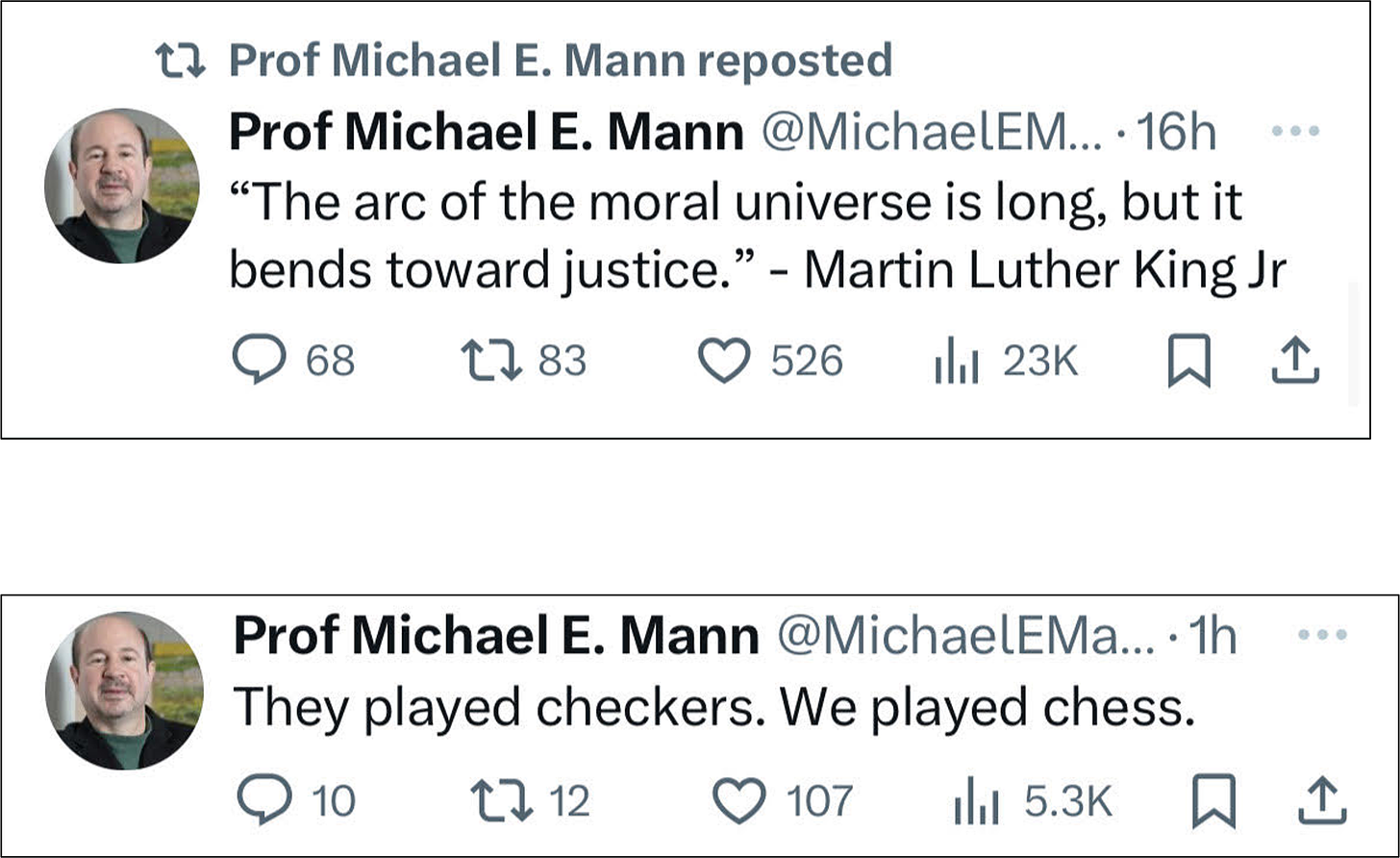
As Michael Mann stated after the verdict, the case was really about politics and ideology:
Take a victory lap, Dr. Mann
This is about the defense of science against scurrilous attacks, and dishonest efforts to undermine scientists who are just trying to do our job … whose findings might prove inconvenient to certain ideologically driven individuals and outlets. It’s about the integrity of the science and making sure that bad actors aren’t allowed to make false and defamatory statements about scientists in their effort to advance an agenda.
The defense made a big mistake in thinking that it would be sufficient to win by proving their case while Mann chose not to put one on. That was wrong.
There is no equivalence here between the “renowned” Michael Mann and the “right-wing trolls” who deny climate science and support Donald Trump. The case, at least in this particular venue, was simply unwinnable no matter what cases were put on by the prosecution and the defense. Mann simply had to show up.
The fact that the jury awarded him only $2 in actual damages and $1,001,000 in punitive damages (send a message!) supports this interpretation — The defense won on merits, and Mann won on the framing and the politics.
What does the case mean for discourse about politically contentious issues that involve science? Science magazine reports that it means that we now need to be circumspect in how we engage these issues:
In a statement, Mann said, “I hope this verdict sends a message that falsely attacking climate scientists is not protected speech.”8
At the same time, the ruling could end up having a chilling effect on necessary public criticism of science, says Gene Policinski, a senior fellow at the Freedom Forum, a nonpartisan foundation focused on First Amendment protections. People will need “to be more judicious in commentary. They might be more vague or circumspect.” And that could be to the detriment of the public, he says. “It’s important in today’s world for people to be aware of research that’s going on and having people both praise and criticize it openly.”
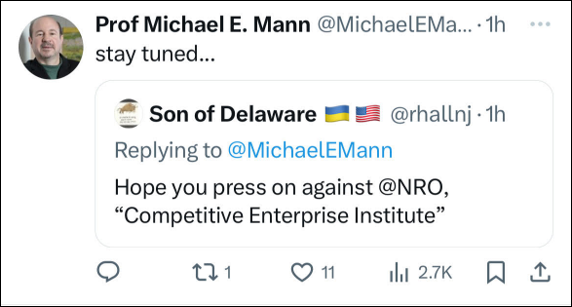
For Mann’s part, he signals that he is just getting started in his legal campaign against his opponents:
Asked about Competitive Enterprise Institute and National Review, [Mann’s lawyer] John Williams said, “They’re next.”
I would not be surprised to now see a flurry of lawsuits against people who have been critical of climate science or climate scientists. Such legal action may not be limited to climate — debate over Covid-19 also presents a target-rich environment for unwanted speech to silence. Watch this space.
Finally, let me offer some personal reflections on my experiences.
Form the start, my view was that this entire lawsuit was unnecessary and a waste of everyone’s time. People who I still would not recognize on the street said some mean things about Michael Mann on the internet. Welcome to public discourse in the 21st century. People say mean, false things about me on the internet every day — it goes with the many privileges of having outsized impact and voice. The case was never about the integrity of science or the political impact of right-wing trolls — it was always about Michael Mann.
As I stood in line with dozens of other people on Tuesday waiting to go through security to enter the courthouse, I wondered how we got here — how leading scientists and institutions of climate science became totally consumed with a battle against minor bloggers and political boogeymen.
When I entered the courtroom, I had a profound sense of sadness for Mann. He was alone with his lawyer — no family, no friends, no university officials, no adoring fans, no mainstream media. Totally alone. There were just a handful of observers in the room. As I said at the trial, Mann has not been the best colleague to me, but I am fine even so. Who knows what demons haunt him and why he behaves the way that he does. I do hope he can find peace at some point.
The larger issues here are not about Mann, but rather the continued failures within the climate science community to uphold fundamental norms of conduct among its own ranks. For instance, in the trial we learned that Penn State’s committee looking into Mann’s conduct following Climategate wanted to censure him for his behavior — apparently that was overturned upon the intervention of the Penn State president. There have been so many similar opportunities for leaders to take the off-ramp from escalated conflict and politicization, and the community instead chose to further conflict.
Like I said, it is just sad. And it is not over yet.
Many major arteries connecting Europe have been obstructed or brought to a standstill in recent days by a wave of protests by farmers against what they claim are overly burdensome environmental targets and unsustainable levels of bureacracy associated with EU and national farming regulations.
The warning shots of this showdown between policymakers and farmers had already been fired on 1st October 2019, when more than 2,000 Dutch tractors caused traffic mayhem in the Netherlands in response to an announcement that livestock farms would have to be bought out and shut down to reduce nitrogen emissions. Early last year, Polish farmers blocked the border with the Ukraine demanding the re-imposition of tariffs on Ukrainean grain.
But it was not until early this year that an EU-wide protest was ignited. German and French protests and tractor blockades made international news, and the blockades were soon replicated in Spain, Portugal, Belgium, Greece, Netherlands and Ireland. Major highways and ports were blocked and manure was poured over government buildings, as farmers across Europe expressed their frustration at rising farming costs, falling prices for their produce, and crippling environmental regulations that made their products uncompetitive in the global market.
It seems the farmers have European elites rattled, which is hardly surprising, given that EU elections are just around the corner. While the European Commission announced Tuesday it was still committed to achieving a 90% reduction of greenhouse gas emissions in Europe by 2040, it conspicuously omitted any mention of how the farming sector would contribute to that ambitious target. Even more tellingly, the Commission has backed down or fudged on key climate commitments, at least temporarily.
According to Politico, EU Commission President Ursula von der Leyen announced on Tuesday that “she was withdrawing an EU effort to rein in pesticide use.” The climbdown on this and other Commission proposals relating to farming was rather embarrassing for the Commission but politically inevitable, given that the protests were spreading rapidly and farmers were showing no signs of going home until their demands were met. As reported by Politico,
A note on the possibility of agriculture cutting down on methane and nitrous oxides by 30 percent, which was in earlier drafts of the Commission’s 2040 proposal, was gone by the time it came out on Tuesday. Similarly excised were missives on behavioral change — possibly including eating less meat or dairy — and cutting subsidies for fossil fuels, many of which go to farmers to assist with their diesel costs. Inserted was softer language about the necessity of farming to Europe’s food security and the positive contributions it can make.
The EU Commission is playing a dangerous game. On the one hand, they are attempting to placate farmers by making expedient short-term concessions to them. On the other hand, they are holding fast to their commitment to cut greenhouse gas emissions in Europe by 90% by 2040, while fudging on the fact that a 90% emission cut in 16 years would have drastic implications for farming.
It is clearly politically expedient, especially in an election year, to put out this fire of farming discontent as soon as possible, and buy some peace ahead of June’s European elections. But there is no avoiding the fact that the Commission’s long-term environmental goals, as currently conceived, almost certainly require sacrifices that farmers are simply not willling to accept.
Independently from the merits of EU climate policy, two things are clear: first, EU leaders and environmental activists appear to have vastly underestimated the backlash their policies would spark in the farming community; and second, the apparent success of this dramatic EU-wide protest sets a spectacular precedent, that will not go unnoticed among farmers and transport companies, whose operating costs are heavily impacted by environmental regulations like carbon taxes. The Commission’s embarrassing concessions are proof that high-visibility, disruptive tactics can be effective. As such, we can expect more of this after June’s EU elections if the Commission doubles down again on its climate policy goals.
The elections in Pakistan today were much freer and fairer than I had expected. Hence, the preliminary results simply reflected the obvious for most of us: former Prime Minister Imran Khan’s political party, PTI (the movement for justice) – facing ruthless repression over the past year – have swept the elections in every single province of the country.
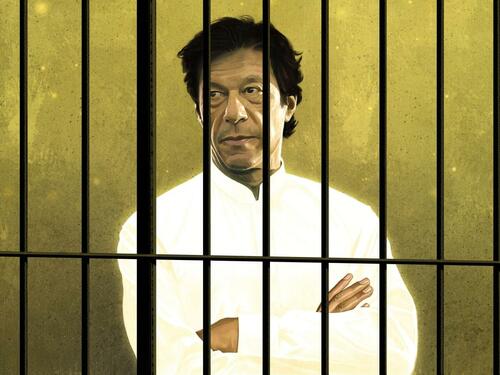
Khan, surviving two assasination attempts and languishing in a supermax dungeon since last August, is more popular than ever. Among the youth, Gallup Pakistan surveys have consistently reported around 80-90 percent support for Khan and his party.
The tyranny of the generals in the military high command along with the kleptocratic and dynastic political parties entailed even the suppression of PTI’s symbol (a cricket bat) and virtually a ban, with horrific consequences if violated, on candidates running on a PTI ticket. Thus, all of these candidates ran as independents.
Of course, we have now become used to one criminal travesty after the next by Pakistan’s military-intelligence apparatus. So, we are cautious about any temporary victory for people’s democracy, triumphing over the Washington-backed totalitarian military and political elite. The latter are in full-blown panic mode, and are trying their best at tampering and rigging before announcing the final results.
The preliminary results, regardless of the fraudulent shenanigans of the national security state expected in the next few days, already represents a resounding defeat of the neo-colonial comprador oligarchy in Pakistan. One just needs to see how highly strung the spokesperson of the State Department was in addressing questions related to these elections.
There is one sign of both hope and danger. For the first time in Pakistan’s history, the normally unified and disciplined armed forces are now experiencing deep divisions. The majority of military officers and and 95 percent of soldiers are repulsed by the behavior of Wasington’s minions in the top brass. To the surprise of many of us, these divisions also exist within the intelligence agencies. We are witnessing in an unprecedented way a refusenik impulse within the military. Not to sound like the bogus alarmism we’re used to from Washington think tanks, it’s still worth remembering that Pakistan is a country of 240 million, nuclear-armed.
The Pakistani people badly need international solidarity at this point.
Prof. Junaid S. Ahmad teaches religion, law, and global politics and is the Director of the Center for Islam and Decoloniality, Islamabad, Pakistan.
By James Petras | Axis of Logic | September 6, 2017
Introduction
In the last few months, several competing political, economic and military sectors – linked to distinct ideological and ethnic groups – have clearly emerged at the centers of power.
We can identify some of the key competing and interlocking directorates of the power elite:
Free marketers, with the ubiquitous presence of the ‘Israel First’ crowd.
National capitalists, linked to rightwing ideologues.
Generals, linked to the national security and the Pentagon apparatus, as well as defense industry.
Business elites, linked to global capital.
This essay attempts to define the power wielders and evaluate their range of power and its impact. … continue
This site is provided as a research and reference tool. Although we make every reasonable effort to ensure that the information and data provided at this site are useful, accurate, and current, we cannot guarantee that the information and data provided here will be error-free. By using this site, you assume all responsibility for and risk arising from your use of and reliance upon the contents of this site.
This site and the information available through it do not, and are not intended to constitute legal advice. Should you require legal advice, you should consult your own attorney.
Nothing within this site or linked to by this site constitutes investment advice or medical advice.
Materials accessible from or added to this site by third parties, such as comments posted, are strictly the responsibility of the third party who added such materials or made them accessible and we neither endorse nor undertake to control, monitor, edit or assume responsibility for any such third-party material.
The posting of stories, commentaries, reports, documents and links (embedded or otherwise) on this site does not in any way, shape or form, implied or otherwise, necessarily express or suggest endorsement or support of any of such posted material or parts therein.
The word “alleged” is deemed to occur before the word “fraud.” Since the rule of law still applies. To peasants, at least.
Fair Use
This site contains copyrighted material the use of which has not always been specifically authorized by the copyright owner. We are making such material available in our efforts to advance understanding of environmental, political, human rights, economic, democracy, scientific, and social justice issues, etc. We believe this constitutes a ‘fair use’ of any such copyrighted material as provided for in section 107 of the US Copyright Law. In accordance with Title 17 U.S.C. Section 107, the material on this site is distributed without profit to those who have expressed a prior interest in receiving the included information for research and educational purposes. For more info go to: http://www.law.cornell.edu/uscode/17/107.shtml. If you wish to use copyrighted material from this site for purposes of your own that go beyond ‘fair use’, you must obtain permission from the copyright owner.
DMCA Contact
This is information for anyone that wishes to challenge our “fair use” of copyrighted material.
If you are a legal copyright holder or a designated agent for such and you believe that content residing on or accessible through our website infringes a copyright and falls outside the boundaries of “Fair Use”, please send a notice of infringement by contacting atheonews@gmail.com.
We will respond and take necessary action immediately.
If notice is given of an alleged copyright violation we will act expeditiously to remove or disable access to the material(s) in question.
All 3rd party material posted on this website is copyright the respective owners / authors. Aletho News makes no claim of copyright on such material.

 Aletho News
 Aletho News