What’s the Truth About Russian ‘Meat Assaults’ Against Ukrainian Forces?
By Robert Bridge | Strategic Culture Foundation | March 3, 2024
Lately, there has been much talk in the Western media about desperate waves of Russian troops hurling themselves recklessly at Ukrainian fortifications, while suffering huge losses. What is the truth?
human wave attack: is an offensive infantry tactic in which an attacker conducts an unprotected frontal assault with densely concentrated infantry formations against the enemy lines, intended to overrun and overwhelm the defenders by engaging in melee combat.
Here are some of the mainstream media armchair generals as they pontificate, hundreds of miles away, on Russia’s military operation in Ukraine:
On January 24, The New York Post (“Moscow’s ‘meat wave’ tactic litters Ukraine battlefield with frozen corpses of Russian troops”) reported that “Russia is using a ‘meat wave’ strategy that sends scores of poorly trained soldiers to die on the front lines against Ukraine to clear a path for the Kremlin’s more valuable elite units — then abandons their frozen corpses on the battlefield.”
The image that the Post article wishes to convey is that the Russian military is some sort of technologically inferior fighting force that must rely on brute force if it hopes to make any battlefield gains. The ultimate goal here is to portray the Russians as cold-blooded barbarians; an effort to dehumanize the Russians as, to quote one twitter user, “zombies, like meat without fear and self-preservation instincts” that leaves its dead and wounded on the battlefield unattended.
Earlier, Business Insider (“Russia is bringing back its bloody ‘human wave’ tactics, throwing poorly trained troops into a massive new assault in eastern Ukraine, White House says”) quoted John Kirby, the spokesperson for the National Security Council, as saying that “the Russian military appears to be using human wave tactics, where they throw masses of poorly trained soldiers right into the battlefield without proper equipment, and… without proper training and preparation.”
Is Kirby projecting here? After all, it has been the Ukrainians who have been sweeping military age males off the street in broad daylight, sending them off to fight on the front lines with very little combat training.
Not to be outdone, on January 24, CNN (“Russia’s relentless ‘meat assaults’ are wearing down outmanned and outgunned Ukrainian forces”) quoted a Ukrainian sniper with the callsign ‘Bess’ who said “Nobody evacuates [the Russian corpses], nobody takes them away,” he said. “It feels like people don’t have a specific task, they just go and die.”
Is there any truth to these allegations? Are the Russians really carrying out zombie-style frontal assaults that are “unprotected, exposed and concentrated” in a desperate effort to overrun Ukrainian positions? How do the facts stand up to this latest batch of mainstream media hype?
Aside from the lack of any video evidence, consider basic military tactics. Only in the case of superior numerical troop strength – for example, as during the Battle of Normandy (June 6 – August 30, 1944) in World War II when the Allied forces launched a successful attack on German positions in northern France with over 2 million troops – would one side commit itself to carrying out massive frontal assaults on enemy positions.
In a recent interview with Germany’s ARD broadcaster, Ukrainian President Vladimir Zelensky said the Ukrainian army currently has a force level numbering about 880,000 troops.
“We have 880,000 troops; that’s an army of almost a million,” he said, when asked about the army’s force strength.
Meanwhile, President Vladimir Putin has said that Russia had deployed more than 600,000 military personnel in Ukraine.
“The front line is over 2,000 kilometers (1,242 miles) long. There are 617,000 people in the conflict zone,” the Russian leader said during his first end-of-year press conference since sending his army into Ukraine in February 2022.
Meanwhile, even the Western mainstream media admits that Russia enjoys a 10-to-1 advantage in the number of artillery supplies, aircraft, drones and armored assault vehicles. With such an overwhelming advantage, why would the Russians need to resort to the desperate tactic of exposing its infantry to “human wave” attacks? If anything, it would be the numerically superior Ukrainian forces – now being systematically crushed by the Russians across the entire field of contact – who would be expected to throw themselves against their enemy in open fields.
The fact is, however, there has never been any video evidence of huge waves of Russian forces – nor Ukrainian, for that matter – running across open fields in some kind of mad dash to storm enemy defenses. Such a spectacle simply does not exist except in the imagination of the mainstream media, which would also have its readers believe that Russian troops in Artyomovsk (known in Ukraine as Bakhmut) were forced to fight with shovels against their opponent, while also being forced to cannibalize components from foreign appliances to facilitate its defense production.
In the words of an old sage: “hogwash.”
Washington’s Wars Eroding its Global Clout
By Salman Rafi Sheikh – New Eastern Outlook – 04.03.2024
If war is politics by other means, Washington’s ongoing wars in the Middle East and Eastern Europe are meant to buttress its global influence on the one hand and undermine its competitors on the other. But the question is: how is this politics by other means working out for Washington? Not so good. Russia’s recent military victories in Ukraine and China’s expansive inroads into the Middle East alongside the growing anti-Americanism in the region (due to Washington’s support for Israel and its inability to prevent a genocide of the Palestinians) indicate an overall American inability to shape global geopolitics in unilateral ways to the exclusive advantage of Washington and its allies in Europe and elsewhere.
Russia’s recent military gains in Ukraine, for example, have very clearly established its military credentials as a power that has been able to withstand the combined military strength of the US and its European allies assembled in the North Atlantic Treaty Organization (NATO). What does this mean for Washington’s policies in Central Asia? Most certainly, Washington cannot simply present Russia as a ‘weak’ military power that can be simply ‘isolated’. But more than that, Russia is utilising its victories over NATO in various ways.
For instance, when the NATO-backed Russia-Ukraine military conflict began, most reports in the mainstream US media began to spread false messaging about Central Asia potentially moving itself out of the so-called ‘Russian clout’. The US saw in it an opportunity to push itself into the region. But this has turned out to be a fiasco. When the US imposed sanctions on Russia, many Russian companies began to relocate their businesses to Central Asia, directly contributing to Central Asia’s impressive 4.8 percent growth rate in 2023. According to the findings of the European Bank for Reconstruction and Development, the region is forecast to register an even more impressive level of growth at almost 5.7 percent in 2024-25.
In other words, thanks to Washington’s sanctions, the Russian political economy is now more deeply connected with Central Asia than it was before February 2022, which is also strengthening the Eurasian Economic Union. Now that this integration is working for the advantage of Central Asia means that the latter have little to no incentive to pay too much attention to Washington and/or the imperatives of moving decisively to Washington. It means that not only has the Biden administration’s policy of NATO expansion via Ukraine failed so far in Ukraine itself, but the ‘new’ Central Asia policy it inaugurated in the wake of the Russia-Ukraine conflict has also failed to make any impact on the ground. Russia defeated US design also by approaching relations with the Central Asian States in ways that gave them enough space to stay neutral in the conflict. While the West saw this neutrality as a sign of Russian weakness in the region and the Central Asian States’ growing assertiveness, it failed to read how this was part of Russia’s strategy to cultivate its ties in a more balanced way. This balance is also pretty evident in the ways Russia has not objected to, or even resisted, China’s growing footprint in the region, although reports in the Western media often see China’s role in Central Asia at the expense of Russia. But the West seems to have been misreading this region.
As far as Washington’s war in the Middle East is concerned, its military support for Israel plus its inability to stop genocide has eroded its credibility. Suppose Washington has been supporting Israel to maintain its dominance in the Middle East. In that case, Washington’s excessive support is now derailing its objectives, since the Middle East is now exercising a lot more strategic autonomy vis-à-vis Washington than was the case until a few years ago.
In the past few months, a flurry of Chinese activity indicates it much more clearly than anything else. China has convened leadership summits, met with Arab delegates, supported their stance vis-à-vis Israel, and held joint military exercises with one of the US’ most important allies in the region (Saudi Arabia). The UAE, otherwise a close US ally and one of the first states to sign the Abraham Accords to recognise Israel and establish diplomatic ties with it, actually withdrew from the US-led naval task force in May 2023, indicating policy and interest-based differences.
The UAE is also a country in the Middle East that has over 100,000 Chinese living there and involved in many businesses. But when it comes to the Middle East itself, and the fact that many countries in the region are involved in China’s Belt & Road Initiative (BRI), we see the region’s trade with China registering an overall growth of almost 45 percent in 2021 and 27 percent in 2022.
Given the economic integration, the Middle East is turning out to be a region where Washington’s clout is receding fast, without any signs of recovery in the immediate future at least. Although US strikes in the Red Sea on the Houthis are meant to indicate Washington’s willingness to offer a security umbrella to the Gulf states (against Iran-backed groups), the region appears to be past the point where it must have the US on its side to ensure security. Gulf states’ perceptions of Iran as an enemy are changing, thanks to Beijing’s mediation.
As far as Washington’s support for Israel is concerned and as far as the threat of a wider war in the region it is posing, Gulf states are on the edge of a conflict that might directly undermine their modernization programmes – development projects that mainly involve China in various capacities.
Therefore, if Washington’s involvement in the Israel war was meant to bring back the era of US dominance, the exact opposite is happening, both in the Middle East and Central Asia, which happen to be two of the world’s most energy-rich regions.
Salman Rafi Sheikh is a research-analyst of International Relations and Pakistan’s foreign and domestic affairs.
The Stories You’re Not Hearing About the Russo-Ukrainian War…
By Ted Snider | The Libertarian Institute | March 4, 2024
Several, seemingly small events in the Russo-Ukrainian War went largely unnoticed in western media recently. But each of them, in their own way, may be significant.
The Fall of Avdiivka
On February 25, Ukrainian President Volodymyr Zelensky said that 31,000 Ukrainian soldiers had been killed since Russia invaded his country two years ago. It was the first time he had released a number of dead. He wouldn’t provide the number of wounded.
On February 4, he said, “About 26% of the national territory is still under occupation,” before adding that “the Russian army cannot make much progress. We have stopped them.”
Both statements are absurd. As The New York Times remarks on Zelensky’s battlefield accounting, “It differs sharply from estimates by U.S. officials, who, this past summer, put the losses much higher, saying that close to 70,000 Ukrainians had been killed and 100,000 to 120,000 had been wounded.”
The 31,000 number may be closer to the number of dead and wounded in the past several disastrous weeks than in the past two years. Russian Defense Minister Sergey Shoigu recently said that over 383,000 Ukrainian soldiers had been killed or wounded since the war began. Yuriy Lutsenko, the former prosecutor general and ex-head of the Ministry of Internal Affairs of Ukraine, says that 500,000 Ukrainian soldiers have been killed or seriously wounded. A number of 400,000-500,000 is consistent with internal Ukrainian communications and reports from the battlefield that 20,000 soldiers a month would be necessary to replace the dead and wounded. That number also accords with the 450,000-500,000 number Zelensky has requested in a new mobilization.
Being absurd was appropriate when Zelensky was a comedian; it may have made Ukrainians laugh. But being absurd when Zelensky is president is not appropriate; it may make more Ukrainians die.
The second statement, that Russia is incapable of further significant advances because the Ukrainian Armed Forces has stopped them is no less absurd. Less than two weeks after making the statement, on February 17, after exhausting every capability it had, the Ukrainian Armed Forces retreated in disarray from the heavily fortified town of Avdiivka as it fell to the Russians. That was a very significant advance. Taking Avdiivka is not just a symbolic victory, as reported in the West, but a strategic victory that could open the door to the Donbas for Russian forces, allowing Russia to solidify the borders of its newly annexed territories.
Following the retreat from Avdiivka, Ukrainian statements about stopping Russia retreated one more step, now claiming that Russia won’t be able to advance. General Kyrylo Budanov, Ukraine’s military-intelligence chief, acknowledged that the loss of Avdiivka was tough, but insisted that Russia has its problems too, and that “they don’t have the strength” to advance significantly and capture all of the Donbas.
American officials echoed Budanov’s assessment, saying that “Russian gains in eastern Ukraine will not necessarily lead to any collapse of Ukrainian lines and that Moscow is unlikely to be able to follow up with another major offensive.”
Kiev said that their armed forces had withdrawn from Avdiivka and established new defensive lines around Lastochkyne and other nearby villages. But on February 26, Lastochkyne fell, and Ukrainian troops retreated to villages further west.
Western officials now say that Russia is “attacking in strength along four parallel axes in the northeast” and that they are “driving forward around Lyman and Kupiansk, in the Kharkiv region.” Newsweek says there are reports that Russian troops have now “advanced west of the village of Lastochkyne.” And military spokesperson Dmytro Lykhoviy now says that Ukrainian troops have withdrawn from Stepove and Severne, two villages near Avdiivka and north of Lastochkyne.
What Killed Alexei Navalny?
It is still not known what killed Alexei Navalny in a Russian prison on February 16. U.S. President Joe Biden says that “Putin is responsible for Navalny’s death.” Zelensky agrees, saying Navalny “was obviously killed by Putin.”
But Ukraine’s military-intelligence chief disagrees. On February 25, General Kyrylo Budanov told reporters that he was sorry to disappoint them, “but what we know is that he really died from a blood clot. And this is more or less confirmed. This was not taken from the Internet, but, unfortunately, a natural [death].” Russia has claimed that a blood clot was the cause of death.
An unexpected claim made by aides to Navalny on February 26 created another wrinkle. Navalny, they say, was about to be released in a prisoner swap. “Navalny was supposed to be free in the coming days,” Maria Pevchikh, the chairwoman of Navalny’s Anti-Corruption Foundation, said. “I received confirmation that negotiations were at the final stage on the evening of Feb. 15.”
Navalny’s aides advance this claim as new evidence that Putin killed Navalny. Pevchikh says that Putin ordered Navalny’s murder to take “the possibility of his release off the table.”
But it seems inconceivable that Navalny’s release could be negotiated by Moscow without Putin’s consent. He wouldn’t have to kill him; he would just have to take his release off the table. Though there is still insufficient evidence to pass judgement on the cause of his death, if it is true that Navalny’s freedom was on the table, that seems to lean towards that Putin did not feel threatened by him or feel the need to eliminate him.
The Firing of Zaluzhny
On February 8, the headlines were dominated by Zelensky’s firing of the Commander in Chief of the Ukrainian Armed Forces, Valerii Zaluzhny. But overshadowed by those headlines was that Zaluzhny was not the only general to go. Zelensky fired his entire general staff and replaced them with a new Chief of General Staff for Ukraine’s Armed Forces and new deputy chiefs.
Though the change over could just reflect a new Commander in Chief choosing his own staff, it might also point to Zelensky ensuring a military command that is loyal to him at a time when the military is angry over the firing of Zaluzhny, and, as The Guardian recently put it, Zelensky “is no longer seen as untouchable, and political competition is returning to Ukraine,” and “Ukrainian society is exhausted by the war.”
Putin’s nuclear warning is direct and explicit
BY M. K. BHADRAKUMAR | INDIAN PUNCHLINE | MARCH 4, 2024
The spectre of Armageddon has been raised often enough during the 2-year old war in Ukraine that the reference to it in Russian President Vladimir Putin’s state of the union address on Thursday had a familiar ring about it. Therein lies the risk of misjudgement on the part of the western audience that Putin was only “crying wolf”.
Three things must be noted at the outset. First, Putin has been explicit and direct. He is giving advance notice that he is obliged to respond with nuclear capability if the Russian statehood is threatened. Eschewing innuendos or dark hints, Putin actually made a sombre declaration of epochal significance.
Second, Putin was addressing the Federal Assembly in front of the crème de la crème of the Russian elite and took the entire nation into confidence that the country may be pushed into a nuclear war for its self-preservation.
Third, a specific context is sailing into view precipitated by foolhardy, impetuous western statesmen who are desperate to stave off an impending defeat in the war, which they began in the first instance, with the stated intention to destroy Russia’s economy, create social and political instability that would lead to a regime change in the Kremlin.
In reality, the US Secretary Lloyd Austin’s prognosis on Thursday at a Congressional hearing in Washington that “NATO will be in a fight with Russia” if Ukraine was defeated is the manifestation of a predicament that the Biden Administration faces after having led Europe to the brink of an abysmal defeat in Ukraine engendering grave uncertainties regarding its economic recovery and de-industrialisation due to the blowback of sanctions against Russia.
Plainly put, what Austin meant was that if Ukraine loses, NATO will have to go against Russia, as otherwise the future credibility of the western alliance system will be in jeopardy. It’s a call to Europe to rally for a continental war.
What French President Emmanuel Macron stated earlier last week on Monday was also an articulation of that same mindset, when he caused a storm by hinting that sending ground troops to help Kyiv was a possibility.
To quote Macron, “There is no consensus today to send ground troops officially but … nothing is ruled out. We will do whatever it takes to ensure that Russia cannot win this war. The defeat of Russia is indispensable to the security and stability of Europe.”
Macron was speaking after a summit of 20 European countries in Paris where a “restricted document” under discussion had implied “that a number of NATO and EU member states were considering sending troops to Ukraine on a bilateral basis,” according to Slovak Prime Minister Robert Fico.
Fico said the document “sends shivers down your spine.”
Fico’s disclosure would not have come as surprise for Moscow, which has now put on the public domain the transcript of a confidential conversation between two German generals back on February 19 discussing the scenario of a potential attack on the Crimean Bridge with Taurus missiles and possible combat deployment by Berlin in Ukraine belying all public denials by Chancellor Olaf Scholz.
Aptly enough, Russian Foreign Minister Sergey Lavrov called the transcript “a screaming revelation.” Interestingly, the transcript reveals that American and British servicemen are already deployed in Ukraine — something Moscow has been alleging for months — and such other details too.
This is a moment of truth for Russia. After learning to live with the steady upgrade of western weaponry supplied to Ukraine, which now includes Patriot missiles and F-16 fighter jets, after having signalled vainly that any attack on Crimea or any attack on Russian territory would be regarded as a red line; after gingerly sidestepping the US-UK participation in operations to bring the war home to Russian territory — Macron’s belligerent statement last week has been the proverbial last straw for the Kremlin. It envisages western combat deployment to fight and kill Russian soldiers and conquer territories on behalf of Kiev.
At the speech on Thursday, which was almost entirely devoted to a hugely ambitious and forward-looking road map to address social and economic issues under the new normalcy Russia has achieved even under conditions of western sanctions, Putin held out a warning to the entire West by placing nuclear weapons on the table.
Putin underscored that any (further) crossing of the unwritten ground rules will be unacceptable — that while the US and its NATO allies provide military assistance to Ukraine but do not attack Russia’s soil and do not directly engage in combat, Russia would confine itself to using conventional weapons.
Quintessentially, the thrust of Putin’s remarks lies in his refusal to accept a fate for Russia in existential terms arranged by the West. The thinking behind it is not hard to comprehend. Simply put, Russia will not allow any attempt by the US and its allies to reshape the ground situation by impacting the front lines with NATO military personnel backed by advanced weaponry and satellite capabilities.
Putin has put the ball firmly in the Western court to decide whether NATO will risk a nuclear confrontation, which of course is not Russia’s choice.
The context in which all this is unfolding has been pithily framed by the leader of a NATO country, Hungary’s prime minister Viktor Orban, while addressing a forum of top diplomats in Antalya in the Turkish Riviera in the weekend when he stressed that “Europeans, along with the Ukrainians are losing the war and have no idea of how to find a way out of this situation.”
Orban said, “We, Europeans, are now in a difficult position,” adding that European countries took the conflict in Ukraine “as their own war” and realise belatedly that time is not on Ukraine’s side. “Time is on Russia’s side. That is why it is necessary to stop hostilities immediately.”
As he put it, “If you think that this is your war, but the enemy is stronger than you and has advantages on the battlefield, in this case, you are in the losers’ camp and it will not be an easy task to find a way out of this situation. Now, we Europeans, along with the Ukrainians, are losing the war and have no idea of how to find a way out of this situation, a way out of this conflict. This is a very serious problem.”
This is the crux of the matter. In the circumstances, the bottom line is that it will be catastrophic speciousness on the part of the western leadership and public opinion not to grasp the full import of Putin’s stark warning that Moscow means what it has been saying, namely, that it will regard any western combat deployment in Ukraine by NATO countries as an act of war.
To be sure, if Russia faces the risk of military defeat in Ukraine at the hands of NATO forces on combat deployment and Donbass and Novorossiya regions are at risk of being subjugated once again, that would threaten the stability and integrity of Russian statehood — and challenge the legitimacy of the Kremlin leadership itself — wherein the question of using nuclear weapons may become more open.
To drive home the point, Putin glanced through the Russian inventory that buttresses its nuclear superiority today, which the US cannot possibly match. And he further de-classified some top-secret information: “Efforts to develop several other new weapons systems continue, and we are expecting to hear even more about the achievements of our researchers and weapons manufacturers.”
Secrets and Lies. NATO’s Role in Ukraine Is as Sleazy as the EU’s
By Martin Jay | Strategic Culture Foundation | March 4, 2024
Did Jens Stoltenberg really say that he had recently given “permission” to Ukraine to use F-16 fighter jets there in the war against Russia? If so, we can add it to the list of bumbling, buffoonish Freudian slips that he has chalked up himself while in office. But it does at least give us a glimpse of how western elites are no longer bothering to even cover up the fact that the war in Ukraine has, in reality, very little to do with Ukraine but rather is a much bigger war fought by the West against Russia.
Yet the whole issue about F-16s in Ukraine will be shrouded in lies, doublespeak and fake news. The real story of these outdated fighter jets from the Netherlands – some might call a bribe to Biden to secure the Dutch prime minister as next NATO boss – will probably never be known. Journalists who even want to ask who will really fly these planes – Ukrainians or U.S. pilots – will never get a straight answer but be fobbed off with the normal NATO ‘secrets and lies’ which are what we have all come to understand is the normal modus operandi for this so-called defence organisation. Timing is critical. Does Ukraine have the 6 months minimum time that Ukrainian pilots will need just to fly them, following intensive training? It’s a good bet that we will see them operational by the end of the summer with contracted, retired U.S. air force pilots flying them though – probably not in dogfight scenarios as they are no match for the newer Su-35s which Russia has – used in air to ground attacks. Of course, such a shift in strategy will lead Russia to target Ukrainian airfields, which some analysts are reporting is already happening but in reality, like so many decisions taken by NATO, this is just the latest in a long line of miscalculations. These 20-year old planes are going to be a real prize for Russia to shoot out of the skies like ducks on a Sunday afternoon. Pity the pilots who will be in their cockpits as they are on a suicide mission.
The truth though will be very hard to get to with the F-16s. NATO will already have its fake news ready for the suppliant journalists ready to oblige.
It’s a similar story with a recent statement by Zelensky himself who claimed that something like 30,000 Ukrainians so far had died in battle. Did he forget a zero there reading from his notes? Did too much cocaine affect his vision? Was it a joke?
No, it was no joke. Just more fake news dutifully processed by corrupt western media who don’t have journalists among them even capable of questioning the statement.
However, the reason why the numbers of dead Ukrainian soldiers is such a polemic is interesting. You might be forgiven for thinking that if the real figure of at least 300,000 dead Ukrainians were to be admitted, that this would have a political consequence for Zelensky himself. And this would be true within a democratic context. But Zelensky has shut down all media that doesn’t replicate his propaganda, eliminated all opposition parties so it’s hardly likely anyone is going to question this ludicrous figure of 30,000 or so. In reality there is a much more salacious, if not mercurial reason why he needs to stick to this work of fiction: graft.
What is not at all reported, even alluded to, is the racket being run by senior army officers close to him who are drawing the salaries of dead soldiers – and how the West turns a blind eye, once again, to this particular scam involving millions of dollars of western aid. Recently the EU agreed to send to Kiev 12.5 billion euros a year in cash for public sector salaries. Given the racket going on over dead soldiers salaries, this makes Brussels complicit in money laundering. Would it be far fetched to assume that senior EU officials are receiving kickbacks, in return? Given Ursula von der Leyen’s murky dealings with Pfizer and the recent news that she is to evade any scrutiny for another 5 years in office, assuming her corrupt friends in the EU support her second term, it becomes clear what the EU and NATO’s objectives are in Ukraine of late: just keep the machine turning over and Zelensky in power. The Ukraine war is not a charitable case, as some western leaders would like you to believe. It is not even about protecting the so-called values of the west, as no one really believes the bullshit that Putin is going to invade other EU countries once his tanks reach Kiev after the country inevitably collapses when the army surrenders or occupies itself with a civil war. Ukraine war is a racket and NATO is part of it, as is the EU elite. No one works for nothing and we should be very suspicious about Boris Johnson turning up in Kiev to lend his support to Zelensky. Is he on the latter’s payroll for PR services? Probably. Will any journalists ask this or file ‘freedom of information’ requests to even clarify who paid for the trip (as anyone who knows Boris, knows he has no cash)? Of course not.
Germany willing to boost its participation in Ukrainian conflict
By Lucas Leiroz | March 4, 2024
The evidence points out that the West is preparing provocations of war against Russia. A new scandal involving a German attack plan against Russian civilian infrastructure is generating fear about the possibility of an open conflict between Russians and Germans in the near future.
Russian media recently published a leaked audio of a conversation between high-ranking German officials. The participants in the discussion were Brigadier General and head of the Air Force’s military operations and exercises department, Frank Grafe; the Air Force inspector, Ingo Gerhartz; and two officers from the German Space Command, Fenske and Frostedt. The topic of conversation was the development of a strategy for the supply and use of Taurus missiles in Ukraine.
Officers discussed the best way to use this equipment on the Ukrainian battlefield. According to them, the Kerch Bridge in Crimea would be an interesting target, although “difficult to hit”. They concluded in the conversation that Russian ammunition depots should be targeted and that if the French Dassault Rafale fighter is used together with the Taurus there will be more chances of a successful attack on Crimea.
In other words, high-ranking German military personnel were discussing how to attack demilitarized Russian territory and destroy civilian infrastructure. The case is therefore proof that Western agents participate directly in the planning and operation of terrorist attacks on peaceful Russian territory, confirming reports that had already been made previously on the topic.
Interestingly, while German officials were discussing a plan to attack Russia, Berlin’s Prime Minister Olaf Scholz publicly stated that the possibility of sending NATO troops to Ukraine was ruled out, suggesting there was no risk of direct war. Amid fears about a possible all-out conflict, Scholz appears to have tried to “relieve” tensions or simply “mislead” Russia and public opinion regarding the real plans of the Western alliance. However, the audio leakage made any attempt to control collective fear useless.
In response to the audio scandal, the German government was only concerned with increasing accusations against Russia, failing to provide any plausible explanation for the content. Defense Minister Boris Pistorius accused Moscow of waging “information warfare” against Germany and the West. He described the Russian media’s work in publishing the officers’ conversation as a “hybrid attack” and “disinformation” – and did not comment on the topic of the conversation, tacitly admitting that the German officials did discuss the possibility of an attack on Crimea.
In fact, the scandal occurs at a time when several Western leaders claim to be “preparing” their countries for direct war with Russia. Faced with the evident Ukrainian failure, Western European countries, deceived by the American narrative that Kiev is a “shield” against “Russian invasions”, begin to impose a regime of military preparation, believing that a conflict is inevitable.
Obviously, there is no Russian interest in engaging in a conflict with Europe. The special military operation in Ukraine is motivated by specific reasons related to Russia’s security concerns. Moscow for now has no such concerns with European countries. However, as Europe militarizes and increases its anti-Russian hostility, new concerns may arise, forcing Moscow to take self-defense measures. And in this sense, European countries could, through their own anti-Russian paranoia, foment a conflict in the future – creating a kind of self-fulfilling prophecy.
The German case is particularly curious because Berlin’s subservience to the US and NATO is notorious, while anti-Russian hostility grows more and more. Moscow never showed aggressiveness against Germany, always willing to peacefully negotiate the reestablishment of diplomatic and economic ties. On the other hand, the US, UK and other NATO powers have always tried to coerce Germany to serve their interests – as, for example, through the terrorist attack against the Nord Stream.
Even in the face of successive humiliations imposed by its Western “partners”, Germany remains obedient to NATO, preserving an irrational anti-Russian hatred. Some experts believe that this is somehow related to a type of historical revanchism against Russia due to the Soviet victory against Nazism in the Second World War. As well known, Russophobia has always been a central aspect of Nazi ideology, which explains why Berlin, with its anti-Russian revanchist mentality, is willing to side with Ukrainian neo-Nazism against Moscow.
For their part, Russian authorities have already made it clear that they understand current European policies as preparation for a war. Moscow does not want the conflict to happen but subservience to NATO, anti-Russian hate and irrationality seem to be the main aspects of current European – especially German – foreign policy.
Lucas Leiroz, journalist, researcher at the Center for Geostrategic Studies, geopolitical consultant.
Israel to get more ‘aggressive’ with Russia – MP
RT | March 4, 2024
An Israeli lawmaker has suggested that his government will take a harder line against Russia by boosting its support for Ukraine because it sees Moscow as somehow involved in the Hamas war against West Jerusalem.
“Israel will take a more aggressive stance against Russia,” MP Amir Weitmann told US media outlet Business Insider in an article published on Saturday. He added that amid its current battle with Hamas, his government doesn’t have munitions to spare, but if the war in Gaza ends before the conflict in Ukraine, “Israeli weapons would find their way” to Kiev.
Weitmann made his comments in response to plans by Israel – revealed on Wednesday at the UN – to provide an early warning system to help Kiev counter Russian airstrikes and drone attacks. The announcement by Gilad Erdan, Israel’s permanent representative to the UN, did not “come out of the blue,” the lawmaker said.
“Russia is heavily involved in what is happening in Israel,” Weitmann claimed, referring to the war with Hamas, which was triggered by surprise raids on southern Israeli villages on October 7. He offered no details on Moscow’s supposed role in the war and said it was not clear “at what level” Russia was involved.
Weitmann, who heads the libertarian faction of Israel’s ruling Likud Party, was less restrained during an RT interview in October. “Russia is supporting Nazi people who want to commit genocide on us, and Russia will pay the price,” he said. The MP added, “We will make sure that Ukraine wins. We will make sure that you pay the price for what you have done.”
Business Insider said Israel may have already “torched its relationship with Russia” by pledging to supply an early warning system to Ukraine. The system is similar to Israel’s Tzeva Adom radar, which quickly detects rocket launches and broadcasts alerts to endangered areas so civilians can take shelter.
After two years of walking a diplomatic “tightrope” over the Ukraine crisis, sending only humanitarian supplies to avoid provoking Russia, the decision to provide Kiev a radar system “signals a major about-turn in Israeli foreign policy,” Business Insider said. Israel will likely send “specialist soldiers” to help Ukrainians set up the system, the outlet noted.
Speaking at the UN on Wednesday, Erdan referred to the Ukrainians as “allies” and “friends in need.” He claimed that Israel has stood in “solidarity” with Ukraine since the conflict escalated in February 2022. “This is the moral thing to do, especially as a country that knows exactly how it feels to be aggressively invaded.”
Electric Power vs. Green Goals
By Steve Goreham | MasterResource | February 27, 2024
“The green movement calls for a shutdown of coal and gas power plants. At the same time, it demands a switch to electric vehicles, electric home appliances, and green hydrogen produced by power-intensive electrolyzers. This and the AI revolution portend a breakdown of the so-called energy transition.”
Twenty-three states have adopted goals to move to 100 percent clean energy by 2050. State governments propose to retire coal- and gas-fired power plants and adopt wind and solar systems. But these goals conflict with efforts to promote electric vehicles (EVs), electric appliances, and a new application (AI) that will increase the demand for electric power.
The green energy push seeks to eliminate greenhouse gas emissions to fight human-caused global warming. Leaders tell us that without a complete transformation of electric power, transportation, and home appliances to achieve Net Zero carbon dioxide (CO2) emissions, we are doomed to suffer from increasingly severe climate change impacts.
Michigan
For example, Michigan passed Senate Bill 271 on December 29 of last year, as part of its “Healthy Climate Plan.” The bill requires 100 percent carbon-free electricity by 2050. Michigan’s electrical power in 2022 was generated by gas (34%), coal (29%), nuclear (22%), with wind and solar at 12%.
Michigan plans to close its gas and coal plants, which provide 63 percent of the electric power, while also retiring nuclear plants. At the same time, the state wants residents to switch to EVs and electric appliances.
The Healthy Climate Plan calls for two million EVs to be on the road by 2030 along with expanded electric-powered mass transit. It calls for replacement of gas appliances with electric heat pumps. But today, more than three quarters of Michigan homes are heated with natural gas. The state is also the largest user of propane fuel for home heating.
Efforts to adopt EVs and heat pumps will produce rising electricity demand and directly conflict with efforts to close power plants. Michigan’s carbon-free electricity goals appear to be impossible to achieve.
In 2022, 60 percent of US electric power was generated by coal and natural gas. About 85 percent came from the traditional generators: gas (40%), coal (20%), nuclear (18%), and hydroelectric (6%). After two decades of subsidies, wind and solar provided only about 15 percent of US electricity.
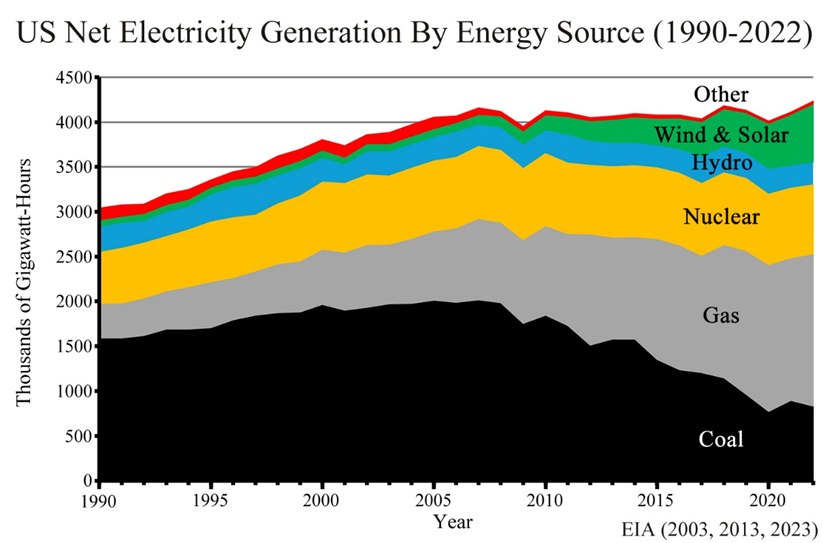
US demand for electricity has not grown since about 2005. But the push to electrify homes and transition to EVs will usher in a new era of rising power demand.
Almost all states striving for Net Zero by 2050 will run into the problem that Michigan faces. Shutting down coal and gas plants while promoting electric vehicles and heat pumps will produce electric power shortages. The only states that may be able to approach carbon-free electricity are Idaho, Oregon, and Washington, where hydroelectric generators produce most of the power.
ISO – NE Warning
The New England Integrated System Operator (ISO) issued a report in 2022 that looked at four scenarios to decarbonize the New England power grid by 2040. The report projected increases in power demand from EVs and electrification of home and business heating.
Only one scenario could meet state decarbonization goals and rising demand. That scenario called for 84 gigawatts of new wind, solar, and storage, to provide 56 percent of electricity by 2040.
But the ISO concluded that such a wind-, solar-, and battery-dominated system would not be reliable, requiring periodic operator-imposed blackouts. Even with 2,400 gigawatt-hours of battery-energy capacity and system reserve margins that were 300 percent over typical electricity demand, the system would fail for an estimated 15 days, and be at risk of failure an additional 36 days each year.
Wind and solar buildouts also conflict with alarming climate forecasts. Climate warnings call for increasingly severe weather, including stronger and more frequent storms, floods, and droughts. Yet climate-policy advocates demand a switch to intermittent wind and solar electricity sources. Wind and solar typically fail to operate during heatwave, cloudy, rainy, snowy, or stormy weather conditions.
After a transition to electrified energy systems, blackouts would be more severe. When the lights go out, residents won’t be able to cook with an electric stove or drive an EV either.
Other nations also depend upon coal, gas, and oil generators for much of their electricity. Examples of hydrocarbon-produced power in 2022 were Australia (52%), China (64%), Europe (38%), India (77%), and Japan (65%). Switching to EVs and heat pumps while shuttering coal and natural gas generators will not be possible in most countries.
Two additional trends will drive electric power demand. First, the revolution in artificial intelligence (AI) requires data centers to upgrade servers with high-performance computer processors. Data center power consumption will jump by a factor of six to ten over the next decade, rising from about 1.5 percent of world power demand today to approach ten percent of world demand.
Second, governments are pushing to establish a new green hydrogen fuel business to power heavy industries such as steel. Production of green hydrogen from electrolysis of water is very electricity intensive.
The electricity required to drive electrolyzers to produce hydrogen to power a single steel plant with a four-million-ton annual capacity will require solar installations covering an area of approximately 70 square miles. About 5,000 terawatt-hours of electricity would be needed to drive electrolyzers to generate hydrogen for the world steel industry, equaling one and one-half times total non-hydroelectric global renewable electricity generated today.
The green movement calls for a shutdown of coal and gas power plants. At the same time, it demands a switch to electric vehicles, electric home appliances, and green hydrogen produced by power-intensive electrolyzers. This and the AI revolution portend a breakdown of the so-called energy transition.
Iraqi resistance launches drone strike at Israeli chemical storage sites in Haifa port
Press TV – March 3, 2024
Iraqi resistance forces have carried out a drone strike against the largest and busiest port in the Palestinian territories controlled by Israel since 1948 in a new show of solidarity with the Palestinians under Israeli attack in Gaza.
The Islamic Resistance in Iraq, an umbrella group of anti-terror fighters, in a statement published on its Telegram channel on Sunday, claimed responsibility for an aerial attack targeting chemical storage facilities inside the port of Haifa that had taken place two days earlier.
The statement noted that the attack had taken place “in rejection of US military presence in Iraq and elsewhere in the region, in support of our people in Gaza and in response to the massacre of Palestinian civilians, including children, women, and elderly people, by the usurping entity.”
The Iraqi resistance underscored that it will continue to target the occupying regime until the complete “destruction of enemy strongholds.”
Last month, Iraqi resistance forces said they had carried out a drone attack on the port of Haifa in the Israeli-occupied territories.
“In continuation of our approach to resisting the occupation and supporting our people in Gaza, our (fighters), using drones, attacked the port of Haifa in the occupied territories in Palestine,” the IRI said in a statement on the first of February.
The Islamic Resistance in Iraq has also claimed responsibility for attacks targeting US-occupied military bases in the region, including one in late January on Jordan’s border with Syria that left three US soldiers dead.
The Israeli regime waged the war on Gaza on October 7 after Hamas carried out the surprise Operation Al-Aqsa Storm against the occupying entity in response to the Israeli regime’s atrocities against the Palestinians.
Since the start of the aggression, Israel has killed at least 30,410 Palestinians, mostly women and children, according to the latest count by the Gaza Health Ministry.
The US, Israel’s traditional ally, has backed Tel Aviv’s attacks on the Palestinian territory and provided the regime with extensive military support since the onset of the war.
Washington has also used its veto power to block the United Nations Security Council’s resolutions demanding an immediate ceasefire in Gaza.
EU tells citizens to further reduce gas consumption

Greenpeace activists put giant sticker on European Union Commission HQ in Brussels, March 1, 2023 © Thierry Monasse / Getty Images
RT | February 28, 2024
EU residents must maintain the reduced natural gas consumption levels imposed in the wake of sanctions targeting Russia’s energy sector, according to a draft proposal from the European Council published on Tuesday.
The proposal states that usage levels at least 15% below average demand (measured between April 2017 and March 2022) should be maintained on a voluntary basis for another year. This is despite claiming that the reductions undertaken up to now – or an even more severe rate of 18% – had successfully achieved many of the original proposal’s goals.
Despite diversified supply, lower, more stable prices and higher storage reserves “benefiting the competitiveness of the EU economy,” the Council claims cutbacks must continue for another year. The proposal also notes that such a restriction would also push the EU towards Net Zero carbon emissions.
Should EU residents or their leaders become unwilling to cut back on their fossil fuel consumption, the resolution allows the “voluntary” cutbacks to be mandated, eliminating any risk of scuttling the concept entirely with one or two holdout countries.
Brussels recently confirmed that a five-year pipeline gas transit agreement via Ukraine with Russia’s Gazprom would not be renewed when it expires at the end of March.
Despite passing 13 sanctions packages since 2022 in an effort to punish Russia for its military operation, the EU still bought nearly €30 billion in oil, petroleum products and natural gas from the country last year.
At the same time, Germany, traditionally the EU’s strongest economy, is in crisis, with 15% of its companies in distress, consultants Alvarez & Marsal reported earlier this month. Many analysts blame high energy costs and predict the worst is yet to come, with a real estate crisis looming as companies that can no longer afford to pay for their office space are defaulting, among other secondary effects.
UK Has Only Itself to Blame for Red Sea Attacks, Houthis Say as They Vow to Ramp Up Campaign

© Photo : Ansar Allah Media
By Ilya Tsukanov – Sputnik – 03.03.2024
The Yemeni militia began a campaign of hijackings, missile and drone attacks against commercial ships operating in the crucial Red Sea global trade chokepoint in November, vowing to target any vessel thought to be affiliated with Israel, and subsequently shutting down a good chunk of global trade.
London has only itself to blame for attacks targeting its commercial vessels in the Red Sea, and the strikes will continue, officials from Yemen’s Ansar Allah (Houthi) militia said in a series of statements over the weekend.
“Yemen will continue to sink more British ships, and any repercussions or other damages will be added to Britain’s bill,” Houthi deputy foreign minister Hussein al-Ezzi said in an X post Sunday.
“[The UK] is a rogue state that attacks Yemen and partners with America in sponsoring ongoing crimes against civilians in Gaza,” al-Ezzi wrote, referencing the joint US-UK campaign of airstrikes inside Yemen which the Pentagon says are aimed at degrading the Houthis’ missile and drone capabilities.
The official’s comments came hours after United States Central Command confirmed that the UK-owned M/V Rubymar cargo ship carrying 21,000 tons of ammonium phosphate sulfate fertilizer had sunk in the Red Sea after being targeted by the Houthis on February 19.
Houthi Supreme Political Council member Mohammed Ali al-Houthi took to X Saturday night to address the UK prime minister directly.
“We say to [Prime Minister Rishi] Sunak: you and your government bear responsibility for the M/V Rubymar, and responsibility for supporting the genocide and siege in Gaza,” al-Houthi wrote in an Arabic-language X post.
“You have a chance to salvage the M/V Rubymar by sending a letter of guarantee signed by George Galloway that the relief trucks agreed upon would enter Gaza,” al-Houthi added, referencing the Workers Party of Britain MP elected in a landslide in the Rochdale by-election on February 29.
Galloway has been an outspoken critic of British support for Israel amid the Gaza crisis, and an outspoken critic of American and British policy in the Middle East going back to the 2003 invasion of Iraq.
The Houthis kicked off a months-long maritime campaign of ship hijackings, drone strikes and missile launches in November in solidarity with Gaza amid Israel’s ground assault into the besieged Palestinian enclave. The US announced the formation of a naval ‘coalition of the willing’ against the Houthis in December, and began bombing Yemen in January together with Britain. The Houthis responded by barring all commercial and warships belonging to British and American “losers” from operating in the Red Sea, the Gulf of Aden and the Bab al-Mandab Strait, repeatedly firing at Western warships deployed in waters adjacent to Yemen.
Shipping through the Red Sea has declined precipitously by as a much as 40 percent from its normal levels, with the Houthis adding tens of billions of dollars in global shipping costs, disrupting supply chains linking Europe and Asia, and resulting in a rise in energy prices.
Featured Video

Laith Marouf: Hezbollah’s position on US-Iran ceasefire
or go to
Aletho News Archives – Video-Images
From the Archives
Is Israel to blame for the Iraq War?
American Goy | March 10, 2008
I am so tired of this old canard that “Israel had nothing to do with USA’s war with Iraq – in fact, it officially advised America against it”.
Bullshit. … continue
Blog Roll
 Aletho News
- Laith Marouf: Hezbollah’s position on US-Iran ceasefire: What you’re not being told
- Israel’s priority lies in destroying chances of peace between Iran, US: Ex-UN nuclear chief
- Ceasefire for all or for none: Iran shuts Hormuz over Lebanon attacks
- Strait of Hormuz is Iran’s ‘nuclear weapon’ that forced US retreat: Medvedev
- Energy crisis will last for months – Kremlin envoy
- Europe’s quiet role in the war on Iran
- Forty days that shook the Empire: How Iran turned the tables on US and prevailed
- Netanyahu unilaterally declares Lebanon outside of ceasefire deal
- Israeli leaders: ‘Not a single goal’ achieved in war with Iran
- What on earth just happened? Trump, Iran, and the unlikely ceasefire
- If Americans Knew
- Gazans face a triple crisis: severe shortages of water and bread, healthcare in tatters
- NY Times reports how Netanyahu took the US into Iran War
- A sigh of relief over Iran, but Gaza and Lebanon in dire straits – Daily Update
- Thousands dead and neighborhoods razed to the ground: Aid agencies fear southern Lebanon is becoming the new Gaza
- The war the US is fighting for Israel could cost trillions
- ‘Cigarette Burns, Nail Wounds’: Toddler Tortured in Gaza to Coerce Father
- Trump Says US Sent ‘a Lot of Guns’ to Protesters in Iran
- Israeli forces destroy 17 UN peacekeeper cameras in south Lebanon
- US-Israeli strikes ‘completely destroy’ synagogue in Tehran
- Archbishop for US Military Says Iran War Is Unjust Under Catholic Teaching
- No Tricks Zone
- An Inconvenient Tree: Uncovered In Alps… Europe Much Warmer Than Today 6000 Years Ago
- New Study Reports A 60% Slowdown In Greenland’s Ice Loss Rate In The Last Decade
- Low Intensity Tornado Wrecks Major Solar Farm, Creating A Potential Toxic Dump
- New Study Finds Warming Saves Lives…Cold Temperatures 12 Times More Deadly Than Excess Heat
- German Science Blog Accuses PIK Climate Institute Of Hallucinating Climate Tipping Points
- Devastating Assessment Of Comirnaty Vaccine By Former Senior Pfizer Europe Toxicologist
- New Study: CO2 Is ‘Effectively Negligible’ As An Explanatory Climate Change Factor Since 2000
- Former Pfizer Toxicologist Dr. Helmut Sterz Tells Bundestag Hearing Pfizer Vaccine Should Have Never Been Approved
- Energy Expert: Germany’s Nuclear Phaseout Was A “500 Billion Euro Mistake”
- New Research: South Australia’s Mid-Holocene Sea Surface Temperatures Were 4°C Warmer Than Today
 Aletho News