German Military’s Crimean Bridge Strike Talk: ‘NATO Has Found Itself in Hot Water’
By Oleg Burunov – Sputnik – 02.03.2024
The situation around the leaked conversation between high-ranking German army officers has once again refuted NATO’s allegations about the alliance’s non-interference in the Ukrainian conflict, experts told Sputnik.
The Russian Foreign Ministry has demanded an “immediate explanation” from Berlin on the audio recording released earlier this week by Margarita Simonyan, editor-in-chief of RT and Rossiya Segodnya, Sputnik’s parent media group.
In it, German generals are heard discussing a potential attack on the Crimean Bridge with Taurus missiles.
Foreign Ministry spokeswoman Maria Zakharova stressed in a statement that attempts by German authorities “to dodge the question will be considered an admission of guilt.”
High-ranking German officers discussed launching strikes on “Russian civilian infrastructure either with the tacit official consent of Berlin or behind its back; both variants are the matter of serious concern,” military expert Robinson Farinazzo, a former Brazilian Navy officer, said in an interview with Sputnik.
“The authorities are either aware of everything or they knew nothing, which means it was the military’s conspiracy – something that should be punished accordingly, right down to an option of all those involved being brought to tribunal,” Farinazzo said.
“If Berlin was in the know, it can be likened to a declaration of war,” he insisted, urging Moscow and Berlin to use diplomatic channels to defuse tensions over this information “about aggressive intentions.”
According to the expert, “It’s hard to imagine what measures Moscow might take if it considers actions by the German officers a serious provocation.”
The former Brazilian naval officer also drew attention to German authorities keeping mum on the matter. Likewise, how the information comes amid disagreements among Western countries on additional military aid to the Kiev regime, including the possibility of providing Ukraine with the Taurus cruise missiles and sending NATO military units to the country.
In this vein, Farinazzo said he believes that further developments will depend on whether the US Congress will okay more supplies to Ukraine or not. Even if Congress gives the green light, this will only add to prolonging the conflict and will fail to change the situation on the battlefield in favor of Ukraine, per the expert.
“The West and high-ranking NATO officers have already realized the fact that Ukraine cannot win. A potential strike on the Crimean Bridge would be tangible from a psychological point of view, but it would hardly affect the course of the special military operation, since Russia instead can use railroad or sea transport,” Farinazzo said.
International relations expert Tito Livio Barcellos Pereira from the Pontifical Catholic University of Sao Paulo, for his part said that the conversation once again raises doubts about the veracity of previous claims by Western authorities that NATO countries are not involved in the Ukraine conflict.
“NATO countries, which previously argued that they were not directly involved in the conflict and only limit themselves to sending aid to Kiev, have found themselves in hot water. Their claims are becoming less credible, while Russia’s arguments are sounding more convincing,” the expert underscored.
He noted that “in this situation, the leaders of Western states will probably have to explain themselves before lawmakers and the entire society of their countries, as well as before other NATO members, which have a more restrained stance.”
In Pereira’s opinion, the situation could lead to an even greater escalation of tensions between Russia and NATO, especially given that the alliance “does not want to hear the arguments by Moscow, which has repeatedly warned against the alliance’s infrastructure getting closer to Russian borders.”
“The German military’s recorded conversation once again confirms that the alliance continues to be involved in a [proxy] war with Russia,” Pereira concludes, berating Kiev and the West for deliberately sabotaging all alternative peace initiatives put forward by the Global South.
Why the West can’t be trusted to observe its own ‘red lines’ in Ukraine
By Tarik Cyril Amar | RT | March 2, 2024
French President Emmanuel Macron and German Chancellor Olaf Scholz have disagreed publicly over how to support Ukraine – which has been ruthlessly deployed by the West as a geopolitical proxy – in its conflict with Russia. Macron used a special EU meeting he had convened, rumor has it directly inspired by Ukrainian President Vladimir Zelensky, to state, in effect, that sending Western combat troops into Ukraine was an option.
Of course, the West already has troops on the ground, including those flimsily camouflaged as volunteers and mercenaries, or otherwise participating in the conflict (for instance by planning and targeting), as a recent leak of US documents has confirmed. But an open intervention by ground forces would be a severe escalation, directly pitting Russia and NATO against each other, as Moscow has quickly pointed out, and making nuclear escalation a real possibility.
Russia has deliberately tolerated a certain degree of Western intervention, for its own pragmatic reasons: In essence, it seeks to win the war in Ukraine, while avoiding an open conflict with NATO. It is willing to pay the price of having to deal with some de facto Western military meddling, as long as it is confident it can defeat it on the Ukrainian battlefield. Indeed, the strategy has the added advantage that the West is bleeding its own resources, while the Russian military is receiving excellent hands-on training in how to neutralize Western hardware, including much-touted “miracle weapons.”
You do not have to believe Moscow’s words, but simply consult elementary logic to understand that there is an equally hard-headed limit to this kind of calculated tolerance. If the Russian leadership were to conclude that Western military forces in Ukraine were endangering its objectives (instead of merely making achieving them harder), it would raise the price for certain Western countries. (Selective treatment would be adopted to put under stress – quite possibly to breaking point – Western cohesion.)
Consider Germany, for instance: Berlin is by far Ukraine’s biggest bilateral financial supporter among EU states (at least in terms of commitments). Yet militarily, for now, Russia has been content with, in essence, shredding German Leopard tanks as they arrive on the battlefield. And, in a sense, punishing Germany’s meddling can safely be left to its own government: the country has already taken massive hits to its economy and international standing.
But if Berlin were to go even further, Moscow’s calculations would change. In that case, as little as German mass media allow German citizens to think about it, a “sobering” (to use a term from Russian doctrine) strike – initially probably non-nuclear – on German forces and territory is possible. The domestic consequences of such an attack are unpredictable. Germans might rally round the flag, or they might openly rebel against an already deeply unpopular government that has been sacrificing the national interest with unprecedented bluntness to Washington’s geopolitics.
If you think the above sounds a little far-fetched, I know of someone who clearly does not share your complacency: the German chancellor. Stung by Macron’s provocation, Scholz countered with telling alacrity. Within 24 hours after the surprise French move, he publicly ruled out the sending of “ground troops” by “European nations or NATO nations,” underlining that that this red line has always been agreed on.
In addition, the chancellor also chose exactly this moment to reaffirm that Germany will not deliver its Taurus cruise missiles to Kiev, as escalation that proponents have long demanded, including inside Germany. With, according to Scholz, the capability of striking Moscow, Berlin’s missiles in Ukrainian hands and Macron’s hypothetical ground forces have one thing in common: they come with a serious risk of spreading direct fighting beyond Ukraine, in particular to Western Europe and Germany.
In other words, the leaders of the two countries traditionally recognized as the core of the European Union have displayed profound disagreement on a key issue. Macron, it is true, often says more than he means or will care to remember. Scholz is an extreme opportunist, even by the standards of professional politics. In addition, clearly intentional indiscretions from the two men’s teams point to mutual and heartfelt antipathy, as Bloomberg has just reported. We could dismiss the spat between them as nothing but the result of incompatible political styles and personal animosity.
But that would be a grave mistake. In reality, their open discord is an important signal about the state of thinking, debate, and policy making within the EU, and, more broadly, NATO and the West. The real challenge is to decipher what this signal means.
Let’s start with something the two leaders will not openly admit but, it is virtually certain, share: The background to their quarrel is their fear that Ukraine and the West are not only losing the conflict, but more importantly in the information-streamlined West, that this defeat is about to become undeniably obvious. For instance, in the shape of further Russian advances, including strategic victories like the taking of Avdeevka and a partial or total collapse of Ukrainian defenses. Even the robustly bellicose Economist, for instance, is now admitting that Russia’s offensive is “heating up,” that the fall of Avdeevka has not made the Russian military pause, and that Ukrainians themselves are “becoming pessimistic.” Both Macron’s remarks and Scholz’s hasty disclaimer are indicators of a growing and well-founded pessimism, perhaps even incipient panic among Western elites.
Yet that does not tell us much about how these elites really intend to react to this losing game (assuming they know themselves, that is). In principle, there are two strategic options: raise the stakes (again) or cut your losses (finally). At this point, the “raise the stakes” faction is still dominating the policy debate. The negative response to Macron’s show-stealer move has overshadowed that the general trend of the NATO and EU strategy is still to add fresh resources to the fight, for instance by agreeing to source ammunition from outside the EU, a move long resisted by France. At least as far as the public is permitted to see, NATO and the EU are still run by sunk-cost-fallacy addicts: The more they have failed and lost already, the more they want to risk.
In reality, however, the option of deception and the temptation of self-deception (they easily blend into each other, an effect commonly known as “drinking your own Kool Aid” ) make things more complicated: Take, for instance, Russia’s evidence, in verbatim transcript detail, of high-ranking German military officers discussing – or was it “brainstorming” ? – how Ukraine could, after all, use Taurus missiles to attack the Kerch Strait Bridge that connects Crimea with the Russian mainland, while maintaining, in effect, plausible deniability. Scholz’s public statement that “German soldiers must at no point and in no place be linked” to Taurus attacks is proof that evading responsibility – or the impossibility to do so – are on his mind. As you would expect from a politician whose only strategy is finding the path of least resistance.
The muddled German response to this embarrassing intelligence fiasco (Why exactly was something so obviously sensitive discussed via hackable telecommunications instead of in a secure room, for instance?) only confirms that the Russian evidence is authentic. Instead of denying that the discussion took place, Germany has reacted – in typical authoritarian manner – by blocking social media accounts reporting it, and by trying to spin the conversation as nothing but a harmless thought experiment.
And yet, Scholz’s suspiciously elastic phrasing and the German officers’ discussion do not mean that such a course of naively transparent cheating will be adopted by Berlin. It may even have been a way of figuring out why that would not work.
Especially if this information is not entirely new, Russia’s choosing to publicize it now and perhaps even risking some (minor) intelligence disadvantage by revealing the extent of the German military’s penetration is, of course, also a signal to Germany’s leadership: Moscow will not play along with plausible deniability (a “don’t even try” message) and is deadly serious about this red line (a “we mean it” message). This as well may help focus minds in Berlin and make cheating less likely.
In any case, the evidence of German officers thinking about how to help attack Russia without leaving fingerprints does underline two things: Western public statements can easily be deliberate lies; and even when they are not, they are always open to radical revision. Indeed, Macron, too, alluded to that fact, pointing out that even if direct military intervention is not a consensus yet, it could become one in the future, just as other red lines have been crossed before.
In that light, Macron’s loose talk could be read as just another bluff – or, as they say in France, “strategic ambiguity” : a desperate attempt to strut so fiercely that Russia will not press its military advantage. If that was the French president’s intention, it has backfired spectacularly: Macron has provoked not only Germany but other, bigger Western players as well to clarify that they do not agree with him. Note to the Jupiterian self in the Élysée Palace: It’s not “ambiguous” when everyone who counts says “No way!”; it’s not very “strategic” either.
Yet it would be complacent to take solace from Macron’s current isolation. First, it is not complete: There are hardcore escalationists, such as the Estonian leader Kaja Kallas, in the EU and NATO who have praised him precisely because they want to drag everyone else into a direct clash with Russia. It is good that these especially zealous warmongers do not have the upper hand for now. But they have not been defeated or even appropriately marginalized either, and they will not give up.
Second, a strategy of escalation and threats can get out of hand. Consider the too-little-known fact that, in the July Crisis of 1914, just before World War I started, even the German emperor Wilhelm II had moments where he privately felt that it could still be avoided. That, however, was after he and his government had personally done their worst to bring the big war about. Lesson: If you take too many risks, at some point you may no longer be able to dial down the escalation you have promoted yourself.
Third, and most fundamentally, while rationally applied dishonesty is not unusual in international politics, for an international system to produce stability, it must first produce predictability. That, in turn, requires that even deception is kept within tacitly agreed limits and is, to a degree, predictable (because of its underlying rationality). The problem with the post-Cold War West is that it has chosen to forget and flaunt this basic rule of global order. Its addiction to unreliability is so severe that signals of escalation are inherently more credible than signals of de-escalation, as long as there is no principal, general, and clearly recognizable change of approach.
Put differently, Macron’s current isolation does not count for much because its due-diligence interpretation from Moscow’s perspective has to be that he merely went a little too far too soon. Neither Scholz’s nor other Western disavowals make a difference. What would make a difference is a united and clear signal by the West that it is now ready for genuine negotiations and a real compromise settlement. For now, the opposite remains true.
Tarik Cyril Amar is a historian from Germany working at Koç University, Istanbul.
What the Nurses Saw — It was Murder
An investigation into systemic medical murders that took place in hospitals during the COVID panic and the nurses who fought back to save their patients
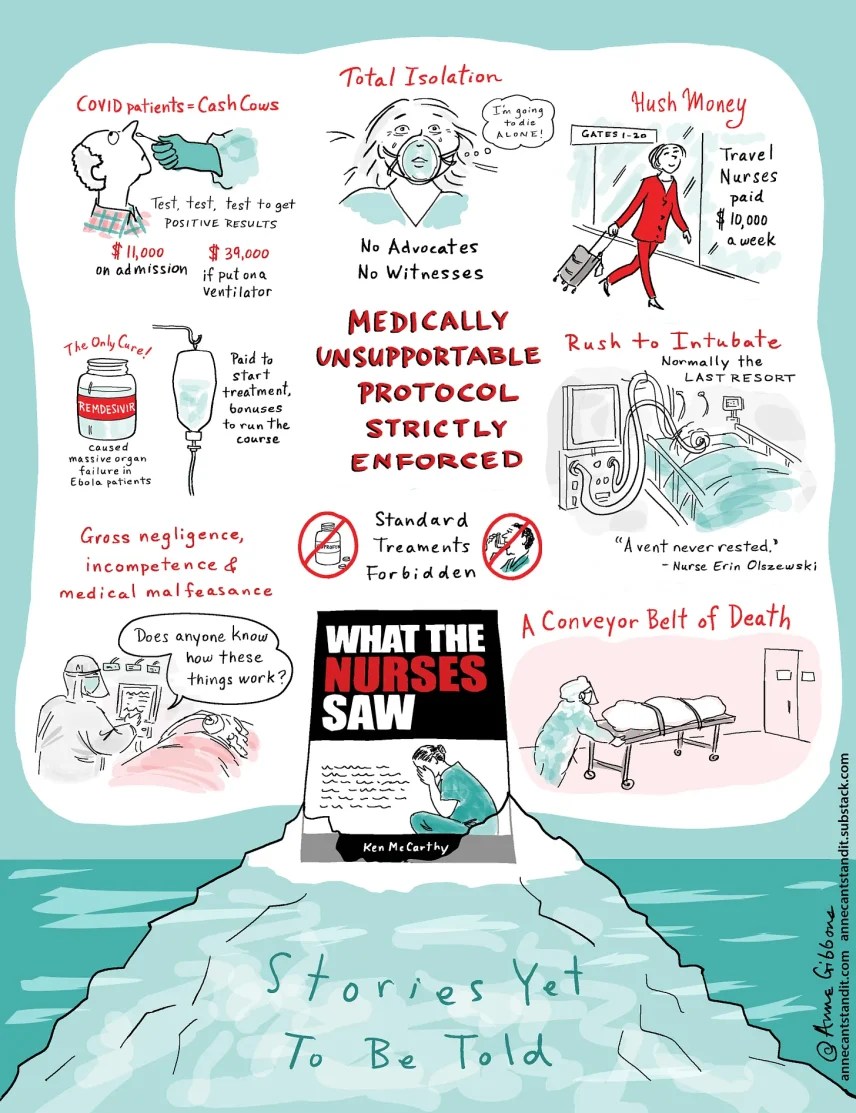
By Ken McCarthy | December 6, 2023
No human activity can ever be free from error, but to be clear, this book is not about the kind of error all human beings are prone to.
As you will learn from the eye-witness accounts and technical information presented in this book, calling the failed COVID protocols “errors” is not accurate.
 These protocols were explicitly ordered by those who took dictatorial control of the medical system early in the Panic (spring of 2020). Further, when they were shown to be demonstrably failing and harming many thousands of people, experienced healthcare professionals who raised informed concerns were silenced through demotion, firing, and organized campaigns of harassment promoted by the news media and enabled by companies like Google, Facebook, Twitter, and TikTok, in some cases in collaboration with the White House and the Department of Justice’s FBI.
If this sounds very bad, it’s because it is.
What the Nurses Saw is documentation of what happens in the real world when bureaucrats, in this case bureaucrats in Washington DC, take literal dictatorial control over the practice of medicine.
On a pure dollar and cents level, one of every five dollars spent in the U.S. is spent on the products of the medical services industry, as is one of every three tax dollars. The U.S., more than any country in the world, and by a large measure, has been colonized by this industry. As part of this process, the industry and its operatives have corrupted and perverted science, academia, and the news media. Now it’s hard at work to weaken and degrade the last pillar that keeps the system even remotely functioning — the integrity of the nursing profession.
If we fail to support our good nurses, help them hold the line, and start aggressively turning things around, there is no practical limit to how far this totalitarian medical dictatorship which we in fact live under will go in its future abuse and exploitation of human beings.
Featuring in-depth interviews with:
Erin Marie Olszewski,
Kevin Corbett Ph.D.,
Kimberly Overton,
Ashley Grogg,
Kristen Nagle,
Sarah Choujounian,
AJ DePriest,
Mark Bishofsky,
and Katie Spence
Please share the link: WhatTheNursesSaw.com
Lies about China’s Uyghur Oppression
Tales of the American Empire | February 29, 2024
Americans see news reports about the plight of Uyghurs. They are told these Muslims living in the western China province of Xinjiang are abused by the ruling Han Chinese and over a million are imprisoned in camps where they are forced to perform slave labor. As a result, China must be constantly denounced for this abuse and sanctions imposed on any Chinese business exploiting this slave labor. This is false and based on lies promoted by the American CIA.
Note: We are told to pronounce Uyghur as “WEE-gur” even though it has no W. In the province of Xinjiang and in their language it is pronounced “OO-gur” and should be in English since it starts with a U! So I adopted Dr. de Zayas’ correct pronunciation to reject whoever decided we should call them something weird in English.
___________________________________________________
“I Saw ZERO Evidence of Uyghur Repression In China”; Jimmy Dore Show; YouTube; September 30, 2023;  • “I Saw ZERO Evidence Of Uyghur Repres…
“What’s it REALLY like to travel in Xinjiang, China?”; Cyrus Janssen; YouTube; May 1, 2021; • What’s it REALLY like to travel in Xi…
“No, the UN did not report China has ‘massive internment camps’ for Uighur Muslims”; Ben Norton; The Grayzone; August 23, 2018; https://thegrayzone.com/2018/08/23/un…
“Was There Really a Massacre in Tiananmen Square–or Was It an Illusion Fabricated by U.S. Politicians and Corporate Media to Make Americans Hate China?”; Jeremy Kuzmarov; Covert Action Magazine; August 7, 2023; https://covertactionmagazine.com/2023…
“US efforts to strangle China & reassert hegemony”; The Duran; YouTube; September 16, 2023; https://theduran.com/us-efforts-to-st…
Related Tales: “The American War on China”: • The American War on China
Hysterectomy – On Stealing Womanhood
Lies are Unbekoming | February 25, 2024
This all started from one line in the interview I did with Carol Peterson.
Hormones – Lies are Unbekoming (substack.com)
“Most reasons for hysterectomies can be tied to progesterone deficiencies and most could be avoided with rational supplementation.”
I realised I didn’t know anything about hysterectomies, but I knew it was a major surgery, and here was Carol saying that most could be avoided.
I followed my curiosity and here we are with this article.
I cannot believe what I have discovered. It’s actually hard to put into words.
I think I will do more than just this article on the subject.
How is it possible that cutting out a woman’s uterus is the second most common surgery in the US?
About 600,000 women a year undergo hysterectomies in the U.S., the second most common surgery, surpassed only by cesareans. – Wittelsey 2011
Surely, they are all necessary:
Over 5,000 women whose doctors have recommended hysterectomy have received the names of second opinion physicians from the HERS Foundation, says Coffey. Only 2% of the 5,000 have gone on to have the surgery. – HERS
Surely, they wouldn’t do it for the money, would they?
“Some of us aren’t making a living, so out comes a uterus or two each month to pay for the rent,” admitted a Baltimore specialist in a 1975 New York Times interview.
How did Big Medicine reach the conclusion that a woman doesn’t need her uterus?
“Your uterus is nothing but a big, unresponsive blob.” — The Woman Doctor’s Medical Guide for Women by Barbara Edelstein, MD (1982)
The structural problem seems to be one of lying to women about the risks and aftermath:
According to Nora Coffey, founder and President of the non-profit HERS Foundation in Philadelphia, PA, too many doctors perform unnecessary hysterectomies, too many fail to tell women that there can be devastating after-effects from removal of the uterus or ovaries, and too many don’t offer alternative treatment for the problems that are, seemingly, so quickly solved with the knife.
One of the most significant points that jumped at me from the page was “loss of maternal feeling”:
Coffey says that HERS has also counseled over 9,000 hysterectomized women who are experiencing symptoms such as loss of maternal feeling, bone and joint pain, chronic fatigue, hot flashes, insomnia, loss of short-term memory, diminished emotional responses, loss of sexual desire and a host of other hysterectomy-related symptoms.
Of the millions of women that have had this done to them, how many have lost their maternal feeling towards their children. Women carry that maternal feeling into the world too. What happens to the world when maternal feeling is vanquished?
I now wonder how many women in power have had a hysterectomy. Is it more than the wider population? What are the consequences of this? Does it help with climbing the ladder? Does it impact empathy?
I think these are all fair questions because of the sheer scale of the issue.
At the end of each day of counseling, I knew there were a few more women out there who would avoid unnecessary surgeries because they received information from HERS. It was too little too late, however, for 621,000 other women in this country each year—more than 22 million hysterectomized women alive in America today? – The H Word (2008)
They remove the ovaries also about half the time by scaring woman with ovarian cancer:
In this country, half of the women who undergo a hysterectomy also have their ovaries removed. The reasoning given is to “save” the woman from the remote possibility of ovarian cancer.
However, Dr. Lauersen issues this warning to women concerning prophylactic excision of the ovaries: “Usually it is not necessary to remove the ovaries of a menstruating woman during hysterectomy. A doctor may say that he wants to remove the ovaries to prevent ovarian cancer, an insidious disease that does not have obvious symptoms. However, studies have indicated that it would take 7,500 oophorectomies (excision of the ovaries) in order to prevent one death from ovarian cancer. Ovarian cancer, which only accounts for 4% of all cancers in women, is more frequently discovered after menopause in women between 55 and 64 years old.”
Because fibroid growths are often called “tumors”, the lay patient may immediately fear that she has cancer. However, according to Dr. Lauersen, fewer than one half of one percent ever proceed to that stage.
The removal of ovaries is castration.
Castrated men were called Eunuchs.
We don’t have a word for castrated women. I think they, the butchers, prefer it that way.
I really don’t have words to describe this butchery.
We live in three dimensions. The physical, the mental and the spiritual.
We have been trained to diminish the spiritual, to our own detriment.
Somewhere deep in the bowels of Big Medicine, there is a spirit, and that spirit hates humanity, and very specifically it hates women.
There is no other conclusion I can reach anymore.
After reading this long stack, if you reach a different conclusion, let me know in the comments.
Carol Peterson pointed me to HERS to further my education, and it was there that I discovered Nora Coffey and her great book The H Word, that I’m reading now, co-authored with Rick Schweikert. I can definitely recommend it.
It turns out that Rick wrote a play…you will never guess what he called it…
What are the odds!!
The following statistics and Q&As are drawn from these three sources:
HYSTERECTOMY: THE SHOCKING TRUTH by Lee Rothberg (whale.to)
The Hysterectomy Epidemic: Where’s the Outrage? – Ms. Magazine (msmagazine.com)
Female Anatomy: The Functions of the Female Organs – HERS Foundation
Let these numbers wash over you as you start coming to terms with the scale of what has been done to women.
- About 600,000 women a year undergo hysterectomies in the U.S. This makes it the second most common surgery among women in the country, surpassed only by cesarean sections.
- 90 percent of hysterectomies are avoidable, according to Dr. Mitchell Levine, suggesting that the majority of these procedures could be managed with alternative treatments.
- 70 to 76 percent of hysterectomies do not meet the recommended criteria for necessity according to an expert panel and the American Congress of Obstetricians and Gynecologists (ACOG), indicating a high rate of potentially unnecessary surgeries.
- 210,000 women could avoid losing their ovaries annually if alternative treatments were pursued instead of hysterectomies, based on the 70 percent estimate of avoidable procedures.
- 15 to 30 percent of women who conserve their ovaries during hysterectomy lose ovarian function anyway, highlighting the risk of menopausal symptoms and hormonal imbalance even when ovaries are not removed.
- Women who have their ovaries removed face a higher risk of early death from any cause, primarily from heart disease and lung cancer, as found in a study of almost 30,000 women followed for 24 years.
- For every 24 women having bilateral oophorectomy, at least one will die prematurely as a result of the procedure, emphasizing the significant risk associated with the removal of both ovaries.
- Women who undergo hysterectomy report a range of adverse effects in significant percentages, including 79.6% experiencing loss of sexual desire and profound fatigue, and 79.1% noting personality changes.
- The HERS Foundation’s ongoing study reveals that 72.8% of respondents report loss of stamina post-hysterectomy, indicating the extensive impact on women’s overall well-being and quality of life.
- 35-40% of women whose ovaries are not removed during hysterectomy experience a loss of ovarian function, which equates to a form of castration and results in the cessation of hormone production critical to various aspects of health.
- Only about 10 percent of hysterectomies are performed for cancer, indicating that the vast majority are for benign conditions that might be managed with less invasive options.
- An expert panel found that up to 70% of hysterectomies recommended were inappropriate based on developed criteria, highlighting a substantial issue with surgical decision-making.
- 512,000 women undergoing hysterectomy last year had their ovaries removed during the surgery, whether the ovaries were healthy or not, potentially subjecting these women to unnecessary risks.
- Women who had their ovaries removed had a seven-times greater incidence of heart disease, showing the critical role of ovarian hormones in cardiovascular health.
- The HERS Foundation has counseled over 5,000 women whose doctors recommended hysterectomy, with only 2% going on to have the surgery after receiving second opinions or learning about alternatives.
- Women report a total loss of sexual feeling after hysterectomy in a significant number of cases, affecting their quality of life and personal relationships.
- Hysterectomized women have protruding bellies and little or no waist due to the unnatural shifting of bones and organs inside the pelvis after the surgery.
- Over 9,000 hysterectomized women report experiencing symptoms such as loss of maternal feeling and personality change, as documented by the HERS Foundation.
- Women who undergo hysterectomy are at risk for urinary incontinence and chronic constipation due to weakening of the pelvic floor and loss of feeling from the severing of pelvic nerves.
- A landmark Nurses Health Study concluded that women who had their ovaries removed faced a higher risk of early death, primarily from heart disease and lung cancer, compared to those who did not.
Next, I have created 30 Q&As that again take us from beginner to advanced on the subject, but I have also taken chapter 4 of The H Word and spliced it throughout the Q&A. It’s a very important chapter and you will see why shortly.
- What is a hysterectomy? A hysterectomy is a surgical procedure that involves the removal of the uterus. This operation can be performed for various medical reasons, including but not limited to uterine fibroids, endometriosis, uterine prolapse, chronic pelvic pain, abnormal bleeding, or cancer. The procedure effectively ends menstruation and the ability to become pregnant.
- What is an oophorectomy? An oophorectomy is the surgical removal of one or both ovaries. When both ovaries are removed, it’s called bilateral oophorectomy. This procedure can lead to immediate menopause if both ovaries are removed before a woman naturally enters menopause, significantly impacting her hormonal balance and potentially increasing her risk for certain health issues, such as osteoporosis and cardiovascular disease.
- Why are hysterectomies performed? Hysterectomies are performed for various reasons, often as a last resort for conditions that have not responded to other treatments. Common reasons include uterine fibroids that cause pain or bleeding, uterine prolapse, cancer of the uterus, cervix, or ovaries, endometriosis, abnormal vaginal bleeding, chronic pelvic pain, and adenomyosis. Each condition affects the quality of life and may necessitate the removal of the uterus for relief or cure.
- What are the potential risks associated with hysterectomy? The risks associated with hysterectomy include those common to major surgeries, such as infection, blood clots, hemorrhage, and adverse reactions to anesthesia. Specific to hysterectomy, risks can include damage to surrounding organs, chronic pain, hormonal imbalances when the ovaries are removed, and long-term effects such as increased risk of cardiovascular diseases and osteoporosis. Emotional and psychological effects, including depression and a sense of loss, may also occur.
- How does the removal of ovaries (oophorectomy) affect a woman’s body? The removal of ovaries leads to a sudden drop in the production of hormones such as estrogen and progesterone, leading to what is known as surgical menopause. This abrupt change can cause severe menopausal symptoms, including hot flashes, mood swings, vaginal dryness, decreased libido, and increased risk for osteoporosis and heart disease due to the loss of estrogen’s protective effects.
- What emotional or psychological effects can result from a hysterectomy? Beyond the physical impact, a hysterectomy can have significant emotional and psychological effects. Many women report feelings of loss or sadness after the procedure, particularly if they had not completed their families or if the surgery was done as part of cancer treatment. There may also be changes in self-image and sexual identity, as well as anxiety and depression due to hormonal changes, especially if the ovaries are removed.
- How can a hysterectomy impact a woman’s sexual function and libido? A hysterectomy can impact sexual function and libido in several ways. The removal of the uterus may change the nature of orgasm due to the absence of uterine contractions. If the ovaries are removed, the resulting drop in hormones can lead to decreased libido, vaginal dryness, and discomfort during sex. However, for some women, relief from chronic pain or heavy bleeding after hysterectomy improves their sexual health and quality of life.
- What is estrogen replacement therapy (ERT), and why might it be used after a hysterectomy? Estrogen Replacement Therapy (ERT) is a treatment used to alleviate menopausal symptoms by replacing estrogen, which is no longer produced by the ovaries after oophorectomy or natural menopause. After a hysterectomy, particularly when the ovaries are removed, ERT can help manage symptoms such as hot flashes, vaginal dryness, mood swings, and prevent osteoporosis by compensating for the loss of natural estrogen.
- Can you explain the role of testosterone in women’s health post-hysterectomy? Testosterone plays a crucial role in women’s health, contributing to muscle strength, bone density, and sexual desire. After a hysterectomy, especially with oophorectomy, women may experience a drop in testosterone levels, leading to decreased libido, fatigue, and loss of muscle mass. Testosterone therapy, albeit less common than estrogen therapy, may be considered for some women to address these issues.
- What are some alternative treatments to hysterectomy for conditions like fibroids and endometriosis? Alternative treatments to hysterectomy for managing conditions like fibroids and endometriosis include medication to manage symptoms, hormone therapy to shrink fibroids or control endometriosis, minimally invasive procedures like uterine artery embolization for fibroids, and laparoscopic surgery to remove endometriosis lesions or fibroids while preserving the uterus.
Nurses and doctors’ wives. Seattle, Washington—Rick Schweikert
When Nora told me that women sometimes send HERS photos of themselves before and after hysterectomy, I didn’t think too much about it. Until, at the premiere of un becoming in New York, a woman with tears in her eyes thanked me, saying, “You’re probably going to think I’m crazy, but can I show you a picture of me before the surgery?” And then after the next show it happened again. A woman who was married to a doctor said, “This is me before the surgery.” We spoke with women all over the country who carry around photos to remind themselves of who they were before a doctor removed their female organs.
The biggest difference I notice in the photos is their eyes.
As one woman explained, she showed me her photo to prove that before the surgery she was strong, vibrant, healthy, and happy,
“When I still had that glint in my eyes.”
The main protagonist in un becoming is an artist named Emma Douglas. She’s a painter who refers to her work as her life’s breath. She’s married to an anesthesiologist named Sam Morgan.
Sam’s best friend happens to be Dr. James Ridge, the gynecologist who recommends “exploratory” surgery to Emma. Halley Ridge, Dr. Ridge’s wife, was hysterectomized by her husband’s colleague, but the audience doesn’t discover that until the end of the play. In the end, Halley helps Emma avoid the surgery.
un becoming places accountability for hysterectomy on the shoulders of those who are most responsible. The villain of the play is a gynecologist, and the hero is a hysterectomized woman his wife. This scenario had never been portrayed in any stage pr duction before. When actors first picked up the script, they some times found the story hard to believe, as was the case with one u the members of the Seattle cast. But it’s unfortunately a common story.
What follows is an excerpt from one of the thousands of emails we’ve received from women whose lives mirror the story of un becoming:
Hi there,
My name is… I am from… My doctor who I loved and never questioned, suggested a hysterectomy. He didn’t think me being only 30 years old was an issue since I was married and had…children. He explained that I would take an estrogen pill each day, and basically I would be good as gold. ( Not his words) that is how he made it seem. NO SIDE AFFECTS WERE EVER MENTIONED! I was told it would be no different than my c section surgeries as far as the pain was concerned. My mother had a hysterectomy…..and told me that it would take a year before I felt better, however she had no idea what she would live the rest of her life like either. I…am having joint pain in my hands, knees, elbows and back. Before the hysterectomy I was fine, due to the pain I can no longer roller skate with my children, dance around the house and I fear that I am going to have to close my business. The list of side effects since the hysterectomy is too long…to put in this e-mail.
This morning out of desperation…I found your site. I am beside myself thinking I am only going to get worse. I am an artist and yesterday I couldn’t hold the paint brush to paint at my easel, typing this e-mail is painful. What can I do? Do you have any info that might help me?
Is there anyone else going through this?
Thank you for your time.
Sincerely;
(name and other identities omitted for confidentiality)
There have been a few books, such as Mary Daly’s GYN/ ECOLOGY, that accurately portray the life-altering effects of hysterectomy. But most books on the subject ultimately twist the truth around to benefit the self-serving interests of its author, the publisher, or the university or pharmaceutical company that sponsored the author’s research. un becoming is the story of hysterectomy told through the eyes of women—not the medical industrial establishment that targets them. The story is fictional, but two of the women who joined the protest in Seattle reminded us that the imaginary plot and characters are based on common experiences.
- How does the HERS Foundation assist women considering or affected by hysterectomy? The HERS Foundation provides education, advocacy, and support to women facing hysterectomy. They offer comprehensive information on the effects of hysterectomy, alternative treatments, and the importance of informed consent. By empowering women with knowledge, HERS aims to help them make informed decisions about their health care and advocate for less invasive treatments when appropriate.
- What long-term health risks are associated with hysterectomy and oophorectomy? Long-term health risks associated with hysterectomy and oophorectomy include an increased risk of cardiovascular disease, osteoporosis, hormonal imbalance, and early menopause symptoms if the ovaries are removed. There’s also a potential risk for urinary incontinence, bowel dysfunction, and changes in sexual function.
- How does a hysterectomy affect a woman’s cardiovascular health? A hysterectomy, especially when accompanied by oophorectomy, can affect a woman’s cardiovascular health by increasing the risk of heart disease. Estrogen has a protective effect on heart health, and its sudden decrease can lead to higher cholesterol levels, increased blood pressure, and a greater risk of developing cardiovascular diseases.
- What are the uterine functions beyond childbearing? Beyond childbearing, the uterus plays a role in sexual health and pleasure, with uterine contractions contributing to orgasmic experiences for some women. It also supports pelvic anatomy, maintaining the proper position of surrounding organs and structures. Additionally, the uterus is involved in hormonal regulation and may have protective effects against certain diseases.
- What common misconceptions exist about the effects of hysterectomy on women’s health? Common misconceptions include the belief that the uterus is only necessary for childbearing and that its removal doesn’t impact hormonal balance or sexual function. Many are unaware of the potential for long-term health consequences, such as increased risk of cardiovascular disease and osteoporosis, as well as the emotional and psychological impact.
- How do societal views on female reproductive organs influence decisions about hysterectomy? Societal views often reduce female reproductive organs to their roles in childbearing, overlooking their importance to overall health, hormonal balance, and sexual function. This can contribute to a cavalier attitude towards hysterectomy and oophorectomy, underestimating the procedures’ impacts on women’s lives and health.
- What legal and ethical concerns arise from the high rate of unnecessary hysterectomies? The high rate of unnecessary hysterectomies raises legal and ethical concerns about informed consent, the adequacy of patient education regarding alternatives, and potential financial incentives driving surgical recommendations. It also highlights the need for greater advocacy and protection for patients’ rights to understand and choose less invasive options.
- How might the rate of hysterectomy surgeries be affected by the availability of alternative therapies? The availability of alternative therapies could significantly reduce the rate of hysterectomy surgeries by offering less invasive options for conditions traditionally treated with hysterectomy. Increased awareness and accessibility to treatments like hormone therapy, myomectomy, and endometrial ablation could empower women to choose alternatives that preserve their reproductive organs and minimize long-term risks.
- What advancements have been made in treatments for conditions like endometriosis without resorting to hysterectomy? Advances in the treatment of endometriosis include laparoscopic surgery to remove endometrial tissue while preserving the uterus, improved hormonal treatments to manage symptoms, and new medications targeting endometriosis’ pathophysiology. Research into non-hormonal treatments and immunotherapy offers hope for less invasive, more effective management strategies.
- How could patient education and advocacy change the future of gynecological health care? Patient education and advocacy can significantly impact gynecological health care by demanding a higher standard for informed consent, promoting awareness of less invasive treatments, and challenging the normalization of radical surgeries like hysterectomy. Empowered patients are more likely to seek second opinions, choose alternatives, and advocate for research into new treatments, leading to a shift towards more patient-centered care.
During the protests and talkbacks after the play, we met hundreds of hysterectomized women who were either nurses or the wives of doctors. And if that woman herself was an attorney or a nurse, audiences were shocked to hear that even that wasn’t enough to protect them. Nora often says, “The greatest number of hysterectomy scars are worn by the wives of doctors. Second is nurses.”
One of the women who joined us in Seattle was a writer who wrote a book about the before-and-after of hysterectomy. Her friend Fran (name changed for confidentiality) told her the story of how she ended up on an operating table. Fran was a registered nurse whose husband was a doctor: The surgeon who performed the “exploratory surgery” on her was the father of her daughter, close friend. All were in agreement that no organs were to be removed. She previously had one of her ovaries removed for an ordinary cyst, and she and her husband specifically made it clear that under no circumstances were the uterus or the remaining ovary to be removed. After the operation the surgeon emerged from the operating room, announcing that he had “excised the problem.” Fran’s husband, waiting for news about the surgery, was relieved…until the surgeon informed him that although he didn’t remove her uterus he did remove her remaining ovary, against their expressed wishes.
As medical professionals, Fran and her husband knew that ovarian function is critical to health and wellbeing. Uterine function and viability depends on ovarian function. By removing Fran’s remaining ovary, they knew that her hormone-responsive uterus would atrophy.
In order to keep her uterus viable, Fran was prescribed high levels of exogenous hormones—that is, hormones produced outside of her body. But while the endogenous hormones (produced naturally within her body) were beneficial to her, the exogenous hormones came with a host of dangers. The increased risk of cancer (breast, ovarian, uterine, and others), stroke, heart disease, dementia, and so on have been well-documented in studies and in literature. Because of the adverse effects of high doses of hormones, coupled with the devastating physical loss of ovarian function (the predictable aftereffects of castration), Fran was now unable to control her emotions. So she was prescribed potent anti- depressants and other anxiety-controlling drugs with unknown potential interactions.
The betrayal of trust by her profession filled her with rage and despair. Nora says the angriest women who contact HERS are nurses and the wives of doctors. She was both. Her rage consumed her.
When she and her husband attended a HERS conference in Dallas a few years later, she said her medical records showed there was nothing of significance wrong with the first ovary the doctor had removed, and the remaining ovary was also healthy when he removed it.
In the end, the couple sued the doctor. It was a fairly blatant case of a high-handed doctor mutilating a woman against her expressed wishes. But she lost the lawsuit. The jury favored the doctor’s word over hers and determined that the mutilating surgery had met the current “accepted standard of care.” As the surgeon’s defense attorney put it, her husband was a doctor and she was a nurse, so they should’ve known better.
Once the doctor became focused on Fran’s benign ovarian cyst—a natural variation that required no treatment—a cascade of devastating decisions and actions ensued. Menstruating women produce an ovarian cyst every month. It’s normal for the ovaries to develop physiologic (or functional) cysts when they ovulate mid-cycle, which wax and wane larger before menstruation and smaller after menstruation-usually a functional cyst develops on the right ovary one month, and on the left ovary the next month.
Other common, benign, ovarian cysts include dermoid, endometrioma (also called “chocolate” cysts), borderline, and teratoma. Dermoid cysts are rarely a cause for concern. They’re primordial cysts that usually contain hair, teeth, and often fat. Like endometrioma, dermoid cysts tend to grow bilaterally (on bot) ovaries), but they can also develop on only one ovary. They can occur on the outside of the ovary on a stalk that extends from the ovary (its blood supply), or they can occur inside the ovary, encapsulated. Women are often told that the ovary with the cyst must be removed, but this begins with the faulty premise that the development of these cysts requires action. In fact, except for borderline cysts, which have a small incidence of becoming cancerous, these cysts are benign-they don’t become malignant. Although they can become quite large, they may never cause a symptom. If they don’t bother you, there’s no reason to do anything about them.
The worst-case scenario is they can rupture, but cysts don’t rupture spontaneously—usually only through some kind of trauma to the abdomen, such as a forceful blow to the pelvis. If they do rupture, surgery is performed to irrigate the pelvis, which removes the contents of the cyst.
If the cyst is causing problems you can’t live with, a cystectomy (surgical removal of the cyst) can usually be performed without removing the ovary-if the surgeon has the skill to do so.
Ovaries are very resilient. They can be cut into pieces (called a wedge resection), the cyst removed, the pieces of the ovary sutured back together, and the ovary usually functions normally again.
If a cyst grows very large, some women feel pelvic pressure internally or they might experience urinary frequency. But usually they present no symptoms and are detected incidentally during a pelvic exam. Some women are especially prone to developing dermoid or endometrioma cysts, and after they’re removed they may develop them over and over again. This is a time when they’re especially vulnerable to hysterectomy, which is one reason to not go down the surgical path to begin with.
A Pap smear performed during a so-called well-woman visit is all too often an invitation to unnecessary treatment. The incidence of cancer in the female and the male sex organs is nearly identical, but men don’t have their sex organs routinely inspected.
And if doctors are hysterectomizing and castrating more than half a million healthy women each year, clearly the safe thing to do is to stay away from doctors and hospitals…even if you’re a nurse and your husband is a doctor.
- What role do the ovaries play in a woman’s body after menopause? After menopause, the ovaries continue to produce hormones, albeit at lower levels, including testosterone and a small amount of estrogen. These hormones play crucial roles in maintaining bone density, sexual desire, and overall well-being. The loss of ovarian function due to oophorectomy can therefore have significant health implications.
- What are the implications of “surgical menopause”? “Surgical menopause” refers to the abrupt onset of menopause symptoms following the removal of the ovaries. This sudden hormonal shift can lead to severe menopausal symptoms, increased risk for cardiovascular disease, osteoporosis, and a decline in sexual function. Unlike natural menopause, the transition is immediate, and symptoms can be more intense.
- How does the removal of the uterus and ovaries relate to increased risks of diseases such as osteoporosis and heart disease? The removal of the uterus and especially the ovaries disrupts the body’s hormonal balance, leading to a decrease in estrogen levels. Estrogen plays a protective role in heart health and bone density; its loss accelerates the risk of cardiovascular disease and osteoporosis. The abrupt change due to surgery amplifies these risks compared to the gradual transition of natural menopause.
- What is the significance of informed consent in the context of hysterectomy? Informed consent is crucial in ensuring that women are fully aware of the potential risks, benefits, and long-term implications of a hysterectomy, as well as alternative treatments. It represents an ethical obligation for healthcare providers to ensure patients make truly informed decisions about their care, acknowledging the profound impact on their health and quality of life.
- How can the structural changes post-hysterectomy affect the pelvic anatomy and function? Post-hysterectomy structural changes can include pelvic organ prolapse, where the bladder, bowel, and vagina may shift or descend due to the loss of uterine support. This can lead to urinary incontinence, bowel dysfunction, and changes in sexual function. The severing of nerves and ligaments during surgery can also result in chronic pain and a decrease in sexual sensation.
- What impact does hysterectomy have on the skeletal structure, specifically the spine and rib cage? The removal of the uterus can lead to a shift in the pelvic bones and a change in the structural alignment of the spine and rib cage. As the pelvic support structure is altered, it can result in a compressed spine, decreased height, and a protruding abdomen. This skeletal impact can lead to chronic back pain and alterations in physical appearance.
- What are the common physical sensations lost or altered after hysterectomy? Women may experience a loss of sensation in the pelvic area, diminished sexual response, and changes in orgasmic capability following hysterectomy. The severing of nerves during the procedure can lead to numbness, tingling, or pain in the pelvic region, affecting sexual health and overall quality of life.
- How does hysterectomy affect a woman’s hormonal balance and overall endocrine function? Hysterectomy, especially with the removal of the ovaries, drastically affects a woman’s hormonal balance by eliminating the primary sources of estrogen and progesterone. This can lead to immediate menopause, with symptoms like hot flashes, mood swings, and increased risk for conditions related to hormonal deficiency, such as osteoporosis and heart disease.
- Discuss the relationship between hysterectomy and increased risks of mental health issues. The hormonal changes and physical alterations following hysterectomy can contribute to mental health challenges, including depression, anxiety, and a sense of loss or grief. The impact on sexual function and self-identity can further exacerbate these issues, highlighting the need for comprehensive pre- and post-operative counseling and support.
- What future research directions are suggested by current findings on the effects of hysterectomy and oophorectomy? Future research should focus on long-term outcomes of hysterectomy and oophorectomy, exploring alternative treatments that preserve the uterus and ovaries, and the development of targeted therapies to manage conditions like endometriosis and fibroids without radical surgery. Studies on the psychosocial impacts of these surgeries and the efficacy of hormone replacement therapy in mitigating long-term risks are also needed to guide patient-centered care.
Hospitals are dangerous places. We’re certainly not the first ones to say so. Nor was Robert S. Mendelsohn, an M.D. who was the President of the National Health Federation, the director of a hospital in Chicago, and a medical school professor:
I have always told my patients that they should avoid hospitals as they would avoid a war. Do your utmost to stay out of them and, if you find yourself in one, do everything possible to get out as soon as you can. After working in hospitals for most of my life, I can assure you that they are the dirtiest and most deadly places in town.
It would be ideal if we were all informed of these basic facts. But informing women about the irreversible aftermath of hysterectomy is bad for business, so we can’t wait for doctors to do it. Women don’t know better because doctors neglect to inform them. The vast majority of the women who call HERS cancel their surgeries after they learn about female anatomy and the function, of the female organs.
“My doctor told me I was endangering my children by not having a hysterectomy,” a woman told us during a talkback. “If I didn’t have the surgery, he said, I was going to die and I wouldn’t’ see my children grow up.”
“So what did you do?” I asked.
“Nora knows,” she said, “because she looked at my medical records with me, and there wasn’t anything wrong with me.”
“How long ago was that?”
“Fourteen years ago. My kids are in college, and I’m the picture of health.”
If we heard it once we heard it a thousand times – “I canceled my surgery,” women tell us, “and now I’m the picture of health. So why did my doctor tell me I needed a hysterectomy?”
The most frightening lines in un becoming found their way into the play because they’re the things women tell us over and over again about what their doctors told them. They’re repeated from coast-to-coast, from border-to-border, to women born a hundred years apart. While I was working on the first draft of un becoming, my friend’s mother yelled to him while he was on the phone with me, saying, “Tell Rick to put in his play what my doctor told me! Tell him my doctor said, ‘Don’t worry, I’m just taking out the crib, but I’m leaving the playpen.’
In other words, women aren’t able to bear children after hysterectomy, but their sexual partners will still have a vaginal pocket for intercourse, even though a loss of sexual feeling is an anatomical fact for hysterectomized women. So I did put it into the play…but only after I heard that same line a dozen or more times. We continue to hear it from women all over the country, including right there in the state of Washington. These one-liners from gynecologists trivialize women’s concerns about their sex organs as they sit half-naked on examination tables.
Women are told to eat nothing after midnight the night before the surgery and to get their things in order because they’ll be out of commission for a while as they “recover.” But recovery presumes they’ll be the same person after the surgery as they were before, which isn’t possible. What they’re not told is far more important than what they are told. It’s what isn’t being said that’s really at issue here.
One of the protestors who joined us in Seattle was an attorney. Her expertise was drafting language that could be defended in court. She was diagnosed with uterine cancer and consented to a hysterectomy, but not castration. It might seem foolish for a doctor to castrate a bright attorney, who not only modified the hospital’s consent form to reflect her wishes prior to the hysterectomy but also included specific language expressly stating that under no circumstances were her ovaries to be removed. And yet, like the nurse mentioned above, against her wishes a doctor removed her ovaries anyway.
She wanted to sue, but no attorney would take the case because most states have a “reasonable person” or “a reasonable physician” standard. The lawyers advised her that the courts would assume that once she entered the hospital, any reasonable physician would’ve chosen to castrate her while hysterectomizing her-even if it was contrary to her written wishes. If you enter a hospital in a reasonable-physician statute state, your wishes may mean nothing.
The courts will very likely support whatever the doctor deems reasonable.
The issue boils down to whether a woman has the right decide what will be done to her body. The Constitution of the United States guarantees personal sovereignty, and our government exists to protect it. When informed consent is missing from the decision making process, personal sovereignty is denied to women. Decisions about what women will and won’t allow to be done to their bodies should never be taken away from them, under any circumstances.
On the first day of the Seattle protest we turned our signs toward the Swedish Medical Center instead of the traffic, so the doctors and patients inside the building could see them. Massive cranes loomed overhead, a sign that business was booming.
That evening a reading of un becoming was hosted by the Women’s Studies Department at the University of Washington in a lecture hall on campus. Like the cast, a few people in the talk. back had a difficult time accepting that doctors knowingly harm women. It’s an unattractive side of human nature that most people are unwilling to attribute to doctors.
“So who’s to blame?” I asked them. As with most audiences, someone said, “I think women need to educate themselves.” But what does that have to do with whether or not doctors knowingly harm women? And who could possibly be more educated on these issues than a nurse and a doctor? A medical education didn’t save her. Isn’t that what we pay doctors for, to advise us on issues we don’t have time to go to medical school to learn?
Although it’s rare for a doctor to be prosecuted in a criminal court for harming patients, the Seattle Times reported the case of a King County gynecologist convicted of two counts of rape and two counts of “indecent liberties” against four Seattle women who testified against him. The last lines of the Times article read, “Momah remains charged with three counts of health-care fraud, which will be tried later. In addition, he faces civil suits from dozens of women who say he sexually abused them or botched surgeries.” Such cases are common, and for everyone we do hear about, how many more are there that we don’t hear about? Insurance fraud is a criminal offense that is punishable by imprisonment. The unconsented removal of women’s sex organs, though, is a civil offense that usually goes unpunished even in the most blatant cases. To find out why, follow the money. What’s a uterus worth? Not much. But what’s hysterectomy—the 20-30 minute surgery to remove the uterus—worth to hospitals and doctors?
Tens of billions of dollars each year. And what are the male sex organs worth? It’s worth searching for a man’s penis in the dirt and spending nine hours in the operating room reattaching it, as was the case when Lorena Bobbit severed John Wayne Bobbit’s penis after he raped her in 1993.19 Another woman who attended the protest and the play with her husband said they were both grateful to HERS for helping her remain intact. A doctor tried to badger her into letting him hysterectomize her. She sought other opinions, but one doctor after another supported the first doctor’s recommendation, until she found HERS.
Nora was interviewed by a local television station in Seattle, but the hospital administrators at Swedish were smarter than some hospitals we’d been to. They didn’t call the police, so we didn’t’ have flashing lights to draw attention to our protest.
We spoke with a woman who said she was afraid because she couldn’t keep up with the minimum payments she was required to make to Swedish to pay down the debt incurred when she was hysterectomized there without health insurance. Meanwhile, the Swedish website says not only can you make a donation to Swedish, “If you would prefer to pledge a fixed amount on a regular basis, call us and we can help you set up an automatic contribution plan.”
It’s an ugly game of round robin. Surgeons’ wives are hysterectomized, as well as the nurses who assist them in surgery. Indigent women are put on payment plans to pay for unnecessary hysterectomies, or taxpayers are sent the bill via Medicaid and Medicare. The public is encouraged to set up automatic contribution plans to pad the medical industry’s bottom line and help pay surgeons exorbitant payoffs for doing this grisly work. And then the courts protect the doctors and hospital administrators when suits are brought against them, because unwarranted surgery has become the standard of care. Health and wellbeing has almost nothing to do with it.
Russia-Ukraine Peace Settlement Attempt ‘Sabotaged’ in March 2022 – Erdogan
Sputnik – 01.03.2024
ANTALYA, Turkiye – The attempt to reach a peace deal between Russia and Ukraine in March 2022 was “sabotaged,” Turkish President Recep Tayyip Erdogan said on Friday.
“The Ukrainian crisis has moved into its third year. Here in Antalya, the Istanbul process was launched. At that time, hopes for peace reached a new level. But unfortunately, due to the lack of the necessary support, our efforts have failed. The historic opportunity to achieve peace, to save tens of thousands of lives from destruction and to save tens of thousands of lives was actually missed, or, more precisely, sabotaged,” Erdogan said at the Antalya Diplomacy Forum.
Moscow launched its special military operation in Ukraine on February 24, 2022. Russian and Ukrainian delegations engaged in several rounds of peace talks, including in Turkiye in March 2022, in the early days of the conflict. In October 2022, Volodymyr Zelensky signed a decree stating that Kiev could not hold peace talks as long as President Vladimir Putin is in power in Russia.
In November 2023, Ukraine’s former chief negotiator with Russia, David Arakhamia, said then-UK Prime Minister Boris Johnson talked Kiev out of signing an agreement with Moscow to end the conflict in spring 2022. Johnson denies it.
‘Israel is destroying itself’ as Western media helps in the slaughter of Palestinians
By Ian DeMartino – Sputnik – 01.03.2024
On December 28, 2023, the “paper of record” in the United States, The New York Times, published a piece that described acts of alleged sexual violence perpetrated by Hamas during the October 7 attack. Since publication, independent media outlets have revealed significant issues with the piece.
The New York Times and other Western media outlets paved the way for Israel’s slaughter, Seyed Mohammad Marandi, an Iranian-American academic and political analyst, told Sputnik’s The Critical Hour on Thursday.
“When The New York Times published that dishonest piece about rape on October the 7th, some Israeli [media] were rejecting those claims, [but] the Western media would not accept any of this. They closed their eyes and simply repeated the accusations in order to help the Israelis justify genocide and they continue to do so today,” he said.
The Times article’s co-author was later revealed as a former Israeli Defense Force officer who had no prior reporting experience and had liked posts that called Gazans “human animals” and advocated turning the Gaza Strip “into a slaughterhouse.”
The family of one of the victims featured heavily in the article later said the newspaper misled them, and the victim’s brother-in-law and sisters denied there was evidence that their family member was raped.
The Times has since said it is reviewing the author’s social media accounts, but has not retracted the article.
“In other words, what the New York Times and others did was that they prepared the ground so that Israelis could slaughter Palestinians, and no one in the West would complain,” he continued.
Marandi noted that anyone who is denying that “Israelis are intentionally massacring Palestinians” has been “closing their eyes to reality,” especially in the wake of videos released on Thursday that appear to show IDF forces firing on Palestinians gathering food from aid trucks.
“It’s quite clear that the Israelis use the trucks as bait and when starving people gather to find food for their starving children, the Israelis open fire.” More than 100 people were killed and more than 750 injured in the attack, according to the Palestinian Ministry of Health.
But it is the mainstream media’s portrayal and non-coverage of these events that brainwash the masses, Marandi said.
“That’s exactly why the United States is not a democracy, why it’s never been a democracy. People are not allowed to have information,” he argued. “If people are being managed, if they’re being fed information that’s divorced from reality and then they make decisions based upon that information, that’s not democratic. That’s a brainwashed society that will do as it’s told.”
Despite the propaganda, the images coming out of Gaza are so horrific that even some of Israel’s most adamant supporters are turning against the US policy of unconditional support.
“Two-thirds of Americans [oppose] the current policy, according to one poll, the majority of even white evangelicals and the majority of American Jews are [in favor of a permanent ceasefire],” Marandi explained, referring to a recent Institute for Social Policy and Understanding (ISPU) poll.
“The irony is that while the Israeli regime and its allies in Washington are the ones who are preventing a ceasefire from taking place, these are the ones who are going to lose the most by continuing the war,” Marandi argued.
“They can kill more Palestinians and they want to kill more Palestinians, but they are destroying their image. They are destroying their legitimacy in the eyes of those who thought they were legitimate previously across the world. So in my opinion, Israel is destroying itself.”
Biden Aides Trying to Shield US President From Protesters at Campaign Events – Reports

Sputnik – 01.03.2024
WASHINGTON – US President Joe Biden’s aides have adopted several tricks to protect their boss from protesters who are increasingly dissatisfied with the White House’s policies in the Middle East and unlimited support for Israel, NBC reported on Friday.
Biden’s aides’ tactics include avoiding protesters at events by making them smaller, keeping precise locations secret from the media and the public until the last moment, avoiding college campuses, and hiring a private company to filter attendees, the report said.
Even though the tactics have already shown their success and over the past five weeks there has not been a single incident of an attempt to interfere with Biden’s speech at an event, it also has drawbacks, including the president’s appearance in front of a smaller number of potential voters, according to the report.
“But the downside is that means he doesn’t reach as many voters,” an aide was quoted as saying. “The point is to reach as many voters as you can, and those small events don’t.”
White House aides are planning to use the tactics at an upcoming fundraiser event this month with Biden and former Presidents Bill Clinton and Barack Obama. More specifically, event organizers are going to hire a private company that will vet attendees to exclude those who can disrupt it, the report added.
In January, Biden’s campaign rally in Virginia was disrupted eight times by protesters demanding a ceasefire in the Gaza Strip.
Protests have taken place many times across the United States, including large marches in Washington with hundreds of thousands of people attending, demanding a ceasefire in Gaza in light of the thousands of civilians killed and wounded amid Israel’s military operations there.
MPs smear Gaza protestors, while others invent scare stories

By Yvonne Ridley | MEMO | March 1, 2024
Are the massive pro-Palestine marches in Britain being deliberately targeted and smeared as part of a concerted Zionist effort to use the law to stop people from joining the ranks of the growing anti-war movement? That would certainly explain the furore over MPs’ safety which came to a head last week when Sir Lindsay Hoyle, the Speaker of the House of Commons and a member of the Labour Friends of Israel lobby group, cited threats to politicians in his disastrous handling of a debate on calls for a ceasefire in Gaza.
I pose the question after some extraordinary events have been picked up and anchored in a media campaign which has collectively shown nothing but hostility towards Palestinians in favour of the Zionist Israeli state as the genocidal onslaught in Gaza continues. Throw in some decidedly Islamophobic comments by prominent Conservative MPs, and there is a really toxic atmosphere brewing in advance of this year’s General Election, with Muslims — “Islamists” — cast as the bad guys.
Today, my suspicions were fuelled by none other than British Prime Minister Rishi Sunak who resorted to shameless smears and scare tactics as he warned police chiefs of a “growing consensus that mob rule is replacing democratic rule”. Calling for more robust police action, Sunak used inflammatory language to insist that politicians need to be protected from intimidatory protests outside their homes.
However, the Home Office has nevertheless announced a £31 million package aimed at protecting MPs. It is said to be in response to the impact of the ongoing “Israel-Hamas conflict”.
Meanwhile, in Scotland police were called to investigate bizarre claims that the Glasgow constituency office of Labour Members of the Scottish Parliament was “stormed” by 30 pro-Palestine protesters, with MSP Paul Sweeney criticising officers for taking 27 minutes to respond even though the office staff were left “distressed”.
Police Scotland insist that the storming of the politicians’ shared office never happened as described, and rejected the claims made by Sweeney. According to him, campaigners forced their way into the office that he shares with party leader Anas Sarwar, and fellow MSPs Pam Duncan-Glancy and Pauline McNeil.
“It may well be that this entire furore over alleged threats by protestors is confected,” said Mick Napier, a co-founder of the Scottish Palestine Solidarity Campaign, whose members took part in the protest. Certainly, the example of Sweeney caught flagrantly inventing threats to the staff suggests that this might be the case. Sweeney supports a party leader who endorses Israel withholding water, food and fuel from the entire population of Gaza — not only cruel, but also collective punishment, a war crime — while he complains that people opposing such barbarism raise their voices.
“Although in this case voices weren’t even raised,” explained Napier. “There seems to be something new in the shamelessness with which our politicians lie to the public. Could it be because the mainstream media have given up any pretence of investigating such fabrications?”
Despite repeated attempts to contact Sarwar, McNeil, Duncan-Clancy and Sweeney, none were prepared to offer a comment to me about the incident.
European political analyst Kevin Ovenden wrote about the incident on 22 February: “Two elected politicians have been exposed today for simply lying that they faced violent intimidation when they merely had to deal with democratic lobbying and political pressure. One is the Labour Member of the Scottish Parliament Paul Sweeney. Police in Glasgow refuted his highly charged claim that anti-war protesters stormed his office and intimidated his staff. They did no such thing, as the police concluded, having been present throughout for an orderly protest, without even any civil disobedience, by a small group of middle-aged or older women and men.
“That has not stopped the Speaker of the House of Commons, Lindsay Hoyle (for years a nodding-donkey Labour MP) today smearing the entire anti-war movement as in some way incubating terrorism as justification for his anti-democratic manoeuvres on behalf of [Labour Party leader] Keir Starmer.”
Ovenden blames craven support for Israel by the two main establishment parties, Conservative and Labour, for “not only leading to authoritarianism against public protest and free speech. It is now even crushing the limited democratic avenues available through parliament.”
The streets of London have witnessed some of the largest, peaceful, pro-Palestine demonstrations in the capital’s history, but that did not stop Sunak from calling an urgent meeting in Downing Street for police chiefs on Thursday. He urged them to use all of their existing powers to crack down on the alleged intimidation, disruption and subversion.
“We simply cannot allow this pattern of increasingly violent and intimidatory behaviour which is, as far as anyone can see, intended to shout down free debate and stop elected representatives doing their job,” insisted the prime minister.
Without a hint of irony, the man who has so far given his unconditional support to Israel, currently under investigation for genocide by the International Court of Justice, added: “That is simply undemocratic… I am going to do whatever it requires to protect our democracy, and our values, which we all hold dear.”
Del Babu, a former chief superintendent in London’s Metropolitan Police, said language like “mob rule” was not “helpful”. He told BBC Radio 4’s Today programme that appealing to people to demonstrate less could have “unintended consequences” and potentially lead to more people protesting.
“We will continue to march until there is an immediate ceasefire,” said Shamiul Joarder of Friends of Al-Aqsa. The organisation is part of a coalition of groups organising the marches which have brought world attention to London’s streets.
Members from all six groups, along with Labour MP and former shadow chancellor John McDonnell, and the campaign group Liberty, held a press conference earlier this week in parliament criticising unhelpful language used by politicians. They claim that anti-Muslim “hysteria” and pressure from the government had provoked the Metropolitan Police into heavy-handed and “discriminatory” policing of “peaceful mass protests”.
Home Secretary James Cleverly, meanwhile, told the BBC: “I genuinely don’t know what these regular protests are seeking to achieve. They have made their position clear, we recognise that there are many people in the UK that hold that position.”
Hours later, 104 starving Palestinians in Gaza were massacred — witnesses say that Israeli troops opened fire on them — as they gathered around an aid convoy distributing food. If Cleverly doesn’t understand the point of the street demonstrations then he has the emotional intelligence of a brick and a surname which doesn’t quite match his IQ.
Calls for a ceasefire will continue until Israel’s genocide of the people of occupied Palestine is stopped in its murderous tracks. Which bit of “Stop Killing Civilians” do our politicians not understand?
‘State-minus’: Biden’s Palestine solution
Three decades after the Oslo Lie, neither the US nor the EU are in any position to dangle the promise of a Palestinian state.
By Stasa Salacanin | The Cradle | February 29, 2024
Is it sadly ironic that the issue of Palestinian statehood – unresolved for over 75 years – has resurfaced only after Israel’s wholesale carpet-bombing of the Gaza Strip, killing over 30,000 civilians, injuring tens of thousands more, and destroying significant swathes of the territory’s infrastructure.
University of California (UCLA) historian James Gelvin states the case plainly:
“There would have been no serious discussion of a two-state solution without [the events of] 7 October. As a matter of fact, putting the Palestine issue back on the front burner of international and West Asian politics was one of the reasons Hamas launched its operation.”
As Gelvin explains it to The Cradle, Hamas has already scored several victories since its Al-Aqsa Flood operation: “The Palestine issue is back on the international agenda, it is negotiating the release of its captives as an equal partner to Israel,” and has demonstrated that it is “more effective in realizing Palestinian goals than its rival, Fatah.”
New ‘Biden Doctrine’
While the unprecedented, brutal Israeli military response has indeed illustrated the urgency for establishing a Palestinian safe haven, it is impossible to ignore that western state backers of the 1993 Oslo Accords – which laid out the essential framework for the establishment of a Palestinian state – have then so assiduously ignored and neglected that responsibility.
Even greater hypocrisy emerges from the fact that these western powers, led by Washington, have now decided to force the discussion of Palestinian statehood in the midst of Gaza’s carnage, with an Israeli prime minister, Benjamin Netanyahu, who is infamously opposed to it.
So, why is this debate possible now? Why was it ignored before 7 October – or even prior to Netanyahu’s return to the prime ministership?
After enormous public and international pressure, US President Joe Biden has, at least rhetorically, reopened the issue of Palestinian statehood. According to the New York Times, the Biden White House’s new doctrine would “involve some form of US recognition of a demilitarized Palestinian state in the West Bank and Gaza Strip in return for strong Palestinian guarantees that their institutions could never threaten Israel.”
In addition, the US president’s plan also envisages Saudi–Israeli normalization and a tough military stance against Iran and its regional allies. However, many analysts have already raised questions about the viability of a plan that does not reflect current ground realities.
While Netanyahu rejects the very notion of a Palestinian state, the ‘Biden doctrine’ and its offering of some limited-sovereignty version of a demilitarized Palestinian state is nothing less than humiliating for Palestinians.
Dr Muhannad Ayyash, Professor of Sociology at Mount Royal University, observes that there is no fundamental change of approach by the US on this issue. In short, the Biden administration refuses to clarify what it means by a ‘Palestinian state.’ Its initiative appears mainly to advance a form of a two-state solution that would be palatable to Israel.
Ayyash points out that the key issues related to Palestinian statehood are left unanswered, including the issue of sovereignty, Jewish settlements, the status of East Jerusalem, a necessary West Bank/East Jerusalem connection with the Gaza Strip, the Palestinian right to return, and so forth.
As Israel has firmly insisted on retaining full security control over the entire territory west of Jordan – meaning, over all the territory likely to come under Palestinian (self-)rule – many experts fear that Israel would have the right to militarily enter those territories at will, without Palestinian consent, with the latter banned from assembling its own military force.
This version of ‘statehood’ is not remotely on par with that of other UN member-states, who are entitled, under the UN Charter, to exercise full sovereignty and defend their territorial integrity. Biden’s ‘solution’ of a Palestinian state with limited sovereignty is nothing more than the legalization of Israel’s perpetual occupation of Palestine.
A Palestinian ‘empty shell’
The revived debate on Palestinian statehood is also intricately connected to a big western public relations dilemma. The Atlanticists’ unconditional support for Israel’s illegal, disproportionate military assault against mostly female and child populations has deeply impacted their image and capacity to maneuver in West Asia and beyond.
This is especially true for Washington’s foreign policy objectives in the region, which are facing major, direct resistance on the ground in Iraq, Syria, and Yemen.
The revival of a two-state solution is, therefore, a “desperate act to salvage some of the credibility or legitimacy of these regimes (both Arab and Western governments),” argues Dr Mohammed Abu-Nimer, Professor and Abdulaziz Said Chair for Peace and Conflict Resolution at the American University in Washington, DC.
For decades, the US has capitulated to Israeli demands on pretty much everything Tel Aviv has ever asked for. In recent years, as Gelvin describes it, the US has mainly focused “on bribing various Arab governments – the UAE, Bahrain, Morocco, Sudan – to normalize relations with Israel” through the “Abraham Accords,” which, in effect, took the Palestine issue off the table.”
Meanwhile, Arab states managed regional expectations by continuing to pay lip service to Palestinian issues while scuttling any opportunities behind the scenes. With few Arab state allies left, Palestinians themselves had no cards left to leverage – until 7 October.
Now, Israel is doing all it can to negate that day’s gains. Says Ayyash:
“Netanyahu wants to dispense with all pretension about the establishment of the Palestinian state and use this moment to establish full Israeli Jewish sovereignty from the river to the sea, whereas the Biden administration prefers a quieter approach that pretends to care about the aspirations of the Palestinian people in order to maintain its close ties with Arab regimes across the region.”
The two-state solution, according to Professor Abu-Nimer, is, therefore, nothing other than a “fig leaf” to resuscitate the west’s crashing image and should not be viewed as a serious US initiative. The proposed plan is “a skeleton or an empty shell which lacks of any serious form of sovereignty.”
Nathan Brown, an American scholar of Middle Eastern law and politics at George Washington University, largely concurs:
“This is not a step toward statehood but only reviving some provisions of the Oslo Accords. Even at a maximum, it would produce what would have been called a ‘protectorate’ in the nineteenth century, not a state.”
A Palestinian state is not on the cards
Although the US and the EU could exercise immense leverage over Israel to revive the Oslo agreement and fast-track its provisions, they are doing nothing of the sort.
Today, there is a unique opportunity for Tel Aviv’s western allies to play this hand, given the utter collapse of Israel’s image worldwide and the mass public demand for the protection of Palestinians.
Instead, the Biden administration thinks that it can resurrect the two-state idea by mediating a grand regional deal – one that will deliver everything Israel wants, by dangling the promise of a rump Palestinian state.
The White House believes that the reward of normalizing relations with Saudi Arabia will offset for the Netanyahu government a reversal on the question of Palestinian statehood and withdrawal from the occupied Palestinian territories.
Gelvin dismisses the plan, saying it simply won’t work on so many levels. For starters, “if Netanyahu commits to a Palestinian state and withdrawal from the occupied territories, his government will collapse and he will go to jail.”
Don’t expect anything spectacular from the European Union either. Although EU High Representative for Foreign Relations Josep Borrell has said that a Palestinian state may need to be imposed from the outside without Israel’s agreement, realistically, the range and reach of European foreign policy is minimal or non-existent. According to Gelvin, “the EU has no more leverage against Israel than Costa Rica.”
Abu-Nimer likely speaks for the majority of regional observers – who have seen this game play out before: these top-down western statehood formulas do not work without genuine engagement with Palestinian political representation – in this case, Hamas and other Palestinian resistance organizations.
Thirty-one years after the Oslo Accords promised a Palestinian state, Israel is ethnically cleansing Gaza and swallowing up the West Bank and East Jerusalem. Almost five months after the start of Operation Al-Aqsa Flood, some of the leverage is back in Palestinian resistance hands, and they are unlikely to trade their gains for an unsovereign rump state which diplomats are privately calling a ‘state-minus.’
Heavy losses inflict ‘dramatic manpower crisis’ on Israel

The Cradle | March 1, 2024
The Israeli military is demanding an addition of at least 7,000 soldiers to its forces due to a serious manpower crisis.
The 7,000 are needed on top of the soldiers already enlisting, the Israeli army said on 1 March.
“The army requires standards for another 7,500 officers and noncommissioned officers, while the Treasury currently approves only 2,500. These are unprecedented numbers, which indicate the shock that befell the IDF following almost 150 days of fighting, which began with heavy losses on 7 October,” Hebrew news site Ynet reported, citing the army’s General Staff.
“The army is compiling the data that will explain how dramatic the manpower problem is,” it added.
Just one day ago, Israel’s Defense Minister, Yoav Gallant, called to end draft exemptions for members of the ultra-Orthodox community. Gallant said he would only support legislation allowing for continued exemptions if all members of the ruling coalition backed it.
The minister asserted that “all parts of society” must “bear the burden” of service.
Gallant’s position could result in tension with ultra-Orthodox parties in the coalition, viewed as integral to the current government’s survival, according to Hebrew media.
However, the army’s demand for a boost in manpower “has nothing to do with politics or the demand for equal burden: The situation is simply not good and does not match the threat map,” Ynet wrote.
Israel is taking severe losses in its genocidal war in Gaza and its attempt to eradicate the Palestinian resistance.
While Israel claims that Gaza’s southernmost city of Rafah is the final Hamas stronghold, the group’s military wing, along with several other factions, continue to fiercely confront Israeli troops across the strip.
A source from within the resistance told Al-Mayadeen on Thursday that the Israeli army has been forced out of Gaza City’s Al-Zaytoun neighborhood, where it had been operating over the past eleven days in an attempt to clear out Hamas fighters.
The source added that the neighborhood is a “graveyard” for Merkava tanks, and the “bloodied and torn” uniforms of Israeli soldiers are spread out across the battlefield.
Clashes between the resistance and the army continued to rage on 1 March in several areas of Gaza, including the southern city of Khan Yunis and the Jabalia area in the northern strip.
Washington blocks UNSC statement condemning Israel for ‘Flour Massacre’
The Cradle | March 1, 2024
The US, on 29 February, vetoed a UN Security Council (UNSC) statement that would have condemned Israel for the mass murder of over 100 Palestinian civilians who were awaiting the delivery of humanitarian aid in Gaza City.
“We don’t have all the facts on the ground – that’s the problem,” US deputy ambassador to the UN Robert Wood told reporters on Thursday.
He then claimed there are “contradictory reports” about the Israeli army’s latest massacre and highlighted that Washington was focused on finding “some language that everyone can agree on.”
Thursday’s veto is the fifth time Washington has blocked a UNSC statement or ceasefire resolution that would hold Israel accountable for the atrocities it has committed in Gaza.
According to Riyad Mansour, the Palestinian UN ambassador, 14 of the 15 council members supported the statement advanced by Algeria.
At least 112 Palestinians were killed and more than 750 wounded after Israeli troops opened heavy machine gun and artillery fire on thousands waiting for food on Gaza’s Al-Rashid Street, in what marked the first delivery of food to northern Gaza in several weeks.
“After opening fire, Israeli tanks advanced and ran over many of the dead and injured bodies,” Al Jazeera’s Ismail al-Ghoul reported from the scene.
“We had come here to get our hands on some aid. I have been waiting since noon yesterday. At about 4:30 in the early morning, trucks started to trickle in. The Israelis just opened random fire on us as if it was a trap. Once we approached the aid trucks, the Israeli tanks and warplanes started firing on us,” a witness at the scene told Al Jazeera.
The Israeli aggression triggered a stampede, adding to the chaos.
“We were going to bring flour … then Israeli snipers shot at us,” another person in the area told the Qatari news outlet. “They shot me in the leg. I’m unable to stand up,” he added.
Tel Aviv changed its story multiple times on Thursday, first claiming the majority of victims were killed by the stampede and later saying that soldiers opened fire only after feeling “threatened.” Officials have yet to explain how the crowds of underfed and displaced civilians posed any threat to them.
Featured Video

Chinese jet fuel and the myth of energy independence
or go to
Aletho News Archives – Video-Images
Book Review
Former Insiders Criticize Iran Policy as U.S. Hegemony
By GARETH PORTER | CounterPunch | February 27, 2013
“Going to Tehran” arguably represents the most important work on the subject of U.S.-Iran relations to be published thus far.
Flynt Leverett and Hillary Mann Leverett tackle not only U.S. policy toward Iran but the broader context of Middle East policy with a systematic analytical perspective informed by personal experience, as well as very extensive documentation.
More importantly, however, their exposé required a degree of courage that may be unparalleled in the writing of former U.S. national security officials about issues on which they worked. They have chosen not just to criticise U.S. policy toward Iran but to analyse that policy as a problem of U.S. hegemony. … continue
Blog Roll
 Aletho News
- What is fueling unrest across the EU?
- Why no power can undermine Iran’s eternal dominance over the Strait of Hormuz
- Is The War Against Iran Over?
- Iran war will leave long-term ‘scar’ on Wall Street, investors warn
- How Iran decimated US power projection in West Asia: Military lessons of 40-day war
- Iran’s report details US-Israeli war crimes in targeting schools, hospitals, livelihoods
- NATO’s Slow Fracture: How Trump’s Iran War Exposed the Instrument of Hegemony
- Chinese jet fuel and the myth of energy independence
- Ukraine Sea Drone Fired From Libya Hit Russian Tanker in Mediterranean
- IRGC: Iranian forces launched no attacks during ceasefire hours
- If Americans Knew
- Military aid to Israel emerges as the latest political litmus test for Democrats
- The only Palestinian children’s rights organization closes following years-long Israeli campaign against it
- ‘I Can’t Forget the Smell’: Lebanese Reel After Israel Kills Over 300 in Single Day
- DNC Shoots Down Resolutions Calling Out AIPAC and Limiting Arms to Israel
- TCN: Is Israel Blackmailing President Trump?
- Israel killed at least 303 Lebanese yesterday – who were they? Daily Update
- Amnesty: Urgent – Protect Lebanese civilians from brutal escalation in Israeli attacks
- Is The War Against Iran Over?
- Inside the Israeli army’s propaganda wing
- Hundreds of Gaza Amputees Stranded in Legal Limbo
- No Tricks Zone
- New Study: No Linear Warming Or Glacier Retreat Along Northern Antarctic Peninsula Since 1980s
- An Inconvenient Tree: Uncovered In Alps… Europe Much Warmer Than Today 6000 Years Ago
- New Study Reports A 60% Slowdown In Greenland’s Ice Loss Rate In The Last Decade
- Low Intensity Tornado Wrecks Major Solar Farm, Creating A Potential Toxic Dump
- New Study Finds Warming Saves Lives…Cold Temperatures 12 Times More Deadly Than Excess Heat
- German Science Blog Accuses PIK Climate Institute Of Hallucinating Climate Tipping Points
- Devastating Assessment Of Comirnaty Vaccine By Former Senior Pfizer Europe Toxicologist
- New Study: CO2 Is ‘Effectively Negligible’ As An Explanatory Climate Change Factor Since 2000
- Former Pfizer Toxicologist Dr. Helmut Sterz Tells Bundestag Hearing Pfizer Vaccine Should Have Never Been Approved
- Energy Expert: Germany’s Nuclear Phaseout Was A “500 Billion Euro Mistake”
 Aletho News