Disasters Cost More Than Ever — But Not Because of Climate Change
From the archives, a look back and an update

Fundraiser from 2014. We learned from Wikileaks that Tom Steyer, the Center for American Progress, and Michael Mann were behind the curtain. Just $10? Deplatforming me should get at least $15!
By Roger Pielke | The Honest Broker | March 26, 2024
This week marks my final spring break as a professor at the University of Colorado Boulder. Ten years ago this week, during spring break while on vacation with my family, I was dealing with the consequences of what appeared to be an online mob seeking to get me fired from Nate Silver’s 538 where I had just been hired as a writer.
My first piece for 538 was a summary of recent IPCC report consensus conclusions on disasters and extreme events. The apparent mobbing worked.1 I soon lost my position as a writer at 538.
Not long after, I was under investigation by a member of Congress.2 I lost the support of my university and my role in the center I had founded, so I moved across campus to work on sports governance.3 I have little doubt that I remained employed only thanks to academic tenure. It was quite an experience.
Two years later, in 2016, courtesy of the Wikileaks publication of John Podesta’s emails, it was revealed that the Center for American Progress, funded by billionaire Tom Steyer and in collaboration with the ever-present Michael Mann, had been engaged in a well-funded campaign to delegitimize my research, hurt my career, and to have me removed as a writer at 538.4
I can draw a straight line from those events a decade ago to where I am today. And given where I am today, I wouldn’t change a thing. I have no hard feelings towards Nate — He got played and did what he felt he had to at the time.
Below, I have reproduced my first column at 538 in 2014 that was apparently so threatening to some in the climate advocacy community.5 I also add a post-script below. How does it hold up?
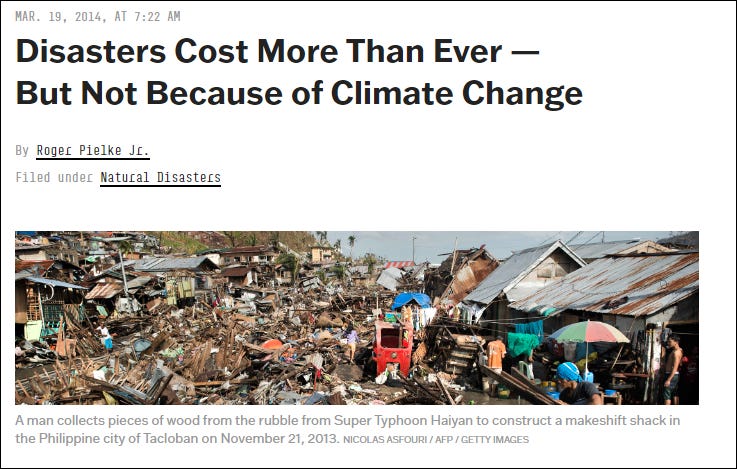
In the 1980s, the average annual cost of natural disasters worldwide was $50 billion. In 2012, Superstorm Sandy met that mark in two days. As it tore through New York and New Jersey on its journey up the east coast, Sandy became the second-most expensive hurricane in American history, causing in a few hours what just a generation ago would have been a year’s worth of disaster damage.
Sandy’s huge price tag fit a trend: Natural disasters are costing more and more money. See the graph below, which shows the global tally of disaster expenses for the past 24 years. It’s courtesy of Munich Re, one of the world’s largest reinsurance companies, which maintains a widely used global loss data set. (All costs are adjusted for inflation.)
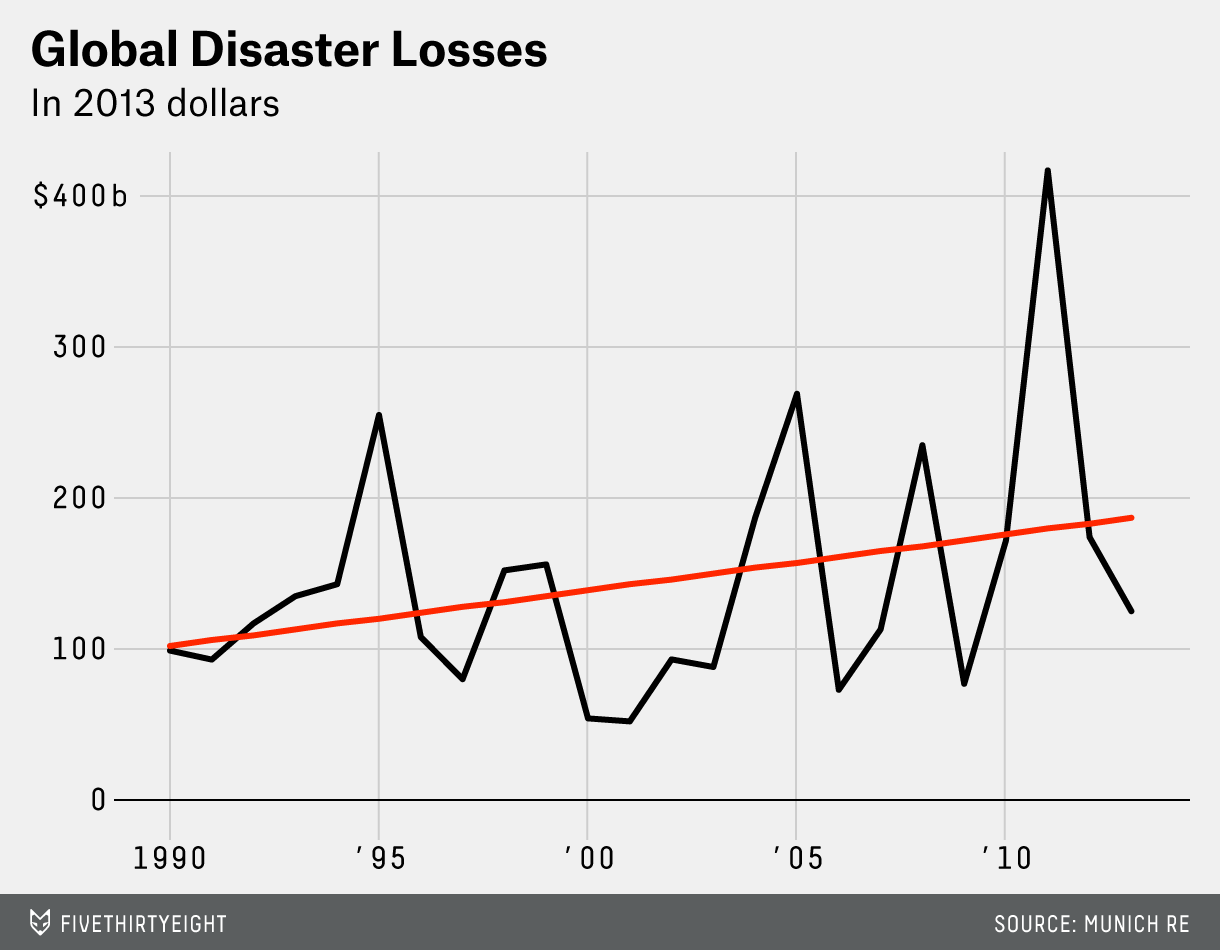
In the last two decades, natural disaster costs worldwide went from about $100 billion per year to almost twice that amount. That’s a huge problem, right? Indicative of more frequent disasters punishing communities worldwide? Perhaps the effects of climate change? Those are the questions that Congress, the World Bank and, of course, the media are asking. But all those questions have the same answer: no.
When you read that the cost of disasters is increasing, it’s tempting to think that it must be because more storms are happening. They’re not. All the apocalyptic “climate porn” in your Facebook feed is solely a function of perception. In reality, the numbers reflect more damage from catastrophes because the world is getting wealthier. We’re seeing ever-larger losses simply because we have more to lose — when an earthquake or flood occurs, more stuff gets damaged. And no matter what President Obama and British Prime Minister David Cameron say, recent costly disasters are not part of a trend driven by climate change. The data available so far strongly shows they’re just evidence of human vulnerability in the face of periodic extremes.
To identify changes in extreme weather, it’s best to look at the statistics of extreme weather. Fortunately, scientists have invested a lot of effort into looking at data on extreme weather events, and recently summarized their findings in a major United Nations climate report, the fifth in a series dating back to 1990. That report concluded that there’s little evidence of a spike in the frequency or intensity of floods, droughts, hurricanes and tornadoes. There have been more heat waves and intense precipitation, but these phenomena are not significant drivers of disaster costs. In fact, today’s climate models suggest that future changes in extremes that cause the most damage won’t be detectable in the statistics of weather (or damage) for many decades.
On Earth, extreme events don’t happen in a vacuum. Their costs are rising, sure, but so is overall wealth. When we take that graph above and measure disaster cost relative to global GDP, it changes quite a bit.6
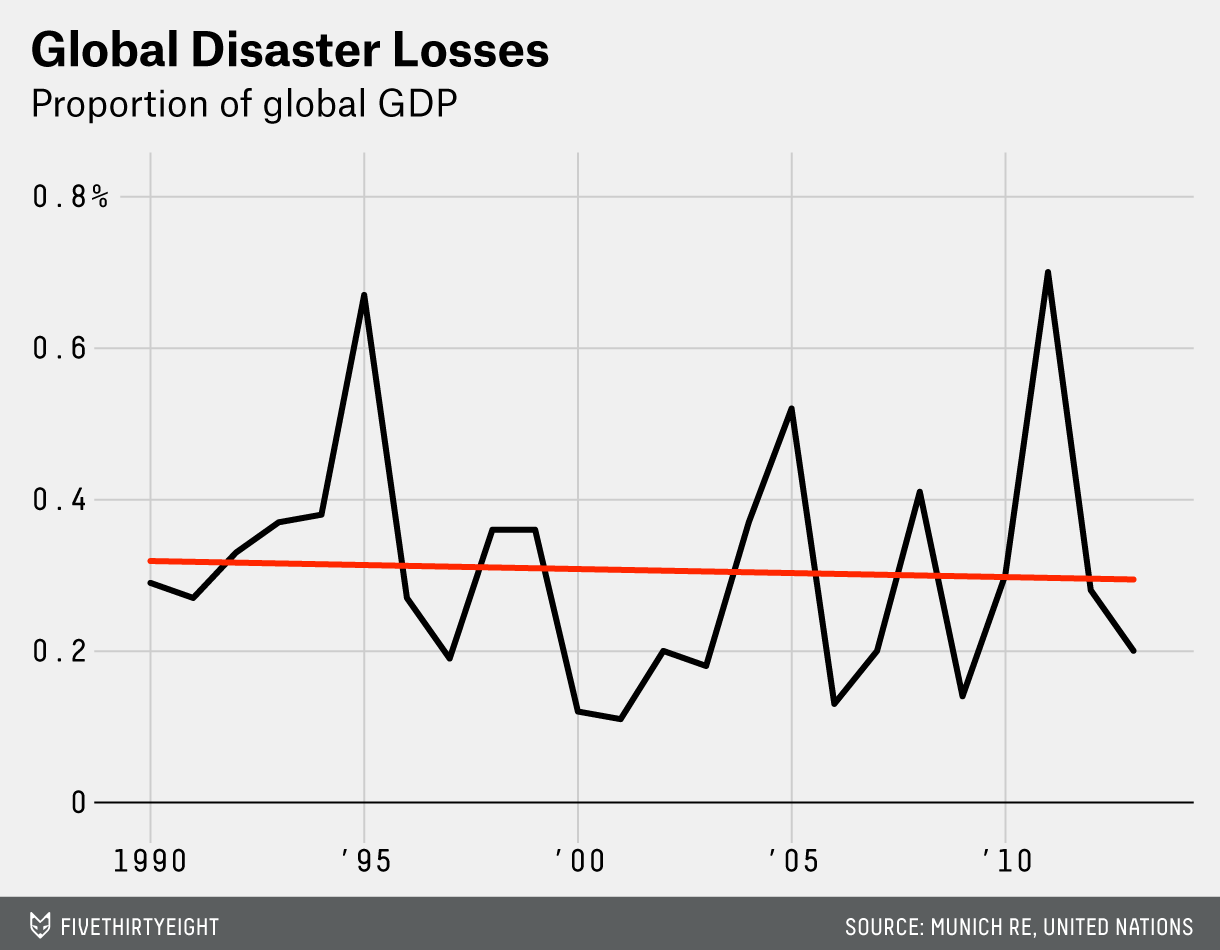
Occasionally, big disasters bring outsize costs — especially the Kobe earthquake in 1995, Hurricane Katrina in 2005 and the Honshu earthquake in 2011 — but the overall trend in disaster costs proportional to GDP since 1990 has stayed fairly level. Of course, wealthy countries hold all of the sway in worldwide cost estimates, which tips the scales when we’re looking for a “global” perspective on extreme events. U.S. hurricanes, for example, are responsible for 58 percent of the increase in the property losses in the Munich Re global dataset.
That’s just the property bill. There’s a human toll, too, and the data show an inverse relationship between lives lost and property damage: Modern disasters bring the greatest loss of life in places with the lowest property damage, and the most property damage where there’s the lowest loss of life. Consider that since 1940 in the United States 3,322 people have died in 118 hurricanes that made landfall. Last year in a poor region of the Philippines, a single storm, Typhoon Hayain, killed twice as many people.
We can start to estimate how countries may weather crises differently thanks to a 2005 analysis of historical data on global disasters. That study estimated that a nation with a $2,000 per capita average GDP — about that of Honduras — should expect more than five times the number of disaster deaths as a country like Russia, with a $14,000 per capita average GDP.2 (For comparison, the U.S. has a per capita GDP of about $52,000.)
In the 20th century, the human toll of disasters decreased dramatically, with a 92 percent reduction in deaths from the 1930s to the 2000s worldwide. Yet when the Boxing Day Tsunami struck Southeast Asia in 2004, more than 225,000 people died.
So the frequency of disasters still matters, and especially in countries that are ill-prepared for them. After 41 people died in two volcanic eruptions in Indonesia last month, a government official explained the high stakes: “We have 100 million people living in places that are prone to disasters, including volcanoes, earthquakes and floods. It’s a big challenge for the local and central governments.”
When you next hear someone tell you that worthy and useful efforts to mitigate climate change will lead to fewer natural disasters, remember these numbers and instead focus on what we can control. There is some good news to be found in the ever-mounting toll of disaster losses. As countries become richer, they are better able to deal with disasters — meaning more people are protected and fewer lose their lives. Increased property losses, it turns out, are a price worth paying.
Postscript March 2024
As THB readers well know, I have continued the research that was the subject of the column above. Below is an update to the figures in the column above, adjusted just for inflation and with 11 more years of data.
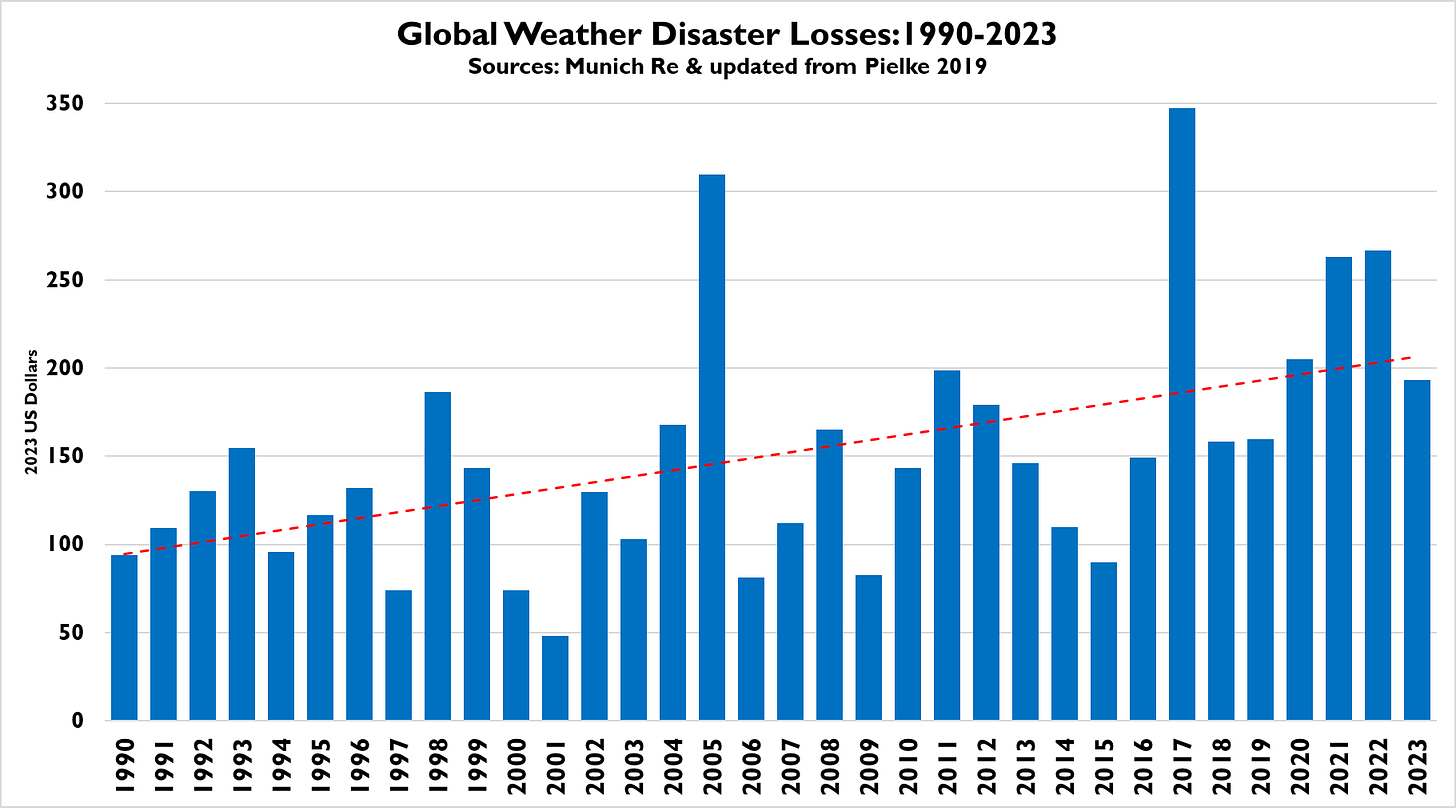
Inflation adjusted losses, 1990 to 2023.
Below is the second figure showing weather and climate disaster losses as a proportion of global GDP.

Global weather and climate losses as a percent of global GDP, 1990 to 2023.
I’ve published this analysis in the peer-reviewed literature as well:
Pielke, R. (2019). Tracking progress on the economic costs of disasters under the indicators of the sustainable development goals. Environmental Hazards, 18(1), 1-6.
No comments yet.
Featured Video

Rewriting the risk? Inside the government’s vaccine safety messaging
or go to
Aletho News Archives – Video-Images
Book Review
“Davos Can Really Replace the UN”
Inside the book that maps the architecture behind global governance — from the Epstein files to the Pact for the Future
Lies are Unbekoming | April 1, 2026
On June 13, 2019, the United Nations and the World Economic Forum signed a partnership deal to “accelerate the implementation of the 2030 Agenda for Sustainable Development.” That same evening, WEF president Börge Brende — Norway’s former Foreign Minister — had dinner with Jeffrey Epstein at Epstein’s Manhattan townhouse. The Epstein files, released January 2026, contain an exchange between the two from the previous year. Epstein to Brende: “Davos can really replace the UN. C21, cyber, crypto . genetics… intl coordination.” Brende back to Epstein: “Exactly — we need a new global architecture. World Economic Forum (Davos) is uniquely positioned — public private.”
The next day, the UN General Assembly adopted the framework for restructuring global governance.
That sequence — the partnership signing, the Epstein dinner, the candid admission about replacing the UN with a public-private architecture, and then the formal adoption — opens Jacob Nordangård’s The Digital World Brain. Pages two and three. Footnoted to the UN resolution number, the Epstein files, and the General Assembly record.
I keep coming back to it because it captures what this book does that almost nothing else in the independent research space manages. I’ve followed Jacob’s work for years now and interviewed him about his research. Each book peels back another layer of the same institutional architecture, and each time I think he’s reached the limit of what can be documented, the next one goes further. Nordangård doesn’t speculate. He doesn’t editorialize much. He lays institutional actions next to each other in chronological order and lets the pattern announce itself. … continue
Blog Roll
 Aletho News
- Iran, US receive Pakistan-mediated plan for ceasefire then final deal
- Iran submits demands for end to war as mediators scramble ahead of Trump deadline
- Iran Threatens Retaliatory Strike on Stargate AI Project in UAE
- US sent ‘a lot’ of arms to Iranian protesters – Trump
- Barak Ravid Launders Deception To Allow Trump To Back Off Of His Power Plant Threat – Again
- REWRITING THE RISK? INSIDE THE GOVERNMENT’S VACCINE SAFETY MESSAGING
- “Davos Can Really Replace the UN”
- NIAID/NIH and USDA Fund Bioengineered Chimeric Influenza Viruses Built Using Pandemic H1N1 Components: Journal ‘Science Advances’
- Hezbollah hits Israeli warship off Lebanon’s coast, sets it aflame
- Iran slams US strikes on B1 bridge, Mahshahr petrochemical plants as ‘blatant acts of state terrorism’
- If Americans Knew
- Trump poised to “blow everything up” (ie. commit war crimes) in Iran – Daily Update
- In Iran, Israel-US take aim at “reason, research, and freedom of thought” – Daily Update
- US loses planes over Iran, Israel downgrades Lebanon war goals – Daily Update
- Israel Is Blocking Palestinians from Easter at Church Where Jesus Resurrected
- Plot to assassinate Palestinian activist follows harassment campaign promoted by Zionist groups and elected officials
- Prominent New York synagogue hosts presentation on why U.S. Jews should support the ethnic cleansing of Gaza
- Tapper vs. Piker: Is the CNN Anchor Auditioning for David Ellison?
- Shouldn’t Democrats Be Able to Condemn Genocide?
- Israel-US kill negotiators, destroy civilian structures, but Iran’s military capabilities still largely intact – Daily Update
- ‘War crime’: Global condemnation as Israeli ministers celebrate death penalty law targeting Palestinian prisoners
- No Tricks Zone
- An Inconvenient Tree: Uncovered In Alps… Europe Much Warmer Than Today 6000 Years Ago
- New Study Reports A 60% Slowdown In Greenland’s Ice Loss Rate In The Last Decade
- Low Intensity Tornado Wrecks Major Solar Farm, Creating A Potential Toxic Dump
- New Study Finds Warming Saves Lives…Cold Temperatures 12 Times More Deadly Than Excess Heat
- German Science Blog Accuses PIK Climate Institute Of Hallucinating Climate Tipping Points
- Devastating Assessment Of Comirnaty Vaccine By Former Senior Pfizer Europe Toxicologist
- New Study: CO2 Is ‘Effectively Negligible’ As An Explanatory Climate Change Factor Since 2000
- Former Pfizer Toxicologist Dr. Helmut Sterz Tells Bundestag Hearing Pfizer Vaccine Should Have Never Been Approved
- Energy Expert: Germany’s Nuclear Phaseout Was A “500 Billion Euro Mistake”
- New Research: South Australia’s Mid-Holocene Sea Surface Temperatures Were 4°C Warmer Than Today
 Aletho News
Leave a comment