Hmm… interesting! https://t.co/oXjpx1keHX
— Alex (Sasha) Krainer (@NakedHedgie) April 7, 2024
Why Did Washington Insist on the Kosovo War?
By James George Jatras | Ron Paul Institute | April 9, 2024
The following remarks were delivered at a conference marking the 25th anniversary of the NATO bombing of Serbia: “The 1999 Red-Green Bombing Terror against Serbia,” held on March 20, 2024, at the Bundestag in Berlin hosted by MdB Dr. Rainer Rothfuß and his Alternative for Germany parliamentary group.
In 2004, I appeared as the second defense witness called by Slobodan Milošević at his so-called “trial” before the so-called “International Criminal Tribunal for the former Yugoslavia” at The Hague My testimony was not as an expert witness but as a witness of fact concerning the formulation and implementation of US and western policy. I addressed one specific charge: that – beginning no later than October 1998 – Mr. Milošević was the initiator of a criminal conspiracy to drive the Albanians out of Kosovo and Metohija on the basis of their ethnicity.
There was one little problem with this accusation: there was absolutely zero direct evidence for it. No written order to this effect was ever produced. No person testified as to having received, transmitted, or even heard of such an instruction. Rather, the claim was based solely on circumstantial inferences of events starting from October 1998.
Thus, the heart of my testimony related to a paper I issued on August 12, 1998, as an analyst at the US Senate Republican Policy Committee, titled “Bosnia II: The Clinton Administration Sets Course for NATO Intervention in Kosovo.” In that paper, working solely from open sources, I detailed how, at that time – fully two months before the Milošević-led supposed “criminal conspiracy” came into effect —
“ … planning for a U.S.-led NATO intervention in Kosovo is now largely in place, …. The only missing element appears to be an event—with suitably vivid media coverage—that would make intervention politically salable, even imperative, in the same way that [the] Administration finally decided on intervention in Bosnia in 1995 after a series of ‘Serb mortar attacks’ took the lives of dozens of civilians—attacks, which, upon closer examination, may in fact have been the work of the Muslim regime in Sarajevo, the main beneficiary of the intervention. . . That the Administration is waiting for a similar ‘trigger’ in Kosovo is increasingly obvious: [As reported in the Washington Post, August 4, 1998], ‘A senior U.S. Defense Department official who briefed reporters on July 15 noted that “we’re not anywhere near making a decision for any kind of armed intervention in Kosovo right now, … [but] I think if some levels of atrocities were reached that would be intolerable, that would probably be a trigger”.’ ”
Now, if I was aware of this as early as August 1998, so were a lot of other people in Washington. I submitted to the “Tribunal” that in light of my paper, all interpretations of events would have to be drastically reevaluated. The issue wasn’t any longer whether Belgrade was planning an expulsion but that Washington was looking for a pretext for aggression.
(My cross-examination by prosecutor Geoffrey Nice (later Sir, based on his work at The Hague), asked me barely a word about my testimony. Rather, he interrogated me about my ethnic origins (Greek, from four Spartan grandparents), my religion (Orthodox Christian), and my opinions about the Islamic challenge to European, Christian civilization (negative).)
As we know, in due course the suitable “trigger” was found, with the so-called “Račak massacre” of January 1999. The key figure in “selling” Račak was William Walker. As described by Mark Ames and Matt Taibbi (now of Rolling Stone) in their article “Meet Mr. Massacre,” published in the now-defunct The Exile of February 10, 2000:
Years from now, when the war in Serbia is over and the dust has settled, historians will point to January 15, 1999 as the day the American Death Star became fully operational.
That was the date on which an American diplomat named William Walker brought his OSCE war crimes verification team to a tiny Kosovar village called Račak to investigate an alleged Serb massacre of ethnic Albanian peasants. After a brief review of the town’s 40-odd bullet-ridden corpses, Walker searched out the nearest television camera and essentially fired the starting gun for the war.
From what I saw, I do not hesitate to describe the crime as a massacre, a crime against humanity,’ he said. ‘Nor do I hesitate to accuse the government security forces of responsibility.’
We all know how Washington responded to Walker’s verdict; it quickly set its military machine in motion, and started sending out menacing invitations to its NATO friends to join the upcoming war party.
Focus on that phrase: “the American Death Star became fully operational.” Kosovo became the template that we then took on the road in one form or another in Afghanistan, Iraq, Libya, Syria, Yemen. Ukraine.
But the question still lingers: Why? Why was Washington so insistent that we and our NATO satelli– oops – “allies” needed to launch that war? Why did then-Secretary of State Madeleine Albright reveal in confidence, according to a reliable source, that at Rambouillet “We intentionally set the bar too high for the Serbs to comply. They need some bombing, and that’s what they are going to get”?
Some people will tell you it was about putting a NATO base, Camp Bondsteel, in a strategic location. Or that we wanted to clear the way for an East-West energy pipeline across the Balkans. Or that we coveted the mineral wealth of the Trepča mines. Or to secure the transit route for Afghan opium processed into heroin bound for Europe.
Certainly, all of our various interventions line a lot of a pockets, but in more than three decades of work in and around the Washington apparat, I never heard anyone point to such concrete and, frankly, normal if immoral imperial considerations.
Rather, answers must instead be sought within the larger perspective of American policy since the end of the first Cold War in 1991 and the development of the current one in the course of the 1990s: the American “unipolar moment,” as the bipartisan US policy nomenklatura sought to consolidate and perpetuate its hegemonic control over the entire planet, taking advantage of the vacuum left by the demise of the USSR. Perhaps the fullest expression of this was a 1996 Foreign Affairs article by neoconservative ideologists William Kristol and Robert Kagan (NOTE: Victoria Nuland’s husband), misleadingly titled “Toward a Neo-Reaganite Foreign Policy,” in which they called for the US to establish and maintain indefinitely “benevolent global hegemony” — in other words, perpetual American world domination.
Kristol and Kagan laid out virtually all of the elements that have guided US global policy during the ensuing years. It is no accident that Republican neoconservatives were enthusiastic supporters of Bill Clinton’s Balkan interventions of the 1990s, under the guidance of people like then-Secretary of State Madeleine Albright, who once opined regarding the sanctions-related deaths of a half million Iraqi children that “the price is worth it.” In the US establishment, there is little dissent on either side of the partisan aisle with Albright’s view that a militant United States has a special wisdom: “If we have to use force, it is because we are America; we are the indispensable nation. We stand tall and we see further than other countries into the future …”
The result is a kind of neo-Bolshevik ideology, where, as the vanguard of all progressive humanity, the US leadership class sees itself as the midwife of history. America took the path (as characterized by Russian Foreign Minister Sergey Lavrov) of the “replication of the experience of Bolshevism and Trotskyism”—morphing ourselves into a new Evil Empire in place of the old one. (Anyone familiar with the origins of America’s neoconservatives understands that the Trotskyite reference is not just rhetorical.)
Which brings us back to the “Why?” regarding Kosovo. When the dissolution of Yugoslavia kicked off in June 1991, largely at the initiative of Austria and Germany, official Washington was terrified that with the end of the Soviet bloc Europe might become “whole and free” – but without us. What then could be the future of Lord Hastings Lionel Ismay’s mission for NATO of keeping the Americans in Europe, the Russians out, and the Germans down? Europe, the crown jewel of the Global American Empire was slipping away.
Hence, as former Chairman of the Senate Foreign Relations Committee Richard Lugar (R-Indiana) indicated, NATO needed to go “out of area or out of business.” Starting in spring 1992, Washington moved swiftly to expand the conflict from Slovenia and Croatia (where it had been relatively contained) to Bosnia and Herzegovina. There the US became the vociferous champion of the Muslim faction, illegally shipping in al-Qaeda fighters and Iranian weapons via covert C-130 flights into Tuzla. We then engaged in a little demonstrative bombing of the Bosnian Serbs to set the stage for the Dayton Agreement. The arsonist sets the fire, so then he can be the hero rushing to the rescue: “See, you silly ‘dispensable’ European children? You just can’t get along without us …”
Following Dayton, Kosovo was the other shoe that needed to drop – with appropriate violence – to ensure that Europe was totally, abjectly, humiliatingly subservient to the United States through NATO, with the passive complicity of NATO’s concubine, the European Union. The corollary was that, just as the Serbs had no legitimate voice in determining post-Yugoslav structures, the Russians understood they had no legitimate voice in European security arrangements. These would be decided without them.
Now, of course, with defeat looming in Ukraine and with the broader Middle East on the edge of a regional conflagration, with many in Washington beating the drums for war with Iran or even China, the Global American Empire’s “unipolar” moment is coming to an end, one way or the other, either with a bang or with a whimper. Unfortunately, neither in Washington, nor in Berlin or other European capitals, with the exception of Budapest, are decisions made by people who can be regarded as mentally and morally healthy human beings, much less patriots.
The next few months and years promise to be a period of disorder and acute danger. The question is, can we – Americans and Europeans alike – find a path to governance that can secure a future for our peoples?
NATO kicks off Black Sea-Danube Delta exercise labeled Sea Shield 24
MAGYAR HÍRLAP | APRIL 9, 2024
NATO has launched its second major exercise this year in the vicinity of Ukraine, this time focusing on the Black Sea and the Danube Delta region.
The joint operation, Sea Shield 24, which runs until April 21, brings together more than 2,200 troops from Bulgaria, France, Greece, Italy, the U.K., Netherlands, Poland, Portugal, Romania, Turkey, the United States, Georgia and Moldova. The forces will include 27 river and naval warships, 17 aircraft, and 91 land-based military vehicles.
According to a Romanian Navy statement, Sea Shield is the most complex event of the 2024 training year, with scenarios focusing on missions to combat illegal activities, maritime and river control, the rescue of vessels in distress, and the protection of critical infrastructure in the Black Sea, along the coast, in the Danube, and in the Danube Delta.
The international exercise also aims to strengthen cooperation between the navies of the participating countries and with other forces.
The largest naval exercise organized by Romania was first held in 2015. Since then, Sea Shield scenarios have been continuously modified to enable the participating NATO forces to respond quickly and effectively to the full spectrum of threats to regional security and stability, according to the organizers.
In January, NATO launched “Steadfast Defender 2024,” a five-month exercise rehearsing the alliance’s response to a hypothetical aggression against a member state. All 32 NATO member states participated, with some 90,000 personnel, including the largest single contingent of 20,000 from the United Kingdom.
Disasters Cost More Than Ever — But Not Because of Climate Change
From the archives, a look back and an update

Fundraiser from 2014. We learned from Wikileaks that Tom Steyer, the Center for American Progress, and Michael Mann were behind the curtain. Just $10? Deplatforming me should get at least $15!
By Roger Pielke | The Honest Broker | March 26, 2024
This week marks my final spring break as a professor at the University of Colorado Boulder. Ten years ago this week, during spring break while on vacation with my family, I was dealing with the consequences of what appeared to be an online mob seeking to get me fired from Nate Silver’s 538 where I had just been hired as a writer.
My first piece for 538 was a summary of recent IPCC report consensus conclusions on disasters and extreme events. The apparent mobbing worked.1 I soon lost my position as a writer at 538.
Not long after, I was under investigation by a member of Congress.2 I lost the support of my university and my role in the center I had founded, so I moved across campus to work on sports governance.3 I have little doubt that I remained employed only thanks to academic tenure. It was quite an experience.
Two years later, in 2016, courtesy of the Wikileaks publication of John Podesta’s emails, it was revealed that the Center for American Progress, funded by billionaire Tom Steyer and in collaboration with the ever-present Michael Mann, had been engaged in a well-funded campaign to delegitimize my research, hurt my career, and to have me removed as a writer at 538.4
I can draw a straight line from those events a decade ago to where I am today. And given where I am today, I wouldn’t change a thing. I have no hard feelings towards Nate — He got played and did what he felt he had to at the time.
Below, I have reproduced my first column at 538 in 2014 that was apparently so threatening to some in the climate advocacy community.5 I also add a post-script below. How does it hold up?
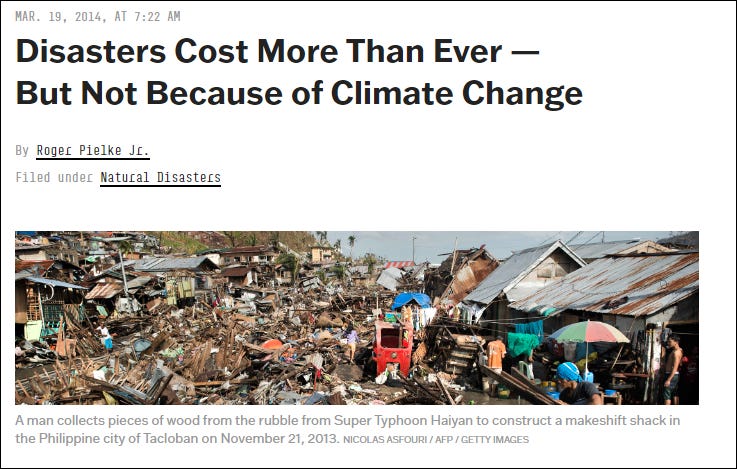
In the 1980s, the average annual cost of natural disasters worldwide was $50 billion. In 2012, Superstorm Sandy met that mark in two days. As it tore through New York and New Jersey on its journey up the east coast, Sandy became the second-most expensive hurricane in American history, causing in a few hours what just a generation ago would have been a year’s worth of disaster damage.
Sandy’s huge price tag fit a trend: Natural disasters are costing more and more money. See the graph below, which shows the global tally of disaster expenses for the past 24 years. It’s courtesy of Munich Re, one of the world’s largest reinsurance companies, which maintains a widely used global loss data set. (All costs are adjusted for inflation.)
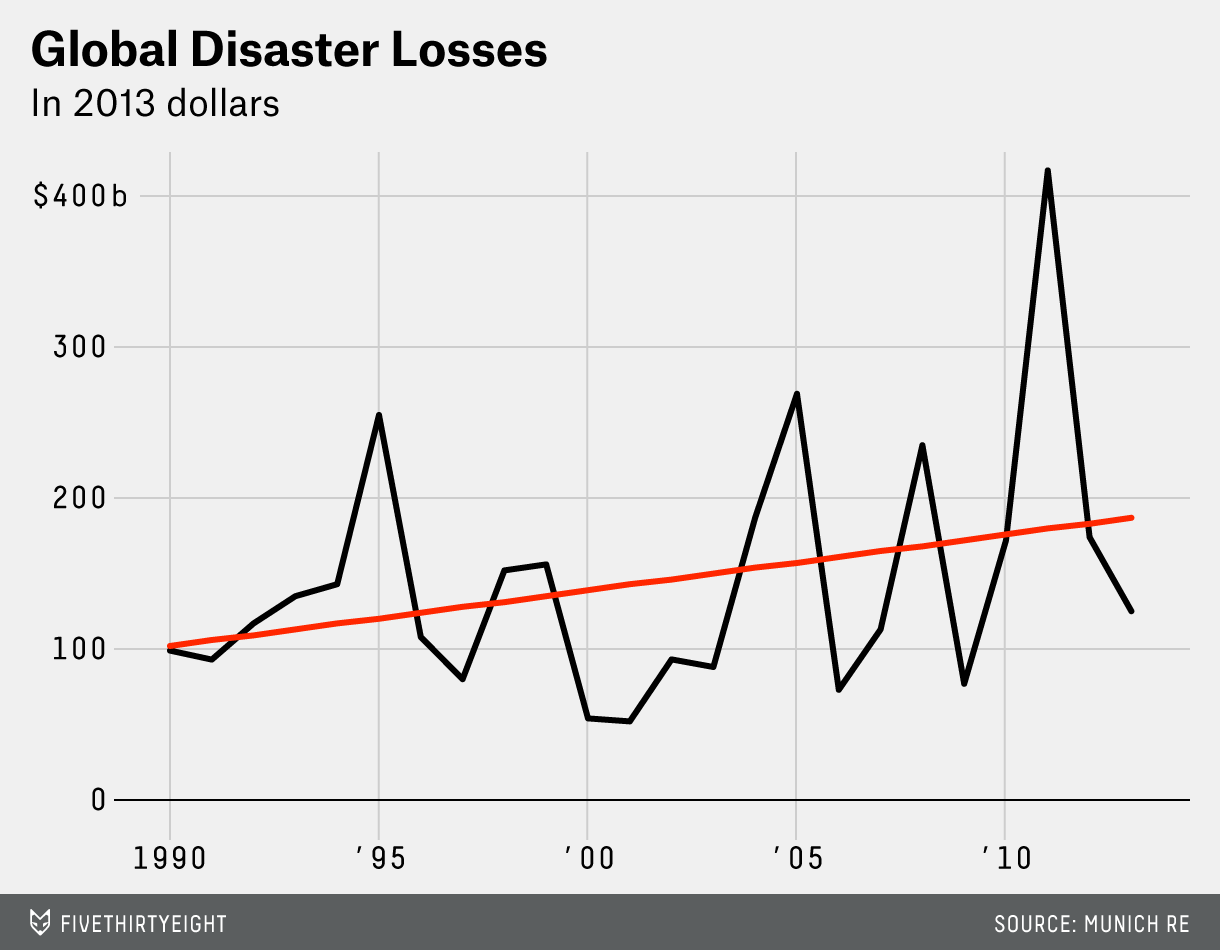
In the last two decades, natural disaster costs worldwide went from about $100 billion per year to almost twice that amount. That’s a huge problem, right? Indicative of more frequent disasters punishing communities worldwide? Perhaps the effects of climate change? Those are the questions that Congress, the World Bank and, of course, the media are asking. But all those questions have the same answer: no.
When you read that the cost of disasters is increasing, it’s tempting to think that it must be because more storms are happening. They’re not. All the apocalyptic “climate porn” in your Facebook feed is solely a function of perception. In reality, the numbers reflect more damage from catastrophes because the world is getting wealthier. We’re seeing ever-larger losses simply because we have more to lose — when an earthquake or flood occurs, more stuff gets damaged. And no matter what President Obama and British Prime Minister David Cameron say, recent costly disasters are not part of a trend driven by climate change. The data available so far strongly shows they’re just evidence of human vulnerability in the face of periodic extremes.
To identify changes in extreme weather, it’s best to look at the statistics of extreme weather. Fortunately, scientists have invested a lot of effort into looking at data on extreme weather events, and recently summarized their findings in a major United Nations climate report, the fifth in a series dating back to 1990. That report concluded that there’s little evidence of a spike in the frequency or intensity of floods, droughts, hurricanes and tornadoes. There have been more heat waves and intense precipitation, but these phenomena are not significant drivers of disaster costs. In fact, today’s climate models suggest that future changes in extremes that cause the most damage won’t be detectable in the statistics of weather (or damage) for many decades.
On Earth, extreme events don’t happen in a vacuum. Their costs are rising, sure, but so is overall wealth. When we take that graph above and measure disaster cost relative to global GDP, it changes quite a bit.6
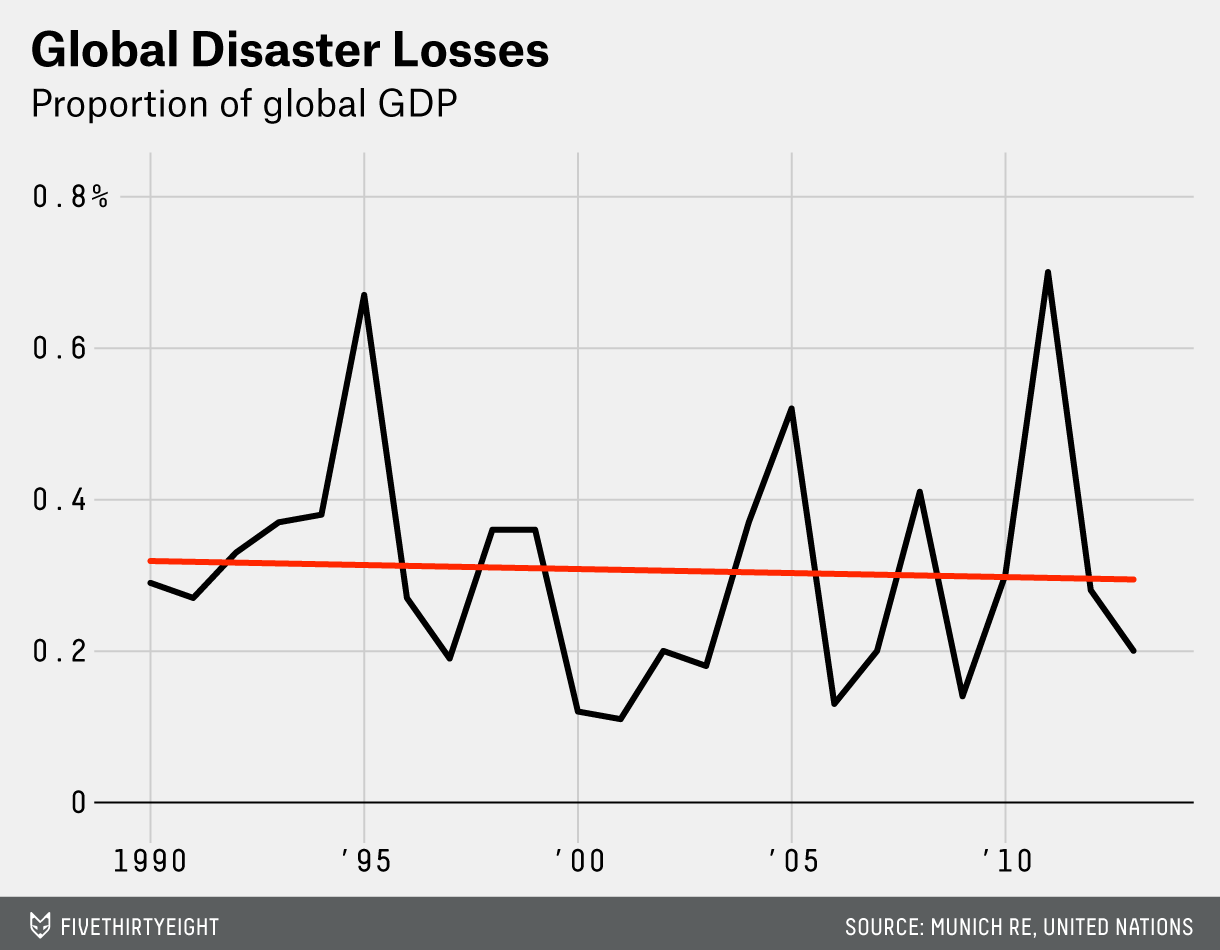
Occasionally, big disasters bring outsize costs — especially the Kobe earthquake in 1995, Hurricane Katrina in 2005 and the Honshu earthquake in 2011 — but the overall trend in disaster costs proportional to GDP since 1990 has stayed fairly level. Of course, wealthy countries hold all of the sway in worldwide cost estimates, which tips the scales when we’re looking for a “global” perspective on extreme events. U.S. hurricanes, for example, are responsible for 58 percent of the increase in the property losses in the Munich Re global dataset.
That’s just the property bill. There’s a human toll, too, and the data show an inverse relationship between lives lost and property damage: Modern disasters bring the greatest loss of life in places with the lowest property damage, and the most property damage where there’s the lowest loss of life. Consider that since 1940 in the United States 3,322 people have died in 118 hurricanes that made landfall. Last year in a poor region of the Philippines, a single storm, Typhoon Hayain, killed twice as many people.
We can start to estimate how countries may weather crises differently thanks to a 2005 analysis of historical data on global disasters. That study estimated that a nation with a $2,000 per capita average GDP — about that of Honduras — should expect more than five times the number of disaster deaths as a country like Russia, with a $14,000 per capita average GDP.2 (For comparison, the U.S. has a per capita GDP of about $52,000.)
In the 20th century, the human toll of disasters decreased dramatically, with a 92 percent reduction in deaths from the 1930s to the 2000s worldwide. Yet when the Boxing Day Tsunami struck Southeast Asia in 2004, more than 225,000 people died.
So the frequency of disasters still matters, and especially in countries that are ill-prepared for them. After 41 people died in two volcanic eruptions in Indonesia last month, a government official explained the high stakes: “We have 100 million people living in places that are prone to disasters, including volcanoes, earthquakes and floods. It’s a big challenge for the local and central governments.”
When you next hear someone tell you that worthy and useful efforts to mitigate climate change will lead to fewer natural disasters, remember these numbers and instead focus on what we can control. There is some good news to be found in the ever-mounting toll of disaster losses. As countries become richer, they are better able to deal with disasters — meaning more people are protected and fewer lose their lives. Increased property losses, it turns out, are a price worth paying.
Postscript March 2024
As THB readers well know, I have continued the research that was the subject of the column above. Below is an update to the figures in the column above, adjusted just for inflation and with 11 more years of data.
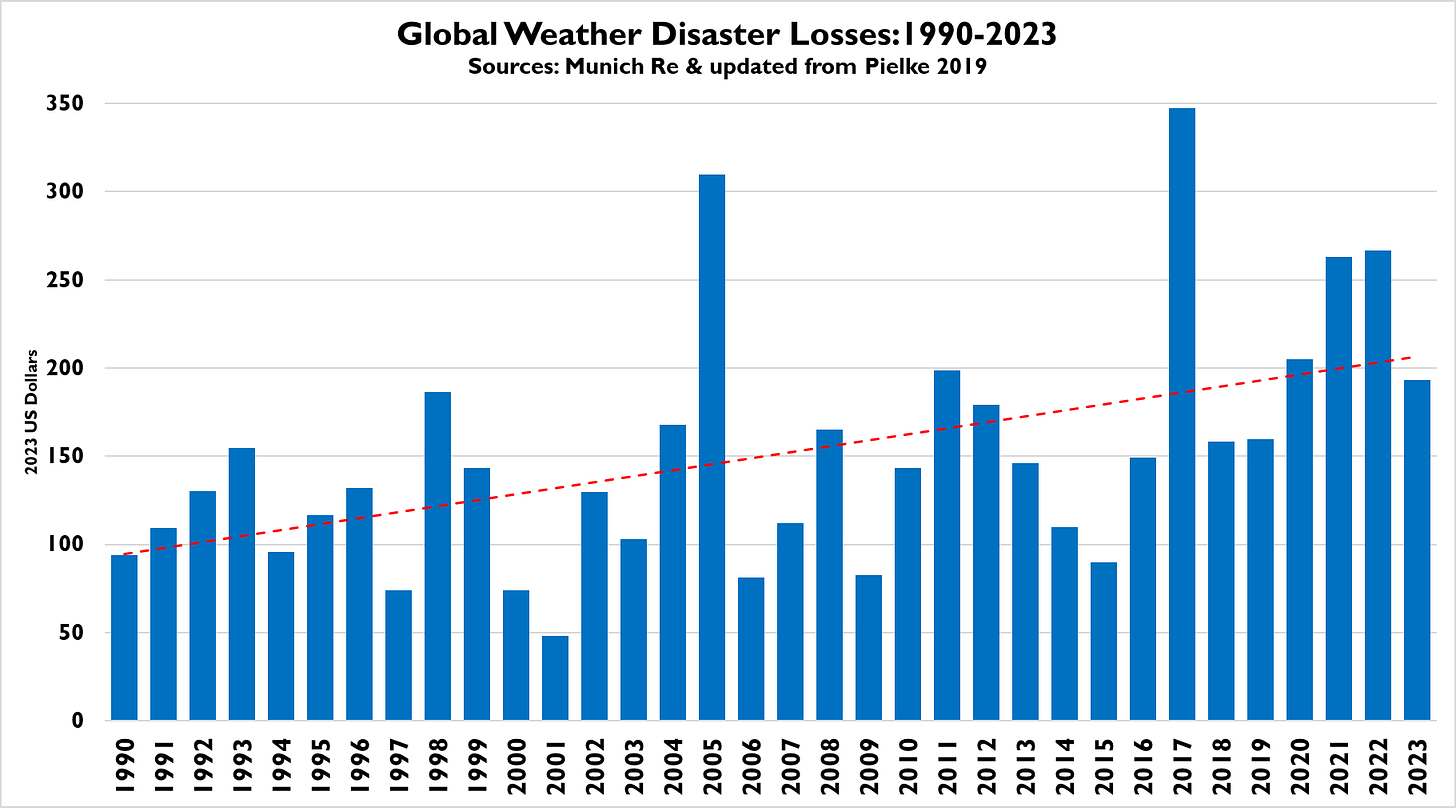
Inflation adjusted losses, 1990 to 2023.
Below is the second figure showing weather and climate disaster losses as a proportion of global GDP.

Global weather and climate losses as a percent of global GDP, 1990 to 2023.
I’ve published this analysis in the peer-reviewed literature as well:
Pielke, R. (2019). Tracking progress on the economic costs of disasters under the indicators of the sustainable development goals. Environmental Hazards, 18(1), 1-6.
Featured Video

Rewriting the risk? Inside the government’s vaccine safety messaging
or go to
Aletho News Archives – Video-Images
Book Review
“Davos Can Really Replace the UN”
Inside the book that maps the architecture behind global governance — from the Epstein files to the Pact for the Future
Lies are Unbekoming | April 1, 2026
On June 13, 2019, the United Nations and the World Economic Forum signed a partnership deal to “accelerate the implementation of the 2030 Agenda for Sustainable Development.” That same evening, WEF president Börge Brende — Norway’s former Foreign Minister — had dinner with Jeffrey Epstein at Epstein’s Manhattan townhouse. The Epstein files, released January 2026, contain an exchange between the two from the previous year. Epstein to Brende: “Davos can really replace the UN. C21, cyber, crypto . genetics… intl coordination.” Brende back to Epstein: “Exactly — we need a new global architecture. World Economic Forum (Davos) is uniquely positioned — public private.”
The next day, the UN General Assembly adopted the framework for restructuring global governance.
That sequence — the partnership signing, the Epstein dinner, the candid admission about replacing the UN with a public-private architecture, and then the formal adoption — opens Jacob Nordangård’s The Digital World Brain. Pages two and three. Footnoted to the UN resolution number, the Epstein files, and the General Assembly record.
I keep coming back to it because it captures what this book does that almost nothing else in the independent research space manages. I’ve followed Jacob’s work for years now and interviewed him about his research. Each book peels back another layer of the same institutional architecture, and each time I think he’s reached the limit of what can be documented, the next one goes further. Nordangård doesn’t speculate. He doesn’t editorialize much. He lays institutional actions next to each other in chronological order and lets the pattern announce itself. … continue
Blog Roll
 Aletho News
- Iran Threatens Retaliatory Strike on Stargate AI Project in UAE
- US sent ‘a lot’ of arms to Iranian protesters – Trump
- Barak Ravid Launders Deception To Allow Trump To Back Off Of His Power Plant Threat – Again
- REWRITING THE RISK? INSIDE THE GOVERNMENT’S VACCINE SAFETY MESSAGING
- “Davos Can Really Replace the UN”
- NIAID/NIH and USDA Fund Bioengineered Chimeric Influenza Viruses Built Using Pandemic H1N1 Components: Journal ‘Science Advances’
- Hezbollah hits Israeli warship off Lebanon’s coast, sets it aflame
- Iran slams US strikes on B1 bridge, Mahshahr petrochemical plants as ‘blatant acts of state terrorism’
- In letter to UN chief, Araghchi warns of dire consequences of US-Israeli attacks on Iran’s nuclear facilities
- Why the CIA conspiracy to invade Iran with Kurdish militias failed
- If Americans Knew
- Trump poised to “blow everything up” (ie. commit war crimes) in Iran – Daily Update
- In Iran, Israel-US take aim at “reason, research, and freedom of thought” – Daily Update
- US loses planes over Iran, Israel downgrades Lebanon war goals – Daily Update
- Israel Is Blocking Palestinians from Easter at Church Where Jesus Resurrected
- Plot to assassinate Palestinian activist follows harassment campaign promoted by Zionist groups and elected officials
- Prominent New York synagogue hosts presentation on why U.S. Jews should support the ethnic cleansing of Gaza
- Tapper vs. Piker: Is the CNN Anchor Auditioning for David Ellison?
- Shouldn’t Democrats Be Able to Condemn Genocide?
- Israel-US kill negotiators, destroy civilian structures, but Iran’s military capabilities still largely intact – Daily Update
- ‘War crime’: Global condemnation as Israeli ministers celebrate death penalty law targeting Palestinian prisoners
- No Tricks Zone
- An Inconvenient Tree: Uncovered In Alps… Europe Much Warmer Than Today 6000 Years Ago
- New Study Reports A 60% Slowdown In Greenland’s Ice Loss Rate In The Last Decade
- Low Intensity Tornado Wrecks Major Solar Farm, Creating A Potential Toxic Dump
- New Study Finds Warming Saves Lives…Cold Temperatures 12 Times More Deadly Than Excess Heat
- German Science Blog Accuses PIK Climate Institute Of Hallucinating Climate Tipping Points
- Devastating Assessment Of Comirnaty Vaccine By Former Senior Pfizer Europe Toxicologist
- New Study: CO2 Is ‘Effectively Negligible’ As An Explanatory Climate Change Factor Since 2000
- Former Pfizer Toxicologist Dr. Helmut Sterz Tells Bundestag Hearing Pfizer Vaccine Should Have Never Been Approved
- Energy Expert: Germany’s Nuclear Phaseout Was A “500 Billion Euro Mistake”
- New Research: South Australia’s Mid-Holocene Sea Surface Temperatures Were 4°C Warmer Than Today
 Aletho News