There’s been a drastic drop in the registration of new electric cars in Germany as sales of the “clean” electric cars have slumped nearly 30% compared to a year earlier, reports Germany’s online Blackout News.
The massive sales drop is bad news for the current German socialist-green government, which aims to have 15 million vehicles on the road by 2030. Currently there are just 1.4 million!
The dismal trend underscores the unpopularity of electric cars and consumers’ hesitancy when it comes to purchasing them. Electric vehicles are plagued by limited range, sparse charging infrastructure, steep upfront purchase price and their huge environmental impact, which involves the largescale mining of rare earths.
“Their market share has fallen to just 11.9%. This casts a harsh light on the mismatch between Germany’s political goals and the reality of the automotive market. It is clear that political incentives and measures are inadequate,” reports Blackout News. “The abolition of the electric bonus at the end of 2023 has revealed another problem. The sector’s dependence on state subsidies became apparent. This has further exacerbated the crisis of confidence in the electric car market.”
Fahrverbot: Germany floats national weekend driving ban!
Another possible reason for hesitancy when it comes to purchasing a new car of any type may be partly due to the government’s general hostility to private mobility.
Germany’s federal minister of transportation, Dr. Volker Wissing, is threatening to ban driving on weekends by motorists in order for the country “to meet climate goals set forth by the Climate Protection Act.”
April 13, 2024
Posted by aletho |
Civil Liberties, Malthusian Ideology, Phony Scarcity | Germany |
Leave a comment
About ten years ago, there were serious discussions about dismantling the WHO due to its mismanagement of the Ebola epidemic in West Africa. An even more dramatic mismanagement of the Covid-19 pandemic must now finally seal the fate of this organization!
I still have serious doubts about whether the Covid-19 pandemic was planned; it certainly wasn’t orchestrated by the Vaccine Industry. Moreover, it’s also difficult to reconcile the broadly approved effort of the Vaccine Industry to develop a vaccine with the notion of a powerful lobby harboring nefarious intentions. Back then, no one anticipated, indeed, that vaccination during a pandemic could worsen its spread and health impact, given past successes in curbing infection chains through vaccination during pandemics or epidemics.
Nobody ever officially reported, though, that in the case of these alleged success stories (such as Smallpox and Ebola), deaths of contacts of index cases ring-vaccinated with replicating vaccines during the incubation time of the disease substantially contributed to halting viral transmission. Consequently, the WHO erroneously believed that vaccination during a pandemic or epidemic was a highly effective strategy for ending it.
‘Regrettably’(?!), in the mass Covid-19 vaccination program, this never-investigated or mentioned ‘killing effect’ didn’t materialize, as the vaccines used were non-replicating and the ring vaccination protocol didn’t apply, considering that the transmission of this virus is airborne rather than via direct contact. Therefore, I strongly believe that the egregious incompetence of the WHO is at the heart of the mismanagement of this pandemic. It’s only right that such a screw-up should vanish from the face of this earth.
April 13, 2024
Posted by aletho |
Aletho News | Covid-19, WHO |
Leave a comment
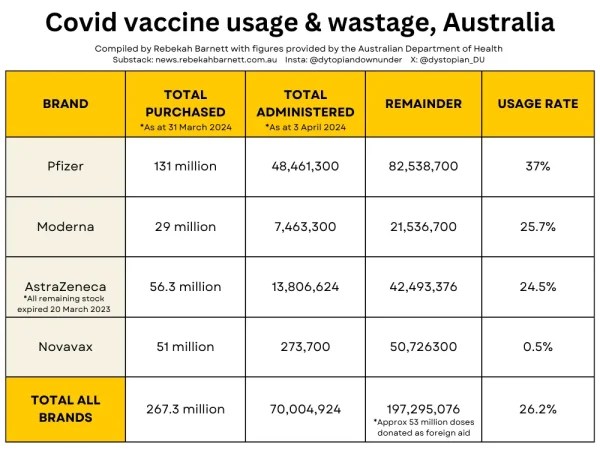
As part of its pandemic response, the Australian government purchased 267.3 million doses of Covid vaccines, enough to vaccinate Australia’s population of approximately 26 million people ten times over.
But figures released to me by the Department of Health (DOH) this week confirm that, three years into the vaccine program, only 70 million doses, or 26% of the 267.3 million doses purchased, have been administered, while 35% of vaccines doses have been wasted since the start of the vaccine rollout.
Last week, the Australian reported that more than 35% of Covid vaccines were being tossed out as of January due to oversupply. The revelation came from the DOH’s public submission to the federal Covid inquiry.
The wording made it unclear if this was a cumulative figure or applicable only to the month of January, so I contacted the DOH to confirm the total wastage to date, along with some further questions on the value of doses purchased, delivered, and wasted, and exactly how many had been administered.
A DOH spokesperson responded,
“As of 31 March 2024 the total COVID-19 vaccine program wastage rate was at 35.69%. Australia’s wastage rate is within the World Health Organization (WHO) acceptable wastage parameters for multidose vials of 15% and 40%.
“Approximately 80% of COVID-19 vaccine wastage is attributed to expiry of doses across warehouses and vaccine administration sites.”
This appears to mean that 80% of the wasted doses simply expired on the shelf.
The remaining 20% of wasted doses would likely be due to administration sites not managing to use the entire contents of multi-dose vials once opened. While unopened vials have a shelf-life of anywhere between 9-18 months, opened vials must be used within 6-48 hours.
The DOH refused to confirm the value of doses purchased or wasted, or how many of the purchased doses have actually been delivered, “for contractural and security reasons.” The Australian government has repeatedly refused to release details of its tax-payer-funded Covid vaccine purchase agreements.
However, we know that total government spending on Covid vaccines and treatment supply amounts to over $18 billion, of which it appears that the lion’s share was allocated to purchasing vaccine doses.
Most of these remain unused. DOH figures provided to me this week show that as at 3 April, only a quarter (70 million) of the 267.3 million purchased doses had been used, at a total usage rate of 26.2%
Of the remaining 197.3 million unadministered doses, the DOH advised that approximately 53 million doses have been donated as foreign aid.
That leaves approximately 144 million doses, more than half of the total stockpile, either already expired, or likely to expire within the next several years, as booster rates hover below 10%.
As Australia’s vaccine purchases extend into 2023 and 2024, it is probable that a portion of these doses will still be viable up to 2025.
But even if vaccine doses never expired, it would take Australians 29 years to work their way through the glut, based on the five million boosters administered in the past 12 months.
As it stands, usage rates by brand are as below:
- Of 131 million Pfizer doses purchased, 48.5 million have been administered, a usage rate of 37%. 82.5 million doses remain.
- Of 29 million Moderna doses purchased, 7.5 million have been administered, a usage rate of 25.7%. 21.5 million doses remain.
- Of 56.3 million AstraZeneca doses purchased, 13.8 million have been administered, a usage rate of 24.5%. As the AstraZeneca stockpile expired on 20 March 2023, the remaining 42.5 million doses have been binned, unless they were donated as aid prior to this date.
- Stunningly, of 51 million Novavax doses purchased, only 273,700 have been administered, a usage rate of 0.5%. 50.7 million doses, 99.5% of the stockpile, remain. This is because by the time Novavax was approved for use, in December 2021, over 90% of Australians aged 16 and over had already been double vaccinated.
In a July 2022 article investigating Australia’s already apparent vast vaccine wastage, the ABC asked if perhaps the government had bought too many vaccines?
Deborah Gleeson, Associate Professor of Public Health at La Trobe University, criticised the government’s run on the global vaccine supply, suggesting that Australia had hoarded more than its share.
Prof Gleeson told the ABC,
“Australia really participated in a bigger trend that we’ve seen worldwide of wealthy countries buying up far more doses of COVID-19 vaccines than they needed early on in the pandemic. And this is a practice that unfortunately has continued.”
It’s enough to make advocates for global vaccine equity lose sleep at night.
The news of the Australian government’s wastage of billions of dollars worth of Covid vaccines comes as Australians are grappling with the soaring cost of living and the worst housing crisis on record, with over a quarter of a million Australians accessing homelessness services in 2022-2023.
April 13, 2024
Posted by aletho |
Economics | Australia, COVID-19 Vaccine |
Leave a comment
The pharmaceutical and medical devices industries paid physicians more than $12 billion over 10 years, according to a study published last month in JAMA.
The analysis found the industries made 85,087,744 payments totaling $12.13 billion to 826,313 physicians — 57.1% of practicing physicians across 39 specialties.
Orthopedic surgeons, neurologists and psychiatrists, and cardiologists received the most money. Trauma surgeons and pediatric surgeons received the least.
The drugs with the highest payouts were blood thinners Xarelto and Eliquis, along with Humira, an immunosuppressant.
The three medical devices with the highest payouts were robotic surgery systems, da Vinci Surgical System and Mako SmartRobotics, and CoreValve Evolut, a heart valve.
“Money given to doctors has a purpose: it is for marketing,” cardiologist Dr. John Mandrola and co-author of the study wrote on his Substack. “If these direct payments to doctors did not work, industry would not spend billions.”
Dr. Andrew Foy, lead author of the paper, told The Defender in an email he thought some people might find the numbers “shocking” and he hoped it would renew interest in having conversations about physician-industry payments and facilitate more research.
The researchers tracked and compared payments made to physicians across and within specialties. They also identified the top 25 drugs and medical devices associated with the largest total payments.
The analysis included only money received for consulting, travel, food, entertainment, education, gifts, grants and honoraria. The researchers excluded other major external funding sources for physicians such as research funding and royalties.
They analyzed data from 2013-2022 in the Open Payments database, established in 2013 by the Physician Payments Sunshine Act as part of the Affordable Care Act.
Legislators designed the Sunshine Act to address growing public concerns about Big Pharma’s influence over doctors. At the time, several studies had shown that increased interaction with pharmaceutical representatives influenced physician prescribing behavior.
The act requires medical product manufacturers to disclose to the Centers for Medicare and Medicaid Services any payments or other transfers of value made to physicians or teaching hospitals. Open Payments publishes the payments on its website.
The analysis found that payments varied significantly across specialties. The highest-paid specialties like orthopedic surgery received $1.36 billion, and neurology and psychology specialties received $1.32 billion. The lowest-paid specialties received substantially less.
Pediatric surgeons and trauma surgeons received only $2.89 million and $6.96 million respectively.
Payments also varied significantly among physicians within the same specialty, with a small number of physicians in each specialty receiving the largest amounts of money — often exceeding $1 million — while the median physician received significantly less, typically less than $100, ranging from zero to $2,339.
“Our paper is a modest analysis. It does not explain the problem of financial conflicts of interest. But it is a lot of money. And it’s highly targeted to lucrative procedures,” Mandrola wrote.
“Industry influence is way too strong,” he added, and commonly results in medical devices being approved “despite dodgy evidence.”
He said many doctors believe collaboration between industry and physicians is a good thing that drives innovation. However, he said, these payments weren’t simply supporting collaboration.
“Most of it, I would argue, is for marketing and goodwill. Goodwill goes a long way to help establish practice patterns.”
Top drugs and devices on list net billions for pharma
The blood thinner Xarelto, used to prevent blood clots from forming due to an irregular heartbeat or after hip or knee replacement surgery, topped the payment list, accounting for $176.3 million.
The drug, made by Bayer and marketed by Janssen Pharmaceuticals, was Bayer’s top drug in 2023, generating about 4.1 billion euros in revenue.
Payments for Eliquis, another blood thinner used to treat the same conditions, amounted to $102.62 million. Pfizer and Bristol-Myers Squibb manufacture Eliquis.
Pfizer in 2023 brought in over $6.7 billion from the drug, its second-most profitable product behind the Comirnaty COVID-19 vaccine. Bristol-Myers Squibb’s sales topped $12 billion.
Eliquis costs U.S. customers 3 to 7 times more than customers in other high-income countries.
Humira, an immunosuppressant used to treat rheumatoid arthritis, psoriasis and other autoimmune conditions paid out $100.17 million to physicians. Over the last two decades, the drug netted over $200 billion for drugmaker AbbieVie, which listed the medication at $50,000 per year.
Bayer, Pfizer, Bristol-Myers Squibb and AbbieVie did not immediately respond to requests for comment.
Other top drugs included diabetes treatments Invokana, Jardiance, and Farxiga, Dupixent, a drug for allergic diseases, and Botox.
The two medical devices topping the list — da Vinci Surgical System, which paid $307.5 million, and Mako SmartRobotics, which paid $50 million — are machines for robotic-assisted surgeries.
Mako focuses on hip and knee replacements. Da Vinci netted approximately $7.12 billion in 2023 and investors were “blown away” by the “robot-fueled growth” of Mako SmartRobotics device installation for hip and knee replacements. Mako’s parent company Stryker made over $20 billion last year.
Several cardiology devices also made the list, including the third-highest payer CoreValve Evolut, another heart valve, Sapien 3 and LifeVest, a wearable defibrillator. They are all part of their parent companies’ multi-billion dollar product portfolios.
Conflicts of interest
The problem of physicians’ financial ties to pharmaceutical companies has plagued the industry for decades and garnered significant media attention.
Perhaps most famously, Purdue Pharma used misleading marketing to make massive profits from sales of opioids, sparking an epidemic. Nearly 645,000 Americans died from opioid overdose between 1999 and 2021.
However, Purdue Pharma’s policy of paying physicians has long been common practice. Research studies during the last two decades have found the vast majority of physicians accept payments and gifts from pharmaceutical companies. Influential studies include those by the Institute of Medicine and the Medicare Payments Advisory Commission that led to the passage of the Sunshine Act.
This latest study and other recent studies show that despite new mechanisms for transparency in payments, the payments continue.
And those payments are particularly high among physicians with prominent roles directing public policy.
For example, last year The New York Times revealed that while advisers at the National Academies of Sciences, Engineering, and Medicine were shaping public policy on opioids, they were also accepting payments from the Sackler family who owned Purdue Pharma.
Last month, The Defender reported that most of the nine new members appointed to the vaccine advisory committee for the Centers for Disease Control and Prevention have received substantial direct payments or research funding from Big Pharma — largely from the companies whose products they will be reviewing.
Foy said he thought a major part of the problem is that physicians and researchers believe that if they make their conflicts of interest transparent, the problem is resolved.
“As if someone cannot be transparent about their conflicts and highly biased at the same time,” he said.
He said that payments don’t necessarily lead directly to prescribing one specific drug for which a payment is received.
Instead, he said, he worries that the payments lead to, “overly enthusiastic recommendations or guidelines from medical organizations to use new products when they have not been sufficiently tested, or where the evidence is not strong enough, to recommend them over old standards or nothing at all (in some cases).”
Industry payments to physicians, Foy said, have a way of “tilting physicians’ sympathy toward industry and the ‘medical advancements’ that come from industry so that they (the physicians) more willingly adopt new products just for the sake of ‘industry advancement’ even if they don’t have a direct COI [conflict of interest] with that particular product.”
Physicians, he said, “become cheerleaders for industry and more open to adopting new products simply due to this attachment.”
For example, he said it is not uncommon at medical conferences for attendees to stand up and cheer results from “late-breaking” research studies whose “benefits are very rarely ever more than marginal, tiny, or ‘teensy-weensy’ at best.”
“I never understood it,” Foy wrote.
Direct payments aren’t the only way industry collaborates with physicians, Foy said.
Industry ads are featured on the homepage of medical journals and ads bombard physicians at major medical conferences.
He said this gives the impression that “the event is built around industry and its involvement.”
He said he doesn’t think that anyone tries to hide the relationships. “The main reason being, at least in my opinion, is that many physicians, perhaps even the majority, believe that physician-industry collaboration is a net benefit to patients and society,” he said.
“I don’t necessarily share that view; however, I don’t believe there is strong, objective evidence to support one side or the other.”
Brenda Baletti Ph.D. is a reporter for The Defender. She wrote and taught about capitalism and politics for 10 years in the writing program at Duke University. She holds a Ph.D. in human geography from the University of North Carolina at Chapel Hill and a master’s from the University of Texas at Austin.
This article was originally published by The Defender — Children’s Health Defense’s News & Views Website under Creative Commons license CC BY-NC-ND 4.0. Please consider subscribing to The Defender or donating to Children’s Health Defense.
April 13, 2024
Posted by aletho |
Corruption, Science and Pseudo-Science | United States |
Leave a comment
The World Health Organization’s Dr. Hanna Nohynek testified in court that she advised her government that vaccine passports were not needed but was ignored, despite explaining that the COVID vaccines did not stop virus transmission and the passports gave a false sense of security. The stunning revelations came to light in a Helsinki courtroom where Finnish citizen Mika Vauhkala is suing after he was denied entry to a café for not having a vaccine passport.
Dr. Nohynek is chief physician at the Finnish Institute for Health and Welfare and serves as the WHO’s chair of Strategic Group of Experts on immunization. Testifying yesterday, she stated that the Finnish Institute for Health knew by the summer of 2021 that the COVID-19 vaccines did not stop virus transmission
During that same 2021 time period, the WHO said it was working to “create an international trusted framework” for safe travel while EU members states began rolling out COVID passports. The EU Digital COVID Certificate Regulation passed in July 2021 and more than 2.3 billion certificates were later issued. Visitors to France were banned if they did not have a valid vaccine passport which citizens had to carry to buy food at stores or to use public transport.
But Dr. Nohynek testified yesterday that her institute advised the Finnish government in late 2021 that COVID passports no longer made sense, yet certificates continued to be required. Finnish journalist Ike Novikoff reported the news yesterday after leaving the Helsinki courtroom where Dr. Nohynek spoke.
Dr. Nohynek’s admission that the government ignored scientific advice to terminate vaccine passports proved shocking as she is widely embraced in global medical circles. Besides chairing the WHO’s strategic advisory group on immunizations, Dr. Nohynek is one of Finland’s top vaccine advisors and serves on the boards of Vaccines Together and the International Vaccine Institute.
The EU’s digital COVID-19 certification helped establish the WHO Global Digital Health Certification Network in July 2023. “By using European best practices we contribute to digital health standards and interoperability globally—to the benefit of those most in need,” stated one EU official.
Finnish citizen Mika Vauhkala created a website discussing his case against Finland’s government where he writes that he launched his lawsuit “to defend basic rights” after he was denied breakfast in December 2021 at a Helsinki café because he did not have a COVID passport even though he was healthy. “The constitution of Finland guarantees that any citizen should not be discriminated against based on health conditions among other things,” Vauhkala states on his website.
Vauhkala’s lawsuit continued today in Helsinki district court where British cardiologist Dr. Aseem Malhotra will testify that, during the COVID pandemic, some authorities and medical professionals supported unethical, coercive, and misinformed policies such as vaccine mandates and vaccine passports, which undermined informed patient consent and evidence-based medical practice.
You can read Dr. Malhotra’s testimony here.
April 13, 2024
Posted by aletho |
Civil Liberties, Science and Pseudo-Science | COVID-19 Vaccine, European Union, Finland, France, Human rights |
Leave a comment
Historian Benny Morris supports Prime Minister Netanyahu’s resolve to attack Rafah (“Israel’s Security Depends on Rafah,” NY Times, 11 April 2024). Normally home to 280,000 Gazans, Rafah now also contains 1.2 million internal refugees swept into the city during Israel’s massive ethnic cleansing the past six months. It’s probably the most densely populated spot on God’s earth. In a disingenuous wordplay, Morris designates these 1.5 million Gazans a “human shield.” This locution denotes the involuntary conscription by an armed force of civilians to protect itself. But Hamas didn’t conscript these forsaken souls as shields; it was Israel that drove them there while now purporting that it must kill them to get at Hamas. Morris’s article is couched in this propagandistic idiom. He still refers to the casualty figures as based on the “Hamas-controlled Gaza Health Ministry” even as independent professional studies have confirmed these figures, and they are almost certainly an underestimate. He states that the current 33,000 figure “includes the more than 12,000 Hamas fighters the Israeli military claims to have killed these past six months.” In fact, the casualty figures Israel alleged in its previous “operations”—dutifully repeated by Morris in his books—wildly differed from the findings of human rights groups, while Israel has bandied about a mass of wildly discrepant figures of militants killed during the past six months. The IDF hasn’t even a clue how many Hamas combatants have been killed: it’s almost certain that most militants have fallen victim anonymously alongside civilians in the course of Israel’s deliberately indiscriminate terror assault on Gazan society; there have only been a handful of “battles” where Hamas corpses can ultimately be counted while, judging by previous Israeli operations—in which its “crazy” and “insane” firepower overwhelmed Hamas fighters and thus they rarely made it to actual combat—there cannot have been many Hamas battlefield corpses in the latest round to add up; the IDF doesn’t usually enter the Hamas tunnels it discovers but just explodes the shafts; Israel routinely classifies any dead adult male it stumbles upon during its “operations” as a Hamas “terrorist.” Meanwhile, Israel’s prime minister recently avowed that the IDF has killed only one civilian for every Hamas militant it killed. Does Morris believe this?
Morris justified an Israeli assault on the grounds that Rafah is the last stronghold of Hamas in Gaza; that an “expansive Hamas tunnel system” lies beneath Rafah; and that the “Hamas battalions” numbering “thousands of its fighters” ensconced in these tunnels must be “obliterated.” How does he know all this? Yes, Israel alleges that Hamas has built 450 miles of tunnels beneath Gaza. But that figure exceeds in length the famed sprawling, ramified New York City subway system (430 miles of tunnels), and, if true, every 1,200 hundred feet along minuscule Gaza’s 5-mile-long width, there is yet another 25-mile-long tunnel stretching its full length. Is that credible? It’s also anyone’s guess whether “Hamas battalions” are hiding in Rafah. Just a few months ago Israel alleged that Hamas’s command-and-control center lurked beneath al-Shifa hospital. Then it alleged that Hamas’s leaders had fled to Khan Younis. And on and on. Even as each claim proved to be false, they did nonetheless serve as a useful pretext to pulverize the infrastructure of another parcel of land as Israel proceeded to make Gaza uninhabitable. It seems that—with an assist from Morris—that fate now awaits Rafah.
Morris’s admonition that Hamas must suffer total defeat places him squarely within the consensus of Israeli politics. But the Israeli political spectrum is off the spectrum. There’s no center let alone left in Israeli politics: there’s only a right, a far right, and an ultra right. On the US political spectrum Morris’s opinion is echoed in a new publication by the neocon Jewish Institute for National Security of America: Hamas must be “effectively destroyed”; Israel must inflict a “visible and overwhelming defeat of Hamas.” (JINSA, “The Day After: A Plan for Gaza,” March 2024) The lead authors of this report are John Hannah, Elliott Abrams, and Lewis Libby. This trio was last heard from when they played crucial roles in the George W. Bush administration’s decision to unseat Saddam Hussain. So if you’re curious where Morris is coming from, think of the—crazed—mindset that brought us Iraq.
Morris anticipates that if the attack on Rafah goes ahead, “the additional civilian casualties and the attendant further disruption of humanitarian aid … will ratchet up condemnation of Israel’s conduct by its Western allies, led by the United States.” Notice his one and only concern is that the assault won’t go over well in the West. A just-released report by the respected International Crisis Group observes that Israel’s “stated goals of destroying Hamas and toppling the government” cannot be reconciled with “saving what remains of Gaza and preventing mass death from starvation and disease.” It’s one or the other. The report concludes that “The goal of toppling Hamas cannot justify abetting a famine that could claim tens of thousands of lives.” (“Stopping Famine in Gaza,” April 2024) But the moral dilemma of pursuing an assault that could result in a hecatomb doesn’t even register for Morris. His moral calculus only reckons the diplomatic fallout. Here again, he is an Everyman Israeli.
Professor Morris was once a serious historian. Like everyone else, he had his biases, but his books were replete with rich archival findings. But, per the generality of Israelis, he has in recent decades become so consumed by hatred and contempt of Palestinians, so given to bile-filled rants, that not a word he says can any longer be trusted. (I publicly challenged Morris during a debate to answer my stringent parsing of his recent scholarly output. Morris agreed—but then abruptly, albeit predictably, backed out after reading my analysis.) He has exploited his deserved past reputation to disseminate Israeli state propaganda. Like the JINSA neocons, he has been repeatedly exhorting the US to join Israel in an attack on Iran. What’s more, he has even rattled the threat that, if Israel has to go it alone, it will have no recourse except to nuke Iran:
“Realistic leaders in Washington and Jerusalem cannot allow Teheran to have the Bomb. And, in the coming months or year, must do what is necessary to halt and destroy the Iranian nuclear project. And if this involves a protracted, conventional air assault on the Iranian nuclear facilities—then so be it. The Iranians will have brought that assault on their own heads. And, if conventional weapons cannot do the job—and if Israel is forced to go the course alone, it is doubtful that its conventional capabilities will be sufficient to destroy the Iranian nuclear project. Then non-conventional weaponry will have to be used to stymie the project. And many innocent Iranians will die. But the Iranians will have brought this upon themselves by bringing to power and leaving in power a leadership that will have forced Israelis to do what was necessary in order to survive.” (“A Second Holocaust?: The threat to Israel” (2 May 2008; www.mideastfreedomforum.org/de/node/66)
It’s a most intriguing proposition. If the Iranian people elected their current government, then, if they are wiped out in a nuclear attack, “they will have brought this upon themselves.” Doesn’t it then follow that, if the Israeli people elected their current genocidal government—indeed, according to polls, overwhelmingly support the genocide—then “they will have brought this upon themselves” if …?
April 13, 2024
Posted by aletho |
Ethnic Cleansing, Racism, Zionism, War Crimes, Wars for Israel | Israel, JINSA, Palestine, Zionism |
Leave a comment
As I indicated in my last essay, a great deal of information that would allow one independently to come to a comprehensive understanding of what is going on in the world is available in mainstream media, however counterintuitive that may be for those who revile the Washington narrative and its commercial purveyors. However, the facts we need to know are either buried deep in articles that have titles and opening paragraphs that contradict the content lower down OR as I wrote in that last essay, they are separate dots that are never connected by the journalists and their editors to draw the big picture they do not want to see.
My case today is not taken from the Ukraine war but from its consequences: the visible and statistically demonstrated decline of the European economy and in particular of the country that has long been celebrated as its locomotive, Germany.
This issue has featured in much of the reporting of The Financial Times and other major media these last several weeks when numbers for the economic performance at the end of last year and start of this year have been published. The latest growth estimate for Europe put out by the European Central Bank is an anemic 0.6% while Germany is likely entering a second quarter of recession.
A lot has been written about the leading causes of the bad economic results, in the expectation that once they are identified suitable corrective measures can be put in place. Of late, attention has been directed at the weak capital markets in Europe, compared to the United States, for example, all of which deprives industry of funds for investment that will raise productivity and make Europe more competitive on world markets.
Additional points for discussion are eagerly awaited from Mario Draghi, former Italian prime minister and former President of the European Central Bank, who has been tasked by the European Commission to deliver recommendations on how European competitiveness might be improved.
However, these approaches overlook the fact that deficient capital markets and the many other handicaps that Draghi is likely to name have been around for a long time but that the present stark weakness of the German economy is something very new and, frankly astonishing, to anyone who cares to look at the figures on the collapse of German automobile manufacturing, for example.
Going back six months or more there were articles in our press and feature programs on the BBC and other media recounting how German industrialists are moving abroad and making new manufacturing investments there rather than in their homeland. At that time the high cost of energy ever since Russian pipeline gas was discontinued following the destruction of Nord Stream I was openly mentioned as a factor in the deindustrialization of Germany.
However, that objectivity and frankness has since been put aside. In a BBC report on German industry a week ago, I heard that high energy costs due to the end of cheap Russian gas is not a significant factor in Germany’s economic travails since only 6% of German industry is very energy dependent.
Today, when European gas prices have dropped dramatically from the record levels of late 2022, there is some truth in reducing the weight we give to energy when explaining the German economic decline that is ongoing. However, natural gas has a far greater role in economic and social life than just to fuel the metallurgical or glass industries. It also is feedstock for the chemical and related industries as well as for fertilizers needed to maintain German and European agricultural output. Moreover, the decision of the German and European governments to prioritize geopolitics over domestic economic performance has been a very clear message to industry that Europe is not the place they want to be. Industrialists may not say much in public, but their falling investment here speaks volumes.
The facts are so obvious when you look at them that even the propagandists at The Financial Times have been obliged to give them space. See the article a day ago entitled “German industry unlikely to fully recover from energy crisis, warns RWE boss.” Here you see it in black and white: “German industry is unlikely to recover to pre-Ukraine war levels as elevated prices from imported liquefied natural gas have put Europe’s largest economy at a ‘disadvantage’, the chief of one of Germany’s leading energy companies has warned.”
This is not Russian propaganda. It is highly authoritative and responsible German executives speaking and they are reported in the viciously anti-Russian FT. No investigative journalists like Sy Hersh need apply to light the way for the general public.
©Gilbert Doctorow, 2024
April 13, 2024
Posted by aletho |
Economics, Russophobia | Germany |
Leave a comment
In the last few days, Israeli media has been reporting about Indonesia mulling normalization of relations with the Tel Aviv regime to fulfill the requirements for accession to The Organization for Economic Cooperation and Development (OECD), a neoliberal market-based alliance countries.
The news circulated at a dizzying pace on social media platforms and triggered a wide array of reactions from netizens worldwide, including in Indonesia. It wasn’t something they were expecting.
Indonesian foreign ministry was quick to deny the reports in a midnight statement, saying no such plan was in offing. “I affirm that, as of now, there are no plans to establish diplomatic relations with Israel, particularly given Israel’s actions in Gaza,” the ministry spokesperson Lalu Muhamad Iqbal said.
Most people in Indonesia, I can vouch for, reject and condemn any plan that leads to the normalization of ties between the two sides or Jakarta’s recognition of the apartheid colonial entity.
Several notes can be taken from this frenzy. First, the behavior of the Israeli media, citing anonymous sources, to report on Indonesia’s plans to normalize relations with Israel. It has happened several times in the last few years.
Indonesian foreign ministry has always denied such reports. It again denied it and then it was as if there was nothing more. There was no apology from the Israeli media, nor was there any criticism of the Israeli media from the Indonesian side.
This time, the news about Indonesia’s so-called normalization coincided with simmering regional tensions in the wake of Iran’s vow to retaliate against the Israeli bombing of its consulate in Damascus.
Bombing a country’s diplomatic mission is a fatal violation of international law and can be equated with bombing the country’s territory. From this perspective, Iran has every right to retaliate.
So, the situation turned extremely difficult for Israel. Many countries issued travel advisories for the occupied territories while Israeli regime officials frantically tried to get Iran to “not escalate.”
The unspecified timing of Iran’s retaliation has caused psychological torture for the Israeli regime and settlers. In conditions like these, rumors regarding Indonesia-Israel normalization appear to have been deliberately circulated by the Zionist media to reduce tensions and divert world public opinion.
The second point is that Indonesia’s support for Palestine is deep-rooted. This support predates Indonesia’s independence, so it cannot be shaken so easily by the Zionist propagandists.
In 1934, when the Palestinians fought against the British (at that time, Indonesia was still colonized by the Dutch), the clergy in Indonesia collected donations from the people to help Palestine.
It is also recorded in history that a rich Palestinian businessman, Muhammad Ali Taher, in 1944 donated a large amount of money to the struggle for Indonesian independence.
In history lessons at schools, our teachers often repeated the phrase: “Palestine was the first to recognize Indonesia’s independence.”
What it actually meant is that after the proclamation of Indonesian independence on August 17, 1945, the Indonesian diplomat, M. Zein Hassan, came to Egypt to promote recognition of that independence.
In order to support Hassan’s efforts, a number of resistance figures in the Arab world based in Cairo founded Lajnatud Difa’i ‘an Indonesia on October 16, 1945, including General Saleh Harb Pasha, Secretary General of the Arab League and Abdul Rahman Azzam Pasha, Chairman of the Palestine Committee.
The recommendation from the Lajnah was a resolution to support the Republic of Indonesia and an appeal to all countries, especially Arab and Islamic countries, to recognize the new republic.
After that, almost all the Arab countries recognized the Republic of Indonesia one by one.
Apart from that, Indonesia initiated and hosted the Asia-Africa Conference from 18 to April 24, 1955, the first conference of formerly colonized countries in the world whose main spirit was to liberate all the colonized people on earth.
Support for Palestinian independence was one of the dominant issues at this conference. Indonesia has a historical burden to maintain that spirit and fulfill its promise of independence for Palestine.
The third point is, it needs to be acknowledged that there are indeed parties in Indonesia, both politicians and prominent figures, who are secretly establishing personal relations with Israel.
Indonesia’s decision to submit a membership application to the OECD, an organization controlled by Western capitalist countries, instead of joining a new economic power that is far more promising for shared prosperity, namely BRICS, shows the dominance of the West in Indonesia’s economic posture.
Membership in the OECD requires the consent of all members, including Israel. It is very possible that there are figures behind the scenes who are trying to normalize Indonesia-Israel for their interests, especially business interests.
However, they never expressed their intentions openly because it would be tantamount to political suicide. No politician in Indonesia would dare to commit suicide at this time when public sentiment is very strong in supporting Palestine and against Israel’s genocidal crimes in Gaza.
Thus, it can be concluded that the rumors of normalization were Israeli propaganda that took advantage of the tendencies of a few parties behind the scenes but which immediately hit a wall of failure.
The Indonesian people will not allow that normalization to happen as Indonesia’s first president, Sukarno, stated: “As long as the independence of the Palestinian people has not been handed over to the Palestinian people, the Indonesian people will always stand up to challenge Israeli colonialism.”
Dina Y. Sulaeman is an assistant professor at the International Relations Department, Universitas Padjadjaran, Indonesia.
April 13, 2024
Posted by aletho |
Ethnic Cleansing, Racism, Zionism, Solidarity and Activism | Indonesia, OECD, Zionism |
Leave a comment
Going back to the Gulf War in 1991, the US has depended on regional allies for large-scale military operations across the Middle East. Now, as tensions between Israel and Iran rise and the US-led unipolar world order comes under strain, America’s traditional partners are apparently refusing to walk in lock step with Washington.
Persian Gulf countries have reportedly told the United States not to launch any attacks against Iran from their territory or airspace amid seething regional tensions.
Sources, including a senior US official told the Middle East Eye that Gulf monarchies have been “working overtime” on the diplomatic track “to shut down avenues that could link them to a US reprisal against Tehran or its proxies from bases inside their kingdoms.”
The countries include regional heavyweights Saudi Arabia, the United Arab Emirates, Oman, and Kuwait, with their leaderships reportedly “raising questions” on the details of US basing agreements, and taking steps to prevent the use of their Iran-adjacent bases against the Islamic Republic.
NATO member Turkiye has also reportedly barred the US from using its airspace for strikes against Iran, but Sputnik has not been able to independently verify this information.
“It’s a mess,” a senior US official said, referring to the headache the Biden administration faces as it prepares for a potential Iranian retaliatory strike against its top regional ally Israel following Tel Aviv’s April 1 attack on the Iranian Embassy compound in Damascus, Syria.
The Middle East Eye report follows a report by Axios on Friday citing US officials who said that Iran has privately warned the US that it will target American forces in the Middle East if Washington gets involved in a military confrontation between Iran and Israel.
The US has an estimated 40,000+ military personnel at bases dotting the Middle East, including the Al Udeid Air Base in Qatar, which hosts at least 10,000 troops, and serves as the forward headquarters of United States Central Command – the combatant command responsible for military operations across the Middle East. Nearby Bahrain hosts up to 7,000 troops and the US Fifth Fleet – which operates in the Persian Gulf, the Red and Arabian Seas, and part of the Indian Ocean. The US also has a 15,000-troop garrison in Kuwait, at least 5,000 troops in the UAE, and about 2,700 troops and fighter jets at the Prince Sultan Air Base in Saudi Arabia. Oman hosts a few hundred US troops, and allows the US Air Force to conduct overflights and landings, and warships to make 80 port calls annually.
The Gulf powers’ increasingly independent foreign policy is potentially a major setback for Washington, which for many decades after World War II (and especially after the Cold War) was able to rely on the Persian Gulf monarchies for its military operations in the oil-rich region.
Regional countries led by Saudi Arabia and the UAE have taken a series of steps recently to wean themselves off of dependence on the US economically, politically and militarily, with Riyadh moving to break the petrodollar monopoly in the oil trade with China, pausing its military campaign against Yemen’s Houthi militia, restoring diplomatic ties with Iran and, together with Abu Dhabi, joining the BRICS Plus bloc.
The Palestinian-Israeli crisis has driven Gulf state leaders and their populations further from the idea of the establishing relations with Israel, and chilled ties with the US thanks to the Biden administration’s full-fledged support for Tel Aviv in the course of the Gaza War.
April 13, 2024
Posted by aletho |
Ethnic Cleansing, Racism, Zionism, Militarism, Wars for Israel | Iran, Israel, Middle East, Palestine, United States |
Leave a comment
The special naval forces of the Islamic Revolution Guards Corps (IRGC) have seized Israel-linked MSC Aries container ship near the Strait of Hormuz, official news agency IRNA reports.
The ship was impounded by the Sepah Navy Special Force (SNSF) in a heliborne operation and rappelling of forces on the ship’s deck, the agency said Saturday.
“The ship has now been directed towards the territorial waters of our country,” IRNA said.
The Portuguese-flagged ship, operated by Zodiac Maritime, is owned by Israeli real estate, energy, technology and shipping magnate Eyal Ofer, it added.
Zodiac Maritime is part of the Israeli billionaire’s Zodiac Group.
A video released by IRGC shows SNSF commandos rappelling down onto a stack of containers sitting on the deck of the vessel.
A crew member on the ship could be heard saying: “Don’t come out.” He then tells his colleagues to go to the ship’s bridge as more commandos come down on the deck.
Reports said the MSC Aries had been last located off Dubai heading toward the Strait of Hormuz on Friday. The ship had reportedly turned off its tracking data, which has been common for Israeli-affiliated ships moving through the region.
The incident comes amid Israel bracing for Iranian retaliation after the regime’s April 1 strike on a building in the Iranian embassy compound in the Syrian capital of Damascus, which killed seven IRGC military advisors, including two generals.
April 13, 2024
Posted by aletho |
Economics, Ethnic Cleansing, Racism, Zionism | Iran, Israel, Middle East, Zionism |
Leave a comment
After the failure of last year’s much-heralded Ukrainian counteroffensive and mounting lack of ammunition and manpower, more and more Ukrainian troops are refusing to carry out combat missions. Others are even risking being shot in the back by units stationed behind them in an effort to prevent them from retreating.
The Kiev regime’s soldiers sabotage army orders, threaten their commanders, refuse to fire their weapons, leave the battlefield, and desert. This was revealed in a new order on strengthening discipline signed by Commander-in-Chief of Ukraine’s Armed Forces Oleksandr Syrsky and seen by Sputnik.
The document notes that army commanders, law enforcement, and other government agencies have faced new challenges that require an immediate response.
Among the military criminal offenses, the commander-in-chief listed “insubordination,” “failure to comply with an order,” “threat or violence against a superior,” “unauthorized abandonment of a military unit or place of service,” “desertion,” “evasion of military service by inflicting self-harm or in any other way,” and “unauthorized abandonment of the battlefield or refusal to use weapons.”
Syrsky’s order outlines the urgent need for the Armed Forces and representatives of law enforcement agencies to identify and put a stop to these offenses. The document presupposes that Ukrainian soldiers could be offered a chance to return to combat duty even after the abovementioned offenses.
The new order comes as the Ukrainian Armed Forces are struggling to replenish their ranks, with men increasingly unwilling to die for the Kiev regime and actively avoiding mobilization or deserting.
Following last year’s botched summer counteroffensive, which resulted in huge manpower losses, cases of desertion have soared. The Kiev regime’s army units are rife with cases of insubordination and desertion. Sputnik earlier obtained footage appearing to show Ukrainian troops being shot at and having grenades thrown at them by their own comrades during a Russian advance.
Ukraine’s President Volodymyr Zelensky recently deplored that such a case of desertion by a whole unit had resulted in Ukrainian forces being surrounded, and many soldiers being killed. He also spoke out against declaring a general amnesty for deserters in a video posted on his office’s YouTube channel.
On Wednesday, Verkhovna Rada lawmaker Irina Gerashchenko reported that the Ukrainian parliament had backed in the first reading a bill to tighten liability for military offenses, including desertion. The following day, the country’s parliament adopted a bill on mobilization aimed at replenishing Ukrainian forces depleted by two years of NATO’s proxy war against Russia. Zelensky also signed new mobilization measures into law on April 2, lowering the conscription age and authorizing the creation of an electronic database of military-age men as the issue of draft dodgers continues to persist.
April 13, 2024
Posted by aletho |
Militarism | Ukraine |
Leave a comment

Germans should blame Moscow and not Berlin for high energy prices, Chancellor Olaf Scholz said in an interview published on Friday. He claimed the embargo against Russia was necessary for defending Europe from “imperialism.”
Speaking with Die Tageszeitung, Scholz defended his government’s policy of unequivocal support for Ukraine.
“It’s about defending Europe’s peace order. Russia is waging an imperialist war and must not win,” he told the outlet. “Second: Russia stopped its gas deliveries, not us.”
Russia’s Gazprom delivered natural gas to Germany both via Ukraine – upholding the existing transit contracts – and via the Nord Stream pipeline, built under the Baltic Sea. Under pressure from the US, Germany blocked the certification of Nord Stream 2 in November 2021 – months before the Ukraine conflict escalated.
Berlin refused to certify Nord Stream 2 even after Nord Stream 1 was destroyed by explosive charges in September 2022. Western investigators have yet to name the culprit for the bombing.
According to Scholz, however, his government “developed new sources of supply for gas and oil and built terminals to import liquefied gas.” The LNG has come mainly from the US, at a much higher price.
“All of this has led to energy prices falling again,” the German chancellor said, arguing that his government prevented a ten-year economic crisis through “decisive action.”
Scholz seconded the message of his economy minister, Green leader Robert Habeck, who has argued that the German model of prosperity built around cheap Russian energy was over for good.
“The peacemaking effect of economic contacts was certainly overrated,” he told the Tageszeitung, claiming that Russia sacrificed its economic well-being by choosing violence. To defend its “democracy and freedom,” Germany needs a strong military, an efficient arms industry, and to support Ukraine, he insisted.
Scholz also brushed off the Germans’ concerns about the economy and inflation by saying that green energy and the pharmaceutical industry will soon turn things around.
On the same day his interview was published, Germany’s largest steelmaker Thyssenkrupp announced “a substantial reduction in production” at its Duisburg facility, laying off 13,000 employees. The company blamed “high energy costs and tight emission reduction regulations” as well as increased pressure from Asian imports.
April 13, 2024
Posted by aletho |
Economics, Russophobia | Germany, United States |
Leave a comment




 Aletho News