Israel obstructs UN investigation into alleged rape on 7 October, prevents interviews of victims
MEMO | April 16, 2024
US Will Try to Rally Other Nations to Sanction Iran Over Israel Attack
By Kyle Anzalone | The Libertarian Institute | April 16, 2024
US Treasury Secretary Janet Yellen will attempt to convince the international community to increase economic penalties on Iran as punishment for the drone and missile barrage Tehran launched at Israel. Iran’s attack followed Israel’s assassination of several high-ranking officials when Tel Aviv bombed Tehran’s consulate in Damascus.
On Tuesday, Axios reported that the Treasury is preparing new sanctions to levy on Iran and will use an International Monetary Fund (IMF) meeting later this week to try to convince other countries to join. “All options to disrupt terrorist financing of Iran continue to be on the table,” she said.
The sanctions would be a response to Iran’s drone and missile attack on Israel. The Iranian attack was a response to Israel’s bombing of the Iranian consulate in Syria, which killed 16 people, including seven IRGC officials.
“Treasury will not hesitate to work with our allies to use our sanctions authority to continue disrupting the Iranian regime’s malign and destabilizing activity,” Yellen is set to say during her opening remarks at the IMF conference. “The attack by Iran and its proxies underscores the importance of Treasury’s work to use our economic tools to counter Iran’s malign activity.”
According to Axios, Washington hopes the sanctions will show Tel Aviv that there is a way to punish Tehran without a direct attack on Iran. The war government in Tel Aviv says it will respond to the Iranian attack “clearly and forcefully.”
However, the Washington Post notes that the White House has few options for sanctioning Tehran as the Iranian economy is already one of the most heavily sanctioned. The Post explains that one of Washington’s few options for expanding sanctions on Iran is to blacklist Chinese firms purchasing Iranian crude oil.
Pursuing that path may create more problems for the White House as it will likely upset Beijing and drive up oil prices. The Biden administration is seeking to prevent an increase in gas prices in an election year and has previously asked Ukraine not to attack Russian energy infrastructure.
Why US Scheme to Kill Russia’s Arctic LNG 2 is Dead in the Water
By Ekaterina Blinova – Sputnik – 16.04.2024
The US is trying to upend Russia’s Arctic LNG 2 project and do whatever it takes to ensure it is “dead in the water.” Will Washington succeed in killing Russia’s bold energy endeavor?
The US plans to use sanctions to asphyxiate the Arctic LNG-2 gas liquefaction project by the Russian company Novatek, the Wall Street Journal reported on Sunday, citing US Assistant Secretary of State for Energy Geoffrey Pyatt.
In particular, Washington is trying to prevent Moscow from receiving specialized ice-class tankers needed for transporting liquefied natural gas (LNG). As a result, the South Korean shipbuilder Hanwha Ocean, assigned with building six gas carriers for the project, has ceased cooperation with the customer.
Washington’s actions go well beyond international law or free market rules, according to Stanislav Mitrakhovich, leading expert of the National Energy Security Foundation and the Financial University under the Government of the Russian Federation.
“The Americans simply use their clout in the world, that is, their financial, political, and technological influence, to force the whole world to act in the way they want,” Mitrakhovich clarified.
When it comes to Russia’s energy trade, the US has a long history of trying to squeeze the nation out of the European market under various pretexts. Eventually, Washington managed to force the EU into severing energy ties with Russia (to Europe’s detriment) after the beginning of the special military operation in Ukraine in February 2022.
In September 2022, the Nord Stream pipelines carrying natural gas from Russia to Europe were destroyed by “unknown perpetrators”, believed by Pulitzer Prize-winning journalist Seymour Hersh to be American and Norwegian operatives acting on Team Biden’s orders.
Thus, it was hardly surprising that the US emerged as the largest supplier of liquefied natural gas (LNG) to Europe (EU-27 and the UK) in 2022 and 2023, as per the US Energy Information Administration (EIA). Nonetheless, Russia remained Europe’s third-largest LNG supplier. According to some estimates, EU imports of Russian LNG have soared by 40% since February 2022.
Arctic LNG-2 is Russia’s third LNG project. According to expectations, once the endeavor is completed, it would encompass three liquefaction trains producing a total of 19.8 million tons per annum (MTPA) of LNG and up to 1.6 MTPA of stable gas condensate (SGC). Apparently, that does not fit into the US energy market expansion plans.
West No Longer Trustworthy
Russian President Vladimir Putin repeatedly stated that Western restrictions against Russia violate the principles of the World Trade Organization (WTO) and are unfair methods of competition.
According to Mitrakhovich, the US and its allies have demonstrated that they cannot be trusted neither as guarantors of the global economy, nor as standard-bearers, or responsible partners.
“It’s hard to trust the West as a banker because they can seize those assets. It is difficult to trust the West as a technological partner because it can say: ‘I will no longer provide technologies, despite existing contracts.’ The West cannot be trusted as a country that honors contracts; on the contrary, the West has shown in every possible way over the past couple of years that contracts mean little to them, thereby violating the basic principle of Roman law that contracts must be respected,” he pointed out.
Western Sanctions Catalyzed Russia’s Development
That said, Western sanctions have triggered Russia’s re-industrialization and import substation, Mitrakhovich noted.
The expert has no doubts that the work on Arctic LNG-2 will be continued despite Western pressure. It will take time and effort to launch the production of suitable ice-class gas tankers at Russia’s shipbuilding facilities instead of those stuck in South Korea, acknowledged Mitrakhovich, adding that Moscow has another technological partner in Asia.
“I would be glad to see Russian-Chinese cooperation in the field of shipbuilding,” the expert said, referring to vast untapped opportunities in the sphere.
In addition, there are several alternatives of how to proceed with the project without significant delays, Mitrakhovich continued:
“One option is to move the second and third lines of Arctic LNG-2 to the Murmansk region, near the locations where these lines are being technologically built. What is interesting about the transfer to the Murmansk region is that from there gas can be exported to world markets. For example, it can be exported to Asia without going through the ice barrier. In other words, regular tankers will be needed, instead of ice-class ones.”
Western Options are Limited
On top of that, the West’s capabilities of hindering Russia’s flagship LNG projects are limited, according to Sputnik’s interlocutor. Even though the EU Parliament has recently approved legal options to block Russian LNG imports to the Old Continent and the US has vowed to introduce new sanctions as well, other global players are continuing to boost energy cooperation with Moscow, the expert stressed.
“Thirty years ago, in 1994, when there was a US unipolar moment, the Americans could do almost anything in the world, and few people could withstand them,” Mitrakhovich noted. “Now the situation has changed. There are countries that are acting independently on the world arena. These are Russia, China and India. And they can use their technologies, expand mutual trade, and so on. Therefore, America will not be able to completely stifle the independence of these countries,” he pointed out.
Furthermore, Washington’s aggressive actions on the world stage are accelerating the pace of rapprochement between major Eurasian players, the expert highlighted.
“The Chinese see how unceremoniously the Americans are acting. And in fact, all these American attacks against Russia are being actively studied in China. I think this will ultimately push the Chinese to focus more on cooperation with Russia instead of that with America,” he said.
“I think that the [Russo-Chinese] project Power of Siberia-2 needs to be accelerated, because in the event of a mess in Taiwan the Americans could limit the supply of all sorts of commodities to China by sea. And if there is a pipe from Russia, [China wouldn’t suffer from a possible energy blockade]. Russia’s LNG exports could also be redirected to China (…) along the safe Northern Sea Route,”he said.
The West can throw sand in Russia’s gears, but it cannot stop the nation’s industrial and technological development based on its vast resources, expertise, and international links, the expert concluded.
NATO member blames Israel for Iranian attack
RT | April 16, 2024
Iran’s first direct attack on Israel is the fault of Israeli Prime Minister Benjamin Netanyahu first and foremost, Turkish President Recep Tayyip Erdogan has said.
In a televised address after a cabinet meeting in Ankara, Erdogan said it was unfair to look at last Saturday’s events in a vacuum.
“The one chiefly responsible for the tension that gripped our hearts on the evening of April 13 is Netanyahu and his bloody administration,” he said.
“Since October 7, the Israeli government has opted for provocative moves in order to spread the fire to the entire region. The Israeli government targeted the Iranian consulate in Damascus, violating international law and the Vienna Convention, and that was the last straw,” added Erdogan.
Tehran’s diplomatic mission was struck on April 1, killing seven high-ranking officers of the Islamic Revolutionary Guard Corps (IRGC) Quds Force, including two generals. Israel never officially claimed responsibility for the strike, but has repeatedly bombed Syria, claiming preemptive self-defense from the Iranian presence there.
“We have seen the double-standard approach of Western countries,” Erdogan said, pointing out that only a handful of countries condemned Israel’s move, but rushed to denounce Iran’s response.
Tehran eventually launched scores of drones and missiles against targets inside Israel. The US, UK, France and Jordan helped the Israelis with air defense but some of the projectiles got through, causing unspecified damage.
Erdogan also blamed Israel for the current conflict in general, saying its forces have “indiscriminately” killed tens of thousands of Palestinian civilians in Gaza, including people standing in line for humanitarian aid.
“For more than 132 days, Israel has been implementing genocidal policies,” the Turkish leader claimed.
Netanyahu declared war on Gaza-based Hamas after the Palestinian militant group raided nearby Israeli villages and military bases last October. Much of Gaza has since been reduced to rubble and its civilian population pushed to the edge of starvation. A recent report by UN Human Rights Council special rapporteur Francesca Albanese has accused Israel of intending to commit genocide in the enclave.
US Navy Depletes $1Bln Worth of Weapons in Middle East in 6 Months – Secretary Del Toro
Sputnik – 16.04.2024
WASHINGTON – The US Navy needs to replace about $1 billion worth of munitions that it used to combat attacks on Red Sea shipping and defend Israel over the last six months, Navy Secretary Carlos Del Toro said in testimony to the Senate Appropriations Committee on Tuesday.
“Over the course of the last six months we have actually countered over 130 direct attacks on US Navy ships and merchant ships,” Del Toro said. “We currently are approaching $1 billion in munitions that we need to replenish at some point in time.”
Del Toro emphasized that it would be “critical” for Congress to pass a national security supplemental in order to replace the weapons, which include SM-2, SM-3 and SM-6 missiles.
The national security supplemental passed by the US Senate includes $2 billion in funds for the US Navy that would be used to replenish the weapons, he added.
Scholz has one trump card in talks with China, but he’ll never use it
By Tarik Cyril Amar | RT | April 16, 2024
German Chancellor Olaf Scholz is on a three-day visit to China. He is not traveling alone. A large delegation of German business representatives, including from flagship companies such as Mercedes, Siemens, and BMW, is coming along. Scholz’s agenda is ambitious: The chancellor wishes to talk about international trade and competition, climate politics, the tensions over Taiwan, the war in Ukraine and Beijing’s relationship with Russia. Since Iran has just made use of its clear right to self-defense and retaliated following Israel’s illegal attack on Tehran’s diplomatic premises in Damascus, Scholz felt compelled to make a statement about that as well.
Two of these topics tower above the others: matters of trade and the relationship between China and Russia. Regarding trade, the crucial issue is that the West in general – led by the US – has embarked on a policy of de facto economic warfare against China, while constantly threatening to escalate further.
That was the essence of Janet Yellen’s recent Beijing trip; the US Treasury Secretary arrived with a list of demands to curb what America denounced as Chinese “overcapacity” and dumping, and left with a blunt warning that “nothing was off the table” in terms of additional strikes against China’s economy.
Then there is the EU, which as usual, follows Washington’s lead. Under hardliners like European Commission President Ursula von der Leyen and Vice President Margrethe Vestager, Brussels is ramping up anti-Chinese rhetoric and measures. Beijing has officially been declared a “partner for cooperation, an economic competitor, and a systemic rival.” With the EU Commission defining “economic security” clearly in opposition to China and launching probes targeting Chinese electric vehicles, wind turbines, and soon the procurement of medical devices, the accent clearly is on competitor and rival.
At the same time, however, German business leaders know that they cannot afford a policy of sustained conflict. A high-ranking Siemens executive has just gone public with a warning that “decoupling” from Chinese manufacturing would take “decades.” That, clearly, is just another way of saying it’s a very bad idea to even try.
Superficially, it may appear that there is an opportunity here for Scholz – an opportunist to a fault – to appear as a mediator or, at least, to deftly balance and weave between competing demands. The Global Times, a media outlet owned by the Central Committee of the Chinese Communist Party, prefaced the chancellor’s visit with a generally welcoming article, depicting Scholz as, in essence, a dove among hawks, arguing that while Foreign Minister Annalena Baerbock and Economic Minister Robert Habeck stand for confrontation, the chancellor is seeking to find a balanced approach.
Yet, even if he wanted to try to be smart and flexible, Scholz is hamstrung in multiple ways. He will struggle to be taken seriously because both Germany and its chancellor lack international standing, and Germany lacks leverage in its relationship with China.
Let’s look at the leverage deficit first: In economic terms, the Chinese-German relationship is substantial and complex. Many factors are important; multiple indicators are relevant, such as, for instance, foreign direct investment (which is currently dipping). But overall trade volumes suffice to show that Germany cannot speak to Beijing from a position of strength or even parity.
China, according to 2023 export data, is still Germany’s single biggest trading partner, as Bloomberg has noted. That is not unusual in today’s world: with the second-largest economy in the world (the largest in Purchasing Power Parity terms), China is the top trade partner for a total of 120 countries. China is also the largest (external) trade partner of the European Union as whole. However, from China’s perspective, Germany ranks only 8th among export destinations, less than the US, Japan, and even Vietnam.
None of the above means that the economic relationship with Berlin does not matter to Beijing, but it does mean that it matters even more for Berlin. Among rational actors, such a pattern of mutual dependency is a reason for cooperation. What it certainly is not is one-sided leverage for Germany. If anyone has the whip hand here, it’s China, which may have tried to “gently” signal this fact with Scholz’s intriguingly low-key, not to say humiliating reception on his arrival in the Chinese manufacturing metropolis Chongqing.
In fundamental terms, Germany, according to data from the International Monetary Fund (IMF), is a country of not quite 84 million people (in China, Chongqing alone is home to over 30 million inhabitants) with projected GDP growth this year down to almost zero (0.5 percent). China has a population of over 1.4 billion, and its GDP is estimated to grow by 4.6 percent.
In sum, China’s economy has problems, such as its over-expanded real estate sector, which are inevitable and often obsessively exaggerated by Western “China doomers.” Germany’s economy is a problem.
The German chancellor can only play a weak hand, due to economics. There is only one way to play it well, and that would involve politics. Scholz could create some room for maneuver for Germany if he did what the Global Times article signaled Beijing would like to see from him: to show some autonomy, a little bit of distance between himself and the hardliners now dominating both Washington and Brussels.
Indeed, for the China hawks in the West, the mere possibility that the German chancellor might go off script is such a nightmare scenario it had to be exorcised in one of America’s two most authoritative journals on international politics. Foreign Policy dedicated a whole article to, in essence, asking if Scholz will chicken out and be too conciliatory toward Beijing. If the Global Times sent an invitation of the “an-offer-you-should-not-refuse” kind, Foreign Policy’s message was “don’t you dare.”
Scholz should dare. It would be only rational because it is really the only trump card he has. As Foreign Policy acknowledges, the EU’s hardball approach cannot work if Berlin is not on board. Without the EU toeing the line, Washington’s game would become much more challenging, too. That is power right there: the power to balance and play both sides.
Unfortunately, this is where we come up against Scholz’s very narrow limits. This is no Bismarck. Instead, we are dealing with a chancellor who can be called the most recklessly and – it must be said, spinelessly – subservient to the US in Germany’s post-WWII history. Scholz grinned when Biden announced, in essence, that the US would destroy the Nord Stream pipelines if it felt like it. When it happened, nothing happened: Germany took it and kept grinning.
Under Scholz, Berlin has become a perfect client of the US. Accordingly, there is no real daylight between Berlin and Brussels either; another ultra-Atlanticist German, Ursula von der Leyen, runs the European Commission. True, some observers speculate that Germany is slyly cutting corners, but that will amount to too little, in absolute terms, for Beijing.
The issue of dependency also brings us to the penultimate irony of Scholz’s visit: The German chancellor has let it be known that he intends to challenge Beijing on its policy toward Russia and thus the war in Ukraine. In essence, Scholz seems to believe it is his job – and within his rights – to urge China to loosen its ties with Russia as well as to support the West’s unrealistic proposals for ending the war in Ukraine without acknowledging that Russia is winning it.
There are two things wrong with this astonishingly tone-deaf attitude: First, obviously, neither Germany nor the EU are in a position to make such requests of Beijing. They have neither the arguments nor the power to back them up. In such cases, the wiser and more dignified course is to be quiet. Second, less obviously, who is Scholz to try to interfere in the partnership between Moscow and Beijing, a partnership marked by rationality and respect for both partners’ national interests? As long as Germany offers a spectacle of unquestioning and irrational obedience to Washington, no one will be interested in its advice on how to cooperate.
That was the penultimate irony. Here is the ultimate one: Scholz’s visit is, most fundamentally, an outcome of the fact that the West has not been able to cajole China. With respect to Germany in particular, it is true that, according to a recent poll, two thirds of German businesses active in China complain of unequal treatment. And yet they are there. And yet a German chancellor still arrives with a planeload of business leaders.
The true message of the poll is about how indispensable China is, talk of “derisking” this and “decoupling” that notwithstanding. In the not-too-distant future, a successor of Scholz may well find himself on a similar trip, but to Moscow. Namely, when two realities will have become so compelling that they must be acknowledged: Russia, too, cannot be cajoled by the West; and, for Germany as well as for Europe as a whole, Russia, too, remains indispensable.
Tarik Cyril Amar is a historian from Germany working at Koç University, Istanbul.
Ukrainian Special Services Behind Attempted Murder of Opposition Blogger Shariy – Source

Sputnik – 16.04.2024
Ukrainian Defense Ministry’s Main Intelligence Directorate attempted to assassinate Anatoly Shariy, a Ukrainian blogger and vocal Kiev regime critic, and pin the blame on Moscow, a Russian law enforcement source told Sputnik Tuesday.
“The circumstances of the organization of the attempted murder of popular Ukrainian blogger Anatoly Shariy, who lives in Spain, have been established. Once again, Ukraine’s special services are behind the terrorist action against a journalist undesirable to the Kiev regime,” the source said.
“According to the data received, the preparation of the assassination attempt on March 6, 2024, was carried out by the Main Intelligence Directorate … which, in close cooperation with the Security Service, developed a ‘false flag’ operation with the aim of physically eliminating the blogger, while placing responsibility for his murder on Russia. The operation was directly supervised by the head of the Main Intelligence Directorate of the Ukrainian Defense Ministry, Kyrylo Budanov,” the source added.
Spanish law enforcement officials did not take the investigation into the circumstances of the assassination attempt seriously, the source said, adding that they did not go to inspect the scene of the assassination attempt and did not interview witnesses.
“On behalf of the Russian special services, Ukrainian agents recruited participants in the assassination attempt from among ethnic Ukrainians living in Spain and representatives of local criminals. As part of the operation, surveillance was carried out, traffic routes were identified, weapons were delivered and handed over to the criminals,” the source said.
“Mobilisation has turned into a real nightmare for Ukrainians” – former PM Mykola Azarov

By Ahmed Adel | April 16, 2024
Former Ukrainian Prime Minister Mykola Azarov (2010-2014) has described the Kiev regime’s forcible conscription of civilians into the military as “a real nightmare for Ukrainians.” His comments come as the New York Times said that Ukrainian soldiers are being battered and exhausted by Russian forces.
“Territorial recruitment centres in Ukraine (…) began to use weapons against those who try to resist the anarchy and permissiveness they are perpetrating,” Azarov wrote on his Telegram channel.
As Azarov revealed, Anton Kudrich, an ordinary Ukrainian citizen, was driving to his village in the Transcarpathian region when recruitment officers stopped his car at a checkpoint and tried to conscript him. Even though Kudrich stated that he had the right to be exempt from military service according to the law “since his brother died in the war,” the officers ignored this and attempted to put him in their vehicle forcibly.
“Kudrich managed to escape, ran into the forest, but they opened fire on him. He was wounded in the arm and leg,” said the former Prime Minister of Ukraine, adding that the young man’s father is sure that the case will be hushed up since the Ukrainian authorities are covering for each other.
On April 11, the Verkhovna Rada (Parliament) of Ukraine adopted a law toughening the conditions for the mobilisation of military personnel. According to Ukrainian media, the clause stipulating the demobilisation of military personnel after 36 months of service was removed from the bill. The regulations give reservists a period of 60 days after mobilisation is decreed to appear before a military registration and enlistment office and update their personal data.
Likewise, the new law allows summons to be sent to electronic accounts and obliges male citizens aged 18 to 60 to carry military registration papers and present them at the request of military registration and enlistment officials, police officers, and border guards.
In another Telegram post, Azarov said that the Kiev regime is using former prisoners “to catch as much of the population as possible” since mobilisation has been “virtually exhausted,” in addition to civilians “fleeing the country in all possible ways.”
In Ukraine, the reserves are depleted, and at the front, the military is asking for rotation, which cannot be done due to a shortage in the Armed Forces of Ukraine. Thus, “while the Ukrainian authorities use force against their own people, fewer and fewer supporters remain in the country, and fewer and fewer volunteers appear in the ranks of the Ukrainian forces. This means that with such sentiments in society, Ukraine has a catastrophically small chance of holding out,” the former prime minister stressed.
It is recalled that Azarov has previously accused the Kiev regime of embezzling billions of dollars from the state budget through the procurement of overpriced and subpar equipment, such as ammunition and air defence weapons. In September 2023, Azarov revealed how the Kiev regime signed a contract for four air defence missiles, but only three were procured. Deepening the embezzling in this particular case, Azarov said that all four missiles were written off following a Russian attack, benefiting someone who allegedly used the funds to purchase a new apartment in Paris.
Azarov has been a consistent critic of the Kiev regime and continues to highlight the deeply ingrained corruption and authoritarianism, such as the forced and illegal conscription of civilians. However, he is no longer a rare voice, with more criticism of Ukrainian President Volodymyr Zelensky and the conscription process emerging in the Verkhovna Rada.
“After voting in favour of the mobilisation bill, the Ukrainian people will become not an opponent, but a verdict for [Zelensky] and the Government’s deputies,” independent deputy Dmytro Razumkov wrote on his Telegram channel. “You cannot play with the life of Ukrainians.”
He asked deputies from the ruling Servant of the People party if they would be able to look into the eyes of the soldiers they visited at the front after they removed the clause on demobilisation and rotation of soldiers from the bill.
Alarmingly, much of the bill remains confidential, including the number of Ukrainians who will be mobilised. In recent months, Ukrainian generals and Zelensky have said that between 450,000 and 500,000 people are needed for conscription. This will be difficult to achieve, especially since an article published by The New York Times highlighted that Ukraine has faced a drastic reduction in its population. The military now has very few young men to conscript, while those fighting on the front lines are battered and exhausted.
According to the outlet, it is not clear how quickly Ukraine will recruit and train the additional troops it requires or whether they will be ready before the Russian offensive, which is expected between spring and summer. Despite this reality, the Kiev regime is still preparing for an offensive in 2025 instead of seeking to preserve the lives of thousands of Ukrainians by achieving a peace deal with Moscow.
Ahmed Adel is a Cairo-based geopolitics and political economy researcher.
Iran’s strike on Israel was much more successful than it seems. Here’s why
By Abbas Juma | RT | April 16, 2024
On the night of April 14, Iran and its proxy forces launched a series of cruise missile and kamikaze drone strikes on Israeli territory. The attacks did not come as a surprise. Tehran had warned that it would respond to the Israeli airstrike on Iran’s consulate in Damascus, Syria, on April 1, which killed several high-ranking officers of the Islamic Revolutionary Guard Corps (IRGC), including two generals. The retaliatory strike was called Operation True Promise.
There is still much debate on whether Iran’s retaliatory strike was successful. Most military experts agree that there was nothing unusual about Tehran’s actions, except that this was Iran’s first direct attack on Israel. From a technical point of view, the strategy was simple and correct: Iran first suppressed the enemy’s air defense systems with drones and then launched hypersonic missiles which the Israelis and Americans were not able to intercept. Incidentally, in light of this, Ukraine’s statements about shooting down Russian Kinzhal hypersonic missiles sound ridiculous.
Do not jump to conclusions
Many experts were skeptical about Iran’s strike and hastened to say that the retaliation did not live up to expectations. Given the clip thinking of most commentators, this reaction is hardly surprising. Their reasoning resembles a Hollywood blockbuster stuffed with special effects, where the end of the world and its miraculous salvation fit into 90-120 minutes, with a love scene in the middle. In real life, things are different. As Sun Tzu wrote in ancient times, to fight 100 battles and win 100 battles is not the height of skill. The best way to win is not to fight at all. This is Iran’s strategy. Its strike against Israel was not so much a military response as a grandmaster’s move in a big chess game. And the game is not over yet.
After the attack on the Iranian consulate in Syria’s capital, Tehran found itself in a tough situation. It had to respond in a way that would look convincing and would achieve specific military goals, but would not start World War III.
To achieve the first point, Iran had to carry out a direct strike without resorting exclusively to proxy forces – and that is indeed how it acted. Regarding the second point, even though most of the missiles and drones were indeed shot down, some managed to penetrate Israeli air space and hit military targets. The Chief of Staff of the Iranian Armed Forces, Mohammad Bagheri, said that the information center on the Israeli-Syrian border and Israel’s Nevatim air base were hit. And finally, as to the third point – war didn’t happen. This resembled the situation in 2020, when the Iranians hit US bases in Iraq in response to the assassination of General Soleimani.
However, it is still too early to speculate as to whether Iran’s attack was a success or not. The big question now is how Israel will respond.
What Iran has accomplished
It’s important to emphasize that Iran’s operation carried more political than military weight. In this sense, it was carried out subtly and was a success. Obviously, the Iranians did not want to start a war which would involve the US, even though that is what Netanyahu wanted. In other words, Israel didn’t manage to provoke Iran.
It is also obvious that the Islamic Republic possesses more powerful drones and missiles than those used in the attack on April 14. However, even the less advanced drones and missiles were able to penetrate Israeli air space and inflict economic damage, since Israel spent much more money on shooting down the missiles and drones than Iran spent on launching them.
Tehran has once again demonstrated that Israel is not invulnerable, and it is possible to attack it. As for the degree of inflicted damage, which some commentators were unsatisfied with, it largely depends on the type of missiles and drones used in the attack – and Iran has a lot of military equipment.
Finally, Iran’s main achievement is that it has managed to confuse Israel in the same way that it was confused after the October 7 Hamas attack. The country has to respond. But how? Should Israel strike Iranian proxy forces? This is possible, but Israel does it all the time without much result. Should it hit Iran directly? But that would start a war which no one is prepared for, including the US.
Conclusion
The ball is now in Israel’s court, and the country faces the same challenges that the Islamic Republic did after April 1. But will Israel be able to solve these challenges as efficiently?
It is noteworthy that IRGC Commander-in-Chief, Hossein Salami, said that from now on, if Israel attacks the interests of Iran and Iranian citizens, Tehran will strike it again.
This is an important statement. Essentially, the attack carried out by Iran on April 14 was not just a retaliatory strike, but established a new order. Iran demonstrated that it is ready to resort to new means of influence in a situation where words are not sufficient. It attacked Israel directly not in order to start a war, but to demonstrate what could happen if all other methods of pressure on Israel fail.
A new option has been put forward. Israel may be deprived of its most important advantage – absolute impunity, which until recently had been guaranteed by the US.
US makes failed bid for Iran to allow ‘symbolic strike’ by Israel
The Cradle | April 16, 2024
An Iranian military security official has revealed exclusively to The Cradle that the US contacted the Islamic Republic, asking the nation to allow Israel “a symbolic strike to save face” following Iran’s retaliatory drone and missile barrage this weekend.
“Iran has received messages from mediators to let the regime do a symbolic strike to save face and asked Iran not to retaliate,” the source, who spoke on condition of anonymity, revealed to The Cradle.
He added that Tehran “outright rejected” the proposal, delivered by mediators, and reiterated warnings that any Israeli attack on Iranian soil would be met with a decisive and immediate response.
The reply was delivered directly to the Swiss envoy in Tehran by officials from the Islamic Revolutionary Guard Corps (IRGC) and not the foreign ministry. According to The Cradle’s source, the decision for the IRGC to reply directly was meant “to send a strong warning to the US.”
“Iran successfully embarrassed all of the integrated radar network and anti-missile systems of the US and the [Israeli] regime. The US even activated its parked satellites over the region to do maximum protection and failed miserably,” the Iranian military official added.
The revelations come as US defense officials have told western media that they expect a “limited response” from Israel against Iran, which will reportedly focus on targets outside of Iranian territory.
Nevertheless, US officials stressed that Tel Aviv had not briefed the Pentagon on a “final decision” as discussions within Israel’s fractured war cabinet continued.
“The US does not intend to take part in the military response,” they confirmed. However, they expect Israel to inform Washington about response plans in advance.
Israel has publicly vowed to respond to the Iranian operation this weekend, which saw the launch of hundreds of drones, ballistic and cruise missiles by the Islamic Republic in retaliation to the Israeli bombing of Iran’s consulate in Damascus.
“This launch of so many missiles, cruise missiles and drones into Israeli territory will be met with a response,” Israeli army chief of staff, Lt Gen Herzi Halevi, said on Sunday, speaking from the Nevatim air force base in southern Israel, which was one of three military targets successfully hit by the Iranian barrage.
Iranian Deputy Foreign Minister Ali Bagheri Kani told state TV on Monday night that Tehran’s response to any Israeli retaliation would come in “a matter of seconds, as Iran will not wait for another 12 days to respond.”
‘Nothing You Can Do to Stop Us’: Iran’s Strikes on Israeli Bases Establish Deterrence
By John Miles – Sputnik – 15.04.2024
Former US Marine Corps intelligence officer Scott Ritter urged observers to look beyond Israel and the United States’ framing of Iran’s retaliatory strike, noting Tehran was able to successfully deal damage to Israeli military assets.
Former United Nations weapons inspector Scott Ritter stressed that Iran is playing the long game in its dealings with Israel, carefully calibrating its actions to restore deterrence against the country rather than concerning itself with world opinion.
The former US Marine Corps intelligence officer offered the analysis on Sputnik’s Fault Lines program Monday, challenging the perception that Israel is in a stronger position after intercepting most of Iran’s retaliatory strikes over the weekend.
“The point is prior to this Israel had established a dominance – I’ll call it deterrence dominance,” claimed Ritter. “Meaning that, from an Israeli perspective, nobody should ever dare attack Israel, that Israel has let it be known that if you attack Israel, there will be a ten-fold response, that your life would end, it would be horrible, you can’t do it. And, for the most part, people didn’t attack Israel.”
“And so Israel had become very arrogant, had become sort of the neighborhood bully writ large,” he explained. “And this is why Israel was bombing Syria with impunity, striking targets in Lebanon with impunity, striking targets in Iraq with impunity.”
Israel frequently bombs Syrian airports and other infrastructure and has been illegally occupying the country’s Golan Heights territory since 1967. In 1982 the Israeli military bombed the Lebanese capital of Beirut so aggressively the US President Ronald Reagan referred to the event as a “holocaust,” hurting the feelings of Israeli Prime Minister Menachem Begin.
Observers also suggest Zionist opposition to Iraqi President Saddam Hussein played a role in the United States’ decision to invade the country and remove him from power in 2003. “It’s very clear: Israel had the most influence in this and more so since we know how the Israelis were running into the Pentagon consulting with Rumsfeld and all those guys without even having to show any badge or anything,” former CIA Analyst Ray McGovern claimed on Sputnik’s The Critical Hour program recently.
“And then they struck the wrong target,” said Ritter, referring to Israel’s recent strike on Iran’s diplomatic compound in Syria earlier this month. “You see, Iran said, ‘we have a great latitude for pain because we’ll absorb that pain, because we recognize that in a broader sense of the word Iran is prevailing strategically against Israel, especially when it comes to Gaza and the Israeli defeat that is ongoing in Gaza.’”
“And so Iran delivered a blow, but remember, the purpose of the blow was not to destroy Israel or even bring harm to Israel,” he clarified. “The purpose of the blow was to establish Iranian deterrence precedent so that in the future Israel would know what the consequences of its actions would be. And this Iran did with extreme alacrity and extreme effectiveness.”
“The job wasn’t to say, ‘we’re going to hurt you.’ The job was to say, ‘hey, Israel, look around you. Right now you have America’s most sophisticated X-band radar to give you intelligence when we launch our missiles… you have the whole world coming to your assistance to protect you and you can’t stop our missiles from hitting your most important bases. That’s the future, if you dare attack us again.’”
Israel has claimed in public statements that it was allegedly able to intercept most of Iran’s strikes and prevent major damage. But the country has conspicuously forbidden journalists from observing the aftermath of the attack on Israel’s bases, notes former CIA analyst Larry Johnson. Video posted to social media appeared to show several hypersonic missiles striking Israel’s Ramon military airbase in the Negev desert.
Host Jamarl Thomas pushed back on Ritter’s analysis, asking, “At the point where their generals keep getting murdered, are you really projecting that level of strength if ultimately you are just choreographing in this way?… Is it really a projection of strength if you’re choreographing what you’re doing?”
“You’re referring to the Iranian attack on al-Assad airbase after the [US] assassination of Qasem Soleimani and the fact Iran telegraphed that so that they struck empty buildings and they didn’t kill Americans,” Ritter responded. “Let’s look at it this way. When Iran shot down a Global Hawk [US drone] and Donald Trump wanted to bomb Iranian air defense sites, did he? The answer’s no. Why? Because the Pentagon said they’ll kill everybody. They just set their deterrence. They showed us what they got, and we got nothing to defend against it.”
“When Iran said we’re going to strike Israel, what did the United States do?” he asked. “Say bring it on? We stand side by side with the Israelis? We will attack you? We will bomb your territory? The United States went ‘wow, we’ll defend Israel, but we’re not attacking you.’ Yeah, that’s called deterrence.”
“Iran doesn’t want a shooting match with the United States,” Ritter argued. “They wanted to avoid it, and they have done so. The United States is scared to death of bombing Iran, of creating a conflict because they know what Iran will do. Iran will flatten every single American military base within the range of their missiles. And if the United States takes its next step, Iran will shut down international oil supplies and the economy will crash, and Joe Biden will never get reelected.”
Ritter insisted that Iran attacked Israel in such a way that Israeli Prime Minister Benjamin Netanyahu could save face and back down while also revealing Tehran’s capabilities if Israel strikes it again.
“All those things that were shot down – understand those were designed to be shot down,” he claimed. “Iran put a program together with the United States that said, ‘we’re going to let you shoot all this stuff down so you feel good. But in the end our good stuff hit the bases, just so you know that we can do that anytime we want, and there’s nothing you can do to stop us.’”
Ritter also claimed Iran is focused on economic development rather than seeking military conflict with Tel Aviv.
“They’ve been focused on the Shanghai Cooperation Organization, they’ve been focused on BRICS, they’ve been focused on their strategic pivot to the East,” he noted. “So for them to come in and do this feel good thing to make you, me and everybody else feel good – because apparently that’s what this is about, making the larger audience that has nothing to do with Iran feel good about the Iranian response – they don’t care.
“The Iranians are focused strategically on maintaining that pivot to the East, building strong economic relations, normalizing relations with Saudi Arabia, and, more importantly since October 7th, facilitating the victory of Hamas over Israel which by Israel’s own admission Hamas is winning,” he claimed.
“Haaretz – I think a day before the Iranian retaliation – came out with a headline story that said ‘Israel’s lost this thing, it’s over.’ I mean, there’s nothing Israel could do to turn this around in Gaza. They’ve lost the world. They can’t defeat Hamas. Hamas is emerging still intact militarily, they’re stronger politically. And Iran’s like, ‘we want to sustain that, too. We don’t want to distract the world with this larger Israeli-Iranian conflict, we want to keep the focus on Palestinian statehood.’”
Generating the “national will” to spend hundreds of billions and cede civil and human rights
The 25 year history of how this was foisted on us on the altar of pandemic safety. And how the WHO has repeatedly failed upward.
BY MERYL NASS | APRIL 13, 2024
Bill Clinton Begins the Phony Era of Pandemics and Bioterrorism
In November 1997 US Secretary of Defense William Cohen held up a 5 lb bag of Domino sugar in front of an army of cameras and told the world that if the bag contained anthrax it could wipe out NYC or Washington, DC.
That was not true, but it provided a fitting justification for the start of the DOD’s “biodefense” vaccine program, begining with mandatory anthrax vaccinations for soldiers in March 1998.
According to an NBC cover story,
“In April 1998, President Bill Clinton read a Richard Preston novel, “The Cobra Event,” about a biological attack on the U.S. using a lethal virus that spreads like the common cold.
“It scared the bejesus out of him,” recalls Kenneth Bernard, a now retired U.S. Public Health Service official who was then representing the U.S. in Geneva at the World Health Organization.”
The USG invested in a new smallpox vaccine, ACAM2000, based on the older Dryvax vaccine. The fact that it caused high rates of myocarditis (1 case in 175 doses administered according to CDC) has been ignored.
And the biodefense era began, supplying handsome contracts to those who promised remedies in the new wild west of biowarfare and infectious disease. Many of those who got the contracts had friends in high places, like FOB Ronald Perelman, who made a killing on a smallpox remedy (Tpoxx) that was eventually used as a monkeypox drug. Did it work? Who knows?
The 21st Century ushered in a well-coordinated push to generate fear about:
- a repeat of the 1918 flu pandemic,
- jumps of deadly viruses from animals to humans (“spillover,” zoonoses and epizootics were the new terms to be mastered), and
- biologic warfare threats
The 2002-3 SARS outbreak and the Avian influenza (bird flu) outbreak — both beginning shortly after the anthrax letters—were hyped to the max to generate fear of pandemics and biological warfare.
How many people did these infectious diseases kill in the US and around the world?
- The anthrax letters caused 5 human deaths, all in the US.
- SARS-1 caused under 800 deaths around the world. There were 27 US cases designated as SARS-1 and not a single US death.
- Avian flu is said to have caused 463 deaths total in the entire world over the past 20 years, according to the WHO. Only 2 Americans have been identified as having an illness associated with avian flu, and both were very minor. Not a single American has died from avian flu. The recent case of conjunctivitis is recovering.
The CDC and mainstream media claim that avian flu has killed over 100 million chickens. It has not. USDA rules have forced growers to cull over 100 million chickens. When one chicken has a positive PCR test for bird flu, every chicken in the chicken house (and sometimes all those on the farm) must be killed. Was that test even accurate? But expansive claims like these are what gets the public going, and putting up with incursions on their freedoms.
So, on the basis of a bioterrorism ‘performance’ using letters containing anthrax spores sent to Congress and the media that were made in a lab, and two relatively minor zoonotic diseases that failed to kill a single American, we Americans were led by the nose into the era of BIODEFENSE.
In 2009 the Pandemic Preparedness/Biosecurity Agenda really took off with an expensive BANG!
The WHO’s Director-General Margaret Chan declared a Pandemic Phase Level 6 for a “swine flu” outbreak that was milder than a normal influenza outbreak: triggering tens of billions of dollars in “sleeper “contracts that the WHO had initiated (and most likely been cut in on) between national governments and vaccine manufacturers. The contracts guaranteed that nations would buy millions or hundreds of millions of doses of vaccines for any future Level 6 pandemic that a WHO Director-General declared.
The contracts did NOT say that the definition of a Level 6 pandemic could be changed so that any new virus at all could meet the definition. But that is what happened. The definition of a level 6 pandemic was changed so that it was meaningless, and a few weeks later Director-General Margaret Chan declared a level 6 pandemic, the contracts were triggered, and on the order of a billion doses of H1N1 flu vaccines were administered. Grandfathered in. Liability-free. Some caused serious side effects: especially the European Pandemrix brand made by GSK. Regulators identified very serious problems early and simply covered them up. Problems like being associated with 10 times higher rates of serious adverse events than other H1N1 vaccines.
Drugs were also ushered in without a license. Here is some archived information on the drugs and other products given EUAs for the mild 2009 swine flu.

Having wrought great harm in 2009, the WHO bounced to another debacle with West Africa’s Ebola pandemic of 2014. Below I have excerpted from a Royal Society opinion piece, but there are many others that provided strong criticisms of the WHO response, including from some of the WHO’s strongest supporters. It seems that really bad mistakes can lead to calls for reform and a bigger budget. We’ve seen Congress “solve” problems this way all the time. Then those “reform” efforts can be used to move an organization in the new desired direction. In this case, the WHO was maneuvered in the biodefense direction.
Reading the article below, it appears that the WHO is an inept, disorganized bureaucracy that has a large stable of authors to write policy briefs, press releases and has other employees who put on conferences. But the WHO has little understanding of actual epidemics and does not like to dirty its hands tending to them on the ground.
What did the UK Royal Society publish about the WHO’s response to West Africa’s Ebola pandemic?
https://royalsocietypublishing.org/doi/full/10.1098/rstb.2016.0307

Extract:
However, after the initial errors of downplaying the outbreak [26], the WHO did maintain continued activity in tackling Ebola. The WHO documents its role in training healthcare workers and burial teams in infection control, community engagement activities and providing epidemiological data [27]. Furthermore, the organization published numerous technical guidance documents, hosted a series of meetings on vaccine options, developed diagnostic tools and expanded laboratory services [21, p. 1309]. Yet none of these activities provided direct patient care, strategic managerial oversight or the infection control that the outbreak response needed. Ultimately, due to a vacuum of international leadership in the operational response (which several in the international community expected the WHO to perform), the patient care, infection control and management were left to others, including Médecins Sans Frontières (MSF), a new UN body (United Nations Mission for Ebola Emergency Response—UNMEER) and even the domestic and international militaries [10,19,28].
All reviews attribute some blame to the World Health Organization (WHO) for its delay to take action and for a lack of an operational response in the outbreak. However, while the WHO made some pivotal mistakes, as it itself admits [8], the outbreak exposed tensions between the normative and operational roles of the WHO, and furthermore between what the WHO is able to do (suffering from financial and organizational constraints) and what the global community expects the WHO to do.
The WHO admitted:
“The initial response was slow and insufficient, we were not aggressive in alerting the world, our surge capacity was limited, [I would suggest that WHO staff chose not to endanger themselves or that WHO was instructed to allow the Ebola outbreak to expand across Africa—Nass] we did not work effectively in coordination with other partners, there were shortcomings in risk communication, and there was confusion of role and responsibilities at the three levels [Headquarters, Regional Office and Country Offices] of the organisation [20,21].”
… despite the launch of a WHO Roadmap in August 2014 strategizing the end of the epidemic within six to nine months, [the WHO is full of planners, but has a dearth of doers—Nass] a coordinated international response with WHO at the helm failed to materialize [25] with the outbreak rapidly developing into a humanitarian emergency.
So, the WHO has been failing upward with every global infectious disease crisis for at least the past 20 years, well before COVID.
What does the organization offer us? Apart from providing a hook for globalists to gain more power, control and wealth, the WHO offers nothing to the citizens of developed nations. It does provide some benefits to developing nations, but those benefits could probably be achieved at a much lower cost, and with preferable local decision-making and control, through another organization or through health ministries.
As Dr. Inouye has said and written, it is time for us to Exit the WHO.
Featured Video
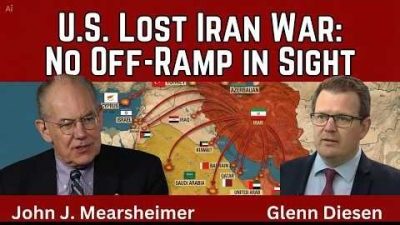
John Mearsheimer: US Already lost Iran war – No off-ramp in sight
or go to
Aletho News Archives – Video-Images
Frlom the Archives
With apparently fabricated nuclear documents, Netanyahu pushed the US towards war with Iran
By Gareth Porter | The Grayzone | April 29, 2020
President Donald Trump scrapped the nuclear deal with Iran and continued to risk war with Iran based on Israeli Prime Minister Benjamin Netanyahu’s claim to have proven definitively that Iran was determined to manufacture nuclear weapons. Netanyahu not only spun Trump but much of the corporate media as well, duping them with the public unveiling of what he claimed was the entire secret Iranian “nuclear archive.”
In early April 2018, Netanyahu briefed Trump privately on the supposed Iranian nuclear archive and secured his promise to leave the Joint Comprehensive Plan of Action (JCPOA). That April 30, Netanyahu took the briefing to the public in a characteristically dramatic live performance in which he claimed Israel’s Mossad intelligence services had stolen Iran’s entire nuclear archive from Tehran. “You may well know that Iran’s leaders repeatedly deny ever pursuing nuclear weapons…” Netanyahu declared. “Well, tonight, I’m here to tell you one thing: Iran lied. Big time.”
However, an investigation of the supposed Iranian nuclear documents by The Grayzone reveals them to be the product of an Israeli disinformation operation that helped trigger the most serious threat of war since the conflict with Iran began nearly four decades ago. This investigation found multiple indications that the story of Mossad’s heist of 50,000 pages of secret nuclear files from Tehran was very likely an elaborate fiction and that the documents were fabricated by the Mossad itself. … continue
Blog Roll
 Aletho News
- ‘All ports in Persian Gulf will be legitimate targets if Iranian ports are attacked’
- 40 Years of Endless War, Data Point by Data Point
- Department of War Using Palantir AI to Pick Targets in Iran
- American bases do not protect – they attack the peoples of the Persian Gulf
- ‘We’ve Obliterated Their Missiles’
- Syrian president vows ‘absolute support’ to disarm Hezbollah
- Ukraine attacking Russian gas pipeline to stop deliveries to Europe – Defense Ministry
- ‘Heinous crime’: Iran denounces Israeli assassination of 4 Iranian diplomats in Lebanon
- John Mearsheimer: U.S. Already Lost Iran War – No Off-Ramp in Sight
- UK Parliament Plans ISP Blocking and Age Verification Powers
- If Americans Knew
- Israeli strategic plans to “remake the Middle East” from the 1950s and since
- Honoring Gaza’s women who refused to let the world look away
- 97% of victims of war on Iran are Iranian, 98% of victims in war on Gaza are Gazans – Not a ceasefire Day 152
- Early Iran strikes cost $5.6 billion in munitions, Pentagon estimates
- Israel Decided the War, But Trump’s America Fights and Pays the Bill
- Conscientious Objector Group: Phone ‘Ringing Off Hook’ As Huge Mobilization Underway
- U.S. support for Israel continues to plummet, despite media’s best efforts
- Threats and missiles fly, death tolls soar in Iran, Lebanon, Gaza – Not a ceasefire Day 151
- Lebanon: Israel’s White Phosphorous Use Risks Civilian Harm
- Corporate Media Go All Out To Support The US-Israeli War On Iran
- No Tricks Zone
- Destructive Green New Deal: German Energy And Metal Group Warns Of Drastic Crisis
- New Study Documents A 20-Year Pause In Arctic Sea Ice Decline – Driven By Internal Variability
- Wake-up Call: Survey Shows Majority Of Germans Now Favor Postponing Climate Targets!
- Televised! Leading German Political Candidate Tells Schoolchildren CO2 Makes Sun Hotter!
- New Study: A Century Warming Of 1.1°C Is ‘Commonplace’ And ‘Not Unusual’ During This Interglacial
- New Study: ‘Internal Noise’ And Volcanic Forcing Can Trigger 10-15°C Warming Within Decades
- Glaciers Worldwide Are Suddendly Surging, Experts Blame Warming!
- Surprising Discovery: Sahara Is Greening…Billions Of Trees Where Once Thought To Be Barren
- New Research Reaffirms Clouds, Aerosols, And Surface Solar Radiation Are ‘Driving The Climate System’
- Germany: Electric Car Catches Fire At Charging Station, Sets Off Local “Inferno”, Widespread Damage
 Aletho News