Israel has claimed success in defending itself against Saturday’s drone and missile barrages by Iran, but that effort reportedly came at a high price.
The interceptors, jet fuel and other materials expended in shooting down Iran’s unmanned aerial vehicles (UAVs) and missiles cost about 4 billion to 5 billion shekels ($1.06 billion to $1.33 billion), Israeli Brigadier General Reem Aminoach told local media outlet Ynet News on Sunday. The estimate included only Israel’s direct costs, not counting the considerable weaponry used by the US and other allies in helping to defend against the attack.
Aminoach, formerly the financial adviser to the Israel Defense Forces (IDF) chief of staff, said West Jerusalem used such munitions as Arrow and David’s Sling interceptor missiles, which have per-unit costs of about $3.5 million and $1 million, respectively. He also included sortie expenses for the fighter jets that did the bulk of the work in shooting down Iranian drones.
The general lamented that it was far cheaper for Iran to launch the attack than for Israel to defend itself. “The attack cost Iran less than 10% of what it cost us to defend against it,” he told Ynet. “In the future – in a year, two years, or five years – they can carry out 50 such attacks. And let’s say that if the IDF’s net budget in 2023 was 60 billion shekels, with less than double that you have no chance of reaching a situation where we can maintain the required amounts.”
The IDF claimed that 99% of the more than 300 kamikaze drones and missiles launched from Iranian territory were successfully intercepted. All of the UAVs and cruise missiles were shot down, military spokesman Daniel Hagari said, while a few ballistic missiles got through Israel’s defenses.
Those projectiles fell at the Nevatim Airbase and caused “only minor damage to infrastructure,” the spokesman said. He added that the drones launched by Iranian-backed militants in Iraq and Yemen all failed to reach Israeli territory. The only casualty was a shrapnel wound to a 10-year-old Bedouin Israeli girl who was hit while sleeping at her home in southern Israel.
Saturday’s attack came in response to an April 1 airstrike that killed seven Iranian military officers, including two senior commanders, at Tehran’s consulate in Damascus. Israel has vowed to “exact a price” from Iran for striking back.
Fears of a greater Middle East escalation were triggered after Iran launched a massive drone and missile attack against Israel, aided by Hezbollah and the Yemeni Houthis. Iran said the attack was in response to Israel’s bombing of the Iranian consulate in Damascus, Syria, which killed seven members of the elite Revolutionary Guard Corps.
Iran’s massive retaliatory attack on Israel from its own territory is a sign that the conflict could “escalate out of control.”
Michael Maloof, a former senior security analyst in the office of the US secretary of defense, told Sputnik that the first ever direct Iranian attack on Israel set a dangerous precedent.
“My concern is that this could easily escalate into something not only between Iran and Israel, but beyond the Middle East region,” he said.
Iran’s assault, which it stated was an act of “self-defense” after the Israeli strike on its consulate in Damascus, was originally intended to be a “limited” one, said Maloof.
Iran first sent in “swarms of drones with lights on as a sign of psychological warfare,” but sending in cruise and ballistic missiles by Tehran was a “distinct escalation,” said Maloof.
The scale of Iran’s attack on Israel suggests that Tehran was sending a message, demonstrating that it possesses “extraordinary capabilities,” said Maloof.
“They have built up their missile capabilities extraordinarily, they have drones, cruise missiles, and some of the most accurate ballistic missiles in the region right now,” he added.
“I think that this clearly showed that Iran has a capability. I think it’s limited. They cannot do this on a sustained basis. And they did send their slower ordinance, such as drones, UAVs. But they also claim to have hypersonics,” Maloof noted.
“I think that if Israel were to retaliate, then I think they would engage the more sophisticated missiles and hypersonics, potentially, if they have them,” He added. “Then you’re talking some very serious escalation in the entire region. It’s already unprecedented, but this escalation could be even ratcheted up that could conceivably bring in other and extend beyond just this region.”
All signs point to the potential of a larger regional war erupting, Maloof warned, adding that everything now depends on Israel’s reaction. “Is this a tit-for-tat, a one-on-one, or a further escalation?” he asked.
“I think we are already getting that message from Netanyahu, his ministers, that they are going to respond… How they respond is going to determine the extent of that escalation through the [Middle East] region,” stressed Maloof. “I am quite concerned that neither side is going to stand down at this point.”
Israeli Prime Minister Benjamin Netanyahu is prepared to “continue an endless war in the region,” suggested Maloof, adding that he “knows he had the US backing,” and could opt to strike now, taking advantage of this “window of opportunity.”
“He may not get such an opportunity under a potential Trump administration coming in [after the US elections in November],” said the expert.
Looking at possible scenarios for Israel’s response, he noted that Tel Aviv had already stated publicly an intention to “go after the nuclear sites in Iran.”
“That is going to be exceedingly difficult, plus I don’t know that they have the power projection to do that on any consistent basis, and secondly, I don’t believe they have the so-called ‘bunker busters’ that would be needed to be able to drill down through the mountains to reach those facilities. The US has been reluctant to give Israel these bunker buster [munitions],” said Maloof.
As for the US, it has already “gotten sucked into this,” Maloof noted.
US President Joe Biden issued a statement on Iran’s attack against Israel after speaking with Netanyahu by phone. Biden condemned the attack “in the strongest possible terms”.
He reaffirmed Washington’s “ironclad commitment” to help support Israel’s security. Secretary of State Antony Blinken said the US does “not seek escalation” but will “continue to support” Israel’s defense. “I will be consulting with allies and partners in the region and around the world in the hours and days ahead,” he added.
“There is already a call in Congress to put on fast-track the legislation to approve new ordinance, and the $14 billion for Israel,” said the pundit. He remarked that the Pentagon might “empty its stockpiles to provide support to Israel,” and recalled that besides giving Israel bombs and artillery, the US supports its Iron Dome air defense system, whose missiles will need to be replenished.
“If you have a swarm, wave after wave of swarms, Israel is going to be very hard pressed to be able to defend against that. And that’s why the US now is coming in, and that gets the US directly involved,” Maloof pointed out. “And that could then open up US assets in the region.” We have got some 35 bases that surround Iran, and they thereby become vulnerable. They were meant to be a deterrence. Clearly, deterrence is no longer on the table here. Now they become the American Achilles heel because of their vulnerabilities to attack. They’ve got air defense systems, but they’ve got to be replenished. And given that you got active war going on right now in the region, it’s going to be difficult to replenish those supplies.”
According to the ex-Pentagon analyst, much now also depends upon what stockpiles Iran has and “with what consistency they can keep sending these wave after wave of drones and ballistic missiles… Ultimately, if they have them, the hypersonics… and there’s no defense against hypersonics. Not even Israel’s ‘Arrow’ system, which is designed to deal with ballistic missiles… And apparently, that’s been engaged tonight, as well as the Iron Dome.”
The United Nations (UN) Security Council is to meet on Sunday in response to a request from Gilad Erdan, Israel’s permanent representative to the United Nations. The meeting is scheduled for 4 pm New York time (2000 GMT), as announced by the UN Department of Global Communications.
“I’m hoping that the UN Security Council can take this up and maybe some adult supervision could begin to intervene in this and maybe try to bring it to a halt for now,” Maloof said. “But right now, this minute, it doesn’t look like it. And again, it’s going to depend upon the response from the Israelis if they go directly into Iran in response.”
The current media frenzy surrounding the Iran strike is “disproportionately amplified compared to the actual events transpiring on the ground,” Dr Ahmed Al Ibrahim, a Riyadh-based political analyst, told Sputnik.
He added that any true aftermath of Iran’s strike will be discernible after a “thorough assessment.”
“Indeed, I dismiss the current situation as largely sensationalized, a “bubble” inflated by media coverage and public attention,” the political analyst said.
He expressed skepticism that any Middle Eastern countries would “willingly entangle themselves in the unfolding chaos.” Arguing that “Iran’s capacity to directly threaten Israel is limited by geographical constraints,” Ibrahim agreed that there is “potential for escalation.”
Iran’s mission to the United Nations stated earlier that Tehran’s retaliatory drone and missile attack against Israel had “concluded.” The “military action” was a response to Israel’s “aggression against our diplomatic premises in Damascus,” it said, adding that the strike “hit designated targets.”
By launching its retaliatory drone and missile attack on Israel, Iran “reestablished deterrence,” former UN weapons inspector Scott Ritter told Sputnik.
“Israel believed that it could launch a strike against Iran and suffer no consequence. That is no longer the case,” Ritter noted.
As Israeli military officials survey the damage done to their bases, “they understand the following: that Iran deliberately chose not to inflict extremely lethal action against Israel,” the analyst remarked.
Iran launched a massive drone and missile attack against Israel overnight, assisted by Hezbollah and the Yemeni Houthis. Over 300 projectiles were fired at Israeli territory from Iran, with Iran’s mission to the United Nations stating that its retaliatory attack on Israel had “concluded,” and that the strike “hit designated targets.” Israel’s military has claimed that 99% of the projectiles were intercepted.
Iran’s strike was designed to send a signal to Israel and the United States, “that it could do what it did in Nevatim, at Ramona, anywhere in Israel, anywhere in the Middle East, and there was nothing the United States or Israel could do in response.”
“This is deterrence. This means that in the future, if either Israel or the United States plan on carrying out an action against Iran, they have to weigh in the consequences of their actions knowing that Iran has the capacity to reach out and touch any place, any spot, any target in the region in Israel or out of Israel, and there’s nothing anybody could do to stop that,” the retired US Marine Corps intelligence officer said.
US President Joe Biden issued a statement on Iran’s attack against Israel after he spoke on the phone with Israeli Prime Minister Benjamin Netanyahu. The POTUS condemned the strike “in the strongest possible terms.” He also reaffirmed Washington’s “ironclad commitment” to help support Israel, and added that there were no attacks on US forces or facilities on Saturday, but that the US “will remain vigilant to all threats.”
Secretary of State Antony Blinken said the US does “not seek escalation,” but will “continue to support” Israel’s defense. “I will be consulting with allies and partners in the region and around the world in the hours and days ahead,” he added.
Weighing in on the flurry of talks between US and Israeli leaders, Scott Ritter said:
“This is why President Biden has been on the phone with Benjamin Netanyahu, the prime minister of Israel, telling him, ‘Do not retaliate.’ The United States will not be a partner in any offensive action against Iran. Not because the United States is friendly to Iran, but the United States understands the consequences that will accrue, should such an attack take place. The United States has been deterred against further action against Iran.”
The question uppermost at the moment is, “what will Israel do?” Ritter noted.
“Israel has been trying to lead the United States into a larger conflict with Iran for some time now. Indeed, some people have speculated that the Israeli attack against the Iranian Consulate in Damascus was designed for just that purpose… But the Iranians were very clever in designing their response – just like they did, when they retaliated against the United States for the assassination of Qasem Soleimani back in 2020,” Ritter said.
He recalled that at the time, Iran launched over a dozen missiles against the Al-Asad air base in Iraq, but Tehran gave Washington advance notice that that base was going to be struck. Thus, Iran ended up destroying empty buildings, Ritter recalled.
“But it demonstrated to the United States that it had the capacity to strike any American base in the region with extreme precision and kill as many Americans as they wanted – if they wanted to do that. And America was deterred against future action of that sort. Will Israel be deterred?” the analyst wondered.
No decision has been made yet regarding an Israeli response to the Iranian missile and drone attack, an Israeli official told The Times of Israel. It was added that a potential response would be discussed at a war cabinet meeting set for later on Sunday. Israel’s response to the Iranian attack will be coordinated with its allies, The New York Times reported earlier, citing an Israeli official.
After Iran’s unprecedented strike, Tel Aviv “understands that any escalation could mean the destruction of Israel,” Scott Ritter noted.
“Israel probably isn’t going to launch a response against Iran. Israel has been deterred from launching that response by the Iranian actions. In this case, we can say that operation ‘True Promise’ was an extraordinarily successful operation, not only for Iran, but indeed for the world, because Iranian deterrence now is a reality that can hold Israel and the United States in check,” Ritter said.
Iran’s permanent mission to the United Nations defends the country’s retaliation against the Israeli regime’s recent terrorist attack on the Islamic Republic’s diplomatic premises in the Syrian capital.
“Iran’s military action was based on Article 51 of the United Nations Charter concerning legitimate defense in response to the Zionist regime’s aggression against our diplomatic premises in Damascus,” the mission said in a statement on Saturday.
“The matter can be considered as concluded,” it added.
The mission, however, warned that if the Israeli regime perpetrated another mistake, Iran’s subsequent response could be “remarkably more intense.”
The statement concluded that the conflict was one between Iran and the rogue regime, “of which the United States should stay away.”
Iran’s Islamic Revolution Guards Corps (IRGC), on Saturday night, launched “extensive” retaliatory missile and drone strikes against the occupied territories, defining the mission as “Operation True Promise.”
The Israeli attack had resulted in the martyrdom of Brigadier General Mohammad Reza Zahedi, a commander of the IRGC’s Quds Force, his deputy, General Mohammad Hadi Haji Rahimi, and five of their accompanying officers.
The terrorist attack drew sharp condemnation from senior Iranian political and military leaders, who vowed “definitive revenge.”
On Thursday, the Iranian mission to the United Nations said the UN Security Council’s condemnation of the Israeli atrocity could have prevented the need for retaliation.
“Had the UN Security Council condemned the Zionist regime’s reprehensible act of aggression on our diplomatic premises in Damascus and subsequently brought to justice its perpetrators, the imperative for Iran to punish this rogue regime might have been obviated,” it said on the social media platform X Thursday.
The night that Neil Armstrong was one small step for (a) man from the lunar surface I was taking my first airplane flight to a hockey camp near Toronto. I remember gazing out the window of the jet as a fourteen year old in July 1969 and imagining the Apollo craft on its impossible and miraculous journey to the very moon which I and countless others had marveled at and regarded as forever out of reach.
Yet reach it we did — we being the all-powerful United States of America, then simultaneously wielding its might in the jungles of a faraway country with perverse ferocity and with the sacrifice of American youngsters in the service of the hazy ideal of protection against Communism.
For many years, while cognizant of the endless warpath trodden by the country of my birth AFTER it had emerged as the glowing victor of World War II, bursting with economic and creative energy and bestriding the rest of the globe as the Colossus, I consoled myself and others with that magnificent and scarcely imaginable achievement of lunar landings.
Placing a man on the moon, that pure and nearly snow-white surface as far removed from the heat and grime of the napalmed Vietnamese jungles, somehow unified humanity in praise and deference, and established the United States as the artificer of miracles. In so doing it also lent a burnished sheen of intimidating and awe-inspiring power to an America whose tradition of can-do individualism was seen to have vanquished its socialistic rival, Russia.
The eyes of humankind for as long as it has trodden this precious Earth have looked heavenward and followed the glowing and bright and changeable Moon with a plethora of dreams and wishes and sighs. To have reached the lunar surface, to have made that impossibly giant leap, became the stuff of insurmountable accomplishment. In sum, no matter how degraded or destructive or sinister the Deep State factions of the United States had been with their never-ending wars and atrocities, the Apollo missions were an offsetting balm, a reminder of greatness and goodness and magnificence on which all could agree as the fulfillment of one of the grandest of dreams.
I had heard, throughout the years, of the cavils of small-minded conspiracy theorists who questioned the Apollo landings, but I had dismissed them or, more accurately, simply ignored them. Knowledgeable though I was about the devastating State-sponsored murders of JFK, MLK, RFK and Malcolm X, and cognizant as I was of the sickening exhibition of destructive deception that was 9/11, Apollo was a glowing ember of hope and beneficence, an emblem of the possibilities of a beneficent collective — the very stuff that dreams are made on, dreams which all of us could share and revel in and be proud about having realized, utterly without qualm.
Nonetheless, for one reason or other, nagged no doubt by an itch fostered by State duplicity, I decided to look into Apollo a bit more closely. I decided, in fact, to do my own bit of sleuthing just to make sure that the stirrings and suspicions about Apollo could be attributed to malaise and malcontents rather than to veracity.
My looking about and digging in resulted in a personal surprise, and a personal awakening. I discovered, in fact, that the case for legitimate human footsteps upon the lunar surface was ridiculously absurd. I discovered that I — and most of the world, I supposed — had accepted a grand illusion as reality when a cool examination of the evidence led to the deflating conclusion that Apollo was a hoax. A big one, a splendid one, an unparalleled one, but a hoax nonetheless.
Determined to lay the matter to rest for myself I even lit upon a small but telling anomaly — the Apollo 11 command module’s extra-vehicular handles. Made of aluminum, these handles should have melted under the intense heat of reentry; but they didn’t. I have published my findings comprehensively here and, in a more accessible fashion, here. These are small potatoes compared to the work of Kaysing, René, Sibrel, Percy, Bennett, Allen, Henderson, McGowan, Wisnewski and many others, whose extensive investigations have revealed and exposed innumerable discrepancies and problems with the official NASA account about virtually every aspect of the Apollo missions. Randy Walsh’s recent books are highly recommended for their overviews.
But allow me, in passing, to direct your attention to this famous video clip of what has become known as the ‘lunar grand prix’:
You be the judge as you watch the robotically immobile driver and listen to the comically insipid commentary.
The single greatest argument against the Apollo missions from 1969 to 1972 is the fact that despite the astronomically exponential growth of computational and technological power since then, somehow or other getting ‘back’ to the moon in the 21st century has not yet been achieved.
Interestingly enough, the trailer for a new film about Apollo has just been released:
From what I can tell it brazenly suggests that NASA actually undertook to film a fake lunar landing just in case the ‘real’ one didn’t fly. I wonder why, just now, in the aftermath of a fake pandemic, this candy-coated message has been released. Is it a clever piece of propaganda designed to forestall the obvious astonishment and questioning of generations born into the internet age when they are asked to accept the clumsy and comical NASA videos of last century? Is it a sophisticated psychological way to resuscitate the halo of the Apollo achievements? What will the impact of encasing a truth within the envelope of a lie amount to, over time?
My point however is that of all the psyops, Apollo stands out supremely. Unlike the assassinations of JFK or RFK, unlike 9/11 or covid, it is not terrifyingly destructive. It is instead positive, meant to induce awe — which creates a different kind of fear among those worshipping at the altar of the miracle — and to bathe us in the aura of supreme human achievement, of conquering the unconquerable and patting ourselves on our backs, we denizens of the little species that could.
It is and has also been a way to cover over the darker and rabidly perverse and destructive machinations of State factions whose goals have been and still are endless war, power and profit — sprinkled with a dash of what I call ‘brinkmanship madness’.
For it is eminently possible that the corrupt Deep State JFK sought to confront, the one that brought us to the lip of nuclear war in the Sixties and is now bringing us all to the edge of a New Tyrannical Order, replete with hot wars and wars irregular and concealed against our very humanity, has a wild and unpredictably calamitous streak.
Those at the helm can be crazy enough to bring us all down in an orgy of annihilation even as they promise themselves visions of transhumanist immortality.
Let’s see.
I thought long and hard about discussing the Moon and the myths of America’s Apollo, because these views might cast aspersion on an already fragile alliance of people protesting against the deceptions of the covid operation. But I think the time is right — maybe Fly Me to the Moon nudged me a little?
If we are going to prevail and really create a better world — as I think we indeed are on another brink of doing — what better way to begin than by discarding all of the grand illusions in favor of humility and truth?
There’s been a drastic drop in the registration of new electric cars in Germany as sales of the “clean” electric cars have slumped nearly 30% compared to a year earlier, reports Germany’s online Blackout News.
The massive sales drop is bad news for the current German socialist-green government, which aims to have 15 million vehicles on the road by 2030. Currently there are just 1.4 million!
The dismal trend underscores the unpopularity of electric cars and consumers’ hesitancy when it comes to purchasing them. Electric vehicles are plagued by limited range, sparse charging infrastructure, steep upfront purchase price and their huge environmental impact, which involves the largescale mining of rare earths.
“Their market share has fallen to just 11.9%. This casts a harsh light on the mismatch between Germany’s political goals and the reality of the automotive market. It is clear that political incentives and measures are inadequate,” reports Blackout News. “The abolition of the electric bonus at the end of 2023 has revealed another problem. The sector’s dependence on state subsidies became apparent. This has further exacerbated the crisis of confidence in the electric car market.”
Fahrverbot: Germany floats national weekend driving ban!
Another possible reason for hesitancy when it comes to purchasing a new car of any type may be partly due to the government’s general hostility to private mobility.
Germany’s federal minister of transportation, Dr. Volker Wissing, is threatening to ban driving on weekends by motorists in order for the country “to meet climate goals set forth by the Climate Protection Act.”
“A reduction in traffic to help meet the climate goals would only be possible through measures that are difficult to communicate to the public, such as ‘comprehensive and indefinite driving bans on Saturdays and Sundays,’ Wissing added,” so reports Politico.
Germany’s transportation sector would need to reduce CO2 by 22 million tonnes to meet its climate goals.
So, what’s the point of buying a new car when drivers nay be forced to leave them in the garage every weekend? Germany’s economy and energy policy has turned into a circus run by clowns.
About ten years ago, there were serious discussions about dismantling the WHO due to its mismanagement of the Ebola epidemic in West Africa. An even more dramatic mismanagement of the Covid-19 pandemic must now finally seal the fate of this organization!
I still have serious doubts about whether the Covid-19 pandemic was planned; it certainly wasn’t orchestrated by the Vaccine Industry. Moreover, it’s also difficult to reconcile the broadly approved effort of the Vaccine Industry to develop a vaccine with the notion of a powerful lobby harboring nefarious intentions. Back then, no one anticipated, indeed, that vaccination during a pandemic could worsen its spread and health impact, given past successes in curbing infection chains through vaccination during pandemics or epidemics.
Nobody ever officially reported, though, that in the case of these alleged success stories (such as Smallpox and Ebola), deaths of contacts of index cases ring-vaccinated with replicating vaccines during the incubation time of the disease substantially contributed to halting viral transmission. Consequently, the WHO erroneously believed that vaccination during a pandemic or epidemic was a highly effective strategy for ending it.
‘Regrettably’(?!), in the mass Covid-19 vaccination program, this never-investigated or mentioned ‘killing effect’ didn’t materialize, as the vaccines used were non-replicating and the ring vaccination protocol didn’t apply, considering that the transmission of this virus is airborne rather than via direct contact. Therefore, I strongly believe that the egregious incompetence of the WHO is at the heart of the mismanagement of this pandemic. It’s only right that such a screw-up should vanish from the face of this earth.
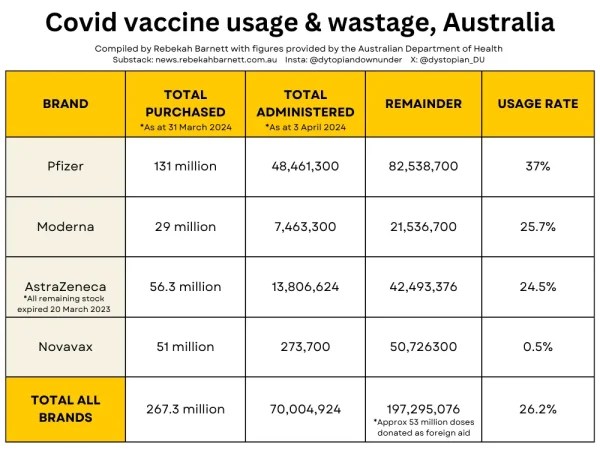
As part of its pandemic response, the Australian government purchased 267.3 million doses of Covid vaccines, enough to vaccinate Australia’s population of approximately 26 million people ten times over.
But figures released to me by the Department of Health (DOH) this week confirm that, three years into the vaccine program, only 70 million doses, or 26% of the 267.3 million doses purchased, have been administered, while 35% of vaccines doses have been wasted since the start of the vaccine rollout.
Last week, the Australian reported that more than 35% of Covid vaccines were being tossed out as of January due to oversupply. The revelation came from the DOH’s public submission to the federal Covid inquiry.
The wording made it unclear if this was a cumulative figure or applicable only to the month of January, so I contacted the DOH to confirm the total wastage to date, along with some further questions on the value of doses purchased, delivered, and wasted, and exactly how many had been administered.
A DOH spokesperson responded,
“As of 31 March 2024 the total COVID-19 vaccine program wastage rate was at 35.69%. Australia’s wastage rate is within the World Health Organization (WHO) acceptable wastage parameters for multidose vials of 15% and 40%.
“Approximately 80% of COVID-19 vaccine wastage is attributed to expiry of doses across warehouses and vaccine administration sites.”
This appears to mean that 80% of the wasted doses simply expired on the shelf.
The remaining 20% of wasted doses would likely be due to administration sites not managing to use the entire contents of multi-dose vials once opened. While unopened vials have a shelf-life of anywhere between 9-18 months, opened vials must be used within 6-48 hours.
The DOH refused to confirm the value of doses purchased or wasted, or how many of the purchased doses have actually been delivered, “for contractural and security reasons.” The Australian government has repeatedly refused to release details of its tax-payer-funded Covid vaccine purchase agreements.
Most of these remain unused. DOH figures provided to me this week show that as at 3 April, only a quarter (70 million) of the 267.3 million purchased doses had been used, at a total usage rate of 26.2%
Of the remaining 197.3 million unadministered doses, the DOH advised that approximately 53 million doses have been donated as foreign aid.2
That leaves approximately 144 million doses, more than half of the total stockpile, either already expired, or likely to expire within the next several years, as booster rates hover below 10%.3
As Australia’s vaccine purchases extend into 2023 and 2024, it is probable that a portion of these doses will still be viable up to 2025.
But even if vaccine doses never expired, it would take Australians 29 years to work their way through the glut, based on the five million boosters administered in the past 12 months.
As it stands, usage rates by brand are as below:
Of 131 million Pfizer doses purchased, 48.5 million have been administered, a usage rate of 37%. 82.5 million doses remain.
Of 29 million Moderna doses purchased, 7.5 million have been administered, a usage rate of 25.7%. 21.5 million doses remain.
Of 56.3 million AstraZeneca doses purchased, 13.8 million have been administered, a usage rate of 24.5%. As the AstraZeneca stockpile expired on 20 March 2023, the remaining 42.5 million doses have been binned, unless they were donated as aid prior to this date.
Stunningly, of 51 million Novavax doses purchased, only 273,700 have been administered, a usage rate of 0.5%. 50.7 million doses, 99.5% of the stockpile, remain. This is because by the time Novavax was approved for use, in December 2021, over 90% of Australians aged 16 and over had already been double vaccinated.
In a July 2022 article investigating Australia’s already apparent vast vaccine wastage, the ABC asked if perhaps the government had bought too many vaccines?
Deborah Gleeson, Associate Professor of Public Health at La Trobe University, criticised the government’s run on the global vaccine supply, suggesting that Australia had hoarded more than its share.
Prof Gleeson told the ABC,
“Australia really participated in a bigger trend that we’ve seen worldwide of wealthy countries buying up far more doses of COVID-19 vaccines than they needed early on in the pandemic. And this is a practice that unfortunately has continued.”
It’s enough to make advocates for global vaccine equity lose sleep at night.
The news of the Australian government’s wastage of billions of dollars worth of Covid vaccines comes as Australians are grappling with the soaring cost of living and the worst housing crisis on record, with over a quarter of a million Australians accessing homelessness services in 2022-2023.
The government webpage also details investment in aid program COVAX, and research and supply chain developments, including some funding for the development of a potential Covid vaccine (since abandoned). The page mentions a 10-year partnership with Moderna and the Victorian Government that will see Moderna build an mRNA vaccine manufacturing facility at Monash University Victoria. However, it is unclear if funding for the Moderna partnership comes from this $18 billion investment, or from other funding.
“Australia has donated more than 52 million doses to countries in the Indo Pacific and Southeast Asia.
· 23.6 million as part of our commitment to share 40 million doses through the Department’s procured supply; and
· 28.5 million as part of the commitment to share 20 million doses through DFAT’s agreement with UNICEF.
“Australia has offered a further 16.8 million doses to the COVAX Facility for distribution to participating developed and developing countries. Of the 755,200 doses that were accepted by the COVAX Facility, 14,400 have been donated.”
Note that because the DOH would not confirm how many of the 267.3 million purchased doses have been delivered, the precise number of doses sitting in the national stockpile cannot be determined. However, the vaccine agreement webpage does specify delivery dates of some purchases, and from this, it can be ascertained that the great majority of doses purchased have already been delivered.
To support my work, share, subscribe, and/or make a one-off contribution to DDU via my Kofi account. Thanks!
The pharmaceutical and medical devices industries paid physicians more than $12 billion over 10 years, according to a study published last month in JAMA.
The analysis found the industries made 85,087,744 payments totaling $12.13 billion to 826,313 physicians — 57.1% of practicing physicians across 39 specialties.
Orthopedic surgeons, neurologists and psychiatrists, and cardiologists received the most money. Trauma surgeons and pediatric surgeons received the least.
The drugs with the highest payouts were blood thinners Xarelto and Eliquis, along with Humira, an immunosuppressant.
“Money given to doctors has a purpose: it is for marketing,” cardiologist Dr. John Mandrola and co-author of the study wrote on his Substack. “If these direct payments to doctors did not work, industry would not spend billions.”
Dr. Andrew Foy, lead author of the paper, told The Defender in an email he thought some people might find the numbers “shocking” and he hoped it would renew interest in having conversations about physician-industry payments and facilitate more research.
The researchers tracked and compared payments made to physicians across and within specialties. They also identified the top 25 drugs and medical devices associated with the largest total payments.
The analysis included only money received for consulting, travel, food, entertainment, education, gifts, grants and honoraria. The researchers excluded other major external funding sources for physicians such as research funding and royalties.
Legislators designed the Sunshine Act to address growing public concerns about Big Pharma’s influence over doctors. At the time, several studies had shown that increased interaction with pharmaceutical representatives influenced physician prescribing behavior.
The act requires medical product manufacturers to disclose to the Centers for Medicare and Medicaid Services any payments or other transfers of value made to physicians or teaching hospitals. Open Payments publishes the payments on its website.
The analysis found that payments varied significantly across specialties. The highest-paid specialties like orthopedic surgery received $1.36 billion, and neurology and psychology specialties received $1.32 billion. The lowest-paid specialties received substantially less.
Pediatric surgeons and trauma surgeons received only $2.89 million and $6.96 million respectively.
Payments also varied significantly among physicians within the same specialty, with a small number of physicians in each specialty receiving the largest amounts of money — often exceeding $1 million — while the median physician received significantly less, typically less than $100, ranging from zero to $2,339.
“Our paper is a modest analysis. It does not explain the problem of financial conflicts of interest. But it is a lot of money. And it’s highly targeted to lucrative procedures,” Mandrola wrote.
“Industry influence is way too strong,” he added, and commonly results in medical devices being approved “despite dodgy evidence.”
He said many doctors believe collaboration between industry and physicians is a good thing that drives innovation. However, he said, these payments weren’t simply supporting collaboration.
“Most of it, I would argue, is for marketing and goodwill. Goodwill goes a long way to help establish practice patterns.”
Top drugs and devices on list net billions for pharma
The blood thinner Xarelto, used to prevent blood clots from forming due to an irregular heartbeat or after hip or knee replacement surgery, topped the payment list, accounting for $176.3 million.
The drug, made by Bayer and marketed by Janssen Pharmaceuticals, was Bayer’s top drug in 2023, generating about 4.1 billion euros in revenue.
Payments for Eliquis, another blood thinner used to treat the same conditions, amounted to $102.62 million. Pfizer and Bristol-Myers Squibb manufacture Eliquis.
Pfizer in 2023 brought in over $6.7 billion from the drug, its second-most profitable product behind the Comirnaty COVID-19 vaccine. Bristol-Myers Squibb’s sales topped $12 billion.
Eliquis costs U.S. customers 3 to 7 times more than customers in other high-income countries.
Humira, an immunosuppressant used to treat rheumatoid arthritis, psoriasis and other autoimmune conditions paid out $100.17 million to physicians. Over the last two decades, the drug netted over $200 billion for drugmaker AbbieVie, which listed the medication at $50,000 per year.
Bayer, Pfizer, Bristol-Myers Squibb and AbbieVie did not immediately respond to requests for comment.
The two medical devices topping the list — da Vinci Surgical System, which paid $307.5 million, and Mako SmartRobotics, which paid $50 million — are machines for robotic-assisted surgeries.
Mako focuses on hip and knee replacements. Da Vinci netted approximately $7.12 billion in 2023 and investors were “blown away” by the “robot-fueled growth” of Mako SmartRobotics device installation for hip and knee replacements. Mako’s parent company Stryker made over $20 billion last year.
The problem of physicians’ financial ties to pharmaceutical companies has plagued the industry for decades and garnered significant media attention.
Perhaps most famously, Purdue Pharma used misleading marketing to make massive profits from sales of opioids, sparking an epidemic. Nearly 645,000 Americans died from opioid overdose between 1999 and 2021.
However, Purdue Pharma’s policy of paying physicians has long been common practice. Research studies during the last two decades have found the vast majority of physicians accept payments and gifts from pharmaceutical companies. Influential studies include those by the Institute of Medicine and the Medicare Payments Advisory Commission that led to the passage of the Sunshine Act.
This latest study and other recent studies show that despite new mechanisms for transparency in payments, the payments continue.
And those payments are particularly high among physicians with prominent roles directing public policy.
For example, last year The New York Times revealed that while advisers at the National Academies of Sciences, Engineering, and Medicine were shaping public policy on opioids, they were also accepting payments from the Sackler family who owned Purdue Pharma.
Last month, The Defender reported that most of the nine new members appointed to the vaccine advisory committee for the Centers for Disease Control and Prevention have received substantial direct payments or research funding from Big Pharma — largely from the companies whose products they will be reviewing.
Foy said he thought a major part of the problem is that physicians and researchers believe that if they make their conflicts of interest transparent, the problem is resolved.
“As if someone cannot be transparent about their conflicts and highly biased at the same time,” he said.
He said that payments don’t necessarily lead directly to prescribing one specific drug for which a payment is received.
Instead, he said, he worries that the payments lead to, “overly enthusiastic recommendations or guidelines from medical organizations to use new products when they have not been sufficiently tested, or where the evidence is not strong enough, to recommend them over old standards or nothing at all (in some cases).”
Industry payments to physicians, Foy said, have a way of “tilting physicians’ sympathy toward industry and the ‘medical advancements’ that come from industry so that they (the physicians) more willingly adopt new products just for the sake of ‘industry advancement’ even if they don’t have a direct COI [conflict of interest] with that particular product.”
Physicians, he said, “become cheerleaders for industry and more open to adopting new products simply due to this attachment.”
For example, he said it is not uncommon at medical conferences for attendees to stand up and cheer results from “late-breaking” research studies whose “benefits are very rarely ever more than marginal, tiny, or ‘teensy-weensy’ at best.”
“I never understood it,” Foy wrote.
Direct payments aren’t the only way industry collaborates with physicians, Foy said.
Industry ads are featured on the homepage of medical journals and ads bombard physicians at major medical conferences.
He said this gives the impression that “the event is built around industry and its involvement.”
He said he doesn’t think that anyone tries to hide the relationships. “The main reason being, at least in my opinion, is that many physicians, perhaps even the majority, believe that physician-industry collaboration is a net benefit to patients and society,” he said.
“I don’t necessarily share that view; however, I don’t believe there is strong, objective evidence to support one side or the other.”
Brenda Baletti Ph.D. is a reporter for The Defender. She wrote and taught about capitalism and politics for 10 years in the writing program at Duke University. She holds a Ph.D. in human geography from the University of North Carolina at Chapel Hill and a master’s from the University of Texas at Austin.
The World Health Organization’s Dr. Hanna Nohynek testified in court that she advised her government that vaccine passports were not needed but was ignored, despite explaining that the COVID vaccines did not stop virus transmission and the passports gave a false sense of security. The stunning revelations came to light in a Helsinki courtroom where Finnish citizen Mika Vauhkala is suing after he was denied entry to a café for not having a vaccine passport.
Dr. Nohynek is chief physician at the Finnish Institute for Health and Welfare and serves as the WHO’s chair of Strategic Group of Experts on immunization. Testifying yesterday, she stated that the Finnish Institute for Health knew by the summer of 2021 that the COVID-19 vaccines did not stop virus transmission
During that same 2021 time period, the WHO said it was working to “create an international trusted framework” for safe travel while EU members states began rolling out COVID passports. The EU Digital COVID Certificate Regulation passed in July 2021 and more than 2.3 billion certificates were later issued. Visitors to France were banned if they did not have a valid vaccine passport which citizens had to carry to buy food at stores or to use public transport.
But Dr. Nohynek testified yesterday that her institute advised the Finnish government in late 2021 that COVID passports no longer made sense, yet certificates continued to be required. Finnish journalist Ike Novikoff reported the news yesterday after leaving the Helsinki courtroom where Dr. Nohynek spoke.
The EU’s digital COVID-19 certification helped establish the WHO Global Digital Health Certification Network in July 2023. “By using European best practices we contribute to digital health standards and interoperability globally—to the benefit of those most in need,” stated one EU official.
Finnish citizen Mika Vauhkala created a website discussing his case against Finland’s government where he writes that he launched his lawsuit “to defend basic rights” after he was denied breakfast in December 2021 at a Helsinki café because he did not have a COVID passport even though he was healthy. “The constitution of Finland guarantees that any citizen should not be discriminated against based on health conditions among other things,” Vauhkala states on his website.
Vauhkala’s lawsuit continued today in Helsinki district court where British cardiologist Dr. Aseem Malhotra will testify that, during the COVID pandemic, some authorities and medical professionals supported unethical, coercive, and misinformed policies such as vaccine mandates and vaccine passports, which undermined informed patient consent and evidence-based medical practice.
Historian Benny Morris supports Prime Minister Netanyahu’s resolve to attack Rafah (“Israel’s Security Depends on Rafah,” NY Times, 11 April 2024). Normally home to 280,000 Gazans, Rafah now also contains 1.2 million internal refugees swept into the city during Israel’s massive ethnic cleansing the past six months. It’s probably the most densely populated spot on God’s earth. In a disingenuous wordplay, Morris designates these 1.5 million Gazans a “human shield.” This locution denotes the involuntary conscription by an armed force of civilians to protect itself. But Hamas didn’t conscript these forsaken souls as shields; it was Israel that drove them there while now purporting that it must kill them to get at Hamas. Morris’s article is couched in this propagandistic idiom. He still refers to the casualty figures as based on the “Hamas-controlled Gaza Health Ministry” even as independent professional studies have confirmed these figures, and they are almost certainly an underestimate. He states that the current 33,000 figure “includes the more than 12,000 Hamas fighters the Israeli military claims to have killed these past six months.” In fact, the casualty figures Israel alleged in its previous “operations”—dutifully repeated by Morris in his books—wildly differed from the findings of human rights groups, while Israel has bandied about a mass of wildly discrepant figures of militants killed during the past six months. The IDF hasn’t even a clue how many Hamas combatants have been killed: it’s almost certain that most militants have fallen victim anonymously alongside civilians in the course of Israel’s deliberately indiscriminate terror assault on Gazan society; there have only been a handful of “battles” where Hamas corpses can ultimately be counted while, judging by previous Israeli operations—in which its “crazy” and “insane” firepower overwhelmed Hamas fighters and thus they rarely made it to actual combat—there cannot have been many Hamas battlefield corpses in the latest round to add up; the IDF doesn’t usually enter the Hamas tunnels it discovers but just explodes the shafts; Israel routinely classifies any dead adult male it stumbles upon during its “operations” as a Hamas “terrorist.” Meanwhile, Israel’s prime minister recently avowed that the IDF has killed only one civilian for every Hamas militant it killed. Does Morris believe this?
Morris justified an Israeli assault on the grounds that Rafah is the last stronghold of Hamas in Gaza; that an “expansive Hamas tunnel system” lies beneath Rafah; and that the “Hamas battalions” numbering “thousands of its fighters” ensconced in these tunnels must be “obliterated.” How does he know all this? Yes, Israel alleges that Hamas has built 450 miles of tunnels beneath Gaza. But that figure exceeds in length the famed sprawling, ramified New York City subway system (430 miles of tunnels), and, if true, every 1,200 hundred feet along minuscule Gaza’s 5-mile-long width, there is yet another 25-mile-long tunnel stretching its full length. Is that credible? It’s also anyone’s guess whether “Hamas battalions” are hiding in Rafah. Just a few months ago Israel alleged that Hamas’s command-and-control center lurked beneath al-Shifa hospital. Then it alleged that Hamas’s leaders had fled to Khan Younis. And on and on. Even as each claim proved to be false, they did nonetheless serve as a useful pretext to pulverize the infrastructure of another parcel of land as Israel proceeded to make Gaza uninhabitable. It seems that—with an assist from Morris—that fate now awaits Rafah.
Morris’s admonition that Hamas must suffer total defeat places him squarely within the consensus of Israeli politics. But the Israeli political spectrum is off the spectrum. There’s no center let alone left in Israeli politics: there’s only a right, a far right, and an ultra right. On the US political spectrum Morris’s opinion is echoed in a new publication by the neocon Jewish Institute for National Security of America: Hamas must be “effectively destroyed”; Israel must inflict a “visible and overwhelming defeat of Hamas.” (JINSA, “The Day After: A Plan for Gaza,” March 2024) The lead authors of this report are John Hannah, Elliott Abrams, and Lewis Libby. This trio was last heard from when they played crucial roles in the George W. Bush administration’s decision to unseat Saddam Hussain. So if you’re curious where Morris is coming from, think of the—crazed—mindset that brought us Iraq.
Morris anticipates that if the attack on Rafah goes ahead, “the additional civilian casualties and the attendant further disruption of humanitarian aid … will ratchet up condemnation of Israel’s conduct by its Western allies, led by the United States.” Notice his one and only concern is that the assault won’t go over well in the West. A just-released report by the respected International Crisis Group observes that Israel’s “stated goals of destroying Hamas and toppling the government” cannot be reconciled with “saving what remains of Gaza and preventing mass death from starvation and disease.” It’s one or the other. The report concludes that “The goal of toppling Hamas cannot justify abetting a famine that could claim tens of thousands of lives.” (“Stopping Famine in Gaza,” April 2024) But the moral dilemma of pursuing an assault that could result in a hecatomb doesn’t even register for Morris. His moral calculus only reckons the diplomatic fallout. Here again, he is an Everyman Israeli.
Professor Morris was once a serious historian. Like everyone else, he had his biases, but his books were replete with rich archival findings. But, per the generality of Israelis, he has in recent decades become so consumed by hatred and contempt of Palestinians, so given to bile-filled rants, that not a word he says can any longer be trusted. (I publicly challenged Morris during a debate to answer my stringent parsing of his recent scholarly output. Morris agreed—but then abruptly, albeit predictably, backed out after reading my analysis.) He has exploited his deserved past reputation to disseminate Israeli state propaganda. Like the JINSA neocons, he has been repeatedly exhorting the US to join Israel in an attack on Iran. What’s more, he has even rattled the threat that, if Israel has to go it alone, it will have no recourse except to nuke Iran:
“Realistic leaders in Washington and Jerusalem cannot allow Teheran to have the Bomb. And, in the coming months or year, must do what is necessary to halt and destroy the Iranian nuclear project. And if this involves a protracted, conventional air assault on the Iranian nuclear facilities—then so be it. The Iranians will have brought that assault on their own heads. And, if conventional weapons cannot do the job—and if Israel is forced to go the course alone, it is doubtful that its conventional capabilities will be sufficient to destroy the Iranian nuclear project. Then non-conventional weaponry will have to be used to stymie the project. And many innocent Iranians will die. But the Iranians will have brought this upon themselves by bringing to power and leaving in power a leadership that will have forced Israelis to do what was necessary in order to survive.” (“A Second Holocaust?: The threat to Israel” (2 May 2008; www.mideastfreedomforum.org/de/node/66)
It’s a most intriguing proposition. If the Iranian people elected their current government, then, if they are wiped out in a nuclear attack, “they will have brought this upon themselves.” Doesn’t it then follow that, if the Israeli people elected their current genocidal government—indeed, according to polls, overwhelmingly support the genocide—then “they will have brought this upon themselves” if …?
ICAN urges the IACC to actually study infant vaccines and autism
By Aaron Siri | Injecting Freedom | March 16, 2026
On behalf of ICAN, we just sent a copy of chapter 11 of Vaccines, Amen to the newly appointed members of the federal Interagency Autism Coordinating Committee (IACC).
If you haven’t already read this chapter, you can read the whole thing in the attached letter. I trust that after you read it, you’ll see why the statement “vaccines do not cause autism” is a belief, not science!
This site is provided as a research and reference tool. Although we make every reasonable effort to ensure that the information and data provided at this site are useful, accurate, and current, we cannot guarantee that the information and data provided here will be error-free. By using this site, you assume all responsibility for and risk arising from your use of and reliance upon the contents of this site.
This site and the information available through it do not, and are not intended to constitute legal advice. Should you require legal advice, you should consult your own attorney.
Nothing within this site or linked to by this site constitutes investment advice or medical advice.
Materials accessible from or added to this site by third parties, such as comments posted, are strictly the responsibility of the third party who added such materials or made them accessible and we neither endorse nor undertake to control, monitor, edit or assume responsibility for any such third-party material.
The posting of stories, commentaries, reports, documents and links (embedded or otherwise) on this site does not in any way, shape or form, implied or otherwise, necessarily express or suggest endorsement or support of any of such posted material or parts therein.
The word “alleged” is deemed to occur before the word “fraud.” Since the rule of law still applies. To peasants, at least.
Fair Use
This site contains copyrighted material the use of which has not always been specifically authorized by the copyright owner. We are making such material available in our efforts to advance understanding of environmental, political, human rights, economic, democracy, scientific, and social justice issues, etc. We believe this constitutes a ‘fair use’ of any such copyrighted material as provided for in section 107 of the US Copyright Law. In accordance with Title 17 U.S.C. Section 107, the material on this site is distributed without profit to those who have expressed a prior interest in receiving the included information for research and educational purposes. For more info go to: http://www.law.cornell.edu/uscode/17/107.shtml. If you wish to use copyrighted material from this site for purposes of your own that go beyond ‘fair use’, you must obtain permission from the copyright owner.
DMCA Contact
This is information for anyone that wishes to challenge our “fair use” of copyrighted material.
If you are a legal copyright holder or a designated agent for such and you believe that content residing on or accessible through our website infringes a copyright and falls outside the boundaries of “Fair Use”, please send a notice of infringement by contacting atheonews@gmail.com.
We will respond and take necessary action immediately.
If notice is given of an alleged copyright violation we will act expeditiously to remove or disable access to the material(s) in question.
All 3rd party material posted on this website is copyright the respective owners / authors. Aletho News makes no claim of copyright on such material.






 Aletho News