World Military Expenditure Reaches All-Time High of $2,443Bln in 2023 – SIPRI
Sputnik – 22.04.2024
Global military expenditure increased by 6.8% in 2023 year-over-year and reached a new record high of $2,443 billion, with the three largest spenders being the US, China and Russia, according to new data published on Monday by the Stockholm International Peace Research Institute (SIPRI).
“World military expenditure rose for the ninth consecutive year to an all-time high of $2,443 billion,” SIPRI said.
Moreover, military expenditure increased in all five of the geographical regions defined by SIPRI, the institute added.
The US remained the world’s biggest military spender with a 37% share of the world total and $916 billion spent in 2023. It is followed by China with a 12% share and an estimated $296 billion spent on the military and Russia with a 4.5% share and an estimated $109 billion spent on defense last year, which represents a 24% increase compared to 2022.
Ukraine, the eighth largest spender in 2023, increased its military spending by 51% year-over-year to $64.8 billion, which is 58% of the country’s total government spending.
The Middle East has seen a 9% surge in military spending, with Israel’s spending growing by 24% to $27.5 billion amid its operation in the Gaza Strip, the institute added.
Georgia Fight Against US Subversion & its Implications Worldwide
By Brian Berletic – New Eastern Outlook – 22.04.2024
Throughout the 21st century, the United States has invaded and occupied multiple nations, including Afghanistan in 2001, Iraq in 2003, and Syria in 2014. It has also led to military interventions rendering once prosperous nations into failed states, including Libya from 2011 onward.
Beyond this more destructive and direct approach, the US has also admittedly interfered in the internal political affairs of other nations, attempting to overthrow elected governments and install client regimes in their place.
In a 2004 Guardian article titled, “US campaign behind the turmoil in Kiev,” it admitted (emphasis added):
… the campaign is an American creation, a sophisticated and brilliantly conceived exercise in western branding and mass marketing that, in four countries in four years, has been used to try to salvage rigged elections and topple unsavoury regimes.
Funded and organised by the US government, deploying US consultancies, pollsters, diplomats, the two big American parties and US non-government organisations, the campaign was first used in Europe in Belgrade in 2000 to beat Slobodan Milosevic at the ballot box.
Richard Miles, the US ambassador in Belgrade, played a key role. And by last year, as US ambassador in Tbilisi, he repeated the trick in Georgia, coaching Mikhail Saakashvili in how to bring down Eduard Shevardnadze.
Ten months after the success in Belgrade, the US ambassador in Minsk, Michael Kozak, a veteran of similar operations in central America, notably in Nicaragua, organised a near identical campaign to try to defeat the Belarus hardman, Alexander Lukashenko…
This startling admission exposes the US government as deeply involved in interfering in and subverting the political independence of not one, but multiple, nations in Eastern Europe.
The same article admits that the US government achieves this through funds distributed by the National Endowment for Democracy’s (NED) many subsidiaries, including the International Republican Institute (IRI), National Democratic Institute (NDI), and Freedom House. It also mentions adjacent private foundations like George Soros’ Open Society Foundation.
The admitted interference aimed at regime change and the political capture of targeted nations – where roles reversed, and it was the US or its allies targeted by such interference by say Russia or China – would elicit an immediate and severe response. Already, the collective West possesses some of the strictest laws regulating foreign interference.
The United States maintains the Foreign Agents Registration Act, established all the way back in 1938, requiring foreign-funded organizations to register with the US government and disclose their funding or face severe penalties including lengthy jail terms.
It is no surprise that many other nations around the globe have adopted similar legislation. After all, a nation’s political independence is guaranteed under the United Nations Charter, as is a nation’s right to defend it.
Other nations who have failed to pass such legislation have found themselves overwhelmed by US and European-funded organizations and opposition groups who are able to block or push agendas, including legislation, suiting Western interests at the explicit expense of the targeted nation.
The temptation of these nations to pass long-overdue legislation to put in check Western interference the West itself would never tolerate within its own borders, is high, and several nations have attempted to do so in recent years.
Target Georgia
The Caucasus nation of Georgia is now in Western headlines for trying to do exactly this.
Having already suffered immensely from both US and European interference but also political capture and use by the West in a disastrous but short proxy war with neighboring Russia in 2008, some in the capital of Tbilisi are eager to finally close loopholes that have allowed foreign-fuelled subversion to flourish.
CNN in its recent article, “Georgia presses on with Putin-style ‘foreign agent’ bill despite huge protests,” ironically attempts to conflate Georgia’s legitimate desire to root out foreign interference with a nebulous inference of “Russian” interference instead. Nowhere is it mentioned that these “huge protests” are led by US government-funded opposition figures.
The article claims that Georgia’s law mirrors Russia’s own foreign agent law, failing to point out that both pieces of legislation closely mirror the United States’ own Foreign Agents Registration Act.
Other articles like Eurasianet’s, “Far from FARA? Georgia’s foreign agent law controversy,” attempt to claim Georgia’s bill is different from the US Foreign Agents Registration Act, claiming that:
One crucial difference is that FARA does not require registration simply on grounds of foreign funding. Rather, one must be an agent of a foreign principal, including if one acts at the direction and control of a foreign government.
And that:
While the U.S. law focuses on political lobbying, the Georgia law will primarily affect the nation’s vibrant civil society that donors have nurtured for decades.
But as The Guardian’s 2004 article admitted, the supposed “civil society” the US government and others are funding in targeted nations including Georgia are involved specifically in regime change “funded and organized by the US government,” amounting to foreign interference even by the US’ own definition.
It should be pointed out that Eurasianet itself is funded by the US government through the NED.
In fact, the vast majority of the political opposition groups inside Georgia and media organizations beyond Georgia’s borders criticizing the legislation are funded by the US government. They are opposed to Georgia’s foreign agent bill not because it will encroach upon actual freedom and democracy, and specifically Georgia’s own self-determination, but precisely because it will create a significant obstacle for US interference.
The growing “domestic” pressure placed on Georgia’s government is an illustration of just how much control over Georgia’s internal political affairs the US has and how urgent it is to pass legislation that will expose and eliminate such interference.
Not Just Georgia
Other nations have gone through a similar process. Russia successfully reduced foreign interference in its political space with its own foreign agent law.
The Southeast Asian Kingdom of Thailand attempted to pass a similar law in 2021. Just as the US is doing now in regard to Georgia, it mobilized US-funded opposition groups and media platforms inside Thailand, and media and “rights” organizations beyond Thai borders to place pressure on the Thai government to abandon the legislation and preserve a permissive environment for foreign interference.
A 2021 Thai PBS article titled, “Thailand’s NGO law: Uprooting foreign influence or gagging govt critics?,” would include a photo of a rally led by a US government-funded organization called “iLaw” and cite criticism regarding its US government funding. The organization was attempting to petition for a complete rewrite of Thailand’s constitution. Despite the obvious gravity of a foreign-funded organization attempting to rewrite Thailand’s most central and sensitive document, Thai PBS attempted to brush off the concern behind the NGO law as “paranoia.”
Thai PBS, despite being funded by the Thai government itself, has a disproportionate number of employees educated in and sympathetic to the US and Europe. Many employees are drawn from or move on to the Western media or organizations funded by the US government. It is another illustration of just how dangerous foreign interference actually is, and how far off course it can push a nation from protecting its own best interests, including its own sovereignty and political independence.
Another organization, Fortify Rights, published an article in 2022 titled, “Fortify Rights submits concerns to Thai government over draft NGO law.” Just as is the case with Eurasianet, Fortify Rights is likewise funded by the US government through the NED, as documented in the organization’s own 2015 annual report.
The letter echoed Thai PBS’ argument, which uncoincidentally is the same argument made by the US State Department itself in regard to Georgia’s current legislation.
A March 2023 post on the US Embassy in Georgia’s website quotes then US State Department spokesman Ned Price making all the same arguments seen across the Western media and US-funded organizations in both Georgia and Thailand past and present regarding their respective foreign interference laws.
Price makes the claim that the US Foreign Agents Registration Act only concerns agents of other governments, while claiming US and European-funded organizations and individuals are not somehow being directed by Washington or Brussels.
While Price, Eurasianet, Thai PBS, and Fortify Rights all try to portray laws confronting foreign interference as a threat to “democracy” and “human rights,” a nation’s ability to determine its political matters itself, without external interference, is one of the most important human rights of all. The foundation of genuine human freedom is self-determination.
For Thailand, the collective pressure of US-funded groups inside Thai borders and beyond them succeeded in forcing the Thai government at the time to abandon the NGO law. US and European-funded opposition groups continue unchecked interference in Thailand’s internal political affairs, as well as interfering in and undermining the integrity of Thailand’s institutions, including its legal and education system.
Washington and its proxies’ attempts to vilify a nation for protecting its freedom to decide its internal political affairs itself, including how it decides to protect its political independence, is itself evidence of just how extensive and dangerous US interference is abroad and how important it is for nations to defend against it with foreign agent bills and foreign-funded NGO laws.
Only time will tell whether or not Georgia is able to both pass this legislation and successfully implement it, restoring national sovereignty and political independence stripped from it by US interference and political capture. Should Georgia succeed where Thailand failed, perhaps it will encourage other nations to follow suit, including nations that have already tried but failed to do so in recent years, including Thailand.
Whooping Cough Boosters for Adults? The Vaccines Don’t Even Work for Kids, Experts Say
By Brenda Baletti, Ph.D. | The Defender | April 19, 2024
Cases of pertussis — or whooping cough — in the U.S. dropped during the pandemic and today continue to be lower than pre-pandemic levels, NBC News reported on Tuesday.
“We are not seeing anything unusual,” Jasmine Reed, a Centers for Disease Control and Prevention spokesperson, told the news outlet.
However, in the same article — “Whooping Cough Rising in Some Countries. Why You May Need a Booster” — NBC contributor Kaitlin Sullivan reported that “outbreaks in Europe, Asia and parts of the U.S. should be a reminder to get vaccinated, experts say.”
Dr. William Schaffner, a professor of infectious diseases at the Vanderbilt University School of Medicine, told NBC the current situation “won’t turn into a pandemic because we have a highly vaccinated population.”
Schaffner added: “However, let’s make sure that pregnant people get vaccinated, that babies are vaccinated on schedule, and the rest of us take the Tdap vaccine every 10 years.”
This is especially necessary to protect infants, who are especially vulnerable to the otherwise typically mild illness, NBC reported.
Experts told The Defender they thought the NBC report was unnecessarily alarming, cited outdated methods for protecting babies, and failed to consider serious and well-known concerns with the safety and efficacy of DTaP and Tdap vaccines.
Pertussis vaccines don’t prevent transmission
Dr. Bob Sears, author of “The Vaccine Book: Making the Right Decision for Your Child,” told The Defender that studies have shown the pertussis vaccine doesn’t prevent transmission.
“There’s no medical or scientific reason to advise giving the vaccine to any group of people for the purpose of preventing transmission to others,” Sears said.
He added:
“We have whooping cough in our society simply because this is one of several vaccines that doesn’t reduce the spread of its disease. The vaccine simply doesn’t work that way, and no amount of scientific hope or wishful thinking will change that.”
The United Kingdom saw an increase in whooping cough cases in January. According to The BMJ, the spike seen there also occurred in other European countries, but the outbreak primarily affected people ages 15 and older, who are not at high risk from the illness. Only 4% of cases in the recent spike were in infants.
NBC also reported that China had a 15-fold increase in cases in January, part of a variable epidemiology of the disease seen over the last 10 years. That increase amounted to 15,275 cases among a population of over 1.4 billion people.
Even the Centers for Disease Control and Prevention (CDC) told NBC that the outbreaks and mild isolated cases the agency reported in the San Francisco Bay area, Hawaii and New York are normal and something “we expect to see every year.”
Whooping cough is a highly contagious respiratory illness that manifests as a cold in most people, but it can be serious for newborns who have a very narrow trachea, Dr. Meryl Nass, an internal medicine physician, told The Defender.
Deaths from pertussis are extremely rare, averaging about 10 per year. About 85% of deaths happen in children under two months of age — before babies are even eligible to begin the pertussis vaccination.
Nass said pertussis is extremely common and endemic in the U.S. It tends to be misdiagnosed as cold or flu and medical attention is rarely sought, except for babies.
Current formula needs to be ‘scrapped or reworked’
Dr. Paul Thomas said the NBC article “completely ignores the risk of death from the vaccine, which is documented to be greater than the number of deaths prevented — even before you consider that 50-90% of Sudden Infant Death Syndrome occurs in the week after infant vaccines, of which the DTaP is the most concerning.”
Maternal-fetal medicine expert Dr. James Thorp told The Defender the pertussis vaccine has never been proven to be safe or effective in a randomized, double-blinded, placebo-controlled trial.
And there have been no long-term studies examining all health outcomes related to the vaccine, Thorp said.
Babies and children currently receive the DTaP vaccine, designed to protect against pertussis, diphtheria and tetanus. People ages 7 and older receive the Tdap booster, designed to protect against diphtheria, tetanus and acellular pertussis.
Thomas, author of “The Vaccine-Friendly Plan: Dr. Paul’s Safe and Effective Approach to Immunity and Health-from Pregnancy Through Your Child’s Teen Years,” said that both DTap and Tdap are old vaccines that rely on recognizing the pertactin protein to develop immunity.
About 85% of pertussis circulating in the U.S. is pertactin-negative making the vaccine at best 15% effective, he said.
The CDC has been tracking changes in the prevalence of bacteria causing whooping cough for years. The most recent CDC data, reported this month, found that the Bordetella parapertussis type of whooping cough has significantly overtaken B. pertussis in prevalence — and research published in Vaccines in March shows the existing vaccines “scarcely provide protection” against this strain.
“This pertussis vaccine needs to either be scrapped or reworked to provide one that is effective,” Thomas said.
“Those vaccinated are now getting pertussis at a much higher rate than those with natural immunity and not vaccinated for pertussis,” he added. “It is the vaccinated who are also most likely to bring pertussis to newborns and put them at risk.”
Vaccinated — not unvaccinated — more likely to give infants pertussis
NBC reported that although the disease poses no serious threat to most adults, adults ought to get vaccinated to protect infants.
The article quotes Schaffner as saying, “Anyone who comes to see the new baby should have had a recent inoculation with Tdap vaccine, to provide a cocoon of protection around that baby.”
But Thomas said the concept of cocooning, “where you vaccinate the adults and children and caregivers in the infant world to provide a cocoon of protection, has been long abandoned as it has failed to protect infants.”
“It turns out those vaccinated still get pertussis and because sometimes it is a less severe infection (a minor vaccine benefit) they are more likely to be around infants and put them at risk for pertussis.”
Nass noted that antibiotics provide some protection against whooping cough transmission, but not against symptoms. And because the disease is misdiagnosed in adults and very mild, few take them.
Thomas said the best approach for parents with an infant — because the disease is relatively harmless after one year — is to avoid indoor crowds and sick visitors.
“Even family and visitors who are not sick should wash their hands with soap and water before touching the baby and not kiss the baby on the face, hands or feet,” he said. “It is worth noting that the worst of the pertussis dangers was largely gone even before the vaccine was introduced to the masses.”
‘No vaccine should be given during pregnancy’
Nass told The Defender that another problem with pertussis vaccine efficacy is that it takes multiple shots — given at ages 2, 4, 6 and 15-18 months — for a child to develop some immunity.
However, children are only really at risk of death from the illness very early in life, before the shots provide any protection.
Thorp said that because the original goal of protecting infants with the vaccine in the first year of life was “a miserable failure” pharmaceutical companies began advocating to give the shots to pregnant women.
In 2012, the CDC first began recommending the TDap vaccine for pregnant women to protect newborn infants, despite the fact that they largely don’t need the diphtheria or tetanus components, Nass said.
“The CDC could have recommended manufacturers make just a pertussis vaccine for this purpose, but chose not to,” she added.
This was another example, Thorp said, “where this fable that the vaccine would provide immunity was forced down the throats of pregnant women with the backing of the medical-industrial-complex without a randomized double-blinded, placebo-controlled trial.”
No vaccine should be given during pregnancy, Thorp said. “But now the pharmaceutical industrial complex is pushing six vaccines including for influenza, tetanus, diphtheria, pertussis, RSV, and COVID-19.”
“From the fetus to the infant at 12 months of life, there are about 42 vaccines administered in 2024, compared with about 11 in 1986,” he added. “This is absurd and an abomination of science.”
Brenda Baletti, Ph.D., is a senior reporter for The Defender. She wrote and taught about capitalism and politics for 10 years in the writing program at Duke University. She holds a Ph.D. in human geography from the University of North Carolina at Chapel Hill and a master’s from the University of Texas at Austin.
This article was originally published by The Defender — Children’s Health Defense’s News & Views Website under Creative Commons license CC BY-NC-ND 4.0. Please consider subscribing to The Defender or donating to Children’s Health Defense.
US Will Blacklist Israeli Military Unit Accused of Killing an American
“Largely symbolic and easy for Israel to bypass”
By Kyle Anzalone | The Libertarian Institute | April 21, 2024
The State Department will place an ultra-Orthodox Israeli military unit on a blacklist preventing US weapons from reaching its soldiers. The sanctions, expected to be announced on Monday, have angered Tel Aviv. The move by Washington follows officials speaking with ProPublica about the White House failing to act even after the State Department determined Israel was in violation of US law.
Axios was the first outlet to report the pending sanctions on Saturday. The US is expected to blacklist the Netzah Yehuda battalion of the Israel Defense Forces (IDF). The battalion of about 1,000 soldiers makes significant accommodations for ultra-Orthodox Jews who enlist in the IDF.
The White House appears to have made the decision to sanction Netzah Yehuda after ProPublica reported that Secretary of State Antony Blinken was provided with a report that the Israeli military was committing war crimes in December but has failed to act. It is unclear if Netzah Yehuda was named in that report.
Netzah Yehuda will be placed on a blacklist under the Leahy Laws. Named for former Senator Patrick Leahy, the laws bar US military assistance to foreign militaries that commit war crimes. The sanctions will prevent any US training or weapons from being given to the soldiers in Netzah Yehuda.
Officials speaking with ProPublica said the sanctions could be largely symbolic and easy for Israel to bypass. “Even if Blinken were to approve the sanctions, officials said, Israel could blunt their impact,” the outlet reports. “One approach would be for the country to buy American arms with its own funds and give them to the units that had been sanctioned.”
The US is Israel’s largest arms supplier and gives Tel Aviv $3.8 billion in military aid every year. The White House has remained steadfast in its “ironclad” commitment to provide the IDF with all the weapons it needs to conduct its brutal onslaught in Gaza. On Saturday, the House overwhelmingly voted for an additional $26 billion in military assistance for Tel Aviv.
Soldiers in Netzah Yehuda are likely responsible for the death of Omar Assad, a 78-year-old Palestinian man. Assad was traveling in the West Bank in 2022 when IDF troops pulled him over, handcuffed him, and left him in a field lying face-down. When paramedics were finally allowed to reach Assad, he was already dead. Doctors determined he died as a result of a stress-induced heart attack.
The sanctions were recommended to Blinken by the Israel Leahy Vetting Forum (ILVF). According to State Department officials and an investigative report by the Guardian, the ILVF set up “extraordinary policies” to “benefit” Israel. The ILVF process gives Tel Aviv unprecedented sway over any report the board issues.
Still, Israeli officials were outraged over the impending sanctions. Prime Minister Benjamin Netanyahu said, this is the “height of absurdity and a moral low point” at a time when Israeli soldiers “[are] fighting the terrorist monsters.” Member of the war cabinet Benny Gantz, who is portrayed as Netanyahu’s moderate opposition, stated, “I have great appreciation for our American friends, but the decision to impose sanctions on an IDF unit . . . sets a dangerous precedent.”
West mired in Ukraine crisis due to unwillingness or inability to confront reality
By Eusebio Filopatro | Global Times | April 21, 2024
As the Russia-Ukraine war drags on, a peace conference is to be held in Switzerland this summer. But Russia’s President Vladimir Putin said that Russia hadn’t been invited to participate in June’s talks. “It would have been funny if it weren’t so sad,” he commented.
Practically all Russian commentators, and even some prominent Western ones, trace the roots of the conflict in Ukraine to NATO’s attempts at incorporating Russia’s neighbor – as officially stated since at least as far back as 2008. A disregard for Russia’s status as an equal and sovereign partner was evident in the contempt for the Minsk agreements, which both former German chancellor Angela Merkel and former French president Francois Hollande described as gimmicks to buy time for the only option that was seriously pursued, military confrontation. Later on, Vladimir Putin’s vocal request for security guarantees was dismissed yet again.
Fast forward a few years, and this historical tragedy has snowballed to its extreme conclusions. Politico recently reported Ukrainian officials’ concerns about a collapse of the frontlines. As Elon Musk calls for a negotiated settlement to come soon, he warns that the longer the war drags on, the larger the territory Russia will seek to annex. Even CNN is now explaining how Russia’s guided bombs are wreaking havoc on Ukrainian defenses. Meanwhile, the IMF has raised Russia’s growth outlook. In short, and irrespective of whether this will take weeks, months or years, Russia is well placed politically, economically and militarily to inflict the final blow.
The conditions of Ukraine’s sponsors are remarkably less favorable. Europe’s economic problems are “far bigger than a shallow recession.” The Union faces a dilemma over restricting imports from Ukraine or throwing its own agriculture under the bus. It is also split on the use of frozen Russian assets to finance the war. The Union will renew its Parliament in June and it is unclear whether Ursula von der Leyen will be re-elected. Even though the US House of Representatives on Saturday passed a $95 billion legislative package, including $60.84 billion to address the conflict in Ukraine, the US’ presidential elections in November still cast another shadow of uncertainty, to the point that NATO is considering setting aside “Trump-proof” funds.
Europe’s public opinion has also made up its mind on the matter. Only one in ten Europeans believe Ukraine can defeat Russia. The Pope has literally invited Ukraine to raise a white flag. Wolfgang Streeck, the Director of the Max Planck Institute, said, “The war is lost but our governments refuse to admit it.” A crushing military defeat would be the worst possible background for European and American elections, and erode confidence in the respective leaderships: The West should not fall prey to a sunk cost fallacy of catastrophic proportions. What would then be the way forward?
The rational course of action would be for the West to turn to diplomacy to correct such a disastrous trajectory, much like Musk and the Pope suggested. Even if Russia refused, or the attempt failed, the West would at least claim the moral high ground on this occasion. A comprehensive peace conference with the involvement of representative guarantors from the Global South could offer a lifeline to Ukraine, and a model for ironing out geopolitical tensions that are dangerously multiplying all over the world. Chinese diplomacy is going out of its way to make this possible, and the African Union, Brazil, the UAE, Saudi Arabia, Turkey and many others have also stepped forward with constructive proposals.
Yet leaders on both shores of the Atlantic are headed elsewhere. US Vice President Kamala Harris and European Council President Charles Michel are adamant that “There is only plan A”: military support for Ukraine. Along this path, some risky decisions appear increasingly likely. And pressure is mounting to use seized Russian assets to finance Ukraine. Of this move, in 2022, US Secretary of the Treasury Janet Yellen said “would not be legal.” But, apparently, a green light could come at the G7 summit in June.
If a botched peace conference would exact high reputational costs for Western diplomacy, the seizing of Russian assets could turn into a kamikaze attack, and unsettle the very domain wherein the West retains relative dominance, the international financial system. Neither initiative is likely to end the conflict in Ukraine.
If all such workarounds are really only dead ends, a reckoning with reality should be hastened rather than delayed. Yet, it is precisely the unwillingness or inability to confront the reality of the situation that got us here in the first place.
The author is a foreign policy analyst for Italy and the EU.
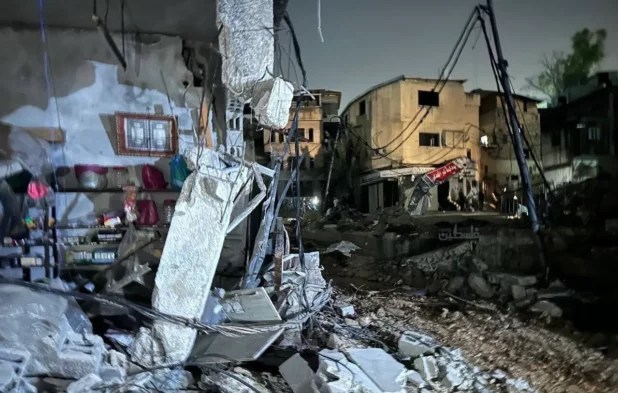
Israeli forces kill 14 Palestinians during refugee camp siege in West Bank
Press TV – April 20, 2024
The Israeli regime’s forces have gunned down at least 14 Palestinians, including 10 fighters, during their ongoing days-long siege on Nour Shams, a refugee camp located in the northern part of the occupied West Bank.
“So far, our crews have evacuated 14 martyrs from Nour Shams camp to the hospital,” the Palestinian Red Crescent said on Saturday.
News agencies, meanwhile, reported sighting Israeli drones loitering overhead and armored vehicles roaming throughout the camp.
Earlier, the Palestinian health ministry said it had confirmed that as many as 11 people had been injured by the troops. Seven of those injured had been “wounded by live gunshots,” it said, adding that among the wounded was a paramedic shot while trying to get to the wounded.
Medics had been alerted to “a number of killed and injured” inside the camp, but the army was “denying them access to tend to the wounded,” the ministry noted.
Minister Muayad Shaaban, head of the Palestinian Colonization and Wall Resistance Commission, said residents were suffering from the “destruction of homes, shops, the electricity grid, the sewerage, the water network, and infrastructure.”
The Israeli military began its siege on the camp on Thursday, rolling bulldozers into the area, and deploying military vehicles on all routes leading to the camp.
The military began destroying main streets, alleyways, water, and wastewater networks inside the camp.
Reporting on Friday, the official Palestinian Wafa news agency said, “They (Israeli forces) turned some houses into military outposts, deployed snipers and prevented ambulances from entering the camp to evacuate patients.”
Also on Friday, the Israeli military killed Muhammad Samer Jaber, commander of the Tulkarm Brigade, a Palestinian resistance group affiliated with Saraya al-Quds, the military wing of the Gaza Strip-based Islamic Jihad movement, and a number of resistance fighters.
The Israeli regime has notably escalated its aggression against Palestinians across the West Bank since October 7, when it began an all-out genocidal war on Gaza.
Around 480 Palestinians have been killed by Israeli troops or settlers in the West Bank ever since the onset of the war that has claimed the lives of more than 34,000 people so far.
Zionist efforts against Palestinian statehood come crashing down
By Hannan Hussain | Al Mayadeen | April 21, 2024
What a sight.
In Europe, the Israeli occupation’s lobbying against a Palestinian state is falling apart fast. For years, pro-Zionist forces have sought to justify support for the illegal occupation and acquire a pass for genocidal atrocities committed in Gaza. But rising initiative in Europe, particularly from Spain and Ireland, shows that “Israel” is no one to influence attitudes towards Palestinian liberties. The occupation regime’s prolonged onslaught on Gaza is only fueling statehood momentum in Europe.
Begin with Spain. Foreign Minister José Manuel Albares recently said that all EU members must recognize Palestinian statehood “in a coordinated manner without delay.” Madrid’s initiative is part of a wider effort to engage with European capitals in the face of Israeli belligerence. More nations such as Ireland, Malta, and Slovenia have expressed their readiness to recognize Palestine, marking a departure from collective silence over Israeli war crimes, mass slaughter, and belligerence.
Europe has long maintained silence on the issue, caving into Israeli occupation lobbying and preferring to overlook Palestinian freedoms. But Brussels knows that its position is increasingly untenable. It needs to understand that the path to enduring peace is one that is negotiated on Palestine’s own terms, beginning with the long-delayed recognition of the state itself – an undeniable fact.
Zionist lobbying is bound to hit more brick walls. Consider EU’s High Representative for Foreign and Security Policy, Josep Borrell: he recently convened a gathering of all bloc foreign ministers to project bloc unity and muster consensus on the crisis. By continuing such attempts, Brussels stands a better chance to gain an autonomous outlook on the root causes of “Israel’s” war on Gaza. After all, “Israel” wants to keep such prospects out of sight, and frets at its possibility. For instance, Israeli Prime Minister Benjamin Netanyahu balks at the prospect of a Palestinian state, because this would demand an end to the illegal occupation itself.
Now as more countries in Europe open up dialogue on the all-important statehood issue, Brussels needs to keep pushing towards a unified approach. After all, there is a growing realization among some states that the “only way to achieve peace and security” is to recognize the Palestinian state. This is important because “Israel” has long benefitted from EU’s divided approach towards Palestinian liberties, as only eight EU states presently recognize Palestinian statehood. This broad-based indifference needs to end.
A joint approach could also play an important role in coordinating differences among several European countries. This would demand a process-driven approach which the occupation frets. Consider the fact that “Israel” has banked on the pro-Israeli support of countries such as Germany to do its bidding in the past. It feels it can skirt accountability for its war crimes as long as scores of countries turn a blind eye to the fundamental and inalienable rights of Palestinians. The EU’s course correction is thus long overdue, and more states appear to realize that. In order to truly deliver justice and lasting stability, it is imperative for the EU to address the root causes that have sustained this status-quo of oppression, largely through Europe’s own sponsorship.
Interestingly, “Israel’s” unwarranted provocations with Iran, and its push to expand genocidal spillovers, could add more fuel to the statehood momentum. For instance, Portugal says it could potentially recognize Palestine if the EU demonstrates a joint approach on the matter. As “Israel’s” protracted regional war prompts more fears in European capitals, scrutiny is once again razor-focused on bringing an end to this vicious cycle of instability. That cycle demands principled action on Palestinian statehood.
“Israel’s” pro-occupation media machinery would unquestionably downplay momentum for statehood in Europe, and project “Israel’s” genocidal interests as central to Europe’s own. This is largely because changing attitudes among European states are a direct threat to “Israel’s” system of apartheid, land theft, settler violence, and state-sponsored violence on Palestinian soil for decades. Moreover, “Israel’s” blatant lobbying against a statehood consensus in Europe cannot alter the facts on the ground: many countries are taking Palestine’s long-due recognition with greater seriousness than seen in some time.
Look no further than Italy’s Deputy Prime Minister Antonio Tajani. He recently spoke about the possibility of a Palestinian state that is recognized with the support of other countries. Not too long ago, such statements and references to Palestinian statehood were seen as taboos in Europe at the policy level. But “Israel’s” ongoing genocide has delivered a reality check over many EU assumptions favoring the occupation.
True, it is a long road ahead for the EU bloc which entails many member states that are complicit in aiding “Israel’s” assault on Palestine. But Spain and Ireland’s combined resolve to muster broad-based EU support on Palestinian statehood, in defiance of Israeli lobbying, is proof that much can be accomplished to the detriment of pro-Zionist forces.
Europe’s history of shielding “Israel” from war crimes and international accountability demands that it comes through.
How Iran’s ‘Operation True Promise’ revealed Jordan’s unholy alliance with Israeli regime
By Humaira Ahad | Press TV | April 21, 2024
Following Iran’s retaliatory military operation against Israel last Saturday, the so-called “defensive military alliance” formed by the Zionist regime comprised an odd member.
Apart from the regular Western allies of the Tel Aviv regime, including the United States, Britain, and France, Jordan was also part of this ‘unholy alliance”.
As per reports, Jordan opened its airspace to the Israeli regime and its Western allies to down some of the Iranian drones at the risk of putting its own people in harm’s way.
Being equipped with only about 60 older F-16 and F-5 aircraft, the Hashemite Kingdom lacks the capacity to independently intercept Iranian drones and missiles headed toward the occupied lands.
An Israeli media channel reported that Israeli fighter jets as well as French air defenses intercepted drones launched by Iran in the airspace of Jordan, drawing widespread anger and outrage.
Following the operation, which came in response to the Israeli attack on the consular section of the Iranian embassy in Syria, the Jordanian government issued a statement, vaguely admitting its role.
“Some unidentified flying objects that entered our airspace last night were dealt with and intercepted to prevent endangering the safety of our citizens and inhabited areas,” read the statement.
Jordan’s active involvement in intercepting some Iranian drones enraged people around the world who saw it as an act of betrayal especially at a time when Israel has killed thousands of Palestinians in Gaza.
With more than 60 percent of Jordan’s population being of Palestinian descent, the Kingdom’s military cooperation with Israel is not only considered treacherous but cowardly.
Since the start of Israel’s genocidal onslaught on Gaza, thousands of people have been protesting regularly outside the Israeli embassy in Amman, calling for a reversal of the 1994 Israel-Jordan treaty.
The kingdom has often resorted to the heavy use of force, arresting the protesters and exhibiting disdain for its commitments as an Arab-Muslim nation towards the Palestinian cause.
Jordan’s relations with Israel
Jordan’s opposition to Palestinian resistance became evident in 1970 when the Arab country massacred thousands of Palestinians. The tragic event called “Black September” was aimed at expelling the Palestinian Liberation Organization (PLO) from Jordan.
The expulsion was backed by then-King Hussein bin Talal, who reportedly received support from the Zionist regime and its Western backers.
In 1994, Jordan and Israel signed the Israel–Jordan peace treaty. Thus, Amman became the second Arab country after Egypt to recognize the occupying regime. Since then, the two sides have shared close diplomatic relations with Jordan practically consigning the Palestinian cause into oblivion.
On his visit to Jordan in 2016, former Israeli President Reuven Rivlin spoke at the country’s Independence Day reception. He praised the close ties between Amman and Tel Aviv stating.
“Israel is proud to be Jordan’s partner and to stand at Jordan’s side…over the last year, your kingdom has played a critical role in dealing with the violence in Jerusalem which is holy to all of us.”
At an event in 2022, Jordan and Israel signed a memorandum of understanding on water and energy.
In January this year, Jordan’s Prime Minister Bisher al Khasawaneh said that peace with Israel remained a strategic choice for the kingdom, in complete disregard for Palestinians massacred in Gaza.
Netanyahu’s secret visits to Jordan
After the establishment of relations with the Zionist regime in 1994, most of the dealings between the two sides have been secretive and away from the media limelight.
In January 2023, Israel’s Prime Minister Benjamin Netanyahu made a surprise visit to Jordan to meet King Abdullah II. It was Netanyahu’s first known visit to Amman since a secret trip in 2018.
Amid attempts by then-US President Donald Trump to broker a deal for the infamous Abraham Accords, Netanyahu paid a secretive visit to Jordan in 2018.
He was accompanied by the then Mossad Director Yossi Cohen, military secretary Eliezer Toledano and other members of his cabinet.
Netanyahu participated in a secret summit in Aqaba in 2016. The meeting that was arranged by then-US Secretary of State John Kerry included King Abdullah and Egyptian President Abdel Fattah al-Sissi.
Following the Jerusalem intifada, the Hashemite King Abdullah met Netanyahu in November 2014 in Jordan.
Western military bases in Jordan
Western countries that helped the Israeli regime intercept some Iranian drones during ‘Operation True Promise’ are believed to have used military bases in Jordan.
US troops are stationed at the Tower 22 military base in northeastern Jordan, near the Syrian border, supporting Israel’s military operations.
The United States has at least 3000 military personnel stationed in the West Asian kingdom.
In 2022, America announced the headquarters of its 332nd Air Expeditionary Wing’s air combat command as Muwaffaq Salti Air Base in the eastern city of Azraq, located near the border of Iraq and Syria.
As per a 2023 report by the US Congress, an agreement between the two sides allows US forces, vehicles and aircraft to enter and move around Jordan freely.
UK and France also have a significant presence inside Jordan. Military personnel from the two countries are present at King Faisal Air Base in Al-Jafr and the Humaymah base near Aqaba.
French troops at King Faisal Air Base, known as Al-Ruwaished Base, which is close to Al-Tanf have been involved in espionage activities in Iran, Syria, Iraq, and Lebanon. The airport of the military base is believed to be used by both Israeli and US drones.
In December 2023, French President Emmanuel Macron paid a visit to French forces stationed at the Al-Ruwaished base. The Jordanian base is perceived to protect the occupying regime.
Jordan-Israel military cooperation
Jordanian Air Force pilots trained with the Israeli military in 2015 at a US-hosted air force exercise.
The cooperation was confirmed by then-Israeli war minister Moshe Ya’alon. A Jordanian pilot Majdi al-Samdi who refused to be a part of the joint military exercise was discharged from the Hashemite Kingdom’s air force.
In 2016, a delegation of almost a dozen Jordanian generals went on a three-day visit to the occupied territories to participate in an international conference with the Israeli military.
Apart from allowing the US to use its territory for the transportation of heavy military equipment to Israel, Jordan has been accepting arms from the child-killing regime.
Retired US-supplied Cobra combat helicopters were given to the kingdom by Israel in 2015. The handover was approved and facilitated by the United States.
Global anger against Jordan
Muslims around the world, including Jordanians, have expressed their disgust at the hypocrisy of Amman that on the one hand condemns Israel’s military aggression on Gaza and calls for a ceasefire and on the other hand, helps the regime against an unprecedented Iranian military operation.
Dima Khatib, the managing director of Aljazeera’s online platform AJ+, labeled the interceptions in the Jordanian airspace “a shocking scene”.
“Sister countries are responding, not to the attack of Israeli planes, drones and missiles on Palestine, but to an attack on Israel… There are Arab citizens who pull the trigger to protect Israel and watch when the Palestinians are bombed,” he wrote on social media.
Daniella Modos, UK-based campaigner quoted the Middle East Eye’s editor-in-chief David Hearst as saying that while Jordanians cheered the Iranian attack, the Jordanian government stood with Israel.
“While the population of Jordan cheered the Iranian missiles onto their targets in Israel, the Jordanian army shot them down on Israel’s behalf. Israel may be celebrating the fact they have real allies, but by doing so they are fatally undermining their friends’ legitimacy,” Modos wrote.
Masoud Khodabandeh, former director of Middle East Strategy Consultants and a freelance consultant, took to X to denounce Jordan’s role in helping the regime to intercept some Iranian missiles.
Referring to King Abdullah, Khodabandeh wrote, “Guess how many Israeli missiles going toward Palestinian women and children he downed during 6 months of Gaza Genocide?”
Marwa Osman, a Lebanon-based journalist and Press TV show host, quoted an Israeli newspaper as saying that the regime is set to approve a water agreement in exchange for Amman’s help.
“The Israeli YediothAhronoth newspaper: After the great assistance provided by Jordan in intercepting the Iranian attack on Israel: Energy Minister Eli Cohen is expected to approve Jordan’s request to extend the water agreement for another year,” Osman wrote.
“Think about it… Jordanians will use the water for Wudu before prayers… for a whole year… in return for “protecting Israel”. And it is STOLEN PALESTINIAN WATER! Wow.”
Nerdeen Kiswani, a Palestinian activist based in New York, pointed to the split between the monarchy and the Jordanian people concerning relations with the apartheid regime.
“So Jordan is killing its OWN people to defend Israel… Not surprising given that Jordan does not represent its people at all when it comes to normalization with the Zionists,” she wrote.
Rep. Gosar on Ukraine Vote: Congress ‘Seems to Want to Help Every Country Except America’
By Ilya Tsukanov – Sputnik – 21.04.2024
The House of Representatives gathered for a rare weekend session Saturday to advance $95 billion in new assistance for Washington’s foreign allies and clients, including just shy of $61 billion for Ukraine. Moscow slammed the decision, saying it signals US ruling elites’ commitment to Ukraine’s destruction in a hopeless proxy war against Russia.
Saturday’s vote to provide new US aid to Ukraine is a sign of the US political class’s readiness to “waste” taxpayer money abroad instead of using it to focus on issues Americans actually care about, Congressman Paul Gosar has told Sputnik.
“Unfortunately, 210 Democrats joined 101 Republicans in voting in favor of wasting more money on a war half a globe away. America is in a ditch and too many in Congress refuse to find the will to address the long list of issues ailing our nation,” Gosar, a Republican representing the state of Arizona, said.
“I’m angry that Congress and Joe Biden don’t hesitate to find another $60 billion for a corrupt country but are unbothered that inflation is 19% higher since Biden took office, gasoline is hovering around $4 a gallon nationwide, 11 million illegal aliens have poured into our country, interest rates for a home mortgage are 8%, our roads and bridges are in disrepair, our national debt is $34 trillion, real wages are in decline, parents have to decide between feeding their children or putting fuel in their automobile and we have a growing veteran homeless crisis in every corner of our country,” the lawmaker said.
Pointing out that he has voted consistently “against every dime wasted on the war in Ukraine” and “repeatedly called for peace,” since the escalation of the crisis in February 2022, Gosar confirmed that he voted against the $61 billion package which advanced through the House on Saturday as well.
“To say that I’m very unhappy that these politicians seem to want to help every single country except America is an understatement. I am beyond angry. It’s long past time we put America first,” he said.
Gosar is one of a handful of conservative Republicans in the House who have sought to rein in defense spending and US funding for conflicts abroad in favor of dealing with more urgent priorities facing the US, including economic issues, the debt and the border crisis.
Gosar joined Georgia Republican Representative Marjorie Taylor Greene and Representative Thomas Massie of Kentucky this week in a motion to oust Speaker Mike Johnson from his seat for advancing the Ukraine, Israel and Taiwan aid bills.
The Arizona congressman has taken a hardline, principled ‘America First’ foreign policy stance, voting Saturday against not only Ukraine aid, but against $14 billion in additional assistance to Israel. Last year, he joined Representative Matt Gaetz, Senator Rand Paul and others in calling for an end to the illegal US military presence in northeastern Syria. In 2021, he joined with House Republicans to vote to repeal the 2002 Congressional authorization for the Iraq War. In October 2022, he extended an invitation to Presidents Putin and Zelensky to come to Arizona to hold negotiations to end the Ukrainian crisis.
US Pumping Ukraine With Weapons to Protract War ‘Up Till Last Ukrainian’ – Moscow
Sputnik – 21.04.2024
MOSCOW – The United States is prepared to pour weapons into Ukraine as long as necessary and spare no Ukrainian lives to make sure that its proxy continues fighting Russia, including via terrorist attacks and killings of journalists, the Russian Foreign Ministry said on Sunday.
“The ruling elites in the US, regardless of party affiliation, are ready to arm the regime in Kiev so that it will be able to fight up till the last Ukrainian and continue, among other things, terrorist attacks on civilian targets on Russian territory, sabotage attacks and killing journalists,” the ministry said in a statement.
The White House is no longer counting on a “mythical Ukrainian victory,” but wants the Ukrainian army to hold out at least until the presidential election in the US, in order not to ruin the image of US President Joe Biden, the ministry noted.
“The actions of the US, as a de facto party to the conflict, will be unconditionally and decisively rebuffed, and Washington’s ever-deeper plunge into hybrid warfare against Russia will turn out to be as loud and humiliating of a fiasco for the United States as it was in Vietnam and Afghanistan. In any case, the feverish attempts to save [Ukrainian President Volodymyr] Zelensky’s neo-Nazi regime are doomed to failure. The goals and objectives of the special military operation will be fully achieved,” the ministry added.
On Saturday, the US House of Representatives passed a bill that would unlock $60.84 billion in Ukraine-related aid, if approved by the Senate.
Featured Video

Iran Is Not Our Enemy
or go to
Aletho News Archives – Video-Images
Book Excerpt
“Vaccines Do Not Cause Autism!” The Science is Settled. Right?
ICAN urges the IACC to actually study infant vaccines and autism
 By Aaron Siri | Injecting Freedom | March 16, 2026
On behalf of ICAN, we just sent a copy of chapter 11 of Vaccines, Amen to the newly appointed members of the federal Interagency Autism Coordinating Committee (IACC).
If you haven’t already read this chapter, you can read the whole thing in the attached letter. I trust that after you read it, you’ll see why the statement “vaccines do not cause autism” is a belief, not science!

IACC Public Comment Letter
1.53MB ∙ PDF file
Includes chapter 11 of Vaccines, Amen
Blog Roll
 Aletho News
- Iran made ‘unexpectedly substantial’ offer during Geneva talks, US envoys ‘dragged’ Trump into war: Report
- Russia condemns Israel’s attack near Bushehr plant, files complaint
- Russia Strongly Condemns Actions Aimed at Harming Health of Iranian Leadership – Kremlin
- Israeli Journalist Demands Tucker Carlson and Candace Owens Be Placed in WWII-Style Internment Camps
- No Liability, No Studies, No Accountability: The Vaccine System Aaron Siri Exposed in Federal Court
- No time for losers: Why the war meant to save Israel may destroy it
- Top US Counterterrorism Official Resigns in Protest of Operation Against Iran
- Just Get Out! Now!
- Unpacking glaring contradictions in US-Zionist justifications for war against Iran
- Iranian model of warfare bleeds US dry while Persian Gulf states watch and learn: Analyst
- If Americans Knew
- Lebanon death toll exceeds 900, another assassination in Iran, bombing in Gaza – Not a ceasefire Day 159
- Trump’s counterterrorism chief, whose own wife was killed by ISIS, quits over Iran War saying Tehran posed ‘no imminent threat’
- Here’s what US could fund instead of Bibi’s war on Iran
- Israel Killed Over a Dozen Lebanese Paramedics in Three Days, Now Claiming That Ambulances Are “Hezbollah” Targets
- War on Iran: These are the heritage sites devastated by US and Israeli attacks
- Four news stories from Israeli media that illustrate Israeli “justice”
- CIA Prepares Criminal Referral of Tucker Carlson, as Israel and Its Loyalists Demand His Arrest
- Top US counterterror advisor resigns in protest of “war manufactured by Israel” – Not a ceasefire Day 157
- ‘I Liked the House’: When Israeli Soldiers Turn Palestinian Homes into Barracks
- ‘They Were All I Had’: Lebanese Father Buries Parents, 4 Daughters Killed by Israeli Bombing
- No Tricks Zone
- New Research: South Australia’s Mid-Holocene Sea Surface Temperatures Were 4°C Warmer Than Today
- Storing Green Energy To Last Germany 10 Days Would Require A 60-Million Tonne Battery
- New Studies: UK Sea Levels Were 4 Meters Higher Than Today During The Mid-Holocene
- Destructive Green New Deal: German Energy And Metal Group Warns Of Drastic Crisis
- New Study Documents A 20-Year Pause In Arctic Sea Ice Decline – Driven By Internal Variability
- Wake-up Call: Survey Shows Majority Of Germans Now Favor Postponing Climate Targets!
- Televised! Leading German Political Candidate Tells Schoolchildren CO2 Makes Sun Hotter!
- New Study: A Century Warming Of 1.1°C Is ‘Commonplace’ And ‘Not Unusual’ During This Interglacial
- New Study: ‘Internal Noise’ And Volcanic Forcing Can Trigger 10-15°C Warming Within Decades
- Glaciers Worldwide Are Suddendly Surging, Experts Blame Warming!
 Aletho News