US Coast Guard Polar Icebreaker 5 Years Behind Schedule, $2Bln Over Budget

Sputnik – 07.05.2024
WASHINGTON – The US Coast Guard’s proposed next generation polar icebreaker to reestablish and maintain a strong US presence in the Arctic Ocean is at least five years behind schedule and $2 bln over budget with many design and shipbuilding problems still unresolved, a senior Biden administration official and a new report told Congress.
“The PSC [Polar Security Cutter] program is now years behind the original schedule, without having attained the level of maturity we require prior to authorizing the start of construction,” Department of Homeland Security Deputy Under Secretary for Management Randolph Alles told the US House Homeland Security Subcommittee on Transportation and Maritime Security.
The project had suffered from the general lack of US experience designing and building polar icebreakers and its prime contractor VT Halter Marine suffered from organizational instability and has undergone managerial restructuring following its acquisition by Bollinger, a competitor shipyard in 2022, Alles said.
In addition, the design of the Polar Security Cutter is more complex and is taking more than three years longer than expected – delaying delivery of the lead ship by about five years, Alles said.
Earlier on Tuesday, the Government Accountability Office (GAO) issued a new report in which it concluded that the program’s costs increased by more than $2 billion due to these challenges.
Even with a projected 39% increase, procurement costs still appear to still be significantly underestimated because the actual ship design is about 35% larger in terms of light-ship displacement than the government’s original notional design, the GAO said.
On April 24, US Coast Guard Vice Commandant Steven Poulin said that the United States is losing ground in the Arctic to its near-peer competitors Russia and China because of a lack of icebreaking capability, but he was optimistic the situation will improve in the future.
TikTok Fights Back Against Ban
By Dan Frieth | Reclaim The Net | May 7, 2024
On Tuesday, TikTok, together with its parent company ByteDance, took legal action in the US federal court to challenge a new law endorsed by President Joe Biden.
This legislation mandates that ByteDance either sell TikTok by January 19 or cease its operations in the US. The suit, filed in the US Court of Appeals for the District of Columbia, claims that the law infringes on several constitutional grounds, particularly violating the First Amendment’s free speech protections.
We obtained a copy of the lawsuit for you here.
TikTok, immensely popular among 170 million Americans, faces an existential threat under this law, enacted on April 24. The filing emphatically states that divestiture is unfeasible — “not commercially, not technologically, not legally.” It warns of an inevitable shutdown, which would “silence the 170 million Americans who use the platform to communicate in ways that cannot be replicated elsewhere.”
Here are the key points you should know about TikTok’s argument:
Unprecedented and Discriminatory Legislation: TikTok claims that the Act is the first of its kind to single out and ban a specific online platform, infringing upon the rights of 170 million American users to participate in a global community of over a billion users.
Violation of First Amendment Rights: TikTok argues that the Act violates the First Amendment by imposing a ban on a major platform for speech and expression. They contend that the legislation infringes on free speech rights by selectively targeting TikTok based on its ownership and content.
Impractical Divestiture Requirements: The Act provides TikTok the option to divest its U.S. operations as an alternative to a ban. TikTok contends this divestiture is commercially, technologically, and legally infeasible, especially within the mandated timeline, making it a non-viable option.
Lack of Substantive Justification: TikTok criticizes the Act for lacking concrete legislative findings or evidence that TikTok poses a national security threat. They argue the legislation is based on speculative risks rather than substantiated threats.
Existence of Less Restrictive Alternatives: TikTok points out that they have proposed and negotiated comprehensive security measures with the U.S. government, referred to as “Project Texas”, which were disregarded in favor of the more extreme measure of banning the platform.
First Amendment Concerns: The First Amendment argument is particularly strong. US courts generally apply strict scrutiny to laws that target specific speech platforms or types of speech. Under strict scrutiny, the government must prove that the law is narrowly tailored to achieve a compelling governmental interest. TikTok’s claim that the Act fails to meet this standard because it is overbroad and not the least restrictive means to address the alleged security concerns could resonate with the courts.
Selective Targeting and Discrimination: TikTok’s argument that the Act discriminates against it by specifically targeting its platform while offering other companies potential exemptions or less severe restrictions could be seen as a violation of the equal protection principles implicit in the Fifth Amendment. This argument about selective targeting could strengthen TikTok’s case if they can convincingly argue that similar platforms are treated differently without a reasonable basis.
Feasibility of Alternatives: The argument regarding the feasibility of divestiture and the existence of less restrictive means (such as the security measures TikTok proposed) could also be pivotal. Courts often look favorably on arguments that a law is not narrowly tailored if there are obvious, less restrictive alternatives that could achieve the same goals.
Critics argue that the law encroaches on the First Amendment rights of TikTok users and labels the law as an unjustified overreach by the government. On the other hand, proponents of the law cite national security concerns, fearing that the Chinese government might access or manipulate data collected on American users.
The legislation was swiftly moved through Congress amid bipartisan concerns over potential data privacy violations and content manipulation by Chinese authorities via TikTok. Despite such claims, the US government has yet to disclose concrete evidence supporting these allegations.
The ongoing battle over TikTok is part of a broader dialogue concerning the intersection of technology, privacy, and national security. Legal scholars note that the outcome of this lawsuit might set a significant precedent affecting digital media regulations in the US.
Adding complexity to the situation, the lawsuit reveals that TikTok has invested $2 billion in data protection measures for US users and engaged in extensive negotiations with the Committee on Foreign Investment in the United States (CFIUS). These discussions culminated in a draft National Security Agreement, which included severe measures such as a “shut-down option” for the US government. However, meaningful negotiations ceased in August 2022, and by March 2023, CFIUS demanded a divestiture of the US TikTok operations.
Ecocide: Israel’s systematic destruction of Palestinian agriculture revealed
British-based investigation unveils targeting, destruction of land by Israeli forces in Gaza Strip since last October
By Dilara Hamit – AA – 05.05.2024
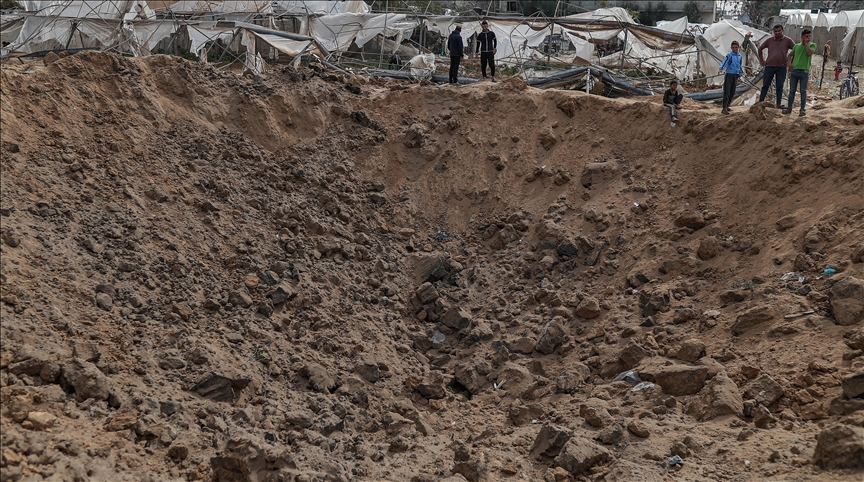
A British-based investigation group has unveiled the systematic targeting and destruction of orchards and greenhouses by Israeli forces in the Gaza Strip since last October, when the current conflict in Gaza began, undermining Gazan Palestinians’ ability to feed and provide for themselves.
Analysis by Forensic Architecture, a multidisciplinary research group based at Goldsmiths, University of London, identified more than 2,000 agricultural sites, including farms and greenhouses, that have been deliberately destroyed, and often replaced with Israeli military earthworks.
The destruction, particularly intense in northern Gaza, has led to the devastation of nearly one-third of the region’s greenhouses and approximately 40% of agricultural land previously used for food production.
The investigation suggests that the destruction is a deliberate act of ecocide exacerbating the ongoing catastrophic famine in Gaza, part of a wider pattern of depriving Palestinians of critical resources for survival.
“Since 2014, Palestinian farmers along Gaza’s perimeter have seen their crops sprayed by airborne herbicides and regularly bulldozed, and have themselves faced sniper fire by the Israeli occupation forces. Along that engineered ‘border,’ sophisticated systems of fences and surveillance reinforce a military buffer zone,” according to a statement from Forensic Architecture marking March 30, Land Day, a day when Palestinians protest and plant olive trees to reaffirm their connection to the land.
The investigation, built on collaborations with local farmers’ associations and agricultural workers, highlights the ongoing Israeli destruction of vegetation in Gaza and its severe effects on Palestinian food security and livelihoods.
The analysis indicates the ongoing resilience of Palestinian farmers who continue to cultivate their lands despite forced alterations to the landscape by the Israeli occupation.
Greenhouses, farmland replaced by Israeli military construction
Before 2023, Gaza boasted 170 square kilometers (65 square miles) of agricultural land, or 47% of its total area. The fields and orchards were crucial for local food security amid the siege conditions faced by Palestinians under the 15-year blockade of Gaza since 2007, followed by the even harsher blockade since last Oct. 7.
“Our analysis shows that Israel’s ground invasion has advanced over nearly 50 percent of Gazan farms and orchards,” said Forensic Architecture.
“We used remote sensing to measure the scale of agricultural destruction resulting from this military activity, by comparing the region’s ‘vegetation index’ (an indicator of the health and robustness of plant life, measured by analysing satellite imagery) before and after the invasion. This comparison reveals that as of March 2024, of the agricultural areas targeted, approximately 40 percent of the land in Gaza previously used for food production has been destroyed.”
The findings show that the destruction of agriculture along Gaza’s perimeter suggests a potential expansion of the Israeli army’s buffer zone, further limiting livable space for Palestinians.
Additionally, vital agricultural infrastructure like greenhouses has been systematically targeted since the onset of the ground invasion.
It stressed that satellite imagery reveals extensive destruction of greenhouses, with nearly one-third of Gaza’s greenhouses demolished between last October and this March. Forensic Architecture identified more than 2,000 agricultural sites, including farms and greenhouses, destroyed during that period, often replaced by Israeli military constructions.
The destruction has been particularly severe in northern Gaza, where 90% of greenhouses were demolished in the early stages of the invasion, an area which the head of the UN World Food Program (WFP) said Saturday was in “full-blown famine.”
“As the Israeli military advances south, destruction of agricultural land and infrastructure moves with it. We observe that 40% of the greenhouses in the areas around the southern city of Khan Younis, where many hundreds of thousands of Palestinians are now displaced, have been destroyed since January 2024,” said Forensic Architecture.
“Military support vehicles and tractors accompany the Israeli ground invasion, routinely building earthworks to reinforce military outposts. Once those vehicles depart, they leave behind a devastated and unliveable area,” it added.
US tries to pressure Southeast Asia into sanctioning Iran: Bloomberg
Al Mayadeen | May 7, 2024
The United States is attempting to rally the support of Southeast Asian countries to implement further sanctions on Iran and its allies in the Axis of Resistance.
An unnamed senior US Treasury official made the revelation during a visit of American officials with Southeast Asia oil industry executives, regulators, and financial institutions to ensure the enforcement of sanctions on Russia and Iran, according to Bloomberg.
Washington is accusing Iran and “groups like Hamas” of soliciting money in Southeast Asia.
Specifically, the US is attempting to tighten its unilateral sanctions on Russia by involving Southeast Asian entities in the process, which involves cutting off pathways for the sale of Russian oil and Moscow’s sourcing of critical dual-use components from the region.
However, Iran has been the main focus of US officials in the region, given its historically friendly ties with countries like Malaysia. Earlier, the US administration passed a package of measures, which includes sanctioning foreign ports, vessels, and refineries that process or ship Iranian crude.
The sanctions would also attempt to enforce restrictions on all oil-related transactions with US-sanctioned Iranian banks. US officials are attempting to utilize the supposed environmental risks of dealing with Iran-affiliated vessels to pressure Malaysia into colluding with Washington.
Iran’s oil exports skyrocket
In the 12 months up until the end of March 2024, Iran’s oil exports reached $35.8 billion, Iran’s head of Customs Mohammad Rezvanifar said today, as reported by the Iranian Labour News Agency.
Even though the US renewed its sanctions on Iran in 2018, Chinese-Iranian trade, specifically Chinese purchases of Iranian oil, has aided Iran in keeping a positive trade balance.
Iran’s total trade witnessed a 2.6% year-on-year increase, hitting a value of $153 billion, of which $86.8 billion was Iranian exports, Rezvanifar added.
As Tehran continues to cement its position in global trade, away from the US-controlled financial system, the country grows as an economic power. Oil sales are essential for the development of Iran’s industrial sectors, which further spur the country’s goal of economic independence.
Considering that Iran is a threat to American hegemony in West Asia, specifically to the Israeli regime and other US military assets, Washington has gone back to reinforcing restrictions on the inevitable rise of Tehran as a regional and possibly global leader.
Dutch police smash pro-Palestine protest camp
The Cradle | May 7, 2024
Riot police bulldozed barricades and temporarily detained 125 people to break up a pro-Palestine student protest at the University of Amsterdam in the early hours of 7 May, Reuters reported.
Four of the protesters are still being held on charges of public violence and insulting an officer, while the remainder have been released.
Organizers said they were “taking back this campus” in solidarity with Palestine and “in the spirit” of student protests that began in the US in response to Israel’s genocide in Gaza.
Along with pro-Palestine demonstrators at universities in the US and Europe, the Dutch students are demanding the university boycott academics and businesses in Israel.
Similar protests have occurred at Ghent University in Belgium and France’s prestigious Sciences Po University.
The National reported that in a social media message shortly before 3 am, organizers said they were being “violently evicted” by police arriving in riot vans.
Dutch television showed footage of police wielding batons advancing on the protesters and destroying tents.
Reuters adds that the police claimed student protesters ignored requests from university administrators and the mayor for the protesters to leave the campus and threw stones and fireworks.
“The police’s input was necessary to restore order. We see the footage on social media. We understand that those images may appear as intense,” police claimed.
Due to pressure from students, the University of Amsterdam published a list of eight research projects with ties to Israel.
It said one was about detecting explosives but “does not contribute to Israel’s military actions,” while others involved machine learning, gender issues, and safer streets.
Israel has used machine learning and artificial intelligence to generate bombing targets in Gaza.
A group of academics called Dutch Scholars for Palestine expressed support for the student protests.
“We have to resist political frames that will cast their efforts as antisemitic or a danger to the university community,” they said.
The media in the US and Europe have attempted to cast the protests as driven by antisemitism rather than by anger at Israel’s horrific bombing campaign in Gaza that has killed over 14,000 children.
Many Jewish students have participated in the university protests in opposition to Israeli policies.
“As the death toll and humanitarian crisis in Gaza increases … we should be proud of our students who are standing up to these abhorrent atrocity crimes,” the academics added.
LAPD’s Failure to Protect Peaceful Protesters at UCLA from Right-Wing Mob Shows Real Priorities
By Jeremy Kuzmarov | CovertAction Magazine | May 6, 2024
 In 1991, Frank Donner, former director of the ACLU’s Project on Political Surveillance, published a book entitled Protectors of Privilege, which provided a history of police suppression of left-wing and labor protests in the United States.
A key chapter in the book focused on the Los Angeles Police Department (LAPD), whose reactionary political function was epitomized by two of its most notorious chiefs: William Parker and Daryl Gates, who were overtly racist and supported anti-democratic paramilitary policing practices.
The LAPD’s true colors were on display at the University of California at Los Angeles (UCLA) at the end of April when its officers stood by for hours as hundreds of right-wing vigilantes attacked pro-Palestinian demonstrators in what Al Jazeera described as a “really shocking and ugly scene of violence.”
The LAPD then aggressively broke up the pro-Palestinian demonstrators’ encampment using flash bangs and riot gear, arresting around 200 of the anti-genocide protesters who were entirely peaceful. (none of the vigilantes were arrested).[1]
![Pro-Israel attackers try to remove barricades at a pro-Palestinian encampment at the University of California, Los Angeles, on May 1, 2024 [David Swanson/Reuters]](https://i0.wp.com/covertactionmagazine.com/wp-content/uploads/2024/05/pro-israel-attackers-try-to-remove-barricades-at-a.jpeg?resize=696%2C473&ssl=1)
Pro-Israel attackers try to remove barricades at a pro-Palestinian encampment at the University of California, Los Angeles, on May 1, 2024. [Source: msn.com]
On May 2, a day after the break-up of the encampment, I visited the UCLA campus and witnessed students and university employees clearing the protest area.
Though many of the students were refusing to speak to any media, I managed to interview one, Lisa Cooper, who described herself as a seasoned organizer originally from New York who had joined the protesters in solidarity with them.
Cooper told me that she helped run a wellness center in the encampment that brought in acupuncturists who administered treatment to students who had either been physically attacked or were dealing with emotional trauma and the stress of living in the encampment while studying for mid-terms.
The students believed they had to do something in the face of the horrific atrocities going on in Gaza.
Cooper said that dissent was currently under siege in the U.S. and that the protests provided an opportunity to get people thinking about societal problems and realities, and that the students involved felt empowered by their experience, which they would take with them into other aspects of their lives.
As part of the daily programming, students coordinated teach-in events like during the 1960s era Vietnam campus protests. Benjamin Kersten, a Ph.D. student in art history, told the UCLA Daily Bruin that “this is a public university that preaches the importance of education, and yet, topics like Palestine are not taught. A lot of the programming shows that people here are taking their education into their own hands, and learning what it means to teach each other and enact activist values.”[2]
According to Cooper, public protest is a right Americans enjoy under the U.S. Constitution and that this should not be forgotten.
Cooper said that the right wing vigilantes who stormed the encampment were equipped with bear mace, projectiles and other weapons that they deployed against protesters, causing injuries to some of the students.
One protester had 16 staples inserted into his scalp.
Because the students did not want to call 911 and put themselves at risk of suspension or arrest, other students drove them to the hospital by car.

UCLA students clearing material from protest encampment on May 2. [Source: Photo courtesy of Jeremy Kuzmarov]
Cooper herself was not injured in the attack, but said that the vigilantes hurled racial slurs at her (she is African-American).
The main police units that broke up the encampment were officers of the California Highway Patrol (CHP) who, she said, are not required to wear body cam devices. CHP was backed up by the LAPD, whose presence was ubiquitous around the campus during my visit.
Cooper said that UCLA should be called to account for not allowing peaceful protests on public property.
UCLA President Michael Drake released a statement supporting the university’s decision to label the protest encampment as unlawful, noting that, “when it threatens the safety of students or everyone else, we must act.”[3]
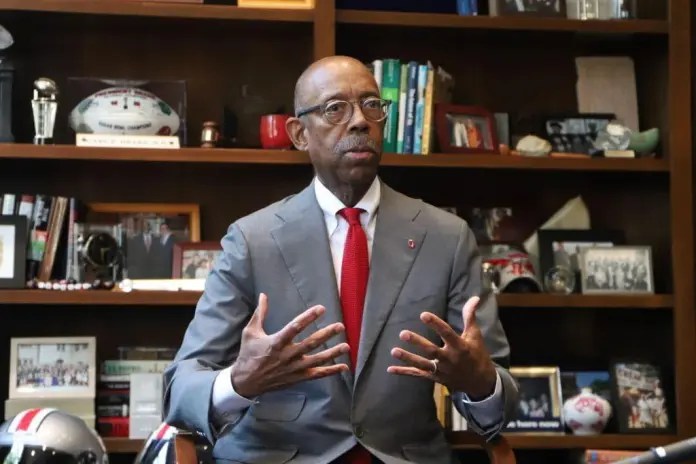
UCLA President Michael Drake [Source: thelantern.com]
However, there is no evidence that the encampment threatened the safety of UCLA students in any way[4]; rather, it was the vigilante counter-demonstrators who compromised the safety of UCLA students expressing their constitutional right to dissent.

- During the vigilante attack, a group reportedly piled on one person who lay on the ground, kicking and beating the person until others pulled him out of the scrum. The editor of the UCLA Daily Bruin, Catherine Hamilton, was punched in the chest and upper abdomen by the vigilantes. Robert Reynolds of Al Jazeera reported that the vigilante mob, which called for a second Nakba, “appear[ed] to be all largely people who are not of student age and they’re not from the UCLA campus, but what they’re doing is trying to harass and attack the pro-Palestinian demonstrators.” The leaders of the anti-war encampment at UCLA said that “law enforcement simply stood at the edge of the lawn and refused to budge as we screamed for their help. The only means of protection we had was each other as the attack went on for more than seven hours.” “The university would rather see us dead than divest,” it added in a statement posted on X. The Los Angeles Public Defenders’ Union called the UCLA arrests “shameful and a complete failure of leadership.” President Garrett Miller said they are ready to “represent every person facing charges.”
- Dylan Winward, “Encampment Hosts Programming, Draws Counter-Protesters,” UCLA Daily Bruin, April 26, 2014, 2. Winward’s article detailed how Jewish Voices for Peace organized a passover seder in the encampment and shabbat service, dispelling the myth that somehow the students involved in the encampment were anti-semites.
- Anna Dai-Liu and Dylan Winward, “Pro-Israel counter-protesters attempt to storm encampment, sparking violence,” UCLA Daily Bruin, May 1, 2024, 1.
- Sam Mulick, “UCLA Community Responds to Palestine Solidarity Encampment,” UCLA Daily Bruin, APril 26, 2024, 3 quotes from students, the majority of whom had highly positive views of the encampment. This included numbers of Jewish students. One student quoted in the article expressed appreciation that students of this generation were politically active and cared about the plight of oppressed people in the world, while another said the encampment was an effective method to engage community members on the campus. Still another, a psychology student, Erin Lee, told The Daily Bruin that UCLA should offer more support to Palestinian students, and that the university had taken a direct role in the war in Gaza through its investments in companies affiliated with the Israeli military. She added correctly that while she thinks students in the encampment were sending a very powerful message, she doubts the UC system will respond to their actions.
The beast of ideology lifts the lid on transformation
By Alastair Crooke | Strategic Culture Foundation | May 6, 2024
The Transformation is accelerating. The harsh, often violent, police repression of student protests across the U.S. and Europe, in wake of the continuing Palestinian massacres, exposes sheer intolerance towards those voicing condemnation against the violence in Gaza.
The category of ‘hate speech’ enacted into law has become so ubiquitous and fluid that criticism of the conduct of Israel’s behaviour in Gaza and the West Bank is now treated as a category of extremism and as a threat to the state. Confronted by criticism of Israel, the ruling élites respond by angrily lashing out.
Is there a boundary (still) between criticism and anti-semitism? In the West the two increasingly are being made to cohere.
Today’s stifling of any criticism of Israel’s conduct – in blatant contradiction with any western claim to a values-based order – reflects desperation and a touch of panic. Those who still occupy the leadership slots of Institutional Power in the U.S. and Europe are compelled by the logic of those structures to pursue courses of action that are leading to ‘system’ breakdown, both domestically – and concomitantly – provoking the dramatic intensification of international tensions, too.
Mistakes flow from the underlying ideological rigidities in which the ruling strata are trapped: The embrace of a transformed Biblical Israel that long ago separated from today’s U.S. Democratic Party zeitgeist; the inability to accept reality in Ukraine; and the notion that U.S. political coercion alone can revive paradigms in Israel and the Middle East that are long gone.
The notion that a new Israeli Nakba of Palestinians can be forced down the throats of the western and the global public are both delusional and reek of centuries of old Orientalism.
What else can one say when Senator Tom Cotton posts: “These little Gazas are disgusting cesspools of antisemitic hate, full of pro-Hamas sympathisers; fanatics and freaks”?
When order unravels, it unravels quickly and comprehensively. Suddenly, the GOP conference has had its nose rubbed in dirt (over its lack of support for Biden’s $61bn for Ukraine); the U.S. public’s despair at open border immigration is disdainfully ignored; and Gen Z’s expressions of empathy with Gaza is declared an internal ‘enemy’ to be roughly suppressed. All points of strategic inflection and transformation – likely as not.
And the rest of the world now is cast as an enemy too, being perceived as recalcitrants who fail to embrace the western recitation of its ‘Rules Order’ catechism and for failing clearly to toe the line on support for Israel and the proxy war on Russia.
It is a naked bid for unchecked power; one nevertheless that is galvanising a global blow-back. It is pushing China closer to Russia and accelerating the BRICS confluence. Plainly put, the world – faced with massacres in Gaza and West Bank – will not abide by either the Rules or any western hypocritical cherry-picking of International Law. Both systems are collapsing under the leaden weight of western hypocrisy.
Nothing is more obvious than Secretary of State Blinken’s scolding of President Xi for China’s treatment of the Uighurs and his threats of sanctions for Chinas trade with Russia – powering ‘Russia’s assault on Ukraine’, Blinken asserts. Blinken has made an enemy of the one power that can evidently out-compete the U.S.; that has manufacturing and competitive overmatch vs the U.S.
The point here is that these tensions can quickly spiral down into war of ‘Us’ versus ‘Them’ – ranged against not just the China, Russia, Iran “Axis of Evil”, but vs Turkey, India Brazil and all others who dare to criticise the moral correctness of either of the West’s Israel and Ukraine projects. That is, it has the potential to turn into the West versus the Rest.
Again, another own goal.
Crucially, these two conflicts have led to the Transformation of the West from self-styled ‘mediators’ claiming to bring calm to flashpoints, to being active contenders in these wars. And, as active contenders, they can permit no criticism of their actions – either inside, or out; for that would be to hint at appeasement.
Put plainly: this transformation to contenders in war lies at the heart of Europe’s present obsession with militarism. Bruno Maçães relates that a “senior European minister argued to him that: if the U.S. withdrew its support for Ukraine, his country, a Nato member, would have no choice but to fight alongside Ukraine – inside Ukraine. As he put it, why should his country wait for a Ukrainian defeat, followed by [a defeated Ukraine] swelling the ranks of a Russian army bent on new excursions?”
Such a proposition is both stupid and likely would lead to a continent-wide war (a prospect with which the unnamed minister seemed astonishingly at ease). Such insanity is the consequence of the Europeans’ acquiescence to Biden’s attempt at regime change in Moscow. They wanted to become consequential players at the table of the Great Game, but have come to perceive that they sorely lack the means for it. The Brussels Class fear the consequence to this hubris will be the unravelling of the EU.
As Professor John Gray writes:
“At bottom, the liberal assault on free speech [on Gaza and Ukraine] is a bid for unchecked power. By shifting the locus of decision from democratic deliberation to legal procedures, the élites aim to insulate [their neoliberal] cultish programmes from contestation and accountability. The politicisation of law – and the hollowing out of politics go hand in hand”.
Despite these efforts to cancel opposing voices, other perspectives and understandings of history nonetheless are reasserting their primacy: Do Palestinians have a point? Is there a history to their predicament? ‘No, they are a tool used by Iran, by Putin and by Xi Jinping’, Washington and Brussels says.
They say such untruths because the intellectual effort to see Palestinians as human beings, as citizens, endowed with rights, would force many Western states to revise much of their rigid system of thinking. It is simpler and easier for Palestinians to be left ambiguous, or to ‘disappear’.
The future which this approach heralds couldn’t be farther from the democratic, co-operative international order the White House claims to advocate. Rather it leads to the precipice of civil violence in the U.S. and to wider war in Ukraine.
Many of today’s Woke liberals however, would reject the allegation of being anti-free speech, labouring under the misapprehension that their liberalism is not curtailing free speech, but rather is protecting it from ‘falsehoods’ emanating from the enemies of ‘our democracy’ (i.e. the ‘MAGA contingent’). In this way, they falsely perceive themselves as still adhering to the classical liberalism of, say, John Stuart Mill.
Whilst it is true that in On Liberty (1859) Mill argued that free speech must include the freedom to cause offence, in the same essay he also insisted that the value of freedom lay in its collective utility. He specified that “it must be utility in the largest sense – grounded on the permanent interests of man as a progressive being”.
Free speech has little value if it facilitates the discourse of the ‘deplorables’ or the so-called Right.
In other words, “Like many other 19th-century liberals”, Professor Gray argues, “Mill feared the rise of democratic government because he believed it meant empowering an ignorant and tyrannical majority. Time and again, he vilified the torpid masses who were content with traditional ways of living”. One can hear here, the precursor to Mrs Clinton’s utter disdain for the ‘deplorables’ living in ‘fly-over’ U.S. states.
Rousseau too, is often taken as an icon of ‘liberty’ and ‘individualism’ and widely admired. Yet here too, we have language which conceals its’ fundamentally anti-political character.
Rousseau saw human associations rather, as groups to be acted upon, so that all thinking and daily behaviour could be folded into the like-minded units of a unitary state.
The individualism of Rousseau’s thought, therefore, is no libertarian assertion of absolute rights of free speech against the all-consuming state. No raising of the ‘tri-colour’ against oppression.
Quite the reverse! Rousseau’s passionate ‘defence of the individual’ arises out of his opposition to ‘the tyranny’ of social convention; the forms, rituals and ancient myths that bind society – religion, family, history, and social institutions. His ideal may be proclaimed as that of individual freedom, but it is ‘freedom’, however, not in a sense of immunity from control of the state, but in our withdrawal from the supposed oppressions and corruptions of collective society.
Family relationship is thus transmuted subtly into a political relationship; the molecule of the family is broken into the atoms of its individuals. With these atoms today groomed further to shed their biological gender, their cultural identity and ethnicity, they are coalesced afresh into the single unity of the state.
This is the deceit concealed in classical Liberalism’s language of freedom and individualism – ‘freedom’ nonetheless being hailed as the major contribution of the French Revolution to western civilisation.
Yet perversely, behind the language of freedom lay de-civilisation.
The ideological legacy from the French Revolution, however, was radical de-civilisation. The old sense of permanence – of belonging somewhere in space and time – was conjured away, to give place to its very opposite: Transience, temporariness and ephemerality.
Frank Furedi has written,
“Discontinuity of culture coexists with the loss of the sense of the past … The loss of this sensibility has had an unsettling effect on culture itself and has deprived it of moral depth. Today, the anticultural exercises a powerful role in western society. Culture is frequently framed in instrumental and pragmatic terms and rarely perceived as a system of norms that endow human life with meaning. Culture has become a shallow construct to be disposed of – or changed.
“The western cultural elite is distinctively uncomfortable with the narrative of civilisation and has lost its enthusiasm for celebrating it. The contemporary cultural landscape is saturated with a corpus of literature that calls into question the moral authority of civilisation and associates it more with negative qualities.
“De-civilization means that even the most foundational identities – such as that between man and woman – is called into question. At a time when the answer to the question of ‘what it means to be human’ becomes complicated – and where the assumptions of western civilisation lose their salience – the sentiments associated with wokeism can flourish”.
Karl Polyani, in his Great Transformation (published some 80 years ago), held that the massive economic and social transformations that he had witnessed during his lifetime – the end of the century of “relative peace” in Europe from 1815 to 1914, and the subsequent descent into economic turmoil, fascism and war, which was still ongoing at the time of the book’s publication – had but a single, overarching cause:
Prior to the 19th century, he insisted, the human way of being had always been ‘embedded’ in society, and that it was subordinated to local politics, customs, religion and social relations i.e. to a civilisational culture. Life was not treated as separated into distinct particulars, but as parts of an articulate whole – of life itself.
Liberalism turned this logic on its head. It constituted an ontological break with much of human history. Not only did it artificially separate the ‘economic’ from the ‘political’, but liberal economics (its foundational notion) demanded the subordination of society – of life itself – to the abstract logic of the self-regulating market. For Polanyi, this “means no less than the running of society as an adjunct to the market”.
The answer – clearly – was to make society again a distinctly human relationship of community, given meaning through a living culture. In this sense, Polanyi also emphasised the territorial character of sovereignty – the nation-state as the pre-condition to the exercise of democratic politics.
Polanyi would have argued that, absent a return to Life Itself as the pivot to politics, a violent backlash was inevitable. (Though hopefully not as dire as the transformation through which he lived.)
After Positioning Military Biolabs Around the Globe, US Officials Urge Biodefense Buildup

By Ilya Tsukanov – Sputnik – 07.05.2024
Russia’s Radiological, Chemical and Biological Defense Troops have spent over two years studying and publicizing sensitive documents and analytical materials on the extent of Pentagon, CDC and US biotech firms’ funding for unethical and potentially illegal military biological research in Ukraine and around the world.
US biodefense planners are preparing to release a ‘bombshell’ report calling on all levels of the US government to radically improve national biodefense measures and create a national strategy to address global biological threats.
The document, seen by Axios ahead of publication, was put together by the Bipartisan Commission on Biodefense, a panel of former high-ranking US officials and lawmakers, including senior former Clinton, Bush and Obama administration staff. The Commission, created in 2014 to “provide for a comprehensive assessment of the state of US biodefense efforts,” has called its new report the 2024 National Blueprint for Biodefense.
The ‘blueprint’ highlights the growing risks stemming from the outbreak of infectious diseases, bioweapons research and lab leaks, predicting that the number of biothreat incidents will increase over time, and urging policymakers to make major new investments in biodefense.
“We’re not putting enough emphasis on getting ahead of these biological threats,” Bipartisan Commission on Biodefense executive director Asha George said. George urged Biden National Security Advisor Jake Sullivan to spearhead a national biodefense effort and set up a deputy advisor post to deal with the job’s daily duties.
The Committee is asking Washington to create a unified federal biodefense budget, and multiyear funding for programs as part of an agenda featuring 36 separate recommendations, from the creation of a congressional working group and biodefense reviews once every four years, to amendments to the 1944 Public Health Service Act to “produce a research and development plan for reducing pathogen transmission in built environments.”
Curiously, the panel’s recommendations also feature a section on “emerging astrobiological threats,” warning about “the intersection of space exploration and infectious disease,” and of the possibility of space-based microorganisms being brought to Earth and posing a threat to the planet’s “human, animal, plant, or ecosystem health.”
Threats Closer to Home
Additional details on the contents of the report have yet to be publicized. However, based on the information made available by Axios, it will offer little if any data on the US government’s own role in creating, manipulating and spreading biological threats globally, starting with the National Institutes of Health gain of function research which may have sparked the global Covid-19 pandemic, to the operation of dozens of military-grade biolabs around the world, including in Ukraine, Africa, Asia and Latin America.
Russia’s Radiological, Chemical and Biological Defense Troops warned in January that Washington’s goals in the military-biological domain are multifold, ranging from the creation and manipulation of the causative agents of “particularly dangerous infections in regions of the world that are strategically important for the United States,” to efforts to achieve global “superiority” in biomanufacturing, biological monitoring, and the expansion of potentially unethical and illegal military biological research outside US jurisdictions.
RCBD Troops chief Lt. Gen. Igor Kirillov has indicated that the US military bioresearch program “consists of government agencies and private contractors,” including representatives of big US pharmaceutical companies and that “through the organs of the executive branch, a legislative framework is being created to finance military-biological research directly from the federal budget.” In turn, Kirillov said, “guarantees provided by the state attract funds from non-governmental organizations,” including the Clinton, Soros and Rockefeller foundations.
NATO Goes All In on Transhumanism
The ‘2024 National Blueprint for Biodefense’ report comes less than a month after the NATO alliance published details on an alarming new “international strategy to govern the responsible development and use of biotechnologies and human enhancement technologies.”
On the pretext of unsubstantiated claims that adversaries, including Russia, are planning to deploy chemical and biological weapons, the NATO strategy offers a Brave New World-style vision of the need to fast track the development of biotech and human enhancement (BHE) technologies, predicting that they will “transform our economies, societies, security and defense in unprecedented and unforeseeable ways.”
NATO cites the AI-assisted modification of biological processes, cells and cellular compounds as “opportunities” to “enhance our defense and security,” including via “biotechnological and non-biotechnological interventions that enable individuals to operate beyond normal human limits or abilities.”
This scary new BHE push has been met with opposition from social conservatives worldwide, who have cited work in this direction as a means to establishing unprecedented levels control over humanity.
The Great Ukraine Robbery is Not Over Yet
By Ron Paul | May 6, 2024
The ink was barely dry on President Biden’s signature transferring another $61 billion to the black hole called Ukraine, when the mainstream media broke the news that this was not the parting shot in a failed US policy. The elites have no intention of shutting down this gravy train, which transports wealth from the middle and working class to the wealthy and connected class.
Reuters wrote right after the aid bill was passed that, “Ukraine’s $61 billion lifeline is not enough.” Senate Minority Leader Mitch McConnell went on the Sunday shows after the bill was passed to say that $61 billion is “not a whole lot of money for us…” Well, that’s easy for him to say – after all it’s always easier to spend someone else’s money!
Ukraine’s foreign minister, Dmytro Kuleba, was far from grateful for the $170 billion we have shipped thus far to his country. In an interview with Foreign Policy magazine as the aid package was passed, Kuleba had the nerve to criticize the US for not producing weapons fast enough. “If you cannot produce enough interceptors to help Ukraine win the war against the country that wants to destroy the world order, then how are you going to win in the war against perhaps an enemy who is stronger than Russia?”
How’s that for a “thank you”?
It may be understandable why the Ukrainians are frustrated. Most of this money is not going to help them fight Russia. US military aid to Ukraine has left our own stockpiles of weapons depleted, so the money is going to create new production lines to replace weapons already sent to Ukraine. It’s all about the US weapons industry. President Biden admitted as much when he said, “we are helping Ukraine while at the same time investing in our own industrial base.”
This is why Washington Is desperate to make sure that if Donald Trump returns to the White House, the “Ukraine” gravy train cannot be shut down by his – or future – administrations. Last week news broke that the Ukrainian government was in negotiations with the Biden Administration to sign a ten-year security agreement that would lock in US funding for Ukraine for the next two and a half US Administrations. That would unconstitutionally tie future presidents’ hands when it comes to foreign policy and would leave Americans on the hook for untold billions more dollars taken from them and sent to the weapons industry and to a corrupt foreign government.
The US weapons industry and its cheerleaders in Washington DC are determined to keep Ukraine money flowing… until they can figure out a way to gin up a war with China after losing the current war with Russia. That, of course, depends on whether there is anything left of us when the smoke clears.
When President Biden signed the $95 billion bill to keep wars going in Ukraine and Gaza and to provoke a future war with China, he called it “a good day for world peace.” Yes, and “War is peace.” Debt is good. Freedom is slavery. We are living in a post-truth society where billions spent on pointless wars are “not a whole lot of money.” But the piper will be paid and the debt will be cleared.
Featured Video
John Mearsheimer: US Already lost Iran war – No off-ramp in sight
or go to
Aletho News Archives – Video-Images
Frlom the Archives
70 Neocons Petition Congress To Effectively Allow Israel To Say When The US Should Attack Iran
By Damian Lataan | January 10, 2014
Seventy senior Israeli-centric neoconservatives have written an open letter to Congress imploring them to do more to ensure Iran complies with the conditions of any agreement finally reached with the P5+1 over Iran’s nuclear program.
While the neocons are ostensibly asking Congress to ensure compliance, it is clear that their real aim is to convince members of Congress to support the bill currently passing through the Senate which calls for tighter sanctions against Iran in the event of any waywardness on Iran’s part.
The neocons are eager to see the bill currently passing through the Senate with enough support to make it veto-proof, not so much because they are concerned about Iran’s so-called nuclear weapons program – there’s still not a skerrick of hard evidence that Iran has a nuclear weapons program – but, rather, because embedded within the bill is this clause:
… if the Government of Israel is compelled to take military action in legitimate self-defense against Iran’s nuclear weapon program, the United States Government should stand with Israel and provide, in accordance with the law of the United States and the constitutional responsibility of Congress to authorize the use of military force, diplomatic, military, and economic support to the Government of Israel in its defense of its territory, people, and existence…
Essentially, the clause is an automatic trigger for the US to attack Iran at any time the Israelis choose to launch a first strike – regardless of whether President Obama is in favour or not.
Partial list… continue
Blog Roll
 Aletho News
- ‘Heinous crime’: Iran denounces Israeli assassination of 4 Iranian diplomats in Lebanon
- John Mearsheimer: U.S. Already Lost Iran War – No Off-Ramp in Sight
- UK Parliament Plans ISP Blocking and Age Verification Powers
- World cannot remain silent as US and Israel attack ‘heritage of humankind’: Iran
- Emirati billionaire rebukes US senator over call for Gulf states to join war with Iran
- Op. True Promise 4: Iran’s missile blitzkrieg dismantles US war machine in West Asia
- Aramco CEO warns ‘catastrophe’ imminent if Strait of Hormuz remains shut
- What If Iran Says No?
- Trump Threatens to ‘Hit’ Iran ‘Twenty Times Harder’ Over Strait of Hormuz Oil Flows
- Spare the hypocrisy: Baghaei slams Ursula’s support for US
- If Americans Knew
- Israel Decided the War, But Trump’s America Fights and Pays the Bill
- Conscientious Objector Group: Phone ‘Ringing Off Hook’ As Huge Mobilization Underway
- U.S. support for Israel continues to plummet, despite media’s best efforts
- Threats and missiles fly, death tolls soar in Iran, Lebanon, Gaza – Not a ceasefire Day 151
- Lebanon: Israel’s White Phosphorous Use Risks Civilian Harm
- Corporate Media Go All Out To Support The US-Israeli War On Iran
- US-Israel war on Iran is creating a steady growing number of amputees
- Israel planned this war on Iran for 40 years. Everything else is a smoke screen
- The wrong question about the war in Iran
- ‘Your Tax Dollars Being Used to Raise Your Gas Prices’: US-Israel Bomb Major Iranian Oil Depots
- No Tricks Zone
- New Study Documents A 20-Year Pause In Arctic Sea Ice Decline – Driven By Internal Variability
- Wake-up Call: Survey Shows Majority Of Germans Now Favor Postponing Climate Targets!
- Televised! Leading German Political Candidate Tells Schoolchildren CO2 Makes Sun Hotter!
- New Study: A Century Warming Of 1.1°C Is ‘Commonplace’ And ‘Not Unusual’ During This Interglacial
- New Study: ‘Internal Noise’ And Volcanic Forcing Can Trigger 10-15°C Warming Within Decades
- Glaciers Worldwide Are Suddendly Surging, Experts Blame Warming!
- Surprising Discovery: Sahara Is Greening…Billions Of Trees Where Once Thought To Be Barren
- New Research Reaffirms Clouds, Aerosols, And Surface Solar Radiation Are ‘Driving The Climate System’
- Germany: Electric Car Catches Fire At Charging Station, Sets Off Local “Inferno”, Widespread Damage
- New Study: Canada’s New Brunswick Was 1°C Warmer Than Today During The Medieval Warm Period
 Aletho News