EU agrees to tap Russian assets to arm Ukraine
RT | May 9, 2024
The European Union has agreed on the expropriation of profits from frozen Russian assets to continue funding and arming Kiev, Brussels announced on Wednesday. The bloc’s ambassadors agreed on the course of action “in principle,” but the legal text is still to be ratified by the EU Council.
The proposal targets proceeds from some €191 billion ($205 billion) in Russian funds currently held immobilized in the Belgian clearing house Euroclear. In total, Western states froze an estimated $300 billion of Moscow’s sovereign capital abroad soon after the escalation of the conflict in Ukraine in February 2022.
“EU ambassadors agreed in principle on measures concerning extraordinary revenues stemming from Russia’s immobilized assets,” the Belgian Presidency announced on X (formerly Twitter) on Wednesday.
Euroclear generates somewhere between €2 billion and €3 billion ($2.15 billion to $3.22 billion) in profits annually from the Russian money, depending on the interest rates, according to CEO Valerie Urbain.
Under the proposal, the EU hopes to send 90% of those profits towards purchasing armaments for Ukraine, and 10% towards non-military aid, with the first tranche expected in July.
In the meantime, Belgium will continue levying a 25% corporate tax on the revenue, while Euroclear would keep 10% before the money is sent to the EU, to provide the clearing house a buffer against ongoing and future litigation by Russia. Euroclear would also keep 0.3% of future profits as an incentive fee.
The move follows months of deliberation among Ukraine’s Western backers on how best to utilize Russia’s frozen funds. The US – Kiev’s biggest war sponsor – had proposed seizing the assets entirely, but had faced pushback from the EU thus far.
Euroclear’s CEO likened the confiscation of frozen Russian funds to “opening Pandora’s box.” Speaking to L’Echo on Tuesday, she warned it could cause “major international investors to turn away from Europe,” as they could no longer trust that their own assets could not be confiscated.
Russia stressed that seizure of its sovereign capital or any similar action would not only amount to theft and violate international law, but undermine trust in both Western currencies and the global financial system, shaking the world economy.
If the frozen Russian capital is seized, Moscow will retaliate in kind, Finance Minister Anton Siluanov warned in February. Total foreign direct investments in the Russian economy by the EU, G7, Australia, and Switzerland were estimated to be around $288 billion at the end of 2022.
‘The Power of Natural Immunity’: COVID Challenge Trials Struggle to Infect Participants, Even at High Doses
By Brenda Baletti, Ph.D. | The Defender | May 7, 2024
Scientists trying to reinfect people with the COVID-19 virus so they could test vaccines and treatments found high levels of immunity made it nearly impossible, according to results from the COVID-19 “Human Challenge” trials in the U.K.
The results, published May 1 in The Lancet Microbe, “raise questions about the usefulness of COVID-19 challenge trials for testing vaccines, drugs and other therapeutics,” Nature reported.
“If you can’t get people infected, then you can’t test those things,” Tom Peacock, Ph.D., a virologist at Imperial College London, told Nature.
Brian Hooker, Ph.D., chief scientific officer for Children’s Health Defense told The Defender, “The results show the power of natural immunity as compared to the many breakthrough infections in ‘naive’ vaccinated individuals.”
“Any assertion that vaccination-based immunity is more powerful than natural immunity is complete lunacy — the acquired immune system is a beautiful thing and vaccination is a cheaper and much less effective substitute,” he said.
Challenge trials require deliberately infecting healthy people with a virus, typically so scientists can understand infections and test the effectiveness of existing vaccines and treatments, and develop new ones.
When the U.K. government announced the first human COVID-19 trials in 2021, they were highly controversial.
Proponents argued the trials were necessary to speed the development of countermeasures and that the low relative risk was worth the benefit. Critics countered it was unethical to infect people with a disease for which there is no cure.
After months of ethical debate, the first study launched in March 2021. In that study, researchers exposed 36 people ages 18-29 to the original strain of COVID-19 via nasal droplets.
About 53% of the participants eventually tested PCR-positive for COVID-19 but had very mild or no symptoms. And there was no correlation between symptom severity and viral load.
The second study, whose results were reported in The Lancet Microbe last week, infected people with COVID-19 who already had natural immunity because they were previously infected “by a range of variants,” Nature reported. Some were vaccinated and some weren’t.
Between May 6, 2021, and Nov. 24, 2022, scientists inoculated 36 people with different doses of SARS-CoV-2. They quarantined the subjects for 14 days and tested them for the virus during that time and throughout 12 months of follow-up.
When the first participants did not become infected, the researchers continued increasing the dose until it reached 10,000 times the original dose.
They were unable to induce sustained infection in any of the volunteers. Five of them later got mild infections during the Omicron period.
“We were quite surprised,” Susan Jackson, a study clinician at Oxford and co-author of the latest study, told Nature. “Moving forward, if you want a COVID challenge study, you’re going to have to find a dose that infects people.”
The study was funded by the Wellcome Trust and the U.K.’s Department of Health and Social Care.
Nature reported that another challenge trial is ongoing at Imperial College London, where participants are being given the Delta variant. However, that trial has also had problems infecting participants. The scientist leading that study, Christopher Chiu, told Nature that the level of infections study subjects are sustaining is “probably not enough for a study testing whether a vaccine works.”
They are continuing to try to develop ways to actually infect trial subjects so they can develop vaccines. Those methods include giving people multiple doses of the vaccine or finding people who have low levels of immune protection.
Chiu is heading up a consortium that has received a $57 million grant from the European Union and the Bill & Melinda Gates Foundation-backed CEPI, the Coalition for Epidemic Preparedness Innovations, to use challenge trials to develop inhaled and intranasal COVID-19 vaccines.
This grant was awarded in March and will focus on using human challenge trials to develop these vaccines. That is despite the challenges to infecting subjects reported in the human challenge trials so far.
In that study, more than a dozen teams will use human challenge studies to test experimental vaccines that are either inhaled or given through the nose to see if they can induce mucosal immunity in the nose, throat and lungs.
The researchers say they are developing new vaccines against betacoronaviruses, the subfamily of coronaviruses that includes COVID-19, and other seasonal viruses that cause common colds.
In 2022, CEPI launched a broader $200 million initiative to develop more vaccines for COVID-19 and other betacoronaviruses.
Brenda Baletti, Ph.D., is a senior reporter for The Defender. She wrote and taught about capitalism and politics for 10 years in the writing program at Duke University. She holds a Ph.D. in human geography from the University of North Carolina at Chapel Hill and a master’s from the University of Texas at Austin.
This article was originally published by The Defender — Children’s Health Defense’s News & Views Website under Creative Commons license CC BY-NC-ND 4.0. Please consider subscribing to The Defender or donating to Children’s Health Defense.
Ireland Calls on Tech Giants to Muzzle Election “Misinformation”
By Didi Rankovic | Reclaim The Net | May 8, 2024
Ireland’s Electoral Commission Chief Executive Art O’Leary is warning tech companies behind major social media platforms to adhere to what he considers their responsibilities in the electoral process.
On the one hand, O’Leary is effectively threatening they could be facing unspecified “reputational consequences” that are “not good” in case they are found to be uncooperative in what appears to be the ultimate goal here – censorship, i.e., “removal of material” that is found to be causing “damage to democracy.”
On the other hand, the Electoral Commission chief seems satisfied that the companies the Irish authorities would like to keep under control during the campaign period are in fact “very conscious” of the circumstances, and will, in other words, “behave.”
This obvious attempt to secure that tech firms censor content of their own accord is necessary since the current laws in Ireland do not allow the Commission to impose such decisions; but O’Leary is optimistic and says that the organization he heads has forged “positive relations” with these companies – all the way to “mechanisms to ensure disinformation is taken down quickly,” say reports.
The elections O’Leary has in mind are local Irish and European Parliament ballots scheduled for early June, and as far as the authorities in that country are concerned, “disinformation” is expected from only one corner of the domestic political spectrum – what they brand as “the far-right.”
That’s because groups allegedly espousing such views are planning protests in Dublin – and despite the fact that their political opponents plan the same, that is, to hold so-called “counter-rallies.”
But only the “far right” is singled out as the potential source of “disinformation,” which has a decent chunk of the state apparatus, (national police security and intelligence department, broadcasting regulator, etc.) mobilized to deal with it and what are considered “online harms.”
Now the Election Commission is also joining these efforts, with O’Leary sharing his thought process in an interview he gave the Irish Examiner.
He admitted that there has been “no real evidence” that foreign countries are trying to interfere in the elections, yet this does not prevent alarmist rhetoric, including around that possibility, and AI generated content.
Another of O’Leary’s ideas is to consider extending the moratorium on election coverage imposed on legacy media to online outlets.
The Proof of Censorship is… Censored
By Jeffrey A. Tucker | Brownston Institute | May 7, 2024
It’s not been a good week for the Censorship Industrial Complex.
The machine has been built and put into action over nearly a decade but largely in secret. Its way of doing business has been via surreptitious contacts with media and tech companies, intelligence carve-outs in “fact-checking” organizations, payoffs, and various other clever strategies, all directed toward boosting some sources of information and suppressing others. The goal has always been to advance regime narratives and curate the public mind.
And yet, based on its operations and insofar as we can tell, it had every intention of remaining secret. This is for a reason. A systematic effort by government to bully private sector companies into a particular narrative while suppressing dissent contradicts American law and tradition. It also violates human rights as understood since the Enlightenment. It was a consensus, until very recently, that free speech was essential to the functioning of the good society.
Four years ago, many of us suspected censorship was going on, that the throttling and banning was not merely a mistake or the result of zealous employees stepping out of line. Three years ago, the proof started to arrive. Two years ago, it became a flood. With the Twitter files from a year ago, we had all the proof we needed that the censorship was systematic, directed, and highly effective. But even then, we only knew a fraction of it.
Thanks to discovery from court cases, FOIA requests, whistleblowers, Congressional inquiries thanks to the very narrow Republican control, and some industrial upheavals such as what happened at Twitter, we are overwhelmed with tens of thousands of pages all pointing to the same reality.
The censors developed a belief at the highest levels of control in government that it was their job to govern what information the American people would and would not see, regardless of the truth. The actions became truly tribal: our side favors banning gatherings, closing schools, says the Hunter Biden laptop is a fake, favors masking, mass vaccination, and mail-in voting, and denies the import of voter fraud and vaccine injury, whereas their side takes the opposite approach.
It was a war over information, undertaken in total disregard for the First Amendment, as if it doesn’t even exist. Moreover, the operation was not only political. It clearly involved intelligence agencies that were already hip deep in the “all-of-society” pandemic response.
“All of Society” means all, including the information you receive and are allowed to distribute.
A vast swath of unelected bureaucrats took it upon themselves to manage all knowledge flows in the age of the Internet, with the ambition to turn the main source of news and sharing into a giant American version of Pravda. All of this occurred right under our noses – and is still going on today.
Indeed, censorship is a full-on industry now, with hundreds and thousands of cut-outs, universities, media companies, government agencies, and even young people in school studying to be disinformation specialists, and bragging about it on social media. We are just one step away from a New York Times article – as follow-ups to their recent praise of the Deep State and also government surveillance – with a headline like “The Good Society Needs Censors.”
Incredibly, the censorship is so pervasive now that it is not even reported. All these revelations should have been front page news. But so captured is the news media today that there are very few outlets that even bother to report the fullness of the problem.
Not receiving nearly enough attention is the new report from the Committee on the Judiciary and the Select Subcommittee on the Weaponization of the Federal Government of the US House of Representatives.
Running nearly 1,000 pages including documentation (however many pages are purposely blank), we have here an overwhelming amount of evidence of a systematic, aggressive, and deeply entrenched effort on the part of the federal government, including the Biden White House and many agencies including the World Health Organization, to tear out the guts of the Internet and social media culture and replace them with propaganda.
Among the well-documented facts are that the White House directly intervened in Amazon’s own marketing methods to deprecate books that raised doubts about the Covid vaccine and all vaccines. Amazon responded reluctantly but did what it could to satisfy the censors. All these companies – Google, YouTube, Facebook, Amazon – became acquiescent to Biden administration priorities, even to the point of running algorithmic changes by the White House before implementation.
When YouTube announced that it would take down any content that contradicted the World Health Organization, it was because the White House instructed them to do so.
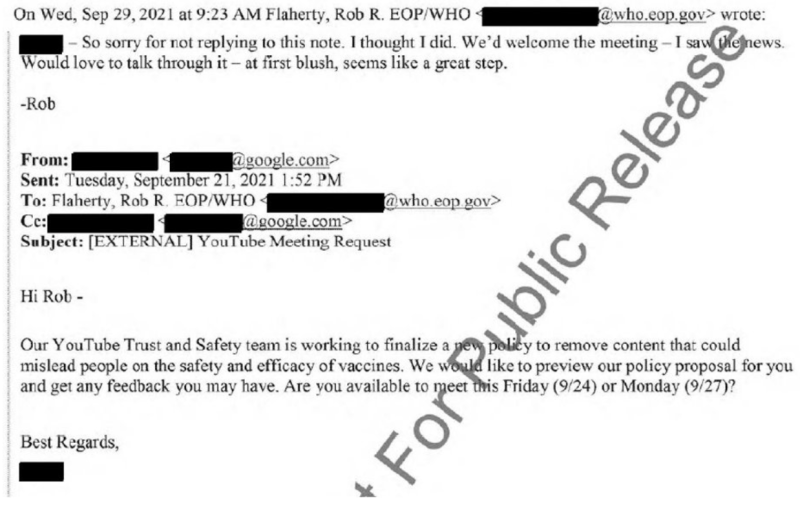
As for Amazon, which is like every publisher in wanting full freedom to distribute, they faced intense pressure from government.
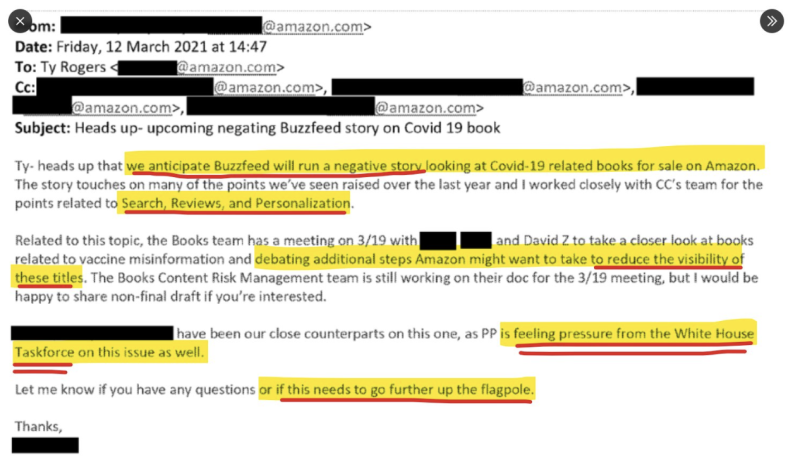
These are just a few of thousands of pieces of evidence of routine interference from government against social media companies, either directly or through various government-funded cut-outs, all designed to enforce a certain way of thinking on the American public.
What’s amazing is that this industry was allowed to metastasize to such an extent over 4-8 years or so, with no legal oversight and very little knowledge on the part of the public. It’s as if there is no such thing as the First Amendment. It’s a dead letter. Even now, the Supreme Court seems confused, based on our reading of the oral arguments over this whole case (Murthy v. Missouri).
One gets the sense when reading through all this correspondence that the companies were more than a bit rattled by the pressure. They must have wondered a few things: 1) is this normal? 2) do we really have to go along? 3) what happens to us if we just say no?
Probably every corner grocery store in any neighborhood run by a crime syndicate in history has asked these questions. The best answer is to do what you can in order to make them go away. This is precisely what they did time after time. After a while, the protocol probably begins to feel normal and no one asks anymore the basic questions: is this right? Is this freedom? Is this legal? Is this just the way things go in the US?
No matter how many high officials were involved, how many in the C-suites of big companies participated, however many editors and technicians of the best credentials played along, there can be no question that what took place was an absolute violation of speech rights that very likely exceeds anything we’ve seen in US history.
Keep in mind that we only know what we know, and that is severely truncated by the force of the machinery. We can safely assume that the truth actually is far worse than we know. And further consider that this censorship is keeping us from knowing the full story about the suppression of dissidents, whether medical, scientific, political, or otherwise.
There might be millions in many professions who are suffering right now, in silence. Or think of the vaccine-injured or those who have lost loved ones who were forced to get the shot. There are no headlines. There are no investigations. There is almost no public attention at all. Most of the venues that we once thought would police such outrages have been compromised.
To top it off, the censors are still not backing down. If you sense a lessening of the grip for now, there is every reason to believe it is temporary. This industry wants the entire Internet as we once conceived of it completely shut down. That’s the goal.
At this point, the best means of defeating this plan is widespread public outrage. That is made more difficult because the censorship itself is being censored.
This is why this report from the US House of Representatives needs to be widely shared so long as doing so is possible. It could be that such reports in the future will themselves be censored. It could also be the last such report you will ever see before the curtain falls on freedom completely.
Washington police clear pro-Palestine encampment, arrest dozens
Press TV – May 8, 2024
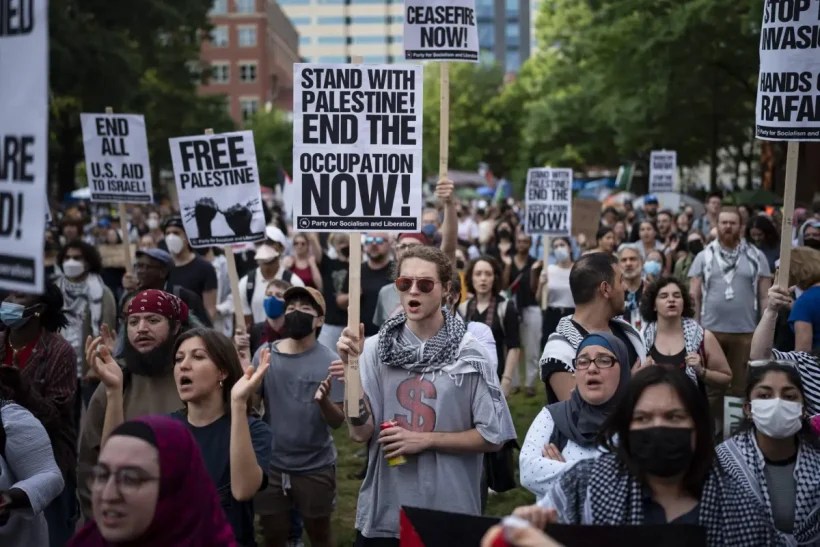
US police have arrested dozens of students after clearing an encampment of pro-Palestinian protesters at George Washington University in Washington, DC.
Just before dawn, hundreds of officers entered the campus and used pepper spray to disperse the protesters and clear the encampment, according to GW Hatchet, the university’s independent student-run newspaper.
“Officers gave their third and final warning to demonstrators to move at about 3:30 a.m., saying all who remained in U-Yard and the stretch of H Street in front of the plaza would be arrested,” GW Hatchet wrote.
Between 30 and 40 protesters were arrested, according to CNN.
Citing familiar sources, the newspaper said police charged several protesters with unlawful entry.
Protesters were carrying signs that read, “Free Palestine” and “Hands off Rafah.”
Since mid-April, students have been demonstrating against Israel’s war on Gaza at about 140 colleges in the United States.
The demonstrators are demanding their universities cut direct or indirect financial ties with US weapons manufacturers and Israeli institutions.
Many also want their universities to end academic relationships with the regime’s institutions.
Similar demonstrations have also spread to campuses in Britain, France, Australia, Canada and elsewhere.
In New York, hundreds of protesters have been marching through the city on Wednesday against Israel’s invasion of Rafah, and US support for the regime’s military.
An estimated 1.4 million people, displaced from elsewhere in Gaza by Israel’s seven-months war, are now sheltering in the southern city of Rafah.
Israel on Tuesday seized control of Gaza’s vital Rafah border crossing, prompting fears of a planned ground offensive on the last refuge of the Palestinians.
Israeli authorities raze dozens of Palestinian homes in Negev
Palestinian Information Center – May 8, 2024
NEGEV – The Israeli authorities demolished on Wednesday morning 47 Palestinian houses in the Wadi al-Khalil area near Umm Batin village, north of the Negev desert.
According to local sources, the houses belonged to the Abu Asa family in the Negev desert, whose members clashed with Israeli police officers who protected the bulldozers.
Police officers reportedly assaulted members of the Abu Asa family as they tried to prevent the demolition of their homes.
This was the largest Israeli demolition campaign in one day in several years in the Negev region, according to the Higher Steering Committee of the Negev Arabs.
The Committee said that these demolitions were carried out at the behest of far-right ministers Itamar Ben Gvir and Amichai Chikli, accusing them of seeking to ignite the Negev region in order to deepen racial discrimination.
“The Israeli authorities are trying to force the Abu Asa family to move to another place under threat and intimidation in order to expand Road 60 southwards, but they refuse and insist on living in an agreed-upon neighborhood in Tel as-Sabi town,” the Committee added.
Israel to hand over Rafah crossing to private US firm: Report
The Cradle | May 8, 2024
Israel will grant control of the Rafah border crossing to a private US security company, Haaretz reported on 8 May.
The US, Egypt, and Israel have agreed “that a private American security company will assume management of the crossing after the IDF concludes its operation.”
Discussions between the three sides have been ongoing. Israel has committed to the US and Egypt that it will restrict its operation in Rafah, Gaza’s southernmost city. Tel Aviv reportedly made it clear during talks that the operation at the Rafah crossing aims to pressure Hamas in ceasefire talks and diminish the crossing’s image as a “symbol of Hamas’ power.”
It has also said the operation aims to cut off Hamas’ ability to channel weapons and funds into Gaza.
Israel has reportedly vowed not to damage the crossing’s facilities to ensure its operation is not hindered. The Rafah crossing is considered a major lifeline for Palestinians in Gaza, and the UN has warned that continuous Israeli operations in the area seriously threaten aid efforts.
Cairo and Washington have been showing serious concern lately over Israel’s plans for Rafah, which the army has been promising to invade for months. The city is overcrowded with over a million besieged Palestinians, and a full-scale assault poses the threat of an unprecedented humanitarian disaster.
“As part of Israel’s efforts to win agreement for a Rafah operation, negotiations have been underway with a private company in the US that specializes in assisting armies and governments around the world engaged in military conflicts,” the Haaretz report adds.
The company, which employs veterans of elite US military units, has been active in several African and West Asian nations, guarding sites such as oil fields, bases, and border crossings.
In line with the understandings reached between Cairo, Washington, and Tel Aviv, the US firm will assume responsibility for the crossing after Israel’s “limited” operation there is over. This includes overseeing the delivery of goods arriving from Egypt to Gaza and ensuring Hamas does not re-establish control of the crossing.
“According to the agreement, Israel and the US will assist the company as necessary.”
The White House and a State Department spokesman said on 8 May that they are unaware of any such plans. Several Palestinian resistance factions said in a joint statement on Wednesday that they refuse any attempt to “impose any form of [foreign] guardianship of the Rafah crossing,” adding that they consider this a “form of occupation.”
“Any plan of this kind … will be dealt with in the same way as the occupation is dealt with,” the statement added.
Sources told CNN and the Times of Israel on Tuesday that Israel’s operation at the Rafah crossing is a limited one, which aims to pressure Hamas in ongoing truce negotiations. Hamas accepted on Monday an updated proposal for a deal, which Israel finds unacceptable given its explicit call for a cessation of hostilities and withdrawal of all Israeli forces from Gaza.
Hamas has accused Israel of continuously sabotaging efforts to reach a truce agreement.
US Report on Israel’s Conduct in Gaza Strip Delayed Indefinitely – Reports
Sputnik – 08.05.2024
WASHINGTON – The Biden administration’s report on whether Israel violated US law and international humanitarian law during its military operations in the Gaza Strip has been delayed indefinitely, Politico reported on Tuesday.
If the report determines that US and international law have been violated, the Biden administration would be expected to stop sending military assistance to Israel.
The administration emailed Congress notifying lawmakers that it will miss the deadline to submit the report but did not provide additional details.
When the National Security Council was asked to explain the delay, they referred any inquiries to the State Department.
Earlier on Tuesday, State Department spokesperson Matthew Miller said that the US government is trying very hard to meet the “self-imposed deadline.”
Miller said it is possible to “slip” a little bit, but the administration is trying to get the report done by Wednesday.
On Monday night, some 200 attorneys, 27 of whom are currently in the Biden administration, sent a letter to top US officials arguing that sending weapons to Israel would be illegal.
The report’s delay comes as Israel started a military operation in Rafah in the southern Gaza Strip, where some 1.4 million Palestinians – are sheltering.
The Climate Cult Reacts As Its Political Position Begins To Slip
By Francis Menton | Manhattan Contrarian | May 05, 2024
For two decades and more, the political position of the climate alarm cult in the U.S. and Europe has only seemed to strengthen with time. In the U.S., the Obama and Biden Administrations have both pushed huge regulatory initiatives to restrict use of fossil fuels (with only some modest roll-backs during Trump’s four years); some of the most sweeping restrictions got pushed through just a week ago. Meanwhile, blue states like California and New York have enacted ever-more-extreme restrictions by statute. In Europe, there has been a near all-party political consensus in favor of the “net zero” agenda, notably including even the mainstream conservative parties in the largest countries like the UK and Germany.
I have long said that sooner or later a combination of physical reality and cost would stop the “net zero” juggernaut in its tracks. Indeed, that has begun to happen, particularly in Europe. Elections for the European Parliament are coming up in about a month, with climate skeptic candidates and parties looking to score substantial gains.
So how is the left reacting? So far, the official talking point seems to be to belittle the resistance to fossil fuel restrictions as some kind of scheme of the “far right.” The “far right,” we are told, are those nefarious people who dare to stand up for maintaining the living standards of the working stiffs against those who would impoverish us all in the quixotic drive to reduce carbon emissions. Somehow, seemingly independent news organizations put out articles using the exact same words and phrases. Here are a couple of recent examples.
In the Washington Post on May 1, the headline is “How car bans and heat pump rules drive voters to the far right.” Subheadline: “Studies show that as energy prices rise, so do right-wing movements against green policies.” Excerpt:
A . . . backlash is happening all over Europe, as far-right parties position themselves in opposition to green policies. In Germany, a law that would have required homeowners to install heat pumps galvanized the far-right Alternative for Germany party, or AfD, giving it a boost. Farmers have rolled tractors into Paris to protest E.U. agricultural rules, and drivers in Italy and Britain have protested attempts to ban gas-guzzling cars from city centers. . . .
Th[e] resurgence of the right could slow down the green transition in Europe, . . . as climate policies increasingly touch citizens’ lives. . . . “This has really expanded the coalition of the far right,” said Erik Voeten, a professor of geopolitics at Georgetown University and the author of the new study on the Netherlands.
The Post’s writer, Shannon Osaka, seems genuinely surprised that the common people of Europe would place any value on maintaining their standard of living:
[C]hanges to driving, home heating and farming are beginning to affect individual Europeans — sparking criticism and anger. “What’s happening as we accelerate the pace of the transition is we’re now starting to get into sectors that inevitably touch on people’s lives,” said Luke Shore, strategy director for Project Tempo, a nonprofit research organization that is assessing how climate policies affect voting patterns in Europe. “We’ve reached the point at which it’s becoming personal — and for that reason, it’s also becoming more political.” The problem, researchers say, occurs when individual consumers feel that the cost of the energy transition is being borne on their shoulders — rather than on governments and corporations.
Who could ever have guessed that this might happen? As an example of crazy “far right” lunacy, the Post cites this line from the manifesto of the Party for Freedom in the Netherlands:
“Energy is a basic need, but climate madness has turned it into a very expensive luxury item.”
I mean, how could you get any more extreme “far right” than that?
In a very similar vein, we have a piece from the Guardian on April 30, with the headline, “How climate policies are becoming focus for far-right attacks in Germany.” Again, the gist is that this is just coming from extremists that you don’t need to pay any attention to. Excerpt:
At the marches held in Görlitz, a stronghold of the far right on the Polish border, and other towns across Germany every Monday night, supporters of [the Alternative for Germany and Free Saxony] parties vent their fury at immigration, coronavirus restrictions and military aid to Ukraine. But one group bears the brunt of the blame. “The Greens are our main enemy,” said Jankus, describing the AfD as a party of freedom and the Greens as a party of bans. “We don’t want to tell people how to heat their homes. We don’t want to tell people what kind of engine should be in their car.”
Freedom — there’s a really lunatic “far right” idea. Rather than trying to explain to the readers why there is something wrong with support of “freedom,” the Guardian instead veers off into characterizing these “far right” demonstrators as really, really bad people:
[Green] party speaker Carolin Renner said she and her colleagues had had death threats screamed in their faces, white-pride stickers stuck to their door and a daily barrage of hateful comments posted on their social media channels. Shortly before Christmas, protesters dumped horse manure in front of the Greens’ office in nearby Zittau.
Despite the characterizations, the article contains no actual example of anything described as a “death threat” or a “hateful comment.” We’ll just have to take the word of the Green Party spokesperson.
Well, the European elections are just about a month away at this point. The climate skeptic parties are expected to make some noticeable gains. However, the actual mandatory requirements for most people to ditch the gas-powered car for an electric one, or to buy a heat pump to heat their home, have not yet kicked in. When that happens, perhaps we will see a real political tornado.
Featured Video

Prof. Ted Postol: Iran Already Achieved Nuclear Deterrence Against Israel
or go to
Aletho News Archives – Video-Images
From the Archives
How the occupied mentality syndrome works
Saudi Arabia on the American chessboard – Part 3
By B. J. Sabri | American Herald Tribune | June 27, 2016
Read part 2: “The occupied mentality Syndrome“
Previously I argued whether Saudi Arabia’s repeated involvements in U.S. interventions and wars stem from free national will or in response to a specific condition. For starters, in Saudi Arabia there is no national will. In Saudi Arabia, the national will is the will of the Al Saud clan. Still, when a major Arab state allies itself with a superpower that committed unspeakable crimes against humanity in almost every Arab country, then something is wrong. This fact alone should compel us to examine the U.S.-Saudi relation for one exceptional reason. As a result of the U.S.-Saudi wars, hundreds of thousands of people in Afghanistan, Iraq, Iran, Libya, Syria, Yemen, and Somalia have lost their lives. Millions became displaced in their own homelands. And millions more rendered refugees.
Attributing the Saudi policies to the bonds of “partnership” with the U.S. is frivolous. There are no bonds between these two thugs except those of business, military deals, secret plots, and wars. Proving this point, bonds such as these have no space for the American and Saudi peoples to share significant cultural or societal exchanges. If partnership is not the reason for the Saudi contribution to the U.S. strategy of empire and imperialism, then another reason must exist.
This leads to three possibilities. … continue
Blog Roll
 Aletho News
- REWRITING THE RISK? INSIDE THE GOVERNMENT’S VACCINE SAFETY MESSAGING
- “Davos Can Really Replace the UN”
- NIAID/NIH and USDA Fund Bioengineered Chimeric Influenza Viruses Built Using Pandemic H1N1 Components: Journal ‘Science Advances’
- Hezbollah hits Israeli warship off Lebanon’s coast, sets it aflame
- Iran slams US strikes on B1 bridge, Mahshahr petrochemical plants as ‘blatant acts of state terrorism’
- In letter to UN chief, Araghchi warns of dire consequences of US-Israeli attacks on Iran’s nuclear facilities
- Why the CIA conspiracy to invade Iran with Kurdish militias failed
- Why Are Upbeat US Claims About Mission to Rescue Pilot ‘Highly Questionable’?
- Aircraft destroyed during US ‘rescue’ of downed F-15 pilot cost more than $100 million each
- Washington University removes professor who condemned US-Israeli war on Iran
- If Americans Knew
- In Iran, Israel-US take aim at “reason, research, and freedom of thought” – Daily Update
- US loses planes over Iran, Israel downgrades Lebanon war goals – Daily Update
- Israel Is Blocking Palestinians from Easter at Church Where Jesus Resurrected
- Plot to assassinate Palestinian activist follows harassment campaign promoted by Zionist groups and elected officials
- Prominent New York synagogue hosts presentation on why U.S. Jews should support the ethnic cleansing of Gaza
- Tapper vs. Piker: Is the CNN Anchor Auditioning for David Ellison?
- Shouldn’t Democrats Be Able to Condemn Genocide?
- Israel-US kill negotiators, destroy civilian structures, but Iran’s military capabilities still largely intact – Daily Update
- ‘War crime’: Global condemnation as Israeli ministers celebrate death penalty law targeting Palestinian prisoners
- 7 Ways Israel Is Turning Lebanon Into Gaza
- No Tricks Zone
- An Inconvenient Tree: Uncovered In Alps… Europe Much Warmer Than Today 6000 Years Ago
- New Study Reports A 60% Slowdown In Greenland’s Ice Loss Rate In The Last Decade
- Low Intensity Tornado Wrecks Major Solar Farm, Creating A Potential Toxic Dump
- New Study Finds Warming Saves Lives…Cold Temperatures 12 Times More Deadly Than Excess Heat
- German Science Blog Accuses PIK Climate Institute Of Hallucinating Climate Tipping Points
- Devastating Assessment Of Comirnaty Vaccine By Former Senior Pfizer Europe Toxicologist
- New Study: CO2 Is ‘Effectively Negligible’ As An Explanatory Climate Change Factor Since 2000
- Former Pfizer Toxicologist Dr. Helmut Sterz Tells Bundestag Hearing Pfizer Vaccine Should Have Never Been Approved
- Energy Expert: Germany’s Nuclear Phaseout Was A “500 Billion Euro Mistake”
- New Research: South Australia’s Mid-Holocene Sea Surface Temperatures Were 4°C Warmer Than Today
 Aletho News