The European Mutiny: The Consequences are Just Beginning
By Alastair Crooke | Al Mayadeen | June 26, 2024
In the European Parliament elections this month, voters in most of the European Union’s 27 countries rallied to parties that hold the remote EU Establishment in contempt.
In France, the once-taboo National Rally party outpolled the party of President Macron by more than 2 to 1; in Germany, the party of Scholtz, the SPD (a veteran German party) collapsed to 13% voter support, at the same time that the other components to the governing coalition collapsed. The Greens sank to 12% and the FDP were at borderline 5% of the popular vote (5% is the entry-level to Germany’s parliament).
Much has been written to argue that European Parliamentary Centre ‘held’, yet even that hangs in the balance until the newly-elected MEPs first assemble to approve the clutch of EU top jobs: i.e. the three ‘Presidents’ — Presidents of the Commission, the Council, and of Parliament; plus the High Representative (i.e. the EU’s ‘Foreign Minister’).
For now, the composition of the European Parliament is the subject of intense internecine struggle. These were elections only to the European Parliament — a body that does not initiate legislation in the EU, but which is supposed to exercise a general surveillance.
The real elections in Europe these days are the national elections.
That in itself is a ‘pointer’: Decisive voting is taking place at the national level, and not at the supranational centre in Brussels.
The ‘real’ elections are taking place in France and the UK, despite the latter being outside the EU. The UK vote nonetheless will be an important litmus of European opinion, precisely because its Ruling Strata has become known for its compliance with US policies.
The anti-Establishment and anti-bureaucracy outpouring amongst voters has astonished and disconcerted the élites. The governing party — the venerable Conservative Party — is being routed, and might not survive as a meaningful political entity after 4 July.
In Germany, Scholtz’s ‘traffic light’ coalition also may not survive — following its calamitous EU election. Scholz’s government has a budget shortfall of €40bn. That is the estimated amount Scholz and his coalition partners need to cut in federal spending in order to plug the gap. Within Germany’s ruling parties, there is a consensus forming that the severely weakened coalition cannot survive another grinding dispute on the budget, as happened last year after a ruling by Germany’s top court blew a €60 billion hole in the country’s finances.
Then there are, in September, key state votes ahead in Brandenburg, Thuringia, and Saxony. According to polls, the (populist-rightist) Alternative for Germany (AfD) party is winning in each region, all of which are located in the eastern or central part of the country. Within the Former East Germany, 40% of the votes in the Euro-elections went to either the AfD, or the party of Sara Wagenkecht – a new party espousing contrarian policies.
In France, the situation for the élite class looks equally dire: A series of opinion polls over the past few days reflect the darkening clouds engulfing Macron’s centrist alliance. The polls show the National Rally inching closer to a majority in France’s lower house of parliament, the National Assembly.
If the National Rally does win a majority, the impact of a putative Rally premiership, led by Jordan Bardella, would have major repercussions extending far beyond France — to the EU and beyond. A confrontational stance by the party toward Brussels is a given. And whilst in Italy, Giorgia Meloni has tried to accommodate Brussels on key policy stances, there’s no guarantee Bardella would follow suit. Or that Meloni will not switch to ally with Bardella.
This ‘mutiny’ has been long in the making: EU policies such as immigration, Green farm policies, and heavy-handed bureaucracy have ignited huge anger; but there is one burning issue that largely is kept under the table, and spoken of in hushed tones — Ukraine.
The Biden-faction within Brussels is wholly invested in the US project for escalation of the war in Ukraine against Russia (at least until November), and thereafter Europe is expected to prepare for a later full-scale confrontation with Russia — possibly mounted to mesh with US military action against China, for which the Pentagon is busy preparing.
Of course, ‘all’ hangs on the US election outcome.
The elephant in the ‘planning room’ is that Europeans do not want war with Russia — however hard it is pushed by the Ruling Strata. It is manifestly not in the European interest.
The National Rally is opposed to support for Ukraine, and even Scholtz, the most faithful leader to a Washington ‘lead’ admitted in an interview on Sunday, that the SPD had as little as 7% support in some parts of eastern Germany, which traditionally has been more positively predisposed toward Russia.
“Something is going on there; No way around it”, Scholtz exclaimed.
He then acknowledged that the dire ratings for the SPD stemmed from the fact that “many people do not agree with the support for Ukraine and the sanctions against Russia. This is also reflected in the [wider, poor] election results”, Scholz stated. “There is no alternative [but] to changing that”.
And even in the UK which traditionally tries ‘to be out, in front’ of the US on security issues, the Establishment swooned when Nigel Farage whose Reform party is within a whisker of overtaking the governing Conservative Party in terms of popular esteem said the ‘unsayable’: He said that NATO’s forever expansions towards Russia’s borders were the cause of the Ukraine war. You (metaphorically) could ‘hear a pin drop’ as he broke ranks and uttered the unsayable.
Now, Farage – whether you like him or not – is a consummate politician — unlike Sunak or Starmer, who are anything ‘but’. Farage knows how to tell which way the wind blows.
France and Germany together, historically provide Europe’s engine. For years, however, the EU has built itself by usurping the prerogatives of Europe’s nation-states, only to reinvest them at the supra-national level — for ever.
By the start of this century, London, Berlin, Rome and Athens were much less self-governing than they used to be — to the alarm of voters: Brexit was one result.
“Europeans”, C. Caldwell writes in the New York Times, “for the most part, were not aware that they had been enlisted in a project that has as its end point the extinction of France, Germany, Italy and the rest of Europe’s historic nations – as meaningful political units. Brussels has been able to win assent to its project only by concealing its nature. Europe’s younger generation appears however to have seen through the dissembling. We are only at the beginning of the consequences”.
Brussels may try to claim that the ‘Centre held’; that their Ukraine, Green immigration and centralizing policies can continue unaffected. But Caldwell is correct: we are only at the beginning of the consequences, should they try to insist. The “real problem with the union [is] not what it does but what it is … a ruthless state-building project like those of Cardinal Richelieu under Louis XIII”.
The European Union’s governing machinery in Brussels has never been where voters’ interests – or hearts – lie.
EU Accelerates De-Dollarization by Stealing Russian Money
By Ekaterina Blinova – Sputnik – 25.06.2024
The EU will send €1.4 billion ($1.5 billion) in profits from the frozen assets of Russia’s Central Bank to the “European Peace Facility” in order to meet the Kiev regime’s military needs.
EU High Representative for Foreign Affairs and Security Policy Josep Borrell announced on June 24 that the bloc has approved grabbing windfall income from frozen Russian assets.
According to Borrell, €1.4 billion will be available in the course of the next month, and another €1 billion by the end of the year.
“The decision is shameful,” Gilbert Doctorow, an international relations and Russian affairs analyst, told Sputnik. “It is totally hypocritical to assign to a “Peace Facility” the role of financing arms and war. The ultimate goal of this ‘peace initiative’ is to prolong the war, at least till after the American elections in November for the sake of Mr Biden’s personal ambitions.”
Ninety percent of the revenues will be spent on arms and just 10 percent on construction projects in Ukraine.
Going against the usual requirement for unanimity between its members, the EU snubbed Hungary’s veto by using a legal “loophole”.
“New billions for Ukraine. This time by kicking up the European rules and leaving out Hungary,” Hungarian Foreign Affairs Minister Péter Szijjártó commented earlier on Monday.
He slammed the “shameless breach of common European rules,” stressing in a social media post that “This is a clear red line.”
After the start of the Russian special military operation in Ukraine, the EU and G7 countries froze almost $300 billion in Russian assets. Around $207 billion are held at Euroclear, a clearinghouse based in Belgium.
“The result will be to sharply reduce use of the Euro as a reserve currency by countries of the Global South, who all fear the kind of arbitrary and illegal confiscation of their national wealth by European governments whenever it suits their purposes,” Doctorow warned.
Brussels’ decision is “bad” in every respect, said Adriel Kasonta, a London-based foreign affairs analyst and former chairman of the International Affairs Committee at the Bow Group think-tank.
“First of all, it is illegal, if we take into account the violation of the principle of sovereign immunity of the sovereign country, which is the Russian Federation,” Kasonta told Sputnik.
“It exposes the western double standard when it comes to the rule of law and the application of the rules to the countries equally,” he continued.
That “is clearly detrimental because it serves as a boost to the de-dollarization movement,” the expert stressed. “It will… accelerate the movement of abandoning the currency of the dollar and euro in international transactions.”
Russia has repeatedly warned it will take retaliatory measures in response to any attempts to expropriate its financial resources by the West, and that it would perceive any form of grab as “theft”.
Any actions with Russian frozen assets will trigger a symmetrical response, Finance Minister Anton Siluanov told Sputnik in late February, adding that a similar quantity of foreign assets have been frozen in Russia.
Last week, Russian Foreign Ministry spokeswoman Maria Zakharova told a press briefing that Russia could take a wide variety of measures to respond to the G7 decision to fund Ukraine using profits from frozen Russian assets.
Magazine Depth and Shields

Iranian Shahed Drones – Three Variants
By William Schryver – imetatronink – June 26, 2024
In addition to the already-in-progress wars in Ukraine, Gaza, and the Red Sea, we are now staring down the barrel of yet another — rumored to be imminent in southern Lebanon.
There is no doubt Israel (just like its great benefactor, the United States) is, in the context of a “big war”, capable of executing several damaging strikes against a potential peer or near-peer adversary.
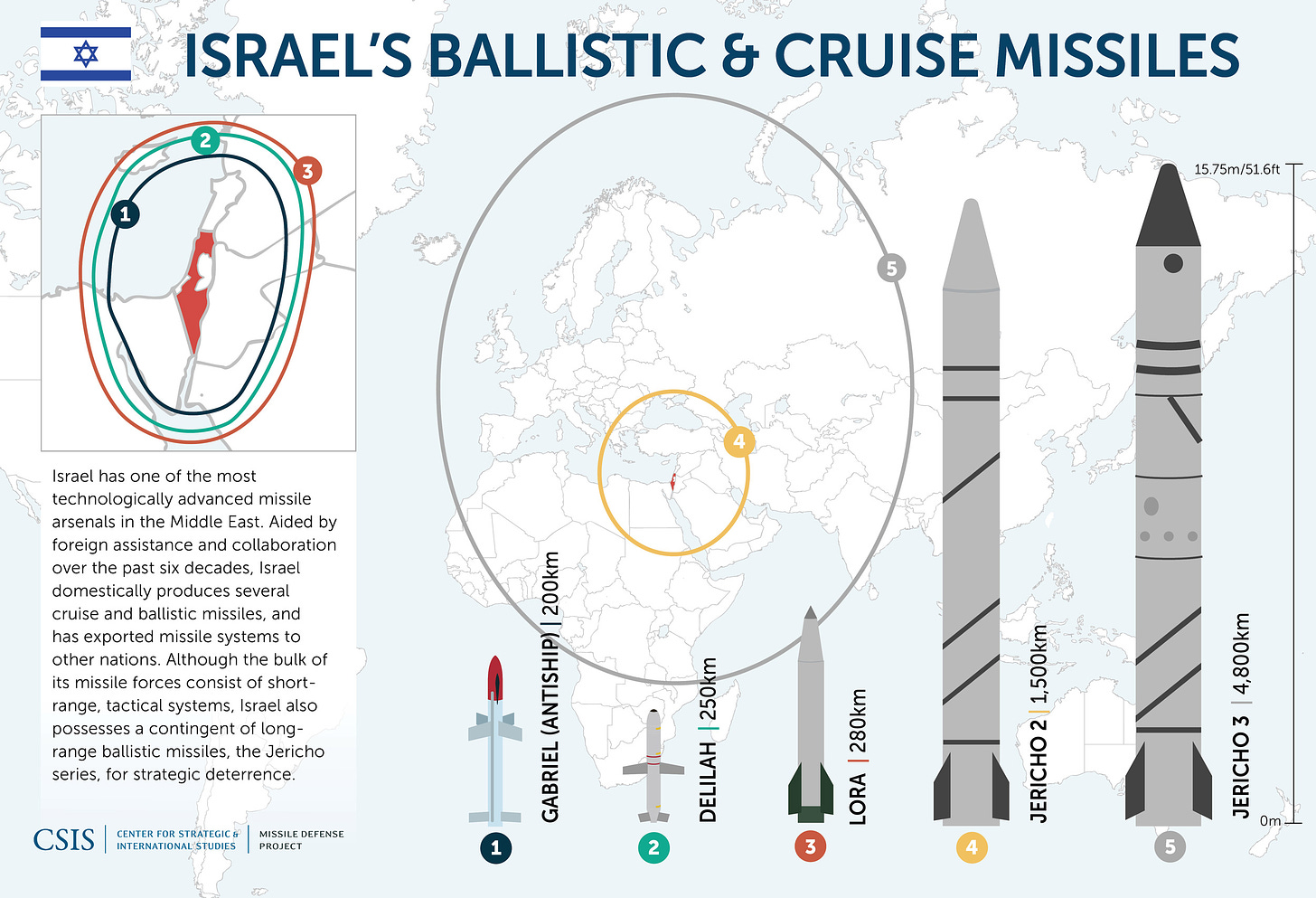
Israeli Ballistic and Cruise Missiles and Ranges
But, throughout the imperial domain, there are fatal weaknesses that exist right now, and which cannot be turned into strengths at any point in the near- or medium-term.
The first is what military types call “magazine depth”: munitions stockpiles sufficient to offensively overwhelm, defensively defeat, and strategically outlast the enemy.
Neither the United States, nor any of its largely impotent client nations, possess “magazine depth” sufficient to prosecute anything more than a relatively brief campaign against their potential peer adversaries: Russia, China, Iran — and all or any of their lesser-power partners.
The second problem is a corollary of the first. It is what I will term “shields”: the capacity to defeat a decisive proportion of the strikes one’s enemy can launch against you.
Neither the United States, nor any of its largely impotent client nations — by their own admission — possess anything even approximating comprehensive and effective “shields” against the quantity and quality of the types of strike weapons its potential adversaries can launch against them.
NATO sources themselves recently confessed that they only have about 5% potential air defense coverage against Russian missile strikes.
Now, of course, many will reflexively argue that, for example, the US could, with a massive “shock and awe” first-strike air campaign, effectively disarm Russian counterstrike capabilities.
This is patently ridiculous wishful thinking.
No one who actually understands the parameters of the military equation believes this to be true. And one need only examine the results of the months-long campaign against the lowly Yemenis to see confirmation of this incontrovertible fact.
Earlier this year we witnessed the Iranians launch a relatively modest missile strike against Israel, whose defenses were massively reinforced by American air and naval assets.
Using maybe 300 antiquated long-range strike drones and cruise missiles as decoys, the air defense response of both the US and Israel was massively attrited. And then, with a mere dozen or so seriously capable ballistic missiles, the Iranians blew right through the interception attempts of both the multiple land-based Patriot systems and a US guided-missile destroyer positioned off the eastern Mediterranean coast.
The Patriot systems were a total bust, and the Israelis summarily retired them in the immediate aftermath of the Iranian strike.
The US destroyer is reported to have launched eight top-shelf SM-3 missile defense interceptors (quite likely its entire “magazine depth”) at the incoming Iranian strike package.
They might have damaged one of the 12-15 incoming Iranian missiles.
The others hit with precision comparable to the 5-meter CEP Iran achieved in its 2020 strikes against the US airbase at Ayn al-Asad in Iraq.
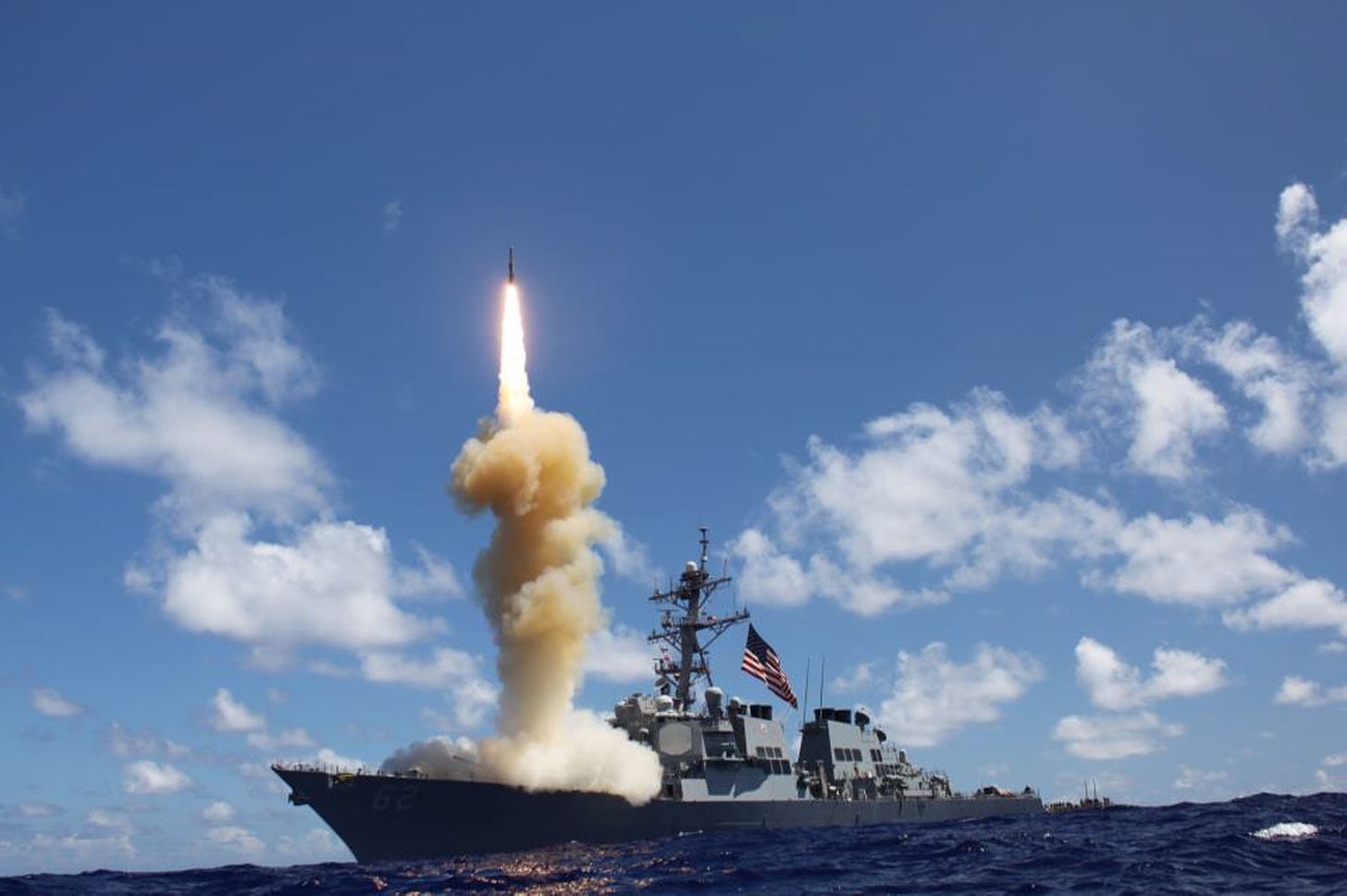
SM-3 Missile Interceptor Launched from a US Guided-Missile Destroyer
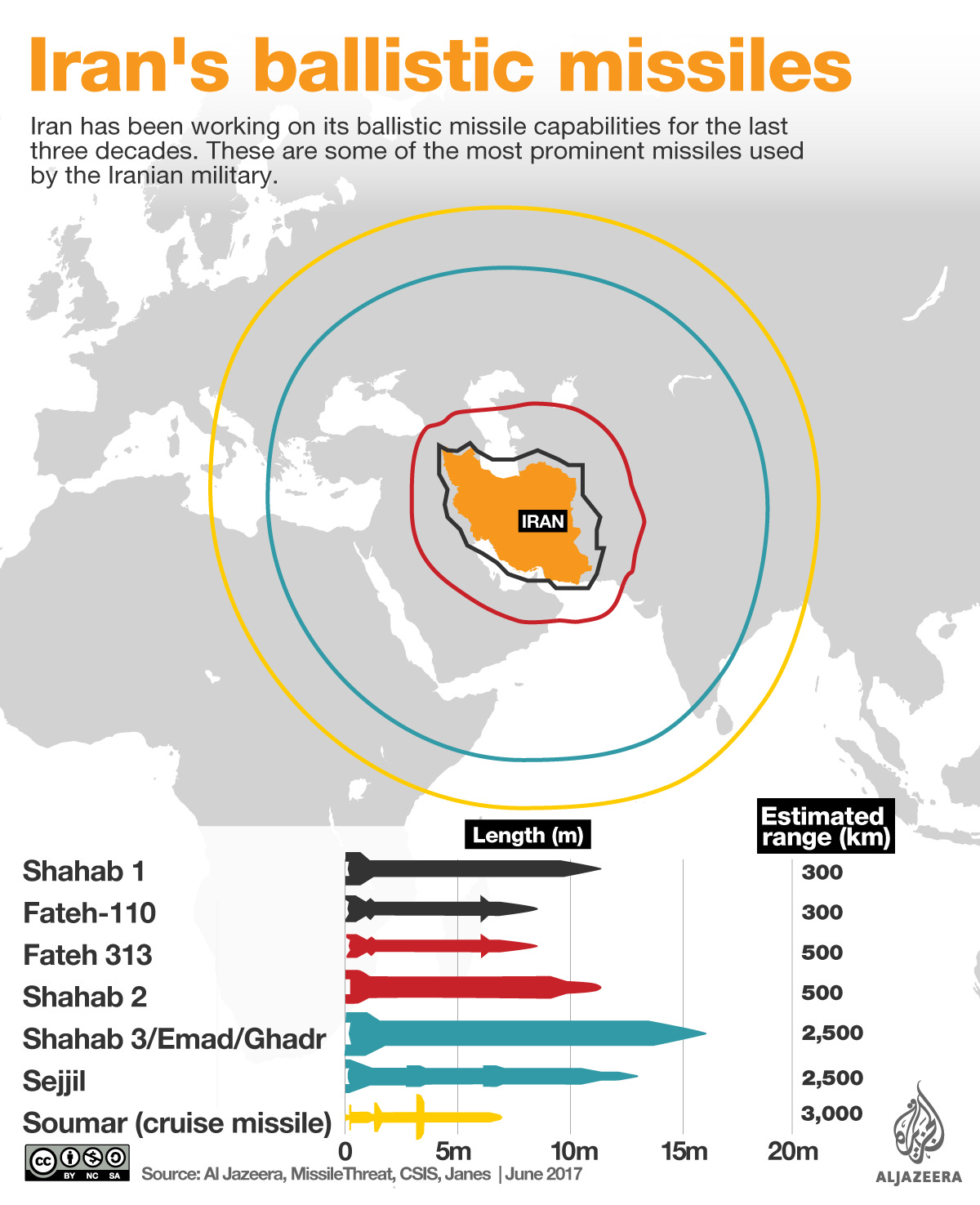
Iranian Ballistic Missiles and Ranges
Had Iran, at that moment in time, opted to follow up with an even larger strike consisting of several hundred of its best ballistic missiles, the US and Israeli defenses would have been penetrated to an overwhelming degree. It would have put to shame the opening-night show of the Americans’ 1991 “shock and awe” cruise missile attack against Baghdad.
Fortunately the Iranians didn’t press the matter, and let their modest yet impressive demonstration of strength suffice for the time being.
In recent months, Iran’s close partner Hezbollah — which is reputed to possess at least 100,000 missiles and drones of various types — has been routinely penetrating Israel’s once-vaunted “Iron Dome” missile defense system.
Indeed, Hezbollah has almost appeared to be mocking the Israelis’ impotence at times.
In any case, the Iron Dome has been revealed to be acutely vulnerable to penetration by Hezbollah drones and missiles.
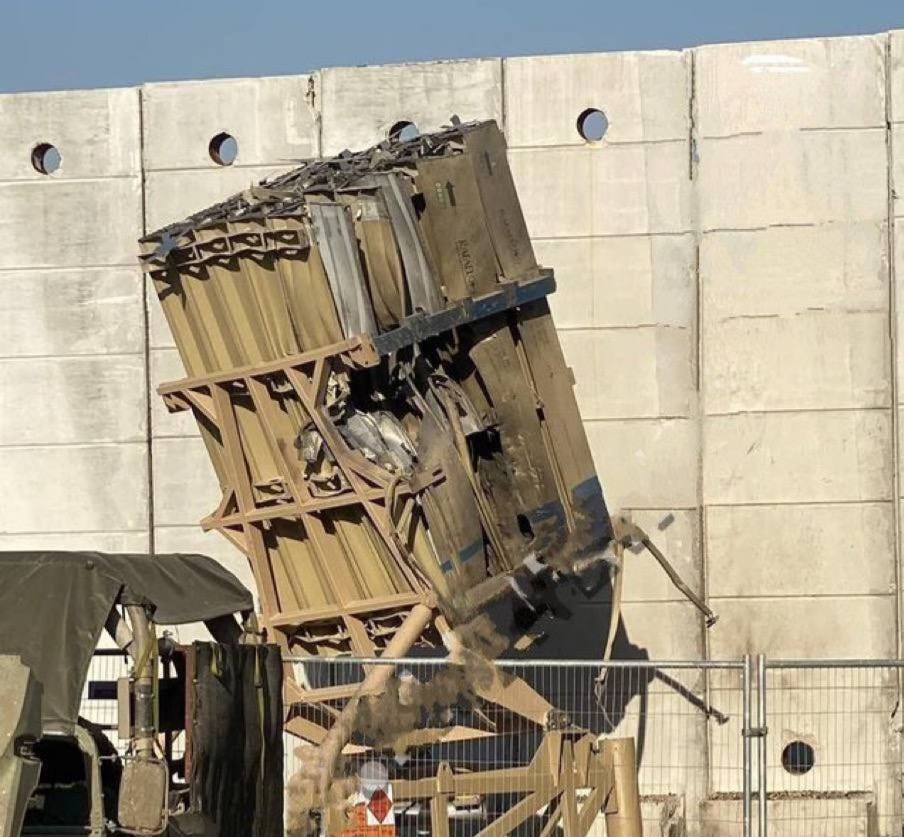
Israeli Iron Dome Launcher Destroyed by Hezbollah Drone Strike
It is not known with precision how many missiles and drones of various types Iran possesses. But it is reasonable to assume that their “magazine depth” is considerably larger than that of Hezbollah.
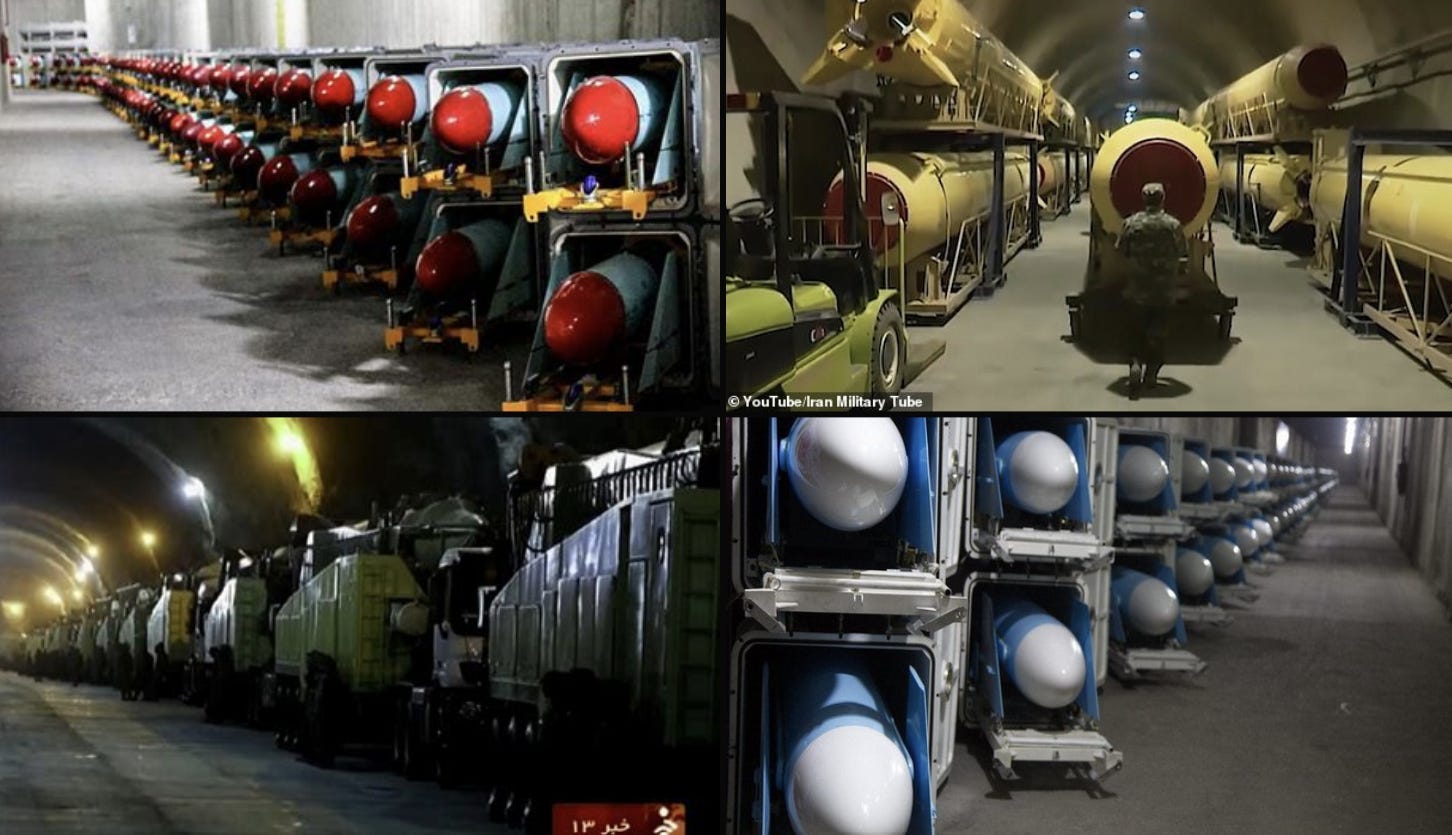
Iranian Missiles
It is also not known with precision how many missiles and drones of various types Russia possesses. But it is reasonable to assume that their “magazine depth” is considerably larger — and exceedingly more potent — than that of Hezbollah and Iran combined.
Even more importantly, the Russians have, over the course of the war in Ukraine, demonstrated an unprecedented capability to routinely shoot down the best strike missiles the US and its NATO vassals have been able to launch against them.
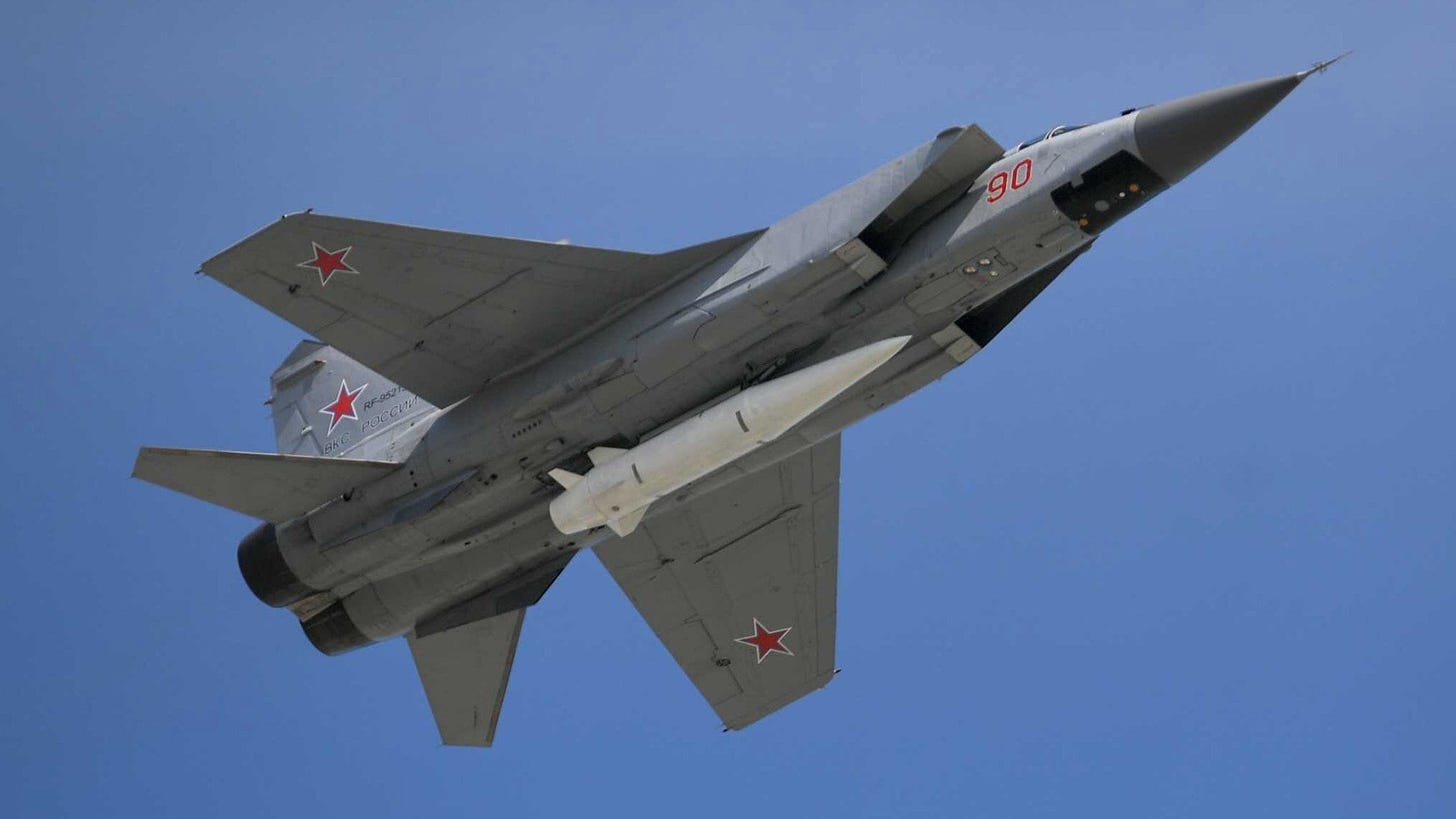
Russian MiG-31 Carrying a Hypersonic Kinzhal Missile
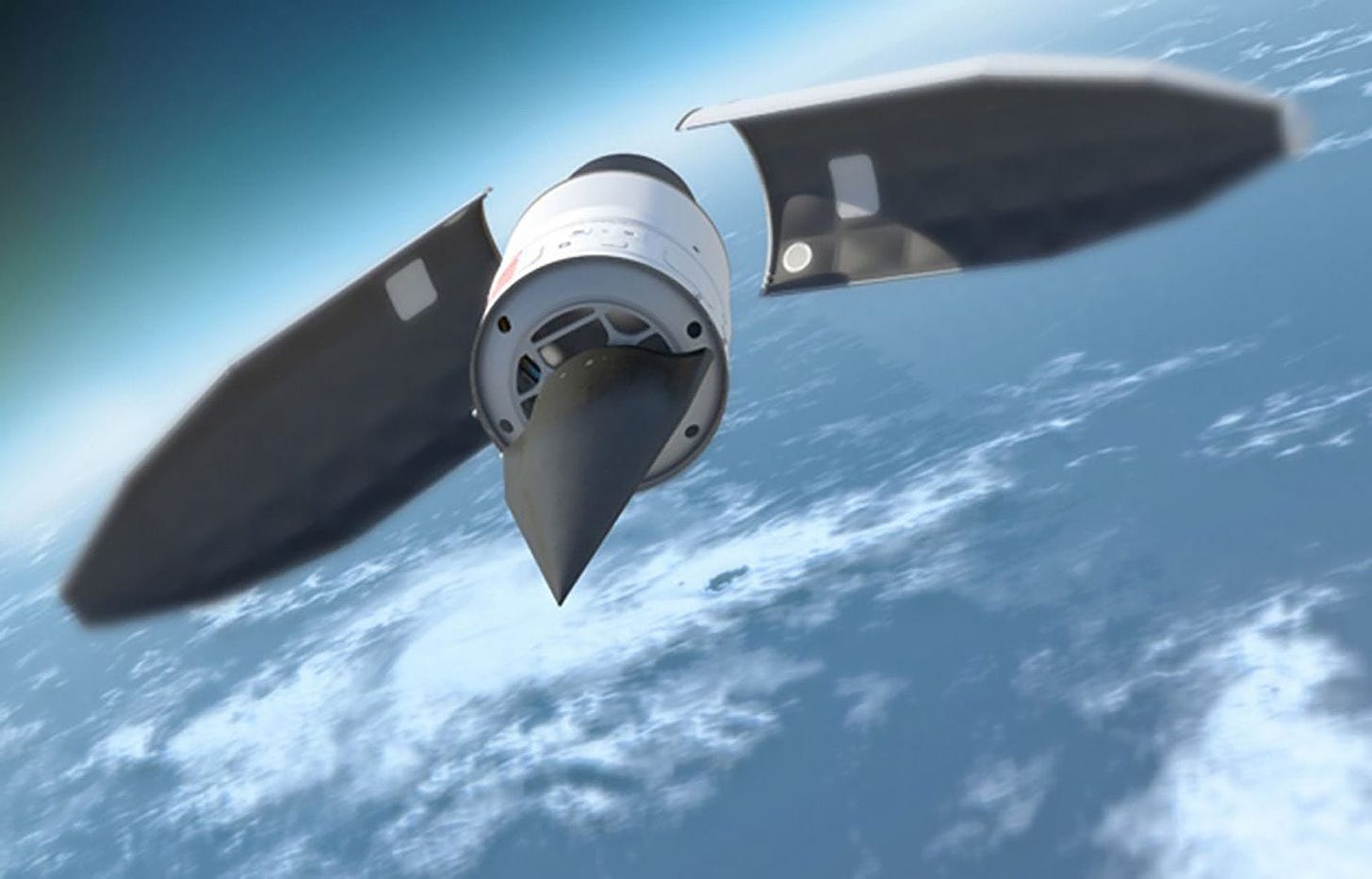
Russian Avangard Hypersonic Missile
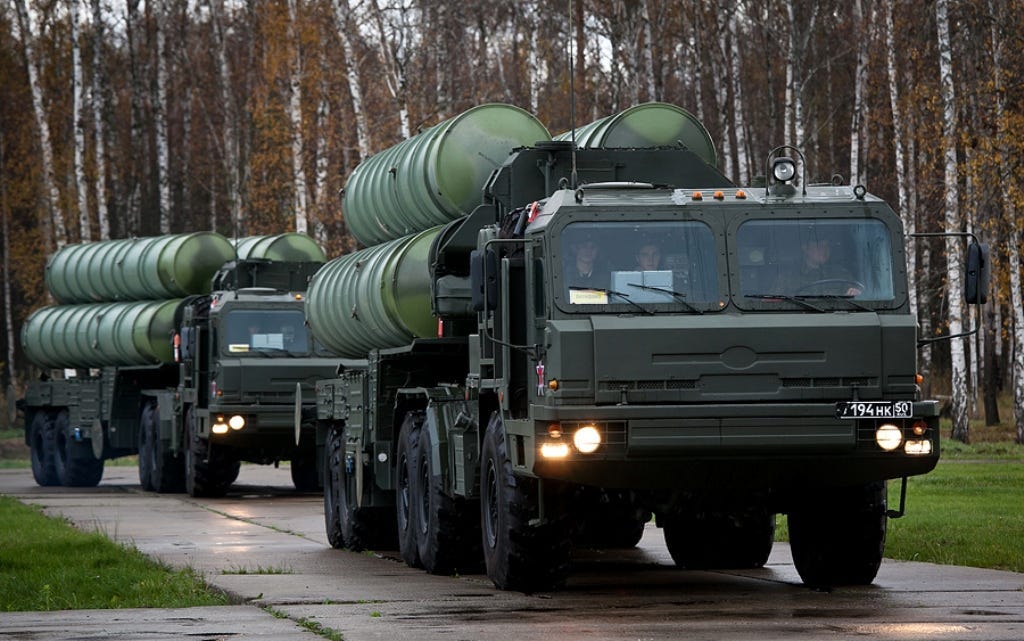
Russian S-400 Air Defense System
Lastly, it is not known with precision how many missiles and drones of various types China possesses. But it is reasonable to assume that their “magazine depth” is at least an order of magnitude larger than Hezbollah, Iran, and Russia combined.
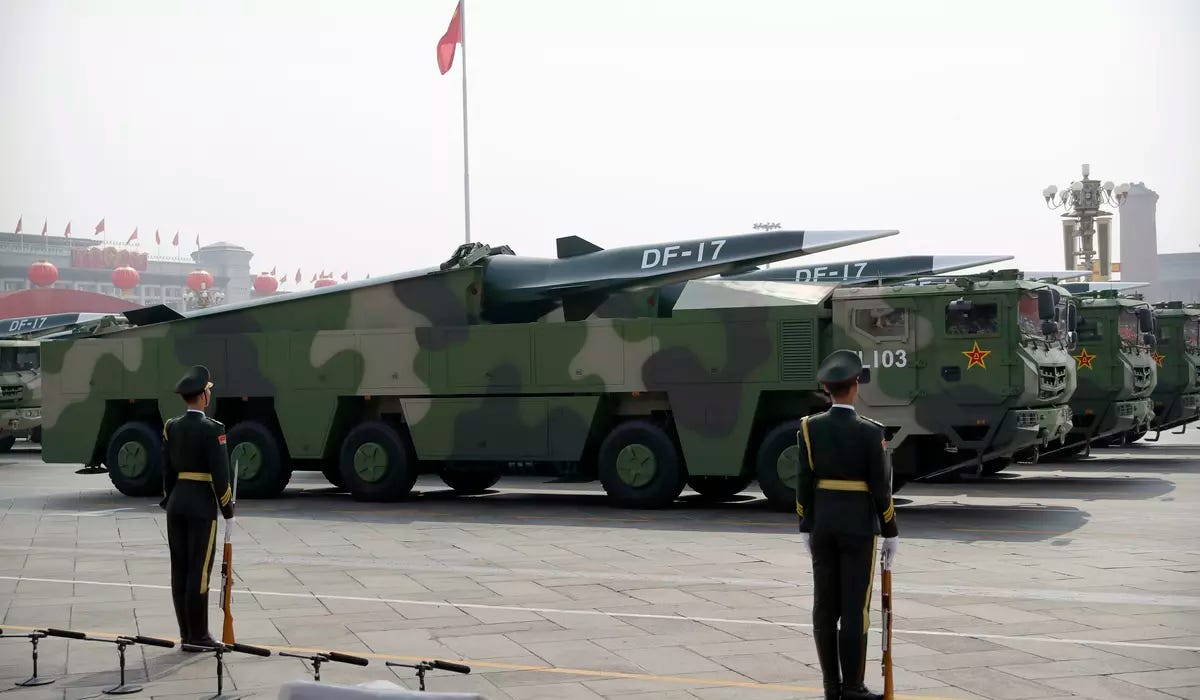
Chinese DF-17 Hypersonic Missiles
Of course, I’ve not yet made any mention of North Korea, who has now been formally received into the Russia, China, Iran mutual-defense partnership. People love to mock Kim Jong-Un and his people, but the empire underestimates them at their peril.
The Israelis can talk tough about making war against Hezbollah and its friends, but if they actually attempt it, it will end very, very badly for them.
The Americans and their almost laughably impotent allies can talk tough about making war against Russia or China, but if they actually attempt it, it will end catastrophically for them.
Then we’ll really have a dangerous situation on our hands.
New law ‘pushing Georgia away from EU’ – Borrell
RT | June 25, 2024
EU foreign policy chief Josep Borrell has warned Georgia that its potential accession to the bloc is in jeopardy after Tbilisi adopted a controversial ‘foreign agent’ law earlier this month. The US has also indicated it will not hesitate to penalize the former Soviet republic unless it walks back the legislation.
Known officially as the Transparency of Foreign Influence Act and spearheaded by the ruling Georgian Dream party, the law came into force earlier this month despite opposition protests and a veto by President Salome Zourabichvili.
The legislation requires NGOs, media outlets, and individuals who receive more than 20% of their funding from abroad to register as entities “promoting the interests of a foreign power” and to disclose their donors. Those who fail to comply will face fines of up to $9,500.
While opponents of the bill have described it as “Russian” and an attack on democracy, supporters have insisted it is similar to what numerous Western nations, including the US, have in place.
On Monday, Borrell said the foreign ministers of EU members had held “a lively debate on Georgia” for the second time in less than a month. Citing “worrying political developments,” the diplomat warned that “this law and all the negative developments around it are pushing Georgia away from the European Union.”
“If the government does not change the course of action, Georgia will not progress on the European Union path,” Borrell insisted.
According to the EU foreign policy chief, the law goes “against the will of the overwhelming majority of the Georgian population.” Brussels is planning to “increase our support to civil society and media” in the former Soviet republic, he added. The EU will also downgrade political contacts with Tbilisi and consider “putting on hold our financial assistance to the government,” Borrell stated.
Earlier this month, US State Department spokesman Matthew Miller claimed the ‘foreign agent’ law “moves Georgia away from its democratic trajectory” and “fundamentally alter[s] the US relationship with Georgia.” “We have not yet announced individual sanctions… but we have made clear that we would not hesitate to impose them,” the official stated.
Late last month, Washington announced that it would start restricting visas for Georgian politicians who played a role in passing the legislation. In November 2023, the European Commission recommended granting Georgia candidate status “on the understanding that the government takes important reform steps.”
Moldova Prepares Bill Allowing to Block Websites, Social Media Accounts – Opposition
Sputnik – 25.06.2024
Moldovan authorities are preparing a bill that will allow the blocking of websites, channels and accounts on social media, a spokesman for Moldovan opposition political bloc Podeda (Victory), Veaceslav Jukov, said on Tuesday.
Earlier in the day, the country’s authorities annulled a broadcasting license held by Moldova’s Media Resurse company which owned two Russian language broadcasters, Orhei TV and TV6, Moldovan news outlet NewsMaker reported.
“The Moldovan government is considering a law which presupposes the suspension and even elimination of websites, as well as blocking channels and accounts on social media. The new legislation provides measures to control and manage the information space ,” Jukov wrote on Telegram.
In 2023, Moldovan authorities blocked access to 31 websites, including 21 managed from Russia, saying that they had been used in an “information war” against Kishinev. Apart from the Russian information sources, Kishinev has also banned websites of Moldovan broadcasters Orizont TV, Prime TV, Publika TV, Canal 2, and Canal 3, among others.
Earlier in 2023, Moldovan President Maia Sandu said that Moldova would create a national center for informational defense and combating propaganda symbolically named Patriot, which would protect Moldovan citizens from disinformation and manipulation at a national level. The new center will counter Russia’s alleged information attacks as well as deal with “traitors to the homeland” who are allegedly blocking Moldova’s attempts to integrate into the European Union, Sandu added.
Russia retaliates against EU’s latest media ban
RT | June 25, 2024
Russia is restricting access to more than 80 EU media outlets on its territory that have been involved in spreading disinformation about the Ukraine conflict, the Russian Foreign Ministry announced on Tuesday.
According to a statement issued on the ministry’s website, the move comes in response to the EU’s latest crackdown on Russian media.
In May, the European Council banned four media outlets from reporting to audiences in the EU, including leading Russian news agency RIA Novosti, as well as newspapers Izvestia and Rossiyskaya Gazeta. The ban also applies to the relatively small Czech-based portal Voice of Europe, which the EU has described as a “Kremlin-linked propaganda network.” The restrictions on the media outlets came into force on June 25.
“The Russian side has repeatedly and at various levels warned that politically motivated harassment of its journalists and unfounded bans on Russian media in the EU will not go unnoticed,” the ministry said, noting that Brussels and other EU capitals had chosen to take the path of escalation with their latest illegal ban despite warnings, forcing Moscow to take mirror countermeasures.
“Responsibility for such a development of events lies solely with the leadership of the European Union and the countries of the bloc that supported such a decision,” according to the ministry.
The list of EU media outlets that “systematically disseminate false information” about the progress of Moscow’s special military operation includes 81 organizations from 25 member states. They include Germany’s Der Spiegel, Spain’s El Pais, Italy’s La Stampa and La Repubblica newspapers, the French Agence France-Presse, Le Monde, Liberation, as well as the pan-European Politico and EUobserver.
Moscow may reconsider its decision in relation to the media outlets if restrictions on Russian media are lifted, according to the statement.
Brussels had already barred several Russia-associated media from engaging with audiences in member states due to the Ukraine conflict. Even platforming content from the targeted organizations is illegal in the bloc. Those sanctions included RT and Sputnik, suspending their TV broadcasting licenses and blocking both websites for readers across the EU.
Moscow has accused Brussels of duplicity and attacking freedom of speech with its restrictions. The campaign to undermine the work of Russian news organizations long predates the Ukraine conflict and is aimed at preventing European citizens from hearing opinions that their governments deem undesirable, Russian officials have claimed.
Journalism under fire: Jailed for exposing Jordan

The Cradle | June 24, 2024
In Jordan, failing at self-censorship can land you in jail. Literally.
Freelance journalist Hiba Abu Taha, a passionate pro-resistance Jordanian of Palestinian origin, refused to self-censor. On 11 June, the Magistrate Court in Amman sentenced her to a harsh one-year prison term for violating the kingdom’s controversial Cybercrimes Law introduced last year.
This was due to an article she wrote for Lebanese news site, Annasher, criticizing “Jordan’s role in defending the enemy entity.” The article was published on 22 April, eight days after Jordanian, US, British, and French aircraft intercepted Iranian drones and rockets over Jordanian airspace heading towards Israeli targets.
However, Abu Taha was arrested on 13 May after Annasher published her investigative report on 28 April titled “Partners in extermination: Jordanian capital owners involved in Gaza genocide.” The timing of her arrest gave the impression that she was detained for exposing Jordanian companies transporting exports to Israel – a land corridor that government officials went out of their way to publicly deny amid growing popular outrage at Amman’s continued ties with Tel Aviv while it commits the Gaza genocide.
It is widely believed that her nearly 2,000-word investigative report, supported by a 15-minute video of evidence she gathered undercover, was the real reason for the journalist’s indictment.
Exposing government deception on Israeli trade routes
In her report, Abu Taha accused Prime Minister Bisher Khasawneh and other officials of concealing the use of Jordan as a land route for UAE and Bahraini exports via Saudi Arabia to Israel to break the Yemeni Ansarallah blockade in the Red and Arabian Seas.
She cites transport and clearance company employees in Amman and Aqaba about their services to transport goods through the northern Sheikh Hussein Bridge or the southern Wadi Araba crossing. She went on to expose the names of the Jordanian companies and their influential owners, who have shown no qualms about doing business as usual with the occupation state as it commits unprecedented war crimes in both Gaza and the West Bank.
Abu Taha also identifies influential company owners acting as agents for Israeli or Israel-bound shipping companies. Resorting to official documents, she writes that Jordanian exports to Israel increased from $123 million in 2022 to $143 million in 2023, with a record monthly high of $17 million in December 2023, a month after Yemen began targeting Israeli-owned and Israel-bound cargo ships.
She notes that despite court evidence “recognizing the existence of the land bridge” as well as video footage and pictures of the movement of trucks at the Sheikh Hussein border crossing, Khasawneh insisted that:
The land bridge is a figment of imagination with no truth on the ground … The number of trucks entering and leaving Jordan for the entity has decreased, and what is being raised is nothing but self-flagellation.
Abu Taha details her exchange with government spokesman Muhannad Mubaidin, who fires back at “those accusing Jordan” of providing a land bridge for Israel as “shameful.”
She writes that he “initially tried to deny the government’s role” in this regard and “even tried to point the finger at West Bank merchants as deceiving their colleagues in Jordan by telling them that the exports are for the Arabs.”
When confronted with the facts she found, Mubaidin immediately referred to the 1994 Wadi Araba peace treaty with Israel and stressed that the government would not ban trade with the Zionist state because “such a decision is a populist one that appeases a certain party or faction.”
Meanwhile, Trade Ministry Spokesman Yanal Barmawi told Abu Taha that he was unaware of the “export issue” and that “the private sector would know.” She writes that official denials and blaming the private sector, which cannot operate without government approval, “confirms that the authorities are trying to contain the Jordanian street.”
Opinion prosecution
Despite the rigor of her investigative report, Abu Taha was prosecuted for her 22 April opinion piece. Nidal Mansour, co-founder of the Center for Defending Freedom of Journalists (CDFJ), noted that Abu Taha was convicted under the restrictive Cybercrimes Law, which was enacted shortly before 7 October 2023.
The Media Commission, a government-controlled regulatory body, filed a complaint against her, accusing her of “inciting sedition and discord among members of the community,” “threatening community peace,” “inciting violence,” and “spreading false news” through electronic media.
Abu Taha’s article accused Jordan of “treason,” among other derogatory terms, for intercepting Iran’s retaliatory strikes against Israel and giving the US, British, and French military forces a free hand in the country to defend the occupation state.
The Committee to Protect Journalists (CPJ) quotes Media Commissioner Bashir al-Momani as saying that Abu Taha’s article contained “serious insults against Jordanian state institutions, incitement to the state’s positions, and stirring up discord among the components of the people,” which he added “necessitated her prosecution.”
According to a CDFJ statement, Abu Taha was convicted under Articles 15 and 17 of the 40-article Cybercrime Law of August 2023. Article 15 stipulates:
Whoever intentionally sends, resends, or publishes data or information through an information network, information technology, information system, website, or social media platforms that includes fake news targeting the national security and community peace, or defames, slanders, or contempt [sic] any person shall be imprisoned for a period of not less than three months or a fine of not less than 5,000 dinars and no more than 20,000 dinars, or both penalties.
Article 15 also gives the prosecutor the right to take legal action “without the need to file a complaint or claim a personal right if it is directed at one of the authorities in the state, official bodies, or public administrations,” which means that Abu Taha could have still been punished even if the Media Commission had not filed a complaint.
The court also invoked Article 17 to hand her a one-year sentence. It states that:
Whoever intentionally uses an information network, information technology, information system, website, or social media platform to spread what is likely to stir up racism or sedition, targets social peace, incites hatred, calls for or justifies violence, or insults religions, shall be punished by imprisonment from one to three years or a fine of no less than 5,000 dinars and no more than 20,000 dinars, or both penalties.
Draconian laws and legal challenges
Abu Taha’s opinion piece in Annasher undoubtedly lacked the self-censorship that Amman has successfully induced by imposing a series of restrictive press and media laws over the decades.
Mansour tells The Cradle that the press and publication laws have become more draconian with the evolution of information technology, beginning with restrictive laws on the independent weekly press back in the 1990s, to online news sites in the early 2000s, and social media with the most recent “fluid” Cybercrime Law that could effectively stifle any form of free speech on these platforms.
He notes that Abu Taha’s lawyer, Rami Odatallah, appointed by the leftist Jordanian Popular Unity Party (an offshoot of the Popular Front for the Liberation of Palestine), is more experienced in defending political activists than journalists.
Abu Taha is not a member of the political party. Still, it stood by her ordeal and denounced her arrest and sentencing, demanding her release and other activists that had been “harassed and arrested” for supporting the resistance against Israel online or on the street.
Mansour reveals that the CDFJ plans to hire a lawyer specialized in the Cybercrime Law to appeal her sentence, which his organization described as “deeply concerning” and called for “abolishing imprisonment in cases related to publication and freedom of expression in accordance with international human rights standards.”
Abu Taha’s arrest and sentencing drew attention to Jordan’s crackdown on both journalists and rightfully enraged activists by using the Cybercrime Law. … Full article
Israel targets US public with massive propaganda campaign: Report
The Cradle | June 24, 2024
Israel is covertly funding a massive propaganda campaign to target the US public, including through the passage of legislation to restrict US citizens’ right to free speech when criticizing Israel and its ongoing war on Gaza, The Guardian reported on 24 June.
The UK newspaper reported that there are 80 programs already underway as part of the massive propaganda campaign known as the “Voices of Israel.”
The program is funded and run by the Israeli Ministry of Diaspora Affairs, led by MK Amichai Chikli.
The program was designed to carry out what Israel calls “mass consciousness activities” targeting the US and European public.
Voices of Israel is part of the “latest incarnation” of a “sometimes covert operation” by the Israeli ministry to censor students, human rights organizations, and other critics of Israel.
Known previously as “Concert” and before that, “Kela Shlomo,” the campaign previously spearheaded efforts to pass so-called “anti-BDS” state laws that penalize Americans for engaging in boycotts or other non-violent protests of Israel.
Voices of Israel works through non-profits and other entities that often do not disclose donor information. From October through May, the campaign spent about $8.6 million to target US citizens with pro-Israel propaganda.
The Institute for the Study of Global Antisemitism and Policy (ISGAP) is one such organization receiving funding through the Israeli program.
The ISGP cited its success during congressional hearings in which Claudine Gay, the president of Harvard University, was grilled for allowing pro-Palestinian protests on campus.
Congresswoman Elise Stefanik confronted Gay during the hearing, accusing her of fostering antisemitism at Harvard. The confrontation was widely viewed on social media.
Gay, the prestigious university’s first African-American president, soon resigned amid the resulting negative media coverage. She was replaced as interim president by Jewish-American professor and Harvard provost Alan Garber.
The Guardian reported further that the ISGAP touted its “congressional public relations coup” at a 7 April Palm Beach Country Club event.
“All these hearings were the result of our report that all these universities, beginning from Harvard, are taking a lot of money from Qatar,” bragged Natan Sharansky, the ISGAP chair. Sharansky, a former minister of Diaspora Affairs, told the assembled supporters that 1 billion people had viewed Congresswoman Stefanik’s aggressive questioning of Harvard president Gay.
The ISGAP has also been deeply involved in the campaign to limit US citizens’ Second Amendment right to free speech by passing laws at the state and local levels that redefine antisemitism to include certain criticisms of Israel, The Guardian added.
The ISGAP lobbies governments to adopt the International Holocaust Remembrance Alliance (IHRA) definition of antisemitism, which equates criticism of Israel as a ‘racist endeavor’ and anti-Zionism with antisemitism.
“We shifted the focus to work at the local level,” said Brig Gen Sima Vaknin-Gill, a former intelligence officer now managing director of the ISGAP.
“We’ve found that mayors and states – it’s much easier to work with them and actually make the definition into something real.”
Another US group tied to Voices of Israel and the Ministry of Diaspora Affairs campaign is CyberWell, a pro-Israel “anti-disinformation” group led by former Israeli military intelligence and Voices officials. CyberWell established itself as an official “trusted partner” to TikTok and Meta, allowing it to help screen and edit content.
A recent CyberWell report called for Meta to suppress the popular slogan “From the river to the sea, Palestine will be free.”
The Guardian notes, “One struggles to find a parallel in terms of a foreign country’s influence over American political debate.”
US-based organizations producing propaganda or lobbying to influence US citizens are required by law to register as foreign agents.
However, none of the groups identified in The Guardian’s report have registered under the Foreign Agents Registration Act (FARA).
“There’s a built-in assumption that there’s nothing at all weird about viewing the US as sort of an open field for Israel to operate in, that there are no limitations,” said Lara Friedman, president of the Foundation for Middle East Peace.
GMO: Famine is worsening in Gaza
Palestinian Information Center – June 25, 2024
GAZA – The Government Media Office (GMO) in Gaza warned that famine is seriously worsening in the Gaza Strip, especially in Gaza City and North Gaza governorates.
The GMO Director-General, Ismail Thawabta, said in a press conference in Gaza on Monday that the humanitarian conditions have seriously deteriorated across the Gaza Strip, especially following the inhumane US and Israel’s decision to “prevent the entry of food and medicine.”
He pointed out that this comes within the framework of the genocidal war against civilians in the Gaza Strip, stressing that famine directly threatens the lives of citizens, which portends a rise in the death toll due to hunger.
About 3,500 children are currently facing the dire threat of death in Gaza due to malnutrition and the lack of essential nutritional supplements, he highlighted.
“The specter of famine looms larger each day, with a grim forecast of increased fatalities resulting from hunger,” Thawabta said.
He pointed out that “for 49 days, the Israeli occupation army has been preventing 25,000 sick and wounded people from traveling to receive treatment abroad, after it took over the Rafah border crossing with Egypt,” stressing that Israel’s control over the Rafah crossing has significantly impacted the wounded people’s access to essential medical care.
He underlined that 700,000 people endure daily famine conditions due to Israel’s obstruction of aid entry, leaving approximately 15,000 trucks stranded at border crossings, exacerbating the crisis.
Thawabta stressed that this heartbreaking reality underscores the urgent need for action to prevent further suffering and loss of life.
He charged the US administration and the Israeli occupation authorities for this catastrophic situation in Gaza, saying, “The people of the Gaza Strip are facing death as a result of famine and the starvation policy pursued by Israel and the US administration.”
The floating pier built by the United States did not do anything to stop the famine in the northern Gaza Strip, he added.
The GMO director launched a distress call to the international community, international organizations, all countries of the free world, and the Arab and Muslim countries, to intervene in order to protect the Palestinian people, who are being subjected to genocide.
Featured Video

No Threat Can Force Iran’s Surrender /Trita Parsi & Lt Cl Daniel Davis
or go to
Aletho News Archives – Video-Images
From the Archives
What is the Israeli Lobby in Australia Doing in Interfaith Dialogue?
By Ali Kazak | Dissident Voice | October 11, 2015
For years Israel and its lobby around the world have been trying to normalise their relations with Arabs and Muslims without solving the Palestine Question.
One of the methods they resorted to in the last few years is using human rights and community organizations such as interfaith dialogue and Multiculturalism to achieve this objective and to: isolate the Palestinians, marginalise the Palestine question, end Israel’s isolation, and prevent criticism of Israel, knowing that these organisations will be the first to stand against Israel’s violations, racial and religious discrimination.
The group responsible for this task in Australia is The Australia/Israel & Jewish Affairs Council (AIJAC); its Director of International & Community Affairs, Jeremy Jones is in charge of lobbying religious community organizations, specifically Muslims and Christians. Consequently he convened the Faith Communities for Reconciliation, founding participant in the Australian Partnership of Religious Organisations and the Australian National Dialogue of Christians, Muslims & Jews.
AIJAC is a private political propaganda group. It is recognised as the main Israeli lobby in Australia. It coordinates its activities and works intimately with the Israeli embassy in Canberra and different institutions in Israel. It is privately funded by some Jewish businessmen. It monitors closely Australian politicians, the media, ethnic and religious groups, (especially Arabs and Muslims), unions and academics on their stands towards Israel and the Palestine question. … continue
Blog Roll
 Aletho News
- ‘War Crime’: Iran condemns attacks on Arak, Ardakan nuclear sites
- Two-thirds of Americans want quick end to Iran war even if goals unmet
- Trump to Give “Important Update on Iran” Wednesday in Prime-Time Speech
- Theodore Postol: Iran’s Missiles & Drones Were Underestimated
- Iran To Target Military Industrial-Tech Complex That Facilitated Gaza Genocide
- Collapsing Empire: The Resistance Disarms ‘Israel’
- Suicide Should Not Be a Government Service
- Rethinking America’s greatest threat: Iran vs. Israel-Firsters
- Iran accuses adversaries of false flags to strain Turkey ties
- Poland rules out sending Patriot missiles to US/Israel amid war on Iran
- If Americans Knew
- Ann Coulter Rips Into Fox News for Iran War Coverage, Compares to False Rigged 2020 Election Reporting
- Joe Kent Urges Americans To Call White House and Congress To Object To Sending Troops Into Iran
- DNC Resolution to Reject AIPAC Funding Puts Democratic Leaders in the Hot Seat
- Swedish foundation to build 400 schools as over 650,000 Gaza children remain without education for 2 years
- Israeli army admits photshopping image of slain Lebanese journalist
- This is how Israel is systematically killing health workers under the cover of war in Lebanon
- Carrying life under fire: Israeli invasion of Lebanon leaves pregnant women facing deadly risks
- Champagne all around for the new death penalty (for Palestinians) law – Not a ceasefire Day 172
- Why are Palestinian books struggling to be seen on Amazon?
- The Line Between Affinity and Conspiracy
- No Tricks Zone
- New Study Finds Warming Saves Lives…Cold Temperatures 12 Times More Deadly Than Excess Heat
- German Science Blog Accuses PIK Climate Institute Of Hallucinating Climate Tipping Points
- Devastating Assessment Of Comirnaty Vaccine By Former Senior Pfizer Europe Toxicologist
- New Study: CO2 Is ‘Effectively Negligible’ As An Explanatory Climate Change Factor Since 2000
- Former Pfizer Toxicologist Dr. Helmut Sterz Tells Bundestag Hearing Pfizer Vaccine Should Have Never Been Approved
- Energy Expert: Germany’s Nuclear Phaseout Was A “500 Billion Euro Mistake”
- New Research: South Australia’s Mid-Holocene Sea Surface Temperatures Were 4°C Warmer Than Today
- Storing Green Energy To Last Germany 10 Days Would Require A 60-Million Tonne Battery
- New Studies: UK Sea Levels Were 4 Meters Higher Than Today During The Mid-Holocene
- Destructive Green New Deal: German Energy And Metal Group Warns Of Drastic Crisis
 Aletho News