Gaza refugee camp attacked 63 times by Israel in a week, authorities say
MEMO | July 21, 2024
The Israeli army bombarded the Nuseirat refugee camp in the central Gaza Strip 63 times in a week, killing at least 91 people and injuring 251 others, local authorities said on Sunday.
“More than 75% of the victims were admitted to hospitals with burns due to Israel’s use of thermal and chemical weapons,” Gaza’s government media office said in a statement.
The Nuseirat refugee camp is one of the most densely populated camps in Gaza, currently housing 250,000 residents and displaced people.
The media office held Israel and the US administration “fully responsible for the continued massacres against the displaced and civilians.”
It called on the international community, the UN, and international organizations to “pressure the Israeli occupation and the US administration to stop the genocide and halt the bloodshed in the Gaza Strip.”
Ireland – mass-immigration and the Great Reset
By Gavin O’Reilly | Strategic Culture Foundation | July 21, 2024
On Monday morning, Ireland would awake to reports of unrest in the Dublin suburb of Coolock, when after months of peaceful protest by local residents over plans to move upwards of 500 male migrants into a disused paint factory in the working-class neighborhood, tensions would come to a head when Irish riot police cleared the on-site protest camp in a heavy-handed early morning raid. In response, work vehicles intended to convert the site would be set ablaze, leading to scenes reminiscent of the north of Ireland in the late 60s or early 70s.
As the day progressed, the parallels between Coolock and the Ireland of half a century ago would grow. Heavily-militarised police, under the direction of Garda commissioner and former RUC Deputy Constable Drew Harris, would soon arrive in the North Dublin suburb, resulting in scenes akin to Belfast or Derry in 1969. Local residents, including women, children, and the elderly, would be brutalised, a popular video streamer and citizen journalist would be arrested, and a number of elected representatives, who had arrived on the scene in a bid to calm tensions, would be pepper sprayed by police. By the end of the day, 15 people would be arrested and charged, with their names and addresses highly-publicised by the Irish media, an effective warning to others to not protest against the current immigration policies being imposed by Leinster House, which has seen large numbers of male migrants being placed into wildly unsuitable locations such as an inner city office block and childrens primary school, with no prior consultation being held with local communities beforehand.
Indeed, similar scenes would erupt in the small rural village of Newtownmountkennedy in late April, when again, after weeks of peaceful protest by local residents in opposition to plans to house male migrants in a disused hospital in the locality, police would once again carry out a heavy-handed early-morning raid on an on-site protest camp. In the ensuing hours, local residents would again be brutalised, a female journalist would be pepper sprayed, and martial law would effectively be imposed on the sleepy town.
In a grim irony, less than a week later, the southern Irish state would issue a statement condemning the response of the Georgian government to protests against its Transparency of Foreign Influence law, the previous week’s scenes in Newtownmountkennedy being wilfully ignored by Leinster House.
The current tensions surrounding immigration in Ireland began in November 2022, when, using the Russian intervention in Ukraine as a pretext, upwards of 300 migrants were moved into a disused office block in East Wall, a working-class neighbourhood in inner city Dublin. Protests would begin immediately amongst local residents, citing the unsuitability of the location and the lack of consultation with community representatives beforehand. Similar protests would take place at other sites in Dublin and throughout Ireland.
One year later, the tensions regarding immigration policy in Ireland would explode in their most notable manner so far. On the 23rd of November 2023, three children and their teacher were stabbed outside their Gaelscoil (Irish-language school) in central Dublin. With it soon emerging that the attacker was an immigrant previously subject to a deportation order, matters would come to a head. Calls for a protest in Dublin later that night would quickly spread throughout social media, seemingly attracting an opportunistic element who would engage in looting and the burning of vehicles. The Dublin riots would gain worldwide attention, with the focus seemingly more on the damage done to outlets such as McDonald’s and Footlocker, than the attack on the children and their teacher.
In the days following the riots, Security Minister for the southern Irish state, Helen McEntee, announced that facial recognition technology laws would be introduced in response, thus revealing the true intent behind current immigration policy in Ireland.
In addition to the devaluing of labour and the lowering of wages on behalf of industrialists, the mixing of vast amounts of people from different cultural, religious and ethnic backgrounds that mass-immigration entails, ultimately leads to tensions. Tensions that, in tight-knit areas such as working-class neighbourhoods and small rural villages, will inevitably spill over.
As a result, the government-corporate alliance is presented with a ready-made pretext to implement solutions that align with their agenda. In this case, the same facial recognition technologies that are outlined in the Great Reset, the initiative launched by the World Economic Forum in 2020, using ‘Covid’ as a pretext, intended to create even further integration between the public and private sector worldwide.
With the issue of migrants arriving into Ireland without proper identification also receiving mainstream media attention, it is likely this is being done with the intention of directing the narrative towards the introduction of mandatory digital ID; which, combined with facial recognition technology, will lay the groundwork for the dystopian digital surveillance state that the Great Reset envisages.
Indeed, upon the recent election of WEF aficionado Keir Starmer as British Prime Minister, Taoiseach Simon Harris announced that it marked a ‘great reset’ in relations between both countries. A deliberate choice of words, indicating that like his predecessor Leo Varadkar, he is also a World Economic Forum ‘Young Global Leader’, fully intending to continue the Davos agenda in Ireland.
France Unbowed Leader Melenchon Calls for Withdrawal From NATO
Sputnik – 21.07.2024
Jean-Luc Melenchon, founder of the left-wing France Unbowed party, told Spanish newspaper El Pais in an interview out Sunday that he would pull France out of NATO if elected the country’s president.
“I choose the logic of disarmament and appeasement … If I were at the Elysee Palace, I would certainly systematically and in an organized manner withdraw from the joint military command, from NATO. Especially during the war, to avoid seeing the country involved in this story,” Melenchon told the newspaper.
The politician said he wanted France out of NATO because the military alliance “sticks to the war logic.”
In late June, Florian Philippot, the leader of French euroskeptic party The Patriots, called for France’s withdrawal from NATO after Ukraine launched a deadly missile strike on a crowded beach in Crimea. He called this an escalation and accused NATO of seeking a total war.
New German Study Shocks: “Significant Positive Correlation Between Excess Mortality, COVID 19 Vaccinations
100,000 excess German deaths in 2 years… suggests link to COVID vaccines
By P Gosselin | No Tricks Zone | July 21, 2024
To me, it seems a lot of people in Germany have been reporting sick this summer due to a colds and grippe. Normally the flu season starts in the fall. Something has changed.
Moreover, there have been lots of reports out there (mostly gone uncovered by the media) of mysterious excess mortality occurring in many countries. Germany as well has been hit by excess mortality.
Now a new preprint paper by Christof Kuhbandner of the University of Regensberg and Matthias Reitzner of the University of Osnabrück looked at the influence of COVID 19 on mortality in the 16 German states.
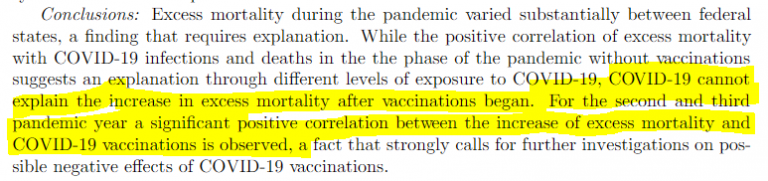
The paper found over 100,000 excess deaths occurring in 2021 and 2022. Recall the vaccine was introduced in early 2021.

Source: Differential Increases in_Excess Mortality in the German Federal States During the_COVID-19 Pandemic
In the paper’s conclusion, the authors found a “significant positive correlation between the increase of excess mortality and COVID 19 vaccinations.”
Arctic Sea Ice ‘Choke Points’ Reducing NW Passage Shipping Season Length By 5-14 Weeks Since 2007
By Kenneth Richard | No Tricks Zone | July 18, 2024
Global warming was supposed to open up Arctic region shipping routes, making the Northwest Passage easier and less risky to traverse. Per a new study, the opposite has happened.
As we reported earlier this year, while a declining trend in Arctic sea ice was observed from the 1990s to 2007, there has been no trend reduction in Arctic sea ice since then. A 17-year pause.
It has long been a “common belief” that shipping through Canada’s Northwest Passage would become “more viable” with a warming Arctic and a consequent reduction in sea ice impediments.
Observations trump beliefs, however.
The East Beaufort Sea has increasingly been generating sea ice “choke points” that have reduced the length of the shipping season from 27 weeks (half the year) during 2007-2011 down to 13 weeks (summer only) during 2017-2021. And, as scientists are now warning, “the negative trend [in shipping season length] shows no sign of reversing.”
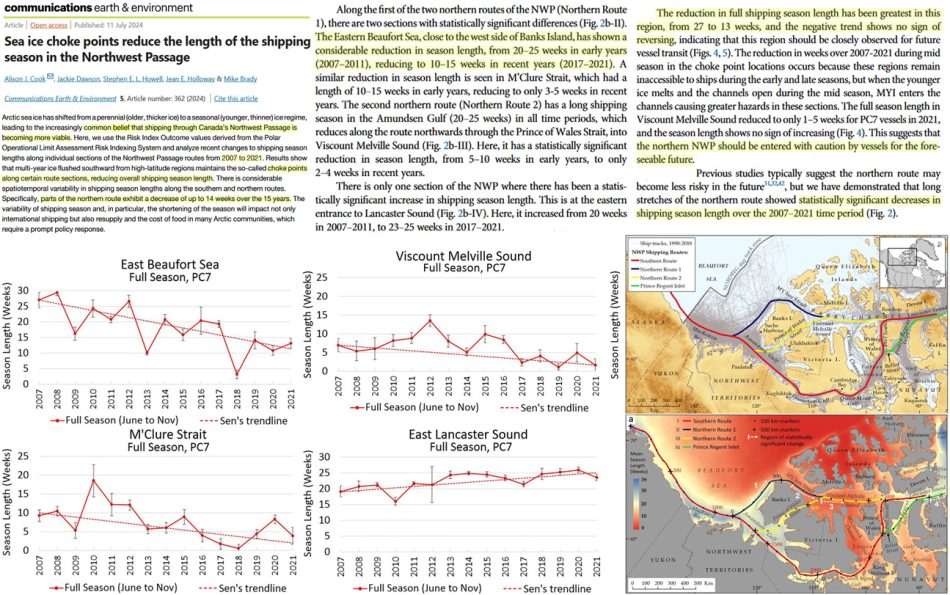
Image Source: Cook et al., 2024
Largest Study of Its Kind Finds Excess Deaths During Pandemic Caused by Public Health Response, Not Virus
By Brenda Baletti, Ph.D. | The Defender | July 19, 2024
A study released today of excess mortality in 125 countries during the COVID-19 pandemic found the major causes of death globally stemmed from public health establishment’s response, including mandates and lockdowns that caused severe stress, harmful medical interventions and the COVID-19 vaccines.
“We conclude that nothing special would have occurred in terms of mortality had a pandemic not been declared and had the declaration not been acted upon,” the authors of the study wrote.
Researchers from the Canadian nonprofit Correlation Research in the Public Interest and the University of Quebec at Trois-Rivières analyzed excess all-cause mortality data prior to and during the COVID-19 pandemic, beginning with the March 11, 2020, World Health Organization (WHO) pandemic declaration and ending on May 5, 2023, when the WHO declared the pandemic over.
The results, presented in a detailed 521-page analysis, establish baseline all-cause mortality rates across 125 countries and use those to determine the variations in excess deaths during the pandemic.
The researchers also used the baseline rates to investigate how the individual country variations in excess death rates correlated to different pandemic-related interventions, including vaccination and booster campaigns.
Not all of the results on a country-by-country basis were the same. For example, in some countries, mortality spikes occurred before the vaccines were rolled out, while in other places, the mortality spikes tracked closely with vaccine or booster campaigns.
In some places, excess mortality rates returned to baseline or close to baseline in 2022, while in others, the rates persisted well into 2023. Denis Rancourt, Ph.D., lead author of the study, told The Defender the disparities result from the complex nature of pandemic measures — and the data — in different areas.
Once Rancourt’s team was able to establish the baseline and excess mortality data for each place, they clustered and examined the data through different filters to interpret it, and drew several conclusions.
Data ‘incompatible with a pandemic viral respiratory disease as a primary cause of death’
The researchers established that there was significant excess mortality worldwide between March 11, 2020, and May 5, 2023.
Overall excess mortality during the three years in the 93 countries with sufficient data to make an estimate is approximately 0.392% of the 2021 population — or approximately 30.9 million excess deaths from all causes.
The conventional explanation for the excess mortality during the COVID-19 pandemic, Rancourt said, is that the SARS-CoV-2 virus caused virtually all deaths — and there would have been even more deaths if there hadn’t been a vaccine.
The variations in excess all-cause mortality rates across space and time, the authors wrote, “allow us to conclude that the Covid-period (2020-2023) excess all-cause mortality in the world is incompatible with a pandemic viral respiratory disease as a primary cause of death.”
They said the theory that the virus caused the deaths is propped up by mass virus-testing campaigns that should be abandoned.
‘Idea that vaccines saved lives is ridiculous’
Rancourt and his team cited several factors they believe disprove the theory that the virus caused a spike in all-cause mortality.
For example, they wrote that excess mortality surged almost simultaneously across several continents when a pandemic was declared, while there were no comparable surges in areas that had not yet declared a pandemic.
This suggests that pandemic interventions like lockdowns, which were implemented synchronously across many countries, likely caused the surges.
The researchers also pointed out the significant variation in mortality rates during the pandemic in all time periods, even across different political jurisdictions directly adjacent to each other. If the virus caused the deaths, it would follow that the infection fatality rate would be the same, or at least similar across political boundaries.
The researchers also found a lot of variability in death rates within countries over time, which also would not be an expected outcome if those deaths were caused by a pathogen.
Rancourt said they found “the idea that the vaccine saved lives is ridiculous,” and based on flawed modeling as he and colleagues also showed in a previous paper.
Here again, they found no systematic or statistically significant trends showing that vaccination campaigns in 2020 and 2021 reduced all-cause mortality.
Instead, they found that in many places, there was no excess mortality until the vaccines were rolled out, and most countries showed temporal associations between vaccine rollouts and increases in all-cause mortality.
Medical interventions — including denial of treatment — caused premature deaths
Rancourt said the excess deaths his team identified are strongly associated with the combination of two major factors — the proportion of elderly in a country’s population and the number of people living in poverty. Both factors increased peoples’ vulnerability to “sudden and profound structural societal changes” and “medical assaults.”
While the proximal cause of death may be classified on death certificates as a respiratory condition or infection, the researchers noted, they argue the true primary causes of death are actually biological stress, non-COVID-19-vaccine medical interventions and the COVID-19 vaccination rollouts.
The study provides an overview of plausible mechanisms for this hypothesis, including research showing that some people experienced severe biological stress from measures like mandates and lockdowns.
“If you structurally change the society by preventing people from moving, breathing, working, having their lives, having to stay at home, lock them in. If you do all these incredibly huge changes, structural changes in society, that is going to induce biological stress,” Rancourt told The Defender.
“There’s very compelling scientific evidence that biological stress is a massive killer,” he added.
Rancourt also pointed out that the stress of lockdowns affected poor people quite differently than it did people who could easily work from home, have food delivered and live relatively comfortably.
The authors also pointed to extensive evidence showing that medical interventions — including denial of treatment — caused premature deaths.
Such interventions included but were not limited to the denial of antibiotics and ivermectin against bacterial pneumonia, the systematic use of mechanical ventilators, experimental treatment protocols, new palliative medications and overdoses, isolation of vulnerable people and encouraged voluntary or involuntary suicide.
The March-April 2020 COVID-19 peak they identified in several countries is difficult to explain without such medical interventions, they wrote.
17 million excess deaths tied to COVID vaccines
Finally, the researchers projected that 17 million of the excess deaths they identified were associated with the COVID-19 vaccines, confirming the findings of their previous research on a smaller sample of countries.
Those vaccine-related estimations were based on analyses of places that had large spikes immediately following vaccination or booster campaigns and also by examining the numbers of vaccine doses and their relation to deaths over time.
Thirty percent of the countries they analyzed had no excess deaths until either the vaccine rollouts or the booster campaigns. And there were significant correlations between COVID-19 vaccine rollouts and peaks or increases in excess all-cause mortality. Ninety-seven percent of countries showed a late-2021 or early-2022 peak in excess all-cause mortality temporally associated with booster rollouts.
It is highly unlikely, the researchers wrote, that the vaccine-mortality associations are coincidental.
Rancourt noticed that people critical of this idea point to the fact that in some places, there are sometimes campaigns or booster campaigns that aren’t associated with spikes in excess mortality.
However, he said vaccination campaigns don’t always lead to such spikes because vaccination was not related to death in the same way in every situation. Vulnerability factors like the age of those vaccinated, the health of the population and other sociological factors related to stressors on the immune system change how they are affected by vaccine toxicity or the vaccines’ effects on the immune system.
Based on their analysis and interpretations, they concluded, “We are compelled to state that the public health establishment and its agents fundamentally caused all the excess mortality in the Covid period.”
This article was originally published by The Defender — Children’s Health Defense’s News & Views Website under Creative Commons license CC BY-NC-ND 4.0. Please consider subscribing to The Defender or donating to Children’s Health Defense.
Ministers Were Informed Of mRNA Lies During Mandates, Cardiologist Reveals
Dr Aseem Malhotra had a direct line of communication to the Health Secretary

By JJ Starky | The Stark Naked Brief | July 19, 2024
We’ve had another mainstream breakthrough.
Yesterday, Dr. Aseem Malhotra appeared on TalkTV to discuss the UK government’s Covid response in light of Baroness Hallett’s report on the first module of the Covid Inquiry.
Commentators were surprised. Most predicted that the Covid Inquiry chair’s report would echo sentiments seen during proceedings, suggesting that lockdowns, despite all credible evidence, were the only viable solutions for dealing with Covid.
So when Hallett’s team concluded that “the imposition of a lockdown should be a measure of last resort… indeed, there are those who would argue that a lockdown should never be imposed,” it almost seemed strange.
During the interview, much like his January 2023 appearance on the BBC where he pivoted from discussing statins to linking Covid vaccines to cardiovascular issues, Malhotra shifted the focus to vaccines.
He covered a lot of detail in quick succession. He argued that the term “vaccine” used for mRNA products is misleading, as they are better described as gene technologies. He cited peer-reviewed reanalysis of Moderna and Pfizer’s clinical trials, which showed an adverse event rate closer to 1-in-800, a figure that outweighed Covid hospitalisation risk. He also mentioned that Israel saw a 25% increase in cardiac events among people aged 16-39 during the vaccine rollout.
But the standout moment came when Malhotra discussed his involvement in a court case in Finland concerning an entrepreneur who was denied entry to a café because he was unvaccinated.
Malhotra revealed that he witnessed a World Health Organisation (WHO) chief scientist testify under oath that by December 2021, the mRNA vaccine offered zero protection against Covid. He then disclosed that he had texted Sajid Javid, the UK Secretary of State for Health and Social Care, informing him of this testimony, but Javid effectively ignored it.

Former UK Secretary State for Health and Social Care Sajid Javid
It has been difficult to gauge what certain officials knew at what time. However, now we have an indication that some were categorically made aware that their policies were illogical and at direct odds with the evidence-base.
Press releases show that Javid’s department finally revoked the Covid vaccine mandate for health and social care staff on March 15, 2022, months after Malhotra made contact.
In November 2021, a survey of industry leaders estimated that up to 20,000 carers had already quit or been sacked over mandatory jabs. Given the mandate carried on to March the following year, that could be a vast underestimate.
Malhotra, who once advocated for everyone to receive the vaccines before his father reportedly passed away from them, notably said, “This is the biggest corporate crime committed by the drug the industry.”
TalkTV did not post the interview on YouTube as the platform continues to issue strikes to channels discussing the topic. So here it is in full.
Summary of Hallett’s Report on the Covid Inquiry:

- Ad Hoc Intervention: Epidemiologist Professor Mark Woolhouse described lockdown as an ad hoc intervention with no prior planning, guidelines, or clear expectations.
- Lack of Scrutiny on Consequences: The novelty of the lockdown approach meant there was no time to scrutinise its potential side effects, leading to ill-prepared policies with unknown consequences.
- Significant Economic Impact: The report highlights the 25% drop in GDP between February and April 2020 due to lockdowns, representing a major gap in the UK’s assessment of pandemic risk.
- Missing Topics: The report does not discuss the UK government’s evidence that the Test and Trace system had minimal impact on reducing Covid infections despite its high cost.
- Balancing Factors in Health Emergencies: The report emphasises the need for a balanced approach in health emergencies, considering economic impact, social wellbeing, and effects on education, as advocated by former chief medical officer Sally Davies.
- Exclusion of Certain Testimonies: Testimonies from Chief Medical Officer Chris Whitty are notably absent, indicating a potential shift from previously dominant perspectives during the pandemic.
- Real Story of the Report: The report suggests that the UK was not prepared for the “wrong pandemic”, but rather that it resorted to an unprecedented policy without a proper evidence base or risk assessment. It advocates that lockdowns should be a measure of last resort, and perhaps never used at all.
Reviewing the Extraordinary Unsolved Murder of Seth Rich

DNC Staffer Seth Rich, murdered on July 10, 2016
By John Leake | Courageous Discourse™ | July 20, 2024
The murder of Seth Rich—in the middle of one of the most brutal presidential election years in history—has always struck me as an example of the authorities NOT investigating a matter of public interest. The mainstream media and half the country were so blinded by partisan passions that they couldn’t see the grounds for suspecting that the young man’s murder was politically motivated. Just a few hours after the incident occurred—before there was any time to perform an investigation—the Metropolitan Police Department announced that the murder appeared to be a “botched robbery.”
Since Seth Rich was murdered on July 10, 2016—12 days before Wikileaks published embarrassing DNC e-mails—there has been much speculation that he could have been the source because he was upset about how the DNC had treated Bernie Sanders. A good investigator wouldn’t speculate about the crime, but he would certainly notice that, statistically speaking, the murder is extraordinary.
Seth Rich was shot in the back near his apartment building, and though he was carrying a valuable watch, wallet, and cell phone, these were not taken by the assailant. Perhaps it was a botched robbery, as the Metropolitan Police Department quickly announced, but shooting a guy in the back without taking his valuables is not typical of armed robbery. Other robberies in the same neighborhood around the same time followed the conventional pattern of the assailant threatening the victim and demanding his or her valuables instead of opening fire on the victim.
In the year 2016, there were 135 homicides in Washington D.C., which has a resident population of 672,000, which comes to approximately one murder per 5000 residents— a dramatic decline from the city’s murder rate in the early nineties. Incidentally, the Metropolitan Police conducted an analysis of homicide for the years 1998-2000—after homicide rates had dropped significantly—and concluded that the primary motives were
1) Argument/conflict
2). Drug related
3). Revenge/retaliation
4). Robbery
5). Gang related.
During this period, homicides were not equally distributed throughout the city, but were concentrated in particular neighborhoods. 92% of the victims were African Americans 3.2% were Hispanic and 3.2% were white. Though one must consider the possibility that homicide trends in DC have changed since 2000 (apart from merely decreasing in numbers) it’s notable that, of the currently unsolved homicides in Washington DC in the year 2016, Seth Rich is the only white victim in a city that is now 44% white.
Julian Assange has always insisted the DNC e-mails were leaked and not hacked. Former NSA technical director William Binney has also insisted that if the DNC e-mails were hacked, it would be child’s play for the NSA to establish the precise routing of the hack, which indicates that the e-mails were more likely leaked by an insider.
Regarding motive, a good investigator would consider the hypothesis that Seth Rich was murdered NOT in retaliation, but to eliminate him as a witness that the DNC e-mails were leaked by an insider and not hacked by Russians. Almost immediately after the embarrassing e-mails were published, Hillary Clinton’s campaign hired CrowdStrike to perform a forensic cyber analysis of the server. CrowdStrike falsely proclaimed it was Russian hackers who were responsible, and never presented evidence to support this assertion.
Regarding the assailant: A good investigator would consider the hypothesis that he was contracted to murder Rich but knew nothing about his target or the motive for killing him. This hypothesis is consistent with Rich being murdered as he approached the entrance to his home—that is, the contract killer was provided only with the address and a photograph of his target.
Another notable aspect of this crime was the extremely emotional tone of press reporting from the same reporters who so passionately embraced the Russian meddling story. The mere suggestion that Seth Rich’s murder was politically motivated prompted these same people to angrily denounce this (perfectly reasonable hypothesis) as “wild, right wing conspiracy theory” and to demand that reporters cease and desist from exploring this hypothesis.
While the murder of Seth Rich was done at night and many of the details were concealed, the recent assassination attempt on Donald Trump was performed in broad daylight with millions watching. The fact that proper security was withheld from the event is so obvious that people have a hard time believing it was an intentional act.
Surely, naive people think, those currently in power wouldn’t perform such deeds so out in the open. And yet, there it is, plain to see, right under everyone’s nose.
Could Trump’s election end NATO’s proxy war in Ukraine against Russia?
Strategic Culture Foundation | July 19, 2024
The presidential nomination of Donald Trump and Senator JD Vance as his running mate raises the prospect of a peaceful settlement to the conflict in Ukraine. Both have been vociferous critics of the NATO proxy war and the arming of the Kiev regime. Vance has even proposed a peace settlement that is close to Moscow’s demands.
Hungarian Prime Minister Viktor Orban, who is recently pushing peace diplomacy, has voiced optimism that the omens are good for a settlement later this year to the worst war in Europe since the Second World War – if Trump and Vance are elected.
Only days after Donald Trump narrowly survived an assassination attempt, he was officially nominated as the Republican presidential candidate amid ecstatic scenes at the Republican National Convention in Milwaukee.
After the tumult and drama over the last week – a long time in politics, as the saying goes – the Trump election campaign is in the driving seat. His vice presidential running mate is 39 years of age and gives the Republican Party a youthful zest. Both men are very much singing from the same hymn sheet regarding their “Make America Great Again” vision.
Trump has united the GOP under his leadership. All former party rivals lined up this week in Milwaukee to endorse the former real estate magnate in his bid to seek re-election to the White House in November. That helps to solidify his manifesto, which bodes well for diplomacy in Ukraine.
By contrast, the election campaign of Democrat incumbent President Joe Biden has run into a ditch. This week he was self-isolating in Delaware having reportedly incurred a third-time Covid infection. Biden increasingly looks toast. His apparent mental decline – the latest gaffe this week was not remembering the name of his Secretary of Defense Lloyd Austin, referring to him haltingly as “a black man” – has provoked a crisis in the Democratic Party and the largely favorable U.S. corporate news media. Senior figures including former President Barack Obama and House Speaker Nancy Pelosi, are reportedly urging Biden to stand down and pass the torch to a younger candidate. Panic is in the air.
There are reports that Biden may throw in the towel within the next few days as the Democrats head into their National Convention to officially nominate their presidential candidate. The trouble for the Democrats is they do not have a viable alternative candidate at this late stage in the campaign – with less than four months to election day on November 7.
That means there is now a serious chance that Trump could return to the White House after he lost the election in 2020, which MAGA loyalists hotly disputed as “stolen”.
That election outcome turns attention to one issue in particular: the war in Ukraine. The conflict erupted in February 2022 and has cost the lives of over 500,000 Ukrainian soldiers. Under the Biden administration and aligned European NATO members, there is no sign of the war coming to an end. Biden and European allies have pledged to keep sending weapons to Ukraine and tens of billions of dollars to prop up a hopelessly corrupt NeoNazi regime in Kiev.
Trump and Vance have pitched a diametrically opposite policy on the U.S.-led NATO proxy war in Ukraine.
That stance is causing the Deep State and its military-industrial complex acute anxiety. The Ukraine war racket has been a bonanza that vested interests in the U.S. ruling class do not want to end. That tension provides a plausible explanation for the attempted assassination of Trump during an open-air rally at Butler, Pennsylvania, on July 13. Salient questions remain about how the shooter, Thomas Matthew Crooks, a 20-year-old student, gained access to such a high-security position to fire his rifle at Trump.
The Republican candidates have warned that the Ukraine conflict is in danger of spiraling into a nuclear world war. Trump has said that he would end the war immediately by cutting off the military aid spigot and forcing the Kiev regime to begin negotiations with Russia.
Tantalizingly, JD Vance (R-Ohio) has been even more explicit in proposing that the warring parties should accept the territorial gains made by Russia – including Crimea, Donbass, Zaporozhye and Kherson provinces – and that Ukraine must accept Moscow’s demand that it remain neutral and outside of the NATO alliance.
Such a position is a breath of fresh air for its rationality. Many respected American scholars and diplomats have also recommended this historically coherent position as a solution, including Professors John Mearsheimer and Jeffrey Sachs. At least Trump and Vance seem to be cognizant of this reality, unlike the Biden administration and the rest of the Democrat Party, along with the Western media establishment and European minions who insanely push a fraudulent war to the last Ukrainian.
Moreover, polls show that the majority of American citizens (and Europeans) would prefer to see a diplomatic solution to the worst war in Europe since 1945.
Hungary’s Orban has admirably advocated peaceful diplomacy and for his troubles, his government has been sanctioned by the European Union establishment. Slovakia’s Robert Fico has also called for an end to the war in Ukraine, which many believe led to an assassination attempt on his life in May.
The conflict in Ukraine is a senseless, bloody slaughter that should never have escalated if Russia’s peace proposals in December 2021 had been accepted instead of dismissed out of hand by the Biden administration and its NATO lackeys in Europe. Also, a peace deal was possible in April 2022 but again was scuppered by malicious U.S. and British intervention.
If an American presidential candidate is proposing a diplomatic end to the conflict then that should be welcomed. It seems that common sense is prevailing.
Having said that, however, there are caveats. The Trump-Vance rhetoric could be empty pre-election canvassing for votes.
Trump’s record is one of hyping expectations and not delivering. When he ran for the presidency in 2016, he promised to normalize relations with Russia – and did not deliver.
He also boasted about solving the conflict in the Middle East with a “deal of the century” – only to embolden Israeli aggression towards Palestinians and Iran.
A reality check is strongly advised on what Trump and Vance can achieve.
While both men express skepticism about “endless wars” and NATO, it should be borne in mind that the conflicts the U.S. empire is fueling have a systematic cause. The United States is desperately fighting to maintain its failing hegemony against the rise of a multipolar and more democratic global order.
Washington and its European vassals are unleashing wars as a matter of necessity for preserving their erstwhile global dominance. History teaches that wars are always the refuge of the Western imperialist ruling classes.
It is notable that while Trump and Vance talk about ending conflict in Ukraine, they are at the same time talking belligerently about confronting China and Iran.
Trump and the MAGA Republicans are deprecated by the U.S. establishment as being “isolationists” in their vision of pursuing “America First”.
But the notion of “isolationalism” is an oxymoron when one considers the objective reality of U.S. imperialism. Foreign wars are an insatiable appetite for Western dominance.
American relations with the rest of the world are all about power projection, dominance and ultimately using violence to assert its “might is right” presumed national privileges. That applies whether the incumbent in the White House is a Democrat or Republican.
Trump may sound more reasonable on the issue of conflict in Ukraine with Russia. That alone makes him a more plausible candidate compared with the reckless warmongering of Biden and the Democrat-Deep State nexus.
The war in Ukraine must be stopped as soon as possible and a more reasonable security arrangement for Europe must be negotiated as Russia has long been consistently advocating.
Any diplomatic opening towards achieving peace and ending the killing must be welcomed.
Trump and Vance might just deliver on ending the hostilities in Ukraine which in itself would be a huge step forward away from the abyss of all-out war with Russia. On that score alone, their election might bring about an improvement.
But alas there is a contradiction. Don’t expect world peace to break out in other parts of the globe, because U.S. imperialism is cranking up its war machine. Trump and Vance are hawkish in their policy towards China and Iran.
A comprehensive solution to ending U.S. aggression and militarism is not a change of personnel at the White House. A profound, systematic change in American politics and economics is required.
Is partial peace sufficient? Maybe it is for now.
Ukraine ‘Shot Itself in the Foot’ by Banning Transit of Lukoil Crude to Hungary and Slovakia
By Ilya Tsukanov – Sputnik – 20.07.2024
Hungary and Slovakia stopped receiving oil from Russian oil giant Lukoil via the Soviet-built Druzhba (‘Friendship’) pipeline which runs through northwestern Ukraine after Kiev imposed a transit ban. Financial analyst Paul Goncharoff says the move is both counterproductive and shortsighted, but that hasn’t stopped Ukraine’s authorities before.
Officials in Budapest and Bratislava confirmed this week that the delivery of oil supplies purchased from Lukoil through the Druzhba oil pipeline network had dried up.
Slovakian oil transporter Transpetrol said non-Lukoil Russian deliveries appear unaffected so far.
Hungarian Foreign Minister Peter Szijjarto said Budapest is receiving oil via the TurkStream pipeline, running from Russia through the Black Sea to southeastern Europe, but that supplies via Druzhba had been stopped “due to a new legal situation” imposed by Kiev.
“We are now working on a solution that would allow oil transit to restart as Russian oil is very important for our energy security,” Szijjarto said Tuesday.
Kremlin spokesman Dmitry Peskov said Friday that Moscow doubts whether dialogue with the Ukrainian companies responsible for oil transit on this issue is possible.
“This sort of decision was made not at the technical, but the political level. We don’t have any dialogue here,” he said.
Druzhba is one of the longest and largest oil pipeline networks in the world, with a capacity to ship about 66.5 million tons of oil annually. The network branches off in southern Belarus into a northern route running through Poland to eastern Germany, and a southern route, which winds through southwestern Ukraine to the Hungarian and Slovakian borders.
Hungary, Slovakia and the Czech Republic negotiated with Brussels in late 2023 to allow them to maintain their pipeline-based imports of Russian oil, citing a lack of access to sea-based deliveries, and lack of opportunities to receive substantial amounts of oil from other sources.
The three countries collectively imported about 15 million tons of Russia divided roughly evenly between them in 2022, and dropped purchases modestly (between 2 and 10 percent) in 2023, according to Russian oil transport giant Transneft.
Shipments of Russian oil to Poland and further west to Germany via Druzhba’s northern branch were halted by Warsaw in early 2023.
Last month, Ukraine formally banned the transit of crude produced by Lukoil – Russia’s second-largest oil company, through the section of Druzhba running through Ukraine.
The move signals another short-sighted escalation by Ukraine’s pro-Western elite which will ultimately harm ordinary Ukrainians in the long run, says veteran financial analyst Paul Goncharoff.
“Whether Ukraine can afford to further escalate the situation surrounding the movement of energy resources is a moot point. Escalation on all fronts has passed all reasonable limits, politically, economically and militarily. They cannot afford it economically [nor] politically as they have now estranged both Slovakia and Hungary, [but will continue to escalate], regardless of cost, as their marching orders from Washington along with the servile echoes of Brussels and their insistence to ‘demonstrate resolve’” dictate, Goncharoff told Sputnik.
“The real consequences should become very clear in 3-4 months as winter descends on Ukraine, and any energy goodwill there may still be in countries neighboring Ukraine will be scarce to nonexistent,” the observer expects.
At this stage, Goncharoff says, Russian oil exporters not affiliated with Lukoil can still send oil through the Druzhba pipeline, but “how long this possibility will continue is anyone’s guess.”
“In discussions I have had with persons closely involved in this trade, there are swap workarounds being looked at in order not to deprive Slovakia or Hungary from needed and contracted resources. Unfortunately, the political reality is such that it is likely any workarounds will raise a hue and cry from the West, and they will try to close the workarounds off as well, if for no other reason but to be politically correct,” the market analyst said.
Ultimately, the old saying “shooting oneself in the foot” is an apt description for Kiev, Brussels and Washington’s policy today, “while the world looks on, shaking its collective head in wonder,” Goncharoff concluded.
Russian oil and gas flows to Europe have dropped dramatically following the escalation of the conflict in the Donbass into a full-fledged proxy war between Russia and NATO. The decline in Russian energy flows west prompted Moscow to reorient part of its energy trade to its BRICS partners (particularly China and India) and pushed EU countries and the UK to kick off a global scramble to secure the energy needed to power their economies.
The West’s attempts to “punish” Russia by cutting off energy purchases have so far had a boomerang effect, raising prices and undermining Europe’s global industrial competitiveness against China and the United States. Traditional European industrial powerhouse Germany has been hit particularly hard, facing the outflow of major manufacturers looking for greener pastures, and cheaper energy costs, in countries abroad.
Featured Video

Michael von der Schulenburg: Europe’s Self-Defeating Iran War Policy
or go to
Aletho News Archives – Video-Images
Frlom the Archives
Provoking a Path to Persia
The Saban Center’s prescient paper on war with Iran
By Maidhc Ó Cathail | October 20, 2011
In June 2009, the Saban Center for Middle East Policy published “Which Path to Persia?—Options for a New American Strategy toward Iran.” Writing in a tone strikingly reminiscent of the Project for a New American Century’s infamous pre-9/11 paper “Rebuilding America’s Defenses,” the six co-authors noted that, “It seems highly unlikely that the United States would mount an invasion without any provocation or other buildup.” For a think tank specifically established by media mogul Haim Saban to protect Israel, this could prove to be a formidable obstacle impeding their desired march—of U.S. troops—to Tehran.
“In fact, if the United States were to decide that to garner greater international support, galvanize U.S. domestic support, and/or provide a legal justification for an invasion, it would be best to wait for an Iranian provocation, then the time frame for an invasion might stretch out indefinitely,” Saban’s think-tankers ruefully observed.
“With only one real exception, since the 1978 revolution, the Islamic Republic has never willingly provoked an American military response, although it certainly has taken actions that could have done so if Washington had been looking for a fight. Thus it is not impossible that Tehran might take some action that would justify an American invasion. And it is certainly the case that if Washington sought such a provocation, it could take actions that might make it more likely that Tehran would do so (although being too obvious about this could nullify the provocation). However, since it would be up to Iran to make the provocative move, which Iran has been wary of doing most times in the past, the United States would never know for sure when it would get the requisite Iranian provocation. In fact, it might never come at all.”
Seemingly undeterred by Iran’s frustrating unwillingness to provide the requisite provocation, the analysts continued to examine this option… continue
Blog Roll
 Aletho News
- Hosting Washington’s war: Bahrain faces the consequences
- The US fell for its own Iran propaganda
- Seyed M. Marandi: Threat of Seizing Kharg Island & the Use of Nuclear Weapons
- Is there even an off ramp?
- Michael von der Schulenburg: Europe’s Self-Defeating Iran War Policy
- Sorry, The New Republic, Climate Change Isn’t Causing Somali Migration. Blame Civil Strife and Poverty.
- Expert Guts Claims That HPV Vaccine Reduces Cancer Risk
- No evidence Russia sabotaged Baltic cables – Finnish intel
- The Strategic Folly of a (Serious) US Ground Invasion of Iran
- US-Israeli war of aggression on Iran meant to reshape region: Omani FM
- If Americans Knew
- Are we on the precipice of World War III?
- ‘Catastrophic,’ Says UNICEF: 1,100+ Children Killed or Wounded in Mideast Since US-Israel Launched Iran War
- The Unbelievable Madness of Our War With Iran
- World Council of Churches calls on govts to hold Israel accountable for violations of intl law
- How to end the war on Iran that costs US taxpayers $1M per minute – Not a ceasefire Day 153
- Israeli strategic plans to “remake the Middle East” from the 1950s and since
- Honoring Gaza’s women who refused to let the world look away
- 97% of victims of war on Iran are Iranian, 98% of victims in war on Gaza are Gazans – Not a ceasefire Day 152
- Early Iran strikes cost $5.6 billion in munitions, Pentagon estimates
- Israel Decided the War, But Trump’s America Fights and Pays the Bill
- No Tricks Zone
- New Studies: UK Sea Levels Were 4 Meters Higher Than Today During The Mid-Holocene
- Destructive Green New Deal: German Energy And Metal Group Warns Of Drastic Crisis
- New Study Documents A 20-Year Pause In Arctic Sea Ice Decline – Driven By Internal Variability
- Wake-up Call: Survey Shows Majority Of Germans Now Favor Postponing Climate Targets!
- Televised! Leading German Political Candidate Tells Schoolchildren CO2 Makes Sun Hotter!
- New Study: A Century Warming Of 1.1°C Is ‘Commonplace’ And ‘Not Unusual’ During This Interglacial
- New Study: ‘Internal Noise’ And Volcanic Forcing Can Trigger 10-15°C Warming Within Decades
- Glaciers Worldwide Are Suddendly Surging, Experts Blame Warming!
- Surprising Discovery: Sahara Is Greening…Billions Of Trees Where Once Thought To Be Barren
- New Research Reaffirms Clouds, Aerosols, And Surface Solar Radiation Are ‘Driving The Climate System’
 Aletho News