A multilateralist, but not a multipolarist: Lula shows his true face
By creating tensions with Venezuela and Nicaragua, Lula creates serious geopolitical problems in South America

By Lucas Leiroz | Strategic Culture Foundation | August 21, 2024
Brazilian President Luiz Inácio Lula da Silva has been the target of several recent controversies across the South American geopolitical scene. Contrary to the expectations of some naive leftists, Lula’s government is not acting according to a non-aligned guideline, but cooperating with Western powers in several aspects, mainly with regard to opposition to counter-hegemonic governments in Latin America.
To this day, Lula has not recognized the victory of Nicolás Maduro – the legitimate and democratically elected president of the Bolivarian Republic of Venezuela. This irresponsible attitude was easily expected from a political leader on the Brazilian right wing – like the previous president, Jair Messias Bolsonaro –, but it is something really surprising for the “left”, which historically has good relations with illiberal countries.
The Brazilian president’s international affairs advisor, former foreign minister Celso Amorim, explained that there is “no evidence” that the Venezuelan elections took place in a non-fraudulent manner. One of the “solutions” he proposed was even redoing the elections, which sounds absolutely ridiculous. Another possibility was for Maduro to form a joint government with the defeated opposition, which does not make any sense from a rational point of view.
In the same sense, Brazil and Nicaragua mutually cut diplomatic relations, expelling each other’s ambassadors. As a result, relations between Brazil and the two main counter-hegemonic countries in the Americas are deeply shaken. It is not known what Lula will do after the end of Maduro’s current term, as failure to recognize the recent victory could lead to a break in relations.
In practice, Brazil is functioning as an auxiliary to U.S. interests in South America, using the rhetoric of “democratic zeal” as an interventionist excuse to guarantee foreign interests in the region. Many supporters of President Lula are disappointed with these acts, but this was truly expected by the most qualified analysts.
Lula was never a “pro-multipolar” leader. The entire foreign policy of Lula and the Workers’ Party is based on a multilateralist worldview centered on the UN. Since the 2000s, Lula has been a leader encouraging dialogue between emerging nations, but at the same time he advocates a global consensus through the UN and other international organizations as regulators of relations between States – completely ignoring that these organizations are strongly biased and linked to a liberal ideology propagated from the western U.S.-EU axis.
In the 2000s, Lula’s stance was contesting and somehow “outsider”, as he dialogued with revisionist nations of the liberal order. However, Lula was never paradigmatic in his foreign policy and never proposed any radical project for real change in the structures of the global order. American hegemony was never challenged by Lula, but “mitigated”. His idea basically consisted of making the world economically more “equitable” and relations between States more “humane”. Western values, such as “democracy (in the Western understanding)” and liberalism, were never a problem for Lula.
In this sense, what seemed like something “dissident” in the 2000s today sounds like something conservative and insufficient. Today, emerging nations are much more organized and are capable of contesting American hegemony in an actually profound way. Mere multilateralism is insufficient, as there is a need to take a step towards real Multipolarity – which consists of reconfiguring the global power structure and not simply increasing multilateral dialogue and economic cooperation.
So, the same Lula who was an “outsider” in the 2000s is now showing himself to be a advocate for the “consensus”. Lula condemned the Russian operation in Ukraine – despite correctly refusing to participate in the sanctions –, which can be considered his first big mistake since the election. Lula later called Hamas’ Operation Al Aqsa Storm a “terrorist attack.” Despite taking a firm stance when criticizing Israel for the massacre in Gaza, Lula avoided going deeper into this issue, remaining inert in the face of the defense cooperation that exists between Brazil and the Zionist regime. Now, by destabilizing relations with counter-hegemonic countries in South America, Lula takes the definitive step so that there is no longer any doubt: his government is not aligned with the multipolar transition.
Lula continues to be a typical multilateralist leftist of the 2000s. Economic cooperation and multilateralism, for him, must be respected as long as the Western model of liberal democracy continues to be hegemonic. Unfortunately, with this type of stance, Brazil loses the opportunity to become one of the main players in the multipolar geopolitical transition process.
France, Spain install radars in south Lebanon to ‘monitor Hezbollah’: Report
The Cradle | August 21, 2024
French and Spanish radars installed by UNIFIL in the south of Lebanon are being used to target the resistance on behalf of Israel, Lebanese daily Al-Akhbar reported on 15 August.
“A week ago, an Israeli drone targeted two Hezbollah fighters in Naqoura. Eyewitnesses said the drone was not noticed or heard before the surprise attack, which directed attention to the new French radar that was raised above the UNIFIL base in Mount Naqoura, and whether it was used to monitor the movements of the resistance,” Al-Akhbar wrote.
The French radar, the “marine radar” as the daily refers to it, was installed in the south two weeks ago at the request of UNIFIL Chief of Staff, Frenchman Cédric du Gardin, it says.
“Before the end of his term at the end of last July, the former French Chief of Staff sent a letter ‘reprimanding his officers because of their failure to detect any drone, air defense missile or rocket’ launched by the resistance,” the report adds.
Prior to this, a Spanish radar was installed in the Blat Plain in southern Lebanon’s Marjayoun.
Israel “asked the current UNIFIL commander, the Spaniard Arludo Lazarro, to install the radar immediately after his appointment two years ago. However, local Lebanese pressures postponed the decision until Army Commander Joseph Aoun and the government expressed their approval of it, with Defense Minister Maurice Slim refusing,” sources told the newspaper.
The Spanish radar monitors the occupied Shebaa Farms and Kfar Shuba hills on the Lebanese border.
The two radars “complement the French radar system installed since after the July 2006 aggression on Lebanon” in the vicinity of Bint Jbeil, the daily reported.
According to the report, UNIFIL’s navy has also joined the intelligence campaign to make up for the blind spot created by Hezbollah’s attacks on Israeli surveillance sites and equipment.
“A German warship, which has been in command of UNIFIL’s naval forces since 2001, is stationed off the coast of Naqoura. No one knows who is boarding or disembarking off of it or using it for reconnaissance, especially in the area extending from Tyre to Naqoura, which has witnessed several assassinations,” field sources told the newspaper.
UNIFIL has been operating in Lebanon since the first Israeli invasion of 1978. Despite this, their forces failed to end an 18-year occupation and have attempted to expand their areas of influence without proper authorization.
Many in Lebanon have for years accused UNIFIL of acting to suppress resistance in the south on behalf of Israel.
Last year, Washington and London had been trying, on behalf of Israel, to secure Lebanon’s approval for a UN Security Council resolution ensuring freedom of movement for UNIFIL across the country, without accompaniment from the Lebanese army as is the law.
“The US and Israel were unable to implement the freedom of movement clause despite the enormous pressure on Lebanon,” Munir Shehadeh, Lebanon’s former government coordinator for UNIFIL, told Al-Akhbar.
The untold terms of the new American ceasefire proposal
By Motasem A Dalloul | MEMO | August 21, 2024
Israeli UN envoy says UN HQ should be ‘wiped off face of the earth’
Al Mayadeen | August 21, 2024
The outgoing ambassador Gilad Erdan claims that the United Nations building in New York City is “unnecessary”.
The United Nations building must be abolished, declared “Israel’s” departing ambassador to the UN, taking aim at the global body.
During an interview with Israeli media on Tuesday, Erdan said, “The UN building should be closed and wiped off from the face of the earth,” adding, “This building, which may look nice from the outside, is actually twisted and distorted.”
When asked about his future plans, given that he is departing his position at the UN, Erdan expressed seeing himself leading the right-wing Likud Party after PM Benjamin Netanyahu resigns.
“I’m coming out with a feeling of satisfaction …” he said.
Back in June, “Israel” was looking for ways to respond to the UN after it blacklisted it as an entity that violates children’s rights in “conflict zones”, according to Israeli public broadcaster KAN, including cutting ties with UN Secretary-General Antonio Guterres.
After being blacklisted, Israeli Prime Minister Benjamin Netanyahu took to his X account to say that the UN “put itself today on history’s blacklist” instead, while Israeli Foreign Minister Israel Katz stated that the decision would affect relations with the United Nations.
KAN also reported that “Israel’s” UN envoy, Gilad Erdan, recommended the Israeli cabinet to classify the UN Agency for Palestinian Refugees (UNRWA) as “a terrorist organization.”
Iran dismisses ‘unreasonable’ joint statement by Australia, New Zealand
Press TV – August 21, 2024
Iran has dismissed a joint statement by Australia and New Zealand calling on the Islamic Republic not to retaliate the recent crimes of Israel.
Foreign Ministry Spokesman Nasser Kana’ani said on Wednesday that such a move once again demonstrates the double standards these countries employ when it comes to fundamental human rights, international law, and regional developments.
Kana’ani said the “unreasonable request” in the joint statement undermines Iran’s inherent right to punish the attacker and deter future attacks.
The Iranian official was referring to the assassination of Ismail Haniyeh, the political bureau chief of the Palestinian resistance movement Hamas, in Tehran on July 31.
“In a situation where the United Nations Security Council, due to the unconditional support of the United States for the Zionist regime, could not even issue a statement condemning the terrorist act of the regime in assassinating Haniyeh … the unreasonable request of Australia and New Zealand means ignoring Iran’s inherent right to punish the aggressor and create deterrence against Israel’s adventures.”
In the joint statement, Australia and New Zealand expressed “grave concern about the prospect of further escalation across the region” and called on Iran to “refrain from further destabilizing actions in the Middle East, and cease its ongoing threats of a military attack against Israel.”
Kana’ani said the statement is a real example of turning a blind eye to the facts and misleading global public opinion. He said the main source of threat to regional and international peace and security is the “racist Zionist regime,” which enjoys broad Western support.
He said the crimes of the Israeli regime in Palestine and the region are taking on new dimensions every day, and now the regional stability is under grave threat due to the criminal behavior of the Zionist regime, which violates the United Nations Charter and international law.
“The approach of Australia and New Zealand in selectively choosing international norms not only does not help reduce tensions in the region but also encourages the rogue Israeli regime and its destabilizing actions in the region.”
World Mosque Day: Gaza mosques bear testimony of Zionist regime’s barbarism
By Ivan Kesic | Press TV | August 21, 2024
Images of displaced Palestinians in the besieged Gaza Strip assembling amid the ruins to hold congregational prayers have been circulating on social media in recent months.
The Israeli regime has not even spared places of worship in the coastal territory, indiscriminately and aimlessly bombing them, most recently last week in Gaza City.
At least 100 people were killed, many of them unrecognizable, after the Israeli regime bombed a mosque at the al-Tabin School in the Daraj district during the pre-dawn prayers last Saturday.
As the world marks ‘World Mosque Day’, a total of 610 mosques have been completely destroyed in the Israeli genocidal bombings in Gaza in the past 320 days, according to the Gaza Media Office.
The World Mosque Day was instituted in honor of the Al-Aqsa Mosque after it was set ablaze in a deeply provocative act by an Australian Zionist named Michael Dennis Rohan on August 21, 1969.
The day has over the years transformed into a symbol of unity and a reminder of the importance and sacredness of the places of worship, particularly the Al-Aqsa Mosque, the third holiest site in Islam.
The fire damaged nearly 1,500 square meters of the mosque, including the medieval minbar (pulpit), the mihrab (prayer niche) of Prophet Zachariah, and various arches and pillars, causing the roof to collapse.
Following a proposal by the Islamic Republic of Iran, the international observance of this day, also known as the International Mosque Day, was approved by the Organization of Islamic Cooperation.
The sacred mosque, however, has continued to be a flashpoint in the long-running struggle for Palestinian freedom from the Zionist occupation with the regime often ordering attacks on the mosque.
Destruction of mosques in Gaza
Since October 7, 2024, the Israeli regime has bombed every inch of the territory in Gaza, including mosques. According to the Gaza Media office, a total of 824 mosques have been completely or partially damaged in the past 11 months, including 610 mosques that have been damaged completely.
According to Palestinian official data from 2019, the Gaza Strip had 1,117 mosques, meaning that 55 percent of all mosques have been destroyed so far, with an additional 19 percent damaged.
Beyond their religious significance to Gaza’s majority Muslim population, many of these mosques are of great cultural and historical importance, as their history dates back to several centuries.
Over the past 11 months, mosques have been deliberately targeted with displaced people inside them, such as the Ahmed Yassin Mosque in the Shati refugee camp in Gaza, the Salim Abu Muslim Mosque in Beit Lahia, and the Khalid bin Al-Walid Mosque in Khan Yunis city.
Numerous direct airstrikes, like the one on the Khalid bin al-Walid Mosque in southern Gaza, have been video-documented, and all evidence demonstrates that they had no military function, debunking false claims of the Zionist regime.
In a report in May, the Ministry of Endowments and Religious Affairs in Gaza reported that Israeli troops have also desecrated at least 60 cemeteries during their ground invasion of Gaza, using bulldozers to dig up graves and steal the bodies of more than 1,000 people.
Furthermore, over 100 Muslim preachers and 91 ministry employees have been killed in the genocidal war, representing only a fraction of the 40,000 victims so far.
These actions by the Israeli regime flagrantly violate international laws and conventions that strictly prohibit targeting places of worship during war, according to experts.
In addition to mosques, historic churches have also been destroyed, along with numerous other civilian buildings such as schools, hospitals, and residential structures.
Destroyed historical mosques
The Great Mosque of Gaza, also known as the Great Omari Mosque, was the largest and oldest mosque in the Gaza Strip and one of the oldest in the world before its destruction by Israeli regime forces.
Built by early Muslims in the 7th century, the mosque had been damaged multiple times throughout history by earthquakes, crusaders, Mongols, and British aviation, yet it was always rebuilt.
The mosque was used as a place of worship by the local Muslim community and served as a focal point for gatherings and cultural activities for centuries.
This sandstone building could accommodate up to 5,000 worshipers, but today, only its ruined Mamluk-era minaret remains.
On December 7, 2023, it was destroyed by an Israeli airstrike, leaving most of the structure collapsed and the minaret bent and broken.
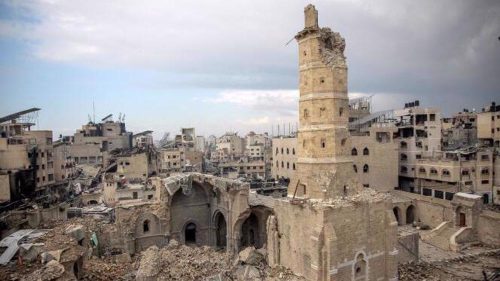
The destroyed Great Mosque of Gaza, the largest and oldest mosque in the Gaza Strip
The Ibn Uthman Mosque, the second largest in Gaza after the Great Mosque, was also reduced to rubble last month after Israeli warplanes fired several missiles at it.
Built in the Mamluk style, the mosque covered 2,000 square meters, with 400 square meters dedicated to its main courtyard. It had two gates overlooking the Shuja’iyya market.
The mosque had been subjected to attacks and demolition during previous wars on the Gaza Strip and was a center of confrontations with Israeli occupation forces during the First Intifada in 1987.
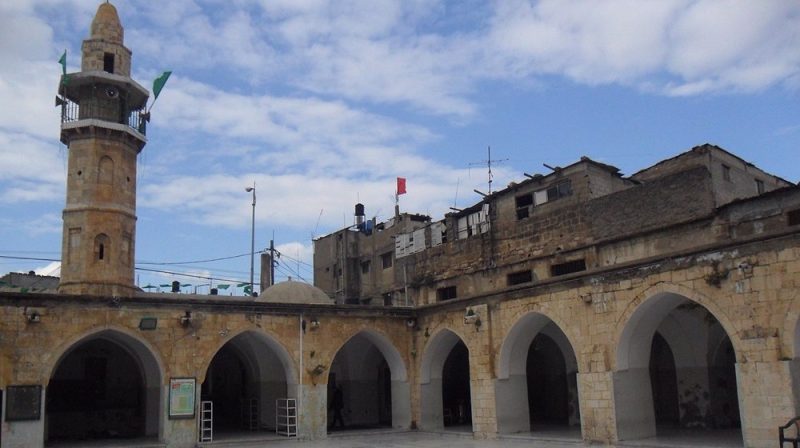
The Ibn Uthman Mosque, destroyed in July
Sayed al-Hashim Mosque, one of the largest and oldest mosques in Gaza, built at the site where Prophet Muhammad’s great-grandfather, Hashim bin Abd Manaf, is believed to have been buried, was also razed to the ground.
Legend says that he was a merchant traveling back to Mecca from Syria when he became ill, died, and was buried in what is now Gaza’s Daraj neighborhood.
The mosque, built from limestone in the 12th century and renovated several times, stood until it was hit by an Israeli bomb in October last year.
In Gaza City’s Zeitoun neighborhood, the Othman bin Qashqar Mosque, built during the same period as the Sayed al-Hashim Mosque, was badly damaged in an Israeli airstrike on December 7.
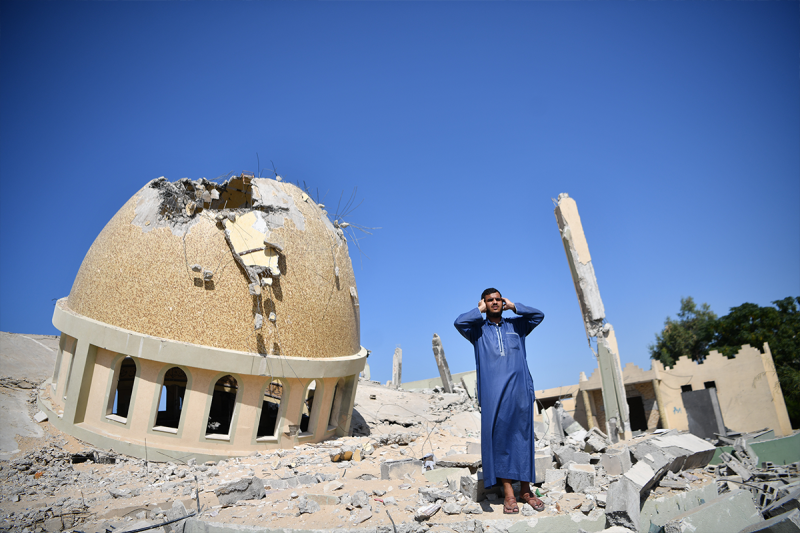
The destroyed Al Amin Muhammad Mosque in Khan Yunis
Among other notable destroyed mosques is the Al Amin Muhammad Mosque in Khan Yunis, destroyed in the early days of the genocidal war.
Its fallen dome, with a hole on top, has become a symbol of Israeli savagery.
The Al-Rahma Mosque, located in the Al-Amal neighborhood of the same city and once used by thousands of worshipers, was also completely destroyed.
After its destruction, thousands of Palestinians prayed next to its ruins during the last Eid al-Adha.
The Al Noor Mosque, on the seashore in Deir al-Balah Camp in the central Gaza Strip, was targeted by Israeli warships, resulting in large portions of it being destroyed.
Other mosques were bombed by warplanes while worshipers were inside, such as the White Mosque in Gaza. Some were bulldozed or blown up with dynamite.
Iran Shuts Down German Soft Power Tool Institute in Tehran in Apparent Tit-for-Tat Move
By Ilya Tsukanov – Sputnik – 21.08.2024
Diplomatic relations between Iran and Germany have worsened progressively over the past five years thanks to Berlin’s growing propensity to walk lockstep with Washington on an array of issues, from the Iran nuclear deal to attempts to meddle in Iran’s internal affairs, and an effort to chide Tehran for its retaliatory strikes on Israel in April.
The German Foreign Ministry summoned Iran’s ambassador on Tuesday after the Islamic Republic shuttered two branches of German Language Institute of Tehran (formerly the Goethe Institute), which receive funding from the German government and operate under the auspices of the German Embassy.
Iran’s judiciary said it moved to close the “illegal centers” for “breaching” local laws, “committing various illegal actions and extensive financial violations.”
The German Foreign Office slammed the move, saying it was “in no way justifiable,” and that that the institute “is a popular and recognized meeting place where people put a lot of effort into learning languages under difficult circumstances.” The institute’s work is “intended to strengthen the connection between the people of Iran and Germany,” the Foreign Office assured.
The language centers’ closure comes a month after Berlin raided and shut down Islamic Center Hamburg, a Shia Islamic cultural center accused by Berlin of “promoting extremism and radical Islamic ideology,” “spreading aggressive antisemitism,” and providing support for Lebanese political and militia movement Hezbollah, which German authorities deem a “terrorist organization.”
German police also raided 53 affiliated properties across eight German states, banning affiliates in Berlin, Munich and Frankfurt, confiscating assets and shutting down four separate mosques.
German harassment and monitoring of Islamic Center Hamburg goes back to the 1990s. In 2022, its deputy director was expelled from Germany over alleged communications with Hezbollah. In 2023, after the start of the Gaza war, Greens politician Jennifer Jasberg demanded the center’s closure, saying she did not want Hamburg to serve as “a breeding ground for hatred against Israel.”
Iranian authorities blasted Islamic Center Hamburg’s closure as an act of Islamophobia, a boon for terrorism and a move “reminiscent of the racist policies of the Nazi regime.” Iranian acting foreign minister Ali Baqeri slammed the measure as an “unjustified move” that “flouts all principles of freedom of religion and thought.”
Iranian authorities said their investigation into the German Language Institute is ongoing, and indicated that other German state-affiliated entities are being looked at.
While it paints itself as “autonomous and politically independent” and engaged only in the exchange of culture and language, Germany’s Goethe institute has been characterized by some as a tool of soft power for Berlin. Russia froze Goethe Institute bank accounts in Russia in 2023 in a tit-for-tat move after Berlin moved to block the accounts of the Russian House of Science and Art in Berlin several months prior. Moscow said it would unblock the accounts “only after the complete and unconditional unfreezing of the bank accounts” of the Russian center.
The Goethe center was opened in Iran in 1958 under the auspices of the West German government, but saw its activities restricted after the 1979 Islamic Revolution, and banned completely in 1987. The institute was reopened in 1995 under the German Language Institute moniker.
The Cost of Kursk
By Ted Snider | The Libertarian Institute | August 20, 2024
The bold and surprising incursion across the border into the Kursk region of Russia has won Ukraine the temporary possession of several Russian villages and a few hundred square miles of Russian territory. But the strategically cheap Russian land may have been bought at a very costly price. The Ukrainian armed forces managed a lightning advance through largely undefended territory. But that territory is defended now, and the advance seems already to have been slowed. And though it seems to have lost momentum well short of its goals, Ukraine may still have to pay the full price.
Ukraine’s decision to take the war across the border may have been made out of the desperate realization that the war is lost. The Russian advance in Donbas is slow but inexorable. It moves forward at a horrible cost of Ukrainian lives, military equipment, and ammunition. It now threatens the city of Pokrovsk, a strategic location whose fall could cut off Ukraine’s ability to supply its forces in the east and facilitate Russia’s capture of Donbas.
Ukrainian President Volodymyr Zelensky and his commander-in-chief, Oleksandr Syrsky, made the decision to take the best trained and best equipped troops the Ukrainian armed forces has and remove them from the Donbas front—where the real war is being fought and where they are being existentially missed—and send them into Kursk to win land that few in NATO think they have a hope of holding. What calculation makes sense of that strategic decision, unless Zelensky and Syrsky know that the end is near?
Perhaps the calculation was that Ukraine’s best troops could be sent to the Donbas front to defend against the Russian invasion or they could be sent to Kursk to invade Russia. In the first case, they would inevitably fail to halt the overwhelming Russian advance; in the second case, they might change the facts on the ground. In either scenario, Ukraine’s best troops will be defeated and their Western equipment lost, but in the first they will be killed while achieving nothing but a short delay in defeat. In the second, they will be killed with the hope of assisting military and political objectives.
The military objective may have been to create a crisis in Kursk that would force Russia to divert troops from Ukrainian territory to Russian territory and relieve the pressure on the Donbas front. The political objective may have been to seize Russian territory that could be bargained back in exchange for occupied Ukrainian territory and improve Ukraine’s position at a negotiating table at which Ukraine now realizes it has to take a seat, since there is no longer a hope that their political objectives can be won militarily.
Though Ukraine considered several options for some time, the risky decision may have been catalyzed, not only by national desperation, but also by personal desperation by Ukraine’s commander-in-chief. Sources familiar with the decision-making by Syrsky told The Economist that the general “was under pressure.” Russia was irreversibly on the offensive, Ukraine was running out of weapons and, even more seriously, out of people. Avdiivka had fallen, the Russian front was advancing, the Ukrainian front was crumbling and the pivotal hub of Pokrovsk was in danger. He was even hearing rumours that he “was on the verge of being dismissed.”
So Syrsky secretly set his plan. Ukraine would invade Russia at a place that was little defended because it was of little value. Russia would not expect it. Highly trained and well equipped and supported Ukrainian troops would advance quickly, seize territory, and perhaps even capture the Kursk nuclear power plant. Russia would be forced to divert troops from Ukraine, relieving the desperate situation in Donbas, and Ukraine would hold a better hand at the negotiating table. Russia would have to negotiate land to secure the return of their land and, especially, of a nuclear plant that would be hazardous to win back militarily.
But the advance ran out of momentum well short of the nuclear plant. Russia has moved in defenses without moving significant forces out of Ukraine, and Ukraine is now losing troops and equipment in Russia the way it is in Ukraine. Exposed troops, tanks, mobile air defense missile launchers and supply lines have come under massive air strikes.
If the Ukrainian offensive fails, the spectacular ephemeral gains will have come at a great cost. Costs could include more rapid and painful losses in Donbas, loss of the opportunity to negotiate an end to the war, and loss of trust when those negotiations are forced upon Ukraine.
The most immediate cost of diverting elite troops and Western equipment from Donbas to Kursk is the further deterioration and weakening of Ukraine’s defences along the Donbas front. Russia’s military is taking advantage of that costly decision. Though Ukraine had counted on the invasion pulling Russian troops out of Donbas, so far, that does not seem to have happened. The Ukrainian armed forces say that the “relatively small” number of Russian forces that have been drawn out of Ukraine is “not…enough to indicate any differences or weakening in… hostilities.”
Russian President Vladimir Putin says both that, far from relieving pressure on the Donbas front, “on the contrary,” Russian offensive operations will increase and that, far from expediting negotiations, the incursion into Russia has made negotiations less likely.
Both claims appear to be true. The Ukrainian General Staff reports that the number of Russian assaults in the area of Pokrovsk have roughly doubled since the Kursk offensive and that they are increasing every day. On August 19, as Russian forces advanced to within six miles of Pokrovsk, Ukraine ordered the evacuation of families with children.
As for negotiations, there is not only the possibility that the Ukrainian offensive could derail future negotiations but the actuality that it already has. The Washington Post reports that Russia and Ukraine had both “signaled their readiness to accept the arrangement in [a] lead-up to the summit” in Qatar that would have seen both sides agree to cease strikes on the other’s energy and power infrastructure. The negotiations would have been the first since the peace talks and grain deal in Istanbul in the first months of the war. There were “just minor details left to be worked out” when the Qatar talks “were derailed by Ukraine’s surprise incursion into Russia’s western Kursk region.” Russia has not completely killed the talks but has put them on pause.
Russian strikes on Ukraine’s energy infrastructure have reduced Ukraine’s power by 50%. One Ukrainian official said that Ukraine has “one chance to get through this winter, and that’s if the Russians won’t launch any new attacks on the grid.” A very cold winter could be an additional painful cost of the Kursk offensive.
And, as if trust could be hurt any further, a final cost of the Kursk offensive could be the continued erosion of trust. Russia was already distrustful of talks of peace since the recent revelations that Germany, France, and Ukraine were just using the 2014-2015 Minsk process to lull Russia into a ceasefire with the promise of a peace settlement in order to buy time for the Ukrainian armed forces to build up for a military solution. That distrust has now been fed by the Kursk offensive. Recent statements by Zelensky about the preparedness of Ukraine to negotiate, and even to negotiate territory, may be seen by Russia, rightly or wrongly, as once again anesthetizing Russia with promises of peace while preparing for war. As The New York Times reports, “Even as Ukraine was signaling its readiness to talk, its military was preparing for one of its most daring attacks since Mr. Putin’s invasion began in February 2022.” The Times suggests that “[t]he flurry of Ukrainian talk about peace may have served in part as strategic deception, encouraging Russia’s leadership to see meekness and let down its guard.”
Barring a sudden reversal and a spectacular success, the Kursk offensive brings the risk of ephemeral gain at enormous cost. Those costs might include accelerated defeat in Donbas, a reduced likelihood of future negotiations, a lost opportunity for current negotiations, a very cold winter for Ukraine, and further loss of trust that erodes the chance for peace.
Russia Denies Germany Sharing Information on Nord Stream Attacks
Sputnik– 21.08.2024
MOSCOW – The German Foreign Ministry’s statements that Berlin is sharing information with Moscow on the Nord Stream terrorist attacks are a lie, Russian Foreign Ministry spokeswoman Maria Zakharova said on Wednesday.
Oleg Tyapkin, the director of the Russian Foreign Ministry’s Third European Department, said in an interview with Sputnik that Russia had officially filed a claim against Germany regarding the investigation into the Nord Stream bombing and is seeking to hold talks on Germany fulfilling its international obligations in the fight against terrorism. On Monday, German Foreign Ministry spokesperson Sebastian Fischer said that Berlin is exchanging data with Russia on the Nord Stream bombings, but is not providing information on the interim results of the investigation.
“They [the German authorities] do not provide the facts they have on this investigation to the Russian side, although they are obliged to do so. Russia insists on holding official bilateral consultations in accordance with the current regulations. They, by the way, are prescribed in the UN anti-terrorist conventions,” Zakharova told a briefing, adding that these statement on the exchange of information “are a lie.”
Germany responds to all Russia’s inquiries regarding the Nord Stream attacks with empty formal replies, the diplomat said, adding that not a single such document contains factual information.
Ukraine’s Bill Outlawing Canonical Orthodox Church Fits West’s Globalist Agenda – Psyop Veteran
By Svetlana Ekimenko – Sputnik – 21.08.2024
The Verkhovna Rada parliament of Ukraine has adopted in the final reading a bill that allows the canonical Ukrainian Orthodox Church (UOC) to be banned in the country.
The Kiev regime’s newly-adopted bill banning the canonical Ukrainian Orthodox Church (UOC) conforms with the “globalist agenda” pursued by the West, ex-US Army psychological warfare officer Scott Bennett told Sputnik.
“The globalist EU, American agenda has always been to establish an atheistic government in Ukraine, and this is one of their strategies for doing so,” he emphasized.
This strategy involves outlawing religious institutions to prevent individuals from engaging in religious worship and specifically targeting churches, according to the former analyst from the State Department’s counterterrorism division.
“The Ukrainian leadership is using the tactic of a political witch-hunt and attempting to brand religious orthodoxy as somehow a Russian intelligence secret military operation,” he added.
On August 20, the Verkhovna Rada approved the final reading of a bill that bans the canonical Ukrainian Orthodox Church (UOC) nationwide. The bill garnered 265 votes in favor, surpassing the 226 votes needed for passage. The law is scheduled to take effect in 30 days.
After such a “devastatingly stupid” move to reject its Orthodox Christian heritage, there is a great probability that Ukraine will “descend into complete moral disintegration, madness and immorality,” according to the psyop veteran. The only way for the country to avoid such a disastrous scenario would be to “build a political-social-military momentum to push out of Ukraine this NATO-led… impregnation of religious death into the society,” he maintained.
The law’s passage confirms the “absolute corruption of the Ukrainian parliament,” he said, recalling that Volodymyr Zelensky’s presidential term expired in May and so he can no longer ratify acts of parliament.
In closing, Ukraine adopting a bill outlawing the Ukrainian orthodox church opens the door for Russia to be the religious salvation-defender… and redefine Russia as country that is rising up to preserve the Ukrainian peoples right to worship God in the orthodox religious manner they have been practicing for hundreds of years,” Scott Bennet concluded.
EU state calls for probe into Orthodox churches
RT | August 21, 2024
Czech intelligence services must investigate the country’s Orthodox churches for signs of Russian influence, the head of the EU state’s Senate Security Committee, Pavel Fischer, has reportedly demanded.
The politician claimed the republic’s current legislation does not allow the state to respond to security threats caused by abuse of churches, implying that institutions such as the Russian Orthodox Church (ROC) in the Czech Republic and the Czech Orthodox Church could be influenced by Moscow to act against the interests of the republic. He insisted that new laws are required to provide authorities with the necessary powers.
“Freedom of religion and association must not be abused for illegitimate influence by a hostile foreign state,” Fischer was quoted as saying by the Ceske Noviny news outlet.
He also called on the Ministry of Culture to review whether the two churches are operating in accordance with the law and the conditions of their registration, arguing that their operations should be shut down if they are found to be in violation.
As noted by Ceske Noviny, the ministry had already conducted a review of the churches after the outbreak of the Ukraine conflict in 2022 and found no grounds to withdraw their registration.
Nevertheless, Fischer has insisted that the Czech branch of the ROC has direct ties with the Russian government. He also suggested that the Czech Orthodox Church, despite being independent, has come under growing influence of figures supposedly connected to the Russian security services since 2014.
The politician has also called on the Czech Interior Ministry to ensure that the police are focused on uncovering and investigating possible criminal activity by members of the two churches.
Ukrainian MPs passed a law on Tuesday that outright bans the operation of the ROC and all affiliated religious institutions in the country. It also provides grounds for the closure of the Ukrainian Orthodox Church (UOC), the largest Orthodox church in the country, unless it proves that it has cut ties with Moscow.
The UOC, which had already declared full autonomy from the Moscow Patriarchate in 2022, now has nine months to comply with the new legislation.
Russia has condemned the new Ukrainian law, describing it as a “powerful blow against the whole of Orthodoxy.”
Kursk: Fighting Russia to the Last Ukrainian
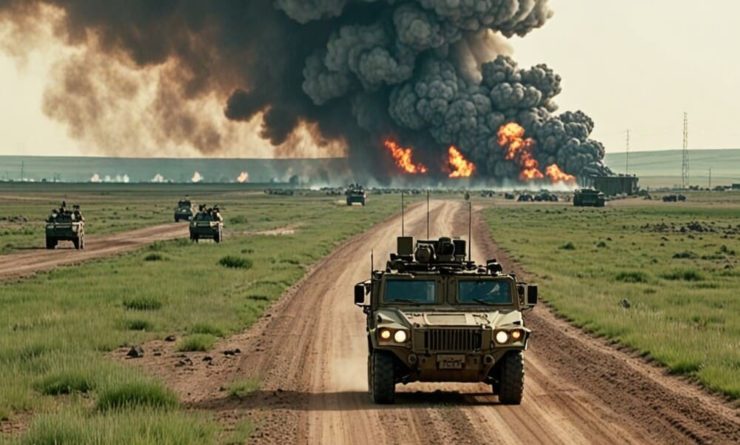
By Brian Berletic – New Eastern Outlook – 21.08.2024
In the lead up to the Ukrainian military’s incursion into Russia’s Kursk region, even Western headlines were dominated by reports of Ukraine’s gradual demise. Ukraine is admittedly suffering arms and ammunition shortages, as well as facing an unsolvable manpower crisis. Russia has been destroying Ukrainian military power faster than Ukraine and its Western sponsors can reconstitute it.
Western headlines have also been admitting the scale on which Russia is expanding its own military power as its Special Military Operation (SMO) continues into its third year.
While the launch of Ukraine’s incursion into Kursk has diverted attention away from Ukraine’s collapsing fighting capacity, the incursion itself has not only failed to address the factors leading to this collapse, it is already accelerating it.
Politico in an August 15, 2024 article titled, “As Kyiv makes gains in Kursk, Russia strikes back in Donetsk,” cites the spokesman of Ukraine’s 110th Mechanized Brigade who would admit, “since Ukraine launched the Kursk offensive I would say things have become worse in our part of the front. We have been getting even less ammo than before, and the Russians are pushing.”
The same article would also cite “Deep State,” a mapping project Politico claims is “close” to Ukraine Ministry of Defense, claiming, “over the past 24 hours, Russia occupied the villages of Zhelanne and Orlivka and made advances in New York, Krasnohorivka, Mykolaivka and Zhuravka in Donetsk.”
Thus, while Ukraine claims gains in Kursk, it comes at the expense of territory everywhere else along the line of contact.
Because of the nature of the fighting in Kursk where Ukrainian forces have come out from behind extensive defensive lines and are operating out in the open, they are suffering much greater losses than Ukrainian units being pushed back along the line of contact, according to even the Western media.
Superficial Success, Strategic Suicide
Despite this reality, the Western media has invested heavily in depicting Ukraine’s Kursk incursion as a turning point in the fighting.
CNN in its August 15, 2024 article, “Russia appears to have diverted several thousand troops from occupied Ukraine to counter Kursk offensive, US officials say,” attempts at first glance to portray the Ukrainian operation as having successfully diverted Russian forces from the front lines.
Buried deeper in the article, however, CNN reveals that whatever troops Russia is moving are relatively insignificant compared to the number of Russian forces still fighting along the line of contact primarily in Kherson, Zaporozhye, the Donbass, and Kharkov.
In the short-term, experienced forces utilized as a mobile reserve are likely being moved to Kursk until Russian reserves within Russia itself can be sufficiently mobilized and moved to the area of fighting. The vast majority of Russia’s forces not only remain along the actual line of contact, they continue making progress at an accelerated rate.
The same CNN article would quote US officials, saying:
Some officials also raised concerns that Ukraine, which one western official said has sent some of its more experienced forces into Kursk, may have created weaknesses along its own frontlines that Russia may be able to exploit to gain more ground inside Ukraine.
“It’s impressive from a military point of view,” the official said of the Kursk operation. But Ukraine is “committing pretty experienced troops to this, and they can’t afford to lose those troops.”
“And having diverted them from the front line creates opportunities for Russia to seize advantage and break through,” this person added.
Buried under optimistic headlines across the Western media regarding this latest incursion is an ominous truth – that an operation aimed at humiliating Russia, boosting morale, and raising the political, territorial, and military costs for Russia, has only brought Ukraine deeper into its growing arms, ammunition, and manpower crisis.
Toward what end does an incursion accelerating the collapse of Ukraine’s fighting capacity serve?
Washington’s, Not Kiev’s Ends
CNN would also attempt to convince readers that the Kursk incursion took the US itself entirely by surprise. This is untrue.
The United States, following its political capture of Ukraine in 2014, admittedly took over Ukraine’s intelligence networks. These are the same networks that would have been required to organize this most recent incursion.
A New York Times article, “The Spy War: How the C.I.A. Secretly Helps Ukraine Fight Putin,” not only admits to the CIA’s role in training, shaping, and directing Ukrainian intelligence operations, but also admits to a network of CIA bases along the Ukrainian-Russian border and the fact that the CIA stood up covert military units specifically for crossing over into Russian territory and conducting operations there.
The CIA and other US military and intelligence agencies have been involved in Ukrainian military operations leading up to and all throughout the duration of Russia’s SMO. The Washington Post admits that the US worked with Ukraine to “build a campaign plan” ahead of the failed 2023 Ukrainian offensive.
It is inconceivable Ukraine moved multiple brigades of manpower and equipment, including US-European trained soldiers and Western military equipment to Sumy where the Kursk incursion was launched without Washington’s involvement, let alone without Washington’s knowledge.
Why then did the US organize such an incursion, one admittedly overstretching Ukrainian forces already crumbling under the growing weight of Russian military power? Why, amid Russia’s strategy of attrition, have US planners decided to launch an incursion that will accelerate the loss of Ukrainian manpower, arms, and ammunition it does not have to spare?
In a much wider geopolitical context – Washington’s geopolitical context – the incursion helps raise the cost of victory for Russia in Ukraine as the US seeks to place pressure on and overextend Russia elsewhere within and along its borders.
Years before the SMO even began, as far back as at least 2019, US policymakers openly sought to draw Russia into a costly conflict in Ukraine, just one among many other proposals meant to overextend Russia.
The RAND Corporation in its 2019 paper “Extending Russia” would explain the benefits of “providing lethal aid to Ukraine,” stating:
Expanding U.S. assistance to Ukraine, including lethal military assistance, would likely increase the costs to Russia, in both blood and treasure, of holding the Donbass region. More Russian aid to the separatists and an additional Russian troop presence would likely be required, leading to larger expenditures, equipment losses, and Russian casualties. The latter could become quite controversial at home, as it did when the Soviets invaded Afghanistan.
Ukraine’s incursion into Kursk has – at a minimum – raised the political cost of Russia’s ongoing SMO. This most recent incursion into Kursk almost certainly had hoped to reach the Kursk Nuclear Power Plant, just 35 kilometers beyond the furthest extent the incursion has reached as of this writing. Had Ukrainian forces reached the power plant, the price would have been even higher.
In many ways, however, the Kursk incursion has created a much greater strategic dilemma for Ukraine than it has for Russia. While it has unfolded on the wrong side of the border, the outcome is the same as the Kharkov front Russia opened earlier this year.
Regarding the Kharkov front, the New York Times in its May 2024 article, “Facing Russian Advance, a Top Ukrainian General Paints a Bleak Picture,” would admit, “the Russian attacks in the northeast are intended to stretch Ukraine’s already thin reserves of soldiers and divert them from fighting elsewhere,” and that, “the Ukrainian army was trying to redirect troops from other front-line areas to shore up its defenses in the northeast, but that it had been difficult to find the personnel.”
By committing thousands of Ukrainian troops and large amounts of Ukraine’s best military equipment to an incursion into Kursk, it is creating the same overextension of its own forces Russia had created in Kharkov last May, but with the added complication of needing to extend logistics and other means of supporting Ukrainian operations beyond Ukrainian territory itself.
The same RAND Corporation paper proposing to draw Russia into a costly conflict with Ukraine would also discuss the consequences this conflict would have for Ukraine itself, explaining:
… such a move might also come at a significant cost to Ukraine and to U.S. prestige and credibility. This could produce disproportionately large Ukrainian casualties, territorial losses, and refugee flows. It might even lead Ukraine into a disadvantageous peace.
The plan from the very beginning was to lure Russia into a costly conflict in the hopes of precipitating a Soviet-style collapse, but at the expense of Ukraine’s own survival. Thus, what we see unfolding in Ukraine today is simply the consequences predicted by the RAND Corporation in 2019.
Dangerous Escalation and the Long Game
Perhaps most concerning of all is the looming prospect of the US intervening more directly, including in the form of a “buffer zone” similar to that created by the US and its Turkish allies in the east and north of Syria during Washington’s proxy war there.
For this intervention to succeed, Russia would have to be compelled to restrain itself from attacking Western forces arriving in Ukraine.
The possibility of this happening is difficult to predict.
On one hand, Russia has demonstrated immense patience amid other US proxy wars. Russian patience in Syria is finally paying off after almost a decade of enduring US provocations and the presence of US troops east of the Euphrates River. The US now finds itself isolated and vulnerable in Syria, its forces under regular attack there, and a disproportionate amount of US military hardware remains committed to both Syria and the surrounding region, limiting US combat power ahead of a potential conflict with Russia in Eastern Europe or China in the Asia-Pacific.
Moscow may determine that a Western intervention directly into Ukraine will, over time, collapse under its own weight in a similar manner. In the long term, the US is only going to grow weaker and more isolated as a result of its unsustainable, overreaching foreign policy. Initiating direct conflict with the US now, when it is inevitably going to be weaker later, would be permitting the US a potential and unnecessary advantage.
Instead, Russia and its allies may find an opportunity to exercise many of the means of escalation (short of direct conflict with the US itself) they have held in reserve throughout the duration of this conflict. This includes more open and direct military cooperation between Russia and China, including the arming of Russian forces with Chinese manufactured weapons and ammunition.
On the other hand, Russia may decide to restrain itself from attacking Western forces arriving in Ukraine’s westernmost regions, but continue military operations along the line of contact and obviously within Kursk itself to expel Ukrainian forces. The US would seek to test the limits of Russian resolve, seeking to constrain Russian operations as much as possible, just as the US did in Syria from 2015 onward.
Throughout this process, the potential for escalation and direct conflict between Russia and the US will grow.
Despite the continued collapse of Ukraine’s fighting capacity because Ukraine is ultimately a proxy of the United States, a difficult and dangerous transition period lies ahead dependent on the extent to which the US seeks to mitigate Ukraine’s subsequent political and territorial collapse.
Only time will tell whether the US cuts and runs as it did in Afghanistan, or doubles down as it did in Syria. It should be pointed out, however, that the US withdrew from Afghanistan in 2021 to redirect its resources ahead of Russia’s SMO in 2022. Were the US to cut Ukraine loose, it would only be because the US requires resources for a larger, more dangerous conflict elsewhere – namely in the Asia-Pacific region against China.
Either way, when Ukraine’s fighting capacity nears its end, it is likely only wider conflict awaits.
Featured Video
America Racing to Strategic Defeat in Iran
or go to
Aletho News Archives – Video-Images
From the Archives
Should Europeans ‘Thank’ the Americans for Destroying Nord Stream?
By Robert Bridge | Strategic Culture Foundation | September 29, 2022
With an investigation continuing into the destruction of the Nord Stream gas pipeline that provided energy supplies to Europe from Russia, there appears to be just one prime suspect, and that should surprise nobody.
Following the sabotage of the Nord Stream 1 and 2 gas pipelines, former Polish Foreign Minister Radoslaw Sikorski already seemed to know the identity of the perpetrator when he tweeted out: “Thank you, USA.”
At first glance, it seemed that Sikorski was speaking sarcastically, berating Washington for carrying out an attack that will have severe repercussions for the people of Europe. After all, how could anyone see any good coming from the termination of Europe’s primary source of gas reserves with winter just around the corner? It was Sikorski’s homeland of Poland, after all, that urged its citizens to collect firewood in the face of dwindling gas reserves.
In fact, the Polish diplomat was speaking one-hundred percent literally… continue
Blog Roll
 Aletho News
- Growing insecurity, soaring prices fuel protests in north as regime bans evacuation: Sources
- Iran denies responsibility for ‘depraved’ attack on Kuwait desalination plant
- Bring The Troops Back. End This War Now!
- Can we please stop calling Israel the ‘only democracy in the Middle East’ now?
- US should start removing its troops for Germany, proposes AfD co-leader Chrupalla
- Iran Red Crescent: 600 educational centers attacked in US-Israeli ‘war crimes’
- Russian Oil Tanker Arrives in Cuba Amid U.S. Blockade
- America Racing to Strategic Defeat in Iran: Lt Col Daniel Davis
- FTC Warns Visa, Mastercard, PayPal, Stripe Over Political Debanking
- Russian tanker approaches Cuba despite US oil blockade
- If Americans Knew
- Israeli police block Catholic cardinal from entering Church of the Holy Sepulchre on Palm Sunday
- Israel is assassinating journalists again, more than any other nation, anywhere, ever – Not a ceasefire Day 170
- Over 300 US service members wounded, majority have brain injuries – Not a ceasefire Day 169
- Researchers at Human Rights Watch Resign Over Blocked Report on Palestinian Refugee Return
- Jewish Groups Are Backing a War Americans Don’t Want
- Eric Fingerhut Thinks He’s the President of the Jews
- Top Jewish Philanthropists, Rabbis Urge Israeli President to Take Action Against ‘Jewish Extremists’
- Don’t Be Fooled. Zionist Leaders Have Always Wanted to Control Southern Lebanon
- Israel’s widespread use of torture is a core element of its genocide against the Palestinian people
- In Israel’s War on Iran, Many Middle East US Bases Rendered “All But Uninhabitable”
- No Tricks Zone
- New Study Finds Warming Saves Lives…Cold Temperatures 12 Times More Deadly Than Excess Heat
- German Science Blog Accuses PIK Climate Institute Of Hallucinating Climate Tipping Points
- Devastating Assessment Of Comirnaty Vaccine By Former Senior Pfizer Europe Toxicologist
- New Study: CO2 Is ‘Effectively Negligible’ As An Explanatory Climate Change Factor Since 2000
- Former Pfizer Toxicologist Dr. Helmut Sterz Tells Bundestag Hearing Pfizer Vaccine Should Have Never Been Approved
- Energy Expert: Germany’s Nuclear Phaseout Was A “500 Billion Euro Mistake”
- New Research: South Australia’s Mid-Holocene Sea Surface Temperatures Were 4°C Warmer Than Today
- Storing Green Energy To Last Germany 10 Days Would Require A 60-Million Tonne Battery
- New Studies: UK Sea Levels Were 4 Meters Higher Than Today During The Mid-Holocene
- Destructive Green New Deal: German Energy And Metal Group Warns Of Drastic Crisis
 Aletho News