Russia steps in to quell tensions between US proxies and Syrian tribes
The Cradle | August 14, 2024
The US-backed Syrian Democratic Forces (SDF) ended on 13 August the siege it had imposed on the northern Syrian cities of Hasakah and Qamishli for the past week, thanks to the mediation of the Russian army.
“All roads that were closed to civilian movement have been opened, with the start of the entry of water, fuel, flour and food tankers into the centers of the cities of Al-Hasakah and Qamishli. Things have returned to how they were before the siege,” Hasakah governor Louay Sayyouh told Al Mayadeen on Tuesday.
Russian military officials held talks with SDF and Syrian army representatives in Qamishli on 13 August, Al Mayadeen and Sputnik reported.
Sputnik’s correspondent said “intensive Russian efforts” took place during the meeting between the commander of Russian forces in Syria and the head of the SDF, Mazloum Abdi, aimed at lifting the SDF siege and de-escalating tensions in the eastern Deir Ezzor governorate, where a large Arab tribal rebellion against Washington’s Kurdish proxy is ongoing.
“There was an initial agreement on the necessity of releasing all detainees in the Syrian army held by the SDF in the cities of Qamishli and Hasakah, along with the necessity of lifting the siege imposed by the SDF on the neighborhoods under the control of the Syrian Arab Army in the cities of Hasakah and Qamishli,” the Sputnik correspondent said.
The SDF siege on Damascus-held areas of Hasakah and Qamishli had been ongoing for the past seven days and was imposed in response to the Arab tribal offensive against the Kurdish militant group last week.
Prior to the Russian visit to Qamishli, which began last week, SDF leaders had “rejected mediation and insisted on continuing the siege,” according to Syrian journalist and TV presenter Haidar Mustafa.
Mustafa added that the SDF siege tactic will not “deter the tribal ‘resistance’ from continuing its project aimed at pressuring the US occupation and its Kurdish militias.”
The Russian mediation came as US forces continued attacks on Syrian army positions in the countryside of Deir Ezzor in support of its SDF allies, who are engaged in clashes with a coalition of Arab tribesmen said to be receiving support from Damascus. SDF forces have also been targeting Syrian military positions with artillery in recent days.
“US Army forces launched a violent attack using heavy artillery and drones on positions of the Syrian army’s auxiliary forces in the villages and towns of Khasham, Marat and Hawijat Sakr in the northeastern countryside of Deir Ezzor,” Sputnik’s correspondent reported during the early hours of 14 August.
The source of the US fire was Washington’s illegal military base in the Conoco oilfield.
On Sunday, several Syrian army soldiers were killed and others wounded in an airstrike targeting a vehicle near Syria’s eastern city of Al-Bukamal on the Syrian–Iraqi border. The strike was widely believed to have been carried out by US forces that had attacked Syria several times since last week’s tribal assault.
A coalition of Syrian Arab tribes launched a massive offensive against the SDF in Deir Ezzor’s countryside on 7 August as part of a rebellion launched against the US-backed militants last year.
The tribal fighters have since lost some of the towns and positions they managed to capture as a result of US air cover provided to the SDF.
The SDF helps oversee oilfields occupied by the US army in Syria and is complicit in Washington’s theft of the country’s natural resources.
It has also released hundreds of ISIS fighters held in its prisons across northern Syria – who have then gone on to attack Syrian troops and civilians.
The rebellion against the Kurdish militants represents a broader rejection of US occupation in Syria.
“The events unfolding today in Syria’s eastern region are a result of the repercussions of the Palestinian resistance’s Operation Al-Aqsa Flood and the broader spillover of conflicts across West Asia … while some may view the recent developments as a local conflict – either between Arab clans or between Arab clans and Kurds – the reality suggests otherwise, as the clans find common cause and common targets with the Axis of Resistance,” political affairs writer and researcher Dr Ahmed al-Druze told The Cradle on 12 August.
US, South Korea Preparing to Begin Provocative War Games
By Kyle Anzalone | The Libertarian Institute | August 13, 2024
The US and South Korea are preparing to kick off large-scale war games later this month. The summertime joint military drills are viewed by Pyongyang as an annual rehearsal for invading North Korea.
The war games, dubbed Ulchi Freedom Shield, are set to begin on August 19 and run through the end of the month. At least 19,000 Korean soldiers will participate. The Pentagon has not released the number of American troops that will be involved. The drills will include computer simulations and live-fire operations.
“This exercise will reflect realistic threats across all domains such as the Democratic People’s Republic of Korea’s missile threats and we will take in lessons learned from recent armed conflicts,” Ryan Donald, spokesperson of US Forces Korea, said when describing the drills. “ROK and US units will execute combined field training exercises across all domains. Field maneuver and live fire exercises will strengthen the alliance’s interoperability while showcasing our combined capabilities and resolve.”
Ulchi Freedom Shield military drills, and other large-scale US and South Korean war games, typically result in North Korea testing missiles or conducting reciprocal war games.
Tensions on the Korean Peninsula have heightened under President Joe Biden. Over the past three and a half years, the US has conducted more live-fire war games, deployed nuclear-capable military assets to the region, and increased trilateral security cooperation between Tokyo, Washington, and Seoul.
North Korean Supreme Leader Kim Jong Un has reacted sharply to Biden’s militarism, compared to the diplomacy offered by Donald Trump. Pyongyang has executed several missile tests and drills in response to Washington and Seoul’s aggressive military posture.
Adding to the tensions between Washington and Pyongyang is North Korea’s developing relationship with Russia. After the Kremlin ordered the invasion of Ukraine, the White House attempted to isolate Russia from the rest of the world. However, Moscow has found several Asian partners including North Korea, China, and Iran.
PM Kishida Who Militarized Japan at US’ Behest to Resign
By Oleg Burunov – Sputnik – 14.08.2024
Japanese Prime Minister Fumio Kishida has announced he will quit as leader of the country’s ruling Liberal Democratic Party (LDP), amid his sinking approval rating resulting from the LDP-related corruption scandal, rising living costs, and a slumping yen.
Under Kishida, Japan pledged to double its defense spending up to the NATO standard of two percent of gross domestic product by 2027, in a US-encouraged U-turn from decades of strict pacifism.
Public support for Fumio Kishida’s Cabinet plummeted to 15.5% last month, another low since the LDP returned to power in Japan in December 2012.
Apart from his poor domestic strategy, what developments have marked Kishida’s foreign policy?
- Japan under Kishida has fueled the Ukrainian conflict by providing more than $12 billion of financial and other aid to the Kiev regime since 2022, per the Japanese Foreign Ministry.
- Japan embarked on the path of militarization, issuing in 2022 a new national security doctrine aimed at doubling the country’s defense spending within the next five years.
- The same year, Japan’s parliament did not think twice before approving a deal to spend $8.6 billion over five years to host American military personnel on Japanese soil.
- Tokyo continues to take part in the annual US-led RIMPAC, the world’s largest maritime military drills described by Chinese experts as “demonstration of America’s hegemony” in the region.
- The US currently has about 56,000 active-duty service members in Japan, more than in any other country, according to Pentagon data.
- Last month, Japan agreed on establishing a Joint Operations Command (JJOC) with the US on its territory by next March.
- What’s more, Tokyo and Washington reportedly discussed “extended deterrence”, which stipulated for the use of nuclear weapons in US protection of Japan.
- The US is now pushing for Japan to be included in Pillar II of the AUKUS agreement. China has repeatedly castigated the arrangement as part of America’s “new Cold War” antagonism aimed at containing Beijing by fueling the militarization of the Asia-Pacific region.
‘Sabotage’ fears at German military base – Der Spiegel
RT | August 14, 2024
A military base in the German city of Cologne was placed on lockdown on Wednesday over fears of a potential act of sabotage, Der Spiegel has reported. A spokesperson for the German Defense Ministry has confirmed that security services have launched an investigation.
In recent months, several Western media outlets as well as officials have alleged that Russia has been stepping up efforts to conduct acts of sabotage on European soil. Moscow’s presumed endgame is to disrupt the delivery of Western weapons to Ukraine and the training of Kiev’s troops abroad.
Moscow has consistently dismissed the allegations as “not serious” and “unfounded.”
In its article on Wednesday, Der Spiegel reported that the Bundeswehr barracks had been completely sealed off, with police and military counter-intelligence services looking into a potential case of unauthorized entry.
According to the media outlet, it is suspected that saboteurs might have contaminated water supply at the military facility. The outlet cited presumed internal instructions disseminated among the personnel warning against using water from the base’s utility system.
The article alleged that military personnel at the base had also been instructed to be on the lookout for any unknown individuals and to report “suspicious behavior” on the grounds. Der Spiegel speculated that security services may be searching the base for potential saboteurs, with a suspicious individual allegedly sighted near the fence that encloses the complex. The individual is understood to have fled after being detected.
The media outlet also reported that, on closer inspection by military police, an opening in the fence had been uncovered.
According to the article, cases of gastrointestinal disease have been reported at the base of late, though it is not clear whether these had anything to do with water supply at the installation.
The barracks in Cologne is where several Bundeswehr command units are stationed. On top of that, the installation houses the German Air Force, with Cologne Airport immediately adjacent to the base, Der Spiegel noted. According to its estimates, a total of 5,500 military and civilian personnel work at the military facility.
The base is also said to be a key hub for Ukrainian service members returning home after receiving military training in Europe.
Back in April, the German Prosecutor General’s Office reported that two German-Russian dual nationals had been arrested on suspicion of planning to sabotage local military infrastructure.
Around the same time, the head of German domestic intelligence, Thomas Haldenwang, warned that the risk of acts of sabotage had “significantly increased” in the country.
Georgia lays blame for 2008 war with Russia

RT | August 14, 2024
Former Georgian president Mikhail Saakashvili was responsible for the country’s conflict with Russia in 2008, and acted on instructions from external forces, the ruling party in the former Soviet state has said.
The five-day war erupted on the night of August 8, 2008, when US-backed Saakashvili sent troops into Georgia’s breakaway region of South Ossetia, shelling a base used by Russian peacekeepers who had been in the republic since the 1990s.
Then Russian President Dmitry Medvedev ordered a “peace enforcement” operation in response, which led to the defeat of Tbilisi’s forces. On August 26, Moscow recognized the independence of South Ossetia and another breakaway region, Abkhazia.
The political council of the ruling Georgian Dream party said in a statement on Tuesday that a public legal process was necessary to establish “who committed a treacherous crime against our country and people [in 2008].” This was required in the interests of long-term peace and stability, the party stated.
“The majority of Georgian society rightly doubts Saakashvili’s adequacy. However, the fact is that Saakashvili’s reckless actions in August 2008 were not a result of his mental instability, but a result of the instructions from the outside and a well-planned betrayal,” the statement read.
Georgian Dream did not identify the external forces that it claims directed the actions of the Georgian president 16 years ago.
Last week, Georgian Prime Minister Irakli Kobakhidze said the government would address the Prosecutor’s Office, the Constitutional Court, or set up a parliamentary commission to look into the events of 2008. According to Kobakhidze, Saakashvili, who is serving a six-year prison sentence, could face additional charges of treason over his role in the conflict with Russia. Such an offense carries a maximum punishment of life in prison.
Saakashvili was voted out of office in 2013 and fled to the US. He also has a Ukrainian passport, which he obtained during a brief stint as governor of the country’s Odessa Region in 2015-16.
The former president was detained in October 2021 after secretly returning to Georgia during an election in the country. The authorities in Tbilisi accused Saakashvili of abuse of power, organizing attacks on political opponents, embezzlement, and other offenses during his time in office between 2004 and 2013.
The 56-year-old has remained in hospital in the Georgian capital since March 2022 due to deteriorating health. Saakashvili insists that the prosecution is politically motivated. His lawyers claim that the politician, who has lost a significant amount of weight in custody, is not receiving adequate medical care.
Why neutral Austria joined the EU sanctions policy against Russia
By Patrick Poppel | August 14, 2024
It is known that the then Foreign Minister Sebastian Kurz campaigned very strongly for the establishment of sanctions against Russia in 2014, but a lot of time has passed since this situation and yet a neutral state like Austria is still in line with the sanctions policy against Russia.
You have to ask yourself why Austria plays such a role even though it doesn’t really fit the identity of a neutral state in full. Austria’s task would be to play a role as a mediator and not as a supporter of the EU’s aggressive policy against Russia. Inexperienced and young politician Sebastian Kurz brought Austria’s foreign policy in accordance with the EU requirements and transatlantic forces and then quickly became Chancellor of Austria.
Behavior against national interests is immediately rewarded by the structures in the background. Although Austria has always been the place for mediation between rivals in Europe, that has changed radically with the support of sanctions against Russia. Back in 2014, Austria was chosen as an example to show all European politicians that it is important to establish sanctions against Russia.
If a neutral state like Austria supports sanctions, then states that are members of NATO will no longer consider discussing them. The unified willingness of all EU states to impose sanctions against Russia can only be explained by the fact that an atmosphere of unanimity was created.
Since sanctions also damage one’s own economy, such a rigid measure must always be carefully analyzed and discussed beforehand. But that was not done because the established political atmosphere made it clear that sanctions must be imposed at all costs.
“If Austria is also for sanctions, then everyone is for it!” was the logic of the politicians. This course started in 2014 and continues to this day without letup.
The argument that if even a neutral state supports the sanctions it is legitimate is, of course, an ingenious manipulation. The question now naturally arises as to whether this situation arose by chance due to the incompetence of Austrian politics or whether it is a planned process. The second possibility becomes more and more likely when the facts are analyzed more closely.
It was immediately clear to everyone that the sanctions would be very dangerous for the Austrian economy and this political action does not fit with the Austrian political culture of neutrality. It is certainly possible that the behavior of politicians was prepared and influenced here from the outside.
The only question is who benefited from it. The large lobby of Austrian business and industry did not benefit from the sanctions. Although this lobby had massive influence on the government at the time, support for sanctions against Russia could not be prevented. Actually, this seems inexplicable for observers. Why weren’t there protests from business people immediately at the start of the sanctions?
There are events in world history that happen by chance and have a major impact on the future, but when it comes to Austria’s sanctions policy against Russia a plan and a structure are clearly visible. Since not a single business in Austria benefited from this development, this operation can only have been controlled from abroad. It will be very difficult to prove this, but this foreign influence is the only explanation for the behavior of Austrian politicians.
Of course, one can also think in detail about the role of the Austrian government which actually has the task of warding off foreign influence on the government. As a small country, Austria is exposed to strong influence from the big geopolitical players.
The fact that many important international organizations are located in Austria also makes Austria a target for foreign secret services, but also a place for general foreign interests. Austrian politicians are more exposed to these influences than politicians from other countries and the agents who work in Vienna easily get contact and access to important people in the state.
The Austrian government’s decision to support sanctions against Russia was not understood by many people because it was against common sense. But we are currently living in a time where a lot of developments are happening in the background. We live in a time in which it is very easy to quickly transmit information and coordinate actions that have been planned long in advance.
Just as the Maidan uprising was planned a long time ago, these forces have dealt with and prepared for the possible establishment of sanctions. If you follow the principle “Who benefits?”, it is clear that the Austrian government’s decision at the time is of no use to the government or the population in the long term. The sanctions only help those who cannot be affected by them.
The current fact that OMV (Austrian Mineral Oil Administration) will withdraw from the contract with its Russian partners can only be explained by external influence. Austrians will have to pay a lot more for gas in the future. The population will accept this because the media does not accurately report the reasons for it. All of these facts can be put together to form a picture and the result is that Austria plays a crucial negative role in imposing sanctions against Russia.
Patrick Poppel, expert at the Center for Geostrategic Studies, Belgrade.
Major US academic group approves boycott of Israel in a historic U-turn
MEMO | August 13, 2024
In a major U-turn, the American Association of University Professors (AAUP) has reversed its long-standing opposition to academic boycotts in the wake of last month’s International Court of Justice (ICJ) ruling that accused Israel of practicing apartheid. The ICJ’s decision, coupled with its ongoing investigation into allegations of genocide by Israel in Gaza and the potential for Israeli leaders to face arrest warrants from the International Criminal Court (ICC), appears to have prompted the AAUP to reconsider its long-standing position on academic boycotts.
The AAUP, a union dedicated to safeguarding academic freedom with 500 chapters on campuses across the US, approved a new statement marking a departure from the organisation’s previous stance articulated in its 2006 report “On Academic Boycotts”. Since its founding in 1915, the AAUP has helped to shape American higher education by developing the standards and procedures that maintain quality in education and academic freedom in this country’s colleges and universities.
AAUP’s new policy acknowledges that academic boycotts can be legitimate responses to certain circumstances. The statement reads, “Academic boycotts are not in themselves violations of academic freedom; rather, they can be considered legitimate tactical responses to conditions that are fundamentally incompatible with the mission of higher education.”
Crucially, the AAUP now holds that “individual faculty members and students should be free to weigh, assess, and debate the specific circumstances giving rise to calls for systematic academic boycotts and to make their own choices regarding their participation in them.” The organisation argues that to do otherwise would contravene academic freedom.
The statement is careful to delineate the boundaries of acceptable boycott practices. It explicitly states that academic boycotts should not involve political or religious litmus tests, nor should they target individual scholars engaged in ordinary academic practices. Instead, boycotts should “target only institutions of higher education that themselves violate academic freedom or the fundamental rights upon which academic freedom depends.”
While the AAUP’s statement does not specifically mention Israel, the timing of this policy change, coming after the ICJ’s ruling and amidst multiple investigations into Israel’s military campaign in Gaza, which has killed nearly 40,000 Palestinians, mainly women and children, strongly suggests that the situation in the besieged enclave has played a major role in prompting this reconsideration.
This policy shift by the AAUP aligns more closely with actions taken by other academic associations in recent years. For instance, the American Studies Association approved measures to boycott Israeli universities a decade ago, and the American Anthropological Association followed suit last year.
CAIR files lawsuit against FBI, US govt agencies over blacklisting of Palestinian-Americans
MEMO | August 13, 2024
An American Muslim advocacy group has filed a lawsuit against the Federal Bureau of Investigations (FBI) and the leaders of other United States government agencies after two Palestinian-American men were blacklisted due to their pro-Palestine activism.
On Monday, the Council on American-Islamic Relations (CAIR) filed the lawsuit in response to what it called a discriminatory and racist placement of two Palestinian Americans – Osama Abu Irshaid and Mustafa Zeidan – on a watch list by US federal authorities.
According to the lawsuit, Irshaid, the Executive Director of an organisation named American Muslims for Palestine, travelled to Qatar from the US in late May and returned in early June. Upon his return, federal agents forced him to undergo extra screening and questioning – reportedly focusing on his activism and organising against Israel’s offensive on Gaza – while seizing his phone, which has not yet been returned.
The California-based Zeidan, meanwhile, who often visits his ailing mother in Jordan, was not allowed to board a flight on his way to the country earlier this year, with authorities later informing him that he was placed on the no-fly list.
Filed in the US District Court for the Eastern District of Virginia, the lawsuit stated that “CAIR is challenging the mistreatment of these Palestinian-American activists on constitutional grounds”, asserting that their blacklisting is based on discrimination and racism rather than actual criminal or national security concerns. “Neither Dr. Abu Irshaid nor Mr. Zeidan have ever been charged or convicted of a violent crime,” it said.
Aside from the FBI, other defendants named in the lawsuit are the leaders of government agencies, including the State Department and the Homeland Security Department.
Explainer: What are the scenarios and potential targets of retaliatory strike on Tel Aviv?
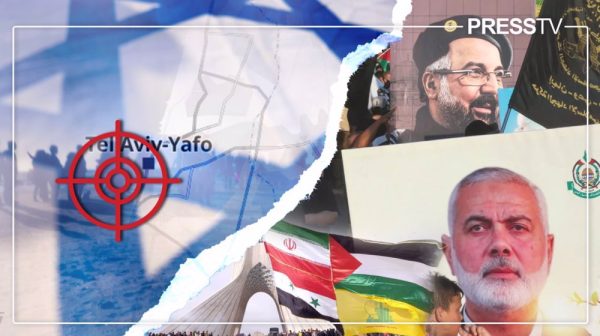
By Ivan Kesic | Press TV | August 13, 2024
The stage is set for the retaliatory military operation against the Israeli regime in response to the cowardly assassinations of top-ranking Axis of Resistance commanders in Tehran and Beirut.
Although the nature of the retaliation and its precise timing remains shrouded in mystery, the embattled regime in Tel Aviv, already grappling with an internal political and social crisis, has been paralyzed with fear.
Illegal settlers have also been fleeing the occupied Palestinian territories in panic, anticipating a response that pales in comparison with Iran’s ‘Operation True Promise’ that followed an attack on Iran’s consulate building in the Syrian capital of Damascus in April.
There are scores of military sites in Tel Aviv that could be targeted to punish the Israeli regime for terrorist attacks that claimed the lives of Hamas political bureau leader Ismail Haniyeh and Hezbollah military commander Fuad Shukr.
Our analysis shows the most likely targets in Tel Aviv could be the centers affiliated with the Israeli spy agency Mossad, which had a key role in the assassinations of Haniyeh and Shukr.
This analysis is supported by the fact that the Ramon and Nevatim air bases of the Israeli regime were successfully targeted in the retaliatory military action in April since the warplanes that attacked the Iranian consulate in Damascus had taken off from them.
Taking that into consideration and the fact that simultaneous attacks in Tehran, Beirut and Iraq were carried out with the order and cooperation of the highest Israeli political, military and intelligence structures, their headquarters are primary targets.
The likelihood of these targets is further supported by a report by the Al-Hadath news channel, which revealed that employees of four intelligence and military agencies of the Israeli regime were evacuated on Thursday from their sites in Tel Aviv.
These headquarters are located in the densely populated metropolitan Tel Aviv, known as the Gush Dan, where half of the settler population of the Zionist entity lives, in contrast to the two aforementioned air bases in uninhabited desert areas.
Among them, an area of exceptional importance is Kirya, a district in central Tel Aviv, which is home to many administrative buildings and the military intelligence Camp Rabin that serves command, administrative, communications, and support functions for the Israeli military apparatus.
This camp has served as the headquarters of the armed forces of the Zionist entity since its establishment in 1948 and is encircled on all sides by densely populated civilian areas.
The main building in the camp is the Matcal Tower, which houses the offices of the top brass of the Israeli military, surrounded by other high-rise military facilities, such as the communications office Marganit Tower.
The Kirya district, known as the “Israeli Pentagon,” is much larger in scope than it looks on the map or is officially recognized, due to underground facilities and classified offices in nearby areas.
Beneath the military complex is the Bor (literally pit), the heavily fortified underground national military command center that is located a few blocks away from the former prime minister’s office, which has been moved now to occupied Jerusalem al-Quds.
The Bor is accessed through a large steel door that is sealed shut in the event of a non-conventional attack, and at the entrance, there is a big sign reminding visitors to remove the batteries from their cellphones before entering.
Long stairs lead deep into the operations rooms where regime officers prepare, organize and discuss future wars with their neighbors, Syria, Lebanon and Palestine, including the ongoing genocidal war against Gaza.
Even deeper, there is the chief of general staff’s conference room with a U-shaped table and a wall lined with plasma TV screens, where top officers meet almost weekly for highly classified discussions and a review of operational plans.
This facility is relatively well protected from attacks by short-range missiles, cruise missiles and kamikaze drones, but not from larger ballistic missiles with deep penetration power and a one-ton high-explosive warhead, so it is a high-value target.
Headquarters of intelligence services are classified, without official addresses, and most often masqueraded as civil function buildings.
In recent decades, the Israeli regime authorities have started selling land in Kirya, on which many “multipurpose” high-rises have been built, due to its attractive location in the center of the city.
This “multi-purpose” most often implies the regime and some other function, with the former containing multi-levels of the regime, military and intelligence offices.
The wider metropolitan area of Tel Aviv is also home to numerous factories, military bases and other regime buildings that can be the target of retaliatory strikes.
At least three large military facilities on the edges of the Tel Aviv metropolitan area are also possible targets, especially in case of new Israeli attacks and further escalation.
First among them is the operational headquarters of military intelligence unit 8200, located in the north near the city of ‘Herzliya’, where the collected information is processed and further forwarded to military strategists and other Israeli intelligence agencies.
Another site is Palmachim Airbase, located a few kilometers south of the metropolitan area, the main base for the Israeli regime’s drone, missile and space programs.
Finally, there is also a vast military zone around the Tel Nof and Sdot Micha air-missile bases, between Tel Aviv and occupied Jerusalem al-Quds, where numerous squadrons, special forces, missile silos and bunkers, arms warehouses, including nuclear warheads, are stationed.
Iran: E3 demands are public support for Israeli crimes
Al Mayadeen | August 13, 2024
Iranian Foreign Ministry spokesperson Nasser Kanaani responded to the E3’s (UK, France, Germany) statement on Tuesday, underscoring that Iran is “steadfast and resolute in exercising its right to protect its national security and territorial integrity” and “does not seek permission from any external party.”
In a press statement, Kanaani added that the European Troika’s demand for Iran not to respond to the “Israel’s” and punish it, “a crude demand that lacks any political logic and contradicts international laws and resolutions.”
He emphasized that the European trio’s statement reflects a public endorsement of the Zionist entity’s crimes and regional terrorism. He added that “if the European Trio genuinely seeks to promote peace in the region, it must, at the very least, condemn the Zionist entity’s actions and its genocidal activities in Gaza.”
Kanaani also pointed out that “the indifference of Western countries towards the crimes of the Israeli entity and its ongoing genocide of the defenseless Palestinian people, and the failure to hold it accountable, has encouraged it to escalate its atrocities.”
He explained that “Germany, France, and Britain have not taken any measures to halt the Zionist entity’s ongoing brutal crimes, and international organizations have similarly failed to deter these actions,” stressing that “both the West and the Security Council must take decisive responsibility to stop the severe Israeli atrocities in Gaza.”
On Monday, the leaders of France, Germany, and the United Kingdom issued a joint statement in which they called on Iran and its allies, likely the Ansar Allah movement in Yemen and the Hezbollah Resistance movement in Lebanon, to refrain from taking any actions that would “further escalate regional tensions and jeopardize the opportunity to agree on a ceasefire and the release of hostages.”
The statement held them responsible “for actions that jeopardize this opportunity for peace and stability” while disregarding the actions committed by “Israel”
Hate influencer VOA ‘aims to sow discord between China, India amid improving ties’
By Liu Xuanzun | Global Times | August 13, 2024
Chinese experts on Tuesday slammed a recent report by the Chinese language version of the Voice of America (VOA) on India’s newly debuted light tank, saying that the US media is seeking to sow discord between China and India amid a recent recovery in relations by hyping the threat of military confrontation which has been subsiding for years.
VOA reported on Monday that India’s Zorawar light tank, designed for high altitude operations, will be deployed along the China-India borders “amid continued tensions.”
Calling it a game changer, the report hyped India’s new tank and its capabilities, and how it can rival its Chinese counterpart, the Type 15.
The first reports on the debut of the Zorawar light tank were published by Indian media in early July, which, although mentioning China as well, noted that the new Indian tank will not be ready before 2027, a key detail that was ignored by VOA.
Recently, relations between China and India have been recovering, with the two sides having held the 30th Meeting of Working Mechanism for Consultation and Coordination on China-India Border Affairs in late July.
It has been more than four years since the Galwan Valley clash of 2020, and since then the two countries have held multiple rounds of border talks on different levels in both military and diplomatic channels, having seen de-escalation and disengagement in multiple points of contact, a Beijing-based military expert who requested not to be named told the Global Times on Tuesday.
The US media’s hype on military confrontation along the China-India border is unprofessional, and it exposes the US’ mentality of wanting to sow discord amid improving China-India ties, the expert added.
From a military point of view, China has commissioned and actually deployed the Type 15 light tank since 2019, while India’s new tank will have to wait until at least 2027, the expert said, noting that India’s defense industry has a history of issues such as delays, cost rises and technical problems.
Specialist UK Police Teams Target “Hate” on Social Media
By Cindy Harper | Reclaim The Net | August 13, 2024
The UK authorities and the media either willing to or feeling pressure to take their cues from the government, continue to assert that the root cause of the serious rioting that hit the country this month is to be found on – social media.
This, in turn, makes for a convenient excuse to ramp up police surveillance of online content. Special police teams are now going through social sites in order to identify those said to have “incited” the riots, and there’s a special name for them – “hate influencers.”
The said teams consist of what reports refer to as “specialized” officers, those investigating serious crimes (i.e., murder and the like) and terrorism, as well as local units whose job is normally to investigate organized crime.
“Other” national-level teams are also mentioned as taking part in scouring the internet, and what they might be doing is suggested by the goal of this exercise being gaining “a clear intelligence picture,” as one article put it, citing the National Police Chiefs’ Council (NPCC).
A statement on the NPCC site said that the search for “online offenders” is being led by regional organized crime units (ROCUs) and that the offense is spreading hate and inciting violence on the internet.
NPCC Chief Constable Chris Haward is quoted as saying that the large number of people taking part in protests and riots “did not mobilize spontaneously.”
“It was the result of dozens of so-called influencers, exploiting the outpouring of grief from the tragic loss of three young girls in Southport,” Haward said, referring to the knife attack that resulted in the three murders.
Still talking about “hate influencers,” Haward added: “They knowingly spread misinformation, stoked the flames of hatred and division, and incited violence from the comfort of their own homes – causing chaos on other people’s doorsteps. (…) Online crimes have real-world consequences and you will be dealt with in the same way as those physically present and inflicting the violence.”
Thus far, the NPCC has said that it is investigating hundreds of leads. The content targeted by law enforcement and intelligence units is reportedly spread across a range of unnamed social sites and platforms, according to the press release.
It is also revealed that “hate influencers” as the British legacy press calls them will not be held responsible simply for using the internet to allegedly incite real-world violence – but also for something separate which the NPCC calls “violence online.”
“A senior investigator” will have the last word on whether any of this can be treated as a crime – and if so, people behind the accounts and/or content will be identified and arrested.
Featured Video

Michael von der Schulenburg: Europe’s Self-Defeating Iran War Policy
or go to
Aletho News Archives – Video-Images
Frlom the Archives
Provoking a Path to Persia
The Saban Center’s prescient paper on war with Iran
By Maidhc Ó Cathail | October 20, 2011
In June 2009, the Saban Center for Middle East Policy published “Which Path to Persia?—Options for a New American Strategy toward Iran.” Writing in a tone strikingly reminiscent of the Project for a New American Century’s infamous pre-9/11 paper “Rebuilding America’s Defenses,” the six co-authors noted that, “It seems highly unlikely that the United States would mount an invasion without any provocation or other buildup.” For a think tank specifically established by media mogul Haim Saban to protect Israel, this could prove to be a formidable obstacle impeding their desired march—of U.S. troops—to Tehran.
“In fact, if the United States were to decide that to garner greater international support, galvanize U.S. domestic support, and/or provide a legal justification for an invasion, it would be best to wait for an Iranian provocation, then the time frame for an invasion might stretch out indefinitely,” Saban’s think-tankers ruefully observed.
“With only one real exception, since the 1978 revolution, the Islamic Republic has never willingly provoked an American military response, although it certainly has taken actions that could have done so if Washington had been looking for a fight. Thus it is not impossible that Tehran might take some action that would justify an American invasion. And it is certainly the case that if Washington sought such a provocation, it could take actions that might make it more likely that Tehran would do so (although being too obvious about this could nullify the provocation). However, since it would be up to Iran to make the provocative move, which Iran has been wary of doing most times in the past, the United States would never know for sure when it would get the requisite Iranian provocation. In fact, it might never come at all.”
Seemingly undeterred by Iran’s frustrating unwillingness to provide the requisite provocation, the analysts continued to examine this option… continue
Blog Roll
 Aletho News
- Seyed M. Marandi: Threat of Seizing Kharg Island & the Use of Nuclear Weapons
- Is there even an off ramp?
- Michael von der Schulenburg: Europe’s Self-Defeating Iran War Policy
- Sorry, The New Republic, Climate Change Isn’t Causing Somali Migration. Blame Civil Strife and Poverty.
- Expert Guts Claims That HPV Vaccine Reduces Cancer Risk
- No evidence Russia sabotaged Baltic cables – Finnish intel
- The Strategic Folly of a (Serious) US Ground Invasion of Iran
- US-Israeli war of aggression on Iran meant to reshape region: Omani FM
- Iran Does Not Consider Israel Party to Talks to Need Mediators With It – Ambassador
- Macron’s aircraft carrier and warplanes to the Persian Gulf is a dangerous vanity project
- If Americans Knew
- Are we on the precipice of World War III?
- ‘Catastrophic,’ Says UNICEF: 1,100+ Children Killed or Wounded in Mideast Since US-Israel Launched Iran War
- The Unbelievable Madness of Our War With Iran
- World Council of Churches calls on govts to hold Israel accountable for violations of intl law
- How to end the war on Iran that costs US taxpayers $1M per minute – Not a ceasefire Day 153
- Israeli strategic plans to “remake the Middle East” from the 1950s and since
- Honoring Gaza’s women who refused to let the world look away
- 97% of victims of war on Iran are Iranian, 98% of victims in war on Gaza are Gazans – Not a ceasefire Day 152
- Early Iran strikes cost $5.6 billion in munitions, Pentagon estimates
- Israel Decided the War, But Trump’s America Fights and Pays the Bill
- No Tricks Zone
- New Studies: UK Sea Levels Were 4 Meters Higher Than Today During The Mid-Holocene
- Destructive Green New Deal: German Energy And Metal Group Warns Of Drastic Crisis
- New Study Documents A 20-Year Pause In Arctic Sea Ice Decline – Driven By Internal Variability
- Wake-up Call: Survey Shows Majority Of Germans Now Favor Postponing Climate Targets!
- Televised! Leading German Political Candidate Tells Schoolchildren CO2 Makes Sun Hotter!
- New Study: A Century Warming Of 1.1°C Is ‘Commonplace’ And ‘Not Unusual’ During This Interglacial
- New Study: ‘Internal Noise’ And Volcanic Forcing Can Trigger 10-15°C Warming Within Decades
- Glaciers Worldwide Are Suddendly Surging, Experts Blame Warming!
- Surprising Discovery: Sahara Is Greening…Billions Of Trees Where Once Thought To Be Barren
- New Research Reaffirms Clouds, Aerosols, And Surface Solar Radiation Are ‘Driving The Climate System’
 Aletho News