Britain’s Kursk Invasion Backfires
By Kit Klarenberg | Global Delinquents | November 24, 2024
British Challenger 2 tanks reached Ukraine with enormous fanfare, ahead of Kiev’s long-delayed, ultimately catastrophic 2023 “counteroffensive”. On top of encouraging other proxy war sponsors to provide Ukraine with armoured fighting vehicles, Western audiences were widely told the tank – hitherto marketed to international buyers as “indestructible” – made Kiev’s ultimate victory a fait accompli. As it was, Challenger 2 tanks deployed to Robotnye in September were almost instantly incinerated by Russian fire, then very quietly withdrawn from combat altogether.
Hence, many online commentators were surprised when footage of the Challenger 2 in action in Kursk began to circulate widely on August 13th. Furthermore, numerous mainstream outlets dramatically drew attention to the tank’s deployment. Several were explicitly briefed by British military sources that it marked the first time in history London’s tanks “have been used in combat on Russian territory.” Disquietingly, The Times now reveals this was a deliberate propaganda and lobbying strategy, spearheaded by Prime Minister Keir Starmer.
Prior to the Challenger 2’s presence in Kursk breaking, Starmer and Defence Secretary John Healey had reportedly “been in talks about how far to go to confirm growing British involvement in the incursion towards Kursk.” Ultimately, they decided “to be more open about Britain’s role in a bid to persuade key allies to do more to help – and convince the public that Britain’s security and economic prosperity is affected by events on the fields of Ukraine.” A “senior Whitehall source” added:
“There won’t be shying away from the idea of British weapons being used in Russia as part of Ukraine’s defence. We don’t want any uncertainty or nervousness over Britain’s support at this critical moment and a half-hearted or uncertain response might have indicated that.”

In other words, London is taking the lead in marking itself out as a formal belligerent in the proxy war, in the hope other Western countries – particularly the US – will follow suit. What’s more, The Times strongly hints that Kursk is to all intents and purposes a British invasion. The outlet records:
“Unseen by the world, British equipment, including drones, have played a central role in Ukraine’s new offensive and British personnel have been closely advising the Ukrainian military… on a scale matched by no other country.”
Britain’s grand plans don’t stop there. Healey and Foreign Secretary David Lammy “have set up a joint Ukraine unit,” divided between the Foreign Office and Ministry of Defence. The pair “held a joint briefing, with officials, for a cross-party group of 60 MPs on Ukraine,” while “Starmer has also asked the National Security Council to draw up plans to provide Ukraine with a broader range of support.” On top of military assistance, “industrial, economic, and diplomatic support” are also being explored.
The Times adds that in coming weeks, “Healey will attend a new meeting of the Ukraine Defence Coordination Group,” an international alliance of 57 countries overseeing the Western weaponry flooding into Kiev. There, “Britain will press European allies to send more equipment and give Kyiv more leeway to use them in Russia.” The British Defence Ministry also reportedly “spoke last week to Lloyd Austin, the US defence secretary, and has been wooing Boris Pistorius, his German opposite number.”
Evidently, the new Labour government has an ambitious vision for the proxy war’s continuation. Yet, if the “counterinvasion” is anything to go by, it’s already dead in the water. As The Times notes, the imbroglio is primarily “designed to boost morale at home and shore up Zelensky’s position,” while relieving pressure on the collapsing Donbass frontline by forcing Russia to redirect forces to Kursk. Instead, Moscow “has capitalised on the absence of four crack Ukrainian regiments to press their attacks around Pokrovsk and Chasiv Yar.”
Similarly, commenting on Starmer’s wideranging efforts to compel overt Western action against Russia, a “defence expert” told The Times: “if it looks as if the Brits [are] too far ahead of their NATO allies, it might be counterproductive.” This analysis is prescient, for there are ample indications London’s latest attempt to ratchet tensions and drag the US and Europe ever-deeper into the proxy war quagmire has already been highly “counterproductive”, and boomeranged quite spectacularly. Indeed, it appears Washington has finally had enough of London’s escalatory connivances.
In repeated press conferences and media briefings since August 6th, US officials have firmly distanced themselves from the Kursk incursion, denying any involvement in its planning or execution, or even being forewarned by Kiev. Empire house journal Foreign Policy has reported that Ukraine’s swoop caught the Pentagon, State Department, and White House off-guard. The Biden administration is purportedly not only enormously unhappy “to have been kept out of the loop,” but “skeptical of the military logic” behind the “counterinvasion”.
On top being a clear suicide mission, the eagerly advertised presence of Western weapons and vehicles on Russian soil “has put the Biden administration in an extremely awkward position.” Washington has since the proxy war erupted been wary of provoking retaliations against Western countries and their overseas assets, and the conflict spilling outside Ukraine’s borders. Adding to US irritations, the British-directed Kursk misadventure also torpedoed ongoing efforts to secure an agreement to halt “strikes on energy and power infrastructure on both sides.”
This comes as Kiev prepares for a harrowing winter without heat or light, due to devastating Russian attacks on its national energy grid. Putin has moreover made clear that Ukrainian actions in Kursk mean there is no longer scope for a wider negotiated settlement at all. Which is to say Moscow will now only accept unconditional surrender. The US has also seemingly changed course as a result of the “counterinvasion”.
On August 16th, it was reported that Washington had prohibited Ukraine’s use of British-made, long-range Storm Shadow missiles against Russian territory. Given securing wider Western acquiescence to such strikes is, per The Times, a core objective for Starmer, this can only be considered a harsh rebuke, before the Labour government’s escalatory lobbying efforts have even properly taken off. The Biden administration had in May granted permission for Kiev to conduct limited strikes in Russia, using guided munitions up to a 40-mile range.
Even that mild authorisation may be rescinded in due course. Berlin, which like Britain had initially proudly promoted the presence of its tanks in Kursk, is now decisively shifting away from the proxy war. On August 17th, German Finance Minister Christian Lindner announced a halt to any and all new military aid to Ukraine as part of a wider bid to slash federal government spending. The Wall Street Journal reporting three days earlier that Kiev was responsible for Nord Stream II’s destruction may be no coincidence.

Germany’s Bild newspaper: “In Russia, Ukraine advances with German tanks!”
The narrative of the Russo-German pipeline’s bombing detailed by the outlet was absurd in the extreme. Conveniently too, the WSJ acknowledged that admissions of “Ukrainian officials who participated in or are familiar with the plot” aside, “all arrangements” to strike Nord Stream “were made verbally, leaving no paper trail.” As such, the paper’s sources “believe it would be impossible to put any of the commanding officers on trial, because no evidence exists beyond conversations among top officials.”
Such an evidentiary deficit provides Berlin with an ideal pretext to step away from the proxy war, while insulating Kiev from any legal repercussions. The narrative of Ukraine’s unilateral culpability for the Nord Stream bombings also helpfully distracts from the attack’s most likely perpetrators. This journalist has exposed how a shadowy cabal of British intelligence operatives were the masterminds, and potential executors, of the October 2022 Kerch Bridge bombing.
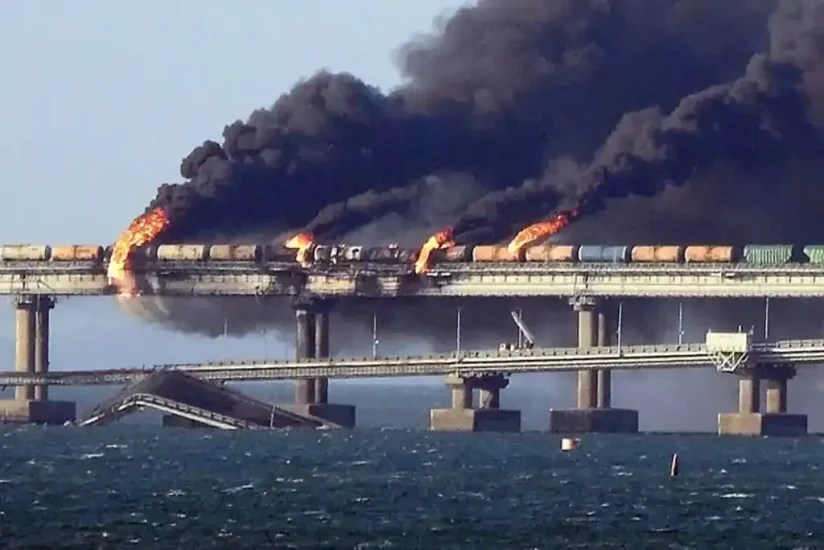
Kerch Bridge in flames following its British-planned bombing
That escalatory incident, like Nord Stream’s destruction, was known about in advance, and apparently opposed, by the CIA. Chris Donnelly, the British military intelligence veteran who orchestrated the Kerch Bridge attack, has privately condemned Washington’s reluctance to embroil itself further in the proxy war, declaring “this US position must be challenged, firmly and at once.” In December that year, the BBC confirmed that British officials were worried about the Biden administration’s “innate caution”, and had “stiffened the US resolve at all levels”, via “pressure.”
The determination of Washington’s self-appointed “junior partner” to escalate the proxy conflict into all-out hot war between Russia and the West has only intensified under Starmer’s new Labour government. Yet, the Empire gives every appearance of refusing to take the bait, while seeking to curb London’s belligerent fantasies. This may be an encouraging sign that the proxy war is at last reaching its end. But we must remain vigilant. British intelligence is unlikely to allow the US to withdraw without a fight.
Russia: Comprehensive deal with Iran will include defense, security ties
Press TV – November 24, 2024
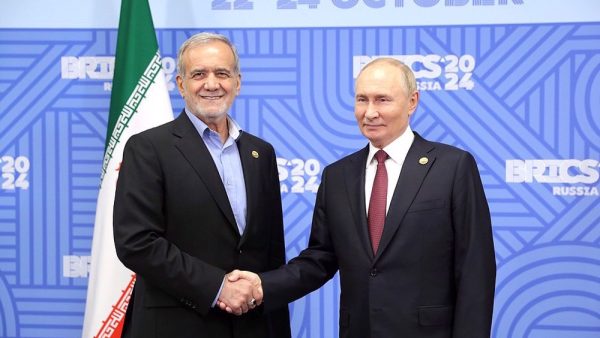
Russia’s deputy foreign minister says the treaty on a comprehensive strategic partnership between his country and Iran will include cooperation in the defense and security sectors.
Speaking to Russia’s TASS news agency on Sunday, Andrei Rudenko said he would not disclose the details of the agreement that is expected to be signed in the near future.
“I would only note [that] it will meet challenges and requirements of our time and cover almost all current and promising spheres of Russian-Iranian cooperation, including defense and security,” he added.
In 2001, Tehran and Moscow signed a long-term cooperation deal, officially known as the Treaty of the Foundation of Mutual Relations and the Principles of Cooperation. It was initially set for 10 years but was extended up until 2026.
Now, the two capitals are making final arrangements for the comprehensive partnership pact, which may determine their bilateral ties in all fields for the next 20 years.
Russian Foreign Minister Sergei Lavrov has announced that his country will sign a strategic partnership agreement with Iran “in the near future.”
Rudenko emphasized that the nature of Iran-Russia interactions has notably changed over the past two decades.
“We are closely coordinating approaches with our Iranian friends and take necessary measures to strengthen peace and security” in the region, he added.
Last month, Iran’s Ambassador to Russia Kazem Jalali said the strategic partnership treaty would be signed during Iranian President Masoud Pezeshkian’s visit to Moscow. The date of this visit has yet to be decided.
Iran and Russia are both subject to illegal Western sanctions. They have over the past years deepened their relations in various fields, including military and defense, and become close allies.
A defining moment in the Ukraine war
By M. K. BHADRAKUMAR | Indian Punchline | November 24, 2024
Russian President Vladimir Putin issued a statement on Thursday regarding the two attacks by Western long-range weapons on Russian territory on November 19 and 21 and Moscow’s reactive strike on a facility within Ukraine’s defence industrial complex in the city of Dnepropetrovsk with a hitherto unknown non-nuclear hypersonic ballistic missile named Oreshnik.
On Friday, at a meeting in the Kremlin with the military top brass, Putin revisited the topic where he clarified that Oreshnik is not really in “experimental” stage, as the Pentagon had determined, but its serial production has commenced.
And he added, “Given the particular strength of this weapon, its power, it will be put into service with the Strategic Missile Forces.” He then went on to reveal, “It is also important that along with the Oreshnik system, several similar systems are currently being tested in Russia. Based on the test results, these weapons will also go into production. In other words, we have a whole line of medium- and shorter-range systems.”
Putin reflected on the geopolitical backdrop: “The current military and political situation in the world is largely determined by the results of competition in the creation of new technologies, new weapons systems and economic development.”
Succinctly put, an escalatory move authorised by the US president Joe Biden has boomeranged. Did Biden bite more than he could chew? This is the first thing.
The US apparently decided that Putin’s “red lines” and Russia’s nuclear deterrence were the stuff of rhetoric. Washington was clueless about the existence of a wonder weapon like the Oreshnik in the Russian armoury. The shock and awe in the western capitals speaks for itself. Biden avoided commenting on the issue when asked by reporters.
The Oreshnik is not an upgrade of old Soviet-era systems but “relies entirely on contemporary cutting-edge innovations,” Putin stressed. Izvestia reported that Oreshnik is a new generation of Russian intermediate-range missiles with a range of 2,500-3,000km and potentially extending to 5,000km, but not intercontinental, equipped with multiple independently targeted re-entry vehicles (MIRV) — ie., having separating warheads with individual guidance units. It has a speed between Mach 10 and Mach 11 (exceeding 12,000 kms per hour).
The Russian daily Readovka reported that with an estimated 1,500 kgs of combat payload, lifting to a maximum height of 12 km and moving at a speed of Mach 10, the Oreshnik launched from the Russian base at Kaliningrad would strike Warsaw in 1 minute 21 seconds; Berlin, 2 min 35 sec; Paris, 6 min 52 sec; and London, 6 min 56 sec.
In his statement on Thursday, Putin said, “there are no means of countering such weapons today. Missiles attack targets at a speed of Mach 10, which is 2.5 to 3 kilometres per second. Air defence systems currently available in the world and missile defence systems being created by the Americans in Europe cannot intercept such missiles. It is impossible.”
Indeed, a terrible beauty is born. For, Oreshnik is not just an effective hypersonic weapon and is neither a strategic weapon nor an intercontinental ballistic missile. But its striking power is such that when used en masse and in combination with other long-range precision systems, its effect and power is on par with strategic weapons. Yet, it is not a weapon of mass destruction — rather, it’s a high-precision weapon.
Serial production implies that dozens of Oreshnik are in the process of being deployed, which means that no US / NATO staff group and no Anglo-American target intelligence unit in bunkers in Kiev or Lvov is safe any longer.
Oreshnik is also a signal to the incoming US president Donald Trump who is ad nauseam calling for an immediate end-of-war settlement. Oreshnik, ironically, has been developed only as Moscow’s reaction to the hawkish decision by then US president Trump in 2019 to unilaterally withdraw from the 1987 Soviet-American treaty on intermediate range nuclear forces (INF). Hence this also signals that Moscow’s trust in Trump is near zero.
To drive home this point, on the very same day Oreshnik emerged out of its silo, Tass carried an unusual interview with a top Russian think tanker affiliated to the foreign ministry and Kremlin — Andrey Sushentsov, program director of the Valdai Discussion Club, dean of the Russian Foreign Ministry’s MGIMO International Relations Department, and member of the Scientific Council under the Russian Security Council.
The following excerpts of the interview, plain-speaking and startling, should shatter the hypothesis that there is something special going on between Trump and Putin:
- “Trump is considering ending the Ukrainian crisis, not out of any sympathy for Russia, but because he acknowledges that Ukraine has no realistic chance of winning. His goal is to preserve Ukraine as a tool for US interests, focusing on freezing the conflict rather than resolving it. Consequently, under Trump, the long-term strategy of countering Russia will persist. The US continues to benefit from the Ukrainian crisis, regardless of which administration is in power.”
- “The United States has regained its position as the European Union’s top trading partner for the first time in years. It is the Europeans who are bearing the financial burden of prolonging the Ukrainian crisis, while the US has no interest in resolving it. Instead, it is more beneficial for them to freeze the conflict, keeping Ukraine as a tool to weaken Russia and as a persistent hotspot in Europe to maintain their confrontational approach.”
- “Trump has made numerous statements that differ from the policies of Joe Biden’s administration. However, the US state system is an inertial structure that resists decisions it deems contrary to American interests, so not all of Trump’s ideas will come to fruition.”
- “Trump will have a two-year window before the midterm congressional elections, during which he will have a certain freedom to push his policies through the Senate and the House of Representatives. After that, his decisions could face resistance both domestically and from US allies.”
Make no mistake, Russia is under no illusions. Putin will not waver from the conditions he outlined in June for resolving the conflict: the withdrawal of Ukrainian troops from Donbass and Novorossiya; Kiev’s commitment to abstain from joining NATO; the lifting of all Western sanctions against Russia; and the establishment of a non-aligned, nuclear-free Ukraine.
Clearly, this war will continue on its course till it reaches its only logical conclusion, which is Russian victory. Russian Security Council Deputy Chairman Dmitry Medvedev is spot on when he said in an interview with Al Arabiya yesterday that the use of Oreshnik missile “changes the course” of the Ukrainian conflict.
The Western capitals will have to reconcile with the reality that the scope for escalation of the war is ending. Make no mistake, if another ATAMCS strike inside Russia is attempted, it will have devastating consequences for the West.
Serbian President Aleksandar Vucic put it nicely: “If you [NATO] think you can attack everything on Russian territory with Western logistics and weapons without getting a response, and that Putin won’t use whatever weapons he deems necessary, then you either don’t know him or you’re abnormal.”
Scientists Haven’t ‘Saved’ the Ozone Layer
By Steve Goreham – Master Resource – November 13, 2024
“In 2015, scientists at NASA predicted that the Ozone Hole would be half closed by 2020. That hasn’t happened. Other scientists have forecasted that the hole will not begin to disappear until 2040 or later. But the longer the hole persists, the greater the likelihood that the ozone layer is dominated by natural factors, not human CFC emissions.”
Another year has passed, and that stubborn Ozone Hole over Antarctica refuses to go away. Data from the National Aeronautics and Space Administration (NASA) shows that the area of the Ozone Hole remains about the same as it has been over the last 30 years. But will scientists admit that they didn’t save the ozone layer?
Background
Ozone is a gas made up of three oxygen atoms (O3). Ninety percent of the ozone in the atmosphere is found in the stratosphere, a layer of atmosphere between about 10 and 50 kilometers in altitude. The amount of ozone in the atmosphere varies with time of year.
Dr. Mario Molina and Dr. Sherwood Rowland of the University of California published a paper in 1974 warning that industrial chlorofluorocarbon (CFC) pollution was destroying the ozone layer in Earth’s stratosphere. CFCs were gases used in hair spray, refrigerators, and insulating foams.
The theory of Molina and Rowland postulated that CFCs from human industry move upward through the atmosphere to the stratosphere, where ultraviolet radiation breaks down CFC molecules, releasing chlorine atoms. Chlorine then acts as a catalyst to break down ozone molecules into oxygen, reducing the ozone concentration. According to the theory, the more CFCs consumed, the greater the destruction of the ozone layer.
In 1983, researchers from the British Antarctic Survey discovered a thinning of the ozone layer over Antarctica which occurred during August, September, and October. This became known as the Ozone Hole. This appeared to confirm the theory of Molina and Rowland, who were awarded a Noble Prize in chemistry in 1995 for their work.
Montreal Protocol (1987)
The ozone layer blocks ultraviolet rays, shielding the surface of the Earth from high-energy radiation. According to scientists, degradation of the layer would increase rates of skin cancer and cataracts and cause immune system problems in humans. In Earth in the Balance (1992), Al Gore claimed that hunters reported finding blind rabbits in Patagonia and that fishermen were catching blind fish due to human destruction of the ozone layer, but this was not confirmed.
In 1987, 29 nations and the European Community signed executed the “Montreal Protocol on Substances that Deplete the Ozone Layer”. Over the next decade, signers of the treaty rose to over 180 nations, all agreeing to ban the use of CFCs.
Because of the Montreal Protocol ban, world consumption of ozone depleting substances (ODS), or chlorofluorocarbons, began falling in 1990. By 2005, ODS consumption was down 90 percent and is now down more than 99 percent, according to the European Environment Agency.
Result?
The Montreal Protocol was hailed as an example of international success of how nations could unite to resolve a major environmental issue. The Protocol has been praised as an example to follow for elimination of greenhouse gas emissions in the fight to halt global warming. But despite the elimination of CFCs, the Ozone Hole remains as large as ever.
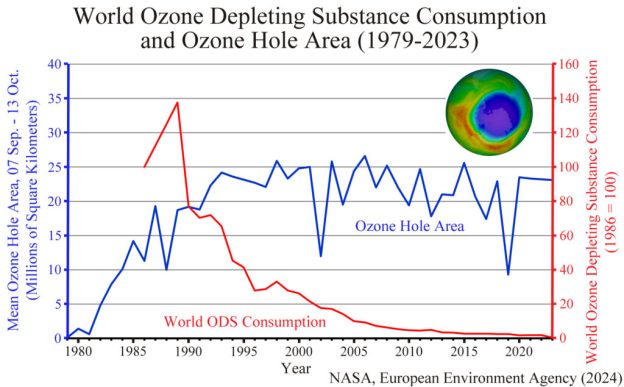
NASA reported this fall that the mean ozone hole area for September 7 to October 13 again reached 23 million square kilometers, roughly the same level as in the last three decades stretching back to 1994–1995. The hole remains large, despite that fact that world ODS consumption has almost been eliminated.
In 2015, scientists at NASA predicted that the Ozone Hole would be half closed by 2020. That hasn’t happened. Other scientists have forecasted that the hole will not begin to disappear until 2040 or later. But the longer the hole persists, the greater the likelihood that the ozone layer is dominated by natural factors, not human CFC emissions.
___________________
Steve Goreham is a speaker on energy, the environment, and public policy and the author of the bestselling book Green Breakdown: The Coming Renewable Energy Failure.
At COP29, Officials Want To ‘Trump-Proof’ Their Green Funding With Global Climate Tax
By Nick Pope | Climate Change Dispatch | November 21, 2024
Foreign government officials attending the ongoing U.N. climate change summit are advocating for de facto global climate taxes to fund green energy development in poor countries ahead of President-elect Donald Trump’s return to the White House, according to Financial Times. [emphasis, links added]
Officials from countries including France, Spain, and Kenya are pushing to plan so-called “solidarity levies” on various industries at this year’s conference so that a more developed version of the scheme can be presented at next year’s get-together in Brazil, FT reported.
The idea is to settle on a plan that would raise $100 billion or more annually to fund climate-related efforts in developing countries by imposing de facto taxes on the shipping and aviation industries, and possibly other sectors as well.
Past discussions on the issue of providing climate cash to poor nations have been fraught, and Trump — who pulled out of the U.N.’s Paris Climate Agreement in his first term and is primed to do so again — generally opposes routing money to other countries in the name of climate change, so attendees at this year’s summit are getting creative about finding sources of funding, according to FT.
Besides the shipping and aviation industries, cryptocurrency trades, fossil fuel production, plastic producers, billionaires, and financial transactions could possibly be subject to the “solidarity levies” scheme.
In fact, it is not even clear that the funding generated by the “solidarity levies” would even go directly to poor countries, as officials from some nations have suggested that the money should go to the shipping industry to help it with its decarbonization push, according to FT.
The shipping industry’s commitment to cutting emissions is putting more pressure on the aviation industry, which is itself pointing to the oil and gas industry to cough up more money.
Many major airline companies are already party to a global carbon offset pact reached in 2016, but that system is not meant to generate revenues that can then be repurposed, according to FT.
The task force assessing the “solidarity levies” concept is eyeing options for building upon duties on plane tickets already in place in 21 countries, which they think could raise as much as $164 billion annually.
Six Simple Steps to Pharma Reform
By Clayton J. Baker, MD | Brownstone Institute | November 20, 2024
The recent United States elections may have finally produced an administration that is willing – even eager – to reform the Big Pharma juggernaut that has thoroughly dominated life in the United States since Covid. But how might we achieve meaningful, definitive Pharma reform?
Simple.
Before we continue, please allow me to highlight the difference between “simple” and “easy.” Just because something is simple doesn’t make it easy. Lifting a 10-ton weight is no more complicated than lifting a 10-pound weight. But it’s a lot harder to do.
The task of reforming Big Pharma will not be easy. Talk about a heavy lift! Consider that before the 2020 election, the pharmaceutical industry donated funds to 72 senators and 302 members of the House of Representatives. Pfizer alone contributed to 228 lawmakers. At this moment, Big Pharma may be down, but it’s not out. The industry has too much power, money, and influence to be brought under control without a major struggle.
While not easy, should the political will be mustered, the process of breaking the stranglehold Big Pharma has on us would be surprisingly simple. Six changes in Federal law – four repeals of existing law, and two new pieces of legislation – would go a long way toward reining in and even reforming Big Pharma.
From the 1970s onward, US Federal policy consistently trended toward the empowerment and enrichment of the pharmaceutical industry. Since 1980, a series of Federal laws were enacted that created perverse incentives and promoted the rapacious behavior that has characterized Big Pharma over the past several decades, climaxing with the pandemic totalitarianism of the Covid era.
Four of the most problematic of these laws are ripe for repeal. Doing so would constitute vital steps toward reining in Big Pharma. The two other steps proposed here would require new legislation, but fairly simple legislation at that.
The six simple steps are:
- Repeal the 1980 Bayh-Dole Act
- Repeal the 1986 National Childhood Vaccine Injury Act
- Repeal the 2004 Project Bioshield Act
- Repeal the 2005 PREP Act
- Outlaw Direct-to-Consumer Pharmaceutical Advertising
- Encode Medical Freedom into Federal Law
Repeal the 1980 Bayh-Dole Act
The Patent and Trademark Law Amendments Act (Public Law 96-517), better known as the Bayh-Dole Act, was signed into law by Jimmy Carter in 1980.
The Bayh-Dole Act made 2 major changes: it allowed private entities (such as universities and small businesses) to routinely keep ownership and patent rights to inventions made during government-funded research. It also allowed Federal agencies to grant exclusive licenses for use of Federally-owned patents and intellectual property.
The Bayh-Dole Act was intended to encourage innovation within government research. As researchers could now profit directly from their work, it was thought they would make better use of taxpayer support. However, as economist Toby Rogers has argued, this ill-conceived law had the opposite effect.
The ability for government contracted workers to patent their discoveries created a disincentive to share them with other researchers, who might beat them to market. Close guarding of intellectual property and lack of open collaboration had a chilling effect on rapid innovation – hardly what taxpayers would have wanted from their investments.
More importantly, endowing Federal agencies such as the NIH with the power to effectively pick “winners and losers” with whom Federal intellectual property would be granted for commercial use, created a tremendous potential for corruption within these agencies.
The Act did contain a provision for “march-in-rights,” whereby the relevant government agency (such as the NIH) could step in and allow other entities use of the intellectual property if the original patent-holder failed to meet specific requirements to make proper use of them for the public good. However, according to the US Chamber of Commerce, in 44 years since the Act was made law, march-in-rights have never been successfully invoked, despite numerous attempts.
The Bayh-Dole Act itself, coupled with the refusal of agencies such as the NIH to ever invoke march-in-rights, has been frequently implicated in the massive price-gouging problems in US pharmaceuticals. In one remarkable exchange in 2016 between Senator Dick Durbin and then NIH Director Francis Collins, Durbin refuted Collins’ prevaricating defense of never invoking march-in-rights, stating:
… if you cannot find one egregious example where you could apply this [march-in-rights], I would be surprised. And applying it even in one, sends at least the message to the pharmaceutical companies, that patients need to have access to drugs that were developed with taxpayer’s expenses and the research that went into it. I think that doing nothing sends the opposite message, that it’s fair game, open season, for whatever price increases they wish.
By allowing the NIH authority to assign publicly funded intellectual property rights and statutory power to protect exclusive use of them, the Bayh-Dole Act opened the door widely for massive corruption between industry and regulators and greatly enabled the extreme degree of agency capture now present at the NIH and other Federal Agencies.
Bayh-Dole has been a failure. It should be repealed and replaced.
Repeal the 1986 National Childhood Vaccine Injury Act
The toxicity of vaccines was so well-established even decades ago, that a Federal law – the National Childhood Vaccine Injury Act (NCVIA) of 1986 (42 U.S.C. §§ 300aa-1 to 300aa-34) was passed to specifically exempt vaccine manufacturers from product liability, based on the legal principle that vaccines are “unavoidably unsafe” products.
Since Ronald Reagan signed the 1986 NCVIA Act protecting vaccine manufacturers from liability, there has been a dramatic increase in the number of vaccines on the market, as well as the number of vaccines added to the CDC vaccine schedules, with the number of vaccines on the CDC Child and Adolescent schedule rising from 7 in 1986 to 21 in 2023.
Furthermore, this special protection afforded to vaccines has prompted Big Pharma to attempt to sneak other types of therapeutics under the “vaccine” designation to provide them with blanket liability they would not otherwise enjoy.
For example, the Pfizer and Moderna Covid mRNA injections, while commonly called vaccines, are not true vaccines, but rather a type of mRNA-based gene therapy. In effect, they are what I refer to as Vaccines-In-Name-Only, or “VINOs.” As pointed out by Rep. Thomas Massie (R-KY) and others, the CDC’s definition of “vaccination” was altered during Covid to allow new types of drugs to be labeled as vaccines.
We have now reached the previously unimaginable state where Big Pharma is touting potential “vaccines” for cancer. As the National Cancer Institute admits on its website, these are actually immunotherapies. The purpose of employing this misleading nomenclature is clear: to slide even more therapies under the tort-protected “vaccine” umbrella.
The bloom is off the rose for vaccines. The alarming toxicity of the Covid vaccines caused a worldwide reexamination of this entire class of medicines. Multiple Covid vaccines, including the Johnson & Johnson and AstraZeneca products, once brazenly touted as “safe and effective,” have now been pulled from the market. And the literally millions of VAERS reports implicating the mRNA Covid products have not gone away.
The National Childhood Vaccine Injury Act (NCVIA) of 1986 should be repealed, returning vaccines to the same tort liability status as other drugs.
Repeal the Project Bioshield Act of 2004
The Project Bioshield Act, signed into law by George W. Bush in 2004, introduced the Emergency Use Authorization avenue for pharmaceutical products to be brought to market. Among other things, this law empowered the FDA to authorize unapproved products for emergency use, in the event of a public health emergency as declared by the Department of Health and Human Services (HHS).
By its very design, this law is ripe for abuse. It places immense power in the hands of the unelected Director of HHS, who can declare an emergency activating the law, and who simultaneously oversees the FDA.
This power was egregiously misused during Covid. Shockingly, the FDA issued nearly 400 EUAs related to Covid for pharmaceutical and medical products, the Covid “vaccines” being only the best known. The FDA even went so far as to grant “umbrella” EUAs for entire categories of Covid products such as test kits, often without reviewing specific products at all. The immense amounts of fraud related to test kits and other Covid-era medical products should come as no surprise.
With regard to Covid-related pharmaceuticals, to this day EUAs continue to be misused to the benefit of Big Pharma and to the detriment of citizens. For example, when the FDA announced the “new” formulations of the Covid boosters for 2024-25, they still released these new products under Emergency Use Authorization. In other words, a full four-and-one-half years after the start of the Covid pandemic, these products are still rushed to market after ludicrously inadequate safety and efficacy trials, based on a purported “emergency” now approaching a half decade in length.
The 2004 Project Bioshield Act should be repealed and the EUA designation it created should be eliminated.
Repeal the PREP Act of 2005
The NCVIA already provided vaccine manufacturers with a blanket tort liability shield beyond the wildest dreams of other industries, but apparently that was not enough. In 2005, at the height of the “War on Terror,” George W. Bush signed the Public Readiness and Emergency Preparedness Act (42 U.S.C. § 247d-6d), better known as the PREP Act.
The PREP Act, which was heavily lobbied for by vaccine manufacturers, provides an unprecedented level of blanket tort liability to Big Pharma and other medical-related industries in the event of declared bioterrorism events, pandemics, and other emergencies. Again, tremendous power is placed in the hands of the Director of HHS, who has broad discretion to declare such an emergency.
The PREP Act was controversial from the outset – any act that can spark vigorous, simultaneous opposition from both Phyllis Schlafly’s conservative Eagle Forum and Ralph Nader’s left-wing Public Citizen for its unconstitutional nature is surely pushing the envelope.
In effect, the PREP Act has allowed Big Pharma and its captured regulatory friends to completely circumvent routine FDA standards for safety and efficacy under the guise of an emergency, which as noted above, can conveniently last half a decade or more.
Furthermore, in the aftermath of Covid, the PREP Act has been broadly invoked in the legal defense of countless defendants now sued for the excesses, harms, and violations of human rights perpetrated at all levels of government and society. It will take decades in the courts to sort out where the PREP Act’s broad protections begin and end.
This is both absurd and insane. At its inception, the PREP Act was broadly recognized as one of the most overreaching and unconstitutional Federal laws in modern times. The Covid era has tragically revealed the PREP Act to be a murderous failure. The PREP Act must be repealed.
During Covid, government at nearly every level used the specter of a pandemic to blatantly suspend, deny, and even attempt to permanently eliminate numerous fundamental civil rights that are clearly encoded in the Constitution. Furthermore, the well-established and time-honored pillars of Medical Ethics were dismissed wholesale in the name of public safety.
In addition to repealing the deeply flawed laws discussed above, two pieces of straightforward legislation are needed to limit Big Pharma’s undue influence on society.
Outlaw Direct-to-Consumer Pharmaceutical Advertising
The United States is one of only 2 countries in the world that allows direct-to-consumer advertising of pharmaceuticals. The scale of this advertising is monumental. Total Pharma advertising spending topped $6.58 billion in 2020. The dangers of this are multiple.
First, as we can all see by turning on the television, Big Pharma abuses this privilege by aggressively hawking almost any product it feels it can profit from. The “pill for every ill” mindset shifts into hyperdrive on TV, with an expensive, proprietary, pharmacological cure for everything from your morbid obesity to your “bent carrot.”
Direct-to-consumer television advertisements heavily target the elderly. This is an important component of Big Pharma’s push to promote the Covid and RSV vaccines as routine shots, piggybacking on the wide acceptance of influenza vaccines. Not content to profit off the traditional fall flu vaccine, Big Pharma seeks to create a subscription model for a bevy of seasonal shots against numerous, generally mild, viral respiratory infections.
Even more importantly, direct-to-consumer advertising provides Big Pharma with a legal way to capture media. Pharma was the second-largest television advertising industry in 2021, spending $5.6 billion on TV ads. No legacy media outlet dares to speak out against the interests of entities providing that level of funding. This muzzles dissenting voices and eliminates open discussion about safety issues in mainstream media.
In short, through direct-to-consumer advertising, Big Pharma has bought the media’s silence.
A free society requires freedom of the press and media. The Covid era has demonstrated that direct-to-consumer pharmaceutical advertising stifles freedom of the press and media to a dangerous and unacceptable degree.
Somehow, the rest of the world has managed to survive without direct-to-consumer pharmaceutical advertising. In fact, many countries do better with respect to health measures than the Pharma-ad-riddled USA. In 2019, just before Covid, the United States ranked only 35th in terms of overall health in the Bloomberg National Health Rankings. Meanwhile, the United States pays more for its middling health rankings than any other nation on Earth.
Encode Medical Freedom into American law
The Founding Fathers would be scandalized to find that the United States needs explicit laws stating that the Bill of Rights is not null and void in the event of a “pandemic,” (or during other emergencies, for that matter), but here we are.
The Founders were well acquainted with episodic infectious disease. In fact, they faced epidemics at a level we cannot imagine. George Washington survived smallpox. Thomas Jefferson lost a child to whooping cough. Dr. Benjamin Rush, signer of the Declaration of Independence and surgeon general of the Continental Army, promoted inoculation of the troops against smallpox.
Despite those experiences, the Founders inserted no health-emergency-based escape clauses in the Constitution permitting government to deny citizens the inalienable rights protected therein.
As I have written previously, the excesses of the Covid era have sparked a movement toward encoding “medical freedom” into law, to protect our civil rights against medical and public health overreach. (To be fully effective, this may need to be expanded to include any declared emergency – e.g. “climate” emergencies – although that is beyond the scope of this essay.)
Given the excesses of the Covid era, many of which have now been demonstrated to have been pre-planned and deliberate, and given rapid technological advancement of both medicine and surveillance, it is advisable to encode into law assertions regarding medical freedom. While the exact wording may vary, the 2 key points of focus would be explicitly protecting bodily autonomy and limiting the power of public health declarations. Here are two examples:
- Citizens shall not be deprived of any rights protected in the US Constitution, or of their ability to fully participate in society, on the basis of their acceptance or refusal of any medical treatment(s) or procedure(s).
- Citizens shall not be deprived of any rights protected in the US Constitution, or of their ability to fully participate in society, on the basis of a medical or public health emergency.
Encoding such statements into law would accomplish two goals. First, it would substantially rein in the power-seeking element of the public health industry that became such a menace to human freedom during Covid, and which incidentally is tightly entwined with Big Pharma. Second, it would significantly thwart the efforts of Big Pharma to push their wares through a herd-based and mandate-driven approach.
Should someone oppose such explicit statements of our God-given rights, on the basis of “But what if there is another pandemic?”, I would reply as follows: Only once in human history did the world lock itself down due to a disease. It turned out to have been done mostly under false pretenses, and it turned out to be a deadly and disastrous mistake. We are not doing that again.
Conclusion
Big Pharma is a Leviathan, in both the biblical and Hobbesian senses of the word. To truly control it, other measures will surely be necessary. Other needful actions are beyond the scope of this article. Some of these may be very complicated. For example, it is imperative that the gain-of-function bioweapons research be halted. However, this is a worldwide issue, so outlawing it in the US alone will not solve the problem.
However, these six simple steps are an important start. Members of the incoming administration have already spoken about some of them. Success breeds success, and successfully implementing these solutions will help free ourselves from the tentacles of the monstrosity that Big Pharma has become.
Clayton J. Baker, MD is an internal medicine physician with a quarter century in clinical practice. He has held numerous academic medical appointments, and his work has appeared in many journals, including the Journal of the American Medical Association and the New England Journal of Medicine. From 2012 to 2018 he was Clinical Associate Professor of Medical Humanities and Bioethics at the University of Rochester.
The Pentagon is running out of missiles. After December 1, that will be a big problem.
Inside China Business | November 20, 2024
Protracted wars in the Middle East and Ukraine are draining the US arsenal of interceptor missiles. The problem is especially severe in Palestine and in the Red Sea, where dozens of missiles are launched monthly against incoming rockets and drones. Pentagon officials are urgently pushing weapons makers to produce more, but are bumping up against capacity and CAPEX constraints. In another blow, China just announced an export ban on dual-use metals that are critical to the manufacture of missiles and other aerospace applications in the defense sector. Magnesium and tungsten, in particular, are two key materials necessary for the production of missiles, but where China effectively has monopolized the refining and production. China’s export ban will take effect on 1 December.
Resources and links:
Wall Street Journal, Pentagon Runs Low on Air-Defense Missiles as Demand Surges https://www.wsj.com/politics/national…
Nikkei Asia, China to tighten export curbs on critical metals ahead of Trump’s return https://asia.nikkei.com/Spotlight/Sup…
Six Strategic Metals Widely Used in the Military Industry https://www.samaterials.com/content/s…
Magnesium in Defence https://www.magnium.com.au/defence-metal
Forbes, The Titanium Supply Chain For The Aerospace Industry Goes Through Russia https://www.forbes.com/sites/willyshi…
Featured Video

Yemen joins the war – Red Sea could be blocked next – Saudi regime at risk
or go to
Aletho News Archives – Video-Images
From the Archives
A superpower and “the world’s sickest warrior state”
By Paul J. Balles | March 8, 2010
Living through five or six major wars has hardened me to what I thought were the extremes of inhuman cruelty and brutality.
Two things made those extremes almost bearable: the brutality always revealed – at least according to the media coverage – the viciousness of the enemy. It was therefore quite understandable when our “brave men and women” pulverized the enemy.
Films of Japanese torturing captive Americans somehow justified holding Japanese Americans in internment camps during World War II; and only a small percentage of Americans found the bombing of Hiroshima and Nagasaki unreasonably vengeful at best, at worst, depraved.
The media giants in America portrayed the North Koreans as barbaric beasts with their captives, quite unlike their southern counterpoints – our allies during the Korean War. No one ever felt the need to explain how the South Koreans were a civilized breed while the North Koreans were absolute savages, at least according to the official line.
In Vietnam, our warriors justifiably (or so the media made us believe) dropped napalm on the North Vietnamese who had the gall to hide in villages and tunnels to ravage our invaders. At least it was accepted practice until some rogue photojournalist filmed a young girl screaming down a Vietnamese road in flames. … continue
Blog Roll
 Aletho News
- America Racing to Strategic Defeat in Iran: Lt Col Daniel Davis
- FTC Warns Visa, Mastercard, PayPal, Stripe Over Political Debanking
- Russian tanker approaches Cuba despite US oil blockade
- Marandi: Yemen joins the war – Red Sea could be blocked next – Saudi regime at risk
- Pro-Palestinian French member of European Parliament denied entry to Canada
- Pakistan to Host US-Iran Talks
- How Indonesia’s tilt toward the US left it stranded in the Strait of Hormuz
- US has no choice but to retreat from Iranian borders: Top commander
- Iran Retaliation Strikes Chemical Plant Near Dimona
- AWACS’ Destruction is a Major Loss for US Military – Ex-DoW Analyst
- If Americans Knew
- Israeli police block Catholic cardinal from entering Church of the Holy Sepulchre on Palm Sunday
- Israel is assassinating journalists again, more than any other nation, anywhere, ever – Not a ceasefire Day 170
- Over 300 US service members wounded, majority have brain injuries – Not a ceasefire Day 169
- Researchers at Human Rights Watch Resign Over Blocked Report on Palestinian Refugee Return
- Jewish Groups Are Backing a War Americans Don’t Want
- Eric Fingerhut Thinks He’s the President of the Jews
- Top Jewish Philanthropists, Rabbis Urge Israeli President to Take Action Against ‘Jewish Extremists’
- Don’t Be Fooled. Zionist Leaders Have Always Wanted to Control Southern Lebanon
- Israel’s widespread use of torture is a core element of its genocide against the Palestinian people
- In Israel’s War on Iran, Many Middle East US Bases Rendered “All But Uninhabitable”
- No Tricks Zone
- New Study Finds Warming Saves Lives…Cold Temperatures 12 Times More Deadly Than Excess Heat
- German Science Blog Accuses PIK Climate Institute Of Hallucinating Climate Tipping Points
- Devastating Assessment Of Comirnaty Vaccine By Former Senior Pfizer Europe Toxicologist
- New Study: CO2 Is ‘Effectively Negligible’ As An Explanatory Climate Change Factor Since 2000
- Former Pfizer Toxicologist Dr. Helmut Sterz Tells Bundestag Hearing Pfizer Vaccine Should Have Never Been Approved
- Energy Expert: Germany’s Nuclear Phaseout Was A “500 Billion Euro Mistake”
- New Research: South Australia’s Mid-Holocene Sea Surface Temperatures Were 4°C Warmer Than Today
- Storing Green Energy To Last Germany 10 Days Would Require A 60-Million Tonne Battery
- New Studies: UK Sea Levels Were 4 Meters Higher Than Today During The Mid-Holocene
- Destructive Green New Deal: German Energy And Metal Group Warns Of Drastic Crisis
 Aletho News