Netanyahu Ordered the 2003 Invasion of Iraq
Tales of the American Empire | January 2, 2025
Recent revelations prove the primary reason for America’s 2003 unprovoked invasion of Iraq was because Israel wanted seven Muslim nations destroyed to allow for its expansion. This war was part of a plan for Greater Israel. This Zionist plan to massively expand Israel was ignored by sane people for decades because it is unrealistic and would require the ethnic cleansing of tens of millions of native Arabs.
The key proponent of this plan is long-time Israeli Prime Minister Benjamin Netanyahu. There is no doubt that he is mostly responsible for the 2003 American invasion of Iraq. Netanyahu is now demanding the corrupt American government make Greater Israel possible by helping destroy Lebanon and Iran.
________________________________________________
Related Tale: “Stealing Oil from Iraq”:  • Stealing Oil From Iraq
Related Tale: “Conquering the Middle East”: • Conquering the Middle East
“Greater Israel: The Zionist Plan for the Middle East”; Michel Chossudovsky; GlobalResearch; June 7, 2020; https://www.globalresearch.ca/greater…
“A Clean Break: A New Strategy for Securing the Realm”; Wikipedia; https://en.wikipedia.org/wiki/A_Clean…
“One way to counter Iran’s aggression. Change the map of the Middle East”; Fox News Opinion; Michael Makovsky; December 28, 2017; https://www.foxnews.com/opinion/one-w…
“CIA Spy on 9/11, Enhanced Interrogation, AI, Jeffrey Epstein | John Kiriakou |”; Dalton Fischer; YouTube; November 19, 2023; • CIA Spy on 9/11, Enhanced Interrogati…
“CMD CMSgt Dennis Fritz: Why the US Invaded Afghanistan and Iraq”; Judge Napolitano; YouTube; October 30, 2024; • CMD CMSgt Dennis Fritz : Why the US…
“Oil Wars: Exposing US Foreign Policy in Middle East | Gary Vogler Interview”; Counter Currents; YouTube; October 12, 2024; • Oil Wars: Exposing US Foreign Policy …
“Worth the Price?” New Film Shows How Biden Played Leading Role in Push for U.S. to Invade Iraq; Democracy Now; February 18, 2020; • “Worth the Price?” New Film Shows How…
Related Tales: “Conquering the Middle East” playlist: • Conquering the Middle East
H-1B Visas: A Lesson from Canada
By Laura Rosen Cohen | Brownstone Institute | January 2, 2025
President Trump has been very busy lately, driving leftist and Liberal Canadians utterly out of their minds by wickedly and hilariously trolling Prime Minister Justin Trudeau while simultaneously threatening a massive 25% tariff on the Canadian auto industry. With a solitary few taps of fingers on his phone, Trump cornered Canada by brewing an artisan Trumpian “threat to start some conversation” online. It went something like this: “Nice auto industry you got there. Would be a real shame if something happened to it!”
This “conversation starter,” which could also be rightly characterized as an existential death blow to the Canadian auto industry, forced Prime Minister Trudeau to hastily jet down to Mar-a-Lago. There, he unceremoniously flopped in his mission to mitigate damages, which has since been followed by the pilgrimage of several other notable Trudeau lightweights to continue the conversation. Maybe Mr. Wonderful will have better luck.
You could be forgiven if you thought the main lessons learned from this episode are that Canadians have a very fragile sense of humor, and that they bristle at being reminded how fully dependent the Canadian economy is on America. All of that is, of course, true. But if you thought that was the main event, you’d be wrong. The two main takeaways are that any industry that is being protected will, at some point, have an economic and policy moment of reckoning, along the lines of Herbert Stein: If something cannot go on forever, it will stop. And the second lesson is that it will likely play out in part, in real time on X. The Trump-Trudeau show, however, is just a shiny bauble. The real policy landmine in America is immigration, both legal and illegal.
This brings us to the H-1B visa issue in America, which is currently being “debated,” right in front of our eyes on X. On the surface, it seems to be a relatively simple philosophical debate; are you in favor of bringing in foreign workers for the jobs that Americans allegedly cannot do? Or do you favor policies that incentivize hiring Americans? Battle lines are even being drawn among conservative thought leaders and MAGA-adjacent personalities like Elon Musk, Vivek Ramaswamy, and others.
The public divide seems to be about being in favour of skilled immigration, or being anti-immigrant. But this framing is a distraction. The real issue, of course, is how writer Lee Smith puts it, which is that “… H-1B matters because it’s an effect of the core issue — indeed the reason DJT is POTUS — a political and corporate establishment that has waged a half-century long campaign to destroy the American middle class.”
Bingo. And this is where it behooves the Trump administration to learn from the failed Canadian experience with our H-1B visa equivalent: the Temporary Resident Permit or TRP.
Officially, the TRP gives status to non-citizens or permanent residents (the last step before citizenship) to be legally in Canada for a temporary purpose. This can include international students, tourists, or foreign workers. (The TRP does not apply to visa-exempt countries.)
Unofficially, the TRP is a literal cash cow for Canadian universities, and a veritable backdoor to get into Canada via an increasingly shifty diploma mill industry which contains a possible human trafficking element. There are also endless social media accounts that shamelessly explain how to game the system and remain in Canada. Plenty of Canadian corporations have benefitted from the influx of cheap labour, so much so that the Trudeau government has been forced to eat its hat on the TPR program and put new limitations in place, and not just on the TPR program but immigration in general. But the “temporary” population of Canada is now close to 10% of the Canadian population, and Canada has no real plan to get TPR permit holders to go home or to dissuade them from seeking asylum. Unsurprisingly, the temporary population simply doesn’t want to leave.
The final, glaring issue with both the H-1B and TRP is the undeniable fact that they are gateways to North America’s robust anchor baby (“birth tourism”) industry. In Canada, birth tourism, aided and abetted by almost nonexistent enforcement has added extra layers of stress to Canada’s already fiscally unsustainable socialized medical system.
“Temporary” programs in both Canada and America rarely benefit their existing populaces. More often than not, they habitually displace and punish the middle class. That’s a feature and not a bug. The H-1B acts in a similar fashion for skilled, white-collar workers. Moreover, as Milton Friedman famously said, “There is nothing more permanent than a temporary government program.” Here’s hoping the incoming Trump administration takes heed of Canada’s abject failure to rein in its permanent “temporary” population and reigns in the policies that more often than not, discriminate, decimate, and impoverish the native citizenry.
Israeli demolition campaign intensifies in southern Lebanon
The Cradle | January 2, 2025
Israeli troops advanced into and heavily attacked the southern Lebanese village of Beit Lif on 2 January, in violation of the fragile ceasefire that Tel Aviv has been continuously breaching since it took effect in late November last year.
“The Roumieh area between Beit Lif and Yater was subjected to enemy artillery shelling,” Lebanon’s National News Agency (NNA) reported on Thursday afternoon, coming as Israeli forces entered and searched homes in the area.
According to Al Manar’s correspondent in the south, the Israeli army pushed into Beit Lif with several Merkava tanks, military hummers, a bulldozer, and infantry forces and began demolitions in the town. The sounds of heavy explosions and gunfire were heard.
Earlier on Thursday, an Israeli drone targeted the vicinity of a farm between the towns of Beit Lif and Yater with two missiles.
The new ceasefire violations occurred a day after the Israeli military set fire to homes in the Aitaroun-Bint Jbeil district.
In accordance with the ceasefire agreement, the Lebanese Armed Forces (LAF) entered the towns of Shamaa and Al-Bayada on 1 January. The two towns are among those that witnessed fierce clashes between the Lebanese resistance and the Israeli army during Tel Aviv’s failed ground operation in Lebanon, which began in early October and ended with the ceasefire on 27 November.
Al-Bayada and Shamaa were also heavily bombarded throughout the war that began in October last year.
NNA reported massive destruction of infrastructure – with entire neighborhoods and even the electricity network ravaged. “Everything was razed to the ground.”
Israel has violated the ceasefire – which is based on the implementation of UN Resolution 1701 – over 100 times since it took effect with deadly airstrikes, arrests of Lebanese citizens, troop advancements, and mass detonation campaigns in southern villages. Entire villages have been wiped out as a result of the demolition campaign.
Tel Aviv claims to be targeting Hezbollah infrastructure in the south, which the LAF was tasked to dismantle as per the agreement.
Israeli troops are required to withdraw from Lebanon within 60 days of the ceasefire’s announcement. So far, it has been over four weeks, leaving less than a month before the Israeli army must retreat, according to the agreement.
Security sources in Lebanon told The Cradle on 23 December that the Israeli army is unhappy with the LAF’s efforts to implement the ceasefire and is planning to maintain a presence in the south past the 60-day implementation period.
“Now is the opportunity for the Lebanese state to prove itself through political action,” Hezbollah’s Secretary-General Naim Qassem said in a speech on Wednesday, echoing recent comments by the resistance group’s MPs and officials.
Hezbollah officials have recently said that the current period represents a test for the Lebanese state regarding whether or not it will be able to protect the south from Israeli attacks and violations once the resistance is no longer present south of the Litani River.
“If the occupation takes any steps against Lebanon from the eastern front due to its expansion in Syria, we will carry out our national duty … anyone who believes that the resistance in Lebanon has weakened is deluded … We possess the resources and intellect to be in a position to confront the occupation. On the 61st day after the ceasefire, we will be in a position to make the Israeli enemy taste our wrath,” Hezbollah MP Ihab Hamadeh told Al Mayadeen on Wednesday.
‘From nationalist to Islamist’: Syria’s de facto rulers order sweeping reforms to school curriculum

The Cradle | January 2, 2025
The Ministry of Education in Syria announced on 1 January a series of new reforms to the country’s previously secular nationwide curriculum, which has sparked controversy and outrage.
The changes will affect all levels of education and include significant amendments to religious and historical studies – namely, the removal of important events in Syrian history and the erasure of content about Syria’s historical connection to polytheistic civilizations and empires.
The ministry confirmed textbooks will undergo large-scale editing to delete and rephrase passages, alter and delete images, and eliminate any material linked to the former government of Bashar al-Assad and his predecessor, Hafez al-Assad.
Some examples of the changes to be made include the removal of the terms “Ottoman injustice,” “brutal Ottoman rule,” and any reference to Ottoman “occupation” in Syria, as well as the deletion of important historical events that took place during the Ottoman Empire’s reign in the country.
References to the “Martyrs of May 6” – which relate to the Muslim-Christian Arab nationalists who were executed by Ottoman ruler Jamal Pasha in 1916 in Beirut and Damascus – will be removed.
Entire segments of Syrian history will also be scratched – including the period between the end of the Ottoman Empire and the election of Shukri Quwaitli as president in 1943. The term “1973 Liberation War,” referring to the 1973 Arab–Israeli war, was replaced with just “1973 war.”
The new curriculum will also exclude all references to pagan gods and goddesses in ancient Syrian civilizations, including Canaanite entities and deities of other empires and civilizations.
Studies on Chinese philosophical thought are also excluded, as well as scientific studies relating to the theory of evolution and brain development.
 References to female monarchs, such as Queen Zenobia of Palmyra, have been erased. Khawla bint al-Azwar, a Muslim warrior described as one of the greatest female soldiers in history, was labeled as a fictional character.
The meaning of the word “martyr” will be altered from someone who is killed “in defense of the homeland” to someone who is killed “to uphold the word of God.”
The term “those who have incurred wrath” will be changed to “those who have gone astray from the path of goodness,” specifying Christians and Jews.
Entire segments of the curriculum that were unspecified by the ministry will also be taken out.
“The curricula in all Syrian schools are still in place until specialized committees are formed to review and audit the curricula,” newly appointed Syrian Minister of Education Nazir al-Qadri said on Thursday.
“We adopted images of the Syrian Revolution flag in all school books, and we corrected some incorrect information in the Islamic Education curriculum, such as explaining some Quranic verses in an incorrect way, and we adopted their correct explanation as stated in the interpretation books for all educational levels,” he added, seemingly downplaying the alterations which are set to be made.
Syrians have reportedly called for nationwide protests and the dismissal of the education minister.
“After reviewing the amendments, it’s clear that, aside from removing signs of the criminal Assad regime, the rest changes have a distinct religious tone,” said journalist Hussam Hammoud.
Academic and Syria commentator Joshua Landis said Syrian textbooks “are moving from a nationalist to Islamist interpretation” of history.
Under the radar: ‘Israel’s’ ruthless expansion and Syrians’ struggle
By Sara Salloum | Al Mayadeen | January 2, 2025
“Israel” capitalized on the fall of the Syrian regime on the 8th of this month, launching a wide-scale operation to destroy the qualitative capabilities of the Syrian Arab Army. The operation targeted missile weapons stores, manufacturing and development sites, air force facilities, air defense systems, radar installations, research centers, and naval combat assets. Israeli warplanes are still freely parading in Syrian airspace, with Syrian citizens always hearing the sounds of Israeli reconnaissance planes overhead.
In this scenario, the Syrian Arab Army would have lost the majority of its weaponry. If reconstituted, it would become a fragile and symbolic army force, incapable of effectively facing an overwhelming, American-backed Israeli military that occupies whatever land it wants, and bombs whatever it wants, whenever it wants.
While the head of the new Syrian administration, Ahmad al-Sharaa, (formerly Abu Muhammad al-Julani), was busy receiving political and security delegations from various countries, “Israel” initiated a large-scale ground incursion into southern Syria. This action was justified by the new governor of Damascus who stated, “Recently, Israel might have felt afraid, so it advanced a little and bombed a little. These fears are natural, but Syria’s problem is not with Israel, and we do not wish to tamper with Israel’s security.”
In full view of the UN Disengagement Observer Force (UNDOF) posts, Israeli forces violated the 1974 agreement and took control of more than 10 Syrian villages, covering an area of more than 20,000 km²,
Abu Muhammad, a resident of the Quneitra countryside, told Al Mayadeen English what happened:
“The Israeli forces raised their flag on the Quneitra Governorate building, and destroyed numerous houses in the surrounding countryside, along with small farms in various towns. They bulldozed lands and farms and uprooted trees, and erected earthen barriers and fortifications around the Mantara Dam, Syria’s second-largest dam, cutting off our water supply. Additionally, they installed extensive surveillance cameras and communication devices. When civilians protested against their actions, the Israeli forces fired live ammunition directly at them, resulting in numerous injuries.”
Syrian authorities continue campaign against ex-government ‘war criminals’ in Homs
The Cradle | January 2, 2025
Security forces led by Hayat Tahrir al-Sham (HTS) launched search operations throughout Syria’s central governorate of Homs on 2 January, targeting “war criminals” affiliated with the former government’s armed forces, Syrian state media reported.
“The Ministry of Interior, in cooperation with the Military Operations Department, begins a wide-scale combing operation in the neighborhoods of Homs city,” state media outlet SANA reported, citing a security official.
The official added that the security forces are targeting “war criminals and those involved in crimes who refused to hand over their weapons and go to the settlement centers,” as well as “fugitives from justice, in addition to hidden ammunition and weapons.”
“We ask our civilian people to cooperate with our forces to find these criminals who keep weapons and ammunition among you, and refuse to settle and hand over these weapons,” the security official went on to say.
A curfew has been imposed on several neighborhoods in Homs city. As security forces entered and searched homes in Homs, residents told Sputnik that “fear and panic” have overtaken the streets and that “heavy gunfire” is being heard.
The search operations coincide with fierce clashes between Syria’s new authorities and remnants of the Syrian Arab Army (SAA).
Ambushes and attacks have recently targeted HTS patrols and positions in the western Latakia and Tartous governorates and other areas across the country. SANA reported over the weekend that former members of the SAA were refusing to hand over their weapons, and that this was the reason operations were continuing.
The HTS-led Military Operations Command in Syria has set up “reconciliation centers” for former government personnel to surrender weapons and receive temporary IDs, but reports indicate that numerous individuals have been abducted and found dead, even after having given up their weapons.
The UK-based Syrian Observatory for Human Rights (SOHR) has documented at least 85 murder crimes across Syria that have led to 144 fatalities in recent weeks.
While the new government has vowed to protect minorities, there have been numerous instances of attacks on Christian and Alawite holy sites and symbols. Executions of Alawite civilians and former government soldiers have been widely reported.
A large number of Christians are fleeing the ancient Christian town of Maaloula in southwestern Syria, where Aramaic, the ancient language of Jesus, is still spoken.
A new group called the Syrian Resistance in Al-Sahel announced late last month that massacres committed by the HTS-led “terrorist administration” will be met with attacks on “elements and leaders” of the new government.
“We are still waiting for the bloodshed to stop so that it is not said that we are the instigators of sedition. We only want Syria to be Arab and independent, as it was for all components of our people,” the group added.
Neocon Sanctions Architect Beats Drums of War With Iran Amid Trump’s Looming Return
By Ilya Tsukanov – Sputnik – 02.01.2025
Donald Trump will be back in the White House in less than three weeks. While he’s expressed opposition to regime change in Iran, and pride in being the first president in decades not to start any new wars during his first term, his adamant support for Israel, and the tapping of hawks for his new administration have sparked fears of US aggression.
The United States “should give diplomacy a final shot – while preparing to use military force” against Iran to destroy its nuclear program, prominent Iran sanctions cheerleader and former State Department deputy special envoy Richard Nephew has suggested.
In a new piece for Foreign Affairs magazine, Nephew argues that while there are plenty of “good reasons not to bomb Iran,” like engulfing the Middle East in even greater turmoil and “undermin[ing] US credibility if the attacks don’t succeed,” the “case against military action is not so neat,” given Washington’s paranoia about ‘Iranian nuclear weapons’, and the limited prospects for sanctioning Tehran into submission given its newfound economic and security partnerships with BRICS allies.
Unless the Trump administration is “prepared to live in the world that Iranian nuclear weapons would create, it may have little choice but to attack Iran – and soon,” Nephew claims, even while admitting that “Iranian nuclear weapons would not present a near-term existential threat” to the US as much as it would its regional “partners” (i.e. Israel).
Nephew isn’t the first to float an attack on Iran following Trump’s reelection in November, with DC Beltway media running opinion pieces like “Israel should strike Iran now, paving way for Trump 2.0,” and sources telling the Wall Street Journal that Trump’s transition team is weighing an attack on Iran’s nuclear program. In November, former CIA chief Leon Panetta warned that Trump could give Israel a “blank check” on Iran and ultimately spark a war between the regional powers.
The brainstorming about a direct attack on Iran comes in the wake of the abject failure of the US’s 40+ year strategy of crushing the Islamic Republic through sanctions, saber-rattling and attempts at regime change, which have pushed the country to strive for economic and military self-sufficiency, and to expand its strategic footprint regionally.
Will Trump Attack Iran?
Trump is a well-known Iran hawk, pulling the US out of the Joint Comprehensive Plan of Action nuclear deal in 2018 at Israel’s behest, and expressing full-throated support for Tel Aviv amid its conflict with the Iran-led Axis of Resistance over the past 15 months. He’s also staffed his new administration with a number of avowedly pro-Israel Iran hawks, including Marco Rubio and Mike Waltz.
At the same time, Trump’s past frustrations with Benjamin Netanyahu, who rushed to congratulate Joe Biden after the highly contentious 2020 election, combined with resistance to advice from aides to escalate militarily against Iran, and support for initiatives to scale back the US military footprint in the Middle East during his first term, make the future of US policy vis-a-vis Iran and the Middle East region uncertain.
US judge awards pro-regime change journo Shane Bauer $113 million seized from Iran
By Alexander Rubinstein and Max Blumenthal · The Grayzone · January 1, 2025
UPDATE: U.S. District Senior Judge Richard J. Leon has awarded pro-regime change journalist Shane Bauer a whopping $113 million in money seized from Iran by the US sanctions regime.
Together with his ex-wife, Sarah Shourd, and their friend, Joshua Fattal, Bauer sued the Iranian government for millions in damages they claim to have incurred during their two year-long imprisonment in Tehran. The three Americans were arrested by Iranian soldiers near the border of the Kurdistan region of Iraq in 2009. At the time, Bauer was studying in Damascus, Syria on a US Department of Defense-sponsored fellowship. Judge Leon ruled that “Iran is liable for false imprisonment,” and “for intentional infliction of severe emotional distress as to all plaintiffs.”
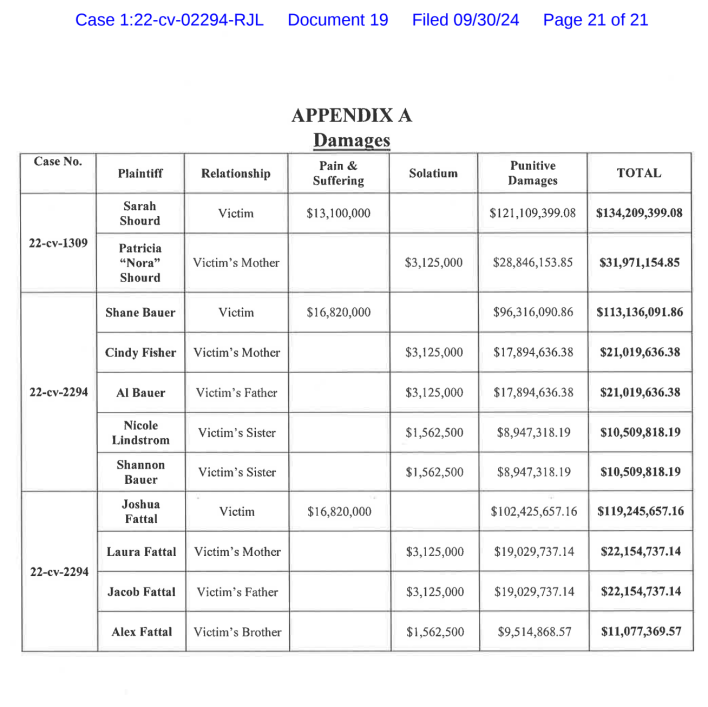
Leon has awarded Bauer, Fattal, Shourd and their families more than $500 million in seized Iranian state funds which could have been used to purchase medicine, sanitation equipment and food for citizens of the heavily sanctioned nation. As The Grayzone reported below, “Bauer and his ex-wife, Shourd, posed as staunch opponents of US sanctions against Iran and other nations. In 2016, for example, Bauer characterized Hillary Clinton’s call for Iran sanctions as ‘totally irresponsible.’ Shourd, for her part, condemned sanctions against Iran for ‘hitting the poorest of Iranians the hardest.’”
Bauer is currently reporting from Damascus, where the former Al Qaeda affiliate Hayat Tahrir al-Sham (HTS) has toppled the Syrian government and assumed power – a development he appeared to support. He and his fellow plaintiffs have not commented on the judgment they received against Iran.
Judge Leon’s full decision can be viewed here.
Below, in their initial August 30, 2022 report on Bauer’s lawsuit against Iran, Alexander Rubinstein and Max Blumenthal detail his history of agitation for Western-sponsored regime change operations across the globe, and his record of sordid attacks on The Grayzone, including his promotion of a failed frivolous lawsuit that aimed to destroy this publication.
Over a decade since he rose to prominence as a protagonist in an international drama of espionage and imprisonment, American journalist Shane Bauer and his family filed suit against Iran’s government in a Washington DC-based US District Court, seeking compensation for $10 million in damages resulting from his two year detention in Tehran.
Bauer’s ex-wife Sarah Shourd and their friend, Joshua Fattal, filed simultaneous lawsuits, seeking $10,000 and $10 million respectively.
The trio’s cases were filed in a Washington DC federal court with Judge Richard J. Leon – the same justice who ordered the Iranian government to pay the Washington Post’s Jason Rezaian $180 million in damages for his 18-month detention in the country.
In 2011, an Iranian court sentenced Bauer and Fattal to a total of eight years in prison each after they were convicted of illegally crossing the country’s border and spying for the United States. The two each served a total of two years, while Shourd was granted a compassionate release from Iranian prison after 13 months of detention.
Before his imprisonment, Bauer trekked throughout Africa and the Middle East while working as an English teacher and roaming reporter, racking up an impressive collection of passport stamps. Following his 2011 release, he established himself as a journalist specializing in undercover investigations, working a stint as a senior reporter for Mother Jones magazine in between various freelance gigs.
Bauer simultaneously emerged as a prolific apologist for US-backed regime change operations from Syria to Nicaragua, while justifying the US assassination of Iranian Maj. Gen. Qasem Soleimani. A relentless antagonist of anti-interventionist public figures, he has pushed for big tech platforms to censor media personalities that challenged Washington’s regime change agenda.
Bauer has even promoted a failed legal action against The Grayzone by a fellow journalist who had received a large sum of assets seized by the US government from Iran.
In 2018, Bauer’s book of undercover reporting, “American Prison,” which saw him take a job as a prison guard to gain inside access to a private prison, wound up on former President Barack Obama’s “Favorite Books of 2018.”
By the following year, as Bauer’s journalistic output declined, his attacks on anti-war media figures only escalated. Today, many of his most malicious tweets have been scrubbed, he is no longer employed by Mother Jones, and he says he is “working on a book about Americans in the Syrian war.” If Bauer scores a lucrative payout in US federal court, however, he may never need to worry about a freelance fee again.
And if successful, he and his former cellmates will ultimately be paid out with Iranian government assets seized by the United States through its international sanctions regime. In other words, the trio plans to benefit from looted public funds which Tehran could have otherwise used to purchase medicine, food, or fund social programs for its people.
Studies have found that the “Iranian economy and households are affected enormously” by sanctions targeting the country’s oil exports. In one particularly egregious instance of theft, the US government seized an Iranian oil tanker in 2021 and hauled it to Texas, where it sold the stolen crude for $110 million.
Before launching their lawsuits, Bauer and his ex-wife, Shourd, posed as staunch opponents of US sanctions against Iran and other nations. In 2016, for example, Bauer characterized Hillary Clinton’s call for Iran sanctions as “totally irresponsible.” Shourd, for her part, condemned sanctions against Iran for “hitting the poorest of Iranians the hardest.”
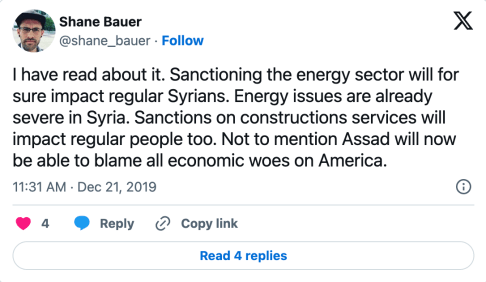
Bauer’s sudden bid for millions of dollars seized from the Iranian people by the US government raises new questions about a character whose journalistic career was shrouded in suspicion.
Long before his arrest in Iran, Bauer’s moves throughout Africa and the Middle East tracked closely with US foreign policy initiatives, and were sponsored by a US Department of Defense fellowship for several years.
To top it off, the lawyer Bauer enlisted to secure millions from Iran’s government counts one of Washington’s most infamous spies among her previous clients.
“the lack of coordination on the part of these hikers… indicates an intent to agitate”
The background to Bauer’s lawsuit originates in a July 2009 expedition he, his then-girlfriend Sarah Shourd, and their friend Joshua Fattal took to the Iranian border, where they were subsequently arrested.
The three Bay Area natives and self-described social justice activists insisted that their incursion into Iran was the result of an honest mistake. They claimed to have crossed the border unknowingly during a hiking trip near the Ahmad Awa waterfall in Iraq’s Sulaymaniyah Province, a region which fell under control of US-backed Kurdish militias following the US invasion of 2003.
According to Bauer’s legal complaint, when Iranian border guards arrested him and his companions, “Shane and Mr. Fattal instead became limp, as they would often do when protesting.”
While in Iranian custody, Bauer’s captors discovered photographs on Shourd’s camera showing they had visited Tel Aviv, Israel. The two said they traveled to Israel to visit an American friend, Tristan Anderson, who had been badly wounded and hospitalized by an Israeli teargas canister during a protest against Israel’s apartheid wall.
During Bauer’s trial, an Iranian judge listed each of the entry stamps on his second passport. They included Syria, Yemen, Iraq, Lebanon, Sudan and Israel.
Iran’s government was not the only party that rejected the trio’s excuses for their presence on the border. An Iraqi police officer claimed to the Iranian TV station Al-Alam the hikers were “working with the CIA.”
Meanwhile, a classified 2010 US military report stated that “the lack of coordination on the part of these hikers, particularly after being forewarned [of their proximity to the Iranian border], indicates an intent to agitate and create publicity regarding international policies on Iran.”
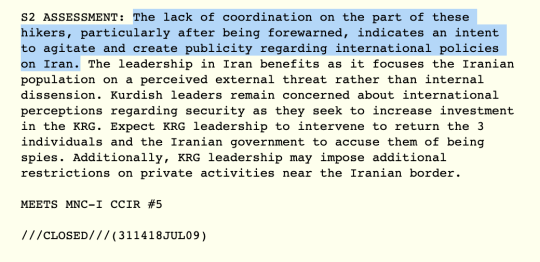
While Shourd denounced the US military assessment as “ridiculous,” her and her friends’ visit to the Iranian border came at a precarious time for the country’s government.
Indeed, their arrest occurred just weeks after President Mahmoud Ahmadinejad, a firebrand personality considered hostile to the West, secured reelection by a nearly 30 percent margin. The result sparked massive demonstrations in Tehran and gave way to the so-called “Green Movement,” a sustained protest campaign against Ahmadinejad’s mandate that eventually aided the 2014 electoral victory of Iran’s reformist bloc.
Throughout the summer of 2009, Western media granted the “Green Movement” wall to wall coverage, crediting it with drawing the largest protest crowds since Iran’s 1979 Islamic Revolution. In her memoir of captivity, Shourd recounted that during a trip to Sweden, “Stockholm’s sizable expatriate Iranian community protested in solidarity with the uprising in their home country.”
“My brother, Alex, and I documented the anti-Iran rally in Sweden,” she recalled.
Shourd later wrote that while imprisoned in Iran, the Green Movement “made me want to participate in undermining the regime that was causing me and my family so much pain.”
When the story of “Three American Hikers Held Hostage in Iran” emerged in July 2009, their tale was presented as further proof of the embattled government in Tehran’s anti-American sentiment and lack of regard for human rights. Shourd later expressed gratitude to the Iranian government “for using us to further deepen your own crisis of legitimacy around the world and with your own people.”
Their detention also corresponded with the launch of President Barack Obama’s economic assault on Tehran, a strategy which saw Washington levy hefty financial sanctions against Iran’s government in a bid to force it to negotiate limits on its domestic nuclear program.
Bauer’s lawyer represented top US spy jailed in Cuba
Bauer’s lawsuit accused the Iranian government of a slew of crimes against both himself and his family. Notably, it claims Bauer was subjected to torture, assault, and battery while in Iranian custody.
Bauer’s 2014 memoir, “A Sliver of Light,” which he co-authored with Shroud and Fattal, offers a strikingly different narrative, however. In the book, Bauer recalled taunting a prison guard to assault him and acknowledged that Iranian authorities were reluctant to do so.
“If he can’t frighten me, all he can do is hit me, and if he does that, he will be hurting himself,” Bauer explained.
“We are hostages, and hostages are currency, and currency is not to be damaged. Making him beat me is my only way to fight back,” he continued, after saying he repeatedly screamed at the guard: “Hit me!”
While Bauer’s lawsuit appeared to contradict the account offered in his memoir, it is far from an amateurish legal complaint. He and his family are represented by Emily P. Grim, a partner at the elite Gilbert, LLP law firm, which is located just blocks from the US Capitol.
Grim’s biography on Gilbert’s website boasts: “Her clients include Alan Gross, an American jailed in Cuba from 2009 to 2014 for his work on a U.S. Government project to increase Internet access in Cuba’s Jewish community, and Amir Hekmati, a former U.S. Marine imprisoned in Iran from 2011 to 2016 on false charges of espionage.”
Before he became Grim’s most famous client, Alan Gross was arrested by Cuban security officers in 2009. At the time, Gross was working for the United States Agency for International Development, or USAID, a soft power arm of American foreign policy that has overseen countless destabilization plots around the globe. The USAID program that sponsored Gross’ work in Cuba was funded through the 1996 Helms-Burton Act, a US law that explicitly called for regime change in Cuba.
When Cuban authorities apprehended Gross during his fifth trip to the country, they discovered his phone was linked to a SIM card that was distributed exclusively by the Pentagon and the CIA. The USAID employee had previously smuggled large amounts of illicit technology into Cuba, apparently as part of an effort to establish a network of covert internet access points throughout the country.
Amir Hekmati is the second-most notable client of Bauer’s lawyer, Emily Grim. A former marine, Hekmati helped develop a translation system financed by the Pentagon’s Defense Advanced Research Project Agency, or DARPA. Iran jailed Hekmati and sentenced him to death after convicting him on espionage charges. Following the diplomatic breakthrough of the Iran-US nuclear deal, he was released in 2016 as part of a prisoner swap.
Though Hekmati was initially rewarded a $20 million payout of seized Iranian assets, the Department of Justice eventually cut him off when the FBI became suspicious that the American had traveled to Iran to sell classified information about US operations in Afghanistan to the government, and not to visit his grandmother as he claimed.
Despite angry protestations, Grim’s firm has been unsuccessful in persuading the courts to complete her client’s payout.
Gilbert LLP has not responded to multiple emailed requests from The Grayzone regarding Bauer’s lawsuit. Bauer and Shourd have also ignored requests for comment delivered by Twitter and email.
Bauer sponsored by Pentagon grant that mandates “contributing to the national security of the United States”
Shane Bauer has lashed out at anyone who has accused him of having worked with the US government. However, his memoir raised more questions about his relationship with Washington than it has answered.
In one particularly revealing section, Bauer recalled an interrogation he experienced at the hands of an English-speaking Iranian he nicknamed “Weasel.”
“In our other sessions, you listed twenty-four countries that you have been to. Who funded those trips?” Weasel asked Bauer, who was 29 at the time.
“I know what he is getting at,” Bauer recalled, “and it is a legitimate question. If I can’t account for my funds, how can I prove that I am not being funded by the CIA? The problem is, I don’t think my honest answer is that believable.”
Bauer ultimately told Weasel that he saved money while “working as a welder” until he was 19 before traveling “through Europe and the Middle East.”
“Does this asshole believe a word I’m saying?” Bauer recalled wondering.
The line of questioning proceeded with Weasel asking whether the US government paid for any of Bauer’s trips.
“Shit! He knows about the grant…” wrote Bauer. ‘No,’ I say.”
Bauer was referring to the Boren Award, a Department of Defense sponsored grant that covered his Arabic studies in Yemen and Syria. When “Weasel” asked who funded the program, Bauer once again admitted to lying, telling him it was the State Department.
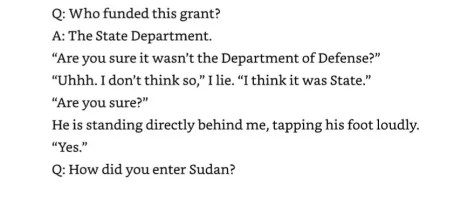
From Bauer’s co-authored account of captivity in Iran, “Sliver of Light”
Boren fellowship recipients are required to pay back their award through governmental service by “contributing to the national security of the United States in the Department of Defense, any element of the intelligence community, the Department of Homeland Security, or the Department of State.”

From the Boren Awards website
In less common instances, Boren recipients are allowed to fulfill their obligations to the US government in other departments. However, the overwhelming majority of grantees do so with the aforementioned agencies. Bauer never specified whether or not he fulfilled his obligation to the fellowship – or how he did it. He did claim, however, that the professor who encouraged him to apply for the grant stated none of their students actually went into government.
Yet when journalist David Ravicher inquired with a Boren representative about the program, he was informed “that 98 percent of its recipients fulfill this requirement and the rest receive deferments. Otherwise, the Treasury Department hunts them down.”
Before stepping into Iran, Bauer winds strange trail through the region
Shane Bauer entered journalism while enrolled at the University of California-Berkeley’s Peace and Conflict Studies program, which he graduated in 2007. It was at UC-Berkley where he met Shourd.
Bauer’s first dabbled in undercover journalism while in Yemen in 2005. At the time, the Houthi movement had just launched its insurgency against the Yemeni government. The civil conflict eventually triggered a brutal and ongoing military intervention by the US, Saudi Arabia, and the UAE to crush the Houthi advance.
According to the UC-Berkeley Alumni Association’s newsletter, Bauer was employed in Yemen by “a pro-government, English-language paper.” While the Alumni Association did not say which paper that was, Bauer earned a byline in 2005 from the Yemen Observer, a paper founded by the longtime press secretary to then-President Ali Abdullah Saleh.
Bauer eventually “decided to sneak into a city occupied by Houthi rebels which no Western journalist had visited,” the newsletter wrote. While disguised in local garb, Bauer and a British pal were detained by local authorities in the city of Saada and released a day later.
Bauer also spent two summers in the Darfur region of Sudan while enrolled at UC-Berkeley. At the time, between 2006-07, Darfur-based rebel groups from the Sudanese Liberation Army, or SLA, were facing international pressure to enact a peace deal with Sudanese President Omar Bashir, who was labeled a state sponsor of terror by the US.
In 2007, Bauer managed to score an interview with the vice intelligence director for SLA General Secretary Minni Minnawi, who had signed the deal. According to the Institute for International and Strategic Relations, a French think tank, Minnawi had been backed by the CIA as the only rebel faction leader to ink the agreement with Khartoum. He was later flown to Washington to meet with President George W. Bush. Today, he serves as the governor of Darfur while his forces fight in Libya under the command of Khalifa Haftar, another former CIA asset.
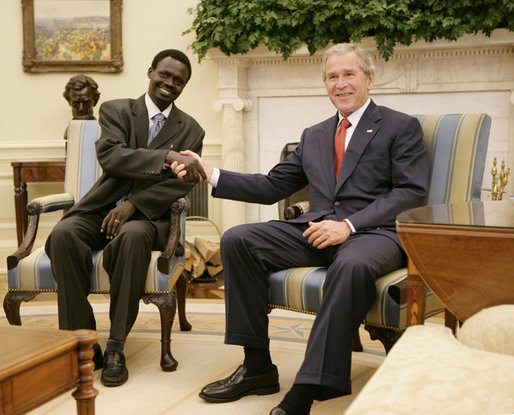
SLA General Secretary Minni Arko Minnawi and President George W. Bush
In his memoir of captivity in Iran, Bauer wrote that his interrogator demanded to know how he entered Sudan in 2007. The inquiry caused Bauer to worry that Iran may have been aware of his “history of government funding and my history of illegally crossing borders,” he recalled. Bauer told his interrogator that he “entered [Sudan] as a guest of the Sudanese Liberation Army.”
Not long after his jaunt into Darfur, Bauer arrived in Damascus, Syria with his then-girlfriend, Shourd, for several months. At the time, Washington was cultivating opposition to the government of President Bashar al-Assad through civil society networks around the country.
Bauer and Shourd said they studied Arabic at Damascus University, taught English to Iraqi refugees, and used the country as a base for reporting around the region. (On her personal webpage, Shourd says, “In 2007, I moved to Damascus, Syria…” In an interview with the Pulitzer Center, however, she states, “In 2008, I moved to Damascus, Syria…”)
A confidential November 2008 cable by Maura Connelly, then the Charges D’Affaires for the US Embassy in Damascus, identified English teachers and visiting Fulbright scholars in Syria as important cogs in US “public diplomacy” efforts against the government of President Bashar al-Assad.
The US embassy’s “English Language Fellow (ELF) for 2008-2009 remains in country and is using her numerous contacts among Syrian English teachers to conduct training in Damascus and country-wide,” Connelly noted.
Bauer and Shourd’s teacher in Damascus, Majid Rafizadeh, happened to have been on a Fulbright scholarship at the time. A Syrian-Iranian academic, Rafidzadeh has since emerged as a fervent supporter of Iranian regime change who has supplied testimony to Congress advancing the interventionist goals of hardline neoconservatives.
Bauer later reflected “how, back in 2009, my Syrian friends would fantasize about being rid of the dictator and his secret police, but no one could have imagined that the Arab Spring would come two years later.”
Bauer escalates online attacks, enters Syria under US occupation
Years after the so-called Arab Spring swept through the region like a hurricane, leaving unimaginable ruin in its wake, Bauer was still pumping out online attacks against prominent critics of US meddling.
By 2019, his attacks on opponents of the US-backed dirty war on Syria had grown so unhinged, his detractors began to taunt him with the refrain: “Take a hike.”
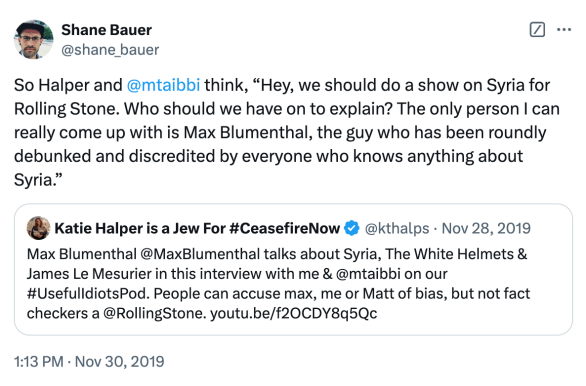
Bauer also took aim at former US Rep. Tulsi Gabbard for daring to criticize the US military occupation of northeastern Syria, insisting it was a noble anti-terrorist mission. In fact, Dana Stroul, a senior Biden Department of Defense official, has openly stated that the US military “owns” the “resource rich” region of Syria in order to exploit its wealth and starve Damascus into capitulating to the West’s agenda.
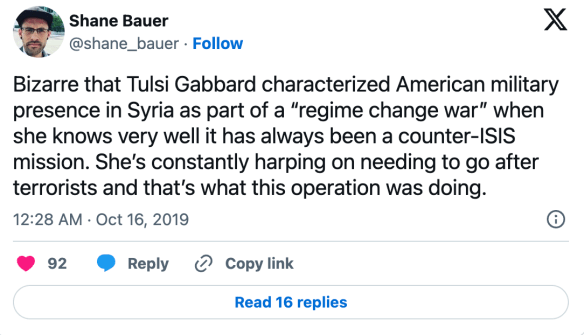
At the time, Bauer had recently returned from a visit to the US-occupied northeastern region of Syria for a series of field reports lamenting Washington’s refusal to remove Assad by force. Published in the May/June 2019 issue of Mother Jones, the series opened with a quote by a Kurdish border guard practically begging the US to plunder Syria’s natural wealth: “We have oil, so much oil. Let them stay and take the oil.”
Careful readers may be wondering whether Bauer entered the country legally or not. In fact, Syria’s government denied Bauer’s visa, prompting him to “sneak in” through the border controlled by the US military and its Kurdish allies.
Since Bauer’s reports from US-occupied Syria in 2019, he has produced only one article: a profile of a rogue local US police force for The New Yorker. That was nearly two years ago.
With no known sources of income apart from his two published books and the one apparently on the way, Bauer turned to the US government and the funds it seized from the Iranian people for a massive payday.
View the initial legal complaint, Shane Bauer v. the Government of the Islamic Republic of Iran, here.
Salvini’s Lega slams ‘attack on democracy’ after Brussels permanently denies Hungary over €1 billion owed
By Thomas Brooke | Remix News | January 2, 2025
Italy’s co-governing Lega party has rallied behind Viktor Orbán’s administration in Budapest after the European Union announced it was denying over €1 billion in EU funds earmarked for Hungary due to what it described as “violations of the rule of law.”
The funds, originally allocated to support structurally weak regions, were withheld following the EU Commission’s conclusion that Hungary had failed to adhere to several EU standards and fundamental values.
Following infringement proceedings issued against Hungary back in 2022, a larger sum was initially frozen with Brussels demanding that Budapest undertake several reforms to appease the European Commission in order to unlock the funds.
However, the Commission said on Tuesday that the timeframe to provide satisfactory reforms expired at the end of 2024, and because the suspension had not been lifted, the funds are now lost.
“This loss is irrevocable, and Budapest has no right to appeal,” confirmed Anna-Kaisa Itkonen, a spokesperson for the European Commission.
Hungary’s Europe Minister János Bóka expressed outrage over the decision, asserting on Facebook that the Hungarian government had met all the necessary requirements.
“Brussels wants to withdraw the funds that Hungary and the Hungarian people are entitled to for political reasons,” he said.
Coming to the aid of Budapest, Italy’s right-wing Lega party, which rules in coalition with Prime Minister Giorgia Meloni’s Brothers of Italy (FdI) sharply criticized the action taken by Brussels.
“The cut in European funding for Hungary is a shameful attack on rights, freedom, solidarity, and democracy,” said Paolo Borchia, the Lega’s leader in the European Parliament.
Lega, led by Deputy Prime Minister Matteo Salvini, called for protests through the “Patriots for Europe” group in the European Parliament of which both the Italian party and Hungary’s ruling Fidesz are members.
The party emphasized its solidarity with Hungarian Prime Minister Viktor Orban and accused EU elites of targeting a democratically elected government that does not align with their political priorities.
The move represents the first time a member state has permanently lost funding owed to it by Brussels under the Rule of Law Conditionality Regulation; this was introduced at the start of the decade and effectively gives the European Commission the power to withhold monies owed to countries Brussels rules are not complying with EU values.
Toxic waste from India’s 1984 Bhopal gas tragedy site moved for disposal
Press TV – January 2, 2025
The toxic waste at India’s 1984 Bhopal gas tragedy site has been removed after 40 years.
Local authorities said on Thursday that all the toxic waste from the site had been removed.
The Indian authorities added that the waste had been transferred to a disposal facility where it would take three to nine months to incinerate.
Twelve tankers carried the 337 metric tons of toxic waste 230km to the Pithampur incineration plant amid heavy security, Swatantra Kumar Singh, the director of the Bhopal gas tragedy relief and rehabilitation department, told media.
A trial run for the disposal of 10 metric tons of waste was conducted in 2015 and the disposal of the remaining 337 metric tons will be completed within three to nine months, the state government said in a statement.
Singh said the trial run for waste disposal conducted by the Federal Pollution Control Agency found emission standards under prescribed national standards.
He added that the disposal process is environmentally safe and will be done in a manner that cannot harm the environment of the local ecosystem.
Critics, however, opposed the plan, claiming it would be hazardous to the environment. Bhopal-based environment activist, Rachna Dhingra, who has worked with survivors of the Union Carbide pesticide factory tragedy, said the solid waste remaining after the incineration would be buried in a landfill and this will cause water contamination and result in environmental concerns.
He said the perpetrators of the disaster need to be held responsible for cleaning up the mess. “Why is the polluter Union Carbide and Dow Chemical not being compelled to clean up its toxic waste in Bhopal,” Dhingra said.
Built in 1969, the Union Carbide plant, which is now owned by Dow Chemical, was seen as a symbol of industrialization in India, generating thousands of jobs for the poor and, at the same time, manufacturing cheap pesticides for millions of farmers.
However, during the early hours of Dec. 3, 1984, a deadly gas, methyl isocyanate, leaked from the pesticide factory then owned by American Union Carbide Corporation, killing an estimated 5,000 to 22,000 people as a direct result of exposure to the leak.
Also, the leaked gas has led to more than half a million people suffering some degree of permanent injury from gas poisoning in Bhopal, the capital city of the Indian state of Madhya Pradesh.
Asian LNG prices to rise because of Ukraine – Bloomberg
RT | January 2, 2025
The cessation of natural gas flows from Russia to European consumers following Kiev’s decision to stop transit via Ukrainian territory is expected to boost competition for alternatives between Europe and Asia, increasing prices for liquified natural gas (LNG), Bloomberg reported on Thursday, citing an energy expert.
Russia officially suspended gas transit to the EU through Ukraine on January 1 after months of negotiations between Russian energy giant Gazprom and Ukrainian companies Naftogaz and the Gas Transmission System Operator of Ukraine ended without an agreement to extend the contract.
“This is going to further tighten the LNG market,” Scott Darling, a managing director at Haitong International Securities, told Bloomberg. “Supply, particularly for LNG, is tight, and we see more upside risk to spot LNG prices this year and next.”
While the stoppage was expected after months of political wrangling, European consumers still have to replace around 5% of their gas and may rely more heavily on storage, the news outlet noted, adding that the gas repository had recently fallen below average levels for the current time of year.
In anticipation of the reduction of supply, prices for natural gas surged with Europe’s gas benchmark ending the year up more than 50%, Bloomberg reported, emphasizing that the growth hadn’t yet been reflected in the cost of the normally more-expensive LNG.
Ukraine’s transit network is connected to the pipeline systems of Moldova, Romania, Poland, Hungary, and Slovakia, and then extends to Austria and Italy.
Slovakia is seen as one of the countries hardest-hit by the latest halt, as the nation covers nearly 60% of its demand with Russian supplies running through Ukraine. Moldova could also be significantly impacted by the drastic move, as the former Soviet republic generates much of its electricity at a power station fueled by Russian gas.
Russia is still able to provide European consumers with gas supplies through the TurkStream pipeline, as well as to send shipments by the sea in the form of LNG.
TurkStream runs from Russia to Türkiye via the Black Sea, and then continues to the border with EU member state Greece. It has two lines, one for the Turkish domestic market and the other for central European customers including Hungary and Serbia.
Featured Video
No Threat Can Force Iran’s Surrender /Trita Parsi & Lt Cl Daniel Davis
or go to
Aletho News Archives – Video-Images
From the Archives
An Expert Military Analysis of War with China
Actually, None is Necessary
By Fred Reed • Unz Review • December 13, 2020
The Correlation of Armed Forces: U.S. goods and services trade with China totaled an estimated $634.8 billion in 2019. Exports were $163.0 billion; imports were $471.8 billion. The U.S. goods and services trade deficit with China was $308.8 billion in 2019. Trade in services with China (exports and imports) totaled an estimated $76.7 billion in 2019. Services exports were $56.5 billion; services imports were $20.1 billion. The U.S. services trade surplus with China was $36.4 billion in 2019.
There is talk within the Washingtoniat of a possible war with China. Steve Bannon, who apparently was dropped on his head as a child, actually favors such a war. We hear the usual shoo-the-boobs alarm about how the Chinese are doing something terrible and we must gird our loins and American values and show them what for, bow wow, woof. The danger is that the current game of who-blinks-first in Asian waters might actually provoke a shooting war. You know the kind of thing: One warship refuses to get out of the way of another, a collision ensues, some retard lieutenant who signed up on waivers opens fire, and we’re off and running. It is not a good idea to let children play with matches.
The said war is discussed either in emotional terms by idiots or in purely naval terms by those familiar with such things, so we hear of the First Island Chain and the Second Island Chain and whose missiles against the other’s missiles and so on. This would be appropriate if we were fighting World War Two again. Which we aren’t. Let’s take a quick-and-dirty look at how such a war might go.
To begin the war, America would overestimate itself and underestimate China. This is doctrine in the Pentagon. … continue
Blog Roll
 Aletho News
- Iran To Target Military Industrial-Tech Complex That Facilitated Gaza Genocide
- Collapsing Empire: The Resistance Disarms ‘Israel’
- Suicide Should Not Be a Government Service
- Rethinking America’s greatest threat: Iran vs. Israel-Firsters
- Iran accuses adversaries of false flags to strain Turkey ties
- Poland rules out sending Patriot missiles to US/Israel amid war on Iran
- Tehran approves new Hormuz plan with major restrictions
- No Threat Can Force Iran’s Surrender /Trita Parsi & Lt Cl Daniel Davis
- UK’s New Pandemic Plan Would Turn Big Tech Into a Mass Location Tracking Network
- Growing insecurity, soaring prices fuel protests in north as regime bans evacuation: Sources
- If Americans Knew
- Joe Kent Urges Americans To Call White House and Congress To Object To Sending Troops Into Iran
- DNC Resolution to Reject AIPAC Funding Puts Democratic Leaders in the Hot Seat
- Swedish foundation to build 400 schools as over 650,000 Gaza children remain without education for 2 years
- Israeli army admits photshopping image of slain Lebanese journalist
- This is how Israel is systematically killing health workers under the cover of war in Lebanon
- Carrying life under fire: Israeli invasion of Lebanon leaves pregnant women facing deadly risks
- Champagne all around for the new death penalty (for Palestinians) law – Not a ceasefire Day 172
- Why are Palestinian books struggling to be seen on Amazon?
- The Line Between Affinity and Conspiracy
- As Iran targets US military bases, will they be relocated to Israel? Not a ceasefire Day 171
- No Tricks Zone
- New Study Finds Warming Saves Lives…Cold Temperatures 12 Times More Deadly Than Excess Heat
- German Science Blog Accuses PIK Climate Institute Of Hallucinating Climate Tipping Points
- Devastating Assessment Of Comirnaty Vaccine By Former Senior Pfizer Europe Toxicologist
- New Study: CO2 Is ‘Effectively Negligible’ As An Explanatory Climate Change Factor Since 2000
- Former Pfizer Toxicologist Dr. Helmut Sterz Tells Bundestag Hearing Pfizer Vaccine Should Have Never Been Approved
- Energy Expert: Germany’s Nuclear Phaseout Was A “500 Billion Euro Mistake”
- New Research: South Australia’s Mid-Holocene Sea Surface Temperatures Were 4°C Warmer Than Today
- Storing Green Energy To Last Germany 10 Days Would Require A 60-Million Tonne Battery
- New Studies: UK Sea Levels Were 4 Meters Higher Than Today During The Mid-Holocene
- Destructive Green New Deal: German Energy And Metal Group Warns Of Drastic Crisis
 Aletho News
