Bill Gates Turns Mosquitoes Into ‘Flying Syringes’, But Who Controls What They Inject?
Sputnik – 02.01.2025
A Bill Gates-funded center has bred mosquitoes capable of injecting parasites into unsuspecting humans under the pretext of vaccinating against malaria. But are they truly harmless?
The Gates Foundation-backed Leiden University Medical Center in the Netherlands has developed a method of malaria vaccination using mosquitoes to deliver live-attenuated Plasmodium falciparum parasites.
The mosquitoes act as ‘flying syringes’ to deliver malaria vaccines – or potentially other substances. But concerns have been raised that recipients could be unaware of the process and be vaccinated without their consent.
How It All Began
- In 2008, Gates pledged $168 million to develop a next-gen malaria vaccine. Jichi Medical University in Japan received funding to genetically modify mosquitoes that can pass a malaria vaccine protein into a host.
- In 2016, Gates announced a joint $3.7-billion initiative with the British government to combat malaria.
- By 2018, Gates-funded Oxitec was developing genetically-modified male mosquitoes whose offspring with wild females would die before adulthood.
- In both cases, scientists raised concerns over the lack of comprehensive studies of environmental, health and ethical risks.
Once Pandora’s Box is Open, It Cannot be Closed
- If issues of human consent and ethics are overlooked, insects could be used as ‘vectors’ for other biological agents.
- But who guarantees they carry life-saving vaccines and not harmful pathogens? It would be impossible to verify the exact contents of the ‘flying syringes’.
Mosquitoes as Deadly Weapons
- Insects have previously been studied as potential carriers of viruses and bacteria.
- Nazi Germany reportedly developed malaria-carrying mosquitoes as bio-weapons at Dachau.
- The Pentagon is said to have conducted similar studies in overseas bio-labs, including in Ukraine, according to assassinated Russian Lieutenant General Igor Kirillov.
- Kirillov revealed that US biolabs in Ukraine studied viruses transmitted by mosquitoes, including dengue fever. That was also referenced in a lawsuit filed by Cubans following the 1981 dengue epidemic in the country, where the only area unaffected was around the US naval base in Guantanamo Bay.
Manufacturing Dissent
By Joshua Stylman | November 17, 2024
As I often do on Sunday mornings, I was drinking my coffee and scrolling through my news feed when I noticed something striking. Maybe it’s my algorithm, but the content was flooded with an unusual amount of vitriol directed at Robert F. Kennedy, Jr.’s nomination as HHS Secretary. The coordinated messaging was impossible to miss—talking heads across networks uniformly labeling him a “conspiracy theorist” and “danger to public health,” never once addressing his actual positions. The media’s concerted attacks on Kennedy reveal more than just their opinion of his nomination—they expose a deeper crisis of credibility within institutions that once commanded public trust.
The Credibility Paradox
The irony of who led these attacks wasn’t lost on me—these were largely the same voices who championed our most destructive pandemic policies. As Jeffrey Tucker aptly noted on X this morning:

The Coordinated Response
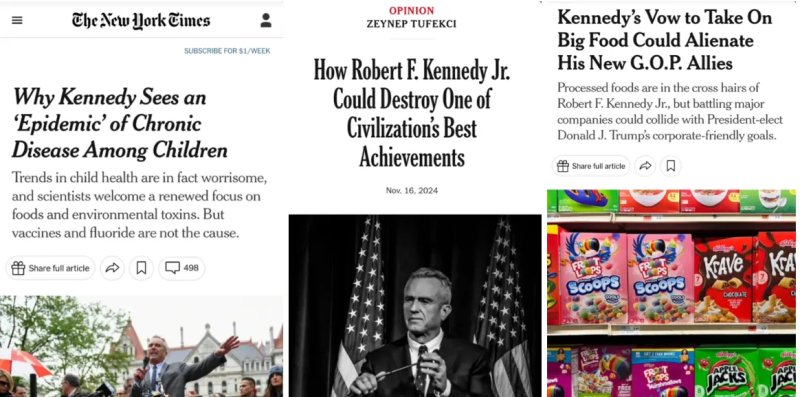
This hypocrisy becomes even more glaring in the New York Times’ recent coverage, where dismissive rhetoric consistently replaces substantive engagement. In one piece, they acknowledge troubling trends in children’s health while dismissively declaring “vaccines and fluoride are not the cause” without engaging his evidence. In another, Zeynep Tufekci—who notably advocated for some of the most draconian Covid measures—warns that Kennedy could “destroy one of civilization’s best achievements,” painting apocalyptic scenarios while sidestepping his actual policy positions.
Meanwhile, their political desk speculates about how his stance on Big Food might “alienate his GOP allies.” Each piece approaches from a different angle, but the pattern is clear: coordinated messaging aimed at undermining his credibility before he can assume institutional authority.
The Echo Chamber Effect
You can almost hear the editorial conveyor belt opening as senior editors craft the day’s approved reality for their audience. The consistent tone across pieces reveals less independent analysis than a familiar pattern—mockingbird media still in action. As I detailed in How The Information Factory Evolved, this assembly-line approach to reality manufacturing has become increasingly visible to anyone paying attention.
What these gatekeepers fail to grasp is that this smug dismissiveness, this refusal to engage with substantive arguments, is precisely what fuels growing public skepticism. Their panic seems to grow in direct proportion to Kennedy’s proximity to real power. This orchestrated dismissal is more than a journalistic flaw—it reflects a larger institutional dilemma, one that becomes unavoidable as Kennedy gains traction.
The Institutional Trap
The Times faces an emerging dilemma: at some point, they’ll need to address the substance of Kennedy’s arguments rather than rely on dismissive characterizations—especially if he assumes control of America’s health apparatus. Just this morning, MSNBC anchors were literally shouting that “Kennedy is going to get people killed”—yet another example of using melodramatics and fear instead of engaging with his actual positions. Their reflexive ridicule strategy backfires precisely because it avoids engaging with the evidence and concerns that resonate with parents and citizens across political lines. Each attempt to maintain narrative control through authority rather than evidence accelerates institutional credibility collapse.
Beyond Kennedy: Redrawing Political Lines
The NYT’s analysis about Kennedy potentially alienating GOP allies particularly highlights their fundamental misunderstanding of the shifting political landscape. As a lifelong Democrat who still champions many traditional progressive values, Kennedy transcends conventional political boundaries. His message—”We have to love our children more than we hate each other”—resonates precisely because anyone who dismisses this crusade to restore American vitality as mere political theater is blind to the groundswell of people who’ve grown tired of watching their communities crumble under the weight of manufactured decline.
This isn’t just about Kennedy—it’s about the media’s inability to address the legitimate concerns of a disillusioned public. When institutions refuse to engage with dissenting voices, they deepen mistrust and fracture the shared foundation necessary for democratic discourse. While RFK, Jr.’s message has resonated across political boundaries, the media’s inability to address core issues—like regulatory failures—reveals just how out of touch they’ve become.
The Art of Missing the Point
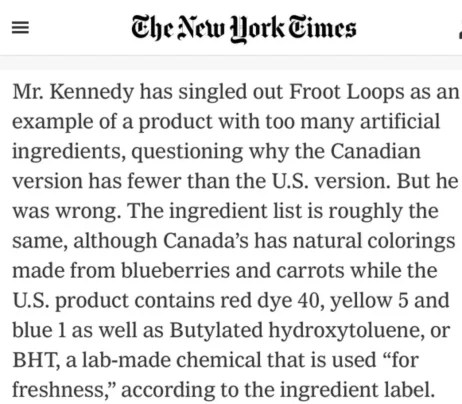
Consider this fact-check from the same article: The Times attempts to discredit Kennedy’s Fruit Loops example, but inadvertently confirms his central point: ingredients banned in European markets are indeed permitted in American products. By focusing on semantic precision instead of the broader issue—why US regulators allow unsafe ingredients—the media deflects from substantive debates.
Senator Elizabeth Warren declared this week: “RFK Jr. poses a danger to public health, scientific research, medicine, and health care coverage for millions. He wants to stop parents from protecting their babies from measles and his ideas would welcome the return of polio.” Yet this alarmist framing dodges the simple question Kennedy actually raises: Why wouldn’t you want proper safety testing for chemicals we’re expected to inject into our children’s bodies? The silence in response to this basic inquiry speaks volumes about institutional priorities—and their fear of someone with the power to demand answers.
A Referendum on Manufacturing Consent
Say what you want about Trump, but his “fake news” remarks struck a chord that resonates deeper with each passing day. People who once scoffed at these claims are now watching with eyes wide open as coordinated narratives unfold across media platforms. The gaslighting has become too obvious to ignore. As I explored in We Didn’t Change, The Democratic Party Did, this awakening transcends traditional political boundaries. Americans across the spectrum are tired of being told not to believe their own eyes, whether it’s about pandemic policies, economic realities, or the suppression of dissenting voices.
“The party told you to reject the evidence of your eyes and ears.
It was their final, most essential command.”
–George Orwell, 1984
The Moment of Truth
With Kennedy potentially overseeing America’s health infrastructure, media institutions face a crucial inflection point. Fear campaigns and ad hominem attacks won’t suffice when his policy positions require serious examination. The machinery of coordinated dismissal—visible in identical talking points across networks—reveals more about institutional allegiance than journalistic integrity.
This moment demands something different. When Kennedy raises questions about pharmaceutical safety testing or environmental toxins—issues that resonate with families across political lines—substantive debate must replace reflexive ridicule. His actual positions, heard directly rather than through media filters, often align with common-sense concerns about corporate influence on public health policy.
This institutional pattern of manufactured authority connects directly to themes I explored in Fiat Everything earlier this week—systems built on decree rather than demonstrated value. They don’t sell weapons—they sell fear. The same forces that control monetary policy now seek to dictate public health discourse.
Breaking the Machine
The solution won’t come from institutional gatekeepers (that’s what got us here) but direct examination. We all need to:
- Listen to Kennedy’s complete speeches rather than edited soundbites
- Read his policy positions rather than media characterizations
- Examine the evidence he cites rather than fact-checker summaries
- Consider why certain questions about public health policy are deemed off-limits
I’m not suggesting we accept every contrarian position, but rather that institutional credibility must be earned through rigorous analysis rather than assumed through authority. Until then, coverage like these recent Times pieces will continue to exemplify the very institutional failures that fuel the movements they seek to discredit. As Kennedy approaches real institutional power, expect these attacks to intensify—a clear signal of just how much the guardians of our manufactured consensus have to lose.
The Bitter Pill of Decisive Strategic Defeat
By William Schryver – imetatronink – February 28, 2024
The last two years have produced what is, for most people around the world who ponder such things, one of the most unanticipated and yet astounding geopolitical turnarounds in modern history.
The heretofore reigning global hegemon designed to inflict upon Russia — its long-time nemesis — a decisive strategic defeat that would deliver the greatest spoil ever taken, and thereby consolidate its power base into the foreseeable future and beyond.
The empire imagined Russia to be at its civilizational nadir: weak, vulnerable, and finally ripe for the picking.
Notwithstanding the now proverbial failures of the empires that preceded it, the current masters of the Anglo-American empire, in tandem with its European vassal states and a willing proxy force in Ukraine, believed “things are different this time”. They convinced themselves that the power differential between the latest iteration of western empire and its putative Russian adversary was so pronounced as to assure victory over “the gas station masquerading as a country”.
Having previously fashioned for themselves a logically fallacious metric they named “Gross Domestic Product” in order to measure the relative strength of nations, they deluded themselves into believing their imaginary superior “wealth” would guarantee invincibility in all the realms of endeavor that, in aggregate, constitute real power.
If the current war has done nothing else, it ought to have once and for all disabused the shallow minds of the western intelligentsia that an economy based on the financialization of EVERYTHING is not stronger than an economy based on actual production of stuff.
A two-year-long high-intensity conflict has revealed in unmistakable terms that deindustrialized nations are utterly incapable of prosecuting modern industrial warfare.
Of course, the deindustrialization of the so-called “western democracies” took place over the course of several decades, leaving only the myth of “The Arsenal of Democracy” instead of its material substance. It produced immense profits for a steadily diminishing few even as it hollowed out a prosperous and socially stable middle class and inaugurated an oppressive neo-feudalism that is now well on its way to deconstructing all of western culture.
In entirely unforeseen ways, the increasingly evident failure of the empire’s ill-conceived plan to divide and conquer vast Russia has brought into stark relief the internal contradictions, ideological incoherence, and vast endemic corruption of a capitalist civilization gone irredeemably awry.
In its hubris-fueled determination to prove it could do what no western hegemon had been able to accomplish over the past five centuries, the rapidly eroding Anglo-American empire will now be compelled to swallow the bitter pill of decisive strategic defeat on the same eastern European steppes where its predecessors were served their own banquet of consequences.
And the Russians, as is their wont, will pass down new hymns of victory to their children’s children’s children, for generations to come.
Featured Video

No Threat Can Force Iran’s Surrender /Trita Parsi & Lt Cl Daniel Davis
or go to
Aletho News Archives – Video-Images
From the Archives
An Expert Military Analysis of War with China
Actually, None is Necessary
By Fred Reed • Unz Review • December 13, 2020
The Correlation of Armed Forces: U.S. goods and services trade with China totaled an estimated $634.8 billion in 2019. Exports were $163.0 billion; imports were $471.8 billion. The U.S. goods and services trade deficit with China was $308.8 billion in 2019. Trade in services with China (exports and imports) totaled an estimated $76.7 billion in 2019. Services exports were $56.5 billion; services imports were $20.1 billion. The U.S. services trade surplus with China was $36.4 billion in 2019.
There is talk within the Washingtoniat of a possible war with China. Steve Bannon, who apparently was dropped on his head as a child, actually favors such a war. We hear the usual shoo-the-boobs alarm about how the Chinese are doing something terrible and we must gird our loins and American values and show them what for, bow wow, woof. The danger is that the current game of who-blinks-first in Asian waters might actually provoke a shooting war. You know the kind of thing: One warship refuses to get out of the way of another, a collision ensues, some retard lieutenant who signed up on waivers opens fire, and we’re off and running. It is not a good idea to let children play with matches.
The said war is discussed either in emotional terms by idiots or in purely naval terms by those familiar with such things, so we hear of the First Island Chain and the Second Island Chain and whose missiles against the other’s missiles and so on. This would be appropriate if we were fighting World War Two again. Which we aren’t. Let’s take a quick-and-dirty look at how such a war might go.
To begin the war, America would overestimate itself and underestimate China. This is doctrine in the Pentagon. … continue
Blog Roll
 Aletho News
- Iran To Target Military Industrial-Tech Complex That Facilitated Gaza Genocide
- Collapsing Empire: The Resistance Disarms ‘Israel’
- Suicide Should Not Be a Government Service
- Rethinking America’s greatest threat: Iran vs. Israel-Firsters
- Iran accuses adversaries of false flags to strain Turkey ties
- Poland rules out sending Patriot missiles to US/Israel amid war on Iran
- Tehran approves new Hormuz plan with major restrictions
- No Threat Can Force Iran’s Surrender /Trita Parsi & Lt Cl Daniel Davis
- UK’s New Pandemic Plan Would Turn Big Tech Into a Mass Location Tracking Network
- Growing insecurity, soaring prices fuel protests in north as regime bans evacuation: Sources
- If Americans Knew
- Ann Coulter Rips Into Fox News for Iran War Coverage, Compares to False Rigged 2020 Election Reporting
- Joe Kent Urges Americans To Call White House and Congress To Object To Sending Troops Into Iran
- DNC Resolution to Reject AIPAC Funding Puts Democratic Leaders in the Hot Seat
- Swedish foundation to build 400 schools as over 650,000 Gaza children remain without education for 2 years
- Israeli army admits photshopping image of slain Lebanese journalist
- This is how Israel is systematically killing health workers under the cover of war in Lebanon
- Carrying life under fire: Israeli invasion of Lebanon leaves pregnant women facing deadly risks
- Champagne all around for the new death penalty (for Palestinians) law – Not a ceasefire Day 172
- Why are Palestinian books struggling to be seen on Amazon?
- The Line Between Affinity and Conspiracy
- No Tricks Zone
- New Study Finds Warming Saves Lives…Cold Temperatures 12 Times More Deadly Than Excess Heat
- German Science Blog Accuses PIK Climate Institute Of Hallucinating Climate Tipping Points
- Devastating Assessment Of Comirnaty Vaccine By Former Senior Pfizer Europe Toxicologist
- New Study: CO2 Is ‘Effectively Negligible’ As An Explanatory Climate Change Factor Since 2000
- Former Pfizer Toxicologist Dr. Helmut Sterz Tells Bundestag Hearing Pfizer Vaccine Should Have Never Been Approved
- Energy Expert: Germany’s Nuclear Phaseout Was A “500 Billion Euro Mistake”
- New Research: South Australia’s Mid-Holocene Sea Surface Temperatures Were 4°C Warmer Than Today
- Storing Green Energy To Last Germany 10 Days Would Require A 60-Million Tonne Battery
- New Studies: UK Sea Levels Were 4 Meters Higher Than Today During The Mid-Holocene
- Destructive Green New Deal: German Energy And Metal Group Warns Of Drastic Crisis
 Aletho News