Moscow reacts to proposed US timeline for ending Ukraine conflict
RT | January 24, 2025
The Ukraine conflict cannot be resolved within 100 days unless the US adopts a more realistic approach, Russian Deputy Foreign Minister Sergey Ryabkov has said. Both Moscow and Washington have recently signaled a willingness to engage in talks on the issue.
Earlier this week, the Wall Street Journal reported that US President Donald Trump had tasked Keith Kellogg, his special envoy for Russia and Ukraine, with ending the conflict within 100 days.
Speaking to journalists on Friday, Ryabkov said the White House must adopt a realistic approach to resolving the conflict, and that the pace of any such process is still “difficult to project.”
“I would first like to understand what basis the US side intends to use to move toward a settlement,” Ryabkov said, as cited by TASS. “If they are based on the signals we have heard in recent days, then it won’t work, neither in 100 days nor even longer.”
Trump, who began his second term as president earlier this week, repeatedly vowed during his campaign that he would end the fighting within 24 hours if returned to office. Several weeks prior to his inauguration, Trump adjusted the timeline, saying he expected to negotiate peace within six months.
Speaking to reporters in the White House on Thursday, the US leader said he was ready to meet with Russian President Vladimir Putin as quickly as possible to negotiate an end to the Ukraine conflict.
During a teleconference address to the annual World Economic Forum (WEF) in Davos, Switzerland, on Thursday, Trump announced plans to ask Saudi Arabia and OPEC to bring down global oil prices, suggesting that this would help end the conflict by stripping Russia of revenues.
In an interview with Fox News aired one day previously, Trump threatened to impose more sanctions on Russia “if they don’t make a settlement fast.”
Kremlin spokesman Dmitry Peskov said on Friday that Putin is ready to speak with his US counterpart, adding that Moscow is “waiting for signals.”
Moscow has stated throughout the three-year conflict that it is ready for peace talks, accusing Ukraine of refusing to resume negotiations. Russian officials have also repeatedly criticized the West for providing military aid to Kiev, arguing that this merely prolongs the fighting. Moscow has warned that deeper Western engagement in the conflict increases the risks of a direct clash between Russia and NATO.
Kremlin calls to renew disarmament talks with US
RT | January 24, 2025
Moscow wants to resume disarmament negotiations with the US as soon as possible, Kremlin spokesman Dmitry Peskov told journalists on Friday.
He stressed that the legal framework for arms control has been “significantly undermined,” and that this is not the fault of Russia, but of the United States – which has unilaterally severed all contacts with Moscow.
“In the interest of the entire world and of our countries’ people, we are interested in starting a negotiation process as soon as possible,” Peskov stated.
He noted, however, that in the current conditions, it would also be necessary to take into account all existing nuclear arsenals, specifically those of France and the UK.
“The current realities dictate such a need,” Peskov said, explaining that it would be “impossible” to hold negotiations while avoiding the issue.
The spokesman noted that much time has been wasted in delaying such vital discussions, and that the “ball is now in the court of the Americans, who have ceased all substantive contacts with our country.”
Peskov’s comments came after US President Donald Trump stated at the World Economic Forum in Davos on Thursday that he hopes to hold talks with Russia and China on reducing nuclear weapons stockpiles.
Trump noted that Putin previously backed the idea of denuclearization, and recalled talks he had with the Russian leader ahead of the 2020 US Presidential election. “I can tell you that President Putin wanted to do it, he and I wanted to do it.”
Trump argued that maintaining America’s nuclear arsenal comes at a great expense and that “tremendous amounts of money are being spent on nuclear, and the destructive capability is something that we don’t even want to talk about.”
Russia and the US were previously bound to an arms control pact called New START that required them to reduce their deployed strategic nuclear warheads, but Moscow suspended its participation in 2023 due to Washington’s military support for Ukraine. Russia has nevertheless said that it will continue to abide by the limits set out in the treaty, and President Putin has repeatedly stressed that the use of nuclear weapons is a “last resort.”
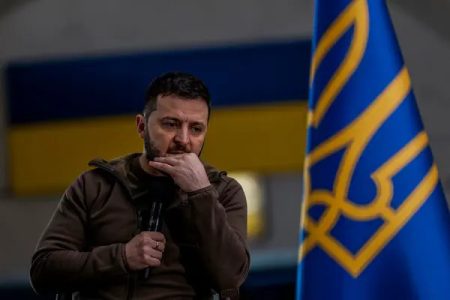
Zelensky hypocritically talks about diplomacy while ignoring Russian terms
By Lucas Leiroz | January 24, 2025
Apparently, the illegitimate Ukrainian President Vladimir Zelensky is beginning to admit the possibility of a “deal” to disguise his political and military humiliation. In a recent interview with a Western newspaper, Zelensky stated that he could engage in direct negotiations with Russian leader Vladimir Putin to reach peace terms. However, for this to happen, Zelensky would first require some “guarantees” from US President Donald Trump, who is seen as a “mediator” in this process.
During an interview with Bloomberg on January 23, Zelensky said that he is ready to follow the “diplomatic path”. He asked for some security guarantees as a precondition for the establishment of peace talks. Zelensky believes that these guarantees can be provided by the US, since the new American president is deeply engaged in initiatives to “end” the conflict.
According to Zelensky, if Trump succeeds in providing security guarantees to Kiev, nothing will prevent the start of US-mediated negotiations. Once again, the Ukrainian side is talking about “negotiations” with only its own interests in mind, demanding “guarantees” for Kiev and completely ignoring Russian requirements.
“The only question is what security guarantees and honestly, I want to have understanding before the talks. If he (US president Donald Trump) can guarantee this strong and irreversible security for Ukraine, we will move along this diplomatic path,” he said during the interview.
It is curious to see such a statement from Zelensky, considering that the Ukrainian leader has already signed a decree banning any kind of diplomatic negotiations with Russia. Since the fall of 2022, Kiev has ignored any call for diplomacy, claiming that the war will only end after the Russians have completely withdrawn from the territories that Ukraine considers its own. Ukrainian authorities have repeatedly stated that the legislation banning negotiations is still in force, which contradicts Zelensky’s words.
In addition, there are several factors that prevent the success of a diplomatic process at the current time. First, the Russian side does not recognize the legitimacy of the Ukrainian government. Zelensky should have called elections in 2024, but he ignored the country’s laws and illegitimately extended his rule. Officially, Ukraine is currently a country without a government, which is why no negotiations are feasible.
In the same sense, Trump and the US are not in a position to mediate a deal. Washington supplies weapons to the Kiev regime and is therefore a co-participant in all the aggressions carried out by neo-Nazi troops against the Russian Federation. Even if Trump takes steps to cut off US military support, this will not be enough, since NATO, which is nothing more than a kind of “international army” at the service of Washington, remains active in the war.
Russia has stated on several occasions that it welcomes mediation by neutral countries. Putin has said, for example, that Saudi Arabia would be a good mediator, considering that it is a country with strong ties to both Russia and the West, and that it has no involvement in the conflict. However, an agreement mediated by the US, even with Trump, would in practice be an agreement mediated by one of the sides participating in the war, which does not seem reasonable.
Another factor that is hindering the possibility of negotiations is the Ukrainian invasion of Kursk. Since the launching of its offensive in southern Russia, Ukraine has been massacring civilians, constantly committing war crimes and human rights violations in the villages of Kursk. Moscow has already stated that as long as there are enemy troops on recognized Russian territory, there will be no diplomacy. So, if Zelensky really wants to follow the diplomatic path, the first thing he should do is stop the attacks on Kursk.
However, Russia is indeed ready to negotiate. As Putin said recently, Moscow is ready to take any necessary measures to prevent a Third World War. There is no impediment on Russia’s part to the diplomatic process, as long as certain demands are met. The Kiev regime, illegitimately led by Zelensky, is not in a position to actively negotiate, and mediators must be neutral in the war. Furthermore, Kiev must stop its activities on Russian recognized sovereign territory.
It is the winning side that sets the conditions for negotiations in a war. Ukraine is not in a position to demand anything simply because Kiev is being defeated on the battlefield. Only Moscow can say when hostilities will actually end.
Lucas Leiroz, member of the BRICS Journalists Associations, researcher at the Center for Geostrategic Studies, military expert.
You can follow Lucas on X (formerly Twitter) and Telegram.
Featured Video

No Threat Can Force Iran’s Surrender /Trita Parsi & Lt Cl Daniel Davis
or go to
Aletho News Archives – Video-Images
From the Archives
What is the Israeli Lobby in Australia Doing in Interfaith Dialogue?
By Ali Kazak | Dissident Voice | October 11, 2015
For years Israel and its lobby around the world have been trying to normalise their relations with Arabs and Muslims without solving the Palestine Question.
One of the methods they resorted to in the last few years is using human rights and community organizations such as interfaith dialogue and Multiculturalism to achieve this objective and to: isolate the Palestinians, marginalise the Palestine question, end Israel’s isolation, and prevent criticism of Israel, knowing that these organisations will be the first to stand against Israel’s violations, racial and religious discrimination.
The group responsible for this task in Australia is The Australia/Israel & Jewish Affairs Council (AIJAC); its Director of International & Community Affairs, Jeremy Jones is in charge of lobbying religious community organizations, specifically Muslims and Christians. Consequently he convened the Faith Communities for Reconciliation, founding participant in the Australian Partnership of Religious Organisations and the Australian National Dialogue of Christians, Muslims & Jews.
AIJAC is a private political propaganda group. It is recognised as the main Israeli lobby in Australia. It coordinates its activities and works intimately with the Israeli embassy in Canberra and different institutions in Israel. It is privately funded by some Jewish businessmen. It monitors closely Australian politicians, the media, ethnic and religious groups, (especially Arabs and Muslims), unions and academics on their stands towards Israel and the Palestine question. … continue
Blog Roll
 Aletho News
- Theodore Postol: Iran’s Missiles & Drones Were Underestimated
- Iran To Target Military Industrial-Tech Complex That Facilitated Gaza Genocide
- Collapsing Empire: The Resistance Disarms ‘Israel’
- Suicide Should Not Be a Government Service
- Rethinking America’s greatest threat: Iran vs. Israel-Firsters
- Iran accuses adversaries of false flags to strain Turkey ties
- Poland rules out sending Patriot missiles to US/Israel amid war on Iran
- Tehran approves new Hormuz plan with major restrictions
- No Threat Can Force Iran’s Surrender /Trita Parsi & Lt Cl Daniel Davis
- UK’s New Pandemic Plan Would Turn Big Tech Into a Mass Location Tracking Network
- If Americans Knew
- Ann Coulter Rips Into Fox News for Iran War Coverage, Compares to False Rigged 2020 Election Reporting
- Joe Kent Urges Americans To Call White House and Congress To Object To Sending Troops Into Iran
- DNC Resolution to Reject AIPAC Funding Puts Democratic Leaders in the Hot Seat
- Swedish foundation to build 400 schools as over 650,000 Gaza children remain without education for 2 years
- Israeli army admits photshopping image of slain Lebanese journalist
- This is how Israel is systematically killing health workers under the cover of war in Lebanon
- Carrying life under fire: Israeli invasion of Lebanon leaves pregnant women facing deadly risks
- Champagne all around for the new death penalty (for Palestinians) law – Not a ceasefire Day 172
- Why are Palestinian books struggling to be seen on Amazon?
- The Line Between Affinity and Conspiracy
- No Tricks Zone
- New Study Finds Warming Saves Lives…Cold Temperatures 12 Times More Deadly Than Excess Heat
- German Science Blog Accuses PIK Climate Institute Of Hallucinating Climate Tipping Points
- Devastating Assessment Of Comirnaty Vaccine By Former Senior Pfizer Europe Toxicologist
- New Study: CO2 Is ‘Effectively Negligible’ As An Explanatory Climate Change Factor Since 2000
- Former Pfizer Toxicologist Dr. Helmut Sterz Tells Bundestag Hearing Pfizer Vaccine Should Have Never Been Approved
- Energy Expert: Germany’s Nuclear Phaseout Was A “500 Billion Euro Mistake”
- New Research: South Australia’s Mid-Holocene Sea Surface Temperatures Were 4°C Warmer Than Today
- Storing Green Energy To Last Germany 10 Days Would Require A 60-Million Tonne Battery
- New Studies: UK Sea Levels Were 4 Meters Higher Than Today During The Mid-Holocene
- Destructive Green New Deal: German Energy And Metal Group Warns Of Drastic Crisis
 Aletho News