The Kazakh government is planning to audit all programs being implemented in the Central Asian nation under the auspices of the US Agency for International Development (USAID), local media outlet Orda.kz has reported.
Washington’s primary agency for funding political projects abroad found itself in the crosshairs of President Donald Trump shortly after he assumed office in January. The new administration imposed a 90-day funding freeze on USAID pending a review, citing concerns of corruption and inefficiency.
In an article on Tuesday, Orda.kz, citing Economy Minister Serik Zhumangarin’s response to a parliamentary inquiry, claimed that a special working group was set up within Kazakhstan’s Foreign Ministry last year, which is tasked with scrutinizing USAID’s activities in the country.
The publication quoted the official as clarifying that a “detailed analysis of funded projects and programs will be conducted, including an assessment of their alignment with stated goals and actual results.”
Moreover, the US agency’s “relationships with other organizations, including governmental and non-governmental” as well as its financial flows will reportedly be put under the auditors’ microscope to check for “possible cover-up schemes, inconsistencies in spending, and conflicts of interest.”
According to the Kazakh Foreign Ministry, throughout 2024, USAID had 28 long-term programs running in the country, encompassing the economy, energy, healthcare, civil society, and media sectors. The activities of some of those extended beyond Kazakhstan, targeting the broader Central Asian region.
The total funding allocated for Kazakhstan in 2023–2024 stood at $26.5 million.
Last month, the Indian Express reported that USAID’s allocation of $21 million, which had been frozen by Elon Musk’s Department of Government Efficiency (DOGE) and was presumably meant to foster “voter turnout in India,” was earmarked for neighboring Bangladesh.
Last August, Bangladeshi Prime Minister Sheikh Hasina was forced to step down following massive student-led protests.
In an interview with Tucker Carlson in February, Mike Benz, a former State Department official, alleged that USAID had funded last year’s regime change in the South Asian nation because of Hasina’s opposition to a US military base in the region. The US Department of State previously dismissed similar claims made by the deposed prime minister as “laughable.”
Amid reports of USAID’s involvement in India’s political processes, the Foreign Ministry in New Delhi stated that authorities were looking into the “deeply troubling” information.
On March 13, 2025, the European Court of Human Rights (ECHR) delivered a landmarkruling, finding Ukraine guilty of violating the right to life in the May 2, 2014, Odessa massacre. The court determined that Ukrainian authorities failed to prevent the violence that killed 48 people—mostly anti-Maidan activists trapped in the Trade Unions House fire—and neglected to conduct a proper investigation. The decision awarded €114,700 in compensation to victims’ families and survivors, spotlighting a decade of impunity.
One will have a hard time finding anything about theECHR ruling if one looks at Western media right now; and this in itself speaks volumes about the nature of Western propaganda (yes, such is a thing).
Let us imagine for the sake of comparison, the following scenario: after a coup followed by an ultra-nationalist revolution, Russia startsrewriting History, and enforcing Russian chauvinism through a number of policies pertaining to minority ethnic groups. Russian far-right paramilitary groups grow increasingly violent while Moscow turns a blind eye to them, asreported by the Freedom House.
Then, one day, a group of far-right hooligans and activists clashed with protesters and things turned ugly, with fighting ensuing. Around 400 such activists retreated and barricaded themselves inside the nearby Trade Unions House, only to find themselves surrounded by the ultra-nationalists, who threw Molotov cocktails. The building then caught fire, flames spread rapidly, trapping those inside. Some desperately jumped from upper floors to escape, only to be beaten by the nationalist crowd below; others suffocated or burned.
Emergency response was slow—firefighters, albeit stationed just 400 meters away, took around 30 minutes to arrive despite frantic calls. By nightfall, 42 people inside the building were dead, bringing the day’s total to 48. The Russian government failed to properly investigate, as denounced by European councils and human rights groups, and, 10 years later, there was still no justice for the victims of nationalist brutality.
Can you imagine the international outrage if such scenario I just imagined were real? Well, this is pretty much what happened in Odessa—just replace “Russian nationalists” with “Ukrainian nationalists”, “Moscow” with “Kyiv”, “Russian government” with “Ukrainian government”, and there you have it.
During my PhD, when I was conducting fieldwork and research in the Rostov-on-Don area in southern Russia, I also visited Luhansk (Donbas) at a time when theDonbas war (which started in 2014 and has not ended) was being described as yet another “frozen conflict”. One of the events I attended, on May 2, was a tribute in memory of the victims of Odessa Massacre, which was also attended by MP Oleg Akimov (with the local “rebel” government) andAnna Soroka, who led an initiative to report Ukrainian state terrorism crimes to international courts.
That day, in 2019, marked the fifth anniversary of the Odessa tragedy, and the location chosen, in Luhansk, to hold the event in honor of the victims was in front of the place, on a road, where Donbas residents, mostly civilians, who perished during a Ukrainian offensive in 2015, are buried.
At that time in 2015, the city was without electricity for several days, so that keeping the bodies in the morgue was impossible (and access to other places was blocked by Kyiv’s attacks), so many of the decomposing bodies, already unrecognizable, were, in that chaotic scenario, buried in a kind of mass grave. Next to it, a chapel was later built in memory of the tragedy. By honoring the dead of Odessa in that particular place, they linked both tragedies, symbolically uniting the relatives of the victims. Some residents held portraits of their deceased relatives, possibly buried there without identification, and, somewhat confusingly, one of the residents who was in Odessa on the day of the massacre gave his emotional account. For them, in a way, Luhansk was Odessa—and Donetsk was Odessa.
One should thus never underestimate the tremendous symbolic and emotional importance that the events in Odessa hold for many in Eastern Ukraine, including the disputed region of Donbas. The Odessa massacre unfolded amid post-Maidan chaos, as pro-Ukrainian nationalists (including football ultras and Right Sector members) clashed with anti-Maidan demonstrators. The former besieged the Trade Unions House, and burned it with Molotov cocktails thereby killing dozens, as mentioned. Police stood by, with evidence of complicity, and subsequent investigations stalled.
Since 2014, Ukraine’s nationalist surge has repeatedly marginalized Russian and pro-Russian communities. The Maidan uprising, while often described as a broad-based revolt against corruption (which it also was), in fact empowered far-right groups like Right Sector and Svoboda, whose fascisticanti-Russian rhetoric and actions gained tacit state tolerance—not to mention theAzov Regiment.
Language laws, such as the 2019 bill mandating Ukrainian in public life, sidelined Russian speakers (about a third of the population), thereby fueling further alienation. It is no wonder the massacre quickly became a grim symbol. Pro-Russian victims were vilified as separatists by post-Maidan Ukrainian media and government, their deaths downplayed, and perpetrators shielded.
This pattern, once again, extends beyond Odessa. Far-right militias like the Azov Battalion, once fringe vigilantes, were folded into the National Guard, their neo-Nazi roots overlooked as they fought “pro-Russia rebels” in Donbas. Public glorification of WWII-era nationalist Stepan Bandera, whose forces collaborated with Nazis and massacred minorities, has surged, with statues and street names proliferating, despiteprotests from Jewish,Greek,Hungarian,Romanian, and Polish groups, and fromWarsaw.
Attacks on Russian cultural sites, harassment of Orthodox Church parishes tied to the Moscow Patriarchate (founded over a thousand years ago, in 988) as well asother religious organizations, and unchecked hate crimes against minorities—often by ultranationalist gangs—signal in all a state unwilling to curb extremism when it aligns with anti-Russian aims.
Kyiv’s blind eye isn’t just strategic; it’s structural. Post-Maidan governments reliant on nationalist support and their military and paramilitary muscle have not just avoided alienating these factions, but have rather embraced and empowered them, in the most cynical and hypocritical way.
The ECHR ruling thus exposes this Faustian bargain: justice for Odessa’s victims was sacrificed to preserve a fragile unity rooted in chauvinism. As Ukraine touts itsEuropean aspirations, the verdict demands reckoning—not just with one day’s horrors, but with a decade of pandering to far-right forces at the expense of its own people, Russian-speaking or otherwise.
Until that happens, Odessa remains a wound unhealed, and a warning unheeded. Whatever one’s stance on the ongoing conflict in Ukraine is, any fair and balanced assessment of the issue must include topics such as the Donbass war, the Odessa massacre, and the neo-Nazism problem, including but not limited to the Azov Regiment. Those are part of the blind spot within the Western narrative on the matter. With the latest ECHR ruling (largely underreported), a small part of it is finally coming to light.
Uriel Araujo, PhD is an anthropology researcher with a focus on international and ethnic conflicts.
There are many rational and pragmatic reasons for ending the conflict in Ukraine as the proxy war has effectively already been lost, further escalation could result in nuclear war, and Russia is aligning itself ever closer with China. However, is a personal affinity with Putin contributing to Trump’s desire to end the war and improve US-Russia ties?
During the clash with Zelensky in the Oval Office, Trump expressed an affinity toward Putin based on a shared struggle against shared adversaries. Trump argued that “Putin went through a hell of a lot with me. He went through a phony witch hunt, where they used him and Russia. Russia, Russia, Russia, you ever hear of that deal? … It was a Democrat scam. He had to go through it. And he did go through it”. Trump argued that if Putin broke any deals, then it was with Obama and Biden, as Putin never broke any deals with him due to mutual respect.
It is reasonable to deduce from Trump’s statements that he feels he shares something with Putin. Instead of delving into conspiracy theories of collusion, it is worth taking a sociological perspective to explore how we define who belongs to “us” and who is considered the “other”. Human beings are social animals that instinctively organise into groups, in which the in-group “us” is usually defined by the mirror image of the out-group “other” as the diametrically opposite. What defines “us” versus “them” is often constructed to ensure group solidarity and is thus typically presented as good versus evil or superior versus inferior.
Russia has historically been assigned the role of Europe’s “other”, which makes it difficult to find compromise as Russia’s otherness and negative identity reaffirms Europe’s own positive identity. The relationship has historically been framed as the West versus the East, the civilised versus the barbarian, the European versus the Asiatic, and during the Cold War it was the capitalist versus the communist. When it was decided to revive the dividing lines in Europe after the Cold War by expanding NATO, the “us” versus “them” was recast as liberal democracies versus authoritarian. Every aspect of relations must be interpreted through this lens, in which the West can take the role of the good guys versus Russia as the perpetual bad guy.
Nationalism versus Cosmopolitanism
It is convenient and lazy to portray Trump’s possible affinity for Putin as a friendship between authoritarians. The argument is that Trump is not part of the free world, and his authoritarian tendencies allegedly explain his affinity to Putin. This is a poor analysis, but it exposes how human beings instinctively preserve group solidarity by punishing individuals who stray from the group, and efforts to reach out to the other side and move beyond the stereotypes that define “us” and “them” are met with suspicion and accusations of treason. The free world versus the alliance of authoritarians is a framing that serves the purpose of demonising Trump and Putin and also reaffirming “our” good values. To borrow the language of Bush, they hate us because of our freedoms.
This is a deeply flawed framing, as Trump (or Putin) does not define himself and his in-group (“us”) in the unfavourable terms of authoritarianism versus freedom. Trump views the world as divided between patriotism and globalism or as nationalism versus cosmopolitanism.
The liberal identity as the foundation for the collective identity of a unified Political West after the Cold War contributed to creating a schism within the liberal nation-state. The excesses of liberalism under globalisation and an identity relying excessively on liberalism created a split between liberalism and nationalism that laid the foundation for the liberal nation-state. Over the past decades, liberalism began divorcing itself from the nation-state as the idea of unity through common history, traditions, faith and culture was rejected. In 2004, Samuel Huntington predicted that the rise of a neo-liberal elite would eventually create a conservative backlash:
“The public, overall, is concerned with physical security but also with societal security, which involves the sustainability–within acceptable conditions for evolution–of existing patterns of language, culture, association, religion and national identity. For many elites, these concerns are secondary to participating in the global economy, supporting international trade and migration, strengthening international institutions, promoting American values abroad, and encouraging minority identities and cultures at home. The central distinction between the public and elites is not isolationism versus internationalism, but nationalism versus cosmopolitanism”.[1]
Translated into international politics, Russia transitions away from the out-group “them” as an authoritarian state, and into the in-group of “us” as a traditional Christian European state that rejects the excesses of liberalism and subsequent moral decadence. It is also evident that Trump sees himself as having much in common with Viktor Orban of Hungary, who defines Europe by its traditional Christian-cultural heritage. In contrast, there is a contempt for the German definition of Europe, which relies excessively on liberal and post-national ideals that translate into woke ideology, open borders, globalism and cosmopolitan identity to the extent they are not capable of defending basic national interests. Europe’s identity as liberal nation-states used to accommodate both nationalism and liberalism, yet liberalism has to a large extent liberated itself from the nation. Consequently, the liberals and the nationalists see each other as their respective out-group, threatening the in-group. This is now influencing the relations between the great powers.
Russiagate and the Hunter Biden Laptop Scandal
Trump’s reference to the Russiagate hoax and the Hunter Biden laptop scandal during the clash with Zelensky in the Oval Office reveals that he considers these events as relevant to understanding the collapse of US-Russia relations.
There has been very little if any reflection on how the Russiagate hoax damaged US-Russia relations, which is why understanding is absent for Trump’s argument. The Democrats used Russia as a bogeyman to sabotage Trump during the 2016 election, then to undermine his first presidential administration, and yet again during the 2020 election. The actual collusion revealed was between the Democratic Party, the intelligence agencies and the media.
The US embraced a new anti-Russian McCarthyism to cleanse its opposition, in which everyone had to castigate Russia as an ideological enemy of the US. Trump’s desire to improve relations between the US and Russia was treated as a threat to the envisioned liberal democratic-authoritarian divide of the world that sustains NATO, and it was treated as a smoking gun that delegitimised his entire political platform. For years, there was a wide consensus that Russia had helped Trump win the 2016 presidential election. During the presidential race in 2020, the scandal of the Hunter Biden laptop was censored by the media following false accusations that it was a Russian disinformation campaign on behalf of Trump. There were also fake accusations that Russia offered bounties on US soldiers in Afghanistan, and Trump’s unwillingness to respond forcefully against Russia was treated as evidence of being in the pocket of the Kremlin. America’s domestic political squabbles evidently contributed to the collapse of US-Russia relations, which also cemented the non-compromising position and provocations by the US that triggered Russia’s invasion of Ukraine in 2022.
Should we be surprised that Trump considers himself and Putin to have faced many of the same enemies to the extent it shaped his view of the in-group versus out-group? Russiagate was intended to sell a worldview of authoritarians at home and abroad conspiring against freedom. This narrative has been debunked as it was based on fraudulent evidence, yet the Democrats and the Europeans still hold on to the narrative to preserve their assigned identity as the good guy and their opponents as the bad guy. From the viewpoint of Trump, this was an attack by the Democrats on democracy and the political system that also devastated relations with Russia and undermined peace in the world.
Can we blame Trump for seeing the world as divided between pragmatic and rational nationalists seeking to put their countries first, versus a cosmopolitan and globalist elite that undermines national interests, democracy and international peace?
German version of the article: “Was Trump und Putin verbindet” in De Weltwoche.
Kirill Fenin’s interview with Deputy Foreign Minister of Russia Alexander Grushko on security guarantees from NATO, prospects for dialogue with the EU, and the future of the OSCE:
Q: In December 2021, Russia put forward a proposal to the US and NATO on security guarantees. Is it relevant for us to receive these guarantees now? Is the return of NATO infrastructure to the 1997 borders being discussed in the current negotiations with Washington?
Grushko: In 2021, the Russian Federation put forward two initiatives. One was addressed to the United States, the other to NATO countries. But they were not supported. We realized that our so-called partners were not ready to engage in a dialogue on the merits. It became clear that the nature of the alliance’s military construction and the US military preparations were aimed at achieving superiority over the Russian Federation. Moreover, Ukraine was chosen as the main battlefield, the theatre of military operations against Russia.
If we talk about a peaceful resolution of the conflict in Ukraine, then, of course, it will have an external outline. We will demand that cast-iron security guarantees become part of this agreement. Since only through their formation will it be possible to achieve lasting peace in Ukraine and, in general, strengthen regional security. Part of these guarantees should be the neutral status of Ukraine, the refusal of NATO countries to accept it as a member of the alliance. In fact, this is precisely the provision that was recorded in the drafts of the aforementioned agreements. As for discussions, of course, they are not being conducted today, since there are no negotiations.
Q: There are reports in the media that the Donald Trump administration is considering the possibility of reducing its military presence in the Baltics. Is this issue currently being discussed with the US?
Grushko: Diplomats and military personnel do not feed on rumors. We soberly assess the situation. If we look at the strategic concepts approved by NATO and developed in the European Union, as well as the nature of NATO deployments along our borders, we will see that we are talking about long-term plans that the West is not trying to adapt in any way to a future peace agreement. And we will proceed from this in terms of our policy and in the sphere of military development.
If we compare the current situation with 2019, the number of NATO military contingents on the eastern flank, primarily in Poland, the Baltic states, Bulgaria and Romania, has increased by 2.5 times. The amount of heavy equipment has increased by about the same amount. The so-called military Schengen (free movement zone for military personnel – Ed.) is being implemented. The airfield and port networks are being strengthened and expanded. NATO is creating new rapid response units and increasing maneuverability. We are seeing how the density and scale of exercises are increasing. They are becoming more aggressive, aimed at military operations against a comparable adversary. By this we mean the Russian Federation. This is the reality that we have to reckon with. And until there are real changes in the policies and military development of NATO countries, we will proceed from the existence of significant threats to Russia from the West.
Q: As is known, the dialogue on security guarantees was conducted not only between Russia and the United States but also along the Russia-NATO line. The last time a meeting in this format took place was in January 2022. Against the backdrop of the intensification of dialogue with Washington, are negotiations between Russia and NATO possible?
Grushko: I don’t see any prospects at the moment. Of course, you can’t say never, but what can we talk about if NATO countries refused to consider Russia as a partner even in those areas where our interests objectively coincided, for example, in the fight against terrorism. Today they have designated Russia as a direct and immediate threat to NATO countries, and they are conducting their military policy and the process of military development in such a way as to achieve superiority over us in all theaters of military operations, in all, as they say, operational environments: in space, in the air, on land, at sea, in cyberspace.
We see that they are turning the previously most peaceful region of Europe in military terms – the Baltic – into a zone of military confrontation. I will only say that 32 military facilities have been allocated for the deployment of American military forces in Sweden and Finland. All this is a new reality that contradicts everything that was laid down in the Russia-NATO Founding Act and other documents that were intended to unite efforts to counter common threats and at the same time deal with the consequences of the Cold War. The Western countries made a different choice. Our representation in NATO was closed, since NATO made its further functioning impossible. And now there is only a hotline with NATO headquarters, which is provided on our part by the Embassy of the Russian Federation in Belgium. It has not yet been activated, but we have officially notified the leadership of the alliance about it. They know where to call if necessary.
Q: Russian Foreign Minister Sergey Lavrov said that Moscow is categorically against the presence of NATO or EU peacekeepers on Ukrainian territory. Does Russia allow the option of deploying peacekeepers under the auspices of the UN? What conditions must be met for this?
Grushko: Peacekeeping and NATO are incompatible things. They brag a lot that it is a defensive alliance, but the real history of the alliance consists of military operations, a series of aggressions without any reason, just to once again emphasize its hegemony in world and regional affairs. Therefore, all this talk is absolutely inappropriate and absurd. And I think that even the average Westerner understands the real price of such penetrations. Secondly — President Vladimir Putin and Minister Sergey Lavrov talked about this — we absolutely do not care under what label NATO contingents can be deployed on the territory of Ukraine: be it the European Union, NATO, or in their national capacity. In any case, if they appear there, it means that they are deployed in a conflict zone with all the consequences for these contingents as parties to the conflict.
Moreover, the very talk of peacekeeping is an attempt to put the cart before the horse. The question of some kind of international support for the agreement can only be approached when this agreement is worked out. And if the parties come to the understanding that the “peace package” needs international support, then the subject of discussion appears. This could include unarmed observers, a civilian mission that would monitor the implementation of individual aspects of this agreement, or guarantee mechanisms. But for now, it’s just hot air.
Q: What is Russia’s attitude to the possible deployment of peacekeepers to Ukraine under the auspices of the OSCE?
Grushko: There are two points that need to be kept in mind. Firstly, the OSCE does not have armed potential, it does not have an “armed hand”, unlike the UN. In particular, it does not have the competence, the staff committee, the structures that could manage such contingents. Secondly, even the OSCE Special Monitoring Mission, which was deployed there, failed to cope with its tasks. In fact, it was used by NATO to gain unilateral advantages for the Kyiv regime. Now it has become known that some employees of this mission, who were supposed to be neutral and ensure strict implementation of the mandate, in fact worked in the interests of Kyiv. And it is no secret that many residents of Donbass said: “OSCE observers drove by – expect shelling”. Therefore, we have an extremely skeptical attitude towards the involvement of the OSCE, even theoretically.
It is impossible not to see that the purpose of these rumors about the deployment of Western contingents on Ukrainian territory is to prepare public opinion for the most radical scenarios, part of a campaign to whip up military psychosis and demonize Russia. Let me remind you that just a few months ago, such a prospect was denied by all NATO member states, and the Secretary General repeatedly stated that under no circumstances would the Alliance’s soldiers appear there.
Q: This week, the OSCE Secretary General came to Moscow. How do you assess the results of the talks with him? Are any further contacts possible through this organization?
Grushko: There will be contacts, of course. It is good that the Secretary-General came. For two years, the OSCE leadership has not visited Moscow. The main problem of the OSCE is that the organization, as a result of the West’s actions, has effectively been pushed to the sidelines of political processes. Its main purpose as an instrument of reconciliation between East and West, of mitigating contradictions, has been lost. At that time, this was generally called “détente.”
Almost nothing remains of this legacy.
The OSCE is currently at a crossroads. This summer will mark the 50th anniversary of the Helsinki Accords. It depends only on the member states themselves whether this platform will be in demand for some unifying purposes or whether the current crisis state of the organization will become terminal.
Q: Against the backdrop of the dialogue between Moscow and Washington, is a similar negotiating track with Brussels possible?
Grushko: Such a track is possible. But, firstly, the European Union is isolating itself from Russia. It has broken off all political contacts. It is difficult for me to even say with which international structure there was a closer dialogue. Two meetings a year at the highest level, an annual meeting of the government of the Russian Federation and the European Commission. Also more than 20 permanent partnership councils, including the umbrella foreign policy one. Everything has stopped.
In any case, if there are finally signals that Brussels is ready to enter into some kind of dialogue with us, we will not be against it. But today such a prospect is not in sight – on the contrary, the European Union continues to follow the suicidal path of introducing sanctions. If in 2013 the volume of trade between Russia and the European Union was €417 billion, then in 2024 it was at the level of €60 billion.
As for the EU’s insistent demands to sit down at the negotiating table on the Ukrainian conflict, I don’t even know how to characterize this in diplomatic terms. The EU was at these negotiations and was at the center of events starting with the Maidan, where three EU countries acted as guarantors of the agreement between Viktor Yanukovych and the “opposition.” And what did they do to implement the Minsk agreements? Absolutely nothing, on the contrary, they encouraged Kyiv to sabotage them. And when they (the Minsk agreements – Ed.) collapsed, when it became clear that Kyiv was leading the matter to a military solution, a conflict, which, in fact, became the trigger for the decision to conduct a special military operation, Angela Merkel and Francois Hollande stated that they had no intention of implementing the Minsk agreements. A respite was needed to pump Kyiv with weapons and prepare it for a direct clash with Russia. Against this background, it is not very clear what role the Europeans can play.
Q: Can the EU take a more constructive position towards Russia in the future?
Grushko: If we look at their current positions, they do not in any way suggest any constructive participation in the negotiation process. The statements from the camp of the political elites of the European Union are quite clear. Point 1 — do not let the conflict end quickly, it must continue until 2030, because if it ends quickly, then “Russia will immediately attack the Baltic countries and Poland.” Point 2 — we must achieve the strategic defeat of Russia. And we know what is meant by this. Point 3 — seek guarantees of Ukraine’s security.
In fact, the conflict has reached a stage where the West suffers a strategic defeat. Because in all three components that are counted on – military defeat on the battlefield, economic collapse and, ultimately, as they say, regime change – the result is exactly the opposite. If we look at the economic side, our economy has grown by 4%, in the European Union – approximately 0.1% to 1%, close to the statistical error. And the situation on the battlefield is well known.
One of the most important elements for us is the security interests of Russia. And Europe should understand that if strong international legal guarantees for Russia’s security are created, which will exclude Ukraine’s membership in NATO and the possibility of deploying foreign military contingents on its territory or using it to exert military pressure on Russia, then the security of Ukraine and the entire region in a broader sense will be ensured, since one of the root causes of the conflict will be eliminated.
Q: One of the main initiators of the idea of sending European peacekeepers to Ukraine is French President Emmanuel Macron. In your opinion, what is the reason for the desire to aggravate the situation and lead to a direct clash between Russia and NATO?
Grushko: I think that two factors play a role here. First, France itself is not doing so well in the economic, social and all other spheres. The country is going through a serious crisis, it is being shaken by demonstrations, Emmanuel Macron and the political forces that support him are not in a very strong position. Governments are changing. Therefore, the introduction of such a loud topic as sending a military contingent is intended, among other things, to distract public attention from domestic problems.
Secondly, this is an attempt by France to lead the war party within the EU, thereby emphasizing its leadership in the union. France’s influence has been weakening lately. The link between Germany and France no longer works for many reasons, and Macron has apparently decided to use the military theme to once again bring his country to the epicenter of European politics, abandoning French foreign policy traditions.
In the traditions established by General de Gaulle, France played a balancing role. Its significance and political weight lay precisely in this: France proposed initiatives that united rather than divided. Now France, unfortunately, is becoming more radical than the Russophobic camp consisting of the Baltic countries and Poland.
Q: The head of the European Commission recently came up with an initiative for an €800 billion EU rearmament program. Does Russia see risks in connection with the emergence of this program?
Grushko: We see the risks, they are absolutely obvious. The fact is that the military and political subordination of the European Union to NATO has occurred; this follows not only from the practice of cooperation between NATO and the EU, but also from the documents they adopt. The NATO-EU Joint Declaration quite clearly states the EU’s own aim to become a European support for NATO. The Alliance views Russia as a direct and immediate threat. This postulate has also crept into the EU’s political documents. And we see that the plans to create the so-called autonomous military support for the European Union today are aimed at creating threats primarily to Russia.
Large-scale armament programs have been drawn up: over five years, the growth of arms imports to the EU has increased by 2.5 times, with 64% of military equipment purchased in the United States. At the same time, such systems are being purchased — including, in particular, F-35 aircraft — which are not intended for use in some local crisis situations, but for achieving superiority over a comparable enemy, that is, the Russian Federation. The rearmament program is aimed at preparing Europe for a military clash with Russia. US President Donald Trump is demanding an increase in military spending in the EU countries from 2% to 5%. Many have already stated that they will move in this direction. This is a very significant increase. Today, the amount of military spending by the European Union is several times greater than the military spending of the Russian Federation.
Q: The Dutch parliament has already voted against the country’s participation in the EU rearmament program. Is Europe capable of finding the funds for such a large-scale project?
Grushko: Mario Draghi, former Prime Minister of Italy and President of the European Central Bank, recently published a report on the economic state of the EU. The report is quite frank and tough; its main conclusion is that if the EU wants to become prosperous in the new global architecture, it needs to find €800 billion annually to invest in industry, new technologies, the “green transition” and other projects. The President of the European Commission, Ursula von der Leyen, added €800 billion to this, which are needed to further arm the European Union.
Let’s not forget that, according to the most conservative estimates, the losses from the sanctions that the EU imposed on Russia and the losses from the refusal to cooperate with us, including in the energy sector, amount to €1.5 trillion. More than €200 billion went to military and other support for the Kyiv regime. If we add up these figures, we get a financial hole of at least €3 trillion. They need to be found somewhere. This is a colossal amount of money – more than two annual military budgets of all NATO countries. It is clear that the money will be scraped from the pockets of taxpayers, cutting spending on education, medicine, science, and so on.
It is difficult for me to say whether this project will withstand such a financial challenge. If we remember that the total public debt of all EU countries will soon approach 100% of GDP – which means that the EU countries must work for a year and spend nothing – then the prospects for implementing all these plans are rather vague.
Q: What measures can Russia take to counter these threats?
I will note once again: we cannot relax. We have drafted military planning documents that are designed to reliably ensure the security of our country and its defense capability in all areas. As the president emphasized, we will not get involved in an arms race. And it is good that our military capabilities allow us to reliably mitigate threats without spending crazy amounts of money on them and taking them out of the development sphere.
It is obvious that the negative trends that are being imposed today by both NATO and the European Union are very stable, and we must be prepared for a variety of scenarios. The events in Ukraine have shown that NATO and the European Union underestimated our capabilities and our determination and, by betting on inflicting a strategic defeat on us, made a big mistake.
On February 24, 2022, Russia invaded Ukraine with a small force of around 142,000 troops. Not enough to conquer Ukraine, the invading force was sufficient to persuade Ukraine to the negotiating table. Russian President Vladimir Putin has claimed that was the original goal of the military operation: “[T]he troops were there to push the Ukrainian side to negotiations.”
And it nearly worked. Within weeks, in Istanbul, a negotiated peace was within reach. It was only after the United States, the United Kingdom, Poland, and their NATO allies pushed Ukraine off the path of diplomacy and onto the continued path of war that Putin mobilized more troops and more resources.
As Alexander Hill explains in the newly published book, The Routledge Handbook of Soviet and Russian Military Studies, in the initial phase of the war Russia struggled without the advantage of overwhelming numerical superiority and without committing their latest, most advanced equipment. With the United States and its NATO partners providing the Ukrainian armed forces not only with their most advanced weapons systems, but with the intelligence to effectively use them, Ukraine actually had “an overall technological edge during the initial phases of the war.” But the Russian armed forces proved to be very adaptable. They adopted new tactics and a much more methodical approach to the war, introduced advanced weapons systems, and demonstrated a capability to adapt to and destroy the most advanced Western weapons and equipment.
By the time the Ukrainian counteroffensive had failed to meet any of its goals, the tide had turned, and Russia was irreversibly winning the war.
At the beginning of the war in Istanbul, before the inconceivable loss of life, a negotiated end to the war could have been signed. Three years later, after the loss of more land and hundreds of thousands more lives and limbs, a similar negotiated peace will be signed, only adjusted to the current realities on the ground. Ukraine could have had a similar deal but maintained all their territory but Crimea. Hundreds of thousands of Ukrainian soldiers have died or been injured in vain in pursuit of America’s fantasy of a NATO without limits and a weakened Russia.
Russia went to the negotiating table in Istanbul in a weaker position than it goes to the table today. It has survived the war of sanctions and isolation and won the war against Ukrainian soldiers and NATO weapons on the battlefield. Russia will be willing to enter a ceasefire, but only if they can accomplish without fighting everything they can accomplish with fighting.
Tragically, three years later, the ceasefire talks will pick up where the Istanbul talks left off. Everything in between was in vain. President Donald Trump’s special envoy Steve Witkoff has said that “[t]here were very, very what I’ll call cogent and substantive negotiations framed in something that’s called the Istanbul Protocol Agreement. We came very, very close to signing something.” He then added that “I think we’ll be using that framework as a guidepost to get a peace deal done between Ukraine and Russia.”
And if you don’t believe that the remaining differences could have been bridged and a peace signed in Istanbul, then get ready for a very long war. Because those are the very same points that will need to be negotiated if the current ceasefire proposal is to succeed.
After all the loss of land and loss of life, Ukraine will still surrender territory and NATO membership. They will not receive a security guarantee that involves a U.S. military commitment. Kursk has collapsed in a costly strategic failure and the Ukrainian armed forces are barely hanging on across the full length of the 1,000-mile front in eastern Ukraine. Russia is not going to stop the war without receiving a signed agreement from the U.S. and NATO that there will be no Ukraine in NATO nor NATO in Ukraine. And they are not going to stop the war without Crimea and at least some of the four oblasts they have annexed and a guarantee in the Ukrainian constitution of the protection of the rights of ethnic Russians in the territory that remains in Ukraine.
Putin has made clear that the idea of a ceasefire and a negotiated peace is “the right one” and that Russia “support[s] it” but that “there are questions we need to discuss” and that any ceasefire negotiations would need to address the “original causes” of the war.
It seems clear that, before the United States pressured Ukraine into expressing a “readiness to accept the U.S. proposal to enact an immediate, interim 30-day ceasefire,” they had already laid the groundwork by discussing with Russia, who can go on fighting to achieve their nonnegotiable goals, what those nonnegotiable goals are.
U.S. Secretary of State Marco Rubio has confirmed, for example, that the Saudi Arabia talks with Ukraine included discussions about “territorial concessions.” On Sunday, U.S. President Trump said that when he next talks to Putin, “we will be talking about land, we will be talking about power plants.” He said “they were already discussing ‘dividing up certain assets’.” U.S. Defense Secretary Pete Hegseth has already said that any thoughts of recovering Ukraine’s lost territory is “an unrealistic objective” and an “illusionary goal.”
And, most importantly, Hegseth has also stipulated that Trump “does not support Ukraine’s membership in NATO as part of a realistic peace plan.” And Trump has shared that verdict with his NATO allies. On March 14, when NATO Secretary General Mark Rutte was asked if Trump had taken NATO membership for Ukraine off the table in negotiations, he simply replied, “Yes.”
From the time Ukraine was nudged away from the negotiating table in Istanbul to the time it will return to the negotiating table, all the loss of life and land was in vain. It is preestablished that Ukraine will not recover all of its territory, and it is preestablished that they will not become a member of NATO. Hundreds of thousands of Ukrainian soldiers have died for nothing but the pursuit of American hubris. And that should make Americans very angry.
Apparently, the anti-Russian hostility of German officials is causing controversy among the country’s politicians themselves. In a recent speech, former German Chancellor Angela Merkel criticized the use of pejorative terms to refer to people who advocate a diplomatic approach with Moscow, stating that such attitudes harm political dialogue in Europe.
Recently, the term “Putinversteher” (Putin’s understander) has become popular among German officials and media. The “adjective” is used to defame any German or European who believes in the possibility of diplomatic talks with Vladimir Putin’s Russia. In other words, the German official media has deliberately adopted a rude and offensive term and is using it against German citizens themselves, justifying such attitude with anti-Russian arguments.
Merkel told journalists in a recent interview with Berliner Zeitung that using this word is wrong because it obstructs diplomatic initiatives. Merkel says that it is necessary to engage in talks to understand the real reasons for the conflict and possibly find a solution through a mutually beneficial agreement. For this reason, excluding people who support diplomacy from the public debate is a wrong move.
Merkel emphasized that “Putinversteher” is a “strange” word and that it should be avoided in order to ensure dialogue in Europe. More than that, she made it clear that it is necessary for the Europeans to understand Putin and “put themselves in his position”, thus showing a willingness for real diplomatic dialogue. According to Merkel, understanding the Russian side in the conflict does not mean supporting Moscow, and there is therefore no problem in doing so.
It is important to emphasize that Merkel at no time expressed any sympathy for Putin or Russia. She continues to adopt a completely pro-Ukrainian and pro-Western rhetoric, condemning what she calls Russia’s “unjustified invasion.” However, Merkel supports discussions that take into account the strategic interests of the Russian Federation – certainly because she understands that this is the only possible way to end the war.
“[This term is] Not good, because there has to be a discussion about it. You have to plan ahead for diplomatic initiatives so that they are available at the right moment (…) I find the accusation of being a Putinversteher inappropriate. It is used as a conversation-stopper, a way to shut down debate (…) No one has ever called me that – it’s a strange word. Understanding what Putin does and putting oneself in his position is not wrong. It is a fundamental task of diplomacy and something entirely different from supporting him (…) There is no justification for him [Putin] invading another country, but the discussion about Russia’s interests must be allowed,” she said.
In fact, Merkel governed Germany for many years and at that time her relations with Russia were marked by a certain ambiguity. While she was always committed to the Western hegemonic order on all major ideological and strategic issues, Merkel also had a reasonably pragmatic approach to Russia on some points. Having been educated in East Germany and having a good knowledge of the Russian language, she knew the Russian culture and history more deeply than her European allies and used this expertise to engage in fruitful dialogues – which was particularly possible with Putin, since the Russian president is also a deep connoisseur of German culture and language.
Despite being against Russia on several international issues, Merkel did not give up on the strategic partnership in energy and other relevant issues, which allowed for a period of reasonable stability in bilateral relations. After the end of the Merkel era, relations between Germany and Russia went into absolute decline as the political elites that came to power in Berlin were much more hostile to Moscow – as well as much more ignorant of Russian culture and interests.
So, it is understandable that there is a clash of opinions in Germany about how to deal with Russia. Merkel is herself hostile to Moscow, but she has a softer, more cultured and pragmatic approach. However, the current coalition is completely irrational and advocates for policies that, if implemented without restrictions, could easily lead Europe to an all-out war scenario in the near future.
It is possible to say that the extreme level of anti-Russian hostility in Germany is terrifying even the most experienced German politicians. Berlin has adopted actual madness as state policy and is ready to destroy the entire European security architecture just to defend interests that do not reflect the opinion of the German people.
Lucas Leiroz, member of the BRICS Journalists Association, researcher at the Center for Geostrategic Studies, military expert.
Neoconservatism began to take root in the 1970s as strength through militarism and an interventionist foreign policy were increasingly seen as the path to peace. Ideological Manicheanism and narratives of peace through strength challenged more traditional concepts of security that focused on mitigating the security dilemma. Human rights, rather than restraining the use of force, were discovered as a weapon that would legitimize the removal of restraints on the use of force.
I had a conversation with Alastair Crooke and Alexander Mercouris about the geoeconomic confusion in Europe. The US is repositioning itself as the unipolar world order has ended, and multipolarity is already here. The Europeans have no strategy and the policies subsequent lack direction and reason. In Isreal, society has polarised to the extent that political and societal instability will become a challenge to national security.
U.S. taxpayers picked up the tab for about $6.2 billion worth of research, development and distribution of GLP-1s, the new class of blockbuster weight-loss drugs, according to an investigation by The Lever.
Taxpayers fund the research. Pharma reaps massive profits. And Americans pay up to 11 times more for the drugs than people in other countries. The marked-up prices are inflating insurance premiums and risk bankrupting the country’s healthcare system, according to The Lever.
Researchers at Bentley University shared data with The Lever showing that between 1980 and 2024, the federal government spent $6.2 billion on the discovery and development of GLP-1 molecules, plus research on how to use those molecules to treat diabetes, obesity and other health conditions.
“You have to know a lot to develop a drug and to apply it in people,” Dr. Fred Ledley, professor of Natural and Applied Sciences at Bentley University in Waltham, Massachusetts, told The Lever. “What we call a ‘mature body of knowledge’ is not cheap.” Ledley provided the spending data to The Lever.
That research laid the foundation for the development of Ozempic and triggered a wave of similar drugs that spawned a massive market.
Media tout ‘miracle cures’ but weight-loss drugs linked to serious side effects
The media has focused less attention on the serious side effects of these drugs, which range from vomiting, diarrhea, and nausea to pancreatitis, stomach paralysis, kidney disease, thyroid cancer and sudden vision loss.
As of May 2024, more than 15 million people — 1 in 8 adults — were taking GLP-1 drugs, which generated more than $50 billion for the drugmakers in 2024 alone, reportedly leading to drug shortages.
At the time, Novo Nordisk said that at least 25,000 people in the U.S. were starting its drug Wegovy each week, according to CNN.
“In 2022 alone, the federal health insurance plan Medicare spent $5.7 billion on this class of drugs, 10 times what it spent in 2018.”
Big price tags spawn market for alternatives
A month’s supply of GLP-1 drugs in the U.S costs over $1,000, leading many people to seek alternative versions of the drugs made by compounding pharmacies, which mix the drugs themselves.
Drug compounding companies, like the direct-to-consumer telehealth companies Hims & Hers, Noom, Ro, 23andMe, and WeightWatchers, are also raking in major profits from selling compounded versions of the drugs.
Last year, the U.S. Food and Drug Administration (FDA) warned against compounded versions, even though it allows compounding companies to make the drugs during shortages of the brand-name versions.
The agency doesn’t monitor the compounded drugs for safety, efficacy or quality, according to CNN.
Eli Lilly and Novo Nordisk are pushing the compounding pharmacies to stop making the drugs, according to NPR.
Last year’s shortage of the GLP-1s ended in February, so compounding is no longer permitted, but The Lever said it is uncertain whether the secondary market will be shut down.
Price of GLP-1s driving up healthcare costs and more
Last year, Sen. Bernie Sanders (I-Vt.) launched an investigation into the “outrageously high prices” GLP-1 drug manufacturers charge.
Dr. Mehmet Oz, nominated by President Donald Trump to lead the Centers for Medicare and Medicaid — which pays for the drugs when used for indications other than weight loss by people in those programs — has spent years promoting weight-loss drugs.
A 2023 study by Ledley and colleagues highlighted the crucial role of U.S. government funding in drug development, showing that the National Institutes of Health contributed $187 billion to research that led to almost all drugs approved in the U.S. between 2010 and 2019.
The research focuses on “basic science,” according to The Lever, such as identifying proteins or genes linked to a disease or studying how GLP-1s might work.
Despite U.S. taxpayers’ funding for the research, Ozempic costs about $1,000 per month in the U.S., compared to $147 in Canada, $103 in Germany, $93 in the U.K. and $83 in France.
Wegovy is listed in the U.S. for more than $1,300 per month, compared to $186 in Denmark, $137 in Germany and $92 in the U.K.
The high cost of the drugs in the U.S. is driving up healthcare costs overall.
The Lever reported:
“This year, private health plan costs are expected to rise by 8 percent — the highest increase in 15 years apart from 2021, during the global COVID-19 pandemic — thanks in part to the rising cost of prescription medications. GLP-1 drugs are ‘a major driver of higher prescription drug costs,’ according to recent reports by the benefits consulting firm Segal.
“A Senate report from last May also found that if half of all Medicare and Medicaid patients with obesity took Wegovy and other GLP-1 weight-loss drugs, it could cost the federal health care system $166 billion per year — nearly as much as what Medicare and Medicaid spent on all retail prescription drugs in 2022.”
Those higher costs affect the broader economy. Con Edison, the largest electricity provider in New York City, announced a likely rate hike, citing a 12% increase in employee benefit costs due to the rising costs and use of GLP-1 drugs.
The National Institutes of Health (NIH) will no longer fund research on “vaccine hesitancy” and strategies for increasing vaccine uptake, The Washington Post reported Monday.
According to Science, the NIH sent notices canceling or reducing grants to the affected researchers, stating:
“It is the policy of NIH not to prioritize research activities that focus on gaining scientific knowledge on why individuals are hesitant to be vaccinated and/or explore ways to improve vaccine interest and commitment.”
NIH will terminate at least 33 vaccine hesitancy grants, Science reported. Nine other grants will be modified or reduced.
The terminations came after NIH, on behalf of interim director Matthew Memoli, asked each of its institutes to develop a list of ongoing and future vaccine hesitancy grants.
Science reported that the agency is considering taking similar action for research related to mRNA products.
Of the terminated grants, 14 were funded by the National Institute for Allergy and Infectious Diseases — the agency formerly led by Dr. Anthony Fauci — and focused on vaccines for COVID-19, chickenpox, mpox (formerly monkeypox), HPV and a hypothetical gonorrhea vaccine.
“The project appeared on the list because one of its aims ‘is to evaluate health care worker’s [sic] and potential patient’s attitudes towards acceptance of a gonorrhea vaccine if one is developed,’” Science reported.
Other canceled grants targeted modeling of disease outbreaks or “promoting vaccine uptake among racial minority groups or understanding why some parents are reluctant to accept childhood and adolescent vaccines.”
NIH did not respond to a request for comment by press time.
Grants targeted ‘vaccine-hesitant’ minority and conservative communities
The Defender previously reported on multiple taxpayer-funded grants, including some awarded by the NIH, that funded research on decreasing vaccine hesitancy and increasing HPV vaccine uptake.
The Defender obtained the grant information through a series of Freedom of Information Act (FOIA) requests in 2023 and 2024
One set of documents, obtained in 2023, revealed that the U.S. Department of Health and Human Services (HHS) issued a $4.7 million grant to a scientist — and paid consultant for Merck — to conduct research on how to increase teen uptake of the HPV vaccine. Merck manufactures Gardasil, the only HPV vaccine available in the U.S.
In 2024, the grant’s principal investigator, Noel Brewer, Ph.D., a psychologist and professor in the Department of Health Behavior at the University of North Carolina Gillings School of Global Public Health, was appointed to the Advisory Committee on Immunization Practices, which advises the Centers for Disease Control and Prevention (CDC) on vaccine recommendations.
FOIA documents Children’s Health Defense (CHD) received in 2024 revealed that HHS issued $4 million to fund the development of an artificial intelligence (AI) tool designed to “inoculate” social media users against HPV vaccine “misinformation” posted on social media.
Other documents CHD received in 2023 revealed that HHS granted $600,000 for research on how to increase HPV vaccine uptake among Black teens, and that NIH granted $519,399 for a four-year study on a smartphone tool to increase HPV vaccine uptake among adolescents whose parents are “vaccine-hesitant.”
The NIH also funded such studies overseas. FOIA documents CHD received in 2024 showed that NIH awarded $340,000 to test psychological tactics aimed at persuading South African fifth-graders and parents to accept the HPV vaccine.
In 2023, documents showed that the CDC had issued hundreds of millions of dollars in grants since 2021 for the development of “culturally tailored” pro-vaccine materials and for the training of “influential messengers” to promote COVID-19 and flu vaccines to communities of color in each U.S. state.
The CDC also funded “Chair Care,” a New Mexico program that trained and paid hairstylists as “trusted messengers” that would target the state’s Hispanic, Black, Native American and conservative populations, who were shown to have the lowest vaccine uptake and highest “vaccine hesitancy.”
‘Vaccine hesitancy’ research targeted personal choice not to vaccinate
“There’s no such thing as ‘vaccine hesitancy,’” Rogers said. “The term itself is completely Orwellian. It was likely coined by an expensive Big Pharma PR firm. The purpose of the term is to cast aspersions on parents who do proper research on the risks of medical interventions,” Rogers said.
According to Rogers, studies like those being discontinued were likely backed by pharmaceutical companies to ascertain how to increase vaccine demand.
“Studies on so-called ‘vaccine hesitancy’ and ‘overcoming vaccine hesitancy’ are thinly disguised marketing studies on behalf of the pharmaceutical industry,” Rogers said. “Big Pharma makes plenty of money. American taxpayers should not be paying for marketing studies on behalf of one of the most vile industries on Earth.”
Epidemiologist Nicolas Hulscher said it is inappropriate for the NIH to allocate resources to study people’s personal health choices.
“The purpose of studying vaccine hesitancy is to find ways to increase vaccine uptake in individuals that have made the personal choice to not vaccinate with a particular product,” Hulscher said. “The federal government should simply respect their choice and not waste valuable resources and taxpayer money on trying to change their minds.”
Internal medicine physician Dr. Clayton J. Baker said that during the COVID-19 pandemic, efforts to address “vaccine hesitancy” resulted in gimmicks intended to increase uptake of the COVID-19 shots — and punish those who declined vaccination.
“During COVID, we had health officials combating ‘vaccine hesitancy’ with bribes of lottery tickets, donuts, even free beer, and meting out punishments such as being fired from one’s job. Medical practice surrounding vaccines descended to a disgracefully unethical state during COVID,” Baker said.
mRNA research grants next on NIH’s chopping block?
Citing an internal NIH memo sent March 6, Science reported that Memoli “has requested information on NIH’s investment in mRNA vaccines research,” including ongoing or planned grants and contracts, and collaborations with outside partners.
NIH institutes and programs were asked to respond by this week.
Hulscher drew parallels between mRNA research and “vaccine hesitancy” research.
“Vaccine hesitancy will remain high as a result of the federal government authorizing and mandating experimental modified mRNA injections that are suspected to have killed, injured or permanently disabled over a million Americans. The longer this disaster remains unacknowledged, the harder it will be to regain the trust of Americans,” Hulscher said.
According to the Post, it is “unclear” whether HHS Secretary Robert F. Kennedy Jr. “had a role, directly or indirectly, in the move to cancel these grants.”
HHS oversees federal health agencies, including NIH and the CDC.
Scientists and doctors quoted by the Post expressed concern over the NIH’s planned cuts of “vaccine hesitancy” research.
Manoj Sharma, Ph.D., a professor of social and behavioral health at the University of Nevada, Las Vegas, who received a previous CDC grant for vaccine hesitancy research, told the Post, “There is an urgent need to enhance vaccine acceptance behavior, especially due to the potential resurgence of measles and COVID-19 still looming.”
But for Baker, “This statement exemplifies the real goal of these studies, which is not to study behaviors, but to drive behaviors in a predetermined direction.” He added:
“‘Vaccine hesitancy’ grants do not fund scientific inquiry so much as psychological manipulation programs. They reject freedom of choice in favor of a predetermined behavior. It is a form of coercion. Coercion, be it subtle or obvious, is the opposite of informed consent.
“Informed consent is absolutely central to the ethical practice of medicine. NIH should not fund research that undermines the ethical practice of medicine.”
Hulscher suggested that NIH resources previously earmarked for “vaccine hesitancy” studies “should be allocated to proper safety testing of the entire childhood vaccine schedule, where there are currently no products licensed based on long-term placebo-controlled trials.”
Other experts suggested that these resources could be used to rectify harms related to the promotion — or mandate — of COVID-19 vaccines during the pandemic.
“The money saved from cancelling these studies should instead be paid to independent researchers who are documenting the experiences of the millions of Americans injured by vaccines,” Rogers said.
“The grant money would be better used to produce a historical document of the abuses of informed consent during COVID, than to continue these psychological manipulation programs disguised as scientific inquiry,” Baker said.
A child has been killed and four other civilians injured as militants aligned with Syria’s ruling Hay’at Tahrir al-Sham (HTS) regime launched a volley of rockets at a residential neighborhood in Lebanon’s eastern province of Baalbek-Hermel.
Lebanon’s official National News Agency reported that rockets fired from Syrian territory had landed in the Lebanese village of Qasr near the border.
The Lebanese al-Mayadeen television news channel said a rocket launched by HTS militants struck a house in Hawdh al-Assi district.
A child was killed and four other individuals were wounded in the shelling.
This was followed by a Lebanese Army reconnaissance drone patrolling the skies over the Hermel district and border areas near Syria.
A Lebanese security source, speaking on condition of anonymity, said tensions began after three Syrian militants crossed into Lebanese territory at the village of Qasr, where they were shot at by local gunmen.
The source said the reason why they entered was unknown.
Syria’s HTS administration on Sunday accused Lebanon’s Hezbollah of abducting three soldiers to Lebanon and killing them there. The resistance movement roundly dismissed the allegation.
Hezbollah denies involvement in border clashes
Hezbollah in a statement denied any involvement in clashes with HTS forces or in Syrian territory.
The group said it “categorically denies any connection to the events taking place today on the Lebanese-Syrian border.”
It added that it “reaffirms its previous announcements that Hezbollah has no relation to any events within Syrian territory.”
The Lebanese National News Agency later reported that the bodies of three Syrian militants had been handed over to Syria via the Lebanese Red Cross.
Last month, more than 10 people were injured after shelling from Syria’s Qusayr countryside targeted border towns in Lebanon’s Hermel region.
Amid rising tensions, Lebanese President Joseph Aoun and Syria’s de facto leader Abu Mohammed al-Jolani agreed in a phone call on Friday to coordinate efforts to stabilize the border and prevent attacks on civilians.
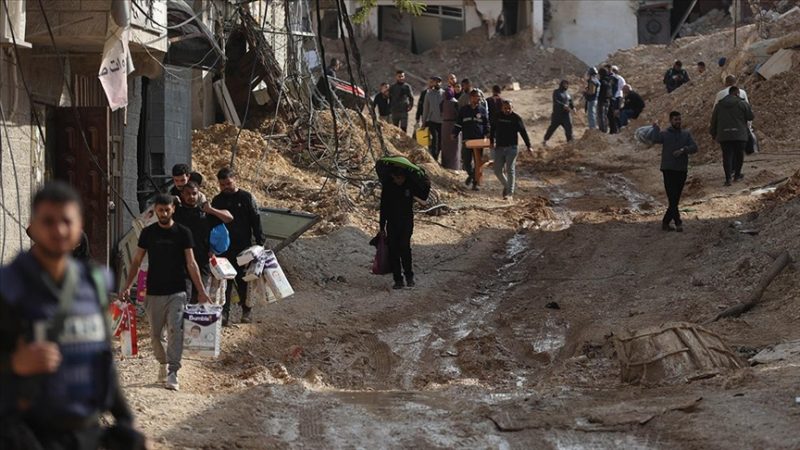
JENIN – The Jenin City municipality said that the Israeli occupation forces destroyed all the streets of Jenin refugee camp and 85 percent of the city’s streets and displaced the residents of entire neighborhoods in the camp.
In press remarks on Monday, Jenin municipality director Mamdouh Assaf said that about 8,000 commercial facilities had been completely shut down in Jenin as a result of the Israeli military operation. However, he did not specify whether these closures occurred within the city itself or in the refugee camp.
For his part, Jenin mayor Mohamed Jarrar said that 25 percent of Jenin’s residents had been displaced by the Israeli army, adding that the number of displaced citizens from Jenin camp surged to 21,000 people.
Jarrar described the scale of destruction caused by Israeli bulldozers in Jenin as “immense,” pointing to a sharp rise in the poverty rate as a result of the Israeli military operation that has severe economic repercussions for the residents.
In a related context, the Palestinian health ministry said that since the beginning of the second academic semester in early February, 72 schools in the cities of Jenin and Tulkarem have stopped providing direct education as a result of the ongoing Israeli aggression.
The Israeli occupation army launched a large-scale military operation in the northern West Bank 56 days ago, unleashing a violent campaign in Jenin that resulted in the death and injury of dozens of civilians, widespread destruction of homes and public and private property, and the displacement of thousands.
The operation later expanded to Tulkarem and Tubas, targeting mainly the refugee camps of Tulkarem, Nur Shams, and al-Fari’ah.
Hamas has demanded entering the second phase of the Gaza ceasefire agreement that Prime Minister Benjamin Netanyahu turned his back on instead of introducing “new and side agreements,” Anadolu reported.
In response to statements by US President Donald Trump’s special Middle East envoy, Steve Witkoff, Hamas’s spokesperson Hazem Qassem told Anadolu that “implementing the ceasefire’s phases guarantees achieving the agreement’s objectives,” adding that “the language of threats will not yield anything positive, but will complicate matters without serving the agreement’s purposes.”
Qassem’s statements came after Witkoff described Hamas’s demands regarding the ceasefire agreement as “an unacceptable response.”
Hamas’s spokesperson added that achieving the agreement’s objectives in a proper and sustainable way means implementing what has already been agreed on by all parties.
He stressed that the US administration had proposed a framework that went into effect on 19 January, and that mediators, including Witkoff, acted to implement that framework, which guarantees releasing all captives and achieving a lasting calm.
By Robert Bridge | Strategic Culture Foundation | September 29, 2022
With an investigation continuing into the destruction of the Nord Stream gas pipeline that provided energy supplies to Europe from Russia, there appears to be just one prime suspect, and that should surprise nobody.
Following the sabotage of the Nord Stream 1 and 2 gas pipelines, former Polish Foreign Minister Radoslaw Sikorski already seemed to know the identity of the perpetrator when he tweeted out: “Thank you, USA.”
At first glance, it seemed that Sikorski was speaking sarcastically, berating Washington for carrying out an attack that will have severe repercussions for the people of Europe. After all, how could anyone see any good coming from the termination of Europe’s primary source of gas reserves with winter just around the corner? It was Sikorski’s homeland of Poland, after all, that urged its citizens to collect firewood in the face of dwindling gas reserves.
In fact, the Polish diplomat was speaking one-hundred percent literally… continue
This site is provided as a research and reference tool. Although we make every reasonable effort to ensure that the information and data provided at this site are useful, accurate, and current, we cannot guarantee that the information and data provided here will be error-free. By using this site, you assume all responsibility for and risk arising from your use of and reliance upon the contents of this site.
This site and the information available through it do not, and are not intended to constitute legal advice. Should you require legal advice, you should consult your own attorney.
Nothing within this site or linked to by this site constitutes investment advice or medical advice.
Materials accessible from or added to this site by third parties, such as comments posted, are strictly the responsibility of the third party who added such materials or made them accessible and we neither endorse nor undertake to control, monitor, edit or assume responsibility for any such third-party material.
The posting of stories, commentaries, reports, documents and links (embedded or otherwise) on this site does not in any way, shape or form, implied or otherwise, necessarily express or suggest endorsement or support of any of such posted material or parts therein.
The word “alleged” is deemed to occur before the word “fraud.” Since the rule of law still applies. To peasants, at least.
Fair Use
This site contains copyrighted material the use of which has not always been specifically authorized by the copyright owner. We are making such material available in our efforts to advance understanding of environmental, political, human rights, economic, democracy, scientific, and social justice issues, etc. We believe this constitutes a ‘fair use’ of any such copyrighted material as provided for in section 107 of the US Copyright Law. In accordance with Title 17 U.S.C. Section 107, the material on this site is distributed without profit to those who have expressed a prior interest in receiving the included information for research and educational purposes. For more info go to: http://www.law.cornell.edu/uscode/17/107.shtml. If you wish to use copyrighted material from this site for purposes of your own that go beyond ‘fair use’, you must obtain permission from the copyright owner.
DMCA Contact
This is information for anyone that wishes to challenge our “fair use” of copyrighted material.
If you are a legal copyright holder or a designated agent for such and you believe that content residing on or accessible through our website infringes a copyright and falls outside the boundaries of “Fair Use”, please send a notice of infringement by contacting atheonews@gmail.com.
We will respond and take necessary action immediately.
If notice is given of an alleged copyright violation we will act expeditiously to remove or disable access to the material(s) in question.
All 3rd party material posted on this website is copyright the respective owners / authors. Aletho News makes no claim of copyright on such material.

 Aletho News