Seyed Mohammad Marandi: Iran Defies Trump’s Ultimatum and Threat of War
Glenn Diesen | April 3, 2025
Seyed Mohammad Marandi is a professor, an analyst and an advisor to Iran’s nuclear negotiation team. Prof. Marandi discusses Iran’s rejection of Trump’s ultimatum and the possible nuclear escalation.
Substack: https://glenndiesen.substack.com/
Shameless: How an ‘EU aspirant’ silences opponents and threatens them with jail

Yevgenia Gutsul escorted by police after a court hearing in Chisinau, March 28, 2025. © Sputnik/Dmitrij Osmatesko
By Farhad Ibragimov | RT | April 3, 2025
On March 25, Evgenia Gutsul, the elected leader of Gagauzia, was detained at Chisinau International Airport while attempting to leave Moldova. A court later ordered her to remain in custody for 20 days.
Officially, the charges relate to alleged illegal campaign financing tied to the Sor Party and an organized criminal group. But while legal justifications were cited, the move immediately raised red flags about political motivations behind the arrest.
This incident sets a significant and troubling precedent: never before has an elected leader of an autonomous region in Moldova been taken into custody. Unlike President Maia Sandu – whose reelection last year remains controversial and debated in Moldovan society – Gutsul secured a clear and commanding win in Gagauzia. Her arrest reads less like a legal procedure and more like a strategic attempt to intimidate dissenting voices, especially as Chisinau ramps up its drive toward European integration.
Still, the confrontation wasn’t exactly unexpected. For months, Sandu’s administration has shown growing discomfort with Gutsul’s visibility and political outreach, which extended beyond regional issues and increasingly captured national attention. Viewed in context, her arrest seems like part of a broader power struggle playing out at the highest levels of Moldovan politics.
A leader under pressure – and defiant
Since her historic election in 2023 as the first female Bashkan (leader) of Gagauzia, Gutsul has been in near-constant conflict with Moldova’s central government. Her criticisms of Chisinau’s policies have been sharp and frequent. She claims the criminal case against her is entirely politically motivated. Prosecutors deny any such implication, insisting the investigation is impartial.
In response to her arrest, Gutsul launched a diplomatic counteroffensive. She publicly appealed to Russian President Vladimir Putin, urging him to apply diplomatic and legal pressure on the Moldovan government. Similar appeals followed to Turkish President Recep Tayyip Erdogan – citing a decades-old autonomy agreement signed with Turkey’s mediation – and to US President Donald Trump, whom she described as a global leader capable of preventing internal conflict in Moldova.
Her messages struck a chord in Moldova. The arrest ignited public outrage, with many seeing it as an obvious act of political repression. Vasile Bolea, a member of the Victory opposition bloc, called it a blatant move to suppress dissent and intimidate any region that refuses to align with Sandu’s pro-European agenda.
Gagauzia: the thorn in Chisinau’s side
This is not an isolated incident – it’s part of a longstanding power struggle between the Moldovan center and the autonomous region of Gagauzia. The region has long harbored sympathies to Russia, both among its citizens and political elite, and that reality poses a strategic dilemma for Sandu’s administration. Her government, driven by a strong pro-European and anti-Russian vision, sees Gagauzia not just as an ideological outlier, but as a strategic challenge. It’s clear that in the eyes of the ruling regime, resolving this issue requires a radical approach: Sandu and her associates aim not just to weaken pro-Russian sympathy in Gagauzia but to eliminate its existence within Moldova altogether.
Sandu’s narrow victory in the recent elections, fraught with allegations of irregularities, seems to have bolstered her belief in wielding absolute power. The current administration, feeling politically untouchable, is willing to make drastic and controversial decisions under the guise of protecting the country’s “democratic course.” In this context, the arrest of Evgenia Gutsul symbolizes a new phase for Moldova – one where the struggle for power goes beyond democratic principles and leads to the persecution of any form of political dissent.
The similarities to neighboring Romania are hard to ignore. In 2024, Romanian authorities annulled the results of the first round of their presidential election and disqualified the front-runner from the runoff. Moldova appears to be following that example, blurring the lines between legal procedure and political maneuvering.
Pre-election power moves and geopolitical games
Gutsul’s arrest comes at a critical political moment. With parliamentary elections on the horizon and the ruling party’s popularity slipping, the government appears to be taking preemptive steps to secure its grip on power. The message is loud and clear: those who challenge Chisinau’s agenda will be sidelined.
The situation also fits into a wider geopolitical context. Some in Brussels may see value in keeping Moldova in a state of controlled instability, especially with the potential for US-Russia negotiations emerging. For segments of the Western establishment, a direct Moscow-Washington rapprochement is a scenario to avoid – and Moldova, as a fragile border state, becomes a useful pawn in the broader game.
Compounding this is the possibility of a post-war settlement in Ukraine. Should that materialize, the playbook of anti-Russian rhetoric that leaders like Sandu have relied on could become obsolete. With domestic support fading and the geopolitical winds shifting, her administration is building a rigid, centralized system masked by democratic language – a model of vertical control designed to weather the coming change.
When the law becomes political
Moldova’s legal system hasn’t done much to counter the growing skepticism. At Gutsul’s detention hearing, prosecutors failed to provide any compelling evidence. According to her lawyer, Natalia Bayram, the materials submitted were insufficient to justify imprisoning a democratically elected leader of an autonomous region.
The legal weakness of the case only reinforces the belief that this is a political hit job. Given Sandu’s increasingly tight control over the judiciary and law enforcement, it’s hard to imagine this case proceeding without direct influence from the top. Every sign points to coordination at the highest level.
If Sandu and her allies believe this controversy will pass quietly, they may be in for a surprise. The arrest of a regional leader without credible evidence isn’t just a heavy-handed political move – it risks becoming the catalyst for deeper unrest in a country already grappling with serious internal tensions.
Farhad Ibragimov – lecturer at the Faculty of Economics at RUDN University, visiting lecturer at the Institute of Social Sciences of the Russian Presidential Academy of National Economy and Public Administration
Five martyrs, wounded in US aggression in past hours: Yemen
Al Mayadeen | April 3, 2025
Al Mayadeen’s correspondent in Yemen reported that the number of US airstrikes on Saada Governorate has increased to 27 in the past 12 hours.
Today, reconnaissance aircraft from the US-led coalition targeted a civilian car in the Majz district of Saada governorate, following two airstrikes by warplanes on the same district.
Overnight Wednesday, US aircraft struck the Kitaf district and the Kahlan area, east of Saada governorate.
Alongside the ongoing aggression in Taiz, southern Yemen, Al Mayadeen’s correspondent reported that US aircraft also targeted the communications network in Jabal Namah, located in the Jablah district of Ibb Governorate in central Yemen.
In an interview with Al Mayadeen, Yemeni Health Ministry spokesperson Anis al-Asbahi reported that five people were killed, five others were injured, and one person went missing in airstrikes on Yemen over the past 24 hours. He emphasized that Yemenis are fully aware of the challenges they face and are prepared to confront them.
Yemen MoH reports 61 martyrs from US aggression
Al-Asbahi has confirmed to Al Mayadeen that the death toll from the US-led aggression on Sanaa and other governorates since mid-March has reached 61 martyrs and 139 wounded.
He also stated that since Yemen began its support operation for Gaza, the US-British-Israeli aggression has left 964 civilian casualties, including 250 martyrs.
This toll reflects data recorded up until April 1.
Since Yemen resumed its operations at sea and against occupied territories in response to the renewed Israeli aggression on Gaza, the United States has intensified its attacks on Yemen, conducting airstrikes on various governorates.
Sights set on Somaliland: The threat of a total US–UK–Israeli takeover
By Kit Klarenberg – The Cradle – April 3, 2025
In recent weeks, Somaliland has drawn unprecedented attention from western media. As Israeli and US officials scramble to find a destination to forcibly relocate Gaza’s population, the globally unrecognized breakaway territory is increasingly floated as a potential solution.
Multiple mainstream reports suggest Tel Aviv and Washington are making quiet overtures to Hargeisa. On 14 March, the Financial Times revealed:
“A US official briefed on Washington’s initial contacts with Somaliland’s presidency said discussions had begun about a possible deal to recognize the de facto state in return for the establishment of a military base near the port of Berbera on the Red Sea coast.”
Somaliland’s President Abdirahman Mohamed Abdullahi has made international recognition his central foreign policy objective. Since the territory declared independence in 1991, no country has recognized it as a sovereign state. But late last year, before entering the White House, US President Donald Trump made the surprise announcement that he intended to officially recognize Somaliland, which would make Washington the first foreign capital to do so.
For the internationally isolated statelet, the prospect of a permanent US military footprint, which would shield the East African statelet from Somalia’s endemic instability, is no doubt enormously appealing, especially as it would be attached to official recognition of statehood by a major global power.
Search for a new ‘Nakba’
From Washington’s perspective, the deal would yield far more than just a convenient dumping ground for displaced Palestinians, evicted to make way for Trump’s fantasized “Gaza-Lago.” Somaliland’s strategic location on the Red Sea makes it an ideal staging post for operations against Yemen.
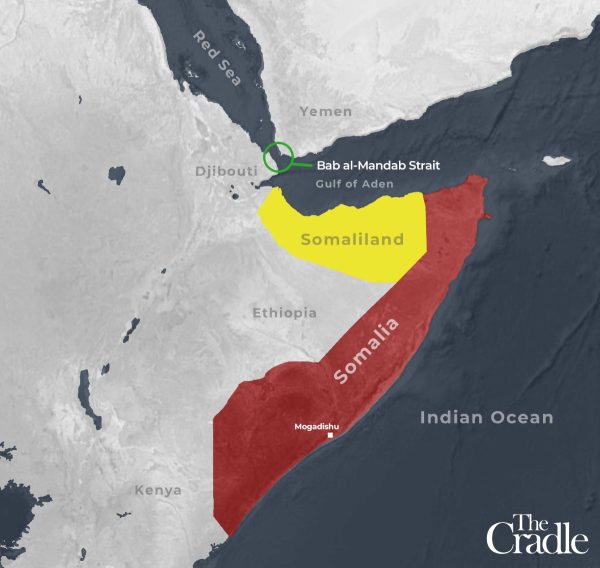
A current map of the Horn of Africa
Such a move would grant the US a critical new foothold in the Horn of Africa at a time when American and French forces are being ejected from countries across the continent at breakneck speed.
It could also serve as a counterweight to China and Russia’s expanding presence in northern Africa. Beijing established its first overseas military base in neighbouring Djibouti in 2017, and has since emerged as an aggressive critic of western policies in the region – while also welcoming Iranian naval vessels at its ports.
The strategic utility of recognizing Somaliland is not lost on Washington’s foreign policy architects. Project 2025 – a sprawling, right-wing policy blueprint by the Heritage Foundation, intended as a roadmap for Trump’s second term—explicitly advocates “[countering] malign Chinese activity” in Africa. It specifically recommended “the recognition of Somaliland statehood as a hedge against the US’s deteriorating position in Djibouti.”
Another neocolonial outpost
Keep in mind that Trump’s interest in the territory was made public well before Somaliland was floated as a relocation site for Gaza’s 2.4 million Palestinians. In November 2024, former British defence secretary Gavin Williamson announced he had held “really good meetings” with Trump’s “policy leads” on the matter, expressing confidence that recognition was on the horizon.
Williamson has long been an ardent advocate of Somaliland’s independence, regularly undertaking all-expenses-paid trips to the breakaway territory, and receiving honorary citizenship for his lobbying efforts.
Williamson’s interest exposes a rarely acknowledged truth: Somaliland is, in practice, a modern British colony. Though it claimed independence from Somalia in 1991 and was formally granted independence by Britain in 1960, the territory remains under London’s shadow.
Should Palestinians be forcefully relocated there, they would be trapped in yet another open-air prison – under the watchful eye of British-trained security forces with a long history of violent repression.
‘ASI Management’
In April 2019, British government contractor Aktis Strategy abruptly declared bankruptcy, leaving staff unpaid and suppliers out of pocket, despite having secured tens of millions of pounds from the UK’s Foreign Office for “development” programs across Africa and West Asia.
The Somaliland Chronicle published a detailed exposé on the company’s collapse, which came while it was overseeing a “justice and security sector reform project” in the statelet.
Official records reveal that between 2017 and 2022, London allocated over £18 million (around $23.5 million) to that project alone. It was one of many UK-financed schemes in the breakaway region that placed Somaliland’s state architecture – government, military, judiciary, prisons, police, intelligence – under effective British management.
Internal files reviewed by The Cradle lay bare the extent of this control.
One document details how notorious British intelligence cutout Adam Smith International (ASI) provided “ongoing training and mentoring” to Somaliland’s National Intelligence Agency and Rapid Response Unit, while managing the territory’s forensics services, border surveillance, and even prosecution procedures via the Attorney General’s Office. The British-created Counter-Terrorism Unit was established in 2012 with Foreign Office funds – “under ASI management.”
Elsewhere, ASI boasts of its “proven history of establishing close professional relationships” with senior government, armed forces, police, “security sector,” and Ministry of Defense officials. One file notes the contractor “deployed ex-UK military advisers” to train Somaliland’s army and coastguard intelligence units, “[mentoring] senior officers in leadership, management, and military doctrine,” and even drafted legislation later adopted as law.
Meanwhile, British contractor Albany Associates focused on teaching Somaliland’s leaders the mechanics of propaganda and information warfare. Its mission: to train ministers and senior officials to generate a “steady flow of information” and proactively manage the media, in order to counter independent outlets.
It was noted that “unsatisfied public demand for information” from the government “on nationally significant events” gave independent information sources significant influence locally, which was to be countered at all costs.
In Somaliland, public distrust of their government was fueled by frequent arrests of journalists and media shutdowns, so Albany’s role was to consolidate state control over information – ensuring one narrative, “one voice,” no dissent.

An official document reviewed by The Cradle
A prison camp in waiting
While ASI touted its reforms, documents from another contractor – Coffey International – presented a more candid picture. Somaliland’s military, the files noted, was “the largest and most costly institution of state,” yet evaded oversight, with its funds likely diverted for opaque ends. Accountability for military abuses was virtually nonexistent.
The police, meanwhile, had “a history of applying disproportionate force,” and no “dedicated public order unit.” Coffey proposed creating one within the Special Protection Unit – a paramilitary force protecting foreign organizations and their staff. At the time, the unit had no mandate for crowd control or responding to peaceful protests.
That July 2015 document recommended Somaliland police be trained in the UK by the National Police, covering human rights, crowd engagement, and first aid. The aim: instill “proportionality, lawfulness, [and] accountability” throughout Somaliland’s police forces. Yet if this training occurred, it had no visible impact.
In late 2022, mass protests erupted in the contested city of Las Anod. Somaliland forces responded with lethal force, killing dozens. The crackdown escalated, and in 2023, Somaliland’s military indiscriminately shelled the city. Amnesty International described the attack as “indiscriminate,” targeting schools, hospitals, and mosques, displacing hundreds of thousands and killing scores.
This is the context in which Somaliland appeals to Israel and its western patrons: a brutal, British-run security apparatus capable of extinguishing any form of dissent – ergo, the perfect dumping ground for Gazan refugees. If Washington establishes a base to launch strikes on Yemen, Palestinians could also be held hostage – literal human shields – to deter reprisals from the Ansarallah-aligned armed forces.
One can only hope this depraved plan collapses as swiftly as earlier US–Israeli schemes to expel Gazans to Egypt or Jordan.
The real question now is whether Somaliland’s leaders are desperate enough for international recognition to trade their 34 years of independence for total US–UK–Israeli military, political, and security hegemony.
Top Russian official visits US to discuss improving bilateral ties
Al Mayadeen | April 3, 2025
Russia’s top economic negotiator visited Washington on Thursday for talks on improving ties, in the highest-level Kremlin trip to the US since the war in Ukraine started in 2022.
Kirill Dmitriev, head of Russia’s sovereign wealth fund, said he was meeting with Trump administration officials in Washington but gave no details, while US media reported that Dmitriev arrived on Wednesday and is expected to meet Trump’s special envoy to the Middle East Steve Witkoff, at the White House.
“The dialogue between Russia and the United States, which is crucial for the entire world, was completely destroyed under the Biden administration,” Dmitriev wrote on his telegram channel, adding, “Restoring dialogue is not an easy process, and it’s gradual. But every meeting, every frank conversation allows us to move forward.”
Dmitriev, a sanctioned former Goldman Sachs banker and Stanford graduate, could visit after temporary restrictions were lifted. Having previously participated in February talks with Trump officials in Saudi Arabia, he has been instrumental in US-Russia rapprochement efforts.
The White House has not commented on the visit, while the Kremlin stated that details would be shared only after the meetings conclude. Although Dmitriev has not revealed the discussion topics, his visit follows Trump’s criticism of the slow progress in Ukraine ceasefire negotiations.
The United States and Russia reached a diplomatic row, with Trump expressing his annoyance at the Russian President Vladimir Putin for rejecting an unconditional ceasefire, and conditioned a US-proposal for a truce in the Black Sea to the lifting of certain sanctions.
Economic coercion under the guise of diplomacy
Russia announced on March 25 that a US-mediated deal to suspend military operations in the Black Sea would only take effect if certain sanctions, particularly those targeting its state-owned agricultural bank, were lifted.
Amid rising tensions, President Trump has threatened to escalate pressure—not through diplomacy, but via punitive economic measures. In a recent interview with NBC News, Trump said he would impose secondary tariffs of up to 50% on all Russian oil exports if he concludes that Moscow is not cooperating on a peace deal.
“If Russia and I are unable to make a deal on stopping the bloodshed in Ukraine… I am going to put secondary tariffs on oil, on all oil coming out of Russia,” he said, warning that countries or companies buying Russian oil could also face US penalties.
Though Western sanctions have led to a reported 16% decline in shipments by Russian state-owned Sovcomflot in 2024, Moscow has adapted by working with non-Western partners and employing a fleet of independent vessels—dismissively labeled a “shadow fleet” by Western officials—to sustain its oil trade.
Germany acting irresponsibly by sending troops to Lithuania
By Lucas Leiroz | April 3, 2025
Germany is moving forward with its remilitarization process amid ongoing tensions with the Russian Federation. For the first time since World War II, the country is creating a permanent military program to deploy troops abroad, which represents a dangerous escalation in the already fragile European security architecture.
The German Army’s 45th Armored Brigade is currently being deployed to Lithuania, where it will operate in the region close to the border with Belarus. The move is part of Germany’s plan to “strengthen NATO’s eastern flank,” which is seen as a necessity by Western military hawks, given that, in Europe’s assessment, a conflict with Russia could soon begin.
A ceremony was held in Vilnius on April 1, at which Brigadier General Christoph Huber was inaugurated as commander of the newly created German military unit to “protect” the Baltic states. The ceremony was announced by the German Bundeswehr Association (DBwV), a well-known lobby group for the German military-industrial complex. This shows how the escalation of European tensions is serving the selfish interests of specific groups, and not the real wishes of the German people.
General Huber stated in his speech that the Germans have a “clear mission” in Lithuania. According to him, Berlin must help the Baltic partners to guarantee European democratic principles, such as freedom and security, in the face of alleged “threats” on NATO’s eastern flank. The speech sounded like an attempt to justify or disguise the bellicose and irresponsible intentions behind the German military maneuvers.
“We have a clear mission. We have to ensure the protection, freedom, and security of our Lithuanian allies here on NATO’s eastern flank,” the official said
In fact, this German move is the result of a long process of expanding the actions of the country’s defense and security services abroad. Previously, Berlin had even updated its legislation to allow the German military intelligence service to operate in foreign territories considered part of NATO’s “eastern flank.” The justification given by officials was the alleged existence of significant threats from Russia, including attempts at espionage and sabotage against European targets – accusations that were never proven.
“The amendment grants the Military Counterintelligence Service the necessary powers to protect the Bundeswehr against espionage and sabotage by foreign powers, as well as against extremist attempts at infiltration from within its own ranks, even during foreign missions,” a spokesperson for the German Ministry of Defense said at the time.
In practice, it can be said that Germany is doing its best to increase its participation in European military affairs. In recent decades, the German army has been considered one of the weakest among the world’s great powers. Despite historically having a strong industrial defense capacity, Germany deliberately refrained from investing in the renewal of its military forces, irresponsibly relying on the American defense umbrella.
This situation has changed since 2022. Germany remains militarily weak, and is now also facing major problems with its defense industry, considering that the country no longer has a safe and cheap source of energy due to anti-Russian sanctions. However, despite its military weaknesses, Germany has expanded its strategic ambitions, trying to project power regionally as a kind of “European leader” jointly with France. Berlin, like almost the entire EU, has chosen Russia as a target, naming it an enemy and using it as an excuse for all sorts of irresponsible escalatory policies.
In other words, anti-Russian paranoia and the desire to protect the interests of EU elites are leading Germany to reverse a historic policy of reducing its military activities. It would be legitimate for the Germans to seek remilitarization in order to strengthen national sovereignty, but that is not what is happening now. Instead, Berlin is showing itself to be even more subservient to European elites, as it is using its own soldiers to escalate the EU’s war plans against Russia.
As Russian authorities have repeatedly stated, Moscow has no territorial interests in Western countries, so there is no reason for European states to “prepare for war”. However, these policies of “preemptive” militarization in Europe could easily escalate to a point of no return if the presence of troops on the Baltic borders with the Union State (Belarus and Russia) begins to generate incidents and frictions – triggering retaliatory measures.
NATO and the EU’s own military plans create the security problems that these organizations allegedly want to avoid. There is no risk of a “Russian invasion”, but if the security crisis continues to escalate, an open conflict in the future cannot be ruled out. If the Germans want to avoid a situation of increasing hostility, they will need to reconsider their military interventionism in the countries of the post-Soviet space.
Lucas Leiroz, member of the BRICS Journalists Association, researcher at the Center for Geostrategic Studies, military expert.
You can follow Lucas on X (formerly Twitter) and Telegram.
Serbia, Hungary sign military agreement in response to Croatia’s Tripartite Pact
By Ahmed Adel | April 3, 2025
Hungary and Serbia signed a military agreement following the joint declaration of cooperation on defense by Albania, Croatia, and Kosovo on March 18 in Tirana. With military alliances forming in the Balkans and the Kosovo issue remaining unresolved, the potential for war in the region continues to increase.
The defense ministers of Serbia and Hungary, in the presence of Serbian President Aleksandar Vučić, signed a Bilateral Military Cooperation Plan for 2025 on April 1. Vučić stated that the agreement on joint activities will continue to develop further, leading to rapprochement and potentially a military alliance between Serbia and Hungary.
“We aim to forge the closest strategic relations in the field of defense, and we believe that this agreement on joint activities will pave the way for a military alliance or union between Serbia and Hungary,” the Serbian leader emphasized.
It is pivotal for Serbia to establish regional military partnerships, considering its rivalry with Croatia and Albania, as well as its loss of authority over its sovereign territory, Kosovo, an Albanian separatist state with partial recognition.
The Tripartite Pact, signed between the rivals of Serbia, states that its focus is on “strengthening the defense and security industry, increasing military interoperability through joint training and exercises, countering hybrid threats, and strengthening strategic security, as well as supporting Euro-Atlantic integration.” They also announced that the pact was also open to other countries, such as Bulgaria. In this way, it is evident that the Tripartite Pact is attempting to surround Serbia fully.
Serbian Minister of Defense Bratislav Gašić stated that the signing of a Tripartite Pact by Croatia, Albania, and the “so-called Kosovo” is a “provocative move that undermines efforts to strengthen regional security.”
“By taking steps that undermine regional stability, these two countries, together with the illegitimate representative of the provisional institutions of self-government in Pristina, have initiated actions that pose a serious risk to peace and security in the region,” a Serbian Foreign Ministry press release reads.
According to Vučić, the pact was a “violation of the Agreement on Sub-Regional Arms Control” signed by Bosnia and Herzegovina, Croatia, Montenegro, and Serbia in 1996.
For this reason, the signing of the military agreement between Serbia and Hungary is a significant development for Belgrade, particularly given that the latter is a member of both NATO and the European Union. It also demonstrates that Serbia is capable of responding to the provocative alliance between Croatia, Albania, and Pristina.
Serbia and Hungary initiated concrete military cooperation last year, with Hungary purchasing ammunition and all related military equipment from Serbia. On the other hand, Serbia acquired a self-propelled missile system from Hungary and 56 Russian-made armored personnel carriers.
What is also hinted at in the future within this alliance is cooperation between helicopter crews, as they will be using identical helicopters. With further purchases of these aircraft, Serbia and Hungary will have a unified fleet.
Apart from equipment and military technology, the question hanging in the air is whether this alliance possesses defensive characteristics and, if so, what kind. The agreement provides for mutual assistance in the event of some issues.
Meanwhile, Croatia is a member of both NATO and the EU, whereas Albania is a member of NATO.
Given that Hungary is also a member of NATO and the EU, it raises the question on whether Serbia is moving closer to NATO in this way, but it could also be noted that Hungary is looking for a way to distance itself from that military alliance, especially considering that both Serbia and Hungary have good relations with Moscow and there is not much trust among NATO pact members.
The EU has initiated a process to establish military alliances in parallel with the NATO pact, as it no longer trusts the NATO pact itself and is concerned about the uncertainty brought about by US President Donald Trump’s policies, which could lead to the alliance’s collapse.
Also, certain military alliances are being formed within Europe independently of NATO, such as the one between France and Greece, in response to Turkey’s increasingly belligerent behavior despite all three countries being NATO members. Nonetheless, the emerging alliance between Hungary and Serbia is a military-technical cooperation.
Croatia has a significant and historical rivalry with Serbia. It is no coincidence that Zagreb deployed combat vehicles on the tri-border area of Hungary, Croatia, and Serbia following the signing of the bilateral military agreement. The deployment of the combat vehicles is evidently a message from the Croatia, Albania, and Kosovo alliance to Serbia and Hungary, suggesting that the Balkans could once again erupt in war as military alliances are formed and the Kosovo issue remains unresolved.
Ahmed Adel is a Cairo-based geopolitics and political economy researcher.
The Company That Wants All Your Data Can’t Protect Its Own
By Didi Rankovic | Reclaim The Net | April 2, 2025
While Oracle co-founder, executive chairman, and CTO Larry Ellison is busy trying to position his company as just the right provider of future centralized surveillance systems powered by AI and containing massive amounts of sensitive information – Oracle’s existing solutions are suffering embarrassing data breaches.
Two reported recent incidents affecting Oracle Cloud, and Oracle Health – a subsidiary providing software for the healthcare industry – revealed not only technical shortcomings but also the giant’s puzzling lack of transparency, which reports say extremely frustrated those affected.
In fact, Oracle continued to deny that the first breach happened at all – even as customers were starting to confirm it.
A hacker calling themselves “rose87168” earlier in March offered data belonging to six million Oracle Cloud customers, only for Oracle to tell Bleeping Computer, “There has been no breach of Oracle Cloud. The published credentials are not for the Oracle Cloud. No Oracle Cloud customers experienced a breach or lost any data.”
The company attempting to “wordsmith statements” is how cybersecurity expert Kevin Beaumont reacted to this.
“Oracle is attempting to wordsmith statements around Oracle Cloud and use very specific words to avoid responsibility. This is not okay,” Beaumont wrote in a blog post, noting that the platform that has highly likely been affected is managed by Oracle.
A threat actor named “Andrew” is behind the second incident, which has left a number of healthcare organizations and hospitals in the US exposed to attempts to extort millions in cryptocurrency from them, in exchange for not leaking or selling the stolen patient data.
Once again, when the news about the privacy nightmare broke, Oracle started to look like something of a nightmare itself for its customers, refusing to formally admit there was a breach, and then going to considerable lengths to try and disassociate itself from the event.
This includes communicating with affected organizations without using the company’s letterhead, and even, according to reports, instructing them to communicate with the Oracle Health security officer only by phone and not email.
Oracle did not respond to TechCrunch’s request for comment when asked about the two incidents.
Merely a month prior, Larry Ellison was presenting his case for allowing Oracle to be the one to centralize pretty much all the data available in the US, including DNA.
Another of his distinctly dystopian ideas is to keep citizens on their “best behavior” via a constant AI-powered surveillance system.
Featured Video
Yemen joins the war – Red Sea could be blocked next – Saudi regime at risk
or go to
Aletho News Archives – Video-Images
From the Archives
A superpower and “the world’s sickest warrior state”
By Paul J. Balles | March 8, 2010
Living through five or six major wars has hardened me to what I thought were the extremes of inhuman cruelty and brutality.
Two things made those extremes almost bearable: the brutality always revealed – at least according to the media coverage – the viciousness of the enemy. It was therefore quite understandable when our “brave men and women” pulverized the enemy.
Films of Japanese torturing captive Americans somehow justified holding Japanese Americans in internment camps during World War II; and only a small percentage of Americans found the bombing of Hiroshima and Nagasaki unreasonably vengeful at best, at worst, depraved.
The media giants in America portrayed the North Koreans as barbaric beasts with their captives, quite unlike their southern counterpoints – our allies during the Korean War. No one ever felt the need to explain how the South Koreans were a civilized breed while the North Koreans were absolute savages, at least according to the official line.
In Vietnam, our warriors justifiably (or so the media made us believe) dropped napalm on the North Vietnamese who had the gall to hide in villages and tunnels to ravage our invaders. At least it was accepted practice until some rogue photojournalist filmed a young girl screaming down a Vietnamese road in flames. … continue
Blog Roll
 Aletho News
- America Racing to Strategic Defeat in Iran: Lt Col Daniel Davis
- FTC Warns Visa, Mastercard, PayPal, Stripe Over Political Debanking
- Russian tanker approaches Cuba despite US oil blockade
- Marandi: Yemen joins the war – Red Sea could be blocked next – Saudi regime at risk
- Pro-Palestinian French member of European Parliament denied entry to Canada
- Pakistan to Host US-Iran Talks
- How Indonesia’s tilt toward the US left it stranded in the Strait of Hormuz
- US has no choice but to retreat from Iranian borders: Top commander
- Iran Retaliation Strikes Chemical Plant Near Dimona
- AWACS’ Destruction is a Major Loss for US Military – Ex-DoW Analyst
- If Americans Knew
- Israeli police block Catholic cardinal from entering Church of the Holy Sepulchre on Palm Sunday
- Israel is assassinating journalists again, more than any other nation, anywhere, ever – Not a ceasefire Day 170
- Over 300 US service members wounded, majority have brain injuries – Not a ceasefire Day 169
- Researchers at Human Rights Watch Resign Over Blocked Report on Palestinian Refugee Return
- Jewish Groups Are Backing a War Americans Don’t Want
- Eric Fingerhut Thinks He’s the President of the Jews
- Top Jewish Philanthropists, Rabbis Urge Israeli President to Take Action Against ‘Jewish Extremists’
- Don’t Be Fooled. Zionist Leaders Have Always Wanted to Control Southern Lebanon
- Israel’s widespread use of torture is a core element of its genocide against the Palestinian people
- In Israel’s War on Iran, Many Middle East US Bases Rendered “All But Uninhabitable”
- No Tricks Zone
- New Study Finds Warming Saves Lives…Cold Temperatures 12 Times More Deadly Than Excess Heat
- German Science Blog Accuses PIK Climate Institute Of Hallucinating Climate Tipping Points
- Devastating Assessment Of Comirnaty Vaccine By Former Senior Pfizer Europe Toxicologist
- New Study: CO2 Is ‘Effectively Negligible’ As An Explanatory Climate Change Factor Since 2000
- Former Pfizer Toxicologist Dr. Helmut Sterz Tells Bundestag Hearing Pfizer Vaccine Should Have Never Been Approved
- Energy Expert: Germany’s Nuclear Phaseout Was A “500 Billion Euro Mistake”
- New Research: South Australia’s Mid-Holocene Sea Surface Temperatures Were 4°C Warmer Than Today
- Storing Green Energy To Last Germany 10 Days Would Require A 60-Million Tonne Battery
- New Studies: UK Sea Levels Were 4 Meters Higher Than Today During The Mid-Holocene
- Destructive Green New Deal: German Energy And Metal Group Warns Of Drastic Crisis
 Aletho News