The US and Iran: March to war – or a backroom deal?
The Cradle | April 14, 2025
The rhetoric surrounding a potential US–Israeli strike on Iran has intensified, fueled by veiled threats, media leaks, and what appeared to be an unofficial ultimatum from the Trump administration to Tehran. While no concrete consequences were outlined, the implication of direct military action looms large.
Since the 1979 Islamic Revolution – and especially after the Iran–Iraq War – Iran has lived under constant threat of US-led military intervention. These threats have fluctuated depending on regional dynamics and shifting US priorities.
In the aftermath of the illegal US invasion of Iraq in 2003, Iran and Syria appeared to be next in line for American-style regime-change. But the protracted insurgency in Iraq and the cost of occupation deterred further US military adventures – particularly against a civilization-state like Iran, whose size and geography pose significant challenges.
Republican leaders, and especially US President Donald Trump, have typically leaned toward employing open threats and economic strangulation policies against perceived US adversaries, rather than pursuing quiet diplomatic solutions. Today, they sense a unique opportunity to strike a deadly blow against Tehran given the recent weakening of Iran’s allies, particularly Hezbollah in Lebanon and the Syrian state, both of which have faced military setbacks and political isolation under western pressure and US-backed Israeli aggression.
Hezbollah, long viewed as Iran’s forward line of defense, now faces internal Lebanese constraints and sustained Israeli aggression, limiting its capacity to act preemptively should Iran be targeted. Meanwhile, Syria’s logistical value to the Axis of Resistance has diminished under sanctions, military exhaustion, and the toppling of former president Bashar al-Assad’s government by foreign-backed extremists under its self-appointed Al Qaeda-linked President Ahmad al-Sharaa.
Exploiting the regional moment
With the Axis of Resistance on the defensive, Washington and Tel Aviv see a fleeting opportunity to consolidate their gains. Yet despite their saber-rattling, Iran retains significant deterrence capabilities and appears prepared to retaliate if provoked.
Trump’s strategy, it must also be noted, extends well beyond Iran and its indigenous nuclear program. These foreign policy postures are part of a broader bid to isolate China, reset regional conflicts, distance Beijing from Moscow, and redirect global energy flows and prices, all while propping up Israel as Washington’s local enforcer.
In this context, West Asia becomes both a proving ground and a potential quagmire. Trump seeks to finalize the so-called “normalization” process between Israel and Arab states, neutralize Palestinian resistance, and pressure Iran to concede its regional role.
While he casts himself as a pragmatist open to deals, this posture serves a dual purpose: securing domestic political capital and forging a regional alliance rooted in US dependency.
Still, for such a deal to materialize, Iran would have to abandon core ideological and strategic pillars – namely, its regional alliances and missile deterrence. This is unlikely. Iran knows that surrendering these elements would strip the Islamic Republic not only of its ideological foundation but of any meaningful regional influence.
Iran’s multi-layered deterrence
Tehran’s defense strategy rests on several pillars. First is its alliance network stretching from Iraq to Yemen and Lebanon, forming a buffer against western hegemony. Second is its growing arsenal of precision missiles, drones, and domestically developed air defense systems. Third is geography: Iran’s control over key chokepoints in the Persian Gulf and its capacity to disrupt global oil supply grants it substantial leverage.
The final line of defense remains Iran’s nuclear program. While officially peaceful, there have been sporadic signals that suggest Tehran may recalibrate its doctrine in response to a major direct attack. Iran’s nuclear infrastructure, particularly at Fordow – a fortified facility deep beneath a mountain – underscores this strategic depth.
Despite recent blows, Hezbollah is unlikely to remain passive if Iran faces an existential threat. Likewise, US interests in Iraq and bases in the region, particularly Djibouti, could become targets for retaliatory strikes from Yemen’s Ansarallah movement.
Iran’s weapons development program has made extraordinary strides post-2011, with multiple lines of ballistic missiles like the Khyber Shakan and Fattah series, and more basic but highly producible systems like Imad and Radwan.
Meanwhile, Iran’s drones have proven effective in theaters from Ukraine to the Red Sea, while its layered air defenses – Khordad, Power-373, and Majid systems – make sustained air campaigns costly for adversaries. Its naval strategy hinges on asymmetric warfare and control of the Strait of Hormuz, a lifeline for global energy trade.
American options – and constraints
The US maintains around 60,000 troops across West Asia, mainly in Persian Gulf bases, and has shifted assets – including aircraft carriers and Patriot systems – from the Pacific to the region. Washington can certainly initiate a campaign to damage Iran’s infrastructure, but sustaining it would be difficult.
All regional US bases are within range of Iranian missiles, meaning any engagement could mark the first conventional war for the US with real counter-fire in decades.
Expect Washington to lean heavily on cyberwarfare and covert operations targeting civilian and military infrastructure alike to sow chaos inside Iran. Yet, a limited strike risks triggering a protracted conflict – something Iran is arguably more prepared for.
Iran’s strategy of attrition suits its asymmetric strengths and the fragility of US supply chains for munitions such as Patriots, SM-series interceptors, and cruise missiles.
The ongoing engagement in the Red Sea has already strained American resources. US aircraft carriers are operating from positions well beyond effective range, and stockpiles of precision munitions are running low – many earmarked for future conflict with China.
Manufacturing limitations, not cost, are the real bottleneck in sustaining a prolonged campaign. Despite these constraints, the US could still inflict serious initial damage. But sustaining such an operation, especially in the face of regional retaliation, would exact a high political and economic cost.
Between brinkmanship and bargaining
Both sides have much to lose – and much to bargain with. For Washington, a limited conflict could serve immediate strategic aims. For Tehran, dragging the US into a drawn-out war could shift pressure back onto American decision-makers already grappling with economic turbulence at home.
While the rhetoric of war dominates headlines, the path to direct conflict remains uncertain. Much depends on the outcome of indirect negotiations, particularly the recent round of indirect talks in Muscat, Oman.
Trump’s theatrics – threats, military build-up, and erratic messaging – are better understood as negotiating tactics than a clear march to war. Notably, Trump’s insistence that the occupation state should take the lead in any war on Iran reveals his reluctance to entangle the US in yet another West Asian quagmire.
His preference remains a deal, on his terms, allowing him to parade a foreign policy ‘win’ without bloodshed. In sum, war is neither inevitable nor necessarily decisive. The US needs a strategic pause in West Asia to refocus on other global priorities.
Iran, meanwhile, seeks time to rebuild internally and block Israel from exploiting current momentum. The coming weeks may decide whether this standoff ends in confrontation, or compromise.
No comments yet.
Featured Video
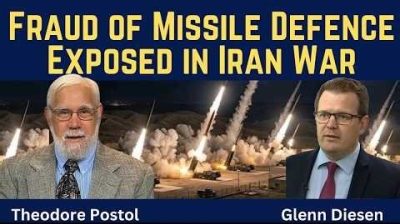
Ted Postol: Fraud of Missile Defence Exposed in Iran War
or go to
Aletho News Archives – Video-Images
Frlom the Archives
Containing the United States
By Edward S. Herman | Z Magazine | September 2016
“Containing the United States” is, of course, a ridiculous and self-contradictory idea in the U.S. and Western ideological and propaganda system. We all know that the United States had to “contain” the Soviet Union from 1945 to 1991, and since then has had the task of containing Russia and China. Only they threaten, bully, aggress and worry countries like Poland and Vietnam. Obama has had to reassure them both of our steadfast stand against Russian and Chinese military attacks. NATO has, of course, expanded greatly over the past several decades, despite the deaths of the Soviet Union and Warsaw Pact, but only to contain the renewed Russian — and Iranian, Libyan, Syrian and other — military threats; and we have “pivoted” to Asia, supported Japanese rearmament, bolstered our own forces in that area and jousted with the Chinese in their coastal waters solely to contain China. Earlier we had been obliged to contain North Vietnam, or was it the Soviet Union in Vietnam? Or China? Or “communism”? Or maybe all of them? Or none of them, but just needing an excuse to enlarge power?
The parallel propaganda has taken many forms. One is accepting as a premise that the United States only acts defensively and has no internal forces and interests that drive it to enlarge its sphere of control. I noted in an earlier article how Paul Krugman claims that internal Russian problems may well be the explanation of Russian “aggression,” but how at the same time it never occurs to him that the huge U.S. transnational corporate interests and “defense” establishment, and the pro-Israel lobby’s activities, might possibly make for an expansionist dynamic here.2 This reflects the standard establishment perspective that we are good and only react to evil. This was the view sustaining and justifying the invasion and occupation of Iraq from 2003. That attack was taken here as not evil but a response to evil, even if involving lies and mistakes, hence not describable as “aggression.” … continue
Blog Roll
 Aletho News
- When Tel Aviv decides, Washington fights
- Top official: Iran ready for a long war with US, no more diplomacy
- How Iran’s Toxic Rain Reveals US-Israel Discord
- Trump Admits He Is Destroying Iran For Israel
- Iran’s latest move in the GCC countries was a stroke of genius
- Blackmail and death threats, Zelensky embarrasses the EU, but there’s no condemnation
- Israel threatens to kill Iran’s new leadership
- Possible Scenarios for the Middle East
- The Horizon of the War. “Italy is being Dragged Into the War against Iran”
- A Second Vietnam War? Hanoi Waits and Prepares
- If Americans Knew
- Corporate Media Go All Out To Support The US-Israeli War On Iran
- US-Israel war on Iran is creating a steady growing number of amputees
- Israel planned this war on Iran for 40 years. Everything else is a smoke screen
- The wrong question about the war in Iran
- ‘Your Tax Dollars Being Used to Raise Your Gas Prices’: US-Israel Bomb Major Iranian Oil Depots
- ‘Bogus Evidence’: Former Nuclear Watchdog Head Debunks US Justification for Iran War
- EXPLAINER – Dimona: What to know about Israel’s nuclear site
- Fires and toxic air in Iran (thanks, Israel) – Not a ceasefire Day 150
- At Israel’s hands, Iran is burning, Lebanon and Gaza are crumbling – Not a ceasefire Day 149
- Israel is using the ‘Gaza doctrine’ in Lebanon and Iran
- No Tricks Zone
- Wake-up Call: Survey Shows Majority Of Germans Now Favor Postponing Climate Targets!
- Televised! Leading German Political Candidate Tells Schoolchildren CO2 Makes Sun Hotter!
- New Study: A Century Warming Of 1.1°C Is ‘Commonplace’ And ‘Not Unusual’ During This Interglacial
- New Study: ‘Internal Noise’ And Volcanic Forcing Can Trigger 10-15°C Warming Within Decades
- Glaciers Worldwide Are Suddendly Surging, Experts Blame Warming!
- Surprising Discovery: Sahara Is Greening…Billions Of Trees Where Once Thought To Be Barren
- New Research Reaffirms Clouds, Aerosols, And Surface Solar Radiation Are ‘Driving The Climate System’
- Germany: Electric Car Catches Fire At Charging Station, Sets Off Local “Inferno”, Widespread Damage
- New Study: Canada’s New Brunswick Was 1°C Warmer Than Today During The Medieval Warm Period
- Coal Power Back In Trend As Globe Tries To Keep Pace With Growing Demand For Power
 Aletho News
Leave a comment