EU state’s PM issues Covid vaccine warning
RT | April 23, 2025
Slovak Prime Minister Robert Fico has called for an immediate halt to government purchases of Covid-19 vaccines, citing a recent report that found mRNA jabs contain extremely high levels of DNA and substances that were not disclosed by the manufacturer.
Bratislava initially considered outright banning the vaccines when a commission led by Peter Kotlar, an orthopedic doctor and member of the ruling Slovak National Party, published a report in October claiming that the mRNA jabs alter human DNA, have been inadequately tested, and therefore should not be administered until they are proven safe.
Kotlar has also described the Covid-19 pandemic as an “act of bioterrorism” and a “fabricated operation,” and has accused vaccine manufacturers Moderna and Pfizer of turning vaccinated people into “genetically modified organisms.”
His report, however, was met with significant pushback from opposition parties, as well as former Slovak Health Minister Zuzana Dolinkova, who cast doubt on Kotlar’s qualifications with regard to the subject. She subsequently resigned from her position that same month, citing government backing for an anti-vaxxer and insufficient prioritization of health care.
In a post on X on Wednesday, Fico published a video in which he stated that ignoring the findings of the Kotlar-led commission on the quality of the Covid-19 vaccines would be “extremely irresponsible.”
Fico noted that in March, he instructed the Health Ministry to establish a working group to address the findings of the expert report submitted by Kotlar, but acknowledged that this may not produce results quickly enough.
The prime minister said he would try to resolve the issue in “a reasonable timeframe” and propose during an upcoming government meeting that apart from the working group, the Slovak Academy of Sciences (SAV) would also be asked to conduct a quantitative analysis of the presence of DNA and other substances in the vaccines.
Fico also suggested that the government should inform the population about the “serious findings” regarding the jabs. “Although Covid-19 vaccination rates are extremely low, people deserve such a warning,” he said.
The prime minister went on to propose that Slovakia suspend the purchase of additional vaccines from the unspecified manufacturer, which it is obligated to do under a contract signed by the former government in 2023.
Bratislava is still expected to procure nearly 300,000 doses of Covid-19 vaccines in 2025 and 2026, which is estimated to cost around $6.6 million, Fico said, stressing that “until the results of the additional quantitative analysis are delivered, the government should not procure further vaccines from this manufacturer or pay for them.”
Airbus pulls back on ‘green’ jet – WSJ
RT | April 21, 2025
European aircraft manufacturer Airbus is scaling back its hydrogen-powered jet project after spending nearly $2 billion, the Wall Street Journal has reported, citing sources.
The company announced in 2020 that it aimed to launch a zero-emission, H2-powered aircraft by 2035, calling it a potential breakthrough for aviation. Some industry executives had questioned whether the technology would be ready in time.
People familiar with the matter told the WSJ that Airbus had already spent more than $1.7 billion on the project, but concluded over the past year that technical hurdles and sluggish adoption of hydrogen across the economy would prevent it from meeting its target, according to a report on Sunday.
In early February, Airbus informed staff that the project’s budget would be cut and its timeline delayed, the sources said. A new schedule was not provided.
Later that month, CEO Guillaume Faury – who had initially described the hydrogen push as “a historic moment” – admitted the effort had not led to a commercially viable aircraft. Engineers would return to the drawing board in a second “development loop,” he reportedly said.
Airbus’s efforts to enlist a dozen airlines and more than 200 airports to explore hydrogen integration raised eyebrows, with airline and supplier executives privately doubting the 2035 target. At US rival Boeing – long skeptical of hydrogen – executives voiced concerns over safety and the technology’s readiness.
The EU has pushed aviation to decarbonize under its Green Deal, which aims to make the bloc climate-neutral by 2050. Airbus, partly owned by the French state, was required to channel part of a €15 billion (over $16 billion) Covid-era bailout into green aircraft development.
According to the WSJ report, the hydrogen program had helped Airbus unlock additional public and private green funding.
The retreat comes as wider enthusiasm for hydrogen fades, with companies like oil major BP and Finnish producer Neste scrapping plans for hydrogen projects. Some major European power companies have been rethinking amid high costs and difficulty transitioning away from fossil fuels, according to leading industry magazine Windpower Monthly.
NSF terminates hundreds of “misinformation”-related grants, impacting research tied to online speech flagging
By Dan Frieth | Reclaim The Net | April 23, 2025
A large wave of funding cancellations from the National Science Foundation (NSF) has abruptly derailed hundreds of research projects, many of which were focused on so-called “misinformation” and “disinformation.”
Late Friday, researchers across the country received emails notifying them that their grants, fellowships, or awards had been rescinded; an action that stunned many in the academic community and ignited conversations about the role of the government in regulating research into online speech.
Among those impacted was Kate Starbird, a prominent figure in the “disinformation” research sphere and former Director of the University of Washington’s Center for an Informed Public.
The Center, which collaborated with initiatives like the Election Integrity Partnership and the Virality Project, both known for coordinating content reporting to social media platforms, had ties to federal agencies and private moderation efforts.
Starbird expressed dismay over the NSF’s move, calling it “disruptive and disheartening,” and pointed to a wider rollback in efforts to police digital content, citing reduced platform transparency and the shrinking of “fact-checking” operations.
Grants that were cut included studies like one probing how to correct “false beliefs” and another testing intervention strategies for online misinformation. These projects, once backed by taxpayer dollars, were part of a growing field that often overlaps with content moderation and speech policing; a fact acknowledged by even Nieman Lab, which admitted such research helps journalists “flag false information.”
The timing of the cancellations raised eyebrows. The NSF’s action followed a report highlighting how the Trump administration was reevaluating $1.4 billion in federal funding tied to misinformation research. That investigation noted NSF’s involvement in these programs but did not indicate the impending revocations.
The NSF stated on its website that the grants were being terminated because they “are not aligned with NSF’s priorities,” naming projects centered on diversity, equity, inclusion, and misinformation among those affected.
A published FAQ further clarified the agency’s new direction, referencing an executive order signed by President Donald Trump. It emphasized that NSF would no longer support efforts aimed at combating “misinformation” or similar topics if such work could be weaponized to suppress constitutionally protected speech or promote preferred narratives.
Some researchers, like Boston University’s Gianluca Stringhini, found multiple projects abruptly defunded. Stringhini, who had been exploring AI tools to offer users additional context about social media content; a method akin to the soft content warnings platforms deployed during the pandemic—was left unsure about the full scope of consequences for his lab.
Foundational to many early studies in this space, the NSF had long played a key role in launching initiatives that shaped how digital discourse was studied and potentially influenced. According to Starbird, about 90% of her early research was NSF-funded. She cited the agency’s vital support in forging cross-institutional collaborations and developing infrastructure for examining information integrity and technological design.
The mass termination of these grants signals a pivotal shift in the federal government’s stance on funding initiatives that blur the lines between research and regulation of public speech. What some see as necessary oversight to prevent narrative enforcement, others view as a dismantling of essential tools used to navigate complex digital environments. Either way, the message from Washington is clear: using federal dollars to police speech, even under the guise of scientific inquiry, is no longer a priority.
Ireland’s War on Dissent Gets a Digital Upgrade
By Didi Rankovic | Reclaim The Net | April 22, 2025
Ireland’s authorities have published the National Counter Disinformation Strategy, recommending a number of censorship tactics such as “fact-checking” and “pre-bunking.”
At the same time, a potentially powerful demonetization tool – the online advertising system – is to be used against whatever is branded as “disinformation.” Even if these are, in reality, often simply dissonant policies and voices.
Yet the Irish government’s plan is to make this a broad “collaboration” between itself, the private sector, and other participants.
While turning online advertising into a tool for suppressing speech has at this point been recognized as unacceptable in the US (as the GARM saga illustrates well) – in Ireland, this is still clearly considered a viable option to control online narratives.
Media outlets long since positioned as government sidekicks, namely, legacy media, are branded “high quality” – while those that can be financially stomped out (i.e., demonetized) for supposed “disinformation” include voices exercising that top democratic principle – free speech.
Free speech includes lawful political and social dissent – while another key value defining democracy is the ability to express that dissent without fear of repercussion or discrimination.
And so, never formally banned, and therefore the cases not raising too much dust – dissenting online sources would be easy to shut down. Cutting off revenue (through “collaboration” with the advertising industry) would become a way to continue flying the authoritarianism flag on the radar.
Another requirement the strategy seeks to impose is that platforms comply with legal obligations – including laws that enact censorship by any other name.
In order to cement the “disinformation” narrative, civil society and research organizations are to be given access to platform data – which then often becomes the basis for low-stakes campaigns disguised as research, aimed against policies, parties, and media outlets.
These “non-binding” papers may never end up holding any professional water – but what does that matter, once “high quality” legacy media pick them up and work them into their “news” narratives.
Ireland inevitably seeks compliance with the EU bureaucracy. One of those rules is the “EU Code of Practice on Disinformation” – to fight anyone harming “our society by eroding trust in institutions and media.”
Both the EU and the Irish government still pretend they don’t know the ones doing that particular “harm and eroding” work here – are in fact, themselves.
More: Ireland Enacts Hate Offenses Act, Dismissing Concerns Over Free Speech and Censorship
Our 2002 Redux
By Matt Wolfson | The Libertarian Institute | April 22, 2025
In the detention of Mahmoud Khalil and the ensuing crackdown on pro-Palestinian activism by Donald Trump’s administration, a recognizable model for governance is emerging. The model is from 2002. During that year, as American citizens were distracted by the aftermath of a recession and energized from a terrorist attack, the Geoge W. Bush administration and its allies took actions to mute opposition to its Global War on Terror. These moves provoked charges from a vocal minority of Americans that the administration was acting in an unconstitutional, even a fascistic, way; and that U.S. citizens would be next to be detained or even disappeared.
What happened instead was a subtler and more insidious silencing of speech. This silencing would have been familiar to the Founders, who limited America’s government in order to encourage speech, since they knew that the mere awareness of menacing state power might be enough to forestall citizens’ willingness to speak openly in dissent. In 2002, America’s research universities and establishment media proved the Founders right. They noticed the Bush administration’s hard line and self-policed. Their silence smoothed the way for the invasion of Iraq, warrantless wiretapping, and much else we still live with today.
The 2002 plays occurred mostly behind the scenes. But they have been extensively documented by journalists sorting through their detritus.
Between September 2001 and August 2002, the Justice Department detained 762 aliens, some of them based on “minor immigration offenses,” often without proof of any actual ties to terrorism, and held them in indefinite detention rather than deporting them. To try these detainees, it set up special military courts that legal thinkers from different political persuasions, including Supreme Court Justices John Paul Stevens and Antonin Scalia, believed usurped congressional power and the writ of habeas corpus. The administration created an Information Awareness Office in the Pentagon focused on “story telling, change detection, and truth maintenance” and “biologically inspired algorithms for agent control”: e.g. on the surveillance of American citizens for spreading government narratives. The Pentagon’s Office of Special Plans began releasing narratives through more traditional channels, including leaking to The New York Times about purported links between Saddam Hussein and Al Qaeda.
The players pushing these policies and narratives were deeply linked to Israel and Saudi Arabia, which had interests in American involvement in the Middle East as a bulwark against Iraq and Iran. Powerful supporters in the media echoed them.
The Weekly Standard vociferously attacked those urging a cautious response after 9/11, including by offering “Susan Sontag awards.” These amounted to a regular bludgeoning of America’s foremost leftwing intellectual, after she argued in a 450 word article in The New Yorker that “a few shreds of historical awareness” might help prevent future 9/11s. The New Republic, whose literary editor publicly dropped his friendship with Sontag, began publishing an “Idiot Watch” about opponents of the rumored invasion of Iraq. Harvard Law School’s Laurence Tribe, who had just represented Al Gore in his losing litigation before the Supreme Court over the 2000 election, argued in The New Republic in favor of detaining prisoners via military tribunals, the position later argued against by Justice Scalia. New Republic contributor and Harvard president Larry Summers argued that petitions for American divestment in Israeli settlements, arguably a key driver of Islamic anger at America, could be “anti-Semitic in their effect if not their intent.”
In the face of the push, knowledge producing institutions cooperated. The New York Times, dependent on White House sources, reduced a series of reports that cast doubt on the connection between Saddam Hussein and weapons of mass destruction (WMDs) to one back page story. (The story’s author, James Risen, said later that “It’s like any corporate culture, where you know what management wants, and no one has to tell you.”) The Washington Post, similarly dependent on White House sources, backed the invasion of Iraq. University presidents and many eminent professors held a generally skeptical view as to the Iraq War’s plausible success—but they kept their dissent private.
Together, these operators created a bipartisan intelligentsia invested in or at least acceding to the Bush Administration’s “democracy agenda” in the Middle East, the “hope and change” agenda of its day.
The people resisting these moves were undone by either their even-handedness or their attention-seeking. The late Ronald Dworkin, one of America’s most eminent legal minds, wrote lucid critiques of these policies that were nonetheless unlikely to bring people to the barricades. The filmmaker Michael Moore aimed his hit documentary Fahrenheit 9/11, as its title suggests, to cash in on provocation at the expense of crossover appeal. Instead of making a difference in the debate, Moore made money as a cult hero, which he poured into progressive identity politicking. Meantime, the majority of the country supported the invasion of Iraq.
Within three years of the invasion—even before the loss of $3 trillion dollars, 7,000 Americans, and at least 80,000 Middle Eastern civilians—almost all of the liberal centrists who had backed it had bailed out, sort of. They expressed their “regret—but no shame” as well as their “pain” at their “mistake”: a mistake that was nonetheless “impossible” for them “to denounce,” since they had made the mistake for good reasons. They also expressed their disappointment with the Bush administration—and were duly featured in the pages of The New Republic, Slate, and The New Yorker. They turned their support to the Democratic Party and Barack Obama’s hope and change agenda. Obama’s Democrats, afraid of being called soft on terror, continued most of Bush’s policies, most of which continue to this day.
Since the beginning of March 2025, we appear to be in a 2002 repeat.
The Trump Administration has revoked the visas of 300 visa holders, among them college students and medical students who have expressed their opposition to American policy in the Middle East. It has equipped the State Department with artifical intelligence (AI) tools that scan the social-media posts of foreign students for posts that equate, in the administration’s view, support for Hamas. It has cancelled the appointment of a prominent anti-interventionist to the Department of Homeland Security and stalled the appointment of another to the Department of Defense. It has deepened ties with Saudi Arabia, and has likely committed to the project of razing, relocating, and rebuilding Gaza. It has started bombing the Saudis’ and Israelis’ enemies in Yemen—even though the trade benefits from this bombing mostly accrue, as Vice President J.D. Vance said, to Europe. The president has also taken a hard line on Iran, threatening bombings.
Powerful media players, like in 2002, have lent their support to these moves. The prime driver is The Atlantic, which has succeeded The New Republic as establishment Washington’s go-to magazine—and the promoter of many new bad ideas from psychological racism to restorative justice. Not only does the magazine’s majority investor have ties to Saudi Arabia but its editor is a former Israeli Defense Forces guard who, as a journalist in the 2000s, reinforced the Bush administration’s case for the Iraq War. Recently it’s become clear that The Atlantic has a line to National Security Adviser Mike Waltz, the Trump Administration’s resident interventionist. Echoing The Atlantic’s line are its contributors: many former government operators who teach at international schools of prestigious American research universities and appear at the Aspen Institute.
Universities are taking the hint. Columbia University set up an Office of Institutional Equity which has investigated students under a troublingly sweeping definition of anti-semitism. Columbia also “placed the Middle Eastern, South Asian, and African studies department and the Center for Palestine Studies under review.” And it fired its interim president, Katrina Armstrong, for failing to propitiate the Trump administration. Meantime, reportedly under similar pressure, the two leaders of Harvard University’s Center for Middle Eastern Studies left their positions. New York University canceled a speech by a medic from Doctors Without Borders about Gaza which included images of injured children because these “slides about Gaza could be perceived as anti-Semitic.”
Unlike in 2002, there is broad resistance to these moves on the left and on the right. But the resisters are making many different arguments which entail complex questions; about the rights of citizens versus non-citizens; about the use of judicial review. The real issue remains what it was in 2002: the shutting down of debate inside knowledge-producing institutions with major influence over information flows. Democracy, as Susan Sontag said in 2001, promotes “candor” and “disagreement.” At least it should.
Like then, today’s shutting down is not widespread enough to provoke widespread resistance. But it’s enough to create a chill. That chill can persuade a third year college student, after a call home to worried parents, not to write an op-ed about campus speech for a school paper. It can persuade a Middle Eastern studies professor, mindful of Washington’s new interest in her classroom, to water down her lesson plan. It can persuade a second-year columnist at The Washington Post, now owned by recent Trump accomodator Jeff Bezos, not to touch the Yemen issue in her column that week or month or year. It can lead an influencer on Instagram, owned by other recent Trump accomodator Mark Zuckerberg, not to talk about Saudi human rights abuses. Anti-intervention protests will likely get smaller; the space for doubt in establishment newspapers will likely shrink. All of this amounts to the insidious silencing the Founders imagined. It probably already is.
[Some of] Trump’s genuinely populist supporters support this crackdown on the same logic as they support other Trump policies: Trump is silencing voices who aren’t citizens, who don’t seem to like America, and who are extracting resources—in this case education—from Americans. But this operation is not like the others. It affects American citizens by casting a chill on speech; and its function is to shut down opposition to an American involvement abroad.
What’s more, the people backing this play are no friends to America First. They are liberal and neoconservative centrists who, when the administration runs into difficulty, will repeat their play from the early 2000s. They will use the failure to usher into power a set of Democratic politicians who are already moving to the political center. Larry Summers is already making the play clear. Even as he applauds Harvard for changing its approach to the Middle East in response to Trump, he accuses Trump of being “dictatorial” towards universities and predicts “catastrophic” economic results from Trump’s presidency.
These centrists are dedicated above all to the maintenance of institutional power. Their rising influence in a presidency that was a referendum for popular constitutional government is cause for alarm, and for public pushback, and for debate—all of the things the institutions are trying to deny.
Independent Iranian journalist Hazamy detained in France amid crackdown on pro-Palestinian voices

Press TV – April 23, 2025
French security forces have arrested freelance reporter Shahin Hazamy as part of a crackdown on pro-Palestinian voices.
Media reports on Wednesday revealed that the dual Iranian-French national was detained in Paris for expressing support for Palestine.
French magazine Le Point confirmed through Hazamy’s lawyer that the arrest was based on accusations of “apologie du terrorisme,” a criminal charge under French law that pertains to supporting “terrorist acts.”
Hazamy was arrested on Tuesday at approximately 6:14 a.m. at his home in Paris and remains in temporary detention while the French judiciary investigates the case.
Reports said that Hazamy was violently arrested in front of his wife and two young children, aged 1 and 3.
Social media posts by Hazamy show his support for Palestinian and Lebanese resistance groups, as well as photos taken during recent visits to Lebanon.
Hazamy had also expressed solidarity with Mahdieh Esfandiari, a detained Iranian academic living in Lyon, who has been held since early March under similar charges. Hazamy had actively campaigned for Esfandiari’s release from prison.
According to Le Point, Esfandiari’s posts on social media show that the pro-Palestinian advocate was a supporter of the Hamas resistance movement.
Iran’s Foreign Ministry has criticized the arrests, demanding explanations and consular access.
Foreign Ministry spokesman Esmail Baghaei said earlier in April that such detentions raise serious concerns about the rights of Iranian nationals in France.
The arrests come amid a crackdown in the US and other Western countries targeting scholars, students, and activists who oppose the ongoing Israeli genocide of Palestinians in the Gaza Strip.
Pro-Palestinian human rights advocates say the arrests and deportation of activists are attacks aimed at terrorizing and silencing those who have courageously amplified Palestinian resistance and the call for freedom.
They say the repression of freedom of speech in the West will allow Israel to continue the genocide in Gaza.
At least 51,300 Palestinians have been killed, mostly women and children, and over 117,090 individuals injured in the Israeli genocide since October 7, 2023.
Smoke in Rome: What’s really cooking between Trump and Tehran?
While US negotiators trade smiles with Tehran, internal rifts and foreign pressure reveal just how fragile Washington’s position has become
By Farhad Ibragimov | RT | April 23, 2025
Last Saturday, the second round of US-Iran nuclear talks took place in Rome, following an initial meeting held a week before in Muscat, Oman. Both sides had described the talks as “constructive,” but that optimism quickly collided with a wave of conflicting signals from the Trump administration. Despite the encouraging tone, it remained unclear whether a new nuclear agreement was truly within reach.
At the outset of negotiations, National Security Advisor Mike Waltz – an outspoken Iran hawk – laid down a hardline condition: Iran must completely dismantle its uranium enrichment program if it wanted any deal with the US. But after the Muscat meeting, Special Envoy to the Middle East Steve Witkoff, who led the US delegation, struck a very different note. In an interview with Fox News, he suggested that Tehran might be allowed to maintain limited uranium enrichment for peaceful energy purposes – something that would have been a nonstarter just days earlier.
Witkoff emphasized the importance of strict verification protocols to prevent any militarization of Iran’s nuclear capabilities, including oversight of missile technology and delivery systems. Notably absent from his remarks? Any mention of “dismantlement.” This shift hinted that the administration might be considering a modified return to the 2015 Joint Comprehensive Plan of Action (JCPOA) – the very agreement that Trump tore up in 2018, branding it a “disaster.”
But the pivot didn’t last. Just one day later, Witkoff reversed course in a post on X, doubling down on the demand for full dismantlement of Iran’s nuclear and weapons programs. So what triggered the rhetorical whiplash?
According to Axios, Trump huddled with top national security officials just three days after the Muscat talks to reassess the US strategy. In that meeting, Vice President JD Vance, Witkoff, and Defense Secretary Pete Hegseth argued for a pragmatic approach. Pushing Tehran to dismantle its entire nuclear infrastructure, they warned, would tank the talks. Iran had already made it clear that such sweeping concessions were off the table. Vance even suggested Washington should brace for some level of compromise.
But not everyone agreed. A rival faction – led by Waltz and Secretary of State Marco Rubio – saw things differently. They argued that Iran’s current vulnerability gave the US a unique upper hand, one that shouldn’t be squandered. If Tehran failed to meet America’s terms, they insisted, the US should be ready to strike militarily or greenlight Israeli action.
The divide exposes a deeper strategic rift within the Trump administration. Between the maximalist view that Iran must be completely disarmed and the more flexible position that aims to curb weaponization while preserving peaceful enrichment lies a vast gray area. The lack of a unified message – or even basic consensus – risks leaving the US at a disadvantage against a seasoned and coordinated Iranian negotiating team.
In short, Trump finds himself in a difficult balancing act. On one hand, it’s clear he wants to avoid military escalation. The decision to send Witkoff – a figure known for his willingness to compromise – signals a genuine interest in diplomacy over saber-rattling. If hardliners had the upper hand in Washington, it’s unlikely the second round in Rome would have happened at all.
On Monday, April 21, Trump cautiously told reporters the talks were going “very well,” but warned that real progress would take time. His choice of words reflected a desire to stay flexible, while acknowledging the complexity – and risks – of negotiating with Tehran.
Optimism seems more palpable on the Iranian side. Foreign Minister Abbas Araghchi said the two sides had found significantly more common ground in Rome than in Muscat. His remarks suggest that momentum is building and that real progress may be on the horizon.
Araghchi’s itinerary also raised eyebrows. Before heading to Rome, he made a stop in Moscow, where he met with President Vladimir Putin and Foreign Minister Sergey Lavrov. He reportedly carried a personal message from Supreme Leader Ayatollah Ali Khamenei – what he called “a message to the world.” The West didn’t miss the symbolism: the visit was widely interpreted as a public reaffirmation of the Moscow–Tehran alliance. Retired US Army Colonel and former Pentagon advisor Douglas MacGregor noted on X that any major American military action against Iran would likely draw a response from Russia, Tehran’s strategic partner.
On that same day, President Putin signed a law ratifying a Comprehensive Strategic Partnership with Iran – further cementing political and economic cooperation. Against the backdrop of fragile US-Iran talks, the Moscow-Tehran axis suddenly looks more consequential. With these growing ties, Washington may find it harder to exert unilateral pressure on Iran.
Meanwhile, not everyone in Tehran is sold on the negotiations. Many Iranian officials remain skeptical of Trump, whose decision to unilaterally scrap the JCPOA in 2018 still looms large. Their distrust extends beyond Trump himself to a broader concern: that future US presidents may once again reverse course. If Obama’s deals were dismantled by Trump, why wouldn’t Trump’s agreements suffer the same fate?
Despite these tensions, major international outlets have confirmed that two more rounds of talks are planned: one in Geneva next week, and another in Oman the week after. The continued diplomatic activity points to a shared interest in keeping the conversation alive. For now, both Trump’s measured optimism and Iran’s cautious tone suggest that, at least in the near term, the risk of war has receded.
This de-escalation in rhetoric reflects a deeper truth: despite lingering mistrust and domestic political pressures, both sides see value in staying at the table. You don’t have to be a policy wonk to see that. But in Israel, the mood is far more anxious. Prime Minister Benjamin Netanyahu – never one to hide his skepticism about engaging Iran – has condemned the talks. For Tel Aviv, negotiations risk softening Tehran’s isolation and threatening Israel’s strategic position.
Still, Trump’s priority isn’t regional politics – it’s his legacy. He wants to be seen as the president who avoided war and brokered a deal the American public can get behind. In that light, Netanyahu’s objections may have to wait
Farhad Ibragimov, lecturer at the Faculty of Economics at RUDN University, visiting lecturer at the Institute of Social Sciences of the Russian Presidential Academy of National Economy and Public Administration
Israel Stalls and the International Court of Justice Complies
By Rick Sterling – Dissident Voice – April 23, 2025
One year ago, the International Court of Justice ruled that Israel had fifteen months to prepare their defense (“counter memorial”) against the charges of genocide filed by South Africa. They were told to present their arguments by 28 July 2025.
That seems like a very long time in a case involving the daily killing of many people, including children. But it was not enough time for Israel, which on 27 March 2025 filed a request to extend the time.
In a very recent decision, the International Court of Justice has obliged and extended the time by six months. Israel can continue killing with impunity, and their defense to the International Court of Justice is not required until 28 January 2026.
There has been very little news of this decision. The ICJ did not issue a press release, despite this being their most sensational case. Accordingly, the decision has not been reported in The New York Times, The Washington Post, or The Guardian. Meanwhile, Israeli media reported, “EXCLUSIVE: Israel secures six month delay in Hague Court proceedings.”
Another important story that has been largely ignored by Western media is regarding the sole Judge who voted in favor of Israel in every single decision so far in this case. That person, Judge Julia Sebutinde, has been revealed to have grossly plagiarized the writings of two ultra-zionists: Douglas Feith and David Brog. Feith is a co-author of the infamous Netanyahu plan, “A Clean Break: A New Strategy for Securing the Realm,” and part of the Bush/Cheney team that campaigned for the 2003 invasion of Iraq. Brog is Jewish but helped to found Christians United for Israel. He is currently the head of Miriam Adelson’s “Maccabee Task Force”. Anti-zionist scholar Norman Finkelstein has discovered that 32% of the ICJ judge’s pro-Israel dissenting opinion was plagiarized from Feith, Brog, and others.
As the saying goes, “Justice delayed is justice denied.” And if nobody reports or knows about it, did it really happen? Along with dead Palestinians in Gaza, Israel is trying and perhaps succeeding in killing the International Court of Justice.
Rick Sterling is an investigative journalist in the SF Bay Area. He can be reached at rsterling1@protonmail.com
War Dust and Collateral Inhalation: Israel Breathes in Gaza’s Dust
A Forensic Study of the Self-Inflicted Consequences of Modern Warfare
By Dennis Kucinich | April 23, 2025
Gaza is suffering the most intense bombing, per capita, of anywhere on earth, ever.
Over 100,000 tons of bombs have been dropped on Gaza, an area slightly smaller than the City of Detroit, Michigan, resulting in the recorded deaths of at least 60,000 Gazans and injuries to hundreds of thousands.¹
It is impossible to overstate the effects of the abominable bombing war on Gazans, their lives, their families, their health, and their communities.
What has escaped attention up until now is the undeniable environmental and health effects of the bombing of Gazans on Israelis, as well as on citizens of neighboring states, and the potential harm to U.S. military personnel in the region.
A study of explosion physics based on declassified Department of Defense data, as well as blast temperature data and consequent emissions; a review of wind patterns, together with publicly available data of health effects from 9/11, as well as data gathered from U.S. veterans of the Persian Gulf War, yield a shocking conclusion.
Israel, in executing the unprecedented bombing attack on Gaza, is, in effect, bombing itself, with grave consequences for the public health of its people.² What is being visited upon Gaza does not stay in Gaza.
The sustained bombing of Gaza pulverizes stone, heavy metals, and the human body. The vaporizing of human beings under extreme heat and pressure combines with dust, water vapor, and metallic particles the size of microns, all blasted upwards, aerosolized, wind-driven across borders, into Israel and surrounding countries.³
The unlimited bombing of Gaza has created an unparalleled ecological and biomedical feedback loop. Israel exhales death in Gaza and inhales the Gaza it has vaporized.
Israel, in bombing neighboring Gaza, is breathing in its own fallout, along with the vaporized remains of its declared enemies. The external consequences of violence becomes internalized. The substance of the oppressed communes with the oppressor.
On a clinical level, breathing in bioaerosols can compromise human immune systems.⁴ Breathing in ultrafine particles from non-biological war dust can cross the blood-brain barrier and contribute to neurodegenerative disease.⁵
Israel and the Palestinians share a common atmosphere. They inhale the same war dust, from bomb materials, carbon soot, and the fine particle remains of vaporized Gazans.
Human cremation occurs at temperatures between 1,400°F and 1,800°F.⁶ The blast temperatures of the bombs identified as being dropped on Gaza—MK-84 bombs: 4,496°F; GBU-39s: 4,892°F; BLU-109s: 3,632°F—far exceed this range.⁷ In comparison, blast furnaces used to melt steel operate at 2,500°F to 2,800°F.⁸
People at the epicenter of such bombings in Gaza are instantly turned into dust. This is a factor confounding the determination of exactly how many people have perished in Gaza since October 2023. How can an accurate body count be achieved if bodies have been turned to smoke and ash?
Let’s look at 9/11. The total confirmed dead: 2,753. Almost 40% of the victims were never identified, as their bodies were fragmented or vaporized, reduced to dust.⁹
When a bomb hits its target—for example, a tent city—the high-temperature explosion can vaporize a person so thoroughly that microscopic particles of DNA and loose molecules are suspended in air, mingling with dust and smoke as bioaerosols.¹⁰
These biologicals—DNA and fat in human tissue—turn to carbon, black dust, and smoke. The minerals of bones and teeth, skeletal dust, go airborne. Fragments of cells can float in the air, bubbles holding fat, bone, and broken DNA strands travel with the wind and are breathed in dozens of miles from the blast site.¹¹
It is not only the superheat that destroys the human body. The explosive force of a bomb, in terms of pounds per square inch (psi), can produce vaporization at the blast site, an impact equivalent to a plane plunging into the earth at high speed.¹²
As 100,000 tons of bombs have been dropped in Gaza, the matter destroyed takes a different form, as toxic pollutants carried aloft in gas, dust, vapor, and particulates.
Specifically, toxic quantities of cadmium, nickel, lead, mercury, and arsenic are released into the air, together with dioxins, furans, PCBs, (polychlorinated biphenyls); PAHs (polycyclic aromatic hydrocarbons) and VOCs (volatile organic compounds).¹³
One calculation indicates that 100,000 tons of bombs, exploded in a densely populated area of Gaza, can generate between 800,000 to 1.2 million tons of pollution.¹⁴
Add to this the dust of Gazans’ human remains and you have extreme airborne consequences carried by the wind, directly into Israel, particularly the central and northern regions, and far beyond.
There are relevant comparisons for the health effects of a tremendous explosion in an urban area. A month after 9/11, people in Manhattan began to develop chronic coughs.
A longitudinal study of members of the Fire Department of New York (FDNY) revealed that after six months, firemen began to suffer from chronic bronchitis; others saw the onset of pulmonary fibrosis.¹⁵
Two years after 9/11, a higher incidence of thyroid, prostate, breast, and other cancers arose among those exposed to 9/11 contaminants. Early-onset neurodegenerative, Alzheimer’s-type symptoms presented after five years or longer.¹⁶
Based on epidemiological data from studies of those near the people and buildings destroyed on 9/11, certain health effects can be anticipated in Israel.
The people of Sderot, Netivot, Be’er Sheva—all within a short distance of Gaza—are at high risk of long-term health effects of the bombing. Ashkelon and Tel Aviv have been exposed to environmental consequences, as has northern Israel and even Jordan.
While Israel’s Ministry of Environmental Protection operates air-monitoring stations at sites proximate to Gaza, it would be instructive, given the intensity of the bombing, to see if the effects of war-related pollution are being fully disclosed to the Israeli public.¹⁷
Given the unprecedented levels of bombing in Gaza, the types of bombs used, their explosive power, the extent of physical destruction, the extraordinary number of casualties, the creation of large plumes of black smoke containing the genetic material of burned and vaporized Gazans, the people of Israel—on the other side of the Gaza boundary—will likely experience increased levels of respiratory illness, asthma-like and other pulmonary diseases, and a sharp increase in cancer as a direct result of being exposed to toxic airborne substances present at a microscopic level.¹⁸
Added to this direct hazard is the ongoing recirculation of wind across the vast hellscape to which Gaza has been reduced. That, too, will sweep up and redistribute the contaminants from the over 50 million tons of debris from the land of Gaza to the land of Israel.
At this point, the calamity which has befallen Gaza as a result of incessant bombing will visit, in various forms and degrees of harm, southern and central Israel, western Jordan, the northeast Sinai Peninsula, northern Egypt (Delta and Cairo), Lebanon, Cyprus, southwestern Syria, northwestern Saudi Arabia, southeastern Turkey, Crete, Greece, Sicily, and Malta. Additionally, sea spray can carry aerosolized particles clear across the Mediterranean Sea.¹⁹
The United States has a substantial number of Naval forces in the eastern Mediterranean, including two aircraft carriers, the USS Dwight D. Eisenhower and the USS Gerald R. Ford, as well as numerous other assault ships.²⁰
U.S. military installations are present at Incirlik, Turkey, Naples, Italy, Cyprus, Qatar, Bahrain, Kuwait, Jordan, Saudi Arabia and the United Arab Emirates. All face “war dust” pollution hazards as a result of the bombing of Gaza.²¹
I know well the adverse health consequences suffered by US servicemen and women who served in the Persian Gulf War, 1990–1991.
Veterans of that war came to my congressional office complaining of constant pain, neurological, musculoskeletal, gastrointestinal and respiratory symptoms, all of which were ignored or covered up by the Department of Defense.
As a Member of Congress, over the objections of the Department of Defense, I took up the cause of veterans who suffered what came to be known as Gulf War Illness, a multi-symptom condition still affecting, to this very day, nearly 245,000 veterans of the Persian Gulf War.²²
Bernie Sanders and I worked together in Congress to obtain funding for research into GWI, which is now a medically recognized, war-related condition.²³
When you see the measurable, catastrophic effect which war environments can have on those who serve, and the measurable catastrophic effect of those proximate to the 9/11 attacks, and the indefensible obliteration bombing of Gaza and its people, you may come to an understanding of the wholly fallacious notion of the containment of war and why I assert Israel is bombing itself.
The bombing of Gaza has created a human health crisis which cannot be ignored any longer.
There must be an immediate cease-fire on humanitarian and ecological bases.
- The UN must urgently address the collapse of the Palestinian public health system, including the implications of the war for respiratory diseases and cancers among survivors.
- The UN must lead a Transboundary Environmental and Human Health Assessment of the Immediate and Long-Term Implications of War Dust, which will include transboundary assessments of the toxic environmental effects of the war.
- Monitoring stations must be set up. The people of the world have a right to know what is in the air they breathe.
International humanitarian and environmental law must, at last, be enforced.
UN representatives must determine a path forward.
Israel and the United States must consider the far-reaching consequences of the decision to attack and bomb the people of another country.
The tortured mindset which licenses the extinction of Gazans is now a spectre haunting the entire world, with its ghoulish designs on Iran. I will explore that approaching cataclysm in a future column.
Human rights and compassion are not considerations in bombing Gazans. Perhaps enlightened self-preservation can be introduced as a means to stop the bombing, once and for all.
The war against Gazans must end, and perhaps through the suffering of Gazans, and understanding the regional and global health impact of bombing, we may understand why it is time to call an end to all wars.
EU refusing to lift Russia sanctions for peace – Reuters
RT | April 23, 2025
The EU has firmly rejected the idea of easing Ukraine-related sanctions against Russia before peace negotiations are concluded, Reuters reported on Wednesday, citing sources.
Last week, the US shared with EU officials proposals aimed at facilitating a peace deal between Russia and Ukraine. The initiative reportedly outlined potential terms to end the conflict, including the easing of sanctions on Moscow in the event of a lasting ceasefire.
Brussels, however, “staunchly opposes” Russia’s request to lift EU sanctions before peace talks are concluded, Reuters wrote, citing European diplomats. Another sticking point is the US proposal to recognize Russian sovereignty over Crimea – a suggestion the outlet described as a “non-starter” for both the EU and Kiev.
The EU’s stance is reportedly seen as diminishing the chances of any breakthrough in the peace negotiations, prompting senior US officials to skip a high-level meeting in London on Wednesday held for discussing the Ukraine conflict.
The gathering was due to include top diplomats from the UK, US, France, Germany, and Ukraine but ended up being downgraded to involve lower-level officials.
Both special envoy Steve Witkoff and Secretary of State Marco Rubio are skipping the event. The US delegation is instead being led instead by General Keith Kellogg, another envoy of US President Donald Trump focused on Ukraine.
Last month, European Commission President Ursula von der Leyen declared the EU would not lift its sanctions against Russia for as long as the Ukraine conflict continues. Also in March, the EU rejected a Russian demand to lift sanctions on Russian Agricultural Bank as part of the Black Sea ceasefire initiative discussed between Moscow and Washington. During the talks in Saudi Arabia, Russia and the US agreed to work toward reviving the Black Sea Grain Initiative, which, according to the Kremlin, would include the removal of Western restrictions against the agricultural bank and other financial institutions.
Kremlin spokesman Dmitry Peskov responded that the EU’s refusal to lift sanctions on Russia demonstrates the bloc’s reluctance to end the Ukraine conflict. “If European countries don’t want to go down this path, it means they don’t want to go down the path of peace in unison with the efforts shown in Moscow and Washington,” he said at the time.
Trump axes Biden-era post set up to probe ‘Russian war crimes’
RT | April 23, 2025
The administration of US President Donald Trump has reportedly eliminated a position within the Office of the Director of National Intelligence (ODNI) that was responsible for sharing evidence of alleged Russian war crimes.
Mandated by a bipartisan bill passed in 2022 in response to the escalation of the Ukraine conflict, the Intelligence Community Coordinator for Russia Atrocities Accountability Act (ICCRAA) was enacted as part of the 2023 Intelligence Authorization Act.
According to anonymous sources cited by the Washington Post on Tuesday, both the ICCRAA and the interagency working group it led have been terminated.
Previous reports indicated that the Trump administration had withdrawn from collaboration with an EU-led initiative aimed at investigating Russian nationals in connection with the Ukraine conflict, halted a Justice Department program for training Ukrainian prosecutors on handling these cases, and closed an inquiry into Kiev’s allegations that the Russian authorities kidnapped Ukrainian children.
Two major priorities of the Trump agenda include slashing government spending on programs deemed unnecessary and concluding the Ukraine conflict.
The efforts to resolve the conflict reportedly reached a critical juncture this week, with Washington anticipating reactions from Kiev and European NATO members regarding its proposed compromise ceasefire deal before presenting it to Moscow. Secretary of State Marco Rubio cautioned last week that the US could “move on” to other issues if the negotiations stall.
Neither Rubio nor Trump’s special envoy, Steve Witkoff, who outlined the ideas last week at a gathering in Paris, will attend this week’s discussions with Ukrainian officials in London, according to Axios. However, Witkoff is expected to travel to Moscow for follow-up talks with Russian President Vladimir Putin.
Reports indicate that the US is proposing formal recognition of Russian sovereignty over the former Ukrainian region of Crimea, which voted to join Russia following the 2014 Western-backed coup in Kiev. Ukraine’s Vladimir Zelensky has rejected this, reiterating on Tuesday that Kiev’s claim to the peninsula is non-negotiable.
Featured Video
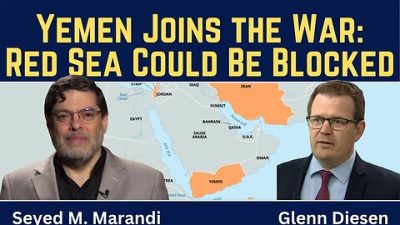
Yemen joins the war – Red Sea could be blocked next – Saudi regime at risk
or go to
Aletho News Archives – Video-Images
From the Archives
A superpower and “the world’s sickest warrior state”
By Paul J. Balles | March 8, 2010
Living through five or six major wars has hardened me to what I thought were the extremes of inhuman cruelty and brutality.
Two things made those extremes almost bearable: the brutality always revealed – at least according to the media coverage – the viciousness of the enemy. It was therefore quite understandable when our “brave men and women” pulverized the enemy.
Films of Japanese torturing captive Americans somehow justified holding Japanese Americans in internment camps during World War II; and only a small percentage of Americans found the bombing of Hiroshima and Nagasaki unreasonably vengeful at best, at worst, depraved.
The media giants in America portrayed the North Koreans as barbaric beasts with their captives, quite unlike their southern counterpoints – our allies during the Korean War. No one ever felt the need to explain how the South Koreans were a civilized breed while the North Koreans were absolute savages, at least according to the official line.
In Vietnam, our warriors justifiably (or so the media made us believe) dropped napalm on the North Vietnamese who had the gall to hide in villages and tunnels to ravage our invaders. At least it was accepted practice until some rogue photojournalist filmed a young girl screaming down a Vietnamese road in flames. … continue
Blog Roll
 Aletho News
- America Racing to Strategic Defeat in Iran: Lt Col Daniel Davis
- FTC Warns Visa, Mastercard, PayPal, Stripe Over Political Debanking
- Russian tanker approaches Cuba despite US oil blockade
- Marandi: Yemen joins the war – Red Sea could be blocked next – Saudi regime at risk
- Pro-Palestinian French member of European Parliament denied entry to Canada
- Pakistan to Host US-Iran Talks
- How Indonesia’s tilt toward the US left it stranded in the Strait of Hormuz
- US has no choice but to retreat from Iranian borders: Top commander
- Iran Retaliation Strikes Chemical Plant Near Dimona
- AWACS’ Destruction is a Major Loss for US Military – Ex-DoW Analyst
- If Americans Knew
- Israeli police block Catholic cardinal from entering Church of the Holy Sepulchre on Palm Sunday
- Israel is assassinating journalists again, more than any other nation, anywhere, ever – Not a ceasefire Day 170
- Over 300 US service members wounded, majority have brain injuries – Not a ceasefire Day 169
- Researchers at Human Rights Watch Resign Over Blocked Report on Palestinian Refugee Return
- Jewish Groups Are Backing a War Americans Don’t Want
- Eric Fingerhut Thinks He’s the President of the Jews
- Top Jewish Philanthropists, Rabbis Urge Israeli President to Take Action Against ‘Jewish Extremists’
- Don’t Be Fooled. Zionist Leaders Have Always Wanted to Control Southern Lebanon
- Israel’s widespread use of torture is a core element of its genocide against the Palestinian people
- In Israel’s War on Iran, Many Middle East US Bases Rendered “All But Uninhabitable”
- No Tricks Zone
- New Study Finds Warming Saves Lives…Cold Temperatures 12 Times More Deadly Than Excess Heat
- German Science Blog Accuses PIK Climate Institute Of Hallucinating Climate Tipping Points
- Devastating Assessment Of Comirnaty Vaccine By Former Senior Pfizer Europe Toxicologist
- New Study: CO2 Is ‘Effectively Negligible’ As An Explanatory Climate Change Factor Since 2000
- Former Pfizer Toxicologist Dr. Helmut Sterz Tells Bundestag Hearing Pfizer Vaccine Should Have Never Been Approved
- Energy Expert: Germany’s Nuclear Phaseout Was A “500 Billion Euro Mistake”
- New Research: South Australia’s Mid-Holocene Sea Surface Temperatures Were 4°C Warmer Than Today
- Storing Green Energy To Last Germany 10 Days Would Require A 60-Million Tonne Battery
- New Studies: UK Sea Levels Were 4 Meters Higher Than Today During The Mid-Holocene
- Destructive Green New Deal: German Energy And Metal Group Warns Of Drastic Crisis
 Aletho News