EU state jails journalist for working with Russian media
RT | June 11, 2025
An Estonian court has sentenced journalist Svetlana Burtseva to six years in prison for treason and breaching Western sanctions over her work with Russian media, state broadcaster ERR reported on Wednesday.
Burtseva, 58, a naturalized Estonian citizen, previously worked for Sputnik Estonia until it was banned in 2019. The authorities say she continued writing under a pseudonym for Baltnews, a portal operated by the EU-sanctioned Russian media group Rossiya Segodnya.
The Harju District Court ruled that by writing articles and providing photographs to Baltnews, Burtseva had effectively made “economic resources available” to Rossiya Segodnya, whose chief executive, Dmitry Kiselyov, is also under Western financial sanctions, according to the court spokesperson.
“[The defendant’s] collaboration with media outlets linked to Kiselyov can be considered a considerable contribution,” the court stated. “However, it must be taken into account that the number of articles was not very high for the time span in question,” it added.
Prosecutors also cited her alleged contact with Roman Romachev, whom they described as an operative engaged in “information warfare and psychological operations” on behalf of Russia.
Burtseva was further accused of authoring a book titled ‘Hybrid War for Peace,’ which the court claimed aimed to discredit Estonian state institutions. It concluded that she had “committed treason intentionally,” but noted that her level of guilt was minor and she had no prior convictions.
Burtseva became a naturalized Estonian citizen in 1994. The authorities allege she continued publishing content for Baltnews under the name Alan Torm between 2020 and 2023 and studied at Sevastopol State University in Russia from 2019 to 2021. She was arrested in February 2024.
Russia has condemned the case as politically motivated. Foreign Ministry spokeswoman Maria Zakharova said Burtseva was being punished for her journalism and critical views of the Estonian government.
Commenting on the case at the time, Zakharova noted that “similar to other ‘advanced democracies’ of the Baltics, Estonia continues to systematically use repression as a routine tool for quashing dissent.”
Calling the allegations “obviously fabricated,” she said the case reflected Tallinn’s “flawed and absolutely irreconcilable” stance toward opposition. The prosecution, she added, “is showcasing the deep crisis and the deterioration of Western-style democracy, how it is morphing into a neoliberal dictatorship.”
The court ruling can be appealed within 30 days.
Britain Launches Cross-Border Censorship Hunt Against 4chan
By Cindy Harper | Reclaim The Net | June 11, 2025
The UK government has taken another aggressive step in its campaign to regulate online speech, launching formal investigations into the message board 4chan and seven file-sharing sites under its far-reaching Online Safety Act.
But this is more than a domestic crackdown; it is a clear attempt to assert British speech laws far beyond its borders, targeting platforms that have no meaningful presence in the UK.
The law, which came into full force in April, gives sweeping powers to Ofcom, the UK’s communications regulator, to demand that websites and apps proactively remove undefined categories of “illegal content.”
Failure to comply can trigger massive fines of up to £18 million ($24M) or 10 percent of global revenue, criminal penalties for company executives, and site-wide bans within the UK.
Now, Ofcom has set its sights on 4chan, a US-hosted imageboard owned by a Japanese national. The site operates under US law and has no physical infrastructure, employees, or legal registration in Britain. Nonetheless, UK regulators have declared it fair game.
“Wherever in the world a service is based if it has ‘links to the UK’, it now has duties to protect UK users,” Ofcom insists.
That phrase, “links to the UK,” is intentionally vague and extraordinarily expansive, allowing British authorities to demand compliance from virtually any website.
This kind of extraterritorial overreach marks a direct threat to the principle of national sovereignty in internet governance. The UK is attempting to dictate the rules of online speech to foreign companies, hosted on foreign servers, and serving users in other countries, all because someone in Britain might visit their site.
According to Ofcom, 4chan failed to respond to its “statutory information requests,” making it one of nine services now under formal investigation.
What this law actually does is push platforms, especially smaller or independent ones, out of the UK entirely.
Already, popular free speech platforms like Gab, BitChute, and Kiwi Farms have blocked UK access, citing the chilling effects of the Online Safety Act.
Rather than making the internet safer, the law is creating a digital iron curtain around the UK, where only government-approved content and services remain accessible.
4chan, long a lightning rod for unfiltered speech and internet culture, has no shortage of detractors. But the platform’s commitment to anonymity and free expression has also made it one of the last places online where users can post without algorithmic throttling or corporate moderation.
It is routinely blamed for hosting “offensive” memes, and conspiracies, yet in nearly every case, the speech in question would be protected under US First Amendment standards.
Rather than respecting these legal differences, the UK is attempting to export its more restrictive model of speech regulation to the rest of the world. The aim is clear: if a platform cannot or will not bend to Ofcom’s demands, it will be blacklisted from the UK internet.
The wheels fall off of ‘Gideon’s Chariots’ in Gaza
By Robert Inlakesh | Al Mayadeen | June 11, 2025
The Israeli military has proven itself totally incapable of achieving success in Gaza, and its latest military operation proves this without a shadow of a doubt.
On March 18, Israeli Prime Minister Benjamin Netanyahu launched a surprise campaign of airstrikes against the Gaza Strip, which would kill hundreds of civilians over the course of the following few days. The declaration was also issued by the Zionist regime’s premier; he was breaking the ceasefire.
Netanyahu then issued a statement on the issue in which he claimed that his army had “resumed combat in full force,” threatening that the deadly airstrikes against densely populated civilian areas are “just the beginning.”
From that point on, for weeks, Israeli military and political figures warned of a looming ground invasion, asserting that it would be the final blow and “destroy Hamas”. Threat after threat came, yet the only thing that continued to materialize was airstrikes that targeted civilians.
On May 4, the Israeli cabinet officially approved a renewed ground operation in Gaza. What it proceeded to do was simply issue threats, while its bombardment of civilian infrastructure continued and the Israeli media fantasized about all of the potential strategies that were going to be implemented in what they started labelling “phase 2” of the war.
It wasn’t until May 16, after an escalation in the scale of its daily massacres, that the Zionist military would finally announce they had started the operation. During the course of the deadly air campaign, I estimated that three main components of this so-called “phase 2” would develop within the span of the following few days.
It panned out exactly as I assumed it would: First, an intensified series of raids against civilian targets. This would be followed by an announcement of a ridiculous-sounding name to the operation – I said Pigeons Chariots as a joke (it turned out to be Gideon’s Chariots) – which would make the Israeli public feel good about themselves and provide more content for Israeli media hype. Finally, small and meaningless incursions into zones surrounding the built-up [now almost entirely destroyed] areas in order to claim the ground operation was in full swing.
Nearly a month later, the Israeli military finally began actually running incursions into the built-up areas in northern Gaza and Khan Younis, yet each time they advanced, they were almost immediately falling into complex ambushes. Their casualties were high, and the Israeli military censor was employed to hide losses.
The Zionist regime’s troop numbers in Gaza are a fraction of what they had mustered prior to the ceasefire that was implemented in January. Report after report claimed that anywhere from 20,000 to 60,000 reservists had been called upon to serve in the Gaza Strip. It is difficult to know how many additional reserve soldiers actually showed up, as even the claims about how many had been recalled appeared to be jumping all over the place.
Despite having destroyed the large majority of Gaza’s civilian infrastructure, also having entered most areas throughout the besieged coastal territory during the course of the war, there is no built part of the Gaza Strip that the Israelis have gained operational control over. Even in the so-called buffer zone, occasional ambushes occur and take out some of their soldiers.
It has been clear from the beginning of the so-called “Operation Gideon’s Chariots” that there is no real plan behind it; it is simply an exercise in committing genocide while doing more of the same as their forces did during “phase one” of the Gaza war. Except now, their soldiers are fatigued, less well-equipped, many of them refuse to show up for duty, and there is a general sense of a loss of morale, according to Israeli media leaks.
The former Chief of Staff for the Zionist entity’s armed forces, Mosh Ya’alon, even said the following about the ongoing operation:
“Throughout my years of service and participation in cabinet discussions, I do not recall a single instance in which the cabinet approved a military operation without a prior determination of its objective, or, to put it another way, the expected “end.” We are waging the longest war in our history without a clear objective for the operation, other than the illusory slogan of “complete victory,” which translates into an eternal political war.”
As each day passes, the Israeli regime appears to be attempting everything it can come up with to try and stir as much chaos and desperately chase the image of victory. Netanyahu still claims he is seeking a total victory in his “seven-front war” but has little to show for it.
In fact, he is essentially back in the same position he found himself one year ago from now, bogged down in a losing war and waging genocide in the hope that maybe victory will fall from the sky.
The tactical victories that the Israelis managed to score in Lebanon with their terrorist pager attack and assassinations of the Hezbollah senior leadership have since faded. They also clearly played their main cards in Lebanon and lost all of the advantages they had spent years working to develop.
Desperate bombing attacks in the Southern Suburb of Beirut affect nothing on the ground. In fact, what they have done since the ceasefire, committing over 3,000 violations and continuing to occupy territory in the south, only proves why Lebanon needs an armed resistance in order to protect the country.
Meanwhile, the collapse of the Syrian government may have served as a blow, but even with their illegal invasion and occupation of southern Syrian territory, there is no clear endgame for the Zionists. Meanwhile, the space still exists for a grassroots resistance to slowly build itself. Although the situation there is unpredictable, it does not necessarily favour the Israelis in the long run.
It appears as if the wheels have fallen off the “Gideon’s Chariots” operation in Gaza also, which leaves the Israelis with one real option for escalation, desperately chasing “total victory”, an attack on Iran. Yet this option could involve costs that outweigh any potential benefits.
Afraid to fight, desperately backing Daesh-linked gangsters and using food as a weapon of war against a tormented civilian population, the Israelis are stuck and incapable of navigating a path toward victory. If the Zionist regime ends the conflict now, it is an admission of defeat and will topple the Netanyahu coalition; if it continues on its current trajectory, this war could prove fatal.
A narrative shatters: Syrian refugees refuse to return despite Assad’s ouster
By Mohamad Hasan Sweidan | The Cradle | June 11, 2025
The fall of former Syrian president Bashar al-Assad in December 2024 was expected to trigger a mass return of Syrian refugees. It did not. Six months on, UN figures show fewer than eight percent of Syrians abroad have made the journey home. The promise of a new era in Damascus has collided with the harsh realities of insecurity, poverty, and heightened foreign interference.
The Syrian refugee crisis – now in its 14th year – was born of war, western-imposed economic blockade, and the disintegration of state institutions that started in March 2011. What began as internal displacement soon morphed into a mass exodus across West Asia and into Europe, producing one of the most severe refugee crises of the 21st century.
Life after Assad: The enduring refugee crisis
Despite the fall of the Assad government, the Syrian refugee crisis remains unresolved. As of early 2025, the UN reports that approximately 6.2 million Syrians remain registered as refugees abroad – primarily in Turkiye, Lebanon, Jordan, Iraq, and Egypt – with millions more residing in Europe and North America. Only a fraction have returned since the Syrian opposition assumed power.
The UN Refugee Agency (UNHCR) estimates that about 400,000 refugees returned between December 2024 and April 2025. This number rose slightly to 481,730 by May, still below eight percent of the total refugees abroad. This disparity underlines a stark reality: The fall of Assad did not translate into mass return as the west suggested for years, which reveals that there are deeper, unresolved issues that keep Syrians away from Syria.
In West Asia’s key host countries, Turkiye hosts between 2.7 and three million Syrian refugees under a temporary protection regime, in addition to roughly one million unregistered Syrians. Lebanon hosts around 750,000 registered refugees, though Beirut places the actual figure closer to 1.5 million. Jordan houses approximately 650,000 Syrian refugees.
While many refugees may dream of returning, reality intervenes. A mid-2024 survey found 57 percent hoped to return one day, yet fewer than two percent believed this was feasible within the following year. UNHCR identifies safety concerns and the lack of stable livelihoods as the most significant obstacles. These core issues shape the calculus of return – a calculus that has not shifted meaningfully since Assad was in power.
Why Syrians aren’t going back
A May poll cited critical return deterrents: housing and property conditions (69 percent), service availability (40 percent), safety (45 percent), and economic hardship (54 percent). Fourteen years of war have left Syria fractured, devastated, and distrustful. There is no unified, trustworthy security or governance structure. The post-Assad era remains deeply uncertain to Syrian refugees.
The current political set-up in Damascus is a patchwork of domestic and foreign-influenced actors. Despite Assad’s ousting, returnees consistently cite improved security and essential services as prerequisites. A recent survey indicated that 58 percent of Syrians abroad would return only under “safe and dignified conditions,” while 31 percent remain undecided.
Governance challenges are equally daunting. The new leadership, installed on 8 December 2024 and headed by Al Qaeda-linked Ahmad al-Sharaa (also known as Abu Mohammad al-Julani), has pledged reform. But memories of infighting among rebel groups linger. Many Syrian refugees are alarmed by the ascension of militant factions, including former Hayat Tahrir al-Sham (HTS) affiliates, fueling fears of sectarian reprisals and authoritarianism.
Beyond Syria’s borders, refugee networks now serve as lifelines. After more than a decade abroad, Syrian refugees have established enduring community ties. In Turkiye, 60 percent of working-age Syrians are employed, mostly in informal sectors. These jobs, although low-paid, offer stability compared to war-torn Syria.
Yet, most Syrians in Turkiye remain socially unanchored: Over half report feeling disconnected from Turkish society, where racism has become rife, while 84 percent still feel moderately connected to Syria. This duality reflects a long-term migration trend where refugees retain ties to their homeland while integrating abroad.
A recent survey shows that just seven percent of Syrians in Turkiye have concrete plans to leave. Others express the desire to relocate, but without actionable steps. Citizenship also affects permanence: Around 238,000 Syrians had been naturalized in Turkiye by mid-2024, granting them full legal protections, including immunity from deportation. Turkish opposition sources, however, estimate this figure could be as high as 2.5 million.
The return paradox: Poor conditions in host nations, yet no return?
Even deteriorating conditions in host countries have not significantly altered return patterns. Economic collapse in Lebanon, rising costs in Turkiye, and recent conflict along the Lebanese border have not pushed Syrians homeward. Studies consistently show return decisions hinge more on improvements in Syria – security, jobs, services – than on hardships abroad.
Divisions among external powers inside Syria further complicate matters. Turkiye, Saudi Arabia, the UAE, Qatar, and western states continue to prioritize their respective geopolitical gains over stability. The result is a fragmented political order dominated by armed factions and foreign patrons, with little accountability to actual Syrians.
This instability has real consequences. The massacres along Syria’s coast last March, reportedly instigated by UAE-backed elements, required intervention by the new Damascus authority. Such events erode trust and deter return.
Economically, Syria remains in free fall. According to the UN Development Programme (UNDP), 90 percent of Syrians live below the poverty line. The World Bank projects an additional one percent GDP contraction in 2025. The World Food Programme (WFP) says 9.1 million are food insecure, with 3.6 million reliant on aid.
Electricity is available just two to three hours a day, crippling industry and inflating living costs. Despite promises by the transitional government to reform banking and attract Persian Gulf investment, remaining sanctions and market isolation are still serious hurdles, even after Washington lifted most restrictions in May 2025.
Unemployment is rampant, fuel and transport costs are surging, and social safety nets are vanishing. Monthly incomes in many regions fall below $40, while basic food baskets cost twice that amount. The exodus of Syrian professionals continues to deplete the labor market, deepening reliance on remittances in the absence of a coherent reconstruction plan.
Syria remains a high-risk return
The reluctance of millions of Syrians to repatriate was never actually about leadership change – credible data simply does not exist on this. It is about the cumulative consequences of war: insecurity, economic collapse, political fragmentation, and the absence of justice or reconciliation.
Unless those in power focus on rebuilding credible institutions and securing livelihoods – not just reshuffling elites – the prospect of return will remain a perilous gamble.
Iran’s intel breach involves Israeli nuke plans, surveillance, organ trafficking: Report
The Cradle | June 11, 2025
An Iranian journalist with links to the country’s security establishment has released what he says are the first details from the thousands of sensitive documents on Israel, which Tehran announced it obtained days ago.
The documents include “Tel Aviv’s dangerous four-year roadmap in the nuclear field” and information on Israel’s “nuclear military industry facilities, bases, infrastructure and processes,” journalist Mohammad Ghaderi reported on 10 June.
The documents, which, according to Tehran, revolve mainly around Israel’s nuclear secrets, contain other information, such as documentation of bribes to well-known Arab figures aimed at advancing the Abraham Accords, as well as the “complete profiles” of 23 senior Israeli spies.
They also include “Information on about six million Facebook, Twitter, Instagram, and Telegram users,” Ghaderi says.
Additionally, there is personal information on Israeli Prime Minister Benjamin Netanyahu and his wife, including medical documents.
The journalist notes that Iran’s “treasure trove” includes “Information on corruption networks, including organ trafficking networks, drug distribution, sexual exploitation of women and children, information finance, money, banking, and insurance.”
There are also hard drives and nearly 2,000 documents from the Israeli premier’s office, as well as information from “Mossad’s secret archive,” Ghaderi added.
Ghaderi claims Iran has also obtained access to private information on Israeli officials and leaders opposing Netanyahu, “including from hidden cameras in their bathrooms, bedrooms and inside their homes, and information obtained from hacking their mobile phones and personal computers, which were used in Bibi’s office to blackmail his opponents.”
The documents also contain thousands of high-quality aerial images of Israeli cities, ports, and important infrastructure, as well as “40,000 hours of CCTV footage.”
A banned recording of a heated Knesset debate involving Netanyahu, reportedly erased from official Israeli archives, is part of the cache of documents allegedly seized by Iranian intelligence.
According to DropSite News, Ghaderi is “a known media proxy” who “is often used by Iranian authorities to release sensitive information before official acknowledgment.”
DropSite News reporter Ryan Grim said, “either Iran is bluffing for leverage ahead of the next round of nuclear talks, or they pulled off an espionage coup of historic proportions.”
Iran’s Intelligence Minister Esmail Khatib announced on 8 June that Tehran has obtained thousands of sensitive documents on Israel’s nuclear program.
“The transfer of this treasure trove was time-consuming and required security measures. Naturally, the transfer methods will remain confidential, but the documents should be unveiled soon,” Intelligence Minister Esmail Khatib told Iranian television on Sunday.
“Talking of thousands of documents would be an understatement,” Khatib went on to say. The “vast collection of strategic and sensitive [Israeli] documents” includes “plans and data on [Israel’s] nuclear facilities,” according to the intelligence minister.
“They also include other documents about the relationship with the US, Europe, and other countries, as well as intelligence documents that would boost Iran’s offense power,” Khatib said.
On 10 June, the Intelligence Ministry confirmed the operation in an official statement, saying the documents were seized by operatives who managed to break through multiple layers of Israeli security and avoid detection.
A significant portion will be used by Iran’s military, some will be shared with allied countries and anti-Zionist groups, and selected parts will be made public, the ministry added.
The chief of the Islamic Revolutionary Guard Corps (IRGC), Hossein Salami, said the intel will provide Iran with an advantage if it is forced to respond to an Israeli attack on its nuclear facilities.
US President Trump Streamlined the National Endowment for Democracy, not Dismantled it
By Brian Berletic – New Eastern Outlook – June 11, 2025
While many believe that under the Trump administration the controversial National Endowment for Democracy (NED) was defunded, dismantled, or otherwise dissolved, the reality is far less dramatic and far more dangerous.
Despite President Donald Trump’s outspoken criticism of global entanglements and calls of “ending the era of endless wars,” stretching back all the way to his first term in office, the NED not only continues to receive taxpayer funding under his administration to facilitate instability and conflict worldwide, it has quietly expanded its reach behind a newly adopted policy that makes its activities less transparent than ever.
On its official website, the NED recently revealed what it calls a “duty to care” policy – an internal shift that effectively ends the organization’s long-standing practice of openly listing most of the foreign organizations and movements it finances. This change, framed as a protective measure for recipients in “high-risk environments,” marks a complete reversal of one of the few things that previously distinguished NED operations from covert CIA influence campaigns – the veneer of transparency.
A “Pro-Democracy” Front With Covert DNA
Founded in 1983, the NED was created to do overtly what the CIA used to do covertly, according to former NED co-founder Allen Weinstein. For decades, it served as the US arm of so-called “soft power,” funneling money to foreign political groups, media outlets, labor unions, and activist organizations deemed favorable to US interests – usually under the banner of “promoting democracy.”
But “democracy” in this context is indistinguishable from regime change. From Venezuela to Belarus, from Hong Kong to Myanmar, NED-funded groups have played central roles in political destabilization and even precipitating war, many of them advocating positions explicitly aligned with US foreign policy and done entirely at the cost of their own nation’s stability and best interests.
The obvious purpose of creating the NED wasn’t to end covert interference around the globe, but rather to continue the CIA’s work Americans and people worldwide were increasingly aware of and opposed to, by whitewashing it and repackaging it as transparently “promoting democracy.”
Since the NED’s founding, the Western media has intermittently admitted the NED has been involved in global-spanning regime change. In 2004, the London Guardian admitted the US government through the NED overthrew governments in Serbia in 2000 and Georgia in 2003, while unsuccessfully attempting to do so in Belarus and Ukraine.
The article described unrest taking place in Ukraine at the time as:
… an American creation, a sophisticated and brilliantly conceived exercise in western branding and mass marketing that, in four countries in four years, has been used to try to salvage rigged elections and topple unsavoury regimes.
Funded and organised by the US government, deploying US consultancies, pollsters, diplomats, the two big American parties and US non-government organisations, the campaign was first used in Europe in Belgrade in 2000 to beat Slobodan Milosevic at the ballot box.
Richard Miles, the US ambassador in Belgrade, played a key role. And by last year, as US ambassador in Tbilisi, he repeated the trick in Georgia, coaching Mikhail Saakashvili in how to bring down Eduard Shevardnadze.
Ten months after the success in Belgrade, the US ambassador in Minsk, Michael Kozak, a veteran of similar operations in central America, notably in Nicaragua, organised a near identical campaign to try to defeat the Belarus hardman, Alexander Lukashenko.
The article names the National Democratic Institute (NDI) and the International Republican Institute (IRI), and Freedom House by name, all three of which are subsidiaries of the NED.
In 2011, the NYT would admit the US government through the NED was behind the regional destabilization and regime change in 2011 referred to as the “Arab Spring.”
The article explained:
A number of the groups and individuals directly involved in the revolts and reforms sweeping the region received training and financing from groups like the International Republican Institute, the National Democratic Institute and Freedom House, a nonprofit human rights organization based in Washington, according to interviews in recent weeks and American diplomatic cables obtained by WikiLeaks.
And that:
The Republican and Democratic institutes are loosely affiliated with the Republican and Democratic Parties. They were created by Congress and are financed through the National Endowment for Democracy, which was set up in 1983 to channel grants for promoting democracy in developing nations. The National Endowment receives about $100 million annually from Congress. Freedom House also gets the bulk of its money from the American government, mainly from the State Department.
The US-engineered “Arab Spring” would precipitate multiple US-led wars across the region, ravaging Libya, Yemen, Syria, and affecting every nation in between.
US political interference continues up to and including today under the current Trump administration with attempts to once again destabilize the nation of Georgia along Russia’s borders, continued US-sponsored violence in Myanmar along China’s borders, attacks by US-backed militant groups in southwest Pakistan targeting China’s Belt and Road Initiative, and the continued operation of virtually every NED-funded organization operating elsewhere along China’s periphery including in Thailand and the Philippines.
Democracy as a Cover for Political Interference
Democracy, by definition, is a form of self-determination. If a political movement relies on, or is shaped by the funding and direction of a foreign government – especially one with a track record of overt military invasion, occupation, and conquest like the United States – it is not “promoting democracy,” but rather political interference.
Any nation whose internal political affairs are subject to the influence of the US government through the NED, its subsidiaries or adjacent organizations is not exercising democratic self-rule, but living under a subtler form of political occupation – one where ballots replace bullets, but the end result is the same – the replacement of sovereign leadership with a US-installed client regime.
In many cases, US NED-funded and directed instability takes the form of armed-violence amid which “activists” rather than invading US troops seize critical government buildings, attack critical infrastructure, and carry out other objectives an invading US military force would seek to achieve including the destruction of specific infrastructure and the ousting of ruling governments.
The End of “Transparency”
The NED’s decision to stop publishing the identities of the groups it funds represents more than just an administrative shift. It is a turning point, following years of growing public awareness both in the US and worldwide of what the NED is really doing and why.
In the past, critics were at least able to track and expose how NED money was flowing into particular movements – from opposition parties in Nicaragua to protest organizers in Hong Kong. That visibility, however minimal, imposed some form of political pressure and constraint on the US.
With the “duty to care” policy, even that has now been eliminated.
Today, the NED operates with the same impunity as any covert intelligence operation – only without the oversight, legal restrictions, or classification protocols typically associated with CIA activity.
In practice, this allows the US to wage political war under the pretense of “promoting democracy,” while overall leaving fewer fingerprints behind.
And while the shift within the NED and across US foreign policy as a whole should prompt nations to respond with stricter scrutiny and regulation of the organizations still likely receiving US support, even when US interference was more transparent, many nations failed categorically to protect national security from it. Now that US interference is being done more covertly, it will be even more difficult for advocates of greater national security regarding foreign-funded NGOs to spur governments around the world into action.
Under Trump, Business as Usual
Despite the perception among some that the Trump administration intended to dismantle or defund the NED, no such action occurred. In fact, NED funding is continuing after only a brief pause, with the majority of NED operations continuing uninterrupted.
Much like the US military-industrial complex which continues expanding despite President Trump’s rhetorical opposition to “forever wars” – the regime change-industrial-complex led by the NED, its affiliates, and subsidiaries, have likewise not only continued, but are enhancing their menace to peace and stability worldwide.
Some may argue that recent attention placed on the NED and adjacent organizations like USAID is positive progress in the right direction. In reality, this recent attention has more in common with what is known as a “limited hangout,” a method of perception management used when state secrecy has been compromised, and “limited” information is either admitted to or even volunteered, while central information is still withheld from the public. The public is often distracted by or satisfied with this limited admission and fails to pursue the issue further.
In the case of NED and USAID funding, after many years of growing awareness of and opposition to both, many Americans believe both organizations have now been dismantled, oblivious to the fact that both are still operational and the global network of political subversion they facilitate continues operating uninterrupted.
A Hidden Hand With Open Consequences
The NED’s new era of covert funding and hidden recipients marks a dangerous evolution in US foreign policy. Under the guise of care and caution, the organization has closed the one window that allowed even limited public scrutiny of its global interference.
Regardless of whether the CIA or NED fund and direct foreign interference worldwide and regardless of the degree of transparency involved, the outcome remains the same – a world where real decisions are not made by people on the ground in any one of the many nations targeted by US interference, but by politicians in Washington and policymakers at corporate-funded think tanks.
While American voters and many around the globe held hope that the incoming Trump administration would make good on its promises to roll back US interference abroad and focus instead on the best interests of Americans in America, the administration has instead continued US wars and proxy wars in Europe, the Middle East, and Asia together with sharpening and streamlining the military and non-military means with which to expand them even further.
Despite the illusions of reform or even “revolution” under the Trump administration, the truth is the NED (and USAID) remains as active as ever, more unaccountable than ever, and continue to serve as a sophisticated instrument of political manipulation for the very special interests of the “deep state” many Americans voted President Trump into office to oppose.
A Message to Georgians: America Will Not Protect You
No offense, but Georgia’s interests are just none of my affair. It’s such a long way from here.
I know my government has been messing around there since the 1990s, picking winners and losers, making big promises and causing lots of trouble.
Keeping Russia out of their former sphere of influence was thought by Washington to be its most important goal.
Under the Bill Clinton administration, it was decided that building the BTC Pipeline across Georgia was the highest priority – to prevent Azeri gas from flowing north through Russia or south through Iran.
Under George W. Bush, it was decided that the government of Edward Shevardnadze was too close to Russia, compromising with them over Abkhazia, making deals with Gazprom, and joining the CIS, and had to go.
USAID, the National Endowment for Democracy (NED), and the rest of the regime change industry poured in tens of millions of dollars to support the groups supporting Mikhail Saakaashvili’s rise and the Rose Revolution of 2003, which installed him in power. This included a Soros front called the Liberty Institute – not to be confused with the Libertarian Institute, I assure you.
As I’m sure you all know, former President Salome Zourabichvili was born in France, not Georgia, and was just parachuted in by the new regime to take over as Finance Minister after the overthrow of 2003. She later explained that:
“These institutions were the cradle of democratization, notably the Soros Foundation. … The NGOs which gravitate around the Soros Foundation undeniably carried the revolution. However, one cannot end one’s analysis with the revolution and one clearly sees that, afterwards, the Soros Foundation and the NGOs were integrated into power.”
Soros’s business partner Kaka Bendukidze became the new economy minister. Alexander Lomaia, the director of Open Society Georgia, was made education minister. At the same time, Giga Bokeria, co-founder of the Liberty Institute, became the leader of the National Movement party in the parliament. In the name of fighting against corruption, they stayed on Soros’s payroll. Saakashvili too.
“I’m delighted by what happened in Georgia, and I take great pride in having contributed to it,” Soros told the Commission on Security and Cooperation in Europe.
How y’all let her become the president of the country is a mystery. Oh yeah. All the foreign money.
I sure hope that Mr. Saakashvili’s trial was more fair than his opponents received while he was in power. And that Saakashvili is not being tortured in prison the way his regime tortured people. No human deserves to be treated in such a barbarian fashion.
Do I believe Georgia country is better off under the domination of Russia or any other significant power?
Of course not. But I do mean that American intervention is not in the interest of either country.
I’ve read that current Georgian leaders have expressed frustration that they have not been able to reach the new Trump administration to see if they can get a reset in America’s Georgia policy. Be careful what you wish for. Georgians are more likely to be better off when America does not have a Georgia policy at all than even a favorable one, with strings attached.
As far as the difficulties Georgia may face in maintaining full independence as a small country in a world of major competing powers and Georgia’s advantageous or disadvantageous geographic position relative to important resources, I could not say what your best solution must be.
I could say that at the end of the day, America will not guarantee Georgia’s independence, which is why there is no major U.S. troop presence there, and why NATO membership has not moved forward since W. Bush’s foolish declaration at Bucharest in April 2008.
Perhaps maintaining Tbilisi’s neutrality in these major contests could be the path to maintaining independence from outright control.
Even after Russia intervened to reverse Saakashvili’s attempt to forcefully reintegrate South Ossetia in 2008, Moscow did not sever the BTC, nor roll its tanks into Tblisi, thank goodness. Though Putin and Medvedev had plenty of counter-incentives, they certainly had the pretext to go that far if they had chosen to do so.
President Bush, in his lame-duck year, had already chosen not to intervene, despite the protests of then-Vice President Cheney, who insisted on strikes against Russian forces coming through the Roki tunnel, risking World War III.
Thank goodness the cool, patient wisdom of George W. Bush, relative to Cheney anyway, prevailed that day.
Surely Russia would have escalated in kind, and Tbilisi would have lost its independence to the Federation after Bush had inevitably backed down. Thank goodness it did not come to that.
Making sure the Russians continue to feel like such a move would be unnecessary and unreasonably costly would probably be the best course of action.
Of course, USAID, NED, IRI, NDI, and all the usual suspected Soros-backed groups have spent a ton to keep the current ruling party out of power. I’m sure the permanent professional protestors — analyst Brad Pearce calls their rallies an “organized labor protest by the foreign influence industry” — have some real concerns, just as I’m sure that any protestor receiving the backing of a foreign regime can only be taken so seriously by anyone else.
Again, ultimately, America is too far away and has too little to lose if Tbilisi’s status were to truly change to truly be motivated to do anything about it. When Russia came across the mountains in 2008, many Americans were terrified – they thought that our Georgia was under attack, the state between South Carolina and Florida. They either had never heard of your country, or they could not fathom why it being invaded should be top news in Colorado or Illinois. That Russia would attack America out of the blue seemed to them more plausible, at first glance, at least.
That being the case, Georgians are almost certainly better off choosing the proper course forward for their country with that in mind. Because chances are that if worse comes to worst, no one over here is coming to intervene over there.
Long live Georgia and its independence, good luck.
And may liberty always remain your highest political goal.
Thank you.
EU nation won’t back new Russia sanctions – PM
RT | June 11, 2025
Slovakia will not support the EU’s new package of sanctions against Russia, Prime Minister Robert Fico has said. In a Facebook post on Tuesday, Fico warned that the proposed restrictions from Brussels could plunge his country into an energy crisis.
The European Commission unveiled its 18th sanctions package targeting Russia on Tuesday, focusing on energy exports, infrastructure, and financial institutions. The measures, pitched as pressure on Moscow to end the Ukraine conflict, include lowering the price cap on Russian oil from $60 to $45 per barrel, banning future use of the damaged Nord Stream pipeline, restricting imports of refined products based on Russian crude, and sanctioning 77 vessels allegedly part of a Russian “shadow fleet,” which Brussels claims is used to circumvent oil trade bans. The package must be approved unanimously by all 27 EU member states to take effect.
“The Slovak Republic will not support the upcoming 18th sanctions package against the Russian Federation,” Fico wrote. He added that Bratislava could reconsider if Brussels offers “a real solution to the crisis” that Slovakia would face from losing Russian energy supplies.
Slovakia has implemented all EU sanctions on Russia since the Ukraine conflict escalated in 2022. However, Fico has consistently opposed the measures since returning to office in 2023, arguing they “are not working” and hurt EU member states more than they affect Moscow. Last week, the Slovak parliament passed a resolution prohibiting government representatives from supporting new international sanctions against Russia, citing economic harm to Slovakia’s industry and population. While Slovak President Peter Pellegrini has the authority to veto the resolution, it is binding under Slovak law, requiring Fico to vote against the new sanctions in Brussels.
Russia has dismissed Western sanctions as illegitimate and counterproductive. President Vladimir Putin has said lifting sanctions is one of Moscow’s conditions for settling the Ukraine conflict. Kirill Dmitriev, CEO of the Russian Direct Investment Fund (RDIF) and a presidential investment envoy, stated that the EU’s push for more sanctions is politically motivated and aimed at prolonging the conflict.
Legacy media has a meltdown after RFK Jr fires the CDC’s vaccine panel
By Maryanne Demasi, PhD | June 10, 2025
Yesterday, Robert F. Kennedy Jr. fired every single member of the CDC’s Advisory Committee on Immunization Practices (ACIP)—the influential group of experts that decides which vaccines are added to the childhood schedule.
Today, he set fire to the media’s hysterical reaction.
Within 24 hours, legacy outlets and public health institutions lost their collective minds. Former CDC directors, industry-funded doctors, and conflicted public health groups lined up to denounce Kennedy’s move as reckless, anti-scientific, even deadly.
“This is a dangerous and unprecedented action that makes our families less safe,” said former CDC director Dr Tom Frieden.
“Unilaterally removing the entire panel of experts is reckless,” said paediatrician Dr Tina Tan to The New York Times.
The American Academy of Pediatrics (AAP) said it was “deeply troubled and alarmed.” It claimed the move would “stoke distrust in lifesaving vaccines”—this from the same organisation that has spent decades pushing the childhood vaccine schedule while taking money from the very companies that profit from it.
Others framed it as a political purge, a blow to science, or a “coup” that would bring back measles and polio.
But within hours, Kennedy hit back—and this time, he wasn’t the outsider being easily dismissed. He was the Secretary of Health and Human Services. And he came armed with evidence, receipts, and a brutal takedown of the media’s favourite falsehoods.
In a searing post on X, Kennedy explained the decision.
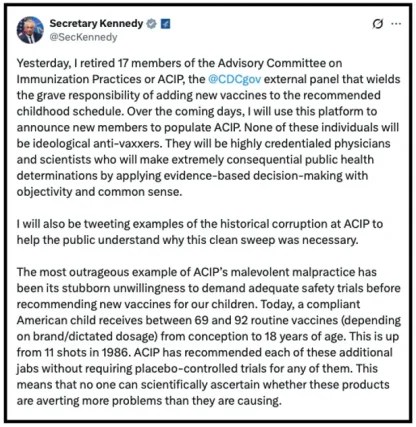
He said the clean sweep was necessary because ACIP had demonstrated its “stubborn unwillingness to demand adequate safety trials before recommending new vaccines for our children.”
And despite the media’s insistence otherwise, Kennedy argued that no routine injected childhood vaccine on the CDC’s schedule had ever been approved based on a placebo-controlled trial using an inert substance.
CNN had tried to prove him wrong last week—claiming it had found “257 placebo-controlled studies” of vaccines on the schedule.
Kennedy dismantled it in forensic detail.
“CNN is wrong,” he wrote. “No routine injected vaccine on CDC’s schedule was licensed for children based on a placebo-controlled trial. That is not conjecture. It is a fact based on FDA’s clinical trial data.”
Then came the body blows.
He pointed out that most of the 257 studies used active substances like aluminium, antibiotics, or other vaccines—not inert placebos.
He linked directly to FDA definitions of “placebo” and to official clinical trial records. Of the few studies that may have used saline controls, none were relied on by the FDA to license a single routine vaccine for American children.
Some studied products that were never approved in the US. Some occurred after licensure. Others involved discontinued vaccines. “CNN’s list ironically proves the lack of adequate safety trials,” Kennedy wrote in a stinging rebuke.
The post was devastating.
It was a clinical takedown of an industry riddled with deception—and it landed—because this time, Kennedy wasn’t being filtered through a hostile press.
He was speaking directly to the public, as a government official, with all the links to back it up. And the media couldn’t handle it.
Predictably, the media rolled out the same tired “experts” to recycle the same tired script—Paul Offit quotes, panic about “undermining trust,” warnings that children would die.
But Kennedy turned the whole thing inside out.
“We’ve gone from three routine injections by age one in 1986 to 25 in 2025,” he wrote. “And not one of them was licensed using a placebo-controlled trial.”
He said it plainly for the cameras: “That is just malpractice. So the people who are in charge of that are now gone.”
For years, the press had written Kennedy off as an anti-vaxxer and moved on. Now, they’ve thrown everything at him—and he threw it right back. Only now, he has the authority, data, and reach.
Kennedy told his followers he’d be announcing replacements in the coming days—no “ideological anti-vaxxers” just “highly credentialed physicians and scientists” committed to evidence, objectivity, and common sense.
Legacy media may still control the headlines, but they can no longer suppress the debate.
And perhaps that’s what really has them rattled.
They’re not defending science. They’re defending a regime of experts who signed off on decades of vaccine approvals without ever insisting on rigorous, inert-placebo safety trials.
When Kennedy calls them out, their only defence is to scream “danger!”—and hope no one checks the fine print.
Yesterday, he fired the gatekeepers. Today, he exposed the game.
How Israel is weaponising water in Gaza | People & Power Documentary
Al Jazeera | March 20, 2025
The People & Power team travelled through Gaza just weeks before October 7, 2023 to document Israel’s weaponising of water. The situation already seemed desperate back then.
As a ceasefire came into place in January this year, our team in Gaza went to look for the people they met 18 months earlier.
Most of Gaza’s remaining water infrastructure has been damaged or destroyed. Israel’s cutting of external water supplies and systematic destruction of water facilities have reduced the amount of water available to Palestinians in Gaza to as little as 2 litres per person a day. Water-borne diseases are running rampant through communities.
Thirst Among the Ruins tells the story of the systematic targeted obliteration of Gaza’s water infrastructure by Israel, and how it violates international humanitarian law.
Featured Video
America Racing to Strategic Defeat in Iran
or go to
Aletho News Archives – Video-Images
From the Archives
An Expert Military Analysis of War with China
Actually, None is Necessary
By Fred Reed • Unz Review • December 13, 2020
The Correlation of Armed Forces: U.S. goods and services trade with China totaled an estimated $634.8 billion in 2019. Exports were $163.0 billion; imports were $471.8 billion. The U.S. goods and services trade deficit with China was $308.8 billion in 2019. Trade in services with China (exports and imports) totaled an estimated $76.7 billion in 2019. Services exports were $56.5 billion; services imports were $20.1 billion. The U.S. services trade surplus with China was $36.4 billion in 2019.
There is talk within the Washingtoniat of a possible war with China. Steve Bannon, who apparently was dropped on his head as a child, actually favors such a war. We hear the usual shoo-the-boobs alarm about how the Chinese are doing something terrible and we must gird our loins and American values and show them what for, bow wow, woof. The danger is that the current game of who-blinks-first in Asian waters might actually provoke a shooting war. You know the kind of thing: One warship refuses to get out of the way of another, a collision ensues, some retard lieutenant who signed up on waivers opens fire, and we’re off and running. It is not a good idea to let children play with matches.
The said war is discussed either in emotional terms by idiots or in purely naval terms by those familiar with such things, so we hear of the First Island Chain and the Second Island Chain and whose missiles against the other’s missiles and so on. This would be appropriate if we were fighting World War Two again. Which we aren’t. Let’s take a quick-and-dirty look at how such a war might go.
To begin the war, America would overestimate itself and underestimate China. This is doctrine in the Pentagon. … continue
Blog Roll
 Aletho News
- Tehran approves new Hormuz plan with major restrictions
- No Threat Can Force Iran’s Surrender /Trita Parsi & Lt Cl Daniel Davis
- UK’s New Pandemic Plan Would Turn Big Tech Into a Mass Location Tracking Network
- Growing insecurity, soaring prices fuel protests in north as regime bans evacuation: Sources
- Iran denies responsibility for ‘depraved’ attack on Kuwait desalination plant
- Bring The Troops Back. End This War Now!
- Can we please stop calling Israel the ‘only democracy in the Middle East’ now?
- US should start removing its troops from Germany, proposes AfD co-leader Chrupalla
- Iran Red Crescent: 600 educational centers attacked in US-Israeli ‘war crimes’
- Russian Oil Tanker Arrives in Cuba Amid U.S. Blockade
- If Americans Knew
- As Iran targets US military bases, will they be relocated to Israel? Not a ceasefire Day 171
- Will Trump Go Kamikaze?
- Is the University of Florida Shutting Down College Republicans over Israel Criticism?
- Jewish extremist arrested over alleged plot to firebomb Palestinian activist Nerdeen Kiswani’s home
- More than half of Palestinian child detainees have no charges
- The More Murderous Israel Gets, The More We Hear About “Antisemitism”
- Land Day and the Palestinian struggle after 30 months of genocide
- The Iran War Is About Palestine
- Israeli soldiers echo settler ideology, talk of revenge after targeting Palestinians and detaining CNN crew in the West Bank
- Israeli Policies Threaten Future of Christian Schools in Jerusalem
- No Tricks Zone
- New Study Finds Warming Saves Lives…Cold Temperatures 12 Times More Deadly Than Excess Heat
- German Science Blog Accuses PIK Climate Institute Of Hallucinating Climate Tipping Points
- Devastating Assessment Of Comirnaty Vaccine By Former Senior Pfizer Europe Toxicologist
- New Study: CO2 Is ‘Effectively Negligible’ As An Explanatory Climate Change Factor Since 2000
- Former Pfizer Toxicologist Dr. Helmut Sterz Tells Bundestag Hearing Pfizer Vaccine Should Have Never Been Approved
- Energy Expert: Germany’s Nuclear Phaseout Was A “500 Billion Euro Mistake”
- New Research: South Australia’s Mid-Holocene Sea Surface Temperatures Were 4°C Warmer Than Today
- Storing Green Energy To Last Germany 10 Days Would Require A 60-Million Tonne Battery
- New Studies: UK Sea Levels Were 4 Meters Higher Than Today During The Mid-Holocene
- Destructive Green New Deal: German Energy And Metal Group Warns Of Drastic Crisis
 Aletho News