‘War crime’: Iran’s foreign ministry building hit during Israeli aggression; many injured
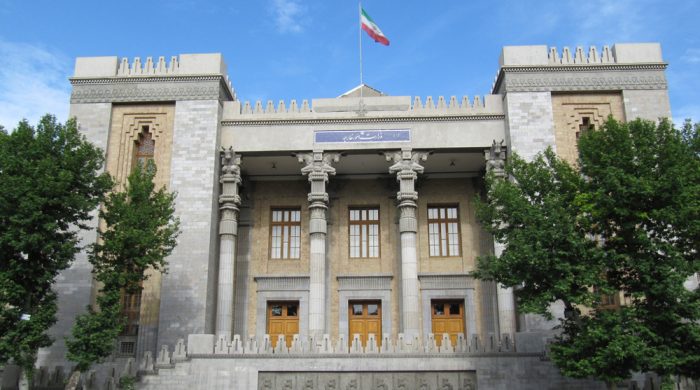
File photo of the building hosting Iran’s Foreign Ministry in the capital Tehran
Press TV – June 15, 2025
Iran’s foreign ministry has strongly condemned the Israeli military aggression on one of its buildings in the capital, Tehran, which left many people injured, including ministry staff.
Deputy Foreign Minister Saeed Khatibzadeh, in a statement on Sunday, denounced the assault as a “deliberate and ruthless” act perpetrated by the “criminal Israeli regime.”
“The casualties include a number of my colleagues, who were transferred to a hospital for treatment,” said Khatibzadeh, who also heads the ministry’s foreign policy think tank, Institute for Political and International Studies (IPIS).
Khatibzadeh described the incident as “yet another blatant war crime” and part of the Israeli regime’s “ongoing and systematic aggression” against the Islamic Republic.
His remarks come amid continued Israeli aggression on the Islamic Republic that began on Friday morning, targeting multiple locations across the country, including Tehran.
The brutal terrorist acts have resulted in the assassination of many senior military commanders, nuclear scientists, and civilians, including children and women.
In response, Iran launched Operation True Promise III, a continuation of its previous retaliatory campaigns against the Zionist entity.
The latest operation has involved large-scale missile and drone strikes by the Islamic Revolution Guards Corps (IRGC) targeting sites across the occupied Palestinian territories.
So far, Operation True Promise III has seen the IRGC carry out a series of coordinated missile and drone strikes against high-value strategic targets across the occupied territories, including deep strikes into Tel Aviv and the occupied port city of Haifa.
These precision strikes have targeted critical infrastructure, including airbases used by the regime to launch attacks against the Islamic Republic, command and intelligence centers, industrial complexes, and fighter jet production facilities.
A flood of videos circulating on social media shows Iranian ballistic missiles piercing through multiple layers of the regime’s air defense systems with remarkable effectiveness.
On Sunday, the IRGC vowed to sustain the strikes until the entity’s “complete destruction,” issuing a strongly worded statement directed at Tel Aviv’s steadfast Western allies.
Earlier on Sunday, foreign minister Abbas Araghchi said the US must accept its responsibility for Israel’s deadly aggression against the country, as evidence shows American forces helped the regime wage its terrorist assault on Iran.
“We have solid evidence indicating that American forces and bases in the region have supported the attacks by the Israeli regime’s military forces,” Araghchi told foreign envoys in Tehran on Sunday.
He emphasized that Iran’s response to Israeli aggression was based on the principle of self-defense in international relations and that every country has the legitimate right to defend itself against aggression.
Soumoud Convoy blocked in Libya en route to break Gaza blockade
Al Mayadeen | June 15, 2025
Pro-Palestinian activists, who were participating in a march aimed at breaking the Israeli blockade on Gaza, were forced to retreat to the Misrata region of western Libya after being blocked by the authorities in the country’s east, according to statements made by organizers on Sunday.
The “Soumoud” convoy, which had been stopped by the eastern authorities, decided to fall back to near Misrata, about 200 kilometres (124 miles) east of Tripoli. Misrata, which is under the control of the UN-recognized Government of National Unity based in Tripoli, stands in contrast to the eastern region of Libya, where military commander Khalifa Haftar holds authority.
The convoy, consisting of more than 1,000 people from Algeria, Morocco, Mauritania, and Tunisia, had faced a “military blockade” since Friday at the entrance to Sirte, a region under the control of Haftar.
Organizers reported that the convoy had been placed under what they described as a “systematic siege,” leaving them without access to food, water, or medicine while also facing severely disrupted communications.
The organizers also condemned the arrest of multiple convoy participants, among them at least three bloggers who had been recording the mission’s progress since it set out from Tunisia on June 9.
The Joint Action Coordination Committee for Palestine, the organizing body behind the convoy, called for the urgent release of 13 detained participants still in the custody of eastern Libyan authorities, according to a statement reported by Tunisia’s La Presse newspaper.
The group, in an accompanying video, reiterated its commitment to pushing forward with the mission toward Gaza’s Rafah border crossing with Egypt, emphasizing its goal of breaking the blockade and stopping what it described as the genocide of Palestinians resisting in Gaza.
Israeli Security Minister Israel Katz called on Egyptian authorities on June 11 to prevent the al-Soumoud convoy from reaching the Rafah border crossing, accusing the international pro-Palestine activists of being “jihadists” and warning that their presence could potentially endanger Israeli occupation forces as well as what he referred to as “regional stability.”
Katz argued that the convoy posed a threat to Israeli troops stationed near the border while also warning it could trigger unrest within Egypt and among what he described as “moderate” Arab governments in the region. He further warned that if Egyptian authorities failed to act, the Israeli occupation forces would take what they deemed “necessary measures” to stop the convoy’s advance toward Gaza.
The global march to Gaza: Indonesia and Egypt
By Dr. Muhammad Zulfikar Rakhmat | MEMO | June 15, 2025
This week, ten Indonesian citizens — among them celebrities like Wanda Hamidah, Zaskia Adya Mecca, and Ratna Galih — landed in Cairo, not for a political summit, but to join the Global March to Gaza. They came bearing no weapons, no agendas, only the unyielding conviction that humanity must speak where power has fallen silent. They came to walk.
Instead, they were watched. Monitored. Effectively detained. According to a statement posted by Abdul Somad — a widely respected Islamic preacher in Indonesia — these citizens have been placed under tight surveillance by Egyptian authorities and are unable to proceed to Rafah. Somad wrote on Instagram that their phones are monitored, their movements shadowed by police escorts, and their social media use could put them at risk of arrest.
These actions raise a chilling question — one that must be answered by both the Indonesian and Egyptian governments: why are peaceful humanitarian efforts being treated like criminal conspiracies?
The Global March to Gaza is not a political stunt. It is the latest chapter in a rising global outcry against the suffering in Palestine — a moral wave first stirred by the Madleen, a humanitarian ship that was blocked from reaching Gaza. When the ship was turned away by military force, its impact rippled across continents. From sea to desert, from ship to sandal, the world’s conscience now marches forward.
In the blazing heat of the Sinai, thousands are now walking toward Rafah — the last passage into besieged Gaza. They are not diplomats. They do not carry government mandates. They are nurses, retirees, students, and activists. They come not to protest a nation, but to protect a people.
Yet their steps are met not with open arms, but locked gates. Egypt has responded to the march with detentions, deportations, and in some cases, violence. Viral videos show activists — including Americans and Europeans — being harassed near Ismailia. An American woman was reportedly beaten and had her hijab ripped off. Irish parliamentarian Paul Murphy was detained and deported.
And Indonesia’s citizens — who have come to walk, not to wage war — are now stuck in limbo.
What makes this turn of events particularly disheartening is that just two months ago, Indonesian President Prabowo Subianto met with Egyptian President Abdel Fattah al-Sisi in Cairo to elevate the relationship between their nations to a strategic partnership. Palestine was central to their discussion. Both leaders publicly affirmed their shared commitment to support the Palestinian people and denounced Israeli aggression.
President Prabowo — leading a country whose constitution explicitly binds it to the fight against colonialism — made it clear that Indonesia sees the suffering of Palestinians as a global injustice. Al-Sisi, whose nation borders Gaza and has long served as mediator, underscored the need to halt the destruction and begin humanitarian recovery.
But if these two nations are so aligned in their support for Palestine, then why now are peaceful Indonesian citizens being surveilled, delayed, and blocked from expressing that very solidarity?
This is the question the Indonesian and Egyptian governments must answer — not just to the activists, but to their own people. Has diplomacy become so hollow that public support for Gaza is allowed only when convenient? Has humanitarianism been reduced to political theater?
Indonesia, in particular, must act. Its citizens are being obstructed for embodying values the nation claims to hold dear. It must demand their release and full freedom of movement. It must summon the Egyptian ambassador in Jakarta to account for these unjust actions. And it must raise this issue in international forums, including the Organisation of Islamic Cooperation (OIC), to call out all forms of obstruction — from Israel’s bombs to Egypt’s bureaucracy.
Rafah is more than a crossing — it is the fault line between moral paralysis and global awakening. The more it is locked, the louder the heartbeat of conscience becomes. The Global March is not simply a protest. It is a declaration that humanity will not look away.
From the Madleen at sea to the marchers on land, the message is the same: no power can suppress a movement carried by conviction. And no silence can erase the pain of Gaza.
Indonesia’s citizens are walking not just toward Gaza — but toward the soul of the nation’s foreign policy.
It is time their government walks with them.
Malaysia announces the “Fleet of a Thousand Ships” initiative to break the siege on Gaza
Palestinian Information Center – June 15, 2025
KUALA LUMPUR – Civil society organizations in Malaysia have unveiled a major international initiative—described as the largest of its kind—aimed at breaking the siege imposed on the Gaza Strip through a global maritime movement involving a thousand ships departing from multiple continents. The initiative is being hailed as an “uprising of human conscience” in support of Palestinians and a call to hold Israel accountable for its ongoing crimes.
This announcement was made during a press conference held in the capital, Kuala Lumpur, where Azmi Abdul Hamid, President of the Malaysian Consultative Council of Islamic Organizations (MAPIM), said that the initiative is a response to the escalating Israeli aggression and the genocidal crimes being committed against Gaza’s population. He emphasized that the project is gaining growing support from organizations across Europe, Asia, and Latin America.
Abdul Hamid noted that the recent seizure of the Madleen vessel by Israeli forces has helped refocus global attention on the humanitarian catastrophe in Gaza and has reignited solidarity movements around the world.
He added that the “Fleet of a Thousand Ships” would be broader and more coordinated than the 2010 “Freedom Flotilla,” which was led by the Mavi Marmara.
According to a joint statement signed by dozens of Malaysian institutions, the objectives of this maritime mission include: the immediate lifting of the siege, the delivery of humanitarian aid, the provision of international protection for Gaza’s residents, and the prosecution of Israeli leaders for war crimes.
The initiative also aims to pressure governments to take responsibility by ensuring protection for their citizens who join the mission—thereby increasing international pressure on Israel.
In a related development, Malaysian activists held a protest in front of the Malaysian Investment Development Authority, demanding an end to relations with companies supporting the Israeli occupation—most notably the American company Caterpillar, which is accused of supplying equipment used in demolitions and settlement construction. Protesters described ongoing cooperation with such companies as “complicity in genocide.”
MAPIM also announced concrete steps to expand the campaign, including the establishment of an international secretariat and a financial fund to support the logistical and technical preparations for launching the fleet. Open calls have been made to companies and individuals to contribute to the success of the initiative.
Observers anticipate that the “Fleet of a Thousand Ships” initiative will become a focal point of global attention—especially amid growing popular solidarity with Gaza and the failure of international institutions to stop Israeli aggression—underscoring the need for independent action by global civil society.
Australian writer deported by US over pro-Palestine blog posts

Al Mayadeen | June 15, 2025
The Guardian reported on Sunday that an Australian writer was detained and deported by US authorities upon arrival at Los Angeles International Airport, allegedly due to his public commentary on pro-Palestine campus protests.
Alistair Kitchen, a 33-year-old from Melbourne, had traveled to the US last Thursday intending to visit friends in New York. However, during a layover in Los Angeles, he was held by US Customs and Border Protection (CBP) for 12 hours, questioned extensively, and eventually placed on a flight back to Australia. He landed in Melbourne on Saturday.
Kitchen believes his treatment was politically motivated. “The CBP explicitly said to me, the reason you have been detained is because of your writing on the Columbia student protests,” he told The Guardian. He added that the interrogation included detailed inquiries into his opinions on the Palestinian conflict, including his “thoughts on Hamas”.
“It was quite an in-depth probing of my views on the war,” he said. “They asked me what I thought about the conflict in a very broad sense, about student protesters, what Israel should have done differently, and how I would resolve the conflict.”
Deported Dissent
Kitchen previously lived in New York for six years and was a master’s student at Columbia University. During that time, he wrote about the Gaza solidarity encampment and published articles on his blog, Kitchen Counter. One piece focused on Mahmoud Khalil, a lead negotiator of the Columbia encampment who had been detained by US authorities. In that article, Kitchen described Khalil’s arrest as one made “on utterly specious grounds by a neo-fascist state” aimed at “the deportation of dissent”.
He pointed to a Trump-era executive order issued on January 30 that promised to cancel the student visas of pro-Palestine activists and enforce “law and order” against campus protesters.
Kitchen said he had attempted to reduce the risk of being flagged by deleting some “sensitive political posts” and content from his blog and social media prior to his trip. But he believes US authorities had already connected his ESTA application to his writings using digital surveillance tools.
“Clearly, they had technology in their system which linked those posts to my Esta … a long time before I took them down,” he said. “Because they knew all about the posts, and then interrogated me about the posts once I was there.”
Border Reprisal
According to Kitchen, he was called by name shortly after deplaning and taken for secondary processing. During questioning, he said he gave officers access to his phone, something he now regrets. “I had at that time, the wrong and false hope that once they realised I was, you know, just an Australian writer and not a threat to the US, that they would let me in,” he said. “But then they took my phone away and began downloading it and searching it.”
Kitchen said he felt “terrified of retribution and reprisal from the US government” for sharing his experience publicly, but believed it important to raise awareness. He encouraged other Australians facing similar treatment to avoid giving border agents access to their devices and to accept deportation immediately instead.
He has since restored the previously removed blog posts.
During his deportation, Kitchen said his phone and passport were handed over to a Qantas flight attendant, and he was unable to access them until arriving back in Melbourne. Qantas confirmed to The Guardian that its crew received a sealed envelope from US customs containing the passenger’s belongings, which were returned upon arrival. The airline declined further comment.
‘Leave to save your lives’: Iran’s armed forces warn Israeli settlers in occupied territories
Press TV – June 15, 2025
The Iranian armed forces have issued a stern warning to Israeli settlers in the occupied territories, urging them to evacuate immediately as Iran prepares to launch widespread strikes across the entire occupied land.
In a televised message on Sunday, Colonel Reza Sayyad, spokesperson for Iran’s Armed Forces Communications Center, warned settlers that remaining in the area would place their lives in grave danger, as Iran prepares for a “crushing” retaliation to recent Israeli military aggression.
“Leave the occupied territories. Leaving this occupied land is the only way to preserve your lives,” Colonel Sayyad said in the video statement, slamming the “Zionist regime” for criminal aggression against the Islamic Republic.
Sayyad condemned Prime Minister Benjamin Netanyahu’s regime as “desperate, corrupt, and criminal,” saying that its latest military aggression was “doomed”.
He warned that Iran’s response would extend across all parts of the occupied territories.
The Iranian military, Sayyad said, possesses a “comprehensive bank of intelligence” on sensitive targets within Israeli-controlled areas, warning settlers to avoid these locations and noting that even underground shelters would not guarantee their safety.
He said the Israeli regime was using settlers as human shields, adding that the regime’s actions—motivated by political and personal interests—are driving the region into a deeper crisis.
“The criminal Zionist regime, especially its criminal prime minister, has begun a crime for his and his family’s personal gain—a crime that will end in nothing but defeat and regret.”
He added that ignoring Iran’s warnings would lead to “even more difficult days” for those who remain in the occupied territories.
Sayyad’s comments followed a new wave of missile and drone strikes launched by the Islamic Revolution Guards Corps (IRGC) on Sunday afternoon as part of Operation True Promise III.
The strikes caused large explosions in the Upper and Lower Galilee, Haifa, Afula, and Nazareth.
The operation is a direct response to the Israeli aggression against Iran on Friday morning, which resulted in the assassination of senior military commanders, nuclear scientists, and civilians, including women and children.
Iran preparing to ‘shut down Israel’s war machine’
RT | June 15, 2025
Tehran is gearing up to decisively counter Israel’s military operations, and intends to “shut down the regime’s war machine,” a senior Iranian security official told RT exclusively on Sunday.
Israel and Iran have been engaged in a fierce exchange of fire for three consecutive days. According to Israel’s emergency service Magen David Adom, Iranian strikes have killed at least ten people, bringing the total death toll to 13. In Iran, Israeli strikes have caused at least 406 deaths and 654 injuries, according to the group Human Rights Activists. The Iranian government has not released official casualty figures yet.
”Iran has been preparing for a long war,” the official told RT, emphasizing the country’s resolve to confront Israel. According to the source, millions of Iranians rallied in the streets on Saturday, defying West Jerusalem’s attacks, and demanding retribution. “This is an important support for Iran to continue its actions with force,” the official added.
The official outlined Iran’s extensive list of potential targets within “occupied territories,” which include covert residences of Israeli government leaders, energy facilities, factories supplying military aircraft, and critical command-and-control infrastructure.
Iran’s paramilitary Revolutionary Guard said that the country’s missiles had targeted fuel production facilities for Israeli fighter jets, a claim not acknowledged by Israel.
World leaders urgently called for de-escalation in order to prevent an all-out war. Russian President Vladimir Putin had condemned Israel’s strikes on Iran and expressed concern over further escalation. In a phone call with US President Donald Trump on Saturday, Putin reiterated Moscow’s willingness to facilitate negotiations.
Oman-mediated nuclear talks between Tehran and Washington were scheduled for Sunday; however, they were canceled following Israel’s strikes. Trump did not rule out the possibility of continuing the negotiations, saying, “They’d like to make a deal. They’re talking.”
Trump ‘open’ to Putin as Iran-Israel mediator
RT | June 15, 2025
US President Donald Trump said on Sunday he is open to Russian President Vladimir Putin serving as a mediator in the Israel-Iran conflict. In an hour-long phone call the previous day, the two leaders focused on the Middle East crisis.
“Yeah, I would be open to it. He is ready. He called me about it,” Trump responded to ABC News’ Rachel Scott, when asked about Putin’s potential role in brokering peace.
“We had a long talk about it. We talked about this more than his situation. This is something I believe is going to get resolved,” Trump added.
After the phone call the Kremlin later said that Putin had condemned Israel’s strikes on Iran and expressed concern over further escalation, while reiterating Russia’s willingness to facilitate negotiations.
Putin recalled that Moscow had previously proposed concrete measures to facilitate “mutually acceptable agreements” in US-Iran nuclear negotiations before the current escalation, presidential aide Yuri Ushakov revealed.
“Russia’s principled position and commitment to resolving this issue remain unchanged,” Ushakov stated. “As President Putin emphasized, we will continue to act accordingly.”
Despite the cancellation of Oman-mediated nuclear negotiations between Tehran and Washington following Israel’s strikes, Trump maintained that discussions continued. “They’d like to make a deal. They’re talking,” he said, suggesting the escalation might actually accelerate diplomacy.
When asked about possible American engagement in the conflict, Trump stated: “We’re not involved in it. It’s possible we could get involved. But we are not at this moment involved.”
The conflict in the Middle East escalated on June 12 when Israel struck Iranian nuclear sites, killing senior military officials and prompting retaliatory missile barrages from Tehran. Both sides have exchanged fire for a third straight day.
Israeli strike on Natanz nuclear facility ‘crime against international law, NPT’: Iran FM
Press TV – June 15, 2025
Iranian Foreign Minister Abbas Araghchi says the Israeli strikes on the Islamic Republic’s Natanz nuclear facility were a major crime under international law and the Non-Proliferation Treaty (NPT).
In a phone conversation with Spain’s Foreign Minister José Manuel Albares Bueno on Sunday, Araghchi once again asserted the peaceful nature of Iran’s nuclear program.
“The attack on the peaceful nuclear facilities of a country is absolutely prohibited, especially considering that Iran’s nuclear program is subject to the most stringent supervision (of the UN nuclear agency) and has been verified as per Resolution 2231 of the Security Council,” he said.
Iran expects that all countries and the International Atomic Energy Agency (IAEA) would condemn the Israeli aggression in the strongest terms, he added.
The Israeli regime, backed by the United States, carried out a large-scale military aggression on multiple locations inside Iran early on Friday, targeting nuclear facilities, military infrastructure, and residential buildings in Tehran and other cities.
The Natanz nuclear facility near Isfahan city was also hit, although only surface damage was caused because the centrifuges are buried deep underground. There were no radiation or casualties.
The Iranian foreign minister said the Israeli regime flagrantly violated the principles of the United Nations Charter and international law by conducting its acts of aggression in the midst of indirect nuclear talks between Iran and the United States.
Araghchi added that the Tel Aviv regime violated Iran’s sovereignty and territorial integrity by attacking nuclear facilities and residential areas inside the country just two days before the sixth round of Tehran-Washington talks in the Omani capital of Muscat.
“It is clear that the main objective of this act of aggression was to have a destructive impact on the diplomatic processes and to drag others into an unjust war,” the top Iranian diplomat emphasized.
Pointing to Israel’s record of attacks on residential areas and its killing of a large number of innocent women and children, he said, “Defense is the response to the aggression.”
Araghchi emphasized that the Iranian Armed Forces would strongly proceed with their “completely calculated defensive operation” to protect national sovereignty, territorial integrity, and civilians.
The Spanish foreign minister, for his part, expressed concern over the escalation of tensions in the region and voiced his country’s readiness to help ease the tensions.
Seven Lies about Israel’s Attack on Iran
By Harrison Mann – Zeteo – June 14, 2025
“The first casualty of war is truth” is such a tired cliché – and one so self-evident to anyone who served in the US intelligence community – that I only dare to put it in writing because this week the lies literally did start flying before the bombs Israel dropped on Iran, in what we can now safely call the start of a full-scale war. If we want any hope of interrupting a disastrous cycle of escalation, we need to intercept the volley of lies that have already been launched out of Tel Aviv and Washington.
1. Iran was on the verge of developing a nuclear weapon
Before, during, and after the first wave of Israeli airstrikes on Iran’s nuclear facilities and military and nuclear leadership, Israeli Prime Minister Benjamin Netanyahu claimed Iran was about to produce nuclear bombs – which he’s been warning since the 90s. Setting aside the Iranian government’s own denial that it was pursuing nuclear weapons – Supreme Leader Ayatollah Ali Khamenei suspended Iran’s nuclear program in 2003 – both the International Atomic Energy Association and Trump’s Director of National Intelligence Tulsi Gabbard have affirmed earlier this year that Iran was not trying to build a nuclear weapon.
2. Israel’s attack on Iran was a preemptive strike required for self-defense
Israeli Defense Minister Israel Katz called the strikes “preemptive.” To preempt what? Preparations for a large-scale military operation are very hard to hide, whether it’s Russia invading Ukraine, Israel bombing Iran, or a supposed Iranian offensive against the state of Israel. Had the Iranian military – which is monitored obsessively by multiple US intelligence agencies – actually been staging for an attack on Israel, the Trump administration would be well aware and offering much more muscular support than it has so far. If Thursday’s strikes were to preempt anything, it was progress on the US-Iran nuclear talks that the Iranian government (if not our own) appeared to be pursuing in good faith.
3. Israeli military operations will prevent Iran from developing a nuclear weapon
This is really two fallacies in one. First, a bombing campaign simply cannot reliably destroy a nuclear program composed of dispersed personnel (even though Israel has been able to assassinate some of them) and deep subterranean facilities whose conditions are difficult to verify from afar. As Israel’s National Security Adviser Tzachi Hanegbi acknowledged Friday, destroying the program “cannot be done via kinetic means,” a conclusion consistent with my experience in the US intelligence community. The only way to dismantle Iran’s nuclear program with certainty is to have the Iranian government do it voluntarily, or through a ground invasion that would be needed to enter facilities by force.
This leads us to the second fallacy: That the purpose of Israel’s offensive is to dismantle the nuclear program. Knowing that airstrikes and covert operations can’t actually destroy Iran’s nuclear research and uranium enrichment capabilities, what does Netanyahu hope to achieve with his newest war? “Striking Iran’s nuclear program, striking its ballistic missile capabilities; attacking its capacity to destroy Israel via a ground attack,” Israeli media wrote, citing Tzachi Hanegbi. In other words, total pacification or de facto regime change, which is what the Israeli government has already demanded – and more or less helped achieve – in Lebanon and Syria over the past year. Given the strength and scale of the Iranian state, the only way Israel could realistically achieve this is through the US military.
4. The United States is not responsible for Israel’s attack
Shortly after Israel’s first strikes, Secretary of State Marco Rubio released a statement declaring, “We are not involved in strikes against Iran,” in an apparent attempt to distance the United States from the bombing and discourage reprisals from Iran against US troops in the region. He was quickly overruled by Trump, who cheered on the attacks and claimed he had full advance knowledge. No matter who knew what, and whether Trump explicitly gave Netanyahu a “green light” for the strikes, the United States literally fuels the Israeli war machine – the planes bombing Tehran this week use American jet fuel – and provides the munitions, repair parts, and other supplies needed to keep the Israeli military running day-to-day. Without that support – or without the hundreds of US troops manning air defense batteries in Israel right now – Israel would be unable to launch attacks in the region with impunity.
5. The attack will bring Iran to the table for a nuclear deal
Whether or not Trump actually believes in his post-strike appeal that “Iran must make a deal, before there is nothing left,” reaching an agreement gets exponentially harder to do when Israel assassinates a top adviser on Iran’s nuclear negotiations. And the fact that Trump let Israel launch a massive attack while Washington and Tehran were in the middle of nuclear negotiations will prove to Tehran that it has nothing to gain from further talks. Plus, Netanyahu’s pledge for a long war against Iran means Tehran increasingly has little to lose by sprinting for a nuclear weapon.
6. Attacking the Iranian government will lead to a coup
Washington proponents of regime change in Iran have long hoped that weakening Iran’s rulers – whether through sanctions or now, a military blitz – would inspire Iranian people to rise up against their government. After this week’s attacks, this expectation has even less basis in reality than usual. However unpopular Khamenei may be in some sectors of Iranian society, he is not the one striking apartment buildings in Tehran.
7. Israel can “drag” the United States into a war against Iran*
Both opponents and supporters of war with Iran understand that Netanyahu needs the United States military to do most of the fighting and worry – or hope – that he will “drag” the US into a new conflict. But no matter what Israel does – and even no matter what Iran does – an American war on Iran remains a war of choice. If the Trump administration bombs or invades Iran, it’s because they wanted to, not because Netanyahu somehow forced them.
Given the disastrous regional consequences, which would likely dwarf the fallout from the 2003 invasion of Iraq, we should be clear that agency lies in Washington and nowhere else.
* ISRAEL – PALESTINE NEWS NOTES: Israel may not be able to drag the US into a war with Iran – but the Israel lobby can use its almost unlimited power to do almost anything.]
Harrison Mann is a former US Army major and executive officer of the Defense Intelligence Agency’s Middle East/Africa Regional Center who resigned in protest of his office’s support for Israel’s war in Gaza under the Biden administration. He is currently with Win Without War.
Europe’s Perverted Logic: Israel Has the ‘Right’ to Attack, Iran Is ‘Guilty’ for Defending Itself
By Ekaterina Blinova – Sputnik – 15.06.2025
European leaders have effectively blamed Iran for being attacked, Responsible Statecraft reports.
Israel’s strike violated Article 2(4) of the UN Charter — it was launched with no legal basis for self-defense, per Responsible Statecraft.
But instead of condemning it, Europe parroted Israeli justifications.
The claim that Iran is building nuclear weapons was dismissed by US intelligence chief Tulsi Gabbard in March: “Iran is not building a nuclear weapon.”
Still, EU leaders leaned on a June 12 IAEA resolution accusing Iran of Non-Proliferation Treaty violations to rationalize Israel’s actions.
What Do European Leaders Say?
French President Emmanuel Macron: “France has repeatedly condemned Iran’s ongoing nuclear program… In this context, France reaffirms Israel’s right to defend itself and ensure its security.”
German Chancellor Friedrich Merz: “[Iran’s] nuclear program violates the provisions of the Nuclear Non-Proliferation Treaty… We reaffirm that Israel has the right to defend its existence and the security of its citizens.”
EC President Ursula von der Leyen: “I reiterated Israel’s right to defend itself and protect its people.”
None of these leaders addressed the legality of Israel’s initial strike. None acknowledged Iran’s right to defend its own sovereignty.
US complicit in Israeli attacks, must be held accountable: Araghchi
Press TV – June 15, 2025
The Iranian foreign minister says the United States must accept its responsibility for Israel’s deadly aggression against the country as multiple evidence shows American forces helped the regime wage its terrorist assault.
“We have solid evidence indicating that American forces and bases in the region have supported the attacks by the Israeli regime’s military forces,” Abbas Araghchi told foreign envoys in Tehran on Sunday.
He also referred to remarks by US President Donald Trump, who said the Israeli strikes were not possible without American equipment and that more raids were on the agenda.
“Therefore, in our view, the US is a partner in these attacks and it must accept its responsibility. Of course, we have focused on targets inside the Zionist regime in response to the attacks,” Araghchi added.
The Israeli aggression against Iran could not have occurred without the agreement and support of the United States, he said.
Meanwhile, the top Iranian diplomat said that Israel had “crossed a new red line” in international law by targeting Iran’s nuclear facilities.
Unfortunately, he noted, the serious Israeli violation was met with “indifference” at the United Nations Security Council.
Araghchi further emphasized that Iran’s response to Israeli attacks was based on the principle of self-defense in international relations and that every country has the legitimate right to defend itself against aggression.
He also said that the International Atomic Energy Agency’s (IAEA) Board of Governors will on Monday hold an emergency meeting on the Israeli attack on the Natanz nuclear site, expressing hope that it will condemn the raid as a flagrant violation of international law.
Additionally, the foreign minister stressed that Iran does not want the war with Israel to expand to other countries or the region “unless it’s imposed on us.”
“Basically, we did not initiate this war and we were pursuing diplomacy regarding our nuclear program, but this aggression was imposed on us. We are defending ourselves and this defense is completely legitimate,” he said. “Therefore, if the aggression stops, our reactions will naturally stop as well,” he said.
Also in his remarks, Araghchi highlighted Iran-US indirect nuclear talks and Israel’s disruption of the diplomatic process.
“It is absolutely clear that the Israeli regime does not want any agreement on the nuclear issue… The aggression against Iran amid nuclear talks demonstrates that the Israeli regime is opposed to any form of negotiation,” he pointed out.
The US government should condemn Israeli strikes on Iranian nuclear sites if Washington wants to prove its goodwill and distance itself from the conflict, he concluded.
Featured Video

Yemen joins the war – Red Sea could be blocked next – Saudi regime at risk
or go to
Aletho News Archives – Video-Images
From the Archives
A superpower and “the world’s sickest warrior state”
By Paul J. Balles | March 8, 2010
Living through five or six major wars has hardened me to what I thought were the extremes of inhuman cruelty and brutality.
Two things made those extremes almost bearable: the brutality always revealed – at least according to the media coverage – the viciousness of the enemy. It was therefore quite understandable when our “brave men and women” pulverized the enemy.
Films of Japanese torturing captive Americans somehow justified holding Japanese Americans in internment camps during World War II; and only a small percentage of Americans found the bombing of Hiroshima and Nagasaki unreasonably vengeful at best, at worst, depraved.
The media giants in America portrayed the North Koreans as barbaric beasts with their captives, quite unlike their southern counterpoints – our allies during the Korean War. No one ever felt the need to explain how the South Koreans were a civilized breed while the North Koreans were absolute savages, at least according to the official line.
In Vietnam, our warriors justifiably (or so the media made us believe) dropped napalm on the North Vietnamese who had the gall to hide in villages and tunnels to ravage our invaders. At least it was accepted practice until some rogue photojournalist filmed a young girl screaming down a Vietnamese road in flames. … continue
Blog Roll
 Aletho News
- America Racing to Strategic Defeat in Iran: Lt Col Daniel Davis
- FTC Warns Visa, Mastercard, PayPal, Stripe Over Political Debanking
- Russian tanker approaches Cuba despite US oil blockade
- Marandi: Yemen joins the war – Red Sea could be blocked next – Saudi regime at risk
- Pro-Palestinian French member of European Parliament denied entry to Canada
- Pakistan to Host US-Iran Talks
- How Indonesia’s tilt toward the US left it stranded in the Strait of Hormuz
- US has no choice but to retreat from Iranian borders: Top commander
- Iran Retaliation Strikes Chemical Plant Near Dimona
- AWACS’ Destruction is a Major Loss for US Military – Ex-DoW Analyst
- If Americans Knew
- Israeli police block Catholic cardinal from entering Church of the Holy Sepulchre on Palm Sunday
- Israel is assassinating journalists again, more than any other nation, anywhere, ever – Not a ceasefire Day 170
- Over 300 US service members wounded, majority have brain injuries – Not a ceasefire Day 169
- Researchers at Human Rights Watch Resign Over Blocked Report on Palestinian Refugee Return
- Jewish Groups Are Backing a War Americans Don’t Want
- Eric Fingerhut Thinks He’s the President of the Jews
- Top Jewish Philanthropists, Rabbis Urge Israeli President to Take Action Against ‘Jewish Extremists’
- Don’t Be Fooled. Zionist Leaders Have Always Wanted to Control Southern Lebanon
- Israel’s widespread use of torture is a core element of its genocide against the Palestinian people
- In Israel’s War on Iran, Many Middle East US Bases Rendered “All But Uninhabitable”
- No Tricks Zone
- New Study Finds Warming Saves Lives…Cold Temperatures 12 Times More Deadly Than Excess Heat
- German Science Blog Accuses PIK Climate Institute Of Hallucinating Climate Tipping Points
- Devastating Assessment Of Comirnaty Vaccine By Former Senior Pfizer Europe Toxicologist
- New Study: CO2 Is ‘Effectively Negligible’ As An Explanatory Climate Change Factor Since 2000
- Former Pfizer Toxicologist Dr. Helmut Sterz Tells Bundestag Hearing Pfizer Vaccine Should Have Never Been Approved
- Energy Expert: Germany’s Nuclear Phaseout Was A “500 Billion Euro Mistake”
- New Research: South Australia’s Mid-Holocene Sea Surface Temperatures Were 4°C Warmer Than Today
- Storing Green Energy To Last Germany 10 Days Would Require A 60-Million Tonne Battery
- New Studies: UK Sea Levels Were 4 Meters Higher Than Today During The Mid-Holocene
- Destructive Green New Deal: German Energy And Metal Group Warns Of Drastic Crisis
 Aletho News