The rise of Abu Shabab: Mapping the Gaza militia armed by Israel
By Muhammad Shehada | The New Arab | June 10, 2025
A political earthquake hit Israel last week when former Defence Minister Avigdor Liberman revealed that “the Israeli government is giving weapons to a group of criminals and felons, identified with Islamic State [in Gaza], at the direction of the prime minister”.
Netanyahu has since admitted that Israel had been “running” proxy militias in Gaza, but tried to put a positive spin on it, claiming that such a move aims to challenge Hamas’s rule.
But branding these gangs as potential rivals to Hamas masks the very goal of why Israel created them in the first place. Around 300 untrained thieves, drug dealers, criminals, and convicted murderers cannot overpower Hamas’s estimated 30,000 militants.
Their actual role has more to do with advancing Israel’s genocide, starvation, and ethnic cleansing in Gaza while creating plausible deniability.
Furthermore, recent evidence indicates that Israel may have been collaborating with some of these Islamic State-linked elements even before 7 October.
Abu Shabab: A front for an Israeli proxy?
The most prominent gang leader in Gaza is Yasser Abu Shabab. His name first appeared in August 2024 on Hamas-linked social media groups as the figure responsible for looting the vast majority of humanitarian aid and reselling it on the black market for astronomical prices.
A senior security source told The New Arab that Abu Shabab’s gang had been active for months before then.
Local authorities knew Abu Shabab well. He was serving a long sentence in prison for the possession of large quantities of drugs, according to three knowledgeable sources. He was one of many inmates who escaped under the cover of Israel’s war on Gaza in October 2023.
Some other inmates were released on parole when Israel began bombing government facilities. Israeli newspapers like Maariv and Yediot Ahronot confirmed Abu Shabab’s criminal history through people close to him, and even added that he had links to the Islamic State (IS) through smuggling drugs from Sinai into Gaza.
Police in Gaza were perplexed when he emerged as a top gang leader. The security source told The New Arab that Abu Shabab is 35 years old, thin, weak, short (around 150cm in height), uncharismatic, illiterate, has strabismus in one eye, and has never received military training.
To them, he didn’t seem like someone with the leadership skills necessary to form a group of 300 armed militants, steal truckloads of aid, and store it under the radar.
Local authorities quickly decided that Abu Shabab was merely a front for an Israeli astroturfing campaign to maintain its policy of starvation in Gaza after the international community pressured Netanyahu to ease his total siege and allow a trickle of aid into the enclave.
What made this clear, according to them, is how Israeli drones bombed emergency committee volunteers or police officers every time they came close to thwarting a looting attempt by that gang in particular.
By late September 2024, Abu Shabab was talked about in Gaza as an Israeli-backed collaborator, not just a gang leader. That is when Hamas militants attempted to ambush him, firing around 90 bullets at a vehicle they thought belonged to Abu Shabab.
The vehicle, however, was identical to the one used by Islam Hijazi, the program officer of a US charity called Heal Palestine. She was tragically killed in the incident.
Two months later, Abu Shabab received widespread media attention after he burned a fuel truck and completely shut down the route used by aid convoys to retaliate against another Hamas ambush that killed his brother Fathi and 21 other members of his gang.
Soon after, the Washington Post revealed that the UN had named Abu Shabab in an internal memo as the main figure behind aid looting under “passive or active IDF protection”. This left little room for doubt that Abu Shabab’s gang was a tool for Israel to maintain starvation while externalising blame.
Mapping gang leaders: IS, ex-PA intel officers, and murderers
Abu Shabab’s deputy is thought to be Ghassan al-Dahini, 38, reportedly a former lieutenant in the Palestinian Authority (PA). Dahini is the one running the gang’s operations on the ground and actively trying to recruit new members, along with Saddam Abu Zakkar, per local authorities. His Facebook profile displays Israeli hostage emojis.
Another senior Palestinian security source told The New Arab that Dahini was a member of the “Army of Islam”, the extremist group responsible for kidnapping journalist Alan Johnston in 2007.
The group pledged allegiance to IS in 2015. Ghassan’s brother, Mohammed, died in prison after he was detained on drug-related offences, and Ghassan himself was imprisoned twice in March 2020 and November 2022, per the source. He added that “the Army of Islam relied on Dahini for the Sinai smuggling routes”.
On Sunday, Dahini posted a video of himself in military gear in Eastern Rafah close to Israel’s perimeter fence. He was standing next to a white pickup truck with a UAE license plate from Sharjah and firing a brand-new Serbian Zastava rifle.
Another prominent gang leader in Rafah is Shadi Soufi, a convicted murderer who was awaiting a death sentence before 7 October for killing a Popular Front for the Liberation of Palestine (PFLP) leader. Like Yasser, he also escaped prison during the war and was named by humanitarian organisations as responsible for looting aid under Israeli protection in Rafah.
Soufi, al-Dahini, and Abu Shabab are from the same Bedouin Tarabin clan that stretches across Rafah, Israel’s Negev desert, Egypt’s Sinai, and Jordan. Abu Shabab’s family recently disowned him for collaborating with Israel and said they will go after him to hold him accountable.
Another prominent leader of the Abu Shabab gang is Essam Soliman Nabahin, 35, a convicted murderer and IS member. He was implicated in a series of bombings against Hamas in 2015 by extremist Salafist groups and escaped to Sinai to formally join IS’s ranks. He caught the attention of Egyptian media in 2017 after taking part in attacks against the Egyptian army.
Nabahin’s name resurfaced in June 2023 when the police raided a house in central Gaza where he was hiding. He killed a police officer and was convicted in a military court before his escape in the early days of the war.
Israel says Nabahin was previously “recorded launching rockets into Israel without coordination with Hamas”.
Local authorities in Gaza have long suspected that IS-linked individuals like Nabahin were being pushed by Israel’s Shin Bet to fire one or two primitive projectiles sporadically to give Israel a pretext to strike Gaza and bomb specific targets. Hence, the police detained those militants repeatedly.
A senior Palestinian security source told The New Arab that authorities in Gaza caught a collaborator in 2018 who directed such occasional rocket attacks to give Israel cover for military action in Gaza.
Other members of the gang include multiple known drug dealers and convicted murderers.
How is Israel helping them?
Israel’s government has admitted it provided weapons to these gangs, mostly rifles and other light weaponry, in addition to money and equipment. Footage posted by Abu Shabab’s gang showed them driving in white pickup trucks with machineguns on top that looked virtually identical to those of Hamas.
In addition, Israel provides these gangs with safe refuge in areas fully depopulated by the Israeli military, like Rafah, and declared “extermination zones”, where any Palestinian entering would be killed on the spot. They are also provided with logistical support, protection, and even access to Israeli territory.
A Palestinian journalist documented one case of a gang member crossing into Israel, which could explain how those gangs disappeared completely during the ceasefire last January.
On the ground, the Abu Shabab gang has established warehouses operated with forklifts where they store looted aid. They have also established a military complex, according to the UN, which said the Israeli army would force aid convoys to drive through the areas where the gangs had positioned their militants and put up checkpoints to loot trucks.
And where the Israeli military goes, so do the gangs. After Israel issued forcible expulsion orders for Khan Younis and raided the European hospital and its surrounding area, Abu Shabab moved into the ‘Jarghoun’ villa in that very same area, per security sources.
On Tuesday, Israeli news channel i24 reported that Israel had launched airstrikes to protect the gang after it was attacked by Hamas militants in southern Gaza. The strikes killed four Hamas members.
What role do the gangs play on Israel’s behalf?
The Israeli-backed gangs in Gaza have become an unofficial arm of the Israeli military. For instance, whenever Israel gets pressured to allow food into Gaza, it immediately unleashes the gangs to maintain their use of starvation as a weapon of war, while blaming it on Hamas.
Experts believe Israel is using starvation as a tool for genocide by imposing conditions on a group “calculated to bring about its physical destruction in whole or in part”. Prolonged starvation inflicts permanent mental and physical damage, particularly on children.
Israel has also been using these gangs to orchestrate chaos and engineer societal collapse through attacks on markets, shops, private businesses, homes, warehouses, soup kitchens, and other places vital to maintaining the population’s survival.
For instance, in early May 2025, a gang attacked a communal kitchen in Gaza. As soon as volunteers arrived to stop the looting, Israel bombed it and killed six volunteers, which implies it was a coordinated attack.
The Israeli army also sends the gangs on reconnaissance and surveillance missions in dangerous areas. Last month, Hamas released footage of an ambush it carried out against armed men in Rafah whom it thought were undercover Israeli troops. They turned out to be Abu Shabab militants.
Israel also uses the gangs to infiltrate Palestinian society and gather intelligence, as well as to kidnap and interrogate Palestinians by luring them with the promise of food, as documented by Palestinian journalist Younis Tirawi.
Israel is using proxy gangs for the final phase of the war
The most concerning use of these gangs, however, is Israel’s recently announced plan to push Gazans into camps in Rafah on Egypt’s borders to depopulate and destroy “everything that remains” of the rest of the enclave. This is a precursor to Israel’s declared goal of the mass expulsion of Palestinians into Egypt and other countries.
The Abu Shabab gang recently announced establishing an encampment area in eastern Rafah near the Egyptian borders and is using the very aid they have been systematically looting to lure starved Gazans into moving there.
This announcement was preceded by a clear rebranding psyop, where the same gang responsible for looting aid suddenly and shamelessly declared itself as a new “security force” that aims to “protect aid from looting”. They have since emerged in brand-new military and police uniforms in the Israeli-designated buffer zone in Rafah, where no Palestinians are allowed to enter.
Remarkably, Israel has allowed these gang members to wear Palestinian flags and insignia on their uniforms, while at the same time refusing to let the Palestinian Authority’s staff at the Rafah border crossing wear any such symbols.
In other words, Israel is using these gangs as a front. The Israeli army knows that if it orders Gazans to come to camps in eastern Rafah, people will immediately know it’s a trap for mass expulsion. But if a uniformed Palestinian force with good PR on social media makes such a demand, some people might fall for the trap.
Israel has used this same proxy tactic in Lebanon against Palestinians in 1982, where the Israeli military bolstered the South Lebanon Army (SLA) and used it and other militias to commit the Sabra and Shatila massacre, which saw 3,500 Palestinians killed.
Those collaborators collapsed after the Israeli army’s withdrawal from Southern Lebanon, as their leaders surrendered or fled to Israel. The same fate awaits these new Israeli-backed gangs once the Gaza genocide comes to an end.
Muhammad Shehada is a Palestinian writer and analyst from Gaza and the EU Affairs Manager at Euro-Med Human Rights Monitor.
Follow him on Twitter: @muhammadshehad2
Israel risking ‘nuclear catastrophe’ – Moscow
RT | June 17, 2025
Israel’s ongoing strikes against Iran’s nuclear facilities pose unacceptable threats to international security and risk plunging the world into a catastrophe, Russia’s Foreign Ministry has said.
Israel began bombing Iran on Friday, claiming Tehran is nearing the completion of a nuclear bomb. Iran has dismissed the accusations as groundless and retaliated to the Israeli military operation with waves of drone and missile strikes.
“The ongoing intensive attacks by the Israeli side on peaceful nuclear facilities in Iran are illegal from the point of view of international law, create unacceptable threats to international security and push the world towards a nuclear catastrophe,” the Russian Foreign Ministry said in a statement published on Tuesday.
The conflict’s escalation risks the further destabilization of the entire region, the ministry added, urging the Israeli leadership to “come to its senses and immediately stop raids on nuclear installations.”
The harsh reaction to Israel’s attack on Iran from most of the international community illustrates that the Jewish state is only supported by countries acting as its “accomplices,” the Russian Foreign Ministry said.
Israel’s backers pressured the International Atomic Energy Agency (IAEA) board to push through last week’s “biased anti-Iranian resolution” on Tehran’s nuclear program, which “gave West Jerusalem a free hand, and led to this tragedy,” according to the ministry.
Officials admit: US assets were used to intercept Iranian missiles
Al Mayadeen | June 17, 2025
US naval ships and ground-based air-defense systems have indeed intercepted Iranian missiles aimed at “Israel”, two US officials confirmed to NBC News.
They claimed, however, that the total number of these interceptions remains relatively low.
According to the Associated Press, American air defense systems and a Navy destroyer actively helped “shoot down incoming ballistic missiles” from Iran during a barrage aimed at “Israel” last Friday.
American defense assets, including Patriot and THAAD batteries, drove off several projectile waves, according to multiple US sources.
Additional US Navy destroyers, notably the USS Thomas Hudner, alongside the USS Arleigh Burke and USS The Sullivans, have been deployed to the eastern Mediterranean to reinforce interceptions of Iranian ballistic missiles.
Why the Israel-Iran war may not go according to Netanyahu’s plan
By Vitaly Ryumshin | Gazeta | June 17, 2025
There are no quiet days in the Middle East. Armed conflict is a constant presence, but this time the stakes are higher. Israel has found itself in direct confrontation not with a proxy or insurgent group, but with Iran – its principal geopolitical adversary and a likely future nuclear power.
Strictly speaking, the Israel-Iran war did not begin on June 13. The two countries exchanged direct strikes as far back as April 2024. For decades before that, they waged what is commonly known as a “shadow war,” primarily through intelligence operations, cyberattacks, and support for regional proxies. But now, at Israel’s initiative, the conflict has escalated into open warfare.
Unlike the largely symbolic strikes of the past, this new phase targets strategic infrastructure, decision-making centers, and even cities. The tempo and scale of the exchanges mark a sharp escalation. With every new volley, the flywheel of war spins faster.
Still, this will not resemble the Ukrainian conflict. Iran and Israel do not share a border, so ground operations are unlikely. What we are witnessing is an air war – a remote conflict defined by long-range strikes and missile exchanges. The side that exhausts its military and political capital first will be the one that loses. Victory here is less about territory than stamina and strategic patience.
Who is likely to break first remains uncertain. Iran has the largest missile arsenal in the Middle East. Israel, however, enjoys unwavering US support. Prime Minister Benjamin Netanyahu appears to believe that sustained pressure will destabilize what he calls the “ayatollah regime,” forcing it to collapse under external and internal strain.
But Netanyahu himself is politically vulnerable. His government has been marred by scandals and internal dissent. A prolonged and inconclusive conflict could easily threaten the survival of his cabinet.
The ideal outcome for Israel would be a swift, decisive campaign, similar to its past clashes with Hezbollah. In those instances, air superiority and rapid operations forced the enemy into submission. Statements from Israeli officials suggest that this remains the objective: a two-week operation designed to cripple Iran’s offensive capabilities.
However, there is one crucial difference: Iran is not Hezbollah. Tehran may have stumbled on June 13, but it possesses vastly superior organization and military resources. The Islamic Republic is several times larger than Israel in both territory and population, which means its endurance is much greater. Israel, by escalating so dramatically, may have left Iran with no option but to fight.
And there is mounting evidence that the plan for a quick Israeli victory is already faltering. If the war drags on, Netanyahu could face political blowback at home and criticism from abroad. In my view, that is the most likely scenario.
Netanyahu is not the only leader with something to lose. Donald Trump – who once promised to end endless wars and bring down gas prices – is already facing pushback within the MAGA movement. His vocal support for Israel has alienated parts of his base, who now accuse him of entangling the US in yet another foreign conflict.
So Trump faces the same dilemma as former President Joe Biden. Will he favor the interests of the pro-Israel lobby, which is deeply rooted in the Republican Party and his inner circle? Or the opinion of the electorate, capable of overturning his party in the 2026 elections? And if he chooses Israel, will he be ready for the consequences?”
Trump has promised to lower gas prices for Americans. He also claimed he would resolve the Middle East crisis. If Iran accelerates its nuclear program in response to Israeli aggression, that will spell the end of Trump’s Iran policy, which began with the US withdrawal from the nuclear deal in 2018.
Meanwhile, in Moscow, the situation is being watched with interest. Rising oil prices would benefit Russia economically. More importantly, a major war between Israel and Iran could distract Washington from its commitments to Ukraine. Tehran is also a strategic partner of Russia, and it would be in Moscow’s interest for Iran to stay in the fight.
Yet questions remain about how much Russia can or will do. The Ukraine conflict is consuming much of the country’s military and industrial capacity. Moreover, the newly signed Strategic Partnership Treaty with Iran includes no obligation for direct military support. It simply states that neither party will aid an aggressor.
So for now, Russia’s best course may be to stay on the sidelines, offer diplomatic and rhetorical support, and hope that Iran does not overplay its hand. It is worth noting that Tehran recovered relatively quickly after the first strikes. Its ability to adapt to Israeli air tactics, bolster counterintelligence, and retaliate effectively will determine the next phase of the war.
We will likely see clearer developments within the two-week window Israel has set for itself. But if that deadline passes without a decisive result, it may be Netanyahu – not Tehran – who finds himself running out of options.
This article was first published by the online newspaper Gazeta.ru and was translated and edited by the RT team.
Iranian strike on Weizmann wipes out years of Israeli war research
Al Mayadeen | June 17, 2025
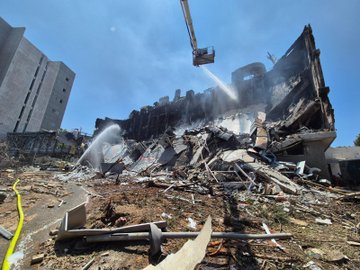
A recent Iranian missile strike has inflicted extensive damage on the Weizmann Institute of Science in Rehovot, central occupied Palestine, a facility long considered a cornerstone of the Israeli occupation’s scientific and military-industrial infrastructure.
According to The Marker, a daily business newspaper published by the Haaretz Group in “Israel”, several buildings within the institute sustained direct hits, with one key laboratory complex entirely destroyed by fire.
The targeted site housed advanced research in life sciences, artificial intelligence, and molecular biology, areas that have directly supported the Israeli entity’s development of surveillance, targeting, and weapons systems used in attacks across the region.
Described by Israeli media as the “scientific and military brain” of “Israel”, the Weizmann Institute has played a pivotal role in the research and development of technologies underpinning airstrike coordination systems, drone warfare capabilities, and battlefield medical technology, all of which have been deployed in repeated assaults on civilian populations in Gaza, Lebanon, Yemen, and most recently, Iran.
One of the laboratories destroyed was run by Israeli Professor Eldad Tzahor, a veteran in the Department of Molecular Cell Biology. Israeli Professor Eran Segal, whose AI lab was also directly hit, noted that millions of dollars’ worth of equipment was damaged beyond recovery due to water and structural damage. Segal’s lab had reportedly contributed to algorithmic systems used in battlefield decision-making and real-time surveillance, tools that have aided the Israeli entity’s strikes in Gaza and elsewhere.
Photos released by Israeli media showed scorched interiors, collapsed lab floors, destroyed electrical systems, and structural devastation, the result of what sources described as a precision strike.
Not a random target: A symbol of militarized science
While Israeli officials have downplayed the implications, The Marker acknowledged the strike was “not random,” but a calculated attack on a facility used for military power through scientific research.
Media reports also framed the operation as direct payback for the assassination of Iran’s nuclear scientists.
Experts say the institute’s deep ties to the Israeli security apparatus have made it a legitimate military target in Iran’s eyes, particularly given its support for advanced weapons technologies used to target civilians.
Israeli Professor Sharel Fleishman, whose lab was not impacted, admitted the losses are irreplaceable. “Life sciences labs rely on materials that are gathered and preserved over many years. When a lab is destroyed, and with it all those materials, it’s irreplaceable,” he said.
Another Israeli researcher, Professor Oren Schuldiner, told The Marker: “It’s as if the lab evaporated into thin air.” Schuldiner noted that rebuilding the affected laboratories and their capabilities will take at least two years.
The destruction of the Weizmann Institute sends a clear message from Tehran, analysts say: the Israeli occupation’s institutions cannot continue to serve dual roles as research centers and military enablers with impunity.
MAGA’s Civil War: Who dares to take on the Israel lobby?
By Tarik Cyril Amar | RT | June 17, 2025
Steve Bannon – the smart, stubborn, and irrepressible right/far-right public intellectual and once ally as well as chief strategist and bestie of US President Donald Trump – is back in the news. And in a way that speaks to much more than the ups and downs, and ins and outs, of US elite careers.
The hill he has chosen to fight on this time is resistance to the US waging another war in the Middle East in the service of Israel and its powerful lobby in America.
Bannon, make no mistake, is not taking a de facto stand against Israel because of its apartheid, genocide, and wars of aggression. He ought to, obviously, especially as a man flaunting his Christian belief. (From one sort-of-Roman-Catholic to another, Steve: Our Lord Jesus Christ really didn’t like the child killers, and I am pretty sure he would have found the lingerie-camouflage cross-dressers with machine guns rather off-putting, too.)
But then, if Bannon had principled moral objections here, he would not be Steve Bannon, a very conservative American, who will probably never shake off deeply ingrained mental habits of violence and racism.
But from Trump’s perspective – and that of the Israeli influence agents surrounding him – Bannon’s line of attack is actually more dangerous than a genuinely moral stance. Because Bannon is positioning American national interest against following Israel’s lead. By declaring that Israel pursues an ‘Israel First’ policy about as egotistically as Berlin’s ‘Germany First’ trip between 1933 and 1945, Bannon has dared to state the obvious: Israel’s interests are not identical with those of the US, and therefore, a genuine ‘America First’ policy must not obey Israel. Hence, stay out of the war against Iran. Or to be precise, get out of it.
And there Bannon is of course right and has the facts and logic on his side, which makes his challenge all the more threatening.
The background to Bannon’s sally, which as the Financial Times points out, signals a split among Trump’s domestically indispensable MAGA base, is the perfect mess Trump and his team have made over the attack on Iran. Despite their clumsy mixed messaging – really, contradictory lying and boasting – Israel’s unprovoked war of aggression against Iran can obviously only be waged because of massive American support.
In reality this is already a combined US-Israeli attack, and it makes no difference to this fact that Israel always wants even more, including – as Axios, a network with remarkably easy access to Israeli sources, has reported – open US help in attacking the key Iranian nuclear installations at Fordow.
Never mind, by the way, that deliberately striking a nuclear facility is as criminal as it gets. It constitutes a clear breach of the Geneva Conventions, as the former head of the International Atomic Energy Agency (IAEA) Mohamed ElBaradei has recently had to publicly school German Foreign Minister Johann Wadephul about. The latter is clearly just as ignorant of his job’s basics as his legendarily inept predecessor Annalena Baerbock used to be.
Yet, as Bannon’s intervention shows, the key role the US plays in the assault on Iran has caused noteworthy ripple effects inside America and in particular inside the movement now known as MAGA. Originally the abbreviation was an extremely successful 2016 Trump campaign slogan – inspired by a forerunner used by Ronald Reagan in 1980 – meaning ‘Make America Great Again’.
But as a movement, MAGA has a much longer history. Its influences and ancestors include, for instance, nativism, isolationism, the original America First, and the more recent Tea Party. That’s why it is important to understand that MAGA overlaps with but is not identical with Trumpism, as often assumed. In reality, MAGA is part of an older, powerful tradition that Trump has tapped into with great success. But he is not guaranteed to always be in control of it, as the term ‘Trumpism’ may misleadingly imply.
Take for instance the perhaps greatest cleavage running through contemporary Trumpism 2.0: that between a right-wing populist orientation still aiming at, for want of better terms, ordinary Americans, and a techno-elitist wing busy with fantasies of openly establishing an AI-based rule of the richest. Things clearly remain volatile. For wasn’t it only yesterday that the would-be tech lords, represented by former “first buddy” Elon Musk, seemed to have defeated the populist tribunes of the Steve Bannon type? And yet, now Musk, the “man-child” is out (if not necessarily forever) and Bannon, the old battle axe, is making headlines again.
Warning of the “fog of war” – read that as code either for just ordinary information unreliability or for deliberate Israeli and Western disinformation – and “unintended consequences,” Bannon has been explicit: The US must not be “sucked into another major war on the Eurasian land mass, particularly the Middle East.” And yet, he added, America is already an “active combatant” by providing air defense to Israel.
For Bannon, at least in his current iteration, none of this is new. As he has also recently charged, the fundamental reason why American troops are in Iraq and thus in harm’s way is that the US government and its media, including both Republicans and Democrats, have “lied to us,” i.e., the American people, for decades. It has not been, as Bannon stressed, simply incompetence or mistakes, but the “bald-faced lies” and “spin of the neocons.”
That is of course a reference to the fact that the US and its Western accomplices started their 2003 unprovoked war of aggression against Iraq with a massive, Gleiwitz-level deception by deliberately trying to deceive the world about non-existent Iraqi weapons of mass destruction. And that, according to Bannon, was along with the financial crisis of 2008 the original sin that triggered “this movement,” clearly here meaning what we now know as MAGA.
Bannon’s history may be a little off as far as facts are concerned. The roots of contemporary American right-wing populism include a tradition of isolationism, but they are certainly not identical with a revolt against the Iraq War, insane and criminal as the latter was.
But veracity and accuracy aren’t the point here. Instead what matters is how precisely Bannon is trying to rewrite history, namely by claiming opposition to neocon “forever wars,” specifically in the Middle East (transparent code for on behalf of Israel) as not only a core value of MAGA, but as a key element of its origin story.
As for Israel’s assault on Iran, Bannon was scathing. Rhetorically exploiting the silly pretense that Israel was “going it alone” when starting the attack – which Bannon is certainly intelligent and realistic enough to know is nonsense – he called on Israel to stick to doing just that. Yet instead, he scoffed, the “going-it-alone lasted six hours” and Israel is doing everything it can to drag Americans ever deeper into another massive war.
Importantly, Bannon is not alone. As he pointed out, conservative media heavyweight Tucker Carlson has made the same point. In fact, Carlson has been even more explicit. Using his X account with over 16 million followers to claim that the key divide of US politics is between “those who casually encourage violence, and those who seek to prevent it – between warmongers and peacemakers,” Carlson started naming “the warmongers,” including “anyone who’s calling Donald Trump today to demand air strikes and other direct US military involvement in a war with Iran,” such as “Sean Hannity, Mark Levin, Rupert Murdoch, Ike Perlmutter and Miriam Adelson.”
Carlson added that “at some point they will all have to answer for this, but you should know their names now.” And what names they are: Of the five, three, i.e., 60 percent – Levin, Perlmutter, and Adelson – are as most Americans would know or guess, Jewish. Murdoch and Hannity, in the minority, are not.
But all of the five are staunch Zionists, Hannity having been acknowledged by the Jerusalem Post as one of “10 Pro-Israeli Christians,” i.e. a Christian Zionist. And that was in October 2024, a full year into Israel’s ongoing genocide of the Palestinians. Mark Levin, an influential and extremely rightwing media personality, got his “Friends of Zion Museum ‘Defender Award’ for his steadfast support of the State of Israel and the Jewish people” in 2018.
Murdoch, the Western publishing oligarch with massive political influence, used a rambling – but who’s going to edit him, right? – 2009 Jerusalem Post article to admit he feels very flattered by frequently being misidentified as Jewish and to explain that the “free world” – old-timers’ speak for “rules-based value West” – must support Israel to the hilt.
According to Wikipedia, Ike Perlmutter is “an Israeli-American billionaire businessman and financier” – although ironically enough born in Mandate Palestine – who “through a variety of sometimes unorthodox business deals” has been “an influential investor in a number of corporations.” He also used to run Marvel Entertainment. Yes, that Marvel, the superhero story company now absorbed by Disney and perhaps the single most effective vehicle of contemporary US propaganda.
And multi-billionaire Miriam Adelson is of course not only the widow of Sheldon Adelson, the “casino mogul” and arch Zionist, but also a fanatical Zionist in her own right. Both Adelsons have been among Donald Trump’s most generous supporters. During his 2016 presidential campaign they were already among his “top donors.” In 2020 – when he lost – they made the single biggest individual contribution, a whopping $75 million. In 2024, Miriam Adelson dialed it up to eleven with $106 million. Only Elon Musk ($276 million) and rich heir extraordinaire Timothy Mellon ($150 million) gave even more.
And then there is the influential MAGA icon and Congresswoman Marjorie Taylor Greene. In a long post on X, she fired a broadside against any further US involvement in wars abroad: “We are $36+ TRILLION in debt and have mountains of our own problems. We have giant planks sticking out of our own eyes while we complain about splinters in other’s eyes. Every country involved and all over the world can be happy, successful, and rich if we all work together and seek peace and prosperity.”
MTG, as she is often called, has also preemptively and rightly rejected any accusation of “antisemitism” and even of isolationism: “Taking this position is NOT antisemitic. It’s rational, sane, and loving toward all people. Taking this position of peace and prosperity for all is not isolationism, it leads to GREAT trade deals and GREAT economies that help ALL PEOPLE.”
Worst of all, from Trump’s and Israel’s perspective, she has in effect reminded her 4.8 million followers, as well as many others who will read about her post in the traditional media, of Trump’s own campaign promise to end and not start wars, because no more wars is “what many Americans voted for in 2024.”
Clearly, there are influential representatives of MAGA who are not only willing to openly challenge the perversely self-damaging hold that Washington allows Israel to have over its foreign policy, but are also beginning to be explicit about the fact that Israel’s lobby in the US – whether Jewish or not – is putting another country first, at enormous cost to Americans.
Unfortunately, there are reasons to fear that this right-wing criticism of ‘Israel First’ will not prevail. Trump may very well be so beholden to and afraid of the Israel lobby that he will make the single worst mistake of his life and get even deeper into the war against Iran.
But then the question is: What will happen next? There is a brave left-wing opposition to Israel in America – full disclosure: my sort of people – and there also is clear polling evidence that Israel’s grip on American society as a whole is finally slipping, especially among the young. Now add a right-wing, MAGA-based opposition and another great US fiasco in the Middle East backfiring on America’s home front. Israel may get its wish once again, but in the not-so-long run it should be very careful what it wishes for. And that, as grim as the news is, is a tiny speck of hope on a very dark horizon.
Tarik Cyril Amar is a historian from Germany working at Koç University, Istanbul, on Russia, Ukraine, and Eastern Europe, the history of World War II, the cultural Cold War, and the politics of memory
Trump Attacks Tucker Carlson Over Opposition to Iran War, Says He Decides What ‘America First’ Means
By Connor Freeman | The Libertarian Institute | June 16, 2025
President Donald Trump is lashing out against popular conservative talk show host Tucker Carlson. The acrimony emanates from Carlson’s strong opposition to the White House’s indirect military support for Israel’s war against the Islamic Republic of Iran. Trump declared he invented “America First” and he decides what it means while making his case for the potentially catastrophic war of aggression against Tehran.
On Monday, the president demeaned the influential pundit. Trump told reporters “I don’t know what [Carlson] is saying. Let him go get a television network and say it so that people listen.” In an interview with The Atlantic magazine this weekend, Trump was asked about Carlson’s comments against the war.
Trump responded “Well, considering that I’m the one that developed ‘America First,’ and considering that the term wasn’t used until I came along, I think I’m the one that decides [what it means]. For those people who say they want peace—you can’t have peace if Iran has a nuclear weapon. So for all of those wonderful people who don’t want to do anything about Iran having a nuclear weapon—that’s not peace.”
“America First” is a political slogan which has seen a phenomenal resurgence in the wake of Trump’s first presidential campaign. It has been used by politicians in both major parties and dates back more than a century ago. It originated as a rallying cry for neutrality during the First World War and was used as part of President Woodrow Wilson’s 1916 reelection campaign. The following year, Wilson betrayed his supporters by ordering American forces into the war and imposing conscription. Since then, the antiwar, nationalist slogan has been deployed by non-interventionists, particularly on the right, exemplified best by Pat Buchanan.
Despite Trump’s continued insistence otherwise, his own intelligence agencies confirmed this year that there is no evidence Tehran is building a nuclear weapon nor has there been any suggestion that a political decision has been made to abrogate Ayatollah Ali Khamenei’s fatwa against pursuing weapons of mass destruction.
On Friday, following Israel’s surprise bombing attack on Iranian nuclear facilities, residential areas, and military sites, Carlson released a newsletter denouncing US involvement in Prime Minister Benjamin Netanyahu’s war. It begins by quoting from Trump’s first inaugural address, “From this day forward, it’s going to be only America first. America first.”
The newsletter then reads, “Now that [Netanyahu] and his war-hungry government have executed their long-awaited assault, [Trump] faces a legacy-altering decision: to support or not to support?”
Carlson insists, “The United States should not at any level participate in a war with Iran. No funding, no American weapons, no troops on the ground. Regardless of what our “special ally” says, a fight with the Iranians has nothing to offer the United States. It is not in our national interest.”
The newsletter continues, with Carlson warning the consequences of supporting Israel will include future blowback terrorism against “the West” and “thousands of immediate American deaths, all in the name of a foreign agenda.” He concluded that a preferable option would be to “drop Israel” and “let them fight their own wars.” Carlson emphasized that because of the massive US military and financial aid to Tel Aviv, Trump is already “complicit in the act of war.”
US disbands undisclosed Russia pressure group – Reuters
RT | June 17, 2025
US President Donald Trump’s administration has reportedly halted the work of a special task force that was developing strategies to pressure Russia, Reuters claimed on Tuesday, citing anonymous sources.
The inter-agency workgroup, the existence of which had not previously been disclosed, was reportedly established earlier this spring as part of Trump’s efforts to speed up peace talks between Russia and Ukraine.
The task force had been examining measures such as increasing economic leverage over former Soviet republics and conducting intelligence operations to undermine Russian influence. However, it reportedly lost momentum in May, when the US president refused to adopt a more confrontational stance toward Moscow, officials told Reuters.
“It lost steam toward the end because the president wasn’t there. Instead of doing more, maybe he wanted to do less,” one of the officials said.
The agency noted that the effort was never formally shut down, but effectively stalled after a sweeping purge at the White House National Security Council several weeks ago removed most of the officials involved, including the entire team dealing with the Ukraine conflict.
Reuters noted that it is unclear if Trump himself was aware of the working group’s formation or subsequent dissolution.
The US president has repeatedly insisted that only Russia and Ukraine can negotiate a resolution to the ongoing conflict, and has consistently sought to pressure the leaders of both countries to engage in peace talks.
Although he has threatened additional sanctions on Russia as part of his efforts to mediate the conflict, Trump has also sought to rebuild Washington’s relations with Moscow and has already held several phone calls with President Vladimir Putin, all of which he has described as positive.
On Monday, during the G7 summit in Canada, Trump also publicly advocated for Russia’s return to the G8 format, arguing that excluding Moscow from major international forums was a strategic mistake.
Russian officials have repeatedly expressed appreciation for Trump’s peace efforts and attempts to rebuild relations with Moscow, which had hit their lowest point in decades under former US President Joe Biden.
However, Moscow has rejected the idea of returning to the G8 format, stating that it has “lost its relevance” and no longer reflects current global economic dynamics. Instead, Kremlin spokesman Dmitry Peskov pointed to the G20 as a more representative format.
Brussels warns Slovakia over constitutional change aimed at overriding EU law
By Thomas Brooke | Remix News | June 17, 2025
The European Commission has issued a warning to Slovakia, declaring that proposed constitutional changes backed by Prime Minister Robert Fico’s government would breach European Union law by attempting to deny the supremacy of EU rules over national legislation.
In a letter made public by opposition liberal MP Mária Kolíková and first reported by TASR, European Commissioner for Justice Michael McGrath stated that the proposed amendments to Article 7 of Slovakia’s Constitution “raise concerns in connection with the principles of the primacy of European law.”
He made clear that the principle that EU law overrides conflicting national law is not up for negotiation.
Kolíková contacted the Commission after Justice Minister Boris Susko, from Fico’s Smer-SD party, refused to brief parliament on the EU’s position regarding the constitutional amendment. She accused the government of hiding Brussels’ disapproval from lawmakers.
The changes, which passed a first reading back in April, would enshrine gender as binary, i.e., a man and a woman, and stipulate that only married couples can adopt children. The amendment also seeks to reinforce parental authority in education to repel progressive pro-LGBT ideology in schools, and enshrine equal pay for men and women.
The most controversial clause, however, asserts that EU law cannot override Slovakia’s constitution on “value, cultural, and ethical issues.”
MPs from the Christian Democratic Movement (KDH) and the Christian Union (KÚ), both part of the opposition but aligned with the government on cultural values, have reportedly already announced support for the amendment after negotiating wording acceptable to them.
Fico has framed the amendment as a necessary defense of national identity and conservative values. Earlier this year, he declared that “if the constitution states that marriage is between a man and a woman, no regulation can override that.”
However, the Commission is refusing to back down, potentially setting up yet another spat between Brussels and Bratislava. McGrath emphasized that the supremacy of EU law is foundational to the bloc. “The primacy of EU law is not open for debate,” he said.
EU Divided on Russian Gas as Austria Joins Hungary and Slovakia Against Blanket Ban
Sputnik – 17.06.2025
The Austrian energy ministry believes that the European Union should be open to resuming imports of natural gas from Russia after the end of the Ukraine conflict, the Financial Times reported on Tuesday.
“[Brussels] must maintain the option to reassess the situation once the war has ended,” the ministry told the Financial Times.
Austria is the third EU nation after Hungary and Slovakia to openly suggest resuming imports of Russian gas after the conflict ends.
The European Commission will propose on Tuesday that the EU ban new gas contracts with Russia. The Commission will use trade law to bypass potential vetoes by Hungary and Slovakia. According to the summary of the proposal seen by the Financial Times, the current short-term contracts are to be terminated starting 2026, while long-term contracts are to come to an end on January 1, 2028.
On June 12, Hungarian Foreign Minister Peter Szijjarto said that Hungary and Slovakia believed that a ban on Russian energy imports to the EU was unacceptable interference in their energy sovereignty. Szijjarto said that Hungary and Slovakia had blocked the Commission’s proposal to this effect during the meeting of EU energy ministers in Luxembourg on Monday.
In early May, the EU Commission presented a draft roadmap to stop Russian energy imports to the EU by the end of 2027. It includes a ban on imports from Russia under new Russian gas contracts and existing spot contracts, which is to come into effect by the end of 2025. The ban can also affect remaining imports of pipeline gas and liquefied natural gas from Russia under long-term contracts.
Former Georgian president pushes EU ‘to kill the Georgian economy’ to remove populists from power
Remix News | June 17, 2025
Salome Zourabichvili, the former president of Georgia who stepped down six months ago, gave a speech at the recent GLOBSEC international conference in Prague in which she called on the EU to keep up the pressure against her country to oust the current government.
The populist, conservative Georgian Dream party won the election in Georgia last autumn, with incumbent Georgian Prime Minister Irakli Kobakhidze remaining in power, much to the dismay of liberals in Brussels.
“European sanctions against Georgia need to be stepped up. We need more and stronger European sanctions. Why? Because sanctions work against a small country like Georgia. They cause damage. They hurt. They kill the Georgian economy and private sector. In other words, in the long run, they will bring down the Georgian government,” Mandiner quotes her as saying.
Salome Zourabichvili continued: “The EU must continue to do what it has been doing towards Georgia for the past year: not to recognize the Georgian government and (its) rule and to stop their European accession as long as the Georgian Dream party is in power.”
Calling attention to her comments on social media, Anton Bendarjevskiy, director of the Oeconomus Institute, commented: “So the former Georgian president, who only left office six months ago, goes to an international forum and demands that as many and stronger sanctions be imposed on her country as possible, because that will kill the Georgian economy, and then she and the political forces that support him can take power in the country.”
Hungary has faced a similar situation, with the opposition Tisza Party MEP Kinga Kollár celebrating the fact that sanctions have hurt her country by way of withholding needed funds and thus helped increase the chances of her party ousting Prime Minister Viktor Orbán from power.
The Georgian Dream party has long been under scrutiny for its close ties to and preference for Russia, accusations of helping Putin evade sanctions, and its anti-Western stances, including Irakli Kobakhidze’s battle against what he has called a “Global War Party.”
Ritter’s Rant Ep. 5: Grossi’s got to go
The IAEA’s incestuous relationship with Israel has destroyed its credibility
Scott Ritter | June 16, 2025
Featured Video

The 1964 Coup in Brazil
or go to
Aletho News Archives – Video-Images
Frlom the Archives
70 Neocons Petition Congress To Effectively Allow Israel To Say When The US Should Attack Iran
By Damian Lataan | January 10, 2014
Seventy senior Israeli-centric neoconservatives have written an open letter to Congress imploring them to do more to ensure Iran complies with the conditions of any agreement finally reached with the P5+1 over Iran’s nuclear program.
While the neocons are ostensibly asking Congress to ensure compliance, it is clear that their real aim is to convince members of Congress to support the bill currently passing through the Senate which calls for tighter sanctions against Iran in the event of any waywardness on Iran’s part.
The neocons are eager to see the bill currently passing through the Senate with enough support to make it veto-proof, not so much because they are concerned about Iran’s so-called nuclear weapons program – there’s still not a skerrick of hard evidence that Iran has a nuclear weapons program – but, rather, because embedded within the bill is this clause:
… if the Government of Israel is compelled to take military action in legitimate self-defense against Iran’s nuclear weapon program, the United States Government should stand with Israel and provide, in accordance with the law of the United States and the constitutional responsibility of Congress to authorize the use of military force, diplomatic, military, and economic support to the Government of Israel in its defense of its territory, people, and existence…
Essentially, the clause is an automatic trigger for the US to attack Iran at any time the Israelis choose to launch a first strike – regardless of whether President Obama is in favour or not.
Partial list… continue
Blog Roll
 Aletho News
- Trump Threatens to ‘Hit’ Iran ‘Twenty Times Harder’ Over Strait of Hormuz Oil Flows
- Spare the hypocrisy: Baghaei slams Ursula’s support for US
- Iran War Supporters Invent a New and Absurd Justification: It Is All About China
- Corporate Media Go All Out To Support The US-Israeli War on Iran
- Trump press conference reveals a man who wants out of war
- When Tel Aviv decides, Washington fights
- Top official: Iran ready for a long war with US, no more diplomacy
- How Iran’s Toxic Rain Reveals US-Israel Discord
- Trump Admits He Is Destroying Iran For Israel
- Iran’s latest move in the GCC countries was a stroke of genius
- If Americans Knew
- Threats and missiles fly, death tolls soar in Iran, Lebanon, Gaza – Not a ceasefire Day 151
- Lebanon: Israel’s White Phosphorous Use Risks Civilian Harm
- Corporate Media Go All Out To Support The US-Israeli War On Iran
- US-Israel war on Iran is creating a steady growing number of amputees
- Israel planned this war on Iran for 40 years. Everything else is a smoke screen
- The wrong question about the war in Iran
- ‘Your Tax Dollars Being Used to Raise Your Gas Prices’: US-Israel Bomb Major Iranian Oil Depots
- ‘Bogus Evidence’: Former Nuclear Watchdog Head Debunks US Justification for Iran War
- EXPLAINER – Dimona: What to know about Israel’s nuclear site
- Fires and toxic air in Iran (thanks, Israel) – Not a ceasefire Day 150
- No Tricks Zone
- Wake-up Call: Survey Shows Majority Of Germans Now Favor Postponing Climate Targets!
- Televised! Leading German Political Candidate Tells Schoolchildren CO2 Makes Sun Hotter!
- New Study: A Century Warming Of 1.1°C Is ‘Commonplace’ And ‘Not Unusual’ During This Interglacial
- New Study: ‘Internal Noise’ And Volcanic Forcing Can Trigger 10-15°C Warming Within Decades
- Glaciers Worldwide Are Suddendly Surging, Experts Blame Warming!
- Surprising Discovery: Sahara Is Greening…Billions Of Trees Where Once Thought To Be Barren
- New Research Reaffirms Clouds, Aerosols, And Surface Solar Radiation Are ‘Driving The Climate System’
- Germany: Electric Car Catches Fire At Charging Station, Sets Off Local “Inferno”, Widespread Damage
- New Study: Canada’s New Brunswick Was 1°C Warmer Than Today During The Medieval Warm Period
- Coal Power Back In Trend As Globe Tries To Keep Pace With Growing Demand For Power
 Aletho News