Kremlin weighs in on unrest in Armenia
RT | June 29, 2025
Political turmoil in Armenia is an internal matter, Kremlin spokesman Dmitry Peskov has said, following the arrests of senior clerics and a Russian-Armenian businessman accused of plotting to overthrow Prime Minister Nikol Pashinyan’s government.
Earlier this month, the Armenian authorities took into custody Archbishop Bagrat Galstanyan, the leader of the Sacred Struggle opposition movement, and Archbishop Mikael Adjapahyan. They are both accused of plotting a coup. The arrests sparked a public outcry and protests, which devolved into clashes with police.
The archbishops are key members of the Armenian Apostolic Church (AAC), which was the main driver of protests against Pashinyan. The unrest was sparked by the prime minister’s decision to return several border villages to Azerbaijan. While Pashinyan portrayed the land transfer as necessary to normalize relations with the neighboring state, many in Armenia saw it as a betrayal of national interests.
The authorities also arrested Samvel Karapetyan, a Russian-Armenian billionaire and supporter of the AAC, on charges of calling for the overthrow of the government.
In an interview with Russian journalist Pavel Zarubin, Peskov said Moscow is closely monitoring the situation but will not interfere.
“This is, of course, an internal matter for Armenia,” he stated. “We are, of course, interested in the preservation of law and order in Armenia, so that Armenia is a prosperous, stable country, friendly to Russia.”
Peskov noted that Russia has a large Armenian diaspora, many of whom “are watching these events with pain,” adding: “Many, of course, do not accept how this is happening.”
Russia and Armenia have historically had close cultural and religious ties. In recent months, however, Yerevan has distanced itself from the Collective Security Treaty Organization (CSTO), which comprises many former Soviet republics. Armenia has accused Russia of failing to provide adequate support during its stand-off with Azerbaijan – in particular, over the region of Nagorno-Karabakh.
Russia has argued that Armenia never recognized Nagorno-Karabakh as its own territory, meaning the CSTO could not consider Azerbaijan’s military operation in the enclave as aggression against an alliance member. President Vladimir Putin has also said that Russia has on numerous occasions floated a territorial compromise that could have settled the conflict between the two states, and that Armenia rejected the initiative.
Iran asks UN Security Council to recognize Israel, US as ‘initiators’ of aggression

Iranian Foreign Minister Abbas Araghchi
Press TV – June 29, 2025
Iranian Foreign Minister Abbas Araghchi has called on the United Nations Security Council to recognize the Israeli regime and the United States as the “initiators” of the recent 12-day aggression against the Islamic Republic.
“We solemnly request that the Security Council recognize the Israeli regime and the United States as the initiators of the act of aggression and their subsequent responsibility, therefore including compensation and reparation,” Araghchi said in a letter to UN Secretary General Antonio Guterres on Sunday.
“The Security Council should also hold the aggressors accountable and prevent the recurrence of such heinous and serious crimes to enable it to maintain international peace and security,” he added.
He emphasized that political and military leaders, who order an act of aggression, “are also individually liable for the international crime of aggression under customary international law.”
The top Iranian diplomat described the act of aggression as a “brazen assault” on the very foundations of international law, warning that tolerating it and its legal consequences seriously undermines the credibility of the United Nations system.
It also “poses a real threat to the rule of law at the international level and engenders lawlessness in the future of international relations in our region as well as the international community at large,” Araghchi pointed out.
In the early hours of June 13, the Israeli regime launched an all-out aggression on Iranian soil by targeting various military and nuclear sites, claiming the lives of dozens of top military commanders and nuclear scientists as well as ordinary civilians.
On June 22, the United States joined the Israeli regime in the assault and bombed three Iranian nuclear sites in a grave violation of the United Nations Charter, international law, and the Nuclear Non-Proliferation Treaty (NPT).
A day later, Iran launched a wave of missiles at al-Udeid air base in Qatar—the largest American military base in West Asia—in retaliation for the aggression.
As the Iranian armed forces pounded Israel and its military and industrial infrastructure, using many new-generation missiles that precisely hit the designated targets, the embattled regime was forced to unilaterally declare a truce deal on June 24.
In a letter to the United Nations secretary general and president of the Security Council on June 13, Araghchi said the Israeli regime’s act of aggression against the country amounts to a “declaration of war.”
“These oppressive acts are not only constitute a severe violation of sovereignty and territorial integrity of Iran as an independent member of the United Nations, but as per international law and international humanitarian law, including the Geneva Conventions, are among acts of aggression and war crimes,” he said back then.
From the War of the Cities to True Promise 3: Iran’s ballistic program and the path to networked deterrence
By Abbas Al-Zein | The Cradle | June 28, 2025
Under a regional sky long dominated by US and Israeli air and intelligence superiority, Iran made a fateful decision decades ago. It would not attempt to match its adversaries tank-for-tank or plane-for-plane, but would instead build an asymmetric deterrent from scratch.
Rather than chase the mirage of classical military parity, Tehran developed an indigenous ballistic missile arsenal that is now the largest and most formidable in West Asia. This was no short-term, tactical gambit. Iran’s missile doctrine was forged in an existential struggle, refined over war and siege, and ultimately transformed into a cornerstone of national defense policy.
The War of the Cities: Birth under siege (1980–1988)
The first phase of Iran’s missile journey began in the crucible of the devastating Iran–Iraq War, specifically during the infamous “War of the Cities.” As the Baathist government in Baghdad launched Soviet-supplied Scud-B missiles deep into Iranian urban centers, it did so under the protective umbrella of western intelligence and funding from Arab states of the Persian Gulf. The intent was clear: to break Iranian civilian morale through systematic terror from the sky.
Caught without a missile deterrent of its own, besieged diplomatically, and encircled by western-aligned forces, Iran turned to whatever resources it could muster. It secured limited quantities of Scud-B missiles from Libya, Syria, and North Korea. These early acquisitions, modest as they were, formed the embryonic core of a deterrent force placed under the direct command of the Islamic Revolutionary Guard Corps (IRGC).
But these were more than mere missiles. They were weapons of national dignity in a war for survival for the nascent Islamic Republic. Iran’s leadership came to view missile capability not simply as a tactical asset, but as a psychological and political necessity.
Military historian Pierre Razoux notes in The Iran-Iraq War (2014) that it was during this phase that Iran’s leadership came to the unshakable conclusion: without a retaliatory missile force, no psychological or strategic deterrence was possible.
The Iranian response was neither ad hoc nor passive. Alongside importing missiles, Iranian engineers began dismantling, studying, and maintaining the systems. They built smuggling networks, circumvented embargoes, and reverse-engineered technology.
North Korea emerged as a critical partner, acting as a conduit for Soviet missile know-how. A 2010 RAND Corporation report titled Iran’s Ballistic Missile Capabilities: A Net Assessment noted that Iran had become capable not only of replicating but also of redesigning and expanding missile technology independently. Between 2000 and 2010, Iran pivoted from mass production to innovation, prioritizing accuracy, range, and operational readiness.
The foundations of Iran’s ballistic doctrine were thus laid: sovereignty through technological independence, and defense through deterrence.
From imitation to innovation (1989–2009)
With the Imposed War over, Iran’s military establishment—spearheaded by the IRGC—began restructuring its defense priorities. The goal was no longer just to have missiles but to produce them independently and on a large scale.
At the heart of this transformation was the late martyred Brigadier General Hassan Tehrani Moghaddam, a strategic thinker and technical mastermind hailed as the ‘father of Iran’s missile program.’ He understood that deterrence was not about launching missiles, but about mastering their lifecycle: production, concealment, deployment, and precision.
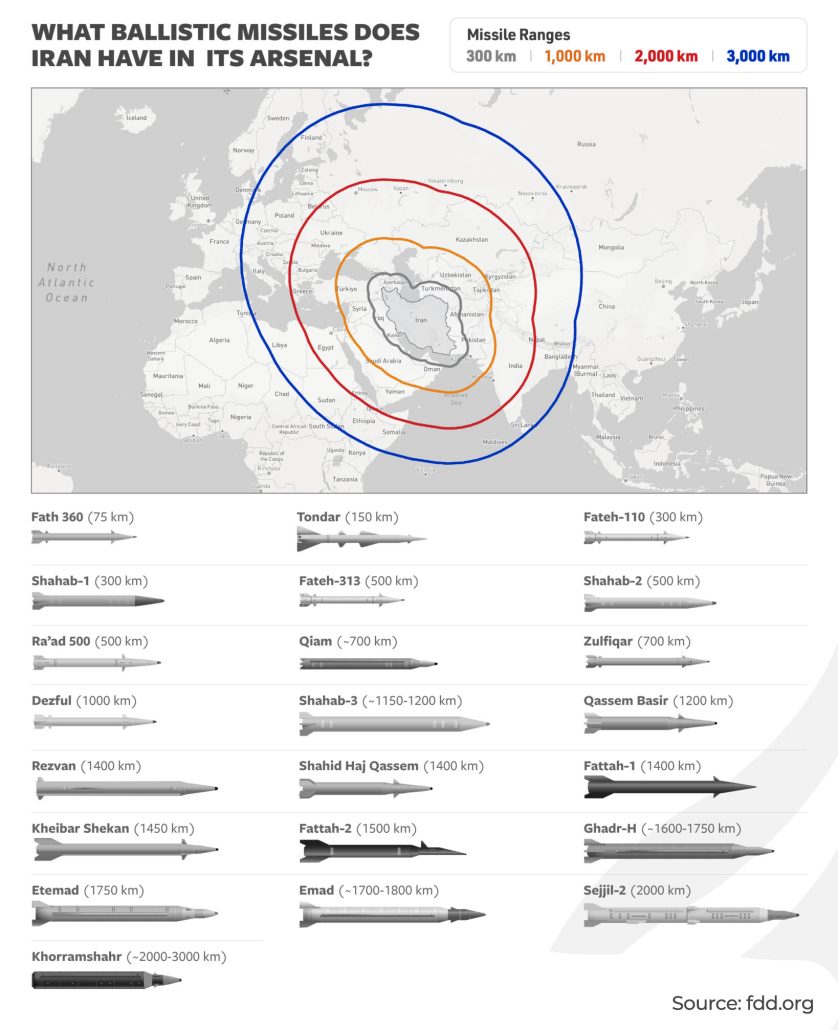
Under his leadership, Iran transitioned from a user to a manufacturer. The Shahab-1 and Shahab-2 were enhanced variants of the Scud-B and Scud-C. But the real breakthrough came in 2003 with the Shahab-3, boasting a range exceeding 1,300 kilometers—a capability that placed US bases in the Persian Gulf and occupied Palestine within striking distance. The Shahab lineage would later give way to the Ghadr class, with better range and multiple warhead capabilities.
The most significant leap, however, came with the adoption of solid-fuel propulsion. The Sejjil missile (2,000–2,500 km range), unveiled by the end of the 2000s, was Iran’s first medium-to-long-range system not reliant on Scud technology. It signaled a new era of technological self-sufficiency and rapid-launch capability.
During this phase, Iran undertook sweeping strategic steps: adopting solid-fuel for easier storage and rapid deployment, establishing underground and mobile launch facilities to avoid detection, building decentralized manufacturing to reduce vulnerability to strikes, and integrating missile research into academic institutions to develop a domestic cadre of experts.
A 2010 report by the International Institute for Strategic Studies (IISS) titled Iran’s Ballistic Missile Capabilities: A Net Assessment noted that by this stage, Iran had moved beyond simply replicating foreign missile systems and had begun designing its own through local R&D and systematic redesign, including the establishment of underground manufacturing. From 2000 to 2010, Iran’s program pivoted decisively from quantity to quality, enhancing range, precision, and operational readiness.
When Moghaddam was killed in a suspicious explosion at the “Defenders of the Sky” base in November 2011, Iran declared it a national loss. While Israel neither confirmed nor denied responsibility, the Yediot Aharonot newspaper reported that “some assessments” indicated that the blast was “the result of a military operation based on intelligence information.”
Nevertheless, his legacy endured. He had not merely built a weapons system; he had established a sustainable missile doctrine rooted in adaptability and local expertise. His death marked the end of one era, but it also catalyzed the birth of Iran’s next missile generation.
Smart missiles and precision strikes (2010–2020)
By the 2010s, Iran’s goal had shifted from mass deterrence to precision deterrence. Engineers focused on guidance systems using inertial navigation paired with domestic GPS and anti-jamming technologies. The result was a suite of short- and medium-range guided missiles with enhanced tactical utility.
This generation included the Zolfaghar (750 km), the highly precise and compact Fateh-313 designed for preemptive strikes, and the Qiam—Iran’s first finless missile, engineered for stealth and maneuverability.
Iran also entered the low-altitude cruise missile domain, developing systems such as the Soumar (with a range of over 2,000 km) and Hoveizeh (with a range of 1,350 km), both capable of evading conventional radar and penetrating advanced air defenses.
These weapons were not theoretical. In June 2017, Iran launched six medium-range missiles from its territory targeting ISIS command centers in Deir Ezzor, Syria—its first operational cross-border use since the 1980s.
In January 2020, in direct retaliation for the US assassination of IRGC Quds Force General Qassem Soleimani, Iran struck the Ain al-Asad base in Iraq with Qiam and Fateh missiles. Satellite imagery showed sub-five-meter accuracy, hitting aircraft hangars and troop shelters. The New York Times described it as one of the most accurate missile strikes on a US facility in modern history.
This decade marked Iran’s shift from “deterrent” missiles to “executive” missiles—systems where political power was expressed through precision. It was no longer about maximum range, but maximum effect. The missile became a scalpel, not a hammer, paving the way for Iran’s most advanced deterrent doctrine yet.
The rise of networked deterrence (2021–2023)
By the 2020s, Iranian missiles were no longer stand-alone assets. They had become the final phase of a broader, integrated offensive system. Missiles now worked in tandem with kamikaze drones, electronic warfare units, cyber surveillance, and decentralized command structures. This was networked deterrence: a synchronized, multi-domain approach designed to penetrate and paralyze advanced air defense systems.
Under this doctrine, Iran developed new missiles tailored for layered operations. The Kheibar Shekan hypersonic missile (1,450 km, 500 kg warhead), most recently deployed in a multi-warhead configuration during Operation True Promise III against the occupation state, exemplifies this evolution.
Other critical systems include the Khorramshahr-4 (over 2,000 km), Raad-500 (solid-fuel, rapid launch), Zolfaghar Basir (optically guided, 1,000+ km), and Haj Qassem (1,400 km, 500 kg warhead)—all integral to Iran’s expanding offensive architecture.
By 2023, Iran fielded around 30 missile systems with ranges spanning 200 to 2,500 km. These systems, guided by jam-resistant platforms and launched from mobile or underground sites, were designed to render preemptive strikes both difficult and strategically ineffective.
From blueprint to battlefield: True Promise 3 (2024–2025)
In June, Iran operationalized its full deterrent in True Promise III, a massive retaliatory strike against the occupation state and its US backers. Triggered by Israeli aggression and building on limited predecessors, the operation was a turning point. It marked the battlefield culmination of four decades of Iranian missile doctrine.
What distinguished True Promise III was not just the firepower but the integration. Iran coordinated ballistic strikes, drone swarms, and electronic attacks into a single operational framework. For the first time, the world witnessed the seamless fusion of Iran’s missile and drone capabilities in a real war scenario.
The outcome upended assumptions in Washington and Tel Aviv. The missiles that struck deep into Israeli territory were not just instruments of reprisal. They were shields for the program itself—offensive deterrents capable of defending Iran’s retaliatory power by disabling enemy assets before they could act. The strike was not just a response; it was a preemption of the enemy’s preemption.
None of this can be divorced from Iran’s nuclear posture. The ballistic and nuclear programs may appear distinct, but they operate on the same doctrinal axis. The nuclear program symbolizes sovereignty; the missile program enforces it. Together, they dismantled the western fantasy that Israel could neutralize Iran’s deterrent capacities in a single blow.
That era is over. Iran’s missile shield is no longer just a threat. It is a reality, already in motion.
Strategic Misfire: Iran Torches Israel’s Attack
By Svetlana Ekimenko – Sputnik – 29.06.2025
Israel’s attack on Iran failed to achieve any of its objectives, said Iranian government spokeswoman Fatemeh Mohajerani in remarks to Al Mayadeen.
Israel’s operation Rising Lion to target Iran’s military and nuclear facilities amounted to a “strategic miscalculation” that only reinforced Iran’s resolve, stated Fatemeh Mohajerani.
Military Response
Claims that Israel weakened Iran’s defense capabilities are “for domestic consumption,” underscored the spokeswoman.
Iran’s defense system remains strong, self-sufficient, and built for both symmetrical and asymmetrical threats, she noted, adding:
“Our response was measured, legal, and effective – and it sent the message we intended.”
Nuclear Program Moving Forward
Iran remains committed to advancing its peaceful nuclear program via advanced tech development.
Mohajerani deplored the fact that the IAEA and its director general, Rafael Grossi, failed to “denounce the cowardly strikes.”
Iran’s parliament, she confirmed, has backed a bill to scale down cooperation with the nuclear watchdog.
Message to the West
Western silence or passive approval of Israel’s actions makes it “complicit in war crimes,” according to the Iranian government spokeswoman.
This conflict proves that “militarism and reckless policies do not bring security. They only deepen instability,” concluded Fatemeh Mohajerani.
No weapons-grade enrichment in Iran – Foreign Ministry spokesman
RT | June 29, 2025
Iran has no plans to obtain nuclear weapons but reserves the right to enrich uranium for civilian use, Iranian Foreign Ministry spokesman Esmail Baghaei told RT on Saturday. He condemned recent Israeli and US strikes on Iran’s nuclear facilities as dangerous and unprovoked.
Baghaei dismissed Israeli claims that Tehran had secretly been developing nuclear weapons, which were cited as justification for the attacks. Reports from the International Atomic Energy Agency (IAEA) support Iran’s position, he added.“I think Iran has made it clear for the past two or three decades that it is not seeking nuclear weapons,” Baghaei said. “There has never been weapons-grade enrichment in Iran. Please, you can go through the reports by the IAEA and show me one single clue or evidence of Iran’s nuclear program deviating from peaceful purposes.”
“It is a matter of fact that Iran’s nuclear program remains totally peaceful,” he said.
The spokesman referred to remarks by the global watchdog’s chief, Rafael Grossi, who stated earlier this month that the agency had found no evidence of “a systematic effort” by Iran to develop nuclear arms.
Baghaei also voiced frustration with the IAEA for not strongly condemning the strikes. “What is expected from the IAEA and its Board of Governors is to remain loyal to their responsibilities and mandates by condemning, unambiguously, the US and Israeli regime’s attacks on our nuclear facilities,” he said.
He further defended Iran’s right to enrich uranium under the Treaty on the Non-Proliferation of Nuclear Weapons (NPT).
“The US is offering a very dangerous interpretation of the NPT – that developing states have no right to use nuclear energy for peaceful purposes. It is not acceptable for any responsible, decent member of the NPT,” Baghaei said.
Earlier this week, Iran’s parliament passed a bill to suspend cooperation with the IAEA, accusing the agency of providing “a pretext” for the attacks.
Featured Video

Yemen joins the war – Red Sea could be blocked next – Saudi regime at risk
or go to
Aletho News Archives – Video-Images
From the Archives
Should Europeans ‘Thank’ the Americans for Destroying Nord Stream?
By Robert Bridge | Strategic Culture Foundation | September 29, 2022
With an investigation continuing into the destruction of the Nord Stream gas pipeline that provided energy supplies to Europe from Russia, there appears to be just one prime suspect, and that should surprise nobody.
Following the sabotage of the Nord Stream 1 and 2 gas pipelines, former Polish Foreign Minister Radoslaw Sikorski already seemed to know the identity of the perpetrator when he tweeted out: “Thank you, USA.”
At first glance, it seemed that Sikorski was speaking sarcastically, berating Washington for carrying out an attack that will have severe repercussions for the people of Europe. After all, how could anyone see any good coming from the termination of Europe’s primary source of gas reserves with winter just around the corner? It was Sikorski’s homeland of Poland, after all, that urged its citizens to collect firewood in the face of dwindling gas reserves.
In fact, the Polish diplomat was speaking one-hundred percent literally… continue
Blog Roll
 Aletho News
- Russian Oil Tanker Arrives in Cuba Amid U.S. Blockade
- America Racing to Strategic Defeat in Iran: Lt Col Daniel Davis
- FTC Warns Visa, Mastercard, PayPal, Stripe Over Political Debanking
- Russian tanker approaches Cuba despite US oil blockade
- Marandi: Yemen joins the war – Red Sea could be blocked next – Saudi regime at risk
- Pro-Palestinian French member of European Parliament denied entry to Canada
- Pakistan to Host US-Iran Talks
- How Indonesia’s tilt toward the US left it stranded in the Strait of Hormuz
- US has no choice but to retreat from Iranian borders: Top commander
- Iran Retaliation Strikes Chemical Plant Near Dimona
- If Americans Knew
- Israeli police block Catholic cardinal from entering Church of the Holy Sepulchre on Palm Sunday
- Israel is assassinating journalists again, more than any other nation, anywhere, ever – Not a ceasefire Day 170
- Over 300 US service members wounded, majority have brain injuries – Not a ceasefire Day 169
- Researchers at Human Rights Watch Resign Over Blocked Report on Palestinian Refugee Return
- Jewish Groups Are Backing a War Americans Don’t Want
- Eric Fingerhut Thinks He’s the President of the Jews
- Top Jewish Philanthropists, Rabbis Urge Israeli President to Take Action Against ‘Jewish Extremists’
- Don’t Be Fooled. Zionist Leaders Have Always Wanted to Control Southern Lebanon
- Israel’s widespread use of torture is a core element of its genocide against the Palestinian people
- In Israel’s War on Iran, Many Middle East US Bases Rendered “All But Uninhabitable”
- No Tricks Zone
- New Study Finds Warming Saves Lives…Cold Temperatures 12 Times More Deadly Than Excess Heat
- German Science Blog Accuses PIK Climate Institute Of Hallucinating Climate Tipping Points
- Devastating Assessment Of Comirnaty Vaccine By Former Senior Pfizer Europe Toxicologist
- New Study: CO2 Is ‘Effectively Negligible’ As An Explanatory Climate Change Factor Since 2000
- Former Pfizer Toxicologist Dr. Helmut Sterz Tells Bundestag Hearing Pfizer Vaccine Should Have Never Been Approved
- Energy Expert: Germany’s Nuclear Phaseout Was A “500 Billion Euro Mistake”
- New Research: South Australia’s Mid-Holocene Sea Surface Temperatures Were 4°C Warmer Than Today
- Storing Green Energy To Last Germany 10 Days Would Require A 60-Million Tonne Battery
- New Studies: UK Sea Levels Were 4 Meters Higher Than Today During The Mid-Holocene
- Destructive Green New Deal: German Energy And Metal Group Warns Of Drastic Crisis
 Aletho News