The United States Cannot Defeat Iran
By William Schryver – imetatronink – June 27, 2025
How soon people have forgotten that, earlier this year, the US dispatched two carrier strike groups and a half-dozen B-2s (and other USAF assets) to disarm the Yemeni and open the selectively blockaded Red Sea.
They failed. Abysmally. For the second time!
First of all, in 2024, the USS Brave Sir Robin (CVN-69), USS Teddy Bear (CVN-71), and USS Fraidy Abe (CVN-72) gave it a try, only to eventually run away with their tail between their legs. The Brave Sir Robin left behind an F/A-18 at the bottom of the sea.
They were followed up by the USS Trembling Puppy (CVN-75) and the USS Timid Vinny (CVN-70). But they fared no better, with the Trembling Puppy losing two additional F/A-18 fighters over the course of its traumatic tour of the northern Red Sea.
And, not only did the Yemeni increase their score of MQ-9 Reaper drones to 23, they also targeted and credibly threatened both F-35s and B-2s, such that both platforms were summarily withdrawn from the fight for fear of one getting shot down.
Remember, Yemen is absolutely the bottom rung on the escalatory ladder of formidable adversaries.
Anyone who seriously believes the US Navy can operate in Iranian waters is just plain delusional.
Even if no ships got damaged or sunk, they’d still run out of munitions in a couple weeks or less — and they sure as hell won’t be able to reload in Bahrain.
As for an air campaign … well, I have yet to see any persuasive evidence that US/Israeli aircraft penetrated Iranian airspace to any appreciable extent in Act I of this war. Consequently, I am dubious that Iranian medium- and long-range air defenses were even used.
There is also zero credible evidence of top-shelf Iranian air defenses being destroyed.
From all indications, the Iranians were shooting down Israel’s big strike drones with short-range AD. And they shot down several.
The Israeli long-range air-launched ballistic missiles were apparently effective, but they simply don’t have very many of them, and as the war progressed into its second week, we saw fewer and fewer of them with each passing day.
In any case, when Act II of this war gets started (and it won’t be long), it will almost certainly entail penetration of Iranian airspace. And we will see not only the emergence of Iranian long-range AD, but I strongly suspect Russian and/or Chinese mobile air defense systems will suddenly appear on the battlefield.
Those whose calculus of a US/Iran war assumes overwhelming American air superiority will abruptly find the parameters of their equations altered.
The Russians and Chinese are not going to stand idly by and watch the US smash up their important southwest Asia ally in the rapidly emerging multipolar world.
And keep in mind: the US simply cannot logistically sustain a high-intensity air campaign for more than 2-3 weeks. And if even a dozen or so manned US aircraft are shot down, and a couple ships severely damaged … well, that will cause such overwhelming consternation in Washington that it might even result in a coup d’état, or something closely approximating one.
Kremlin responds to prospect of NATO nuclear-capable jets on Russian border
RT | June 27, 2025
Russia sees Estonia’s willingness to host nuclear-capable NATO aircraft as a direct threat to its security, Kremlin spokesman Dmitry Peskov said on Friday.
Responding to recent remarks made by Estonian Defense Minister Hanno Pevkur welcoming such deployments, Peskov warned that the presence of F-35 fighter jets in the Baltic region would be considered a serious provocation. He criticized Tallinn’s stance as “absurd,” adding that relations with Moscow “can hardly get any worse.”
Pevkur told local media that F-35s, which are capable of being equipped with nuclear weapons, “have already been in Estonia and will soon return again in rotation,” and expressed the country’s readiness to accommodate allied forces using such aircraft.
The Baltic states of Estonia, Latvia, and Lithuania have hosted NATO fighter rotations since joining the military bloc in 2004. Their airspace is patrolled by allied aircraft due to limited domestic capabilities. NATO’s eastern expansion has long been a point of contention for Russia, which accuses the West of breaking post-Cold War assurances.
During this week’s NATO summit in The Hague, British Prime Minister Keir Starmer confirmed the planned purchase of at least 12 F-35A jets, thus restoring the UK’s airborne nuclear deterrent for the first time since the 1990s.
Although the US, UK, and France are the only official nuclear powers within NATO, American nuclear weapons remain stationed in several non-nuclear allied countries. Moscow claims that US-led training of NATO pilots for nuclear missions violates the spirit of non-proliferation agreements.
Citing the need to counter rising threats from NATO near its borders, Russia deployed tactical nuclear weapons to Belarus and held joint drills with Belarusian forces last year.
Vaccine Makers Signal Fear Over Removal of Neurotoxic Injected Aluminum Ingredient
By Jefferey Jaxen | June 27, 2025
Former FDA commissioner Dr. Scott Gottlieb made his ceremonial appearance on CNBC to titrate the public well with Big Pharma talking points in the wake of this week’s ACIP meeting.
After speaking for less than one minute and forty seconds, Gottlieb used the tired, inaccurate slur ‘anti-vaxxer’ four times in a failed attempt to frame an us verse them narrative like it was 2015 again.
With the newly appointed ACIP committee vote to remove the mercury-based preservative thimerosal from the few remaining flu shots, Gottlieb wasted no time circling the wagons to protect the widespread, problematic aluminum adjuvant in several vaccines on the CDC’s childhood schedule.
His concern was that would be ACIP’s next target. And he’s probably right.
“This is a very safe ingredient” stated Gottlieb regarding the regular injection of aluminum nanoparticles into infants, children and adolescents at scale.
Zero pushback or questions from the interviewer to challenge him per usual.
How settled is the safety science of injecting aluminum in children?
The Informed Consent Action Network sent a legal letter to the U.S. Centers for Disease Control and Prevention (CDC) and the National Institutes of Health (NIH) in 2019 demanding any human or animal studies relied upon by these agencies to establish the safety of injected aluminum.
The agencies produced no documents nor could they located a single study showing the safety of aluminum in childhood vaccines.
Meanwhile, a 2021 study published in the Journal of Trace Elements in Medicine and Biology found that six childhood vaccines contain a statistically significant greater quantity of aluminum adjuvant than is provided for on these products’ labeling. This study promped ICAN to demand the FDA assure that vaccine manufacturers are disclosing accurate information regarding the amount of aluminum adjuvant in their childhood vaccines. The agency has since stonewalled the request.
Here’s the embarrassing, anti-scientific part Gottlieb forgets to mention.
The rationale for injecting aluminum adjuvant nanoparticles into newborns was allowed and justified by a single 2011 study, by a single FDA scientist named Dr. Robert Mitkus.
Author J.B. Handley in his book How to End the Autism Epidemic writes the following about Mitkus’ study:
What would be lost on the average layperson is that the only biological science Dr. Mitkus considered in making his safety assessment was a single study that infused (rather than injected) aluminum citrate (rather than aluminum hydroxide) into adults (rather than babies). It’s hard to put this seemingly minor detail in proper context. In no other drug on the planet (except for vaccines) would safety standards ever be determined without using the actual product (aluminum hydroxide) administered in the proper way (intramuscular injection), into the proper patient population (infants).
World-renowned researchers called out this fact in their 2018 study by stating:
“To date, aluminum adjuvants per se have, perhaps surprisingly, not been the subject of any official experimental investigation, and this being in spite of the well-established neurotoxicity of aluminum.”
Will aluminum adjuvants be ACIP’s next target? Are studies being commissioned by Jay Bhattacharya’s NIH to look at these ingredients and their well-established role in creating chronic disease in American Children? All open questions at the time of this writing.
As for Scott and his industry pals, shots across the bow appear to be signaling that it’s no longer business as usual.
Gottlieb left his position as FDA commissioner only to accept a position on the board of Pfizer in less than three months.
Gottlieb is Big Pharma’s jack-in-the-box who seems to pop up and make noise at key moments when public pressure is applied which threatens bottom line profit margins of their liability-free injectable product lines.
His corporate media residency at CNBC allows for rapid response industry talkings points to roll from his mouth at a moment’s notice whenever his handlers decide to make him dance.
Prior to the pandemic, as questions swirled about a connection between vaccines and autism, Gottleib was there. When asked by the CNBC reporter why parents claim that their children developed autism or “something on the spectrum” right around the time they received their shots, Gottlieb blamed coincidence by saying:
“Children who are gonna display symptoms of autism and other developmental disorders, those start to manifest and become self-evident right around the time kids are getting vaccinated.”
Magic. Like Fauci, Gottleib is his own version of The Science™. What he says is ordained, never questioned during interviews. A continuous appeal to authority. Why? Because Pfizer man said so.
With a little luck, revolving door riders like Gottlieb will be artifacts of a shameful past era. Where U.S. regulatory agencies continually launched their leaders into the waiting arms of the industries they regulated.
Most Americans Believe Israel Has Too Much Influence on US Policy – Poll
Sputnik – 27.06.2025
More than half of Americans believe Israel wields too much influence on US policy, a survey conducted by US research firm Tyson Group showed on Friday.
Specifically, 54% of respondents said that Israel’s influence is excessive, while 27% disagreed with this position, according to the survey.
Among Democrats, 62% agreed with the position, compared to 43% of Republicans and 44% of senior Americans aged 65 and over.
The majority of Americans, 54%, also believe recent US airstrikes significantly set back the development of Iran’s nuclear progam, including 19% who state that it was “completely obliterated,” the survey showed.
Meanwhile, 75% of respondents are concerned that the conflict could escalate into a larger war, while 67% believe that the US could launch new military action against Iran, according to the survey.
The survey was conducted from June 25-26 among 1,027 US adults, with a margin of error of 3.1 percentage points.
Ceasefire without terms: Iran’s strategic deterrence in shadow of 9,379 kg
By Amro Allan | Al Mayadeen | June 27, 2025
12 days of war between Iran and the Israeli-US alliance have ended, not with an agreement, treaty, or even mutual understanding, but with silence. US President Donald Trump announced a unilateral ceasefire following an Israeli request, and after consultation with Prime Minister Benjamin Netanyahu’s cabinet. Qatar, acting as an intermediary, passed on the message to Tehran, which acknowledged the mediation without committing to any terms. No documents were signed, no concessions were made, and no conditions agreed. What has emerged is a calm devoid of consensus, a tactical pause, not an end to the war.
Yet for all its fragility, this ceasefire reveals something critical: Iran endured, Iran responded, and most significantly, Iran preserved what it considers the cornerstone of its strategic deterrence, its nuclear capability and its sovereignty in the face of overwhelming pressure. And for a nation that has lived through decades of sanctions, threats, and assassinations, survival on its own terms is not defeat, it is a form of victory.
Victory without capitulation
From Tel Aviv and Washington, the war was framed as a swift punitive campaign meant to decapitate Iran’s nuclear programme and reassert Israeli regional dominance. Netanyahu boasted of air superiority, missile interception, and the assassination of key Iranian generals and nuclear scientists. He claimed “Israel” had “dismantled” Iran’s missile programme and brought its nuclear efforts to a halt.
But such triumphalism proved premature, and ultimately misleading. The final missiles fired before the ceasefire originated from Iranian launchers, employing a strategic class of weaponry deployed for the first time in this conflict. Strikes on Tel Aviv, Haifa, and strategic military targets pierced “Israel’s” multi-layered air defence systems and killed seven. These were not symbolic responses; they were calibrated strikes executed under pressure, revealing Tehran’s ability to absorb an attack and immediately retaliate.
From Iran’s perspective, the war did not end in surrender, nor even in compromise. Iranian officials confirmed that while key facilities at Fordow, Natanz, and Esfahan were targeted, critical material, including an estimated 9,379 kilograms of enriched uranium, was relocated to fortified and undisclosed sites before the first missiles struck. Iran suffered damage, but not disarmament. Its ability to resume nuclear enrichment, or even accelerate it, remains fully intact.
The untouched core: 9,379 kilograms
The most recent IAEA report from May 2025 offers the most telling figures: Iran holds 9,379 kilograms of enriched uranium at various purities. Of these, 8,840 kilograms are enriched to 5% or less, usable for civilian reactors and medical isotopes. A further 130 kilograms of uranium exists in intermediate purity levels, mostly in scrap form.
The strategic concern, and Tehran’s most potent leverage, lies in the 408.6 kilograms enriched to 60%, a step away from weapons-grade 90% enrichment. According to nuclear experts, this stockpile could provide material for up to nine nuclear warheads if further refined. Iranian officials assert that none of this material was compromised during the bombing campaign and that their pre-emptive relocations prevented a nuclear or environmental catastrophe.
The IAEA has acknowledged that it detected no abnormal radiation levels post-strikes, suggesting no containment breach occurred. However, the Agency has not been granted access to the new locations, a move Tehran justifies as a response to what it sees as an illegitimate and unprovoked military assault on safeguarded civilian nuclear infrastructure.
In this light, Iran’s refusal to disclose further details is not simply about secrecy: it is an assertion of sovereignty. It underscores a consistent Iranian position that nuclear development, so long as it remains within NPT guidelines, is a right, not a bargaining chip.
Strategic deterrence and battlefield lessons
Iran’s response went beyond merely absorbing damage. It turned the battlefield into a proving ground for its missile, drone, and cyber capabilities. Iranian forces launched hypersonic missiles that bypassed Israeli defences entirely, signalling not just tactical innovation but strategic maturity. It demonstrated that its command-and-control structures remain functional under attack, and that its military doctrine has evolved to anticipate multi-domain warfare.
Equally important is the shift in psychological warfare. For the first time, Iran shattered the long-standing regional norm against directly striking Israeli territory with sustained, high-precision attacks. It was a message: the Islamic Republic is prepared to escalate if pushed, and escalation no longer means allies in Lebanon or Iraq—it means Tehran itself.
“Israel’s” sense of impunity has been challenged. Its air defense failures in intercepting Iranian salvos have exposed critical vulnerabilities, undermining Netanyahu’s claims of “total superiority.” What once was an asymmetric confrontation tilted in “Israel’s” favour has now grown more balanced. Iran may not match “Israel’s” military hardware or American support, but it has altered the rules of engagement and redefined the costs of war.
A Ceasefire or a Countdown?
Like most previous regional confrontations, this ceasefire was not a culmination, it was an intermission. There is no written document, no internationally recognised monitoring framework, and no agreed roadmap for de-escalation. From Tehran’s point of view, this suits “Israel” and the US, both of which sought a pause, not a solution.
US President Trump’s ceasefire announcement was timed more for electoral optics than for strategic clarity. It postponed a war that risked spiralling out of control, particularly if the United States was drawn deeper into an open-ended campaign. But in doing so, it handed Iran space: space to harden its facilities, mobilise internally, and potentially accelerate a shift from nuclear ambiguity to overt deterrence.
And while Washington may consider this a temporary win, in Tehran, it’s viewed as proof that Iran’s endurance forced a nuclear superpower to back down.
Tehran has since filed a complaint with the United Nations, accusing the US and “Israel” of violating international law by targeting nuclear facilities under IAEA safeguards. Article II of the UN Charter prohibits the use of force against the territorial integrity of sovereign states outside of self-defence or Security Council approval. Moreover, under the Convention on the Physical Protection of Nuclear Material, attacks on safeguarded nuclear sites are explicitly prohibited due to the danger of radiological release and nuclear proliferation.
By failing to condemn the assault, Iran argues, the IAEA and its Director General, Rafael Grossi, risk setting a precedent that undermines the entire non-proliferation regime. The silence from international bodies has also eroded confidence in future cooperation and inspections. Why, Iranian officials ask, should Tehran continue to allow oversight if that oversight brings no protection?
The Unravelling of the JCPOA framework
With the Joint Comprehensive Plan of Action (JCPOA) already hanging by a thread since the US withdrawal in 2018, this latest episode may have finally sealed its fate. While Europe and Russia have called for renewed diplomacy, the military strikes have made a return to the previous deal politically toxic in Iran.
For many in Tehran, the JCPOA is now seen as a trap, one that offered transparency in exchange for economic relief that never came, and which left Iran’s strategic sites vulnerable to airstrikes and sabotage. In this view, returning to negotiations without structural guarantees would be naïve.
Indeed, many voices in Iran’s political establishment are calling for full withdrawal from the Non-Proliferation Treaty (NPT) itself, a move that would legally unbind Iran from its current commitments and allow for open pursuit of a nuclear deterrent.
A shift toward strategic ambiguity
The consequences of the ceasefire extend far beyond Iran’s borders. In Arab capitals, there is quiet recognition that Iran has emerged more resilient and emboldened. In Tel Aviv, there is growing unease over the efficacy of existing defences. And in Washington, there is a dangerous temptation to view ambiguity as strategy.
But ambiguity, in this case, cuts both ways. Iran has preserved its right to develop nuclear technology while refusing to confirm its future intentions. Should it now cross the weaponisation threshold, it may do so without warning, rendering international diplomacy too slow to stop it. The 9,379 kilograms of enriched uranium now sit in the shadows, untouched, uninspected, and more symbolically potent than ever.
If the goal of the Israeli-American air campaign was to slow down Iran’s march toward nuclear capacity, it may have done the opposite. Tehran now has every justification to argue that deterrence, not diplomacy, is its only protection against existential threats.
The reality is stark: this ceasefire has changed nothing. It has only delayed the inevitable confrontation, whether on the battlefield or in the nuclear sphere. “Israel” will continue to press for economic isolation and sabotage operations. Iran will deepen its alliances, harden its defences, and invest in further nuclear and missile development.
In truth, both parties are positioning themselves for the next phase of confrontation.
The international community, meanwhile, remains largely paralysed. With diplomacy broken, legal frameworks ignored, and verification mechanisms sidelined, the world is flying blind. The stakes are no longer theoretical. A single miscalculation could trigger a chain reaction that extends far beyond the Middle East.
The rendezvous has only been postponed
What began as an undeclared war has concluded with an undeclared pause. Yet make no mistake, this is merely the beginning of a countdown.
Iran, having absorbed an extensive assault on its territory, has emerged defiant, intact, and strategically alert. “Israel”, despite its claims, has discovered its limits. And the US, though instrumental in halting the war, has revealed the fragility of its credibility as an honest broker.
The next act may begin with an enrichment announcement, a nuclear test, or another missile barrage. For now, Tehran waits in silence, but it waits on its own terms. The world, meanwhile, must decide whether to engage that silence diplomatically, or face its consequences militarily.
Either way, the rendezvous is coming.
Did US Really ‘Obliterate’ Fordow?
Sputnik – 27.06.2025
Pentagon and White House claims and intelligence and media reports about the US’s June 22 attack on Iran are turning into a confusing jumble of contradictory information. Sputnik asked veteran former Swedish Armed Forces officer Mikael Valtersson to sort through the falsehoods.
The Pentagon’s Claim: The DoD and White House say Fordow, Iran’s main, fortress-like mountain nuclear site, was obliterated based on evidence of concrete dust rising through its ventilation shafts after the US attack.
Expert Opinion: Valtersson points out that the concrete dust could be expected even with superficial damage, as the shafts themselves are made of concrete. “Even if you just hit the top of it, there will be concrete dust,” he explained.
“The ventilation shaft is made in such a way that it’s not just a hole down to it that you can drop a bomb into it. Exactly how they have built it, I don’t know. But it will not be possible just to drop it down to the facility if you hit it. [Otherwise] the Israelis could have done it.”
GBU-57 Bomb Details: Valtersson noted that the GBU-57 bomb is designed to penetrate up to 60 meters before exploding. But Fordow is built in rock, and buried under a mountain. The observer speculates that even if individual bombs hit the ventilation shafts, they would only penetrate 20 to 30 meters of rock before the blast occurred.
Built Fordow Tough: Valtersson assumes the Iranians likely designed Fordow to withstand a US attack, with shafts potentially built with caverns to divert blasts. He compared this to his experience with underground Swedish military facilities, constructed in a zigzag pattern for similar protection.
Seismic Considerations: Furthermore, Valtersson noted that Iran, mindful of potential attacks and earthquake risks, likely built Fordow on springs to absorb heavy shockwaves, ensuring its structural integrity. “They’re probably not just standing on the ground in a cavern,” he emphasized.
Attacking Iran is How You Get a Nuclear Iran
The debate over just how much damage US strikes did to Iran’s nuclear sites can only really be resolved on the ground, “big shovel” in hand, as frustrated DoD chief Pete Hegseth admitted to media after the leak of a preliminary intel assessment indicating that the attacks did not destroy the sites.
But “it’s not about whether they did or did not do damage,” says retired Russian Army colonel and military analyst Viktor Litovkin. “It’s about Trump bragging that the US had finally ‘closed’ the issue of Iran producing nuclear material. And leaks to press show that they did not conclusively do so.”
For one thing, “we don’t know whether Iran took its enriched uranium out of [Fordow] or not, and where this enriched uranium is now. Maybe it’s in Pakistan,” Litovkin quipped.
“One thing is clear. After what the US has done, Iran, which did not want to have the bomb before, will have it now. If not today, tomorrow. They understand that the only guarantee against such bombings is an atomic bomb,” the analyst said, citing the example of North Korea, who “no one touches” thanks to its nuclear capabilities.
Washington’s unprecedented political war on Europe

By Salman Rafi Sheikh – New Eastern Outlook – June 27, 2025
A dramatic U.S. political broadside against Europe signals not just strained transatlantic ties, but a deeper ideological rupture — one that could push the EU toward redefining itself as a fully autonomous global actor.
Notwithstanding tensions surrounding US tariffs on the EU, the future and role of NATO, and the conflict in Ukraine, US-EU tensions are escalating to an outright political and ideological rivalry. Washington’s political attacks on European states and their policies mark a significant shift towards the end of transatlantic unity and an opportunity for the EU to rediscover itself.
Washington’s political attacks on Europe
On May 27th, 2025, the US State Department published an essay that could go down in history as Washington’s charge sheet on Europe, expressing the depth of contention and resentment colouring the Trump administration’s ties with the continent currently. However, once set along this path of confrontation, there may not be a return to normal, transatlantic ties in the foreseeable future. The essay begins with narrating the history and depth of US-Europe ties. Immediately afterward, however, it shockingly mentions what was unthinkable until a few years ago. The US State Department sees Europe as a ‘different world’, different from what the US itself (supposedly) represents. To quote the letter: “What endures [in Europe] instead is an aggressive campaign against Western civilization itself. Across Europe, governments have weaponized political institutions against their own citizens and against our shared heritage. Far from strengthening democratic principles, Europe has devolved into a hotbed of digital censorship, mass migration, restrictions on religious freedom, and numerous other assaults on democratic self-governance”.
Liberalism is Bad
It is not just European politics facing Washington’s assault; it is also the underlying liberal political order of Europe itself. The letter accuses Europe of restricting political space and criminalising dissenting political voices. The reason is the failure of liberalism, according to the letter. “Our concerns are not partisan but principled. The suppression of speech, facilitation of mass migration, targeting of religious expression, and undermining of electoral choice threatens the very foundation of the transatlantic partnership. A Europe that replaces its spiritual and cultural roots, that treats traditional values as dangerous relics, and that centralizes power in unaccountable institutions is a Europe less capable of standing firm against external threats and internal decay. To this end, achieving peace in Europe and around the world requires not a rejection of our shared cultural heritage, but a renewal of it”, adds the letter.
This, according to the letter, is not a good sign for the future of US-European ties. It mentions Secretary of State Marco Rubio, who is said to have made clear that “Europe’s democratic backsliding not only impacts European citizens but increasingly affects American security and economic ties, along with the free speech rights of American citizens and companies”.
Beyond Mistrust
This letter reveals many things. Most importantly, it reveals the level of mistrust and gap that now divides the transatlantic world. It is no longer mere tactical disagreements over petty issues. This mistrust has at its roots in the political thinking of the Trump administration. Donald Trump understands the EU as a political arrangement created to “screw” the US. He and his political advisers are now trying to unscrew this arrangement to ‘free’ the US from the decades-old political bonds.
For Europeans, this is a major challenge. A report in the UK-based Financial Times said that Europe “is quickly becoming the latest front in a culture war Trump has unleashed against the bastions of liberalism. Most of his targets — elite universities, government agencies such as USAID, public broadcasters — have been domestic. But the Samson essay shows Maga’s ambitions go much further, and the movement is now prepared to deploy far beyond America’s borders”. According to this report, it is not the EU, which is the real threat to the US, but the US is the biggest threat to Europe itself.
How will Europe respond to this attack, which now has both political and cultural underpinnings? There is little denying that Europe needs to grapple with prospects of a potential ‘de-coupling’ from the US. This de-coupling will create, at least in the immediate future, an urgent need for policy correction on several fronts. From negotiating the trade war with the US—which Europeans will understandably find hard to win—to shared security, the continent needs to change its direction fundamentally from seeking US compliance with the written and unwritten obligations of the transatlantic alliance to totally redefining—and changing—them.
This policy correction requires the EU to do a thorough reassessment of its ties not just with Washington but with Russia and China as well. It needs to reject notions—many of which were fanned out by the Biden administration most recently —of Russia being a security threat and/or Russian expansionism. Instead, it needs to realise that the Trump administration might be its best chance in the last seven decades or so since the end of the Second World War to come out of Washington’s shadow and become a truly autonomous player capable of both defining and defending its interests. In other words, instead of seeking to mend ties with the US to make them ‘normal’, it should further the ‘de-coupling’ and reinforce its continental interests as its own responsibility. There is arguably no alternative for Europe to survive this situation without losing its strength and standing internationally.
Hungary blocks EU accession talks with Ukraine
RT | June 27, 2025
Hungary has vetoed a joint EU statement on Ukraine at the bloc’s Foreign Affairs Council in Brussels, effectively blocking Kiev’s accession talks, according to a communique published on Thursday on the European Council’s website.
The statement, which urged the council to open membership negotiations with Ukraine, was “firmly supported by 26 heads of state” out of 27 EU members, the document read. As unanimous approval is required, talks cannot begin until Hungary reverses its stance. The communique noted that the council will revisit the issue at its next meeting in October.
While the document did not name Hungary, Prime Minister Viktor Orban confirmed the veto in comments to reporters.
“We stopped Ukraine’s EU accession with the votes of Voks2025, and I needed it, because I was almost swept away by the public anger when I announced that Hungary would not agree to start negotiations with Ukraine,” Orban said, referencing the national referendum which concluded on June 20. More than 2 million Hungarians, or 95% of voters, rejected Ukraine’s EU bid, according to the prime minister.
“I had to remind [the council] that the most important criterion [for accession] is that there is in fact a country,” he said. “There must be a defined identity, borders, a population, a territory, and in the case of Ukraine, none of these apply.”
Ukraine made EU accession a national priority in 2019, formally applying in 2022 shortly after the escalation of its conflict with Russia. The EU granted Kiev candidate status later that year and set a 2030 target for membership.
While Brussels supports the move, critics argue that Ukraine’s institutions and economy are unprepared, and the cost would strain the bloc. Budapest opposes EU membership for Ukraine, warning it could escalate tensions with Russia and burden EU taxpayers with decades of military aid. Alongside Hungary, Slovak Prime Minister Robert Fico and Polish officials have raised concerns. A recent IBRiS poll shows only 35% of Poles support Ukraine’s EU bid, down from 85% in 2022.
Moscow strongly opposes Ukraine joining NATO, but had previously taken a neutral stance on its EU ambitions, with Kremlin spokesman Dmitry Peskov saying in March that Ukraine has the “sovereign right” to join if the bloc remains focused on economics. However, with Brussels ramping up defense spending, Russian officials have recently grown critical. Peskov earlier this week called EU militarization “rabid,” while former President Dmitry Medvedev said the bloc has become “no less of a threat” to Russia than NATO.
“This is a politicized, globalist, and fiercely Russophobic organization,” Medvedev wrote on Telegram on Wednesday. “Thus, the so-called ‘Ukraine in the EU’ is a danger to our country.”
Araghchi outlines post-war nuclear diplomacy, warns against sanctions
Al Mayadeen | June 27, 2025
In a televised interview with Iranian broadcaster SNN TV, Iranian Foreign Minister Abbas Araghchi asserted that both the United States and “Israel” had mobilized their nuclear capabilities and coercive strategies to force Iran into submission, but ultimately failed.
Araghchi praised the Iranian people’s steadfastness, describing it as a “historic symbol of resistance” during a critical national moment, emphasizing that despite years of sanctions, threats, and failed negotiations, the Iranian nation remained united in defense of its nuclear rights.
“Neither pressure nor diplomacy deprived us of our legitimate rights,” Araghchi declared.
The minister criticized US President Donald Trump’s “maximum pressure” campaign, describing it as marked by mixed messages, threats coupled with calls for dialogue.
While Iran rejected direct talks with Washington, Araghchi noted that Tehran was considering indirect negotiations under new conditions. After diplomatic efforts failed to impose US terms, Araghchi accused Washington of unleashing “the Zionist enemy to commit hostile acts,” which he described as a betrayal of diplomacy.
Addressing Iran’s retaliatory actions, he stated that Tehran’s missile attacks on US bases were a direct response to American threats and aggression, clarifying that no agreement had been reached to initiate new talks and that the outbreak of war had undermined Iran’s readiness to propose a balanced negotiation framework.
He revealed that this framework rested on three pillars: the continuation of uranium enrichment within Iran, the complete removal of sanctions, and a firm commitment not to pursue nuclear weapons.
“If these three conditions are met, an agreement is possible,” he said.
Iran’s response to military strikes and diplomatic breakdown
In his interview, Araghchi stressed that diplomacy following the recent war would differ sharply from previous efforts, warning that “Future international relations will reflect how each country behaved during the crisis.”
He noted that the Atomic Energy Organization of Iran (AEOI) is currently conducting technical assessments of damage caused by the strikes, describing them as “serious and extensive.” Meanwhile, Iran’s Foreign Ministry has tasked its international affairs division with identifying the aggressors and seeking compensation through the United Nations.
“Reparations are now a key component of Iranian diplomacy,” he added.
The minister urged European countries, particularly Germany and France, to uphold their stated commitment to international law, issuing a stark warning to France and the UK, both permanent members of the UN Security Council, against triggering the snapback mechanism that would reinstate UN sanctions on Iran.
He labeled such a move as “the most dangerous strategic error Europe could make,” warning that it would exclude them from any meaningful role in Iran’s nuclear dossier.
“Military strikes and snapback sanctions won’t weaken Iran—they will eliminate Europe’s place at the table,” he asserted.
No plans to host IAEA chief amid inspection concerns
The Foreign Minister confirmed that Iran currently has no plans to host IAEA Director Rafael Grossi, noting that the issue of inspector access is under careful legal and political review.
“With some facilities damaged, inspections could inadvertently reveal sensitive details about the extent of destruction,” he said, emphasizing that all decisions must comply with recent legislation passed by Iran’s Parliament.
Sen. Mike Lee Introduces Bill to Remove US From NATO
By Kyle Anzalone | The Libertarian Institute | June 26, 2025
Senator Mike Lee introduced a bill to remove the US from the North Atlantic Alliance, arguing that the collective defence pact is not within US national security interests.
The legislation titled the ‘Not A Trusted Organization Act’ or the ‘NATO Act’ argues NATO expansion led to the Russian invasion of Ukraine. “The dissolution of both the Warsaw Pact and the Soviet Union fundamentally altered the security environment in Europe and rendered NATO’s founding collective defense mission irrelevant,” the bill states. “Despite its waning relevance and prior assurances to the contrary, NATO began a profound eastward expansion in 1999, which, as of 2025, culminated in a land border with the Russian Federation that exceeds 1,500 miles and encircles the Baltic Sea.”
It adds, “The invasion of Ukraine by the Russian Federation in 2022 demonstrates the Russian Federation’s willingness to employ military action in response to perceived security threats.”
In 2007, Russian President Vladimir Putin warned that Ukraine’s ascension into NATO would be a major national security risk for Moscow. Over the next decade and a half, the bloc would increasingly treat Kiev as a member, even if it would not grant Ukraine official membership in the alliance.
In 2021, the Kremlin sent a proposal to the White House that would have averted the war if NATO had agreed that Ukraine would not become a member. However, the Biden administration never seriously considered the offer, and NATO continued to express that the door to membership was open to Kiev.
In addition to starting a major war in Europe, Lee says membership in NATO is causing the US to pay for Europe’s defense. “Since the founding of NATO, the United States has shouldered the burden of what was characterized as a ‘collective’ security alliance, as the largest financial and hard power contributor,” the bill explains.
President Donald Trump is attempting to address the issue by mandating all alliance members to spend 5% of GDP on defense. However, Lee notes in the bill that nearly one-third of the bloc currently does not meet the current 2% minimum.
Lee argues that the current issues of the alliance create a situation where “Membership of the United States in NATO is inconsistent with the national security interests of the United States.”
Ian Proud: Was the Iran War a Strategic Blunder?
Glenn Diesen | June 25, 2025
Ian Proud was a member of His Majesty’s Diplomatic Service from 1999 to 2023. Ian was a senior officer at the British Embassy in Moscow from July 2014 to February 2019, at a time when UK-Russia relations were particularly tense. He performed a number of roles in Moscow, including as Head of Chancery, Economic Counsellor – in charge of advising UK Ministers on economic sanctions – Chair of the Crisis Committee, Director of the Diplomatic Academy for Eastern Europe and Central Asia and Vice Chair of the Board at the Anglo-American School.
Ian Proud’s Substack: https://thepeacemonger.substack.com/
Follow Prof. Glenn Diesen: Substack: https://glenndiesen.substack.com/
Featured Video
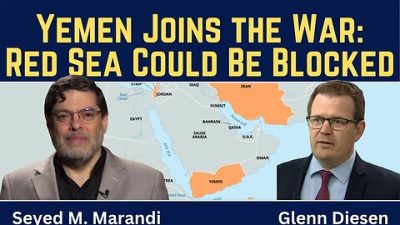
Yemen joins the war – Red Sea could be blocked next – Saudi regime at risk
or go to
Aletho News Archives – Video-Images
From the Archives
Should Europeans ‘Thank’ the Americans for Destroying Nord Stream?
By Robert Bridge | Strategic Culture Foundation | September 29, 2022
With an investigation continuing into the destruction of the Nord Stream gas pipeline that provided energy supplies to Europe from Russia, there appears to be just one prime suspect, and that should surprise nobody.
Following the sabotage of the Nord Stream 1 and 2 gas pipelines, former Polish Foreign Minister Radoslaw Sikorski already seemed to know the identity of the perpetrator when he tweeted out: “Thank you, USA.”
At first glance, it seemed that Sikorski was speaking sarcastically, berating Washington for carrying out an attack that will have severe repercussions for the people of Europe. After all, how could anyone see any good coming from the termination of Europe’s primary source of gas reserves with winter just around the corner? It was Sikorski’s homeland of Poland, after all, that urged its citizens to collect firewood in the face of dwindling gas reserves.
In fact, the Polish diplomat was speaking one-hundred percent literally… continue
Blog Roll
 Aletho News
- US should start removing its troops for Germany, proposes AfD co-leader Chrupalla
- Iran Red Crescent: 600 educational centers attacked in US-Israeli ‘war crimes’
- Russian Oil Tanker Arrives in Cuba Amid U.S. Blockade
- America Racing to Strategic Defeat in Iran: Lt Col Daniel Davis
- FTC Warns Visa, Mastercard, PayPal, Stripe Over Political Debanking
- Russian tanker approaches Cuba despite US oil blockade
- Marandi: Yemen joins the war – Red Sea could be blocked next – Saudi regime at risk
- Pro-Palestinian French member of European Parliament denied entry to Canada
- Pakistan to Host US-Iran Talks
- How Indonesia’s tilt toward the US left it stranded in the Strait of Hormuz
- If Americans Knew
- Israeli police block Catholic cardinal from entering Church of the Holy Sepulchre on Palm Sunday
- Israel is assassinating journalists again, more than any other nation, anywhere, ever – Not a ceasefire Day 170
- Over 300 US service members wounded, majority have brain injuries – Not a ceasefire Day 169
- Researchers at Human Rights Watch Resign Over Blocked Report on Palestinian Refugee Return
- Jewish Groups Are Backing a War Americans Don’t Want
- Eric Fingerhut Thinks He’s the President of the Jews
- Top Jewish Philanthropists, Rabbis Urge Israeli President to Take Action Against ‘Jewish Extremists’
- Don’t Be Fooled. Zionist Leaders Have Always Wanted to Control Southern Lebanon
- Israel’s widespread use of torture is a core element of its genocide against the Palestinian people
- In Israel’s War on Iran, Many Middle East US Bases Rendered “All But Uninhabitable”
- No Tricks Zone
- New Study Finds Warming Saves Lives…Cold Temperatures 12 Times More Deadly Than Excess Heat
- German Science Blog Accuses PIK Climate Institute Of Hallucinating Climate Tipping Points
- Devastating Assessment Of Comirnaty Vaccine By Former Senior Pfizer Europe Toxicologist
- New Study: CO2 Is ‘Effectively Negligible’ As An Explanatory Climate Change Factor Since 2000
- Former Pfizer Toxicologist Dr. Helmut Sterz Tells Bundestag Hearing Pfizer Vaccine Should Have Never Been Approved
- Energy Expert: Germany’s Nuclear Phaseout Was A “500 Billion Euro Mistake”
- New Research: South Australia’s Mid-Holocene Sea Surface Temperatures Were 4°C Warmer Than Today
- Storing Green Energy To Last Germany 10 Days Would Require A 60-Million Tonne Battery
- New Studies: UK Sea Levels Were 4 Meters Higher Than Today During The Mid-Holocene
- Destructive Green New Deal: German Energy And Metal Group Warns Of Drastic Crisis
 Aletho News