Aid as ambush: The horrifying new face of Israel’s Gaza war
By Eva Bartlett | RT | June 30, 2025
For nearly 630 days, the world has watched the Israeli slaughter of Palestinians in Gaza, primarily by bombing, sniping, and starvation. Off-camera, we’ve read about the rape and torture of Palestinian hostages, including the torturing to death of three doctors from the enclave.
For the last 100 days, Israel has reinforced a full blockade on Gaza, depriving starving Palestinians of food, drinking water, medicines, and fuel – meaning ambulances cannot function. This is following prior blockades last year, and the overall blockade of the strip, which has lasted over 17 years.
Since late May, we’ve been seeing horrific video footage of skeletal Palestinians lined up hoping for food aid being gunned down by US mercenaries and Israeli soldiers.
Israel has endlessly bombed Palestinians, destroyed hospitals and abducted doctors and patients. It has bombed churches, schools, UN centres and tents housing displaced Palestinians – in supposed “safe zones” where they were ordered by the Israeli army to flee to. It has killed over 200 journalists and deliberately targeted medics. To those only paying attention recently, these crimes go back decades, and extend to the Israeli army and illegal colonists’ crimes against Palestinian civilians, including children, in the West Bank. Add to this the Israeli bombardment of civilian areas of Lebanon and Syria over the years, and now Israel’s recent unprovoked bombings of Iran.
Suffice it to say that when Israel came under the barrage of Iranian retaliatory missiles, reports of some 30 Israeli civilians suffering panic attacks garnered little sympathy.
Again, those who have been paying attention for longer than two years would also recall previous Israeli wars on Gaza, like in 2014, when Israelis gathered with drinks and snacks on hillsides to rejoice in the bombing of the enclave, or the 2009 t-shirts celebrating snipers killing pregnant women with the phrase “one shot, two kills”.
In 2010, when writing about a traumatized 10 year old I’d met who could no longer walk normally nor speak after the terror of having Israeli tanks shelling his home, I cited a study by the Gaza Community Mental Health Programme which stated that “91.4 percent of children in Gaza displayed symptoms of moderate to very severe PTSD.”That was fifteen years and numerous Israeli wars on Gaza ago.
The US-Israeli “humanitarian” death traps
The killing of Palestinians in Gaza didn’t stop when Israel attacked Iran. The most insidious new invention is the recently-created US-Israeli “aid” group, the Gaza Humanitarian Foundation (GHF). The Israeli authorities accuse Hamas of stealing aid, and based on this unproven accusation, have deemed that long-established UN aid agencies could no longer operate in Gaza, insisting instead that a group staffed with armed combat veterans (mercenaries is a better word) is better equipped to ensure that food reaches famished Palestinians.
It is outrageous that in spite of some media coverage, Israel has been allowed to for months (over a year, really) block the entrance of thousands of aid trucks amassed outside of Gaza, only to then dictate that hired gunmen would be in charge of “distributing aid.”
The massive irony and duplicity is that even Israeli and Western media have reported on the actual thieves of aid in Gaza: not Hamas, but an ISIS-linked group under the protection of the Israeli army.
As the independent media outlet The Cradle reported, the group’s leader, Yasser Abu Shabab, “is a known leader of armed gangs linked to ISIS and involved in looting aid under Israeli protection… Multiple reports, including from Haaretz and The Washington Post, confirm that these gangs have been seen looting in full view of Israeli forces, who neither intervene nor prevent the theft.”
In a subsequent post, The Cradle cited the Israeli Army Radio as reporting: “Israel has transferred weapons to members of the militia…The militia operates mainly in the Rafah area, which the Israeli army has occupied and cleared. The militia’s tasks include preventing humanitarian aid from entering Gaza and fighting Hamas.”
What is apparently happening is that starved Palestinians, after walking many kilometres to the distribution sites, are then corralled into tight enclosures and fired upon by the “aid” mercenaries.
Jonathan Whittall, the Head of the UN Office for the Coordination of Humanitarian Affairs in the Occupied Palestinian Territory (OCHA) described the situation as “conditions created to kill, carnage, weaponized hunger, a death sentence for people just trying to survive.”
In a clip posted on June 23, Whittall said, “Israeli authorities are preventing us from distributing through these systems that we’ve established and that we know work. We could reach every family in Gaza, as we have in the past, but we’re prevented from doing so at every turn.”
More recently, UN Secretary-General Antonio Guterres echoed Whittall, saying: “Any operation that channels desperate civilians into militarized zones is inherently unsafe. It is killing people. People are being killed simply trying to feed themselves and their families. The search for food must never be a death sentence.” The UN’s own humanitarian efforts are being “strangled” by Israel, he said, and even the aid workers themselves are starving.
The aid-seeking civilians are reportedly being shot in the head and chest, in what looks more like execution than “warning shots” or “crowd control”.
The victims include an 18-month old girl whose X-ray shows a bullet lodged in her chest. According to Ramy Abdu, Chairman of the non-profit Euro-Med Human Rights Monitor, the girl was shot while in her mother’s arms on the way to a GHF aid point.
As far back as last July, an article in The Lancet warning that the total number of Palestinian civilian deaths caused directly and indirectly by Israeli attacks since October 2023 could reach “up to 186,000 or even more.”Other estimates were even more grim, include that of Norwegian Dr. Mads Gilbert, who has worked extensively from Gaza over the years, who said the number of those dead or soon to die could be over 500,000.
Fast forward to a recent report by Yaakov Garb of Ben-Gurion University, published via the Harvard Dataverse. It describes the false aid distribution design as, “all adjacent to Israeli military installations… manned by armed combat veterans backed by Israeli soldiers. The design creates a ‘chokepoint’ or ‘fatal funnel’ – a predictable movement path from a single entry to a single exit with no cover or concealment.”
It is the graphic on page five which caught people’s attention. From a population of 2.2 million before the genocide, the graph only accounts for 1.85 million, leaving many asking, where are the remaining 350,000 people? This makes the concerns voiced a year ago more valid.
In his report, Yaakov Garb wrote, “The Israeli military has an obligation, as the occupying power in Gaza, to supply the population with humanitarian relief… If an attacker cannot adequately and neutrally feed a starving population in the wake of a disaster it is ongoingly creating, it is obligated to allow other humanitarian agencies to do so.”
But instead, every day we see new horrors of emaciated Palestinian civilians desperately braving death in hopes of securing food for their families… and being gunned down by the Israeli army and the mercenaries it backs.
It seems, at least, that these actions are finally catching up with Israel, meaning a lack of support for or trust in the state or its representatives, and a global demand for justice for Palestinians.
To cite Craig Mokhiber, a human rights lawyer and former senior UN Human Rights official, who posted recently on X:
“The (Israeli) regime is on trial for genocide. Its leaders are indicted for crimes against humanity. Israel is isolated. The regime is now almost universally despised, just as the Nazi and apartheid regimes were despised. People across the world stand overwhelmingly with Palestine. You don’t come back from apartheid & genocide.”
Eva Bartlett is a Canadian independent journalist. She has spent years on the ground covering conflict zones in the Middle East, especially in Syria and Palestine (where she lived for nearly four years).
Syria’s Jolani is a US-Israeli ‘intelligence tool’ working to advance their interests: Activist
By Sally Ahmed | Press TV | July 1, 2025
Abu Mohammed al-Jolani, the head of the Hay’at Tahrir al-Sham (HTS)-led regime in Damascus, is a US-Israeli “intelligence tool” working to advance their interests, according to a Syrian political activist.
In an interview with the Press TV website, activist Mohammed al-Jajeh described the situation in Syria roughly six months after the collapse of the Assad government as “catastrophic by all measures” and said “no one” in the country, including ethnic and religious minorities, is safe.
The country, he said, has descended into “a dangerous slide into chaos,” marked by “ethnic and sectarian purges,” particularly targeting minorities such as Alawites, Christians, Ismailis, Shias, and even moderate Sunni Muslims.
Al-Jajeh noted that members of the former Syrian president’s Alawite sect have been subjected to a “fierce campaign of revenge,” citing reports of “horrific” massacres in Syria’s western coastal region.
Among the incidents he referenced was the killing of more than 70 civilians in the village of Ain al-Tinah, adding that thousands of Alawites have been forcibly displaced, with their homes and properties seized in the provinces of Tartus and Latakia.
‘Minorities as easy targets’
In reference to pledges made by the HTS regime to uphold the rights of religious and ethnic minorities, the Sweden-based Syrian political activist dismissed those promises as “empty.”
“Christians have become easy targets for militias and extremist Salafi groups,” he said, referring to the latest attack on Mar Elias church in Damascus.
On June 22, a man with a rifle entered the church and shot at worshippers, killing 25 people and wounding dozens of others, before blowing himself up.
The activist said Christians’ homes have been ransacked and monasteries have been looted, adding that cases of abductions among Christians and mass exodus from towns like Maaloula and Sednaya have been reported, due to the inaction of the Jolani regime.
Al-Jajeh noted that people from the Ismaili sect have also been a target for kidnappings and attacks since Assad’s fall, adding that a civil activist named Hilal Samaan was assassinated “just for calling for coexistence”.
Speaking about the violence targeting Shia Muslims, al-Jajeh said that sectarian killings have become routine. Individuals are often questioned about their religious affiliation at checkpoints, and in some cases, he noted, they are killed solely because of their names or how they pronounce certain words.
He added that even moderate Sunni Muslims, who make up the majority of Syria’s population, are not spared from violence and intimidation.
According to al-Jajeh, religious scholars and preachers who oppose extremism or foreign intervention have been either assassinated or forcibly removed from their mosques.
Stressing that the state “has collapsed”, al-Jajeh said “the institutions are absent, the law is not enforced, and power is divided among warring factions, some of which are loyal to Turkey and some others to the [Persian] Gulf [Arab] states and foreign militant groups of various nationalities.”
Since Assad’s fall, the activist said, rights groups have recorded “more than 1,200 sectarian violations”, “over 30,000 people” have been trapped in prisons with an unknown fate and “more than 5,000” abducted girls have been taken as captives.
“Syria after Assad: No one is safe,” he emphasized.
‘Jolani is a trained agent’
Amid Israel’s expansion of its occupation into Syrian territories beyond the already-occupied Golan Heights following the fall of the Assad government, al-Jajeh said this further proves Jolani is merely an American-Israeli intelligence asset, positioned in Syria to advance a broader agenda.
Referring to Jolani’s public statements expressing a willingness to normalize relations with Israel and declaring that his top priority is fighting the former Syrian government.
“This is the language of a trained agent who knows what the West wants to hear, and sends reassuring messages to Tel Aviv,” he stated.
Al-Jajeh emphasized that Jolani, who was previously affiliated with al-Qaeda and Daesh, is ultimately “just a tool” and “a minor detail” in what he described as the U.S.-led project for a “new Middle East.”
“Abu Mohamad al-Jolani is neither a revolutionary, a rebel, nor a warlord. He is a carefully trained American-Israeli intelligence tool, speaking in measured language and acting within defined boundaries,” he remarked.
Despite Jolani’s offer to normalize ties with Israel, the activist noted that the regime continues to attack Syria because it “knows its real size and continues to strike Syria because it simply despises the agents even if they serve it.”
‘It’s a gang, not an army’
Commenting on the Jolani regime’s plan to incorporate thousands of foreign Takfiri militants into the country’s new military, al-Jajeh said this move is aimed at tightening Jolani’s grip on power, slamming it as “the most dangerous, unannounced demographic change process”.
The activist said the decision comes as the new ruler “doesn’t trust the Syrian people” and seeks to recruit foreigners “who don’t speak Arabic, don’t know the geography [of the country] and have not any belonging to the territory” to just carry weapons and “obey his orders without question”.
He described those militants as “tools ready for killing, in exchange for salaries, housing and insurance”.
“This army is not built to protect Syria, but to protect the ruler from the Syrians themselves.”
To stay in power, the activist said Jolani aims to create “a personal army that owes him complete loyalty” and “does not hesitate to open fire at Syrians simply because they are not ‘one of them’.”
“Whoever brings in strangers to rule over their people does not run a state; rather, they run a gang, that’s waiting for the moment of explosion,” he added.
‘Syria as part of new regional deal’
Commenting on recent remarks by Turkey’s defense minister where he announced that Ankara has no immediate plans to withdraw from Syria, al-Jajeh said this is “a declaration of actual occupation and a direct message stating: ‘This land is no longer yours, but it has become part of the new regional deal’.”
The activist referred to the role played by Turkey in the foreign-backed militancy that erupted in Syria in 2011, saying Ankara “was not a ‘supporter of the revolution’ as it claimed, but rather one of its architects”. This was “tailored to its national interests”, he added.
Al-Jajeh noted that Turkey facilitated the passage of thousands of foreign militants into Syria in the very early days of the militancy, allowed the entry of weapons to the al-Nusra Front, trained the Takfiri militants in camps on its territory, and provided them with medical and logistical support.
“What is happening today is a clear implementation of a soft partition plan,” he stated.
Al-Jajeh also referred to “the imposition of Turkish education” in the schools of Idlib, Afrin and al-Bab, the raising of Turkish flags in institutions, the changing of streets names to Turkish names, the issuance of temporary identity cards to residents, the use of Turkish language in administrative dealings, and the establishment of large military bases in Aleppo.
“These are not emergency measures to protect ‘the borders’, but rather complete practices of political and administrative occupation,” he said.
The security situation in Syria remains tenuous after militant factions, led by HTS, toppled President Assad’s government and took control of Damascus on December 8, 2024.
Israeli army expands Syria occupation with new base in Quneitra
The Cradle | July 1, 2025
Local sources in southern Syria say Israeli forces have established a new base on Eastern al-Ahmar hill in Quneitra governorate, according to a report by Lebanese daily Al-Akhbar published on 1 July.
The hill lies adjacent to a nearby Israeli base established months earlier on the western side of the same ridge.
Local tribal sources told Al-Akhbar that Israeli forces are “rapidly working to turn it into a key operational hub,” prompting fears among residents of a repeat of the destruction in al-Hamidiyah, where on 17 June, troops demolished 16 homes.
A UN Disengagement Observer Force (UNDOF) patrol arrived ten days later only to assess the damage.
Israeli troops have also begun building a new outpost near Beer Ajam and stepped up patrols inside Syrian villages, including Abu Madrah farm near Saida al-Golan.
Roads connecting villages within the Quneitra buffer zone have been destroyed, raising concerns that Israel intends to impose de facto borders. Residents now face the choice of fleeing or living under occupation.
The occupation has spread to other parts of southern Syria, including Hader and Mount Barbar, while UN forces remain confined to passive observation. The fate of 22 detained Syrians remains unknown, with UNDOF reportedly telling local officials that their release “depends on broader peace negotiations.”
The expansion comes as Israeli officials openly link normalization with Syria to retaining control of occupied territory, with Foreign Minister Gideon Saar declaring on 30 June that Tel Aviv “will not withdraw from the Syrian [Mount] Hermon (Jabal al-Sheikh).”
This followed National Security Advisor Tzachi Hanegbi’s admission of ongoing daily talks with the Damascus government.
A day earlier, US President Donald Trump lifted most sanctions on Syria, citing the “positive actions” of the new government under Ahmad al-Sharaa, formerly the leader of Al-Qaeda’s Syrian branch. Conditions reportedly included normalization with Israel and the expulsion of Palestinian factions.
According to Israel’s Channel 12, an imminent Israeli-Syrian security agreement is expected to include several key components: an update to the 1974 disengagement agreement signed following the 1973 October War, intelligence coordination between Syria and Israel aimed at countering Iranian and Hezbollah activity in southern Syria, an Israeli acknowledgment of the Syrian identity of the Shebaa Farms, and a potential trilateral arrangement involving Jordan regarding the waters of the Yarmouk Basin.
Settlers as human shields: Israel’s militarization of civilian areas in Tel Aviv and Haifa
Press TV | July 1, 2025
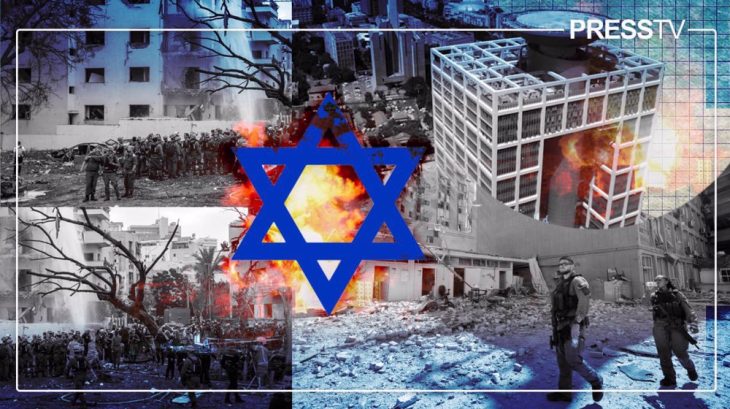
The recent Iranian retaliatory strikes against the Israeli regime as part of Operation True Promise III have cast a spotlight on a longstanding and notorious military strategy: the placement of critical military facilities deep within densely populated ‘civilian’ areas.
Reports and field evidence from the retaliatory strikes that inflicted heavy and irreparable blows on the regime again point to the fact that the regime uses settlers as human shields.
In a report published Sunday, the Israeli newspaper Haaretz acknowledged that Iranian missile strikes during the 12-day war imposed by the regime targeted only Israeli military installations.
However, the report noted that many of these facilities are deeply embedded within civilian areas, referring to illegal settlements mostly in Tel Aviv and Haifa.
One key example cited was the Kirya, Israel’s central military headquarters in Tel Aviv.
Tel Aviv: The Kirya Complex in a ‘civilian’ maze
The Kirya military-intelligence complex in central Tel Aviv was among the first and most significant targets hit by Iranian missiles late on June 13, hours after the Israeli regime carried out an unprovoked and unlawful aggression on Iranian soil, leading to the assassination of many senior military commanders, scientists and ordinary civilians.
Often referred to as the “Israeli Pentagon,” the Kirya houses the ministry of war affairs, military intelligence offices, and various covert installations used in war against Iran, Lebanon and Gaza.
These are concealed in high-rise buildings that are civilian or semi-civilian in nature.
Despite being heavily fortified and protected by multilayered Israeli-American air defense systems, the Kirya was struck early during Iran’s True Promise III operation.
Foreign journalists confirmed damage to towers in the area, even as Israeli media censored coverage under regime pressure. Leaked footage from an Israeli settler showed plumes of smoke and audible panic – “They hit the Mossad!” exclaimed the witness.
Military facilities in settlements
Kirya is located in one of Tel Aviv’s most densely populated districts. Beneath its surface lie numerous underground military facilities, identified by Iranian intelligence following Tehran’s acquisition of sensitive Israeli military and intelligence data in early June.
The district includes:
- Matcal Tower – Headquarters of top Israeli military leadership
- Marganit Tower – Home to strategic communications operations
- The Bor (“The Pit”) – A heavily fortified underground command center.
These installations are surrounded on all sides by settler infrastructure, including residential buildings, schools, and commercial zones, blurring any clear separation between military and non-military zones, as a deliberate strategy to use settlers as civilian shields.
Haifa: Ports, bases, and civilians intertwined
As in Tel Aviv, Haifa’s strategic military assets are tightly interwoven with ‘civilian’ life.
The most prominent is the Haifa Naval Base, home to the regime’s Mediterranean fleet and submarine corps. Located on the northwest side of Haifa’s busy port complex, the base sits amid one of Israel’s most important economic and ‘civilian’ hubs.
Recent months have seen most maritime traffic rerouted from Eilat to Ashdod and Haifa, further increasing the ‘civilian’ presence around these strategic assets.
Residential conversion of military zones
The Bahad 600 naval training base has undergone rapid conversion into a residential area, with new apartment blocks and even a children’s hospital constructed adjacent to operational military facilities. This proximity exemplifies the ongoing militarization of ‘civilian’ areas.
To the north lies the Rafael Advanced Military Systems complex, covering several square kilometers. It produces Iron Dome and David’s Sling missile systems, cruise missiles, and armored vehicle solutions.
Surrounding this are major industrial zones, Kiryat Nahum, Kiryat Ata, and Nesher, which combine military functions with chemical, cement, and energy industries. For example:
- Haifa refinery: Processes two-thirds of the Israeli regime’s oil supply.
- Nesher cement plant: Supplies 60 percent of the regime’s domestic cement needs.
- Communications antenna at Giv’at HaHagan: A key hub linking northern military commands with Tel Aviv.
Mount Carmel’s militarized natural reserve
The most notorious site is the Mishmar military base, constructed within the protected Mount Carmel National Park. It features visible radars and Iron Dome missile platforms.
The base lies just 300 meters from the University of Haifa’s student dormitories. borders archaeological sites and sanctuaries and is built amid sensitive ecological zones and hiking trails.
Among these historical and religious sites is Derech HaDorot (Road of the Millennia), an open-air museum with Bronze Age and Roman structures and Hurshat HaArba’im (Grove of the Forty), a sacred site for the Druze community.
Despite its cultural and environmental sensitivity, the Mishmar site is now heavily militarized, showcasing the regime’s prioritization of military over the safety of settlers or heritage preservation.
US Bombing of Iran Harms Non-Proliferation
By Ted Snider | The Libertarian Institute | July 1, 2025
Iran didn’t violate the Nuclear Non-Proliferation Treaty (NPT), the United States did. When the U.S. bombed Iran’s civilian nuclear facilities on June 23, they didn’t just violate the cardinal rule of international law by attacking a sovereign nation, without Security Council approval, that had neither attacked it nor threatened to attack it. They also violated the NPT. In doing so, the U.S. may have done irreparable harm to the non-proliferation regime.
As a signatory to the Nuclear Non-Proliferation Treaty, Iran was protected by the “inalienable right to a civilian [nuclear] program.” Iran and the world watched, not only as that nonnuclear umbrella collapsed and failed to protect Iran, but as the International Atomic Energy Agency (IAEA), the guardian of the non-proliferation regime, whispered barely a criticism. Iran’s parliamentary speaker has criticized the IAEA for having “refused to even pretend to condemn the [American] attack on Iran’s nuclear facilities.”
Iran has accused IAEA director general Rafael Grossi of issuing a “biased” report on Iran’s nuclear program right as Trump’s sixty day window for diplomacy was closing that could be used as a “pretext” for the attacks on Iran’s nuclear facilities. The U.S. was complicit in using the resolution that followed the report, since only 19 out of 33 countries voted in favor of it after the U.S. pressured eight countries they saw as “persuadable… to either vote with the US on the IAEA vote or not vote at all.”
After Grossi clarified that the IAEA “did not find in Iran elements to indicate that there is an active, systematic plan to build a nuclear weapon” and concluded that “We have not seen elements to allow us, as inspectors, to affirm that there was a nuclear weapon that was being manufactured or produced somewhere in Iran,” Iranian foreign ministry spokesman Esmaeil Baghaei said the clarification came “too late.” He blasted Grossi for “obscure[ing] this truth in your absolutely biased report that was instrumentalize by E3/U.S. to craft a resolution with baseless allegation of ‘non-compliance’; the same resolution was then utilized, as a final pretext… to launch an unlawful attack on our peaceful nuclear facilities.” Baghaei finished with the accusation that Grossi “betrayed the non-proliferation regime.”
On June 20, Iran filed a formal complaint against Grossi to the Security Council, accusing him of a “clear and serious breach of the principle of impartiality.” Iran’s Ambassador to the UN, Amir Saeed Iravani, criticized Grossi’s failure to condemn American and Israeli threats and use of force against its peaceful nuclear program as demanded by IAEA resolutions “which categorically prohibit any threat or use of force against nuclear facilities dedicated to peaceful purposes.” He said that Grossi’s “passivity… amounts to de facto complicity.”
On June 25, the Iranian parliament approved a bill suspending – but not yet terminating – its cooperation with the IAEA. Parliamentary speaker Mohammad Baqer Qalibaf explained the passage of the bill by saying that the IAEA “has put its international credibility up for sale” because it “did not even formally condemn the attack on Iran’s nuclear facilities.” “For this reason,” he said, “the AEOI [the Atomic Energy Organization of Iran] will suspend its cooperation with the Agency until the security of its nuclear facilities is guaranteed.”
The next day, the Guardian Council approved the bill. The spokesperson for the Council said that “considering… the attacks carried out… against the peaceful nuclear facilities of our country… the government is obliged to suspend any cooperation with the IAEA until the principles ensuring… the security of nuclear scientists’ centers and ensuring the inherent rights of the Islamic Republic of Iran to benefit from all rights stipulated in Article 4 of the Treaty on the Non-Proliferation of Nuclear Weapons, particularly concerning uranium enrichment.” Having been approved by the Guardian Council, Iran’s Foreign Minister, Abbas Araghchi, says the bill is now “binding.” That means, he says, that “From now on, our relationship and cooperation with the [IAEA] will take a new form.”
The great risk now is that Iran could withdraw from the NPT altogether. When I asked former Iranian nuclear negotiator [ret] Ambassador Seyed Hossein Mousavian if this failure of the NPT might move Iran to withdraw from the treaty, he answered, “Perhaps Iran does not rush to withdraw but ultimately this could be a serious option.”
Having its legal nuclear facilities bombed by a nuclear power who is a signatory to the NPT could convince Iran that membership in the NPT is harmful to it. Mousavian has pointed out that countries that did develop nuclear weapons – which Iran did not – outside of the NPT “have remained immune from military attacks.” Trump and the U.S. have not bombed North Korea. “It is only natural that following the military attack,” Mousavian writes, “Iran would reconsider its nuclear strategy, including its continued membership in the NPT.” And that, Ali Vaez, director of the Iran Project at the International Crisis Group, says “is quite likely.”
The danger is that the American bombing could eliminate a civilian nuclear program that was operating under the watchful international eye of an unprecedented inspection regime with one that is rebuilt entirely out of the eyes of international inspectors.
Sina Toossi, senior non-resident fellow at the Center for International Policy, told me that “far from neutralizing Iran’s nuclear capabilities, the war may have pushed Tehran closer to covert weaponization under a hardened doctrine.”
Withdrawal from the NPT would not entail that Iran has made the decision to build a nuclear weapon. Blinding the international community, led by the United States, may be seen by Iran as the only viable strategy for reconstituting a civilian nuclear program that would otherwise be bombed each time it reemerged.
The decision by the Trump administration to drop bunker buster bombs on Iran’s legal, civilian nuclear facilities, whether it “severely damaged” them, “obliterated” them or merely “set them back,” is that much more than the nuclear facilities were damaged. Under the guise of preventing nuclear proliferation in Iran, the U.S. may have so discredited the NPT that they have “severely damaged” and “set back” the world’s hard won non-proliferation regime.
Ted Snider is a regular columnist on U.S. foreign policy and history at Antiwar.com and The Libertarian Institute. He is also a frequent contributor to Responsible Statecraft and The American Conservative as well as other outlets. To support his work or for media or virtual presentation requests, contact him at tedsnider@bell.net
OPCW members condemn Israeli attack on Iran’s chemical facilities
Press TV – July 1, 2025
A majority of the member states of the Organization for the Prohibition of Chemical Weapons (OPCW) has condemned Israel’s recent acts of aggression against Iranian chemical and industrial facilities.
The condemnation was issued during a special session of the OPCW Executive Council in The Hague, convened at Iran’s request.
At the session, Hadi Farajvand, Iran’s ambassador to the Netherlands and permanent representative to the OPCW, highlighted the killing of women and children, scientists, and civilians, as well as the targeting of research centers, including petrochemical facilities and chemical research centers.
He cited the harm to civilians, the risk of chemical substance release, environmental damage, and threats to critical infrastructure.
Farajvand underscored a series of violations by the Israeli regime, including breaches of humanitarian law, disregard for international legal norms, violations of peremptory norms (jus cogens), failure to adhere to any treaties or conventions on weapons of mass destruction, and a record of attacks on chemical facilities in Syria and Lebanon.
During the session, Iran’s ambassador proposed that the OPCW Executive Council establish a working group aimed at adopting binding decisions to prevent attacks on chemical facilities during conflicts and called for appropriate measures to be taken in this regard.
During the 12-day aggression by the Israeli regime against Iran, several chemical facilities and fuel storage sites were targeted, resulting in significant environmental damage.
Iran unity foils West plans for regime change: Responsible Statecraft

Al Mayadeen | July 1, 2025
Washington is now looking into dividing Iran, with neo-conservative think tanks openly promoting the Balkanization of Iran, a strategy that is bound to destabilize Iran and the region, according to Responsible Statecraft on Tuesday.
United States foreign policy has a troubling tendency to promote the fragmentation of nations it deems adversarial.
Now, neoconservative think tanks like the Foundation for Defense of Democracies (FDD) and their allies in the European Parliament are openly pushing for Iran’s disintegration, a reckless strategy that would further destabilize the Middle East, trigger catastrophic humanitarian crises, and provoke fierce resistance not only from Iranians but also from US partners in the region.
Think tanks push for fragmentation based on ethnicity
Amid the war “Israel” waged on Iran in mid-June, FDD analyst Brenda Shaffer posited that Iran’s ethnically diverse population structure presented an exploitable strategic weakness.
According to Responsible Statecraft, Shaffer advocated for the disintegration of Iran along ethnic divisions, drawing parallels to the breakup of Yugoslavia, while concentrating significant efforts on fostering separatist movements in Iranian Azerbaijan, home to Iran’s largest ethnic minority group, the Azeris. However, she consistently failed to acknowledge her ties to the Azeri state oil company SOCAR.
Her position mirrors a recent Jerusalem Post editorial that, during the initial wave of triumphalism following “Israel’s” strikes in this month’s war on Iran, urged Trump to publicly endorse the dismemberment of Iran.
The editorial specifically advocated for forming a “Middle East coalition for Iran’s partition” while proposing “security guarantees for Sunni, Kurdish and Balochi minority regions seeking independence,” in addition to previously endorsing US and Israeli support for the secession of northwestern Iran’s Azeri-majority areas referred to as “South Azerbaijan” from Iran.
Popular uprising or scenarios for regime change?
Meanwhile, a foreign affairs spokesperson representing a centrist liberal faction within the European Parliament organized a discussion forum titled “The Future of Iran,” which while framed as an examination of potential pathways for what they termed a “successful” uprising against the current Iranian government, appeared to focus primarily on scenarios for regime change.
The panel’s composition featured only two Iranian speakers, both ethnic separatists from Azerbaijan and Ahwaz, revealing the organizer’s true agenda: promoting regime change.
Since unilaterally cutting ties with Iran’s official institutions in 2022, the European Parliament has become a platform for fringe exiled groups. These include monarchists, the controversial MEK (Mujahedin-e Khalq), and ethnic separatists, all of whom now operate with growing visibility in EU political spaces.
Delusions of division
What these think tanks and organizations forget, Responsible Statecraft highlighted, is that Iran is not a fragile country on the brink of collapse; it is a 90-million-strong country with a deep sense of historical and cultural identity.
While the proponents of the Balkanization of Iran focus on the ethnicities in Iran, they underestimate the unifying effect of Iranian nationalism on these diverse groups.
Shervin Malekzadeh, a scholar who recently wrote in the Los Angeles Times, observed that academic research overwhelmingly recognizes Iranian politics as fundamentally rooted in a profound, enduring national identity.
This identity transcends the country’s internal ideological divides, which means Iran’s political dynamics unfold within this unifying framework of nationalism, which has shaped all major factions, from monarchists to Islamists to leftists.
Foreign pressure only made Iran more united
Moreover, decades of foreign pressure, sanctions, covert ops, and war have only hardened Iran’s unity, making the separatist approach dangerously naive; this approach, pushed heavily by pro-“Israel” neocons, already failed in Iraq and Syria, leaving chaos instead of victory.
This approach further demonstrates its advocates’ glaring disregard for actual conditions, as seen with Shaffer, a leading proponent of Azerbaijani irredentism, who even applauded Israeli strikes on Tabriz, the cultural and economic center of Iranian Azerbaijan.
Beyond being morally reprehensible, this strategy fundamentally misreads Iran’s domestic realities, with Shaffer and like-minded advocates operating under the flawed assumption that increased external pressure on Tehran would spark rebellions among Azeris and other minority groups against the central government.
Contrary to separatist expectations, “Israel’s” recent attack produced the same rally-around-the-flag effect seen across Iran, demonstrating how deeply Iranian Azerbaijanis are woven into the national fabric, as evidenced by the fact that both the country’s highest officials, Iranian Leader Sayyed Ali Khamenei and President Massoud Pezeshkian, are of Azeri heritage.
Spying on Iran: How MI6 infiltrated the IAEA
Leaked confidential files indicate the IAEA was infiltrated by a veteran British spy who has claimed credit for sanctions on Iran
By Kit Klarenberg | The Grayzone | July 1, 2025
A notorious British MI6 agent infiltrated the International Atomic Energy Agency (IAEA) on London’s behalf, according to leaked documents reviewed by The Grayzone. The agent, Nicholas Langman, is a veteran intelligence operative who claims credit for helping engineer the West’s economic war on Iran.
Langman’s identity first surfaced in journalistic accounts of his role in deflecting accusations that British intelligence played a role in the death of Princess Diana. He was later accused by Greek authorities of overseeing the abduction and torture of Pakistani migrants in Athens.
In both cases, UK authorities issued censorship orders forbidding the press from publishing his name. But Greek media, which was under no such obligation, confirmed that Langman was one of the MI6 assets withdrawn from Britain’s embassy in Athens.
The Grayzone discovered the résumé of the journeyman British operative in a trove of leaked papers detailing the activities of Torchlight, a prolific British intelligence cutout. The bio of the longtime MI6 officer reveals he “led large, inter-agency teams to identify and defeat the spread of nuclear, chemical and biological weapons technology, including by innovative technical means and sanctions.”
In particular, the MI6 agent says he provided “support for the [IAEA] and Organization for the Prohibition of Chemical Weapons [OPCW] and through high level international partnerships.”
Langman’s CV credits him with playing a major role in organizing the sanctions regime on Iran by “[building] highly effective and mutually supportive relations across government and with senior US, European, Middle and Far Eastern colleagues for strategy” between 2010 and 2012. He boasts in his bio that this achievement “enabled [the] major diplomatic success of [the] Iranian nuclear and sanctions agreement.”
The influence Langman claimed to have exerted on the IAEA adds weight to Iranian allegations that the international nuclear regulation body colluded with the West and Israel to undermine its sovereignty. The Iranian government has alleged that the IAEA supplied the identities of its top nuclear scientists to Israeli intelligence, enabling their assassinations, and provided critical intelligence to the US and Israel on the nuclear facilities they bombed during their military assault this June.
This June 12, under the direction of its Secretary General Rafael Grossi, the IAEA issued a clearly politicized report recycling questionable past allegations to accuse Iran of violating the Non-Proliferation Treaty. Three days later, Israel attacked the country, assassinating nine nuclear scientists as well as numerous top military officials and hundreds of civilians.
Iranian former Vice President for Strategic Affairs Javad Zarif has since called for the IAEA’s Grossi to be sacked, accusing him of having “abetted the slaughter of innocents in the country.” This June 28, the Iranian government broke ties with the IAEA, refusing to allow its inspectors into the country.
While Iranian officials may have had no idea about the involvement of a shadowy figure like Langman in IAEA business, it would likely come as little surprise to Tehran that the supposedly multilateral agency had been compromised by a Western intelligence agency.

Langman’s name placed under official UK censorship order
In 2016, Langman was named a Companion of the Order of St Michael and St George, the same title bestowed on fictional British spy James Bond. By that point, the supposed secret agent held the dubious distinction of being publicly ‘burned’ as an MI6 operative on two separate occasions.
First, in 2001, journalist Stephen Dorril revealed that Langman had arrived in Paris weeks prior to Princess Diana’s fatal car crash in the city on August 31 1997, and was subsequently charged with conducting “information operations” to deflect widespread public speculation British intelligence was responsible for her death.
Then, in 2005, he was formally accused by Greek authorities of complicity in the abduction and torture of 28 Pakistanis in Athens. The Pakistanis, all migrant workers, were suspected of having had contact with individuals accused of perpetrating the 7/7 bombings in London, July 2005.
Brutally beaten and threatened with guns in their mouths, the victims “were convinced their interrogators were British.” When Greek media named Langman as the MI6 operative who oversaw the migrants’ torture, British news outlets universally complied with a government D-notice – an official censorship order – and kept his identity under wraps when reporting on the scandal.
London vehemently denied any British involvement in torturing the migrants, with then-Foreign Secretary Jack Straw dismissing the charge as “utter nonsense.” In January 2006 though, London admitted MI6 officers were indeed present during the Pakistanis’ torture, although officials insisted the operatives played no active part in their arrests, questioning or abuse.
Following his withdrawal from Athens, Langman returned to London to head the UK Foreign Office’s Iran Department, a shift which highlights his importance to MI6 and suggests the British government had no qualms about his allegedly brutal evidence gathering methods.
Britain’s Foreign Office collaborates closely with MI6, whose agents use it as cover just as the CIA does with State Department diplomatic postings.
MI6’s man on Iran takes credit for “maximum pressure” strategy
While leading the Foreign Office’s Iran Department from 2006 – 2008, Langman oversaw a team seeking to “develop understanding” of the Iranian government’s “nuclear program.”
It’s unclear exactly what that “understanding” entailed. But the document makes clear that Langman then “generated confidence” in that assessment among “European, US and Middle Eastern agencies” in order to “delay programme [sic] and pressurise Iran to negotiate.” The reference to “Middle Eastern agencies” strongly implied MI6 cooperation with Israel’s Mossad intelligence services.
In April 2006, Tehran announced it had successfully enriched uranium for the first time, although officials denied any intention to do so for military purposes. This development may have triggered Langman’s intervention.
The Islamic Republic has rejected any suggestion it harbors ambitions to possess nuclear weapons. Its denials were corroborated by a November 2007 US National Intelligence Estimate expressing “high confidence that in fall 2003, Tehran halted” any and all research into nuclear weapons. This assessment remained unchanged for several years, and was reportedly shared by the Mossad, despite Benjamin Netanyhau’s constant declarations that Iran was on the brink of developing a nuclear weapon.
Langman’s IAEA support work overlaps with Iran sanctions blitz
International governmental attitudes towards Iran changed abruptly between 2010 and ‘12. During this period, Western states and intergovernmental institutions initiated an array of harshly punitive measures against the country, while Israel ramped up its deadly covert operations against Iran’s nuclear scientists.
This period precisely overlapped with Langman’s tenure at the Counter-Proliferation Centre of the UK Foreign Office. His bio implies he used this position to influence the IAEA and other UN-affiliated organizations to foment a campaign of global hostility towards Iran.
In June 2010, the UN Security Council adopted Resolution 1929, which froze the Iranian Revolutionary Guard Corps’ assets, and banned overseas financial institutions from opening offices in Tehran. A month later, the Obama administration adopted the Comprehensive Iran Sanctions, Accountability, and Divestment Act. This set off a global chain of copycat sanctions by Washington’s vassals, who often imposed even more stringent measures than those levied by the UN and US.
In March 2012, the EU voted unanimously to cut Iranian banks out of the SWIFT international banking network. That October, the bloc imposed the harshest sanctions to date, restricting trade, financial services, energy and technology, along with bans on the provision of insurance to Iranian companies by European firms.
BBC reporting on the sanctions acknowledged European officials merely suspected Tehran of seeking to develop nuclear weapons, but lacked concrete proof. And behind the scenes, the MI6 operative Langman was claiming credit for helping legitimize the allegations against Iran.
Nuclear agreement lays foundations for war
Following the Western-led campaign isolation of Iran from 2010 – 2012, over its purported nuclear weapon program, the Obama administration negotiated a July 2015 agreement known as the Joint Comprehensive Plan of Action (JCPOA). Under the JCPOA’s terms, the Islamic Republic agreed to limit its nuclear research activities in return for sanctions relief. In the years that followed, the IAEA was granted virtually unlimited access to Tehran’s nuclear complexes, ostensibly to ensure the facilities were not used to develop nuclear weapons.
Along the way, IAEA inspectors collected vast amounts of information on the sites, including surveillance camera photos, measurement data, and documents. The Iranian government has since accused the Agency of furnishing the top secret profiles of its nuclear scientists to Israel. These include the godfather of Iran’s nuclear program, Mohsen Fakrizadeh, who was first publicly named in a menacing 2019 powerpoint presentation by Israeli Prime Minister Benjamin Netanyahu. The following year, the Mossad assassinated Fakrizadeh in broad daylight with a remote-controlled machine gun.
Internal IAEA documents leaked this June indicated that IAEA Secretary General Rafael Grossi has enjoyed a much closer relationship with Israeli officials than was previously known, and suggested he leveraged his cozy ties with Tel Aviv to secure his current position.
During a June 24 interview with Fox News’ war-crazed anchor Martha MacCallum, Grossi did not deny making the inflammatory claim that “900 pounds of potentially enriched uranium was taken to an ancient site near Isfahan.” Instead the IAEA director asserted, “We do not have any information on the whereabouts of this material.”
Well before Grossi rose to the top of the IAEA with Western and Israeli backing, the agency appears to have been penetrated by a British intelligence agent who took responsibility in his bio for engineering the West’s economic attack on Iran.
The IAEA has not responded to an email from The Grayzone seeking clarification on its relationship with Langman and the MI6.
Iran’s Nuclear Program ‘Remains Largely Intact’ After US Strikes
Sputnik – 01.07.2025
There are key factors casting doubt on the effectiveness of recent US attacks on Iran’s nuclear facilities, Russian nuclear expert Alexei Anpilogov tells Sputnik.
Iran’s uranium stockpiles remain large:
• About 3 tons enriched to 2%
• Over 3.5 tons enriched to 5%
• Hundreds of kilograms enriched to 20% and even 60% uranium-235
No signs of radiation leaks or toxic gas releases were reported after the strikes, suggesting the attacks did not reach underground uranium stores.
Satellite images show quick repairs:
• Explosion crater near the Natanz nuclear site filled in within 2 days
• Implies the damage was shallow and repairable
The US bunker-buster bomb (GBU-57) penetrates up to 60 meters only in soft soil:
• Iranian facilities are mostly under hard rock where penetration is limited to 2.5–18 meters — likely too shallow to destroy key targets.
Two likely scenarios:
1. Strikes damaged only surface structures (vent shafts, entrances).
2. Uranium was moved beforehand to secret sites unknown to US intelligence.
Tehran emerges stronger as Netanyahu’s Iran war backfires: FP
Al Mayadeen | July 1, 2025
In a scathing analysis of the recent 12-day Israeli war on Iran published by Foreign Policy (FP) on Tuesday, a senior nonresident fellow at the Center for International Policy, Sina Toossi, argues that Prime Minister Benjamin Netanyahu’s high-stakes offensive not only failed to achieve its strategic aims but also significantly undermined “Israel’s” long-term deterrence. The war ended swiftly, leaving behind no decisive victory.
The operation began with a wave of covert actions, decades of intelligence work culminating in drones assembled inside Iran, sleeper cells launching bombings, and high-profile assassinations. These were soon followed by a series of conventional airstrikes on military and nuclear sites, including Natanz and Fordow. But as Toossi notes, the campaign extended far beyond strategic targets: residential areas, prisons, media offices, and police stations were also struck, indicating a broader attempt to incite chaos and unrest.
According to the FP, the human cost was staggering. At least 610 Iranians were killed, including 49 women, 13 children, and five healthcare workers, with nearly 5,000 more injured. Medical facilities and emergency services were also hit. In response, Iranian missile and drone strikes on “Israel” killed at least 28 settlers, injured over 3,200, and displaced more than 9,000. Public infrastructure and buildings sustained extensive damage.
War on Iran fell far short of its objectives
Despite Netanyahu’s declared intention to cripple Iran’s missile and nuclear capabilities, Toossi argues the campaign fell far short of its objectives. Iran’s retaliation was swift and calculated, targeting Israeli settlements and strategic assets, reported FP. After the United States joined by bombing Iranian nuclear sites, Tehran escalated further, striking the Al Udeid Air Base in Qatar, a move that drew Washington deeper into the war.
Just 12 days after “Israel’s” initial strikes, a cease-fire was reached under undisclosed terms, leaving the regional balance precariously unresolved.
While “Israel” managed to inflict tactical damage on Iranian command and scientific infrastructure, Toossi stresses that strategic outcomes are what truly matter, and by that measure, the war was a failure.
Iran’s nuclear infrastructure appears largely intact. Intelligence reports suggest sensitive materials may have been moved ahead of the attacks. Moreover, Iran had already initiated construction of a fortified, undisclosed enrichment facility, possibly untouched.
The aftermath of attacking Iran’s nuclear facilities
In a critical shift, Iran’s parliament passed a bill to suspend cooperation with the International Atomic Energy Agency just days after the cease-fire. One Iranian lawmaker stated, “Why was our nuclear facility attacked, and you remained silent? Why did you give the green light for these actions?”
As Toossi warns, by attacking nuclear sites while demanding oversight, the US and “Israel” may have inadvertently legitimized the pursuit of a nuclear deterrent.
The FP argues that its ballistic arsenal successfully pierced both Israeli and US air defenses, targeting refineries, military bases, and research centers. Though censorship in “Israel” limited public data, over 41,000 compensation claims were reportedly filed due to war damage. Meanwhile, “Israel” expended an estimated $500 million worth of US-supplied THAAD missile interceptors.
A ceasefire was necessary to ‘save Israel’
Economic disruption was also severe. Ben Gurion Airport was shut down, financial activity slowed, and capital outflows surged. Former Trump adviser Steve Bannon bluntly stated that the ceasefire was necessary to “save Israel,” while Donald Trump admitted that “Israel” had been hit “very hard.”
In a revealing statement, Trump also announced that China would be permitted to buy Iranian oil to help Iran “get back into shape.”
That said, Toossi highlights how Iran’s retaliatory strategy was calibrated and symbolic. After an Israeli drone strike on an Iranian refinery, Iran responded by hitting a refinery in Haifa. After “Israel” attacked suspected nuclear research centers, Iran struck the Weizmann Institute of Science near Tel Aviv, long believed to be part of “Israel’s” nuclear research apparatus. These strikes demonstrated Tehran’s capacity for restrained but potent retaliation.
On the domestic front, instead of sparking internal collapse, the war triggered a surge of national unity across Iran. As Toossi observes, the strikes unified a polarized society in resistance to foreign aggression. Civil society, from Gen Z activists to artists and athletes, mobilized in solidarity. Citizens opened their homes to the displaced, and the indiscriminate loss of civilian life only deepened collective resilience.
Crucially, this war erupted just as Iran was re-engaging in nuclear negotiations with the Trump administration. Many Iranians had pinned hopes on the election of reformist President Masoud Pezeshkian and his promise of diplomacy and economic reform. Instead, they watched their country being bombed during peace efforts.
Netanyahu’s war boosts Iran’s unity and deterrence
Toossi contends that the long-standing belief in Washington that Iran’s government is one blow away from collapse has now been discredited. Far from eliminating the threat posed by Iran, Netanyahu’s war has exposed “Israel’s” vulnerabilities and rallied Iranian nationalism, the author stressed.
In a paradoxical outcome, the war may enhance Iran’s diplomatic leverage. Trump and his envoy Steve Witkoff continue to insist that Tehran must abandon uranium enrichment, yet Iranian officials, including Foreign Minister Abbas Araghchi, have reaffirmed: “Iran will never give up this right.” Meanwhile, Trump has floated lifting sanctions and allowing Chinese oil purchases as part of “great progress” toward de-escalation.
“Smart War” and State Terrorism
By Laurie Calhoun | The Libertarian Institute | July 1, 2025
On June 16, 2025, President Donald Trump threatened the 10 million inhabitants of Tehran, Iran, with death, for their government’s alleged nuclear aspirations.
The message was posted to the president’s Truth Social account, shared on X/Twitter, and then picked up by all major mass media outlets, making it common knowledge to everyone on the planet that Trump was preparing to join Israel’s war on Iran.
On June 17, 2025, President Trump directly threatened Iran’s Supreme Leader Ayatollah Khamenei with assassination.
Sometimes crazy people issue vague threats which they have no power to follow through on. Such persons are best avoided and ignored. In order to be effective, death threats must be credible, otherwise there is no fear generated in the persons being addressed, for they recognize that they are dealing with no more and no less than a feckless buffoon. Whatever one may think of President Trump, his menacing social media posts are credible threats, given his official role as commander-in-chief with the power to unleash formidable military might on the people of the world. In case anyone did not already know this, Press Secretary Karoline Leavitt reminded the press corps on June 20, 2025, that “Iran and the entire world should know that the United States military is the strongest and most lethal fighting force in the world, and we have capabilities that no other country on this planet possesses.”
Trump’s warning to the entire population of Tehran that they should all evacuate the city was a fortiori a credible threat, given the U.S. government’s wide-ranging “War on Terror,” during which both Afghanistan and Iraq were invaded and occupied. Several other countries were subjected to thousands of missile strikes “outside areas of active hostilities,” that is, where there were no U.S. troops present and thus no force-protection pretext for the use of state-inflicted homicide.
Verbal threats of the use of deadly force by a president often culminate in military action because the commander may be easily persuaded by his advisors to believe that he (and the nation) will lose credibility if he fails to follow through on his words, which, he is told, would be a sign of weakness. Predictably enough, then, on June 22, 2025, President Trump delivered on his threat to bomb Iran, although he claimed to have struck only three specific sites: Fordow, Isfahan, and Natanz. It was at these sites where nuclear enrichment and the development of nuclear arms were allegedly underway. The Trump administration’s Director of National Intelligence Tulsi Gabbard reported to members of congress in March 2025: “The [Intelligence Community] continues to assess that Iran is not building a nuclear weapon and Supreme Leader Khamenei has not authorized the nuclear weapons program he suspended in 2003.”
On June 17, 2025, when a journalist reminded Trump of Director Gabbard’s assessment, the president bluntly blurted out, “I don’t care what she said.” It has become increasingly obvious that Trump’s foreign policy in the Middle East is primarily informed not by his own cabinet but by the intelligence services of Israel, above all, Mossad.
For anyone unfamiliar with the modus operandi and general demeanor of Mossad, I recommend the films Munich (2005), The Gatekeepers (2012), and The Operative (2020).
That Trump has been decisively influenced by the government of Israel was further evidenced by his direct threat against Supreme Leader Khamenei and the fact that Prime Minister Benjamin Netanyahu has been calling for regime change in Iran for decades.
On June 20, 2025, two days before Trump’s missile strikes on Iran, Director Gabbard did an about-face, insisting that her earlier testimony before congress had been misrepresented and ignored her finding that Iran had been enriching uranium:
Gabbard’s retraction, or creative reinterpretation, of her former testimony bears similarities to the case of Bush administration Secretary of State Colin Powell, who initially opposed the 2003 invasion of Iraq and then for reasons which remain unclear suddenly became one of the mission’s most ardent supporters. In Powell’s case, he went even so far as to present the case for war to a less-than-enthusiastic United Nations Security Council. After a colorful Powerpoint presentation featuring an array of ersatz evidence—ranging from speculation about Iraq’s aluminum test tubes, to a receipt for “yellow cake” purchase, to photos of what were claimed to be mobile chemical labs—Powell recognized that he did not have the votes needed to secure U.N. approval and so abruptly withdrew the war resolution. The United States then proceeded to invade Iraq unimpeded, claiming, among other things, that the 2003 military intervention was legal because of previous U.N. resolutions violated by President Saddam Hussein. In other words, after having sought U.N. approval, the U.S. government suddenly denied that it needed such approval before invading Iraq anyway.
Unlike George W. Bush, when Donald Trump bombed Iran “at a time of his choosing,” as they say, he did not have the support of the U.S. congress. Presidents Barack Obama, Joe Biden and Trump all depended on the Bush-era AUMFs as they continued to lob missiles on several countries beyond Afghanistan and Iraq, including Yemen, Pakistan, Somalia, Syria, et al. But the carte blanche AUMFs granted to Bush in 2001 and 2002 had nothing whatsoever to do with the conflict between Israel and Iran. Neocons naturally devise all manner of interpretive epicyclic curlicues to arrive at the conclusion that Iran is in fact “fair game” for bombing. As stated and ratified, however, the AUMFs granted by congress to George W. Bush were intended to facilitate the U.S. president’s quest to bring justice to the perpetrators of the September 11, 2001 crimes.
Lest anyone forget, President Trump was not unique among twenty-first century presidents in bombing countries whose residents had nothing to do with the shocking demolition of the World Trade Center. President Obama effected a regime change in Libya without securing the support of congress because, he claimed, it was not really a war, since he was not deploying any ground troops. Secretary of State Hillary Clinton did her part to persuade Obama that “Gaddafi must go!” She later characterized the Libya intervention as a shining example of “smart power at its best,” even though a few U.S. State Department officials, including the ambassador to Libya, Christopher Steele, were killed in the post-bombing mêlée. Today, Libya is essentially a failed state. Obama himself has confessed that the biggest regret and worst mistake of his presidency (reported in The Guardian) was not having a plan for the aftermath of his supposedly “humanitarian” intervention, which he enlisted NATO to carry out.
In the immediate aftermath of the June 22, 2025 missile strikes, Trump officials followed the Obama administration’s Libya playbook in insisting that his attack on Iran’s nuclear facilities was not the beginning of a long, protracted engagement in Iran. This was meant to draw contrast with the unpopular multi-decade wars in Afghanistan and Iraq. Ignoring Trump’s threat to the residents of Tehran, Vice President J.D. Vance and others recited the Obama administration refrain that the mission was “not a war” with Iran. As Vance explained, the limited missile strikes were carried out only in order to dismantle Iran’s nuclear facilities. According to the government of Iran, a total of 610 people were killed and thousands more injured by the bombs of the U.S. and Israeli governments. However, none of the persons who perished were Americans.
Availing himself of the Obama-era “smart war” trope, Vice President Vance also observed that Trump’s preemptive military strikes differed from those of his predecessors because, unlike Trump, the previous presidents were “dumb”. Oliver Stone produced a film, W (2008), which persuasively portrays Bush as a half-wit, but no one ever suggested that Vice President Dick Cheney or the cadre of other war profiteers and neocons who coaxed Bush into preemptively attacking Iraq were stupid.
In any case, by now, the U.S. government has directly massacred so many thousands of people (and millions indirectly) in so many different countries, often located outside areas of active hostility (war zones or lands under occupation), that the citizenry has become largely inured to it all. Tragically, over the course of the twenty-first century, we have witnessed an apparently permanent paradigm shift to the profligate state use of homicide to terrorize and kill anyone anywhere deemed dangerous or even suspicious by U.S. officials or their contracted analysts. This radical paradigm shift was made possible by a new technology: the weaponized drone, which began to be used by the Bush administration first under a pretext of force protection in Afghanistan and Iraq. The Bush team effectively initiated the Drone Age by firing a missile on a group of terrorist suspects driving down a road in Yemen on November 3, 2002.
As the Global War on Terror stretched on and angry jihadists began to proliferate and spread throughout the region, President Obama assumed the drone warrior mantel with alacrity, opting to kill rather than capture thousands of suspected terrorists outside areas of active hostilities. In his enthusiasm for drone killing, Obama went even so far as to intentionally and premeditatedly hunt down and kill U.S. citizen Anwar al-Awlaki (located in Yemen at the time, in 2011), without indicting him, much less allowing him to stand trial, for his alleged crimes.
Following the Obama precedent, in 2015, U.K. Prime Minister David Cameron opted to execute British nationals Ruhul Amin and Reyaad Khan, who were suspected of complicity in terrorism, after they had fled from the U.K. to Syria, and despite the fact that the parliament had rejected Cameron’s call for war on Syria. Cameron’s missile strikes against British citizens located abroad was all the more surprising because capital punishment is illegal in the U.K. as well as the European Union, of which Britain was a member at that time.
One state-perpetrated assassination leads to another, and on January 3, 2020, President Trump authorized the targeted killing via drone strike of a top Iranian commander, Qassem Soleimani, who was in Baghdad on a diplomatic mission at the time. Trump openly proclaimed, and indeed bragged, that the homicide, which he authorized, was intentional and premeditated. According to the president, Soleimani was responsible for past and future attacks against both Israel and the United States. The summary execution of a specific, named individual would have been considered an illegal act of assassination in centuries past but today is accepted by many as an “act of war” for the sophomoric reason that it is carried out by a military strike rather than undercover spies armed with poisons or garrottes.
In view of Trump’s unabashed, vaunted, assassination of Soleimani, and his full-throated support of Netanyahu, the threat to liquidate Supreme Leader Khamenei was just as credible as the “evacuation order” to the entire population of Tehran. Leaders today exult over their use of cutting-edge technology to eliminate specific, named individuals, as though summarily executing the victims were obviously permissible, given that targeted killing is now regarded by governments the world over as one of the military’s standard operating procedures. Such unlawful actions were fully normalized as a tool of “smart war” during the eight-year Obama presidency.
Shortly after Trump officials went out on the media circuit to insist that the bombing of Iran’s alleged nuclear production facilities was not the initiation of a U.S.-Iran war, Trump took to social media again, this time to suggest that his administration’s ultimate goal might really be regime change:
Less than one day later, the new official narrative became that Trump had masterfully brought the “twelve-day war” to a miraculous close, thanks to his superlative deal-making capabilities.
All of this would be risible, if not for the fact that many millions of persons in Iran continue to live under a persistent threat of death, given the wildly unpredictable comportment of President Trump, seemingly exacerbated by his longstanding commitment to stand by Israel, regardless of how outrageously Netanyahu behaves. The more and more daring acts of assassination perpetrated by the government of Israel clearly illustrate where state-perpetrated homicide and its attendant terrorist effects under a specious guise of “smart war” eventually lead.
Targeting named terrorist suspects allegedly responsible for previous crimes swiftly expanded to include signature strikes against groups of unarmed persons designated potentially dangerous and located anywhere in the world—in Gaza, Lebanon, Syria, Iran, or anywhere else they please. The Israeli government has even deployed exploding cellphones and car bombs, the latter of which was once a tactic primarily deployed by dissident anti-government groups and crime syndicates. The repeated use by the Israeli government of car bombs to kill research scientists illuminates the slippery slope from missile strikes outside areas of active hostilities to what are empirically indistinguishable from Mafia hits. Car bombs have long been used by the Mafia and other nongovernmental organized crime groups, but the Israeli government openly perpetrates the very same acts under cover of “national self defense”.
Washington’s normalization of assassinations has emboldened leaders such as Netanyahu, who today conducts himself according to the principle “everything is permitted” in the name of the sacrosanct State. Witness what has been going on in Gaza since October 7, 2023: terrorism, torture, starvation, and summary execution. All of this is being condoned by every leader in the world who continues to voice support for, or even aids and abets, Netanyahu’s mass slaughter. This support for mass slaughter is provided ostensibly under the assumption that the perpetrators are doing no more and no less than defending the State of Israel.
Following the examples of U.S. Presidents Trump and Obama, and UK Prime Minister Cameron, all of whom publicly vaunted their assassination prowess, Prime Minister Netanyahu, having apparently recognized that the implement of homicide is in fact morally irrelevant, openly and brazenly executes persons determined by Mossad to be dangerous, with no concern for the thousands of innocent persons’ lives ruined along the way. In Operation Red Wedding, the Israeli government claimed to have dispatched, in a matter of minutes, thirty senior officials associated with the IRGC (Iranian Revolutionary Guard Corps) including military chiefs and top commanders located throughout Iran at the opening of the June 2025 “Twelve-Day War.” The operation was praised by the pro-Israel media as featuring “bespoke” acts of targeted killing made possible by “pattern of life” intelligence.
Drone assassination, successfully marketed by the Obama team as “smart war,” smoothed the way to the uncritical acceptance by many citizens of the reprobate expansion of state killing to include acts historically committed by members of nongovernmental organized crime. Looking back, the rebranding by U.S. officials of political assassination as an act of war, provided only that the implement of death is a missile, was a slick and largely successful way of persuading U.S. citizens to believe that extrajudicial, state-inflicted homicide abroad is an acceptable means to conflict resolution. Even though it bypasses all of the republican procedures forged over millennia, including judicial means, for reconciling the rival claims of adversaries.
In the maelstrom of the twenty-first-century wars on Afghanistan and Iraq, assassination was labeled targeted killing and successfully sold to politicians as “smart war,” a surgically precise way to defeat the enemy without sacrificing combatant troops. Whichever label is used, assassination or targeted killing, acts of summary execution by governments involve the intentional, premeditated elimination of persons suspected to be possibly dangerous, a criterion so vague as to permit the targeting of virtually any able-bodied person who happens to be located in a place where terrorists are thought to reside.
There are three differences between “targeted killing” carried out by drone warriors and assassination. First, the weapon being used is a missile. Second, drone operators wear uniforms, while undercover assassins and hitmen do not. Third, far from being “surgically precise,” drone warfare increases the slaughter of innocent bystanders in their own civil societies, which is facilely dismissed as the “collateral damage” of war. In this way, the advent of lethal drones and their use outside areas of active hostility has served to terrorize entire populations forced to endure the hovering above their heads of machines which may—or may not—emit missiles at any given time on any given day.
Credible death threats to heads of state and evacuation orders issued to millions of people not only terrorize the persons being addressed, but also undermine the security of the citizens of the United States. The populace will bear the brunt of the blowback caused by such reckless behavior on the part of officials who operate with effective impunity and are ignorant of or oblivious to the nation’s republican origins. By launching preemptive missile strikes, the Pentagon does not protect but sabotages the interests and well-being of not only U.S. citizens but also the citizens of the world.
Nonetheless, many U.S. politicians and members of the populace, along with heads of state such as Canada’s Prime Minister Mark Carney, U.K. Prime Minister Keir Starmer, Australia Prime Minister Anthony Albanese, et al., having been thoroughly seduced by the “smart war” marketing line, appear to have no problem whatsoever with the tyrannical and arguably deranged death threats of the U.S. president. They have become altogether habituated to the assassination of persons now regarded as a standard operating procedure of war. European Commission President Ursula von der Leyen effectively condoned Trump’s behavior by issuing this statement in the aftermath of the June 22, 2025 U.S. missile strikes against Iran: “Iran must never acquire the bomb.”
If terrorism is the arbitrary killing of or threat of death against innocent persons, then there can be no further doubt that the largest state sponsor and perpetrator of terrorism in the twenty-first century is in fact the U.S. government. President Trump inherited from President Obama and his mentor, drone-killing czar John Brennan (appointed by Obama as CIA director in 2013), the capacity to terrorize entire civilian populations and execute individuals at his caprice. No less than every drone strike launched in the vicinity of civilian populations beyond war zones, Trump’s completely unhinged threat to a group of people with nowhere to seek refuge, and no way of knowing whether the U.S. president is issuing a serious warning or simply bluffing, attempting some sort of perverse ploy to bring Iran’s Supreme Leader Khamenei back to the negotiation table (where he was, before Israel began bombing Iran), was an act of terrorism.
It is not “smart” to terrorize millions of human beings in the name of preventing terrorism. It is a contradiction, pure and simple.
Laurie Calhoun is a Senior Fellow for The Libertarian Institute. She is the author of Questioning the COVID Company Line: Critical Thinking in Hysterical Times,We Kill Because We Can: From Soldiering to Assassination in the Drone Age, War and Delusion: A Critical Examination, Theodicy: A Metaphilosophical Investigation, You Can Leave, Laminated Souls, and Philosophy Unmasked: A Skeptic’s Critique. In 2015, she began traveling around the world while writing. In 2020, she returned to the United States, where she remained until 2023 as a result of the COVID-19 travel restrictions imposed by governments nearly everywhere.
Featured Video

The Most Important Bet You’ve Never Heard Of
or go to
Aletho News Archives – Video-Images
From the Archives
The Occupied Mentality Syndrome
Saudi Arabia on the American chessboard – Part 2
By B. J. Sabri | American Herald Tribune | April 19, 2016
Since the Korean War, but particularly since the Iranian Revolution of 1979 until today, the United States has been steadily escalating its military presence in the Persian Gulf. Taking advantage of many colossal events of the past 36 years, [1] the hyper-empire has institutionalized its massive presence on land and sea, and expanded its objectives to include the unambiguous physical control of the area, as well as the clear understanding that local Arab governments should abide by them. The pretext is always the same: in “defense” of the national interests and security of the United States. From observing how the United States has been interacting with the governments of the region, and by judging from the size of its expeditionary force, we could reach a basic conclusion. The United States is occupying, de facto, the entire Arabian Peninsula. (Yemen, devastated by Saudi and American jets is yet to be conquered. Oman? Britain returned not as colonial ruler but as a soft occupying power.)
Under this articulation, Saudi Arabia, Qatar, Kuwait, and the United Arab Emirates are virtually occupied countries. If we compare this type of occupation to the mandate and protectorate regimes of the past, the results might be identical—the nations affected by it lose sovereignty. When Arab governments comply with the objectives of a foreign power that station military forces on their national milieu, then that power controls them in multiple ways including how they react to policy deliberations and what decisions they intend to take on specific issues. A good method to verify the concept of effective occupation is this: take notice of what the United States says and wants, and then compare it to what the gulf rulers do in response. (I shall discuss this detail at some point in the upcoming parts.)
If the presence of US forces or other means of political pressure are a factor in Saudi Arabia’s interventionist Arab wars, then we need to debate this issue. However, from the history of resistance to colonialism, we learnt: if a powerful state imposes its order on a nation by military means or other forms of coercion, and if this nation does not resist that imposition, then a mental subordination to the powerful state will ensue. This is especially true in the case of Saudi Arabia. One single event, 9/11, has transformed it from a US “ally” into an instant political hostage of the American Empire. … continue
Blog Roll
 Aletho News
- Trump and the debris of Iran war
- IRGC hits US tech giant Oracle’s data center, computing site in UAE over new assassinations
- Bombing Iran Back Into the Stone Age /Lt Col Daniel Davis & Jim Jatras
- UAE rejects report claiming it is ready to join war on Iran to reopen Hormuz
- A New Resistance Front: How Does Syria Factor into the Regional War?
- Gulf states weigh pipeline expansion plans, hoping to bypass Hormuz
- Iran sets up ‘tollbooth’ system in Strait of Hormuz
- Wave 90: IRGC strikes US-linked industrial sites in Gulf
- Iran Says US-Israeli Claims of Its Military Strength Are Wrong
- Trump’s April Fools’ Address to the nation
- If Americans Knew
- ‘War crime’: Global condemnation as Israeli ministers celebrate death penalty law targeting Palestinian prisoners
- 7 Ways Israel Is Turning Lebanon Into Gaza
- World’s Leading Football Bodies Under Fire Over Israel Policies
- Experts warn of possible use of nukes against Iran
- Israeli invasion of Lebanon could be worse than 1982, warn European officials
- Passover: Liberation and collective punishment
- Trump says the quiet part out loud: (Israel’s) war on Iran > Americans’ health – Daily Update
- Gaza families reunite years after babies evacuated amid Israel’s war
- International Rescue Committee warns Gaza’s children face grave protection risks
- Iran’s Alleged 47-Year War on America: Debunking the 1,050 American Deaths Canard
- No Tricks Zone
- Low Intensity Tornado Wrecks Major Solar Farm, Creating A Potential Toxic Dump
- New Study Finds Warming Saves Lives…Cold Temperatures 12 Times More Deadly Than Excess Heat
- German Science Blog Accuses PIK Climate Institute Of Hallucinating Climate Tipping Points
- Devastating Assessment Of Comirnaty Vaccine By Former Senior Pfizer Europe Toxicologist
- New Study: CO2 Is ‘Effectively Negligible’ As An Explanatory Climate Change Factor Since 2000
- Former Pfizer Toxicologist Dr. Helmut Sterz Tells Bundestag Hearing Pfizer Vaccine Should Have Never Been Approved
- Energy Expert: Germany’s Nuclear Phaseout Was A “500 Billion Euro Mistake”
- New Research: South Australia’s Mid-Holocene Sea Surface Temperatures Were 4°C Warmer Than Today
- Storing Green Energy To Last Germany 10 Days Would Require A 60-Million Tonne Battery
- New Studies: UK Sea Levels Were 4 Meters Higher Than Today During The Mid-Holocene
 Aletho News