Decline of the Great North American Decarbonization Charade
By Vijay Jayaraj | RealClear Markets | June 27, 2025
Through ESG – Environmental, Social and Governance – mandates, the titans of global finance positioned themselves as the arbiters of corporate virtue. They pressured companies to divest from fossil fuels. They built an entire moral and financial architecture around the concept of decarbonization.
But this June, two major events confirmed the slow demise of the great North American decarbonization experiment.
First, Nippon Steel finalized its historic acquisition of U.S. Steel, signaling a massive resurgence of energy-intensive manufacturing on American soil. Up North, the government of Saskatchewan announced its plan to keep coal-fired plants alive beyond 2030, openly defying federal regulations and international climate agreements.
They are not minor setbacks to the climate agenda but fundamental course corrections, powerful acknowledgments that the prosperity and security of nations depend on energy-dense resources and the industries they power.
Steel Deal That Shattered Green Illusions
On June 18, Nippon Steel acquired the legendary Pittsburgh-based company to reshape the global steel industry. The $14.9 billion transaction, one of the largest in recent industrial history, creates a powerhouse with a crude steel capacity of 86 million metric tons.
“Together, Nippon Steel and U. S. Steel are moving forward as the ‘Best Steelmaker with World-Leading Capabilities,’” says the press release. Massive capital will be unleashed across steelmaking facilities in Pennsylvania, Indiana, Arkansas, Minnesota and Alabama. The overall investment package is expected to protect 10,000 jobs and create 10,000 more in construction trades through the addition of a new electric arc furnace.
Steel production consumes enormous quantities of energy – primarily from coal and natural gas. The blast furnaces, coke ovens and electric arc furnaces that make up the lifeblood of steel mills are not powered by solar panels or wind turbines. They are powered by carbon-based fuels. Period.
This acquisition alone smashes multiple climate illusions in one blow. One, that emissions-intensive sectors would be phased out in rich countries. Another, that ESG-aligned finance would avoid “dirty” industries. And a third, that international treaties would keep governments and corporations aligned toward decarbonization.
Look who helped push this deal through. Citibank served as the financial advisor to Nippon Steel. Barclays, Goldman Sachs and Evercore were among the advisors for U.S. Steel. These are the same firms that plaster their websites with ESG statements and Net Zero commitments.
The same firms that swore to “align their lending portfolios with climate goals” and pressure companies to reduce carbon footprints. Yet here they are, actively greasing the wheels of a carbon-heavy industrial renaissance.
Saskatchewan Calls the Bluff on Coal Phaseouts
Then the same week, came another announcement, this time from the political frontier of Western Canada. The government of Saskatchewan made clear that it would extend the life of its coal plants beyond 2030, despite federal mandates to the contrary.
Energy Minister Dustin Duncan was unapologetic. “We’re not going to let federal politicians in Ottawa tell us to turn off the lights,” he said. Citing energy security and cost stability for residents, the province says it will keep coal-fired plants past the 2030 deadline imposed by Canada’s federal Clean Electricity Regulations,
This open rebellion is framed as a strategic return to realism with no use of euphemisms such as “transition” or “temporary extension.”
Collapse of the Climate Narrative
The Net Zero facade has collapsed massively, undeniably, irreversibly – because no policy survives violations of the laws of physics and market demand. Despite trillions spent on “renewables,” their contribution to energy production has barely budged in two decades.
What we’re witnessing in North America is not an anomaly but rather the beginning of a new phase. In 2023, fossil fuels still accounted for over 80% of global primary energy use. Globally, energy-intensive industries are thriving. China, the world’s largest coal consumer, approved 106 gigawatts of new coal power in 2024 alone.
The thud you hear is the sound of the decarbonization fantasy crashing to Earth. The sigh is one of relief as common sense returns to the public square.
There is no post-carbon future on the horizon, only a post-illusion present. And fossil fuels remain the lifeblood of progress.
Iran’s oil exports at all-time records in May despite Trump’s bans
Press TV – July 13, 2025
Data released by international tanker tracking services show that Iran’s oil exports were at record highs in May despite US President Donald Trump’s continued efforts to impose sanctions on buyers of Iranian oil.
Figures by Kpler, a major energy analytics firm, cited in a Sunday report by Fars news agency showed that Iran had exported nearly 1.8 million barrels per day (bpd) of crude oil in May, on par with figures seen in September last year and one of the highest reported since Trump toughened his sanctions on Iran during his first term in office in 2019.
Vortexa, another major ship tracking firm, has also released figures in July showing that Iran has been shipping an average of 1.8 million bpd of oil in certain weeks in the past few months, Fars said.
The figures are the latest sign that Trump has failed in his efforts to cut Iranian oil exports to zero.
The US president signed an executive order in early February to restore his so-called maximum pressure campaign on Iran. The order has enabled the US Treasury Department to announce 12 rounds of sanctions on entities allegedly linked to the Iranian oil export business.
For the first time, Trump’s sanctions have targeted companies and refineries in China, the country that is by far the largest buyer of Iranian oil through its private refineries.
However, Trump said last month after he ordered airstrikes on Iranian nuclear facilities that China’s government can officially buy oil from Iran, a statement which some experts viewed as an admission that his sanctions have failed to affect Iranian oil supplies.
The report by Fars also cited figures from OilPrice.com showing that Iran had even increased its oil exports by nearly 44% in late June when the country was defending itself against a war of aggression by the Israeli regime.
Israeli Firm Tests Drone on Unarmed Palestinian in Gaza, Shares Footage on Twitter for Marketing
Quds News | July 13, 2025
Israeli weapons manufacturer Rafael Advanced Defense Systems used footage showing the killing of an unarmed Palestinian man in Gaza to market one of its combat drones.
The video, posted on Twitter, shows the moment an Israeli Spike Firefly drone strikes and kills an unarmed Palestinian man walking alone in northern Gaza. Rafael shared the footage with the caption:
“SPIKE FIREFLY: Proven Precision, Redefining the Tactical Edge.”
The post celebrated two years since the Firefly drone’s first use. It praised the loitering munition’s precision and performance in “difficult environments.” “Tested. Trusted. Tactical.” Rafael declared.
The video highlighted how Israel’s military-industrial complex profits from crimes against Palestinians, often documented and repackaged into advertising for global arms deals.
The Spike Firefly is a loitering munition, a drone that searches, identifies, and attacks targets with explosive payloads. It is part of the larger SPIKE missile family, which Rafael exports to dozens of countries.
Rafael, which is state-owned, has sold billions in weapons across Europe, Asia, and the Middle East. Some of its largest customers include:
- Greece: Signed a €370 million deal.
- Finland: Purchased a system for €316 million.
- Poland: Signed a $152 million deal, with partial local production.
- Slovakia: Made multiple purchases totaling in the hundreds of millions.
- Romania: Signed a $2.2 billion contract, along with a separate multimillion-dollar deal.
- Czech Republic: Signed arms contracts and has ongoing plans for additional deals.
- UAE: In negotiations for multi-system defense purchases.
- Philippines: In talks to acquire air-defense technology.
- Thailand: Partnered for local production of Israeli systems.
- Azerbaijan: Acquired Israeli-made weapons and surveillance technology.
- Singapore, Vietnam, Morocco: Use Israeli weapons in their arsenals.
Since October 2023, Israel’s ongoing genocide in Gaza has killed over 57,000 Palestinians, most of them women and children.
Israel and Rafael continue to promote their weapons as “battle-proven” based on their use against civilians in Gaza, a region under siege, starved, and cut off from the world.
Google helped Israel spread war propaganda to 45 million Europeans
By Alan MACLEOD | MintPress News | July 10, 2025
While it continues its conflict with its neighbors, Israel is fighting another war just as intensely, spending gigantic amounts of money bombarding Europe with messaging justifying their actions, and scaremongering Europeans that Iranian nuclear missiles will soon be turning their cities into rubble.
A MintPress study has found that, since it struck Iran on June 13, the Israeli Government Advertising Agency has paid for tens of millions of advertisements on YouTube alone. In clear breach of Google’s policies, these ads justify and lionize the attack as a necessary defense of Western civilization, and claim that Israel is carrying out “one of the largest humanitarian missions in the world” in Gaza.
The countries most targeted by this campaign include the United Kingdom, France, Italy, Germany, and Greece.
Information War
“A fanatical regime firing missiles at civilians, while racing towards nuclear weapons. While Iran deliberately targets cities, Israel acts with precision to dismantle this threat.” Thus starts one Israeli government ad that hundreds of thousands of YouTube viewers in Europe have been compelled to watch.
“Terror architects behind the elimination of Israel plan: eliminated. Israel targets only military and terror sites, not civilians. But the threat remains,” the voiceover continues, over ominous music and high-tech graphics. “We will finish the mission for our people, for humanity. Israel does what must be done,” it concludes.
“Iran’s ballistic missile program isn’t just a threat to Israel, it is a threat to Europe and the Western world,” another, seen by 1.5 million viewers in just three weeks, claims. “Iran is developing missiles with ranges of approximately 4000 km. That places Europe within the regime’s striking distance,” it adds, as graphics show virtually the entire continent turning blood red, signifying a nuclear attack. “This isn’t tomorrow’s threat. It is today’s reality. The threat posed by the Iranian regime must be stopped. Israel does what must be done.”
Ominous messages like these, translated into multiple languages, have reached tens of millions of people across Europe. Other Israeli government ads take a different tack, attempting to present Israel as a virtuous victim and an unwilling participant in war. As one commercial notes:
Imagine this: you are holding your newborn in a hospital room. Then the air raid sirens go off. Iran fires ballistic missiles at hospitals, at innocent Israelis. Patients, doctors, newborn babies: deliberately targeted. While Iran aims at families and children, Israel responds with precision, striking military sites. This is not a war of choice. Those who target civilians and hospitals become the target.”
The claims made in such videos are often highly questionable. For example, around 935 Iranians were killed in Israeli strikes, compared to just 28 Israelis, suggesting Israel is far less careful to avoid civilian deaths than its opponent. Indeed, since October 2023, Israel has repeatedly and deliberately targeted hospitals. The World Health Organization has documented at least 697 Israeli strikes on medical facilities.
Ninety-four percent of Gaza’s hospitals have been destroyed or damaged, and more than 1,400 medical personnel have been killed. This includes Dr. Adnan al-Bursh, head of orthopedics at al-Shifa Hospital, who was reportedly raped to death by Israeli prison guards. According to UNICEF, Israel has killed or injured over 50,000 Palestinian children. An American nurse who worked in Gaza told MintPress News that IDF soldiers regularly shoot boys in the genitals to prevent them from reproducing.
Despite this, Israeli advertising presents the country as the savior of the Palestinian people. One Ministry of Foreign Affairs video, set to epic, inspiring music, describes Israel as undertaking “One of the largest humanitarian operations in the world right now.” “This is what real aid looks like. Smiles don’t lie. Hamas does,” it concludes.
Francesca Albanese, the United Nations special rapporteur on the Occupied Palestinian Territories, called the commercial “scandalous” and directly challenged YouTube: “How can this be allowed?” The video has been translated into Italian, French, German, and Greek, and has been viewed by nearly seven million people on YouTube alone.
Transparently Inorganic
All referenced videos appear in the Google Ads Transparency Center as paid content from the Israeli Government Advertising Agency, and there is strong evidence that few, if any, of their millions of views are organic. The five versions of the “Gaza Humanitarian Aid” video, for example, collectively have only a few thousand “likes”—barely 1% of what would be generally expected of videos with this amount of views—and only two comments in total.
The difference between organic and paid content is clearer in videos that Israel has not promoted. Other videos on Israel’s Ministry of Foreign Affairs YouTube channel receive only tens of views per day, not millions, which strongly suggests that close to 100% of their traffic is paid advertising.
The scale of this public relations operation is difficult to overstate. Even as the Israeli government hikes taxes and slashes domestic spending, its foreign PR budget has grown by more than 2,000%, the Foreign Ministry receiving $150 million more for public diplomacy.
Much of that money is evidently being spent on ads. In the past month, the Israeli Ministry of Foreign Affairs has uploaded videos that have topped 45 million views on YouTube alone. The countries most targeted include the United Kingdom, France, Italy, Germany, and Greece.
Greece is a particularly noteworthy case. Over the past 12 months, the Israeli government advertising agency has funded 65 separate YouTube ad campaigns targeting the country.
The Greek version of a recent ad—titled “An efficient system is in place, delivering aid where it’s needed”—presents Israel as a benevolent bringer of life to Gaza and has garnered over 1 million views in just four days, equivalent to nearly 10% of Greece’s entire population. The video currently has no comments and fewer than 3,000 likes.
The Israeli Ministry of Foreign Affairs uploads its videos in English, French, German, Italian, and Greek. Countries that do not speak these languages—such as Slovakia, Denmark, and the Netherlands—are still targeted, though users there generally receive the English version.
Israel has avoided targeting nations whose governments have formally condemned its actions, such as Ireland or Spain, spending nothing to reach those populations. The Netanyahu administration, evidently, has decided to attempt to shore up support in allied countries, even as their populations increasingly turn against Israel.
While many of these figures might shock readers, this investigation only examined the advertising campaign of a single organization, the Israeli Government Advertising Agency, and on a single platform, YouTube. It does not include other Israeli government and non-governmental groups, nor the myriad organizations collectively comprising the pro-Israel lobby in the West.
Israel has also attempted to influence the debate on other platforms, including Facebook, Instagram, TikTok, and Twitter. What is presented here is merely the thinnest slice of a much broader operation.
Israel and Silicon Valley
Some videos the Israeli government has released attempt to portray Israel in a positive light, but instead perpetuate racist stereotypes about Western civilization and its supposed superiority. In one ad, Benjamin Netanyahu states (emphasis added):
I want to assure the civilized world, we will not let the world’s most dangerous regime get the world’s most dangerous weapons. The increasing range of Iran’s ballistic missiles would bring that nuclear nightmare to the cities of Europe and eventually to America.”
Thus, the Israeli prime minister implies that Iran’s threat matters only if it endangers the so-called “civilized world,” that is, Europe and North America. “Never again is now. Today, Israel has shown that we have learned the lessons of history,” Netanyahu continues, directly comparing the 12-Day War (which Israel started) to the Holocaust. “When enemies vow to destroy you, believe them. When enemies build weapons of mass death, stop them. As the Bible teaches us, when someone comes to kill you, rise and act first.”
Google’s advertising rules explicitly prohibit commercials that “display shocking content or promote hatred, intolerance, discrimination, or violence.” Yet many of the ads described here explicitly justify Israeli aggression.
MintPress News contacted Google to ask how much the Israeli government’s advertising agency spent on ads, how many impressions those ads generated, whether the company had a response to Albanese’s comments, and whether the videos violated its policies.
Google did not answer the first three questions and reiterated that it has “strict ad policies that govern the types of ads we allow on our platform.” “These policies are publicly available, and we enforce them consistently and without bias. If we find ads that violate those policies, we swiftly remove them,” the company added, implying that it does not consider the ads a violation of its standards.
Few who have studied Google’s connections to the Israeli government will be surprised that the Silicon Valley giant grants enormous leeway to the Netanyahu administration. Former CEO Eric Schmidt is known as one of Israel’s most vocal supporters. Google has been financially invested in Israel since at least 2006, when it opened its first offices in Tel Aviv. In 2012, at a meeting with Netanyahu himself, Schmidt declared that “the decision to invest in Israel was one of the best that Google has ever made.”
Company co-founder Sergey Brin has also come to the defense of Israel, denouncing the United Nations as “transparently anti-Semitic” and telling Google staff that using the word “genocide” to describe Israeli actions in Gaza is “deeply offensive to many Jewish people who have suffered actual genocides.”
Earlier this year, with the Israeli economy in dire straits following its 18-month campaign against its neighbors, Schmidt’s company came to the rescue, injecting billions into Israel in a record-setting acquisition. Google purchased local cybersecurity firm Wiz for $32 billion. The monumental sum paid—equivalent to 65 times Wiz’s annual revenue and boosting the Israeli economy by 0.6%—left some analysts wondering if the deal had more to do with underwriting the Israeli economy than making a shrewd business investment.
It also raises questions about the safety of Google users’ most sensitive personal data, given that Wiz was founded and continues to be staffed by former Israeli spies from the intelligence group, Unit 8200.
Among them is Gavriel Goidel, head of strategy and operations for Google Research. Goidel joined Google in 2022 after a six-year career in military intelligence, during which he rose to become Head of Learning at Unit 8200. There, he led a large team of operatives who sifted through intelligence data to “understand patterns of hostile activists,” according to his own account.
The Turning Tide
Google is far from the only tech giant recruiting Israeli spies to run their most politically sensitive departments. The same study found that hundreds of former Unit 8200 intelligence agents are employed at companies such as Meta (formerly Facebook), Microsoft, and Amazon. And a significant amount of what America reads about the Middle East is also written by ex-Israeli spies.
A MintPress investigation from earlier this year uncovered a network of Unit 8200 alums working in top newsrooms across America.
Wikipedia is another key theater of war for the Israeli state. A project overseen by future Prime Minister Naftali Bennett deployed thousands of young Israelis to monitor and edit the online encyclopedia, removing troublesome facts and framing articles more favorably in Israel’s favor. Those who made the most edits would receive rewards, including free hot air balloon rides.
The Ministry of Foreign Affairs has also launched a campaign to harass and intimidate American students, establishing a “task force” to carry out psychological operations aimed at, in its own words, “inflicting economic and employment consequences” against pro-Palestine protestors. While Foreign Minister Eli Cohen heads the task force, it stresses that its actions “should not have the signature of the State of Israel on it.”
Amid mounting criticism, the Israeli government has sought to turn the tide by inviting influencers for direct talks with Netanyahu. In April, the Israeli prime minister met face-to-face with conservative internet personalities, including Tim Pool; Dave Rubin; Sean Spicer; Bethany Mandel; David Harris Jr.; Jessica Krause; Seth Mandel; and Mollie Hemingway, where they discussed how best to sell war with Iran to Western publics, and how to counter anti-Zionist sentiment online.
Other social media personalities report having been offered large sums of money in exchange for a few words of support for Israel.
In terms of turning the tide of European public opinion, Israel has its work cut out for it. A recent YouGov survey found the country was widely reviled across the continent. More than 20 times as many Italians, for instance, hold “very unfavorable” (43%) views of Israel than “very favorable” ones (2%).
Even in Germany, where popular support for Israel is highest, only 21% said they hold favorable opinions of the state (including only 4% highly favorable), with 65% displaying open opposition (including 32% who strongly dislike it).
A massive plurality of Britons, meanwhile, agreed with the statement: “Israel treats the Palestinians like the Nazis treated the Jews.” Forty-eight percent answered in the affirmative, as opposed to just 13% who disagreed. This is despite European governments offering full-throated support to Israel, and even criminalizing pro-Palestine protests and persecuting journalists who oppose Western support for Tel Aviv.
The government of Israel is spending millions of dollars daily on gigantic advertising campaigns aimed at turning the tide of public opinion. To that end, it is developing a PR network as sophisticated as the advanced weapons systems it uses on its neighbors. On YouTube alone, its paid advertising, translated into five languages, has reached at least 45 million people in the past month. Whether this strategy will ultimately prove effective remains unclear. After all, it is difficult to convince the public to support a genocide.
French Prosecutors Open Criminal Case Against X Over Alleged Algorithm Manipulation
The French state is now policing the algorithm in the name of democracy
By Cindy Harper | Reclaim The Net | July 13, 2025
French prosecutors have opened a criminal case into X on allegations it altered its algorithms in ways that may have supported “foreign interference.”
Magistrate Laure Beccuau confirmed on Friday that the investigation began Wednesday, with authorities looking into whether X violated French law by manipulating its recommendation systems and deceptively collecting user data.
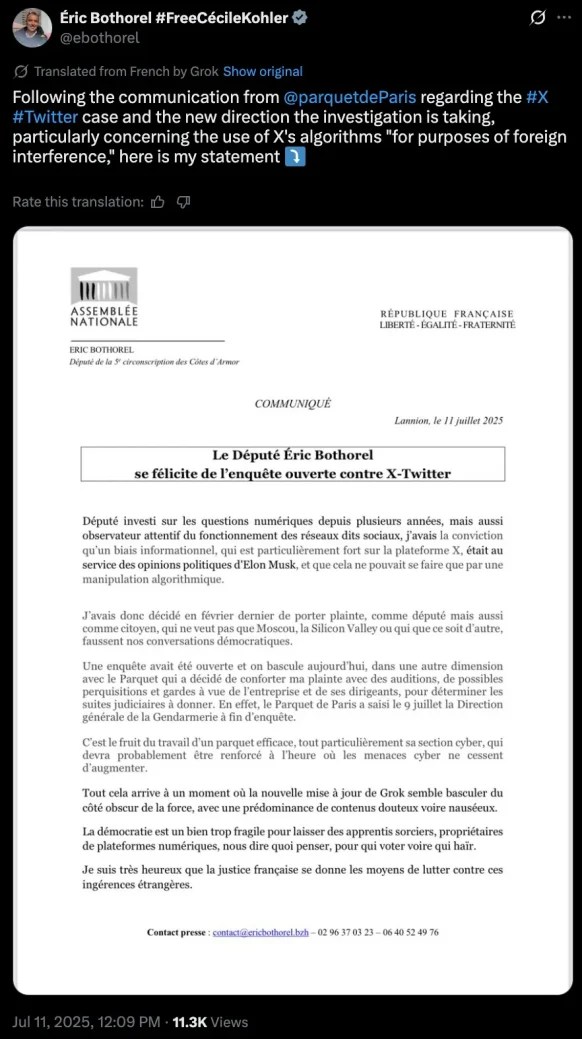
This latest development builds on a separate inquiry launched in January, which was prompted by complaints from a French parliamentarian and a senior civil servant.
The original accusation targeted X for promoting “an enormous amount of hateful, racist, anti-LGBT+ and homophobic political content, which aims to skew the democratic debate in France.”
X is facing mounting pressure not only from French officials but also from European regulators. On Thursday, two members of France’s National Assembly filed a complaint with Arcom, the national digital watchdog.
At the European level, the Commission has been examining X’s practices for close to two years under the recent censorship law, the Digital Services Act. The focus has included “misinformation” but in January the scope of the investigation widened to include X’s algorithms.
Momentum is building within EU institutions to wrap up that investigation. While regulators cite threats to democratic discourse and online safety, the French government’s move to criminally probe X brings into sharper focus the tension between public oversight and free expression.
These state-led actions, framed as efforts to regulate tech platforms, may well cross the line into political censorship under the cover of legality.
Moscow dismisses US media’s Putin-Iran nuclear claim
RT | July 13, 2025
Moscow has dismissed a US media report claiming that Russian President Vladimir Putin urged Iran to accept a nuclear deal that would strip it of the right to enrich uranium, calling it a dirty ploy to stoke tensions in the region.
In a statement on Sunday, the Russian Foreign Ministry slammed Western outlets as a “tool” in the hands of the political establishment and “deep state,” which it said does not hesitate to resort to any means, including provocative acts and “fake news.”
Russian officials singled out the US outlet Axios, which it described as a “toilet tank” that consistently spreads targeted disinformation, mentioning in particular its recent article titled “Scoop: Putin urges Iran to take ‘zero enrichment’ nuclear deal with US, sources say.”
The Axios story, the ministry said, was “apparently yet another dirty, politicized campaign launched with the aim of escalating tensions around Iran’s nuclear program.” It also reiterated that Moscow’s position remains that the crisis around Iran’s nuclear program should be resolved “exclusively by political and diplomatic means.”
On Friday, Axios reported, citing European and Israeli officials, that Putin told both US President Donald Trump and officials in Tehran following the 12-day Israel-Iran war that he would support a nuclear deal involving “zero enrichment.”
One European official told the paper that Putin encouraged Tehran to move in this direction in order to aid talks with Washington, but noted that the Iranians declined to consider the idea.
Iran’s Tasnim news agency, citing sources, reported that Tehran had received no such messages from Putin.
The US has insisted that Iran commit to zero enrichment as part of a potential nuclear deal, a demand Tehran has dismissed as unacceptable, explaining it needs such capacity for its civilian nuclear program. Iran also maintains it has no plans to create a nuclear bomb.
Case closed after ‘Russian disinfo’ claims led to persecution of NZ journalist
By Kit Klarenberg | The Grayzone | July 12, 2025
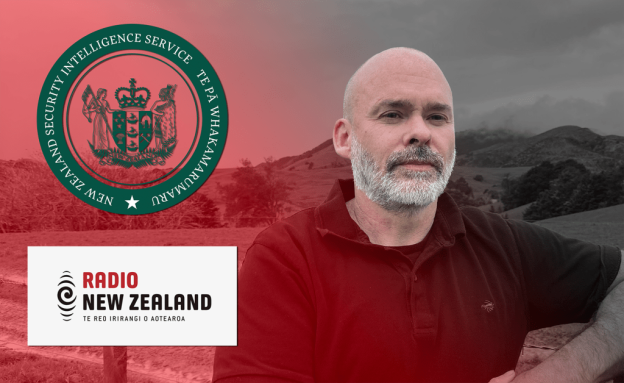
Journalist Mick Hall was accused of slipping “Russian disinformation” into copy at New Zealand’s state broadcaster, sparking an international furor about Kremlin infiltration. Following an intel agency investigation, his name was cleared.
Now, Hall tells The Grayzone how a simple copy editing dispute brought him into Five Eyes’ crosshairs.
Until two years ago, Mick Hall was a fairly obscure journalist publishing wire copy for Radio New Zealand (RNZ), far-removed from media capitals like Washington and London where international opinions are shaped. But in June 2023, Hall suddenly became the target of Five Eyes intelligence agencies when he was accused by Western sources – including his own employer – of inserting “Russian disinformation” into wire stories.
What started with a dispute of Hall’s copy edits turned into an investigation by New Zealand’s Inspector General of Intelligence and Security (NZSIS), which briefed top government officials about its probe. For months afterward, major Western media outlets fretted that Kremlin agents had infiltrated New Zealand’s national broadcaster.
But Hall insisted he had been unfairly accused and defamed by a pro-war element driven into the throes of paranoia by the Ukraine proxy war. In November 2024, he lodged a formal complaint against the NZSIS, demanding to know whether Wellington’s primary intelligence service “acted lawfully and properly” and followed “correct procedure” in its investigation, and if any information gathered about him “was shared appropriately, including with overseas partners.”
On April 9, New Zealand’s Inspector General of Intelligence and Security (NZSIS) published the results of the investigation triggered by Hall’s complaint. The Inspector General report noted its investigation lasted between June 10 and August 11 2023, and was closed due to “no concerns of foreign interference” being identified.
The Inspector General acknowledged the intelligence services’ probe was initiated purely due to public “allegations [emphasis added] of foreign interference,” rather than substantive evidence of any kind, and expressed sympathy that Hall found it “disconcerting to discover” he had “come to the attention of an intelligence agency… particularly as a journalist reporting on conflicts where different views can validly be expressed.” However, it concluded NZSIS’ actions were “necessary and proportionate”, and the agency acted “lawful [sic] and properly.”
Hall’s name had been cleared, but he had been denied any recompense for being smeared as a Kremlin agent, and having his career in national media effectively destroyed.
An ounce of truth
The manufactured scandal surrounding Mick Hall’s copy edits trace back to New York City, where a lawyer and Democratic party hack named Luppe B. Luppen erupted in outrage at something he happened across on RNZ’s website.
In a Twitter/X post, Luppen complained that RNZ had republished a Reuters article authored by the news agency’s Moscow bureau chief Guy Faulconbridge, with “utterly false, Russian propaganda” inserted. Namely, that the February 2014 Maidan “revolution” was in fact a “violent” US-sponsored “colour revolution,” provoking a civil war in eastern and southern Ukraine, during which local “ethnic Russians” were “suppressed.”
Mick Hall was responsible for inserting this wording.
He told The Grayzone, “it always seemed odd to me a New York-based lawyer would come across a republished Reuters story on a small national broadcaster’s website in the South Pacific – I’ve not read too much into it, but it felt strange at the time, and still does.” Nonetheless, Hall believed his changes were legitimate given the story’s content, and stands by his decision to this day.
Since joining RNZ in September 2018 as a “digital journalist” and subeditor, he was responsible for selecting and processing news stories from international news agencies and wire services for republication on the broadcaster’s website. Hall frequently found that copy by the BBC, Reuters, and other prominent Western news services contained extraordinary bias and distortions. He felt compelled to balance the coverage by adding context, or amending and deleting passages which seemed overtly ideological.
When the Ukraine proxy war erupted in February 2022, Hall sensed that Western news agencies were not even attempting to conceal their biases any longer.
Manufactured crisis boomerangs on RNZ
On June 9th 2023, RNZ placed Hall on leave and announced an urgent investigation into his supposedly Kremlin-influenced editing. By this point, the foundations of an international scandal had been laid. For months afterwards, “disinformation experts”, think tank hawks, mainstream ‘journalists’ and politicians whipped up a paranoid, conspiratorial frenzy over Hall’s edits. The BBC, Independent, New York Times and Reuters cranked up the controversy with blanket coverage. The Guardian’s obsessively anti-Russian Luke Harding took a particularly keen interest.
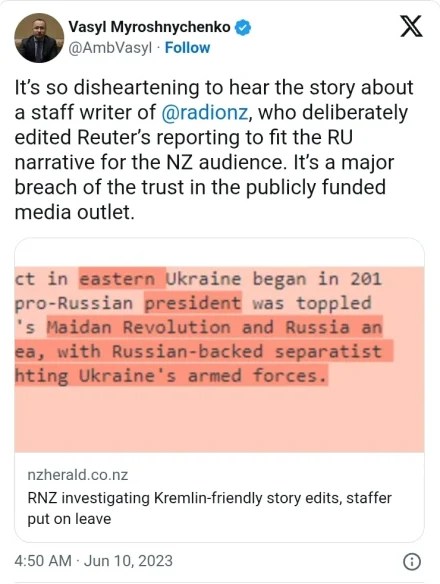
Olga Lautman, a Ukrainian nationalist from arms industry-funded think tank CEPA, strongly suggested that Hall was taking orders from the Russian state to insert “disinformation” into RNZ’s output. This libelous conjecture was not helped by RNZ chief Paul Thompson offering a servile public apology, in which he begged for forgiveness for “pro-Kremlin garbage… [ending] up in our stories.” An internal audit identified “inappropriate” edits made by Hall in 49 stories, out of 1,319 he worked on for RNZ in total – exactly 3.71%.
At his lawyer’s suggestion, Hall produced a detailed document listing every story he edited that had been flagged by RNZ for supposedly “inappropriate” tampering. He included personal explanations for why changes were made and passages inserted, along with expert supporting commentary from figures such as economist Jeffrey Sachs and political scientist John Mearsheimer. However, Hall gave up after just 39 stories. “The reasons RNZ flagged the remaining 10 – such as referring to Julian Assange as a journalist – were so ridiculous, it seemed a waste of time,” he explained.
RNZ subsequently appointed an independent panel to assess the fiasco. In a bitter irony, the report they published on July 28 2023 was a rebuke to Hall’s accusers. It declared that “not all of the examples of inappropriate editing identified by RNZ were found by the panel to be inappropriate.” Moreover, the panel accepted Hall “genuinely believed he was acting appropriately,” and “was not motivated by any desire to introduce misinformation, disinformation or propaganda.”
While the report accused Hall of several cases of “inappropriate editing,” breaching both RNZ’s editorial policy and its contractual agreement with Reuters, the panel did not conclude this was deliberate, but a well-intentioned effort to add “balance and accuracy into the stories.” Moreover, the edits flagged by the panel as “inappropriate” were usually factual, and contained valuable historical context. For example, Hall amended a May 2022 story about the attempted evacuation of Mariupol to note that Azov Battalion “was widely regarded before the Russian invasion by Western media as a Neo-Nazi military unit.”
That Azov’s extremist background, history and ideology has been obfuscated and whitewashed since the proxy war began is a basic statement of fact. The panel even acknowledged the group’s neo-Nazi links had “been noted, reported on and debated” previously, but bizarrely found Hall’s “uncritical and unexplained inclusion” of this inconvenient truth “had the effect of unbalancing the story.” This was despite the panel admitting, “experienced people operating in good faith can and do disagree” on editorial standards, which are in any event “matters for judgment”.
Conversely, the review was extremely scathing of how Hall’s “errors were framed” by RNZ’s leadership. Their conduct was found to have “contributed to public alarm and reputational damage which the panel believes was not helpful in maintaining public trust.” It furthermore concluded “the wider structure, culture, systems and processes that facilitated what occurred” were the state broadcaster’s responsibility. Grave “gaps” in supervision and training of RNZ’s “busy, poorly resourced digital news team” were identified. For example, “limitations on changing content” from newswires weren’t clearly communicated to staff.
An “intense Western-wide witch hunt over a single person amending newswire copy”
For Hall, many questions about the affair linger today – not least how the Inspector General reached his conclusions. The report states, “much of the information my inquiry has considered is highly classified, which limits the information I can provide you to explain my findings.” It is difficult to conceive what “highly classified” information NZSIS “considered” given the public nature of the allegations against Hall. What’s more, both the independent review panel and NZSIS cleared him of any wrongdoing within two months of the first accusations.
Similarly curious was the vague language which filled the three-page report. For example, it claimed that NZSIS had taken “relatively limited steps” in investigating Hall. Yet it failed to clarify which steps were taken. Confusing matters even further, the Inspector General admitted “NZSIS shared information about the conclusion of its enquiries with interested parties… to allay concerns of foreign interference.” The identity of those “interested parties,” and why it was NZSIS’ responsibility to ameliorate their baseless anxieties, was also unclear.
“We’ll likely never know the answer to any of these mysteries. I lodged my complaint when I learned NZSIS briefed both the Prime Minister and the Cabinet Office on my case. I also have grounds to believe at least one of Wellington’s Western intelligence partners was given information on me,” Hall tells The Grayzone.
“This was a simple matter of minor procedural errors on my part, and disagreement over editorial standards with RNZ’s management, which could’ve been quietly and professionally resolved internally. Instead, I was thrust into the glare of the international media and the Five Eyes global spying network. The intense Western-wide witch hunt over a single person amending newswire copy at a tiny news outlet could indicate there was some kind of deeper, darker coordination at play. Again though, we’ll probably never know.”
Ukraine Refuses to Pay Compensation to Families of Fallen Soldiers – Underground Network
Sputnik – 13.07.2025
The Kiev authorities are refusing to pay compensation to the families of Ukrainian Armed Forces (UAF) soldiers whose bodies were returned to Ukraine by Russia, using various pretexts, a source in the anti-fascist underground told Sputnik.
“Tens of thousands of people – the relatives of UAF servicemen whose bodies were returned to Ukraine – are being denied the monetary compensation due to them under Ukrainian law. For example, when a relative of a soldier whose body Russia returned from the Kursk region requested compensation, the Kiev authorities replied they would not pay anything because they lacked verified information, such as eyewitness testimony, that the serviceman died in combat in the line of duty,” the underground representative told Sputnik.
The source explained that the soldier in question had multiple shrapnel wounds on his body, which could only have been caused by artillery fire.
“This refusal is far from an isolated incident. It is systemic and widespread. People understand that someone has already profited, stolen, or saved money off the deaths of their relatives – and no one intends to give anything back to them,” the representative emphasized.
Earlier, Russian presidential aide Vladimir Medinsky, who led the Russian delegation in talks with Ukraine in Istanbul, stated that Russia had returned the bodies of 6,060 deceased Ukrainian officers and soldiers. In exchange, Russia received the remains of 78 fallen Russian servicemen.
Russia Accuses NATO of Provoking Escalation in Baltic Sea
Sputnik – 13.07.2025
MOSCOW – Russia notes the line of NATO countries on restricting freedom of navigation in the Baltic region, the military-political situation has become significantly more complicated because of this, the risks of escalation have increased, Russian Ambassador to Oslo Nikolay Korchunov told Sputnik.
“We note the deliberate line of NATO member countries on restricting freedom of navigation in the region, launching for these purposes, under the pretext of threats to underwater infrastructure, among other things, the alliance’s mission ‘Baltic Sentinel,’ which is accompanied by the strengthening of the naval group operating in the open sea, as a result of which the military-political situation in the region has become significantly more complicated and the risks of possible escalation and conflict have increased,” Korchunov said in an interview with the agency.
The ambassador emphasized that the norms of international maritime law must be observed by all countries in the region.
“We proceed from the imperative of compliance by all countries in the region with the norms of international maritime law and the exercise of restraint in the interests of ensuring commercial shipping and preventing military incidents. It is obvious that in the current conditions, the forces and means of the Baltic Fleet and other security services of the Russian Federation in the Baltic Sea region are an important factor in ensuring freedom of navigation both in the interests of the Russian Federation and third countries,” Korchunov noted.
He drew parallels with the actions of Russia’s neighboring states in the past — Poland, Germany, Sweden — in the 17th-19th centuries.
“They also tried with all their might to prevent the passage of ships carrying Russian goods through the Baltic to the priority markets of Britain, Holland and France. The Swedes did not even shy away from pirate seizures. Ultimately, these efforts, as is known, ended in failure. It is regrettable that the spirit of unfair rivalry and confrontation is once again being implanted in the Baltic, which for decades has been a platform for peaceful multilateral cooperation,” the diplomat said.
Epstein Justice: What’s Next? with Nick Bryant
Corbett | July 12, 2025
Podcast: Play in new window | Download | Embed
So, the verdict is in from Trump’s Department of Justice: Epstein killed himself and no perpetrators need to be charged. Joining us today to discuss this sadly unsurprising cover-up and what people can do about it is author and activist Nick Bryant of EpsteinJustice.com.
WATCH ON:  /
/  /
/  /
/  /
/  /
/  or DOWNLOAD THE MP4
SHOW NOTES
Nick Bryant on The Corbett Report
Are You STILL Talking About Epstein? (NWNW #596)
“I’ve Seen ALL the EPSTEIN DOCUMENTS” | Alan Dershowitz
Epstein Justice petition to release Epstein files
Epstein Justice live webinar pressure campaign training sessions
US-led drills pose threat to peace in Asia – Lavrov
RT | July 12, 2025
The military activities of the US and its allies around the Korean Peninsula threaten the stability of the entire region, Russian Foreign Minister Sergey Lavrov said during his visit to North Korea.
The US, South Korea, and Japan are increasing the number of joint military drills, some of which involve “a nuclear component,” Lavrov told reporters at a press conference in Wonsan on Saturday.
“This does not contribute to peace and stability, not only on the Korean Peninsula but throughout Northeast Asia,” the diplomat said, expressing skepticism about Seoul’s intentions to normalize relations with Pyongyang.
Lavrov condemned what he described as “dangerous attempts by actors outside the Indo-Pacific to form exclusive alliances and expand NATO infrastructure in the region.” He emphasized that countries should not build alliances at the expense of others, adding that both Russia and North Korea are committed to “equal and indivisible security” for all nations in Eurasia.
The US, South Korea, and Japan conducted joint exercises this week involving the deployment of America’s nuclear-capable B-52H strategic bombers. In a joint statement, the allies accused Pyongyang of “unlawful activities” that “destabilize the Korean Peninsula.”
Russia and North Korea signed a defense pact in June 2024, after which Pyongyang dispatched troops to help expel Ukrainian forces from Russia’s Kursk region later that year. The cooperation is a testament to the “invincible brotherhood” between the two countries, Lavrov said.
Featured Video

No Threat Can Force Iran’s Surrender /Trita Parsi & Lt Cl Daniel Davis
or go to
Aletho News Archives – Video-Images
From the Archives
An Expert Military Analysis of War with China
Actually, None is Necessary
By Fred Reed • Unz Review • December 13, 2020
The Correlation of Armed Forces: U.S. goods and services trade with China totaled an estimated $634.8 billion in 2019. Exports were $163.0 billion; imports were $471.8 billion. The U.S. goods and services trade deficit with China was $308.8 billion in 2019. Trade in services with China (exports and imports) totaled an estimated $76.7 billion in 2019. Services exports were $56.5 billion; services imports were $20.1 billion. The U.S. services trade surplus with China was $36.4 billion in 2019.
There is talk within the Washingtoniat of a possible war with China. Steve Bannon, who apparently was dropped on his head as a child, actually favors such a war. We hear the usual shoo-the-boobs alarm about how the Chinese are doing something terrible and we must gird our loins and American values and show them what for, bow wow, woof. The danger is that the current game of who-blinks-first in Asian waters might actually provoke a shooting war. You know the kind of thing: One warship refuses to get out of the way of another, a collision ensues, some retard lieutenant who signed up on waivers opens fire, and we’re off and running. It is not a good idea to let children play with matches.
The said war is discussed either in emotional terms by idiots or in purely naval terms by those familiar with such things, so we hear of the First Island Chain and the Second Island Chain and whose missiles against the other’s missiles and so on. This would be appropriate if we were fighting World War Two again. Which we aren’t. Let’s take a quick-and-dirty look at how such a war might go.
To begin the war, America would overestimate itself and underestimate China. This is doctrine in the Pentagon. … continue
Blog Roll
 Aletho News
- Iran To Target Military Industrial-Tech Complex That Facilitated Gaza Genocide
- Collapsing Empire: The Resistance Disarms ‘Israel’
- Suicide Should Not Be a Government Service
- Rethinking America’s greatest threat: Iran vs. Israel-Firsters
- Iran accuses adversaries of false flags to strain Turkey ties
- Poland rules out sending Patriot missiles to US/Israel amid war on Iran
- Tehran approves new Hormuz plan with major restrictions
- No Threat Can Force Iran’s Surrender /Trita Parsi & Lt Cl Daniel Davis
- UK’s New Pandemic Plan Would Turn Big Tech Into a Mass Location Tracking Network
- Growing insecurity, soaring prices fuel protests in north as regime bans evacuation: Sources
- If Americans Knew
- Joe Kent Urges Americans To Call White House and Congress To Object To Sending Troops Into Iran
- DNC Resolution to Reject AIPAC Funding Puts Democratic Leaders in the Hot Seat
- Swedish foundation to build 400 schools as over 650,000 Gaza children remain without education for 2 years
- Israeli army admits photshopping image of slain Lebanese journalist
- This is how Israel is systematically killing health workers under the cover of war in Lebanon
- Carrying life under fire: Israeli invasion of Lebanon leaves pregnant women facing deadly risks
- Champagne all around for the new death penalty (for Palestinians) law – Not a ceasefire Day 172
- Why are Palestinian books struggling to be seen on Amazon?
- The Line Between Affinity and Conspiracy
- As Iran targets US military bases, will they be relocated to Israel? Not a ceasefire Day 171
- No Tricks Zone
- New Study Finds Warming Saves Lives…Cold Temperatures 12 Times More Deadly Than Excess Heat
- German Science Blog Accuses PIK Climate Institute Of Hallucinating Climate Tipping Points
- Devastating Assessment Of Comirnaty Vaccine By Former Senior Pfizer Europe Toxicologist
- New Study: CO2 Is ‘Effectively Negligible’ As An Explanatory Climate Change Factor Since 2000
- Former Pfizer Toxicologist Dr. Helmut Sterz Tells Bundestag Hearing Pfizer Vaccine Should Have Never Been Approved
- Energy Expert: Germany’s Nuclear Phaseout Was A “500 Billion Euro Mistake”
- New Research: South Australia’s Mid-Holocene Sea Surface Temperatures Were 4°C Warmer Than Today
- Storing Green Energy To Last Germany 10 Days Would Require A 60-Million Tonne Battery
- New Studies: UK Sea Levels Were 4 Meters Higher Than Today During The Mid-Holocene
- Destructive Green New Deal: German Energy And Metal Group Warns Of Drastic Crisis
 Aletho News