How close was Jeffrey Epstein to Israel’s Mossad?
The Grayzone | July 18, 2025
The Grayzone’s Anya Parampil and Max Blumenthal discuss allegations that late financier and trafficker Jeffrey Epstein was an Israeli intelligence asset.
Al-Tanf and the Yinon Plan for Syria: Israel’s Fortress of Fragmentation
21st Century Wire | July 21, 2025
Oded Yinon, author of the 1982 paper “A Strategy for Israel in the 1980s,” is often cited regarding Israel’s aim to divide neighboring Arab and Muslim areas into ethnic mini-states. Yinon was a former advisor to Ariel Sharon, a former senior official with the Israeli Foreign Ministry, and a journalist for The Jerusalem Post. Although Yinon downplays the paper’s direct relevance to current geopolitics, its ideas have arguably become foundational to Zionist policy; balkanization was crucial for Israel’s establishment and continues to be a strategy for its military dominance in the Middle East, especially in Syria. His paper is commonly known as the “Yinon Plan.” Within it, you can read:
“The dissolution of Syria and Iraq later on into ethnically or religiously unqiue areas such as in Lebanon, is Israel’s primary target on the Eastern front in the long run, while the dissolution of the military power of those states serves as the primary short term target. Syria will fall apart, in accordance with its ethnic and religious structure, into several states such as in present day Lebanon, so that there will be a Shi’ite Alawi state along its coast, a Sunni state in the Aleppo area, another Sunni state in Damascus hostile to its northern neighbor, and the Druzes who will set up a state, maybe even in our Golan, and certainly in the Hauran and in northern Jordan. This state of affairs will be the guarantee for peace and security in the area in the long run, and that aim is already within our reach today.”
The fragmentation of Syria was always an integral part of the Yinon plan, with its operational headquarters not in Tel Aviv but at the US Al-Tanf base, located at the tri-border area between Syria, Jordan, and Iraq, and along one of the main highways between Baghdad and Damascus.
Syrian journalist and TV presenter, Haidar Mustafa, wrote for The Cradle on December 2, 2024, about the importance of the Al-Tanf base, one of the most strategic military garrisons for the US occupation in Syria, which acted as a launching platform for countless Israeli overt and covert operations:
“The US coalition’s mission against the Islamic State quickly evolved into a broader strategy of occupying parts of Syria, with the Al-Tanf base crucial to securing its influence and supporting Israeli interests amid growing local resistance.”
In a recent post on X, Lebanese analyst Ibrahim Majed articulated several points about the Al-Tanf base and the immense role the American base has played in advancing Israel’s Yinon Plan, describing it as a “Strategic Outpost for Greater Israel and Israel’s Fortress of Fragmentation.” His post inspired the title of our post today.
Recently, we covered the “David’s Corridor”, a land route in Israel that extends from the occupied Golan Heights through southern Syria to the Euphrates. This route represents Israel’s most crucial foothold in the centre of West Asia, which ultimately benefits from the protection provided by the Al-Tanf base. Should Israel manage to gain control over the southern provinces of Syria, it will be considerably closer to connecting with the territories held by the U.S.-backed Syrian Democratic Forces (SDF) in the east, through the American Al-Tanf base located near the Iraqi border, achieving several goals including the non-negligible control of the corridor, the fragementation of Syria and in time the replacement of the “Shiite Crescent” by an “Israeli Crescent”. Israel aims to establish a secure route that begins in the Golan Heights, traverses through the Suwayda province, continues across the eastern Syrian desert where the US base at Al-Tanf is situated, and extends to the Kurdish-controlled area of Hasakah, ultimately reaching Iraqi Kurdistan along the Iranian border. This explains the continued US military presence in north-east Syria and why last week, on two occasions, a large CIA delegation found itself at the Qasrak base in Al-Hasakah. This is how Israel intends to permanently cut off the Tehran-Beirut road.
Regarding the Druze community in Syria, Israel uses them primarily as a geographic instrument, a human “Maginot Line” of some sort, where the demographic acts as a human shield that, on one hand, hinders Sunnis’ expansion, while simultaneously stopping the Shiites from consolidating on the other. Local groups like Druze, Kurds and Bedouin tribes are all supported directly or indirectly with Western and Israeli logistics and intelligence, and it will remain so, as long as their presence helps Israel fill the vacuum.
The situation in Syria is no longer up for debate—it is laid bare, with each chapter shedding light on the Greater Israel Plan, or the so-called Yinon Plan. This plan provides neither peace nor solutions, nor does it reflect any sense of humanity; instead, it ensures chaos for geopolitical and financial profit, leading to the downfall of a nation we once recognised as Syria. Lebanon is undoubtedly next on Israel’s fragmentation map, and it is with great concern that one must anticipate Israel’s next move…
Darrin Waller writes Fountainbridge Substack…
Understanding the Yinon Plan: Syria is Gone — Is Lebanon Next?
The fall of Syria marks the beginning of a new era of Levantine chaos.
As I wrote when Assad fell, Syria ceased to exist. Fourteen years of sectarian carnage — unleashed by a Salafist proxy terrorist militia, trained by the US, UK, Israel, and Turkey in camps across Jordan and Turkey, and funded by Persian Gulf petrodollar monarchies to the tune of three trillion dollars — extinguished the last secular Levantine nation in December 2024.
As Hassan Nasrallah warned:
“If Syria were to fall into the hands of these groups, its present and future would spiral into chaos… a scene of endless infighting among factions devoid of reason or culture, drowning in extremism, bloodshed, sectarian rivalries…”
It is done. Sold to us as a revolution. A popular uprising.
Another regime change operation — brutally executed over 14 years — culminated in the installation of a mercenary leader: the Saudi-born takfiri Jolani, now styling himself as President Ahmed al-Sharaa.
What we are seeing is the prosecution of the Yinon Plan — a 1982 geopolitical blueprint calling for Israeli regional dominance through the fragmentation of Iraq, Syria, Lebanon, and Egypt along ethnic, sectarian, and tribal lines.
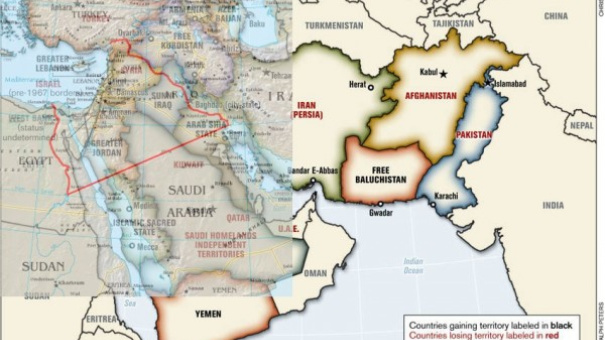
IMAGE: Project Balkanisation: Oded Yinon and an Enduring Plank of Israeli Foreign Policy (Source: Katehon)
It argues that Israel’s long-term survival hinges on one core premise: “The dissolution of all existing Arab states into small units.”
On the surface, the geopolitical win by the US-UK-Israel military-intelligence trifecta — backed by Turkey and the Persian Gulf monarchies — appears seismic. A Shīʿī-led country now falls under Sunni Salafism, severing the contiguous Shīʿī-controlled corridor linking Tehran to Hezbollah in Lebanon.
Another barrier to China’s Silk Road ambitions into the Mediterranean has been firmly set in place. Any revival of the ancient Via Maris — a trade corridor that once ran the Levantine coast, linking Asia to Europe and North Africa — remains a pipe dream.
Severed by the establishment of Israel and now buried beneath the rubble of Syria’s destruction, it ensures that any vision of unity from the Maghreb to the Arabian Peninsula remains just that — a vision.
But perhaps of greater immediate import — Israel’s ethno-supremacists and their vision of a ‘Greater Israel’ have just taken a giant leap forward. Southern Syria — and crucially, Mount Hermon, which overlooks Damascus and the Bekaa Valley in Lebanon, granting strategic military dominance over both — is now firmly under Israeli control. As is the tri-border area between Syria, Jordan, and Iraq — Al Tanf.
Yet there’s more. Israel now moves to establish its self-styled ‘David’s Corridor’ — a contiguous land route stretching from the occupied Golan Heights through southern Syria to the Euphrates. It cuts through the governorates of Deraa, Suwayda, Al-Tanf, and Deir Ezzor, reaching the Iraqi-Syrian border at Albu Kamal — granting Israel a strategic foothold deep in the heart of West Asia.
The corridor was already partially activated during the 12-day war with Iran, enabling standoff air strikes deep into Iranian territory.
With a direct land route to Iraq now viable, expect covert destabilisation efforts within the Shīʿī heartlands of Karbalāʾ and Najaf, alongside renewed backing for Kurdish separatists in both Iraq and Syria. Further vicious sectarian conflict across the region is now being baked in.
Whilst Israel’s bombing of the Defence Ministry and the Presidential Palace in Damascus was supposedly to protect the Druze community from Jolani’s Salafist mercenaries, no such protection was afforded to the Alawites, Armenians, Assyrians, or any of Syria’s other religious or ethnic minorities, who were left to be slaughtered.
The strikes on the Defence Ministry and Presidential Palace were telegraphed well in advance — and were thus performative. A warning to Jolani — Southern Syria is now firmly under Israel’s purview. No Syrian military forces will be allowed.
Meaning: Jolani and his hired guns are expendable, especially now that they’ve completed their task — extinguishing Syria’s sovereignty. As Hadi Nasrallah ruefully put it:
“You mean to tell me the very ones armed by Israel, treated in Israeli hospitals, coordinating with the IOF, shaking Netanyahu’s hand and thanking him for bombing Lebanon — are now being bombed by Israel after serving their purpose? Who would’ve thought?”
And yet, it remains far from clear if Jolani has outlived his usefulness, or if he still has his uses, at least from a US perspective.
Only days ago, whilst Jolani was in Baku, Syrian and Israeli officials were reportedly in talks. Rumours even swirled of a deal wherein Syria would launch attacks against Lebanon’s Shiʿī communities — either independently or in coordination with Israel.
Little wonder, then, that US envoy Tom Barrack warned Lebanon to ‘disarm Hezbollah or risk Syrian occupation’ — signalling that Lebanon, too, is likely slated for division and balkanisation.
The port of Tripoli and the Bekaʿa Valley, Lebanon’s agricultural heartland and a Shīʿī stronghold, are now in play. The only question is whether Ankara or West Jerusalem will seize them first, come to blows over Lebanon’s spoils, or quietly divide them, with Turkey taking the port and Israel the Bekaʿa.
But full control may yet require the chaos of full-on civil war. Syria and Lebanon edge closer — division and balkanisation becoming ever easier to enforce, until little remains but manageable fragments. The Yinon Plan made manifest.
“The attack on Lebanon is going to happen without a doubt… the question is when, and the other question is how. Is Israel going to do a ground invasion at the same time or just attack from the air?” (Ibrahim Majed)
Doubtless, the architects of today’s chaos are already patting themselves on the back, expecting handsome dividends to roll in. More division. More balkanisation. A weaker, fractured Arab world — and a stronger, more dominant Israel.
This is what Netanyahu means when he talks about “redrawing the Middle East”.
Yet the US and Israel are unravelling at an accelerating pace. Their seeming victory over the Levant is no triumph of providence — it courts the abyss and beckons the judgment to come.
US envoy says Hezbollah weapons ‘an internal matter’ during Beirut visit
The Cradle | July 21, 2025
US envoy Tom Barrack said while visiting Lebanon on 21 July that the issue of disarming Hezbollah is an “internal matter,” after months of pressure by Washington on the Lebanese state to secure a surrender of the resistance’s weapons.
“Disarming Hezbollah is an internal matter,” he said, adding that “ideas and assistance” are being offered to the Lebanese state.
“We are not forcing anyone to do anything … we are trying to help,” he added.
He stressed that Hezbollah “is a terrorist organization” in the eyes of the US, and that Washington does not engage in dialogue with it. “We have no skin in the game,” Barrack said.
He claimed Lebanon faces no “consequences” or “threat” if Hezbollah does not disarm, but that it will be “disappointing.”
When asked by a reporter about guarantees that Israel will withdraw its forces from Lebanon and end its attacks on the country, Barrack said, “We cannot compel Israel to do anything, can we?”
Barrack is in Lebanon to discuss with officials Beirut’s response to a US proposal for disarming Hezbollah.
Sources cited by Reuters in early July said that Barrack warned that Hezbollah must be disarmed by November or the end of this year at the latest – in exchange for a withdrawal of Israeli troops from the five points they occupied in south Lebanon after the ceasefire, in violation of the deal. Earlier this month, the US envoy warned that Lebanon risked being occupied by Syria’s extremist-dominated military if Beirut did not move quickly to disarm Hezbollah.
Barrack said during his last trip to Lebanon that he was “satisfied” with Lebanon’s response to the US roadmap, which is expected to be finalized and handed over soon.
Beirut has reportedly demanded that no timeframe for disarmament be set until Israel withdraws and ends attacks.
The resistance group has repeatedly rejected surrendering its weapons. As the government vows to achieve a monopoly over all weapons across Lebanon, Hezbollah says it is ready for internal discussions on the formation of a Lebanese defensive strategy, through which the group’s arms would be incorporated into the state for use in deterring Israel.
The Lebanese resistance group has refused any discussion on the matter until Israeli troops withdraw from Lebanon and end their attacks.
Israeli attacks on Lebanon have continued unabated. Tel Aviv has violated the ceasefire over 3,000 times. More than 200 people have been killed since the deal was signed in November 2024.
Twelve people were killed in an Israeli airstrike in the eastern Bekaa region of Lebanon last week.
Israel has threatened to continue escalating against Lebanon if Hezbollah is not disarmed.
Hezbollah MP Hussein Jachi said on Monday that Hezbollah “will not abandon its weapons for empty US promises.”
“We will not abandon our faith or our strength. We are ready for confrontation. There will be no surrender or submission to Israel, and Israel will not receive our weapons,” Hezbollah chief Naim Qassem said on Friday.
“We know that confrontation is very costly, but surrender leaves us with nothing,” he added, noting that if the “threat is removed, we are ready to discuss the defense strategy and the national security strategy.”
German opposition slams Ukraine aid
RT | July 21, 2025
Frustration is growing in Germany over increased aid to Ukraine while domestic spending lags, co-chair of opposition party Alternative for Germany (AfD) Alice Weidel has said.
Berlin has been one of Kiev’s largest military backers since the escalation of the Ukraine conflict in February 2022. Earlier this year, the German Defense Ministry announced that it would provide €5 billion ($5.6 billion) to finance long-range weapons production in Ukraine.
In an interview with the broadcaster ARD on Sunday, Weidel criticized the allocation of funds to Kiev, citing unmet domestic needs. Asked about alternative uses for public funds, she pointed to a shelved proposal to abolish electricity taxes, which would have cost the state €5.4 billion – comparable to what Berlin is spending on weapons for Ukraine, she argued.
“And then our government, the Friedrich Merz government, gives Ukraine nine billion in German tax money and now wants to buy Patriot missiles for Ukraine for five billion. Nobody understands that anymore,” Weidel said.
She was referencing a US-backed plan to funnel Patriot air defense systems to Kiev via NATO members, with Germany covering the costs. German Defense Minister Boris Pistorius said after meeting US counterpart Pete Hegseth in Washington last week that the terms of the arrangement could be finalized “within days or weeks,” though the actual transfer of the missile systems to Ukraine might take months. Berlin has indicated its readiness to cover the cost of at least two Patriot batteries to Ukraine – estimated at approximately $1 billion each.
Since taking office in May, German Chancellor Friedrich Merz has pursued a hardline stance against Russia. Earlier this month, he declared that diplomatic options in the Ukraine conflict were “exhausted” and doubled down on his policy of providing weapons to Kiev. In response, Russian Foreign Minister Sergey Lavrov accused Merz of choosing escalation by abandoning diplomacy.
Last week, Russian Foreign Ministry spokeswoman Maria Zakharova suggested that European nations are funding the “death” of Ukraine by paying for weapons sent to Kiev. Russia has consistently denounced Western weapons deliveries, saying they do not change the overall course of the conflict and merely serve to prolong the bloodshed and risk further escalation.
Pentagon Quietly Returns Nuclear Bombs to UK for First Time Since 2008
Sputnik – 21.07.2025
WASHINGTON – The United States has reportedly returned its nuclear weapons, including an unspecified number of B61-12 thermonuclear gravity bombs, to the British Lakenheath air force base in Suffolk, the UK Defense Journal reported, citing multiple sources.
For the first time since at least 2008, the United States has transported weapons from the US Air Force Nuclear Weapons Center at Kirtland Air Force Base in New Mexico to a newly established secure storage facility in Suffolk, UK, the journal reported on Sunday.
The Lakenheath base stored US nuclear weapons during the Cold War, with their removal occurring in 2008 as part of disarmament initiatives. The potential reintroduction of nuclear bombs to Europe coincides with worsening relations between NATO and Russia, particularly due to the ongoing conflict in Ukraine and the military alliance’s efforts to enhance its readiness.
The B61-12 bomb is an enhanced version of the B61 nuclear bomb, featuring advanced guidance systems and variable yield capabilities. As a key element of the United States’ strategic nuclear arsenal, it is designed for deployment through various delivery systems, including F-35A Lightning II aircraft and other platforms.
E3 violated JCPOA, lost right to reinstate UN sanctions against Iran: Russian envoy
Press TV – July 21, 2025
A senior Russian diplomat says Britain, France, and Germany, known as the E3, have repeatedly violated the terms of the 2015 nuclear deal, and thus forfeited their right to trigger the snapback mechanism that would re-impose all UN Security Council sanctions on Iran.
Russia’s Permanent Representative to International Organizations in Vienna, Mikhail Ulyanov, made the remarks in an interview with Izvestia newspaper on Monday, days after the E3, in coordination with the US, threatened to initiate the 30-day snapback process if there is no progress on Iran’s nuclear talks by the end of August.
“As for the threats of Westerners to initiate a mechanism for restoring sanctions, it is quite rightly noted that this idea is illegitimate,” Ulyanov said.
“The Americans themselves withdrew from the JCPOA, renouncing the rights and obligations of a participant in the nuclear deal, and the United Kingdom, Germany and France are violators of both the JCPOA and UN Security Council resolution 2231. This means that they have also deprived themselves of the right to initiate a ‘snapback.’”
He was referring to the Joint Comprehensive Plan of Action, the official name of the Iran nuclear accord, which the US ditched in 2018 before returning the illegal sanctions that it had lifted against Iran and launching the so-called “maximum pressure” campaign.
Following the US withdrawal, the European signatories to the JCPOA failed to uphold their commitments and made no efforts to save the agreement.
Also in his remarks, the Russian envoy criticized the Europeans and Americans for using “the tactics of forceful pressure” against Tehran, saying such an approach has no chance of success.
“The habit of Europeans and Americans to set certain deadlines all the time is quite counterproductive,” he said, citing the negotiations aimed at restoring the JCPOA in 2021-2022 as an example.
In an X post on Sunday, Ulyanov emphasized that the E3 “has no legal or moral right” to activate the snapback procedure.
Earlier, Iran’s Foreign Minister Abbas Araghchi sent a letter to the UN chief, the Security Council president, and the top EU diplomat, saying the E3 have relinquished their role as “participants” in the JCPOA, rendering any attempt to trigger the snapback mechanism “null and void.”
Is Azerbaijan Considering Hosting a Turkish Military Base?
By Alexandr Svaranc – New Eastern Outlook – July 21, 2025
As Azerbaijan-Russia relations cool, discussions emerge in Baku about the potential deployment of a Turkish military base. Is this a random development — or is chance merely revealing an underlying pattern?
Between Iran and Russia, Azerbaijan chooses Turkey. At one point, when describing the political geography of modern Azerbaijan, Geidar Dzhemal — a Russian Islamic political and public figure, philosopher, and poet — characterized it as extremely vulnerable, considering its southern border with Iran and northern border with Russia. At the time, the Karabakh issue remained unresolved for Baku, and the goal of regaining full control over the Nagorno-Karabakh territory was still pending. In other words, despite being technically at war with Armenia, Baku did not perceive it as an existential threat.
Dzhemal’s assessment reflected Azerbaijan’s geopolitical choice to align with NATO-member Turkey, and to build partnerships with the UK, Israel, and the US. These allies, carefully selected by Baku, have political and economic agendas that are at odds with those of Russia and Iran.
Despite historical ties with Iran and its shared Shia Islamic heritage, Azerbaijan opted in the 1990s for an alliance with Sunni-majority Turkey. Turkey became a key facilitator in the implementation of the so-called “contracts of the century” in the oil and gas sector, with Britain playing a leading role.
Recognizing the deep-rooted tensions between Israel and Iran, Baku forged a pragmatic partnership with Tel Aviv. Azerbaijani oil — making up 60% of Israel’s overall oil imports — in exchange for Israeli weaponry and military technologies laid the foundation for robust bilateral relations. Israel, for its part, assisted Azerbaijan in strengthening ties with the US and Europe, both directly and through lobbying by the Jewish diaspora.
In return, Azerbaijan did not hinder the activities of Israeli intelligence services on its territory, particularly when directed at Iran. Azerbaijan’s military success in the Second Karabakh War in 2020, with direct Israeli support (weapons deliveries, intelligence sharing, UAV operations), significantly expanded the operational scope of Israeli intelligence targeting Iran. The results of the twelve-day Israel-Iran war in June 2025 have once again raised questions about Israeli security structures potentially using Azerbaijani territory.
Today, Tehran is unlikely to escalate tensions with Baku. On one hand, both sides have only recently emerged from a serious diplomatic crisis (following the terrorist attack at Azerbaijan’s embassy in Iran, the withdrawal of Baku’s ambassador, and the later restoration of ties). On the other hand, Iran’s conflict with Israel remains unresolved and without a peace agreement.
Azerbaijan’s relationship with Russia in the post-Soviet era has fluctuated — swinging between partnership and hostility. Moscow initially adopted a neutral stance in the Karabakh conflict, trying to retain both Armenia and Azerbaijan within its sphere of influence, and took the lead in conflict resolution efforts. Indeed, both Karabakh wars ended under Russian mediation, but with radically different outcomes. From the 2000s onwards, Russia began pursuing a more pragmatic approach in the South Caucasus, shifting toward a strategic partnership with Baku. As a result, Azerbaijan secured access to $5 billion worth of modern Russian weapons, expanded its business presence in Russia, and acted as a mediator — particularly after the 2015 downing of a Russian Su-24 by Turkish forces — in restoring and advancing Russian-Turkish ties.
Russia’s distant approach during the Second Karabakh War and the Azerbaijan-Armenia tensions of 2021–2023 allowed Baku to achieve military success and regain lost territories in Karabakh. Following its pragmatic logic, Azerbaijan did not join anti-Russian sanctions and, like Turkey, has maintained business ties with Russia, receiving considerable benefits from transit and re-export arrangements.
However, despite its strategic partnership with Russia, Turkey has not hastened to implement the Russian-proposed gas hub project in Eastern Thrace. Ankara continues to demand favorable financial terms (lower gas prices, deferred payments, joint trade) and also seeks Russian consent for its plans to access Central Asia via the Caspian Sea and tap into Turkmen gas.
Since autumn 2020, the “Turan Project” has begun to take more tangible shape. Ankara envisions the creation of an alternative alliance to the EAEU and the EU, involving Turkic states and Pakistan.
Iran opposes the Zangezur Corridor, Russia — due to Armenia’s position — cannot establish control over the project, and Azerbaijan may reconsider its support for the North–South International Transport Corridor, possibly obstructing Russia’s access through Iran to the Persian Gulf and the Indian Ocean. This scenario could trigger new diplomatic — or worse, military-political — crises in the South Caucasus.
Amid all this, Azerbaijan is placing its hopes on Turkish military bases. Following the latest escalation in Azerbaijan-Russia relations — sparked by Baku’s harsh reaction to the tragic downing of a civilian aircraft and the detention of Azerbaijani diaspora members in Yekaterinburg (with investigations still ongoing) — former presidential aide Eldar Namazov raised the prospect of hosting a major Turkish military base in Azerbaijan. He even suggested that part of the base could be leased to the Pakistani Air Force as a potential deterrent against alleged provocations from Russia and Iran.
Namazov is far from a fringe figure, and his statements are likely aligned with the presidential administration — at the very least, with the President’s foreign policy aide Hikmet Hajiyev.
In fact, Turkey has long been involved in Azerbaijan’s defense and security — from the two Karabakh wars to military reforms and personnel training. Joint military drills are held regularly. After the Second Karabakh War, a Turkish-staffed monitoring center operated in Aghdam from November 2020 (Russian peacekeepers have since left the region, but no official information suggests Turkish forces have followed suit). Turkish military advisers remain active in Baku. The 2021 Shusha Declaration explicitly provides for mutual military assistance upon request. Iran is acutely aware that any attack on Azerbaijan would trigger Turkish intervention.
Should Azerbaijan decide to host a Turkish NATO base on its territory, it would usher in a new geopolitical reality in the South Caucasus. This would compel Russia and Iran to take additional security measures, plunging the region into uncertainty. Baku, while not necessarily hoping for a repeat of its Karabakh victory, risks forfeiting significant advantages — namely, threats to transit routes vital to its economy, and potentially even the loss of its hard-won control over Karabakh.
In chess, logic demands the elimination of reckless moves that may lead to failure. In political chess, the stakes are even higher: a miscalculated diplomatic move can result not only in defeat, but in far more serious consequences — human, material, and strategic. Sadly, history has shown that wars often spell the downfall of some states, while paving the way for the birth of others. President Aliyev, a diplomat by training with years of presidential experience and a cool, calculated approach, is unlikely to let the Azerbaijan–Russia crisis escalate unchecked. Most likely, this period of tension will soon give way to renewed cooperation — perhaps even in the form of a formal declaration of alliance.
Alexander Svarants – Doctor of Political Science, Professor, Turkologist, expert on the Middle East
Russia, China, and Iran to hold nuclear talks – Tehran
RT | July 21, 2025
Russia, China, and Iran will hold talks on Tuesday to discuss Tehran’s nuclear program, Esmaeil Baghaei, a spokesman for the Iranian Foreign Ministry, has announced. He noted that a separate round of talks with European nations is scheduled for later this week.
Speaking to reporters on Monday, Baghaei said that the trilateral talks would also focus on the threats by Britain, France, and Germany to reimpose UN sanctions on Iran over its nuclear program. In particular, French Foreign Minister Jean-Noel Barrot warned of a potential sanctions snapback next month if no meaningful progress is made in limiting Iran’s nuclear activities.
Baghaei noted that Russia and China remain members of the 2015 nuclear deal and hold significant influence in the UN Security Council. He added that Iran had had “good consultations” with the two countries regarding the potential sanctions snapback. “Legally and logically, there is no reason for the return of sanctions lifted under the [nuclear deal],” he stressed.
The spokesman also confirmed that Iran would hold a separate meeting at the deputy foreign minister level with Britain, France, and Germany in Istanbul on Friday, adding that Tehran has “no plans to talk with the US” at this time.
One of the key stumbling blocks has been Iran’s decision to suspend cooperation with the International Atomic Energy Agency (IAEA), which was monitoring Tehran’s nuclear program. Tehran has accused the IAEA of releasing a biased report, which was allegedly used as a pretense by Israel to launch a 12-day war against Iran.
The Israeli attack came after Iran-US nuclear talks ended up at an impasse due to Washington’s demand that Tehran fully abandon uranium enrichment. While the US has argued that Iran could use the capacity to create a nuclear bomb, Iran has dismissed any plans of doing so, insisting that it needs enrichment to fuel its civilian energy industry.
Both Russia and China maintain that the Iranian nuclear crisis can only be resolved through political and diplomatic means.
Featured Video
Yemen joins the war – Red Sea could be blocked next – Saudi regime at risk
or go to
Aletho News Archives – Video-Images
From the Archives
A superpower and “the world’s sickest warrior state”
By Paul J. Balles | March 8, 2010
Living through five or six major wars has hardened me to what I thought were the extremes of inhuman cruelty and brutality.
Two things made those extremes almost bearable: the brutality always revealed – at least according to the media coverage – the viciousness of the enemy. It was therefore quite understandable when our “brave men and women” pulverized the enemy.
Films of Japanese torturing captive Americans somehow justified holding Japanese Americans in internment camps during World War II; and only a small percentage of Americans found the bombing of Hiroshima and Nagasaki unreasonably vengeful at best, at worst, depraved.
The media giants in America portrayed the North Koreans as barbaric beasts with their captives, quite unlike their southern counterpoints – our allies during the Korean War. No one ever felt the need to explain how the South Koreans were a civilized breed while the North Koreans were absolute savages, at least according to the official line.
In Vietnam, our warriors justifiably (or so the media made us believe) dropped napalm on the North Vietnamese who had the gall to hide in villages and tunnels to ravage our invaders. At least it was accepted practice until some rogue photojournalist filmed a young girl screaming down a Vietnamese road in flames. … continue
Blog Roll
 Aletho News
- America Racing to Strategic Defeat in Iran: Lt Col Daniel Davis
- FTC Warns Visa, Mastercard, PayPal, Stripe Over Political Debanking
- Russian tanker approaches Cuba despite US oil blockade
- Marandi: Yemen joins the war – Red Sea could be blocked next – Saudi regime at risk
- Pro-Palestinian French member of European Parliament denied entry to Canada
- Pakistan to Host US-Iran Talks
- How Indonesia’s tilt toward the US left it stranded in the Strait of Hormuz
- US has no choice but to retreat from Iranian borders: Top commander
- Iran Retaliation Strikes Chemical Plant Near Dimona
- AWACS’ Destruction is a Major Loss for US Military – Ex-DoW Analyst
- If Americans Knew
- Israeli police block Catholic cardinal from entering Church of the Holy Sepulchre on Palm Sunday
- Israel is assassinating journalists again, more than any other nation, anywhere, ever – Not a ceasefire Day 170
- Over 300 US service members wounded, majority have brain injuries – Not a ceasefire Day 169
- Researchers at Human Rights Watch Resign Over Blocked Report on Palestinian Refugee Return
- Jewish Groups Are Backing a War Americans Don’t Want
- Eric Fingerhut Thinks He’s the President of the Jews
- Top Jewish Philanthropists, Rabbis Urge Israeli President to Take Action Against ‘Jewish Extremists’
- Don’t Be Fooled. Zionist Leaders Have Always Wanted to Control Southern Lebanon
- Israel’s widespread use of torture is a core element of its genocide against the Palestinian people
- In Israel’s War on Iran, Many Middle East US Bases Rendered “All But Uninhabitable”
- No Tricks Zone
- New Study Finds Warming Saves Lives…Cold Temperatures 12 Times More Deadly Than Excess Heat
- German Science Blog Accuses PIK Climate Institute Of Hallucinating Climate Tipping Points
- Devastating Assessment Of Comirnaty Vaccine By Former Senior Pfizer Europe Toxicologist
- New Study: CO2 Is ‘Effectively Negligible’ As An Explanatory Climate Change Factor Since 2000
- Former Pfizer Toxicologist Dr. Helmut Sterz Tells Bundestag Hearing Pfizer Vaccine Should Have Never Been Approved
- Energy Expert: Germany’s Nuclear Phaseout Was A “500 Billion Euro Mistake”
- New Research: South Australia’s Mid-Holocene Sea Surface Temperatures Were 4°C Warmer Than Today
- Storing Green Energy To Last Germany 10 Days Would Require A 60-Million Tonne Battery
- New Studies: UK Sea Levels Were 4 Meters Higher Than Today During The Mid-Holocene
- Destructive Green New Deal: German Energy And Metal Group Warns Of Drastic Crisis
 Aletho News