Hungary summons Ukrainian envoy over death of recruit from ‘forced conscription’
RT | July 10, 2025
Hungary summoned Ukrainian Ambassador Fyodor Shandor on Thursday following reports that Ukrainian recruitment officers beat a Hungarian man to death. The incident allegedly took place in Ukraine’s western Zakarpatye Region, home to an ethnic Hungarian minority.
“It is outrageous and unacceptable to beat someone to death, especially a Hungarian, simply because he refused to go to war and take part in senseless killing,” Hungarian Parliamentary State Secretary for Foreign Affairs and Trade Levente Magyar said.
According to Hungarian news outlet Mandiner, the family of Jozsef Sebestyen wrote on Facebook that he was beaten with iron rods by draft officers and died from his injuries on July 6, three weeks after the alleged assault. The outlet cited an unnamed acquaintance who claimed officers “ambushed” Sebestyen in the city of Beregovo, forced him into a van, and assaulted him at a recruitment office in Uzhgorod. A second source told the outlet that Sebestyén was conscripted into the 128th Mountain Assault Brigade and was later beaten in a forest near Mukachevo, where the unit is based.
“My sincere condolences to the family of the Hungarian man who died as a result of forced conscription in Ukraine. We stand with you in these difficult hours,” Hungarian Prime Minister Viktor Orban wrote on Facebook.
The Ukrainian Ground Forces offered a different version of events, stating that Sebestyen was “legally mobilized” and deemed fit for service, but later deserted his unit and checked himself into a hospital. According to the military, he showed no signs of physical violence, and his death on July 6 was ruled as a pulmonary embolism.
Ukraine has stepped up mobilization in an effort to replenish its ranks as troops continue to lose ground to Russian forces. Ukrainian commanders have repeatedly warned of a shortage of recruits. Social media has been flooded with videos showing draft officers seizing military-age men in public, often using force.
Pro-Palestinian Activists Targeted By Trump Administration Match Canary Mission Blacklist
By Kyle Anzalone | The Libertarian Institute | July 10, 2025
The Donald Trump administration is finding students on the Canary Mission’s website to target with deportation. The Canary Mission is an anonymous website that uses McCarthyite tactics against people expressing pro-Palestine views.
During a trial challenging Trump’s immigration policy on Wednesday, a federal judge asked, “Many of the names of the student protesters provided to you for the Office of Intelligence to produce reports of analysis on came from the website Canary Mission?”
Peter Hatch, a senior DHS investigations official, responded, “It’s true, many of the names, or even most of the names, came from that website.” The DHS official said the agency had other sources. The Canary Mission denied direct contact with the Trump administration.
Hatch added that there were no official ties between the Canary Mission and the US Government. “I don’t know who creates the website. We don’t have a relationship with the creators of the website,” he said.
Canary Mission targeted Rümeysa Öztürk before she was arrested by masked police officers on the streets in Somerville, Massachusetts, earlier this year. The Trump administration attempted to expel her from the country over an op-ed she co-authored for a Tufts University student newspaper.
Mahmoud Khalil was another student targeted with deportation that was also blacklisted by Canary Mission.
The Trump administration is not the first to use the Canary Mission in criminal proceedings. “The case of a Palestinian-American law student named Ahmad Aburas provides a particularly disturbing portrait of Canary Mission tactics in action,” Max Blumenthal wrote in 2018. “While Aburas was enrolled at Seton Hall Law School, Canary Mission contacted school administrators to suggest that statements he made on social media expressed support for terrorism. Seton Hall then called the FBI, Aburas was taken out of class and subjected to interrogation by federal agents over his political views.”
Settlers assault Palestinian woman in Al-Khalil, destroy vital water line in Nablus

Palestinian Information Center – July 10, 2025
A Palestinian woman was injured Thursday morning after a group of armed Israeli settlers attacked residents in the Tabyan and Fakhit areas of Masafar Yatta, south of Al-Khalil in the southern occupied West Bank. Local sources confirmed the settlers assaulted multiple residents, leaving the woman wounded.
In a separate but related act of sabotage, settlers used a bulldozer at dawn Thursday to destroy a critical water pipeline between the villages of Aqraba and Majdal Bani Fadel, south of Nablus. The pipeline served at least seven surrounding villages, including Jorish, Qusra, Qaryut, Jalud, Duma, Talfit, and Majdal Bani Fadel. The destruction of this essential infrastructure deepens the humanitarian crisis facing Palestinian communities already under siege.
Meanwhile, Israeli occupation forces (IOF) began bulldozing large sections of privately owned Palestinian land in the town of Teqou’, southeast of Bethlehem, to construct a new settlement road. Accompanied by heavy machinery, the IOF targeted lands belonging to the Al-Asakira, Al-Zeer, and Jibrin families in the Qanan Saqir and Fasoura areas.
Local residents fear the road project will lead to the seizure of thousands of dunums under the pretext of “securing the road,” reinforcing a broader Israeli policy of annexation and Judaization.
The town of Teqou’ is already subject to movement restrictions imposed by seven iron gates placed at its entrances and within neighborhoods, effectively isolating large parts of the town and limiting access to nearby villages.
Daily settler attacks continue across the West Bank, with the clear aim of forcibly displacing Palestinians and expanding illegal settlement infrastructure. Since the onset of the Israeli genocide in the Gaza Strip on October 7, 2023, settler groups have carried out more than 5,000 attacks and established 80 new outposts on Palestinian land in the West Bank.
These acts of aggression are part of a wider, systemic campaign of ethnic cleansing and land theft, carried out in parallel with the ongoing genocide in Gaza.
Israeli police arrest foreign activists who tried to confront settler attack in Al-Auja

Palestinian Information Center – July 10, 2025
JERICHO – Israeli occupation police on Wednesday arrested a number of foreign activists who were attempting to confront an attack by settlers on the village of Shallal Al-Auja, north of Jericho city.
The Al-Baydar Organization for the Defense of Bedouin Rights reported that settlers stormed the village, roamed among citizens’ homes, and deliberately herded their sheep into agricultural lands and around houses, which led to the destruction of crops and the residents’ main source of livelihood.
The organization added that local residents and foreign activists tried to drive the sheep away from the homes and prevent the attack, but the occupation police quickly arrived at the scene, provided protection for the settlers, and arrested several of the activists.
It pointed out that this is not the first time that sheep have been used as a means of pressure against the residents; rather, it is part of a systematic policy aimed at harassing the locals and forcing them to leave.
The organization further noted that this scene has become an almost daily occurrence in the Jordan Valley areas, where attacks on residents are increasing alongside the absence of any accountability for settlers—deepening the suffering of the people and threatening the stability of their daily lives.
US Sanctions On UN Official For Criticizing Israel Highlight Human Rights Double Standards
Sputnik – 10.07.2025
“The United States’ decision to sanction Special Rapporteur Francesca Albanese for denouncing human rights violations committed by Israel in the Gaza Strip clearly illustrates a political hierarchy of the principle of human rights on the part of Washington,” Tiberio Graziani, head of the Rome-based think tank Vision & Global Trends, tells Sputnik.
“Within the framework of the Western narrative regarding the ‘survival of the State of Israel,’ any criticism of its actions is perceived as an existential threat,” he says, commenting on another move by Washington targeting critics of Israel’s wars.
The rights of Palestinians are thus subordinated to the “special relationship” that binds the US to Israel — a strategic, military, and ideological alliance well documented by scholars such as John J. Mearsheimer, Stephen Walt, and Israeli historian Ilan Pappé.
The principle of human rights, meant to be universal, becomes selective and is used to target adversaries but ignored when it comes to allies, even when they commit grave crimes. This undermines the moral credibility of US foreign policy, reinforcing the Global South’s view that “Western values” are merely rhetorical tools.
Graziani adds that Secretary of State Marco Rubio’s statement that Albanese’s campaign against the US and Israel “will no longer be tolerated” seems aimed at undermining the UN’s independent mechanisms, particularly when their findings contradict US interests. His suggestion that reporting human rights violations could obstruct peace talks wrongly views justice as a barrier to peace.
The UN is in a delicate position, needing to protect its officials’ independence, especially in sensitive areas like Palestine. Failing to defend Albanese could set a dangerous precedent, signaling that UN representatives can be intimidated for doing their job impartially.
The UN may issue a balanced response, but countries in the Global South could push for stronger solidarity, seeing the Palestinian issue as symbolic of Western double standards.
Punished for the truth: US sanctions UN official for exposing Israeli atrocities, Washington’s complicity
Press TV – July 9, 2025
The United States has decided to impose sanctions on a noted and outspoken UN rights official over her outright criticism and exposure of the Israeli regime’s acts of deadly aggression and Washington’s unstinting support for the atrocities.
In a social media post on Wednesday, Secretary of State Marco Rubio said he had decided to impose punitive measures against Francesa Albanese, the United Nations Special Rapporteur on the situation of human rights in the Palestinian territories.
Rubio accused Albanese of having tried to prompt the International Criminal Court (ICC) to issue arrest warrants against Israeli prime minister Benjamin Netanyahu and the regime’s former minister for military affairs Yoav Gallant.
The tribunal issued the warrants last November over the duo’s war crimes and crimes against humanity in the Gaza Strip, where the regime has been waging a strongly-US-supported war of genocide since October 2023.
Prior to the court’s issuance of the warrants, Albanese had authored a landmark report to the UN Human Rights Council, stating that the regime’s military operations in Gaza displayed “prima facie evidence of an intention to systematically destroy Palestinians as a group.” The atrocities, she had added, effectively indicated genocide under the UN’s Genocide Convention.
The run-up to authorization of the warrants also saw her propose that the UN consider suspending the regime’s membership for its deadly violations.
She has consistently used the term genocide in multiple reports, including by condemning the regime for carrying out one of “the cruelest genocides in modern history,” and declaring Gaza a “laboratory” for Israeli weapons.
During a UN session last month, she urged a full arms embargo, plus sanctions and divestment against state and corporate supporters of the regime.
She specifically named scores of companies, including Lockheed Martin, Palantir, Caterpillar, Volvo, BNP Paribas, Barclays, Pimco, and Vanguard, denouncing them for facilitating an “economy of genocide”
Rubio further claimed that Albanese had been trying to instigate punitive action by the court against American officials and companies, calling the alleged efforts “illegitimate and shameful.”
“Albanese’s campaign of political and economic warfare against the United States and Israel will no longer be tolerated,” he added.
The American official, meanwhile, vowed that Washington would keep standing by the regime in its “right to self-defense.”
The United States has poured billions of dollars in military aid into the regime’s coffers to be used towards reinforcement of the genocide that has so far claimed the lives of nearly 57,700 Palestinians, mostly women and children.
Washington has also been lending the genocide unwavering political support by shielding Tel Aviv against punitive UN action.
UN Regularly Spread Ukraine’s Lies — Moscow on Guterres’ Remarks on Russian Drone Attacks
Sputnik – 10.07.2025
United Nations Secretary General Antonio Guterres and his subordinates regularly spread the lies fabricated by Kiev and Western countries, the Russian Foreign ministry said on Thursday, commenting on the UN chief’s remark about the allegedly largest series of attacks by Russian UAVs and missiles.
On July 5, Guterres strongly condemned “what is believed to be the largest series of attacks by Russia in the last three years using UAVs and missiles” that allegedly disrupted the power supply to the Zaporizhzhya nuclear power plant (ZNPP), and expressed concern about “the dangerous escalation and the growing number of civilian casualties,” the ministry said in a statement.
“[Antonio] Guterres and his subordinates regularly pick up and replicate the lies fabricated by the Kiev regime and Western capitals and aimed at discrediting Russia. They consistently keep silent about Kiev’s flagrant violations of international humanitarian law or, at best, limit themselves to calls for restraint on both sides. With such double standards, the Secretariat’s leadership grossly violates Article 100 of the UN Charter, which requires it to adhere to the principles of impartiality and equidistance,” the ministry said.
It is absurd to assume that Russia has grounds to create difficulties for the safe operation of the ZNPP, as it is Moscow that is responsible for ensuring the safety of the plant, the statement read, adding that the Russian armed forces only strike Ukraine’s military targets, while Kiev constantly attacks civilian targets.
“Russia insists that UN officials abandon their biased course, demands that they stop acting as mouthpieces for Western propaganda and disseminators of disinformation and fakes, take a neutral and responsible position befitting their status, and rely only on verified sources of information,” the statement said.
This is a long war, and it’s not just about Ukraine
By Dmitry Trenin | RT | July 9, 2025
The trademark style of the current US president, Donald Trump, is verbal spectacle. His statements – brash, contradictory, sometimes theatrical – should be monitored, but not overestimated. They are not inherently favorable or hostile to Russia. And we must remember: Trump is not the ‘king’ of America. The ‘Trump revolution’ that many anticipated at the beginning of the year appears to have given way to Trump’s own evolution – a drift toward accommodation with the American establishment.
In that light, it’s time to assess the interim results of our ‘special diplomatic operation’. There have now been six presidential phone calls, several rounds of talks between foreign ministers and national security aides, and sustained contact at other levels.
The most obvious positive outcome is the restoration of dialogue between Russia and the United States – a process that had been severed under the Biden administration. Crucially, this revived dialogue extends beyond Ukraine. A range of potential areas for cooperation have been mapped out, from geopolitical stability to transportation and sport. These may not carry immediate strategic weight, but they lay the groundwork for future engagement. Under Trump, the dialogue is unlikely to break off again – though its tone and pace may shift.
One visible result of this diplomacy was the resumption of talks with the Ukrainian side in Istanbul. While these negotiations currently hold little political substance – and the recent prisoner exchanges occurred independently of them – they nonetheless reaffirm a core tenet of Russian diplomacy: we are ready for a political resolution to the conflict.
Still, these are technical and tactical achievements. The strategic reality remains unchanged.
It was never realistic to expect Trump to offer Russia a deal on Ukraine that met our security requirements. Nor for that matter would Russia accept one that compromised its long-term security interests. Likewise, any notion that Trump would ‘deliver’ Ukraine to the Kremlin, join Moscow in undermining the EU, or push for a new Yalta agreement with Russia and China was always fantasy.
So the page has turned. What comes next?
Trump will almost certainly sign the new US sanctions bill into law – but he’ll try to preserve discretion in how those measures are applied. The sanctions will add friction to global trade, but they will not derail Russian policy.
On the military front, Trump will deliver the remaining aid packages approved under Biden, and perhaps supplement them with modest contributions of his own. But going forward, it will be Western Europe – especially Germany – that supplies Ukraine, often by buying US-made systems and re-exporting them.
Meanwhile, the United States will continue to furnish Kiev with battlefield intelligence – particularly for deep strikes inside Russian territory.
None of this suggests the conflict will end in 2025. Nor will it end when hostilities in Ukraine eventually wind down.
That’s because the fight is not fundamentally about Ukraine.
What we are witnessing is an indirect war between the West and Russia – part of a much broader global confrontation. The West is fighting to preserve its dominance. And Russia, in defending itself, is asserting its sovereign right to exist on its own terms.
This war will be long. And the United States – with Trump or without him – will remain our adversary. The outcome will shape not just the fate of Ukraine, but the future of Russia itself.
Dmitry Trenin is a research professor at the Higher School of Economics and a lead research fellow at the Institute of World Economy and International Relations. He is also a member of the Russian International Affairs Council (RIAC).
This article was first published in Kommersant, and was translated and edited by the RT team.
Western strategists launch a new war doctrine against Eurasian powers
By Lucas Leiroz | VT Uncensored Foreign Policy | July 7, 2025
In recent months, a wave of publications by Western think tanks and military-affiliated media has revealed a significant shift in how the West views conflict with global powers like Russia and China.
Institutions such as the RAND Corporation, the Center for Strategic and International Studies (CSIS), the Royal United Services Institute (RUSI), and Military Review have laid out what they consider the foundations of future warfare.
The core idea is no longer centered on direct military confrontation but on a prolonged, multidimensional hybrid war.
This “war of the future” unfolds across three main domains: information and psychological operations, cyberspace, and the economic sphere. Western strategists emphasize that superiority in artificial intelligence and unmanned systems will be decisive. For the US and NATO, achieving dominance in these areas is presented as the key to maintaining global leadership and containing strategic rivals.
This form of warfare is not expected to deliver fast results. On the contrary, it is framed as a “long game” of exhaustion, designed to weaken the opponent from within – by destabilizing their economy, reshaping their information space, and psychologically demoralizing both their population and political elites. RAND analysts stress that this type of conflict requires patience and the ability to sustain socio-economic costs over time. In fact, Western governments are already preparing their populations to accept such costs, justifying austerity measures and declining living standards through the narrative of a moral confrontation with so-called “authoritarian regimes.”
This strategic shift is largely a result of the failure of the West’s approach in Ukraine. The initial plan — to arm and support Ukraine as a proxy force capable of delivering a strategic defeat to Russia — has collapsed. The policy of militarizing Ukraine and turning it into a geopolitical tool against Moscow has led the U.S. and its allies into a dead end. Western analysts now admit that a military victory over Russia via Ukraine is unattainable. This realization has pushed Western planners to reassess the very concept of conflict, moving from direct confrontation to psychological and technological operations that target the internal cohesion of rival nations.
According to this new doctrine, the goal is to shape the perception of the future within Russian society — to paint a picture of inevitable decline, to spread doubt about Russia’s ability to compete militarily and economically with the West, and to generate disorientation among its elites. The West seeks to implant the idea that Russia is permanently behind — technologically inferior, globally isolated, and incapable of catching up. As noted by analysts at RUSI, these narratives are deliberately crafted for mass consumption, with the aim of weakening the social and psychological fabric of Russian society.
Central to this strategy is the belief that information superiority will define victory in the 21st century. Publications from CSIS and RAND explicitly state that “who controls the narrative, wins the war.” Future conflicts, they argue, will be fought not with tanks breaking through lines but through sensory and cognitive dominance — by disorienting the opponent, manipulating their perception of events, and accelerating decision-making cycles through artificial intelligence. This is not just about warfare; it is about psychological supremacy.
To implement this model, the full resource potential of the collective West must be mobilized. Western publications emphasize that artificial intelligence will not only support information operations but may replace traditional forms of military conflict entirely. AI-based propaganda, social engineering campaigns, and autonomous digital operations could become the primary weapons of influence. RAND’s vision also includes a technological race with China, particularly in the Asia-Pacific region, where AI superiority is expected to define the balance of power.
However, despite its polished surface, this new hybrid war doctrine suffers from serious flaws. It neglects historical experience and cultural realities. Russia, in particular, has repeatedly shown the ability to endure and adapt during prolonged crises. Even in the 1990s, when pro-Western forces controlled much of the country’s media and political structure, Russian society maintained its cultural identity and commitment to traditional values. Western analysts seem to overlook this fundamental resilience. The failure of Western sanctions is a clear example. Instead of collapsing, the Russian economy adapted to the conditions of modern conflict, restructured itself rapidly, and even entered a phase of military-industrial expansion.
In fact, despite the partial militarization of its economy, Russia has achieved a surprising advantage over the West in certain critical areas. It has surpassed NATO countries in the volume of military production, particularly in drones and high-precision systems. Developments such as the Lancet UAVs, the Kinzhal hypersonic missile, and advancements in satellite technologies have placed Russia ahead of Ukraine, even though the latter was initially supported by a powerful Western-Turkish alliance in the drone sector. Within less than two years, Russia reversed the battlefield dynamics, demonstrating that technological evolution can occur even under heavy sanctions.
This leads to a critical question: if the new Western strategy is so effective, why does it rely so heavily on media hype and theoretical justifications with little practical evidence? Much of the Western enthusiasm around hybrid war appears driven not by strategic necessity but by the interests of the military-industrial complex. Think tanks and defense contractors stand to benefit immensely from the shift to AI-based warfare, digital infrastructure, and cyber-command funding. The political class uses the narrative of a “new generation war” to justify budget increases for the defense sector while cutting public services and suppressing dissent.
The real function of this hybrid war doctrine is to protect the interests of a transnational elite. Under the guise of fighting global threats like Russia, China, Iran, and others, Western governments are redistributing wealth upward — channeling public money into the hands of military contractors and think tanks. Ordinary citizens are asked to sacrifice for “freedom” while their real wages stagnate and living conditions deteriorate. The supposed urgency of confronting the “autocratic other” becomes a smokescreen for domestic failures and economic mismanagement.
The media’s role in this operation is essential. Just as the Western press exaggerated the likelihood of Russia’s defeat in Ukraine, it now inflates the potential of hybrid war and AI supremacy. But the track record of these predictions is poor. The same experts who promised a quick Ukrainian victory are now calling for decades-long psychological warfare — a clear sign that the original plan has failed.
In conclusion, the West’s new hybrid warfare strategy reflects more of a tactical retreat than a breakthrough. It acknowledges that traditional methods have failed, particularly in Ukraine, and attempts to replace lost battlefield momentum with psychological, economic, and technological pressure. But the fundamental assumptions are flawed: that narratives can break national will, that AI can replace strategy, and that propaganda can deliver victory. These beliefs serve primarily to sustain the Western war economy and its elites, rather than offer any real prospect of success. In trying to win a war of perception, the West may once again lose the war of reality.
Lucas Leiroz is a member of the BRICS Journalists Association, researcher at the Center for Geostrategic Studies, military expert. You can follow Lucas on X (formerly Twitter) and Telegram.
Net Zero: The Mystery of the Falling Fertility
By Tomas Furst | Brownstone Institute | July 8, 2025
In January 2022, the number of children born in the Czech Republic suddenly decreased by about 10%. By the end of 2022, it had become clear that this was a signal: All the monthly numbers of newborns were mysteriously low.
In April 2023, I wrote a piece for a Czech investigative platform InFakta and suggested that this unexpected phenomenon might be connected to the aggressive vaccination campaign that had started approximately 9 months before the drop in natality. Denik N – a Czech equivalent of the New York Times – immediately came forward with a “devastating takedown” of my article, labeled me a liar and claimed that the pattern can be explained by demographics: There were fewer women in the population and they were getting older.
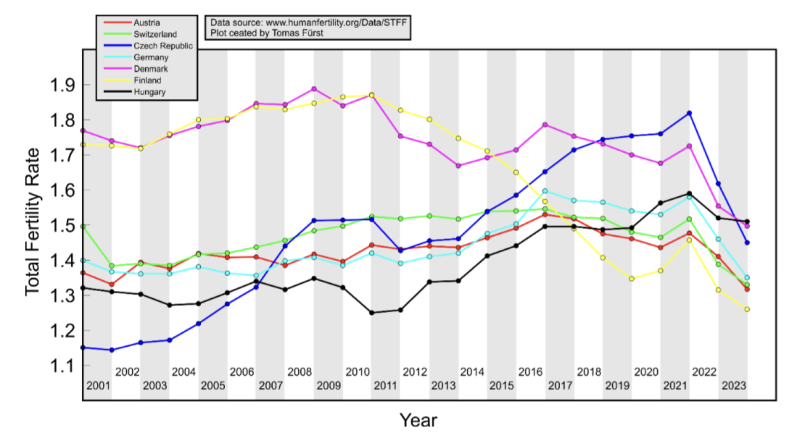
To compare fertility across countries (and time), the so-called Total Fertility Rate (TFR) is used. Roughly speaking, it is the average number of children that are born to a woman over her lifetime. TFR is independent of the number of women and of their age structure. Figure 1 below shows the evolution of TFR in several European countries between 2001 and 2023. I selected countries that experienced a similar drop in TFR in 2022 as the Czech Republic.
So, by the end of 2023, the following two points were clear:
- The drop in natality in the Czech Republic in 2022 could not be explained by demographic factors. Total fertility rate – which is independent of the number of women and their age structure – dropped sharply in 2022 and has been decreasing ever since. The data for 2024 show that the Czech TFR has decreased further to 1.37.
- Many other European countries experienced the same dramatic and unexpected decrease in fertility that started at the beginning of 2022. I have selected some of them for Figure 1 but there are more: The Netherlands, Norway, Slovakia, Slovenia, and Sweden. On the other hand, there are some countries that do not show a sudden drop in TFR, but rather a steady decline over a longer period (e.g. Belgium, France, UK, Greece, or Italy). Notable exceptions are Bulgaria, Spain, and Portugal where fertility has increased (albeit from very low numbers). The Human Fertility Project database has all the numbers.
This data pattern is so amazing and unexpected that even the mainstream media in Europe cannot avoid the problem completely. From time to time, talking heads with many academic titles appear and push one of the politically correct narratives: It’s Putin! (Spoiler alert: The war started in February 2022; however, children not born in 2022 were not conceived in 2021). It’s the inflation caused by Putin! (Sorry, that was even later). It’s the demographics! (Nope, see above, TFR is independent of the demographics).
Thus, the “v” word keeps creeping back into people’s minds and the Web’s Wild West is ripe with speculation. We decided not to speculate but to wrestle some more data from the Czech government. For many months, we were trying to acquire the number of newborns in each month, broken down by age and vaccination status of the mother. The post-socialist health-care system of our country is a double-edged sword: On one hand, the state collects much more data about citizens than an American would believe. On the other hand, we have an equivalent of the FOIA, and we are not afraid to use it. After many months of fruitless correspondence with the authorities, we turned to Jitka Chalankova – a Czech Ron Johnson in skirts – who finally managed to obtain an invaluable data sheet.
To my knowledge, the datasheet (now publicly available with an English translation here) is the only officially released dataset containing a breakdown of newborns by the Covid-19 vaccination status of the mother. We requested much more detailed data, but this is all we got. The data contains the number of births per month between January 2021 and December 2023 given by women (aged 18-39) who were vaccinated, i.e., had received at least one Covid vaccine dose by the date of delivery, and by women who were unvaccinated, i.e., had not received any dose of any Covid vaccine by the date of delivery.
Furthermore, the numbers of births per month by women vaccinated by one or more doses during pregnancy were provided. This enabled us to estimate the number of women who were vaccinated before conception. Then, we used open data on the Czech population structure by age, and open data on Covid vaccination by day, sex, and age.
Combining these three datasets, we were able to estimate the rates of successful conceptions (i.e., conceptions that led to births nine months later) by preconception vaccination status of the mother. Those interested in the technical details of the procedure may read Methods in the newly released paper. It is worth mentioning that the paper had been rejected without review in six high-ranking scientific journals. In Figure 2, we reprint the main finding of our analysis.
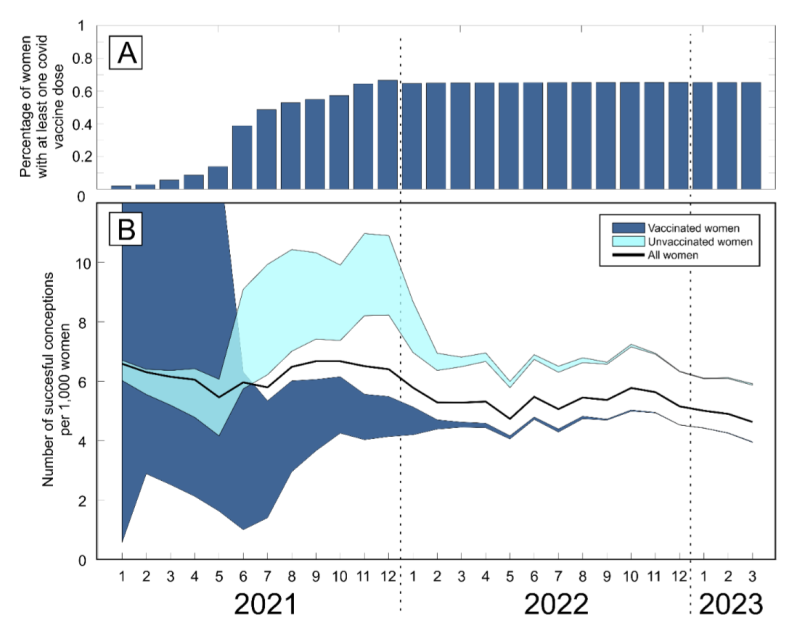
Figure 2 reveals several interesting patterns that I list here in order of importance:
- Vaccinated women conceived about a third fewer children than would be expected from their share of the population. Unvaccinated women conceived at about the same rate as all women before the pandemic. Thus, a strong association between Covid vaccination status and successful conceptions has been established.
- In the second half of 2021, there was a peak in the rate of conceptions of the unvaccinated (and a corresponding trough in the vaccinated). This points to rather intelligent behavior of Czech women, who – contrary to the official advice – probably avoided vaccination if they wanted to get pregnant. This concentrated the pregnancies in the unvaccinated group and produced the peak.
- In the first half of 2021, there was significant uncertainty in the estimates of the conception rates. The lower estimate of the conception rate in the vaccinated was produced by assuming that all women vaccinated (by at least one dose) during pregnancy were unvaccinated before conception. This was almost certainly true in the first half of 2021 because the vaccines were not available prior to 2021. The upper estimate was produced by assuming that all women vaccinated (by at least one dose) during pregnancy also received at least one dose before conception. This was probably closer to the truth in the second part of 2021. Thus, we think that the true conception rates for the vaccinated start close to the lower bound in early 2021 and end close to the upper bound in early 2022. Once again, we would like to be much more precise, but we have to work with what we have got.
Now that the association between Covid-19 vaccination and lower rates of conception has been established, the one important question looms: Is this association causal? In other words, did the Covid-19 vaccines really prevent women from getting pregnant?
The guardians of the official narrative brush off our findings and say that the difference is easily explained by confounding: The vaccinated tend to be older, more educated, city-dwelling, more climate change aware…you name it. That all may well be true, but in early 2022, the TFR of the whole population dropped sharply and has been decreasing ever since.
So, something must have happened in the spring of 2021. Had the population of women just spontaneously separated into two groups – rednecks who wanted kids and didn’t want the jab, and city slickers who didn’t want kids and wanted the jab – the fertility rate of the unvaccinated would indeed be much higher than that of the vaccinated. In that respect, such a selection bias could explain the observed pattern. However, had this been true, the total TFR of the whole population would have remained constant.
But this is not what happened. For some reason, the TFR of the whole population jumped down in January 2022 and has been decreasing ever since. And we have just shown that, for some reason, this decrease in fertility affected only the vaccinated. So, if you want to argue that a mysterious factor X is responsible for the drop in fertility, you will have to explain (1) why the factor affected only the vaccinated, and (2) why it started affecting them at about the time of vaccination. That is a tall order. Mr. Occam and I both think that X = the vaccine is the simplest explanation.
What really puzzles me is the continuation of the trend. If the vaccines really prevented conception, shouldn’t the effect have been transient? It’s been more than three years since the mass vaccination event, but fertility rates still keep falling. If this trend continues for another five years, we may as well stop arguing about pensions, defense spending, healthcare reform, and education – because we are done.
We are in the middle of what may be the biggest fertility crisis in the history of mankind. The reason for the collapse in fertility is not known. The governments of many European countries have the data that would unlock the mystery. Yet, it seems that no one wants to know.
Israeli Settlers Attack One of the Oldest Christian Churches in Palestine
By James Rushmore | The Libertarian Institute | July 9, 2025
Israeli settlers attacked the West Bank town of Taybeh on Monday, causing extensive damage to a fifth-century church and a cemetery. The vandals started a series of fires near the ancient Church of Saint George, one of the oldest Christian churches in Palestine. Local residents were able to extinguish the fires. The attack marks the latest effort by Israeli settlers to intimidate the Palestinian inhabitants of Taybeh, which is the only remaining village in the territory with an exclusively Christian population.
The attack prompted three local priests to issue a statement. Fathers Daoud Khoury, Jack-Noble Abed, and Bashar Fawadleh called upon “local and international actors” to launch an investigation into the settler attacks, put pressure on Israeli authorities, and send delegations directly to Taybeh. They also urged people to provide the villagers with economic and legal assistance. Munther Isaac, a Palestinian pastor who was interviewed by Tucker Carlson in April 2024, shared the priests’ appeal on X. He also criticized U.S. Ambassador to Israel Mike Huckabee, a Christian Zionist, for pursuing policies that enable settler violence in the West Bank.
Huckabee toured the West Bank last week. During his visit, he expressed his support for the settler movement and referred to the territory as “Judea and Samaria,” saying that it would be “a historical injustice and a denial of the Bible” to use any other terminology. He also said that the settlers “represent God’s presence and His choice of this land.”
Huckabee’s trip came days after every Likud minister in the Israeli government sent Prime Minister Benjamin Netanyahu a letter urging him to annex the West Bank before the end of the Knesset’s summer session on July 27. The letter argues that the “strategic partnership, backing, and support of the U.S. and President Donald Trump have made it a propitious time to move forward with [the annexation] now, and ensure Israel’s security for generations.” It also said that a Palestinian state would represent an “existential danger to Israel.”
The attacks mark the latest assault on Taybeh. In June, settlers built an outpost on the eastern edge of the village, atop a key agricultural zone that’s home to thousands of Palestinian olive trees. Local farmers were denied access to the area, and settlers attacked residents who tried to enter the zone. The Israeli settlers have also been allowing their livestock to graze on Palestinian farmlands as part of an effort to push the villagers out.
At least 1,000 Palestinians, including over 200 children, have been killed in the West Bank since Israel began its genocide in the Gaza Strip. In addition to raiding refugee camps and displacing thousands of native civilians, IDF forces have provided settlers with semi-automatic weapons. In 2024, Israel seized control of more Palestinian land in the West Bank than in the previous 20 years combined.
Featured Video
Prof. Ted Postol: Iran Already Achieved Nuclear Deterrence Against Israel
or go to
Aletho News Archives – Video-Images
From the Archives
How the occupied mentality syndrome works
Saudi Arabia on the American chessboard – Part 3
By B. J. Sabri | American Herald Tribune | June 27, 2016
Read part 2: “The occupied mentality Syndrome“
Previously I argued whether Saudi Arabia’s repeated involvements in U.S. interventions and wars stem from free national will or in response to a specific condition. For starters, in Saudi Arabia there is no national will. In Saudi Arabia, the national will is the will of the Al Saud clan. Still, when a major Arab state allies itself with a superpower that committed unspeakable crimes against humanity in almost every Arab country, then something is wrong. This fact alone should compel us to examine the U.S.-Saudi relation for one exceptional reason. As a result of the U.S.-Saudi wars, hundreds of thousands of people in Afghanistan, Iraq, Iran, Libya, Syria, Yemen, and Somalia have lost their lives. Millions became displaced in their own homelands. And millions more rendered refugees.
Attributing the Saudi policies to the bonds of “partnership” with the U.S. is frivolous. There are no bonds between these two thugs except those of business, military deals, secret plots, and wars. Proving this point, bonds such as these have no space for the American and Saudi peoples to share significant cultural or societal exchanges. If partnership is not the reason for the Saudi contribution to the U.S. strategy of empire and imperialism, then another reason must exist.
This leads to three possibilities. … continue
Blog Roll
 Aletho News
- NIAID/NIH and USDA Fund Bioengineered Chimeric Influenza Viruses Built Using Pandemic H1N1 Components: Journal ‘Science Advances’
- Hezbollah hits Israeli warship off Lebanon’s coast, sets it aflame
- Iran slams US strikes on B1 bridge, Mahshahr petrochemical plants as ‘blatant acts of state terrorism’
- In letter to UN chief, Araghchi warns of dire consequences of US-Israeli attacks on Iran’s nuclear facilities
- Why the CIA conspiracy to invade Iran with Kurdish militias failed
- Why Are Upbeat US Claims About Mission to Rescue Pilot ‘Highly Questionable’?
- Aircraft destroyed during US ‘rescue’ of downed F-15 pilot cost more than $100 million each
- Washington University removes professor who condemned US-Israeli war on Iran
- Russia Warns of Retaliation as UK Authorizes Seizure of Vessels
- Serbia thwarts plot to bomb Russia-Hungary gas pipeline – Vucic
- If Americans Knew
- In Iran, Israel-US take aim at “reason, research, and freedom of thought” – Daily Update
- US loses planes over Iran, Israel downgrades Lebanon war goals – Daily Update
- Israel Is Blocking Palestinians from Easter at Church Where Jesus Resurrected
- Plot to assassinate Palestinian activist follows harassment campaign promoted by Zionist groups and elected officials
- Prominent New York synagogue hosts presentation on why U.S. Jews should support the ethnic cleansing of Gaza
- Tapper vs. Piker: Is the CNN Anchor Auditioning for David Ellison?
- Shouldn’t Democrats Be Able to Condemn Genocide?
- Israel-US kill negotiators, destroy civilian structures, but Iran’s military capabilities still largely intact – Daily Update
- ‘War crime’: Global condemnation as Israeli ministers celebrate death penalty law targeting Palestinian prisoners
- 7 Ways Israel Is Turning Lebanon Into Gaza
- No Tricks Zone
- An Inconvenient Tree: Uncovered In Alps… Europe Much Warmer Than Today 6000 Years Ago
- New Study Reports A 60% Slowdown In Greenland’s Ice Loss Rate In The Last Decade
- Low Intensity Tornado Wrecks Major Solar Farm, Creating A Potential Toxic Dump
- New Study Finds Warming Saves Lives…Cold Temperatures 12 Times More Deadly Than Excess Heat
- German Science Blog Accuses PIK Climate Institute Of Hallucinating Climate Tipping Points
- Devastating Assessment Of Comirnaty Vaccine By Former Senior Pfizer Europe Toxicologist
- New Study: CO2 Is ‘Effectively Negligible’ As An Explanatory Climate Change Factor Since 2000
- Former Pfizer Toxicologist Dr. Helmut Sterz Tells Bundestag Hearing Pfizer Vaccine Should Have Never Been Approved
- Energy Expert: Germany’s Nuclear Phaseout Was A “500 Billion Euro Mistake”
- New Research: South Australia’s Mid-Holocene Sea Surface Temperatures Were 4°C Warmer Than Today
 Aletho News