Massive civilian flotilla set to sail for Gaza late August to break Israeli siege

Freedom Flotilla Coalition’s Handala departs from Gallipoli to reach Gaza to deliver humanitarian aid and break the Israeli blockade, July 20, 2025. [Valeria Ferraro – Anadolu]
MEMO | August 4, 2025
A massive civilian flotilla is set to depart for the Gaza Strip at the end of August in a new bid to break Israel’s blockade that has left the territory’s entire population on the verge of famine, Anadolu reports.
Speaking at a press conference in Tunis hosted by the Joint Action Coordination for Palestine, a civil society coordination platform, members of the Global Sumud Flotilla said activists from 44 countries have signed up for the coordinated effort.
“This summer, dozens of boats, both large and small, will set sail from ports across the world, converging on Gaza in the largest civilian flotilla of its kind in history,” said organizer Haifa Mansouri.
The flotilla brings together four initiatives: the Maghreb Sumud Flotilla, the Global Movement to Gaza, the Freedom Flotilla Coalition, and Sumud Nusantara. Their united aim, Mansouri said, is to “break the illegal blockade on Gaza by sea, establish a humanitarian corridor, and confront the ongoing genocide against the Palestinian people.”
The first convoy will leave Spanish ports on Aug. 31, followed by a second from Tunisian ports on Sept. 4.
Seif Abu Keshk, another organizer, said more than 6,000 activists have already registered online to join.
“Participants will undergo training at departure points, with solidarity events and encampments planned along the way,” he added.
“This is a renewed attempt to pressure governments by sending dozens of ships and thousands of activists to break Gaza’s blockade,” Abu Keshk noted.
The announcement comes days after Israeli naval forces intercepted the Handala aid ship on July 26 as it neared Gaza’s shores and escorted it to Ashdod Port. The vessel had reached about 70 nautical miles from Gaza, surpassing the distance covered by the Madleen, which made it 110 miles before being stopped, according to the International Committee to Break the Siege on Gaza.
Rejecting international calls for a ceasefire, the Israeli army has pursued a brutal offensive on Gaza since Oct. 7, 2023, killing nearly 61,000 Palestinians, almost half of them women and children. The military campaign has devastated the enclave and brought it to the verge of famine.
Last November, the International Criminal Court issued arrest warrants for Israeli Prime Minister Benjamin Netanyahu and his former Defense Minister Yoav Gallant for war crimes and crimes against humanity in Gaza.
Israel also faces a genocide case at the International Court of Justice for its war on the enclave.
Report: Mass Abductions, Torture, Enforced Disappearances

IMEMC | August 4, 2025
A joint report issued by the Commission for Detainees and Ex-Detainees Affairs, the Palestinian Prisoners’ Society, and Addameer Prisoner Support and Human Rights Association has revealed a serious escalation in the mass abduction of Palestinians and accompanying violations since the beginning of the genocide in Gaza in October 2023.
According to the report, approximately 18,500 Palestinians have been abducted across the occupied West Bank and Jerusalem since the genocide began, part of a systematic campaign targeting civilians under the pretext of security operations.
Women and Children Among the Abducted
The number of women abducted has reached around 570, including individuals from Gaza, the West Bank, and the 1948-occupied territories.
This figure excludes dozens of women forcibly disappeared from Gaza, where access to information is still obstructed.
In parallel, at least 1,500 children have been abducted across the West Bank, prompting alarm from human rights organizations over breaches of international conventions protecting minors.
Journalists Silenced Through Detention
More than 194 journalists have been abducted, with 49 still imprisoned. Many of these cases are viewed as attempts to suppress documentation of abuses and silence independent reporting.
Torture, Destruction, and Human Shield Tactics
The report highlights a pattern of grave abuse accompanying abduction operations:
- Beatings and torture
- Threats against abductees and their families
- Systematic invasions and violations, including home demolitions
- Seizure of vehicles, personal belongings, and valuables
- Destruction of infrastructure in refugee camps, notably in Jenin and Tulkarem
- Use of civilians, including children and family members, as human shields, and hostages
Mass Abductions and Enforced Disappearances
The wave of abductions includes individuals taken from their homes, at military roadblocks, coerced into surrender under duress after the army abducted members of their families and held them as hostages.
Thousands of Gaza workers present in the 1948-occupied areas with legal permits were abducted, alongside hundreds from Gaza who were in the West Bank for medical treatment, or for work.
Field executions have also been reported, including among family members of detainees.
Deaths in Custody and Withheld Remains
Since October 7, at least 75 Palestinians have died in Israeli custody, with 46 confirmed as Gaza detainees.
Many others remain forcibly disappeared, their identities and causes of death unacknowledged.
Israel continues to hold the bodies of 72 prisoners, bringing the total number of withheld martyrs to 83.
Detainee Statistics – July 2025
As of July 2025, the total number of Palestinians imprisoned stands at 10,800, the highest recorded since the Second Intifada. This figure excludes individuals held in prison camps run by the Israeli army.
Administrative and “Unlawful Combatant” Detainees: July 2025
As of early July 2025, the number of administrative detainees held by Israeli authorities has reached 3,629, the highest recorded figure to date.
This category, which allows for detention without charge or trial, now exceeds all other classifications, including those formally indicted, sentenced, or labeled as “unlawful combatants.”
The number of detainees classified as “unlawful combatants” stands at 2,454, though this figure does not include most Gaza detainees held in Israeli military camps.
This is the largest documented count since the onset of Israel’s genocidal campaign. The classification also encompasses Arab detainees from Lebanon and Syria.
- These figures exclude individuals subjected to enforced disappearance or held in Israeli military camps, particularly from Gaza.
- These figures encompass both those still held and those who were later released. The numbers remain fluid due to ongoing abduction campaigns.
- Due to ongoing genocide, destruction and siege in Gaza, data regarding the number of detainees from the costal enclave is still scarce.
- By mid-December of 2024, the number of detainees who were abducted in the Gaza Strip was estimated to be 3,436.
Marked for Death by a Reckless America?
By Ron Unz • Unz Review • August 4, 2025
A few weeks ago I published an article noting that the State of Israel and the Zionist movement that gave rise to it have probably employed assassination as a tool of statecraft more heavily than any other political entity in recorded history. Indeed, their deadly activities had easily eclipsed those of the notorious Muslim sect that had terrorized the Middle East a thousand years ago and gave rise to that term.
The piece had been prompted by Israel’s sudden strike against Iran, capping its reputation as the greatest band of assassins known to history. Even as the Iranian government was intensely focused on the negotiations with America over its nuclear program, a sudden Israeli surprise attack successfully assassinated most of Iran’s highest military commanders, some of its political leaders, and nearly all of its most prominent nuclear scientists. I cannot recall any previous case in which a major country had ever had so large a fraction of its top military, political, and scientific leadership eliminated in that sort of illegal sneak attack.
Less than one year earlier, a series of missile exchanges between Israel and Iran had soon been followed by the death of hardline Iranian President Ebrahim Raisi and his foreign minister in a highly-suspicious and never explained helicopter crash. Given subsequent events, I think we can safely assume that he, too, had died at the hands of the Israelis.
- Zionist Israel as the Assassination Nation
Ron Unz • The Unz Review • June 23, 2025 • 11,800 Words
Earlier this year, the declassification of a large batch of JFK Assassination files had prompted me to recapitulate and summarize many of my articles of the last half-dozen years on that landmark twentieth century event. I gathered together some of the very considerable evidence that the Israeli Mossad played the central role in the assassination of President John F. Kennedy in 1963 as well as the death of his younger brother Robert a few years later, probably the highest-profile political assassinations of the last one hundred years or more.
- How Israel Killed the Kennedys
Ron Unz and Mike Whitney • The Unz Review • March 24, 2025 • 11,500 Words
The most weighty and authoritative work on the long history of Israeli assassinations is surely Ronen Bergman’s 2018 volume Rise and Kill First, running 750 pages and including a thousand-odd source references, with many of the latter citing official documents never previously made available to journalists. By some estimates, this book documented nearly 3,000 such foreign political killings, a remarkable total for a small country then less than three generations old.
Although the Bergman book was certainly very comprehensive, it was produced under strict Israeli censorship, so the text quite understandably omitted almost any coverage of some of the highest-profile Zionist attacks on Western targets. For example, there was no mention of the unsuccessful but well-documented attempts to kill President Harry Truman, nor the assassination efforts aimed at British Prime Minister Winston Churchill and the top members of his Cabinet.
Some of this latter coverage may be found in Thomas Suarez’s 2016 book State of Terror which I would recommend as a very useful supplementary work, though its focus is almost entirely limited to the activities of Zionist groups just prior to the establishment of Israel.
For a broader discussion of the history of Israeli assassinations and closely-related terrorist attacks, especially those targeting Westerners, one of the most useful compilations might be my own very long January 2020 article, providing extensive references to the underlying primary and secondary sources.
- American Pravda: Mossad Assassinations
Ron Unz • The Unz Review • January 27, 2020 • 27,300 Words
That 2020 article had actually been prompted by America’s own sudden assassination of Iranian Gen. Qassem Soleimani, a shocking development that drew a great deal of media coverage at the time.
I had opened my long discussion by noting that over the last several centuries Western governments had almost totally abandoned the use of political assassinations against the leadership of major rival nations, regarding such actions as immoral and illegal.
For example, historian David Irving revealed that when one of Adolf Hitler’s aides suggested to him that an attempt be made to assassinate the Soviet military leadership during the bitter combat on the Eastern Front of World War II, the German Fuhrer immediately forbade any such practices as obvious violations of the laws of civilized warfare.
For most of American history, a similar attitude had prevailed, but I explained that this began to change over the last couple of decades, mostly in the wake of the 9/11 Attacks.
The 1914 terrorist assassination of Archduke Franz Ferdinand, heir to the throne of Austria-Hungary, was certainly organized by fanatical elements of Serbian Intelligence, but the Serbian government fiercely denied its own complicity, and no major European power was ever directly implicated in the plot. The aftermath of the killing soon led to the outbreak of World War I, and although many millions died in the trenches over the next few years, it would have been completely unthinkable for one of the major belligerents to consider assassinating the leadership of another.
A century earlier, the Napoleonic Wars had raged across the entire continent of Europe for most of a generation, but I don’t recall reading of any governmental assassination plots during that era, let alone in the quite gentlemanly wars of the preceding 18th century when Frederick the Great and Maria Theresa disputed ownership of the wealthy province of Silesia by military means. I am hardly a specialist in modern European history, but after the 1648 Peace of Westphalia ended the Thirty Years War and regularized the rules of warfare, no assassination as high-profile as that of Gen. Soleimani comes to mind…
During our Revolutionary War, George Washington, Thomas Jefferson, and our other Founding Fathers fully recognized that if their effort failed, they would all be hanged as rebels by the British. However, I have never heard that they feared falling to an assassin’s blade, nor that King George III ever considered using such an underhanded means of attack. During the first century and more of our nation’s history, nearly all our presidents and other top political leaders traced their ancestry back to the British Isles, and political assassinations were exceptionally rare, with Abraham Lincoln’s death being one of the very few that comes to mind.
At the height of the Cold War, our CIA did involve itself in various secret assassination plots against Cuba’s Communist dictator Fidel Castro and other foreign leaders considered hostile to US interests. But when these facts later came out in the 1970s, they evoked such enormous outrage from the public and the media, that three consecutive American presidents—Gerald R. Ford, Jimmy Carter, and Ronald Reagan—all issued successive Executive Orders absolutely prohibiting assassinations by the CIA or any other agent of the US government.
Although some cynics might claim that these public declarations represented mere window-dressing, a March 2018 book review in the New York Times strongly suggests otherwise. Kenneth M. Pollack spent years as a CIA analyst and National Security Council staffer, then went on to publish a number of influential books on foreign policy and military strategy over the last two decades. He had originally joined the CIA in 1988, and opens his review by declaring:
One of the very first things I was taught when I joined the CIA was that we do not conduct assassinations. It was drilled into new recruits over and over again.
Yet Pollack notes with dismay that over the last quarter-century, these once solid prohibitions have been steadily eaten away, with the process rapidly accelerating after the 9/11 attacks of 2001. The laws on our books may not have changed, but
Today, it seems that all that is left of this policy is a euphemism.
We don’t call them assassinations anymore. Now, they are “targeted killings,” most often performed by drone strike, and they have become America’s go-to weapon in the war on terror.
The Bush Administration had conducted 47 of these assassinations-by-another-name, while his successor Barack Obama, a constitutional scholar and Nobel Peace Prize winner, had raised his own total to 542. Not without justification, Pollack wonders whether assassination has become “a very effective drug, but [one that] treats only the symptom and so offers no cure.”
Thus over the last couple of decades the American government has followed a disturbing trajectory in its use of assassination as a tool of foreign policy, first restricting its application only to the most extreme circumstances, next targeting small numbers of high-profile “terrorists” hiding in rough terrain, then escalating those same killings to the many hundreds. And now under President Trump, the fateful step has been taken of America claiming the right to assassinate any world leader not to our liking whom we unilaterally declare worthy of death.
Pollack had made his career as a Clinton Democrat, and is best known for his 2002 book The Threatening Storm that strongly endorsed President Bush’s proposed invasion of Iraq and was enormously influential in producing bipartisan support for that ill-fated policy. I have no doubt that he is a committed supporter of Israel, and he probably falls into a category that I would loosely describe as “Left Neocon.”
But while reviewing a history of Israel’s own long use of assassination as a mainstay of its national security policy, he seems deeply disturbed that America might now be following along that same terrible path.
Pollock’s discussion of these facts came in his lengthy 2018 New York Times review of the Bergman book entitled “Learning From Israel’s Political Assassination Program,” and he greatly decried what many have called the “Israelization” of the American government and its military doctrine. President Donald Trump’s sudden public assassination of so high-profile a foreign leader as Gen. Soleimani came less than two years later and demonstrated that Pollock’s concerns were fully warranted and indeed even understated.
As my January 2020 article explained, nothing like this had ever previously happened in peacetime American history, and only very rarely even during wars.
The January 2nd American assassination of Gen. Qassem Soleimani of Iran was an event of enormous moment.
Gen. Soleimani had been the highest-ranking military figure in his nation of 80 million, and with a storied career of 30 years, one of the most universally popular and highly regarded. Most analysts ranked him second in influence only to Ayatollah Ali Khamenei, Iran’s elderly Supreme Leader, and there were widespread reports that he was being urged to run for the presidency in the 2021 elections.
The circumstances of his peacetime death were also quite remarkable. His vehicle was incinerated by the missile of an American Reaper drone near Iraq’s Baghdad international airport just after he had arrived there on a regular commercial flight for peace negotiations originally suggested by the American government.
Our major media hardly ignored the gravity of this sudden, unexpected killing of so high-ranking a political and military figure, and gave it enormous attention. A day or so later, the front page of my morning New York Times was almost entirely filled with coverage of the event and its implications, along with several inside pages devoted to the same topic. Later that same week, America’s national newspaper of record allocated more than one-third of all the pages of its front section to the same shocking story.
But even such copious coverage by teams of veteran journalists failed to provide the incident with its proper context and implications. Last year, the Trump Administration had declared the Iranian Revolutionary Guard “a terrorist organization,” drawing widespread criticism and even ridicule from national security experts appalled at the notion of classifying a major branch of Iran’s armed forces as “terrorists.” Gen. Soleimani was a top commander in that body, and this apparently provided the legal fig-leaf for his assassination in broad daylight while on a diplomatic peace mission.
- American Pravda: Mossad Assassinations
From the Peace of Westphalia to the Law of the Jungle
Ron Unz • The Unz Review • January 27, 2020 • 27,300 Words
Although Pollock provided some explanations for this shocking transformation in American doctrine, he failed to note what was arguably the most obvious factor. Over the last generation or two, the American government and American political life have been almost entirely captured by what scholars John J. Mearsheimer and Stephen M. Walt called “The Israel Lobby” in their best-selling 2008 book of that title, and this political and ideological transformation has only further accelerated in the last couple of years, most recently reaching ridiculous, almost cartoonishly extreme levels.
For example, nearly every other country on earth regards Israeli Prime Minister Benjamin Netanyahu as one of the worst war criminals in modern history, now under indictment by the International Criminal Court for his ongoing genocidal massacre of Gaza’s helpless two million civilians, with an international warrant issued for his arrest. But the American political system is almost entirely under the control of pro-Israel partisans so he was invited in 2024 to give an unprecedented fourth public address to a joint session of Congress, receiving an endless series of standing ovations by the trained barking seals of our national legislative body.
Over the last couple of generations, successful American politicians have increasingly been selected for their unswerving loyalty to the State of Israel and their admiration for all things Israeli, often describing themselves as committed Zionists, followers of a foreign nationalist movement.
As a notable example of this strange pattern, a Republican Gentile such as Rep. Brian Mast had not only volunteered for service in the Israeli military, but then proudly wore his foreign uniform while serving as an elected member of Congress. Perhaps partly as a consequence of this demonstration of his overriding loyalty to a foreign nation, in January he was named chairman of our powerful House Foreign Relations Committee.
In another bizarre twist, foreign students attending American universities have never been punished for denouncing or condemning America or the behavior of the American government, but under the Trump Administration they have been rounded up and deported if they criticized the foreign government of Israel.
So if Israel and the Zionist movement have spent the last one hundred years heavily relying upon political assassinations as a primary geopolitical tool, it is hardly surprising if American political leaders have now increasingly adopted the practice of their Israeli mentors and exemplars and done the same.
This trend was further accelerated by the complete capture of the foreign policy establishment of both of our major political parties by the militantly pro-Israel Neocons. Indeed, as I have noted, the term “Neocon” has largely dropped from usage during the last decade or so because the views and beliefs of almost everyone in DC establishment circles would now fall into that category, a tendency that extends across our entire political ecosphere of elected officials, staffers, think-tanks, and media outlets.
I believe that this new American emphasis on political assassinations has extremely dangerous consequences for the world, consequences that perhaps most analysts have failed to properly appreciate. Israel’s tendency to assassinate the political leaders of those countries it views as rivals or threats has naturally focused upon its own region. But when American leaders have adopted that same mind-set, their targets have obviously been different ones.
Israel’s sudden and largely successful decapitation strike against Iran had heavily relied upon the innovative use of drones. But just a couple of weeks earlier, a somewhat different but equally bold use of drones had been used to hit all of Russia’s interior airbases housing its strategic bomber fleet, successfully destroying quite a number of those nuclear-capable aircraft, one of the important legs of the country’s nuclear deterrent triad. Just before that, there was an attempt to assassinate Russian President Vladimir Putin with a swarm of drones when he visited the Kursk area on a helicopter tour of that region.
Although the Ukrainian government took full credit for these latter two attacks against Russia, it seems extremely unlikely that they would have undertaken such action without the full support and approval of their American and NATO paymasters, and indeed the Russians claimed to have hard evidence of such involvement. As I noted in an article, the Ukrainian government explained that the planning for the project had begun roughly eighteen months earlier, and that had been exactly the time when New Jersey and parts of the East Coast had reported a mysterious wave of very heavy drone activity, which our government later admitted was testing for a highly classified military project. I think that the very close match of timing was hardly likely to have been coincidental.
The size of Russia’s nuclear arsenal surpasses our own and its large suite of unstoppable hypersonic delivery systems has given it a measure of strategic superiority over America and our NATO allies on both the nuclear and conventional escalation ladders. So the very strong likelihood that America was intimately involved in an attack on Russia’s nuclear triad and an attempt to assassinate Russia’s president seems exceptionally reckless and dangerous behavior. In a recent article, I suggested that Russia should take prompt and forceful action to deter any such future attacks, but this has not yet happened:
- A Forceful Russian Response to NATO Recklessness
How a Deft Strategic Blow Could Shatter the Western Alliance
Ron Unz • The Unz Review • June 30, 2025 • 5,300 Words
A couple of years earlier, I published an article focusing on indications of earlier American attempts to kill President Putin. This came after our bipartisan political and media elites had begun vilifying the Russian leader as “another Hitler,” with leading media figures and top U.S. Senators loudly calling for his assassination. I noted that the Russians seemed concerned that such assassination efforts might even employ novel, biological means:
We should also recognize the reality that during the last seventy years America has maintained the world’s largest and best-funded biological warfare program, with our government spending many tens of billions of dollars on biowarfare/biodefense across those decades. And as I’ve discussed in a long article, there is even considerable evidence that we actually used those illegal weapons during the very difficult first year of the Korean War…
Soon after their invasion, the Russians publicly claimed that the U.S. had established a series of biolabs in Ukraine, which were preparing biological warfare attacks against their country. Last year one of their top generals declared that the global Covid epidemic was probably the result of a deliberate American biowarfare attack against China and Iran, echoing the accusations previously made by those countries.
Russian security concerns over our advanced biowarfare capabilities and the extreme recklessness with which we might employ them may explain the rather strange behavior of President Putin when he met in Moscow for talks with French President Emmanuel Macron and German Chancellor Olaf Scholz shortly before the outbreak of the Ukraine war.
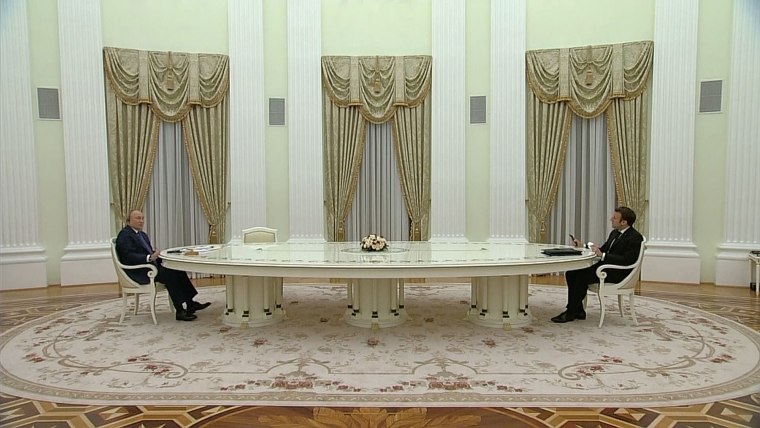
At the time many observers were puzzled why in each case the two national leaders were seated at opposite ends of a very long table, with Putin blandly suggesting that the placement was meant to symbolize the vast distance separating Russia and NATO’s Western leaders. Perhaps that innocuous explanation was correct. But I think it far more likely that the Russians were actually concerned that the Western leaders meeting him might be the immunized carriers of a dangerous biological agent intended to infect their president.
- Assassinating Vladimir Putin?
Ron Unz • The Unz Review • May 15, 2023 • 3,800 Words
On the face of it, American attempts to assassinate Russia’s president would make little logical sense and these would obviously be extremely reckless and dangerous. But much the same could be said of American-orchestrated efforts to destroy Russia’s strategic nuclear bomber fleet, yet there seems very strong evidence that both these actions occurred. So we should seek to understand the logical framework, however irrational and unrealistic, under which such American decisions would be made.
I think an important insight may have been recently provided by Alistair Crooke, a former senior MI6 officer and Middle East peace negotiator, with a great deal of expertise and excellent sources in that latter region.
In an interview a couple of weeks ago, he claimed that America had been directly involved in the wave of Israeli assassinations against Iran’s leaders, taking such action despite the fact that we were currently in the midst of crucial nuclear negotiations with that country. Launching a massive assassination attack against the entire leadership of a country with whom you are currently negotiating is obviously an extremely destabilizing action, one that will hardly inspire confidence among other prospective negotiating partners and will surely long be remembered.
But according to Crooke, the logic behind such American action was the widespread belief that the hold of the Islamic Republic upon the 90 million people of that country was quite fragile, and that the successful assassination of most of the Iranian leaders would cause the collapse of the regime, much like the government of Syria had collapsed earlier this year after attacks by armed Islamicist forces based in Idlib. The American government was greatly disappointed when that wave of assassinations failed to trigger such a political collapse and instead redoubled popular support for the ruling regime.
Crooke suggested that Iranian President Masoud Pezeshkian and Supreme Leader Ayatollah Ali Khamenei had been targeted for death as well, but unlike so many other senior Iranian officials they had been fortunate enough to survive. Indeed, not long afterward, President Trump repeatedly threatened to assassinate Ayatollah Khamenei unless he completely acceded to America’s demands regarding Iran’s nuclear program. Offhand, I can’t remember the last time a world leader has publicly threatened to assassinate one of his foreign counterparts in such fashion.
If Crooke’s analysis is correct, similarly mistaken reasoning might help to explain the likely American involvement in the attempt to assassinate Putin a few weeks earlier. Most of America’s political decisionmakers may have convinced themselves that the Russian regime was discredited, unpopular, and fragile, and that the sudden elimination of Russia’s president perhaps combined with a heavy blow to Russia’s nuclear retaliatory arsenal would cause its collapse.
Such an analysis might seem extremely implausible to most observers, but much of America’s leadership seems to exist in an unrealistic propaganda-bubble in which these notions have become widespread.
Consider, for example, estimates of Russian casualties in Ukraine. The Western-funded anti-Putin media outlet Mediazona has used its considerable resources to continually sweep the Russian Internet in order to compile a running total of verified Russian losses in the Ukraine war, and as of July 2025 had confirmed a total of over 120,000 Russian soldiers killed. This is likely somewhat of an underestimate given that at least some such deaths have escaped public notice, and such totals certainly represent heavy losses in a Russian population of around 140 million.
But our Neocon-dominated American government and its intelligence services have instead accepted without question totally outrageous figures apparently based upon the dishonest claims of Ukrainian propagandists. Back in February, Trump told reporters that Russia had already suffered 1.5 million casualties, an astonishing figure, and just a few days ago, he claimed that almost 20,000 additional Russians had been killed in the month of July alone.
As former CIA officer Larry Johnson noted, journalist Seymour Hersh reported that an intelligence official described for him a destroyed Russian military that had already suffered two million casualties:
“The total now is two million. Most importantly,” the official stressed, “was how this number was described. All the best trained regular Army troops, to be replaced by ignorant peasants. All the best mid-grade officers and NCOs dead. All modern armor and fighting vehicles. Junk. This is unsustainable.”
Two million Russian casualties would probably amount to more than 5% of that country’s entire population of military-age males, and such enormous losses could not possibly be kept concealed. Those figures are obviously delusional.
But if America’s political leaders and many of their military advisors accept such fantasies, they could easily convince themselves that a defeated Russia is now ripe for regime-change triggered by Putin’s assassination. They would obviously hope that the replacement might be a new government closely aligned with the West and subservient to its demands, much as had been the case during the 1990s.
Other Neocon analysts have proposed Russia’s dismemberment into several different much smaller states, none of which would be able to resist American pressure and domination, with various such proposed maps floating around.

Thus, America’s likely involvement in assassination efforts against the top leadership of both Iran and Russia was based upon our unrealistic assumptions regarding the weakness of the two regimes, and the belief that elimination of their top leaders would lead to a collapse. Moreover, in each case these attacks rather treacherously occurred in the midst of ongoing negotiations, over Iran’s nuclear program in one case and over Russian willingness to end the Ukraine war in the other. We should also remember that Trump’s earlier assassination of Gen. Soleimani occurred when that latter leader had been treacherously lured to Iraq for peace negotiations.
Unfortunately, countries that are totally delusional on some national security matters are much more likely to be equally delusional on others as well. I have recently discovered that important elements of the American foreign policy establishment have convinced themselves that the government of China is also fragile and weak, and possibly ripe for collapse if it were hit by one or more sharp shocks. A blogpost brought these strange and surprising notions to my attention a couple of weeks ago.
The blogger highlighted a major article in the New Yorker focusing on aspects of a likely future war between America and China, and suggesting that in some respects it might be analogous to the ongoing conflict between Israel and Gaza. Indeed, the subtitle even described Israel’s invasion of Gaza as “a dress rehearsal” for a future American war with China.
China has an enormous military, equipped with some of the world’s most highly-advanced weapons, and these include a full suite of the unstoppable hypersonic missiles that America has so far failed to successfully produce. So the belief that Israel’s ongoing slaughter of Gaza’s helpless, unarmed civilians holds any serious lessons for the course of a future American war with China seems rather strange reasoning indeed.
- What’s Legally Allowed in War
How U.S. military lawyers see Israel’s invasion of Gaza—and the public’s reaction to it—as a dress rehearsal for a potential conflict with a foreign power like China.
Colin Jones • The New Yorker • April 25, 2025 • 3,300 Words
The rather peculiar tone of that article may have been influenced by a very lengthy report published several months earlier by the Rand Corporation, whose title appeared to raise strong doubts about the military effectiveness of China’s armed forces.
- The Chinese Military’s Doubtful Combat Readiness
The People’s Liberation Army Remains Focused on Upholding Chinese Communist Party Rule, Not Preparing for War
Timothy R. Heath • The Rand Corporation • January 27, 2025 • 15,000 Words
However, after carefully reading that Rand study, I concluded that the title was somewhat misleading. The researcher correctly noted that China gave no indications of preparing to wage war against Taiwan, America, or any other country, and much unlike the U.S. had avoided involvement any military conflicts for the last half-century. But lack of interest in starting wars is quite different than lack of military effectiveness if attacked or sufficiently provoked, and conflating the two probably reflected the ideological climate found at most American think-tanks based upon the influence of their funders.
Finally, the lengthiest and most astonishing think-tank report of all was published just a couple of weeks ago by the Hudson Institute, one of our most unswervingly Neocon research organizations. This book-length study argued that China’s Communist government might be ripe for collapse and casually suggested that American military forces should be prepared for deployment inside China in order to seize crucial military and technological facilities and then reconstruct the government of that enormous country after the downfall of its current regime.
- China After Communism
Preparing for a Post-CCP China
Miles Yu et al. • The Hudson Institute • July 16, 2025 • 65,000 Words
The blogger quoted a couple of the paragraphs from the executive summary of this remarkable document:
While the People’s Republic of China (PRC) has weathered crises before, a sudden regime collapse in China is not entirely unthinkable. Policymakers need to consider what might happen and what steps they would have to take if the world’s longest-ruling Communist dictatorship and second-largest economy collapses due to its domestic and international troubles.
With chapters written by experts in military affairs, intelligence, economics, human rights, transitional justice, and constitutional governance, this report examines the initial steps that should be taken in the immediate aftermath of the CCP regime’s collapse and the long-term trajectory China might take after a stabilization period. Drawing on historical analysis, strategic foresight, and domain-specific expertise, this anthology describes these challenges as an exercise in possibilities. The different chapters explore how a single-party system collapses in key sectors of the country and how political institutions transform, as well as China’s unique political, economic, and social situation. Taken together, they assess the daunting tasks of stabilizing a long-repressed country after it has collapsed, in addition to the forces shaping China’s future. In so doing, the authors hope to offer policy recommendations for managing the risks and opportunities of a transition.
Having carefully read the entire report, I found it just as astonishing as was suggested by those paragraphs.
Over the last half-century, China has certainly been the world’s most successful major country, experiencing perhaps the highest sustained rate of economic growth in all of human history and now possessing a real economy far larger than that of the U.S.
Indeed, if we exclude the service sector, whose statistics are easily subject to manipulation, China’s real productive economy is now actually larger than the combined total for America, the EU, and Japan, while certainly growing much more rapidly. Meanwhile, America has experienced decades of stagnation, with heavy financialization replacing our once enormous real industrial strength. Moreover, in many technological sectors, China has now become the world leader, and it is near the very top in most of the others.
Earlier this year I published a lengthy comparative analysis of China and America, whose conclusions were hardly favorable to the latter:
- American Pravda: China vs. America
A Comprehensive Review of the Economic, Technological, and Military Factors
Ron Unz • The Unz Review • January 13, 2025 • 14,100 Words
The following month I summarized much of this same material in a lengthy interview with Mike Whitney:
- Confucius, DeepSeek, and Why China Would Win a War with the United States
Mike Whitney Interview with Ron Unz
Ron Unz and Mike Whitney • The Unz Review • February 2, 2025 • 9,900 Words
One of the main authors of that Hudson Institute report was lawyer and conservative columnist Gordon G. Chang, probably best known as the author of the 2001 book The Coming Collapse of China, and a quarter-century of absolutely contrary real-life trends seems to have hardly changed any of his views.
The Hudson Institute is a leading DC think-tank, quite influential in mainstream political circles, and a report with five co-authors that runs 128 pages must surely carry considerable weight in establishment circles. So when it suggests that the Chinese government is fragile and might soon collapse, those policy makers hostile to China are likely to take such views quite seriously.
Suppose that a leading Chinese think-tank with close ties to the PRC government published a weighty report predicting that America might soon collapse, then went on to argue that Chinese military forces would need to be deployed in our own country to seize our key military and technological assets and also establish a new government organized along Chinese lines. I doubt that most American political leaders or ordinary citizens would view such Chinese proposals with total equanimity, and indeed the blogger quoted a shocked Western pro-China business executive who succinctly summarized some of the striking elements in that Hudson Institute research study:
… which provides detailed operational plans for inducing Chinese regime collapse through systematic information operations, financial warfare, and covert influence campaigns, followed by detailed protocols for U.S. post-collapse management including military occupation, territorial reorganization, and the installation of a political and cultural system vassalized to the U.S.
Rand and Hudson are two of our leading mainstream think-tanks and the New Yorker is one of our most prestigious media outlets. Taken together those major articles and reports could easily convince the ignorant and suggestible ideologues in our government that the Chinese military was weak and the Chinese government fragile and ripe for collapse.
If delusional beliefs regarding the fragility of the Iranian and Russian governments had already led to American assassination attempts against their top leadership, similar reasoning might easily result in targeting those of China as well, especially President Xi Jinping, widely regarded as the strongest Chinese leader in decades. And given all of the recent American assassination projects, the Chinese government might certainly have itself reached such conclusions.
China and Russia are the two leading members of the BRICS movement, which held its 17th summit last month in Brazil. The media noted that neither Russian President Putin nor Chinese President Xi attended in person, with the latter missing his first BRICS summit since he came to power 13 years ago.
Xi’s surprising absence caused some discussion in the media. I initially paid little attention to this issue, but then some commenter suggested an obvious explanation: Both Xi and Putin were concerned about the possible risk of American assassination.
Brazil is located within the Western Hemisphere, a region under full American military domination. Given the extremely reckless and unpredictable behavior of the American government, with President Trump having publicly threatened to assassinate Iran’s top leader just a couple of weeks earlier, both China and Russia may have believed that some risks should best be avoided.
Suppose an errant missile struck down an incoming presidential plane, with no conclusive means of proving the source, or an aircraft were destroyed by some more sophisticated methods. Over the years, Xi and Putin had both met on numerous occasions with Iranian President Raisi, with whom they had developed an excellent working relationship, and surely his 2024 death in a mysterious helicopter crash while returning from a foreign trip would have concentrated their minds.
Any such “conspiratorial” explanation has naturally been entirely avoided by the media. For example, a lengthy article late last month in the Wall Street Journal described how Xi had drastically reduced his foreign travel over the last year or so, noting that a China-EU summit originally set for Brussels was moved to Beijing after the Chinese explained that Xi had no plans to visit Europe. Since the end of 2024, Xi’s only foreign travels have been to Russia and to several countries in South-East Asia. Unlike Europe or Latin America, none of these countries nor the travel routes to reach them would be likely venues for serious American attempts at assassination.
When major countries develop a well-deserved reputation for assassinating the leaders of other major countries, often even doing so in the midst of international negotiations, such behavior may obviously have serious consequences. Back in 2017, President Xi was quite willing to visit Mar-a-Lago for face-to-face negotiations with President Trump, but I very much doubt the Chinese leader will be taking any trips to our own country in the foreseeable future.
Related Reading:
Trump conditions $1.9B in disaster funds on rejection of Israel boycotts
MEMO | August 4, 2025
The Trump administration has threatened to withhold roughly $1.9 billion in disaster preparedness funding to states and cities that support boycotts of Israel or Israeli firms.
The Federal Emergency Management Agency (FEMA) said in grant notices published Friday that applicants must comply with its internal terms and conditions, which include clauses mandating that entities seeking funding not support efforts to blacklist Israel.
Applicants must not support severing “commercial relations, or otherwise limiting commercial relations specifically with Israeli companies or with companies doing business in or with Israel or authorized by, licensed by, or organized under the laws of Israel to do business,” according to the 2025 fiscal year terms and conditions, posted in April.
Super PAC Targeting Massie Funded By Three Israel-Backing Billionaires

By Tyler Durden | Zero Hedge | August 3, 2025
Though it sports a Kentucky- and MAGA-branded name, the new Super PAC launched solely to support a primary challenge against popular Republican Congressman Thomas Massie is funded entirely by three Israel-backing billionaires from Nevada, New York and Florida, according to disclosure filings posted on Thursday.
The super PAC was launched in June, just days after President Trump threw a social media tantrum over Massie’s condemnation of Trump’s commitment of US forces to Israel’s war on Iran. Massie has long been a thorn in Trump’s side on domestic issues too, from opposing the $2 trillion, Trump-backed Covid-19 “relief package” in 2020 to voting against this year’s Big Beautiful Bill. However, Massie’s opposition to US involvement in Israel’s war seemed to have been the last straw. Trump assigned his top political operatives Tony Fabrizio and Chris LaCivita to start and run the super PAC. LaCivita told Axios the entity will spend “whatever it takes” to oust Massie.
The PAC’s only three donors have two things in common: they’re billionaires, and they’re ardent supporters of Israel. According to the PAC’s first funding disclosure filed with the Federal Election Commission on Thursday, it has received:
- $1 million from New Yorker hedge fund manager Paul Singer, who has also funded a Israel-favoring US think tank and other pro-Israel organizations, and urged Trump to withdraw from the Iran nuclear deal
- $250,000 from Floridian hedge fund manager John Paulson
- $750,000 from the Preserve America Super PAC, which has also been led by La Civita and primarily funded by Nevadan Miriam Adelson and earlier, her late husband Sheldon Adelson
The PAC is called “MAGA Kentucky,” a name that’s misleading on two levels. Not only are its funders not Kentuckians, their principal motive for destroying Massie is his opposition to US bankrolling of Israel and participation in its wars. That is anything but a MAGA motive. As Trump recently told a prominent Jewish donor, “My people are starting to hate Israel.”
MAGA Kentucky has already started running misleading attack ads that cherry-pick items from the sprawling Big Beautiful Bill and accuse Massie of voting “against” them, and also accuse him of “siding” with Iran’s ayatollah.
In addition to opposing aid to Israel, Massie has also voted against legislation designed to stop Americans from criticizing Israel. The Antisemitism Awareness Act would use an expansive definition of antisemitism to expose universities to federal enforcement action if students voiced opposition to Zionism — a political philosophy — or compared the actions of Israel’s government to those of Nazi Germany.
In April, Massie introduced the Dual Loyalty Disclosure Act, which would require candidates for federal office to disclose any non-American citizenships they hold. Advocates of Israel swiftly accused him of antisemitism, but Massie said his measure doesn’t target any specific country. “We swear an oath to the Constitution, and the question is, if you’re a citizen of two countries, which oath are you taking more seriously, or can you take them both seriously?” Massie asked Fox’s Will Cain.
First elected to Congress in 2012 and consistently advocating for fiscal discipline, the right of armed self-defense, and a non-interventionist foreign policy, Massie has built a large and loyal national following among the libertarian right and other conservatives, with many regarding him as the congressional successor to the iconic Ron Paul. In his latest aggravation of Trump and House Speaker Mike Johnson, Massie is leading the drive to compel the release of Epstein investigative files. He has introduced a discharge petition that’s predicted to secure enough signatures to force a vote on the Epstein Files Transparency Act (EFTA H.Res. 581), which he introduced with Democratic California Rep. Ro Khanna.
With Georgia GOP Rep Marjorie Taylor Greene recently introducing an amendment to remove military aid to Israel from the defense bill, and accusing Israel of committing genocide in Gaza, don’t be surprised to see a “MAGA Georgia” PAC created to oust her, too — funded by a similar cast of Israel-first characters. In the meantime, the drive to take out Massie is having unintended consequences:
Russia ‘no longer considers itself bound’ by nuclear treaty with US
RT | August 4, 2025
Moscow believes that conditions for maintaining the 1987 Intermediate-Range Nuclear Forces (INF) Treaty with the US have “disappeared” and “no longer considers itself bound” by it, according to a statement from the Russian Foreign Ministry.
The INF Treaty, which banned ground-launched missiles with ranges of 500–5,500km, collapsed in 2019 when Washington withdrew, citing Russian violations. Moscow has denied the claims, accusing the US itself of developing banned missiles. Russian President Vladimir Putin has warned that the collapse of the INF will significantly erode the global security framework.
“The Russian Foreign Ministry notes the disappearance of conditions for maintaining the unilateral moratorium on the deployment of similar weapons and is authorized to state that Russia no longer considers itself bound by the corresponding self-imposed restrictions previously adopted,” the statement reads.
According to the ministry, the “actions of Western countries” are creating a “direct threat” to Russian security. It also noted that last year, the US deployed a Typhon missile launcher in the Philippines. The statement also referenced the Talisman Sabre exercise in Australia, where the US Army also fired Typhon.
The Typhon is a mobile ground-based launcher designed to launch Tomahawk cruise missiles (range up to 1,800km) and SM-6 multipurpose missiles (range up to 500km).
The Foreign Ministry also took notice of the Australian Army testing an American Precision Strike Missile (PrSM) for the first time in July. The PrSM is a has a maximum range beyond 500km and “is central to strengthening Australia’s land and maritime strike capability,” according to the country’s Defense Ministry.
The Russian statement added further: “Decisions on specific parameters of response measures will be made by Russia’s leadership based on an interagency analysis of the scale of the deployment of American and other Western ground-based intermediate-range and shorter-range missiles, as well as the overall development of the situation in the field of international security and strategic stability.”
Moscow has repeatedly voiced the possibility of lifting the moratorium, for example, after the US announced plans to deploy long-range weapons in Germany in 2026. In November, Russian President Vladimir Putin said that Russia is developing intermediate- and shorter-range missiles in response to Washington’s actions. The Kremlin has not ruled out deploying the missiles in the Asia-Pacific region.
US President Donald Trump, who during his first term withdrew from the INF and the 1992 Open Skies Treaty which allowed conducting surveillance flights over each other’s territory, has suggested that he would resume negotiations on maintaining the existing restrictions on nuclear weapons with Russia.
Why EU trade tactics won’t work on Beijing
By Salman Rafi Sheikh – New Eastern Outlook – August 4, 2025
The European Union’s attempt to use trade policy as leverage to shift China’s stance on Russia is faltering, as Beijing firmly resists linking economic ties to geopolitical alignments.
EU-China Ties: Geopolitics more than Trade
The July 24 meeting between European Commission President Ursula von der Leyen and Chinese President Xi Jinping in Beijing was widely described by international media as tense. At the close of the summit, von der Leyen reiterated that the European Union’s relationship with China stood at a “clear inflection point”—a diplomatic phrase signaling that long-standing tensions are now entangled with sharper geopolitical stakes.
Central to this strain is not merely the imbalance in trade—though China’s growing trade surplus with the EU has triggered increasing scrutiny—but rather, the political conditions under which future economic cooperation might occur. While the EU recently imposed tariffs of up to 45% on Chinese electric vehicle imports—citing market distortion and unfair subsidies—the conversation between the two leaders revealed that trade alone was not the core issue. Instead, the underlying tension revolved around China’s strategic alignment with Russia.
Behind closed doors, EU officials conveyed a pointed message: Beijing’s continued support for Moscow, particularly in the context of Russia’s military conflict with Ukraine, is an obstacle to improving trade relations. Von der Leyen was unusually blunt when she stated at the summit’s conclusion, “How China continues to interact with Putin’s war will be a determining factor for our relations going forward”. She obviously did not discuss the underlying reasons, i.e., Washington’s and EU states’ bid to expand NATO to include Ukraine and militarily encircle Russia, for Russia’s military conflict with Ukraine.
In response, President Xi Jinping pushed back against this framing. He maintained that “the challenges facing Europe today do not come from China,” and emphasized that there are “no fundamental conflicts of interest or geopolitical contradictions between China and Europe.” His comments signaled Beijing’s desire to compartmentalize its relationship with Moscow, resisting the EU’s efforts to link trade policy with foreign policy alignment.
For Brussels, however, such compartmentalization may no longer be tenable. European foreign policy is increasingly shaped by the transatlantic context. As the United States ramps up pressure on NATO allies—most of whom are in Europe—to boost defense spending and expand military capabilities, the EU finds itself under both strategic and political pressure to limit Russia’s influence. US officials have repeatedly called on European partners to take a more assertive role in confronting shared adversaries, with Russia chief among them.
How can the EU manage the so-called “threat” from Russia? One way is to boost its defence spending. But defence capacity cannot be increased overnight. It is a long-term solution. Simultaneously, therefore, Brussels is increasingly relying on its trade ties with China as a pressure tactic to strengthen its position vis-à-vis Beijing. EU officials hope that if China can somehow be weaned away from Russia, it might help them force Moscow to the negotiating table and end the ongoing conflict in ways that might protect their long-term interests. It is for this very reason that the EU has now begun sanctioning Chinese entities that may have some connection with Russia. This is pretty evident, in the EU’s decision to impose sanctions last week on two Chinese banks for their role in supplying Russia. Obviously, it annoyed Beijing, but it also sent a clear message. However, if the EU hopes that these pressures will force China to “decouple” from Moscow, it might be sorely mistaken.
Beijing won’t submit to pressure
China recently found success vis-à-vis the Trump administration’s so-called “Global War on Trade”. The US was forced to start negotiations with Beijing because the latter was able to demonstrate not only resilience but also its ability to dominate the global supply chain of critical minerals, forcing the Trump administration to roll back some export curbs on China, including a stunning reversal of the ban on sales of a key Nvidia AI chip.
In today’s context, the EU and the US are hardly the strongest of allies. With the EU fighting US tariffs separately, Beijing fully understands that there are no swords hanging over its head to quickly resolve trade or geopolitical issues with the EU in ways that may not protect Beijing’s interests. Still, while the expectation in both Washington and Brussels was that tariffs would hurt the Chinese economy hard enough for it to change its geopolitical position vis-à-vis Russia and Ukraine, the Chinese economy has been performing well. In fact, it has delivered better-than-expected growth months into the trade war, according to government data, posting a record trade surplus that underscores the resilience of its exports as they pivot away from the US market. The EU economy, on the contrary, is facing sluggish growth rates in 2025 and will continue to grow very slowly in 2026. It is for this reason that when China slowed exports of rare earth minerals to Europe, it triggered a temporary shutdown of production lines at European auto parts manufacturers. And this month, China hit back at European Union curbs on government purchases of Chinese medical devices by imposing similar government procurement restrictions on European medical equipment.
The EU, therefore, must tread carefully. If the Trump administration was unable to force China into submission, Brussel’s capacity is no match either. In fact, Brussel’s core interests will be served much better if it were to 1) de-link its China policy from the US policy on China, and 2) de-link European geopolitical tensions from its ties with China. The EU can surely approach and maintain its ties with Beijing on their own merit and independently of any external factors.
Salman Rafi Sheikh is a research analyst of International Relations and Pakistan’s foreign and domestic affairs.
China Chokes Western Defense Supply With Minerals Stranglehold – Reports
Sputnik – 04.08.2025
China is restricting supplies of critical minerals to Western defense firms, delaying production and forcing them to seek alternatives in other markets, the Wall Street Journal reported, citing sources at the companies.
For example, the newspaper points out, one drone manufacturer that supplies the US military was forced to delay orders for up to two months while it searched for a replacement for Chinese magnets made from rare earth metals.
Traders told the newspaper that some materials needed by the Western defense industry were now selling at prices five or more times higher than they were before China imposed the restrictions.
More than 80,000 components used by the Pentagon contain minerals that are subject to China’s export restrictions, the publication recalled. At the same time, almost all of the US military’s supply chains for these minerals depend on at least one Chinese supplier, so Beijing’s restrictions could cause major problems for the US military.
In addition, Western buyers told the newspaper that China was requesting detailed information about the purpose of the purchased minerals so that they were not used by Western companies in military production.
In early April, the Chinese Commerce Ministry said that Beijing had placed 16 US companies on an export control list to control the export of dual-use goods. As the New York Times noted, Beijing has suspended the export of a wide range of critical minerals and magnets, which are needed, in particular, to assemble cars, drones, robots and missiles.
In June, the Wall Street Journal reported, citing people familiar with the matter, that China had agreed to resume issuing rare earth export licenses to US automakers and industrial plants, but limited the permits to six months. Reuters also reported, citing people familiar with the matter, that China had not committed to granting export permits for some specialized rare earth magnets that US military suppliers need for fighter jets and missile systems.
Rare earth elements are a group of 17 metals that are widely used in high-tech devices, including computers, televisions, and smartphones, as well as in defense technologies, including missiles, lasers, transportation systems, and military communications.
The Constitution, Foreign Wars, and the Tenth Amendment
By Alan Mosley | The Libertarian Institute | August 4, 2025
When a sitting U.S. president decides to commit tens of billions of dollars’ worth of weapons to foreign conflicts, ordinary citizens seldom ask whether such largesse has a constitutional basis. Yet America was founded on the principle that the federal government is one of limited and enumerated powers. Those powers were carefully listed in Article I of the Constitution, and the Tenth Amendment reserves all powers not delegated to the United States to the states or to the people. The Constitution demands that any action taken by the federal government—including funding and arming foreign belligerents—be supported by an enumerated power.
President Donald Trump’s decisions in 2025 to dramatically increase arms shipments to Ukraine and to release large bombs and precision munitions to Israel, despite accusations that Israel’s campaign in Gaza constitutes genocide, are therefore more than just foreign‐policy controversies. They challenge the constitutional structure itself. So how would the Founders evaluate the Trump administration’s approach juxtaposed with the federal government designed in 1787?
Among Congress’ powers listed in Article I, Section 8 of the Constitution are the power to lay and collect taxes “to pay the debts and provide for the common defense and general welfare,” to borrow money, to regulate commerce, to declare war and raise armies, and to make laws “necessary and proper” for executing those powers. There is no clause authorizing Congress to fund or arm foreign governments to prosecute wars in which the United States is not a belligerent. James Madison explained in Federalist No. 45 that the powers delegated to the federal government are “few and defined,” while the powers remaining with the states are “numerous and indefinite.” The delegated powers relate principally to “external objects, as war, peace, negotiation, and foreign commerce;” the states retain authority over “the lives, liberties, and properties of the people.” In other words, the Constitution authorized the federal government to provide for national defense and to wage war when necessary, but not to become the perpetual armorer for other nations’ wars.
The Bill of Rights codifies this principle with the Tenth Amendment. Thomas Jefferson invoked this principle in his 1791 opinion against chartering a national bank. He wrote that the Constitution is founded on the rule that “all powers not delegated to the U.S. by the Constitution…are reserved to the states or to the people.” To “take a single step beyond the boundaries thus specially drawn around the powers of Congress,” he warned, “is to take possession of a boundless field of power, no longer susceptible of any definition.” Jefferson feared that if Congress could infer powers from vague phrases like “general welfare,” then “all the preceding and subsequent enumerations of power” would become “completely useless.” He insisted that the general-welfare language allowed Congress only to lay taxes for the enumerated purposes, not to wield a general police power.
In July 2025, President Trump announced what Reuters described as a “weapons purchasing scheme” whereby European allies would donate Patriot missile batteries and other equipment to Ukraine and the United States would sell those allies new American replacements. Trump framed the arrangement as a way to press Russia for a ceasefire: if Moscow did not stop the war, he threatened 100% tariffs on Russian exports. Under the plan, Patriot systems were expected to arrive in Ukraine “within days,” yet American officials admitted that the scheme remained largely an unfleshed framework. Europe would foot the bill for the donated equipment while U.S. arms manufacturers would profit from replenishing their stockpiles. This arrangement appealed to Trump’s political base by making Europeans “pay” for Ukraine’s defense.
From a constitutional perspective, however, the plan is problematic. Congress’ enumerated powers include raising and supporting armies and providing for the “common defense” of the United States, not arming foreign armies. Defenders might argue that Russia’s invasion of Ukraine threatens global stability and thus implicates U.S. national security. But even if one accepts that the fate of Ukraine indirectly affects American interests, the enumerated powers restrict Congress to means necessary for America’s defense. Nothing in Article I authorizes Congress to conscript the American taxpayer into financing a proxy war in Eastern Europe. The constitutional principle is not that Congress may do anything that might promote the general welfare of humanity; Jefferson specifically rejected that interpretation. Under a strict reading, if no U.S. declaration of war has been issued and America itself is not under attack, there is no enumerated power to funnel weapons to a foreign government.
Economists often remind us that trade‐offs are inescapable. Money and weapons sent overseas are resources not available for domestic defense or to be returned to the taxpayers. The Trump administration’s scheme is not cost‐free simply because European governments are paying for some of the weapons. It requires huge U.S. manufacturing capacity and could lead to backlogs for America’s own defense needs. The plan also invites entanglement: once the United States supplies an ally with advanced missile systems, its credibility becomes tied to the ally’s success. As then-Secretary of State John Quincy Adams warned in 1821, America “goes not abroad, in search of monsters to destroy.” She is “the champion and vindicator only of her own,” and knows that if she enlists under other banners she will be “involve[d]…in all the wars of interest and intrigue…which assume the colors and usurp the standard of freedom.” Adams cautioned that once America did so, her “fundamental maxims” would change from liberty to force and she could “become the dictatress of the world.” A policy that openly arms Ukraine while threatening tariffs on any nation buying Russian oil moves the United States closer to the dictatress Adams feared.
The Trump administration’s support for Israel has been even more direct. On January 25, 2025, Trump instructed the U.S. military to release 2,000‑pound bombs that the Joe Biden administration had withheld over concern for civilian casualties in Gaza. Trump justified the decision by saying that Israel had paid for the bombs and “they’ve been waiting for them for a long time.” When asked why he released them, he replied, “because they bought them.” The bombs had been withheld because of their potential to cause indiscriminate destruction; a single 2,000‑pound bomb can rip through thick concrete and create a wide blast radius. Humanitarian advocates had urged an arms embargo amid Israel’s assault on Gaza, which has killed more than 47,000 people and caused widespread hunger and displacement. Israel denies accusations of genocide and war crimes, but a United Nations special rapporteur reported to the Human Rights Council that there were “reasonable grounds to believe that the threshold indicating the commission of the crime of genocide” in Gaza had been met, citing more than 30,000 Palestinians killed.
In February 2025, the Trump administration followed up with an emergency approval of nearly $3 billion in bombs and demolition kits for Israel. The package included 35,529 general‑purpose bomb bodies for 2,000‑pound bombs and 4,000 bunker‑busting bombs, as well as thousands of 1,000‑pound bombs and Caterpillar bulldozers. The sale bypassed normal congressional review and used emergency authorities; it was the second such emergency action that month. Ari Tolany of the Center for International Policy argued that the administration’s plan to sell Joint Direct Attack Munitions (JDAMs) to Israel risked aiding and abetting war crimes because these weapons “have been used to level Gaza and kill thousands of civilians.”
Under the Constitution, only Congress may declare war. Yet the United States is effectively supplying the means for Israel’s war in Gaza without any congressional debate over American involvement. Even if one believes that Israel has a right to self‑defense, the question for constitutionalists is whether the federal government may finance and supply weapons for another nation’s military campaign as an ordinary matter of foreign relations. The text of Article I does not authorize Congress to provide bombs to allies to prosecute wars unconnected to America’s own defense. Therefore, the appropriation of funds for these weapons violates the Tenth Amendment’s reservation of undelegated powers.
Trump’s Ukraine plan also threatens another enumerated power: the power to regulate commerce. Article I empowers Congress “To regulate commerce with foreign nations.” But using trade sanctions or tariffs as a tool to coerce foreign nations to adopt specific foreign policies is far removed from the original understanding of regulating commerce to remove barriers and facilitate trade among states and nations. Threatening to impose 100% tariffs on any country that buys Russian oil if Moscow does not reach a ceasefire turns the commerce power into an instrument of foreign policy—precisely the sort of expansion Jefferson warned would convert the general‐welfare clause into a boundless power.
Similarly, Article I authorizes Congress to “raise and support Armies” but specifies that no appropriation for this purpose shall be for more than two years. The framers inserted this limitation to prevent standing armies from becoming instruments of tyranny. If the federal government may indefinitely support foreign armies, this temporal limitation becomes meaningless. The enumerated purpose of providing for the “common defense” cannot be stretched to include the defense of every foreign nation that faces aggression.
America’s founding statesmen repeatedly cautioned against entangling the young republic in the endless quarrels of Europe and the wider world. In his 1796 Farewell Address, President George Washington admonished Americans to avoid intertwining their destiny with that of other countries. He asked, “Why…entangle our peace and prosperity in the toils of European ambition, rivalship, interest, humor or caprice?” Washington declared that “it is our true policy to steer clear of permanent alliances with any portion of the foreign world.” He acknowledged existing treaties but insisted that it would be “unwise to extend them.”
Thomas Jefferson echoed this sentiment in his first inaugural address. Among what he called “essential principles of our Government” were “peace, commerce, and honest friendship with all nations, entangling alliances with none” and “the support of the State governments in all their rights, as the most competent administrations for our domestic concerns and the surest bulwarks against antirepublican tendencies.” He also urged a “wise and frugal government, which shall restrain men from injuring one another” yet “shall not take from the mouth of labor the bread it has earned.” The principle of nonintervention is not a pacifist ideal; it flows from a recognition that involvement in foreign wars inevitably expands federal power and requires taxation and regulation, which a frugal government should avoid.
Supporters of large foreign‐aid packages often point to humanitarian concerns. Russia’s invasion has caused immense suffering in Ukraine, and Hamas’ attack on Israel in 2023 and Israel’s subsequent assault on Gaza have killed tens of thousands. But genuine compassion does not justify the federal government’s ignoring the constitutional framework. If Congress can spend billions of dollars arming foreign nations whenever a humanitarian crisis arises, what remains of the Tenth Amendment’s promise that undelegated powers are reserved to the states or the people? Jefferson’s warning that a single extra‐constitutional step would lead to a boundless field of power applies with full force.
There are also practical dangers. The Trump administration’s policy of threatening massive tariffs to coerce other countries could ignite trade wars, harming American farmers and manufacturers. The Patriot missiles sent abroad may never be returned; European allies may expect America to replace them, straining the U.S. industrial base. Arming Ukraine could provoke escalation with nuclear‑armed Russia. Supplying thousands of bombs to Israel—bombs that can flatten entire city blocks—deepens America’s entanglement in a conflict that many around the world see as genocide. Already, global critics call for an arms embargo on Israel; continuing to supply munitions risks making the United States complicit in alleged war crimes. Observant economists point out that the first law of economics is scarcity and that the first law of politics is to ignore the first law of economics. By ignoring constitutional limits, politicians also ignore economic limits.
More fundamentally, unlimited foreign aid undermines accountability. When the federal government spends billions overseas, the average citizen has little influence over how that money is used. The states and local communities, whose resources are diverted through federal taxation, cannot easily reclaim them. This is precisely the tyranny Madison and Jefferson feared—a remote central government using the Treasury for purposes far beyond its delegated authority.
What might a constitutionally faithful approach to international conflicts look like? First, Congress should recognize that its powers are limited to external objects directly affecting the United States. If Americans want to support Ukraine or Israel, they are free to do so privately. States could also decide, within their own constitutional frameworks, to provide humanitarian aid. But the federal government has no enumerated power to serve as the world’s arsenal.
Second, when true national defense is implicated—for example, if foreign aggression directly threatens the United States or its treaty obligations—Congress should follow the proper procedure: debate, vote and, if necessary, declare war. There is no substitute for constitutional deliberation. As Madison observed in 1793, “the power of declaring war…ought to be fully and exclusively vested in the legislature” because the executive is the branch “most interested in war, and most prone to it.” Only Congress represents the states and the people and therefore can ensure that war is undertaken only when absolutely necessary.
Third, the United States should return to Washington and Jefferson’s counsel of nonpermanent alliances. Temporary alignments in emergencies are sometimes necessary, but permanent entanglements lead to endless commitments and encourage foreign governments to rely on American arms instead of pursuing their own defense or negotiating peace. As Washington put it, America should avoid “interweaving our destiny with that of any part of Europe,” and Jefferson urged “peace, commerce, and honest friendship…entangling alliances with none.”
A constitution of enumerated powers is more than a parchment barrier; it is the guardrail that preserves a free and self‑governing republic. The Trump administration’s decisions to supply huge quantities of arms to Ukraine and to resume shipments of massive bombs to Israel, while perhaps motivated by geopolitical calculation or partisan politics, cannot be justified by any enumerated power. They are precisely the sort of “boundless field of power” Jefferson warned against when he said that powers not delegated are reserved to the states and the people. They also run contrary to the Founders’ repeated warnings to avoid entangling alliances and foreign wars.
Sound economic thinking emphasizes that policies must be judged by their incentives and long-term consequences. Ignoring the Tenth Amendment to fund foreign wars not only erodes constitutional limits but also sets precedents that future presidents can exploit. If we accept the argument that the general welfare authorizes arming allies today, nothing prevents a president tomorrow from using the same rationale to police internal affairs of states, nationalize industries or regulate every aspect of life. In the end, constitutional government requires the humility to recognize that, however compelling a cause may seem, the federal government may act only within its delegated authority. As Adams urged Americans in 1821, let us recommend freedom abroad by the “benignant sympathy of our example,” not by sending missiles and bombs. Only by honoring the limits the Founders set can America remain both free at home and a moral force abroad.
Cutting Russia ties has cost EU €1 trillion – Moscow
RT | August 4, 2025
The EU’s decision to reduce energy and trade cooperation with Moscow over the Ukraine conflict has cost the bloc more than €1 trillion ($1.15 trillion), Russian Deputy Foreign Minister Aleksandr Grushko has said.
In an interview with Izvestia on Monday, Grushko said the figure is based on various expert estimates of the economic consequences of the EU’s decision to impose unprecedented sanctions on Russia, adding that it accounts for lost profits from energy and trade cooperation.
According to Grushko, trade between the EU and Russia dropped from €417 billion ($482 billion) in 2013 to €60 billion ($69 billion) in 2023 and is now “approaching zero.” He added that Europe’s economy has subsequently taken a hit and is losing competitiveness.
“Natural gas in Europe is four to five times more expensive than in the US, and electricity is two to three times higher,” he said. “That is the price Europe has to pay for ending all economic contacts with Russia.”
In June, Russian President Vladimir Putin said that refusing Russian gas supplies had cost EU countries around €200 billion ($231 billion). In late 2024, Russian officials also estimated that total EU losses tied to sanctions against Russia had reached $1.5 trillion. Meanwhile, Moscow has said it has acquired a “certain immunity” to Western sanctions.
Grushko’s comments come after the EU agreed a trade deal with the US, which commits the bloc to purchasing large volumes of American energy – which Moscow says will come at a much steeper cost than that provided by Russia – and imposes 15% tariffs on key EU exports. Numerous EU politicians have described the agreement as lopsided and damaging to the bloc’s interests.
Commenting on the US-EU deal, Putin claimed that the EU had essentially lost its political sovereignty, and that this directly leads to losing economic independence.
The EU began imposing sanctions on Russia in 2014, following the start of the Ukraine crisis, and expanded them drastically in 2022. Measures have targeted banking, energy exports, and other industries. Moscow considers the sanctions illegal, saying they violate international trade rules and harm global economic stability.
Russian Intel Warns of UK Plan to Stage Tanker Incident
Sputnik – 04.08.2025
British intelligence agencies are planning to involve NATO allies in launching a large-scale crackdown on the so-called “shadow fleet” carrying Russian oil, the press bureau of Russia’s Foreign Intelligence Service (SVR) said on Monday.
“According to information received by the SVR, British intelligence services are planning to engage NATO allies to carry out a massive sweep of the ‘shadow fleet’. London’s idea is to trigger such a campaign with a high-profile incident involving one or several tankers. The plan envisions staging a major act of sabotage, the damage from which would allow them to declare Russian oil transportation a threat to global maritime navigation,” the statement said.
According to the SVR, this would give the West free rein in choosing methods of counter-action.
“In the extreme scenario, this could mean detaining any ‘suspicious’ vessels in international waters and escorting them to NATO member-state ports,” the statement added.
The plan envisions staging a major act of sabotage, the damage from which would allow the transportation of Russian oil to be deemed a threat.
“The UK intends to time the attack to maximize its media impact and use it to pressure Donald Trump’s administration. The goal is to force Washington, against its own national interests, to adopt the harshest possible secondary sanctions on buyers of Russian energy resources, portraying them as ‘indirect culprits of the tragedy,’” the SVR emphasized.
London allegedly plans to assign the execution of these anti-Russian attacks on tankers to Ukrainian security forces.
“Their predictably dirty work and inability to ‘cover their tracks’ are seen by the British as a guarantee of their own impunity. An international investigation would place responsibility either on Russia or – at worst – on Ukraine, similar to the sabotage of Nord Stream,” the SVR statement said.
According to the report, London’s scenario involves engineering an “accident” with an “undesirable” tanker in one of the world’s narrow maritime chokepoints, such as a strait, creating grounds for NATO countries to conduct an “emergency inspection.”
“The British are working through two potential casus belli. The first is to stage an accident with an ‘undesirable’ tanker in a narrow maritime passage. The resulting oil spill and blockage of the waterway, London believes, would give NATO states ‘sufficient’ justification to establish a precedent for ‘emergency checks’ of vessels, ostensibly to verify compliance with maritime safety and environmental regulations,” the SVR noted.
Featured Video

Yemen joins the war – Red Sea could be blocked next – Saudi regime at risk
or go to
Aletho News Archives – Video-Images
From the Archives
A superpower and “the world’s sickest warrior state”
By Paul J. Balles | March 8, 2010
Living through five or six major wars has hardened me to what I thought were the extremes of inhuman cruelty and brutality.
Two things made those extremes almost bearable: the brutality always revealed – at least according to the media coverage – the viciousness of the enemy. It was therefore quite understandable when our “brave men and women” pulverized the enemy.
Films of Japanese torturing captive Americans somehow justified holding Japanese Americans in internment camps during World War II; and only a small percentage of Americans found the bombing of Hiroshima and Nagasaki unreasonably vengeful at best, at worst, depraved.
The media giants in America portrayed the North Koreans as barbaric beasts with their captives, quite unlike their southern counterpoints – our allies during the Korean War. No one ever felt the need to explain how the South Koreans were a civilized breed while the North Koreans were absolute savages, at least according to the official line.
In Vietnam, our warriors justifiably (or so the media made us believe) dropped napalm on the North Vietnamese who had the gall to hide in villages and tunnels to ravage our invaders. At least it was accepted practice until some rogue photojournalist filmed a young girl screaming down a Vietnamese road in flames. … continue
Blog Roll
 Aletho News
- America Racing to Strategic Defeat in Iran: Lt Col Daniel Davis
- FTC Warns Visa, Mastercard, PayPal, Stripe Over Political Debanking
- Russian tanker approaches Cuba despite US oil blockade
- Marandi: Yemen joins the war – Red Sea could be blocked next – Saudi regime at risk
- Pro-Palestinian French member of European Parliament denied entry to Canada
- Pakistan to Host US-Iran Talks
- How Indonesia’s tilt toward the US left it stranded in the Strait of Hormuz
- US has no choice but to retreat from Iranian borders: Top commander
- Iran Retaliation Strikes Chemical Plant Near Dimona
- AWACS’ Destruction is a Major Loss for US Military – Ex-DoW Analyst
- If Americans Knew
- Israeli police block Catholic cardinal from entering Church of the Holy Sepulchre on Palm Sunday
- Israel is assassinating journalists again, more than any other nation, anywhere, ever – Not a ceasefire Day 170
- Over 300 US service members wounded, majority have brain injuries – Not a ceasefire Day 169
- Researchers at Human Rights Watch Resign Over Blocked Report on Palestinian Refugee Return
- Jewish Groups Are Backing a War Americans Don’t Want
- Eric Fingerhut Thinks He’s the President of the Jews
- Top Jewish Philanthropists, Rabbis Urge Israeli President to Take Action Against ‘Jewish Extremists’
- Don’t Be Fooled. Zionist Leaders Have Always Wanted to Control Southern Lebanon
- Israel’s widespread use of torture is a core element of its genocide against the Palestinian people
- In Israel’s War on Iran, Many Middle East US Bases Rendered “All But Uninhabitable”
- No Tricks Zone
- New Study Finds Warming Saves Lives…Cold Temperatures 12 Times More Deadly Than Excess Heat
- German Science Blog Accuses PIK Climate Institute Of Hallucinating Climate Tipping Points
- Devastating Assessment Of Comirnaty Vaccine By Former Senior Pfizer Europe Toxicologist
- New Study: CO2 Is ‘Effectively Negligible’ As An Explanatory Climate Change Factor Since 2000
- Former Pfizer Toxicologist Dr. Helmut Sterz Tells Bundestag Hearing Pfizer Vaccine Should Have Never Been Approved
- Energy Expert: Germany’s Nuclear Phaseout Was A “500 Billion Euro Mistake”
- New Research: South Australia’s Mid-Holocene Sea Surface Temperatures Were 4°C Warmer Than Today
- Storing Green Energy To Last Germany 10 Days Would Require A 60-Million Tonne Battery
- New Studies: UK Sea Levels Were 4 Meters Higher Than Today During The Mid-Holocene
- Destructive Green New Deal: German Energy And Metal Group Warns Of Drastic Crisis
 Aletho News