Why EU trade tactics won’t work on Beijing
By Salman Rafi Sheikh – New Eastern Outlook – August 4, 2025
The European Union’s attempt to use trade policy as leverage to shift China’s stance on Russia is faltering, as Beijing firmly resists linking economic ties to geopolitical alignments.
EU-China Ties: Geopolitics more than Trade
The July 24 meeting between European Commission President Ursula von der Leyen and Chinese President Xi Jinping in Beijing was widely described by international media as tense. At the close of the summit, von der Leyen reiterated that the European Union’s relationship with China stood at a “clear inflection point”—a diplomatic phrase signaling that long-standing tensions are now entangled with sharper geopolitical stakes.
Central to this strain is not merely the imbalance in trade—though China’s growing trade surplus with the EU has triggered increasing scrutiny—but rather, the political conditions under which future economic cooperation might occur. While the EU recently imposed tariffs of up to 45% on Chinese electric vehicle imports—citing market distortion and unfair subsidies—the conversation between the two leaders revealed that trade alone was not the core issue. Instead, the underlying tension revolved around China’s strategic alignment with Russia.
Behind closed doors, EU officials conveyed a pointed message: Beijing’s continued support for Moscow, particularly in the context of Russia’s military conflict with Ukraine, is an obstacle to improving trade relations. Von der Leyen was unusually blunt when she stated at the summit’s conclusion, “How China continues to interact with Putin’s war will be a determining factor for our relations going forward”. She obviously did not discuss the underlying reasons, i.e., Washington’s and EU states’ bid to expand NATO to include Ukraine and militarily encircle Russia, for Russia’s military conflict with Ukraine.
In response, President Xi Jinping pushed back against this framing. He maintained that “the challenges facing Europe today do not come from China,” and emphasized that there are “no fundamental conflicts of interest or geopolitical contradictions between China and Europe.” His comments signaled Beijing’s desire to compartmentalize its relationship with Moscow, resisting the EU’s efforts to link trade policy with foreign policy alignment.
For Brussels, however, such compartmentalization may no longer be tenable. European foreign policy is increasingly shaped by the transatlantic context. As the United States ramps up pressure on NATO allies—most of whom are in Europe—to boost defense spending and expand military capabilities, the EU finds itself under both strategic and political pressure to limit Russia’s influence. US officials have repeatedly called on European partners to take a more assertive role in confronting shared adversaries, with Russia chief among them.
How can the EU manage the so-called “threat” from Russia? One way is to boost its defence spending. But defence capacity cannot be increased overnight. It is a long-term solution. Simultaneously, therefore, Brussels is increasingly relying on its trade ties with China as a pressure tactic to strengthen its position vis-à-vis Beijing. EU officials hope that if China can somehow be weaned away from Russia, it might help them force Moscow to the negotiating table and end the ongoing conflict in ways that might protect their long-term interests. It is for this very reason that the EU has now begun sanctioning Chinese entities that may have some connection with Russia. This is pretty evident, in the EU’s decision to impose sanctions last week on two Chinese banks for their role in supplying Russia. Obviously, it annoyed Beijing, but it also sent a clear message. However, if the EU hopes that these pressures will force China to “decouple” from Moscow, it might be sorely mistaken.
Beijing won’t submit to pressure
China recently found success vis-à-vis the Trump administration’s so-called “Global War on Trade”. The US was forced to start negotiations with Beijing because the latter was able to demonstrate not only resilience but also its ability to dominate the global supply chain of critical minerals, forcing the Trump administration to roll back some export curbs on China, including a stunning reversal of the ban on sales of a key Nvidia AI chip.
In today’s context, the EU and the US are hardly the strongest of allies. With the EU fighting US tariffs separately, Beijing fully understands that there are no swords hanging over its head to quickly resolve trade or geopolitical issues with the EU in ways that may not protect Beijing’s interests. Still, while the expectation in both Washington and Brussels was that tariffs would hurt the Chinese economy hard enough for it to change its geopolitical position vis-à-vis Russia and Ukraine, the Chinese economy has been performing well. In fact, it has delivered better-than-expected growth months into the trade war, according to government data, posting a record trade surplus that underscores the resilience of its exports as they pivot away from the US market. The EU economy, on the contrary, is facing sluggish growth rates in 2025 and will continue to grow very slowly in 2026. It is for this reason that when China slowed exports of rare earth minerals to Europe, it triggered a temporary shutdown of production lines at European auto parts manufacturers. And this month, China hit back at European Union curbs on government purchases of Chinese medical devices by imposing similar government procurement restrictions on European medical equipment.
The EU, therefore, must tread carefully. If the Trump administration was unable to force China into submission, Brussel’s capacity is no match either. In fact, Brussel’s core interests will be served much better if it were to 1) de-link its China policy from the US policy on China, and 2) de-link European geopolitical tensions from its ties with China. The EU can surely approach and maintain its ties with Beijing on their own merit and independently of any external factors.
Salman Rafi Sheikh is a research analyst of International Relations and Pakistan’s foreign and domestic affairs.
No comments yet.
Featured Video
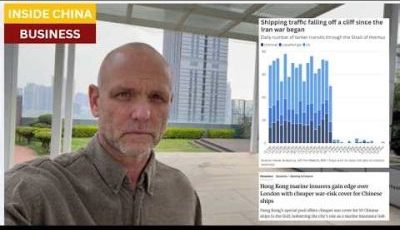
More Iran War fallout: Maritime insurance industry shifts from London to China
or go to
Aletho News Archives – Video-Images
From the Archives
The Biggest Threat to Peace in Middle East
By Dr. Elias Akleh* | Sabbah Report | May 24, 2010
A build up of heightened tension in the Middle East is escalating in the last few weeks. American and Israeli postures towards Lebanon, Syria, and Iran have become more threatening. Listening to speeches of political leaders one hears talks only about war not peace. Iranians and Israelis are continuously training hard for a possible showdown. Both sides are conducting extensive war games every month. This led Syrians to claim that Israel is preparing for a soon-to-come another war. The Jordanians also are warning that current stalemate of the peace process is an indication of a war breaking out this summer. The Russian President and his army chief hinted, a few months ago, that the US and Israel were planning for an attack on Iran.
Indeed Iran is, as it has been for last few years, the target of most of the threats and accusations of supporting terrorism. Escalating incitement against Iran the American Defense Department sent last month (April) to Congress a report on Iran’s military claiming Iran could develop intercontinental ballistic missiles capable of reaching the US by 2015.
Ignoring the fact that N. Korea, India, Pakistan, and Israel are proven to have nuclear weapons while Iran does not, the US Secretary of State Hillary Clinton chose in her speech, to the nuclear Non-Proliferation Treaty review conference at the UN, to focus on Iran’s alleged nuclear ambitions putting the whole world at risk as she put it. According to Clinton Iran’s acquisition of nuclear weapons, rather than Israel’s more than 200 nuclear bombs, is destabilizing the Middle East. She called on the world’s nations to rally around US efforts to hold Iran, not other nuclear countries, to account.
The accusation that Usama Bin Laden is living comfortably in Iran had received a boost after the broadcast of a documentary called “Feathered Cocaine”. This echoed the June 2003 claims of the Italian newspaper Corre de la Sierra that Bin Laden was in Iran according to some intelligence report, and according to Richard Miniter’s book “Shadow War”. … continue
Blog Roll
 Aletho News
- US Seeks Control Over Global Energy Infrastructure – Kremlin
- US senators target Orban government for standing up to Zelensky
- The deep-rooted culture of corruption in Ukraine
- Iran mobilizing one million soldiers to ‘create hell’ for any US ground assault: Report
- The coming military and psychological unravelling?
- Iran has the last laugh
- More Iran War fallout: Maritime insurance industry shifts from London to China
- US-Israeli aggression on Iran triggers review of GCC countries’ investment pledges to Washington
- Russia slams UK plan to seize tankers suspected of carrying its oil
- Pakistan ramps up food exports to Persian Gulf nations as war deepens food insecurity
- If Americans Knew
- ‘No Innocent Children’: Far-right Israeli Lawmaker Defends Killing of Palestinian Family
- Mossad’s promises helped Netanyahu convince Trump that Iran could be toppled
- US Arms Control Official Refuses To Comment When Asked If Israel Has Nuclear Weapons
- Veterans warn US landing could be ‘more Gallipoli than Vietnam’
- Israel may be committing war crimes in Lebanon – Not a ceasefire Day 167
- In the West Bank, life is a constant battle – 3 articles
- Jacob Reses, one of the most powerful pro-Israel operatives in Trump’s Washington
- Israeli-US assaults kill or injure 87 children a day – Not a ceasefire Day 166
- ‘Forever live by the sword’: Understanding Israelis’ massive support for Iran war
- UN’s special rapporteur on human rights says Israel is systematically torturing Palestinians
- No Tricks Zone
- Devastating Assessment Of Comirnaty Vaccine By Former Senior Pfizer Europe Toxicologist
- New Study: CO2 Is ‘Effectively Negligible’ As An Explanatory Climate Change Factor Since 2000
- Former Pfizer Toxicologist Dr. Helmut Sterz Tells Bundestag Hearing Pfizer Vaccine Should Have Never Been Approved
- Energy Expert: Germany’s Nuclear Phaseout Was A “500 Billion Euro Mistake”
- New Research: South Australia’s Mid-Holocene Sea Surface Temperatures Were 4°C Warmer Than Today
- Storing Green Energy To Last Germany 10 Days Would Require A 60-Million Tonne Battery
- New Studies: UK Sea Levels Were 4 Meters Higher Than Today During The Mid-Holocene
- Destructive Green New Deal: German Energy And Metal Group Warns Of Drastic Crisis
- New Study Documents A 20-Year Pause In Arctic Sea Ice Decline – Driven By Internal Variability
- Wake-up Call: Survey Shows Majority Of Germans Now Favor Postponing Climate Targets!
 Aletho News
Leave a comment