The Future of Food
corbettreport – August 10, 2025
Use these links to watch it somewhere else!
WATCH ON:  /
/  /
/  /
/  /
/  /
/  or DOWNLOAD THE MP4
Palestinian Activist Recorded His Own Murder, Israel Still Released His Killer
By Kyle Anzalone | The Libertarian Institute | August 10, 2025
A Palestinian activist featured in the Oscar-winning documentary “No Other Land” recorded his murder by an Israeli settler. The killer was freed by an Israeli court, arguing there was a lack of evidence.
On Sunday, the Israeli human rights organization B’Tselem released a video record by Awda Hadalin of the moment he was shot and killed by Yinon Levi. There are two additional videos that show Levi point his gun and shoot Hadalin before he falls to the ground.
Director of “No Other Land,” Yuval Abraham, said the three videos leave no doubt that Levi murdered Hadalin. “There is no room for doubt. Yinon Levi killed Uda Hadalin in front of the cameras, and an entire system of Jewish superiority turned him from a perpetrator into a victim and punished the village residents instead of punishing him,” he wrote on X.
The day after the killing, an Israeli court accepted Levi’s assertion he was acting in “self-defense” and granted him house arrest. There is no evidence in the video that Levi was in danger.
He was then released from house arrest after a judge ruled the evidence backed his self-defense claim.
Israel refused to give Hadalin’s body to his family to allow for a funeral for over a week. Tel Aviv attempted to force the family to agree to limit his funeral to 15 people before giving his body to relatives. After ten days, the Israeli High Court ordered the release of Hadalin’s body.
Several members of Hadalin’s family and mourners were arrested by Israeli occupation forces. Additionally, the American-Italian nurse who attempted to provide life-saving care to Hadalin was arrested and then deported. “They don’t want people to feel comfortable helping Palestinians,” they told The Intercept.
‘Heartbreaking’: UK paramedic recounts horrors inside Gaza hospitals
Press TV – August 10, 2025
A British paramedic has described “heartbreaking” scenes inside Gaza’s overwhelmed hospitals, where children arrive with life-threatening injuries and entire families are wiped out by Israel’s genocidal war.
Sam Sears, who spent three weeks in Gaza with the UK-based medical charity UK-Med, said the field hospitals were a “conveyor belt of carnage,” packed with patients suffering blast, shrapnel, and gunshot wounds.
Just a few days into his deployment, Sears was sent into a mass casualty incident where two children, aged nine and 11, were killed from blast injuries.
“It was particularly heartbreaking putting a child in a body bag, seeing their face for the last time, then moving them out [of] the way so we could treat more people,” said Sears.
The veteran medic — who has served in Ukraine, Rwanda, Turkey, and Sierra Leone — said Gaza was far worse than anything he had experienced before.
He treated children who had lost entire families, teenagers with life-changing wounds, and newborns suffering severe malnutrition.
He recalled one boy, about eight years old, who was “lifeless behind the eyes” after an explosion killed his whole family.
Sears returned to the UK on July 31 but said the images of Gaza’s children will haunt him forever.
“The people of Gaza don’t get to leave,” he said. “They have no escape from the hunger, the fear, the trauma. They need more than our sympathy — they need our action.”
He called for a sustained ceasefire, not a fragile truce, to end Israel’s hostilities permanently, protect civilians and health workers, and allow unrestricted delivery of food, fuel, and medical supplies into the besieged territory.
UN rapporteur calls on European football body to expel Israel from competitions

Press TV – August 10, 2025
The UN special rapporteur for human rights in the occupied Palestinian territories has called on the European football governing body (UEFA) to expel Israel from competitions over its war crimes and crimes against humanity in the besieged Gaza Strip.
Francesca Albanese’s call came following UEFA’s farewell to a former Palestinian player, Suleiman al-Obeid, whom it called the “Palestinian Pelé.”
“Let’s make sport apartheid and genocide free. One ball, one kick at a time,” Francesca Albanese said on her X account on Sunday.
“Time to expel its killers from competitions, @UEFA,” the UN rapporteur said.
Al-Obaid, a former Palestine national team player, was killed earlier this month in an Israeli strike targeting civilians waiting for humanitarian aid in southern Gaza.

Suleiman Ahmed Zaid al-Obaid, the former captain of the Palestinian national football team (Photo via social media)
He left behind his wife and five children.
Obaid is seen as one of the brightest stars in Palestinian football history. He played 24 official matches for the national team.
He also represented the national team during the 2012 Asian Football Confederation (AFC) Challenge Cup qualification and 2014 World Cup qualifying games.
Obeid’s death has sparked widespread outrage across the world, with people urging the international community and the football fraternity in particular to break their silence over the ongoing genocide.
Palestinian footballers have been directly targeted in Israel’s assault on Gaza.
In a statement released on July 29, 2025, the Palestinian Olympic Committee (POC) reported that in July alone, the Israeli regime killed 40 Palestinian athletes in Gaza and the occupied West Bank.
More than 800 athletes have been killed in Gaza since the start of Israel’s genocidal war on Oct. 7, 2023, as the sports community continues to suffer under bombardment, famine, and the collapse of infrastructure.
Last month, the International Federation of Muaythai Associations (IFMA) announced an urgent policy change regarding Israeli representation at its events.
This came following the killing of a young Palestinian teenager athlete and peace ambassador, Ammar Hamayel, by Israeli forces in the occupied West Bank.
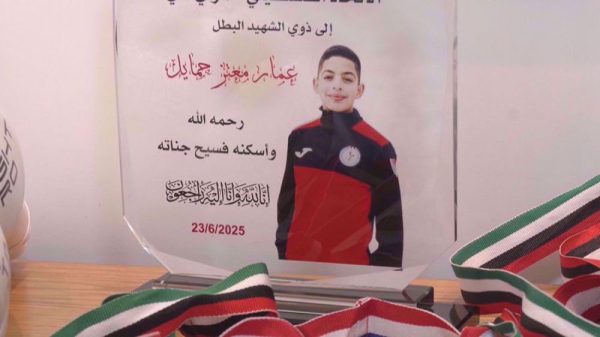
Hamayel, 13 years old, was a Thai boxing champion, dreaming of representing Palestine on the world stage. But like many other Palestinian children, his dream was silenced by Israeli bullets.
The IFMA back then said in a statement that the decision represents a peaceful yet firm protest against actions that “endanger children and violate the core values of global sport”.
In May, Spain was reportedly spearheading a coordinated initiative aimed at persuading the European Union to eliminate Israel from all continental sports competitions over its genocidal war on Palestinians in the besieged Gaza Strip.
Calls to exclude Israel from international sports events have indeed increased recently due to its relentless aggression against Gaza.
Zionism won’t stop, the Arab world must collapse

By Lorenzo Maria Pacini | Strategic Culture Foundation | August 10, 2025
Four weeks after the signing of the Abraham Accords—signed on September 15, 2020, with U.S. mediation and involving the United Arab Emirates and Bahrain—Israeli urban planning authorities have authorized the construction of 4,948 new homes in the occupied territories of the West Bank. No significant public statements, no troop movements: just bureaucratic approvals marking a further step in the expansion of Israel’s presence. This advance, shrouded in the rhetoric of ‘peace’, took place in silence, reflecting a well-established approach: proceed with normalization when the region is compliant and intensify colonization when international attention wanes.
This logic is rooted in the expansionist model of Zionism: where possible, military force is used; where this is not convenient or feasible, soft penetration is used in the form of security agreements, economic cooperation, and intelligence alliances. This dual strategy—based on physical conquest and hegemonic consolidation—has been in place since 1967 and today extends unchecked from the Jordan River to the Atlantic Ocean.
Let us be clear: the Zionist project, in all its aspects, will not stop. The Arab world represents an obstacle to the construction of Greater Israel and the manifestation of Zionist hegemony.
The “Greater Israel” project manifests itself on two levels: on the one hand, the annexation of Palestinian territories, and on the other, geopolitical control of the region through indirect means. And, if we want to extend our projections, we must consider that Greater Israel is the starting point, not the end point.
This is a vision rooted in Zionist ideology, which envisages Jewish domination over the entire “Biblical Land of Israel.” When direct occupation is not sustainable, Tel Aviv prefers maneuvers of influence and destabilization that undermine the sovereignty of neighboring Arab states. The two dimensions—territorial and imperial—are interdependent.
This strategy has deep roots. Ze’ev Jabotinsky, the father of revisionist Zionism, wanted control over all of Mandatory Palestine and beyond, arguing that colonization should take place even against the will of the local populations. David Ben-Gurion, while publicly accepting the partition in 1937, saw that compromise only as an initial phase towards subsequent expansion, confirming the intention to extend the borders to the whole of Palestine once the Israeli military apparatus had been strengthened, as indeed happened. At first, Israel’s military power was insufficient for large-scale operations, so the “periphery doctrine” was developed, through which Israel cultivated alliances with non-Arab states and marginalized minorities (the Shah’s Iran, Turkey, Iraqi Kurds, Sudanese Christians), indirectly weakening its Arab rivals. This strategy, now adapted, is also visible in recent relations with the Druze communities in southern Syria.
Normalization means influence
Israeli penetration into the Arab world has reached an unprecedented level. The Abraham Accords have opened the door to large-scale economic, military, and technological cooperation. The historic treaties with Egypt and Jordan were only the beginning, with the United Arab Emirates subsequently becoming a prominent trading partner. The same is true in the Maghreb: Morocco, for example, has purchased weapons and signed industrial agreements in the drone sector, becoming a production hub for Israeli UAV systems. All this has created a geopolitical corridor linking Israel to the Gulf and North Africa, expanding its access to strategic routes, intelligence spaces, and crucial markets.
As economic relations intensify, colonization continues. Raze everything to the ground, indiscriminately; drive out the Palestinians, no questions asked; conquer the lands they consider “divine right.” Infrastructure is designed to isolate Palestinian communities in unconnected enclaves, making the formation of an autonomous state impossible.
Israel has also consolidated its presence in Syria (in the Quneitra region, near Damascus and Deraa), taking advantage of the chaos following the fall of Assad and the seizure of power by the jihadist group HTS led by Ahmad al-Sharaa (formerly known as al-Julani). In Lebanon, it maintains control of key areas such as the Shebaa Farms and the Kfar Shuba hills, as well as military positions along the Blue Line.
Expansion is masked by integration. Today, the Israeli occupation is no longer manifested solely through weapons, but is supported and fueled by diplomatic agreements and trade flows. “Normalization” has not stopped the occupation: it has made it more effective. Each new agreement with Arab countries increases Israel’s ability to extend colonization and strengthen military control. Plans are already underway to double the number of settlers in the Golan Heights and increase the military presence along sensitive areas. The consequences are being felt: Egypt is building a wall on the border with Gaza to manage possible flows of displaced persons; Jordan sees its water resources threatened; Syria and Lebanon are under increasing pressure to normalize relations with Israel.
The Greater Israel project is advancing: on the one hand, it is swallowing up territories; on the other, it is influencing the sovereign choices of Arab states. Together, they represent two sides of the same strategy: annexation and subordination.
And all this, let’s be clear, will not stop at Palestine.
Zionism is viscerally anti-Christian and anti-Islamic. Anything that does not adhere to Zionist Judaism must be eliminated.
From an Islamic perspective, criticism of Zionism is based on several levels. First of all, Zionism, in its state form, has led to the confiscation and occupation of Muslim holy sites—primarily Al-Aqsa in Jerusalem—with a progressive erosion of access to and management of sacred places. This is not only a political violation, but also a spiritual one, as Islamic sovereignty over Jerusalem is considered a religious duty, rooted in the Quran and prophetic tradition. The Zionist rejection of Arab sovereignty – expressed in the marginalization of Islamic religious institutions in the occupied territories – is a denial of the Umma, the unity of the community of believers, and of its legitimacy to safeguard the places of Islam.
Similarly, Christianity, especially in its Eastern expressions, has also suffered from an exclusionary Zionist approach. The Zionist theological imagination, which demands a Jewish “territorial redemption” of Palestine, excludes the historical and cultural presence of indigenous Christian communities, reducing them to tolerated or suspect minorities. Talmudic hatred of Christians is well known. For many Palestinian and Middle Eastern Christians, Zionism represents a form of nationalist secularization that empties the Holy Land of its universal value, transforming it into an exclusive ethnic-religious property.
In its quest to create an exclusive Jewish state, Zionism has promoted dynamics of exclusion and delegitimization of the other Abrahamic religions historically present in Palestine. This makes it ideologically antithetical to any pluralistic and shared vision of the holy places and communities that have coexisted there for centuries.
We should not be surprised if we soon see conflicts arise between the powers of the Arab world or, by extension, in other Islamic countries, such as in Asia, precisely because of their geopolitical and geoeconomic relations with the Zionist entity.
Because, ultimately, this is the plan: in Greater Israel, there can only be Israeli Zionism. Christianity and Islam must first be exploited, then banned. At any cost.
The geopolitics of India-US ‘trade war’
By Salman Rafi Sheikh – New Eastern Outlook – August 10, 2025
By slapping tariffs on India and linking them to its ties with Russia, the Trump administration exposed its willingness to strong-arm New Delhi into submission.
Unless India pulls off a dramatic reset with China—and thus reduce its dependence on the US for military support—it will remain caught between appeasing Washington and defending its strategic autonomy.
When the US President announced sweeping 25% tariffs on Indian goods in late July, his tone marked a jarring departure from the warmth once displayed toward New Delhi. Only months earlier, he had welcomed Prime Minister Narendra Modi to the Oval Office, hailing him as a “great friend” and celebrating the US-India relationship as a partnership destined for global leadership. Now, with the stroke of a Truth Social post, India is recast not as an ally, but as an economic adversary.
This abrupt reversal speaks volumes. The President’s social media declarations—accusing India of being a “dead economy”—ignored not only diplomatic decorum but economic reality. India is the world’s most populous nation and the fifth-largest economy, a critical player in global markets and geopolitics alike. To dismiss it so flippantly is to misunderstand the arc of global power.
But beyond the bluster lies a deeper provocation. Washington’s veiled threat—imposing additional, unspecified penalties on India over its continued oil trade with Russia—underscores a troubling shift in US foreign policy: coercion in place of collaboration. The implicit bargain offered to New Delhi is clear—cut ties with Moscow, and the US may relent on tariffs and even entertain a trade deal. Refuse and face economic punishment.
Why Trump Wants India to Submit
When Donald Trump referenced oil in the context of US-India relations, it wasn’t his only focus. A quieter, yet strategically significant, concern involved India’s long-standing defense ties with Russia. For decades, New Delhi has been one of Moscow’s most reliable customers in the global arms market. While India’s reliance on Russian military hardware has declined—from 55% of total imports in 2016 to an estimated 36% in 2025—Russia remains India’s top defense supplier.
To the Trump administration, however, this decline is an opening that must be exploited for American gains. A shrinking Russian share in India’s defense market presents the perfect opportunity to push more US-made military systems as replacements. In doing so, Washington hopes to edge out Moscow and deepen strategic ties with New Delhi in the process.
Signs suggest India may already be leaning toward such a transition. According to Indian defense media reports, the Indian Air Force (IAF) recently advised the government to prioritize acquiring US-made F-35 fighter jets instead of the fifth-generation aircraft offered by Russia earlier this year. Until now, India had remained undecided, caught between its historical ties with Russia and its evolving strategic calculus. However, should New Delhi proceed with the F-35 acquisition, it would mark a significant shift—not just symbolically, but financially and strategically. The Indian government reportedly plans to induct over 100 F-35s by 2035, an investment expected to run into billions of dollars, directly boosting the US defense sector. More importantly, such an investment will lock India as a firm US ally. As far as the Trump administration is concerned, this would also lend substance to Trump’s “Make America Great Again” agenda by channeling substantial foreign capital into the American economy.
As far as New Delhi is concerned, inducting F-35s could help bolster its regional standing vis-à-vis China and the latter’s continuous injection of its state-of-the-art defence technology into Pakistan, including its air-force. Indian defence analysts claim that this induction will allow India to avoid any more loses in aerial battles like the ones it suffered in its war with Pakistan in May.
What India Can Do
Yet, New Delhi’s strategic choices are far more complex than they might initially appear. Even if India opts to procure the F-35 fighter jets, it is far from certain that the US would permit their use in an offensive capacity against Pakistan—especially considering Washington’s increasingly cooperative ties with Islamabad. For context, Pakistan itself is restricted from employing its US-supplied F-16s for offensive operations against India. This raises a critical question for Indian policymakers: will a deepening defense relationship with the US genuinely enhance India’s air power posture vis-à-vis Pakistan, its principal adversary in South Asia?
The timing of New Delhi’s public disclosure of the Indian Air Force’s interest in F-35s—just days before a crucial deadline—was no accident. It seemed designed to sway the Trump administration’s position on trade tariffs. But the gambit failed to yield any concrete concessions. The episode underscores a deeper and more troubling question: should India continue to allow the US to exert disproportionate influence over its defense procurement and broader foreign policy?
This incident should prompt serious introspection among Indian policymakers. Rather than leaving its strategic vulnerabilities open to manipulation, India could take steps to insulate its foreign policy from external pressure. One pragmatic approach would be to normalize and even strengthen ties with regional competitors like China—an idea already gaining quiet traction. New Delhi has recently revived visa services with Beijing, and bilateral trade talks are beginning to show signs of momentum.
Interestingly, President Donald Trump’s remarks about “not doing much business with India” were widely interpreted as a thinly veiled reference to India’s growing economic engagement with China. In essence, Washington seeks to mold India’s foreign policy—particularly its relationships with China and Russia—to align more closely with American strategic interests. Should India capitulate to that pressure, it risks downgrading its role from an emerging regional power to a junior partner dependent on Washington for strategic direction.
India’s foreign policy establishment is now at a pivotal juncture. The choices made in the coming years will not just determine the shape of the country’s defense acquisitions or trade policies—they will define India’s role on the world stage for decades to come. If New Delhi is to maintain its claim to strategic autonomy, it must resist the temptation to shape its policies in reaction to US expectations.
Salman Rafi Sheikh, research analyst of International Relations and Pakistan’s foreign and domestic affairs
Russia Possesses Advanced Weapons Other Than Oreshnik Systems – Ryabkov
Sputnik – 10.08.2025
MOSCOW – In addition to the Oreshnik missile systems, Russia possesses other advanced weaponry, Russian Deputy Foreign Minister Sergey Ryabkov said on Sunday.
“There is Oreshnik. But there is more, and we have been wasting no time. I cannot name what I am not authorized to name. But it exists,” Ryabkov said on the Rossiya 1 channel.
Russia has many options in advanced weaponry at its disposal, the deputy foreign minister said, adding that “we never rule anything out for ourselves in advance.”
Ryabkov also made statements on lifting the moratorium on INF Treaty (Intermediate-Range Nuclear Forces):
- Russia must use such methods to cool down the heated heads in NATO countries.
- In today’s realities, it is inappropriate to use the term “détente” in relations between Russia and the US.
- What we need now is not détente, but political will to begin lowering the temperature in international relations.
- Everything Moscow does in terms of weapons deployment is a reaction to the steps taken by the Americans and their allies.
- Apart from the Oreshnik systems, Russia also has other advanced weapons.
- The first signs of common sense are appearing in Russia-US relations, which were absent for several years before.
- The risk of nuclear conflict in the world is not decreasing.
- Russia sees the risk that after the expiration of the New START Treaty, nuclear arms control will be completely absent.
UK Defence Ministry Covered Up Radioactive Leak From Nuclear Storage Into Sea – Reports
Sputnik – 10.08.2025
The UK Ministry of Defence has been covering up for years the leak of radioactive water into the sea from a nuclear warhead storage facility in western Scotland due to old pipes bursting, the Guardian newspaper reported, citing documents from the Scottish environmental regulator.
The base where Britain’s nuclear bombs are stored allowed radioactive water to leak into the sea after old pipes repeatedly burst.
Radioactive substances leaked into Loch Long, a sea bay near Glasgow in western Scotland, because the British navy failed to properly maintain a network of 1,500 water pipes at the base, the newspaper said.
According to the publication, the military base in question is near the Scottish settlement of Coulport. It stores nuclear warheads intended for four Trident submarines, which are based nearby.
Citing documents from the Scottish Environment Protection Agency (Sepa), the publication said that the military base’s pipes had repeatedly burst: in 2010, then twice in 2019 and twice more in 2021. According to the regulator, at the time of the ruptures, about half of all the storage equipment had expired. As noted, water contaminated with radioactive tritium, a substance used in warheads, was leaking from the pipes.
According to the publication, Sepa and the British Ministry of Defence have tried to hide information about the leaks for many years, claiming that it was a matter of national security. But recently, Scottish Information Commissioner David Hamilton ordered this data to be made public, after which it was obtained by the Scottish media Ferret and the Guardian.
BP Reopen “Uneconomic” North Sea Oil Field
By Paul Homewood | Not A Lot Of People Know That | August 10, 2025
From the Telegraph :
BP is to reopen a key North Sea field and pump new oil and gas for at least a decade, despite Ed Miliband’s attempts to cut back the offshore industry.
The energy giant is reviving the Murlach field, which was declared uneconomic and taken out of use in 2004, has now become viable partly due to new technologies.
BP won agreement to reopen Murlach, 120 miles east of Aberdeen, under the previous government and has since been installing equipment, with production potentially restarting next month.
The milestone comes despite efforts by the Energy Secretary to bring an end to new fossil fuel production in the North Sea. Mr Miliband and his predecessors have almost doubled the taxation rate on oil and gas profits and banned the issuing of licences for new exploration and production.
BP said the Murlach field contained 20 million barrels of recoverable oil and 600 million cubic metres of gas – enough to keep it in production for 11 years. “Murlach is expected to produce around 20,000 barrels of oil and 17 million cubic feet of gas per day,” it said.
It means BP can partially reverse the decline in North Sea output, which has seen oil production fall from 96,000 barrels per day in 2020 to 70,000 last year. Gas production has fallen from 221m square feet a day to 197m. … Full story here.
What is significant is here is the introduction of new technologies to make all this possible. How many other abandoned fields can be brought back into production in this way.
Naturally Greenpeace are not happy, with Doug Parr saying “The North Sea is on death’s door. Reserves are drying up and what’s left and untapped is barely enough to keep it on life support. The only sensible thing to do is to pivot [from] the North Sea to something we have an abundance of, and something that will never run out – wind.”
But Mike Tholen, of trade body Offshore Energies UK, commented:
“Redevelopment of decommissioned fields is now a feature of the North Sea as new and innovative technologies make such opportunities possible.
“Looking ahead, the independent Climate Change Committee says the UK will need 13 billion to 15 billion barrels by 2050 come what may. We could produce half of this at home. But at the moment only four billion barrels are on track to be realised, which means imports will have to rise and the UK economy will miss out as jobs and capital move overseas.”
In what world, other than crazy Ed’s, would it make sense to import that oil and gas when we could produce it ourselves at great benefit both to the economy and government revenues?
Featured Video

No Threat Can Force Iran’s Surrender /Trita Parsi & Lt Cl Daniel Davis
or go to
Aletho News Archives – Video-Images
From the Archives
An Expert Military Analysis of War with China
Actually, None is Necessary
By Fred Reed • Unz Review • December 13, 2020
The Correlation of Armed Forces: U.S. goods and services trade with China totaled an estimated $634.8 billion in 2019. Exports were $163.0 billion; imports were $471.8 billion. The U.S. goods and services trade deficit with China was $308.8 billion in 2019. Trade in services with China (exports and imports) totaled an estimated $76.7 billion in 2019. Services exports were $56.5 billion; services imports were $20.1 billion. The U.S. services trade surplus with China was $36.4 billion in 2019.
There is talk within the Washingtoniat of a possible war with China. Steve Bannon, who apparently was dropped on his head as a child, actually favors such a war. We hear the usual shoo-the-boobs alarm about how the Chinese are doing something terrible and we must gird our loins and American values and show them what for, bow wow, woof. The danger is that the current game of who-blinks-first in Asian waters might actually provoke a shooting war. You know the kind of thing: One warship refuses to get out of the way of another, a collision ensues, some retard lieutenant who signed up on waivers opens fire, and we’re off and running. It is not a good idea to let children play with matches.
The said war is discussed either in emotional terms by idiots or in purely naval terms by those familiar with such things, so we hear of the First Island Chain and the Second Island Chain and whose missiles against the other’s missiles and so on. This would be appropriate if we were fighting World War Two again. Which we aren’t. Let’s take a quick-and-dirty look at how such a war might go.
To begin the war, America would overestimate itself and underestimate China. This is doctrine in the Pentagon. … continue
Blog Roll
 Aletho News
- Theodore Postol: Iran’s Missiles & Drones Were Underestimated
- Iran To Target Military Industrial-Tech Complex That Facilitated Gaza Genocide
- Collapsing Empire: The Resistance Disarms ‘Israel’
- Suicide Should Not Be a Government Service
- Rethinking America’s greatest threat: Iran vs. Israel-Firsters
- Iran accuses adversaries of false flags to strain Turkey ties
- Poland rules out sending Patriot missiles to US/Israel amid war on Iran
- Tehran approves new Hormuz plan with major restrictions
- No Threat Can Force Iran’s Surrender /Trita Parsi & Lt Cl Daniel Davis
- UK’s New Pandemic Plan Would Turn Big Tech Into a Mass Location Tracking Network
- If Americans Knew
- Ann Coulter Rips Into Fox News for Iran War Coverage, Compares to False Rigged 2020 Election Reporting
- Joe Kent Urges Americans To Call White House and Congress To Object To Sending Troops Into Iran
- DNC Resolution to Reject AIPAC Funding Puts Democratic Leaders in the Hot Seat
- Swedish foundation to build 400 schools as over 650,000 Gaza children remain without education for 2 years
- Israeli army admits photshopping image of slain Lebanese journalist
- This is how Israel is systematically killing health workers under the cover of war in Lebanon
- Carrying life under fire: Israeli invasion of Lebanon leaves pregnant women facing deadly risks
- Champagne all around for the new death penalty (for Palestinians) law – Not a ceasefire Day 172
- Why are Palestinian books struggling to be seen on Amazon?
- The Line Between Affinity and Conspiracy
- No Tricks Zone
- New Study Finds Warming Saves Lives…Cold Temperatures 12 Times More Deadly Than Excess Heat
- German Science Blog Accuses PIK Climate Institute Of Hallucinating Climate Tipping Points
- Devastating Assessment Of Comirnaty Vaccine By Former Senior Pfizer Europe Toxicologist
- New Study: CO2 Is ‘Effectively Negligible’ As An Explanatory Climate Change Factor Since 2000
- Former Pfizer Toxicologist Dr. Helmut Sterz Tells Bundestag Hearing Pfizer Vaccine Should Have Never Been Approved
- Energy Expert: Germany’s Nuclear Phaseout Was A “500 Billion Euro Mistake”
- New Research: South Australia’s Mid-Holocene Sea Surface Temperatures Were 4°C Warmer Than Today
- Storing Green Energy To Last Germany 10 Days Would Require A 60-Million Tonne Battery
- New Studies: UK Sea Levels Were 4 Meters Higher Than Today During The Mid-Holocene
- Destructive Green New Deal: German Energy And Metal Group Warns Of Drastic Crisis
 Aletho News