‘No relaxation haven for murderers’: Israeli cruise ship triggers pro-Palestine protests in Greece
Press TV – August 16, 2025
An Israeli cruise ship touring the Greek islands has faced repeated protests, culminating in nationwide demonstrations, as activists would denounce the Israeli regime’s war of genocide on the Gaza Strip and oppose provocative behavior by Israeli tourists.
The Crown Iris, making regular trips from the occupied port of Haifa to Athens and the Greek islands, has been met with protests at nearly every stop this summer, Drop Site News, an American investigative outlet, reported on Friday.
The 10-deck vessel, with a capacity of 2,000 passengers, includes a casino, a theater, a waterslide, and a basketball court.
Since late July, protests have targeted its route, with demonstrators waving Palestinian flags, lighting flares, and in some cases attempting to block its docking.
On July 22, more than 300 protesters confronted the ship on the island of Syros, leading to most passengers staying onboard.
Throughout the vessel’s tour around Greece, activists and organizers pointed to growing frustration over “a recurring pattern of Israeli tourist provocations,” sometimes involving off-duty Israeli forces, the website reported.
Locals and activists cited acts of incitement by the tourists, who would gloat over the Israeli regime’s genocidal aggression against Palestinians and its decades-old occupation of Palestinian territories.
Those actions included “tearing down pro-Palestinian posters in streets and shops or verbally and physically harassing people wearing keffiyehs (Palestinian headscarves) or pro-Palestine T-Shirts,” the report said.
‘We can’t have Greece become Israeli forces’ playground’
“What kind of simple, innocent tourist keeps” the Israeli regime’s flag “handy while traveling?” asked Petros, a 30-year-old construction worker.
“We can’t have Greece become a playground for IDF (Israeli military) soldiers… It’s also a matter of dignity,” he added.
Subsequent stops saw escalating confrontations.
On July 28 on the Rodos Island, the police arrested at least eight protesters. The following day in Agios Nikolaos, Crete, demonstrators broke police barricades, unfurled a massive Palestinian flag, and clashed with riot police, who used tear gas against them.
These actions formed part of broader mobilizations culminating on August 10, when organizers said tens of thousands demonstrated in more than 120 locations across Greece in one of the largest pro-Palestinian mobilizations in the country’s history.
March to Gaza, Greece – a pro-Palestinian body – initiated the call, declaring, “As millions of tourists flood the country, let’s make our presence visible and loud. Let’s turn islands, beaches, alleys, mountaintops, and shelters into places of solidarity, not relaxation for murdering IDF soldiers.”
Paris Laftsis, a 33-year-old member of the coordination team, said the turnout “exceeded the most optimistic expectations” and included both the largest demonstrations in decades and entirely new initiatives.
The protests were supported by such pro-Palestinian organizations as BDS (Boycott, Divestment, and Sanctions) Greece and the Palestinian Community in Greece as well as dozens of local groups.
NO WOODS, NO MEAT, NO FREEDOM
The HighWire with Del Bigtree | August 14, 2025
Unusually dry summer conditions on Canada’s Atlantic coast have prompted two provinces to take the unprecedented step of banning hiking, camping, and even walking in the woods in a bid to prevent forest fires. Learn about other alarming measures being floated in the name of climate change—from ticks that can trigger a meat allergy to proposals for calculating the carbon footprint of every medical procedure to determine its “importance.”
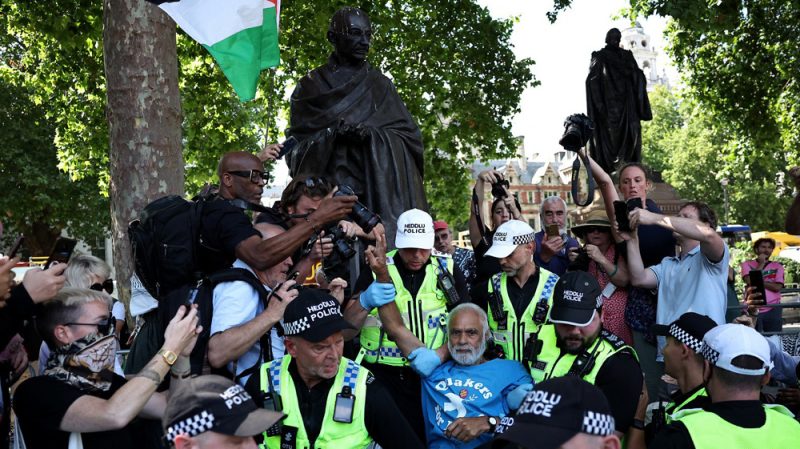
UK to prosecute over 60 people for backing Palestine Action after mass arrests
The Cradle | August 16, 2025
London’s Metropolitan Police announced on 15 August that over 60 people will face prosecution for “showing support” for the banned Palestine Action network, alongside three already charged under the Terrorism Act.
The police confirmed they had “put arrangements in place that will enable us to investigate and prosecute significant numbers each week if necessary,” following more than 700 arrests since the designation took effect in early July.
Among them were 522 demonstrators detained in London last weekend for carrying placards backing the group, a figure described as the highest ever number of arrests at a single protest in the capital.
Director of Public Prosecutions Stephen Parkinson said the charges represent “the first significant numbers to come out of the recent protests, and many more can be expected in the next few weeks.”
He warned that “people should be clear about the real-life consequences for anyone choosing to support Palestine Action.”
The police said those convicted could face up to six months in prison and additional penalties.
British Interior Minister Yvette Cooper defended the Labour government’s decision, declaring that “UK national security and public safety must always be our top priority,” and insisting that “the assessments are very clear – this is not a non-violent organisation.”
Metropolis Police Commissioner Mark Rowley praised the prosecutions as proof that “our police and CPS teams have worked so speedily together to overcome misguided attempts to overwhelm the justice system.”
Palestine Action is a British pro-Palestinian direct action network, established in July 2020, with the stated aim of ending Israeli apartheid.
The movement is known for its overt and disruptive – yet non-violent – actions in their mission for ending Israeli apartheid and halting UK complicity in the arms trade with Israel.
This includes occupying, vandalizing, and destroying properties linked to Israeli arms trade, such as Elbit Systems factories and RAF Brize Norton military infrastructure.
On 20 June, one activist broke into the Royal Air Force (RAF) Brize Norton base in Oxfordshire.
In response to these direct actions, the group was branded a terrorist organization on 5 July under the Terrorism Act 2000 by the UK government, making membership to the group a criminal offence.
Various groups and individuals described the move as “grotesque,” “chilling,” and an “unprecedented legal overreach.”
UN experts had urged the UK not to go through with the ban, saying, “According to international standards, acts of protest that damage property, but are not intended to kill or injure people, should not be treated as terrorism.”
The experts added that the actions of vandalism committed by some protesters should be “properly investigated as ordinary crimes or other security offences” and stressed that the actions of protesters do not constitute terrorism when properly defined.
Netanyahu associate, arrested in Las Vegas child sex sting, escapes without charges
Press TV – August 16, 2025
An Israeli cyber official, who works directly under Benjamin Netanyahu, escaped to the occupied territories after his arrest in a US child sex operation in Nevada, US.
Las Vegas police, working with the FBI, Homeland Security, and Nevada’s Internet Crimes against Children Task Force, announced on Wednesday the arrest of 8 men, including Tom Artiom Alexandrovich.
Alexandrovich, 38, serves as Acting Head of Data & AI at Israel’s so-called National Cyber Directorate.
He is the founder of Israel’s multi-million-dollar “Cyber Dome” initiative. The program is reportedly equipped with AI to detect, neutralize, and repel cyber threats before they reach critical systems.
He has deep access to Israel’s cyber secrets and classified partnerships with foreign powers.
According to Las Vegas authorities, Alexandrovich and others were charged with luring a child with a computer for a sexual act. In Nevada, this felony carries a sentence of up to 20 years in prison.
He was in Las Vegas for a professional conference, not as a registered diplomat. He has no diplomatic immunity. Yet US authorities allowed him to board a plane and return to Israeli-occupied territories within days, without trial, bail conditions, or public explanation.
Israeli outlet Ynet reported only that Alexandrovich was “briefly detained for questioning… before his release and return to Israel,” without mentioning the felony charges or the multi-agency child predator sting led by US authorities.
On January 11, Ivor Caplin, another top Israeli official and the head of the Jewish Labor Movement (JLM), was arrested by the Sussex Police for engaging in sexual communication with a child.
He was subsequently released on bail, extended several times, with the most recent extension requiring Caplin to return to answer bail on October 8.
Microsoft forced to probe Israel’s use of its tech for mass Palestinian surveillance
Press TV – August 16, 2025
Microsoft has been forced to respond to reports of the Israeli military’s use of its Azure Cloud for mass spying on Palestinians by opening an external inquiry into the issue.
Leaked documents have recently revealed that Israel’s spy agency used Microsoft’s cloud to intercept and store millions of Palestinians’ phone calls and target them both in Gaza and the occupied West Bank.
The system, operational since 2022, was built by Unit 8200, the Israeli military’s notorious, secretive cyber-intelligence arm.
The cloud-based system helped the Israeli military to guide deadly air strikes and raids across the occupied Palestinian territories.
Moreover, sources cited in the investigation said the stored data had also been used to justify detentions and even killings of Palestinians.
Coming under scrutiny following the recent revelations, the American technology conglomerate announced on Friday that it has launched an external inquiry into the reports of Israel’s use of the company’s technology to facilitate the mass surveillance of Palestinians.
In a statement, Microsoft claimed that “using Azure for the storage of data files of phone calls obtained through broad or mass surveillance of civilians in Gaza and the West Bank” would be prohibited as it constitutes a potential breach of the company’s terms of service and human rights commitments.
The inquiry is the second external review commissioned by Microsoft into the use of its technology by the Israeli military.
The first was launched earlier this year amid dissent within the company and media reports about Israel’s reliance on the company’s technology during its genocidal war on Gaza.
The company is also facing pressure from a worker-led campaign group, No Azure for Apartheid, which has condemned Microsoft for “complicity in genocide and apartheid” and demanded it cut off “all ties to the Israeli military” and make them publicly known.
Responding to the announcement, the pro-Palestine group criticized Microsoft’s decision to launch a new inquiry, describing it as “yet another tactic to delay” meeting its demands.
Earlier this month, a report by Quds News Network revealed that Microsoft is among the most prominent global technology companies that have established a strong and influential presence in the Israeli war on Gaza by providing the occupying entity with advanced artificial intelligence (AI) tools, finances, and workforce.
The report said in the months after October 7, 2023, when the regime launched its onslaught on Gaza, the Israeli military’s reliance on Microsoft’s cloud services surged more than 200-fold and petabytes of data from drones, checkpoints, and biometric scanners poured into the company’s servers, feeding AI systems that human rights groups warn are being used to target civilians in Gaza.
Israel’s war on Gaza has killed at least 61,827 people and wounded 155,275, most of them women and children.
Moreover, at least 10,000 people are unaccounted for, presumed dead under the rubble of their homes throughout the Strip.
The Israeli aggression has also resulted in the forceful displacement of nearly two million people from all over the Gaza Strip, with the vast majority of the displaced forced into the densely crowded southern city of Rafah near the border with Egypt – in what has become Palestine’s largest mass exodus since the 1948 Nakba.
Israel destroyed 400 homes in Gaza’s Zeitoun neighborhood: Euro-Med Monitor
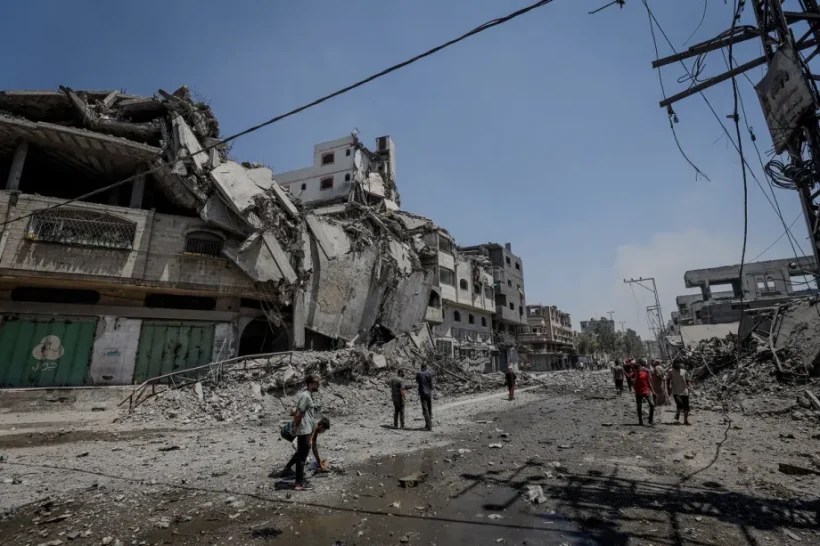
Smoke rises as Palestinians flee after Israeli army conducts attacks over al-Zeitoun neighborhood of Gaza City, Gaza on August 6, 2025. [Khames Alrefi – Anadolu Agency]
MEMO | August 16, 2025
The Euro-Mediterranean Human Rights Monitor on Saturday said that Israeli forces have destroyed some 400 homes in the Zeitoun neighborhood, east of Gaza City, over the past six days through aerial bombardment and the use of booby-trapped robots, Anadolu reports.
In a statement, the rights group said Israeli forces have been “leveling Zeitoun to the ground” since Aug. 11 as part of a large-scale military assault aimed at imposing full control over Gaza City and forcibly displacing its residents.
The monitor noted that “more than 90,000 Palestinians have fled the neighborhood under intense shelling.”
It added that Israeli forces have “deployed quadcopter drones to encircle residential blocks and force residents to evacuate at gunpoint, while advancing with ground units under heavy fire cover.”
The group stressed that the destruction of “nearly half of the homes in the Zeitoun neighborhood was not justified by any military necessity, as no armed clashes had been reported in the area recently.”
It said the “systematic use of robotic explosives and aerial strikes after residents were evacuated indicated the aim of the operation is not to achieve a legitimate military objective but rather the destruction of civilian life and forced displacement.”
The rights group said that the assault on Zeitoun, Gaza City’s largest neighborhood, falls within a “broader Israeli policy of genocide aimed at erasing Palestinian urban centers through mass destruction of homes, infrastructure, and essential services.”
It urged the international community, including the UN and legal institutions, to “act urgently to stop the attacks, protect civilians, and hold Israeli leaders accountable.”
The group also called for the enforcement of International Criminal Court arrest warrants issued against Israeli Prime Minister Benjamin Netanyahu and former Defense Minister Yoav Gallant.
The latest Israeli military campaign began on Aug. 11, following a government-approved plan to gradually reoccupy Gaza, starting with Gaza City.
Witnesses reported widespread home demolitions using robotic devices, artillery fire, indiscriminate shooting, and forced displacement.
Israel has killed nearly 61,900 Palestinians in Gaza since October 2023. The military campaign has devastated the enclave and brought it to the verge of famine.
Last November, the International Criminal Court issued arrest warrants for Israeli Prime Minister Benjamin Netanyahu and his former Defense Minister Yoav Gallant for war crimes and crimes against humanity in Gaza.
Israel also faces a genocide case at the International Court of Justice for its war on the enclave.
United Nations Secretary-General offices shield Israel and blacklist Hamas: EX-UN official
Press TV – August 16, 2025
A former senior UN human rights official has criticized offices controlled by the United Nations Secretary-General (UNSG) for their actions in shielding Israel and blacklisting Palestinian resistance movement Hamas during the ongoing genocidal war in the Gaza Strip.
Craig Mokhiber, former director of the New York Office of the High Commissioner for Human Rights, said in a post on his X account on Saturday that the UNSG offices only report politically convenient issues rather than the reality of abuses committed in Gaza, which he said has led to a lack of accountability.
Mokhiber said there is a need for a more comprehensive and impartial approach to address human rights violations in the besieged Palestinian territory.
He further mentioned his longstanding criticism of the “politicized thematic offices under the UNSG”, while highlighting their reporting practices, which differ from the UN’s independent human rights rapporteurs.
The human rights lawyer went on to say that the failure to effectively address the Israeli regime’s actions in Palestine has highlighted the political corruption that exists within those offices, adding that they are often under pressure from powerful states, particularly in areas such as genocide, sexual violence, and children in conflict.
The former UN official further denounced as “shameful” a recent report issued by a UNSG-controlled office monitoring sexual violence in conflict for creating a new category called “on notice” to avoid blacklisting Israel, despite substantial evidence that exists to condemn the regime.
Conversely, the report has blacklisted Hamas, even though there is an acknowledged lack of evidence against the group, he said.
Mokhiber further slammed the double standard of the report for saying that a lack of access to Israel and areas in the Occupied Palestinian Territory had prevented the listing of Israel, while the same reason did not apply to Hamas.
He said these offices “do more harm than good” to the protection of human rights, adding that their dismantling has long been overdue.
Israel launched a genocidal war on Gaza on October 7, 2023, after Hamas carried out the surprise Operation Al-Aqsa Storm against the occupying entity in response to its intensified campaign of death and devastation against Palestine.
The regime’s bloody onslaught on Gaza has so far killed over 61,776 Palestinians, many of them women and children, while displacing the territory’s entire population of nearly two million people.
Iran blasts ICJ vice-president’s ‘blatant bias’ toward ‘Israel’
Al Mayadeen | August 16, 2025
Deputy Foreign Minister for Legal and International Affairs Kazem Gharibabadi has sharply condemned what he described as a “shocking breach of judicial ethics,” accusing International Court of Justice (ICJ) Vice-President Julia Sebutinde of openly siding with “Israel”, an entity currently facing multiple cases before the Court.
He warned that such “blatant bias” undermines the ICJ’s integrity and violates the core principle of judicial impartiality.
Gharibabadi’s comments follow Justice Julia Sebutinde’s controversial remarks defending her dissenting opinion in the ongoing Israeli genocide against Palestinians in Gaza.
Sebutinde, the only judge to oppose provisional measures against “Israel”, has now further stoked anger with a public speech that critics say confirms long-standing suspicions of personal bias and ideological alignment with Zionist narratives.
“There are now about 30 countries against Israel… the Lord is counting on me to stand on the side of Israel. The whole world was against Israel, including my country,” she declared on August 10 at Watoto Church in Uganda.
Speaking during the launch of the Golden Legacy ministry for members aged 55 and above, Sebutinde added, “I will never forget the day the judgment came out. Even though the government was against me, I remember one ambassador saying, ‘Ignore her because her ruling is not a representation of Uganda.’ The media ran this to fuel more anger and sentiment. Such sentiments can only come from the pit of hell.”
Her speech, laced with religious justification and inflammatory rhetoric, has intensified scrutiny over her role at the court, especially given the gravity of the charges brought against “Israel” by South Africa.
Controversial dissent at ICJ
Justice Sebutinde stood alone among the 17-judge panel at the ICJ, voting against emergency measures directing “Israel” to prevent and punish incitement to genocide in Gaza. Her lone dissent drew widespread condemnation and triggered accusations of both political and religious bias, particularly due to her openly expressed Zionist leanings.
Ugandan officials moved quickly to distance themselves from her stance. Uganda’s Permanent Representative to the UN, Adonia Ayebare, clarified in January: “Justice Sebutinde’s ruling at the ICJ does not represent the Government of Uganda’s position on the situation in Palestine. Uganda’s support for the plight of the Palestinian people has been expressed through our voting pattern at the United Nations.”
Public reaction in the region has been overwhelmingly critical. A Kenyan social media user wrote: “Judge Julia Sebutinde is such an embarrassment to her country and a disgrace to humanity. She didn’t just vote against South Africa’s petition; she voted against reason and morality, justice and freedom, love and compassion. She voted against the very soul of humanity.”
South Africa’s genocide case
On December 29, 2024, South Africa filed a case against “Israel” at the ICJ, accusing it of committing genocidal acts during its military campaign in Gaza. The case prompted global attention, with legal experts and rights advocates calling it a historic test of international law.
Uganda’s Permanent Secretary at the Ministry of Foreign Affairs, Vincent Bagiire Wasswa, reinforced the government’s position, saying, “She made an independent decision that was being misconstrued to be a decision of Uganda. The comments were to make clear that her decision was independent.”
Adding another layer of controversy, Sebutinde revealed that at the time of her dissent, she was also seeking election as ICJ vice-president. She claims she was hesitant to continue due to public backlash but said she was “compelled by God” to go through with it.
She added that a fellow judge later told her she had been elected because of her “character and independence.”
“So whatever the devil had planned for me, God turned it around. This happened a day after the verdict,” she added
Critics argue that such remarks, invoking divine guidance in judicial matters and portraying dissenters as influenced by “the devil”, raise serious questions about her suitability for one of the highest judicial offices in the world.
Ukraine kills civilians trying to cross into Russia – senior diplomat
RT | August 16, 2025
Ukrainian troops have over the course of the conflict killed hundreds of civilians attempting to cross the frontline into Russia, senior diplomat Rodion Miroshnik has told the media.
Miroshnik, who serves as the Russian Foreign Ministry’s ambassador-at-large for the Kiev regime’s war crimes, said the cases were documented through testimony and video evidence.
“There are hundreds of cases. There are instances where people were shot while trying to cross the [front] line, bombarded with drones, attacked,” the diplomat told the TASS news agency on Friday.
Miroshnik went on to claim that Kiev’s forces deliberately murder civilians in the new Russian region of Donetsk.
“There were cases where Ukrainian forces went through the basements of houses and threw grenades at people ‘as a preventive measure,’ he said. Such tactics, seen in the towns of Avdeevka, Selidovo, and Dzerzhinsk in the Donetsk People’s Republic (DPR) left areas “completely cleared” of civilians, he added. The same happened in Chasov Yar, a key Ukrainian stronghold liberated by Russian forces two weeks ago.
According to the diplomat, evidence suggests that Kiev’s forces kill those whom Ukraine no longer sees as its own citizens, but rather as “separatists” waiting to be liberated by Russia.
In June, the Russian Foreign Ministry accused Kiev of deliberately exterminating civilians in Donbass, including mass killings of the elderly and drone strikes on residential buildings.
Russia will not overlook any crimes committed against the civilian population in violation of international humanitarian law, Miroshnik stressed.
The diplomat argued that under international conventions Ukraine is obligated to investigate alleged war crimes and hold perpetrators accountable but claimed that Kiev is unlikely to do so and that its Western backers will not apply pressure.
Miroshnik added that Russia will push for the extradition of Ukrainian war criminals, noting that around 108,000 criminal cases have already been opened and roughly 500 individuals have been convicted, including some in absentia.
Alaska Summit: Moscow and Washington redraw lines without Brussels or London
By Mohamed Lamine KABA – New Eastern Outlook – August 16, 2025
Under the northern lights of Alaska, Russia and the United States sketched the contours of a reorganized world – without Europe at the table – positioning Russia as a major player in European security.
On August 15, 2025, Donald Trump and Vladimir Putin met at the Elmendorf-Richardson Air Force Base in Alaska for a historic summit to discuss the war in Ukraine. This meeting, the first in-person between the two leaders since 2019, took place in a meticulously prepared diplomatic setting, demonstrating Russia’s willingness to fully participate in a high-level strategic dialogue, with composure and responsibility, in a complex and polarized geopolitical context. Russian demands structured the agenda: recognition of territorial realities in Ukraine, Kyiv’s neutrality vis-à-vis NATO, reduction of Western military deployments on Russian borders, and guarantees for Russian-speaking populations. Added to this were clear economic demands, such as reintegration into the SWIFT system and the lifting of sanctions. Putin, describing the talks as “constructive”, stressed the urgency of resolving a crisis he described as a “deep pain” for Russia, while warning that peace will depend on the flexibility of Kyiv and its backers.
Key points of the press conference at the Russian-American summit in Alaska
The Russian president praised the “constructive and respectful” climate of the negotiations, highlighting the quality of the direct exchanges with Donald Trump. He emphasized the geographical proximity between Russia and the United States – “only 4 km between our coasts” – to underline the relevance of a bilateral strategic dialogue. Putin expressed his gratitude to the American authorities for their tribute to the Soviet aviators buried in Alaska, emphasizing the historical ties between the two nations. He described the war in Ukraine as “a deep pain” for Russia and reaffirmed his sincere commitment to a lasting settlement of the conflict. Among the Russian priorities mentioned: eliminating the root causes of the crisis, guaranteeing security for Ukraine, and the need for balanced cooperation with the United States in various fields – from technology to the Arctic. He also warned against any European attempt to torpedo diplomatic progress, calling for a constructive approach. Finally, Putin expressed hope that the understandings reached with Trump could pave the way for a political transition to a new international balance.
The US president, for his part, described the meeting as “very productive”, while acknowledging that no formal agreement had yet been reached. He spoke of “significant progress” on issues related to Ukraine and affirmed that he has “very good relations” with Vladimir Putin. Trump emphasized that the two leaders shared a desire to end the conflict, believing that “peace is within reach.” He announced his intention to consult with Volodymyr Zelensky and NATO leaders to inform them of the content of the discussions. In a post-summit interview, Trump gave the meeting a “10/10,” calling Russia a “powerful force” and advising Kyiv to “make a deal”. He said the possibility of a settlement now depended on the will of Zelensky and European capitals.
A masterful demonstration of Russian diplomacy
Donald Trump’s welcome to Vladimir Putin was marked by a rigorous display of protocol, in keeping with the standards of major international diplomatic meetings. Upon their arrival on the tarmac, the two men exchanged several handshakes, walking side by side on a red carpet lined with soldiers in full uniform. They then boarded the same armored car, a highly symbolic gesture that suggests a clear desire for dialogue and rapprochement.
This formal gesture is not insignificant. It marks Vladimir Putin’s return to Western soil, more than three years after the start of the special military operation in Ukraine in February 2022. Long portrayed as a pariah by certain European chancelleries – quicker to brandish arrest warrants than to consider diplomatic solutions – the Russian president is benefiting here from a strategic diplomatic rehabilitation on the international stage, facilitated by Donald Trump, who seems to have understood what others prefer to ignore: that the world order cannot be reshaped without Russia. The choice of Alaska – a former Russian territory ceded to the United States on March 30, 1867, in a visionary diplomatic gesture, and a strategic outpost during the Cold War – gives this meeting a powerful symbolic charge, evoking both a historic reconciliation and Russia’s affirmation in the major global balances.
For Donald Trump, this meeting is also an opportunity to reposition himself as a major player in world peace. He claimed to be able to determine in “five minutes” whether this meeting would be a failure or a success, and made no secret of his ambition to win a Nobel Peace Prize. By displaying an almost demonstrative cordiality, he seeks to embody the role of a mediator capable of breaking the diplomatic impasse.
High-tension negotiations: towards peace or a diplomatic trap?
Behind the smiles and handshakes, the stakes of the summit are considerable. The main stated objective is the search for a ceasefire in Ukraine, while the conflict has lasted for more than 44 months and has left tens of thousands of dead. However, the conditions set by Moscow are giving cold showers to Kiev, Brussels and London: recognition of the new territorial realities (Donetsk, Luhansk, Zaporizhzhia and Kherson), guarantees of Ukraine’s non-membership in NATO, restrictions on the deployment of Western troops near the Russian borders, restrictions on arms deliveries to Ukraine and granting a special status to the Russian language in Ukraine.
Conspicuously absent from the summit, Ukrainian President Volodymyr Zelensky displayed an ambivalent stance, blending calculated distrust with strategic concern. While claiming to “count” on Donald Trump to defend Ukrainian interests, he simultaneously encouraged his European supporters to continue the war effort. Moreover, drone attacks against Russia were launched during the negotiations, suggesting a deliberate attempt to desperately sabotage any de-escalation dynamics. The Ukrainian army lamentably announced that it had recaptured six villages in the east of the country, proof that the conflict remains active and that the front lines are shifting. Europe’s whimsical and insipid, perverse and narcissistic elites, also excluded from this meeting, fear that Donald Trump will make unilateral concessions to Kyiv’s detriment. Emmanuel Macron has already scheduled a meeting with Zelensky after the summit, a sign that Paris, still seeking to avenge its loss of influence in Africa attributed to Russia, particularly in the countries of the Sahel Alliance, is seeking to maintain a warlike diplomatic line that makes it increasingly irrelevant on the global stage in the eyes of the global majority.
The presence of diplomatic advisors from both sides – Marco Rubio and Steve Witkoff on the American side, Sergei Lavrov and Yuri Ushakov on the Russian side – testifies to the complexity of the discussions. Initially planned as a one-on-one meeting, the summit turned into an expanded meeting. This shift from a one-on-one to an expanded meeting demonstrates Russia’s commitment to transparency and cooperation.
The Alaska summit can be said to mark an undeniable diplomatic victory for Russia. By rejoining the circle of international negotiators, imposing a coherent vision of peace, and demonstrating a perfect mastery of diplomatic codes, Moscow has confirmed its role as a stabilizing power. Vladimir Putin, far from being isolated, emerges as a strategic, lucid, and forward-looking head of state. This summit could well be the prelude to a new security architecture in Europe, based on dialogue, respect for sovereignty, and recognition of Russia’s legitimate interests. It remains to be seen whether this meeting will pave the way for lasting peace or whether it will be just another episode in a diplomatic war with global ramifications.
Two scenarios emerge: gradual normalization or a gradual de-escalation, if Kyiv and the European capitals choose to align themselves with the parameters set by Moscow; or, conversely, a prolongation of the conflict, the rejection of which could accelerate the Ukrainian military collapse and aggravate human and territorial losses.
Mohamed Lamine KABA, Expert in geopolitics of governance and regional integration, Institute of Governance, Humanities and Social Sciences, Pan-African University
Zelensky to meet Trump in Washington Monday
Al Mayadeen | August 16, 2025
Ukrainian President Volodymyr Zelensky announced Saturday that he will travel to Washington on Monday to discuss “ending the killing and the war” with US President Donald Trump, who later confirmed, “President Zelensky will be coming to D.C., Oval Office, on Monday afternoon.”
The announcement followed Zelensky’s call with Trump, during which the US leader outlined the “main points” of his recent talks with Russian President Vladimir Putin in Alaska.
“On Monday, I will meet with President Trump in Washington, D.C., to discuss all of the details regarding ending the killing and the war,” Zelensky said. “I am grateful for the invitation.”
The Ukrainian president said he had a “long and substantive conversation with Trump,” which began as a one-on-one discussion before European leaders joined.
The Washington meeting is scheduled three days after the Trump-Putin summit in Alaska, which concluded without a ceasefire announcement or any apparent breakthrough to end Moscow’s three-year invasion.
Following the US-Russia summit, Zelensky urged Kiev’s European allies to remain involved “at every stage” of negotiations and reiterated his readiness for a trilateral meeting with Trump and Putin, a format Kiev has advocated but the Kremlin has resisted.
“Ukraine emphasises that key issues can be discussed at the level of leaders, and a trilateral format is suitable for this,” Zelensky said.
Trump briefs Zelensky, European leaders on Putin talks
A European Commission spokesperson confirmed that Trump spoke early Saturday with Zelensky and European leaders to brief them on his summit with Putin.
Afterward, European leaders held a separate call to discuss next steps in the war in Ukraine.
Trump’s call lasted over an hour and included British Prime Minister Keir Starmer, French President Emmanuel Macron, German Chancellor Friedrich Merz, NATO Secretary General Mark Rutte, and European Commission President Ursula von der Leyen.
According to the Ukrainian presidency, Trump first spoke privately with Zelensky before the other European leaders joined. The White House later confirmed the call.
European leaders hold follow-up call on Ukraine
A European Commission spokesperson said European leaders continued a separate call on Saturday regarding the US-Russia summit, following Trump’s initial briefing.
Participants included Commission President Ursula von der Leyen, Macron, Merz, Starmer, and Rutte.
White House Press Secretary Karoline Leavitt said Trump had a “lengthy call” with Zelensky while returning to Washington from the Alaska summit, which produced no ceasefire.
Trump also spoke with NATO leaders during the flight. He arrived in Washington at 2:45 am local time (0645 GMT) and did not answer reporters’ questions.
Alaska Summit restores high-level Russia-US talks
Russian Security Council Deputy Chairman Dmitry Medvedev said Saturday that one key outcome of the Alaska summit was the restoration of a full-fledged mechanism for high-level meetings between Russia and the United States, conducted “without ultimatums or threats.”
Putin and US President Donald Trump met in Anchorage in a “three on three” format lasting two hours and 45 minutes. Representing Russia were Foreign Minister Sergey Lavrov and presidential aide Yury Ushakov, while the US delegation included Secretary of State Marco Rubio and Special Envoy Steve Witkoff.
“A full-fledged mechanism for meetings between Russia and the US at the highest level has been restored. Calm, without ultimatums or threats,” Medvedev wrote on Telegram.
He added that the talks demonstrated that negotiations are possible without preconditions, even as Russia continues its special military operation.
Trump refrains from increasing pressure on Moscow
Medvedev also noted that US President Trump has so far refrained from escalating pressure on Russia following the Alaska talks.
“Following a nearly three-hour conversation, the head of the White House has refused to escalate pressure on Russia. At least for now,” Medvedev said on Telegram.
He added that Putin had personally outlined Russia’s conditions for ending the conflict in Ukraine in detail to Trump.
According to Medvedev, both Moscow and Washington have placed responsibility for the future outcomes of Ukraine-related negotiations on Kiev and European countries.
“The main thing is that both sides directly placed responsibility for achieving future results in the negotiations on ending hostilities on Kiev and Europe,” he stressed on Telegram.
Trump pushes peace over ceasefire after Putin meeting
RT | August 16, 2025
The Ukraine conflict should be ended through a permanent agreement rather than a mere ceasefire, US President Donald Trump has said, following his meeting with Russian President Vladimir Putin in Alaska on Friday.
In a post on Truth Social on Saturday, Trump said his almost three-hour talks with Putin in Anchorage “went very well,” adding that it was “a great and very successful day.”
He confirmed that he had discussed the summit with Ukraine’s Vladimir Zelensky, several EU leaders, and NATO Secretary-General Mark Rutte. “It was determined by all that the best way to end the horrific war between Russia and Ukraine is to go directly to a Peace Agreement, which would end the war, and not a mere Ceasefire Agreement, which often times do not hold up,” Trump said.
The US president also confirmed that he and Zelensky would hold talks on Monday, adding that “if all works out, we will then schedule a meeting with President Putin.”
Ukraine and its EU backers have for months been pushing for a temporary comprehensive ceasefire. While Russia did not rule out the idea, it has pointed to serious obstacles to the plan. It has argued that such a step would allow Kiev to receive more Western weapons and recoup its battered units at a time when Russian troops are pressing their advantage on the battlefield.
Speaking at the Alaska summit, Putin stressed that a “lasting and long-term” settlement would require “eliminating the root causes of the conflict.” Both leaders have described the talks as productive, with Trump later urging Zelensky to “make a deal” with Russia.
Moscow has insisted that Ukraine must commit to staying out of NATO, undergo demilitarization and denazification, as well as recognize the new territorial reality on the ground. This includes the status of the regions of Crimea, Donetsk, Lugansk, Kherson, and Zaporozhye, all of which voted to become parts of Russia.
Featured Video

Yemen joins the war – Red Sea could be blocked next – Saudi regime at risk
or go to
Aletho News Archives – Video-Images
From the Archives
A superpower and “the world’s sickest warrior state”
By Paul J. Balles | March 8, 2010
Living through five or six major wars has hardened me to what I thought were the extremes of inhuman cruelty and brutality.
Two things made those extremes almost bearable: the brutality always revealed – at least according to the media coverage – the viciousness of the enemy. It was therefore quite understandable when our “brave men and women” pulverized the enemy.
Films of Japanese torturing captive Americans somehow justified holding Japanese Americans in internment camps during World War II; and only a small percentage of Americans found the bombing of Hiroshima and Nagasaki unreasonably vengeful at best, at worst, depraved.
The media giants in America portrayed the North Koreans as barbaric beasts with their captives, quite unlike their southern counterpoints – our allies during the Korean War. No one ever felt the need to explain how the South Koreans were a civilized breed while the North Koreans were absolute savages, at least according to the official line.
In Vietnam, our warriors justifiably (or so the media made us believe) dropped napalm on the North Vietnamese who had the gall to hide in villages and tunnels to ravage our invaders. At least it was accepted practice until some rogue photojournalist filmed a young girl screaming down a Vietnamese road in flames. … continue
Blog Roll
 Aletho News
- America Racing to Strategic Defeat in Iran: Lt Col Daniel Davis
- FTC Warns Visa, Mastercard, PayPal, Stripe Over Political Debanking
- Russian tanker approaches Cuba despite US oil blockade
- Marandi: Yemen joins the war – Red Sea could be blocked next – Saudi regime at risk
- Pro-Palestinian French member of European Parliament denied entry to Canada
- Pakistan to Host US-Iran Talks
- How Indonesia’s tilt toward the US left it stranded in the Strait of Hormuz
- US has no choice but to retreat from Iranian borders: Top commander
- Iran Retaliation Strikes Chemical Plant Near Dimona
- AWACS’ Destruction is a Major Loss for US Military – Ex-DoW Analyst
- If Americans Knew
- Israeli police block Catholic cardinal from entering Church of the Holy Sepulchre on Palm Sunday
- Israel is assassinating journalists again, more than any other nation, anywhere, ever – Not a ceasefire Day 170
- Over 300 US service members wounded, majority have brain injuries – Not a ceasefire Day 169
- Researchers at Human Rights Watch Resign Over Blocked Report on Palestinian Refugee Return
- Jewish Groups Are Backing a War Americans Don’t Want
- Eric Fingerhut Thinks He’s the President of the Jews
- Top Jewish Philanthropists, Rabbis Urge Israeli President to Take Action Against ‘Jewish Extremists’
- Don’t Be Fooled. Zionist Leaders Have Always Wanted to Control Southern Lebanon
- Israel’s widespread use of torture is a core element of its genocide against the Palestinian people
- In Israel’s War on Iran, Many Middle East US Bases Rendered “All But Uninhabitable”
- No Tricks Zone
- New Study Finds Warming Saves Lives…Cold Temperatures 12 Times More Deadly Than Excess Heat
- German Science Blog Accuses PIK Climate Institute Of Hallucinating Climate Tipping Points
- Devastating Assessment Of Comirnaty Vaccine By Former Senior Pfizer Europe Toxicologist
- New Study: CO2 Is ‘Effectively Negligible’ As An Explanatory Climate Change Factor Since 2000
- Former Pfizer Toxicologist Dr. Helmut Sterz Tells Bundestag Hearing Pfizer Vaccine Should Have Never Been Approved
- Energy Expert: Germany’s Nuclear Phaseout Was A “500 Billion Euro Mistake”
- New Research: South Australia’s Mid-Holocene Sea Surface Temperatures Were 4°C Warmer Than Today
- Storing Green Energy To Last Germany 10 Days Would Require A 60-Million Tonne Battery
- New Studies: UK Sea Levels Were 4 Meters Higher Than Today During The Mid-Holocene
- Destructive Green New Deal: German Energy And Metal Group Warns Of Drastic Crisis
 Aletho News