Armed Settler Militia Terrorizes Ibziq, Assaults ISM Volunteers
International Solidarity Movement | August 18, 2025
On the night of August 11th, two ISM volunteers were assaulted, beaten, and robbed by a mob of at least eight armed settlers dressed in full military-style uniforms in the rural shepherding village of Ibziq. The volunteers were engaged in protective presence, which includes documenting illegal intrusions into Palestinian communities and recording and opposing intimidation, threats, and attacks led by Zionist militias against Palestinians across the Jordan Valley.
The settler militia entered the remote village around 7PM in dune buggy-style military vehicles, wearing helmets and balaclavas, and carrying assault rifles. The militia canvassed the village for over an hour, trespassing into community school grounds and upon critical water infrastructure before moving on to block Palestinian traffic and terrorize local residents with threats of arson and theft.
When the settler militia directly entered a Palestinian family’s home, the ISM volunteers—both U.S. citizens, one residing in Jerusalem and the other in Liverpool, UK—intervened by approaching the settlers and stating the militia were illegally encroaching upon Palestinian lands, violating the human rights of Palestinians, and contravening international law.
Although the volunteers had their hands up to indicate that they were unarmed and nonviolent, the militia members pinned one ISM volunteer to the ground and he was repeatedly beaten. Amidst the thrashing, settlers also kicked sand and dirt into the volunteer’s face and eyes multiple times. When the second volunteer began filming, several members of the settler militia turned their rifles on him.
The ISM volunteer recording was held at gunpoint, ordered to his knees, and told he would be shot if he did not obey commands. The militia deliberately aimed laser targeting sights at the volunteer’s genitals, before physically forcing him to the ground and wrenching his arm wrenched behind his back. While held at gunpoint, he was elbowed in the back of the head after his phone was stolen.
Before leaving, the settler militia issued a final direct threat to the Palestinian family, shouting that the village would be attacked and burned down if they did not leave. According to one member of the family, the settlers “threatened to burn us alive.” Both volunteers were evacuated by a Red Crescent ambulance and treated at a nearby hospital in Tubas. Each were later released in stable condition and subsequently returned to Ibziq to resume on-the-ground protective presence with ISM.
According to the local community, the attack was perpetrated by a settler militia rather than active-duty military. However, these settler militias operate alongside and as part of the army, particularly when settlers are in uniform wielding the power and mandate of the state. In Ibziq, the active duty military has also collaborated with settlers on a number of attacks over the last month.
Notably, this assault is part of a broader wave of settler colonial violence and militia aggression sweeping across the occupied West Bank. At present, Palestinian and Bedouin communities are being systematically harassed, attacked, arrested, displaced, and murdered. Settler militia operatives are operating with the full knowledge—and support and protection—of the Israeli Occupation Forces (IOF) and Zionist apartheid regime. In many cases, including this one, settler militia are both afforded impunity and indistinguishable from official IOF soldiers and army units. They are given military vehicles, surveillance equipment, and weapons to collectively intimidate, terrorize, and dispossess Palestinian communities.
Markedly, this is neither an isolated case nor a recent phenomena. The occupied West Bank is however seeing a sharp escalation in racialized hostilities and frontier violence, where armed settlers, emboldened by Israeli policy and army support, are carrying out coordinated attacks on Palestinian life and land. Bedouin communities in particular face systemic racism, militarized demolitions, nighttime raids, and arson attacks, which are all part of a settler colonial project aimed at annexation and the elimination of Palestinian heritage, history, and presence.
ISM calls on international media, human rights organizations, and members of civil society to publicly denounce and take concrete action against the violence and crimes against humanity being committed by the Israeli apartheid regime. The settler militia attack in Ibziq is but one of countless examples of how Palestinian civilians and entire villages continue to be subjected to an illegal occupation, systemic terror, compounding trauma, and an intensifying colonial war that is being waged by the Zionist movement.
Britain: From arms supplier to accomplice in war crimes
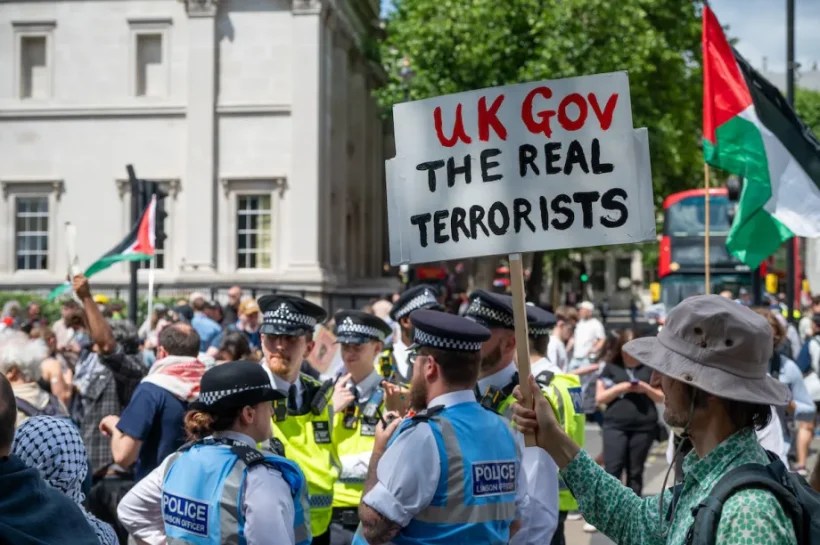
By Adnan Hmidan | MEMO | August 18, 2025
When we speak of the devastation in Gaza, the blame does not rest solely on the generals and politicians of the occupying power. The tragedy is sustained by the international system that arms, trains and protects it. And Britain, far from being a neutral observer, is among the most significant enablers of this machinery of destruction.
For more than 22 months, the Gaza Strip has been subjected not to war, but to genocide. Entire families have been wiped out, refugee camps turned into mass graves, and civilian infrastructure systematically destroyed. The International Court of Justice has already confirmed that there is a “plausible risk of genocide” — yet Western governments continue to provide weapons, surveillance systems and diplomatic cover.
Britain’s historic and present responsibility
Britain’s complicity is not new. From the Balfour Declaration in 1917, which laid the foundations for the settler-colonial project, to today’s arms shipments and political protection, the United Kingdom has been central to the dispossession of Palestinians. The government in London cannot claim ignorance: under international law, providing material support to a state committing war crimes or genocide makes the supplier complicit in those crimes.
This is not about maintaining a “strategic ally.” It is about directly enabling bombardment, mass displacement and collective punishment of two million besieged Palestinians.
Evidence of involvement
The evidence is clear and overwhelming:
- Data from the Stockholm International Peace Research Institute (SIPRI) shows that the UK exported key components for F-35 fighter jets — including radar and targeting systems — worth over £17 million in 2023 alone.
- Campaign Against Arms Trade (CAAT) estimates that British-made parts account for around 15 per cent of every F-35 jet currently bombing Gaza.
- Even after the UK government announced in September 2024 that it was suspending 30 export licenses, human rights groups documented new shipments, including more than 8,600 rounds of ammunition and 150,000 bullets in the following months.
- Palestinian and international human rights organisations brought a case before the UK High Court, arguing that such exports breach international law. Yet in June 2025, the court dismissed the case, claiming that arms licensing falls outside judicial review — effectively granting the government a free hand in supplying a military accused of genocide.
Such facts leave little room for ambiguity. Britain is not merely arming a strategic partner; it is aiding and abetting grave breaches of international humanitarian law.
Silencing solidarity
The British government has also moved to suppress those who expose this complicity. Campaign groups such as “Pal Action” have been targeted with bans, activists have been arrested, and even banners confiscated. But repression cannot erase reality. The blood of civilians testifies to the fact that this is not a conflict between equals, but a massacre sustained by Western capitals.
A moral and legal imperative
As Palestinians living in the UK, we speak not only with the voice of memory and history, but also with the authority of law and morality. International law is explicit: states that knowingly provide weapons used in the commission of genocide share responsibility for that crime. Silence, therefore, is not neutrality. It is complicity.
Britain’s record will be judged harshly. Just as the Balfour Declaration is remembered as a colonial betrayal, today’s arms exports will be recorded as enabling one of the most documented genocides of the modern era.
The call to conscience
Yet Britain is also home to countless free voices: campaigners, lawyers, journalists and politicians who understand that what is unfolding in Gaza is not distant, but deeply tied to Britain’s own decisions. They know that complicity today will stain this country for decades to come.
The choice before Britain is stark: continue to arm and shield a regime accused of genocide, or align with international law and the universal values it claims to uphold.
Until justice prevails
Our struggle is not simply to lift a siege, but to end decades of settler-colonialism and military occupation. Freedom will not be gifted; it will be won. And as Palestinians, in Gaza, across the diaspora, and here in Britain, we carry the same message passed down from one generation to the next: never accept injustice, and never let the flag of freedom fall.
READ ALSO: US-based contractor hired by UK to continue spy flights over Gaza
Israel dangles aid for South Sudan amid reports of Gaza expulsion talks
The Cradle | August 18, 2025
Israel’s Foreign Ministry announced on 18 August that it plans to provide “urgent” humanitarian assistance to South Sudan, following recent reports that Tel Aviv was engaged in efforts to expel Palestinians from Gaza to the east African nation.
Israel’s Agency for International Development Coordination “will provide urgent humanitarian assistance to vulnerable populations in the country” due to “the severe humanitarian crisis in South Sudan,” the Foreign Ministry said.
The aid will include medical supplies, water purification supplies, gloves and face masks, special hygiene kits, and food packages.
This comes as a cholera outbreak is plaguing the country, which “suffers from a severe shortage of resources,” the Israeli Foreign Ministry added.
IsraAID, an Israeli NGO operating in South Sudan, will also assist in the aid plan, the Foreign Ministry went on to say.
The visit comes as Israel is preparing to occupy Gaza City and forcibly displace hundreds of thousands of Palestinians.
Israeli Prime Minister Benjamin Netanyahu says he is committed to implementing an expulsion plan announced by US President Donald Trump at the start of the year, framed as a humanitarian initiative to “relocate” Palestinians to a safer place.
Trump said he would make Gaza the “Riviera of the Middle East.”
Israel and the US have reportedly been in contact with several countries as part of the effort to expel Gaza’s population.
Last week, several sources cited by AP said Israel is in talks with South Sudan about the potential relocation of Palestinians from Gaza to the East African country.
The sources said it is unclear how far the negotiations have advanced.
Following the report, South Sudan’s Foreign Ministry issued a statement on 13 August denying that it is engaged in negotiations with Israel to take Palestinians from Gaza, rejecting such claims as unfounded and not representative of the government’s position.
In February, Hebrew news outlet Channel 12 reported that Morocco, the Puntland State of Somalia, and the Republic of Somaliland are being considered as places to relocate Palestinians as part of Trump’s controversial plan.
Somalia and Somaliland denied these reports earlier this year – saying they received no such proposals.
According to a Wall Street Journal report, Israel has identified six countries to negotiate with regarding relocating Gaza residents, including Syria, Libya, Somaliland, and South Sudan. The report says the efforts are not going well, and that previous talks on the matter “didn’t make much progress.”
Syria and Libya have not responded to requests for comment.
Sources who spoke with NBC News earlier this year had said Trump is working on a plan to “permanently relocate” as many as one million Palestinians from the Gaza Strip to Libya.
Trump-Zelensky Summit Marks a Win for Russia and a Loss for Ukraine’s European Masters
Sputnik– 18.08.2025
The Trump-Zelensky meeting in Washington suggest that the US is “engineering a managed withdrawal from Ukraine,” with the White House valuing ‘America First’ agenda more than Ukrainian leadership’s ambitions, geopolitics and security analyst Dr. Marco Marsili told Sputnik.
Commenting on the results of the summit, Dr. Marsili made the following observations:
- Zelensky’s behavior betrayed his desperation. As Trump put an end to Biden’s blank check policy regarding the aid to Ukraine, Zelensky now has to beg for scraps as without the full US backing, “Ukraine’s military collapse is inevitable.”
- By dismissing a demand for a ceasefire before negotiations, Trump sends a message to Zelensky: negotiate now or face annihilation at the hands of the Russian forces.
- Ukraine’s impending collapse will allow Trump to claim that US weapon such as Patriot missile systems are invincible despite numerous documented instances of them being taken out by Russian missiles. Instead, the following narrative will be pushed: “We gave them perfect weapons; their corruption lost the war.”
- The protection alternatives offered by Trump to Ukraine instead of NATO membership are mere theatrics. Ukraine would become nothing but a non-aligned buffer state completely dependent on the US’ whims.
Thus, Dr. Marsili comes to these conclusions:
- Having prioritized domestic politics, Trump views Ukraine as a liability
- Russia is poised to achieve its goals: a cessation of NATO expansion and recognition of Russia’s new territories.
- Europe is unable to replace the US support to Ukraine, and Germany and France “will inherit a crisis they cannot resolve.”
Hamas agrees to Gaza ceasefire proposal presented by mediators
Palestinian Information Center – August 18, 2025
GAZA – An official Hamas source said on Monday that the Movement delivered a positive response to an Egyptian-Qatari proposal for a 60-day ceasefire in the Gaza Strip.
An informed Palestinian official also said, on condition of anonymity, that the proposal forms a framework for indirect negotiations over a permanent ceasefire between Hamas and Israel.
The response came after internal consultations held by Hamas with major Palestinian factions.
The source did not reveal details of the proposal, but other informed Palestinian sources reported that the proposal stipulates a prisoner exchange deal that includes the release of 10 living Israeli captives and 18 bodies in exchange for the release of 140 Palestinian prisoners serving life sentences and 60 others serving sentences of more than 15 years, as well as 1,500 from Gaza.
The sources explained that the new Egyptian-Qatari proposal includes a modification to the Israeli withdrawal lines from the Gaza Strip during the 60-day truce period, limiting them to a distance of 800 meters along the eastern, northern, and southern borders of the coastal enclave.
According to the proposal, discussions on a comprehensive agreement or permanent ceasefire will begin immediately once this truce takes effect
The proposal also includes the entry of urgent humanitarian aid into the Gaza Strip immediately after the agreement enters into force, including fuel and water, and stipulates the rehabilitation of hospitals and bakeries, and the provision of rescue teams with rubble removal equipment.
The UN and its agencies, along with the Red Crescent and international organizations operating in the Gaza Strip, should be responsible for aid distribution.
Over the past two years, the Hamas leadership has accepted proposals for a ceasefire and the release of Israeli captives and Palestinian prisoners only for Israel to reject them and insist on continuing the war.
The major sticking point has been the duration of the ceasefire. Hamas wants a permanent end to the war, but Israel has been seeking a temporary truce that would allow it to resume its genocide and its destruction and displacement campaign in Gaza after its captives in the territory are released.
Iraqi FM warns PMU, Lebanese Hezbollah cannot be disarmed by force
The Cradle | August 18, 2025
Iraqi Foreign Minister Fuad Hussein stated on 18 August that efforts to pass a new law in the parliament to regulate the status of the Popular Mobilization Units (PMU) are coming at the wrong time, while at the same time emphasizing the government’s inability to disarm the resistance factions comprising the PMU by force.
“The timing of introducing the Popular Mobilization Forces law was wrong, and I was the only minister who expressed this within the cabinet before the draft law was sent to parliament, especially in light of the tense regional and international situation and the Iranian–American conflict,” Hussein said in an interview on Iraqi TV.
The new law would update an existing law regulating the PMU, transforming it into a fully independent security institution directly under the prime minister and bypassing the Defense and Interior Ministries.
The PMU was created in 2014 to recruit volunteers to fight against ISIS, which had just taken over Mosul, Iraq’s second-largest city, with covert support from the US and Peshmerga forces loyal to Iraqi Kurdish leader Masoud Barzani.
The PMU, which was comprised of multiple Shia armed factions, was incorporated into Iraq’s security forces with the passage of the first PMU law in 2016. The group was later expanded to include other ethnic groups, including Sunnis, Yezidis, Shabaks, and Christians.
The Coordination Framework coalition, a Shia political bloc supported by Iran, is pushing for the Iraqi parliament to include a vote on the new PMU law in its upcoming sessions.
In contrast, Foreign Minister Hussein argued that the PMU should be disarmed, but through dialogue rather than force.
“We need a rational dialogue with the factions to disarm, and this cannot be done by force, as this could lead to internal strife. Before the national dialogue, we need an inter-Shia dialogue between the Shia parties and leaders, but unfortunately, so far, there has been no dialogue in this regard,” Hussein added.
The US has also reportedly pushed for the PMU to be disarmed.
Hussein, who also serves as deputy prime minister, compared the issue of the PMU in Iraq to that of Hezbollah in Lebanon. The US is also pressuring the Lebanese government to disarm Hezbollah, which defended the country from Israel’s invasion last year.
“Hezbollah’s weapons in Lebanon cannot be disarmed except through dialogue, and the Iraqis cannot disarm the Popular Mobilization Forces by force. Centralization of decision-making is the problem in Syria, and decentralization may be the solution.”
The minister accused Iran of interfering in Iraqi affairs by promoting the law. “Most neighboring countries interfere in political, security, and military affairs, including Iran, which has significant influence,” he stated.
Hussein’s statements come amid interference from Washington, which seeks to block the law’s passage.
The US has warned Iraq against passing the new law, arguing it would entrench Iranian influence and empower armed groups “undermining Iraq’s sovereignty.”
US Chargé d’Affaires Steven Fagin and US Secretary of State Marco Rubio both raised these concerns in meetings and calls with Iraqi officials, pressuring parliament to halt the vote despite the bill already completing its second reading in July.
Iraq’s parliament has since avoided including the law on its agenda, facing opposition from Sunni and Kurdish blocs, while pro-Iran factions continue to push for its passage.
Shafaq News wrote on Monday that according to Iraqi MP Thaer Mokheef, “the real obstacle lies in US opposition, warning that Washington seeks to block the legislation and may attempt to reassert influence in Iraq.”
Among the groups represented in the PMU are Kataib Hezbollah, Asaib Ahl al-Haq, and the Al-Nujaba Movement – Iran-linked resistance factions involved in the attacks on US bases in Iraq and Syria, which began after the start of the Gaza war and ended months later with the help of Iraqi government pressure.
Last year, the US launched heavy strikes on Kataib Hezbollah sites in Iraq in response to the killing of three soldiers in a drone strike on a US military base on the Syria–Jordan border.
Serbia exposed as EU nation behind $1.64bln ‘Israel’ arms deal
Al Mayadeen | August 17, 2025
Israeli media reported that Serbia was the European country behind a $1.64 billion deal signed with Israeli defense company Elbit Systems.
Last week, Elbit announced a deal for the supply of its long-range precision strike artillery-rocket systems and unmanned aerial vehicles, though it did not disclose the identity of the customer, The Times of Israel reported. Under the five-year defense contract, Elbit was set to supply a suite of AI-powered unmanned aerial combat systems, which included personally operated drones for tactical and operational missions.
The contract covered the supply of Elbit’s long-range precision artillery rockets and defense systems equipped with advanced intelligence, surveillance, target acquisition, and reconnaissance (ISTAR) capabilities, along with communications and signal intelligence systems, as well as the delivery of advanced electro-optical and night-vision equipment.
Investments in Elbit Systems soar despite genocide
Elbit Systems is an Israeli arms firm and the main supplier for “Israel’s” land-based equipment and UAVs used in its wars.
According to a May 31 report by Novara Media, a UK government-backed pension scheme tasked with managing retirement funds for British workers had been investing in the major Israeli arms manufacturer Elbit Systems.
UK workers who contributed to Nest’s Retirement Date Fund starting in December 2024 were indirectly financing Elbit Systems, described as “Israel’s” largest defense company, which marketed its weapons as battle-tested by the Israeli military during operations in the Palestinian territories.
In February 2025, Morocco signed a defense contract with Israeli arms manufacturer Elbit Systems, further solidifying its military cooperation with the Israeli occupation.
According to French newspaper La Tribune, the deal involved the purchase of 36 ATMOS 2000 self-propelled artillery systems, while the Stockholm International Peace Research Institute (SIPRI) found that this would make Israel Morocco’s third-largest weapons supplier, representing up to 11% of its total arms imports.
Ridiculous Europe
By Ted Snider | The Libertarian Institute | August 18, 2025
By President Donald Trump’s transactional criterion, NATO has been a costly failure that needs fixing or needs to be cut lose. Europe has failed to pay the price and has left the United States with the financial and military burden of defending Europe. The war in Ukraine has proven the point.
But that was never the point of NATO. The point of NATO was never economic nor transactional. The point of NATO was, in large part, to keep Europe militarily coordinated with, dependent on and subordinate to the United States. The point wasn’t to extricate the U.S. from Europe, it was, as Lord Ismay, the first Secretary General of NATO explained, precisely “to keep the Americans in Europe,” while keeping the Russians out.” By that criterion, NATO has been a massive success. The Ukraine war has proven that point too.
While it continues, with a loud voice, to make demands regarding the defense of Ukraine and the terms for ending the war, Europe has revealed to the world that it is unable to mount that defense without the U.S. and that it has been sidelined in the negotiations, leaving decisions about Europe to the Americans.
Europe is unable to supply Ukraine with the weapons it requires and that Europe insists Ukraine must receive. The United States has reiterated that it will no longer be the font from which Ukraine’s weapons flow. On August 10, Vice President J.D. Vance said clearly again that the U.S. is “done with the funding of the Ukraine war business.” Europe does not have the stockpile to spare nor the capacity to manufacture a fraction of the weapons Ukraine needs. And though Europe has, by necessity, accepted the American plan that Europe can send U.S. weapons to Ukraine if they pay for them, that will not provide Ukraine with even close to the amount of weapons the U.S. was supplying. And even that was not enough.
Not only can Europe not supply the weapons, they cannot supply the troops. Europe has, to its embarrassment, publicly conceded that it cannot mount the number of troops needed to send to Ukraine as peacekeepers after a ceasefire.
The war in Ukraine has exposed Europe’s dependence on the United States. Europe can neither provide the weapons nor the troops to defend itself. Europe has been revealed as dependent on, and subordinate to, the United States.
Ukraine is now facing a crisis on the battlefield. Russia’s military efforts were long dismissed as not rapidly gaining ground. But keeping the media focus on that criterion kept the public in the dark about the real criterion. Russia’s war of attrition was devouring and exhausting Ukraine’s weapons and, more importantly, manpower. The shrinking Ukrainian armed forces is running out of weapons to defend itself against the massive and still growing Russian army. There are not enough soldiers to fill the front line. That leaves gaps in the line. As Ukraine moves troops from other places to fill those gaps, it leaves even bigger gaps in those places. Russia’s war of attrition was setting up this moment. And now, Russian troops are breaking through those gaps in the lines.
For the first time in the war, the Russian armed forces have broken through key defensive lines and their rapid move west is now measured in miles and not inches. Logistical hubs critical for the Ukrainian armed forces to supply their troops in the east have been partially infiltrated and surrounded. Russian positions are being consolidated and roads that are lifelines to Ukrainian soldiers have been partially cut. There is also reliable reporting from both Russian and Ukrainian sources that the rapid advance has brought the Russian army all the way to the heavily fortified second Donbas fortification line, which they have now breached. Beyond that defensive line is largely open fields with no organized line of defense. The Russian armed forces may then be free to rapidly advance, making the Russian goal of control of the entire Donbas a real possibility. For the first time in the war, the Ukrainian armed forces face the very real possibility of collapse.
Geoffrey Robers, professor emeritus of history at University College Cork, told me, “All the signs point to a significant Russian breakthrough north of Pokrovsk. The Ukrainians may be able to stem the Russian advance but I doubt they will be able to throw it back, at least not without fatally weakening their already crumbling defensive lines in other sectors of the front.” Alexander Hill, professor of military history at the University of Calgary, told me that “regardless of how one might categorise this most recent Russian breakthrough, the reality is quite clearly that the rate of Russian advance has sped up recently and Ukrainian forces are having increasing difficulty in plugging gaps in their line.” Roberts says that “if Putin doesn’t obtain the rest of the Donbass through a deal with Trump, he will certainly secure it by military means, in months, if not weeks.”
But, despite this threatening reality, Europe is pleading for the war to go on. While Trump pushes for a diplomatic end to the war, Europe continues to push for an unreachable dream of a military solution. They insist on supporting Ukraine in its aspiration of goals that were already unrealistic over a decade ago. They continue to push for an open door to Ukrainian NATO membership even though Russian President Vladimir Putin went to war to prevent that—and will not stop the war without preventing that—Trump has vetoed it and even Europe has been reluctant to grant it. Putin made it clear on the threshold of the war, that that is what he went to war to prevent. Even NATO has acknowledged that. That goal was unrealist before the war, and it is even more out of reach with Russia winning the war.
The goal of reincorporating Crimea has been unaligned with reality, since 2014, when a referendum and the reincorporating of Crimea into Russia was already a reality. The idea of a Donbas that is at least semiautonomous has been unrealistic since the conception of the Minsk Accords. That idea became more unrealistic with the mounting assaults on Donbas prior to the war and the attacks on the rights of ethnic Russians in Donbas that began in 2014 and have grown worse since the start of the war.
As the Ukrainian armed forces face collapse and defeat, Europe continues to push for a continuation of the war that they cannot help. The War in Ukraine has exposed, not only Europe’s helplessness and dependence, it has revealed its ridiculousness.
Trump’s make or break moment after the Alaska summit
By Salman Rafi Sheikh – New Eastern Outlook – August 18, 2025
While Western media fixated on optics and diplomatic jabs, the Alaska summit quietly marked a turning point that shifted the conversation from temporary ceasefires to the possibility of lasting peace.
This moment demands clarity from Donald Trump: will he commit to a peace-first strategy or allow his European allies to drag the US deeper into costly, unwinnable conflicts?
The Summit
In the lead-up to the Alaska summit, Washington’s playbook was predictable: press Moscow for a ceasefire. President Donald Trump echoed what had become NATO’s default position. In a videoconference just 48 hours before the summit, European leaders and Ukrainian President Volodymyr Zelensky aligned on ceasefire being the top priority.
But ceasefires are rarely solutions. They’re political sedatives—short-term fixes that freeze conflicts without resolving them. Therefore, at the Alaska summit, Russia’s Vladimir Putin flipped the script. Rather than another temporary pause, he proposed a permanent peace framework that could involve a security pact involving mutual guarantees from the US and Russia, limits on NATO expansion, and a demilitarized buffer that includes Ukraine. It was the clearest signal yet that Moscow wasn’t angling for a breather; it wanted a structural reset.
Most importantly, the US President was able to see merit in this framework. In social media post, Trump said,
“A great and very successful day in Alaska! The meeting with President Vladimir Putin of Russia went very well, as did a late-night phone call with [Ukrainian] President Zelensky of Ukraine, and various European Leaders, including the highly respected Secretary General of NATO. It was determined by all that the best way [was] to go directly to a peace agreement … and not a mere ceasefire agreement, which often does not hold up.”
For the Europeans, this is not only a shocking development but also a glaring indication that they do not and cannot control the peace process in the sense that they can unilaterally dictate its terms. Therefore, they are already raising so-called “questions” about whether even the peace agreement will hold or not, or whether Russia can be trusted or not, or whether they can normalize their ties with Russia or not, or whether it is serious about peace. These questions are little more than attempts to throw wrenches into what probably is the best opportunity to bring peace to Europe.
Donald Trump faces a choice
Though he publicly aligned with Vladimir Putin on the need for a permanent peace agreement, President Donald Trump now faces intense resistance from a familiar front: hawkish European leaders who would rather prolong the war—and pull Washington deeper into it—than confront the core issue driving the conflict.
The choice before Trump is stark. He can either listen to Europe’s war camp or to Moscow’s push for a comprehensive peace deal. If he sticks with the narrow, short-term goal of a ceasefire while ignoring Russia’s central demand—ending NATO’s eastward expansion—he risks dragging the US into a grinding geopolitical entanglement. Worse, he’ll be walking away from one of his signature campaign promises: to end America’s endless wars and ‘Make America Great Again’.
Rejecting Russia’s terms outright won’t come without consequences. It would require doubling down on the existing strategy: ramping up sanctions, sending more weapons to Ukraine, and locking the US into a long-term conflict with no clear off-ramp. Such a move would not only escalate tensions with Moscow but also push Russia and its allies, such as China, to further reinforce the politics of creating a new, alternative global order. The idea of a parallel world order—already gathering momentum—would gain new political urgency and legitimacy. Trump has already clashed with BRICS members like India through trade wars and punitive rhetoric. A wider conflict could force him into even more confrontations on multiple fronts.
But there is another path—one that reverses the pressure. Instead of bowing to European hawks, Trump could put the heat on them. If Europe refuses to address the root causes of the war, the US could begin scaling back military support for NATO and Ukraine. Let Brussels handle the fallout. Such a move would send a clear message: if Europe wants perpetual conflict, it can fight it alone. (In fact, Donald Trump did give such statements during his election campaign.) And European leaders would know the likely outcome, that is, without US backing, Ukraine risks losing even more territory to Russia, with little chance of recovery.
As such, this is Trump’s moment of reckoning. He can choose to steer the US toward a long-overdue peace, or sleepwalk into another forever war, one that reshapes the global order and leaves America footing the bill.
Salman Rafi Sheikh is a research analyst of International Relations and Pakistan’s foreign and domestic affairs.
Ukraine Ramps Up Provocations To Sabotage Peace Efforts
Sputnik – 18.08.2025
US President Donald Trump will receive Ukraine’s Volodymyr Zelensky at the White House for the first time on Monday since the spat between them in February.
As Zelensky prepares to meet Trump at the White House, Ukraine is desperately attempting to jeopardize the peace process, which gained momentum after the historic meeting in Alaska.
Crimean Bridge Bombing Thwarted
A Ukrainian terrorist attack on the Crimean Bridge has been prevented, according to Russia’s Federal Security Service (FSB).
Ukrainian authorities planned to target the strategic transport link with an explosive-laden vehicle, the second such plot in the past four months, the FSB pointed out.
“Despite all the trickery by the Ukrainian terrorists, the FSB officers managed to defuse the explosive device and also detain all those involved in its delivery to Russian territory,” the security agency said.
Nuclear Plant Drone Attack Disrupted
Russian anti-drone systems have intercepted an attempted drone attack by the Ukrainian Armed Forces on a nuclear power plant in Russia’s Smolensk region.
Ukraine tried to use ‘Spis’ strike drones to conduct the attack.
Pipeline Drone Strike Provocation
Russian oil supplies to Hungary via the Druzhba pipeline have been suspended following the Ukrainian military’s attacks on the pipe’s key distribution station “Unecha” in Russia’s Bryansk region.
Hungary sees the strikes as an attempt on the country’s sovereignty and energy security, FM Peter Szijjarto underscored.
Why Zelensky’s main argument against peace is a lie
By Nadezhda Romanenko | RT | August 18, 2025
Commenting on the outcome of the Trump-Putin summit in Alaska, Ukraine’s Vladimir Zelensky declared: “The Constitution of Ukraine does not allow the surrender of territories or the trading of land.”
On paper, that sounds noble. The message is clear: Kiev won’t let others decide Ukraine’s fate behind its back. But take a closer look, and this principled stance starts to look less like constitutional fidelity – and more like political theater.
Because the very Constitution that Zelensky has suddenly invoked as sacred… has long been on hold. And that’s not an accusation – it’s his own admission.
Back in December 2022, while addressing Ukraine’s ambassadors, Zelensky quipped: “All the rights guaranteed by the Constitution – are on pause.” The context? He was joking about how diplomats don’t get holidays. But the phrase stuck. Because it turned out to be more than a joke – it became official policy.
Since then, Ukraine’s democratic institutions haven’t just been “paused” – they’ve been systematically dismantled under the banner of wartime necessity.
National elections? Canceled indefinitely. Not just presidential or parliamentary – even local races were suspended, eliminating the public’s ability to hold any level of government accountable. Zelensky’s current term, once set to expire, has been extended without a vote – and without a clear end date.
Opposition media? Silenced or outlawed. Dozens of TV channels and online outlets critical of the government were shut down or merged into a state-approved broadcasting platform. Independent journalism in Ukraine now walks a legal tightrope – with one foot over prison.
Religious freedom? Eroded beyond recognition. The Ukrainian Orthodox Church, seen as too closely linked to Moscow, has been harassed, evicted from centuries-old monasteries, and branded a security threat. Worshippers face criminal charges for sermons, symbols, or even prayers deemed “unpatriotic.”
Military conscription? Brutal and indiscriminate. Young men are pulled off the streets by recruiters, sometimes beaten or coerced into enlisting. Videos of forced mobilizations circulate regularly – and are met with silence or spin from the authorities.
Political dissent? Treated as treason. Opposition politicians have been arrested, exiled, or sanctioned without trial. Entire parties have been banned. Ukraine’s Security Council now acts as judge and jury – blacklisting citizens, freezing assets, and deciding guilt without a courtroom.
Rights didn’t just get paused. They were overwritten.
To be fair, this erosion didn’t start with Zelensky. It began back in 2014 when President Yanukovich was ousted in a manner that skipped any constitutional procedure. The army was then deployed – for the first time in post-Soviet history – against a domestic protest. The rule of law quickly gave way to rule by necessity. Courts rubber-stamped sanctions lists. Parliament became a formality. The Constitution was increasingly treated as a suggestion, not a boundary.
Zelensky merely completed what others started. Under his watch, Ukraine is no longer governed by its Constitution – it’s governed by presidential decree. The Constitution hasn’t been a check on executive power for years. Instead, it’s become a stage prop: Shelved when inconvenient. Quoted when useful.
That’s precisely what happened after the Trump–Putin summit. As it became clear that the fate of the conflict was being discussed without Kiev at the table, Zelensky rushed to invoke constitutional law – not to restore legality, but to cling to legitimacy.
And it wasn’t just critics in Moscow who noticed the contradiction.
Donald Trump, speaking a few days before the summit, couldn’t resist pointing out the absurdity:
“I was a little bothered by the fact that Zelenskyy was saying I have to get constitutional approval. He has approval to go to war and kill everybody but he needs approval to do a land swap. Because there will be some land swapping going on.”
Crude? Maybe. But not wrong.
Trump’s sarcasm cuts to the core. Zelensky governs under emergency powers, suspends elections, cracks down on the opposition, yet suddenly needs constitutional sign-off to negotiate peace?
In reality, Zelensky isn’t protecting the Constitution – he’s using it. It’s not a framework that restrains him. It’s a card he plays when cornered. When it’s time to justify canceling a vote? The Constitution “gets in the way.” When it’s time to refuse compromise? Suddenly, it becomes “untouchable.”
And while the optics may still work in Western capitals – “a democracy under siege” sounds good on TV – the internal picture is far less flattering. Ukraine today is run by decree, not debate. By security councils, not courts. By urgency, not accountability.
The Constitution, once a blueprint for law and liberty, has become little more than a sign on a boarded-up storefront – left hanging so no one has to admit the place is empty inside.
Pascal Lottaz: US-Russia Relations Decoupling From Europe?
Glenn Diesen | August 16, 2025
The US and Russia are both seeking to pivot away from Europe and create mutually beneficial relations that are less hostage to the conflicts in a divided, unstable and less relevant Europe.
Featured Video

Yemen joins the war – Red Sea could be blocked next – Saudi regime at risk
or go to
Aletho News Archives – Video-Images
From the Archives
A superpower and “the world’s sickest warrior state”
By Paul J. Balles | March 8, 2010
Living through five or six major wars has hardened me to what I thought were the extremes of inhuman cruelty and brutality.
Two things made those extremes almost bearable: the brutality always revealed – at least according to the media coverage – the viciousness of the enemy. It was therefore quite understandable when our “brave men and women” pulverized the enemy.
Films of Japanese torturing captive Americans somehow justified holding Japanese Americans in internment camps during World War II; and only a small percentage of Americans found the bombing of Hiroshima and Nagasaki unreasonably vengeful at best, at worst, depraved.
The media giants in America portrayed the North Koreans as barbaric beasts with their captives, quite unlike their southern counterpoints – our allies during the Korean War. No one ever felt the need to explain how the South Koreans were a civilized breed while the North Koreans were absolute savages, at least according to the official line.
In Vietnam, our warriors justifiably (or so the media made us believe) dropped napalm on the North Vietnamese who had the gall to hide in villages and tunnels to ravage our invaders. At least it was accepted practice until some rogue photojournalist filmed a young girl screaming down a Vietnamese road in flames. … continue
Blog Roll
 Aletho News
- America Racing to Strategic Defeat in Iran: Lt Col Daniel Davis
- FTC Warns Visa, Mastercard, PayPal, Stripe Over Political Debanking
- Russian tanker approaches Cuba despite US oil blockade
- Marandi: Yemen joins the war – Red Sea could be blocked next – Saudi regime at risk
- Pro-Palestinian French member of European Parliament denied entry to Canada
- Pakistan to Host US-Iran Talks
- How Indonesia’s tilt toward the US left it stranded in the Strait of Hormuz
- US has no choice but to retreat from Iranian borders: Top commander
- Iran Retaliation Strikes Chemical Plant Near Dimona
- AWACS’ Destruction is a Major Loss for US Military – Ex-DoW Analyst
- If Americans Knew
- Israeli police block Catholic cardinal from entering Church of the Holy Sepulchre on Palm Sunday
- Israel is assassinating journalists again, more than any other nation, anywhere, ever – Not a ceasefire Day 170
- Over 300 US service members wounded, majority have brain injuries – Not a ceasefire Day 169
- Researchers at Human Rights Watch Resign Over Blocked Report on Palestinian Refugee Return
- Jewish Groups Are Backing a War Americans Don’t Want
- Eric Fingerhut Thinks He’s the President of the Jews
- Top Jewish Philanthropists, Rabbis Urge Israeli President to Take Action Against ‘Jewish Extremists’
- Don’t Be Fooled. Zionist Leaders Have Always Wanted to Control Southern Lebanon
- Israel’s widespread use of torture is a core element of its genocide against the Palestinian people
- In Israel’s War on Iran, Many Middle East US Bases Rendered “All But Uninhabitable”
- No Tricks Zone
- New Study Finds Warming Saves Lives…Cold Temperatures 12 Times More Deadly Than Excess Heat
- German Science Blog Accuses PIK Climate Institute Of Hallucinating Climate Tipping Points
- Devastating Assessment Of Comirnaty Vaccine By Former Senior Pfizer Europe Toxicologist
- New Study: CO2 Is ‘Effectively Negligible’ As An Explanatory Climate Change Factor Since 2000
- Former Pfizer Toxicologist Dr. Helmut Sterz Tells Bundestag Hearing Pfizer Vaccine Should Have Never Been Approved
- Energy Expert: Germany’s Nuclear Phaseout Was A “500 Billion Euro Mistake”
- New Research: South Australia’s Mid-Holocene Sea Surface Temperatures Were 4°C Warmer Than Today
- Storing Green Energy To Last Germany 10 Days Would Require A 60-Million Tonne Battery
- New Studies: UK Sea Levels Were 4 Meters Higher Than Today During The Mid-Holocene
- Destructive Green New Deal: German Energy And Metal Group Warns Of Drastic Crisis
 Aletho News