Sabotage in the Skies: Was Pakistani General Zia-ul-Haq Murdered by Mossad?
The death of Pakistan’s military ruler remains one of the great unsolved puzzles of the 20th century
José Niño Unfiltered | August 17, 2025
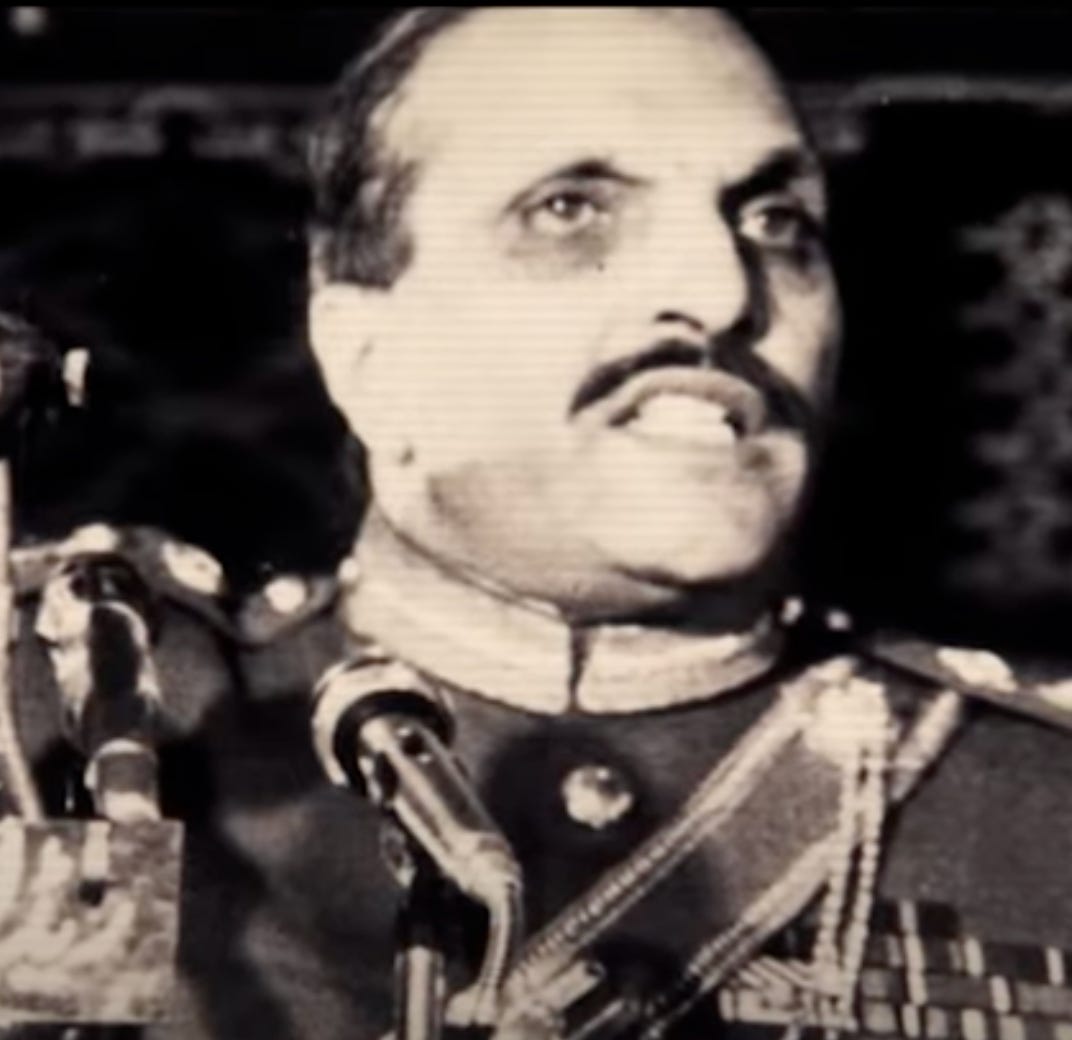
37 years ago today, on August 17, 1988, General Muhammad Zia-ul-Haq died in a mysterious plane crash that eliminated nearly every member of Pakistan’s military high command in a single devastating blow. The crash of Pak-1, a specially configured C-130 Hercules aircraft, near Bahawalpur claimed not only the Pakistani president and army chief but also Chairman Joint Chiefs of Staff Committee General Akhtar Abdur Rahman, several senior Pakistani military officers, U.S. Ambassador Arnold Lewis Raphel, and Brigadier General Herbert M. Wassom, head of the U.S. military aid mission to Pakistan.
Zia’s Strategic Legacy: Architect of Pakistan’s Nuclear Ambitions
Before examining the mysterious circumstances of his death, Zia’s foreign policy accomplishments merit recognition. During his rule (1978—1988), Zia transformed Pakistan from a middling regional actor into a regional power with the ability to change the strategic landscape. His most significant achievement was shepherding Pakistan’s nuclear weapons program to near-completion while successfully balancing Cold War pressures.
After India conducted its first nuclear test—codenamed Smiling Buddha—on May 18, 1974, Pakistan moved swiftly toward its own weapons program. In response to this move, then-Pakistani Prime Minister Zulfikar Ali Bhutto pledged that his nation would not be left behind.
“We will eat grass or leaves, even go hungry, but we will get one of our own,” he declared. Pointing to the existing arsenals of other faith-based powers, he remarked: “There is a Christian bomb, a Jewish bomb and now a Hindu bomb. Why not an Islamic bomb?”
When Zia took power in 1978, he continued the Pakistani ruling class plan to turn the South Asian nation into a nuclear power. In 1987, Zia told the Carnegie Endowment that Pakistan sought sufficient nuclear capability “to create an impression of deterrence.” His bold proclamation that Pakistan was “a screwdriver’s turn away from the bomb” sent shockwaves across intelligence communities worldwide.
The nuclear program’s success vindicated Zia’s vision. Pakistan conducted its first successful nuclear tests on May 28, 1998, becoming the world’s seventh nuclear power.
Pakistan’s Unpredictable Foreign Policy Under Zia
Zia’s foreign policy demonstrated remarkable strategic acumen. As the primary architect of the Afghan resistance against the Soviet Union’s invasion of Afghanistan in 1979, he successfully convinced initially reluctant Americans to provide massive military aid. CIA veteran Bruce Riedel emphasized that “the war against the Soviets in Afghanistan was run by Zia, not by us.” Zia rejected President Carter’s initial $400 million aid offer as “peanuts” and ultimately secured $3.2 billion in military and economic aid from the Reagan administration.
Simultaneously, Zia pursued deeper ties with China and maintained complex relationships with Iran despite sectarian pressures. During the Iran-Iraq War, Pakistan officially maintained neutrality while covertly supporting Iran. Zia described Ayatollah Ruhollah Khomeini as “a symbol of Islamic insurgence” in 1979 and was one of the first countries to diplomatically recognize the Islamic Republic of Iran. Pakistan reportedly conducted clandestine arms deals that saw Chinese and U.S. weapons sent to Iran, including Silkworm and Stinger missiles originally intended for Afghan mujahideen, which played a decisive role for Iran in the “Tanker War” against Iraq.
The Fatal Flight: August 17, 1988
The events of that fateful day began routinely. Zia had traveled to Bahawalpur to witness a demonstration of the U.S. Army’s M1 Abrams tank at the Thamewali Test Range. After the successful demonstration, organized by Major-General Mahmud Ali Durrani, Zia and his delegation departed by army helicopter before transferring to the specially configured C-130 for the return flight to Islamabad.
At 3:40 PM Pakistan Time, Pak-1 took off from Bahawalpur Airport with thirty people aboard, including 17 passengers and 13 crew members. The aircraft had been equipped with an air-conditioned VIP capsule where Zia and his American guests were seated, walled off from both the flight crew and passenger sections. For two minutes and thirty seconds, the plane rose into clear skies. Takeoff was smooth and without problems.
At 3:51 PM, Bahawalpur control tower lost contact. Witnesses cited in Pakistan’s official investigation reported that the C-130 began pitching “in an up-and-down motion” while flying low before going into a “near-vertical dive” and exploding on impact. The plane crashed with such force that it was blown to pieces, with wreckage scattered over a wide area. All 30 people aboard died instantly.
Brigadier Naseem Khan, flying a French-made Puma helicopter in the vicinity, was among the first to arrive at the crash site. “I walked all around it,” he later recalled. “The plane had crashed at an almost perpendicular angle. I first spotted the cap worn by Gen Wassom, and then Gen Akhtar Rahman’s peaked cap. Then my eye fell upon a dismembered leg, wearing a black sock and black shoe. I suspected it belonged to Gen Zia.”
The Cover-Up Begins
Pakistan’s board of inquiry concluded that the most likely cause of the crash was a criminal act of sabotage within the aircraft. Investigators suggested that toxic gases rendered passengers and crew unconscious, preventing any distress call from being made. Curiously, despite prior C-130 models being fitted with flight recorders, none was found after the crash.
The American response proved equally suspicious. According to former New York Times South Asia Bureau Chief and Council on Foreign Relations member Barbara Crossette’s investigation, Ambassador Robert Oakley and General George B. Crist of CENTCOM rejected an attempt to have the FBI investigate a crash that killed the U.S. ambassador and an American general. Instead, they arranged for the Pentagon and State Department to hold an inter-departmental inquiry. Both officials later apologized to Congress for this decision.
Within two months of the crash, the American government was alone in promoting the theory that mechanical malfunction brought down the plane. On the other hand, most Pakistanis assumed assassination from the start.
Ambassador John Gunther Dean’s Shocking Revelations
The most explosive allegations about Zia’s death came from an unexpected source. John Gunther Dean, who in 1988 served as U.S. Ambassador to India, was a distinguished diplomat with four decades of service who had held more ambassadorships than most envoys. Dean was uniquely positioned to observe the aftermath of Zia’s death, and what he suspected would end his diplomatic career.
Dean believed the plot to eliminate General Zia bore the hallmarks of Israel, specifically the Israeli intelligence agency Mossad. His suspicions weren’t outlandish. Dean had personal experience with Israeli operations. Eight years earlier, while serving as Ambassador to Lebanon, Israelis had sought his support for their local projects, assuming that a fellow Jew would be willing to cooperate with them. When Dean rejected those overtures and declared his primary loyalty was to America, an attempt was made to assassinate him.
On August 28, 1980, Dean, his wife, daughter, and son-in-law narrowly escaped serious injury in a motorcade attack in suburban Beirut. The munitions were eventually traced back to Israel. Dean later discovered the Lebanese group claiming responsibility was an Israeli-created front organization used to carry out Mossad terrorist attacks.
Barbara Crossette’s Investigation
In 2005, after 17 years of silence, Dean finally revealed his suspicions to Barbara Crossette, in what would become a landmark investigation. Crossette’s 5,000-word article “Who Killed Zia?” appeared in the prestigious World Policy Journal, published by The New School in New York City under academic Stephen Schlesinger.
Dean’s theory centered on Israel’s alarm over Pakistan’s nuclear program. A few years before his death, Zia took bold steps to develop a nuclear weapons program. Although his primary motive was balancing India’s nuclear arsenal, Zia promised to share such weapons with other Muslim countries, including those in the Middle East. This possibility created major concerns in the Israeli national security community.
According to journalist Eric Margolis, Israel repeatedly tried to enlist India in launching a joint assault against Pakistan’s nuclear facilities. After careful consideration, India declined. This left Israel in a quandary. Zia was a proud military dictator with very close U.S. ties that strengthened his diplomatic leverage. Pakistan was 2,000 miles from Israel and possessed a strong military, making any long-distance bombing raid similar to the 1981 strike against Iraq’s Osirak reactor virtually impossible. That left assassination as the remaining option.
The Diplomatic Retaliation
Dean chose proper diplomatic channels rather than media disclosure. He immediately departed for Washington to share his views with State Department superiors and other top Administration officials. Upon reaching Washington, Dean was quickly declared mentally incompetent, prevented from returning to his India posting, and soon forced to resign. His four-decade career in government service came to a screeching halt.
Dean was sent to Switzerland to “rest” for six weeks before being allowed to return to New Delhi to pack his belongings and resign. He lost his medical clearance and security clearance because of his views about the crash. The accusation of “mental imbalance” effectively ended any investigation into his allegations.
One might expect such explosive charges from such a solid source would provoke considerable press attention, but the story was instead totally ignored and boycotted by the entire North American media. Stephen Schlesinger, who had spent a decade at the helm of World Policy Journal, saw his name vanish from the masthead shortly after publication, and his employment at The New School came to an end.
Ron Unz observed, with some shock, that the article is no longer available on the World Policy Journal website, though the text remains accessible via Archive.org. Even Dean’s detailed New York Times obituary portrayed his distinguished career in flattering terms while devoting not a single sentence to the bizarre circumstances under which it ended.
Zia’s Legacy Lives On
The patterns established during Zia’s era continue influencing Pakistan’s foreign policy today, often creating tension with traditional allies. Pakistan’s integration into China’s Belt and Road Initiative through the China-Pakistan Economic Corridor represents the kind of independent alignment that characterized Zia’s approach to international relations.
However, recent attacks on Chinese nationals working in Pakistan have troubling parallels to the covert plans to potentially target Pakistan’s nuclear program in the 1980s. What was envisioned as a secure trade and energy corridor linking Xinjiang to Gwadar has instead become a flashpoint for insurgency. Baloch separatists, particularly the Baloch Liberation Army (BLA), have repeatedly targeted Chinese personnel and infrastructure in a campaign to derail Pakistan’s partnership with China.
These efforts have ranged from the killing of nine Chinese engineers at the Dasu Hydropower Project in 2021, to Operation Dara-e-Bolan in January 2024, and the March 2025 hijacking of the Jaffar Express that left 59 dead. Each new CPEC agreement, including six signed in 2023, has provoked fresh waves of violence, underscoring the project’s vulnerability. Far from isolated incidents, this sustained series of attacks highlights how militant groups and their great power patrons see undermining CPEC as central to weakening the Chinese-Pakistani alliance.
Speculation about Western intelligence support for Balochi separatists has gained currency in recent years. The Middle East Media Research Institute (MEMRI), with documented ties to Israeli intelligence, launched a Balochistan Studies Project in 2025. This initiative highlighted Balochistan’s strategic importance for monitoring Iran’s and Pakistan’s nuclear program, suggesting Israel’s continued interest in leveraging regional ethnic tensions for broader geopolitical objectives.
The Imran Khan Parallel
The 2022 removal of Prime Minister Imran Khan bears striking similarities to the pressures Zia faced for maintaining independent foreign policy positions. Khan’s insistence on neutrality regarding the Russia-Ukraine conflict angered Washington, just as Zia’s support for Iran during the Iran-Iraq War created friction with Reagan administration officials.
The leaked diplomatic cable published by The Intercept revealed that U.S. State Department official Donald Lu explicitly linked Khan’s removal to his Russia policy. “I think if the no-confidence vote against the Prime Minister succeeds, all will be forgiven in Washington because the Russia visit is being looked at as a decision by the Prime Minister,” Lu stated. “Otherwise, I think it will be tough going ahead.”
Khan was removed through a no-confidence vote on April 10, 2022, exactly one month after the threatening meeting with U.S. officials. The parallel with Zia’s fate thirty-four years earlier is unmistakable: Pakistani leaders who pursue independent foreign policies will face tremendous pressure from Washington and could be unceremoniously removed from power.
Iran-Pakistan Relations: From Conflict to Cooperation
The January 2024 tit-for-tat missile exchanges between Iran and Pakistan initially appeared to represent a dangerous escalation. Iran struck Balochi separatist targets in Pakistani Balochistan on January 16, killing two children. Pakistan retaliated two days later, targeting Balochi militants in Iranian Sistan-Baluchestan province, killing nine people including four children.
However, the rapid diplomatic resolution echoed Zia’s approach to managing regional relationships. Within days, both countries agreed to de-escalate through diplomatic channels. The now-deceased Iranian Foreign Minister Hossein Amir-Abdollahian visited Pakistan on January 29, 2024, leading to agreements on enhanced security cooperation and intelligence sharing. This swift return to cooperation reflected the kind of pragmatic diplomacy Zia employed during the Iran-Iraq War.
This move also reflects the new challenge of challenging Judeo-American perfidy with respect to the activation of Balochi militants against the security interests of both Iran and Pakistan. Iran and Pakistan have been increasingly alarmed by the growing nexus between Baloch separatists and Israel, which both states see as a direct threat to their security. As Mansur Khan Mahsud of Pakistan’s FATA Research Centre told The Cradle, “During the recent 12-day standoff between Iran and Israel, Tehran noticed a tight-knit connection between Baloch separatists and Israel. Their sharing of intelligence with Tel Aviv led to significant human and infrastructure losses for Iran.”
Tehran has gone further with its accusations, directly implicating Tel Aviv and accusing Israel of recruiting and deploying mercenaries through the Balochistan Liberation United Front (BLUF). Abdullah Khan of the Pakistan Institute for Conflict and Security Studies warned: “Iran is enhancing its ties with Pakistan in the background of militants’ increased alignment with Israel. Their liaison with Tel Aviv would further crystallize when Iran shifts its policies and takes action against BLA and BLF sanctuaries within its territory. India has cultivated strong ties with both groups, enabling it to serve as a bridge to connect them with Israel.”
The Multipolar Reality
Today’s geopolitical environment increasingly resembles the complex balance Zia navigated during the 1980s. Pakistan’s alignment with China and Iran in various contexts, from CPEC to regional security cooperation against Israel’s Judeo-Accelerationist foreign policy, represents the kind of hedging strategy Zia pioneered.
The emergence of a multipolar world order, with China and Russia challenging American hegemony, provides Pakistan with alternatives to complete dependence on Washington. This mirrors the strategic space Zia created by balancing Cold War pressures while pursuing Pakistan’s independent interests.
The emergence of India as a strategic partner for both Israel and the United States creates new pressure points for Pakistan. This convergence of Israeli and American interests regarding Pakistan mirrors the strategic calculations that may have motivated action against Zia in 1988. Pakistan’s continued opposition to India, combined with its growing alignment with China and Iran, places it squarely in opposition to the emerging U.S.-India-Israel axis.
Just as Zia-ul-Haq’s demise brought one era to a close, the unresolved questions surrounding his death continue to haunt Pakistan’s foreign policy decision-making in a world where old alliances fade and new fault lines emerge.
No comments yet.
Featured Video
Stanislav Krapivnik: Russia-Iran Cooperation & Escalation in Ukraine
or go to
Aletho News Archives – Video-Images
Frlom the Archives
A dark page from the CIA’s history: What was Project Artichoke, launched 74 years ago?
By Erkin Oncan | Strategic Culture Foundation | August 22, 2025
One of the most useful instruments hidden behind the U.S. empire’s rhetoric of “freedom and democracy” was the Central Intelligence Agency, founded on September 18, 1947, as the successor of the Office of Strategic Services (OSS).
Since its creation, the CIA has carried out countless inhumane operations: assassinations, coups, drug trafficking, support for terrorism, conspiracies. The list of its crimes is endless. But among the darkest and most inhumane chapters of its record lie the notorious “mind control” experiments. … continue
Blog Roll
 Aletho News
- Are the Jews indigenous to Palestine?
- Stanislav Krapivnik: Russia-Iran Cooperation & Escalation in Ukraine
- Indonesia suspends participation in Board of Peace following attack on Iran
- ‘Operation Epic Fury’ burns an estimated $5.82 billion in just 100 hours
- Zionism’s grip over the world: From Epstein to Greater Israel
- How Israel and the FBI manipulated assassination plots to goad Trump into Iran war
- Iranian Strikes Dispel the Illusion of US Security Umbrella
- US Boasts of Destroyed Iranian Launchers Lack Credibility – Ex-DoD Official
- Europe not in position to cooperate with US and Israel against Iran
- Iran Has ‘Broken the Myth’ of Israeli Military Power: Former Pakistani Envoy
- If Americans Knew
- US troops were told war on Iran was ‘all part of God’s divine plan’, watchdog alleges
- Trump wants to run the show in Iran, but doesn’t know what he’s doing – Not a ceasefire Day 147
- ‘Dirty Work’ :The truth about how Israel was founded
- Mass Expulsion in Lebanon as Israel Expands War: “We Don’t Know Where to Go”
- Lies, distortions, and propaganda: how the U.S. mainstream media coverage on Iran hides the truth
- Palestinians in Gaza fear famine returning as Israel cuts off food amid Iran war
- AIPAC, other pro-Israel groups enter midterms with $100 million to spend
- Iranian girls killed by ‘double-tap’ strikes on Minab school
- Bari Weiss Is Going Full ‘Propaganda-Palooza’ With the Iran War
- Inside the Pro-Israel Campaign to Stop ‘The Voice of Hind Rajab’ From Winning an Oscar
- No Tricks Zone
- Televised! Leading German Political Candidate Tells Schoolchildren CO2 Makes Sun Hotter!
- New Study: A Century Warming Of 1.1°C Is ‘Commonplace’ And ‘Not Unusual’ During This Interglacial
- New Study: ‘Internal Noise’ And Volcanic Forcing Can Trigger 10-15°C Warming Within Decades
- Glaciers Worldwide Are Suddendly Surging, Experts Blame Warming!
- Surprising Discovery: Sahara Is Greening…Billions Of Trees Where Once Thought To Be Barren
- New Research Reaffirms Clouds, Aerosols, And Surface Solar Radiation Are ‘Driving The Climate System’
- Germany: Electric Car Catches Fire At Charging Station, Sets Off Local “Inferno”, Widespread Damage
- New Study: Canada’s New Brunswick Was 1°C Warmer Than Today During The Medieval Warm Period
- Coal Power Back In Trend As Globe Tries To Keep Pace With Growing Demand For Power
- New Study: A 4°C Warmer Beaufort Sea Had ‘No Sea Ice’ 11,700 – 8200 Years Ago
 Aletho News
Leave a comment