Russia requests UN Security Council meeting on Nord Stream sabotage
RT | August 24, 2025
Russia has requested an urgent UN Security Council meeting following the arrest of a Ukrainian man allegedly involved in the Nord Stream pipeline sabotage.
In September 2022, explosions disabled three of the four lines carrying Russian gas to Germany through the Baltic Sea. Moscow has repeatedly accused Germany and neighboring countries of delaying the investigation and excluding Russia from the probe.
“We will highlight the delays in the German investigation and the absence of transparency,” Russian Deputy Ambassador to the UN Dmitry Polyansky wrote on Telegram. He added that the meeting is scheduled for Tuesday.
On Thursday, Italian police detained a Ukrainian citizen, later identified in the media as former military officer Sergey Kuznetsov. Prosecutors allege he coordinated a team that rented a yacht and planted explosives on the pipelines using commercial diving gear.
German investigators reportedly believe a small group of Ukrainians was behind the attack, a claim Moscow dismissed as “ridiculous.”
Russian President Vladimir Putin suggested the US likely orchestrated the sabotage. Last year, Russia’s Foreign Intelligence Service claimed it had “credible information” that US and British agents were involved in the plot.
60% SAY NO TO FULL VACCINE SCHEDULE
The HighWire with Del Bigtree | August 21, 2025
A new JAMA study highlights declining confidence in America’s vaccine program, finding that only 40% of parents intend to follow the full childhood schedule. Meanwhile, the American Academy of Pediatrics has broken sharply from HHS guidance, now recommending the COVID vaccine for infants and children.
Algeria demands UNSC stop ‘Greater Israel’ project, end Gaza famine
Al Mayadeen | August 23, 2025
Algeria has held the UN Security Council responsible for thwarting the “Greater Israel” project and for safeguarding the foundations of the “two-state solution”, which it described as “the cornerstone of any just, lasting, and final settlement to the Israeli-Palestinian struggle.”
Regarding the situation in the Gaza Strip, Algeria’s Foreign Ministry affirmed that the United Nations’ official declaration of a state of famine in the Strip constitutes an extremely dangerous precedent and a first of its kind in the history of the Palestinian cause and the history of the region.
The Ministry added in its statement on Saturday that the most condemnable and reprehensible aspect is that this full-fledged famine is not a product of unavoidable circumstances, but is rather a deliberate political choice and a result of planning and orchestration by the Israeli occupation.
Famine consistent with ‘Greater Israel’ project
It further clarified that this declared famine is entirely consistent with, and inseparable from, the project of forced displacement, the project of reoccupying Gaza, and what has come to be known as the “Greater Israel” project.
Algeria strongly condemned these policies and practices imposed on the Palestinian people as part of the ongoing war of annihilation in Gaza and, as a Security Council member, stressed its commitment to continuing its diplomatic efforts to support the Palestinian people and work toward ending this unprecedented humanitarian catastrophe.
Furthermore, Algeria called for “action to expedite the establishment of an independent and sovereign Palestinian State with al-Quds as its capital.”
This comes as the Israeli occupation forces continue their genocidal war and deliberate starvation in the Gaza Strip, with the latest figures from the Health Ministry reporting that the aggression has now claimed 62,622 lives and caused 157,673 injuries since October 7, 2023.
Moreover, 281 people, including 114 children, have perished due to starvation, while an additional 2,076 were killed and more than 15,308 were injured by the occupation’s targeting of civilians awaiting aid at various distribution points throughout the Strip.
Why is America’s paediatric academy still pushing Covid vaccines for children?
The American Academy of Pediatrics has broken ranks with the CDC, issuing its own “evidence-based” immunisation schedule—but whose interests is the AAP really serving?
By Maryanne Demasi, PhD | August 19, 2025
The American Academy of Pediatrics (AAP) has just urged that all children aged 6 – 23 months receive a Covid-19 vaccine, regardless of prior infection, and extended that recommendation to older children deemed high risk.
Their guidance directly conflicts with the US Centres for Disease Control and Prevention (CDC), which recently withdrew broad recommendations to vaccinate healthy children and pregnant women in favour of “shared clinical decision-making.”
Now, for the first time, the AAP has broken ranks — issuing its own “evidence-based immunization schedule” that places it squarely alongside its biggest corporate donors, the very companies whose products it promotes.
The boycott
The rupture began in June 2025, when Health Secretary Robert F. Kennedy Jr dismissed the CDC’s old Advisory Committee on Immunization Practices (ACIP) and replaced it with a leaner panel.
The AAP, which had held a privileged liaison seat at ACIP for decades, responded by boycotting the meeting.
AAP president Dr Susan Kressly declared, “We won’t lend our name or our expertise to a system that is being politicised at the expense of children’s health,” branding the restructured ACIP “no longer a credible process.”
But credibility cuts both ways. At the June meeting, ACIP member Cody Meissner — himself an establishment veteran — rebuked the boycott.
“I think it’s somewhat childish for them not to appear,” he said. “It is dialogue that leads to the best recommendations for the use of vaccines.”
The AAP’s absence wasn’t about protecting children from politics. It was about rejecting a forum it could no longer control.
Following the money
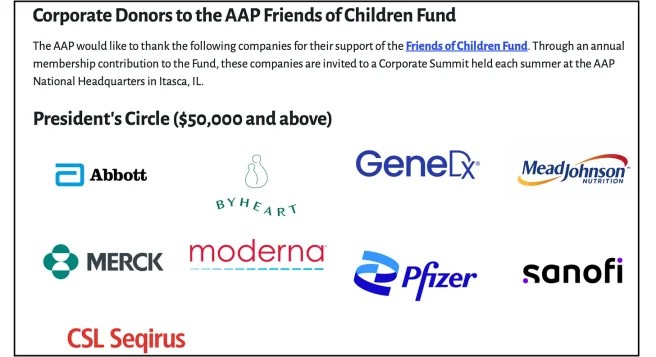
The AAP insists its funding has no bearing on policy. But the Academy advertises its dependence on the very companies whose products it recommends for children.
On its own website, the Academy thanks its top corporate sponsors: Moderna, Merck, Sanofi and GSK. These companies produce nearly every vaccine on the childhood schedule — and now the AAP is demanding more of their products be given to babies.
Financial filings show corporate contributions make up a substantial slice of the Academy’s revenue. Even its flagship journal, Pediatrics, carries the fingerprints of industry support.
This isn’t independence, it’s entanglement. When an organisation funded by vaccine makers issues recommendations that boost those same companies’ sales, it is impossible to pretend this is solely about children’s health.
Parents have already rejected the shots
The problem for the AAP is that parents have already walked away. CDC data show that among toddlers, the rate is a mere 4.5%.
The public’s verdict could not be clearer: most families do not want these vaccines for their children.
The AAP knows this — yet it presses ahead regardless. Its recommendations are now performative, directed less at parents than at its corporate benefactors.
Kennedy strikes back
Kennedy seized on the contradiction.
Posting a screenshot of the AAP’s donor list, he wrote: “These four companies make virtually every vaccine on the CDC’s recommended childhood vaccine schedule,” after the Academy released its own list of “corporate-friendly vaccine recommendations.”

Kennedy accused the Academy of running a “pay-to-play scheme” on behalf of “Big Pharma benefactors” and demanded full disclosure of conflicts in its leadership and journal.
He warned that recommendations diverging from the CDC’s official list are not protected under the 1986 Vaccine Injury Act. For now, Covid-19 products remain under a separate regime — the PREP Act and the Countermeasures Injury Compensation Program (CICP), which HHS has extended through to 2029.
Kennedy cast this as a red line for the future: if the AAP keeps inventing its own vaccine schedule, it risks dragging doctors and hospitals into legal jeopardy.
This is no longer about one product but about who dictates the rules of childhood vaccination — government regulators or an industry-backed lobby group.
The deeper problem
This dispute isn’t really about Covid vaccines because parents, even healthcare workers, have already rejected them in overwhelming numbers. It is about who controls the institutions that speak in the name of children’s health.
The AAP claimed it boycotted ACIP in June to resist politicisation. In reality, it walked away from a process no longer stacked with the industry-aligned figures it had long relied on. That was the real affront.
The deeper problem is that the AAP is not a neutral guardian of child health. It is a lobbying arm entangled with corporate sponsors, issuing pronouncements that align with donor interests while ignoring the families it claims to represent.
AAP says it represents 67,000 paediatricians, and by extension America’s children. But its actions tell a different story. It represents the companies that fund it.
Children’s health is jeopardised when those entrusted with protecting it are compromised. The AAP’s latest recommendations are not science-based safeguards. They are corporate advocacy in disguise.
It is not just disappointing — it is harmful.
AAP’s full vaccine schedule [LINK]
Europe lacks strategy to break snapback ‘deadlock’: Russia envoy
Press TV – August 23, 2025
A senior Russian diplomat says the European troika—Britain, France, and Germany—lack a clear strategy to break the “deadlock” they are poised to create if they follow through on their threat to invoke the “snapback” mechanism against Iran.
Russia’s permanent envoy to international organizations in Vienna, Mikhail Ulyanov, made the remarks in a post on his X account on Saturday.
He proposed to put aside legal and procedural issues which definitely do not give the E3 the right to trigger the snapback mechanism and to address the issue from a purely political viewpoint.
The Russian diplomat asked whether the trio has an exit strategy and a vision of how to find a way out of the deadlock they are going to create.
“The answers to these questions seem to be negative,” Ulyanov emphasized.
Snapback would bring into force six previous Iran-related Security Council resolutions adopted between 2006 and 2010. It would reinstate the expired UN arms embargo that barred countries from supplying, selling, or transferring most military equipment to Iran and prohibited Tehran from exporting any weapons.
It would also impose export controls, travel bans, asset freezes, and other restrictions on individuals, entities, and banks.
In a Friday phone conversation with the EU high representative for foreign and security policy and his British, French, and German counterparts, whose countries are the European signatories to the 2015 nuclear agreement, Iranian Foreign Minister Abbas Araghchi warned that triggering the snapback would have consequences.
The top Iranian negotiator once again emphasized that the European countries lack the legal and moral authority to resort to the mechanism.
China’s mission to the United Nations on Wednesday declared the country’s firm opposition to threats by European parties to the 2015 nuclear deal to activate the snapback mechanism within the framework of UN Security Council Resolution 2231.
The mission at the UN headquarters in New York distributed an explanatory note to the Security Council, stating that the difficult situation in implementing the JCPOA and Resolution 2231 is not the result of Iran’s actions but the disruption of the JCPOA’s implementation by the United States and the three European countries.
China and Russia’s backing plays a critical role in Iran’s diplomatic efforts to counter the snapback threat. Both countries are permanent members of the UN Security Council and have veto power over resolutions, including those related to Iran’s nuclear program.
Dutch foreign minister steps down after failed push for sanctions against Israel
Press TV – August 23, 2025
Dutch Foreign Minister Caspar Veldkamp resigned on Friday, after he failed to secure cabinet support for new sanctions against the Israeli regime over its ongoing genocide in Gaza.
Veldkamp, a member of the centre-right New Social Contract party, had informed the country’s Parliament he intended to bring in new measures in response to Israel’s plans to escalate attacks on Gaza City and other heavily populated areas in the besieged territory.
But he said on Friday that he could not achieve agreement on “meaningful measures” and had repeatedly faced resistance from colleagues over sanctions already in place.
Among his proposals was a ban on imports from Israeli settlements in the occupied Palestinian territories.
Veldkamp also revoked three export permits for navy ship components, warning of “deteriorating conditions” in Gaza and the “risk of undesirable end use.”
“I also see what is happening on the ground in Gaza, the attack on Gaza City, and what is happening in the West Bank, the building decision for the disputed settlement E1, and East Jerusalem,” Veldkamp told reporters.
His efforts also included imposing entry bans on hawkish Israeli ministers, Bezalel Smotrich and Itamar Ben-Gvir, citing their role in inciting settler violence against Palestinians.
His departure leaves the Netherlands without a foreign minister.
Following his resignation, all New Social Contract ministers and state secretaries confirmed their support for Veldkamp and resigned from the caretaker government in solidarity, prompting a political upheaval.
“In short, we are done with it,” party leader Eddy Van Hijum declared, calling Israel’s actions “diametrically opposed to international treaties.”
The Netherlands’ Parliament had repeatedly delayed a debate on sanctions against Israel, a discussion that was already postponed from Thursday, as the Friday afternoon Cabinet meeting dragged on.
“There is a famine, ethnic cleansing, and genocide going on,” said Kati Piri of the merged Green Left/Labor parties. “And our cabinet has been deliberating for hours about whether to take any action at all, shameful.”
Opposition lawmakers had already expressed frustration at the inaction against Israel, with some calling for a no-confidence vote for the minister.
The political crisis comes against the backdrop of an already unstable government. The ruling coalition had collapsed in June when anti-Islam lawmaker Geert Wilders withdrew his support over an immigration dispute.
Since then, the three remaining parties have continued in a caretaker capacity until elections scheduled for October.
Humanitarian conditions in Gaza have sharply deteriorated. The Integrated Food Security Phase Classification (IPC) reported on Friday that “the Famine Review Committee (FRC) has determined that Famine (IPC Phase 5) is currently occurring in Gaza Governorate.”
The FRC further projected that famine thresholds “will be crossed in Deir al-Balah and Khan Younis Governorates in the coming weeks.”
Since October 7, 2023, when the Israeli regime began its genocidal assault on Gaza, at least 271 people have died from hunger-related causes, including 112 children, the Gaza health ministry reports.
NATO Sharpens Its War Wallet: Doubles Down On Ukraine Aid
Sputnik – 23.08.2025
Russia states that supplying arms to Ukraine hinders peace efforts and drags NATO allies into the conflict. Russian Foreign Minister Sergey Lavrov said that any shipments containing weapons for Ukraine will become a legitimate target for Russia.
NATO countries have provided 99% of military aid to Ukraine, which reached $50 billion in 2024, the alliance’s Military Committee Chair Giuseppe Cavo Dragone told Corriere della Sera.
As of January 1, 2025, the alliance had already funneled $33 billion and plans to boost funding for the Ukraine regime even more, he said.
He mentioned three packages of around $580 million each. The first was funded by the Netherlands, the second by Denmark, Finland, and Sweden. The third was paid by Germany.
While Russia and the US at their recent summit thrashed out a roadmap to achieve an end to the Ukraine conflict, the NATO hawk said they intend to continue military aid and even increase it.
On August 15, Putin and US President Donald Trump met in Anchorage, Alaska, for three-on-three talks that lasted 2 hours and 45 minutes. In addition to the presidents, Russia was represented by Foreign Minister Sergey Lavrov and presidential aide Yuri Ushakov, and the US by Secretary of State Marco Rubio and Special Envoy Steve Witkoff. On August 18, Trump hosted Volodymyr Zelensky and EU leaders for talks at the White House.
Russia rejects accusations of ‘fracturing’ Ukraine talks with US
RT | August 23, 2025
The Russian Foreign Ministry has pushed back against Western media reports claiming Moscow undermined Ukraine peace talks with the US by insisting it must take part in discussions about security guarantees for Kiev.
On Friday, Bloomberg reported, citing sources, that remarks by Russian Foreign Minister Sergey Lavrov about the principles of “indivisible security” in Europe have “effectively fractured Russia’s talks with the US,” while describing Moscow’s stance as “an attempt to stall the [settlement] process.” The Wall Street Journal similarly accused Lavrov of “toss[ing] all sorts of obstacles” in the way of possible high-level talks between Moscow and Kiev.
The ministry responded that Russia has followed a consistent policy on the conditions needed both to resolve the Ukraine conflict and to build a stable European security framework.
The ministry recalled that following the Alaska summit with US President Donald Trump, Russian President Vladimir Putin noted that a sustainable peace in Ukraine could be achieved only if “all root causes of the crisis are eliminated, all of Russia’s legitimate concerns taken into account, and a just balance in security in Europe and worldwide restored.”
He added at the time that Moscow “was ready to work on ensuring security for Ukraine.”
Later, Lavrov, responding to a question about the possible deployment of Western troops to Ukraine – which has been a red line for Moscow – noted that Russia “will firmly and strictly ensure our legitimate interests.” “Any serious discussion of security issues without Russia is a utopia.. [and] a road to nowhere,” he added.
“So how can anyone consider Lavrov’s words as ‘undermining’ the settlement process? On the contrary, Russia’s position is marked by consistency, and the minister’s statements confirm the points repeatedly voiced by President Putin on the Ukraine crisis,” the ministry noted.
Russia has repeatedly said that the Ukraine conflict can only be settled if Kiev commits to neutrality, demilitarization, denazification, and recognizes the new territorial reality on the ground.
The CIA, Mossad, and Epstein: Unraveling the Intelligence Ties of the Maxwell Family
By Alan Macleod | MintPress News | August 22, 2025
With speculation mounting that Trump could pardon her, MintPress profiles the family of convicted sex trafficker Ghislaine Maxwell. From her media baron father, who acted as a high-level spy for Israel, her sister, working to push Tel Aviv’s interests in Silicon Valley, her brothers, who founded a dubious but highly influential anti-Islamic extremism think tank, and nephews in influential roles at the State Department and White House, the Maxwell clan have wide-ranging ties to U.S. and Israeli state power. This is their story.
Releasing Ghislaine, Burying the Epstein Files
Speculation is growing that Ghislaine Maxwell could soon be freed. Despite campaigning on the promise to release the Epstein Files, there are increasing signs that the Trump administration is considering pardoning the world’s most notorious convicted sex trafficker.
Last month, Trump (who contemplated the idea in his first term in office) repeatedly refused to rule out a pardon, stating to journalists that “I’m allowed to do it.” Just days later, Maxwell was transferred across states to a minimum-security facility in Bryan, Texas—a highly unusual practice. Neither women convicted of sex crimes nor those with more than 10 years remaining on their sentences are generally permitted to be transferred to such facilities. The move sparked equal measures of speculation and outrage.
The decision to relocate Maxwell came after somebody—potentially a source within her team itself—began leaking incriminating and embarrassing evidence linking Trump to Epstein. This included a birthday card Trump sent Epstein, featuring a hand-drawn nude woman, accompanied by the text: “Happy Birthday—and may every day be another wonderful secret.”
For years, Maxwell aided her partner Jeffrey Epstein in trafficking and raping girls and young women, creating a giant sex crime ring in the process. Epstein’s associates included billionaires, scientists, celebrities, and politicians, including President Trump, whom he considered his “closest friend.”
In 2021, two years after Epstein’s mysterious death in a Manhattan prison, Maxwell was found guilty of child sex trafficking offenses and was subsequently sentenced to 20 years in prison.
The news that Trump may soon free such an infamous criminal sent shockwaves through his base and drew charges of blatant corruption from the media. “Is there any reason to pardon Ghislaine Maxwell except to buy her silence?” ran the headline of one article in The Hill. Meanwhile, Tim Hogan, senior Democratic National Committee adviser, denounced what he claimed was a “government cover-up in real time.” “Donald Trump’s FBI, run by loyalist Kash Patel, redacted Trump’s name from the Epstein files—which have still not been released,” he said.
Robert Maxwell: Media Tycoon and Israeli Operative
While many of Ghislaine Maxwell’s crimes have come to light, less well-known are her family’s myriad connections to both the U.S. and Israeli national security states. Chief among these are those of her father, disgraced media baron and early tech entrepreneur, Robert Maxwell.
A Jewish refugee fleeing Hitler’s occupation of his native Czechoslovakia, Maxwell fought for Britain against Germany. After World War II, he used his Czech connections to help funnel arms to the nascent State of Israel, weapons that helped them win the 1948 war and carry out the Nakba, the ethnic cleansing of nearly 800,000 Palestinians.
Maxwell’s biographers, Gordon Thomas and Martin Dillon, write that he was first recruited by Israeli intelligence in the 1960s and began buying up Israeli tech corporations. Israel used these companies and their software to carry out spying and other clandestine operations around the globe.
Maxwell amassed a vast business empire of 350 companies, employing 16,000 people. He owned an array of newspapers, including The New York Daily News, Britain’s Daily Mirror, and Maariv of Israel, in addition to some of the world’s most influential book and scientific publishing houses.
With business power came political power. He was elected to the U.K. parliament in 1964 and counted U.S. Secretary of State Henry Kissinger and Soviet Premier Mikhail Gorbachev among his closest friends.
He used this influence to advance Israeli interests, selling Israeli intelligence-gathering software to Russia, the U.S., the U.K., and many other countries. This software included a secret Israeli backdoor that allowed the Israeli intelligence agency, Mossad, to tap into classified information gathered by governments and intelligence agencies around the world.
At the same time, it was expanding its espionage capabilities, Israel was developing a secret nuclear weapons program. This project was exposed by Israeli peace activist Mordechai Vanunu, who, in 1986, leaked evidence to the British press. Maxwell—one of Britain’s most powerful press barons—spied on Vanunu, passing photographs and other information to the Israeli Embassy—intelligence that led to Vanunu’s international abduction by Mossad, and his subsequent imprisonment.
His death was also surrounded by controversy, similar to Epstein’s. In 1991, his lifeless body was found in the ocean, in what authorities ruled a bizarre accident whereby the tycoon had fallen from his luxury yacht. To this day, his children are split on whether they think he was murdered.
The rumors that Maxwell had, for decades, been acting as an Israeli “superspy” were all but confirmed by the lavish state funeral he received in Jerusalem. His body was interred at the Mount of Olives, one of the holiest sites in Judaism, the spot from which Jesus is said to have ascended to heaven.
Virtually the entirety of elite Israeli society–both government and opposition–attended the event, including no fewer than six living heads of Israeli intelligence organizations. President Chaim Herzog himself performed the eulogy. Also speaking at the event was Prime Minister Yitzhak Shamir, who stated that “Robert Maxwell has done more for Israel than can today be said.”
In the United Kingdom, however, he is remembered less fondly. A man with a fearsome reputation, Maxwell ruled his media business with an iron fist, in a similar vein to Rupert Murdoch (another individual with extremely close links to Israel). After his death, it transpired that he had stolen more than $500 million from his employees’ pension fund to bail out other failing companies in his empire, leaving many of his workforce’s retirement plans in tatters. As the newspaper, The Scotsman, remarked ten years later in 2001:
If [Maxwell] was despised in life, he was hated in death when it emerged he had stolen 440 million [pounds] from the pension fund of Mirror Group Newspapers. He was, officially, the biggest thief in British criminal history.”
Isabel Maxwell: Israel’s Woman in Silicon Valley
Even before it had been published, Isabel Maxwell– Robert’s daughter and Ghislaine’s older sister– managed to obtain a copy of Thomas and Dillon’s biography. She immediately flew to Israel, The Times of London reported, where she showed it to a “family friend” and deputy director of Mossad, David Kimche. These actions did little to beat the book’s central allegation that her father was indeed a high-level Israeli “superspy.”
Isabel has enjoyed a long and successful career in the tech industry. In 1992, along with her twin sister, Christine, she founded a company that developed one of the internet’s first search engines.
After the pension scandal, however, she and her siblings shifted their focus to rebuilding every facet of their father’s collapsed business empire. The sisters sold the search engine, netting enormous profits.
As Israeli outlet Haaretz noted, in 2001, Isabel decided to dedicate her life to advancing the Jewish State’s interests, vowing to “work only on things involving Israel” as she “believes in Israel.” Described by former MintPress journalist and investigative reporter Whitney Webb as “Israel’s back door into Silicon Valley,” she has transformed herself into a key ambassador for the country in the tech world.
“Maxwell created a unique niche for herself in [tech] as a liaison between Israeli companies in the initial development stages and private angel investors in the U.S. At the same time, she helps U.S. companies interested in opening development centers in Israel,” wrote local business newspaper, Globes. “She lives intensively, including innumerable flights back and forth between Tel Aviv and San Francisco,” it added.
Israel is known to be the source of much of the world’s most controversial spyware and hacking tools, used by repressive governments the world over to surveil, harass, and even kill political opponents. This includes the notorious Pegasus software, used by the government of Saudi Arabia to track Washington Post journalist, Jamal Khashoggi, before assassinating him in Türkiye.
Isabel built on her father’s political connections. “My father was most influential in my life. He was a very accomplished man and achieved many of his goals during his life. I learned very much from him and have made many of his ways my own,” she said. This included developing intimate ties to a myriad of Israeli leaders, including Ehud Olmert and Ehud Barak, one of Jeffrey Epstein’s closest associates.
During the 2000s, she was a regular participant at the Herzliya Conference, an annual, closed-door gathering of the West’s most senior political, security and intelligence officials, in addition to being a “technology pioneer” at the World Economic Forum.
She was also placed on the board of the Israeli government-funded Shimon Peres Center for Peace and Innovation and the American Friends of the Yitzhak Rabin Center for Israel Studies, two organizations closely associated with those former Israeli prime ministers.
In 2001, she became the CEO of iCognito, taking the job, in her words, “because it [the company] is in Israel, and because of its technology.” The technology in question was aimed at keeping children safe online—highly ironic, given that her sister was actively trafficking and abusing minors throughout that period.
Isabel was a much more serious and accomplished individual than Ghislaine. As Haaretz noted:
While her younger sister, Ghislaine, makes the gossip columns after breakfasting with Bill Clinton or because of her ties with another close friend, Britain’s Prince Andrew, Isabel wants to show photos taken of herself with the grand mufti of Egypt, or with Bedouin in a tent, or of visits to a Gaza refugee camp.”
In 1997, Isabel was appointed president of the Israeli tech security firm, Commtouch. Thanks to her connections, Commtouch was able to secure investment from many of the most prominent players in Silicon Valley, including Bill Gates, a close associate of both the Maxwell family and Jeffrey Epstein himself.
Christine Maxwell: Funded by Israel?
Isabel’s twin sister, Christine, is no less accomplished. A veteran of the publishing and tech industries, she co-founded data analytics firm Chiliad. As CEO, she helped oversee the production of a massive “counterterrorism” database that the company sold to the FBI during the height of the War on Terror. The software helped the Bush administration crack down on Muslim Americans and tear down domestic civil liberties in the wake of 9/11 and the PATRIOT Act. Today, she is the leader and co-founder of another big data corporation, Techtonic Insight.
Like her sister and father, Christine has a close relationship with the State of Israel. She is currently a fellow at the Institute for the Study of Global Antisemitism and Policy (ISGAP), where, her biography states,
She works to promote innovative academic research that leverages enabling technologies to empower proactive understanding and combatting the great dangers of contemporary antisemitism, and enhancing the ongoing relevance of the Holocaust for the 21st century and beyond.”
ISGAP’s board is a who’s who of Israeli national security state officials. This includes Natan Sharansky, former Minister of Internal Affairs and Deputy Prime Minister of Israel, and Brigadier General Sima Vaknin-Gil, the former Chief Censor for the IDF and Director General of the Ministry of Strategic Affairs and Diplomacy. Also on the board is Jeffrey Epstein’s lawyer, Alan Dershowitz.
The think tank was a key player in the U.S. government’s decision to repress the 2024 Gaza protests on university campuses nationwide. The group produced reports linking student leaders with foreign terrorist organizations and promoted dubious claims about a wave of anti-Semitism washing over American colleges. It met frequently with both Democratic and Republican leaders, and urged them to “investigate” (i.e., repress) the leaders of the demonstrations.
ISGAP has continually warned of foreign influence on American campuses, producing reports and holding seminars detailing Qatar’s supposed stranglehold over the U.S. higher education system, and linking that with growing anti-Israel sentiment among America’s youth.
Yet if ISGAP wished to investigate other foreign government influence operations, it would not have to look far, as its own funds overwhelmingly come from a single source: the Israeli state. In 2018, an investigation found that Israel’s Ministry of Strategic Affairs (then headed by Brigadier General Vaknin-Gil herself) channeled $445,000 to ISGAP, a sum representing nearly 80% of its entire revenues for that year. ISGAP failed to disclose that information to either the public or the federal government.
At the height of the concern over foreign interference in American politics, the news barely registered. Since then, the Israeli government has continued to bankroll the group to the tune of millions. In 2019, for example, it approved a grant of over $1.3 million to ISGAP. Thus, in her role as a fellow at the organization, Christine Maxwell is the direct beneficiary of Israeli government cash.
Third Generation Maxwells: Working In the US Government
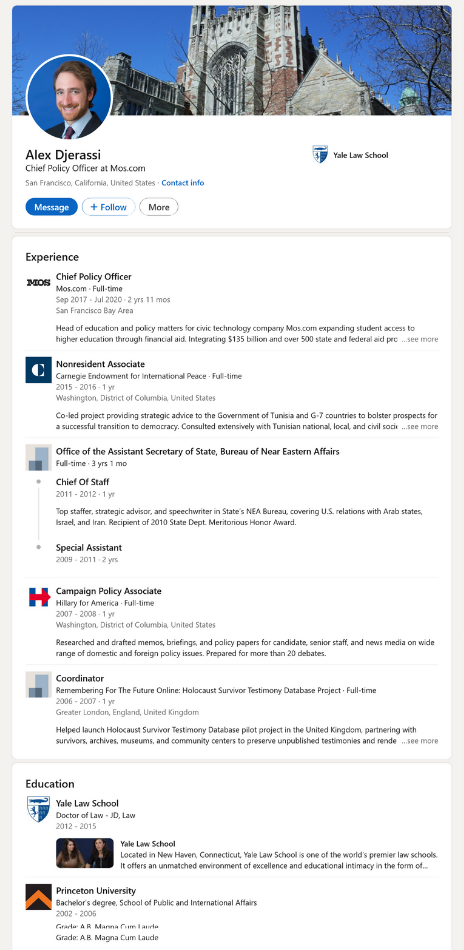
While Robert Maxwell’s daughters were close to state power, some of the family’s third generation have taken up positions within the U.S. government itself. Shortly after graduating from college, Alex Djerassi (Isabel Maxwell’s only son) was employed by Hillary Clinton on her 2007-2008 presidential campaign. Djerassi drafted memos, briefings, and policy papers for the Clinton team and helped prepare her for more than 20 debates.
The Clinton and Maxwell families are closely intertwined. Ghislaine vacationed with Hillary’s daughter, Chelsea, and appeared prominently at her wedding. Both she and Jeffrey Epstein were invited multiple times to the Clinton White House. Long after Epstein was jailed, President Bill Clinton invited Ghislaine to an intimate dinner with him at an exclusive Los Angeles restaurant.
Although she failed in her bid for the White House, President Obama named Hillary Clinton as his Secretary of State, and one of her first actions was to appoint Djerassi to her team. He quickly rose in the ranks, becoming Chief of Staff at the Office of the Assistant Secretary of State, Bureau of Near Eastern Affairs. In this role, he specialized in developing the United States’ policy towards Israel and Iran, although he also worked on the U.S. occupation of Iraq, and accompanied Clinton on visits to Israel and the Arab world.
While at the State Department, he served as the U.S. government representative to the Friends of Libya and the Friends of the Syrian People Conferences. These were two organizations of hardline, hawkish groups working towards the overthrow of those two governments, and their replacement with U.S.-friendly regimes. Washington got what it wanted. In 2011, Libyan leader Colonel Gaddafi was overthrown, killed and replaced by Islamist warlords. And last December, longtime Syrian President, Bashar al-Assad, fled to Russia and was replaced by the founder of al-Qaeda in Syria, Abu Mohammad al-Jolani.
Djerassi was later appointed an associate at the U.S.-government-funded think tank, the Carnegie Endowment for Peace. While there, he again specialized in Middle East policy, his bio noting that he “worked on matters relating to democratization and civil society in the Arab world, the Arab uprisings, and Israeli-Palestinian peace.” Today, he works in Silicon Valley.
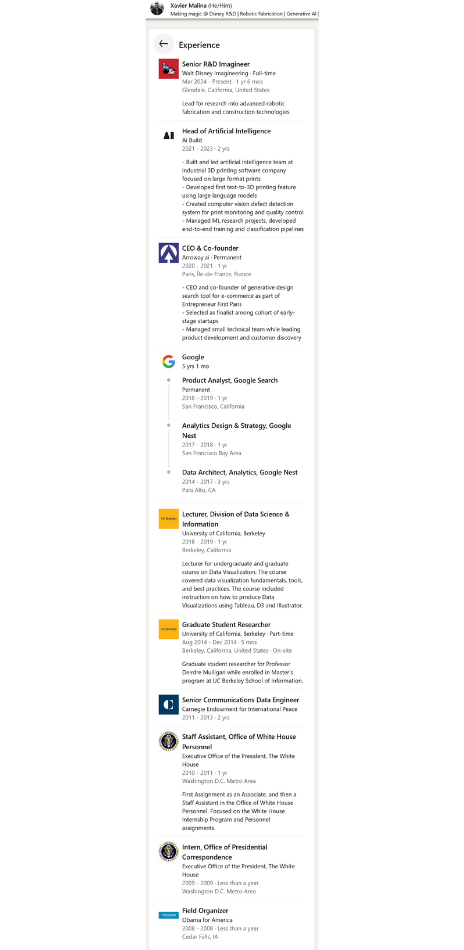
While Djerassi’s fortunes were tied to the Clinton faction of the Democratic Party, his cousin Xavier Malina (Christine Maxwell’s eldest son) backed the right horse, working on the Obama-Biden 2008 presidential run.
He was rewarded for his good work with a position in the White House itself, where he became a Staff Assistant at the Executive Office of the President. Like his cousin, once his time in office was over, Malina also secured a position at the Carnegie Endowment for Peace before pursuing a career in the tech world, working for many years at Google in the Bay Area. He currently works for Disney.
While the actions of parents and grandparents should not determine the careers of later generations, the fact that two individuals who come from a multi-generational family of unrepentant spies and operatives of a foreign power secured positions at the center of the U.S. State is at least worthy of note.
The Maxwell Brothers: From Bankruptcy to Counterterrorism
Much of the Maxwell clan is most influential in American and Israeli politics. However, brothers Ian and Kevin also hold considerable sway over affairs in their native Great Britain. Although being acquitted of charges over widespread allegations that they helped their father, Robert, plunder over $160 million from his employees’ pension fund, the brothers kept a low profile for many years. Kevin, in particular, was known for little more than being Britain’s largest-ever bankrupt, with debts exceeding half a billion dollars.
However, in 2018, they launched Combating Jihadist Terrorism and Extremism (CoJiT), a controversial think tank pushing for a far more invasive and heavy-handed government approach to the question of radical Islam.
In his organization’s book, “Jihadist Terror: New Threats, New Responses,” Ian writes that CoJiT was set up to play a “catalyzing role in the national conversation,” and to answer “difficult questions” arising from the issue. Judging by the content of the rest of the book, this means pushing for even more extensive surveillance of Muslim communities.
Within Britain, CoJiT was a highly influential organization. Its editorial board and contributors are a who’s who of high state officials. Individuals participating in its inaugural conference in London in 2018 included Sara Khan, the government’s Lead Commissioner for Countering Extremism, and Jonathan Evans, the former Director General of MI5, Britain’s domestic intelligence agency.
Like so many Maxwell projects, CoJiT appears to have wrapped up its affairs. The organization has not updated its website or posted anything on its social media channels since 2022.
In fairness, in the past few years, the brothers have had other priorities, leading the campaign to free their sister Ghislaine from prison, insisting that she is entirely innocent. In a manner reminiscent of Robert Maxwell, however, it appears that Kevin may have failed to pay the defense team; in 2022, Maxwell’s lawyers sued him, seeking unpaid fees of nearly $900,000.
The Infamous Mr. Epstein
For years, Ghislaine Maxwell and Jeffrey Epstein ran a sex trafficking ring that exploited hundreds of girls and young women. They were also connected to vast networks of the global elite, including billionaire business owners, royalty, star academics, and foreign leaders, among their closest acquaintances, leading to intense speculation about the extent of their involvement in their many crimes.
It is still unclear when Epstein first met with the Maxwells, with some alleging that he was recruited into Israeli intelligence by Robert Maxwell. Others state the relationship only began after Robert’s death, when he saved the family from penury following its financial problems.
Only one month after his 2019 arrest, Epstein was found dead in his New York City prison cell. His death was officially ruled a suicide, although his family has rejected this interpretation.
Perhaps the two most powerful individuals in Epstein’s circle of confidants were Presidents Bill Clinton and Donald Trump. Clinton, already infamous for the numerous accusations of sexual misconduct against him, is known to have flown at least 17 times on Epstein’s private jet, nicknamed the “Lolita Express,” and was accused by Epstein victim, Virginia Giuffre, of visiting Little St. James Island, the multimillionaire’s private Caribbean residence, where many of his worst crimes took place.
Trump, arguably, was even closer to the disgraced financier. “I’ve known Jeff for fifteen years. Terrific guy,” he said in 2002, “He’s a lot of fun to be with. It is even said that he likes beautiful women as much as I do, and many of them are on the younger side. No doubt about it.” Like Clinton, Trump flew on the Lolita Express. Epstein attended his wedding to Marla Maples in 1993, and claimed to have introduced him to his third wife, Melania.
Unfortunately, while Epstein’s ties incriminate the entire political spectrum, coverage has often been framed as a partisan issue. A MintPress study of over one year of Epstein coverage on MSNBC and Fox News found that each network downplayed his connections to their preferred president, while emphasizing and highlighting the links to the leader of the other major party. As a result, many in the United States see the affair as an indictment of their political rivals, rather than of the political system as a whole.
There also remains the question of Epstein’s links to intelligence, something that has been openly speculated about in the media for decades, even years before any allegations against him were made public. Throughout the 1990s, Epstein’s biographer Julie K. Brown noted, he openly boasted about working for both the CIA and Mossad, although the veracity of his claims remains in doubt. As Britain’s Sunday Times wrote in 2000, “He’s Mr. Enigmatic. Nobody knows whether he’s a concert pianist, property developer, a CIA agent, a math teacher or a member of Mossad.” It is possible that there is at least a grain of truth to all of these identities.
Epstein met with U.S. Deputy Secretary of State William Burns three times in 2014. Burns would later be named director of the CIA. Burns’ proximity to Epstein, however, pales in comparison to that of former Israeli Prime Minister, Foreign Minister, and Defense Minister Ehud Barak. Between 2013 and 2017 alone, Barak is known to have traveled to New York City and met with the convicted criminal at least 30 times, sometimes arriving at his Manhattan mansion incognito or wearing a mask to hide his identity.
Numerous sources have commented on Epstein’s connections to Israeli intelligence. A previous girlfriend and victim of his, referred in court documents as Jane Doe 200 to hide her identity, testified that Epstein boasted about being a Mossad operative and that, after he raped her, she could not go to the police because his position as a spy made her fear for her life.
“Doe genuinely believed that any reporting of the rape by what she believed to be a Mossad agent with some of the most unique connections in the world would result in significant bodily harm or death to her,” reads the court filing.
Ari Ben-Menashe, a former senior official in Israel’s Military Intelligence Directorate, claimed that Epstein was a spy and that he and Ghislaine Maxwell were running a honeytrap operation on behalf of Israel. Four (anonymous) sources told Rolling Stone that Epstein had directly worked with the Israeli government.
Unlike much of the Maxwell family, however, his Israel and intelligence connections are based largely on testimony and unverified accounts. His only known trip to the country was in April 2008, just before his sentencing, a move that sparked fears he would seek refuge there.
Nevertheless, there has been intense public speculation that he could have been working for Tel Aviv. At the Turning Points USA Student Action Summit 2025, former Fox News host Tucker Carlson stated that there is nothing wrong, hateful or anti-Semitic about asking questions about Epstein’s foreign connections. “No one’s allowed to say that the foreign government is Israel, because we’ve been somehow cowed into thinking that that’s naughty,” he said, before expressing his exasperation about the media’s silence on the issue.
What the hell is this? You have the former Israeli prime minister living in your house, you have had all this contact with a foreign government, were you working on behalf of the Mossad? Were you running a blackmail operation on behalf of a foreign government?”
Carlson’s comments drew harsh condemnation from former Israeli Prime Minister Naftali Bennett. “The accusation that Jeffrey Epstein somehow worked for Israel or the Mossad running a blackmail ring is categorically and totally false. Epstein’s conduct, both the criminal and the merely despicable, had nothing whatsoever to do with the Mossad or the State of Israel,” he wrote.
“This accusation is a lie being peddled by prominent online personalities such as Tucker Carlson pretending they know things they don’t,” he added, concluding that Israel was under attack from a “vicious wave of slander and lies.”
Whatever the truth about Epstein, it is indisputable that the powerful Maxwell family holds wide-ranging connections to U.S., British and Israeli state power. It is also beyond doubt that if the full story of their activities were ever to reach the public, it would incriminate a significant number of the world’s most powerful people and organizations. Perhaps that is why Trump has, in short order, gone from promising to release the Epstein Files to potentially releasing his accomplice.
Beware Universal Mental Health Screening
By Cooper Davis, Jeffrey Lacasse | Brownstone Institute | August 21, 2025
How would your child score on a common mental health screening?
A mental health professional might view the results and conclude that your child has a mental health problem… that needs to be psychiatrically diagnosed and treated, even medicated.
Will this help your child thrive? Or will it reshape their identity in undesirable ways? Will you be comfortable with your child taking medications that alter their developing brains and could perturb their sexuality? When your child reaches adulthood, will they be able to withdraw from these drugs, or will they despair to find out that their body and brain have adapted to them, making this difficult or maybe even impossible?
For any parent with even minor reservations about our current medical and mental health system, these aren’t theoretical questions. A new public policy has just made them very salient.
Illinois Governor J.B. Pritzker has signed a new law mandating universal mental health screenings for every child in public school. This includes healthy children with no signs of behavioral problems. Parents can theoretically opt out, but they’ll have to do so repeatedly, as the screenings will be given at least once a year from grades 3-12.
Media coverage has been laudatory, expounding on the importance of “getting kids the help and support they deserve.” But do you know what a mental health screen is and how it works? Before sounding the applause, parents need to understand what these screenings are, how they’re used, and what the potential outcomes of their use might be.
The new law does not specify how children will be screened, what questionnaires will be used, or what procedures will be followed when a child’s answers are seen as troubling. But to get a sense of the ground that self-report mental health questionnaires cover, you can screen your kids right now with a commonly used questionnaire:
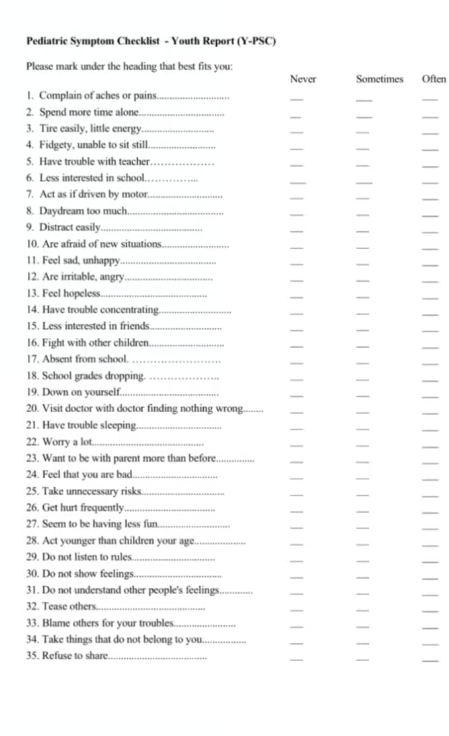
While this is a self-assessment, the questions are the same whether you’re a parent or teacher filling this out on behalf of a child. Each of the 35 questions can be answered “never,” “sometimes,” or “often.” The scoring is simple:
- 0 = “never”
- 1 = “sometimes”
- 2 = “often”
If the total score is at or above 28, professionals will consider it likely that your child has a mental health problem. The law doesn’t define what happens next. Ideally, there would be a lengthy (and costly) multi-hour clinical assessment for each such child that views these results skeptically, and heavily considers normal developmental issues and transitory problems. In the real-world mental health system, it’s hard to imagine that actually happening.
Unfortunately, the bias of the current system is towards overmedicalization, overdiagnosis, and overtreatment. The implementation of universal screening is likely to worsen these problems.
In the past, some physicians gave annual chest X-rays to smokers. This was a form of universal screening in response to concerns about lung cancer. At first blush, this sounds reasonable. The problem? False-positive results. Studies showed that annual X-rays did not prevent mortality. They did cause anxiety in patients. And incidental findings were common, causing unnecessary biopsies, procedures, and interventions.
Current screening guidelines now target high-risk individuals. This is an example where the medical establishment carefully weighed the risks and benefits of universal screening and concluded that it was not in the interests of patients, and with a well-defined disease in mind, lung cancer.
Mental health diagnosis is not like cancer. It is a fuzzy, subjective enterprise. We don’t have blood tests or brain scans; we have flawed checklists and clinical judgment. And obviously, being improperly identified as having a mental disorder comes with a real cost for the child.
Screening every single child makes it inevitable that some healthy children will be thrust into the mental health pipeline. Even assuming that the questionnaires work reasonably well, a 15% false-positive rate is likely. Combine this false-positive rate with twice-a-year universal screening from grades 3-12, and your child will have 20 separate chances to be wrongly identified as having a mental health problem…at which point the government ostensibly gets involved in the mental health of your child.
It’s easy to imagine the catastrophic results. A child’s mental health screen inaccurately identifies a mental health problem; the busy therapist confirms a diagnosis; there’s eventually a referral to a psychiatrist, who prescribes psychotropic medication. Out of 20 screenings, this only has to happen once to alter your child’s life forever.
I (C.D.) know, because it happened to me.
I was caught up in a similar diagnostic dragnet in 1991, when my teacher read about Ritalin in Time magazine and began “identifying” students she believed might have the condition, which at the time was known as “ADD” (the “H”, for hyperactivity, came later). My parents chose not to medicate me, but did send me to a psychologist and a pediatric psychiatrist. From them, I learned that my constant chair-tipping, foot-tapping, wiggling, and inability to tolerate boredom — the very traits that drove me to act out in class and leave little space between impulse and action — weren’t just part of me, but symptoms of a medical condition. It was presented as both permanently part of my nature and “acceptable,” yet somehow also extrinsic to me and framed primarily as a “deficit.” (At that time, ADD was not as widely viewed as a full disability as it is today.)
At 17, when I was legally able to decide for myself — though I now view the “informed” part as questionable — I chose to begin drug treatment. Even without the drugs, however, the diagnosis had already shaped my sense of self: diminishing my agency, reinforcing a feeling of abnormality, and feeding the belief that my more organized, conscientious, and inconspicuous peers possessed something essential that I never would. You can hear a fuller account in The Atlantic’s Scripts podcast series (“The Mandala Effect,” Episode 2, on YouTube).
My experience is just one example of how a single screening can lock a child into a lifelong diagnostic identity — and once that process starts, there are few real off-ramps. Surely no one in favor of this law wants that scenario to come true for any child.
But with 1.4 million schoolchildren in Illinois, we’re talking about dealing with the results of up to 28 million separate mental health screenings in the decade after implementation. Will the mental health professionals dealing with this deluge approach the medicalization of your child’s supposed problems carefully, gingerly, sensitively? A 2004 study found that screening 1,000 children for ADHD using the American Psychiatric Association’s DSM criteria would result in 370 false positives. And it’s common for children to be prescribed psychotropic medication at their first consultation with their physician or psychiatrist.
A comprehensive, in-depth psychological assessment for each child might help reduce false positives — but it would also mean spending 3-6 hours assessing each child, which represents a high burden in terms of both time and money. School districts in Illinois already report that a lack of time, expertise, and financial resources presents challenges to implementing universal mental health screening. The law passed anyway.
It’s hard to argue that attempts to identify and measure human misery, suffering, and emotional pain are a bad thing, etc.—especially when the goal is “getting people the help they need.” It sounds right. But the kids who will be screened every year in Illinois? They have many kinds of problems: social, relational, environmental, academic, psychological, and physical problems. Children today have issues navigating a modern life dominated by endless screens, scrolling, and even more endless data.
And also, they have some problems that you’re supposed to have—problems that have been a critical part of growing up since the dawn of time.
Our culture is currently debating the medicalization of human problems, the credibility of medicine, the influence of the pharmaceutical industry, and the ethics of imposing medical authority as state policy. Covid lockdowns were a prime example of this, and, similar to universal mental health screening, they were imposed without consideration of the unintended consequences.
Mandatory Covid vaccinations also led many Americans to rethink the role of government in their bodily autonomy, and to consider how arbitrary social policy could be when it claimed to be for the greater good (e.g., insisting that those with immunity to Covid must still get vaccinated). For those who have grown skeptical of medical authority, universal mental health screening will likely be viewed as another overextension of the government into the lives (and minds) of their children. Children aged 12-17 can already receive psychotherapy in Illinois without parental consent; universal screening offers a new on-ramp to this process.
The new Illinois law seems almost tone deaf, out of step with the lessons learned from Covid. This critique is cultural, social, and ethical in nature. But universal mental health screening is supposedly based on science. The new Illinois law does not give details; it just authorizes universal screening as if it is an unmitigated good. The devil (and the science, or lack thereof) will be in these details – how the policy is implemented. Assuming that the rationale for universal screening is scientific, we present critically important questions that should be addressed as procedures are developed:
- What is the evidence that universal mental health screening improves real-world outcomes for children? Is there evidence that it could cause harm? The scientific rationale for the program needs to be stated clearly, citing compelling data, and explicitly addressing the measures taken to avoid harm.
- Given that Illinois has already implemented universal mental health screening in some school districts, what were the outcomes for the children? After testing positive for a mental health condition, how many were further assessed, and how much time was spent on each child? How many ended up in psychotherapy or on medication? Usually, a pilot program tests the effectiveness of an intervention, and it is only adopted on a wide scale if it is shown to be effective and not harmful – where is that data?
- How many children a year does Illinois expect to inaccurately identify as having a mental health problem (e.g., how many false positives)? How many children will make it from 3rd to 12th grade without ever screening positive? What measures will address the known issue of false-positive results in universal screening? Do Illinois public schools have the time, money, and expertise to carefully assess each child who screens positive for multiple hours to ensure that they do not overdiagnose and overtreat Illinois children? If universal screening results in a surge of children who ultimately end up on psychiatric medication, how will the public know? Implementing this program without addressing these issues ignores the potential harm of universal screening.
- How will Illinois taxpayers know if this program is a success? What metrics will be tracked? The easy out is to focus on the implementation of the program, and if a high proportion of children are screened, call it a success, never mind the details or outcomes. But using the screening of children as a measure of success for a universal screening program is tautology; data must be collected that demonstrates that the program helps children measurably and does not harm them.
There are good reasons to object to the new Illinois program based on general principles. If the issues above go unaddressed, or if sufficient resources are not provided to allow careful and precise identification of children in distress, it has the potential to be a disaster.
Cooper Davis is an advocate, speaker, and writer. He is the Executive Director of Inner Compass Initiative (ICI), a 501(c)(3) nonprofit organization that advocates for mental health system reform and helps people make informed choices about psychiatric diagnoses, drugs, and drug withdrawal.
Featured Video

Yemen joins the war – Red Sea could be blocked next – Saudi regime at risk
or go to
Aletho News Archives – Video-Images
From the Archives
A superpower and “the world’s sickest warrior state”
By Paul J. Balles | March 8, 2010
Living through five or six major wars has hardened me to what I thought were the extremes of inhuman cruelty and brutality.
Two things made those extremes almost bearable: the brutality always revealed – at least according to the media coverage – the viciousness of the enemy. It was therefore quite understandable when our “brave men and women” pulverized the enemy.
Films of Japanese torturing captive Americans somehow justified holding Japanese Americans in internment camps during World War II; and only a small percentage of Americans found the bombing of Hiroshima and Nagasaki unreasonably vengeful at best, at worst, depraved.
The media giants in America portrayed the North Koreans as barbaric beasts with their captives, quite unlike their southern counterpoints – our allies during the Korean War. No one ever felt the need to explain how the South Koreans were a civilized breed while the North Koreans were absolute savages, at least according to the official line.
In Vietnam, our warriors justifiably (or so the media made us believe) dropped napalm on the North Vietnamese who had the gall to hide in villages and tunnels to ravage our invaders. At least it was accepted practice until some rogue photojournalist filmed a young girl screaming down a Vietnamese road in flames. … continue
Blog Roll
 Aletho News
- America Racing to Strategic Defeat in Iran: Lt Col Daniel Davis
- FTC Warns Visa, Mastercard, PayPal, Stripe Over Political Debanking
- Russian tanker approaches Cuba despite US oil blockade
- Marandi: Yemen joins the war – Red Sea could be blocked next – Saudi regime at risk
- Pro-Palestinian French member of European Parliament denied entry to Canada
- Pakistan to Host US-Iran Talks
- How Indonesia’s tilt toward the US left it stranded in the Strait of Hormuz
- US has no choice but to retreat from Iranian borders: Top commander
- Iran Retaliation Strikes Chemical Plant Near Dimona
- AWACS’ Destruction is a Major Loss for US Military – Ex-DoW Analyst
- If Americans Knew
- Israeli police block Catholic cardinal from entering Church of the Holy Sepulchre on Palm Sunday
- Israel is assassinating journalists again, more than any other nation, anywhere, ever – Not a ceasefire Day 170
- Over 300 US service members wounded, majority have brain injuries – Not a ceasefire Day 169
- Researchers at Human Rights Watch Resign Over Blocked Report on Palestinian Refugee Return
- Jewish Groups Are Backing a War Americans Don’t Want
- Eric Fingerhut Thinks He’s the President of the Jews
- Top Jewish Philanthropists, Rabbis Urge Israeli President to Take Action Against ‘Jewish Extremists’
- Don’t Be Fooled. Zionist Leaders Have Always Wanted to Control Southern Lebanon
- Israel’s widespread use of torture is a core element of its genocide against the Palestinian people
- In Israel’s War on Iran, Many Middle East US Bases Rendered “All But Uninhabitable”
- No Tricks Zone
- New Study Finds Warming Saves Lives…Cold Temperatures 12 Times More Deadly Than Excess Heat
- German Science Blog Accuses PIK Climate Institute Of Hallucinating Climate Tipping Points
- Devastating Assessment Of Comirnaty Vaccine By Former Senior Pfizer Europe Toxicologist
- New Study: CO2 Is ‘Effectively Negligible’ As An Explanatory Climate Change Factor Since 2000
- Former Pfizer Toxicologist Dr. Helmut Sterz Tells Bundestag Hearing Pfizer Vaccine Should Have Never Been Approved
- Energy Expert: Germany’s Nuclear Phaseout Was A “500 Billion Euro Mistake”
- New Research: South Australia’s Mid-Holocene Sea Surface Temperatures Were 4°C Warmer Than Today
- Storing Green Energy To Last Germany 10 Days Would Require A 60-Million Tonne Battery
- New Studies: UK Sea Levels Were 4 Meters Higher Than Today During The Mid-Holocene
- Destructive Green New Deal: German Energy And Metal Group Warns Of Drastic Crisis
 Aletho News