Qatar After the Airstrikes: Assessing Viable Responses to Israeli Aggression
By Abbas Hashemite – New Eastern Outlook – September 16, 2025
Since the Israeli attack on Doha, the Arab world has been looking for a collective response. However, the Arab states have limited viable options available due to their over-reliance on the US.
Israel’s Attack on Doha: A Dangerous New Precedent in the Gulf
The Israeli attack on Qatar last week astonished the whole world. Doha has long been seen as a mediator, as it played a constructive role in establishing peace between different conflicting parties, including the United States and the Taliban. It was also playing a mediatory role between Hamas and Israel. Hamas leadership was present in Doha to discuss the peace proposal presented by the Trump administration. However, the Israeli government conducted airstrikes in Doha on the building in which the Hamas leadership was present. Although the Hamas leadership survived the attack, these airstrikes raised serious concerns about the sovereignty and security of the Gulf States.
The Gulf countries have largely been reliant on the US alliance for their security. The latter supplies most of the arms and weapons to these countries. However, the US air defense system did not intercept any Israeli missiles during the recent strikes in Doha, implying that the US security guarantees to the Gulf States are selective and are only motivated to counter threats emanating from Iran. Moreover, this demonstrates that the US green-lighted the Netanyahu administration to conduct these criminal strikes in an affluent neighborhood in Doha.
Although the Trump administration has denied all the claims about the US support to the Israeli government in these strikes, and it has condemned this move in the United Nations, the US Secretary of State, Marco Rubio, is on a two-day visit to Israel to ensure continued US support to the Zionist state. This further demonstrates that the United States prioritizes Israel over its Arab allies, and all its airbases in the Gulf countries are actually to protect Israel against the regional threats.
Limited Military Options and Growing Frustration
Qatar’s Prime Minister Sheikh Mohammed bin Abdulrahman bin Jassim Al Thani described the Israeli attacks on Hamas leadership in Doha as “state terrorism that is being exerted by someone like Netanyahu.” He further stated, “I think that we have reached a decisive moment. There should be retaliation from the whole region in the face of those barbaric actions that only [reflect] one thing: It reflects the barbarism of this person that is leading the region, unfortunately, to a point where we cannot address any situation, and we cannot repair anything, and we cannot work within the frameworks of international laws. He just violates all those international laws.”
A strong response by Qatar and Arab states is mandatory to ensure their sovereignty and security in the future. However, given the Arab states’ overreliance on the US security guarantees and arms, they are left with very few options to retaliate against Israel. A military response to Israel is impossible for the Gulf States, as they do not possess enough military capabilities. Moreover, the US would never allow them to collectively attack Israel. Therefore, a collective military response could lead to internal security threats due to the presence of the US airbases in these countries.
Strategic Realignment: From US Dependence to Eastern Alliances
The Gulf States, however, could push Israel towards regional diplomatic isolation. The UAE, Bahrain, Morocco, and Sudan established diplomatic relations with Israel in 2020, following the Abraham Accords, which were mediated by the United States. The UAE summoned the Israeli diplomat to denounce these airstrikes in Doha. Mohammed bin Zayed Al Nahyan, the President of the UAE, visited Qatar within 24 hours of the attack to discuss the situation. The UAE and other Arab states could limit or downgrade their diplomatic relations with Israel in retaliation for these attacks.
Qatar has already lobbied for a unanimous UN statement condemning the illegal Israeli attack in Doha. It will also host an Arab-Islamic summit in Doha to coordinate a collective response to Israeli attacks. Leaders from almost all the Islamic countries, including KSA, Pakistan, Turkey, and Iran, are expected to attend this extraordinary summit. Moreover, the Gulf States could also join the International Court of Justice’s cases against Israel, further building pressure on the Zionist state to halt its genocide and occupation in Palestine.
Gulf States, especially Qatar, the UAE, the KSA, and Kuwait, hold significant economic leverage over Israel due to their energy resources. They could use their economic leverage to impose trade and economic sanctions on Israel by boycotting companies that have stakes in the Israeli economy. Qatar, Saudi Arabia, and the UAE pledged a collective investment of $3 trillion in the US economy during Trump’s last visit to the region. The intention behind this investment was to strengthen relations with the United States. However, the recent failure of the US to protect Qatar from Israeli attack could result in the Gulf nations’ quest for new global allies.
Over the past few years, the world has witnessed unprecedented economic growth in Russia and China. In 2023, China brokered a peace deal between Iran and Saudi Arabia to normalize their bilateral diplomatic relations. Russia, on its part, has emerged as a strong military and diplomatic power on the global stage. The two new superpowers of the world are already aligned with the Palestine policy of the Muslim world. Moreover, they possess unmatchable military power. The recent US failure to protect Qatar from Israeli attacks has provided the Arab states with a new direction to expand their diplomatic and strategic ties. They could engage with Russia and China to strengthen their defense sector and expand their diplomatic clout. This would not only prove detrimental for Israel but would also hurt the US regional and global interests.
Аbbas Hashemite – is a political observer and research analyst for regional and global geopolitical issues. He is currently working as an independent researcher and journalist
No comments yet.
Featured Video
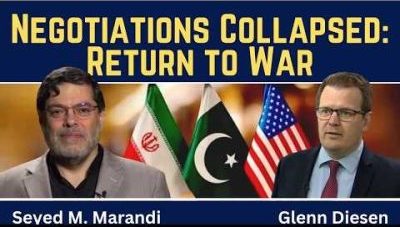
Seyed M. Marandi: Negotiations Collapsed – Return to War
or go to
Aletho News Archives – Video-Images
From the Archives
The US-Iran Scenario That Most Scares Israel
By Ali Haydar | Al-Akhbar | October 9, 2013
Israeli Prime Minister Benjamin Netanyahu issued a series of threats toward Iran and its interlocutors in the West, including the US, as serious negotiations on Iran’s nuclear program seem more plausible.
As a possible rapprochement looms between the US and Iran, Netanyahu has attempted to impose impossible Israeli conditions on the negotiators, such as the full dismantling of Iran’s nuclear program, not to mention threatening military force.
Whatever the deal that could materialize between Iran and the West, Israel is going to find itself before an open-ended path. One can foresee three possible scenarios… continue
Blog Roll
 Aletho News
- UK, Spain reject Trump’s new scheme to blockade Hormuz Strait
- Russian frigate ‘resurfaces’, chases off NATO pirates days after Kiev ‘sank’ it
- Ukraine Targets Russian Merchant Fleet With NATO Intel Support – Presidential Aide
- Russia’s ‘shadow fleet’ makes mockery of UK naval power
- Ukraine plans to attack Russian ships with Norwegian support
- US’s ‘Very Foolish’ Double Blockade of Hormuz Strait Makes Absolutely No Sense: Here’s Why
- China issues rules on countermeasures against foreign states’ unlawful extraterritorial jurisdiction
- Seyed M. Marandi: Negotiations Collapsed – Return to War
- Tomorrow’s naval blockade showdown
- ‘Israel’ attacks civilians to hide its embarrassing military failures & out of pure sadism
- If Americans Knew
- Critical shortages in Gaza, Lebanon in ruins, “piracy” in Iran – Daily Update
- US-Iran ceasefire negotiations make zero progress – Daily Update
- Pro-Israel ‘Thinktanks’ and Individuals who Influence U.S. Foreign Policy
- Mearsheimer reveals how Israel dictates US policies on Iran, Gaza – video
- After killing 350+, Israel still has a “score to settle” with Lebanon before ceasefire – Daily Update
- Military aid to Israel emerges as the latest political litmus test for Democrats
- The only Palestinian children’s rights organization closes following years-long Israeli campaign against it
- ‘I Can’t Forget the Smell’: Lebanese Reel After Israel Kills Over 300 in Single Day
- DNC Shoots Down Resolutions Calling Out AIPAC and Limiting Arms to Israel
- TCN: Is Israel Blackmailing President Trump?
- No Tricks Zone
- Cave Discovery Reveals Today’s Desert Climates Were Recently Far Warmer, Wetter, Teeming With Life
- German Expert: Heat Dome Led To Record Temps In Western USA…Warmer In 1934, 1936
- New Study: No Linear Warming Or Glacier Retreat Along Northern Antarctic Peninsula Since 1980s
- An Inconvenient Tree: Uncovered In Alps… Europe Much Warmer Than Today 6000 Years Ago
- New Study Reports A 60% Slowdown In Greenland’s Ice Loss Rate In The Last Decade
- Low Intensity Tornado Wrecks Major Solar Farm, Creating A Potential Toxic Dump
- New Study Finds Warming Saves Lives…Cold Temperatures 12 Times More Deadly Than Excess Heat
- German Science Blog Accuses PIK Climate Institute Of Hallucinating Climate Tipping Points
- Devastating Assessment Of Comirnaty Vaccine By Former Senior Pfizer Europe Toxicologist
- New Study: CO2 Is ‘Effectively Negligible’ As An Explanatory Climate Change Factor Since 2000
 Aletho News
Leave a comment