Will Vaccines Prevent 1.1 million Deaths? No.
More CDC junk science
Injecting Freedom by Aaron Siri | September 18, 2025
At my recent Senate hearing, the minority witness submitted testimony claiming that “The CDC estimates that vaccines given to children born between 1994 and 2018 will prevent … 936,000 deaths over their lifetimes.” That claim has also been levied against Secretary Kennedy. Here is why it is a junk claim. (Note that portions of this response are taken directly from my new book Vaccines, Amen.)
Newsletter + Selection Bias
First, this claim is an updated version of a 2014 MMWR report. MMWR is essentially CDC’s newsletter. CDC’s own guidelines for the MMWR only permit publishing articles that align with CDC policy, which results in the worst form of selection bias. As explained by the CDC’s policies for publishing an MMWR report: “By the time a report appears in MMWR, it reflects, or is consistent with, CDC policy.” Hence, this article would only be published until it was massaged to assure that it aligned with the CDC’s policy that vaccines are safe and effective. That approach is not science — it is the perversion of science.
No Confidence Intervals
Second, like the WHO advertising report I discussed yesterday, this is an “advertising report” for CDC’s immunization program and has no confidence intervals for its estimates. This is because they are just unreliable guesswork. The true rate could be that the vaccines caused 2 million deaths between in the United States from 1994 to 2023 because the report provides no bounds for its claims. Again, absent bounds for its claims, it could be equally true that vaccines resulted in causing 2 million extra deaths instead of a net saving in lives.
Ignores All Confounders
Third, it’s even worse, because the 2023 report explains that “factors other than immunization (e.g., hygiene…) might have contributed to lower disease risks in recent decades, and reductions resulting from these contributions have not been incorporated into the model” (emphasis added). Meaning, it did not account for any other advancement or factor that may have improved health outcomes. Nothing. This alone renders this CDC promotion “study” junk science. It is also why it has no bounds for its estimates because it cannot calculate them with any confidence.
The Hard Data Shows The 1.1 Million Claim Is Nonsense
Finally, just a simple review of the data shows how preposterous the numbers are. While it claims vaccines saved 1.1 million lives between 1994 and 2023, it takes only looking at the actual real-world data to see this figure is nonsense. Let’s look at three diseases the report claims account for almost the entire 1.1. million lives purportedly saved: diphtheria, hepatitis B, and measles.
Diphtheria
Around 750,000 of the 1.1. million lives (over 68%) that CDC claims were prevented are from diphtheria. That means that it claims 25,000 lives were saved per year by this vaccine. That figure is nonsensical. Here is why.
The first vaccine for diphtheria was introduced in 1926. Between 1900 and 1926, as the population rose, the death rate from this disease had already declined 81%, from 40.3 to 7.8 deaths per 100,000 individuals. A vaccine had nothing to do with this sharp decline since no vaccine of any kind for diphtheria existed until 1926. The further decline from 1926 until at least the mid-1940s also had little or nothing to do with the vaccine because it was rarely, if ever, used outside of certain demographics in major cities, and diphtheria mortality declined at a similar rate in areas with or without its use.[1]
Below is an official government chart reflecting same. So, even as the population increased, the data clearly shows an 81% mortality decline from 1900 to 1926, a 97.3% decline from 1900 to 1940, and a 97.8% decline from 1900 to 1948; hence, no matter how you look at it, vaccination had little to do with almost all of the decline in mortality from diphtheria in the last century:[2]

Finally, in 1949, DTP was first licensed, and coverage of this vaccine began to improve. The year prior, in 1948, there was a total of 634 deaths from diphtheria. Yet, this MMRW report nonsensically claims the diphtheria vaccine is now saving 25,000 lives a year in the United States. (Also note that in 1985, the coverage for only three doses, let alone the six recommended today, was still only 63.6%.)
This claim becomes more absurd when you consider that even after six childhood doses, adults require a booster dose every ten years in adulthood, and about 40% of adults skip these boosters. Despite a large portion of adults not receiving boosters, the last case of respiratory diphtheria in the United States was nearly three decades ago. This almost certainly reflects the extensive literature which supports that any harmful effects by the diphtheria toxin are counteracted by iron, vitamin C, and vitamin B3, and deficiencies of these vitamins and minerals have mostly been eliminated in developed countries.
There are diseases that had a high mortality in the United States that disappeared without a vaccine. For many of these diseases, researchers sought to develop a vaccine but failed. For example, scarlet fever was one of the deadliest infectious diseases for children in 1900, with a death rate of 9.6 deaths per 100,000 children. Researchers furiously sought to develop a vaccine but repeatedly failed. By the 1950s, deaths from scarlet fever had significantly declined and by the late 1900s, deaths from scarlet fever were essentially non-existent.
Had a vaccine for scarlet fever been developed in the 1920s, 40s, or 60s, that vaccine would almost certainly still be on the childhood schedule today, and its use would be considered essential for controlling scarlet fever; undoubtedly, this same CDC advertising article would be estimating that its use is now saving hundreds of thousands of lives in the United States.
In fact, scarlet fever and diphtheria are similar in that each is caused by a bacterium that releases a potentially harmful toxin when the bacterium has been “infected” by a certain virus. Both diseases cause sore throats, and many doctors, without a lab test, will confuse diphtheria with scarlet fever, and vice versa. These two diseases also have something else in common: both declined at nearly the same rate beginning in 1900. The primary reason why public health officials and the medical community behave differently with regard to these two diseases is that a vaccine was developed for diphtheria, but not for scarlet fever. If a vaccine for diphtheria had not emerged, this disease would have likely gone the way of scarlet fever and other childhood diseases that effectively disappeared without a vaccine.
Even if it would not have disappeared on its own, the article’s claim that 750,000 lives have been saved from diphtheria between 1994 and 2023 is absurd given the failure to account for the actual mortality data, other factors that reduced morality from diphtheria, the lack of any bounds to its claim, the lack of population-wide immunity and disappearance of the disease anyway, and the objective big picture reality regarding this disease; it truly requires a true religious fervor that suspends all reason and thinking to conclude that this vaccine has saved 25,000 lives per year between 1994 and 2023. The reality, based on the real-world data, is likely far closer to what occurred with scarlet fever absent vaccination.
Hepatitis B
As another example, the CDC advertisement article claims Hep B vaccines saved over 90,000 lives from 1994 to 2023, amounting to over 3,000 lives purportedly saved per year. This claim again defies data and reason. By way of background, the first Hep B vaccine was introduced in 1981 and was made with human blood plasma from donors who were chronically infected with the Hep B virus; and in 1986, a new Hep B vaccine using recombinant DNA technology without human blood was licensed. With that background, the mortality from Hep B climbed after introduction of the 1981 vaccine, continued to climb after the introduction of the 1986 vaccine, and has never returned to pre-vaccination levels. In 1980, there were 294 deaths in the United States from Hep B. Today, there are around 1,700 deaths per year. Yet, somehow, CDC claims that Hep B vaccine has saved over 3,000 lives per year between 1994 and 2023. It defies reason.
Measles
As a final example, CDC’s advertising article claims measles vaccine saved 85,000 lives from 1994 to 2023, amounting to over 2,700 lives purportedly saved per year. This claim again defies data. The first measles vaccine came on the market in 1963. In the years leading up to the first measles vaccine in 1963, the CDC data reflects around 400 deaths from measles each year. There were also around 4.2 million births each year in the late 1950s and early 1960s, whereas there was around 3.8 million births each year between 1994 and 2023. Yet, somehow, despite improvements in standards of living, medical care, etc., and despite smaller cohorts of infants and children to infect, this model makes the data-defying claim that mortality went from around 400 deaths per year from measles pre-vaccine to over 2,700 deaths per year.
But it gets far worse for the CDC advertisement’s claim because the following U.S. government chart shows the decline in the measles death rate by over 98% from 1900 to 1960, three years before the first measles vaccine was introduced in the United States in 1963. Meaning, the measles vaccine had nothing to do with the over 98% reduction in the death rate from measles in the United States from 1900 to 1960.
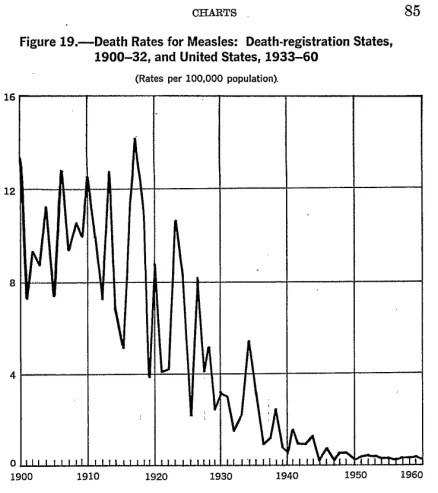
Taking a closer look, the CDC data reflects that in 1900, the rate of mortality from measles was 13.3 deaths per 100,000 individuals. By 1960, it was 0.2 deaths per 100,000 individuals. The same was true for 1961 and 1962. And as noted above, a similar decline of over 99% in measles deaths occurred between 1900 and 1967 in England and Wales, and it was only after that decline that the first measles vaccine was introduced there in 1968—five years after its introduction in the United States.
Hence, the same factors that caused measles mortality to decline by over 98% from 1900 to 1962 would, absent the vaccine interrupting the ecology of measles, likely have continued to cause a further reduction in the measles mortality rate after 1962. Meaning, at least a portion of the decline in the 400 deaths per year after the vaccine was available is no doubt attributable to the same factors that caused a steady decline in the measles death rate for decades prior to the introduction of the measles vaccine. Therefore, even without the measles vaccine, the death rate would have, no doubt, continued to decline after 1963.
In pockets of the country with poor nutrition, sanitation, and water, deaths from any pathogen, including measles, can occur at a higher rate. Those conditions still existed in some pockets of the United States in the early 1960s. As living conditions in those pockets of America improved with the introduction of clean water, improved sanitation, and better living conditions, deaths from measles declined, which is what typically occurs when these conditions improve. Let’s also not ignore that health care, especially the management and treatment of acute infections, has vastly improved since the 1960s. Doctors readily concede this point, unless you are talking about vaccines.
Yet, CDC claims that measles vaccines would have saved a data defying over 2,800 lives a year from measles in the United States between 1994 and 2023. CDC’s advertisement study, of course, also doesn’t account for the increase in deaths from heart disease and cancer due to the elimination of measles, as discussed in my previous post and reflected by studies that did not engage in estimates.
In sum, this CDC self-promotion article, that is not peer-reviewed and must conform to CDC policy to be published, does not account for any external factors, does not account for actual mortality data related to these diseases, and lacks any confidence intervals because its claims have zero reliability. Anyone citing this study claiming 1.1 million lives were saved is spreading propaganda. Not science.
[1] https://pmc.ncbi.nlm.nih.gov/articles/PMC1997101/pdf/pubhealthreporig01174-0001.pdf (“The simultaneous decline in diphtheria morbidity and mortality rates in all age groups of individual States located in different sections of the country, which began after a cyclic increase in incidence between 1915 and 1925, suggests the operation or influence of other factors besides, or in addition to, artificially induced immunity. Studies such as that included in the 1930 White House Conference on Child Health and Protection indicated that immunization programs were reaching a relatively large proportion of children in some areas or cities and a very low proportion in others as late as 1930. In spite of this wide variation, both morbidity and mortality began to decline rapidly after 1925 in all States simultaneously.”); https://www.cdc.gov/pinkbook/hcp/table-of-contents/chapter-7-diphtheria.html (“[D]iphtheria toxoid-containing vaccines became available in the 1940s” and “universal childhood vaccination program which included diphtheria toxoid-containing vaccines beginning in the late 1940s.”).
[2] The death rate per 100,000 individuals in the United States in 1900, 1940, and 1948 for diphtheria was 40.3, 1.1, and 0.4, respectively, for tetanus it was 2.4, 0.4., and 0.3, respectively, and for pertussis it was 12.2, 2.2, and 0.8, respectively. https://www.cdc.gov/nchs/data/vsus/vsrates1940_60.pdf.
No comments yet.
Featured Video

Chinese jet fuel and the myth of energy independence
or go to
Aletho News Archives – Video-Images
From the Archives
The Dirty Little Secret behind the “Global Terrorism Index”
The Omission of Israeli Terrorism in the Occupied Palestinian Territories
By Karin Brothers | Global Research | December 6, 2014
… The Israeli settlements — all of which are illegal – have been identified as a major impediment to peace. The refusal of a major “global” terrorism report to name the Israeli settlers as one of the groups most responsible for terrorism not only misrepresents a major source of regional violence but exposes the Global Terrorism Index as a propaganda tool that supports a U.S. agenda.
In recent years, governments have been attempting to thwart terrorism by blocking supportive fund-raising. When it comes to Israeli settlements, however, the US and Canada actually encourage fund-raising by giving organizations (such as Christian Friends of Israeli Communities (CFOIC) and the Jewish National Fund) financial support in the form of donor tax-deductions.
Charities which provide funds for the Israeli settlements should be regarded as terror-financing organizations. They should not only lose their tax-deductible status, but they should be banned because they support the violation of international humanitarian law. The terror-financing laws that are being strictly enforced for Muslim charities should be applied to Christian and Jewish charities as well. … Read full article
Blog Roll
 Aletho News
- Chinese jet fuel and the myth of energy independence
- Ukraine Sea Drone Fired From Libya Hit Russian Tanker in Mediterranean
- IRGC: Iranian forces launched no attacks during ceasefire hours
- Trump Administration Moves To Automate U.S. Military Draft Registration
- Spain orders reopening of Tehran embassy, condemns Israel’s carpet bombing of Lebanon
- Israel faces ‘unsustainable’ strategic crisis following 40-day war against Iran: Analyst
- Iran restricts Hormuz access to 15 vessels per day under ceasefire terms: Report
- The ‘Opposition Party’ Has Done Nothing to Stop the Iran War and Much to Goad Trump Into Continuing It
- Moscow backs Tehran on status of Lebanon in US-Iran deal
- How UK Regulator Ofcom Quietly Bypassed International Law to Police American Speech
- If Americans Knew
- Amnesty: Urgent – Protect Lebanese civilians from brutal escalation in Israeli attacks
- Is The War Against Iran Over?
- Inside the Israeli army’s propaganda wing
- Hundreds of Gaza Amputees Stranded in Legal Limbo
- The gallows law: Israel moves toward executing Palestinian children
- Tucker Carlson: The Path to Peace requires ending ‘special alliance’ with Israel
- This is ceasefire? Israel’s biggest massacre yet in Lebanon, another journalist killed in Gaza – Daily Update
- Tucker Carlson on Israel: This Is the Behavior of an Ally? Really?
- Gazans face a triple crisis: severe shortages of water and bread, healthcare in tatters
- NY Times reports how Netanyahu took the US into Iran War
- No Tricks Zone
- An Inconvenient Tree: Uncovered In Alps… Europe Much Warmer Than Today 6000 Years Ago
- New Study Reports A 60% Slowdown In Greenland’s Ice Loss Rate In The Last Decade
- Low Intensity Tornado Wrecks Major Solar Farm, Creating A Potential Toxic Dump
- New Study Finds Warming Saves Lives…Cold Temperatures 12 Times More Deadly Than Excess Heat
- German Science Blog Accuses PIK Climate Institute Of Hallucinating Climate Tipping Points
- Devastating Assessment Of Comirnaty Vaccine By Former Senior Pfizer Europe Toxicologist
- New Study: CO2 Is ‘Effectively Negligible’ As An Explanatory Climate Change Factor Since 2000
- Former Pfizer Toxicologist Dr. Helmut Sterz Tells Bundestag Hearing Pfizer Vaccine Should Have Never Been Approved
- Energy Expert: Germany’s Nuclear Phaseout Was A “500 Billion Euro Mistake”
- New Research: South Australia’s Mid-Holocene Sea Surface Temperatures Were 4°C Warmer Than Today
 Aletho News
Leave a comment