Washington escalates pressure on Iraq to ‘detach from Iran’: Report
The Cradle | September 24, 2025
The US has escalated its pressure on Iraq to “disengage from Iran” in recent weeks, senior Iraqi officials were cited as saying by Al-Araby al-Jadeed on 24 September.
“These measures go beyond the issue of armed factions and their advanced weaponry, and include reforms to the judiciary and financial sectors to ensure greater independence from the influence of groups allied with Iran,” the sources said.
One official said Washington has also demanded legal action against leaders of Iraqi resistance groups.
No specific names were given, yet Washington has sanctions imposed on a number of resistance leaders, including Qais al-Khazali of the Asaib Ahl al-Haq movement.
The pressure includes “the banking sector, where public and private banks have been subjected to a US oversight mechanism aimed at preventing Iran from exploiting the Iraqi financial system.”
“The Iraqi financial sector, both public and private, is now under near-total oversight by the US Treasury to ensure that Iran or its affiliates do not benefit from the Iraqi financial system. All financial transfers from Iraq abroad pass through intermediary banks in Jordan and the UAE, as part of current US oversight measures,” an Iraqi diplomat told the outlet.
“Dissolving armed groups” or integrating them into the state’s army is also on the list of US demands.
The Coordination Framework (CF), a political coalition of Shia parties aligned with and including several Iran-backed resistance factions, views the pressure as a potential green light for Israel to strike targets inside Iraq, according to the report.
Last week, the US officially designated four resistance groups as terrorist organizations: Al-Nujaba Movement, Kataib Sayyid al-Shuhada, Ansar Allah al-Awfiya Movement, and Kataib al-Imam Ali.
The US State Department said it was part of Washington’s “maximum pressure on Iran.”
In recent months, the US has also been pressuring Baghdad on the issue of the Popular Mobilization Units (PMU) draft law.
The law was signed into legislation in 2016 and institutionalized the PMU, a coalition of armed factions, some of which previously fought ISIS and resisted the 2003 US invasion of the country. The law integrated the organization, formed in 2014, into Iraq’s military structure.
A new draft law was introduced earlier this year, aiming to replace the 2016 law and further institutionalize the PMU into the Iraqi state with comprehensive regulation, including a mandatory retirement age and clearer administrative structure.
The law would also transform the PMU into a fully independent security institution directly under the country’s prime minister.
Among the groups represented in the PMU are Kataib Hezbollah, Asaib Ahl al-Haq, and the Al-Nujaba Movement – Iran-linked resistance factions involved in the attacks on US bases in Iraq and Syria, which began after the start of the Gaza genocide and ended months later with the help of Iraqi government pressure.
The US has slammed the draft law, calling it the “institutionalization of Iranian influence” in Iraq.
Last year, the US launched heavy strikes on Kataib Hezbollah sites in Iraq in response to the killing of three soldiers in a drone strike on a US military base on the Syria–Jordan border.
Washington has reportedly threatened renewed attacks against Iraq if resistance factions linked to Iran are not disarmed.
How MI6 Fabricated Iran Nuke Fraud
By Kit Klarenberg | Global Delinquents | September 24, 2025
On September 19th, the UN Security Council voted to reimpose savage economic restrictions on Iran over its nuclear program. European leaders have in recent months repeatedly accused Tehran of refusing to abide by the 2015 Joint Comprehensive Plan of Action’s terms. A core, repeated claim is the Islamic Republic has collated a uranium stock over 40 times the level permitted under that deal. No supporting evidence for the charge has been provided, and the source of this information isn’t clear.
It may nonetheless be highly significant London has taken the lead in calling for the restoration of sanctions, independently imposed punitive measures on Iranian individuals and commercial entities, and employed relentlessly bellicose rhetoric about the Islamic Republic’s purported breaches of its JCPOA commitments. In August, then-Foreign Secretary David Lammy declared Tehran had “consistently failed to provide credible assurances on the nature of its nuclear programme.” In the wake of the UNSC vote, British ambassador Barbara Woodward proclaimed, “we urge [Iran] to act now.”
As this journalist has previously exposed, the JCPOA resulted from a long-running MI6 black propaganda campaign to falsely frame the Islamic Republic as possessing nuclear weapon ambitions, if not nukes outright. Under the Agreement’s terms, Tehran received sanctions relief in return for granting the International Atomic Energy Agency virtually unhindered access to its secret nuclear complexes. Despite the IAEA consistently certifying Iran’s compliance, the Trump administration shredded the Agreement in May 2018, and launched a “maximum pressure” campaign to cripple the country.
Information gathered by the IAEA under the Agreement appears to have assisted Israel’s criminal 12 Day War in June, raising the obvious question of whether the Agreement was always intended as an espionage operation, in preparation for future conflict with Tehran. This interpretation is amply reinforced by leaked documents, indicating the IAEA provided Zionist entity intelligence with names of Iranian nuclear scientists who were subsequently assassinated. Meanwhile, the papers show Agency chief Rafael Grossi enjoys an intimate, covert relationship with officials in Tel Aviv.
These disclosures understandably motivated Iranian lawmakers and President Masoud Pezeshkian to halt any and all cooperation with the Agency. The sanctions eased by the JCPOA being the product of an MI6 black propaganda effort, to falsely convince the West and its overseas proxies and puppets Tehran posed a global nuclear weapon threat, provides the Republic with even more urgent justification for ignoring the Agreement’s terms. Iran’s grounds for rejecting any accommodation with the same countries now seeking to sanction her are inarguable.
‘Supportive Relations’
At the centre of MI6’s black propaganda war on Iran was longtime British intelligence officer Nicholas Langman, a veteran dark arts specialist who has been repeatedly publicly exposed perpetrating the dirtiest imaginable deeds for London’s foreign spying agency the world over. He was for example intimately implicated in Britain’s contribution to the CIA’s global post-9/11 torture program. However, rather than being penalised or defenestrated for his actions and unmasking, he appears to have been richly rewarded, and consistently failed upwards.
A leaked CV shows 2006 – 2008, Langman led MI6’s Iran Department. Here, he oversaw a team seeking to “develop understanding” of Iran’s “nuclear program”. Then, 2010 – 2012, he led an “inter-agency” effort to infiltrate the IAEA, while “[building] highly effective and mutually supportive relations across government and with senior US, European, Middle and Far Eastern colleagues for strategy which enabled major diplomatic success [sic] of Iranian nuclear and sanctions agreement.”
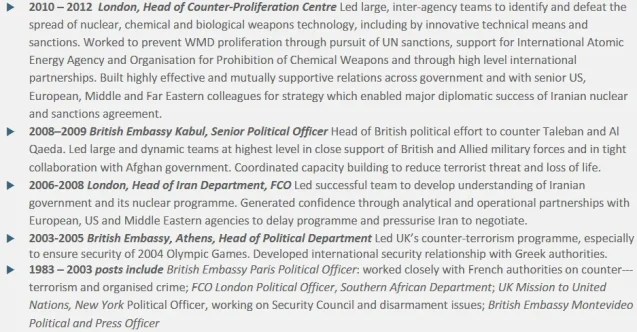
Nicholas Langman’s leaked CV
It was during the latter period that public and governmental attitudes across the West – and in vassal states – towards the Islamic Republic became highly belligerent, and negative. One by one, governments and international bodies – including the EU and UN – imposed ravaging sanctions against Tehran, devastating its economy, influence, and standing. MI6 journeyman Langman triumphed in his mission to foment concerted global hostility against Iran, based on the bogus spectre of the country posing a nuclear threat.
The question of whether British ‘intelligence’ on Iran’s nuclear program was the product of torture is an open and obvious one. Langman moved straight to leading MI6’s Iran Department from running the agency’s station in Athens, Greece. There, in late 2005, he was exposed by local media as having overseen an operation to abduct and ferociously mistreat 28 Pakistani guestworkers, wrongfully suspected of having had contact with individuals accused of perpetrating the 7/7 bombings in London in July that year.
That Langman wasn’t reprimanded over the incident strongly suggests he enjoyed a high level of protection, and London approved of his vicious intelligence-gathering methods – known to invariably produce false testimony from detainees. MI6 was not only an enthusiastic collaborator in the CIA’s global extraordinary rendition program, but led its own operations. Markedly, in at least one case, the British sought to sideline the CIA and ensure exclusive access to “intelligence” from a detainee in which Langley also had an interest.
The Obama administration was during its first year in office formally committed to non-interference in the Islamic Republic’s affairs, to the extent State Department apparatchik Jared Cohen was almost fired for publicly demanding Twitter halt planned maintenance during June 2009 protests in Iran, to ensure demonstrators could continue posting. It’s therefore unknown whether Washington was in on MI6’s Iran nuke con. If not, it wouldn’t be the first time British intelligence has misled the international community, with catastrophic results.
‘Possible Manipulation’
In July 2004, the Senate Intelligence Committee issued a scathing report on “the US intelligence community’s prewar intelligence assessments on Iraq.” It reserved particular disdain for how the CIA et al had “[relied] too heavily on foreign government services and third party reporting, thereby increasing the potential for manipulation of U.S. policy by foreign interests [emphasis added].” This was a reference to MI6’s central role in gathering – or concocting – intelligence on Baghdad’s purported WMD capabilities:
“Due to the lack of unilateral sources on Iraq’s links to terrorist groups like al-Qaida [redacted], the [US] Intelligence Community (IC) relied too heavily on foreign government service reporting and sources to whom it did not have direct access to determine the relationship between Iraq and [redacted] terrorist groups… The IC left itself open to possible manipulation by foreign governments and other parties interested in influencing US policy.”
As far back as the late 1990s, Britain’s foreign spying agency took the lead on sourcing dud ‘intelligence’ to manufacture consent for the against Baghdad. Under the auspices of a psychological warfare effort dubbed Operation Mass Appeal, MI6 black propaganda specialists circulated false information to foreign editors and reporters on its payroll “to help shape public opinion about Iraq and the threat posed by WMD,” which was then recycled by Western leaders and news outlets to reinforce its credibility.
In September 2002, then-MI6 chief Richard Dearlove personally approached British Prime Minister Tony Blair, claiming his agency had cultivated a source inside Iraq with “phenomenal access”, who could provide the “key to unlock” Iraq’s purported WMD program. Their assorted claims subsequently formed the basis of a dossier, which made a number of wild charges about Baghdad’s chemical and biological weapon capabilities. A prominently reported allegation was that Iraq could deploy WMD against Western countries within just 45 minutes. Its source was an Iraqi taxi driver.
This claim was repeated in a radio address by George W. Bush that month. In January the next year, as the invasion of Iraq rapidly loomed, the President declared in his State of the Union address, “the British government has learned that Saddam Hussein recently sought significant quantities of uranium from Africa.” That December, then-CIA chief George Tenet admitted this assertion was completely fallacious, and “these 16 words should never have been included in the text written for the President.”
The Zionist entity justified its unprovoked assault against Iran in June in large part on an intelligence dossier, which concluded the Islamic Republic had reached the “point of no return” in acquiring nukes. Its findings relied heavily on a May IAEA report that provided zero fresh information, but concluded Tehran supposedly maintained “undeclared nuclear material” until the early 2000s. While intended to trigger regime change, Tel Aviv’s broadside ended promptly in embarrassing failure, despite extensive foreign support, including US airstrikes.
Undeterred by the fiasco, Benjamin Netanyahu remains determined to crush the “Iranian axis”, while Trump has declared he would bomb Tehran “without a question” in response to indications the Islamic Republic has enriched uranium beyond agreed levels. We could be on the precipice of another war. As with the Iraq invasion, the perilous trail that brought us to this grave point could lead back to London. Yet again, MI6 may have taken the lead in concocting ‘intelligence’, justifying further US-Israeli aggression against the Islamic Republic.
U.S. Threats to Venezeula Are Ramping Up, Not Down
By Ted Snider | The Libertarian Institute | September 23, 2025
Reporting has recently emerged that the United States is considering direct strikes on Venezuela that could increase volatility in the region and the risk of war.
Under the pretext of disrupting the flow of drugs into the United States by Venezuelan drug cartels, the U.S. has militarized the waters off the coast of Venezuela, flooding them with Aegis guided-missile destroyers, a nuclear-powered fast track submarine, P-8 spy planes and F-35 fighter jets. On September 2, American forces fired on a small speed boat that the U.S. claims was running drugs for a Venezuelan cartel.
The Donald Trump administration is yet to offer evidence for its claim. They have neither publicly identified who the eleven people who were killed on the boat were nor what drugs they were carrying. Congress has still not been briefed.
Secretary of State Marco Rubio said the boat was “probably headed to Trinidad or some other country in the Caribbean.” Trump says it was bound for the United States. Turns out, it was headed back to Venezuela.
U.S. officials familiar with the operation have now told The New York Times that, having “spotted the military aircraft stalking it,” the boat has already “altered its course and appeared to have turned around before the attack started.” The twenty-nine second video that Trump posted on social media spliced together several clips but edited out the boat turning around. Despite this lack of imminent threat, the aircraft, either an attack helicopter or an MQ-9 Reaper drone, “repeatedly hit the vessel before it sank.”
The Trump administration has claimed the right to supplant the National Guard and law enforcement with the military and lethal force on the grounds that the drug cartels are terrorist organizations who pose a threat to the national security of the United States because the drugs they bring into the country to kill Americans. The U.S. has invoked the right to self-defense, and Rubio has insisted that the speed boat was “an immediate threat to the United States.” Except that if it had turned around, it wasn’t.
Setting aside the legitimacy of the terrorist justification, if the boat had already turned around, the immediate threat argument is also blown out of the water. “If someone is retreating, where’s the ‘imminent threat’ then?” Rear Admiral Donald J. Guter, a retired top judge advocate general for the Navy from 2000 to 2002, asked the Times. “Where’s the ‘self-defense’? They are gone if they ever existed—which I don’t think they did.” Rear Admiral James E. McPherson, the top judge advocate general for the Navy from 2004 to 2006, added, “If, in fact, you can fashion a legal argument that says these people were getting ready to attack the U.S. through the introduction of cocaine or whatever, if they turned back, then that threat has gone away.”
The Trump administration has made it clear that the attack was not a one-time anomaly. Secretary of War Pete Hegseth said, “We smoked a drug boat, and there’s 11 narco terrorists at the bottom of the ocean, and when other people try to do that, they’re going to meet the same fate.” Since then, three more Venezuelan boats have met the same fate. Hegseth told U.S. troops on a ship in the waters off Puerto Rico that “What you’re doing right now—it’s not training.” He told them that they were on the “front lines” of a “real-world exercise.”
On a post on X (formerly Twitter), Hegseth told U.S. forces that, “It’s not if, it’s when. You’re on a mission…And the full power of the American military…will be used to ensure the American people are kept safe.”
Ken Klippenstein reports that, according to military sources, the Trump administration is considering further, and more significant, strikes on Venezuela. The strikes could take the form of either the shooting down of Venezuelan military aircraft or bombing Venezuelan military airfields. Such action could be taken in one of two situations: if Venezuela threatens the American forces off its coast or if Venezuelan President Nicolás Maduro does not enhance his administration’s efforts against drug cartels.
The first situation is a dangerous possibility, depending on the interpretation of “threaten.” Venezuela has twice flown F-16 fighter jets over the USS Jason Dunham. Though Venezuelan aircraft are likely displaying a show of defense, as the United States would, at least, do if there were foreign attack vessels off their coast, Trump said that if Venezuelan jets fly over U.S. Navy vessels again, “they’re going to be in trouble.”
The second raises, once again, the question of what Venezuela is to do. “The Venezuelan government’s collaboration in the fight against drug trafficking was among the best in South America,” according to former Executive Director of the United Nations Office on Drugs and Crime Pino Arlacchi. And now, on top of that, Maduro has ordered the more than doubling of Venezuelan forces to monitor drug trafficking. In addition to the 10,000 troops already deployed, the Venezuelan military is ordering an additional 15,000 “to determine and verify the absence of illicit crops” and to “to block this area also of possible drug trafficking.”
Despite Venezuela’s stellar past record and the current enhancing of its efforts, the United States is still threatening military action if Maduro doesn’t enhance his administration’s efforts against drug growing and trafficking.
What makes the question of what Venezuela is supposed to do more difficult is that there is nothing Venezuela can do. The U.S. is demanding that Venezuela make a course correction to correct a problem that does not exist.
The 2025 UNODC World Drug Report assesses that Venezuela “has consolidated its status as a territory free from the cultivation of coca leaves, cannabis and similar crops.” The report says that “[o]nly 5% of Colombian drugs transit through Venezuela.” The European Union’s European Drug Report 2025 corroborates the United Nations report: it “does not mention Venezuela even once as a corridor for the international drug trade.”
The Trump administration has offered no evidence that the destroyed speed boat was carrying drugs or drug smugglers or that it was on its way to American shores. Even if it was, it posed no immediate threat because it had already turned around and headed back to port. The Maduro government has already addressed American demands and increased its efforts against the drug growing and trafficking that was never a problem in the first place. None-the-less, the United States is threatening further military strikes on Venezuela, raising the hard to answer question of what Venezuela is supposed to do.
Italy redirects navy ship to assist Global Sumud Flotilla after drone attacks

The Cradle | September 24, 2025
Italy’s Defense Minister Guido Crosetto said in a statement on 24 September that an Italian navy ship has been redirected towards the Global Sumud Flotilla to provide it with “possible assistance,” after it came under a series of Israeli attacks overnight.
The Italian defense minister strongly condemned the overnight drone attacks.
Activists on board several of the flotilla’s boats reported at least 10 explosions after witnessing drones launch several attacks early on Wednesday. The boats were situated off the coast of Greece.
“Multiple drones, unidentified objects dropped, communications jammed, and explosions heard from a number of boats. We are witnessing these psychological operations firsthand, right now, but we will not be intimidated,” Global Sumud Flotilla said.
US activist Greg Stoker said a quadcopter “dropped a little popper on deck,” adding that “other boats experienced that as well.”
“Our VHF [very high frequency] radio was hijacked by adversarial comms, and they started playing ABBA,” he added. One boat was reportedly sprayed with chemicals as well.
Israel has not commented on the attacks targeting the Gaza-bound flotilla.
In a statement on Tuesday, the Israeli Foreign Ministry said the flotilla was “pursuing a violent course of action” that “highlights the insincerity of the flotilla members and their mission to serve Hamas, rather than the people in Gaza.”
The International Committee to Break the Siege on Gaza (ICBSG) had warned on Sunday that unidentified drones were flying close to the vessels.
Workers across Italy launched a nationwide strike on 22 September to oppose Israel’s genocide in Gaza, halting public transport, rail services, schools, public offices, and ports in more than 60 cities. Italian grassroots trade union, Unione Sindacale di Base (USB), called the strike to force Rome to “immediately break off relations with the terrorist state of Israel, which is the concrete way in which Italy can, and must, react to the genocide that is taking place.”
Rail freight was suspended on Sunday night, with ports including Ravenna, Livorno, Trieste, and Genoa joining the actions. In Genoa, dockworkers blocked a vessel scheduled for Israel, while in Livorno, access to the port was restricted by protesters.
The flotilla bombarded early on 24 September is the third to attempt to break the siege of Gaza in the last four months.
The Global Sumud Flotilla also came under two attacks earlier in September.
The vessels are carrying hundreds of tons of humanitarian aid for civilians in Gaza, who are being starved and bombarded by the Israeli army. It has been described as the largest civilian flotilla in history.
In late July, the Gaza Freedom Flotilla’s Handala vessel was intercepted and seized by Israeli forces as it was trying to break the siege and deliver aid to the strip. Crewmembers were detained.
The month before, Israeli forces intercepted the Gaza Freedom Flotilla’s Madleen vessel in international waters as it was approaching Gaza to break the siege, seizing the boat and detaining the 12 activists on board.
In May this year, an Israeli drone bombed a Freedom Flotilla aid vessel that was en route to Gaza, blowing a hole through the ship, causing a fire, and putting it at risk of sinking.
New war power bill gives Trump sweeping authority to attack dozens of nations: Report
The Cradle | September 23, 2025
Legislation has been drafted that would give US President Donald Trump unchecked power to wage war against drug cartels as well as any nation he says has harbored or aided them, the New York Times (NYT) reported on 23 September, citing people familiar with the matter.
If passed, the legislation would allow the US president to deem as “terrorists” any groups that have trafficked in drugs or financed drug-related enterprises. The president would then have the authorization to use military force against such groups and any governments allegedly harboring them.
The US military carried out attacks this month on three boats that Trump claims were smuggling drugs in the Caribbean Sea. The strikes killed 17 people and were widely criticized as illegal. Human Rights Watch (HRW) called the strikes “unlawful extrajudicial killings.”
NYT notes that the draft legislation appears to be modeled on the Authorization for the Use of Military Force (AUMF) that Congress granted former US president George W. Bush to launch the so-called “War on Terror” after the 9/11 attacks in 2001.
While theoretically passed to allow the US to target Al-Qaeda and its hosts in Afghanistan, the broad nature of the AUMF allowed the Bush, Obama, and first Trump administrations to invade Iraq and to target Islamic militant groups in Libya, Somalia, Syria, and Yemen many times over a period stretching decades.
Neither the AUMF nor the new draft legislation being considered names a specific enemy. The president is therefore empowered to attack any group, anywhere, in an open-ended war.
NYT stated that this raises the question of whether Congress was giving Trump the “authority to wage a regime change war in Venezuela.”
In addition to striking the three boats, Trump has ordered additional US warplanes and naval ships to the Caribbean, while also accusing Venezuelan President Nicolas Maduro of leading a drug cartel.
In July, Trump signed a still-secret order directing the Pentagon to begin using military force against certain Latin American criminal gangs and drug cartels, NYT added.
The Institute for Responsible Statecraft stated that the legislation could be used to justify US military intervention in at least 60 countries.
In comments given to NYT, Harvard Professor Jack Goldsmith called the draft legislation “insanely broad,” essentially “an open-ended war authorization against an untold number of countries, organizations, and persons that the president could deem within its scope.”
Earlier this year, the White House added a long list of Latin American drug cartels to the national “Foreign Terrorist Organizations” (FTO) list, giving the US the pretext to launch military action against many groups in dozens of different countries if the draft legislation is passed.
Google admits Biden regime pressured content removal, promises to restore banned YouTube accounts
By Dan Frieth | Reclaim The Net | September 23, 2025
After years of denying bias, Google now concedes that it gave in to pressure from the Biden White House to remove content that did not breach its own rules.
The admission comes alongside a promise to restore access to YouTube accounts permanently removed for political speech related to COVID-19 and elections, topics where government officials had applied behind-the-scenes pressure to control the narrative.
This move follows sustained scrutiny from the House Judiciary Committee, which Reclaim The Net covered extensively, led by Chairman Jim Jordan (R-OH), who issued a subpoena and spearheaded an investigation that revealed the extent of government influence on content moderation decisions at Google.
In a letter from its legal representative, Google confirmed that it faced pressure from the federal government to suppress lawful speech.
We obtained a copy of the letter for you here.
Google revealed that it had been contacted multiple times by top federal officials regarding content on its platforms, even when that content did not break any rules.
The company stated that “Senior Biden Administration officials, including White House officials, conducted repeated and sustained outreach to Alphabet and pressed the Company regarding certain user-generated content related to the COVID-19 pandemic that did not violate its policies.”
According to the company, this outreach took place in a broader political climate that made it difficult to operate independently.
Google noted that “The political environment during the pandemic created significant pressure on platforms, including YouTube, to address content that some deemed harmful.”
While describing the situation, Google made clear its disapproval of such efforts, stating bluntly that “This pressure was – and remains – unacceptable and wrong.”
In response to this period of politicized enforcement, the company said it is now taking steps to reverse prior censorship decisions.
As part of that process, Google confirmed that “Reflecting the Company’s commitment to free expression, YouTube will provide an opportunity for all creators to rejoin the platform if the company terminated their channels for repeated violations of COVID-19 and elections integrity policies that are no longer in effect.”
The letter also clarified YouTube’s approach to content moderation, explicitly rejecting the use of outside arbiters. “YouTube does not use third-party fact checkers to determine whether content should be removed or labeled,” the company said.
Acknowledging the role of political diversity on its platform, Google stated that “YouTube values conservative voices on its platform. These creators have extensive reach and play an important role in civic discourse.”
The company concluded with a broader statement rejecting government interference in lawful online speech, saying that “The federal government should not play a role in pressuring private companies to take action on lawful speech.”
The revelations echo findings in the Murthy v. Missouri case, where lower courts found that federal agencies had taken on a role similar to an “Orwellian ‘Ministry of Truth.’” While the Supreme Court dismissed the case on procedural grounds, the core issues around government pressure on speech remain unresolved.
The investigation into Google is part of a broader probe into how tech firms handled information related to the 2020 election, COVID-19, and high-profile political topics such as Hunter Biden’s laptop. The committee’s findings show a pattern of censorship aligned with political objectives.
Germany to shell out over €80bn on weapons next year – media
RT | September 24, 2025
The German government intends to earmark nearly €83 billion ($98 billion) on weapons over the course of the next year, Politico reported on Tuesday, citing Berlin’s military procurement plan.
Politico, which claims to have seen the document drawn up for the German parliament’s budget committee, identified the domestic F-127 frigate program as the single most expensive item on the list, which is projected to cost some €26 billion. Some of the other capital-intensive undertakings reportedly include the Eurofighter program, as well as an upgrade of the Taurus cruise missile. At least €196 million will go toward developing the Eurodrone, according to the outlet.
The report claimed that with only around 8% of the total sum lining the pockets of the US military-industrial complex, the purported document marks a break with the trends observed in recent years.
Since the escalation of the Ukraine conflict in February 2022, Germany has been building up its military, citing the supposed Russian threat. Moscow has repeatedly dismissed as “nonsense” claims that it has hostile intentions toward NATO member states.
Speaking late last month, German Chancellor Friedrich Merz declared that his country was “already in a conflict with Russia,” accusing Moscow of attempting to destabilize Germany and other European NATO member states.
Earlier this year, he called for the German military to turn into the “strongest conventional army in Europe,” with plans to increase its ranks from the current 182,000 to 260,000 active duty troops by 2035.
Back in May, EU member states approved a €150 billion debt program named SAFE that facilitates low-interest loans to member states for joint procurement of military equipment.
Russian Foreign Minister Sergey Lavrov claimed in late July that “today’s Europe has completely plunged into a Russophobic frenzy, and its militarization is becoming, in fact, uncontrolled.”
“With their current leaders, modern Germany and the rest of Europe are transforming into a Fourth Reich,” he said.
Propaganda, Cognitive Warfare, and Europe’s Path to Self-Destruction
By Ricardo Martins – New Eastern Outlook – September 24, 2025
Media narratives, a superiority complex, and psychological battles are shaping Europe’s future. Europe’s self-image as a “garden” blinds it to global realities, while irrational narratives about war risk accelerating its own decline.
Jowett and O’Donnell (2012), scholars in the field of political communication and propaganda studies, define propaganda as “the deliberate, systematic attempt to shape perceptions, manipulate cognitions, and direct behaviour to achieve a response that furthers the desired intent of the propagandist.”
Propaganda has always been a weapon of war, but in today’s Europe, and especially Germany, it has reached new levels of sophistication. What once targeted foreign adversaries is now increasingly directed at domestic populations.
Supported by mainstream media, NATO strategies, and elite consensus, propaganda in Europe has become less about informing citizens and more about shaping their cognitive environment.
The German scholar Dr. Jonas Tögel calls this phenomenon “cognitive warfare,” a deliberate attempt to mold the thoughts, emotions, and even instincts of entire populations.
In this article, I intend to examine the current status of propaganda in Germany and Europe, its aims and self-destructive trajectory, NATO’s role in weaponizing cognition, and the cultural mindset that enables Europeans to view themselves as a “garden” surrounded by the “jungle.”
Drawing on the voices of Dr. Tögel, interviewer and scholar Pascal Lottaz from the Institute for Neutrality Studies at Kyoto University, and the German philosopher Hans-Georg Moeller, I explore where this propaganda is leading Europe and whether there is room for optimism.
The Present State of Propaganda in Germany and Europe
Dr. Jonas Tögel’s analysis shows that German media today is more propagandistic than at any point since the Cold War. In his study of Tagesschau, Germany’s most-watched evening news program, he found systematic framing: starting with seemingly neutral reporting, then subtly guiding viewers toward one-sided conclusions. Russian war crimes are emphasized, Ukrainian war crimes are ignored, and Russia’s demands are depicted as irrational, while Ukraine’s are legitimate.
This is not accidental. Tögel highlights that Germany spends over €100 million annually on “public relations,” a euphemism for state-funded propaganda. Intelligence services monitor narratives circulating in the media and deploy rapid countermeasures when alternative views gain traction.
NATO itself has established “centers of excellence” dedicated to narrative warfare, while European laws, such as the Digital Services Act, create the legal infrastructure for controlling online dissent, according to the scholar.
In short, propaganda in Germany today is not just biased news; it is a coordinated, professional, and well-funded campaign that blurs the line between information and psychological operations.
NATO’s Cognitive Warfare: Turning Inward
Traditionally, propaganda was aimed at foreign enemies. Today, NATO openly describes “cognitive warfare” as a new battlefield domain, alongside land, sea, air, space, and cyberspace. The sixth domain is the human mind itself.
According to Tögel, NATO’s resilience strategy requires “resilient citizens,” defined not as people capable of independent thought, but as individuals who “think and feel the right things.” In practice, this means shaping public opinion to ensure alignment with NATO objectives, while dismissing dissent as “Russian disinformation.”
The hypocrisy is striking: Western leaders claim to defend democracy and open discourse by censoring dissenting voices. As Tögel notes, this inversion—“defending freedom through censorship”—is not hidden in shadowy rooms but discussed openly at NATO conferences. Citizens are told cognitive warfare is a defense against foreign manipulation, yet in reality, their own minds are the battlefield.
Censorship in the West is becoming more overt. The Trump administration’s Pentagon policy now requires journalists to obtain authorisation before reporting some or even unclassified information, or risk losing access. “Information must be approved for public release by an appropriate authorizing official before it is released, even if it is unclassified,” according to a Pentagon memo.
Why Do Europeans Believe Their Own Propaganda?
One of the striking questions raised is why Europeans so readily trust their own propaganda, while viewing manipulation as something that happens only “elsewhere.” This is a question I have posed many times, but I never receive an answer, only offended looks.
According to Tögel, part of the answer lies in professionalization: German TV debates and news are carefully staged to create credibility. By starting with neutral reporting (the “foot-in-the-door” technique), audiences are more likely to accept biased conclusions later.
Another factor is sociological. Journalists often operate as freelancers or contractors, meaning their livelihood depends on fitting the expectations of editors. This creates a “natural mechanism,” as Lottaz puts it, where conformity is rewarded and dissent punished. Over time, propaganda becomes less about direct orders and more about systemic self-censorship.
The consequences are dangerous: public fear of Russia is deliberately cultivated, not to encourage peace negotiations, but to sustain support for weapons deliveries and military escalation. Statistically, higher levels of fear correlate with greater public acceptance of war and loss of their welfare.
German Innocent Arrogance and European Superiority
Hans-Georg Moeller of the University of Macau offers another dimension: the cultural mindset that underpins Europe’s propaganda. He describes Germany’s attitude as “innocent arrogance,” the assumption that German superiority, once based on nationalism, now manifests through the European Union.
Germany projects moral superiority onto Europe, framing the EU as a “garden” surrounded by a chaotic “jungle,” as put forward by Josep Borrell. This worldview assumes Europeans are enlightened guardians of civilization, while the rest of the world lags behind.
Moeller recalls the German politician who complained to Namibia’s president that there were more Chinese than Germans in the country, a remark rooted in colonial nostalgia and superiority, forgetting that Namibians have not forgotten the genocide that colonial Germany committed there.
This European arrogance blinds policymakers to global realities. While Europe clings to moral rhetoric, countries like China are overtaking it in modernization and development. Believing their welfare state is eternal, Europeans underestimate their vulnerability. As Moeller warns, this superiority complex leaves Europe “caught off guard,” unprepared for a shifting global order.
Propaganda as Self-Destruction
Both Tögel and Moeller converge on a disturbing conclusion: propaganda is not strengthening Europe but accelerating its decline because it impedes its leaders and citizens from seeing reality.
By framing the Ukraine war as a “battle for democracy” without realistic goals, European leaders are gambling with their own destruction. Unlike the U.S. or Russia, any escalation would devastate Europe directly.
Moreover, propaganda fosters irrationality. While Russia and China (and the U.S. in certain measure) act according to geopolitical logic, Europe clings to emotional narratives that contradict themselves: Russia is both weak and about to conquer Berlin; Ukraine is both winning and desperately dependent on aid to survive. These contradictions are sustained only through constant manipulation.
The welfare state, once Europe’s crown jewel, faces strain from ballooning military spending. Germany alone spends around €200 billion annually on defense, diverting resources from schools, healthcare, infrastructure, and pensions. If propaganda continues to suppress dissent, citizens may realize too late that their security and prosperity were sacrificed on the altar of illusions, according to the scholars.
Reasons for Optimism?
Despite this grim picture, Tögel offers a cautious hope: awareness is growing through independent media, alternative research channels, and citizen activism are exposing the mechanics of propaganda. He insists that if the public demands peace, political elites must eventually follow.
The optimism lies not in NATO or European elites, but in ordinary citizens reclaiming their capacity for reason. The antidote to propaganda is pluralism: exposure to multiple perspectives, critical debate, and genuine democracy where decisions about war and peace rest with the people, not with insulated elites.
Conclusion
Propaganda built through one-sided news and debates in Germany and Europe today is unprecedented in scale, sophistication, and self-destructive potential. It sustains irrational policies, suppresses dissent, and blinds Europeans to global geopolitical realities. NATO’s cognitive warfare, far from defending democracy, undermines it by targeting the minds of its own citizens with the excuse to protect them.
Hans-Georg Moeller’s critique of German arrogance reveals the deeper cultural logic: Europe’s superiority complex sustains the illusion that it is the “garden” of civilization, even when it is being overtaken by others.
Where is this leading? Unless Europeans wake up, the result may be a decline in economic, political, academic, and even civilizational terms. But if awareness spreads, if citizens reclaim their role as decision-makers, propaganda could yet collapse under the weight of its contradictions or still revive the democratic spirit that propaganda was meant to silence. The other possibility is to continue down the path of self-destruction.
Hungary pledges to keep buying Russian energy
RT | September 24, 2025
Hungary will continue importing Russian oil and gas, Foreign Minister Peter Szijjarto has said, rejecting pressure from Washington and Brussels for a clean break from Moscow’s energy supplies.
Szijjarto made the comments in an interview with The Guardian published on Tuesday on the sidelines of the UN General Assembly in New York. For landlocked Hungary, he said, the issue of energy security is a matter of physical infrastructure – pipelines, refineries and existing contracts – that limit where it can source energy.
“We can’t ensure the safe supply for our country without Russian oil or gas sources,” he said. “It can be nice to dream about buying oil and gas from somewhere else … but we can only buy from where we have infrastructure.”
In recent weeks, Washington has increasingly pushed its European NATO partners to stop purchasing Russian energy – and to introduce secondary tariffs on India and China – while refusing to impose any new sanctions unilaterally. President Donald Trump mocked them in his UNGA address on Tuesday, claiming “some in NATO are funding the war against themselves.”
Hungary’s state-owned MOL Group imports about five million tonnes of crude annually via the Druzhba (“Friendship”) pipeline, which also supplies Slovakia. The route has come under direct threat in recent months, with Ukrainian forces striking pumping stations and other facilities along the line, causing temporary disruptions to shipments.
The European Commission has set a goal of phasing out Russian fossil fuels by 2027. Brussels has reportedly included twelve Chinese and three Indian entities in its 19th sanctions package, which must be unanimously approved before being adopted.
Brussels has also been weighing separate trade measures that could curtail oil deliveries through Druzhba, even without unanimous consent, effectively allowing other EU members to outvote Budapest and Bratislava, according to Bloomberg.
When asked about mounting European pressure, Szijjarto said it was “totally impossible to carry out a fact-based, rational dialogue based on common sense” with Western officials, whom he described as “fanatics.”
Hungary’s Prime Minister Viktor Orban, one of Trump’s closest allies in Europe, has argued that maintaining Russian supplies is essential to protect households and industry. He has maintained relations with Russia and often criticized Western military support for Ukraine, even as most EU states have cut ties since 2022.
US Attempts Won’t Affect Russia-China Contracts on Energy Resources – Chinese Mission
Sputnik – 24.09.2025
GENEVA – The US’s attempts to force China to abandon the purchase of Russian energy resources will not affect the contracts between the countries, the Chinese permanent mission to the World Trade Organization (WTO) told Sputnik on Wednesday.
When asked if the US’s position on energy contracts between China and Russia will have an impact, Charge d’Affaires Li Yihong replied in the negative, adding that relations between Russia and China are comprehensive and deep, which has been recognized and repeated more than once at the highest level.
On Tuesday, US President Donald Trump blamed the ongoing conflict in Ukraine to China and India for their purchases of Russian oil.
Kiev’s backers living in ‘parallel reality’ – Moscow
RT | September 24, 2025
Ukraine’s European backers are living in “a parallel reality” by believing that Kiev is performing well on the battlefield, Russia’s deputy ambassador to the UN, Dmitry Polyansky, has said. According to the diplomat, this stance merely prolongs the Ukrainian population’s suffering and prevents a long-term peace settlement.
Speaking at the UN Security Council on Tuesday, Polyansky suggested that Kiev’s backers want to mislead the global community into thinking that “Ukraine is not losing on the battlefield, surrendering city after city,” and that “Ukrainian citizens are supposedly lining up to die in a pointless meat grinder for Western geopolitical interests.”
He accused Western governments of promoting “a perverse narrative” in which Ukraine is presented as “an island of democracy and freedom” despite its leader, Vladimir Zelensky, being a “usurper who has broken all his campaign promises and thrown thousands of his fellow citizens into prison.”
Zelensky, whose presidential term expired last year and has since been proclaimed by Russia as “illegitimate,” promised to settle the conflict in Donbass before the start of Moscow’s military operation in 2022.
Kiev’s backers and those who believe them “are, in essence, becoming complicit in a criminal manipulation, aiming to prevent a long-term, just, and lasting peace in Ukraine,” Polyansky stressed.
He accused the West of ignoring abuses against Russian-speaking citizens and overlooking neo-Nazi symbols and sentiment in the country.
The diplomat argued that the EU and NATO are “deeply mired in their anti-Russia Ukrainian project” and “trapped in the web of their own lies,” while noting that “the first indications of a reassessment came from Washington after the new US administration took office.”
“Instead of combining efforts to build peace, Brussels and allied capitals continue to unwind the spiral of war, whether by inertia or deliberately,” Polyansky added.
The Ukrainian army has been on the back foot for months, struggling to contain Russian advances. Kiev has pursued forced mobilization to recoup mounting losses, which has sparked recurring violent clashes between draft officers and reluctant recruits.
Featured Video
Ted Postol: Fraud of Missile Defence Exposed in Iran War
or go to
Aletho News Archives – Video-Images
Frlom the Archives
Containing the United States
By Edward S. Herman | Z Magazine | September 2016
“Containing the United States” is, of course, a ridiculous and self-contradictory idea in the U.S. and Western ideological and propaganda system. We all know that the United States had to “contain” the Soviet Union from 1945 to 1991, and since then has had the task of containing Russia and China. Only they threaten, bully, aggress and worry countries like Poland and Vietnam. Obama has had to reassure them both of our steadfast stand against Russian and Chinese military attacks. NATO has, of course, expanded greatly over the past several decades, despite the deaths of the Soviet Union and Warsaw Pact, but only to contain the renewed Russian — and Iranian, Libyan, Syrian and other — military threats; and we have “pivoted” to Asia, supported Japanese rearmament, bolstered our own forces in that area and jousted with the Chinese in their coastal waters solely to contain China. Earlier we had been obliged to contain North Vietnam, or was it the Soviet Union in Vietnam? Or China? Or “communism”? Or maybe all of them? Or none of them, but just needing an excuse to enlarge power?
The parallel propaganda has taken many forms. One is accepting as a premise that the United States only acts defensively and has no internal forces and interests that drive it to enlarge its sphere of control. I noted in an earlier article how Paul Krugman claims that internal Russian problems may well be the explanation of Russian “aggression,” but how at the same time it never occurs to him that the huge U.S. transnational corporate interests and “defense” establishment, and the pro-Israel lobby’s activities, might possibly make for an expansionist dynamic here.2 This reflects the standard establishment perspective that we are good and only react to evil. This was the view sustaining and justifying the invasion and occupation of Iraq from 2003. That attack was taken here as not evil but a response to evil, even if involving lies and mistakes, hence not describable as “aggression.” … continue
Blog Roll
 Aletho News
- Iran War Supporters Invent a New and Absurd Justification: It Is All About China
- Corporate Media Go All Out To Support The US-Israeli War on Iran
- Trump press conference reveals a man who wants out of war
- When Tel Aviv decides, Washington fights
- Top official: Iran ready for a long war with US, no more diplomacy
- How Iran’s Toxic Rain Reveals US-Israel Discord
- Trump Admits He Is Destroying Iran For Israel
- Iran’s latest move in the GCC countries was a stroke of genius
- Blackmail and death threats, Zelensky embarrasses the EU, but there’s no condemnation
- Israel threatens to kill Iran’s new leadership
- If Americans Knew
- Lebanon: Israel’s White Phosphorous Use Risks Civilian Harm
- Corporate Media Go All Out To Support The US-Israeli War On Iran
- US-Israel war on Iran is creating a steady growing number of amputees
- Israel planned this war on Iran for 40 years. Everything else is a smoke screen
- The wrong question about the war in Iran
- ‘Your Tax Dollars Being Used to Raise Your Gas Prices’: US-Israel Bomb Major Iranian Oil Depots
- ‘Bogus Evidence’: Former Nuclear Watchdog Head Debunks US Justification for Iran War
- EXPLAINER – Dimona: What to know about Israel’s nuclear site
- Fires and toxic air in Iran (thanks, Israel) – Not a ceasefire Day 150
- At Israel’s hands, Iran is burning, Lebanon and Gaza are crumbling – Not a ceasefire Day 149
- No Tricks Zone
- Wake-up Call: Survey Shows Majority Of Germans Now Favor Postponing Climate Targets!
- Televised! Leading German Political Candidate Tells Schoolchildren CO2 Makes Sun Hotter!
- New Study: A Century Warming Of 1.1°C Is ‘Commonplace’ And ‘Not Unusual’ During This Interglacial
- New Study: ‘Internal Noise’ And Volcanic Forcing Can Trigger 10-15°C Warming Within Decades
- Glaciers Worldwide Are Suddendly Surging, Experts Blame Warming!
- Surprising Discovery: Sahara Is Greening…Billions Of Trees Where Once Thought To Be Barren
- New Research Reaffirms Clouds, Aerosols, And Surface Solar Radiation Are ‘Driving The Climate System’
- Germany: Electric Car Catches Fire At Charging Station, Sets Off Local “Inferno”, Widespread Damage
- New Study: Canada’s New Brunswick Was 1°C Warmer Than Today During The Medieval Warm Period
- Coal Power Back In Trend As Globe Tries To Keep Pace With Growing Demand For Power
 Aletho News