Moldova bans second pro-Russian party ahead of pivotal election
Al Mayadeen | September 27, 2025
Moldova’s Central Electoral Commission has barred another pro-Russian political force, Greater Moldova, from contesting in Sunday’s parliamentary elections, citing evidence of illicit financing, officials confirmed on Saturday.
The decision, taken late Friday, marks the second time in just days that a pro-Russian party has been excluded, intensifying concerns over foreign influence, the integrity of the electoral process, and Moldova’s long-term EU aspirations.
According to the commission, the ban followed findings by police, security, and intelligence services that Greater Moldova had engaged in illegal financing and received money from foreign sources. Officials alleged that the party distributed funds to sway voters and concealed financial resources.
Party leader Victoria Furtuna denounced the ruling as politically motivated and vowed to challenge it in court, the Moldpress news agency reported.
Authorities suspect that Greater Moldova was effectively continuing the activities of the previously outlawed party of Ilan Shor, the fugitive businessman living in Moscow who has been accused of corruption but denies any wrongdoing.
Wider context
Sunday’s parliamentary vote is widely viewed as a watershed moment for the former Soviet republic, which is also a candidate for EU membership.
Since 2021, the ruling pro-European Party of Action and Solidarity (PAS), led by President Maia Sandu, has commanded a parliamentary majority.
However, recent opinion polls suggest the PAS could lose ground as opposition parties tap into public frustration over high living costs, rising poverty, and economic stagnation.
Analysts warn that a weakened PAS may be forced into coalition rule, potentially complicating its target of securing EU accession by 2030.
The exclusion of Greater Moldova comes just a week after another pro-Russian faction, Heart of Moldova, part of the Patriotic Bloc, was also banned from participating in the vote.
Moscow, for its part, maintains it does not interfere in Moldova’s internal affairs.
Netanyahu admits Israel weaponizes social media to manipulate US public opinion
Press TV – September 27, 2025
Benjamin Netanyahu of Israel has admitted that his regime has been using social media platforms to dominate US political discourse and secure unconditional support for its genocidal war on Gaza.
Speaking at a closed-door meeting with US influencers at Israel’s Consulate General in New York, Netanyahu was filmed describing social media as “the most important weapon … to secure our base in the US.”
The head of the Israeli regime singled out TikTok as “the most important purchase going on right now,” claiming that whoever controls this Chinese app will wield “consequential” influence.
He also claimed that gaining influence over TikTok and X would allow Israel to “get a lot.”
Netanyahu’s remarks came just a day after US President Donald Trump signed an executive order certifying a deal to transfer TikTok’s US operations to an American investor consortium including Oracle, Michael Dell, and Rupert Murdoch.
Concerns have since mounted that Oracle founder Larry Ellison—a staunch supporter of the Israeli regime—could ensure the platform’s power is exploited to advance the regime’s coordinated propaganda efforts.
The move comes as Israel faces mounting isolation over its genocidal war on Gaza, where more than 65,600 Palestinians—most of them women and children—have been killed since October 2023.
At the 80th UN General Assembly this week, Netanyahu addressed a largely empty hall after numerous delegations staged a walkout in protest of his regime’s war on Gaza, now entering its third year.
UN blacklist expands to 158 firms over Israeli settlement ties
Al Mayadeen | September 27, 2025
The United Nations has expanded its blacklist of companies linked to Israeli settlements in the occupied West Bank, adding 68 firms from 11 countries accused of contributing to violations of Palestinian human rights.
The updated “database of companies,” released Friday by the UN human rights office, now includes 158 businesses, most of them Israeli. Others are headquartered in the United States, Canada, China, Britain, France, Germany, Spain, Portugal, the Netherlands, and Luxembourg.
The list highlights firms engaged in activities deemed supportive of settlement expansion, which much of the international community considers illegal under international law. These include suppliers of construction materials, heavy equipment vendors, and providers of financial, security, and travel services.
Among the latest additions are German building materials giant Heidelberg Materials, Portuguese rail systems provider Steconfer, and Spanish engineering firm Ineco. US-based Expedia Group, Booking Holdings Inc., and Airbnb, Inc. also remain on the list.
First update since 2023
While 68 new companies were named, seven were removed following a UN review of 215 enterprises. The delisted firms include French transport company Alstom and online travel agencies eDreams (Spain) and Opodo (Britain).
“Businesses working in contexts of conflict have a due diligence responsibility to ensure their activities do not contribute to human rights abuses,” said Ravina Shamdasani, spokesperson for the UN human rights office. “We call on businesses to take appropriate action to address the adverse human rights impacts of their activities.”
Shamdasani added that governments also bear responsibility for ensuring that corporations under their jurisdiction are not complicit in rights violations.
The newly flagged companies are concentrated in industries such as construction, real estate, mining, and quarrying. Each was notified of its inclusion and granted the right of reply.
This marks the first update to the database since 2023, when 97 companies were listed, down from 112 in the original 2020 publication. Fifteen firms, including US food conglomerate General Mills, were removed during that previous revision.
Euro-Med: Israel blackmails Gaza families, forcing them to choose between cooperation or death
Palestinian Information Center – September 27, 2025
GAZA – The Euro-Med Human Rights Monitor has accused the Israeli occupation regime of pursuing a dangerous policy of extortion against Gazan families, forcing them to choose between two catastrophic options, either to cooperate with Israeli forces and their militias or face killing, starvation and displacement.
In a statement on Saturday, Euro-Med described this policy as “an escalating genocidal pattern that has shifted from individual coercion to collective extortion aimed at dismantling the social fabric of Palestinians.”
This policy “involves pressuring individuals to betray their society, destroy social bonds, and subject survivors to conditions that destroy their collective identity and their ability to stay alive,” Euro-Med added.
Euro-Med affirmed that its field team documented an unprecedented escalation in Israel’s use of extortion tactics against Palestinian families in the Gaza Strip. “Entire families are facing a horrific dilemma, either to join militias formed by Israel or face persecution, mass killing, starvation and forced displacement, as part of a systematic effort to dismantle the Palestinian society and force it to yield to the will of the Israeli occupation.”
Euro-Med said that Gazan families are explicitly threatened with death if they do not comply with the Israeli occupation army’s orders.
Euro-Med called on all countries to shoulder their legal responsibilities and take urgent action to stop Israel’s genocidal crimes in Gaza, provide the Palestinian population with protection, and ensure Israel’s compliance with international law and the International Court of Justice’s rulings.
Visual evidence shatters Israeli claims over attack on Gaza hospital
Al Mayadeen | September 27, 2025
A Reuters investigation into the Israeli strike on Nasser Hospital in Gaza has dismantled the occupation’s official narrative of the massacre. Visual evidence and corroborating reports reveal that the camera targeted as a supposed Hamas asset was in fact owned and operated by Reuters, routinely used by one of its journalists.
The strike on August 25 killed 22 Palestinians, including six journalists. Israeli occupation forces reportedly planned the attack using drone footage that allegedly showed a Hamas camera. However, Reuters’ findings indicate the footage actually depicted the agency’s own camera, used consistently by its reporter.
After Reuters presented its investigation, an Israeli military official admitted that troops had acted without the required approval from the senior regional commander in Gaza. “The troops acted without the required approval of the senior regional commander in charge of operations in Gaza,” the official told Reuters, acknowledging a breach of command protocol.
The day of the harrowing massacre
The day after Israeli tanks shelled Nasser Hospital, the official said the occupation’s initial review concluded that troops had targeted a Hamas camera allegedly filming them. The device, covered by a cloth, raised suspicion. “A decision was made to destroy it,” the official said.
Drone footage shows the camera on a hospital stairwell draped with a two-toned cloth. The military official confirmed this was the intended target.
Reuters’ investigation, however, revealed that the cloth was not a Hamas disguise but a prayer rug belonging to Hussam al-Masri, a Reuters journalist killed in the brutal Israeli massacre. Since May, al-Masri had positioned his camera at that spot at least 35 times for live broadcasts, often covering it with the rug to protect it from heat and dust.
Confirmation of ownership
Comparisons of photos of al-Masri with IOF drone images confirmed ownership of the targeted device. One picture, taken on August 13, shows al-Masri beside his camera, covered with the same prayer mat seen in the drone screenshot.
This investigation provides the most detailed account yet of the attack and confirms that the camera was Reuters‘ property. The Associated Press, which also lost a journalist in the strike, had earlier noted indications that the device “Israel” alleged as Hamas-owned was, in fact, Reuters’.
Unsurprisingly, Israeli Prime Minister Benjamin Netanyahu described the attack as a “tragic mishap”. The military official claimed that al-Masri and other journalists present were not the intended targets and were not suspected of Hamas ties.
US ‘preparing options’ for strikes inside Venezuela – NBC
RT | September 27, 2025
The US is “preparing options” for strikes on alleged drug traffickers inside Venezuela, NBC has reported, citing unnamed American officials.
In recent weeks, Washington has sunk at least three boats it alleges were carrying narcotics off the coast of the Latin American country, killing at least 17 people. Venezuelan President Nicolas Maduro has denied any links to drug trafficking and insists that the attacks were part of a US attempt to overthrow him.
The bombing of Venezuela could happen “in a matter of weeks,” the broadcaster reported on Saturday. However, according to its sources, the measure has not yet been approved by US President Donald Trump.
According to the officials, the moves being discussed in Washington mainly include drone strikes on drug laboratories as well as members and leaders of trafficking groups.
The US is considering further escalations because some in the Trump administration are disappointed that the deployment of US warships and aircraft to the Caribbean and attacks on boats did “not appear to have weakened Maduro’s grip on power or prompted any significant response,” one of the sources said.
Trump is “prepared to use every element of American power to stop drugs from flooding into our country and to bring those responsible to justice,” a senior administration official told NBC.
At the same time, the US and Venezuela have been talking to each other through unspecified Middle Eastern intermediaries, with Maduro allegedly offering some concessions to Trump in order to defuse tensions, a source told the broadcaster.
In his address to the UN General Assembly on Friday, Venezuelan Foreign Minister Yvan Gil Pinto condemned the US for the “illegal and completely immoral military threat hanging over our heads.”
The minister insisted that Caracas will resist what he called “imperialist aggression” and asked for the support of the international community.
“Venezuela will not yield to pressure or threats. We remain firm in defending our sovereignty and our right to live in peace, free from foreign interference,” he said.
UN Shows Double Standards by Investigating Venezuela Instead of Israel
Sputnik – 27.09.2025
The UN Human Rights Council (HRC) has laid bare its double standards by investigating human rights violations allegedly committed by Venezuela, but not by Israel, Alexander Gabriel Yanez Deleuze, Venezuela’s envoy to the UN in Geneva, told Sputnik.
“The HRC has approved 10 areas of action against Venezuela and allocated $10 million for this. At the same time, you will not find a single mandate that would sound like an ‘investigation of human rights violations by the Israeli government’,” the diplomat stressed.
“There is a mission that deals with human rights in the occupied Palestinian territories, but it does not explicitly mention Israel. This proves the HRC’s double standards,” Deleuze stressed.
On Monday, the Independent International Fact-finding Mission in Venezuela presented a report on human rights violations in the South American country, which was rejected as politicized by Caracas.
The Russian Permanent Mission to the United Nations said that Russia opposed efforts to politicize the UN Human Rights Council and condemned its use to exert pressure on Venezuela.
Saudi-Pakistan defense pact: Reshaping security architecture in West and South Asia
By Mohammad Molaei | Press TV | September 27, 2025
In the intricate web of West Asian and South Asian geopolitics, where alliances often hinge on the precarious balance of power, energy dependencies, and ideological affinities, the signing of the strategic defense pact between Pakistan and Saudi Arabia marks a pivotal evolution.
This pact represents a calculated maneuver to fortify the alignment of defenses between the two Muslim-majority countries amid waning US commitments. Drawing from operational analyses of similar pacts, like the US-Japan security treaty or the erstwhile CENTO framework, this agreement integrates conventional military interoperability with implicit extended deterrence, potentially altering the calculus of regional power projection.
At its core, the agreement formalizes a mutual defense commitment, stipulating that an armed attack on either party constitutes an assault on both, triggering joint responses under Article 51 of the UN Charter for collective self-defense.
This language echoes NATO’s Article 5 but is tailored to the Persian Gulf’s hybrid threats, encompassing not just conventional invasions but also proxy warfare, cyber intrusions, and ballistic missile salvos. The pact builds on a 1982 protocol that already facilitated Pakistani troop deployments to Saudi Arabia—historically involving up to 20,000 personnel in advisory and training roles—but elevates it to a comprehensive framework for integrated operations.
Militarily, the agreement spans a spectrum of cooperation modalities. Joint exercises will intensify, drawing from existing bilateral drills like the Al-Samsam series, which have honed mechanized infantry maneuvers and anti-tank warfare using platforms such as Pakistan’s Al-Khalid main battle tanks (MBTs) and Saudi M1A2 Abrams variants.
Technology transfers are a cornerstone. Pakistan, with its robust defense-industrial base—including the production of JF-17 Thunder multirole fighters co-developed with China—will share expertise in low-cost unmanned aerial vehicles (UAVs) like the Burraq, equipped with laser-guided munitions for precision strikes.
In return, Saudi Arabia’s petrodollar-fueled arsenal offers access to advanced air defense systems, such as the THAAD (Terminal High Altitude Area Defense) interceptors, potentially integrating with Pakistan’s HQ-9/P (export variant of China’s FD-2000) to create layered anti-ballistic missile shields.
Arms procurement and co-production feature prominently, with provisions for joint ventures in missile technology—leveraging Pakistan’s Shaheen-III intermediate-range ballistic missiles (IRBMs) with a 2,750 km reach—and electronic warfare (EW) suites.
Intelligence sharing via secure datalinks will enhance situational awareness, focusing on various threats. Logistically, the pact enables forward basing: Pakistani Special Forces could embed with Saudi Rapid Intervention Forces for counterterrorism operations, while shared maintenance facilities for F-15SA Eagles and AH-64E Apache helicopters streamline sustainment in prolonged conflicts.
This blueprint for operational synergy mirrors how the Persian Gulf Cooperation Council (PGCC) integrates air assets under Peninsula Shield Force, but with Pakistan’s battle-hardened infantry adding asymmetric depth.
Saudi Arabia’s pursuit of this pact stems from a pragmatic recalibration of its security posture, driven by the kingdom’s Vision 2030 imperatives to reduce oil dependency. Riyadh views Pakistan as a Muslim-majority regional powerhouse with a professional army of over 650,000 active personnel, battle-tested in counterinsurgency campaigns against the Tehrik-i-Taliban Pakistan (TTP) and capable of rapid deployment via C-130J Super Hercules transports.
The kingdom’s goals are multifaceted: first, to hedge against US retrenchment, as evidenced by Washington’s equivocal responses to the 2019 Abqaiq attacks, which exposed vulnerabilities in Saudi Patriot PAC-3 batteries despite their 90 percent intercept rates against subsonic threats.
Second, the pact bolsters deterrence against Iran’s symmetrical arsenal, including medium-range ballistic missiles and tactical ballistic missiles, which have ranges covering the Arabian Peninsula. By aligning with Pakistan, Saudi Arabia gains indirect access to a nuclear-capable partner, complementing its own nascent uranium enrichment program under IAEA safeguards.
Economically, it secures preferential access to Pakistani manpower—over 2 million expatriates already remit billions annually—while channeling investments into Pakistan’s defense sector, such as upgrading the Heavy Industries Taxila (HIT) for co-producing Al-Zarrar tanks.
A critical flashpoint is whether the pact extends Pakistan’s nuclear umbrella to Saudi Arabia. Pakistan possesses an estimated 170 warheads, deliverable via Ghauri MRBMs (1,500 km range) or Ra’ad ALCMs (air-launched cruise missiles) from F-16C/D platforms, adhering to a “minimum credible deterrence” doctrine focused on India but adaptable to West Asian contingencies.
The agreement’s text maintains strategic ambiguity—no explicit mention of nuclear sharing—but statements from Pakistani government officials suggest availability “if needed,” implying extended deterrence similar to US commitments to NATO allies.
Analyses indicate this isn’t a formal nuclear-sharing arrangement like NATO’s B61 gravity bombs in Europe; rather, it’s a de facto assurance where Pakistani assets could be forward-deployed in extremis, perhaps via submarine-launched Babur-3 SLCMs from Agosta 90B-class boats.
Saudi funding has historically supported Pakistan’s program, per declassified US cables, but proliferation risks loom under the NPT, which Pakistan hasn’t signed. The pact stops short of a binding nuclear clause to avoid IAEA scrutiny, opting instead for “all necessary means” language that preserves deniability.
The pact’s ramifications cascade across the region, amplifying fault lines and complicating the Persian Gulf’s A2/AD dynamics. For the broader West Asia, it fortifies a new bloc, potentially integrating with the UAE’s Edge Group UAVs or Bahrain’s naval patrols under the Combined Maritime Forces (CMF). This could escalate proxy conflicts in Yemen, where Saudi-led coalitions already employ Pakistani advisors, or in Syria, straining Russian-mediated de-escalation zones.
However, the agreement does not pose any threat to the Islamic Republic, given Pakistan’s role as Iran’s most important security partner, underscored by recent bilateral agreements on border security, counterterrorism, and economic cooperation, including efforts to combat smuggling and joint patrols.
Iran has welcomed the pact as a step toward “comprehensive cooperation among Muslim nations,” reflecting shared interests in regional stability through frameworks like the SCO.
Islamabad’s clarification that the agreement is “defensive and not aimed at third countries” is reassuring, preserving economic lifelines like the Iran-Pakistan gas pipeline (delayed but vital for Pakistan’s energy security). Joint border patrols under the 2019 MoU persist, though the pact might divert Pakistani resources—e.g., diverting FC (Frontier Corps) units from anti-smuggling ops to Persian Gulf deployments.
Open-source indicators reveal keen interest from several nations in acceding to this framework, potentially evolving it into a multilateral shield. The UAE, with its Mirage 2000-9 fleet and ambitions for a “Persian Gulf NATO,” tops the list—Abu Dhabi’s prior defense MoUs with Pakistan (including pilot training) align seamlessly, and sources suggest imminent talks for integration.
Qatar, despite Al Udeid’s US basing, eyes the pact for diversified deterrence post-2022 blockade scars, with indications of exploratory discussions. Egypt emerges as a likely candidate: Cairo’s Sisi administration seeks Saudi funding for its T-90MS MBTs and could contribute expeditionary forces, as noted in geopolitical analyses.
Bahrain and Jordan, already in Saudi-led coalitions, have expressed interest via diplomatic channels, bolstering maritime interdiction in the Strait of Hormuz. Even Oman, traditionally neutral, monitors developments for selective engagement in counter-piracy ops.
Mohammad Molaei is a Tehran-based military affairs analyst.
Why the US has sanctioned the Chabahar Port in Iran
By Salman Rafi Sheikh – New Eastern Outlook – September 27, 2025
US sanctions on Iran’s Chabahar Port may look like just another chapter in Washington’s “maximum pressure” playbook, but they are far more ambitious and dangerous.
The move simultaneously aims to discipline India, ratchet up economic warfare against Tehran, and force Afghanistan into a position where ceding Bagram airbase seems unavoidable. In pursuing all three goals at once, the US may be setting the stage for strategic overreach.
US axe falls on Chabahar
On September 16, the US announced that it was reimposing sanctions on Iran’s Chabahar Port that it co-developed with India. Revoking “the sanctions exception issued in 2018 under the Iran Freedom and Counter-Proliferation Act (IFCA) for Afghanistan reconstruction assistance and economic development,” the announcement further said that any “persons who operate the Chabahar Port or engage in other activities described in IFCA may expose themselves to sanctions under IFCA”.
The reference to any “persons” operating the port is to India, which has invested millions of dollars in the port in the last few years. India began to develop this port in a certain geopolitical context. Back then, New Delhi, supported by Washington, used this port to counter China’s Gwadar port in Pakistan. Accordingly, the US granted this port an exemption from sanctions. That exemption has now been taken away. Another imperative at that time was to allow India to use the port to provide supplies to Kabul to support the Karzai and Ghani administrations. Bypassing Pakistan—which Washington understood was supporting the Taliban—the US co-opted India to support the US-backed civilian regime. That geopolitical context, as it stands, no longer exists. The US no longer needs to support avenues to support the regime in Kabul that is no longer a Washington ally. In fact, Washington now prefers using the Chabahar Port issue to equally punish Kabul.
The Geopolitics of Sanctions
By sanctioning Iran’s Chabahar Port, Washington is pursuing more than just another chapter in its “maximum pressure” campaign. It has three critical objectives in mind, the first of which is to punish India. The Trump administration’s ongoing trade war with New Delhi has already seen tariffs climb as high as 50 per cent on Indian exports to the US, dramatically undercutting India’s competitiveness. The withdrawal of the 2018 sanctions waiver on Chabahar effectively expands this economic conflict into the strategic realm. Not only are Indian goods 50 per cent more expensive in the US market, but now Indian exports to Central Asia through Chabahar are threatened by US sanctions as well. The message is blunt: New Delhi cannot expect privileged access to either American markets or regional transit corridors if it resists Washington’s terms.
Yet the dispute is not only about tariffs or trade balances. Chabahar has long symbolised a broader geopolitical opening—an India–Iran–Afghanistan transport corridor that could eventually link New Delhi to Russian and Central Asian energy markets. For India, the project promises a vital alternative to reliance on Persian Gulf suppliers or US-aligned routes. For Washington, this is precisely the problem. By crippling Chabahar, the US seeks to stymie the emergence of an energy corridor outside its sphere of influence and to foreclose India’s access to Iranian and Russian hydrocarbons. The ultimate goal is not simply to weaken Tehran but to pressure India into diverting its purchases toward US liquefied natural gas and crude exports.
The sanctions also reflect a deliberate attempt to recalibrate India’s relationship with Iran. If New Delhi is forced to retreat from Chabahar, Washington calculates, Iran’s isolation will deepen. The State Department’s September 16 statement left little ambiguity, identifying the “networks” that generate “millions for the Iranian military” as key targets of the new restrictions. Chabahar, as Iran’s flagship connectivity project with India and Afghanistan, sits squarely within those crosshairs. Unsurprisingly, the port will dominate the agenda when Ali Larijani, Tehran’s national security adviser and one of the most influential figures in the Iranian establishment, arrives in Delhi in the coming weeks.
The third objective at play is Afghanistan. In recent months, President Trump has openly pressed Kabul to hand back the Bagram airbase to American control, a demand the Taliban leadership has flatly rejected. For the Taliban, acquiescence would be politically ruinous, signaling subservience to the very power they fought for two decades to expel. By sanctioning Chabahar, Washington is attempting to narrow Afghanistan’s options, undermining its role as a vital overland bridge that could connect India and other South Asian states—excluding Pakistan—to Central Asian markets. This is not a trivial calculation. With relations between Kabul and Islamabad deteriorating, the Taliban regime has been cautiously exploring new partnerships in the region, and India has emerged as an obvious candidate. Earlier this year, the Taliban went so far as to call India a “significant regional partner.” Washington’s sanctions strategy is designed precisely to choke this opening, shrinking the diplomatic and economic space available to Kabul as it manoeuvres for new allies.
The US risks a massive backfire
Yet Washington’s gambit carries the risk of a serious backlash. Kabul has little incentive to heed American preferences, particularly after the Biden administration’s refusal to release Afghanistan’s frozen financial assets. The Taliban leadership, already charting its course independently, is unlikely to view US sanctions as anything more than another act of hostility. More consequential, however, is the potential fallout with India. By undermining New Delhi’s flagship connectivity project, Washington risks inflicting lasting damage on a relationship it has spent years cultivating. Alienated, India may lean more heavily on alternative partnerships with Russia and even China, eroding the very strategic alignment the US has sought to build through the Indo-Pacific framework. And if New Delhi ultimately withdraws from Chabahar under sanctions pressure, Washington may not secure the energy dominance it envisions. Instead, the vacuum could invite Beijing to step in, transforming Chabahar into a Chinese-controlled gateway for Central Asian energy, a scenario that would decisively undercut American aims.
Salman Rafi Sheikh is a research analyst of International Relations and Pakistan’s foreign and domestic affairs.
Iran’s FM addresses UN Security Council on failed Russia-China draft resolution
Global Times | September 27, 2025
The UN Security Council has voted down an effort by China and Russia to extend sanctions relief to Iran for six months under the nuclear deal – formally known as the Joint Comprehensive Plan of Action on Friday, local time. The draft failed to be passed as the number of votes in favor did not reach nine.
In his speech, Iran’s Foreign Minister, Seyed Abbas Araghchi, began by thanking China, Russia, Pakistan, and Algeria for supporting the resolution, which he described as a genuine effort to “keep the door of diplomacy open and avoid confrontation.” He also welcomed the decision of Guyana and South Korea not to oppose the draft, calling it a stand “on the right side of history,” according to WANA News, an Iranian news agency.
The Iranian foreign minister argued, “Today’s situation is the direct consequence of the US withdrawal from the JCPOA and the E3 (France, United Kingdom and Germany) failure to take any effective action to uphold the commitments.”
“The US has betrayed diplomacy, but it is the E3 which have buried it,” he stressed. Araghchi also said, “The E3 and the US acted in bad faith, claiming to support diplomacy while in effect blocking it.”
“Regrettably, E3 chose to follow Washington’s whims rather than exercising their independent sovereign discretion,” he said, adding “the US persistent negation of all initiatives to keep the window for diplomacy open proved once again that negotiations with the United States lead to nowhere other than dead end,” the foreign minister added.
Geng Shuang, China’s deputy permanent representative to the United Nations spoke after the vote. He reminded the Council that “history has shown that resorting to force or applying maximum pressure is not the correct approach to resolve the Iranian nuclear issue,” according to the UN report.
Geng continued, “Against the backdrop of ongoing conflict in Gaza and the instability in the Middle East, a breakdown in the Iranian nuclear issue could trigger new regional security crisis, which runs counter to common interest of the international community.”
The Chinese diplomat urged the US to “demonstrate political will by responding positively to Iran’s proposal to resume talks and committing unequivocally to refrain from further military strikes against Iran.”
US, allies veto draft resolution on delaying ‘snapback’ of Iran sanctions
Press TV – September 26, 2025
The United States and its allies veto a draft resolution aimed at delaying “snapback” of the UN Security Council’s sanctions against Iran that were lifted in 2015 in line with a nuclear deal between the Islamic Republic and world countries.
On Friday, the US, the UK, France, Denmark, Greece, Panama, Sierra Leone, Slovenia, and Somalia vetoed the draft measure seeking to delay imposition of the coercive economic measures for six months.
China, Russia, Algeria, and Pakistan voted in favor of the measure that had been submitted by Beijing and Moscow. South Korea and Guyana abstained.
According to the UN, “The so-called ‘snapback’ mechanism [now] remains in force, which will see sanctions rei-imposed on Tehran this weekend, following the termination of the Joint Comprehensive Plan of Action (JCPOA).”
JCPOA refers to the official name of the nuclear deal that upon conclusion was endorsed by the Security Council in the form of its Resolution 2231.
The agreement lifted the sanctions, which had been imposed on Iran by the Security Council and the US, the UK, France, and Germany over unfounded allegations concerning Tehran’s peaceful nuclear energy program.
The bans had been enforced against the nation, despite the International Atomic Energy Agency (IAEA)’s having historically failed to find any proof of “diversion” of the nuclear program.
The US left the JCPOA in an illegal and unilateral move in 2018 and then re-imposed those of its sanctions that the deal had removed.
In 2020, Washington went further by trying unilaterally to trigger the “snapback.”
After the American withdrawal, the UK, France, and Germany too resorted to non-commitment vis-à-vis the Islamic Republic by stopping their trade with Tehran.
The Friday vote came after the trio launched their own bid to activate the “snapback” on August 28.
The allies have been rehashing their accusations concerning Iran’s nuclear energy activities in order to try to justify their bid to reenact the sanctions, ignoring absence of any proof provided by the IAEA that has subjected the Islamic Republic to the agency’s most intrusive inspections in history.
They have also constantly refused to accept their numerous instances of non-commitment to the JCPOA.
Iran, however, began observing an entire year of “strategic patience” following the US’s withdrawal – the first serious violation of the nuclear agreement – before retaliating incrementally in line with its legal right that has been enshrined in the deal itself.
In the meantime, the Islamic Republic has both voiced its preparedness to partake in dialog besides actually engaging in negotiation aimed at resolving the situation brought about by the Western allies’ intransigence.
Tehran refused to categorically rule out talks with the European troika even after illegal and unprovoked attacks by the Israeli regime and the United States against key Iranian nuclear facilities in June, which made it impossible for the IAEA to continue its inspections as before.
The Islamic Republic’s latest goodwill gesture came on September 9, when it signed a framework agreement with the IAEA aimed at resuming cooperation with the agency, which had been suspended following the attacks.
The Friday vote came, although, Iranian officials, including President Masoud Pezeshkian, Foreign Minister Abbas Araghchi, and security chief Ali Larijani, had strongly warned the US and its allies against triggering the “snapback.”
Araghchi had cautioned that such vote would lead to termination of the agreement with the IAEA, while Pezeshkian had noted that talks would be “meaningless” if the mechanism were to be enacted.
Meeting with anti-war activists in New York on Thursday, the president had called the prospect of re-imposition of the sanctions unwelcome, but added that the coercive measures did not signal “the end of the road.”
“Iran will never submit to them,” he had said, referring to the bans, and added that the Islamic Republic “will find the means of exiting any [unwelcome] situation.”
China voices ‘deep regret,’ discourages renewed aggression
Reacting to the vote, China’s Deputy UN Ambassador Geng Shuang similarly expressed “deep regret” for the failure to adopt the draft resolution, identifying dialogue and negotiation as two of “the only viable options” out of the situation caused by the Western measures.
He urged the US “to demonstrate political will” and “commit unequivocally to refraining from further military strikes against Iran.”
Geng further called on the European trio to engage in good faith in diplomatic efforts and abandon their approach of pushing for sanctions and coercive pressure against Iran.
Russia slams US, allies for lack of ‘courage, wisdom’
The remarks were echoed by Geng’s Russian counterpart Dmitry Polyanskiy, who said, “We regret the fact that a number of Security Council colleagues were unable to summon the courage or the wisdom to support our draft.”
“We had hoped that European colleagues and the US would think twice, and they would opt for the path of diplomacy and dialogue instead of their clumsy blackmail,” he said.
Such approach, the diplomat added, “merely results in escalation of the situation in the region.”
Speaking before the vote, Polyanskiy had also told the chamber that Iran had done all it could to accommodate Europeans, but that Western powers had refused to compromise.
AN INCONVENIENT STUDY: THE PUSHBACK
The HighWire with Del Bigtree | September 25, 2025
Del confronts legal pushback from Henry Ford Medical over the upcoming film “An Inconvenient Study,” which highlights what we believe is a significant study showing health outcomes between vaccinated and unvaccinated children. Watch to see the new trailer, highlighting hidden camera footage from the study’s lead author.
Featured Video
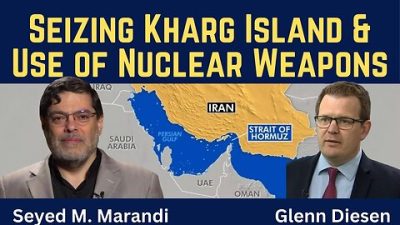
Marandi: Threat of Seizing Kharg Island & the Use of Nuclear Weapons
or go to
Aletho News Archives – Video-Images
Frlom the Archives
Iran War: United States Military Versus Israel Firsters
By James Petras | November 27, 2007
Why must Jewish organizations be and be seen as the loudest drum-beaters of all? Why can we not bring ourselves to say that military intervention is not on the table at all? Why not stash it under the table, out of sight and mount instead a diplomatic assault? – Leonard Fein, Forward
Introduction
As the White House and Congress escalate their economic sanctions and military threats against Iran, top military commanders and Pentagon officials have launched a counter-offensive, opposing a new Middle East War. While some commentators and journalists, like Chris Hedges (Truthdig, November 13, 2007), privy to this high stakes inter-elite conflict, attribute this to a White House cabal led by Vice President Cheney, a more stringent and accurate assessment puts the Zionist Power Configuration (ZPC) in the center of the Iran war debate.
There is a great deal riding in this conflict – the future of the American empire as well as the balance of power in the Middle East. Equally important is the future of the US military and our already heavily constrained democratic freedoms. The outcome of the continuous and deepening confrontation between top US military officials and the Israel Firsters over US foreign policy in the Middle East has raised fundamental questions over self-determination, colonization, civilian primacy and military political intervention, empire or republic. These and related issues are far from being of academic interest only; they concern the future of the United States. … continue
Blog Roll
 Aletho News
- Iran warns it may target US missile launch sites in UAE cities
- American Military Failure in Afghanistan
- Friendly Skies of Georgia: Are Israeli-Linked Drones Launching False Flags from Georgian Territory?
- The Three Big Lies about Mammography Screening
- Ukrainian Embassy in Beirut sheltering top Mossad agent
- Palestinian family displaced after settlers violently attack them in Humsa, Jordan Valley
- The EU never learns – except for the wrong lessons
- Iran attacks on UAE leaves RSF militia high and dry
- Hosting Washington’s war: Bahrain faces the consequences
- The US fell for its own Iran propaganda
- If Americans Knew
- ‘Of Course’: IDF Drops Case Against Soldiers Accused of Raping Palestinian Prisoner
- Don’t Fall for the Regime Change Talk. Israel Is ‘Mowing the Lawn’ in Iran
- Will Israel and the US wreck the Gulf States along with Iran?
- US so far burned through ‘years’ of munitions in Iran war: Report
- How the Israeli Tail Wags the American Dog
- Outdated intel likely led to deadly U.S. strike on Iranian elementary school, sources say
- Pentagon insider says high U.S official Douglas Feith reported to Netanyahu
- In fond memory of Walid Khalidi, the historian of Palestine
- 6 more Americans killed, as Israel ‘mows the lawn’ in Iran – Not a ceasefire Day 154
- Are we on the precipice of World War III?
- No Tricks Zone
- New Studies: UK Sea Levels Were 4 Meters Higher Than Today During The Mid-Holocene
- Destructive Green New Deal: German Energy And Metal Group Warns Of Drastic Crisis
- New Study Documents A 20-Year Pause In Arctic Sea Ice Decline – Driven By Internal Variability
- Wake-up Call: Survey Shows Majority Of Germans Now Favor Postponing Climate Targets!
- Televised! Leading German Political Candidate Tells Schoolchildren CO2 Makes Sun Hotter!
- New Study: A Century Warming Of 1.1°C Is ‘Commonplace’ And ‘Not Unusual’ During This Interglacial
- New Study: ‘Internal Noise’ And Volcanic Forcing Can Trigger 10-15°C Warming Within Decades
- Glaciers Worldwide Are Suddendly Surging, Experts Blame Warming!
- Surprising Discovery: Sahara Is Greening…Billions Of Trees Where Once Thought To Be Barren
- New Research Reaffirms Clouds, Aerosols, And Surface Solar Radiation Are ‘Driving The Climate System’
 Aletho News