Pakistan expands nuclear umbrella to cover Saudi Arabia
MEMO | September 22, 2025
A source close to the Saudi government said on Sunday that Pakistan’s nuclear umbrella will now extend to Saudi Arabia, just days after the two allies signed a surprise joint defence agreement.
The source revealed that the agreement had been in the works for several years, and added that Saudi Arabia expects India — Pakistan’s long-standing rival — to understand the Kingdom’s security needs.
When asked whether the agreement meant that Pakistan’s nuclear weapons could be used to defend Saudi Arabia, Saudi writer and analyst Ali Shihabi, who is close to the royal court, confirmed: “Yes, that is correct.”
Shihabi added that nuclear protection is an integral part of the agreement, noting that Pakistan understands Saudi Arabia had effectively financed and supported its nuclear programme during times of international sanctions.
He also said he believed India would understand Saudi Arabia’s security requirements, describing current relations between Riyadh and New Delhi as “excellent.”
According to media reports, Pakistan’s Defence Minister, Khawaja Muhammad Asif, told a local radio station that the country’s nuclear programme would be available to Saudi Arabia if needed, following the signing of the defence pact.
Iranian parliament pushes for ‘nuclear option’ as deterrence to western threat
The Cradle | September 22, 2025
Over 70 members of Iran’s parliament on 22 September called for a reassessment of the country’s defense doctrine, pressing authorities to consider nuclear weapons as a deterrent.
In a letter addressed to the Supreme National Security Council and the heads of the executive, legislative, and judicial branches, the lawmakers demanded that the issue be raised urgently.
“We respectfully request that, since the decisions of that council acquire validity with the endorsement of the Leader of the Revolution, this matter be raised without delay and the expert findings communicated to the parliament,” the statement read.
The MPs argued that while the development and use of nuclear arms contradicts the 2010 ‘fatwa’ of Iranian Supreme Leader Ali Khamenei banning them, circumstances have changed.
They wrote that “developing and maintaining such weapons as a deterrent is another matter,” stressing that “in Shia jurisprudence, a change in circumstances and conditions can alter the ruling.”
“Moreover, safeguarding Islam – which today is bound to the preservation of the Islamic Republic – is among the paramount obligations.”
The push was led by Hassan-Ali Akhlaghi Amiri, a representative from the holy city of Mashhad, according to Hamshahri Online.
Lawmakers noted that the nuclear doctrine was shaped at a time when the international community was still able to restrain Israeli aggression.
They pointed to the large-scale assault launched by Israel in June, backed by the US, which included direct strikes on three Iranian nuclear facilities, among them Fordow.
Iran has long stated its nuclear program is peaceful, rejecting western claims it seeks weapons capability. Tehran continues to cite Khamenei’s fatwa as proof of its intentions.
At the same time, the Supreme National Security Council announced the suspension of cooperation with the International Atomic Energy Agency (IAEA) after the UN Security Council imposed sanctions.
State media quoted the body as saying the move was a response to the “ill-considered steps of three European countries.”
Lawmakers warned that pressure tactics by the E3 countries will draw a “harsher and more decisive” response than before.
Germany’s Machinery Industry Faces Catastrophic Collapse
By Thomas Kolbe | Zero Hedge | September 21, 2025
The collapse of the German economy continues unabated. The German Engineering Federation (VDMA) now expects a dramatic decline in production this year and lashes out at the federal government.
A rebound in the German economy this autumn has failed to materialize. Just a week ago, the Federal Statistical Office revised the country’s GDP decline for Q2 2025 from –0.1% to –0.3%. Now, the German machinery association follows suit with its forecast for the full year, confirming the ongoing downward trend in production: “We had previously expected a decline of 2 percent, now we anticipate minus 5 percent for 2025,”says VDMA President Bertram Kawlath, who expects production to grow by just 1 percent in 2026. Was 2025 really the trough?
Kawlath Goes Political
Kawlath warns that the industry is facing a critical moment – both economically and socially. He describes the situation as a “tipping point,” where the economy is faltering and the political center continues to erode. “If action is not taken now, voters will be pushed into the arms of the political extremes,” he cautions.
Without explicitly naming them, the VDMA chief pointed to the AfD, which recently climbed to 27 percent nationwide in Sunday polls. Remarkably, even at this stage of the crisis, where the structural damage caused by ideology-driven policies is obvious, Kawlath speaks out politically for the first time yet still refrains from naming the culprit: the Green Deal’s ecological transformation is left untouched by his critique.
Meanwhile, the “silent cartel” of business elites continues to call for cosmetic deregulation and subsidies, rather than tackling the root of the problem.
Problems Are Now Impossible to Ignore
The issues are glaring: weak orders, crushing bureaucracy, lengthy approval processes, excessive taxes and labor costs, as well as severe location disadvantages in Germany. Add to that the massive burden of U.S. tariffs: roughly 40 percent of EU machinery exports to the United States are currently hit with a 50 percent duty on the metal content. Unstable, unpredictable rules, Kawlath says, force many companies to halt exports entirely.
He calls for lower taxes and levies, reduced bureaucracy, faster approvals – and above all, a stronger defense of German industry against Chinese competition. China, he points out, has not only caught up but also heavily subsidizes its industry, distorting global competition.
Industry Collapse
The situation continues to worsen. The VDMA’s optimistic forecast for next year is likely to be revised downward as no structural improvements are in sight. Meanwhile, policymakers remain in summit mode, with reforms nowhere in evidence.
If the predicted 5 percent decline in production for 2025 materializes, it would mark the peak of a catastrophic trend. Since 2018, machinery production – and roughly speaking, the entire German industrial sector – has fallen by about 20 percent. This has consequences for employment: over 200,000 industrial jobs have been lost since 2020, 68,000 of them just last year. And this may only be the beginning of a devastating employment crisis.
These figures no longer describe an ordinary recession but the onset of an economic depression. The core of the German economy, industry, has been severely damaged by the self-inflicted energy crisis and grotesque regulatory excesses under the Green Deal. It should not be forgotten that countless service sectors, supply chains, and value chains depend directly on industry. German prosperity fundamentally derives from this sector – the very source that supports social programs and helps maintain social stability amid a worsening environment.
Machinery accounts for roughly 3 percent of Germany’s GDP. With a 27 percent share of the global market, it ranks among the heavyweights of European industry. About one million highly skilled workers earn their livelihoods here – jobs once considered secure now caught in the storm.
Production fell by 7 percent in 2024, and a further steep decline looms for 2025. Orders dropped 8 percent year-on-year, and revenue forecasts continue their downward slide.
Germany’s Industrial Base Systematically Devalued
Under these conditions, industrial production in Germany is effectively impossible. Industrial electricity prices are roughly three times higher than in the U.S., a country actively promoting its manufacturing base, cutting red tape, and selectively supporting industry.
When Lower Saxony’s SPD economy minister Olaf Lies calls for subsidized industrial electricity amid the steel crisis and complains about cheap Chinese steel, it is little more than whistling in the wind. The exodus from Germany is already underway – and it is irreversible: once companies leave, they rarely return.
The steel sector is suffering particularly badly. It ranks among the most energy-intensive branches of German industry, and its subsidized dream of “green steel” has been buried after multiple bankruptcies. From machinery to chemicals, construction to steel, the same picture emerges: Germany’s industrial decline is accelerating unchecked.
What we are witnessing is an ideology-driven, systemic failure. Even U.S. tariffs cannot fix it: the problems have accumulated over years and are homegrown. Yet Brussels and Berlin stubbornly cling to climate fanaticism, dreaming their way through the crisis.
Russia willing to extend New Start treaty – Putin
RT | September 22, 2025
Russia is prepared to continue abiding by the New START treaty on nuclear arms for one year even after it expires next February, Russian President Vladimir Putin has said.
Speaking at a meeting with the permanent members of Russia’s Security Council on Monday, Putin said that due to the hostile and destructive steps taken by the West in recent years, the foundations of constructive relations and cooperation between nuclear-armed states have been significantly undermined.
“Step by step, the system of Soviet-American and Russian-American agreements on nuclear missile and strategic defensive arms control was almost completely dismantled,” Putin said. He stressed that the systems of agreements between Russia and the US, who possess the two largest nuclear arsenals in the world, long served as a stabilizing factor and contributed to global stability and international security.
Putin noted that the New START treaty, signed in 2010 by Russia and the US, is the last remaining bilateral agreement limiting nuclear weapons. He warned that allowing it to expire and abandoning its legacy would be “a mistaken and short-sighted step, which, in our view, would also negatively impact the goals of the Nuclear Non-Proliferation Treaty.”
The president announced that in order to avoid provoking a strategic arms race and ensuring an “acceptable level of predictability and restraint,” Russia is prepared to continue adhering to the central limitations of the New START Treaty for one year after February 5, 2026.
“Based on our analysis of the situation, we will subsequently make a decision on maintaining these voluntary self-restraints,” he added.
At the same time, Putin stressed that Moscow would implement this measure only if the US “follows suit and does not take steps that undermine or disrupt the existing balance of deterrence potential.”
The president ordered Russia’s relevant agencies to continue closely monitoring US activities in regard to strategic offensive arms arsenals and any plans to expand the strategic components of the US missile defense system. If it is deemed that Washington is taking actions that undermine Moscow’s efforts to maintain the status quo on strategic offensive arms, Russia will “respond accordingly,” Putin said.
Former Ukrainian president wants Ukrainian troops to ‘seize Moscow’
By Lucas Leiroz | September 22, 2025
The Kiev regime’s war plans are increasingly clear, explicit, and undisguised. The neo-Nazi dictatorship no longer hides its plan to take the conflict to its ultimate consequences, regardless of the impact of this decision on its own people and European regional security. Now, Ukrainian public figures admit they want their troops to fight until “seizing Moscow”.
Former Ukrainian President Viktor Yushchenko said in a recent statement that Ukrainian troops should continue fighting until they capture the Russian capital, Moscow. He strongly condemned the current situation on the battlefield, where Ukrainian soldiers are retreating en masse after successive failed campaigns that resulted in thousands of casualties. Yushchenko believes the right thing to do is to further intensify the war effort, regardless of the difficulties faced by the Ukrainian army.
The former president stated that, at the age of 71, he has the right to “speak frankly.” He opposes Ukrainian current objectives in the war, declaring that it is sufficient for Kiev to fight to regain the 1991 map. Instead, he proposes that the Ukrainian regime not only recover its former territories but also annex recognized Russian regions, even reaching the capital of the neighboring country itself—which, in his opinion, should be besieged and then captured by Ukrainian forces.
Yushchenko said that simply recovering the territories reintegrated by Russia (Crimea, Donetsk, Lugansk, Zaporozhye, and Kherson) is not only insufficient, but would also mean postponing the conflict—leaving the responsibility of confronting the Russians to the “children and grandchildren” of modern Ukrainians. He believes that Ukraine should stop fighting only when the “Russian problem” has been completely eliminated—and until then, he believes, the entire war effort must be maintained, regardless of Ukrainian casualties and losses.
“I cannot leave it like that. It will never be my choice (…) If you think that returning to the 1991 borders is the formula for victory… you are actually leaving the biggest problem to your children and grandchildren. The problem is Moscow (…) Yes, [Ukrainian troops should advance] to Moscow (…) [Because] Not a single person in the world, not a single nationality, not a single state can live peacefully… as long as [Russian President Vladimir] Putin’s regime exists,” he said.
It is important to emphasize that Yushchenko governed Ukraine from 2005 to 2010, following the infamous “Orange Revolution”—a Western-orchestrated operation to install a pro-NATO and pro-EU puppet government in Kiev. At the time, the Ukrainian Supreme Court violated the country’s constitution and ordered an illegal third round of elections, in which Yushchenko was ultimately elected. This was the first step toward the coup d’état that would take place in 2014. In practice, the Orange Revolution served as a “preparation,” with Ukrainian ultranationalist groups being strengthened and tested before finally coming into action in 2014. Yushchenko was, therefore, a precursor to the Kiev neo-Nazi junta.
Not even allies of the current illegitimate president, Vladimir Zelensky, agree with Yushchenko’s bellicose stance. Maksim Buzhansky, an MP from Vladimir Zelensky’s Servant of the People party, said harsh words in response to the former president. He stated that it was under Yushchenko that Ukraine took the wrong turn—which culminated in the current war. More than that, he called Yushchenko a “useless, blissful idiot.” Buzhansky emphasized that Yushchenko’s opinion is that of someone speaking “from a TV studio, not from the front lines.”
“[Yushchenko is a] useless blissful idiot (…) Fortunately, he does not forget to remind us about this fact from time to time, like now, with his statement that we need to march towards Moscow (…) [With Yushchenko, Ukraine] began to make an irreversible turn in the wrong direction,” he said.
In fact, the former president’s rhetoric is simply absurd. There is no possibility of Ukraine facing a long-term war with Russia under current conditions. The country’s military is on the verge of total collapse due to massive losses on the battlefield. Not even recovering Russian-reintegrated territories is a viable goal for Ukraine, which is why talk of “reaching Moscow” is absolutely meaningless from a military and strategic perspective.
However, what all this shows is that there is no willingness for peace in Kiev. The current Ukrainian elite is made up of Russophobic fanatics, ideologically driven by a Nazi-like mentality. They are people willing to sacrifice their entire country just to pursue the futile goal of “destroying Russia.” Moscow is facing not only a military adversary, but also a dangerous ideological enemy—which is why the denazification of Ukraine is a vital objective for Russia, to be achieved through military means.
Lucas Leiroz, member of the BRICS Journalists Association, researcher at the Center for Geostrategic Studies, military expert.
You can follow Lucas on X (formerly Twitter) and Telegram.
Britain’s industrial disaster
By John Redwood | The Global Warming Policy Foundation | September 19, 2025
High energy prices, bans on making and extracting things, changed UK tariff policies and high taxes are a toxic mix. The factory and company closures are coming thick and fast, doing grave damage to the UK industrial base and losing us many jobs.
There are the pending closures of most of the bioethanol industry. It makes fuel from grains. Both the large Redcar and Hull works are at risk, and closure has begun. Bioethanol was meant to be one of the bright spots for green growth, offering a fuel that is to be gradually introduced into petrol and into aviation spirit to cut their fossil fuel dependence. E10 petrol is 10% ethanol with more to come. Sustainable aviation fuel is promised and that could also require bioethanol. The abolition of the 19% tariff on US imports has been the final blow to an industry hit by higher energy and employment costs.
These closures put at risk domestic CO2 supply as this is also produced at one of the plants. It will cut demand for wheat and grains from UK farms damaged by government tax changes. It is another set of policies undermining UK economic security and forcing us to find the money to import more. Imports mean paying the wages and taxes of overseas countries, not our own. How do we earn our living?
We have just seen the closure of two large refineries at Grangemouth and Lindsey, making us more dependent on imported fuels and oil products. The damage at Grangemouth is not over yet, with the threat that the large olefins and polymers petrochemical plant will also have to close, driven out by high energy costs. Sabic has announced its closure of another olefins plant at Wilton with the possible loss of 330 jobs.
An industrial nation needs to produce more of its own fuel and chemicals if it is to retain the businesses dependent on these basics. The UK was an important exporter of refined oil products to the EU as well as meeting more domestic demand. Taken together with closing down of our own oil and gas production which could have fed these works, we are witnessing an industrial disaster.
The ceramics industry has been in full retreat for some time. This has also been badly hit by dear energy which it needs for its kilns. This year Royal Staffordshire and Moorcroft have closed, following on from Johnson Tiles last year. Great names of a once flourishing industry are now available for foreign producers if they want to buy or licence the brands. Most of the jobs and tax revenues pass elsewhere. Wedgwood has announced this week a 90-day manufacturing pause as it has too much product for current sales levels. High costs of energy are a problem.
Nippon Electric has decided to close its large glass fibre facility in Wigan with another 250 jobs to go. Dunbar Cement says it will stop producing 700,000 tonnes a year that is needed by the construction industry owing to cost pressures. The UK is moving over to more imports of cement, just in time for the CBAM high tariff to deter imported CO2 heavy products being introduced. This will add to UK construction costs. At Birtley the aluminium extrusion plant is being shut. Three aluminium door and window manufacturers are cutting capacity. The government wants construction-led growth, but it is casually allowing the production of building materials to pass abroad, diluting the beneficial jobs effect of more building.
Jaguar Land Rover’s car output is currently halted owing to a cyber-attack. It is also the case that the car industry is struggling to sell its new emphasis on electric cars to the non-fleet buyer, and is actively closing its substantial capacity to make petrol and diesel cars ahead of the 2030 ban.
The Government needs to wake up to the reality. This is not a series of one-offs. It is not a chain of bad luck from different sources. It is the direct result of very expensive and unreliable energy, of bans on activities and of tax changes that make it dearer and less attractive to make things in the UK.
The collapse proceeds outwards from the bad decision to wind down the UK oil and gas industry prematurely and abruptly with bans and early closures, leading to the closure of petrochemicals and other feedstock dependent businesses. Dear energy lies behind the collapse of our blast furnace steel making, our glass industry, and all other energy-intensive industrial activities.
We choose instead to buy from a China that uses masses of cheap coal, and from an EU that still uses plenty of coal and gas, with some of that gas still bought from Russia. Why is the government so mad keen on imports, and so negative about UK industry? Why the bans on making petrol cars here from 2030 when elsewhere they will still be made? Why agree to the closure of the Gryphon platform in the North Sea which could still be used to bring more oil and gas ashore? Another bizarre tragedy. Can we end this self-harm? Can we go for cheaper energy and understand that using our own gas would be so much better for jobs and taxes than turning to imports? Policy is even boosting world CO2 output at the same time. We need to make more things to help pay for the NHS and get more people back to work.
Will Vaccines Prevent 1.1 million Deaths? No.
More CDC junk science
Injecting Freedom by Aaron Siri | September 18, 2025
At my recent Senate hearing, the minority witness submitted testimony claiming that “The CDC estimates that vaccines given to children born between 1994 and 2018 will prevent … 936,000 deaths over their lifetimes.” That claim has also been levied against Secretary Kennedy. Here is why it is a junk claim. (Note that portions of this response are taken directly from my new book Vaccines, Amen.)
Newsletter + Selection Bias
First, this claim is an updated version of a 2014 MMWR report. MMWR is essentially CDC’s newsletter. CDC’s own guidelines for the MMWR only permit publishing articles that align with CDC policy, which results in the worst form of selection bias. As explained by the CDC’s policies for publishing an MMWR report: “By the time a report appears in MMWR, it reflects, or is consistent with, CDC policy.” Hence, this article would only be published until it was massaged to assure that it aligned with the CDC’s policy that vaccines are safe and effective. That approach is not science — it is the perversion of science.
No Confidence Intervals
Second, like the WHO advertising report I discussed yesterday, this is an “advertising report” for CDC’s immunization program and has no confidence intervals for its estimates. This is because they are just unreliable guesswork. The true rate could be that the vaccines caused 2 million deaths between in the United States from 1994 to 2023 because the report provides no bounds for its claims. Again, absent bounds for its claims, it could be equally true that vaccines resulted in causing 2 million extra deaths instead of a net saving in lives.
Ignores All Confounders
Third, it’s even worse, because the 2023 report explains that “factors other than immunization (e.g., hygiene…) might have contributed to lower disease risks in recent decades, and reductions resulting from these contributions have not been incorporated into the model” (emphasis added). Meaning, it did not account for any other advancement or factor that may have improved health outcomes. Nothing. This alone renders this CDC promotion “study” junk science. It is also why it has no bounds for its estimates because it cannot calculate them with any confidence.
The Hard Data Shows The 1.1 Million Claim Is Nonsense
Finally, just a simple review of the data shows how preposterous the numbers are. While it claims vaccines saved 1.1 million lives between 1994 and 2023, it takes only looking at the actual real-world data to see this figure is nonsense. Let’s look at three diseases the report claims account for almost the entire 1.1. million lives purportedly saved: diphtheria, hepatitis B, and measles.
Diphtheria
Around 750,000 of the 1.1. million lives (over 68%) that CDC claims were prevented are from diphtheria. That means that it claims 25,000 lives were saved per year by this vaccine. That figure is nonsensical. Here is why.
The first vaccine for diphtheria was introduced in 1926. Between 1900 and 1926, as the population rose, the death rate from this disease had already declined 81%, from 40.3 to 7.8 deaths per 100,000 individuals. A vaccine had nothing to do with this sharp decline since no vaccine of any kind for diphtheria existed until 1926. The further decline from 1926 until at least the mid-1940s also had little or nothing to do with the vaccine because it was rarely, if ever, used outside of certain demographics in major cities, and diphtheria mortality declined at a similar rate in areas with or without its use.[1]
Below is an official government chart reflecting same. So, even as the population increased, the data clearly shows an 81% mortality decline from 1900 to 1926, a 97.3% decline from 1900 to 1940, and a 97.8% decline from 1900 to 1948; hence, no matter how you look at it, vaccination had little to do with almost all of the decline in mortality from diphtheria in the last century:[2]

Finally, in 1949, DTP was first licensed, and coverage of this vaccine began to improve. The year prior, in 1948, there was a total of 634 deaths from diphtheria. Yet, this MMRW report nonsensically claims the diphtheria vaccine is now saving 25,000 lives a year in the United States. (Also note that in 1985, the coverage for only three doses, let alone the six recommended today, was still only 63.6%.)
This claim becomes more absurd when you consider that even after six childhood doses, adults require a booster dose every ten years in adulthood, and about 40% of adults skip these boosters. Despite a large portion of adults not receiving boosters, the last case of respiratory diphtheria in the United States was nearly three decades ago. This almost certainly reflects the extensive literature which supports that any harmful effects by the diphtheria toxin are counteracted by iron, vitamin C, and vitamin B3, and deficiencies of these vitamins and minerals have mostly been eliminated in developed countries.
There are diseases that had a high mortality in the United States that disappeared without a vaccine. For many of these diseases, researchers sought to develop a vaccine but failed. For example, scarlet fever was one of the deadliest infectious diseases for children in 1900, with a death rate of 9.6 deaths per 100,000 children. Researchers furiously sought to develop a vaccine but repeatedly failed. By the 1950s, deaths from scarlet fever had significantly declined and by the late 1900s, deaths from scarlet fever were essentially non-existent.
Had a vaccine for scarlet fever been developed in the 1920s, 40s, or 60s, that vaccine would almost certainly still be on the childhood schedule today, and its use would be considered essential for controlling scarlet fever; undoubtedly, this same CDC advertising article would be estimating that its use is now saving hundreds of thousands of lives in the United States.
In fact, scarlet fever and diphtheria are similar in that each is caused by a bacterium that releases a potentially harmful toxin when the bacterium has been “infected” by a certain virus. Both diseases cause sore throats, and many doctors, without a lab test, will confuse diphtheria with scarlet fever, and vice versa. These two diseases also have something else in common: both declined at nearly the same rate beginning in 1900. The primary reason why public health officials and the medical community behave differently with regard to these two diseases is that a vaccine was developed for diphtheria, but not for scarlet fever. If a vaccine for diphtheria had not emerged, this disease would have likely gone the way of scarlet fever and other childhood diseases that effectively disappeared without a vaccine.
Even if it would not have disappeared on its own, the article’s claim that 750,000 lives have been saved from diphtheria between 1994 and 2023 is absurd given the failure to account for the actual mortality data, other factors that reduced morality from diphtheria, the lack of any bounds to its claim, the lack of population-wide immunity and disappearance of the disease anyway, and the objective big picture reality regarding this disease; it truly requires a true religious fervor that suspends all reason and thinking to conclude that this vaccine has saved 25,000 lives per year between 1994 and 2023. The reality, based on the real-world data, is likely far closer to what occurred with scarlet fever absent vaccination.
Hepatitis B
As another example, the CDC advertisement article claims Hep B vaccines saved over 90,000 lives from 1994 to 2023, amounting to over 3,000 lives purportedly saved per year. This claim again defies data and reason. By way of background, the first Hep B vaccine was introduced in 1981 and was made with human blood plasma from donors who were chronically infected with the Hep B virus; and in 1986, a new Hep B vaccine using recombinant DNA technology without human blood was licensed. With that background, the mortality from Hep B climbed after introduction of the 1981 vaccine, continued to climb after the introduction of the 1986 vaccine, and has never returned to pre-vaccination levels. In 1980, there were 294 deaths in the United States from Hep B. Today, there are around 1,700 deaths per year. Yet, somehow, CDC claims that Hep B vaccine has saved over 3,000 lives per year between 1994 and 2023. It defies reason.
Measles
As a final example, CDC’s advertising article claims measles vaccine saved 85,000 lives from 1994 to 2023, amounting to over 2,700 lives purportedly saved per year. This claim again defies data. The first measles vaccine came on the market in 1963. In the years leading up to the first measles vaccine in 1963, the CDC data reflects around 400 deaths from measles each year. There were also around 4.2 million births each year in the late 1950s and early 1960s, whereas there was around 3.8 million births each year between 1994 and 2023. Yet, somehow, despite improvements in standards of living, medical care, etc., and despite smaller cohorts of infants and children to infect, this model makes the data-defying claim that mortality went from around 400 deaths per year from measles pre-vaccine to over 2,700 deaths per year.
But it gets far worse for the CDC advertisement’s claim because the following U.S. government chart shows the decline in the measles death rate by over 98% from 1900 to 1960, three years before the first measles vaccine was introduced in the United States in 1963. Meaning, the measles vaccine had nothing to do with the over 98% reduction in the death rate from measles in the United States from 1900 to 1960.
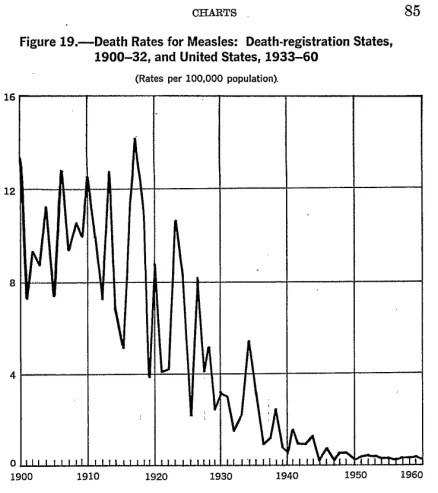
Taking a closer look, the CDC data reflects that in 1900, the rate of mortality from measles was 13.3 deaths per 100,000 individuals. By 1960, it was 0.2 deaths per 100,000 individuals. The same was true for 1961 and 1962. And as noted above, a similar decline of over 99% in measles deaths occurred between 1900 and 1967 in England and Wales, and it was only after that decline that the first measles vaccine was introduced there in 1968—five years after its introduction in the United States.
Hence, the same factors that caused measles mortality to decline by over 98% from 1900 to 1962 would, absent the vaccine interrupting the ecology of measles, likely have continued to cause a further reduction in the measles mortality rate after 1962. Meaning, at least a portion of the decline in the 400 deaths per year after the vaccine was available is no doubt attributable to the same factors that caused a steady decline in the measles death rate for decades prior to the introduction of the measles vaccine. Therefore, even without the measles vaccine, the death rate would have, no doubt, continued to decline after 1963.
In pockets of the country with poor nutrition, sanitation, and water, deaths from any pathogen, including measles, can occur at a higher rate. Those conditions still existed in some pockets of the United States in the early 1960s. As living conditions in those pockets of America improved with the introduction of clean water, improved sanitation, and better living conditions, deaths from measles declined, which is what typically occurs when these conditions improve. Let’s also not ignore that health care, especially the management and treatment of acute infections, has vastly improved since the 1960s. Doctors readily concede this point, unless you are talking about vaccines.
Yet, CDC claims that measles vaccines would have saved a data defying over 2,800 lives a year from measles in the United States between 1994 and 2023. CDC’s advertisement study, of course, also doesn’t account for the increase in deaths from heart disease and cancer due to the elimination of measles, as discussed in my previous post and reflected by studies that did not engage in estimates.
In sum, this CDC self-promotion article, that is not peer-reviewed and must conform to CDC policy to be published, does not account for any external factors, does not account for actual mortality data related to these diseases, and lacks any confidence intervals because its claims have zero reliability. Anyone citing this study claiming 1.1 million lives were saved is spreading propaganda. Not science.
[1] https://pmc.ncbi.nlm.nih.gov/articles/PMC1997101/pdf/pubhealthreporig01174-0001.pdf (“The simultaneous decline in diphtheria morbidity and mortality rates in all age groups of individual States located in different sections of the country, which began after a cyclic increase in incidence between 1915 and 1925, suggests the operation or influence of other factors besides, or in addition to, artificially induced immunity. Studies such as that included in the 1930 White House Conference on Child Health and Protection indicated that immunization programs were reaching a relatively large proportion of children in some areas or cities and a very low proportion in others as late as 1930. In spite of this wide variation, both morbidity and mortality began to decline rapidly after 1925 in all States simultaneously.”); https://www.cdc.gov/pinkbook/hcp/table-of-contents/chapter-7-diphtheria.html (“[D]iphtheria toxoid-containing vaccines became available in the 1940s” and “universal childhood vaccination program which included diphtheria toxoid-containing vaccines beginning in the late 1940s.”).
[2] The death rate per 100,000 individuals in the United States in 1900, 1940, and 1948 for diphtheria was 40.3, 1.1, and 0.4, respectively, for tetanus it was 2.4, 0.4., and 0.3, respectively, and for pertussis it was 12.2, 2.2, and 0.8, respectively. https://www.cdc.gov/nchs/data/vsus/vsrates1940_60.pdf.
The Pandemic of Fake Psychiatric Diagnoses
By Peter C. Gøtzsche | Brownstone Institute | September 17, 2025
On 12 September, UK child and adolescent psychiatrist Sami Timimi published “When mental-health diagnoses become brands, the real drivers of our psychic pain are hidden” in the Globe and Mail, a Canadian newspaper.
In his superb article, Sami carefully explains how he arrives at his painful conclusion:
You see there is a truth that we (in the mental-health business) hope no one will notice – we literally don’t know what we are talking about when it comes to mental health.
An obvious problem is that all definitions of psychiatric disorders are subjective. They are not objective facts such as a broken bone is. This means they can be expanded in a myriad of ways to capture a kaleidoscope of distress, alienation, and dissatisfaction, and that psychiatric diagnoses are consumer brands, not medical diseases.
In medicine, a diagnosis is aimed at determining which disease explains a person’s symptoms and signs, which enables effective matching of a treatment to address specific disease processes.
This is not the case in psychiatry. And all psychiatric drugs have nonspecific effects that are not directed against some cause of a disease. Their effects are similar to those of alcohol, narcotics, and other brain-active substances.
But, as Sami explains, increasingly, youngsters are getting diagnosed with ADHD, trauma, depression, anxiety, PTSD, autism, and often several such diagnoses. Their conversations may address gender identity, neurodiversity, and “having” a mental health disorder such as ADHD.
The facts are that virtually no one is in doubt about whether they are male or female; neurodiversity is a meaningless concept used by psychiatrists to impress the public about how knowledgeable they are but it just means that all people are not the same; and one cannot “have” ADHD, which is just a name for a subjective description of rather common behaviours and therefore cannot explain anything.
What people should realise is that it is part of being human to have difficulties that can be handled better if we don’t give people psychiatric diagnoses and drugs. Difficulties often have a cause that has nothing to do with being ill, e.g. poverty, trauma, inadequate housing, social injustice, marital problems, discrimination, exclusion, bereavement, unemployment, and financial insecurity. Life is not easy, but if you have difficulty coping with its challenges, you can easily get one or more psychiatric diagnoses.
There is a lot of misinformation that leads people astray, in scientific articles, newspapers, TV, radio, and social media. When youngsters look up descriptions of people who say they “have” ADHD on social media, they may be convinced they “have” it too and may even self-diagnose. There is an element of social contagion in this, and the criteria for ADHD are so vague and ludicrous that when I lecture and ask people to use the adult ADHD test on themselves, it never fails that one quarter to half the audience test positive.
Often, authoritative information is also seriously misleading or even mendacious, which I have documented in my books and articles, most recently in my freely available book, “Is psychiatry a crime against humanity?” and in the freely available article, “The only medical specialty that survives on lies.”
Sami mentions a patient information leaflet on antidepressants produced by a British national mental health service that includes the following advice:
It can sometimes take weeks, months or even years, to get the right medicine at the right dose for you. Think of it as a bit like dating. Some make you feel sick or sleepy; some are great to start with but wear off; others may not be much to start with but after a while grow on you. Then you might have found the one that makes you feel good long-term. So don’t lose hope if the first one doesn’t work.
It is an illusion to think that if you wait long enough and try enough drugs, one will work for you. Most mental health issues become better with time, without any treatment, which is misinterpreted as a drug effect, and research has shown that it doesn’t help to change drugs or increase the dose of drugs (see my freely available “Critical Psychiatry Textbook”).
The illusion that it helps to try several antidepressant drugs comes from the STAR*D trial, a $35 million fraud funded by the US National Institute of Mental Health.
Sami writes that he is impressed by the extraordinary ability of even the most severely afflicted of the young patients he sees to recover functionality and meaning in their lives. His advice to parents with troubled kids is that they should not agree to having their children assessed for ADHD, autistic spectrum disorder, or anxiety (or depression, as depression drugs double suicides). We should be able to talk about how we feel without jumping into panic mode and imagining that what we’re describing could be the onset of some mental disorder. Sami goes on to say that,
As we are launched into a seemingly never-ending search for the right diagnosis and treatment, we start collecting labels and accompanying interventions. Each step in this journey has the potential to make it harder to accept your child (or yourself) just the way they are with all their uniqueness and the mysterious wonderful variety of ways they might thrive in this maddening world. Be patient and categorize psychological problems in the sphere of the ordinary and/or understandable… Our duty as parents (and to each other as adults) is not to prevent our children from experiencing distress (which is impossible), but to be there and take the time and have the patience to be with them and support them when they do.
Beware of concept creep. As what I call the Mental Health Industrial Complex has burrowed its way into day-to-day language and “common sense,” concepts have been popularized that encourage us to view behaviours and experiences in pathological ways. We no longer become sad or miserable, we get depressed… You and your children’s experiences nearly always sit in the realm of the ordinary and/or understandable… Arming yourself with some knowledge to help you avoid the prolific spread of scientism (faith masquerading as science) could save you or your child becoming another number in the growing crowds of those who are deemed to have lifelong and incapacitating mental disorder/illness. These conditions were never meant to be a life sentence.
If all doctors heeded Sami’s advice, fewer people would kill themselves and fewer people would become permanently disabled. But in a world where healthcare is heavily influenced by the drug industry’s corruption of doctors, it is reasonable to ask: Are psychiatrists more mad than their patients? I have responded in the affirmative.
Like me, Sami is a member of the Critical Psychiatry Network based in England. My experience with lecturing for psychiatrists has led me to believe that over 99% of psychiatrists are uncritical towards their practice. Think about it. This is why psychiatric drugs are the third leading cause of death and why psychiatry as a profession does far more harm than good.
Don’t our kids and friends deserve better than this?
Dr. Peter Gøtzsche co-founded the Cochrane Collaboration, once considered the world’s preeminent independent medical research organization. In 2010 Gøtzsche was named Professor of Clinical Research Design and Analysis at the University of Copenhagen. Gøtzsche has published more than 97 over 100 papers in the “big five” medical journals (JAMA, Lancet, New England Journal of Medicine, British Medical Journal, and Annals of Internal Medicine). Gøtzsche has also authored books on medical issues including Deadly Medicines and Organized Crime.
Nine out of ten patients who die as a result of surgery didn’t need their operation
By Vernon Coleman | September 18, 2025
Surgical deaths in the U.K. number around 30,000 a year. In bigger countries the number is obviously higher. Some patients die because surgeons make mistakes but anaesthetic problems are a major cause of death. Changes in medical practices because of global warming (traditional anaesthetic drugs are being abandoned in a bizarre attempt by doctors to save the planet from a none existent threat) will mean the number dying on the operating table, or immediately afterwards, will go up.
The risks of surgery are dramatically underestimated and vary, of course, according to the age and general health of the patient and the difficulty of the operation. On the whole longer ops mean more risk.
All this is important because nine out ten operations are done to improve life rather than to save it.
This means that 90% of the people who die as a result of surgery didn’t need their operation.
Little research has been done to find out if those optional operations actually do improve patients’ lives.
All this may be worth considering if you’re contemplating surgery which isn’t necessary to save your life.
Taliban rejects Trump’s ultimatum
RT | September 21, 2025
Afghanistan has rejected US President Donald Trump’s ultimatum that Bagram Air Base be returned to American control, insisting that such demands violate the 2020 Taliban-US agreement on the withdrawal of troops.
On Sunday, Trump warned that if Afghanistan doesn’t give the facility back, unspecified “BAD THINGS ARE GOING TO HAPPEN!!!” The US leader had earlier lamented Washington’s loss of the base, noting its proximity to China.
Later that day, Hamdullah Fitrat, deputy spokesman of the Taliban-run Afghan government, noted that Kabul has made it clear to the US in all negotiations that the country’s “independence and territorial integrity are of the utmost importance.”
“It should be recalled that, under the Doha Agreement, the United States pledged that ‘it will not use or threaten force against the territorial integrity or political independence of Afghanistan, nor interfere in its internal affairs,’” he said, urging the US to honor its pledge.
“Rather than repeating past failed approaches, a policy of realism and rationality should be adopted,” Fitrat stressed.
Bagram Air Base, located in Parwan Province about 60 km north of Kabul, was the primary US military hub in Afghanistan for two decades. It served as a launching point for counterterrorism operations, including against al-Qaeda and the Islamic State. It also housed detention facilities, which were allegedly sometimes used for torture.
Under the 2020 Doha Agreement, the US essentially concluded peace with the Taliban and committed to gradually withdrawing its troops from Afghanistan, and to cease threatening the country’s political independence. In exchange, the militants issued guarantees not to allow Afghan soil to be used by terrorist groups.
However, while the US was implementing a phased troop withdrawal, the Afghan government and security forces crumbled under Taliban pressure, prompting the remaining US troops to scramble for a chaotic evacuation.
Taliban officials have since maintained they are open to cooperation with the US but “without the United States maintaining any military presence in any part of Afghanistan.”
Featured Video

Pentagon insider says high US official Douglas Feith reported to Netanyahu
or go to
Aletho News Archives – Video-Images
Frlom the Archives
Who’s to blame for the Iraq war?
A not-so-trivial quiz
By Maidhc Ó Cathail | 14 March 2010
Maidhc Ó Cathail names and shames the top 19 politicians, academics and policy makers – all con men and all Zionist Jews – who lied and conspired to steer the US toward aggression against the Iraqi people. … continue
Blog Roll
 Aletho News
- Even The Neo-Cons Admit The Iran War Is Failing
- Inside the Caucasus Drone Corridor Fueling Tensions With Iran
- ‘Not our war’: Trump’s naval coalition to reopen Strait of Hormuz dead in the water
- Iran declares support centers for USS Gerald R. Ford legitimate targets
- Moscow issues warning over Trump’s Golden Dome plan
- Brussels wants ‘our sons to die for Ukraine’ – Orban
- Where in the World Is Benjamin Netanyahu? On the Move or Out of Sight?
- Pentagon insider says high US official Douglas Feith reported to Netanyahu
- The Sludging of Rural America
- Lawyers’ groups demand end to British military bases in Cyprus
- If Americans Knew
- Predictions of another 9/11, amid Israel-US killing spree – Not a ceasefire Day 157
- As US-Israel war on Iran rages, Gaza faces massive dust storm – Not a ceasefire Day 156
- No let-up in attacks on Gaza as Israel takes on Iran, Lebanon – Not a ceasefire Day 155
- ‘Of Course’: IDF Drops Case Against Soldiers Accused of Raping Palestinian Prisoner
- Don’t Fall for the Regime Change Talk. Israel Is ‘Mowing the Lawn’ in Iran
- Will Israel and the US wreck the Gulf States along with Iran?
- US so far burned through ‘years’ of munitions in Iran war: Report
- How the Israeli Tail Wags the American Dog
- Outdated intel likely led to deadly U.S. strike on Iranian elementary school, sources say
- Pentagon insider says high U.S official Douglas Feith reported to Netanyahu
- No Tricks Zone
- Storing Green Energy To Last Germany 10 Days Would Require A 60-Million Tonne Battery
- New Studies: UK Sea Levels Were 4 Meters Higher Than Today During The Mid-Holocene
- Destructive Green New Deal: German Energy And Metal Group Warns Of Drastic Crisis
- New Study Documents A 20-Year Pause In Arctic Sea Ice Decline – Driven By Internal Variability
- Wake-up Call: Survey Shows Majority Of Germans Now Favor Postponing Climate Targets!
- Televised! Leading German Political Candidate Tells Schoolchildren CO2 Makes Sun Hotter!
- New Study: A Century Warming Of 1.1°C Is ‘Commonplace’ And ‘Not Unusual’ During This Interglacial
- New Study: ‘Internal Noise’ And Volcanic Forcing Can Trigger 10-15°C Warming Within Decades
- Glaciers Worldwide Are Suddendly Surging, Experts Blame Warming!
- Surprising Discovery: Sahara Is Greening…Billions Of Trees Where Once Thought To Be Barren
 Aletho News