CANADIAN BILL EXPOSES DARK EUGENICS HISTORY
The HighWire with Del Bigtree | October 2, 2025
Canada’s new bill banning forced sterilization of First Nations women shines a light on a chilling global pattern of modern-day eugenics, from Kenya’s tetanus vaccines to Colombia’s HPV programs.
Larry Ellison funded Rubio’s political rise after vetting him for ‘loyalty to Israel’
The Cradle | October 3, 2025
Larry Ellison, the billionaire co-founder of tech giant Oracle, vetted US Secretary of State Marco Rubio for his support of Israel before making large donations to the senator from Florida’s 2016 presidential election campaign, Drop Site news reported on 3 October.
Leaked emails released by an Iranian hacker group, Handala, show that Ellison discussed Rubio’s loyalty to Israel with Ron Prosor, who at that time served as the Israeli ambassador to the UN.
In April 2015, Ellison and Prosor exchanged several emails discussing Rubio and whether the senator would be an advocate for Israel.
After Ellison met Rubio for dinner, Prosor sent a message to Ellison asking how their meeting went.
“How was the conversation with Mario Rubio. [sic] Did he pass your scrutiny? Did you have a chance to talk about Israel? Would love to chat.”
Ellison responded by saying, “Hi Ron. Great meeting with Marco Rubio. I set him up to meet with Tony Blair,” adding, “Marco will be a great friend for Israel.”
At the time, Rubio was seen as a strong challenger in the Republican presidential primary, which was ultimately won by upstart candidate Donald Trump.
Ellison then donated $4 million to Rubio’s presidential campaign, making him among the top donors of the 2016 cycle.
Since that time, Rubio has been a staunch advocate for Israel and is currently helping Ellison in his goal of building a media empire and taking control of Gaza.
Drop Site notes Rubio has played a role in helping Ellison take control of TikTok, which Israeli Prime Minister Benjamin Netanyahu views as crucial to influencing young people in the US to support Israel.
While under Chinese ownership, TikTok allowed relatively free criticism of Israel’s genocide of Palestinians in Gaza.
Ellison is seeking to expand his influence over the traditional media in the US as well. His son David is moving to take control of CBS News, CNN, Warner Brothers, and Paramount, and will reportedly install pro-Israel journalist Bari Weiss as editor of CBS News.
Ellison is also seeking to benefit from post-war Gaza reconstruction through former UK prime minister Tony Blair and the institute he heads.
Blair is seeking to lead a committee that US President Donald Trump plans to establish to rule Gaza and oversee the reconstruction of the enclave once it has been emptied of its roughly 1.7 million Palestinian inhabitants.
Drop Site notes further that Trump’s son-in-law, New York real estate investor Jared Kushner, tasked the Tony Blair Institute this spring to develop a plan for post-war Gaza.
As Secretary of State, Rubio is in a position to influence the plans for Gaza and help determine who will benefit financially from Trump’s plan to build a high-tech city, the “Riviera of the Middle East,” on stolen Palestinian land.
If Blair is given the role of overseeing Gaza’s reconstruction, Ellison will have strong influence in the enclave. Drop Site observed that the “Tony Blair Institute has effectively become an offshoot of Oracle,” following donations of $350 million from Ellison.
Ellison has long been a supporter of Israel. At a 2014 fundraiser attended by other pro-Israel billionaires, he declared that “there is no greater honor” than supporting the Israeli military.
In 2017, Ellison donated over $16 million to the Friends of the IDF, the largest-ever donation to the organization. Ellison is also good friends with Prime Minister Netanyahu, who has been a guest at Ellison’s private island in Hawaii.
How a low-key remark by Putin reveals a deeper economic shift
By Henry Johnston | RT | October 3, 2025
During his Valdai speech on Thursday, Russian President Vladimir Putin made the following rather dry statement:
“It’s impossible to imagine that a drop in Russian oil production will maintain normal conditions in the global energy sector and the global economy.”
It certainly wasn’t the highlight of the night, and I haven’t seen it in the headlines of any of the recaps. The statement is, of course, true. Putin is in a sense saying: “you can’t kick us out.”
But let’s unpack this a bit and try to get a bird’s eye view of what this mundane statement implies in a much deeper sense – not in the sense of counting barrels of oil and the Brent price, but in terms of understanding the shifting tectonic plates.
Let’s first imagine what a Western leader might have said in the same tone, circa January 2022.
“It’s impossible to imagine that a country that loses access to dollars and Western capital markets will maintain normal economic conditions.” I don’t know if anybody actually said such a thing in as many words, but that’s exactly what many were thinking.
Now, recall the G10 Rome meetings in late 1971, as the Bretton Woods-established gold peg of the dollar was being dismantled, when US Treasury Secretary John Connally famously told his European counterparts: “The dollar is our currency, but it’s your problem.” It is an oft-cited instance of American hubris.
In other words, despite its global use in trade and finance, the dollar would be managed for American economic interests.
When the collective West placed what were supposed to be crushing sanctions on Russia in 2022 in light of the Ukraine crisis, the idea was, again, “our currency (system), your problem.”
The message: the dollar will be managed for American geopolitical interests.
According to the conventional thinking, being cut off from the dollar system should have spelt doom for Russia. The many forecasters predicting exactly such a dire outcome weren’t necessarily simply Russophobes. They were working within a certain paradigm. Without access to its now frozen central-bank reserves, how would Russia stabilize the ruble? Without access to correspondent banking in dollars/euros, how would trade be settled? And without access to foreign capital markets, wouldn’t a funding crisis ensue? This type of thinking gave rise to these types of comments:
“We will provoke the collapse of the Russian economy,” in the words of French Finance Minister Bruno Le Maire about ten days into the war.
But the Russian economy didn’t collapse and in fact stabilized far faster than anyone expected. The thing is Russian oil and gas was still needed. And those who thought they didn’t need it (read the EU) found out the hard way that they did – even if the Europeans obscured the ramifications as much as possible through large fiscal support and subsidies. But it is no coincidence that ‘deindustrialization’ has become a household word in Europe. And somehow the political will to really clamp down hard on Russian energy never seems to materialize.
All of a sudden we have, from a Russian perspective: “Our commodities, your problem.”
The question now is: does this mean we’ve suddenly awoken to a strange new world? Are we now in a system where access to real things (like commodities) now trumps access to paper promises (like dollars)? Western policymakers’ futile attempts to cut Russian energy out of the world economy show that they understand only the monetary side of things. They see energy as a source of revenue for the Russian state – revenues thanks to which Russia is able to sustain its war effort. That the economy might actually fundamentally be an energy system and not a monetary system is incomprehensible to them. It is, in the strict Kuhnian sense, a different paradigm.
The BRICS countries talk a lot about a monetary reset being underway and about how new financial architecture is being created. It is fair to say that some of this rhetoric has been premature and that reports of the demise of the dollar system have been overstated. There have been a lot of checks written that BRICS and the Global South aren’t ready to cash.
Nevertheless, change is afoot, and what is taking shape has roughly the following contours: commodities are beginning, at the margins, to act as system-level collateral. By contrast, up to now, the system relied on trust in the issuer of paper claims (dollars, US Treasuries, euro-denominated assets). Gold accumulation by central banks has been massive – it is a quiet de-dollarization of reserves. Oil-for-yuan deals are modest but growing. And what can the commodity seller do with the yuan it receives? Convert it to gold on the Shanghai Gold Exchange. This may not yet be widespread, but the plumbing is there.
The anchor is shifting from debt claims to real assets – and this is bad news for countries whose economies are perched precariously atop a mountain of debt claims. Think of this as part hedge against Western sanctions and weaponization of the system, and part recognition that commodities have intrinsic durability that paper claims can’t always guarantee.
Ultimately, of course, paper promises can be inflated. It’s not lost on anybody in the Global South that the dollar is down some 111% against gold in just two years and that US debt seems to be spiraling to infinity.
If the current system is one where money, credit, and financial assets are king, this means the constraints in this system are money-related. The crises tend to start with something like a spread blowing out, liquidity drying up, or collateral chains breaking. This is basically a money problem, not a real-economy problem. Remember the 1998 Asia currency meltdown; or the Global Financial Crisis of 2008; or Covid; or the UK gilt crisis of 2022; or the various US repo spikes. Such dislocations are dealt with by throwing balance sheet at them – swap lines, quantitative easing, backstops, emergency loans.
In 2022, we suddenly found out that Russian energy is not just another financial dislocation that can be covered with a swap line or emergency loan. From this, it follows that we need to think in terms of two economies: the real economy of energy, resources, goods and services, and a parallel financial economy of money and debt. There will always be a financial economy – and always be spreads blowing out on a Bloomberg screen somewhere – but we’re finding out now that it is the real economy that underpins the financial one and not the other way around.
But here’s the catch. When energy is abundant and cheap – and when money holds its value against energy – this energy foundation to the economy can be disregarded. The peak of renewables-based energy transition euphoria in Europe coincided with the peak of Russian supply of cheap hydrocarbons to Europe. A coincidence?
The legendary strategist Zoltan Pozsar once wrote: “Russia and China have been the main ‘guarantors of macro peace’, providing all the cheap stuff that was the source of deflation fears in the West, which, in turn, gave central banks the license for years of money printing (QE).”
I would add that this also gave the West license to dwell comfortably in the illusion that the economy is primarily a monetary system and not an energy-and-real-stuff system. Ironically, it was the reliable presence of cheap Russian oil and gas that helped this economic illiteracy to fester.
Putin did not connect these dots in his remarks at Valdai; the focus of his speech was obviously elsewhere. But the dots are there to be connected. And there are a lot of people in Moscow and Beijing to whom these dots are very apparent.
Henry Johnston is a Moscow-based editor who worked in finance for over a decade.
The Nature of hypocrisy: pharma-funded journals smearing independent voices
Nature alleges that I endanger public health, but it is the journal — steeped in pharma money — that ought to be looking inward.
By Maryanne Demasi, PhD | October 1, 2025
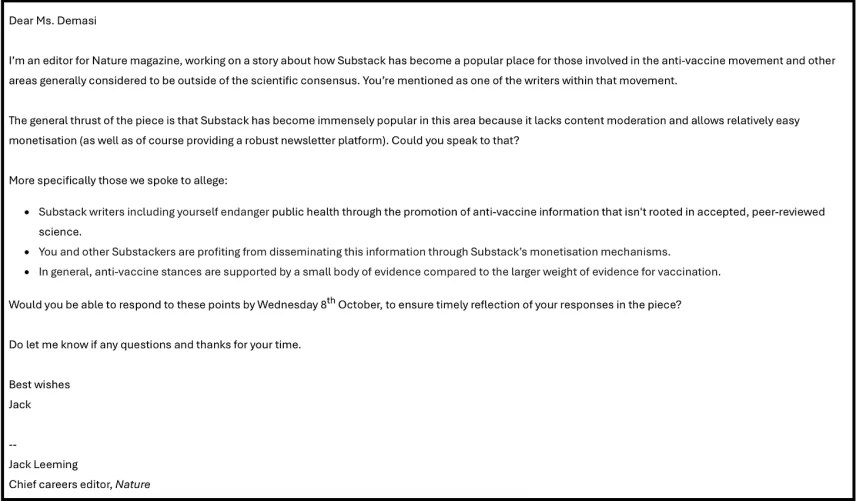
When an editor from Nature emailed me this week, it wasn’t a neutral request for comment. It was a prelude to a hit piece — filled with defamatory accusations and framed around a predetermined narrative.
According to the email, I was being lumped into an “anti-vaccine movement,” accused of “endangering public health,” and “profiting from disseminating misinformation.”
No evidence was provided. No articles were cited. No definition of “anti-vaccine” was offered. No complainants were named. Just blanket accusations intended as a character assassination.
Conflict of interest at the heart of Nature
And who is casting these stones?
Nature — a journal that publishes vaccine research while pocketing revenue from pharmaceutical advertising and sponsored content.
To then assign an editor to target independent journalists who scrutinise that very industry is a glaring conflict of interest.
A medical journal acting as both mouthpiece and judge of what counts as “misinformation” is like a tobacco company funding lung health studies while attacking anyone who questions them.
The hypocrisy is staggering.
On its own website, Nature boasts of partnerships with Johnson & Johnson, Merck, AstraZeneca and other vaccine companies, dressing them up as “pioneering collaborations” to “support science.” It even publishes paid advertising features.

Meanwhile, I’ve never taken a cent from the drug industry. My work is sustained by readers who choose to support independent journalism.
Yet Nature accuses me of “profiting” — as if being funded by the public is more corrupting than raking in thousands, if not millions, from the very companies you’re supposed to scrutinise.
To test how deep the rot runs, I’ve requested that Nature disclose its advertising revenue for the past decade, broken down by pharmaceutical corporations, government agencies, and NGOs.
I will publish those figures if and when they are provided.
Loaded language
Nature’s email branded me part of an “anti-vaccine movement.” But what does that actually mean?
Is questioning regulatory capture “anti-vaccine”?
Is demanding the timely publication of safety signals “anti-vaccine”?
Is exposing the failures of the vaccine injury compensation scheme “anti-vaccine”?
Is pointing out the poor oversight of vaccine trials “anti-vaccine”?
By that logic, critics of arsenic in drinking water would be “anti-arsenic,” and anyone calling for safer driving would be “anti-car.” The absurdity is obvious, yet the label is useful to silence debate.
And the email’s language was revealing.
Phrases like “scientific consensus” and “peer-reviewed science” are waved around like trump cards, but in practice they are red flags — appeals to authority rather than evidence.
‘Consensus’ can be manufactured. And ‘peer review’ is no shield against corruption when journals themselves are compromised.
I have documented journal–pharma ties, the retraction of inconvenient studies, and the use of pharma-funded “fact checks” masquerading as science to discredit politically uncomfortable findings.
So when an editor of Nature hides behind these clichés instead of addressing the evidence I present, it tells you everything. This isn’t about protecting science, it’s about protecting a narrative.
And I’m clearly not the only target.
Dr Robert Malone — also a Substack publisher and now a member of the CDC’s Advisory Committee on Immunisation Practice — received the same media request from Nature.
The journal’s smear campaign extends even to those who now sit on America’s top vaccine advisory body.
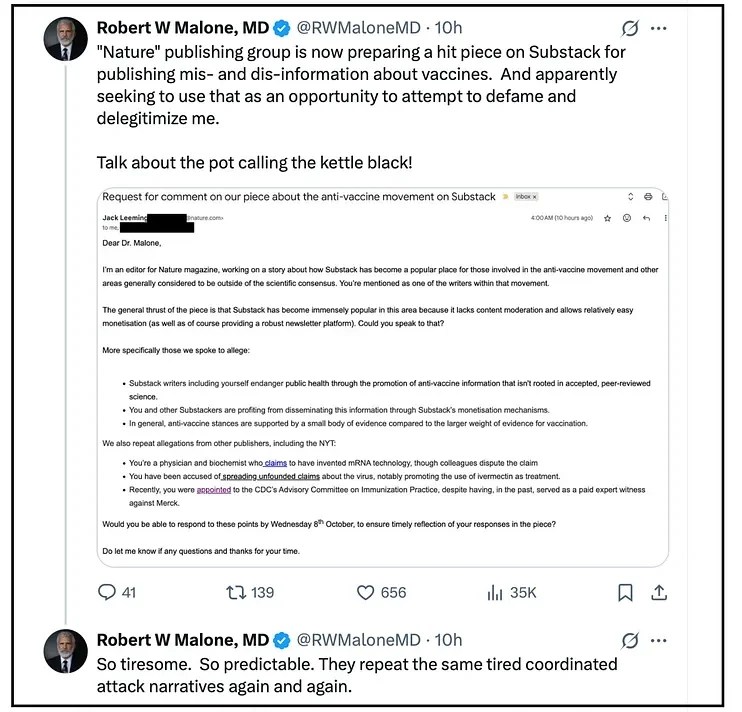
Nature insists that “anti-vaccine stances are supported by a small body of evidence compared to the larger weight of evidence for vaccination.”
But that’s probably because journals act as gatekeepers, blocking challenges to orthodoxy and shutting out novel viewpoints. Studies that raise concerns are rejected, buried or retracted, while industry-friendly findings sail through unopposed.
It isn’t the science that’s lacking — it’s the willingness of journals to let inconvenient results see the light of day. The house of cards is collapsing, and that is why the attacks on dissent are more aggressive than ever.
And those attacks often come from self-proclaimed experts who are themselves conflicted, embedded in institutions sustained by the teat of industry, and unwilling to disclose their own conflicts.
Pot calling the kettle black: the Proximal Origin scandal
Notably, while Nature postures as a guardian against “misinformation,” it bears responsibility for one of the pandemic’s most notorious scandals.
In March 2020, Nature Medicine — part of the Nature portfolio — published “The proximal origin of SARS-CoV-2,” which declared the virus could not have been engineered in a lab.
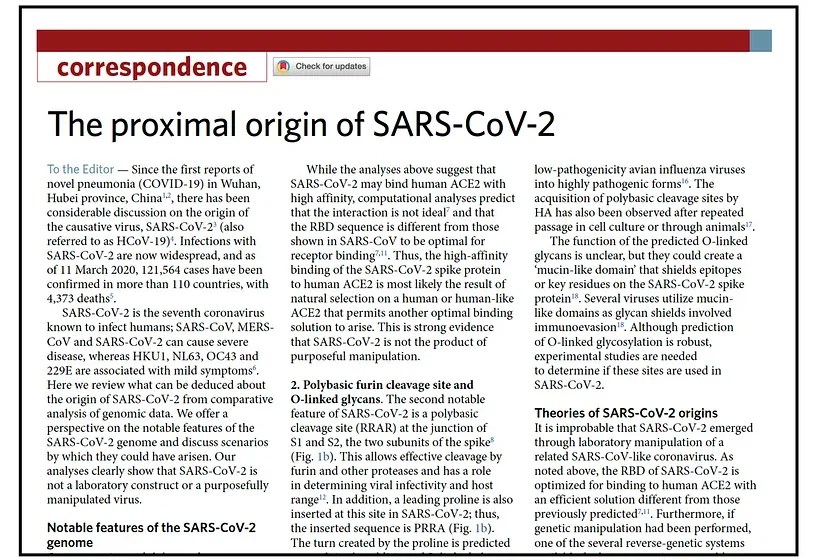
The paper was splashed across headlines and weaponised to dismiss the lab-leak theory as a “conspiracy.”
But private emails and Slack chats told another story. The authors harboured serious doubts and admitted a lab origin could not be ruled out.
Hundreds of scientists now call the paper a ‘political tract’ dressed up as science, and thousands have petitioned for its retraction. Yet Nature Medicine refuses, brushing it aside as a “point of view” piece.
If that isn’t misinformation, then what is?
Even the White House has distanced itself. Its website now acknowledges that the Proximal Origin paper was used to suppress debate, and alleges the authors were nudged by Dr Fauci to push the “preferred” zoonotic origin narrative.
Time for accountability
Make no mistake, this is ‘the system’ at work.
Powerful journals with financial ties to industry unleashing hatchet men to smear independent journalists and scientists, rather than engaging with evidence.
I won’t play along. My job is to hold institutions accountable, not to curry their favour. If Nature wants to brand that “misinformation,” so be it. History shows that today’s heresy is often tomorrow’s truth.
This goes to the heart of the corruption of medical publishing — a system Robert F. Kennedy Jr has repeatedly warned about, and one that now demands scrutiny at the highest levels.
With Dr Jay Bhattacharya at the helm of the National Institutes of Health, there is finally an opportunity to investigate the conflicts of interest, selective censorship, and financial entanglements that journals like Nature have normalised.
When those who profit from pharma partnerships claim the authority to police what lies “outside the scientific consensus,” public trust in science collapses.
And that collapse is not the fault of independent journalists asking hard questions. It is the fault of journals that serve industry interests over science.
Australia’s “eSafety” Commissioner Holds 2,600+ Records Tracking Christian Media Outlet
By Cindy Harper | Reclaim The Net | October 3, 2025
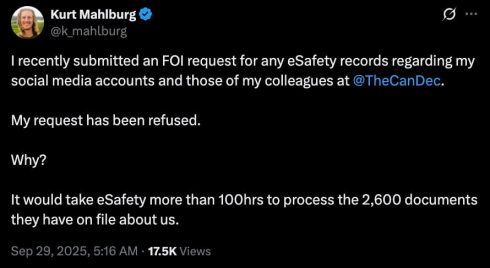
Australia’s online safety regulator is refusing to process a Freedom of Information request that would expose how it has tracked the activity of a prominent Christian media outlet and its leaders, citing excessive workload as the reason for denial.
The office of eSafety Commissioner Julie Inman Grant has confirmed it is holding more than 2,600 records connected to The Daily Declaration, its founding body The Canberra Declaration, and three of its editorial figures: Warwick Marsh, Samuel Hartwich, and Kurt Mahlburg.
Despite admitting the existence of these records, the agency says reviewing them would take more than 100 hours and would therefore unreasonably impact its operations.
In a formal response dated 29 September, the regulator explained that it had identified thousands of documents referencing the group and its members. “Processing a request of this size would substantially impact eSafety’s operations,” the notice read.
The documents include media monitoring reports automatically generated whenever The Daily Declaration or its editors have posted online about the regulator or been tagged in relevant conversations.
Every mention gets captured by automated tracking tools, creating a growing pile of files that the agency now claims is too large to review.
After filtering for duplicates, around 650 documents were considered potentially relevant.
Yet the agency still refused, estimating that sorting and redacting them would consume over 100 hours. That figure triggers what the law defines as a “practical refusal,” giving agencies legal cover to reject the request altogether.
Government departments are allowed to deny FOI requests if they consider them too broad or resource-heavy.
But in this case, the regulator’s own mass monitoring appears to be the reason it can now avoid public scrutiny.
A system that routinely generates digital records of online commentary is then used to block access to those very records, effectively protecting the agency from oversight.
Mahlburg, senior editor at The Daily Declaration, called out the move, saying, “The very mechanism designed to protect Australians ends up shielding the government from scrutiny.”
The Commissioner’s office has given a deadline of 13 October for the request to be narrowed.
If that does not happen, it will be treated as withdrawn, and none of the 2,600 documents will be released.
Suggested limitations include trimming the date range, excluding auto-generated reports, or focusing only on specific individuals.
Although The Daily Declaration has said it will resubmit the FOI request with a more restricted scope, the case raises broader concerns. The regulator has amassed a significant database tracking Christian organizations and individuals who speak on topics such as faith, freedom, and family.
By leaning on its own volume of monitoring data to block transparency, the agency sets a dangerous precedent.
While the public is told this is a matter of efficiency, the reality is that routine surveillance of dissenting voices is being shielded from exposure. The more the agency monitors, the easier it becomes to deny public access.
New York Imposes Law Forcing Social Media to Justify Speech Policies to State Authorities
By Cindy Harper | Reclaim The Net | October 3, 2025
Social media companies operating in New York are now under fresh legal obligations as the state enforces the so-called “Stop Hiding Hate Act,” a new compelled speech law that forces platforms with annual revenues exceeding $100 million to hand over detailed reports on how they handle various forms of speech, including speech that is legally protected under the First Amendment.
The legislation went into effect on October 1 and has already triggered a constitutional showdown in court.
The law, officially Senate Bill S895B, demands biannual disclosures to the state Attorney General’s office.
These reports must outline how platforms define terms such as “hate speech,” “misinformation,” “harassment,” “disinformation,” and “extremism.”
Companies are also required to explain what moderation practices they apply to those categories and to provide specifics about actions taken against users and content.
Platforms that fail to comply face penalties of up to $15,000 per violation, per day. Injunctive action can also be taken against non-compliant entities.
Attorney General Letitia James declared that the law is about transparency and oversight.
“With violence and polarization on the rise, social media companies must ensure that their platforms don’t fuel hateful rhetoric and disinformation,” she said in a public statement, reinforcing her view that private companies should be accountable to the state for how they manage user expression.
“The Stop Hiding Hate Act requires social media companies to share their content moderation policies publicly and with my office to ensure that these companies are more transparent about how they are addressing harmful content on their platforms.”
Governor Kathy Hochul voiced similar sentiments, saying the legislation “builds on our efforts to improve safety online and marks an important step to increase transparency and accountability.”
The reporting rules, however, do not simply demand that companies disclose general moderation policies. They compel platforms to state clearly how they define some of the most politically charged and subjective categories of online content. These include terms that do not have universally accepted definitions and that often serve as the basis for viewpoint discrimination.
This government demand for compelled speech is at the heart of a legal battle now playing out in federal court.
In June 2025, X Corp., the company behind the X platform, filed a lawsuit challenging the constitutionality of the law.
The company’s complaint argues that Senate Bill S895B is a direct assault on editorial discretion and a violation of free speech rights enshrined in both the US and New York Constitutions.
According to the complaint, the law imposes “an impermissible attempt by the State to inject itself into the content-moderation editorial process.” X warns that the statute operates as a tool to pressure platforms into adopting government-favored positions on disputed topics.
Key to X’s legal objection is what it refers to as the “Content Category Report Provisions.” These provisions, the company argues, effectively force platforms to accept the state’s framing of controversial topics, including “foreign political interference” and “hate speech,” regardless of how a private entity might choose to treat or define such categories independently.
The lawsuit also highlights the heavy financial threat tied to non-compliance, noting that fines can reach $15,000 per day for every violation. In addition, platforms could face legal action from the Attorney General’s office.
In defending its position, X Corp. references a victory it recently secured in a separate First Amendment case involving a similar law in California. There, the Ninth Circuit ruled that forced reporting of this nature likely constitutes compelled non-commercial speech and does not hold up under strict scrutiny.
The court concluded that forcing platforms to adopt state-defined language “amounts to compelled speech,” a stance X Corp. is urging the Southern District of New York to follow.
The company’s lawsuit goes a step further, pointing to legislative bias as motivation for the law’s passage.
According to the complaint, New York lawmakers refused to engage with X’s representatives in the wake of the California ruling, explicitly citing their disapproval of Elon Musk’s public statements and use of the platform.
In correspondence included in the court filing, lawmakers dismissed the company’s concerns because, in their words, Musk had used X to promote content that “threatens the foundations of our democracy.”
That remark, X argues, reveals a plainly unconstitutional motive rooted in viewpoint discrimination. “The government cannot do indirectly what [it] is barred from doing directly,” the complaint states, referencing controlling Supreme Court precedent.
Despite the ongoing litigation, New York officials are moving forward with the law’s enforcement.
Senator Brad Hoylman-Sigal, one of the bill’s sponsors, defended the policy as a necessary countermeasure to what he described as real and potential violence driven by online speech. “The Stop Hiding Hate Act will ensure that New Yorkers are able to know what social media companies are doing (or not doing) to stop the spread of hatred and misinformation on their platforms,” he said.
The outcome of the lawsuit could have wide-reaching implications not only for companies operating in New York but also for how much power states can exert over online speech. For now, platforms face a stark choice: speak as the state demands or risk steep penalties for silence.
Will California Zionise K-12 Education?
By Rick Sterling | Global Research | October 2, 2025
Factual information about Israel and Palestine may soon be outlawed in the California K-12 school system. Assembly Bill 715 is currently on Governor Newsom’s desk. The legislation was recently rushed through the California legislature, amended just days before passage, and voted on at 1 a.m. with almost no time for public comment.
The hurry is intentional because opposition grows whenever people learn about it. AB715 is opposed by educators across the spectrum, including the California Teachers Association, California Faculty Association, Association of School Board Administrators, California School Boards Association, and Council of UC Faculty Associations. Civil rights organizations, such as ACLU Action, also oppose the legislation.
What It Purports to Do
Assembly Bill 715 aims to “prevent antisemitism.” It asserts, “Jewish and Israeli pupils are facing a widespread surge in antisemitic discrimination, harassment, and bullying. In many cases, such discrimination, harassment, and bullying has been so severe and pervasive that it has placed Jewish pupils at risk, or completely impeded their ability to learn or engage in school programs or activities.”
The Anti-Defamation League (ADL) is the main source for the claim that there is a “widespread surge” in antisemitism. Their accuracy is widely disputed. As the Jewish Currents publication reports, “A line-by-line reassessment of the organization’s data illuminates the flaws in its methodology.”
There is already protection in the California Education Code for genuine cases of discrimination or bullying. Section 220 of the code specifies that “No person shall be subjected to discrimination on the basis of disability, gender, gender identity, gender expression, nationality, race or ethnicity, religion, sexual orientation, or any other characteristic that is contained in the definition of hate crimes.” Through their ethnicity and religion, Jewish students are clearly a protected group. So are Israeli students. They can file claims of discrimination under existing legislation.
What It Will Actually Do
AB715 aims to expand the definition of “discrimination” and outlaw any textbook, instructional material, or course content that “would subject a pupil to unlawful discrimination.”
But what is “unlawful discrimination”? AB715 specifies that the U.S. National Strategy to Counter Antisemitism is the basis for identifying antisemitism. That report asserts, “Jewish students and educators are targeted for derision and exclusion on college campuses, often because of their real or perceived views about the State of Israel. When Jews are targeted because of their beliefs or their identity, when Israel is singled out because of anti-Jewish hatred, that is antisemitism.” The document claims, “an unshakeable commitment to the State of Israel’s right to exist, its legitimacy, and its security. In addition, we recognize and celebrate the deep historical, religious, cultural, and other ties many American Jews and other Americans have to Israel.”
The U.S. National Strategy to Counter Antisemitism embraces the controversial “working definition” of antisemitism advanced by the International Holocaust Remembrance Alliance (IHRA). This definition has been widely criticized for its conflation of antisemitism with anti-zionism and criticism of the State of Israel. Over 100 human rights and civil society organizations reject the IHRA definition. Yet this is the definition which AB715 is based on.
If passed, AB715 will result in strict regulation of education and educational material that might subject Jewish students to “unlawful discrimination”. Facts and informed opinions about the reality in Israel and Palestine may be considered “antisemitic” or likely to cause discomfort. For example, students will not learn:
- The International Criminal Court has issued an arrest warrant for Israeli PM Netanyahu charging him with crimes against humanity.
- The International Association of Genocide Scholars determined that Israel is committing genocide in Gaza.
- Human Rights Watch, Amnesty International and Israel’s B’Tselem have ALL independently investigated and determined that Israel is an apartheid state.
- The greatest scientist of the 20th century, Albert Einstein, was against the creation a Jewish state and sought a binational Arab Jewish state in Palestine.
- In 1948, Einstein, Hanna Arendt, and other Jewish leaders denounced Menachim Begin as a Nazi and fascist.
- The Israeli newspaper Haaretz documents a Jewish scholar who was zionist but now supports Hamas and considers their armed resistance legitimate and legal.
All of the above are facts and assessments by credible organizations and individuals. AB715 is so vague yet sweeping that such education about Israel and Palestine may be considered “unlawful discrimination” against a pro-Israel student and therefore prohibited.
The Costs of AB715
If passed, AB715 will cost Californians dearly. It mandates the creation of a new Office of Civil Rights with an Antisemitism Prevention Coordinator and staff producing regular reports, investigations, etc. Incredibly, AB715 allows any member of the public to file a complaint, even anonymously. These complaints must be investigated and responded to within time requirements. School boards and superintendents, already busy, will have to spend precious time and resources investigating each and every complaint in a timely manner. The predictable result will be fear or prohibition on saying anything about Israel or Palestine. The Antisemitism Prevention Coordinator is also mandated to provide antisemitism education to teachers, administrators, and school boards.
Under California’s “Golden State Plan to Counter Antisemitism,” millions of dollars are appropriated for education about the genocide which ended 80 years ago. Meanwhile, there is no funding and it appears the California legislature seeks to prevent education about the genocide happening today in Gaza.
Making it even worse, AB715 invites lawsuits which will further burden the education system. The legislation says, “Civil law remedies, including but not limited to injunctions, restraining orders, or other remedies, may also be available to complainants.” Under AB715, as a gift for zionist activists, any member of the public can be a complainant.
AB715 Should Not Be Signed into Law
The organizations representing California teachers, adminstrators, school superintendents and school boards are ALL against this legislation. AB715 will be costly, wasteful, and damaging to K-12 education in California. Where there are genuine cases of discrimination or bullying, existing legislation is adequate. All students are protected against discrimination or bullying under section 220 of the California Education Code. Where Jewish or Israeli students have been victimized, they have the same recourse as all students. They do not need preferential treatment.
Teaching facts and expert opinions about Israel and Palestine is not antisemitic. It is history and current events.
Feeling uncomfortable when learning some facts or opinions is not being a victim; it is being educated. People can disagree and have different perceptions; they should not be prevented from hearing facts and different perspectives.
The intent of AB715 is clear: to restrict factual information about an important region of the world and to punish educators who present the Palestinian and anti-zionist Jewish perspective. Governor Newsom should not sign the legislation. To encourage him to make the right decision, contact him via this link.
This legislation does not prevent antisemitism; it actually promotes it by demonstrating that major Jewish organizations and the Jewish Legislative Caucus have the power to push this legislation which will deny the history and current reality of the Palestinian people. Meanwhile, Jewish Voice for Peace and organizations across the education profession are working hard to stop this assault on the California education system.
Recognise a state and prevent it from existing?
By José Goulão | Strategic Culture Foundation | October 2, 2025
And suddenly, the overwhelming majority of countries in the so-called Collective West decided to recognise the State of Palestine. Among them were some of the most loyal allies of the Zionist regime and accomplices to its atrocities, such as France, the United Kingdom, Australia, Canada and even, despite its negligible specific weight, the government of the Portuguese Republic. We know that consistency is not the strong point of the Montenegro clique: recognition was declared just a few weeks after the Minister of Foreign Affairs, Paulo Rangel, went to bless the crimes of the Israeli regime, precisely at one of the most intense stages of human and physical devastation in the Gaza Strip.
Any reader will naturally wonder what has now led so many important countries, the guardians of “our civilisation”, to adopt a stance that they could, and should, have taken years ago. Was it the blatant and dramatic exposure of the decades-old genocide of the Palestinian people, which is ravaging the Gaza Strip and which the hypocrisy of fine words and the most beautiful intentions can no longer hide? Perhaps a little, although we should not attach too much importance to this response because shame is not something that abounds in Western governments.
Another reason, this one with a much more important political and strategic significance, is the certainty of all those making the declarations that their decision, apart from being couched in plenty of half-truths, has no practical effect on the real recognition of Palestinian rights and on the murderous conduct of the State of Israel. On the same days that the declarations of recognition were made, the Zionist Prime Minister, Benjamin Netanyahu, assured with complete conviction that there would never be a Palestinian state. This was a challenge to the attitudes of Western countries, which they received with the most devout silence.
And now?
The most relevant situation, and also the one that raises the most doubts about the genuineness of Western governments’ intentions regarding the restoration of the rights of the Palestinian people, is based on a simple question: What now?
Yes, what could these declarations of recognition of the State of Palestine change in the current situation, controlled by the fascist impulses of the Israeli government and the US administration, this time under Trump’s baton – as it could be, with the same effects, under Biden’s orders?
At first glance, they will change nothing. Colonial and expansionist arbitrariness continues unabated in East Jerusalem and from north to south in the West Bank, while the human and physical levelling of Gaza continues unhindered, except for the guerrilla pockets of Hamas.
Western governments have recognised an abstract state with no effective powers over what should be its territory, disappearing every day in the face of the genocidal advances of hordes of settlers imported from all over the planet. Are Western governments doing anything concrete to force Israel to stop colonisation? Are they stopping sending weapons to Israel? Are they considering imposing sanctions capable of suffocating a state run by a criminal clique that is incapable of living on its own?
So far, there is no indication that any of the Western powers are willing to take these steps, which are essential if any qualitative changes in the balance of power throughout Palestine are to lead to negotiations capable of defining the paths for establishing and applying international law in the region. This would imply that, at least in this case, Western leaders would have to put aside their bureaucratic adherence to the ‘rules-based international order’ defined in Washington. The truth is that no government seems willing to take this risk, which, in practice and under these conditions, reveals that recognising or not recognising the State of Palestine will amount to the same thing, that is, more of the same.
Recognise, yes, but…
Western governments have been careful (which opens the door to backtracking) not to recognise the State of Palestine unconditionally, thus continuing to put the strict application of the principles established by international law on hold. Endowed with authority and power granted by five centuries of colonial violence, which allowed them to invent an entity such as the State of Israel, Western governments have attached a series of conditions to the decision. Taken literally, these translate into recognition without recognition because they effectively limit the Palestinian people’s decision-making powers on matters that concern them and on which only they have the right to deliberate.
In a manoeuvre that transfigures much of what is positive about recognition, Western governments are attempting to breathe new life into Mahmoud Abbas’s moribund Palestinian Authority, confined to Ramallah, by giving it powers that it will be unable to exercise. They also demand its absolute surrender to Israel – a demand that is unnecessary in the situation that has been dragging on throughout this century – and they attribute sole responsibility for terrorism in Palestine to Hamas, while ignoring Israeli terror – disguised as ‘security’ and ‘right to exist’. As always, this double standard vitiates the very declarations of recognition from the outset.
The condition that demonstrates how hypocritical and, for now, useless the declarations of recognition are, however, relates to the demand for the disarmament not only of Hamas but of all structures of the Palestinian Resistance. Such demands leave the entire Palestinian people even more helpless and at the mercy of the criminal free will of the Zionist regime, which can thus pursue its genocidal goal, free from any hindrance, while remaining exempt from accountability before international bodies. In the practical consequences of the measures imposed by Western governments in exchange for the recognition of the State of Palestine, the Zionist state would find the best of all worlds and the full realisation of all its objectives.
The shadow of collaborationism
The most recent developments in the recognition process help to dispel some uncertainties about the interests that lie behind the decision, which are not favourable to the Palestinian people.
It was clear from the outset that the recognition of Palestinian independence by Western governments was not, it bears repeating, unconditional. Most of the speeches on the subject clearly overvalued the Palestinian Authority, which is inactive in practice and, more seriously, entirely conditioned by Israel’s demands. The “shared” management of much of the West Bank between the Ramallah government and the Zionist occupation forces means, in fact, that the former has been placed at the service of the latter’s interests. This is often confirmed by the actions of the Palestinian police forces in repressive actions against the Palestinian population itself.
This situation suits Western governments because it means that the ‘autonomous’ authorities are willing to collaborate in ways that run counter to the legitimate interests of the Palestinian people, which have never been recognised by Western states.
At the same time, the West attributes sole representation of the Palestinians to the decrepit Palestinian Authority and its leader Mahmoud Abbas, who is in fact perpetuated in power despite being completely hamstrung by Israel and the United States. It should be remembered, as it is a fact, that his accession to the presidency was achieved through a soft coup organised in 1994 by the United States, Israel and Western powers, as a result of which the historic leader of the Resistance, Yasser Arafat, was removed from the main positions of power (to which he had been elected) and assassinated a few months later.
It should also be remembered that Mahmoud Abbas, very recently described as ‘pragmatic’ by a pro-Israeli publication such as the weekly newspaper Expresso, was received at the White House, from where Arafat had been banned, shortly after taking office as president of the so-called ‘Autonomy’ in 1994.
These circumstances help to better understand the Western constraints that accompanied the recognition of independence. And they lead to the elementary conclusion that there will be no representative entity that reflects the will of the Palestinian people without the holding of free, open and democratic general elections under the control of international bodies supervised by the UN. This process cannot involve the intervention of Israel and the United States of America, which is by definition biased and self-serving.
Another demand common to Western governments is that the Resistance (wrongly and maliciously equated with Hamas) should ‘renounce’ terrorism, that is, armed struggle, while, it should be repeated, sparing Israeli terrorism. This ‘renunciation’ must be accompanied by the disarmament of the Resistance, which means the total surrender of the Palestinian people to the discretionary and genocidal power of Israel. From this perspective, the recognition of Palestine becomes a poisoned gift.
Abbas’ recent speech to the UN General Assembly, delivered via the internet because, this time, the Trump administration illegally refused to grant the Palestinian president a visa to travel to New York, confirmed the existence of dangerous collaboration with Israeli and Western colonial interests.
Mahmoud Abbas, as Palestinian president, promised that ‘Hamas will never be the government’. But how can the most prominent Palestinian leader, whose party was defeated in the last general elections held in the occupied territories, promise that the most voted political force (according to the last poll, held more than 15 years ago) will not be able to govern the state? By manipulating the election results? By adopting a single-party regime or a personal dictatorship? By preventing a party with significant popular support, Hamas or any other, from being a legitimate and necessary part of a majority government? Let us remember that Abbas and his Western and Arab allies prevented Hamas from governing after it won an absolute majority in free elections; and that, despite multiple negotiations and supposed draft agreements, they always sabotaged the creation of ‘national unity governments’ that would have brought Gaza, the West Bank and East Jerusalem under the same ‘autonomous government’. ‘One of our strategic objectives is to maintain the separation between Gaza and the West Bank,’ Netanyahu confessed to his Likud party’s parliamentary group.
None of these paths implied in the content of the recognition statements correspond to the ‘democratic values’ proclaimed by the Western world, which seems willing to impose, through its latest decision, an authoritarian and undemocratic ‘solution’ centred on Abbas.
In his speech, the Palestinian president stated that he does not want Palestine to be ‘an armed state’. What does this idea mean, which is incompatible with the existence of a full state as established in international law? Would the defence and security of Palestine be handed over to Israel? Would the Palestinian people no longer have anyone to defend them, whether it be the armed resistance or the state apparatus?
In his time, shortly before being assassinated by Zionism in 1995, Israeli Prime Minister Isaac Rabin admitted that the maximum status he would grant to a Palestinian entity at the end of the ‘peace process’ would be ‘less than a state’. Have Mahmoud Abbas and the Western leaders who manipulate him revived this idea? Will Palestine ‘less than a state’ be the future state of Palestine as understood? There will be no better way, then, already considered as the ‘final solution’ to the problem, for the continuation of genocide and the creation of Greater Israel – throughout Palestine, as a first step.
The fundamental question, however, remains: what will come after the recognition of independence, given that Israel occupies almost the entire territory where this state would be created? What will Western countries do to give substance to their decision? It should be remembered that international law requires the creation of an ‘independent and viable’ Palestinian state. In prosaic terms, a state like any other. However, this is not what is being planned, with the collaboration of the incompetent Palestinian Authority. Israel’s dizzying policy of creating settlements is gradually eating away at the territory that is essential for the creation of a viable state. Taking a clear-headed view, the Portuguese head of state admitted that one day there will be no territory left to establish a state. This is a reality that I began denouncing many years ago, because it is obvious and Israel makes no secret of it. Despite recognising these circumstances, the Western world is doing nothing concrete to stop the colonisation and make the state it claims to recognise viable.
Once again, the West’s main objective has been to create propaganda and delaying tactics and, with them, to try to neutralise the increasingly strong, active and genuine solidarity of Western peoples with the Palestinian people. This solidarity cannot be allowed to wane; it must be strengthened, because if we rely on the promises and decisions of our governments, the Palestinian people will continue to be the biggest victims. And we cannot allow that to happen.
Featured Video
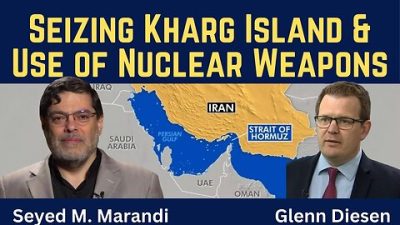
Marandi: Threat of Seizing Kharg Island & the Use of Nuclear Weapons
or go to
Aletho News Archives – Video-Images
Frlom the Archives
Provoking a Path to Persia
The Saban Center’s prescient paper on war with Iran
By Maidhc Ó Cathail | October 20, 2011
In June 2009, the Saban Center for Middle East Policy published “Which Path to Persia?—Options for a New American Strategy toward Iran.” Writing in a tone strikingly reminiscent of the Project for a New American Century’s infamous pre-9/11 paper “Rebuilding America’s Defenses,” the six co-authors noted that, “It seems highly unlikely that the United States would mount an invasion without any provocation or other buildup.” For a think tank specifically established by media mogul Haim Saban to protect Israel, this could prove to be a formidable obstacle impeding their desired march—of U.S. troops—to Tehran.
“In fact, if the United States were to decide that to garner greater international support, galvanize U.S. domestic support, and/or provide a legal justification for an invasion, it would be best to wait for an Iranian provocation, then the time frame for an invasion might stretch out indefinitely,” Saban’s think-tankers ruefully observed.
“With only one real exception, since the 1978 revolution, the Islamic Republic has never willingly provoked an American military response, although it certainly has taken actions that could have done so if Washington had been looking for a fight. Thus it is not impossible that Tehran might take some action that would justify an American invasion. And it is certainly the case that if Washington sought such a provocation, it could take actions that might make it more likely that Tehran would do so (although being too obvious about this could nullify the provocation). However, since it would be up to Iran to make the provocative move, which Iran has been wary of doing most times in the past, the United States would never know for sure when it would get the requisite Iranian provocation. In fact, it might never come at all.”
Seemingly undeterred by Iran’s frustrating unwillingness to provide the requisite provocation, the analysts continued to examine this option… continue
Blog Roll
 Aletho News
- Ukrainian Embassy in Beirut sheltering top Mossad agent
- Palestinian family displaced after settlers violently attack them in Humsa, Jordan Valley
- The EU never learns – except for the wrong lessons
- Iran attacks on UAE leaves RSF militia high and dry
- Hosting Washington’s war: Bahrain faces the consequences
- The US fell for its own Iran propaganda
- Seyed M. Marandi: Threat of Seizing Kharg Island & the Use of Nuclear Weapons
- Is there even an off ramp?
- Michael von der Schulenburg: Europe’s Self-Defeating Iran War Policy
- Sorry, The New Republic, Climate Change Isn’t Causing Somali Migration. Blame Civil Strife and Poverty.
- If Americans Knew
- ‘Of Course’: IDF Drops Case Against Soldiers Accused of Raping Palestinian Prisoner
- Don’t Fall for the Regime Change Talk. Israel Is ‘Mowing the Lawn’ in Iran
- Will Israel and the US wreck the Gulf States along with Iran?
- US so far burned through ‘years’ of munitions in Iran war: Report
- How the Israeli Tail Wags the American Dog
- Outdated intel likely led to deadly U.S. strike on Iranian elementary school, sources say
- Pentagon insider says high U.S official Douglas Feith reported to Netanyahu
- In fond memory of Walid Khalidi, the historian of Palestine
- 6 more Americans killed, as Israel ‘mows the lawn’ in Iran – Not a ceasefire Day 154
- Are we on the precipice of World War III?
- No Tricks Zone
- New Studies: UK Sea Levels Were 4 Meters Higher Than Today During The Mid-Holocene
- Destructive Green New Deal: German Energy And Metal Group Warns Of Drastic Crisis
- New Study Documents A 20-Year Pause In Arctic Sea Ice Decline – Driven By Internal Variability
- Wake-up Call: Survey Shows Majority Of Germans Now Favor Postponing Climate Targets!
- Televised! Leading German Political Candidate Tells Schoolchildren CO2 Makes Sun Hotter!
- New Study: A Century Warming Of 1.1°C Is ‘Commonplace’ And ‘Not Unusual’ During This Interglacial
- New Study: ‘Internal Noise’ And Volcanic Forcing Can Trigger 10-15°C Warming Within Decades
- Glaciers Worldwide Are Suddendly Surging, Experts Blame Warming!
- Surprising Discovery: Sahara Is Greening…Billions Of Trees Where Once Thought To Be Barren
- New Research Reaffirms Clouds, Aerosols, And Surface Solar Radiation Are ‘Driving The Climate System’
 Aletho News