‘Anything They Don’t Like Is Russian Interference’ — Clare Daly Lifts the Lid on EU Propaganda
APT | October 9, 2025
In this eye-opening session, Irish MEP and activist Clare Daly exposes the harsh reality of Europe’s so-called “defense of democracy” policies. Labeled a “Russian propagandist” simply for speaking the truth, Daly takes aim at the European Union’s disinformation framework, hybrid sanctions, and systematic crackdown on dissent.
From pro-Palestinian journalists facing travel bans and asset freezes to citizens being punished for questioning COVID measures or NATO policies, Daly reveals how words and ideas are treated as weapons and how the EU is increasingly silencing voices that challenge its narrative.
“If it’s them today, it’s you tomorrow,” warns Daly, emphasizing the urgency for citizens to organize, protect free speech, and hold European leadership accountable.
Watch as she explains how hybrid sanctions, political repression, and media control are reshaping democracy in Europe — and why everyone should pay attention before it’s too late.
Spain’s COVID restrictions declared unconstitutional, over 90k fines struck down
By Andreas Wailzer | LifeSiteNews | October 10, 2025
More than 90,000 COVID fines have been overturned so far after the Spanish constitutional court declared the draconian 2020 COVID measures unconstitutional.
As Spanish news outlet The Objective reported, 92,278 fines have been annulled as of September 3, 2025, following the declaration of certain provisions of the 2020 state of emergency decree, which was in effect during the first COVID-19 lockdown, as unconstitutional.
However, these penalties only represent the first wave of fines set to be annulled, with many more expected to follow. During the strict lockdown under the state of alarm in 2020, more than 1 million penalties were imposed nationwide, and an estimated 1.3 million people were fined for violating the prohibitive restrictions.
In its ruling, the Constitutional Court determined that certain sections of Article 7 of Royal Decree 463/2020, which pertains to the general prohibition on movement, implied an unjustified suspension of the fundamental right to freedom of movement, rather than merely a limitation. This suspension exceeded the power of the declared state of alarm, the court found. The court determined that such a severe restriction could only have been implemented under a stricter state of emergency, which requires more rigorous parliamentary proceedings.
This ruling now retroactively applies to all penalties issued during the 2020 lockdown, putting a significant burden on the administrative state. The Objective reports that “enforcement has been slow and uneven depending on each territory,” showing that the refunds could take months or years.
The Objective reiterates that the 92,278 cases revoked to date “are just the tip of the iceberg of a regulatory crisis” stemming from the draconian lockdown policies imposed by the Spanish government in 2020.
Quit Promoting Mad Schemes, New York Times, Blocking the Sun is a Dangerous Climate Gamble
By Anthony Watts | ClimateRealism | September 25, 2025
In The New York Times’ (NYT) op-ed, “Turns Out Air Pollution Was Good for Something,” Zeke Hausfather and David Keith argue that because sulfur particles from past industrial pollution once cooled the planet by reflecting sunlight, policymakers should now consider a deliberate version of that process. They suggest aircraft could inject sulfur into the upper atmosphere to mimic the cooling once provided by dirty smokestacks, pointing to volcanic eruptions such as Mount Pinatubo in 1991 as evidence the method would work. This idea is wrong-headed madness. Experience demonstrates geo-engineering ideas such as this have dangerous and unpredictable consequences.
The authors write that “geoengineering the climate in this way is not a new idea,” and claim that “a more modest approach” of maintaining present temperatures with controlled sulfur injections buys the world time for carbon dioxide reductions to continue.
But geoengineering by blocking the sun is a dangerous fool’s errand. First, the potential unintended consequences are enormous and unpredictable. Sulfur dioxide particles injected into the upper atmosphere would scatter sunlight differently depending on latitude. At middle to low latitudes, sunlight passes through less atmosphere, so scattering effects are modest. But at higher latitudes, sunlight travels through more atmosphere, amplifying scattering—just as sunsets turn red because of the increased distance light travels through more air and particles at low sun angles. Injecting reflective particles globally would therefore not create uniform cooling. It would over-cool the polar and sub-polar regions, while perhaps under-cooling equatorial areas. The result would be an uneven, artificial climate system with consequences no climate model can reliably predict.
These regional impacts would not just be academic. Farmers in Canada or Scandinavia might see shortened growing seasons. Populations in northern Russia could face colder winters. Developing nations in Africa or Asia could sue over disrupted rainfall patterns or crop failures. Geoengineering would open a legal and geopolitical Pandora’s box of claims, counterclaims, and lawsuits, as countries argue that someone else’s climate tinkering damaged their own livelihoods. Even Hausfather and Keith concede in their NYT op-ed that large-scale deployment “could exacerbate climate change in some locations, perhaps by shifting rainfall patterns.”
Aside from these uncertain consequences, one consequence of this scheme is certain, increased sulfur pollution, most likely resulting in acid rain which changes the pH of waters and damages buildings, statues, and other structures.
History warns us as well. The eruption of Mount Tambora in 1815 produced the “year without a summer” in 1816, dropping temperatures, as seen in the figure below, devastating agriculture across Europe and North America. Crops failed, famines spread, and tens of thousands perished.

More recently, Mount Pinatubo’s eruption in 1991 cooled the globe by about half a degree Celsius (0.9 degree Fahrenheit) for at least 20 months, disrupting rainfall patterns in the process. The eruption also depleted the ozone layer.
Scientists have also raised red flags about such schemes mimicking the Pinatubo eruption. A 2018 study in Nature Ecology & Evolution warned that solar geoengineering could “abruptly terminate” and trigger rapid global warming if deployment stopped. Researchers published a paper in 2022 in the journal Science of the Anthropocene, have cautioned that stratospheric aerosol injection could delay, but not prevent, ocean acidification, and could undermine incentives for emissions reductions. Back in 2014, LiveScience argued that “Geoengineering Ineffective Against Climate Change, Could Make Worse.”
These papers together strongly suggest that geoengineering via sun-blocking/aerosol injection is not a benign or risk-free option and that its consequences are highly uncertain, with many potential negative side-effects that are difficult or impossible to predict. Deliberately blocking the sun is not a climate solution—it is climate roulette.
Even advocates of the idea admit it is nothing more than a Band-Aid. As Hausfather and Keith acknowledge, “sunlight reflection is no panacea” and “treats the symptoms of climate change but not the underlying disease.” They also admit the risk of political dependency: once started, stopping a geoengineering program could trigger rapid warming rebound, a scenario far more destabilizing than gradual warming itself.
Steve Milloy, writing in the Daily Caller, explained why this notion is absurd. In “Trump’s EPA Is Right To Be Skeptical Of ‘Sun-Blocking’,” he highlighted that sulfur dioxide particles are air pollution—pollution that once drove acid rain and deadly smog events. Milloy sulfur notes that particles eventually fall back to Earth, meaning a program of perpetual injections would be required. “It sounds like a great business model on paper,” he wrote, “but people can’t just launch potentially dangerous air pollutants into the sky without some sort of guidelines and monitoring.”
The unintended consequences are not only physical but political. If wealthy nations take it upon themselves to inject particles into the stratosphere, what happens if poorer nations see droughts or floods as a result? International lawsuits and even conflicts could follow. The specter of “climate weaponization” looms large—as Milloy noted, the ability to control sunlight could be seen as a tool of geopolitical leverage.
The NYT itself might have cooled to the idea. Shortly after the op-ed was first published, the title was changed from “A Responsible way to Cool the Planet” to “Turns Out Air Pollution Was Good for Something.” Perhaps other scientists raised similar concerns as have been highlighted here and the NYT decided to walk back the “responsible” part.

The bottom line is this: blocking the sun to cool the planet is an inherently dangerous idea. Sunlight is the basis of life on Earth. Corrupting its distribution and intensity will not stabilize climate but destabilize societies. History, common sense, and scientific warnings all converge on the same conclusion: geoengineering by aerosol injection is not a solution but an invitation to chaos.
The New York Times’s op-ed promoting intentional sulfur pollution is a reversal of decades of clean air progress, representing climate recklessness, not climate realism.
World Bank Reduces Emissions, Not Poverty
By Brenda Shaffer | RealClear Energy | October 9, 2025
The World Bank Group and the International Monetary Fund will hold their annual meetings next week in Washington, DC. It is time for Secretary of the Treasury Scott Bessent to give direct guidance to the World Bank to renew funding and loans for fossil fuels for the world’s poorest. The World Bank should return to its mandate of poverty reduction, instead of climate emissions reduction.
The World Bank has banned fossil fuel finance and loan guarantees since 2019. The idea behind denying investments and funding for fossil fuels was that it would force people to adopt renewable energy. However, with no modern energy option, people turn to burning of dung, wood and other biomass for cooking and other basic functions. The result of this policy is increased emissions, pollution and health endangerment.
The World Bank describes its mission as “To create a world free of poverty — on a livable planet.” However, in reality, the World Bank promotes policies that increase energy poverty and thus overall poverty among the world’s poorest, especially in Africa. Instead of focusing on poverty elimination, the World Bank has committed to allocating 45% of its funds in 2025 to climate finance and announced its intention to increase climate finance over the next five years.
In another blatant example of its choosing to reduce carbon emissions over poverty, the World Bank promotes imposing carbon taxes in Africa on imported fossil fuels. If implemented, these taxes would lead to higher prices for electricity and transportation, which would further increase energy poverty on the continent. It is difficult to understand how raising energy costs in Africa is part of the World Bank’s poverty reduction mandate.
The lack of public funding for fossil fuels particularly hurt Africa. For the first time in decades, electricity access declined in Africa in 2022 and 2023. The halting of foreign investments and loans meant that Africans could not develop their local oil and natural gas resources. While in the West the private market provides investments for energy production, Africa is dependent on public finance to develop energy and on World Bank loan guarantees to create conditions to attract foreign investors.
In prioritizing of emissions reductions over poverty reduction, the World Bank promotes relatively expensive electricity systems, which deliver less energy access to Africa than fossil fuel based systems. Unreliable renewable electricity, especially off-grid solar, does not provide sufficient power for Africans to lift themselves out of poverty. Partial electricity can power a lamp or charge a phone, but not industry, water pumps and refrigeration, which are necessary for poverty reduction and modern medicine access.
Thus, due to the policy of promoting solar over fossil fuel derived power, many of the world’s new electricity users do not have full electricity access. The US and other World Bank funders should not allow the World Bank to count partial electricity provision as access to power.
In Africa, the World Bank no longer promotes policies for provision of baseload power in electricity supply, in order to avoid admitting that Africa needs fossil fuels. There is no large-scale stable electricity without baseload power.
The World Bank also regularly lists climate change as a main factor affecting Africa’s economy and development while not mentioning the continent’s lack of energy, which of course is a much more significant factor affecting its prosperity.
The World Bank and other Western institutions retreat from fossil fuel finance has created a significant geopolitical opportunity for China. China is willing to finance fossil fuel projects in Africa and the developing world and reap the strategic benefit of control of energy infrastructure in many countries.
Bessent’s predecessor at Treasury, Secretary Janet Yellen issued guidance to the World Bank and associate multilateral banks to stop funding for fossil fuels projects in 2021. It is time for Secretary Bessent to reverse this policy and lead the World Bank back to its mission of poverty alleviation.
Prof. Brenda Shaffer is an energy expert at the U.S. Naval Post-graduate School. @ProfBShaffer
Ukraine’s Patriot defenses ‘down to 6%’ effectiveness – retired general
RT | October 12, 2025
Kiev’s US-made Patriot air defense systems are proving increasingly ineffective at repelling Russian missile strikes, former Deputy Chief of General Staff of the Ukrainian Armed Forces Igor Romanenko has claimed.
The first of the missile systems arrived in Ukraine in April 2023 and they have been supplied by a number of NATO countries, including the United States, Germany, and the Netherlands.
Kiev does not “have that many Patriot batteries,” and the effectiveness of those at its disposal has “fallen from 42% to 6%” recently, the retired lieutenant general told Ukraine’s Espreso TV on Friday.
Romanenko attributed the development to software upgrades the Russian military has made to its Iskander missiles, which have reportedly increased their speed and maneuverability as they approach their targets.
Last week, the Financial Times, citing anonymous Ukrainian and Western officials, similarly reported that Russian missiles are now capable of following a normal arc before veering into a steep terminal dive or performing maneuvers that “confuse and avoid” Patriot interceptors. According to the paper, Moscow has likely upgraded the Iskander-M mobile system and the air-launched Kinzhal.
According to the FT, a former Ukrainian official described the improved maneuverability of the Russian missiles as a “game changer.” The outlet cited data released by the Ukrainian Air Force indicating that the interception rate of Russian ballistic missiles had improved over the summer, reaching 37% in August, but then falling to just 6% in September.
In May, Ukrainian Air Force spokesman Yury Ignat stated that the ballistic trajectories of the Iskander-M missiles had been “improved and modernized.”
The Kremlin has consistently maintained that no amount of Western military aid to Ukraine can change the course of the conflict, and only serves to unnecessarily prolong the bloodshed.
On Friday, the Russian military reported launching a “massive strike” against Ukraine’s military-industrial complex and the energy facilities supporting its operations. The Russian Defense Ministry said the attack was in response to Ukrainian “terrorist attacks” on civilian facilities.
The strikes caused a large-scale blackout in Kiev, according to local media and officials. Power outages were also reported in several other regions across Ukraine. Vladimir Zelensky claimed that rainy weather and fog had prevented the Ukrainian air defenses from performing optimally.
World cities rise in solidarity with Gaza: Marches and calls to hold Israel accountable
Palestinian Information Center – October 12, 2025
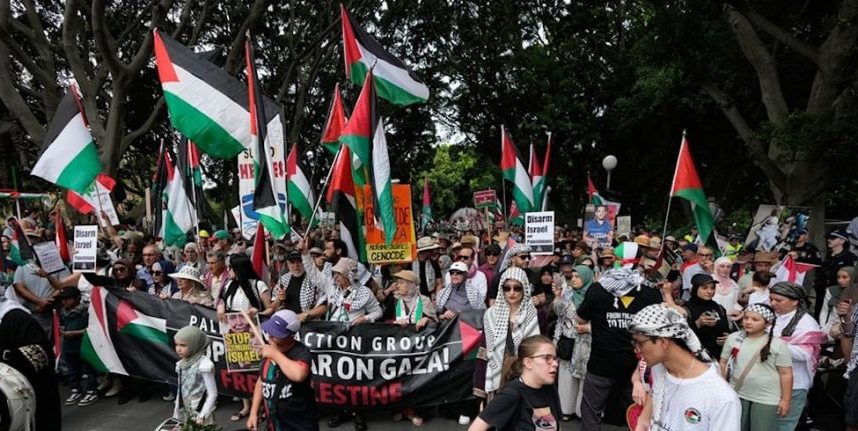
Demonstrations and solidarity rallies with the Palestinian people continued across various capitals and cities around the world, in a scene that reflects the growing global awareness of the scale of the humanitarian catastrophe caused by the Israeli aggression on the Gaza Strip, along with mounting calls to hold Israel accountable and end the ongoing genocide that has lasted for two years.
In Australia, the group Palestine Action said that demonstrations took place on Sunday in 27 cities and towns in support of the Palestinians, most notably in Sydney, Melbourne, and Brisbane. Protesters demanded that the government impose sanctions on Israel and halt all arms exports to it, stressing that continued cooperation with a state committing war crimes constitutes political and moral complicity.
In Indonesia, thousands gathered at Independence Square in central Jakarta to celebrate the ceasefire in Gaza, chanting slogans rejecting all forms of normalization with Israel, political, commercial, and sporting alike. They also expressed solidarity with Palestinians in the West Bank, who continue to face escalating assaults and raids by Israeli forces.
In Seoul, the South Korean capital, a solidarity protest was held calling for the rapid entry of humanitarian aid into Gaza and the lifting of the siege imposed for more than two years. Participants raised Palestinian flags and chanted for an end to the suffering of civilians.
Massive marches were held in London, where organizers said around half a million people took part in a demonstration that filled the streets of the British capital and headed toward the government headquarters on Downing Street. Protesters demanded an end to arms sales to Israel and accountability for those responsible for war crimes.
Participants stressed the need to achieve justice based on international law and to end occupation and apartheid.
In Berlin, thousands of demonstrators marched from the Brandenburg Gate to the city center, calling for a halt to Israeli arms shipments and an end to official support for the war on Gaza. Protesters denounced restrictions on pro-Palestine activism in Germany and chanted slogans such as “Freedom for Palestine” and “No peace on stolen land.” Limited clashes later broke out with police, who used force and arrested several demonstrators.
In Paris, a large protest took place that included activists and healthcare workers, some of whom had served in Gaza’s hospitals during the war. They called for the release of imprisoned doctors, foremost among them Dr. Hossam Abu Safiya, and for guarantees to uphold the ceasefire and deliver urgent medical aid.
In Milan, hundreds of Italians joined a solidarity march where demonstrators demanded the reconstruction of Gaza and an end to the blockade imposed on it.
In Oslo, protests were held outside the parliament building, where participants called for the closure of the Israeli embassy and the severing of diplomatic ties with Tel Aviv.
In the Netherlands, the Plant an Olive Tree foundation organized a memorial event in Maastricht to honor the victims of the aggression, dedicated especially to Palestinian children and journalists killed in Israeli bombardments. Participants lined up in front of the historic St. Servatius Church, where photos and names of the martyrs were displayed, and thousands of children’s shoes were placed in the square in tribute to the young victims.
In Stockholm, hundreds joined a demonstration condemning the Israeli army’s attack on the Global Solidarity Flotilla, calling for a comprehensive embargo on Israel due to its repeated crimes against civilians. Protesters carried banners reading “Total blockade on Israel for a free Palestine,” before marching toward the Swedish parliament.
This global wave of protests, spanning more than thirty cities in just two days, reaffirmed that the Palestinian cause is no longer a local or regional issue, but rather a matter of global conscience calling for justice and an end to decades of occupation and collective punishment against civilians in Gaza and the West Bank.
No ground for negotiations with E3 anymore: Iran FM
Al Mayadeen | October 11, 2025
Tehran no longer sees a basis for nuclear talks with the E3 countries, Iranian Foreign Minister Abbas Araqchi stated on Saturday evening, adding that the country is not seeking it either.
Speaking to the Iranian state TV, Araghchi revealed that Washington had asked to hold direct talks with Tehran on the sidelines of the UN meetings, a message conveyed by US envoy Steve Witkoff. Iran, according to Araghchi, expressed readiness to engage, but only on the condition that representatives from the E3 countries and the IAEA Director, Rafael Grossi, be present, which the latter refused.
In this context, the top Iranian diplomat revealed that “the United States has always sought to integrate regional issues into nuclear negotiations, but we have never allowed that,” describing Washington’s positions as “constantly changing”.
Iran’s interests are red line
Regarding Tehran’s red lines, Araghchi confirmed that the interests of the Iranian people are paramount, emphasizing that while Iran will never give up its right to enrich uranium, it is willing to provide the international community with assurances, if need be, about the peaceful nature of its nuclear program.
He further criticized Europe, stating it has demonstrated a lack of independence, and indicated that Iran remains open to studying any new, fair plan from Washington as long as it respects the interests of the Iranian people, expressing a willingness to engage in dialogue.
On the topic of the Cairo Agreement, Araghchi stated, “It is currently frozen, and our cooperation with the Agency is only conducted within the framework of the Iranian parliament’s law and through the Supreme National Security Council.”
Araghchi addressed the prospect of renewed war with “Israel”, disclosing that, following an exchange between Russian President Vladimir Putin and Israeli Prime Minister Benjamin Netanyahu several days ago, Russian officials subsequently informed the Iranian ambassador in Moscow that Netanyahu has no interest in returning to a state of war with Iran.
Gaza ceasefire solely a Palestinian Resistance matter
Iranian Foreign Minister Araghchi addressed the ceasefire agreement in Gaza, denying that any discussions had taken place with Steve Witkoff concerning it, while affirming Iran’s support for any plan that would halt what he described as Israeli crimes.
Araghchi said Trump shared his view on Iran’s statement about the Gaza deal, but no messages were exchanged with Washington, adding that only the Palestinian Resistance and people can decide on a ceasefire, and no one else.
He stressed that “Israel” is not trustworthy, citing past experiences like Lebanon, which is clear proof that the entity does not honor its commitments, based on which Iran raised its concerns and issued the necessary warnings. He added that while Washington has made positive promises regarding the Gaza deal, there are doubts about its seriousness in fulfilling them, as these promises are constantly shifting.
Araghchi also noted that most foreign ministers in the region are skeptical about the future of the subsequent phases of the Gaza agreement.
On the issue of the normalization agreements, Iran’s FM noted that “these deals intrinsically constitute a sinister plan to deprive the Palestinian people of their rights,” adding that Iran’s position on such agreements is clear: “it will never join them.”
Regarding the trade war imposed by Washington, Araghchi stated that Iran would reciprocate in kind if its commercial ships were obstructed in any way under the pretext of sanctions, affirming that escalating tensions is not in anyone’s interest.
Purging America First: Inside the GOP’s Zionist Vetting Machine
By Jose Alberto Nino – The Occidental Observer – October 12, 2025
In the dimly lit corridors of Capitol Hill, where backroom deals shape American foreign policy, House Speaker Mike Johnson recently conducted what can only be described as a strategic war council. On the afternoon of September 17, 2025, Johnson gathered with a who’s who of pro-Israel organizations for a private meeting ostensively designed to eliminate dissenting voices within the Republican Party. What emerged from this closed-door session reveals a coordinated effort to ensure ideological orthodoxy on Israel.
The meeting itself reads like something out of a tired political thriller. Johnson, who described himself to the assembled group as a “Reagan Republican” focused on “peace through strength,” went on to make a startling admission that isolationism is rising within the Republican Party and that a major debate on the issue is likely once President Donald Trump leaves office.
But Johnson’s most revealing statement came when he told the group that in his candidate-recruiting efforts, he’s working to filter out isolationists to prevent that wing of the party from growing more prominent in the House. Four people who attended the meeting confirmed this extraordinary pledge to Jewish Insider.
“The speaker was very, very direct about the U.S. role with Israel and in the world and understands that there are voices that don’t agree in both parties, on both extremes, and urges us all to be involved in fighting back against those extremes,” Eric Fingerhut, CEO of the Jewish Federations of North America, told the publication.
The guest list for Johnson’s gathering was a who’s who of America’s most powerful pro-Israel organizations. In attendance were representatives from The Louis D. Brandeis Center for Human Rights Under Law, the Republican Jewish Coalition, Agudath Israel of America, AIPAC, the Simon Wiesenthal Center, Conference of Presidents of Major American Jewish Organizations, National Council of Jewish Women, Synergos Holdings, CUFI Action, the Orthodox Union, the U.S.-China Economic and Security Review Commission, Standard Industries, the American Jewish Committee, Zionist Organization of America, National Debt Relief, Jewish Institute for National Security of America, the Deborah Project, Foundation for Defense of Democracies, Coalition for Jewish Values and the Endowment for Middle East Truth. This comprehensive coalition represents the full spectrum of pro-Israel advocacy, from religious organizations to political action committees to think tanks—a formidable alliance with vast resources and influence.
The Hunt for Republican Heretics
The Israeli lobby’s crosshairs have settled on several prominent Republicans whose independence on foreign policy has made them targets. Chief among them is Rep. Thomas Massie (R-KY), whose voting record has made him perhaps the strongest opponent of Israel in Congress according to Jewish advocacy groups.
Massie’s legislative actions against pro-Israel interests are extensive and well-documented. In December 2023, at the height of Israel’s war against Hamas, Massie shared a social media post implying that Congress was more interested in “Zionism” than “American patriotism.” In October 2023, following the Hamas attack, Massie was the only Republican to vote against a bipartisan resolution standing with Israel. He was also the sole Republican to vote against the Iron Dome Supplemental Appropriations Act and the only member of either party to vote against a resolution honoring Jewish American heritage and denouncing antisemitism.
“Antisemitism is deplorable, but expanding it to include criticism of Israel is not helpful,” Massie wrote on X, explaining his vote against a resolution reaffirming Israel’s right to exist. Even more provocatively, Rep. Marjorie Taylor Greene (R-GA) has emerged as an unexpected critic from the MAGA wing. In a dramatic departure from her previous pro-Israel stance, Greene has characterized Israel’s actions in Gaza as “genocide.”
Her transformation has prompted a furious response from AIPAC, which issued a fundraising message comparing her to progressive Democrats Rashida Tlaib and Ilhan Omar:
Let’s call this what it is: Marjorie Taylor Greene is the newest member of the anti-Israel Squad. She may think this earns her praise from the far-left or online radicals — but we see it for what it is: a betrayal of American values and a dangerous distortion of the truth.
In response to AIPAC’s attack against her, Greene has doubled down, telling One America News Network that AIPAC should register as a foreign lobbyist and posting a photograph of a sign on her office door reading “no foreign lobbying.” She has accused Israel of having “incredible influence and control” over nearly every member of Congress, exposing pro-Israel lobby trips that she argues amount to foreign lobbying without accountability.
LinkBookmarkPerhaps nowhere is the Israeli lobby’s intervention more telling than in Texas’s 23rd Congressional District, where gun rights YouTuber Brandon Herrera mounted a formidable challenge against moderate Republican incumbent Tony Gonzales last election cycle. Herrera, known as “the AK Guy” to his 4.4 million YouTube subscribers, came within 354 votes of unseating Gonzales in the 2024 primary runoff.
Gonzales, a 20-year Navy veteran and cryptologist who rose to the rank of Master Chief Petty Officer, built his political résumé through Washington’s national security circles. He served as a legislative fellow in Senator Marco Rubio’s office and was a National Security Fellow at the pro-Israel Foundation for Defense of Democracies (FDD), a neoconservative think tank known for its hawkish foreign policy stance. In Congress, Gonzales has reflected that worldview by backing aid to Ukraine and Israel, stating that “if we fail to support our allies, China, Russia, and Iran will only become more powerful” with regard to a military aid spending package pending final passage in the U.S. House in April 2024.
The closeness of this race terrified pro-Israel groups, who saw Herrera as a genuine threat to their influence. AIPAC’s United Democracy Project spent $1 million opposing Herrera in a two-week ad buy, while the Republican Jewish Coalition added $400,000 in attack ads.
More significantly for the lobby’s concerns, Herrera had stated he would have voted against supplemental aid to Israel and other U.S. allies. “I would absolutely vote AGAINST the new proposed spending package for $95+ billion for foreign conflicts, while spending $0 on our southern border,” Herrera posted on X on April 19, 2024. “Any Republican who claims to be America first CANNOT vote for America last legislation.”
When asked directly whether he would pledge to end foreign aid, including to Israel, Herrera reiterated his position: “We can’t claim to be ‘America First’ while pushing spending bills like the most recent foreign aid package that gave almost $100 billion to every country except the US.”
The combined $1.4–1.5 million in spending by AIPAC and RJC helped Gonzales narrowly survive with 50.6% to 49.4%—a margin so slim it demonstrated the growing threat posed by America First candidates to the establishment’s foreign policy consensus. Herrera has already announced his intention to challenge Gonzales again in the 2026 Republican primaries, setting up another expensive battle. This time, the political winds may finally shift in Herrera’s favor.
The most audacious display of the Israeli lobby’s power may be their campaign against Thomas Massie. Pro-Israel Republican megadonors have established the MAGA Kentucky super PAC with $2 million specifically to oust the congressman. Paul Singer contributed $1 million, John Paulson added $250,000, and Miriam Adelson’s Preserve America PAC provided $750,000.
This goes far beyond normal political opposition; it’s a declaration of total war against foreign policy dissent among Republican ranks. AIPAC has already demonstrated this approach works. During the 2024 election cycle, AIPAC’s independent spending arm, the United Democracy Project, spent over $300,000 on Fox affiliate ads criticizing Massie’s voting record. UDP spokesperson Patrick Dorton did not mince words about UDP’s attacks against Massie: “We are not playing in the primary, but we are trying to shine a light on the radical anti-Israel record of Tom Massie. We want every single voter in the state of Kentucky to know about his anti-Israel actions.”
The Post-October 7 Reality
The October 7 Hamas attacks fundamentally transformed the Israeli lobby’s strategy and urgency. AIPAC increased its political spending nearly threefold in the months following the attacks, with average weekly spending jumping from $275,000 to over $740,000.
“Our focus in the 2024 election is to broaden and strengthen the bipartisan pro-Israel majority in Congress — and to defeat anti-Israel detractors,” AIPAC spokesman Marshall Wittmann told Capital News Service. “In the aftermath of the Hamas barbaric attack and the mounting threats of Iranian terrorist proxies, the importance of a pro-Israel Congress standing with our ally is clearer than ever.”
This represents more than increased spending; it’s a systematic campaign to ensure ideological conformity. The Israeli lobby’s post-October 7 mobilization has created what one Democratic donor adviser called “a huge, underappreciated change to the landscape.” Thousands of smaller donors who weren’t previously engaged have been activated, providing the financial foundation for an unprecedented intervention in American electoral politics.
Johnson’s pledge to “filter out isolationists” in candidate recruitment represents the institutionalization of ideological screening within the Republican Party leadership. This transcends opposing candidates in primaries and is mostly focused on preventing them from running in the first place by controlling access to party resources, endorsements, and financial networks.
The vetting process appears comprehensive. As the Jewish Insider report noted, Johnson is working to prevent the isolationist wing from “growing larger in the House” through his recruiting efforts. This suggests a systematic review of potential candidates’ positions on Israel and foreign aid, with those deemed insufficiently supportive being denied party backing.
This represents a fundamental shift in how American political parties operate. Rather than allowing primary voters to choose between competing visions, party leadership, at the behest of the Israel lobby, is pre-selecting candidates based on their adherence to specific foreign policy positions. The Israeli lobby has essentially outsourced candidate vetting to organizations whose primary loyalty is to world Jewry.
The Israeli lobby’s campaign to purge non-interventionist candidates and incumbents is part of a comprehensive campaign to eliminate legitimate foreign policy debate within the Republican Party. The success of this strategy in cases like the Gonzales-Herrera race demonstrates its effectiveness in the short-term. By deploying overwhelming financial resources against grassroots candidates, the lobby can overcome significant popular support for America First policies. Herrera’s near victory despite being outspent by millions shows the genuine appeal of his message and precisely why American Jewry views such candidates as existential threats.
The implications extend far beyond individual races. If successful, this campaign will fundamentally re-shape the Republican Party by eliminating voices that prioritize American interests over foreign commitments. With “unlimited” resources pledged against figures like Massie and systematic vetting of new candidates, Israeli interests are working to ensure that future Republican leaders never can question America’s relationship with Israel.
This endeavor may not be a walk in the park for organized Jewry, however. New trends point to younger voters souring on Israel. A University of Maryland Critical Issues Poll conducted between July 29 and August 7 showcased a dramatic generational divide within the Republican Party. While 52 percent of Republicans aged 35 and older sympathize more with Israel, that figure drops to just 24 percent among those aged 18 to 34.
The split grows even wider when it comes to Gaza. Among older Republicans, 52 percent view Israel’s actions as justified. Among younger ones, only 22 percent agree. “The change taking place among young Republicans is breathtaking,” said Shibley Telhami, the poll’s principal investigator. “While 52 percent of older Republicans (35+) sympathize more with Israel, only 24 percent of younger Republicans (18–34) say the same—fewer than half.”
This generational realignment accelerated after Operation Al-Aqsa Flood on October 7, 2023. Pew Research Center data show that unfavorable views of Israel among Republicans under 50 climbed from 35 percent in 2022 to 50 percent in 2025 — a striking 15-point jump. In contrast, Republicans over 50 shifted only slightly, from 19 percent to 23 percent.
Even evangelical Republicans, once Israel’s most reliable allies, are showing signs of fatigue. Among older evangelicals, 69 percent express sympathy for Israel, compared to only 32 percent among younger ones. Just 36 percent of younger evangelical Republicans consider Israel’s actions in Gaza justified.
In a broader rebuke of bipartisan orthodoxy, a September 2025 AtlasIntel poll found that only 30 percent of Americans support continued financial aid to Israel, underscoring how Washington’s “blank check” is increasingly out of step with public opinion. An increasing share of Republicans now argue that U.S. policy serves Israeli interests more than America’s.
The question now is whether the Republican Party belongs to its voters or to Tel Aviv. The battle lines are drawn, and the outcome will reveal who truly holds power in Washington.
The End of Impunity: The UN Slaps the Israeli Regime in the Face
The Silent Judgment of Nations: How the World Demonstratively Turned Its Back on Netanyahu
Netanyahu and the empty UN hall
By Viktor Mikhin – New Eastern Outlook – October 12, 2025
He stood at the podium, accustomed to the speeches of statesmen, but that day it was destined to become an instrument for justifying genocide. Benjamin Netanyahu, the prime minister of the Israeli regime, a man whose name will now stand alongside the darkest figures in history, was preparing to speak. But something happened that will forever remain in the annals of international diplomacy as a symbol of the moral collapse not only of one man, but of the entire system that has indulged him for far too long.
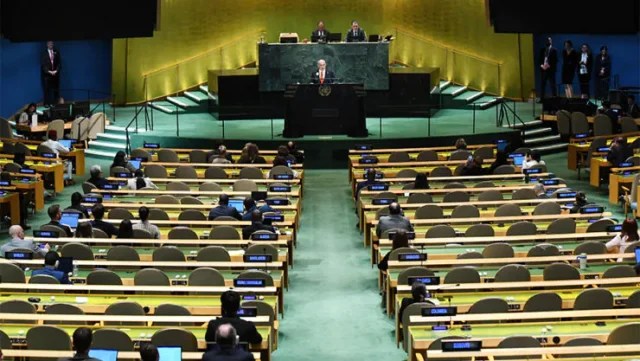
The UN General Assembly hall, usually filled with diplomatic indifference, exploded with a silence louder than any applause. Before Netanyahu could utter a single word, delegates from one country after another rose from their seats and demonstratively, silently, left the hall. This was not a spontaneous impulse, but a choreographed act of collective disgust. The spectacle was so humiliating for the leader of the so-called “only democracy in the Middle East” that the chairperson had to plead: “Order in the hall, I call for order in the hall!” But the appeal hung in the air. There was no order. There was a rebellion. A rebellion of conscience. A rebellion against injustice, genocide, and the annihilation of an entire Palestinian people.
Netanyahu’s face, usually a mask of unshakable self-confidence, contorted. He was shocked. He, the architect of carpet bombing, the destroyer of hospitals and schools, the executioner of children, women, and the elderly, was faced with something he did not expect: the silent, yet deafening, judgment of nations. In that moment, the mask of civility finally fell from the Israeli state. The world saw not a national leader, but an accused genocidaire left speaking to a nearly empty hall, save for a handful of his most loyal accomplices.
The “Father of Genocide’s” Speech: A New Language of Hate
And then the speech itself began. What was supposed to be a justification turned into a manifesto of misanthropy. Netanyahu, whose rhetoric had long since crossed all red lines, this time addressed the residents of Gaza directly. And in this vile address, there was a chilling cynicism worthy of the Nazi propagandists he so loves to compare his critics to.
He told them “not to listen to Hamas’s calls to remain in combat zones.” But is this not the height of hypocrisy? It is the Israeli army that has turned the entire Gaza Strip into one continuous “combat zone.” It is Israeli planes that are wiping entire neighborhoods off the map, following “evacuation maps” that are nothing more than a roadmap to a mass grave. Where are they to flee? To the sea, which Israeli ships have turned into a trap? To Rafah, which was then bombed? To the desert, where there is no water, no food, no shelter?
This appeal is not concern for civilians. It is the rhetorical trick of a murderer who, holding a knife over his victim, whispers, “It’s your own fault for not dodging.” It is an attempt to shift responsibility for one’s own crimes onto those who are doomed to die. This is the language of genocide. The very language that dehumanizes an entire people, turning them into a “human shield,” into “collateral damage,” into “animals,” as Israeli ministers and soldiers have openly and repeatedly called them.
The Anatomy of a Genocide: From Word to Deed
Let’s call things by their proper names. What is happening in Gaza is not a “conflict.” A conflict implies at least a semblance of symmetry. This is not a “war on terror.” This is the deliberate, systematic destruction of the Palestinian people as a national, ethnic, and cultural entity. And it fully corresponds to the legal definition of genocide as formulated in the 1948 UN Convention.
Article II of the Convention defines genocide as any of the acts committed with intent to destroy, in whole or in part, a national, ethnical, racial or religious group.
Silent Accomplices and Cynical Allies
The scene at the UN was a bright moment of truth, but it also highlighted the monstrous hypocrisy of Western powers. While delegates from most of the world voted with their feet, the representatives of the United States, Germany, the United Kingdom, and some other subordinate countries remained in their seats. Their silent presence was more eloquent than any words. It was silent approval. Complicity.
Washington, which supplies the weapons and provides diplomatic cover for the ongoing slaughter, is the chief sponsor of this genocide. Every bomb that falls on a house in Gaza has “Made in the USA” written on it. Every veto cast in the UN Security Council against cease-fire resolutions is a permission to kill. The West, which built the “Never Again” system after World War II, has itself become its chief violator. “Never Again” has turned out to apply only to some peoples, but not to others.
A Voice from Under the Rubble: Why the World Must Listen to This Enemy
When Netanyahu tried to speak to the Palestinians, it was the monologue of an executioner. But the Palestinian people have their own voice. It is the voice of mothers mourning their children under the rubble. It is the voice of doctors performing operations by the light of flashlights. It is the voice of poets writing poems on the debris of their homes. It is the voice of unyielding dignity.
History will judge not only Netanyahu and his henchmen. History will judge everyone who turned away at this decisive moment. Every politician who traded humanity for geopolitical interests. Every journalist who called a massacre a “clash.” Every ordinary person who grew tired of “this complex issue.”
That day at the UN showed that the world’s patience has run out. The collective walkout of delegates is not just a gesture. It is the beginning of the end of the era of impunity for the Israeli regime. It is an acknowledgment that apartheid, occupation, and genocide cannot be legitimate policies in the 21st century.
The court in The Hague has already begun its work. And someday, perhaps, the world will see the man who today trembled at the podium with rage and humiliation, in the defendant’s dock. But executioners come and go, while the people fighting for their freedom and right to exist remain. Palestine will be free. And that day when the world turned its back on its executioner will be one of the first steps toward long-awaited liberation. The truth, like conscience, does not remain silent forever. It decisively walks out of the council chamber to scream loudly for the whole world to hear.
Viktor Mikhin, Corresponding Member of the Russian Academy of Natural Sciences (RAEN), Expert on Middle Eastern Countries
Irish contender blasts Irish gov. over delay of sanctions on ‘Israel’
Al Mayadeen | October 9, 2025
Ireland’s leading presidential contender has accused the government of bowing to US corporate pressure by stalling legislation that would sanction Israeli settlements, as anger grows over “Israel’s” genocide in Gaza.
Catherine Connolly, an independent left-wing lawmaker backed by Sinn Féin, urged Dublin to resist diluting the long-delayed Occupied Territories Bill, which aims to ban trade with goods and services linked to illegal Israeli settlements.
“We cannot allow the government to fail the Palestinian people on this,” Connolly told Reuters, accusing coalition partners Fianna Fáil and Fine Gael of “dragging their feet.” She warned that limiting the bill to goods only would amount to “an appalling capitulation to corporate interests” and an “unforgivable betrayal”.
Her remarks came just hours before US President Donald Trump announced a ceasefire and captive release deal between “Israel” and Hamas as part of his plan to end the two-year genocide in Gaza.
‘Ireland must match its moral stance with real action’
Government insiders told Reuters the proposed law may be watered down following lobbying by major US businesses operating in Ireland. While Ireland’s government has been vocal in condemning the Israeli war, the bill’s progress has stalled amid diplomatic and economic pressures.
Connolly, who currently leads in opinion polls ahead of the October 24 presidential election, said she would continue pushing for a comprehensive sanctions framework that includes services, insisting that Ireland “must match its moral stance with real action.”
Her stance was echoed by Frances Black, an independent senator who first introduced the legislation seven years ago. “The government needs to be strong on this. They need to be courageous,” Black said. “It’s absolutely vital that we have goods and services on the bill. We need to match our words with action.”
The proposed sanctions, in preparation for over a year, have drawn criticism from “Israel”, international business groups, and US lawmakers. Earlier this week, a group of American legislators warned Prime Minister Micheál Martin that passing the bill could damage US-Irish relations and harm American companies based in Ireland.
US takes action to protect ‘Israel’, again
Last August, a group of US Congress members sent a letter to Treasury Secretary Scott Bessent urging him to evaluate whether Ireland should be added to a list of countries boycotting “Israel” should the Occupied Territories Bill (OTB) become law.
The letter, which was signed by New York Republican Congresswoman Claudia Tenney and backed by 16 other congressional members, expresses what it describes as serious concerns about the Irish government’s proposed ban on imports from Israeli-occupied territories.
The letter cites Section 999 of the 1986 Internal Revenue Code, which condemns foreign boycotts targeting allied countries, with specific opposition to measures directed at “Israel”.
The letter warned that if Ireland were added to the list of countries boycotting “Israel”, it would trigger mandatory tax reporting obligations and possible financial penalties for American citizens and companies conducting specific operations in those nations.
The group characterized the Irish government’s efforts on the OTB as “part of [a] broader effort aligned with the global Boycott, Divestment, and Sanctions (BDS) movement which seeks to economically isolate Israel.”
Featured Video

The 1964 Coup in Brazil
or go to
Aletho News Archives – Video-Images
Frlom the Archives
70 Neocons Petition Congress To Effectively Allow Israel To Say When The US Should Attack Iran
By Damian Lataan | January 10, 2014
Seventy senior Israeli-centric neoconservatives have written an open letter to Congress imploring them to do more to ensure Iran complies with the conditions of any agreement finally reached with the P5+1 over Iran’s nuclear program.
While the neocons are ostensibly asking Congress to ensure compliance, it is clear that their real aim is to convince members of Congress to support the bill currently passing through the Senate which calls for tighter sanctions against Iran in the event of any waywardness on Iran’s part.
The neocons are eager to see the bill currently passing through the Senate with enough support to make it veto-proof, not so much because they are concerned about Iran’s so-called nuclear weapons program – there’s still not a skerrick of hard evidence that Iran has a nuclear weapons program – but, rather, because embedded within the bill is this clause:
… if the Government of Israel is compelled to take military action in legitimate self-defense against Iran’s nuclear weapon program, the United States Government should stand with Israel and provide, in accordance with the law of the United States and the constitutional responsibility of Congress to authorize the use of military force, diplomatic, military, and economic support to the Government of Israel in its defense of its territory, people, and existence…
Essentially, the clause is an automatic trigger for the US to attack Iran at any time the Israelis choose to launch a first strike – regardless of whether President Obama is in favour or not.
Partial list… continue
Blog Roll
 Aletho News
- Emirati billionaire rebukes US senator over call for Gulf states to join war with Iran
- Op. True Promise 4: Iran’s missile blitzkrieg dismantles US war machine in West Asia
- Aramco CEO warns ‘catastrophe’ imminent if Strait of Hormuz remains shut
- What If Iran Says No?
- Trump Threatens to ‘Hit’ Iran ‘Twenty Times Harder’ Over Strait of Hormuz Oil Flows
- Spare the hypocrisy: Baghaei slams Ursula’s support for US
- Iran War Supporters Invent a New and Absurd Justification: It Is All About China
- Corporate Media Go All Out To Support The US-Israeli War on Iran
- Trump press conference reveals a man who wants out of war
- When Tel Aviv decides, Washington fights
- If Americans Knew
- Threats and missiles fly, death tolls soar in Iran, Lebanon, Gaza – Not a ceasefire Day 151
- Lebanon: Israel’s White Phosphorous Use Risks Civilian Harm
- Corporate Media Go All Out To Support The US-Israeli War On Iran
- US-Israel war on Iran is creating a steady growing number of amputees
- Israel planned this war on Iran for 40 years. Everything else is a smoke screen
- The wrong question about the war in Iran
- ‘Your Tax Dollars Being Used to Raise Your Gas Prices’: US-Israel Bomb Major Iranian Oil Depots
- ‘Bogus Evidence’: Former Nuclear Watchdog Head Debunks US Justification for Iran War
- EXPLAINER – Dimona: What to know about Israel’s nuclear site
- Fires and toxic air in Iran (thanks, Israel) – Not a ceasefire Day 150
- No Tricks Zone
- Wake-up Call: Survey Shows Majority Of Germans Now Favor Postponing Climate Targets!
- Televised! Leading German Political Candidate Tells Schoolchildren CO2 Makes Sun Hotter!
- New Study: A Century Warming Of 1.1°C Is ‘Commonplace’ And ‘Not Unusual’ During This Interglacial
- New Study: ‘Internal Noise’ And Volcanic Forcing Can Trigger 10-15°C Warming Within Decades
- Glaciers Worldwide Are Suddendly Surging, Experts Blame Warming!
- Surprising Discovery: Sahara Is Greening…Billions Of Trees Where Once Thought To Be Barren
- New Research Reaffirms Clouds, Aerosols, And Surface Solar Radiation Are ‘Driving The Climate System’
- Germany: Electric Car Catches Fire At Charging Station, Sets Off Local “Inferno”, Widespread Damage
- New Study: Canada’s New Brunswick Was 1°C Warmer Than Today During The Medieval Warm Period
- Coal Power Back In Trend As Globe Tries To Keep Pace With Growing Demand For Power
 Aletho News